DSPACE FOR CULTURAL HERITAGE:
ADDING SUPPORT FOR IMAGE VISUALIZATION, AUDIO/VIDEO STREAMING
AND ENHANCING THE DATA MODEL
GLAM
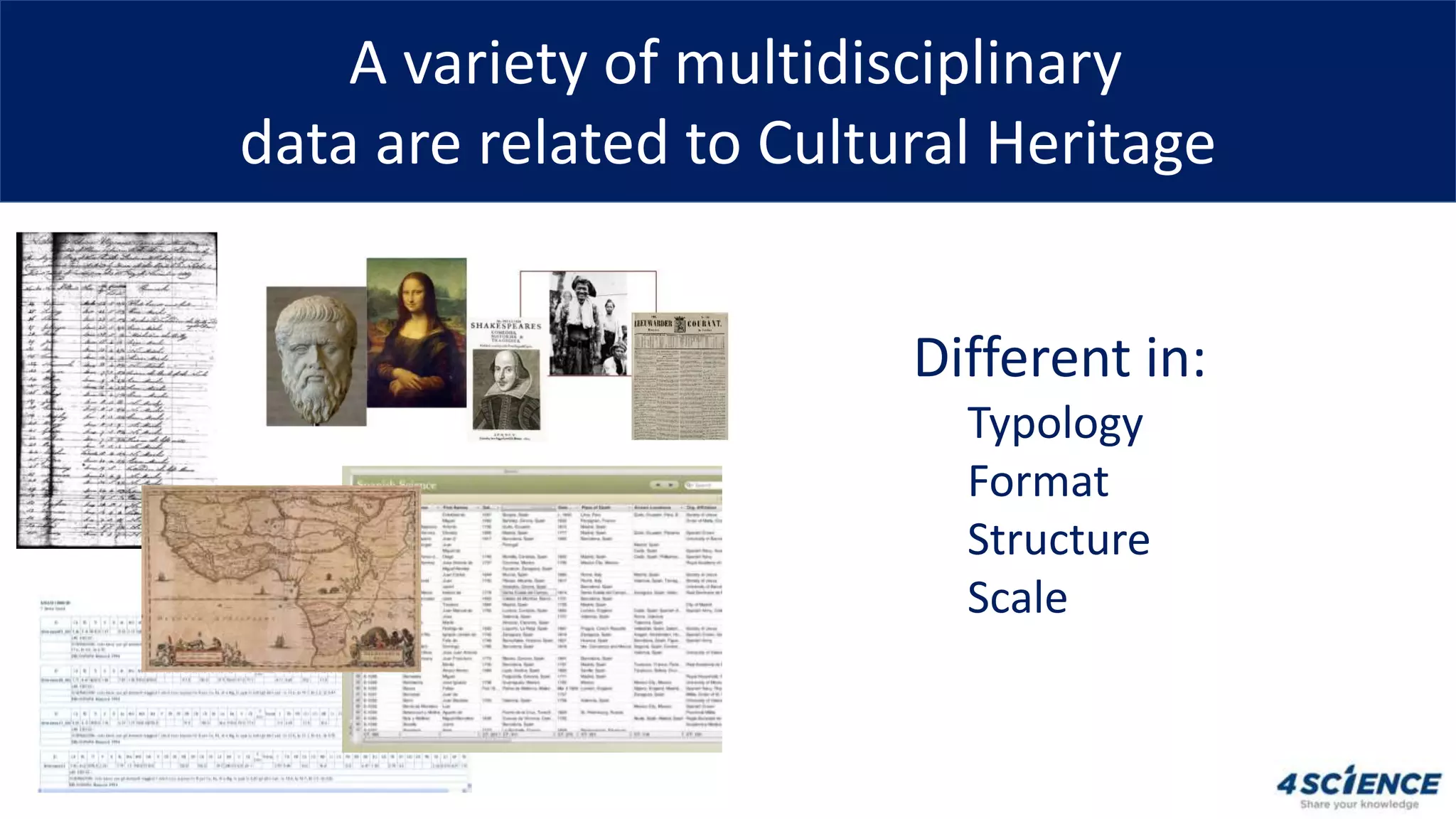
A variety of multidisciplinary
data are related to Cultural Heritage
Different in:
Typology
Format
Structure
Scale
More and more complexity…
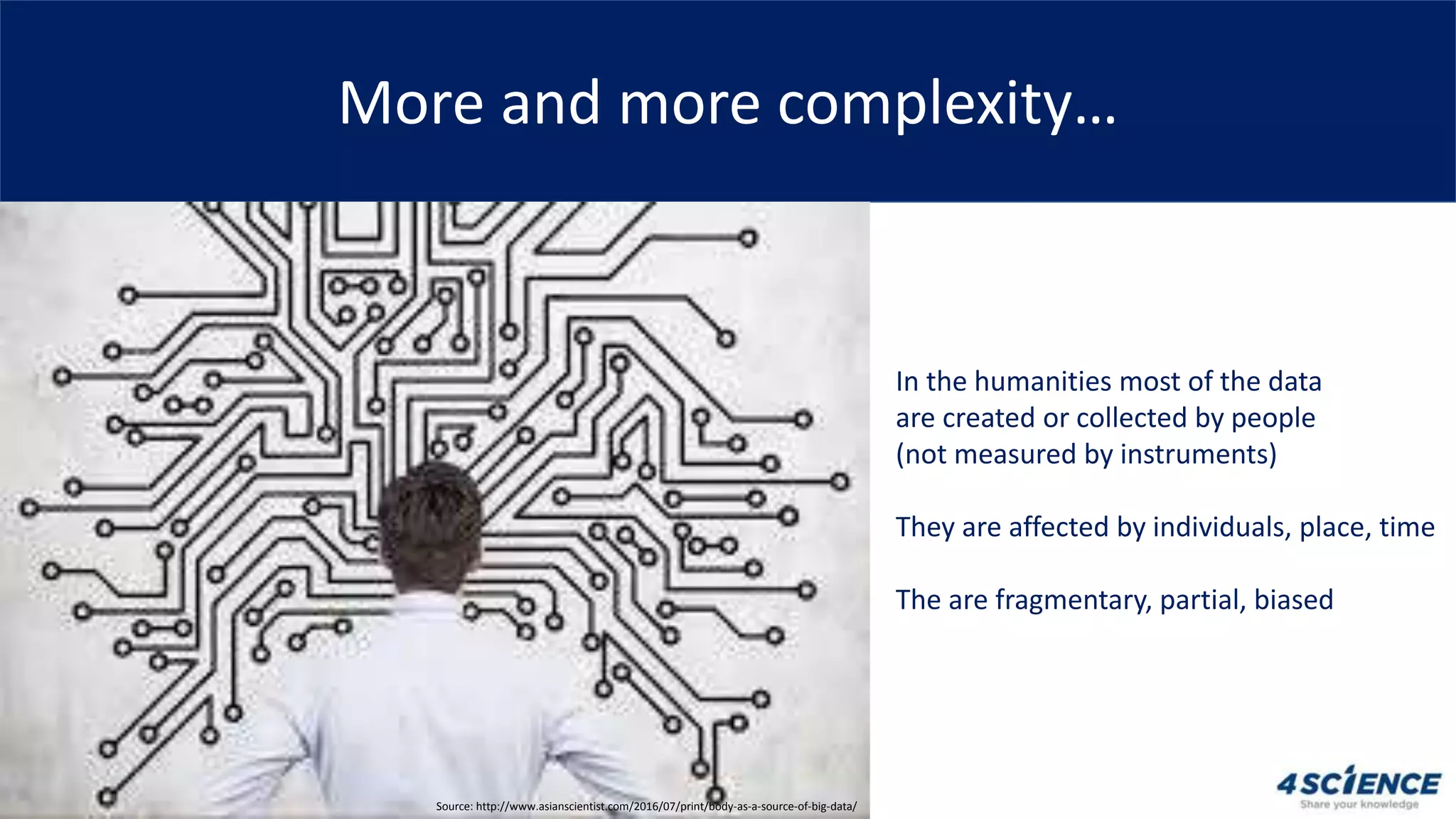
In the humanities most of the data
are created or collected by people
(not measured by instruments)
They are affected by individuals, place, time
The are fragmentary, partial, biased
Source: http://www.asianscientist.com/2016/07/print/body-as-a-source-of-big-data/
Putting data in context…
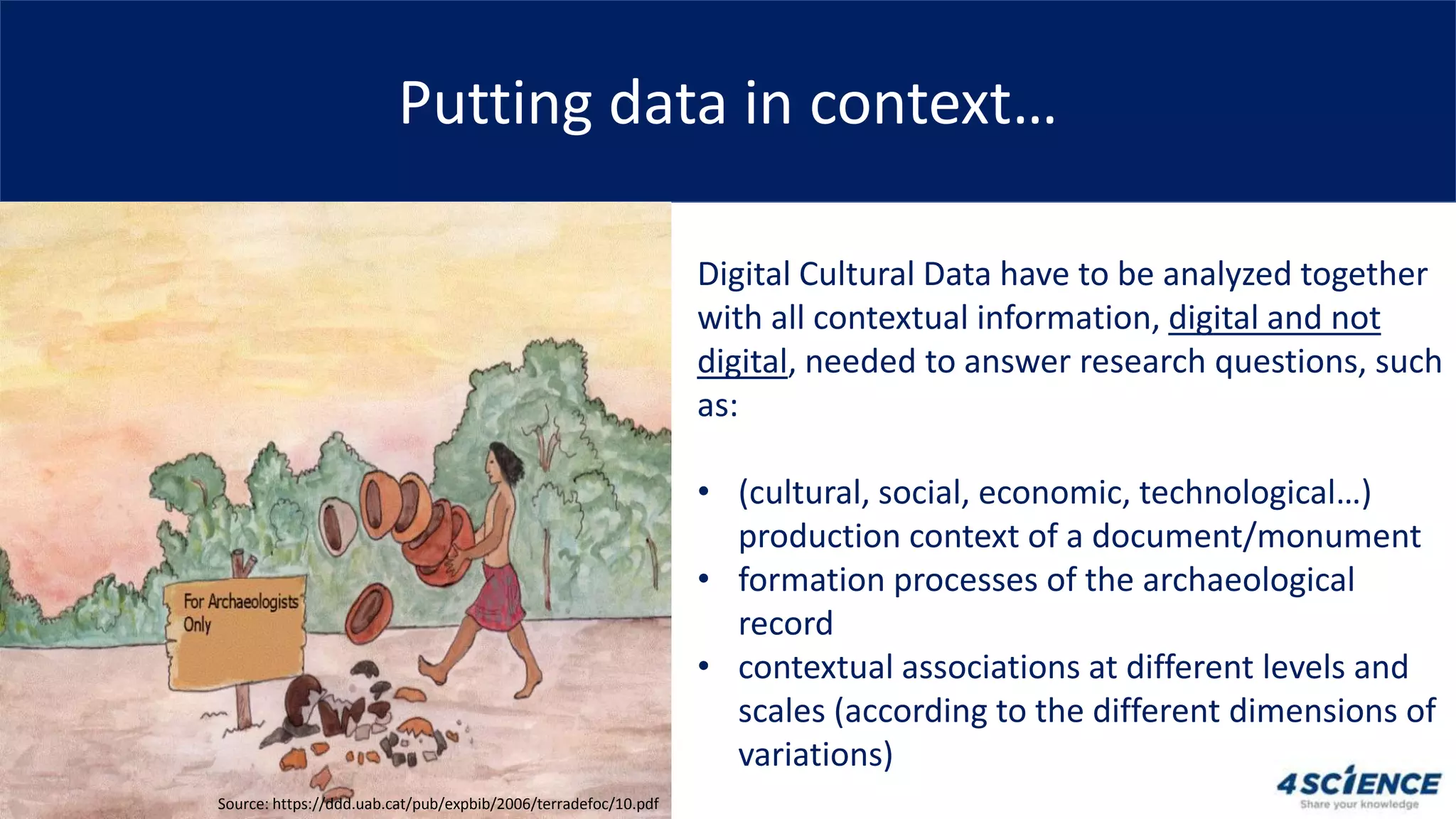
Digital Cultural Data have to be analyzed together
with all contextual information, digital and not
digital, needed to answer research questions, such
as:
• (cultural, social, economic, technological…)
production context of a document/monument
• formation processes of the archaeological
record
• contextual associations at different levels and
scales (according to the different dimensions of
variations)
Source: https://ddd.uab.cat/pub/expbib/2006/terradefoc/10.pdf
…within a Digital Library Management System
Today most of the cultural digital resources are in the Digital Libraries or Repositories
Digital Libraries and Repositories must provide tools for:
• modeling, visualising and analysing information, both in a qualitative and quantitative way, as
well as collaboratively working on it
• highlighting the relationships between data at different scales
• explaining interpretations about the important dimensions of variation and about the network
of contextual relations in which historical and archaeological sources are involved
entering the daily workflow of historians, archaeologists and humanities scholars.
,
DSpace-GLAM
(Galleries, Libraries, Archives, Museums)
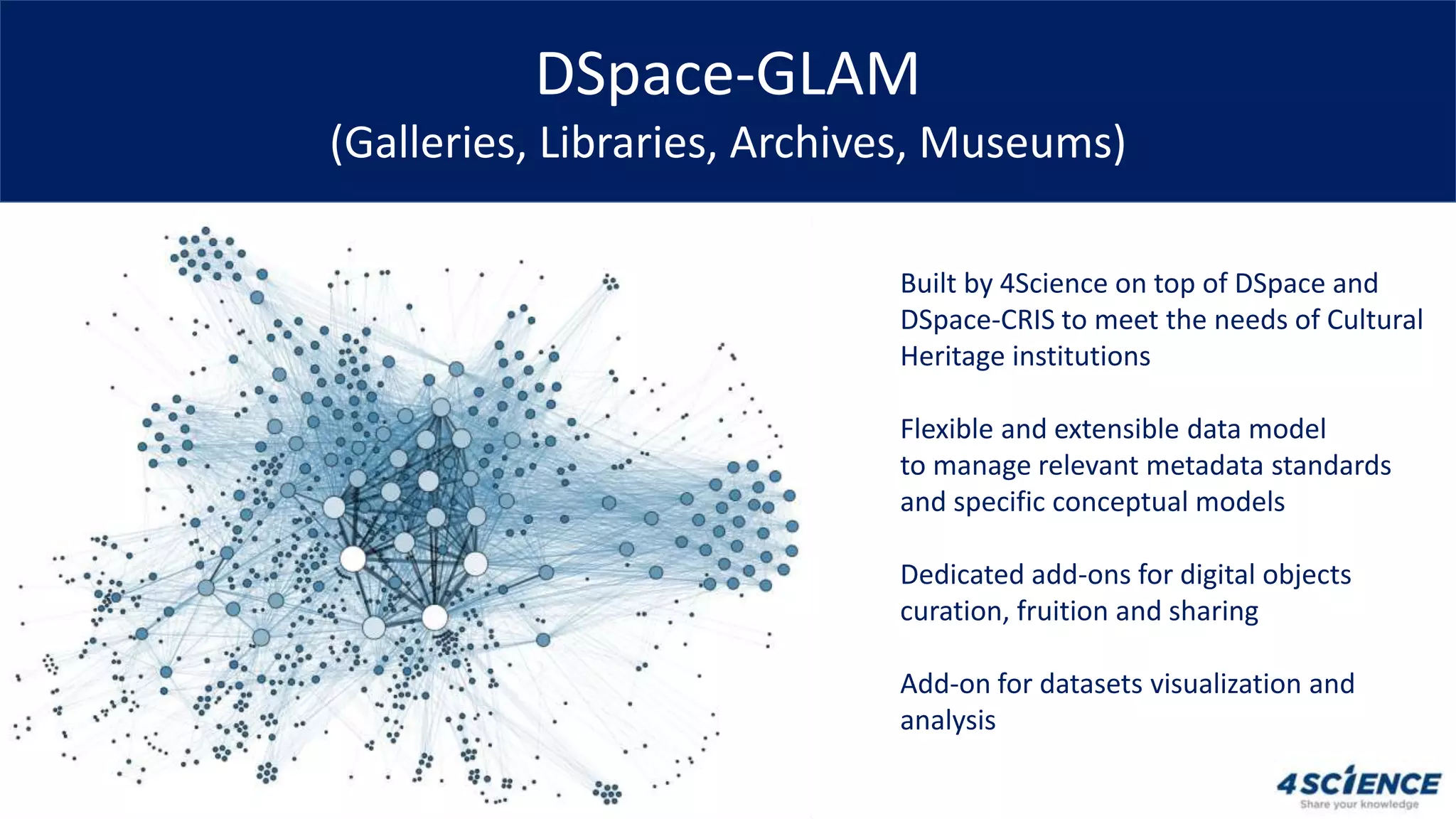
Built by 4Science on top of DSpace and
DSpace-CRIS to meet the needs of Cultural
Heritage institutions
Flexible and extensible data model
to manage relevant metadata standards
and specific conceptual models
Dedicated add-ons for digital objects
curation, fruition and sharing
Add-on for datasets visualization and
analysis
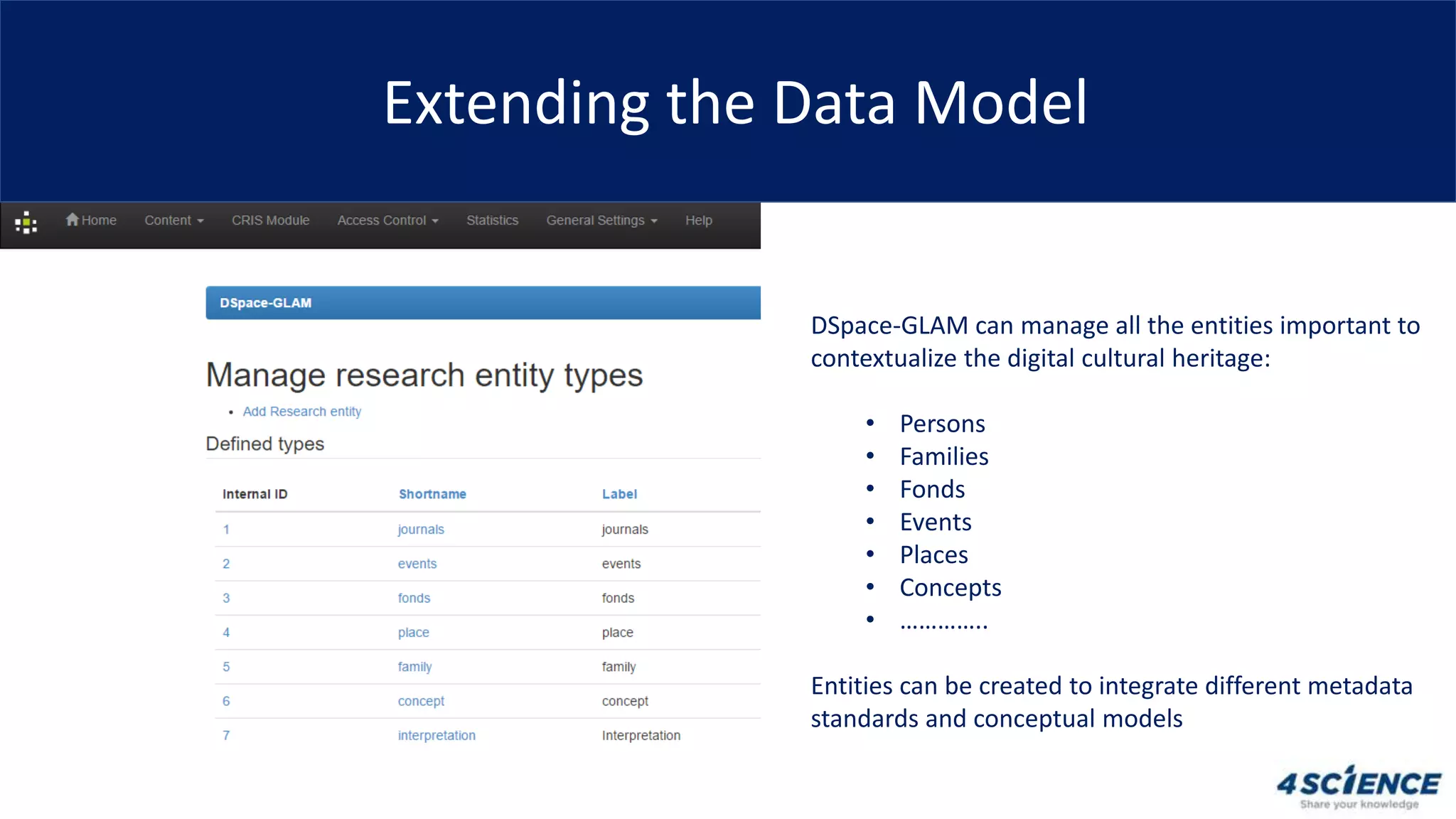
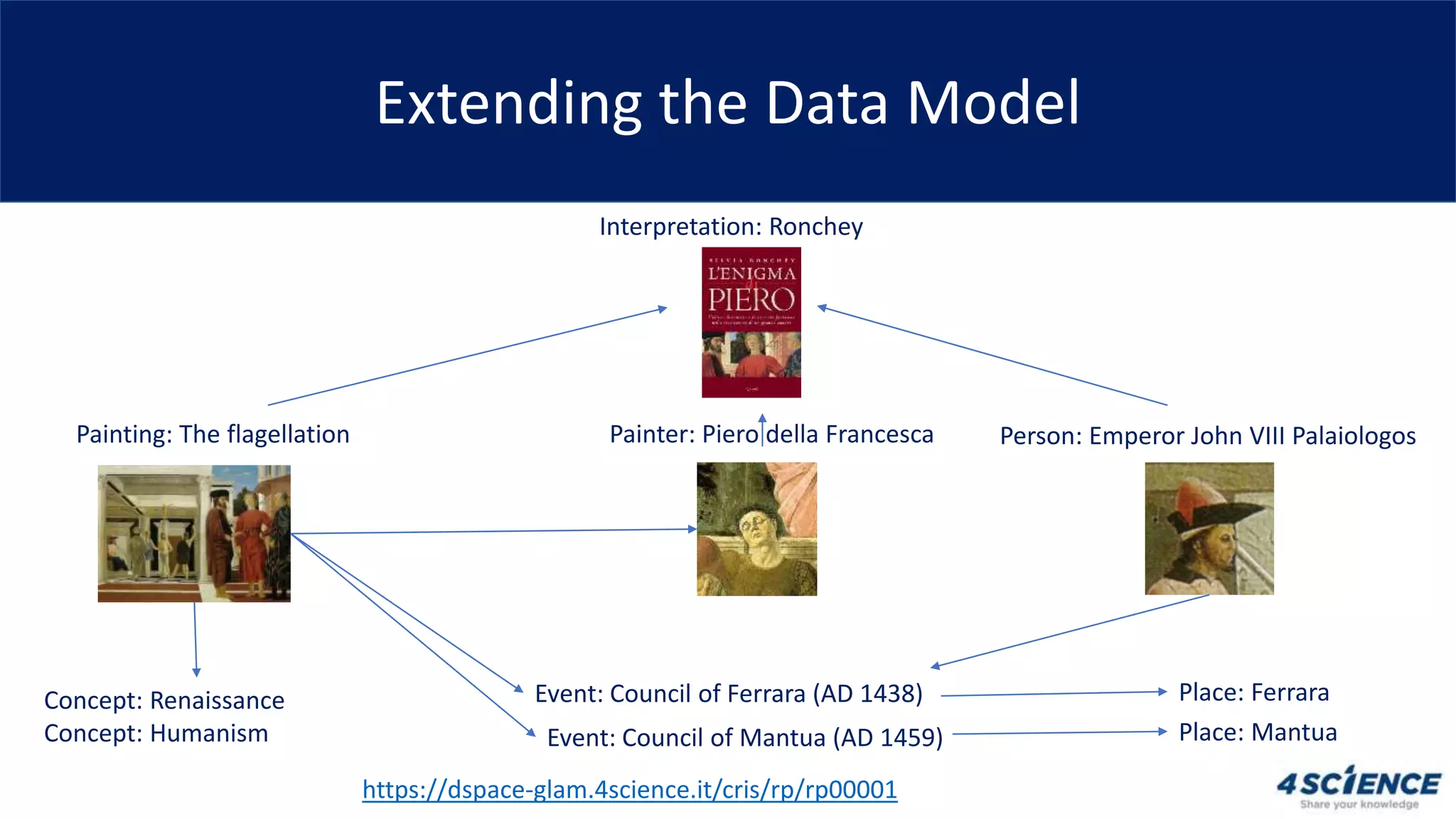
Extending the Data Model
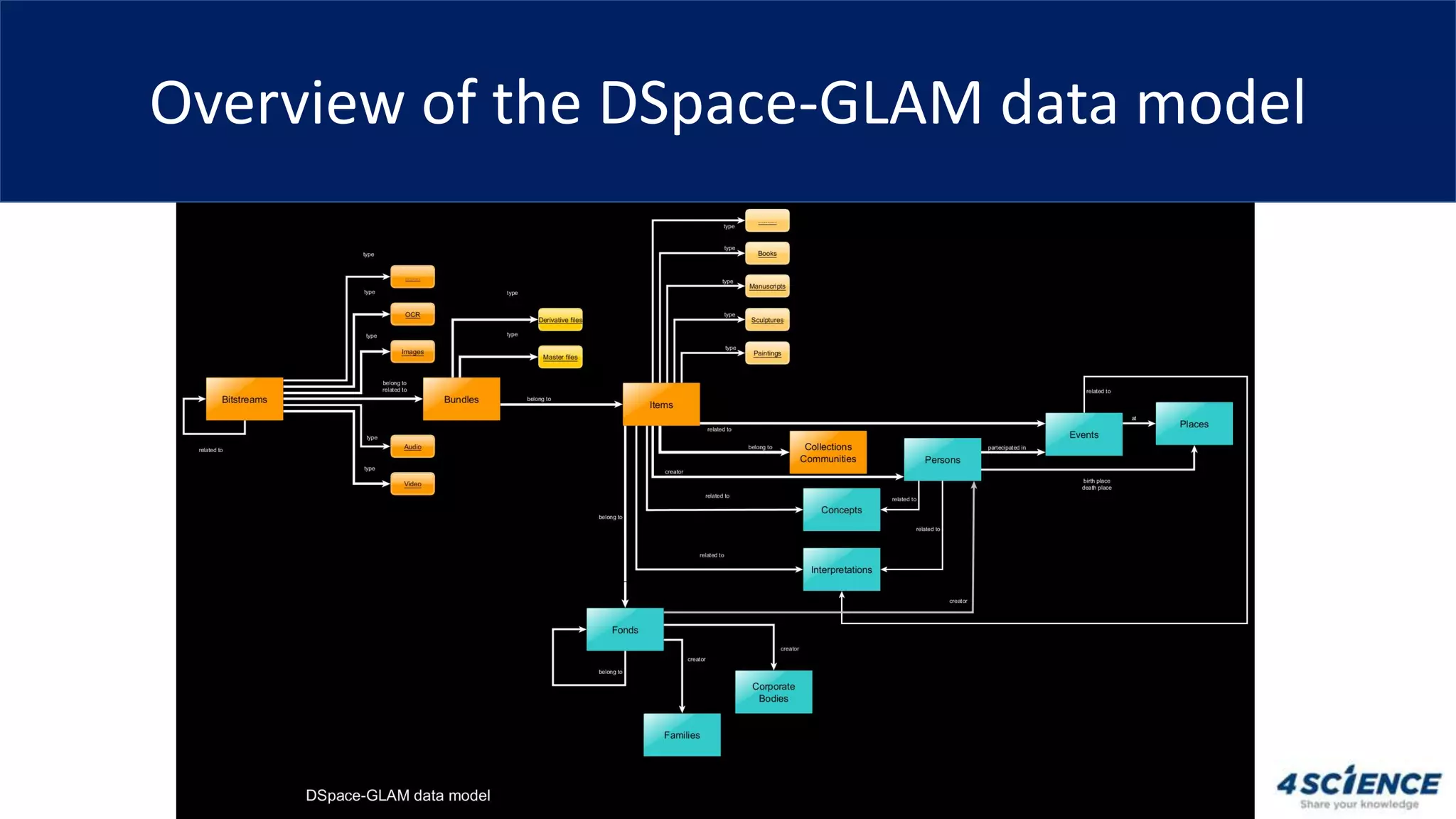
DSpace-GLAM can manage all the entities important to
contextualize the digital cultural heritage:
• Persons
• Families
• Fonds
• Events
• Places
• Concepts
• …………..
Entities can be created to integrate different metadata
standards and conceptual models
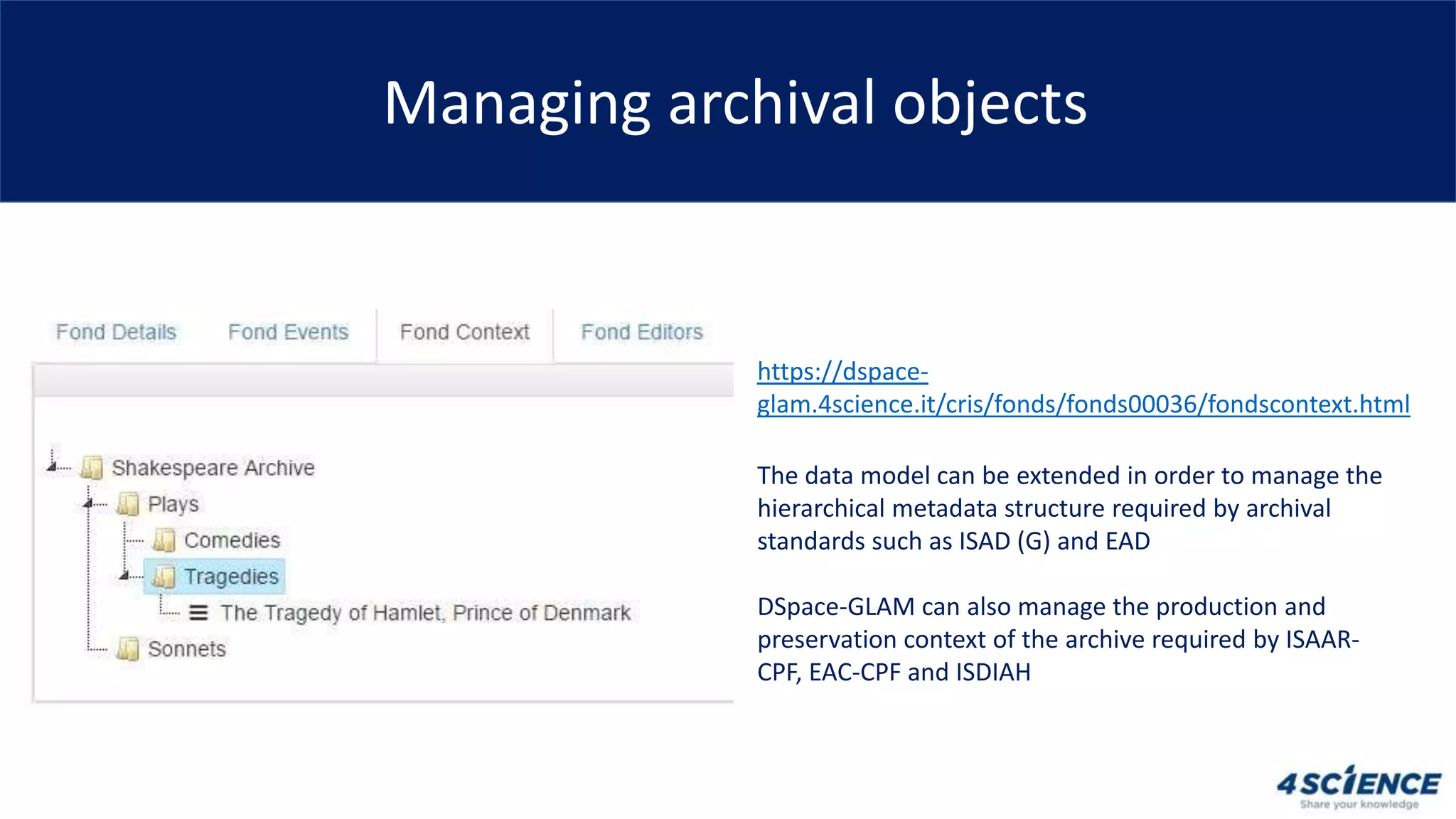
Managing archival objects
The data model can be extended in order to manage the
hierarchical metadata structure required by archival
standards such as ISAD (G) and EAD
DSpace-GLAM can also manage the production and
preservation context of the archive required by ISAAR-
CPF, EAC-CPF and ISDIAH
https://dspace-
glam.4science.it/cris/fonds/fonds00036/fondscontext.html
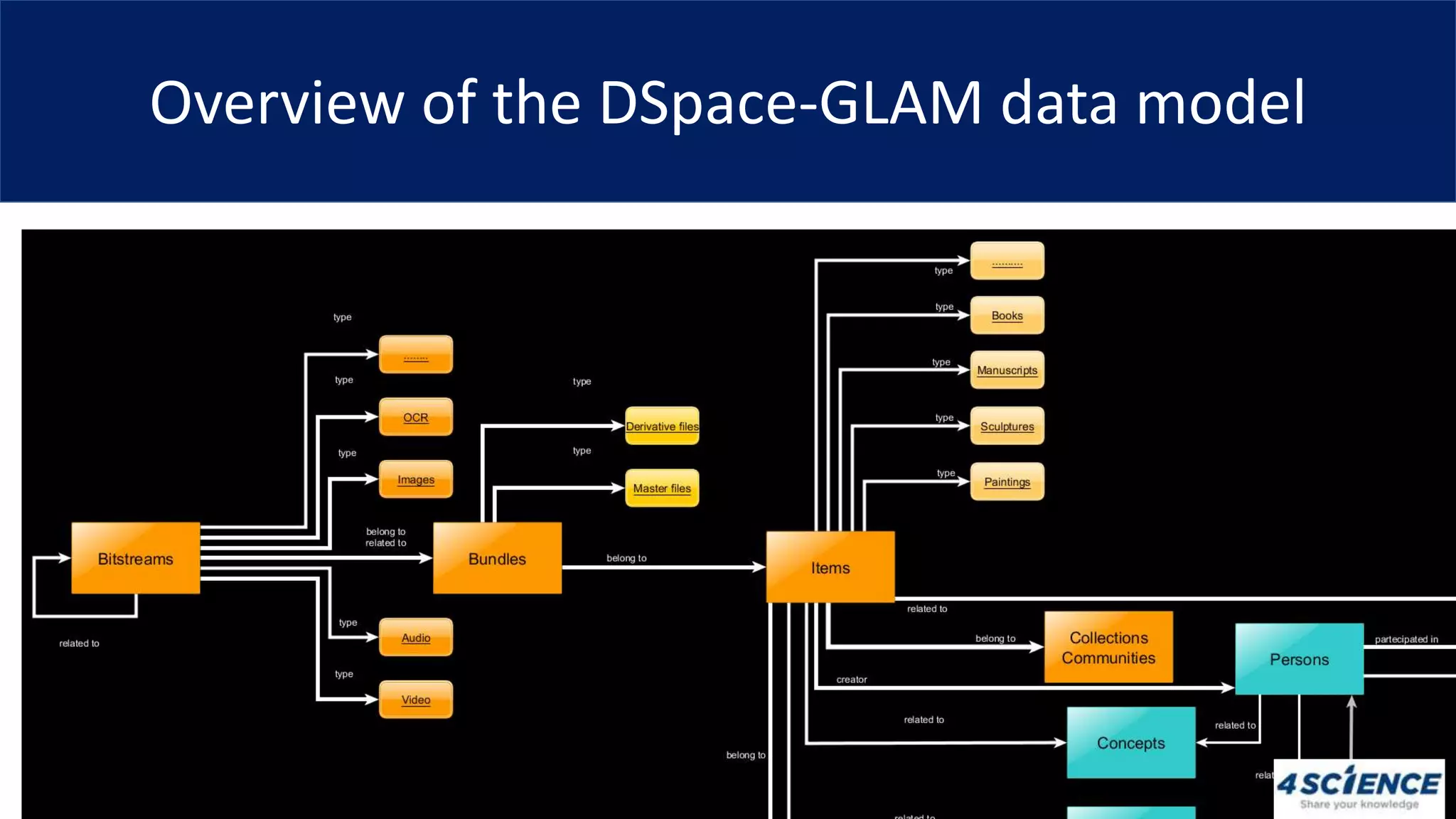
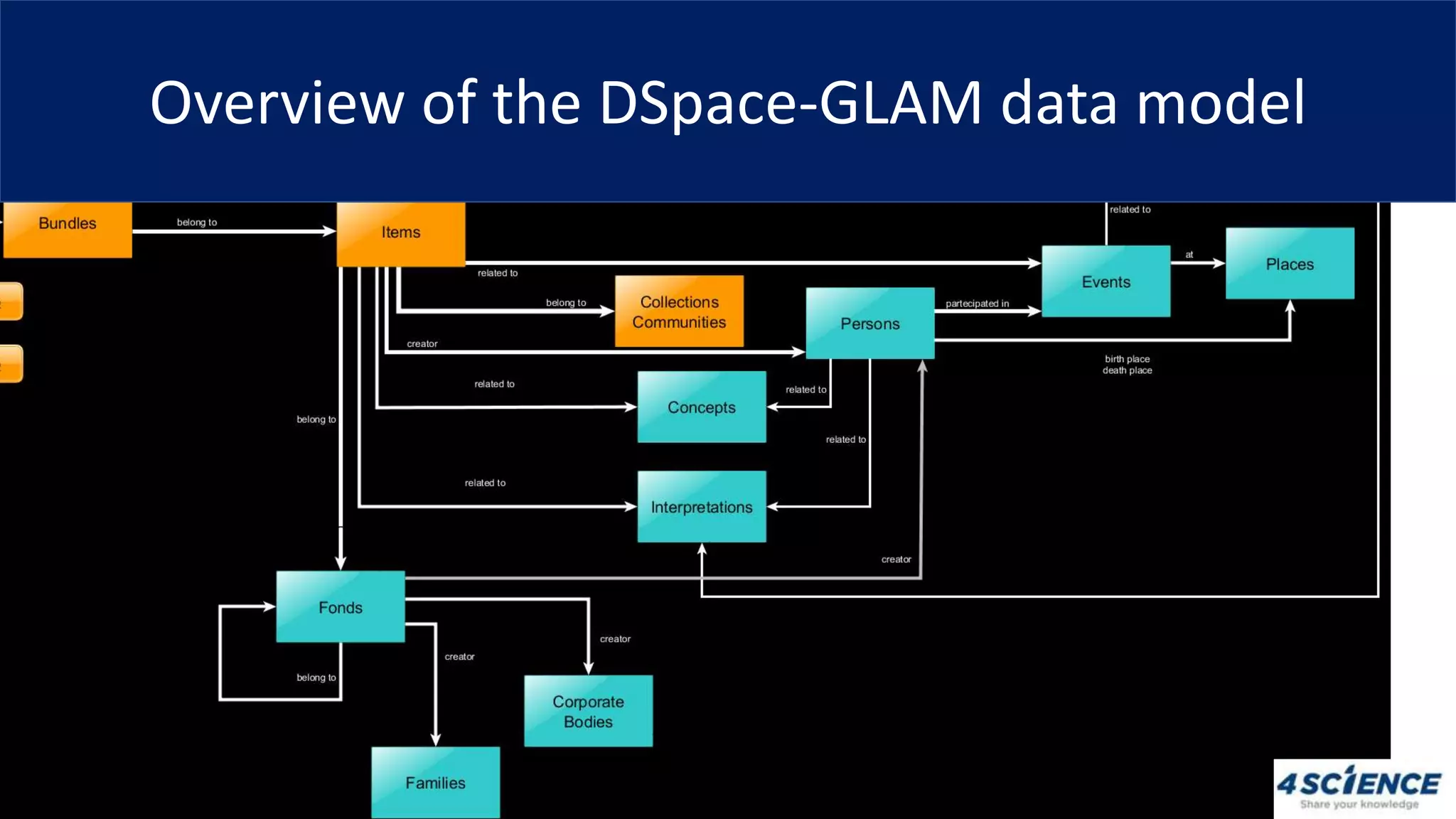
Overview of the DSpace-GLAM data model
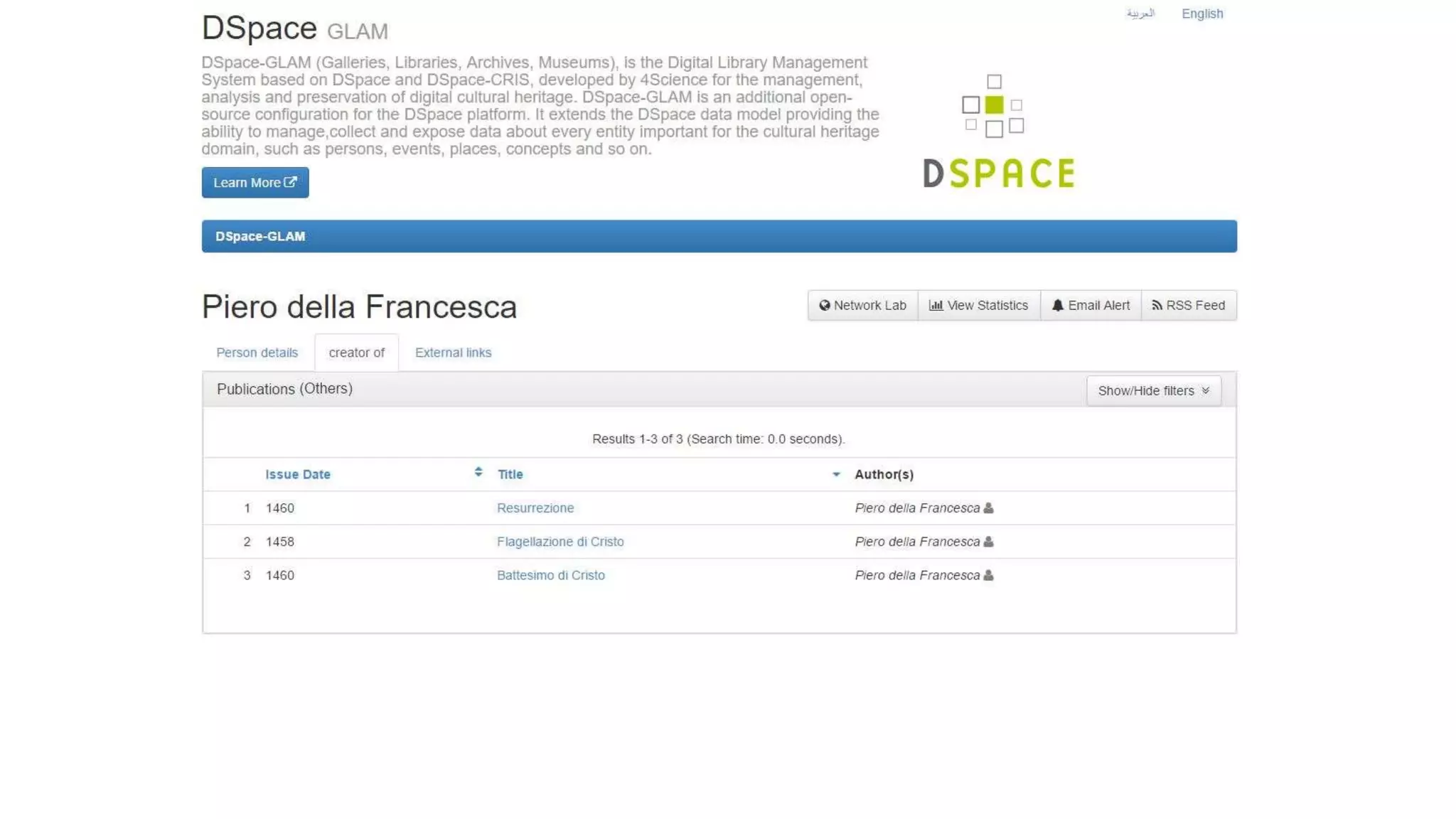
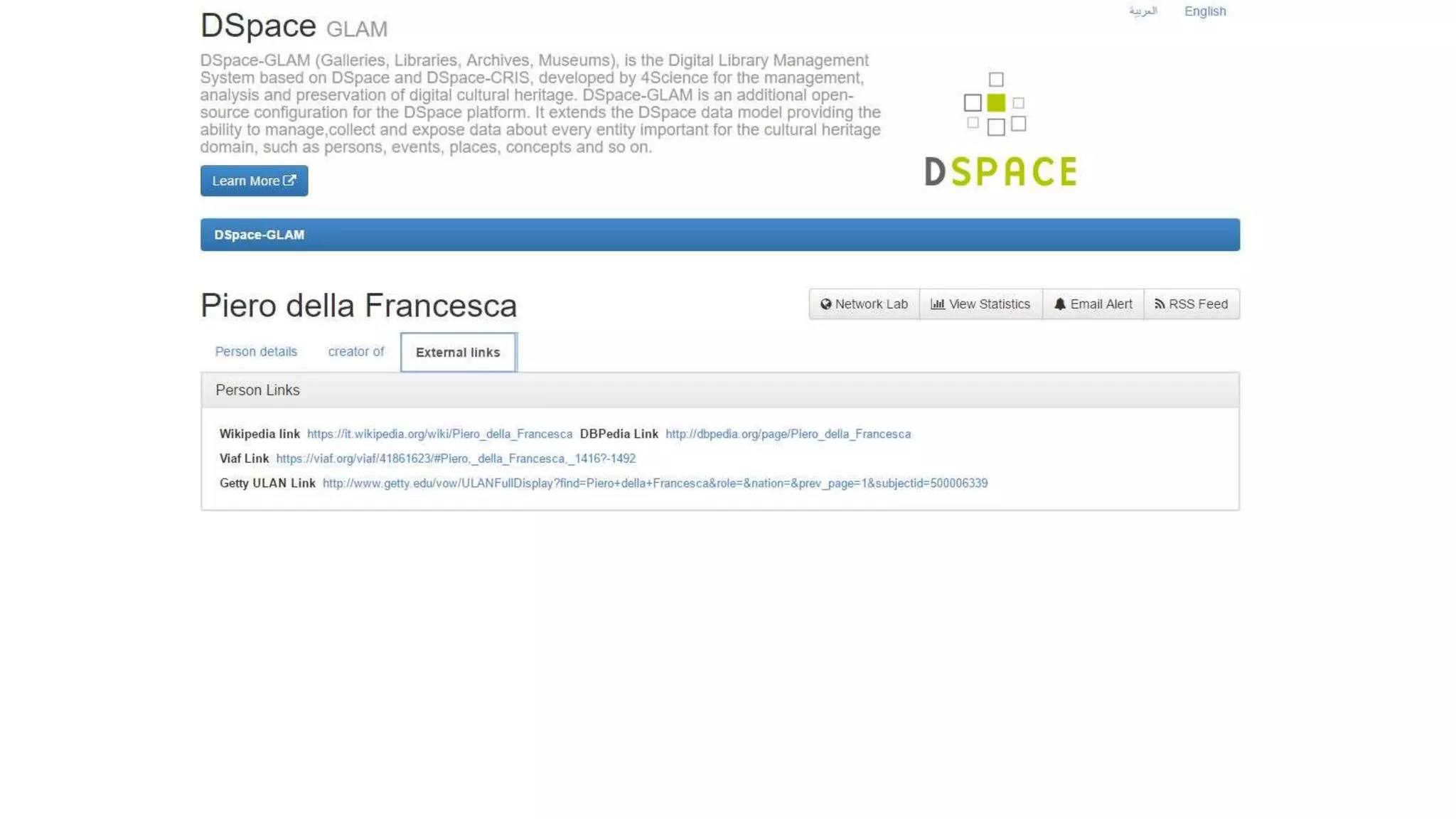
Extending the Data Model
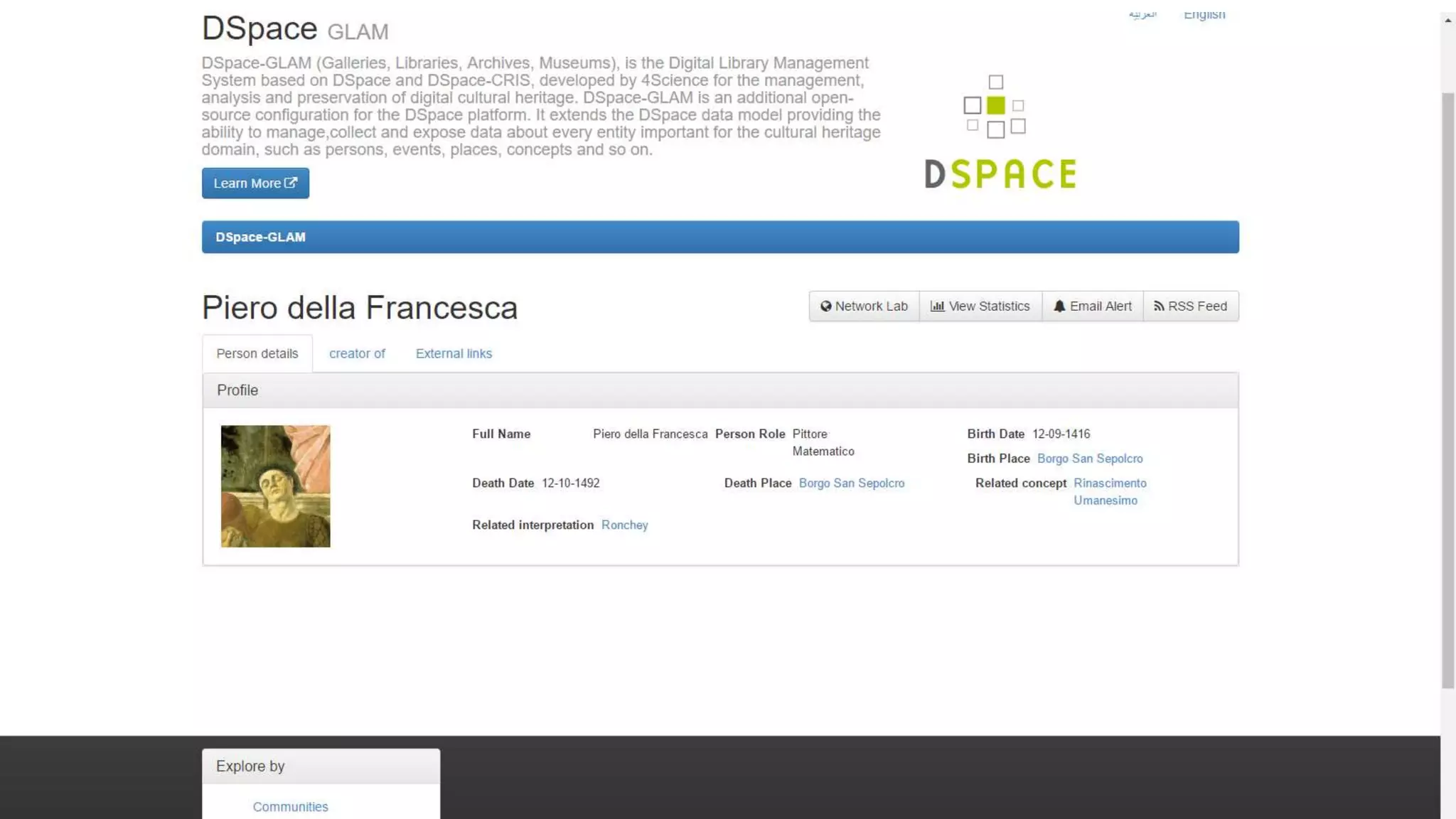
Painting: The flagellation Painter: Piero della Francesca
Event: Council of Ferrara (AD 1438)
Event: Council of Mantua (AD 1459)
Place: FerraraConcept: Renaissance
Concept: Humanism
Person: Emperor John VIII Palaiologos
Place: Mantua
https://dspace-glam.4science.it/cris/rp/rp00001
Interpretation: Ronchey
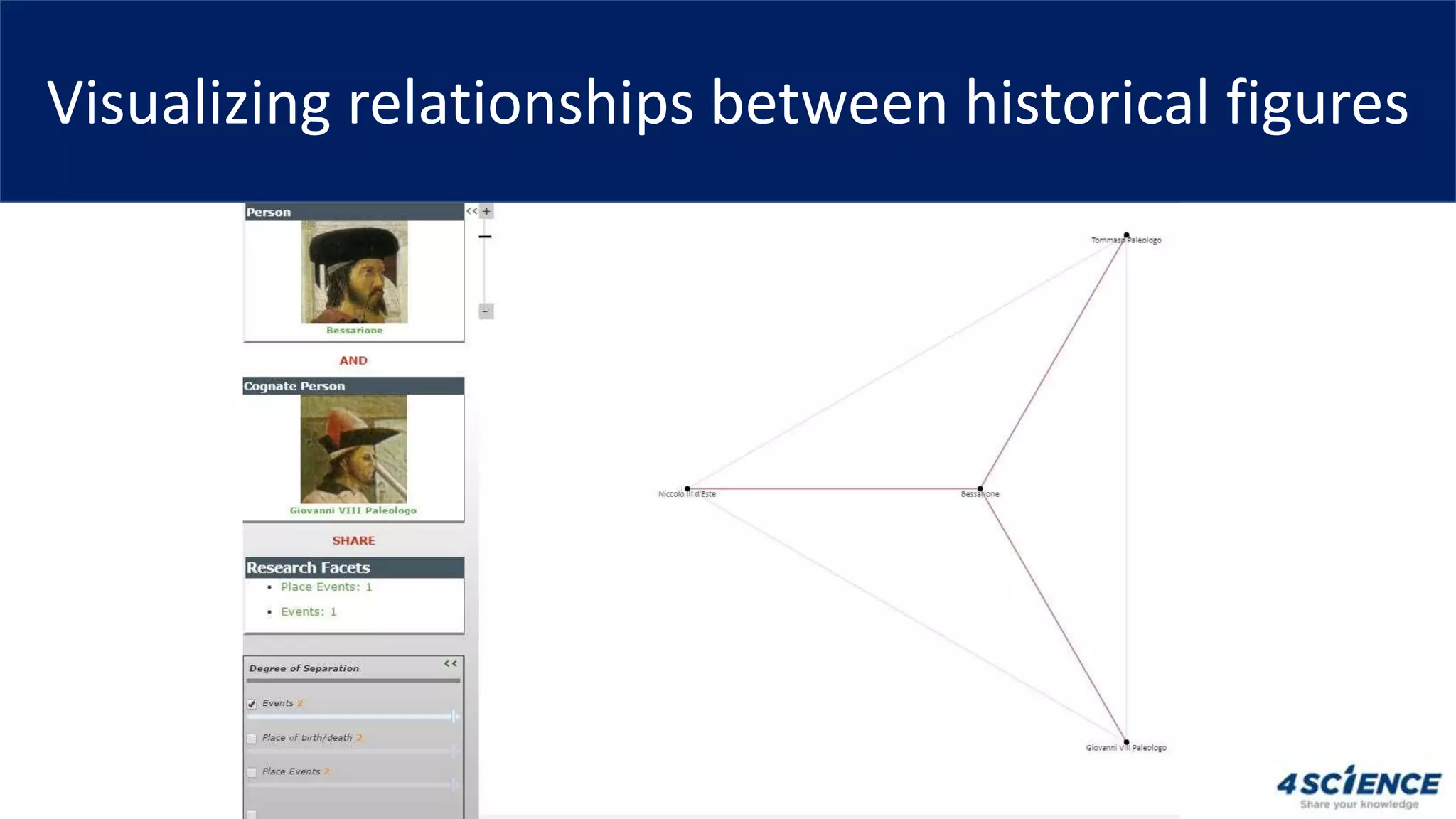
Visualizing relationships between historical figures
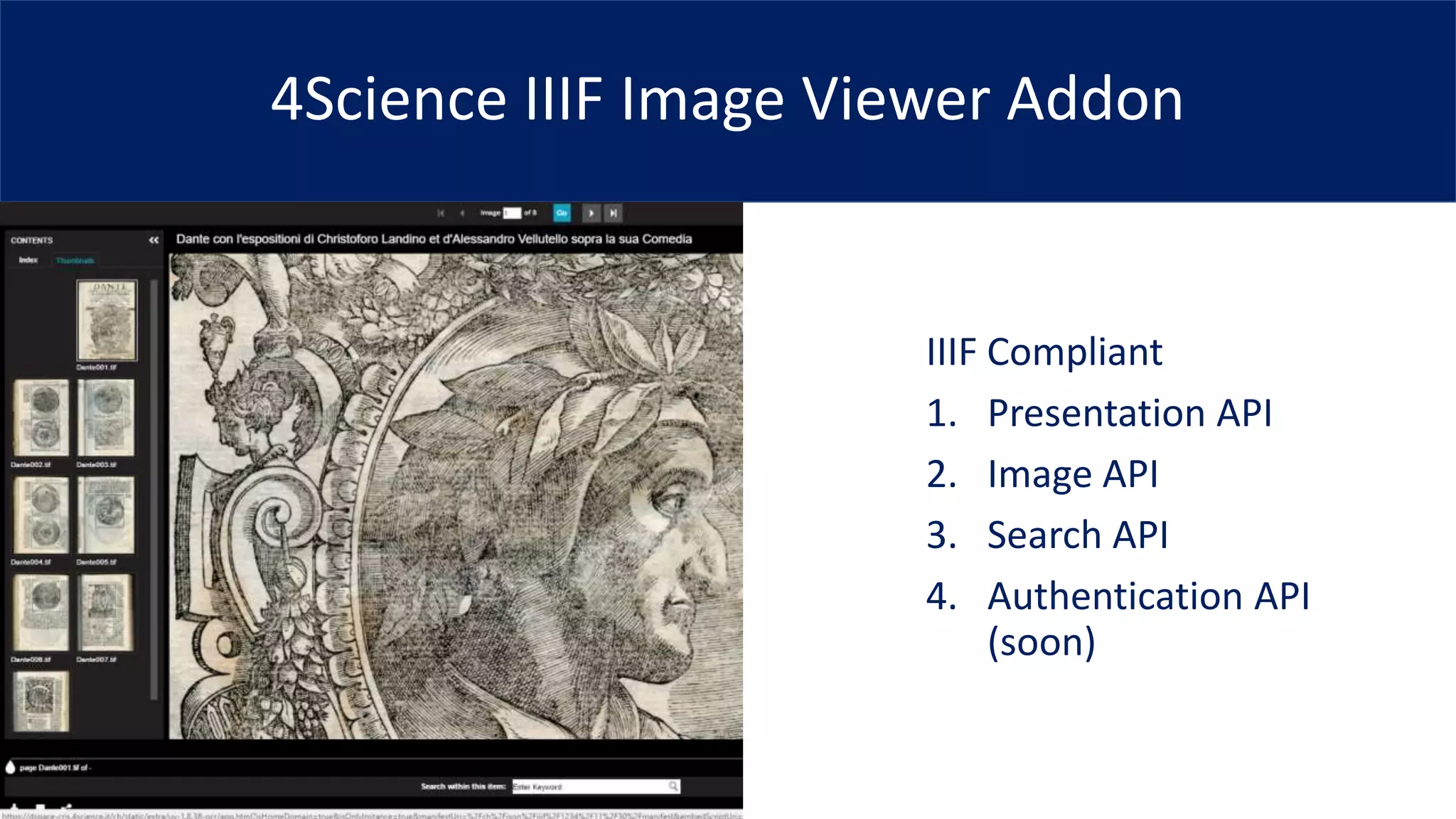
4Science IIIF Image Viewer Addon
IIIF Compliant
1. Presentation API
2. Image API
3. Search API
4. Authentication API
(soon)
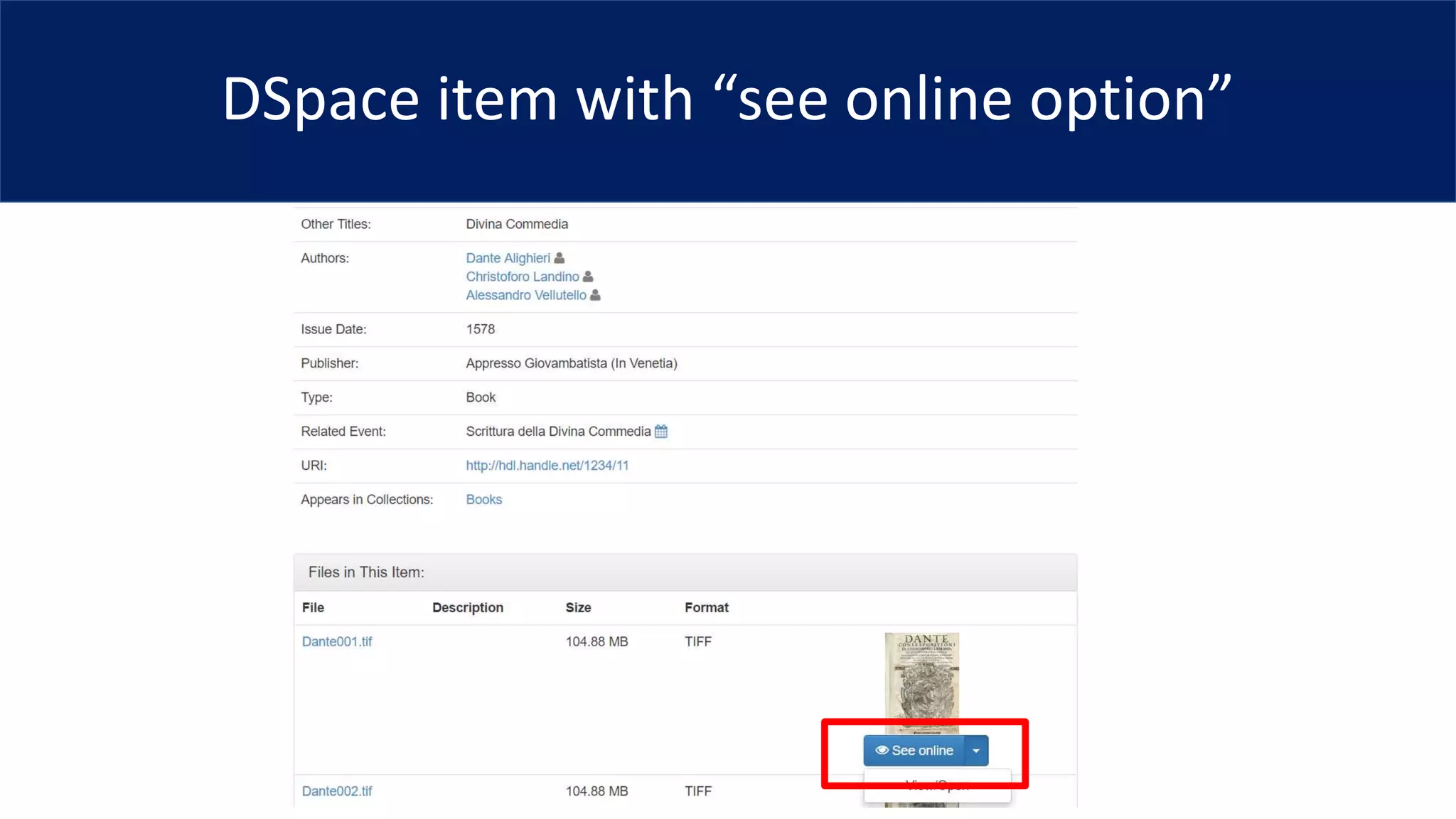
DSpace item with “see online option”
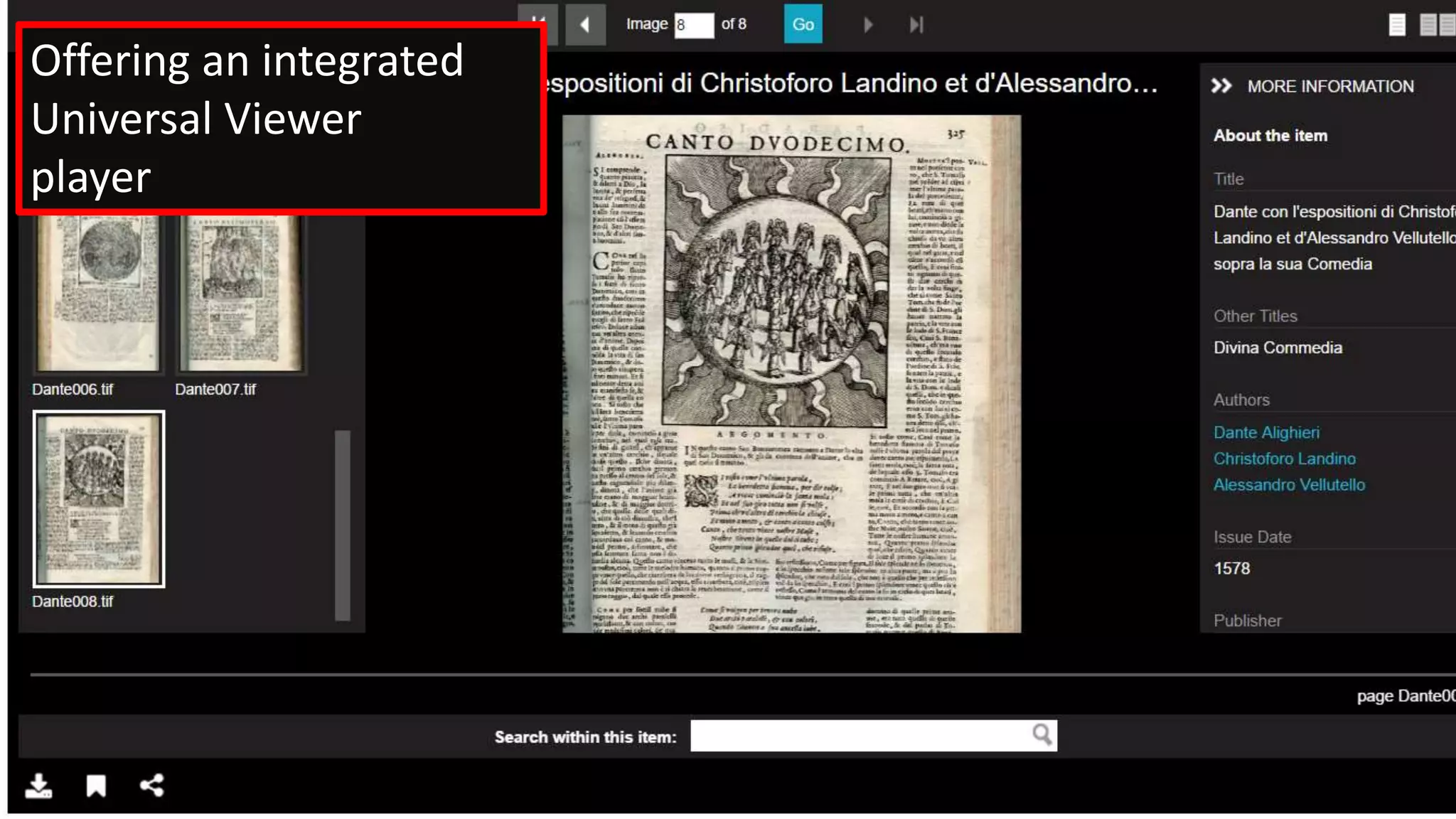
Offering an integrated
Universal Viewer
player
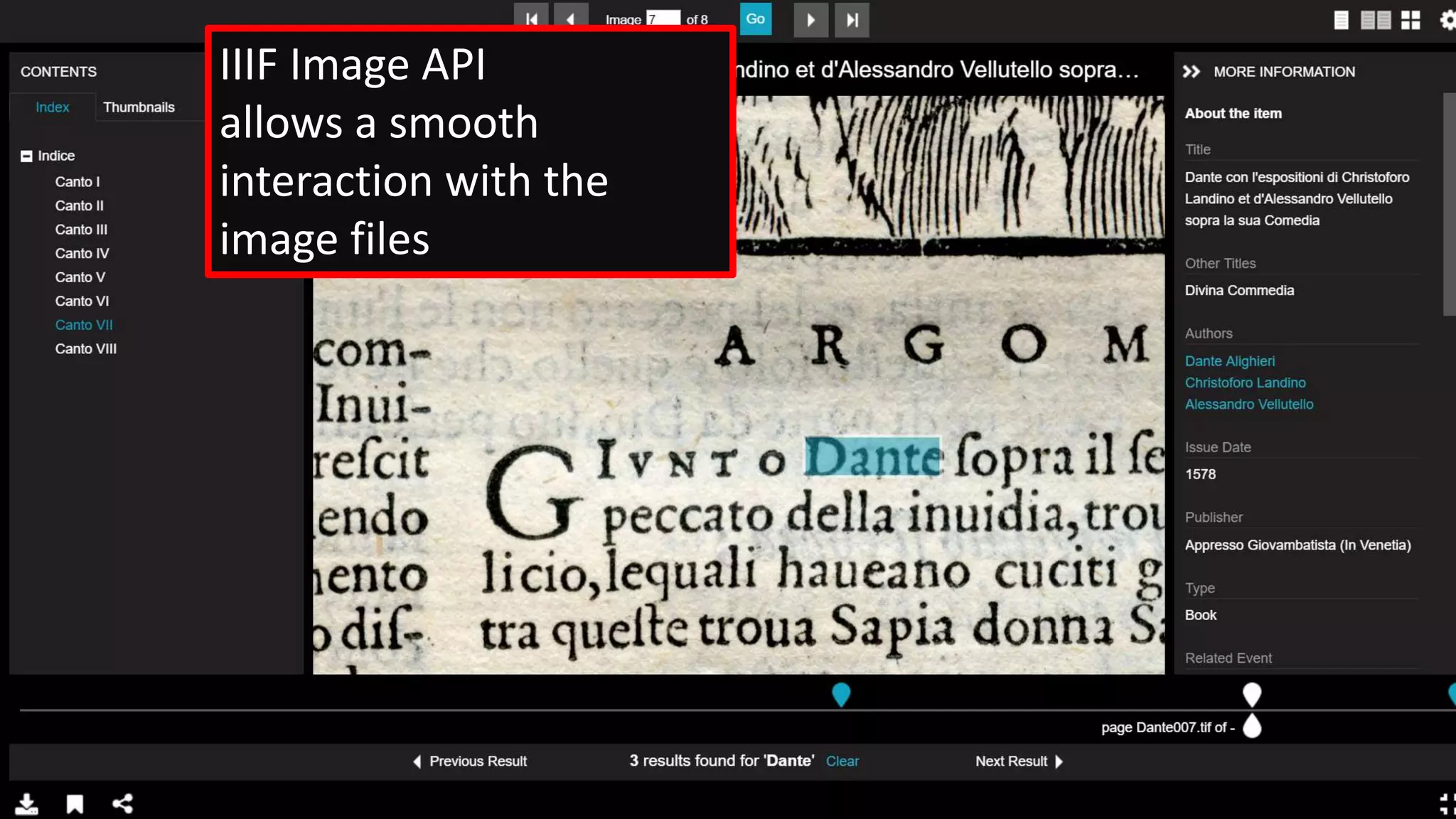
IIIF Image API
allows a smooth
interaction with the
image files
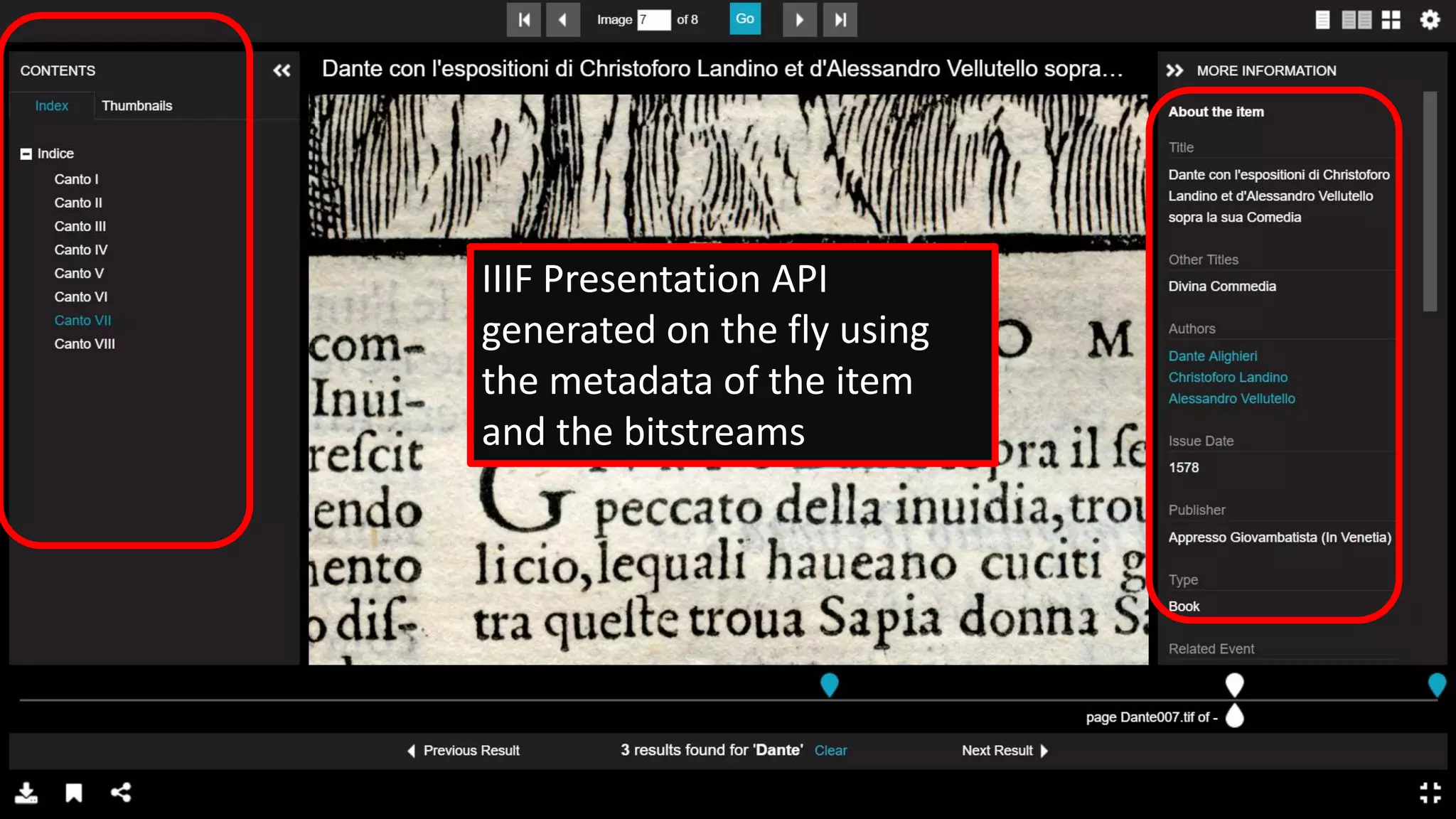
IIIF Presentation API
generated on the fly using
the metadata of the item
and the bitstreams
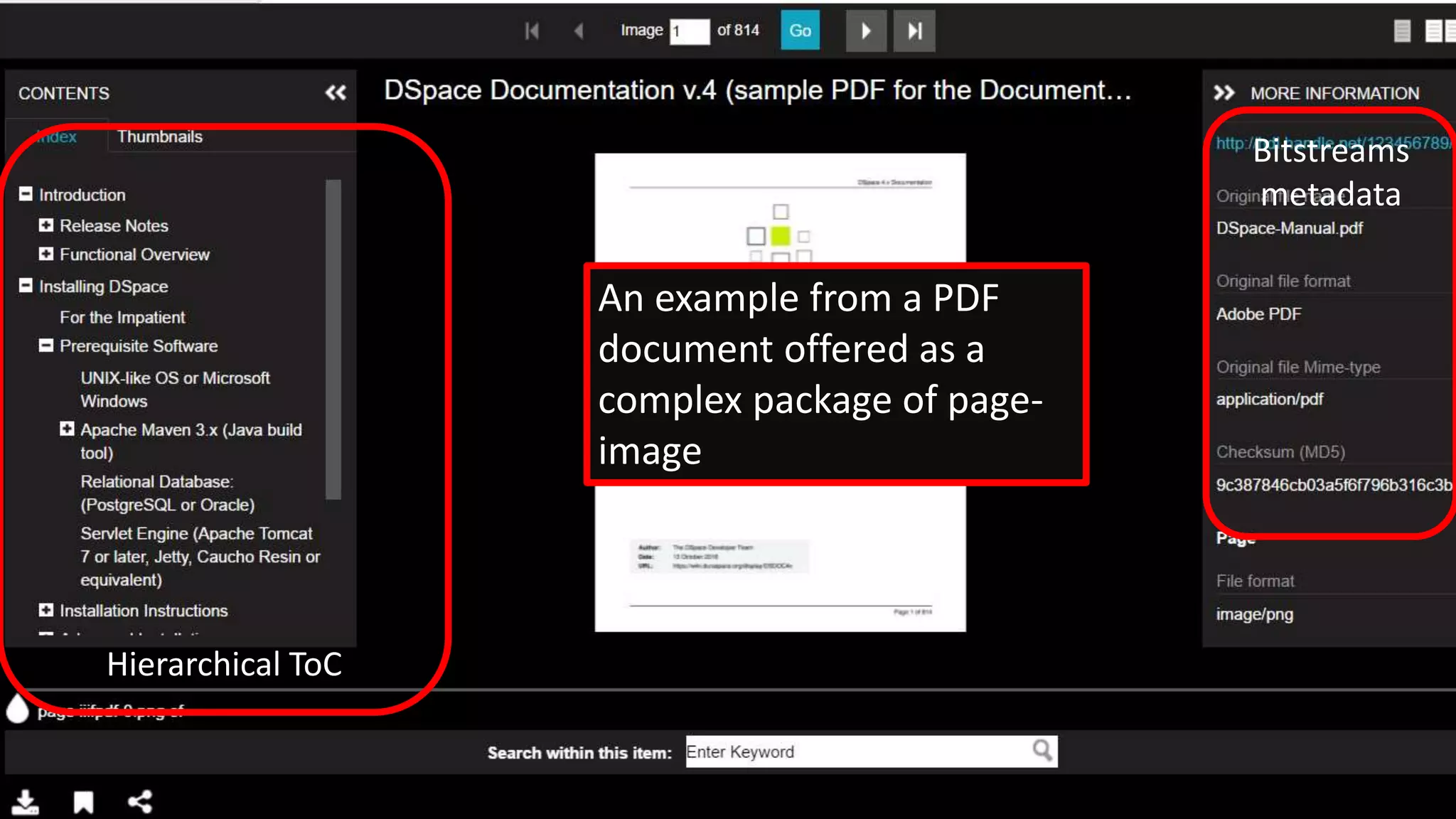
Bitstreams
metadata
Hierarchical ToC
An example from a PDF
document offered as a
complex package of page-
image
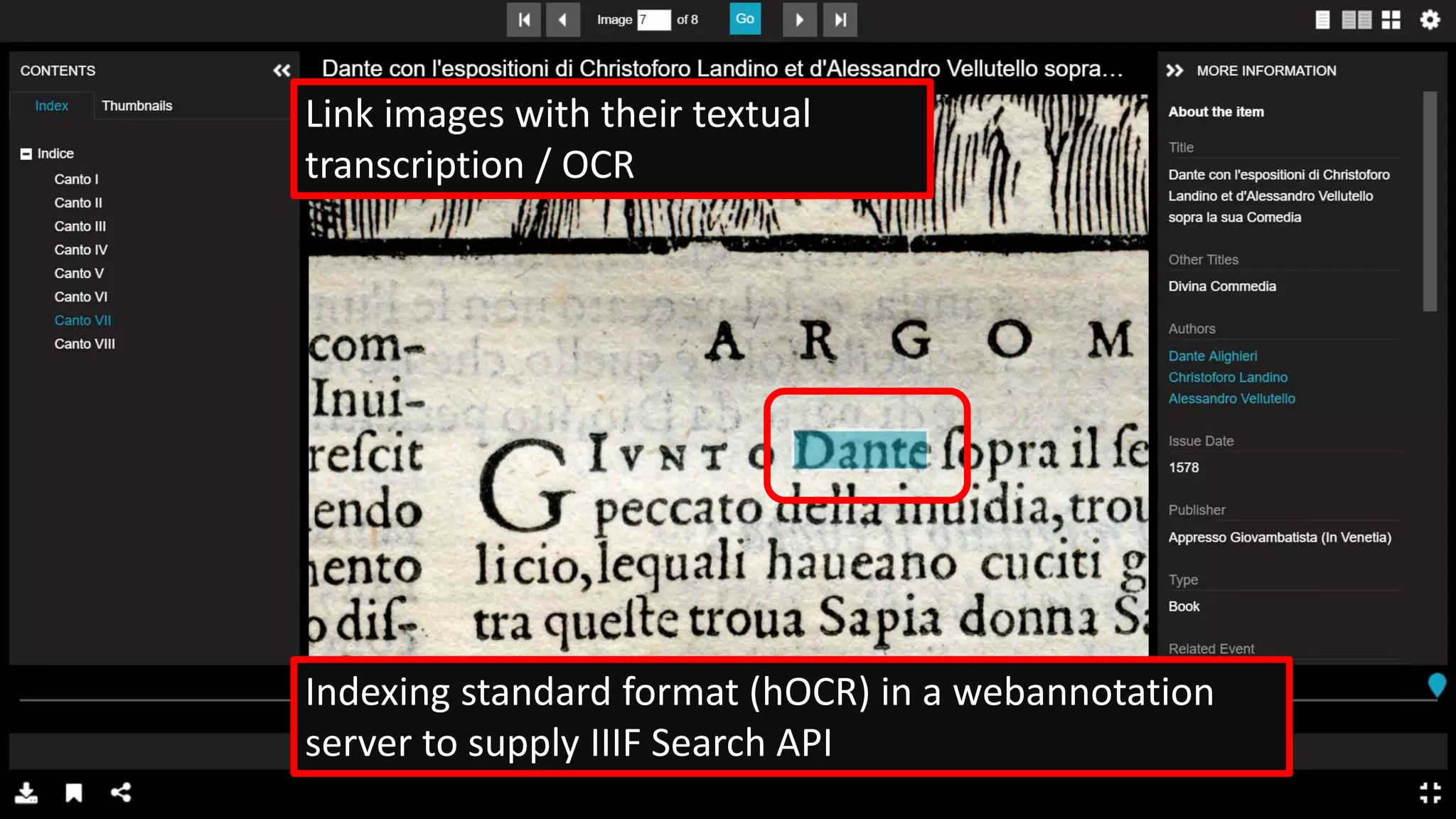
Link images with their textual
transcription / OCR
Indexing standard format (hOCR) in a webannotation
server to supply IIIF Search API
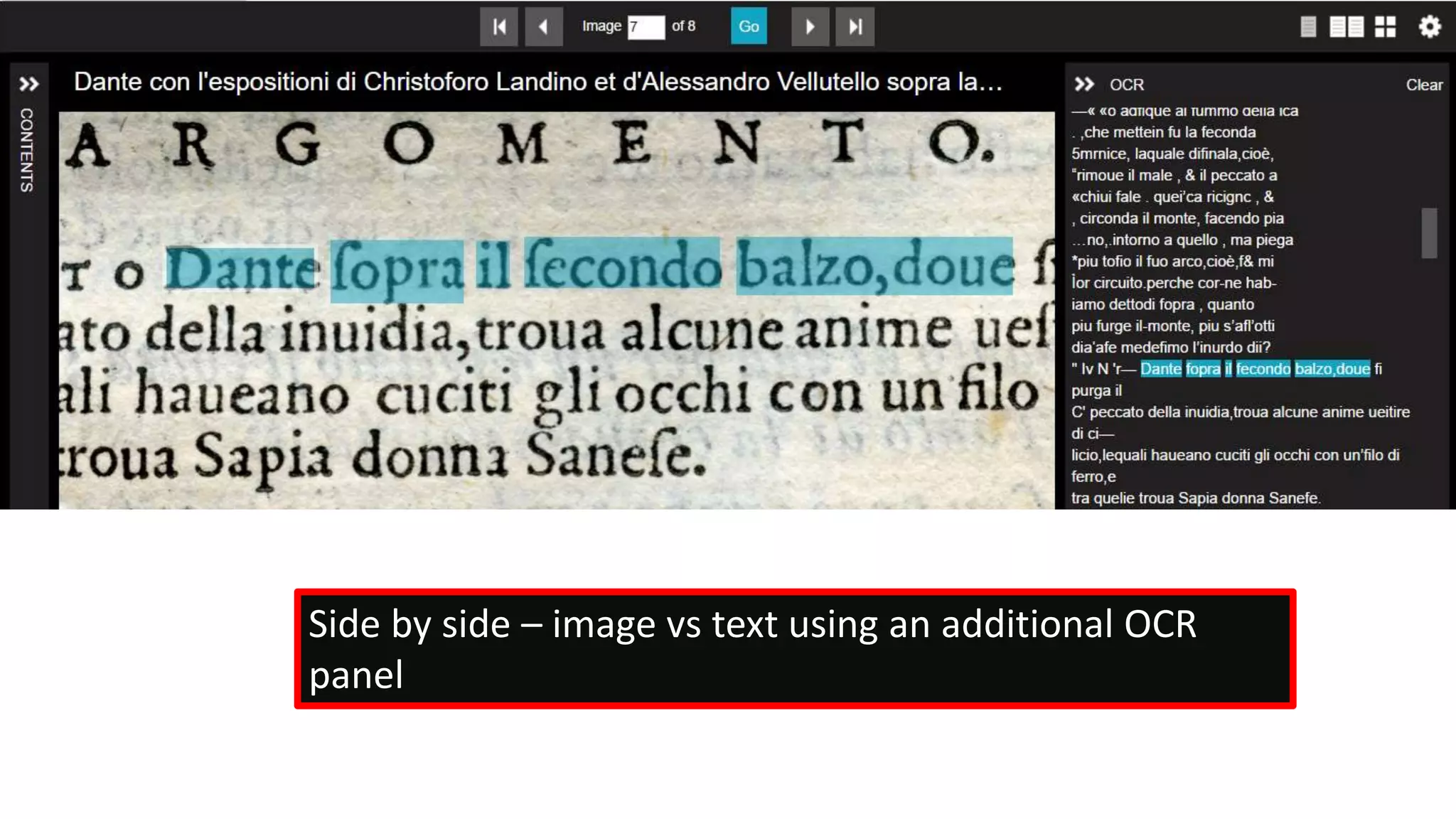
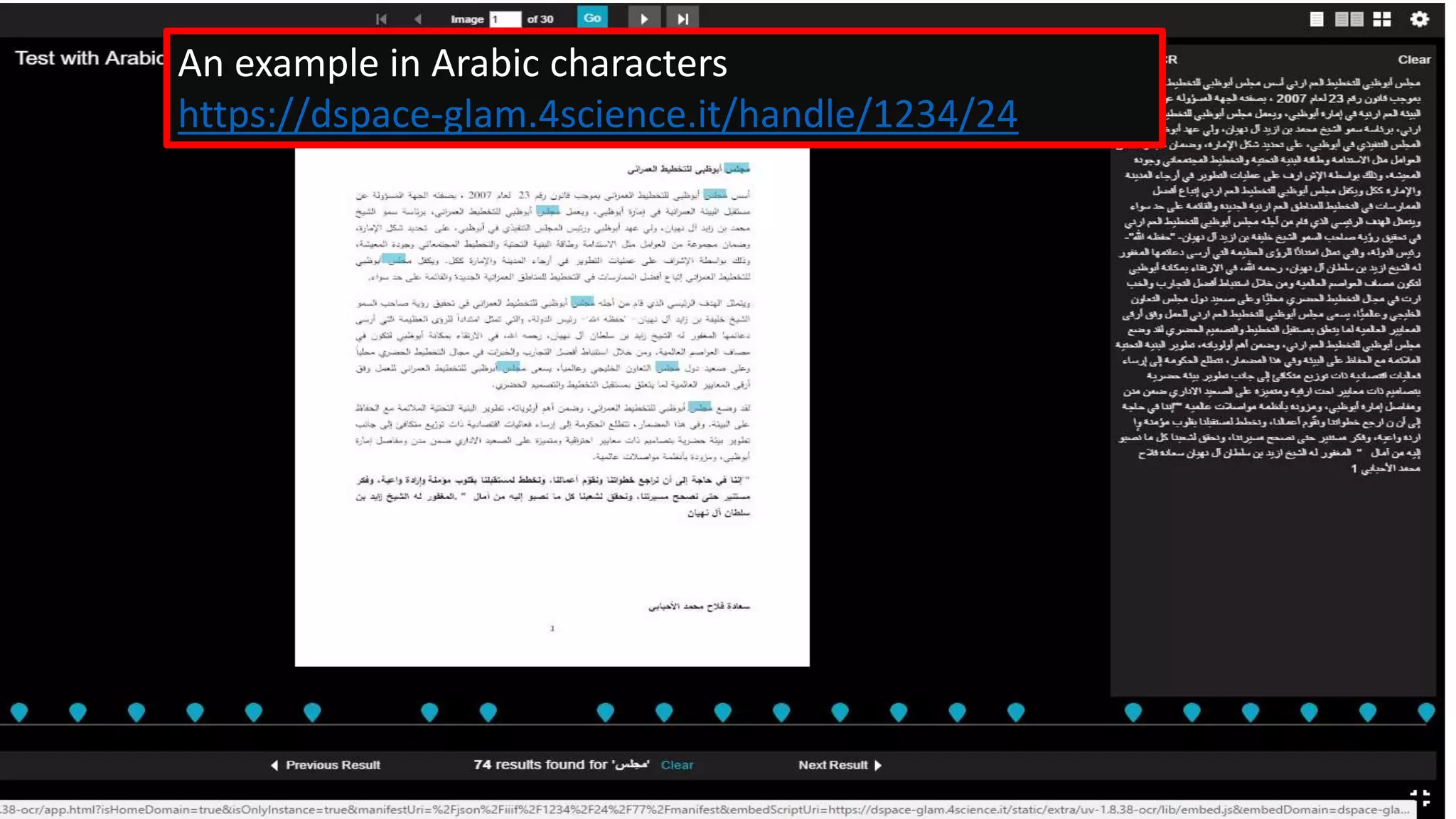
Side by side – image vs text using an additional OCR
panel
An example in Arabic characters
https://dspace-glam.4science.it/handle/1234/24
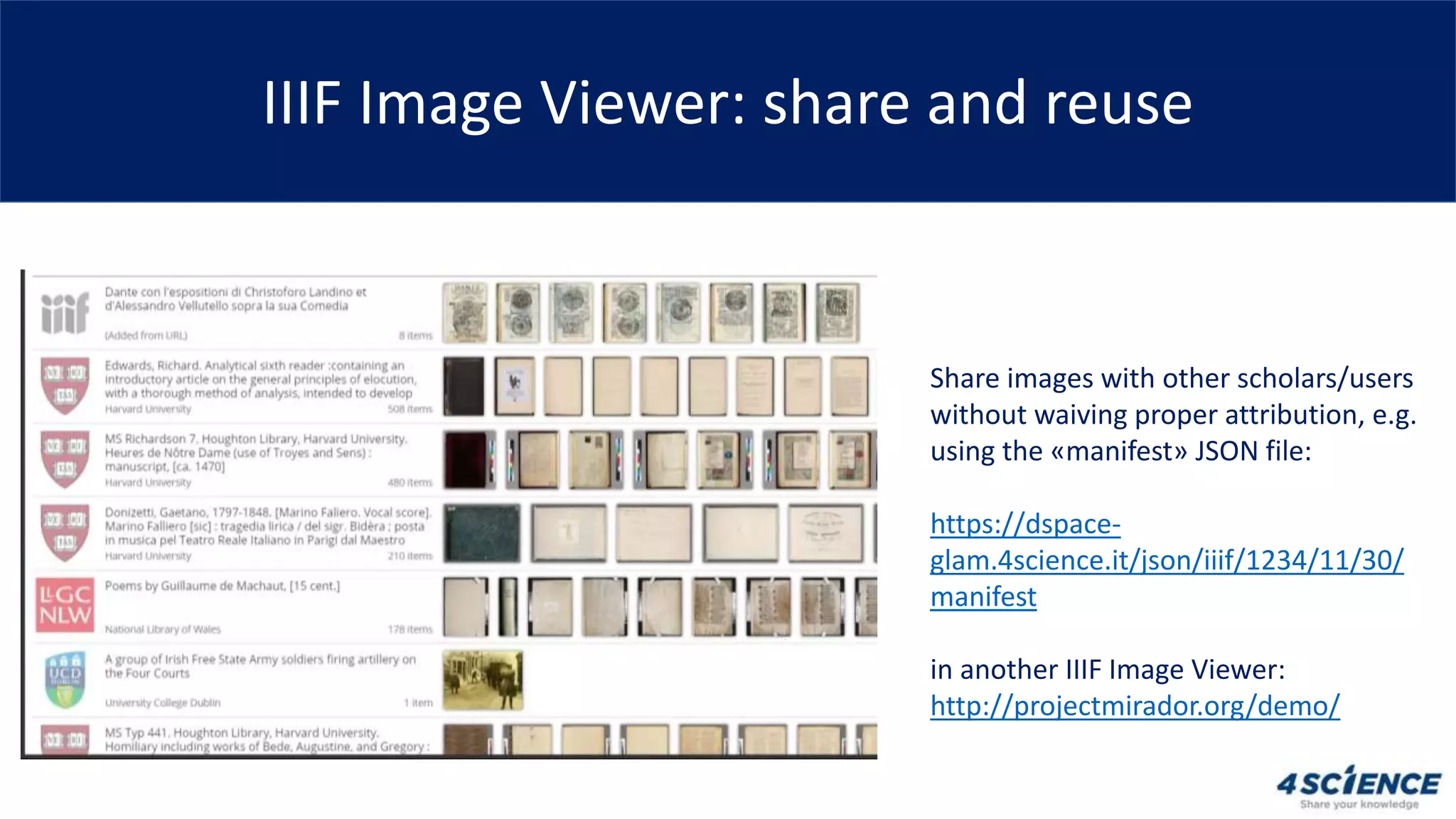
IIIF Image Viewer: share and reuse
Share images with other scholars/users
without waiving proper attribution, e.g.
using the «manifest» JSON file:
https://dspace-
glam.4science.it/json/iiif/1234/11/30/
manifest
in another IIIF Image Viewer:
http://projectmirador.org/demo/
Audio/Video streaming
Full open source stack:
1. Transcoding
2. Adaptive streaming
3. MPEG-DASH standard
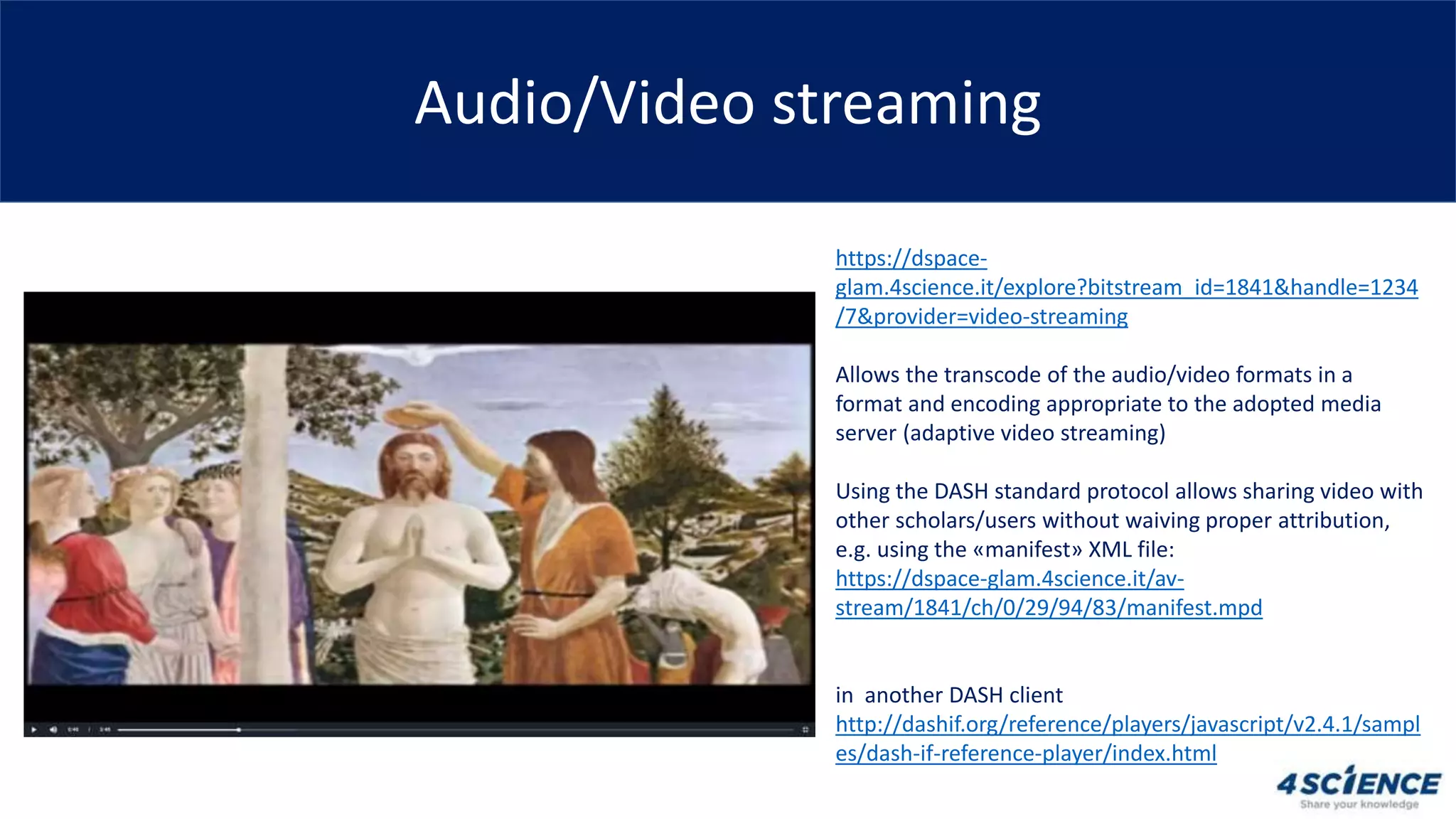
Audio/Video streaming
https://dspace-
glam.4science.it/explore?bitstream_id=1841&handle=1234
/7&provider=video-streaming
Allows the transcode of the audio/video formats in a
format and encoding appropriate to the adopted media
server (adaptive video streaming)
Using the DASH standard protocol allows sharing video with
other scholars/users without waiving proper attribution,
e.g. using the «manifest» XML file:
https://dspace-glam.4science.it/av-
stream/1841/ch/0/29/94/83/manifest.mpd
in another DASH client
http://dashif.org/reference/players/javascript/v2.4.1/sampl
es/dash-if-reference-player/index.html
Visualizing and analysing datasets
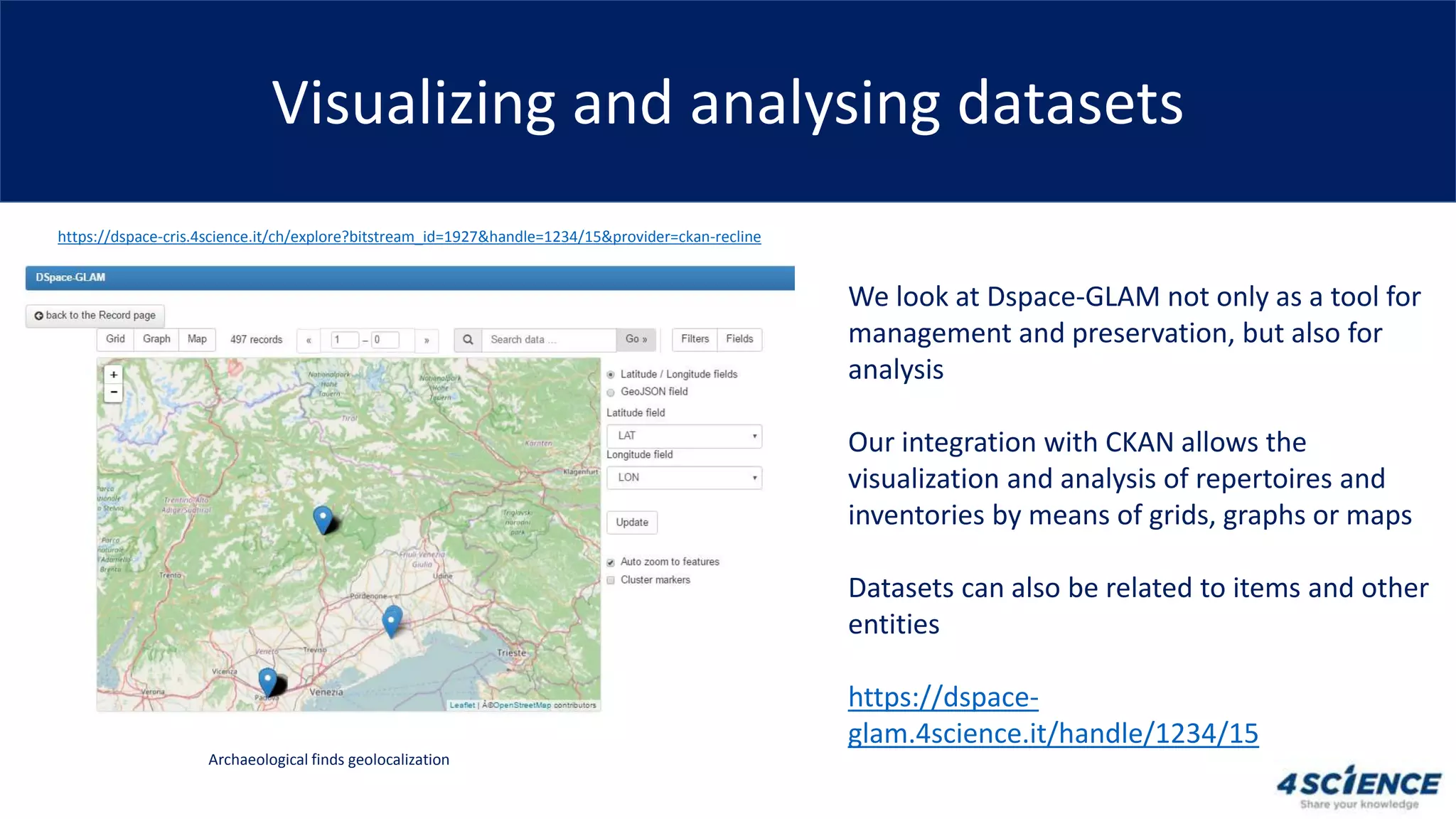
We look at Dspace-GLAM not only as a tool for
management and preservation, but also for
analysis
Our integration with CKAN allows the
visualization and analysis of repertoires and
inventories by means of grids, graphs or maps
Datasets can also be related to items and other
entities
https://dspace-
glam.4science.it/handle/1234/15
Archaeological finds geolocalization
https://dspace-cris.4science.it/ch/explore?bitstream_id=1927&handle=1234/15&provider=ckan-recline
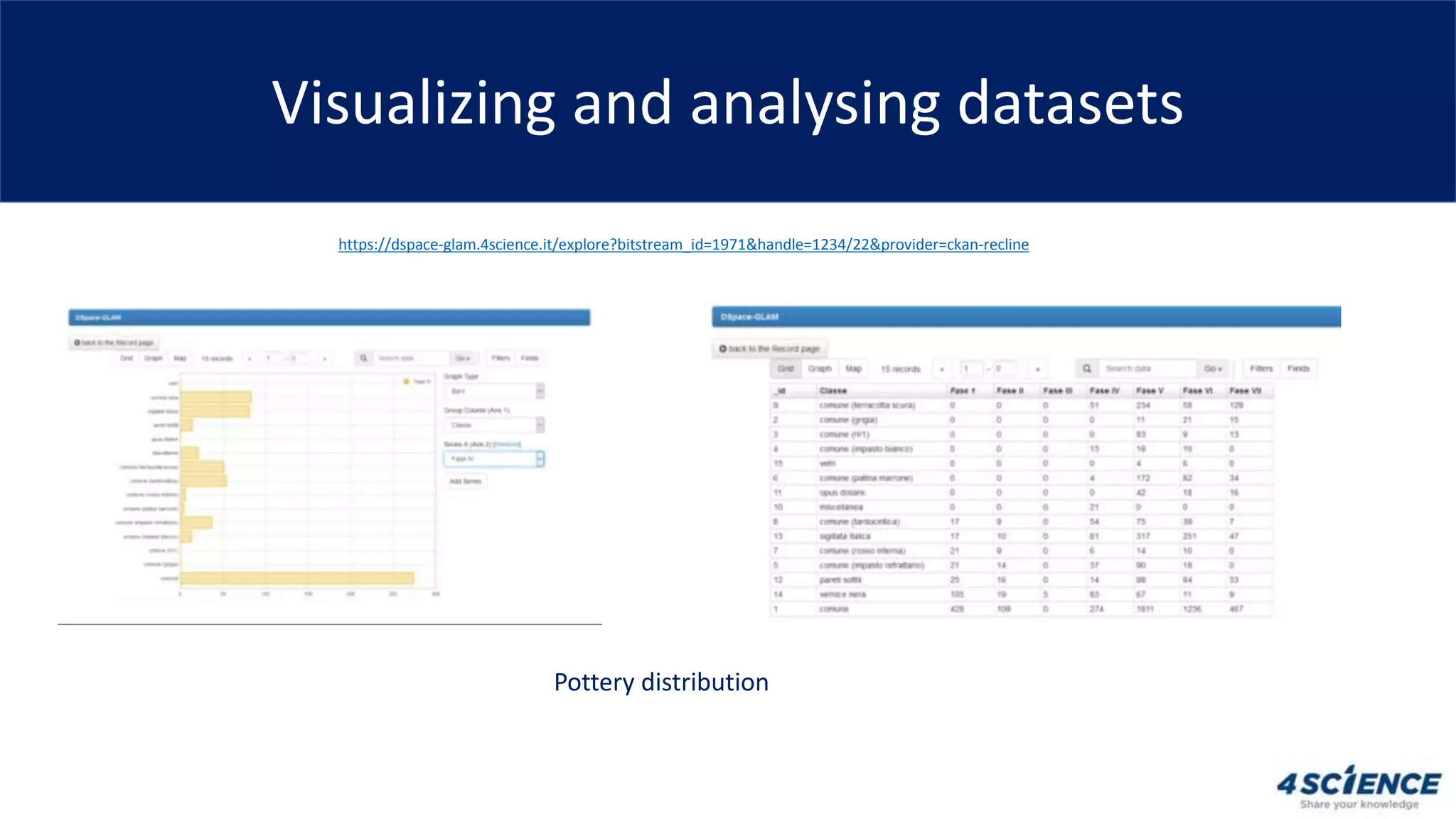
Visualizing and analysing datasets
https://dspace-glam.4science.it/explore?bitstream_id=1971&handle=1234/22&provider=ckan-recline
Pottery distribution
Why do I need DSpace-GLAM?
• DSpace-GLAM is a powerful extension of DSpace created by 4Science
to meet the needs of Galleries, Libraries, Archives and Museums
• to be able to manage, analyze and preserve digital objects
• together with historical, archaeological or other cultural datasets,
• relating them with other entities such as persons, events, places,
concepts, etc.
• to describe the context of cultural objects and data, according to
different granularity levels, and to different interpretations
• using worldwide adopted, cutting-edge, open-source software and
open standards
• The goal is to provide an environment for integrating the traditional
hermeneutic and interpretative work of historical sciences with data
analysis
• In this way, we hope, there may be a fundamental change in the way
digital cultural heritage is experienced, analyzed and contributed to
by the whole scientific community
Data Science in a Digital Humanities Framework
Thanks for your attention
Andrea Bollini
<andrea.bollini@4science.it>
mobile: +39 333 934 1808
skype: a.bollini
orcid: 0000-0002-9029-1854
Claudio Cortese
<claudio.cortese@4science.it>
mobile: 333 9340846
skype: claudio.cortese74
orcid: 0000-0003-4572-9711

DSpace for Cultural Heritage: adding support for images visualization,audio/video streaming and enhancing the data model

  • 1.
    DSPACE FOR CULTURALHERITAGE: ADDING SUPPORT FOR IMAGE VISUALIZATION, AUDIO/VIDEO STREAMING AND ENHANCING THE DATA MODEL GLAM
  • 2.
    A variety ofmultidisciplinary data are related to Cultural Heritage Different in: Typology Format Structure Scale
  • 3.
    More and morecomplexity… In the humanities most of the data are created or collected by people (not measured by instruments) They are affected by individuals, place, time The are fragmentary, partial, biased Source: http://www.asianscientist.com/2016/07/print/body-as-a-source-of-big-data/
  • 4.
    Putting data incontext… Digital Cultural Data have to be analyzed together with all contextual information, digital and not digital, needed to answer research questions, such as: • (cultural, social, economic, technological…) production context of a document/monument • formation processes of the archaeological record • contextual associations at different levels and scales (according to the different dimensions of variations) Source: https://ddd.uab.cat/pub/expbib/2006/terradefoc/10.pdf
  • 5.
    …within a DigitalLibrary Management System Today most of the cultural digital resources are in the Digital Libraries or Repositories Digital Libraries and Repositories must provide tools for: • modeling, visualising and analysing information, both in a qualitative and quantitative way, as well as collaboratively working on it • highlighting the relationships between data at different scales • explaining interpretations about the important dimensions of variation and about the network of contextual relations in which historical and archaeological sources are involved entering the daily workflow of historians, archaeologists and humanities scholars. ,
  • 6.
    DSpace-GLAM (Galleries, Libraries, Archives,Museums) Built by 4Science on top of DSpace and DSpace-CRIS to meet the needs of Cultural Heritage institutions Flexible and extensible data model to manage relevant metadata standards and specific conceptual models Dedicated add-ons for digital objects curation, fruition and sharing Add-on for datasets visualization and analysis
  • 7.
    Extending the DataModel DSpace-GLAM can manage all the entities important to contextualize the digital cultural heritage: • Persons • Families • Fonds • Events • Places • Concepts • ………….. Entities can be created to integrate different metadata standards and conceptual models
  • 11.
    Managing archival objects Thedata model can be extended in order to manage the hierarchical metadata structure required by archival standards such as ISAD (G) and EAD DSpace-GLAM can also manage the production and preservation context of the archive required by ISAAR- CPF, EAC-CPF and ISDIAH https://dspace- glam.4science.it/cris/fonds/fonds00036/fondscontext.html
  • 12.
    Overview of theDSpace-GLAM data model
  • 13.
    Overview of theDSpace-GLAM data model
  • 14.
    Overview of theDSpace-GLAM data model
  • 15.
    Extending the DataModel Painting: The flagellation Painter: Piero della Francesca Event: Council of Ferrara (AD 1438) Event: Council of Mantua (AD 1459) Place: FerraraConcept: Renaissance Concept: Humanism Person: Emperor John VIII Palaiologos Place: Mantua https://dspace-glam.4science.it/cris/rp/rp00001 Interpretation: Ronchey
  • 16.
  • 17.
    4Science IIIF ImageViewer Addon IIIF Compliant 1. Presentation API 2. Image API 3. Search API 4. Authentication API (soon)
  • 18.
    DSpace item with“see online option”
  • 19.
  • 20.
    IIIF Image API allowsa smooth interaction with the image files
  • 21.
    IIIF Presentation API generatedon the fly using the metadata of the item and the bitstreams
  • 22.
    Bitstreams metadata Hierarchical ToC An examplefrom a PDF document offered as a complex package of page- image
  • 23.
    Link images withtheir textual transcription / OCR Indexing standard format (hOCR) in a webannotation server to supply IIIF Search API
  • 24.
    Side by side– image vs text using an additional OCR panel
  • 25.
    An example inArabic characters https://dspace-glam.4science.it/handle/1234/24
  • 26.
    IIIF Image Viewer:share and reuse Share images with other scholars/users without waiving proper attribution, e.g. using the «manifest» JSON file: https://dspace- glam.4science.it/json/iiif/1234/11/30/ manifest in another IIIF Image Viewer: http://projectmirador.org/demo/
  • 27.
    Audio/Video streaming Full opensource stack: 1. Transcoding 2. Adaptive streaming 3. MPEG-DASH standard
  • 28.
    Audio/Video streaming https://dspace- glam.4science.it/explore?bitstream_id=1841&handle=1234 /7&provider=video-streaming Allows thetranscode of the audio/video formats in a format and encoding appropriate to the adopted media server (adaptive video streaming) Using the DASH standard protocol allows sharing video with other scholars/users without waiving proper attribution, e.g. using the «manifest» XML file: https://dspace-glam.4science.it/av- stream/1841/ch/0/29/94/83/manifest.mpd in another DASH client http://dashif.org/reference/players/javascript/v2.4.1/sampl es/dash-if-reference-player/index.html
  • 29.
    Visualizing and analysingdatasets We look at Dspace-GLAM not only as a tool for management and preservation, but also for analysis Our integration with CKAN allows the visualization and analysis of repertoires and inventories by means of grids, graphs or maps Datasets can also be related to items and other entities https://dspace- glam.4science.it/handle/1234/15 Archaeological finds geolocalization https://dspace-cris.4science.it/ch/explore?bitstream_id=1927&handle=1234/15&provider=ckan-recline
  • 30.
    Visualizing and analysingdatasets https://dspace-glam.4science.it/explore?bitstream_id=1971&handle=1234/22&provider=ckan-recline Pottery distribution
  • 31.
    Why do Ineed DSpace-GLAM? • DSpace-GLAM is a powerful extension of DSpace created by 4Science to meet the needs of Galleries, Libraries, Archives and Museums • to be able to manage, analyze and preserve digital objects • together with historical, archaeological or other cultural datasets, • relating them with other entities such as persons, events, places, concepts, etc. • to describe the context of cultural objects and data, according to different granularity levels, and to different interpretations • using worldwide adopted, cutting-edge, open-source software and open standards
  • 32.
    • The goalis to provide an environment for integrating the traditional hermeneutic and interpretative work of historical sciences with data analysis • In this way, we hope, there may be a fundamental change in the way digital cultural heritage is experienced, analyzed and contributed to by the whole scientific community Data Science in a Digital Humanities Framework
  • 33.
    Thanks for yourattention Andrea Bollini <andrea.bollini@4science.it> mobile: +39 333 934 1808 skype: a.bollini orcid: 0000-0002-9029-1854 Claudio Cortese <claudio.cortese@4science.it> mobile: 333 9340846 skype: claudio.cortese74 orcid: 0000-0003-4572-9711