MONITORING THE IMPACT
OF THE HIV EPIDEMIC
USING POPULATION-BASED
SURVEYS
UNAIDS/WHO WORKING GROUP ON GLOBAL HIV/AIDS AND STI SURVEILLANCE 2015 | REFERENCE
Copyright © 2015
Joint United Nations Programme on HIV/AIDS (UNAIDS)
All rights reserved.
The designations employed and the presentation of the material in this publication
do not imply the expression of any opinion whatsoever on the part of UNAIDS
concerning the legal status of any country, territory, city or area or of its authorities,
or concerning the delimitation of its frontiers or boundaries. UNAIDS does not
warrant that the information published in this publication is complete and correct
and shall not be liable for any damages incurred as a result of its use.
UNAIDS / JC2763
CONTENTS
Executive summary	 6
1. Introduction	 7
1.1 Background	 7
1.2 Purpose	 8
1.3 Target audience	 9
2. Developing a population-based survey protocol	 10
2.1 Survey goals and objectives	 10
2.2 Selecting the survey type	 13
2.3 Age criteria	 14
2.4 Survey frequency	 14
2.5 Geographical area	 15
2.6 Ethical considerations and informed consent	 15
2.6.1 Informed consent	 15
2.6.2 Ethical considerations in returning biomarker results	 17
2.6.3 Ensuring appropriate treatment and care referrals	 17
2.6.4 Confidentiality and anonymity of data	 18
2.6.5 Ethical approaches to using GPS data	 19
2.6.6 Ethics review	 19
2.7 Sampling methods	 20
2.7.1 Choosing a sampling frame	 21
2.8 Calculating sample size	 22
2.9 Questionnaire design	 22
2.10 Determining biomarker inclusion	 24
2.10.1 HIV prevalence	 24
2.10.2 HIV incidence	 25
2.10.3 CD4 T-cell count	 26
2.10.4. Viral load measurement	 26
2.10.5. Exposure to ARV medicine	 27
2.10.5 Drug resistance	 27
2 UNAIDS
2.10.6 Other bloodborne and sexually transmitted infections	 27
2.11 Practical aspects related to choice of specimen and assays	 33
2.11.1 Specimen collection	 33
2.11.2 Testing of specimens	 34
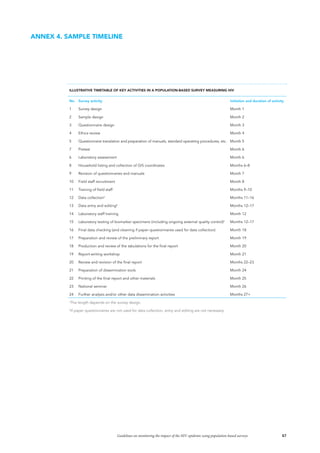
2.12 Budget planning and survey timeline	 35
3. Planning survey implementation	 37
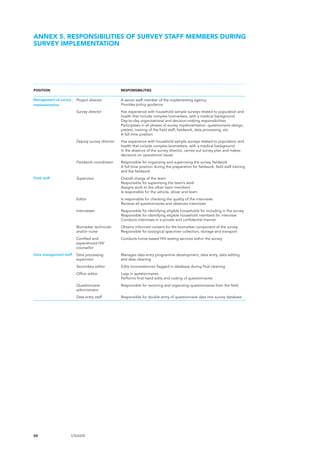
3.1 Staff organization	 37
3.2 Communication and community mobilization	 40
3.3 Preparing training documentation	 40
3.3.1 Preparing manuals for fieldwork	 40
3.3.2 Pretest	 41
3.4 Field training staff	 42
4. Field operations	 44
4.1 Conducting interviews	 44
4.1.1 Using return visits to limit non-response	 44
4.1.2 Ensuring interviewer rapport	 45
4.2 Biomarker field operations	 46
4.2.1 Obtaining informed consent	 46
4.2.2 Collecting and handling specimens	 47
4.2.3 Transferring specimens	 49
4.3 Providing HIV testing services, results and linkage to treatment and care	49
4.4 HIV testing services for children	 50
4.5 Incorporating GPS measurements	 52
4.6 Field-based data management, cleaning, validation and quality
assurance	 54
4.6.1 Interview quality assurance	 54
4.6.2 Quality assurance of specimen collection, testing and
record-keeping	 55
5. Data analysis	 57
5.1 Calculating, assessing and adjusting survey weights for non-response	57
3Guidelines on monitoring the impact of the HIV epidemic using population-based surveys
5.1.1 Calculating non-response	 58
5.1.2 Assessing the impact of non-response	 59
5.1.3 Adjusting for non-response	 60
5.2 Recommended method for calculating indicators—weighting
survey results	 60
5.2.1 Design weights	 61
5.2.2 Response weights	 61
5.2.3 Final sample weights	 61
5.3 Analysis approaches	 62
5.4 Methods for comparing results across populationbased surveys	 66
6. Dissemination of survey results	 68
6.1 Structuring a survey report	 69
6.2 Communicating key messages	 70
6.3 Developing a public access electronic dataset	 71
Annex 1. Calculating the sample size required for a desired
level of precision around HIV prevalence and incidence
estimates	71
Annex 2. Standardized testing strategies and algorithms	 76
Annex 3. Sample budget	 85
Annex 4. Sample timeline	 87
Annex 5. Responsibilities of survey staff members	 88
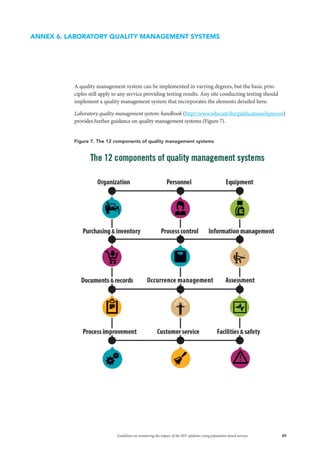
Annex 6. Laboratory quality management systems	 89
Abbreviations	100
References	101
4 UNAIDS
EXECUTIVE SUMMARY
This publication is an update of the 2005 guidelines for measuring national HIV prevalence in population-
based surveys of the UNAIDS/WHO Working Group on Global HIV/AIDS and STI Surveillance. These guide-
lines are written for public health surveillance and programme officers responsible for monitoring the HIV
epidemic in their country. The purpose of the revised guidelines is to assist programme officers in monitoring
the HIV epidemic and the impact of the country’s AIDS response by designing and implementing population-
based surveys that include HIV infection, sexually transmitted infections and other bloodborne biomarkers.
Key considerations during the survey design include that the survey should:
„„ contribute to monitoring indicators of global interest, such as the percentage of people living with HIV,
the percentage of people living with HIV who know their status and who are on treatment and the
percentage of people receiving antiretroviral therapy (ART) who have suppressed viral load;
„„ link questionnaires on HIV prevention, knowledge and service use with biomarker results to measure
the impact of programmes; and
„„ measure the incidence of HIV infection in some settings as appropriate to monitor progress towards
ending the AIDS epidemic as a public health risk by 2030.
To meet these survey objectives, these guidelines recommend that surveys:
„„ be powered to provide accurate estimates of HIV prevalence and viral load at the subnational level
among adults (aged 15 years and older) in all settings in which the HIV prevalence exceeds 2%
(surveys in countries with limited financial resources should aim to measure the HIV prevalence
among adults 15–64 years old);
„„ include measurement of HIV prevalence among children (aged 0-14 years) in settings in which the
HIV prevalence among women of reproductive age is 5% or greater, fertility rates are high, coverage of
programmes for preventing mother-to-child transmission is low and sufficient resources are available
to conduct a survey with large sample sizes among children; and
„„ measure HIV incidence in settings in which HIV prevalence among adults 15–49 years old is
estimated to be 5% or greater and the corresponding HIV incidence is estimated to be 0.3% or greater.
Since surveys offer opportunities to increase the number of people who know they are living with HIV and
who are linked into prevention, care and treatment services, the guidelines recommend that:
„„ all people, as part of their participation in the survey, be provided with access to HIV testing and
return of HIV status and bloodborne biomarker results related to HIV, sexually transmitted infections
and other bloodborne infections as appropriate; and
„„ referrals be made to nearby facilities offering HIV testing, prevention, care and treatment services for
those in need.
The guidelines provide recommendations for other areas related to implementing surveys and disseminating
the results, including new strategies for incorporating Global Positioning System (GPS) measures and strate-
gies for better capturing and accounting for non-response in the survey. It is hoped that these revised guide-
lines will result in comparable, high-quality data from across countries while minimizing the financial and
technical resources required to monitor and inform the AIDS response.
5Guidelines on monitoring the impact of the HIV epidemic using population-based surveys
This chapter briefly summarizes the historical evolution of population-based survey measure-
ment of HIV, the need for updated guidance on monitoring the impact of the HIV epidemic
using population-based surveys, and the target audience for this publication. Important points
from this chapter are as follows.
„„ Population-based surveys that incorporate HIV-related topics can play an important
role in monitoring the HIV epidemic and the programmatic response in countries
with a high burden of HIV infection.
„„ Population-based surveys must be conducted in a way that maximizes the quality,
usefulness and comparability of HIV-related data over time within and across
countries.
„„ Population-based survey measurement of HIV prevalence is recommended when the
estimated HIV prevalence among adults 15–49 years old exceeds 2%.
Background
In 2005, the UNAIDS/WHO Working Group on Global HIV/AIDS and STI Surveillance
published the first global guidance on planning and conducting population-based surveys
with HIV testing (1.1). This focused almost exclusively on providing recommendations for
incorporating HIV biomarkers into existing population-based surveys1
such as Demographic
Health Surveys (DHS) and Multiple Indicator Cluster Surveys (MICS). Both DHS and MICS
are usually designed to be representative of the overall population in an entire country; thus,
as evident in the title, the primary objective of including testing for HIV was to obtain a
national measure of HIV prevalence in the general population.
At the time of that publication in 2005, about 18 countries had conducted surveys including
HIV testing, mostly in sub-Saharan Africa, where the burden of HIV infection is highest.
Since then, the number of national population-based surveys with HIV biomarkers has
increased substantially. As of 2014, more than 80 population-based surveys in 43 countries
included testing for HIV. Of these 43 countries, 38 were in sub-Saharan Africa, with the
remaining being Cambodia, the Dominican Republic, Haiti, India, Mexico and Viet Nam. For
many countries, the results from two or more surveys are available. Burundi, Kenya and South
Africa have each conducted four surveys. Among countries with hyperendemic or generalized
HIV epidemics in sub-Saharan Africa, only two countries, Angola and Sudan, have not yet
conducted any surveys.
Since the original 2005 publication, the scope and objectives of the population-based surveys
have evolved. In addition to the DHS and MICS, many countries now conduct stand-alone
HIV surveys, sometimes called AIDS Indicator Surveys (AIS) or, more recently, Population-
based HIV Impact Assessments (PHIA).
1	 Unless otherwise noted, the terms “population-based survey” or “survey” refer to nationally representative household-
based surveys with complex survey design that also includes HIV biomarkers.
INTRODUCTION
6 UNAIDS
For these more-focused surveys, the primary survey objectives often include assessing HIV
programme impact in addition to measuring HIV prevalence and HIV-related risk behaviour
and knowledge. Reflecting this addition, survey instruments in AIS or PHIA now cover topics
such as voluntary medical male circumcision, cash transfers and the use of HIV-related health
services. New biomarker testing for recency of HIV infection, CD4 count, HIV viral load
levels and antiretroviral therapy (ART) exposure are also typically included, with results of
HIV infection, CD4 count and HIV viral load levels returned to participants through incor-
poration of home-based HIV testing services. Finally, given the heterogeneity of the epidemic
within countries, these surveys are increasingly being designed to produce estimates of key
measures at the subnational level rather than the national level.
Purpose
Given the importance of HIV data obtained from national surveys to monitor the HIV
epidemic and response in the general population, especially in sub-Saharan Africa, it is critical
that countries conduct population-based surveys that maximize the quality, usefulness and
comparability of data over time. The purpose of this publication is to provide countries with
guidance on how to design and implement population-based surveys to monitor the impact of
the HIV epidemic—either as stand-alone HIV surveys or as part of a broader health survey—
with these characteristics in mind.
Using this guidance publication, national surveillance and programme officers should be able:
„„ to assess the epidemic context within a specific country to determine the
appropriateness of conducting a population-based survey that includes HIV-related
biomarkers;
„„ to identify the key survey objectives and survey design required to monitor the impact
of the HIV epidemic;
„„ to assure the appropriate ethical safeguards of survey participants and their data;
„„ to develop a questionnaire that enables high-quality, comparable data to be collected
within a single country over time and across countries;
„„ to understand the benefits and challenges of including HIV, sexually transmitted
infections and other bloodborne biomarkers that may be incorporated into
population-based surveys; and
„„ to analyse, interpret and report results that contribute to the country’s overall
understanding of their epidemic and to international reporting needs.
Although this publication describes the most important issues that need to be considered
when planning and conducting surveys, its purpose is not to provide detailed operational
procedures on how to conduct these types of surveys. More detailed instructions on how to
implement population-based surveys are available from various sources, such as the UNICEF
manual on MICS surveys (2), the model manuals on how to implement DHS surveys (3)
7Guidelines on monitoring the impact of the HIV epidemic using population-based surveys
and the PHIA template protocol and standard operating procedures of the United States
President’s Emergency Plan for AIDS Relief.
Target audience
This publication is intended to support public health surveillance and programme officers
responsible for monitoring the HIV epidemic in their country. It will also help international
and other donor organizations to ensure that they are supporting countries in designing and
implementing surveys that are sensitive to the epidemic context and that provide comparable,
high-quality data across countries while minimizing the financial and technical resources
required.
These guidelines are intended to be applied in countries in which the national HIV prevalence
among adults 15–49 years old is estimated to exceed 2% (Box 1).
Countries with a national adult prevalence of 2% or less are discouraged from conducting
population-based surveys that include biomarker measurement of HIV infection. A similar
HIV prevalence threshold among adults is recommended for surveys limited to selected
subnational areas.
In exceptional circumstances in which HIV biomarkers are considered for inclusion when
prevalence is 2% or less, implementing and funding organizations should review the 2010
technical guidance note of the UNAIDS/WHO Working Group on Global HIV/AIDS and STI
Surveillance (4) before making a final decision.
Box 1. Deciding whether to include HIV biomarkers in a population-based survey
For many countries, conducting a population-based survey that incorporates HIV testing is
often seen as desirable. However, for countries with HIV prevalence among adults 15–49 years
old of 2% or less, this decision should be considered carefully, taking into account the substan-
tial resources and large sample sizes required to obtain meaningful results. These guidelines are
intended for countries in which the national adult HIV prevalence is estimated to exceed 2%.
For national programmes opting to conduct a population-based survey in settings with lower
prevalence, the recommendations in this guidance may still be considered useful.
8 UNAIDS
Developing a protocol is an essential component of planning a population-based survey. The
protocol should be a detailed document describing all critical aspects of the survey design,
implementation plan and approach to analysis. This chapter discusses key elements of the
protocol, including the survey objectives and relevant indicators, the survey population, the
survey design, considerations of geographical area, ethical considerations, sampling methods,
considerations when calculating sample size, questionnaire design, biomarker recommenda-
tions, specimen collection and testing, ethical considerations and budget planning.
Within the presentation of this chapter, the following summarizes the key recommendations
for developing a population-based survey protocol.
„„ The survey should be designed to take into account the epidemic context and primary
survey objectives.
„„ Population-based surveys measuring HIV should return respondents’ HIV status and
other relevant biomarkers.
„„ Measurement of HIV prevalence among children 0–14 years old is strongly
recommended for the countries in which adult female HIV prevalence is 5% or greater.
„„ HIV incidence biomarkers and resulting estimates should only be included in
population-based surveys when the national estimate of HIV prevalence among adults
15–49 years old is 5% or greater and the estimate of HIV incidence is 0.3% or greater.
„„ A reasonable survey implementation timeline should take approximately two years,
starting with survey planning efforts and ending with the release of final survey results.
Survey goals and objectives
To monitor progress towards ending the AIDS epidemic as a public health risk by 2030,
UNAIDS has developed a target to increase ART and reduce HIV transmission in the popula-
tion, such that by 2020 (5):
„„ 90% of all people living with HIV will know their HIV status;
„„ 90% of all people with diagnosed HIV infection will receive sustained ART; and
„„ 90% of all people receiving ART will have viral suppression.
This treatment cascade, referred to as the 90–90–90 targets, encourages country programmes
to be accountable for equitable HIV care service delivery across all populations.
Although monitoring the 90–90–90 targets benefits from triangulation of a variety of data
sources, population-based surveys can contribute to charting a country’s progress. At a
minimum, these surveys should give priority to collecting data that characterize the HIV
treatment cascade, although the validity of results may be of concern if a large proportion
of people previously diagnosed with HIV infection do not disclose their status or refuse to
participate in the survey. Another caution is that the cross-sectional nature of a survey means
that different people will be measured at each step of the cascade rather than following the
DEVELOPING A POPULATION-BASED SURVEY PROTOCOL
9Guidelines on monitoring the impact of the HIV epidemic using population-based surveys
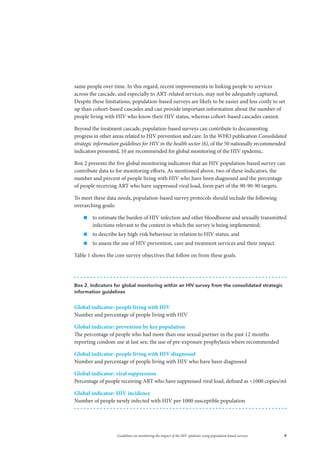
Box 2. Indicators for global monitoring within an HIV survey from the consolidated strategic
information guidelines
Global indicator: people living with HIV
Number and percentage of people living with HIV
Global indicator: prevention by key population
The percentage of people who had more than one sexual partner in the past 12 months
reporting condom use at last sex; the use of pre-exposure prophylaxis where recommended
Global indicator: people living with HIV diagnosed
Number and percentage of people living with HIV who have been diagnosed
Global indicator: viral suppression
Percentage of people receiving ART who have suppressed viral load, defined as <1000 copies/ml
Global indicator: HIV incidence
Number of people newly infected with HIV per 1000 susceptible population
same people over time. In this regard, recent improvements in linking people to services
across the cascade, and especially to ART-related services, may not be adequately captured.
Despite these limitations, population-based surveys are likely to be easier and less costly to set
up than cohort-based cascades and can provide important information about the number of
people living with HIV who know their HIV status, whereas cohort-based cascades cannot.
Beyond the treatment cascade, population-based surveys can contribute to documenting
progress in other areas related to HIV prevention and care. In the WHO publication Consolidated
strategic information guidelines for HIV in the health sector (6), of the 50 nationally recommended
indicators presented, 10 are recommended for global monitoring of the HIV epidemic.
Box 2 presents the five global monitoring indicators that an HIV population-based survey can
contribute data to for monitoring efforts. As mentioned above, two of these indicators, the
number and percent of people living with HIV who have been diagnosed and the percentage
of people receiving ART who have suppressed viral load, form part of the 90-90-90 targets.
To meet these data needs, population-based survey protocols should include the following
overarching goals:
„„ to estimate the burden of HIV infection and other bloodborne and sexually transmitted
infections relevant to the context in which the survey is being implemented;
„„ to describe key high-risk behaviour in relation to HIV status; and
„„ to assess the use of HIV prevention, care and treatment services and their impact.
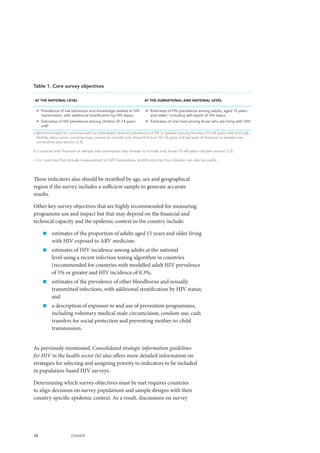
Table 1 shows the core survey objectives that follow on from these goals.
10 UNAIDS
These indicators also should be stratified by age, sex and geographical
region if the survey includes a sufficient sample to generate accurate
results.
Other key survey objectives that are highly recommended for measuring
programme use and impact but that may depend on the financial and
technical capacity and the epidemic context in the country include:
„„ estimates of the proportion of adults aged 15 years and older living
with HIV exposed to ARV medicine;
„„ estimates of HIV incidence among adults at the national
level using a recent infection testing algorithm in countries
(recommended for countries with modelled adult HIV prevalence
of 5% or greater and HIV incidence of 0.3%;
„„ estimates of the prevalence of other bloodborne and sexually
transmitted infections, with additional stratification by HIV status;
and
„„ a description of exposure to and use of prevention programmes,
including voluntary medical male circumcision, condom use, cash
transfers for social protection and preventing mother-to-child
transmission.
As previously mentioned, Consolidated strategic information guidelines
for HIV in the health sector (6) also offers more detailed information on
strategies for selecting and assigning priority to indicators to be included
in population-based HIV surveys.
Determining which survey objectives must be met requires countries
to align decisions on survey populations and sample designs with their
country-specific epidemic context. As a result, discussions on survey
Table 1. Core survey objectives
AT THE NATIONAL LEVEL AT THE SUBNATIONAL AND NATIONAL LEVEL
•	 Prevalence of risk behaviour and knowledge related to HIV
transmission, with additional stratification by HIV status
•	 Estimates of HIV prevalence among children (0–14 years
old)a
•	 Estimates of HIV prevalence among adults, aged 15 years
and older,b
including self-report of HIV status
•	 Estimates of viral load among those who are living with HIVc
a Recommended for countries with an estimated national prevalence of 5% or greater among females (15–49 years old) and high
fertility rates; some countries may choose to include only those 0–4 and 10–14 years old because of financial or sample size
constraints (see section 2.3).
b Countries with financial or sample size constraints may choose to include only those 15–64 years old (see section 2.3).
c For countries that include measurement of ART biomarkers, stratification by this indicator can also be useful.
11Guidelines on monitoring the impact of the HIV epidemic using population-based surveys
objectives should begin during the initial survey planning phase and include input from key
stakeholders and expected donors.
Importantly, consensus around survey objectives will inform decisions about the geographical
area to be included and the eligible survey participants. It will also inform the questionnaire
design and inclusion of specific biomarkers in the survey. As such, the survey objectives will
depend not only on the data required for HIV programming and policy development but also
on the availability of financial, personnel, laboratory and analytic resources to conduct the
survey.
Selecting the survey type
Population-based measurement of HIV indicators can occur through two different survey
mechanisms: via a stand-alone HIV survey (such as PHIA or AIS) or via incorporation into a
broader health survey (such as MICS or DHS).
The decision about whether to measure HIV indicators in a stand-alone HIV survey or
within a large health survey will depend on many factors, each of which should be considered
carefully before developing the survey protocol. These include the overall survey objectives,
the availability of funding, whether a larger health population-based survey is already planned
in the country and the capacity of the implementing agency and its partners to conduct the
desired survey.
For countries that are conducting a stand-alone HIV survey, it is reasonable to expect that the
number of HIV-related topics can be covered in a shorter time period than a broader health
survey. A shorter questionnaire with more specific content will probably reduce the burden
of respondents, possibly resulting in higher-quality survey data (7). In addition, a topically
focused survey may present a more appropriate avenue for incorporating a more extensive
panel of biomarkers as well as the possibility to justify sampling individuals outside the
reproductive age group.
For countries that include HIV measures as part of a broader health survey, data collection on
HIV-related topics may be limited to core indicators only, with selected highly recommended
HIV-related indicators balanced with other topical health-related survey priorities. Countries
will also need to consider the larger sample sizes that may be required for precise estimation
and the potential for reduced data quality if field teams and respondents are overburdened
with many questionnaire components.
12 UNAIDS
Age criteria
Population-based surveys incorporating HIV biomarkers should aim to provide representa-
tive estimates for all adults aged 15 years and older. Including older adults, aged 50 years
and above, allows for characterization of an ageing HIV epidemic resulting from increased
survival because of ART provision. Assessing the burden of disease in populations of older age
is also becoming increasingly important for measuring the impact of programmes.
For children, UNAIDS and WHO currently recommend (8) that children 0–14 years old be
included in a population-based survey when:
„„ national HIV prevalence among females 15–49 years old is 5% or higher;
„„ fertility rates in the country are high;
„„ coverage of programmes to prevent mother-to-child transmission are limited; and
„„ the planned survey sample sizes are sufficiently high to obtain reasonable estimates of
the HIV prevalence among children.
Understanding the burden of disease among children 0–4 years old is particularly important
for identifying missed opportunities to eliminate mother-to-child transmission. For children
10–14 years old, documenting the impact of expanding ART programmes on child survival is
useful.
Because incorporating children and adults of all ages in a survey may present undue financial
burden in many countries or may require very large sample sizes, priority should be given
to measuring HIV prevalence and other outcomes among children 0–4 years old and adults
15–64 years old.
Survey frequency
The decision of when to conduct a survey will likely be driven by the need for data to monitor
the HIV epidemic. Most importantly, survey implementers should consult with other organi-
zations to determine whether a survey with HIV indicators has recently been conducted or is
planned for the near future.
As a tool for validating routine data collected via other surveillance methods, it is general
practice for HIV indicators to be collected about every four to five years within a population-
based survey. This frequency provides sufficient time to capture changes in HIV knowledge,
attitudes, beliefs, behaviour and potential changes in infection at the population level. Shorter
time frames between surveys may not allow adequate time for social norms or rates of
infection to change detectably.
Given the long duration of time between data collection cycles, it is critical that the survey be
designed to appropriately measure all key HIV indicators.
13Guidelines on monitoring the impact of the HIV epidemic using population-based surveys
Geographical area
Early phases of the protocol development warrant discussion regarding the survey’s use of
geographically related information. First and foremost, the protocol should outline the desired
level of geographical representation for key indicators and devise a sampling plan for inclusion
of these specific survey domains. In addition, if spatial analysis is desired, methods of incor-
porating georeferenced data should also be determined.
During the design phase of the survey, programme officers should determine the geographical
level of representativeness necessary to meet the survey objectives, devising a sampling
plan for including specific survey domains. The desired precision of biomarker estimation
should be carefully considered. This determination will guide the sampling strategy and
overall survey budget by outlining the number of required sample domains to be included in
fieldwork. Moreover, if funding is limited, giving priority to geographical areas with a high
prevalence of infection may be preferable to optimize the available resources.
For most surveys and countries with a high burden of HIV infection, standard sample
domains include urban and rural residence as well as some sort of subnational stratification,
typically at the regional or provincial level. Including sample domains below the provincial
level (such as at the district level) can be very costly. To reduce the cost of fieldwork and the
overall size of the survey, it is generally recommended to include the fewest number of smaller
geographical areas as possible while focusing on calculating key survey indicators at a higher
geographical level but with better precision.
Ethical considerations and informed consent
An ethical approach to population-based survey measurement of HIV should ensure that
respondents:
„„ are completely knowledgeable about the survey procedures
„„ have the capacity to freely volunteer to participate
„„ receive benefits from their participation, such as linkage into care for those who are
HIV-positive ; and
„„ are protected from harm
These four elements can be realized by creating procedures for informed consent, return of
biomarker results, referral, protecting the confidentiality of data and review of the survey by
an ethics committee. Each of these procedures is discussed in turn.
Informed consent
To ensure that respondents have agreed to independently participate in each of the survey
components, separate informed consent should be sought for interview participation and for
specimen collection and testing for each specific biomarker.
14 UNAIDS
Informed consent statements for interview participation should include mention of the
importance of the survey and benefits of providing information. In addition, the respondent
should be told how long the interview should last and that the interview can be stopped at any
time. Confidentiality and anonymity should be emphasized. Before being asked to participate,
the respondent should be provided with the opportunity to ask any questions about the survey
procedures.
Similarly to the informed consent request for interview, the informed consent request for
specimen collection and biomarker testing should explicitly state the objectives of the test. The
potential risks involved in specimen collection should be outlined, and the respondent should
be assured by demonstration that all materials to be used are clean and new. The collection
and testing procedures should be clearly explained so that the respondent understands the
process for which consent is being provided. It is critical that the respondent be assured of the
confidentiality of participation and of the results. Again, an opportunity for questions should
be provided before asking the respondent to participate in the biomarker collection and
testing.
The basic information provided in the informed consent statements should be the same
for all survey respondents. However, the procedures for obtaining informed consent for
interview and specimen collection and biomarker testing may differ for younger children and
adolescents compared with adults (aged 18 years and older). Typically, most countries require
both parental consent and child assent for participation in the survey. If either the parent
(or responsible adult) or the child refuses to participate in the biomarker components of the
surveys, specimen collection and biomarker testing cannot take place.
Despite this requirement, it is helpful to acknowledge that policies requiring consent from a
parent or responsible adult for testing can pose barriers to adolescents’ access to HIV testing
and other health services. In these cases, health ministries are encouraged to review and
revise policies that uphold adolescents’ rights to make choices about their own health and
well-being, with obvious considerations for different levels of maturity and understanding. All
training materials should address applicable laws and regulations regarding the age of consent
for HIV testing and situations in which minors may consent for themselves. All staff members
involved in HIV testing services should be aware of their countries’ laws and regulations.
Special considerations should be made for households headed by children or adolescents to
be considered as emancipated minors for inclusion into the survey. Consideration of eman-
cipated minors, as well as all survey procedures for designing consent and assent statements,
should follow country protocols and use the WHO guidance for creating such forms (9). In
addition, in settings with a high proportion of child-headed households, survey implementers
may require special staff to assist with data collection in these vulnerable populations. Helpful
templates for developing thorough informed consent statements are available at
http://www.who.int/rpc/research_ethics/informed_consent/en.
15Guidelines on monitoring the impact of the HIV epidemic using population-based surveys
Agreement to participate in the interview component and/or biomarker component can be
conferred via verbal agreement or written signature. Given the literacy rates in some popula-
tions, verbal consent may be an appropriate avenue of soliciting participation. However,
written consent will be appropriate in populations with higher educational attainment. The
ethics review committee involved in the approving the survey procedures (discussed below)
will provide guidance regarding the most appropriate approach to soliciting informed consent
in the context in which the survey is taking place.
Ethical considerations in returning biomarker results
Historically, population-based surveys measuring HIV prevalence have not disclosed HIV
status or other biomarker results to survey participants. However, in an era of advancing
HIV diagnosis, treatment and care, these guidelines recommend that, on ethical grounds,
HIV status be returned to all consenting survey respondents (10). With ART becoming
increasingly available and the demand for HIV testing high, providing HIV status to survey
respondents creates an opportunity to promote HIV prevention, care, treatment and support
(11). Although provision of HIV status is important for all survey respondents, it is ethically
imperative for individuals that may self-report an incorrect HIV status (12).
Similarly, when the survey includes biomarker testing, such as CD4 count, viral load or
other sexually transmitted and bloodborne infections, these guidelines recommend that an
individual be provided the results and referred for proper clinical evaluation, treatment and
follow-up at the nearest health facility. Should laboratory-based rather than household-based
testing be used, mechanisms should be put in place to return the results either directly to the
individual at the household or to the nearest health facility. Consent procedures should clearly
instruct participants on how and when these results will be made accessible.
There are several ethical considerations for designing a survey that returns biomarker results.
First, all efforts must be made to prevent any adverse consequences from informing partici-
pants of their diagnosis or diagnoses. In addition, the survey protocol and consent procedures
should allow respondents to provide specimen samples without receiving their result or to opt
out of receiving results at any point during the survey (13). Finally, and most importantly, an
in-country ethics review committee or board should review the survey protocol to ensure that
it fully complies with national HIV testing services protocols and best-practice treatment and
referral guidelines. Section 2.6.6 provides additional information on the expected process.
Section 4.3 further discusses practical approaches for conducting home-based HIV testing
services in a survey setting. Section 4.4 further discusses specific considerations for returning
results as part of HIV testing services for children.
Ensuring appropriate treatment and care referrals
Survey implementers need to move beyond a single goal of increasing testing uptake when
considering the ethical implications of testing survey respondents for HIV and other
16 UNAIDS
biomarkers. With the inclusion of HIV testing services in the survey, effective counselling can
make sure that people living with HIV are referred to nearby health-care facilities, with the
goal of linking individuals to comprehensive treatment and care. For those who refuse testing
but choose to disclose their HIV status during the survey, respondents should be provided
with a linkage to HIV care, treatment and support.
To encourage testing among all respondents outside the survey time frame, every participant,
whether or not he or she agrees to participate in biomarker collection, should be given an
informational HIV brochure. This brochure should contain basic education information
describing HIV transmission and prevention methods. The brochure should clearly list the
locations of nearby centres that provide HIV testing services.
Confidentiality and anonymity of data
Every effort should be taken to maintain the confidentiality and anonymity of the survey data,
which include all interview and biomarker data. Section 4.1 further discusses practices for
ensuring confidentiality and privacy during the interview.
To ensure data confidentiality during the post-collection period, if paper questionnaires
are used, completed questionnaires should be stored in a locked room in the agency imple-
menting the survey. For both electronic data capture and data entered by paper questionnaire,
the data file should be kept on a separate network if possible. At a minimum, the data file
should be password-protected and encrypted. In addition, all personal identifiers should be
removed from the survey and testing data. Where possible, bar codes instead of names should
be used.
Before the data sets are finalized and the final report published, only the organization
implementing the survey should have access to the data files. After the tabulation phase has
been completed and no additional reconciliation of the interview results is determined to
be necessary, all sections of the questionnaires relating to the surveyed individuals’ personal
identification must be destroyed, such as the name, the household number, the cluster
number, the number of the administrative subdivisions and the part of the questionnaire
containing the identification codes for the biological specimens.
It is strongly encouraged to maintain a database of biomarker testing results that is separate
from the database with interview data. After all materials including the original personal
identifiers (household number, cluster number, etc.) have been destroyed and the anonymous
data file prepared, the results of the biomarker testing should be merged with the interview
data to create the new survey data file. Section 6.3 further discusses this process. Maintaining
separate databases of results for each survey component helps to ensure that all respondent
information remains confidential throughout the various phases of the survey.
17Guidelines on monitoring the impact of the HIV epidemic using population-based surveys
Ethical approaches to using GPS data
If spatial data are collected as part of the survey, methods for maintaining respondent
anonymity should be incorporated into the survey implementer’s ethical discussions of data
collection. Georeferenced data, although important for characterizing the spatial patterns
of the HIV epidemic, can easily be used to identify the exact household location of a survey
respondent if data remain unprotected (14). Thus, a survey respondent’s geographical location
is considered an indirect identifier (15).
As an identifier, survey implementers are responsible for considering ethical approaches for
using Global Positioning System (GPS) data in the survey. These approaches should give
priority to maintaining participant confidentiality during collection and releases of GPS data,
as detailed below.
As a first step to maintaining the anonymity of the survey respondents, only one GPS point
should be collected per cluster. Collection of cluster-level GPS data, rather than household-
level GPS data, prevents an individual from being linked to back to an exact location.
Nevertheless, this tactic does not provide complete anonymity, particularly in clusters with
few households where these households can easily be identified.
As a second step, GPS data released for public use should be geo-masked to minimize the risk
of disclosure. Geo-masking, which preserves the spatial distribution of the survey data while
preventing identification of the cluster’s exact geo-coordinates (16), can be incorporated in the
survey by swapping, truncating or displacing coordinates.
Of these methods, displacement is the most appropriate for use in the population-based
surveys. For example, the DHS programme displaces urban cluster coordinates by 2 km and
rural cluster coordinates by 5 km, with an additional 1% of rural clusters displaced 10 km (17).
This additional rural displacement scheme does not change the overall spatial distribution of
the rural coordinates, since very few clusters are affected. From a methodological viewpoint,
there is some concern that displacement introduces error into spatial data analysis; however,
recent guidelines (18) suggest both statistical and non-statistical approaches to minimize bias
when using displaced data.
Ethics review
When the survey protocol and questionnaires are finalized, an in-country ethics review
committee should review the survey. This review process is set in place to guarantee that the
survey procedures uphold the protection of human subjects in accordance with the Helsinki
Declaration (19) and Council for International Organizations of Medical Sciences Guidelines
(20). Under some circumstances, a donor institution ethics committee may also review the
survey protocol.
Any ethics review committee that reviews the survey should determine whether adequate
procedures have been set in place that:
18 UNAIDS
„„ reduce physical harm to respondents;
„„ ensure sufficient communication of survey procedures so that the respondents
understand the potential risk inherent in participation and that their participation is
voluntary;
„„ guard the confidentiality and anonymity of all interview data and biomarker data;
„„ provide respondents with access to HIV testing and counselling and referral for health
services should they be required; and
„„ protect marginalized and vulnerable groups, such as children, people with disabilities,
and ethnic minority groups.
If the ethics review committee determines that the survey procedures inadequately address
any of the aforementioned issues, the protocol will need to be changed. Any data collection,
including field practices during training, cannot be conducted without prior approval of the
protocol by the ethics review committee.
Sampling methods
As a first step in ensuring the representativeness of the final survey data, it is recommended
that all population-based surveys use, at a minimum, a two-stage cluster sampling design.
Two-stage cluster sampling provides the best selection of the population of interest because
of the use of multiple sample frames. Moreover, because each selection stage adds a level of
sampling error into the final dataset, using two-stage cluster sampling generally results in
smaller sampling errors compared with other sampling methods.
In this design, the first stage of sampling involves selection of enumeration areas that are
representative of the entire population of interest. A master list, also known as the sample
frame, of all enumeration areas should have defined the geographical boundaries of the
enumeration areas as well as the known population size of the community living in each
enumeration area. In this first stage, a sample of enumeration areas is typically selected with
probability proportional to size; in sparsely populated areas, sample design may require
oversampling the number of enumeration areas included in a given location.
Following selection of enumeration areas with probability proportional to size, a team of
mappers who visit the enumeration area before fieldwork should thoroughly list all house-
holds and dwellings in the enumeration area; this listing will serve as the sample frame for
the second stage of sampling. To ensure that household listing is conducted in a standardized
manner and is as accurate as possible, it is recommended that listing teams be provided with
thorough training and standardized documentation, such as a manual, to reference the listing
protocol and procedures.
In the second stage of sampling, a certain number of households are selected for inclusion into
the survey by equal-probability systematic sampling methods. Although most surveys select a
fixed number of households to be included in the survey, some designs may choose a variable
19Guidelines on monitoring the impact of the HIV epidemic using population-based surveys
number of households. Both the number of enumeration areas selected and the total number
of households selected depend on the sample size required to represent the survey domains
(discussed further in section 2.8).
Choosing a sampling frame
The overall quality of the sampling frame is a key consideration for the feasibility of any survey. In
particular, surveys using two-stage cluster sampling rely heavily on a sample frame to accurately
reflect the population distribution. If a sample frame is of poor quality, the households selected for
interview may not be representative of the target population, and any estimates generated from
the survey data will have limited interpretability. Thus, careful consideration should be made to
choose the best available sample frame, which is most often the country’s most recent census.
A census frame is the most commonly used frame in a population-based survey and offers
several advantages. First, most census frames include cartographic materials, such as maps,
that clearly outline enumeration area boundaries. In addition, a census frame is typically
organized so that each enumeration area has a unique identification code and a known size.
This information can be very useful not only for drawing the survey sample but also for
determining the quality of the census frame.
In some instances, an up-to-date census frame is not available to use. The following lists
examples of alternative frames for consideration:
„„ a master sample from a previous survey, selected from the census frame;
„„ a list of administrative units, with the estimated population for each unit;
„„ a satellite map of high resolution that enables the number of structures per defined
geographical area to be estimated; and
„„ a list of political designated electoral zones, including the number of qualified voters
for each zone.
It is always useful to seek guidance from a sampling statistician when choosing a sampling
frame.
Determining the quality of alternative sampling frames can be challenging. Most importantly,
when assessing the quality of a sample frame other than a census, survey implementers should
determine whether the frame adequately covers the target population in question.
One method of assessing the quality of a sample frame is to compare the sample frame’s distri-
bution of the rural and urban populations in various districts to the rural and urban popula-
tion distribution throughout the country as published in a census report. If the distributions
differ in the frame and census report, the sample frame may not adequately cover the entire
population. When the sample frame coverage is examined, it is also important for the frame to
include a comprehensive list of all of the geographical areas within a country; this is the first
step in ensuring that sample selected for the survey is nationally representative.
20 UNAIDS
Calculating sample size
Determining the overall survey sample size of the population-based survey requires consid-
ering the key survey objectives. Practical budget and staffing considerations also must be
weighed when determining whether the overall sample size is feasible.
The estimates of the overall sample size required to conduct a population-based survey
depend on two general considerations: (1) the number of sampling domains included in the
survey and (2) the level of precision desired for stratified estimates of key indicators. In the
case of the former, the number of sampling domains can range from one (e.g., the country)
to many (e.g., regions, states or provinces). In the case of the latter, precision is often specified
in terms of an indicator’s relative standard error, which is defined as the standard error (SE)
divided by the expected estimate of the indicator. The relative standard error reflects the
sampling error inherent in the survey estimates and drives the sample size per domain.
In general, the more precise an estimate needs to be, the greater the required sample size per
domain; thus, a national estimate is typically more precise than an estimate of an indicator
presented at a subnational level (e.g., regions, provinces or states). Because the total sample
size for a survey with several subnational areas is the sum of the sample sizes obtained for each
area, when estimates for a large number of subnational areas are desired, the overall survey
sample size estimation will increase.
Sample size calculations to estimate HIV incidence, viral load and ARV coverage should
also take into account the number of people who are estimated to be living with HIV. The
continual narrowing of the target population of interest in this way, referred to as a second-
level stratum, will ultimately lead to increases in the sample size required as well as the overall
cost of the survey. Annex 1 presents an example of the effect of second-level stratification.
Guidance on formulas used to calculate sample sizes for complex survey designs is available
elsewhere in more detail (1,21). Tools to help inform calculation of sample sizes for HIV
incidence are available at www.incidence-estimation.org (22). Given the complexity in deter-
mining sample sizes in population-based surveys generally, it is recommended that countries
consult a sampling statistician.
Questionnaire design
The questionnaire is the most critical component of a population-based survey. Its design
should be approached with meticulous care to ensure that its content is appropriate and that
its logic is free from error. When the questionnaire content is designed, the length should be
carefully considered to avoid detracting from the time required to conduct the biomarker
component of the fieldwork. Designers can optimize the length of the questionnaire by
developing it alongside the data analysis plan.
In terms of content, the questionnaire should reflect the survey objectives and provide
comparability with previous surveys, if any, to the extent possible. In addition, as a measure
21Guidelines on monitoring the impact of the HIV epidemic using population-based surveys
Box 3. Methods of capturing interview data electronically
Computer-assisted personal interview: this system allows the interviewer to conduct the
interview by using an electronic device. Using this device, the interviewer enters responses
immediately into the questionnaire software, eliminating the need for office data entry. The
advantage of using this system is fewer errors that could have resulted from interviewer-
induced skip-pattern mistakes or data entry in a central office.
Audio computer-assisted self-interview: this system allows questions to be read aloud to
the respondent from an electronic device. The respondent then self-enters a response to the
question. Although this approach is well suited for collecting sensitive data, respondents must
be able to read and the language of interview should be easily understood when programmed
for audible sound.
Computer-assisted self-interview: this system also allows for self-interview and is conducted
without audio. Again, while this approach is useful for collecting sensitive data about stigma-
tized topics, respondents must be able to read to participate.
of fieldwork quality and to monitor non-response to interviews, the questionnaire should also
record information related to the interviewer who conducted the interviews, the technician
who collected the specimens and the technician who performed the biomarker testing, if this
is a different person.
To create this flexibility and consistency with global monitoring, the questionnaire design
process should be a coordinated and collaborative effort between the organization imple-
menting the survey, the technical committee (discussed in more detail in section 3.1) and
in-country content-area specialists. In addition, data management staff will play a key role
in reviewing questionnaire logic and formatting. The participation of data managers in the
design phase of the survey questionnaire is crucial for reducing errors in the flow of questions
and improving the accuracy and consistency of response categories.
During the questionnaire design phase of the survey, the organization implementing the survey
should also decide whether the questionnaire will be fielded using paper-based questionnaires
or via electronic data capture. Box 3 presents further methods of capturing data electronically.
The questionnaire should also be translated and back-translated into the participants’ local
language to insure the validity of questions and results. Section 3.3.2 4 provides more detail on
pre-testing the questionnaire.
Electronic data capture presents many advantages. In general, electronic data collection produces
data of high quality, since data entry errors are reduced and data are more quickly available for
analysis. Nevertheless, electronic data collection requires a high level of programming capacity,
additional time for preparing software applications for interviewing and data management and
extended training during the pretest and main survey staff training. If electronic data capture
methods are used, early phases of survey planning should consider such constraints.
22 UNAIDS
Programme officers should assess whether electronic-based survey instruments are appro-
priate for the survey context, considering the survey timeline, availability of funding, capacity
for programming, consistency of electricity or availability of batteries and team safety.
Determining biomarker inclusion
Testing for specific biomarkers is a key component of any survey characterizing the HIV
epidemic. Including testing for biomarkers, such as HIV, provides a more accurate data source
for the national and subnational epidemic of HIV infection than self-reported HIV status
(23). At the same time, results of biomarker testing can be linked to individual-level data
collected during the interview. Connecting HIV knowledge, attitudes, beliefs and behaviour
with biomarker data enables greater understanding of the social context in which HIV
infection occurs. This provides an important framework in which HIV programmes can be
monitored for impact.
The biomarkers included in the survey should align with the survey objectives. Possible
biomarkers that can be included in population-based surveys are serological assays for
estimates of HIV prevalence, HIV incidence assays, HIV viral load determination, CD4 count,
ARV drug testing and serological assays for other bloodborne and sexually transmitted infec-
tions. Approaches to measuring these biomarkers are discussed in further detail below and
summarized in Table 2.
HIV prevalence
Estimation of HIV prevalence is a cross-sectional measure of the proportion of people living
with HIV among the general population. For surveys including HIV prevalence estimation,
HIV infection can be determined by detection of HIV-1/2 antibodies and/or HIV p24 antigen
in serum, plasma, capillary or venous whole blood, DBSs or oral fluid.
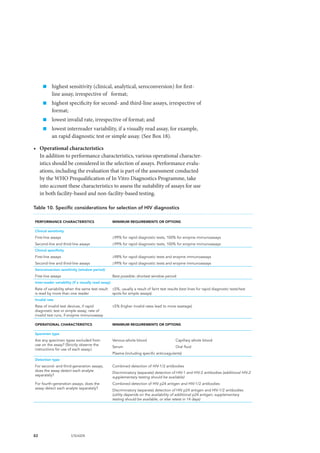
WHO recommends using standardized HIV testing strategies to provide accurate test results
(24). In particular, if enzyme immunoassays are used for screening, a more-specific confir-
matory assay should be included to confirm all enzyme immunoassay–reactive specimens.2
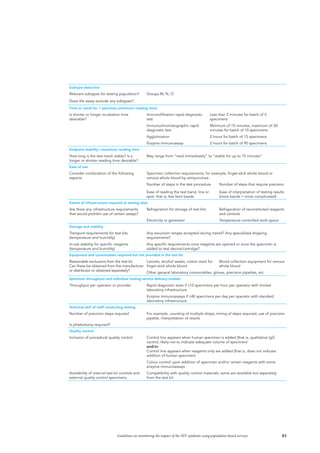
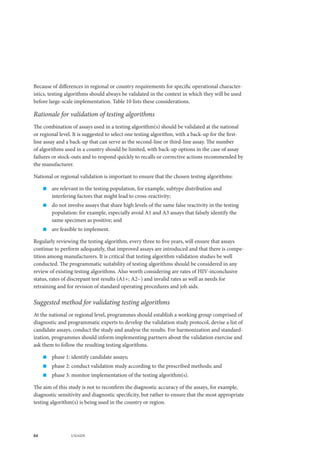
Programmes should be sure to validate national testing algorithms for diagnosing HIV status,
and Annex 2 describes these methods.
When considering how to measure HIV prevalence in a population-based survey, survey
implementers should carefully assess the implications for whether estimates arise from HIV
testing services done in the home using rapid diagnostic tests or from testing done outside
the home, typically in a laboratory. These different testing approaches may lead to different
participation levels determined by the acceptability of each approach (25,26). Acceptance
levels for different approaches also may vary within and across countries. Low response rates
2	 Use of an enzyme immunoassay–based algorithm only can result in an unacceptably high level of false-positives due
to the highly sensitive nature of third- and fourth-generation enzyme immunoassays. This will result in overestimation of
prevalence in the survey and false-positive diagnosis of individuals when the results are returned.
23Guidelines on monitoring the impact of the HIV epidemic using population-based surveys
may bias the overall estimate of HIV prevalence, particularly if individuals who have previ-
ously been diagnosed with HIV refuse home-based HIV testing services. This may be of
greatest concern in settings in which access to HIV testing services is high.
Survey implementers should specify the HIV testing approach clearly in the survey protocol
and final report. They should also carefully consider the potential implications for the
validity of HIV prevalence estimates and other follow-on biomarkers, such as ART exposure
or population-level viral load, when response is low. Section 5.1 describes approaches for
calculating and accounting for non-response in general population-based surveys in more
detail. Finally, countries should exercise caution in drawing conclusions about trends in HIV
prevalence from surveys if testing methods differ across survey rounds.
HIV incidence
HIV incidence is a measure of people newly infected with HIV among individuals who are at
risk for becoming infected within a given time frame. Countries with hyperendemic HIV, in
which there has been either stagnant or increasing HIV prevalence over time, may consider
whether estimating HIV incidence is appropriate and feasible for inclusion in the survey given
the overall survey objectives. In most settings, HIV incidence biomarkers should only be
included when the estimated HIV prevalence among adults 15–49 years old is 5% or greater
and the estimated incidence is 0.3% or greater. At estimates of prevalence and incidence
below these values, the sample sizes required become prohibitively large at reasonable levels of
precision (see Annex 1 for more details).
When a population-based survey includes antibody-based HIV incidence testing, HIV
viral load testing is also necessary to verify the recency of infection (27). Viral load testing
within the context of estimating HIV incidence need only be performed on specimens with
an incidence biomarker test result indicating a recent infection. The results from the viral
load test can be used to reclassify the people with low viral load as not recently infected. This
strategy, referred to as a recent infection testing algorithm, is discussed in more detail in When
and how to use assays for recent infection to estimate HIV incidence at a population level (28).
Specific biological specimens that can be used in assays detecting recent HIV infection
include plasma, serum and DBS collected from capillary or venous whole blood, if the
manufacturer has validated the specific assay for that type of specimen. Assays that are
commercially available and field-validated and have the longest mean duration of recent
infection and smallest false recent ratio are recommended. The latest technical information
regarding available assays and considerations for including recent infection testing algorithms
in population-based surveys is available at http://www.who.int/diagnostics_laboratory/links/
hiv_incidence_assay/en/index4.html.
HIV incidence is calculated based on a formula that includes the estimated mean duration of
recent infection and corresponding relative standard error, the false recent ratio, the estimated
time before which a person is considered to be recently infected, the design factor for the
24 UNAIDS
prevalence of recent infection among positives and the results of the recent infection testing
algorithm assays. Important consideration must be made to select the correct mean duration of
recent infection and false recent ratio depending on the distribution of HIV subtype, especially
for countries with primarily subtype D infections (29,30). Tools developed to assist programme
officers with calculating HIV incidence are available at www.incidence-estimation.org; technical
assistance in using these tools can be sought from the South African Centre for Epidemiological
Modelling and Analysis.
CD4 T-cell count
An individual’s CD4 count is a marker of immune response to HIV infection. Historically,
it has also provided a clinical assessment of HIV infection at the individual level. In many
programmes, a certain CD4 count is used as a threshold to initiate ART and to initiate
prophylaxis.
Within a survey, population estimates of CD4 count can be used to characterize symptoms
among those living with HIV. Moreover, because of linkage between biomarker data and
individual-level data, inclusion of CD4 data, and increasingly viral load data, may provide
useful information for HIV programmes on the impact of expanded ART.
Enumeration of an individual’s CD4 count requires freshly collected whole-blood specimens,
collected either by venous draw or capillary. Although this test has traditionally been
conducted in a laboratory-based setting, access to new technologies is increasingly making
point-of-care testing feasible in population-based surveys (31).
Viral load measurement
At the individual level, HIV viral load measurement is used clinically to determine disease
progression and response to ART. This is done by measuring the concentration of HIV viral
particles in the bloodstream (or plasma). At the population level, viral load measures permit
estimates of the impact of ART among those who are living with HIV. In addition, viral
load test results can be used with other survey data, such as evidence of exposure to ART, to
estimate key indicators such as the proportion of population living with HIV and receiving
ART that are virally suppressed (viral load less than 1000 copies/ml). Finally, HIV viral load
measures are integral to estimating HIV incidence as part of the recent infection testing
algorithm, which was previously described in section 2.10.2.
Testing for HIV viral load is traditionally conducted in a laboratory, using plasma or DBS
specimens. However, like CD4 technologies, these technologies are increasingly being
validated and more widely used in point-of-care settings. Recognizing this, some countries
may opt to test viral load in a field-based rather than laboratory setting.
25Guidelines on monitoring the impact of the HIV epidemic using population-based surveys
Exposure to ARV medicine
Determining the proportion of people living with HIV receiving ART can be an important
indicator for many HIV programmes. In addition, evidence of ART exposure in a recent
infection testing algorithm may help to correct the misclassification of individuals as newly
infected who are not virally suppressed, although this information is not currently required
for estimating HIV incidence based on a recent infection testing algorithm.
Measuring recent exposure to ART drug analytes requires plasma or DBS specimens tested
in a laboratory setting. Standard testing of ARV medicine includes the presence of three drug
analytes of the most common first- and second-line treatments. Although testing platforms
vary, most currently available biochemical analyses used to estimate exposure to ARV
medicine require a high level of technical capacity and access to a mass spectrometer. As a
result, testing is limited to a small number of laboratories in sub-Saharan Africa.
Drug resistance
Given the rapid expansion of HIV treatment scale-up in countries, WHO recommends that
countries routinely monitor drug resistance (32). Drug resistance testing provides information
on the proportion of individuals failing therapy due to drug resistance. In addition, testing can
measure the proportion of individuals not yet receiving ART who will effectively respond to
first line therapy.
For the countries opting to include testing of exposure to ART or to collect self-reported data
on current and previous exposure to ART, HIV drug resistance genotyping on specimens
from these individuals can be used. To test for HIV drug resistance, either DBS or plasma
can be used as the specimen type. Laboratory methods for collecting, handling, processing
and tracking whole blood specimens are the same as those required for the broader survey,
although DBS specimens require processing within two to four weeks of collection. The WHO
HIV drug resistance webpage (33) provides more details on HIV drug resistance surveillance
and laboratory testing methods.
Other bloodborne and sexually transmitted infections
Inclusion in HIV surveys of other biomarkers of bloodborne and sexually transmitted infec-
tions, such as syphilis, hepatitis B, hepatitis C, gonorrhoea, chlamydia and trichomoniasis,
can serve several useful purposes in countries with high levels of HIV infection (34). Most
importantly, measuring them enables population-level assessment of the prevalence of coin-
fection with HIV. Such information also can be used to determine the following important
programmatic considerations:
26 UNAIDS
„„ identifying population subgroups at higher risk of HIV infection;
„„ clarifying the risk of significant side effects of ART for people living with HIV who are
coinfected with hepatitis B and C (35);
„„ assessing health-seeking behaviour and/or access to care for services;
„„ measuring the effectiveness of prevention programmes;
„„ determining the need for additional prevention and health services; and
„„ providing guidance on funding and resource allocation for programmes.
The most common non-HIV-related biomarkers included in population-based surveys are
syphilis and hepatitis B and C. These can be easily tested by laboratory-based methods with
due care for specimen collection and processing within the specified time frames. Rapid
diagnostic tests also exist for these markers, which are suitable for use in field surveys and
home-based testing, since they generally do not require refrigeration and can be used with
capillary whole blood.
Considerations for measuring syphilis and hepatitis B and C are summarized below.
„„ Syphilis: treponemal antibodies and non-treponemal markers. To differentiate
active infection from past, treated syphilis infection, supplemental testing for
non-treponemal markers has historically been required for all specimens that test
reactive for treponemal antibodies. This necessitates a serum specimen. Alternatively,
new tests are becoming available that detect lifetime exposure as well as active
infection in a single test. Countries should review the rapid diagnostic tests available
on the market before identifying a testing strategy in the survey protocol.
„„ Hepatitis B: hepatitis B surface antigen (HBsAg) status. Chronic HBV infection is
indicated by the presence of HBsAg while anti-HBc IgM is not present (negative).3
Since testing for anti-HBc IgM is highly unlikely to be readily available at a reasonable
cost, it is suggested to restrict surveys to testing for HBsAg status to determine
chronic HBV prevalence.
„„ Hepatitis C: anti-HCV status. The presence of HCV antibodies provides information
on HCV infection, either past or resolved or present or active. Additional testing may
be performed for HCV core antigen and/or HCV RNA. If either of these markers is
detectable, the specimen can be considered as an active HCV infection.
In settings with additional resources and previous indication of high rates of sexually
transmitted infections, testing for gonorrhoea, chlamydia and trichomoniasis can also be
considered. These infections are all treatable and thus serve as markers of unprotected sexual
activity. For these infections, nucleic acid testing can be conducted using urine, vaginal swabs
(provider- or self-collected) or urethral swabs.
3	 If testing for anti-HBc IgM is not available, the presence of HBsAg for a minimum of 6 months indicates chronic HBV
infection.
27Guidelines on monitoring the impact of the HIV epidemic using population-based surveys
Programmes also can consider including herpes simplex virus 2 (HSV-2) serology (in partic-
ular, type-specific IgG antibodies) in HIV surveys. Should HSV-2 serological biomarker data
be included, positive serology is a measure of lifelong rather than recent unprotected sexual
activity. When limited to testing in youth, markers of HSV-2 also can be used as a proxy for
sexual experience.
28 UNAIDS
Table 2. Summary of biomarkers
INDICATOR BIOMARKER
SURVEY IMPLEMENTATION
CONSIDERATIONS
SPECIMEN COLLECTION
PROCEDURES
FURTHER CONSIDERATIONS
HIV-related
HIV prevalence HIV-1/2 antibodies Consent for testing, including
diagnosis, required.
HIV status should be returned to
the individual at the time of the
survey or to nearest health facility for
collection.
Individuals should be referred to the
nearest health facility for entry into
care and assessment of treatment
eligibility.
Serum, plasma,
capillary or venous
whole blood, oral fluid
and DBS specimens.
Discrimination between the HIV-1 and HIV-2
subtypes requires a supplementary testing
with the ability to type infections.
Requires testing strategy of up to three
serological assays to determine true
infection status, especially if enzyme
immunoassays are used. May be a
combination of rapid diagnostic tests.
HIV status based on DBS specimens can
only be returned to study participants if
validated by assay manufacturers.
HIV incidence Recent infection
testing (antibody
concentration,
proportion, avidity)
Consent for testing required.
Test results are for population-level
inferences only and should not be
returned to the individual.
Plasma, serum, and
DBS specimens
collected from capillary
or venous whole
blood, provided the
specific assay has been
validated for that type
of specimen by the
manufacturer
Requires efficient specimen processing and
storage (-20C or below) because of the
quantitative nature of the assays.
Requires correct HIV-1-positive diagnosis
because both HIV-negatives and HIV-2
infections will be misclassified as recent
infections.
Requires field validated assays and
characteristics of the recent infection testing
algorithm (such as the mean duration of
recent infection and the false recent ratio)
that are specific to the epidemic context
CD4 absolute
count
Immunocompetence Consent for testing and return of
results required.
Test results should be returned to
the individual at the time of the
survey or to nearest health facility for
collection.
Individuals should be referred to the
nearest health facility for entry into
care and assessment of treatment
eligibility
Capillary or venous
whole blood
Specimen must be tested immediately
Population-
level HIV viral
load
HIV RNA or TNA Consent for testing and return of
results required.
Test results should be returned to
the individual at the time of the
survey or to nearest health facility for
collection.
Individuals should be referred to the
nearest health facility for entry into
care and assessment of treatment
eligibility.
Plasma or whole blood
may be tested using
DBS specimen, if
validated by the assay
manufacturer.
Requires specimen processing from whole
blood to plasma within 4 to 6 hours.
Requires nucleic acid testing technologies,
and therefore electricity and skilled
laboratory technician.
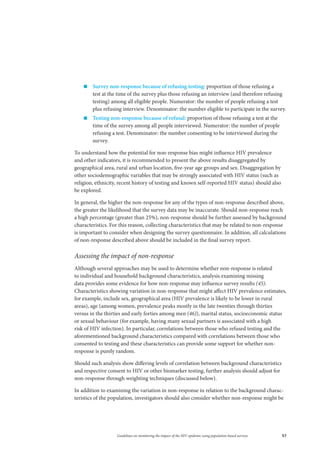
ART coverage Presence of ART
compounds
Consent for testing required.
Test results are for population-level
inferences only and should not be
returned to the individual.
Venous whole blood,
plasma, or DBS
specimens
Requires specimen processing from whole
blood to plasma within 4 to6 hours
Requires a mass spectrometer and therefore
complicated laboratory analyses.
HIV drug
resistance
HIV genotype
(RTNPR regions of
the pol gene)
Consent for testing required.
Test results are for population-level
inferences only and should not be
returned to the individual.
Whole blood, plasma
or DBS
Requires specimen processing from whole
blood to plasma within 24 to 48 hours
Requires technologies, and therefore
electricity and skilled laboratory technician
DBS specimen can be kept at room
temperature for a maximum of 2 to 4 weeks
and then frozen at -18 degrees.
Recommended that specimens are tested
in WHO-designated HIV drug resistance
genotyping laboratories.)
29Guidelines on monitoring the impact of the HIV epidemic using population-based surveys
INDICATOR BIOMARKER
SURVEY IMPLEMENTATION
CONSIDERATIONS
SPECIMEN COLLECTION
PROCEDURES
FURTHER CONSIDERATIONS
Other STIs and bloodborne infections
Hepatitis C
Prevalence of
HCV
HCV antibodies Consent for testing and return of
result required.
HCV status should be returned to
the individual at the time of the
survey or to nearest health facility for
collection.
Individuals should be referred to
the nearest health facility for further
assessment and treatment.
Capillary or venous
whole blood
Requires a testing strategy of one or two
serological assays to determine serostatus.
HCV viral load
(Indicator
of active
infection when
detectable
and indicator
of cure when
undetectable)
HCV RNA or HCV
antigen
Consent for testing and result
required.
Test results should be returned to
the individual at the time of the
survey or to nearest health facility for
collection.
Individuals should be referred to
the nearest health facility for further
assessment and treatment as
appropriate.
Plasma and serum Requires immediate specimen processing
from whole blood to plasma or serum.
Few data on accuracy of DBS specimens;
Results from DBS specimens may only be
returned to study participants if validated by
assay manufacturers.
Hepatitis B
Prevalence of
HBV
Hepatitis B surface
antigen (HBsAG)
Consent for testing and return of
results required.
Hepatitis B status should be returned
to the individual at the time of the
survey or to nearest health facility for
collection.
Individuals should be referred to
the nearest health facility for further
assessment and treatment.
Plasma, serum,
capillary or venous
whole blood
Analytical sensitivity of rapid diagnostic tests
is sub-optimal.
Syphilis
Prevalence of
syphilis (both
past or treated
and current or
active)
Treponemal
antibodies
Consent for testing required.
Test results should be returned to
the individual at the time of the
survey or to nearest health facility for
collection.
Individuals should be treated or
referred to the nearest health facility
for further assessment and treatment.
Whole blood, serum or
plasma
Treponema pallidum particle
agglutination assay, treponema pallidum
haemagglutination assay and EIA require
immediate specimen processing from whole
blood to plasma.
Rapid diagnostic tests for treponemal
detection available
Prevalence of
active syphilis
infection
Non-treponemal
markers
Consent for testing and return of
result required.
Test result should be returned to
the individual at the time of the
survey or to nearest health facility for
collection.
Individuals should be referred to
the nearest health facility for further
assessment and treatment.
Whole blood, serum or
plasma
Limited market availability of RDT for non-
treponemal markers; otherwise,
Rapid Plasma Reagin and Venereal Disease
Research Laboratory assay requires
immediate specimen processing from whole
blood to serum.
Assays require refrigeration.
Assays require laboratory technician.
30 UNAIDS
INDICATOR BIOMARKER
SURVEY IMPLEMENTATION
CONSIDERATIONS
SPECIMEN COLLECTION
PROCEDURES
FURTHER CONSIDERATIONS
Other STIs
Prevalence of
gonorrhoea
Prevalence of
drug resistance
Neisseria
Gonorrhoea
(organism or DNA)
Consent for testing and return of
results required.
Test result should be returned to
the individual at the time of the
survey or to nearest health facility for
collection.
Individuals should be referred to
the nearest health facility for further
assessment and treatment
Urine, vaginal swabs
(provider- or self-
collected), or urethral
swabs
Requires nucleic acid testing technologies
or culture.
Prevalence
of Chlamydia
trachomatis
Chlamydia
trachomatis
(organism or DNA)
Consent for testing and return of
results required.
Test result should be returned to
the individual at the time of the
survey or to nearest health facility for
collection.
Individuals should be referred to
the nearest health facility for further
assessment and treatment.
Urine, vaginal swabs
(provider- or self-
collected), or urethral
swabs
Requires nucleic acid testing technologies if
DNA or culture if organism.
Prevalence of
herpes simplex
virus 2
Anti-HSV-2 Consent for testing and return of
results required.
Test results should be returned to
the individual at the time of the
survey or to nearest health facility for
collection.
Individuals should be referred to
the nearest health facility for further
assessment and treatment as
required.
Serum or plasma Requires serological assays.
Prevalence of
Trichomonas
vaginalis
Trichomoniasis
vaginalis (organism
or DNA)
Consent for testing and return of
results required.
Test results should be returned to
the individual at the time of the
survey or to nearest health facility for
collection.
Individuals should be referred to
the nearest health facility for further
assessment and treatment
Urine, vaginal swabs
(provider- or self-
collected), or urethral
swabs	
Requires microscopy, nucleic acid testing
technologies or culture.
Prevalence
of human
papilloma virus
(types HPV16
and HPV18)
Human papilloma
virus DNA type
HPV16 and HPB18
Consent for testing and return of
results required.
Test results should be returned to
the individual at the time of the
survey or to nearest health facility for
collection.
Individuals should be referred to
the nearest health facility for further
assessment and treatment
Cervical brush or swab Requires nucleic acid testing technologies.
31Guidelines on monitoring the impact of the HIV epidemic using population-based surveys
Practical aspects related to choice of specimen and assays
Currently available diagnostics enable flexibility in the approaches used in population-based
surveys to measure HIV-related biomarkers. For example, many rapid diagnostic tests are
validated for use with capillary whole blood, while laboratory-based methods such as enzyme
immunoassay, chemiluminescence and electrochemiluminescence immunoanalysers are
validated for use with serum and plasma specimens. In addition, advances in the development
of new diagnostics for use at the point of care, including rapid diagnostic tests, have enabled
field-based laboratories to be used within the survey context. With a plethora of options for
biomarker testing approaches, selection of specimen collection and testing methods should
balance best clinical practices with the budget and feasibility constraints. Considerations for
specimen collection and testing are discussed below.
Specimen collection
Two common specimen collection methods are most often used for population-based surveys:
capillary whole-blood collection and venous whole-blood collection. Capillary whole-blood
collection refers to collection that is done through a skin puncture (typically a finger stick)
whereas venous whole blood specimen collection occurs through venipuncture and requires a
larger needle to be inserted into a vein.
Capillary whole-blood collection is advantageous for use in surveys, since it is less invasive
compared with venipuncture, very safe to conduct and can be easily taught to non-laboratory
and non-clinical staff. Capillary whole blood may be used directly in rapid diagnostic tests
to determine HIV infection (when a combination of up to three serological assays is used
within a validated testing algorithm) or to prepare a DBS specimen for serology or nucleic
acid testing. The manufacturers currently validate very few assays for use with DBS specimens,
however. If the manufacturer does not validate the assay for use with DBS, the test results
should not be returned to individual study participants (see section 2.6 for further discussion
of returning HIV status).4
To broaden the scope of assays available for measuring HIV-related biomarkers, many surveys
opt for venous whole-blood collection. As a specimen, depending on whether the collec-
tion tube has appropriate anticoagulant additives, venous whole blood can be used for HIV
serology, CD4 and other point-of-care testing, whereas the remaining blood can be processed
into plasma for viral load and other laboratory-based tests. Alternatively, if the tube has no
additives, whole blood can be processed into serum; both plasma and serum can be used for a
host of assays.
4	 Although the use of non-validated enzyme immunoassays using DBSs was permissible in the past, current recommen-
dations emphasize the ethical imperative to return a HIV status (diagnosis) to survey respondents. Thus, all assays and
specimen types selected for use in the survey where results are returned must have been validated by the manufacturer
for diagnostic purposes.
32 UNAIDS
If venous whole blood is collected in the field, the survey will require
appropriately trained personnel, infrastructure and equipment to process,
store and transfer specimens within the recommended time periods. As
a result, including venous whole blood in a survey significantly increases
survey costs; the transport logistics of transferring the specimens from the
field to the testing laboratory become more involved, and the team sizes
likely increase because of the special training required for phlebotomy.
Moreover, the response rate for surveys that include venipuncture may be
lower, especially among men and children.
To help guide the specimen selection method, Table 3 presents selected
strengths and limitations of each method.
Testing of specimens
For many biomarkers, specimens can be tested in one of three different
locations: in the home of the survey respondent, at a nearby health facility or
at a laboratory. The decision on where and how to conduct specimen testing
depends on a variety of factors, including the capacity of survey field staff,
availability of funding, the best clinical approach for testing the biomarker
of interest and, importantly, the survey objectives. For example, surveys
that include measurement of HIV incidence or ART exposure require using
laboratory testing of specimens for these biomarkers in a central laboratory.
Table 3. Strengths and limitations of methods of collecting blood specimens
SPECIMEN TYPE STRENGTHS LIMITATIONS
Capillary whole
blood
•	 Relatively non-invasive compared
to venous whole-blood collection
•	 Must be used immediately
•	 More painful than venous whole-blood collection
•	 Must be used immediately
•	 Cannot be stored
Capillary whole
blood for DBS
preparation
•	 Relatively non-invasive compared
to venous whole-blood collection
•	 Field staff are easily trained
•	 Specimen collection and logistics
are easier than for venous
collection
•	 More painful than venous whole-blood collection
•	 Few assays are currently validated by the manufacturer for use
with DBS specimens
Venous whole
blood for use as
serum, plasma or
as whole blood
•	 More versatile than capillary
whole-blood collection, greater
blood volume can be obtained
•	 A wide array of assays are
validated for plasma, or serum
specimens
•	 More invasive than a finger prick
•	 Transport of specimens required from the collection site to the
site of processing and/or testing
•	 Requires processing of whole venous blood specimen (generally
using centrifuge) within a specified period of time
•	 Appropriate storage of specimens required
•	 Trained phlebotomists required
•	 Team sizes likely larger than when collecting capillary whole blood
•	 Specially trained staff are required
•	 Lower response rates relative to capillary blood collection
33Guidelines on monitoring the impact of the HIV epidemic using population-based surveys
In contrast, if the survey objective only includes measurement of HIV
prevalence among survey respondents, home-based biomarker testing
may be sufficient to meet the survey objectives. Table 4 summarizes the
strengths and limitations of each testing approach.
Should laboratory testing occur, survey implementers should consider
storing unused specimens for unspecified future testing, which will require
explicit language in the informed consent from survey participants.
Storage of specimens provides the programme with a repository to answer
important research questions that may arise in the future. Despite this
benefit, the cost of storing specimens can be high and technical capacity
is required to maintain them; thus, implementers should consider the
availability of resources in the particular country and whether specimen
storage is feasible.
Budget planning and survey timeline
When the overall survey budget is developed, it is recommended that
budget planning be divided into major tasks, which correspond to the
survey activity timeline. Most surveys should aim to be completed within
two years, including the time that it takes to plan the survey and publish
the final report.
Key survey tasks that involve costs beyond staffing include the pretest,
listing operation, main training of field teams, fieldwork, specimen testing,
Table 4. Strengths and limitations of testing locations
TESTING LOCATION STRENGTHS LIMITATIONS
Home-based testing •	 The results can be provided to the
survey respondent immediately
(following a nationally validated testing
algorithm)
•	 Field staff need to be trained including in quality
assurance
•	 Less assurance of confidentiality of results if a private
place cannot be secured or the time required for
testing differs according to whether or not a person is
infected with HIV
•	 Not all biomarkers have an assay format for home-
based testing
Health facility •	 The results can be provided to the
survey respondent immediately or
shortly after testing (following a
nationally validated testing algorithm)
•	 Limited transport costs, since a
laboratory is not required
•	 Limited opportunities for quality assurance
•	 Field teams require personnel who are trained in the
test procedure and quality assurance
•	 Requires a system to link results back to survey
respondents
•	 Not all biomarkers can be tested in a local health
facility
Laboratory •	 Data quality likely to be higher because
of better quality assurance and likely
more proficient operators
•	 Results may be challenging to return
•	 Requires unique patient identifiers that are linked to
study identifiers
•	 Logistical challenges with specimen transport
•	 Requires a system to link results back to survey
respondents
34 UNAIDS
data entry and analysis, report writing and dissemination activities. For example, budget line
items for the main survey training will include venue costs, field team salaries, field team per
diem allowances, fuel for field practice, printing questionnaires for training, laboratory costs,
etc. Sufficient detail should be provided in the budget to provide an overview of essential
survey costs, and the budget should be constructed to allow some flexibility with survey costs.
It is generally accepted to allow 10% flexibility per line item.
Increasingly, surveys are supported from multiple funding sources, through both in-kind
donations and domestic funding. When multiple donor agencies are covering survey costs, the
budget should note which specific line item(s) each donor is supporting. All survey donors
should be provided with a copy of the budget, detailed by line item, and a work plan with a
corresponding timetable in the form of a signed memorandum of understanding.
The overall budget and survey timeline depend on the survey design and protocol. Annex 3
presents a sample of the budget categories that should be included. A corresponding survey
timeline in Annex 4 illustrates the expected sequence of events from survey planning to
analysis and publication of results.
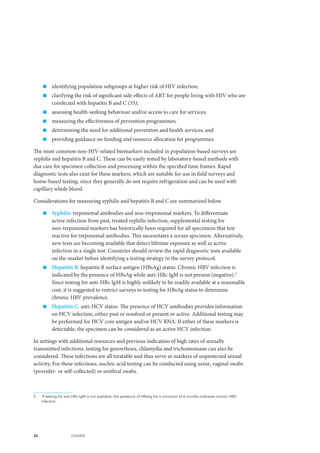
35Guidelines on monitoring the impact of the HIV epidemic using population-based surveys
Pre-survey implementation planning is an essential component of a successful population-
based survey. This section highlights important considerations for survey planning. The topics
discussed include staff organization, mobilizing local leaders, preparing training documen-
tation and training staff for survey implementation. Careful consideration of the topics
presented in this section will enhance survey implementation, leading to high data quality for
monitoring the epidemic and the country’s AIDS response. Within this chapter, the following
recommendations are of great importance when planning survey implementation.
„„ Thorough recruitment to ensure that all survey staff members are dedicated to the
project and of high calibre will greatly enhance the overall data quality of the survey.
„„ If multiple biomarker specimens are collected and/or tests conducted at households, a
laboratory technician or nurse will be best suited to collect specimens and conduct testing.
„„ If the survey includes home-based HIV testing, it is recommended that trained HIV
counsellors be responsible for this portion of the biomarker component of the survey.
„„ Early communication and engagement with community leaders will not only increase
local ownership of the survey but also increase the survey response rates.
Staff organization
The staff required to conduct a population-based survey can be organized into four distinct
categories: survey implementation management, field staff, data management and laboratory
personnel. Annex 5 provides a bulleted list of specific roles and responsibilities for each type
of personnel. A summary of the positions also follows.
Survey implementation staff members include a project director, a survey director, a deputy
survey director and at least two fieldwork coordinators.
The project director, usually a higher-level staff member, will provide policy guidance and
direction for the survey and is a critical liaison between the implementing agency and the
survey steering committee (discussed below).
In comparison, the survey director provides day-to-day oversight of the survey activities and
is the acting manager of the survey. As acting manager, this individual works with all survey
staff, including the technical committee (discussed below) by providing technical oversight for
the survey activities. The deputy survey director works with the survey director to implement
the survey activities.
Field coordinators are responsible for ensuring high data quality throughout data collection
in the field. In addition to office management staff, administrative staff, a sampling expert, a
geographical information coordinator, analysts and data communication specialists may be
necessary for realizing the survey.
Survey implementation staff members are typically full-time employees of the agency imple-
menting the survey or stakeholders coordinating survey efforts. Collectively, they are account-
PLANNING SURVEY IMPLEMENTATION
36 UNAIDS
able for the day-to-day operational management of the survey planning and implementation;
the survey implementation staff members are responsible for the overall quality of the survey.
Field staff members include supervisors, interviewers, biomarker technicians (see Box 4) and
a team driver. Surveys with large questionnaires may even include a field-based editor. Using
a teamwork approach, the field staff members travel in groups to collect data throughout
the entire country. During data collection activities, supervisors oversee interviewing and
specimen collection, manage field logistics, track questionnaires and biological specimens
and determine work assignments. If an editor is included in the team, the editor conducts
the primary check of questionnaire quality and ensures that errors are corrected; in surveys
without an editor, the team supervisor is responsible for checking the quality of the question-
naires. The interviewers conduct face-to-face interviews at the household and individual levels.
In many settings, if sensitive questions will be asked, it is most appropriate for women to
interview women and men to interview men. The composition of interviewers by sex on a
team should reflect the ratio of women to men in the sample. The individuals responsible
for the biomarker components of the survey need to understand the procedures related to
obtaining consent and assent and must be able to collect, test, record, store and transfer
biological specimens.
When teams are being created, each team member’s workload should be carefully considered.
Team members are responsible for more than one aspect of data collection and biomarker
procedures. The number of field staff members required for the survey depends on the overall
sample size, fieldwork timeline, the number of capable staff members available to work for
the duration of the fieldwork, the number of languages into which the questionnaire has been
translated, vehicle availability, the number and type of biomarkers included in the protocol
and available funding. The team composition depends on the overall survey protocol, specifi-
cally the field procedures for measuring biomarkers.
Highly motivated, hard-working field staff members of high calibre should be recruited to
produce the highest-quality data possible; all recruited individuals should be available to work
for the entire duration of fieldwork. If possible and relevant to the survey context, it is recom-
mended that field staff members be able to read and speak at least two of the languages in which
the survey is being conducted. Survey implementing staff members should consider the strengths
and limitations of hiring field staff members with previous survey implementation experience.
Box 4. Recommendations for staffing for biomarker collection and testing
If multiple biomarker specimens are collected and/or tests conducted at households, a labora-
tory technician or nurse will be best suited to collect specimens and conduct testing. If the
survey includes home-based HIV testing, it is recommended that trained HIV counsellors be
responsible for this portion of the biomarker component of the survey.
37Guidelines on monitoring the impact of the HIV epidemic using population-based surveys
Data management staff members are responsible for entering, cleaning and processing the
survey data. If paper questionnaires are used to collect data, data management staff members
include a data-processing supervisor, a secondary editor, an office editor, a questionnaire
administrator and data entry staff members. Electronic data capture requires additional
programmers, but positions for an office editor, a questionnaire administrator and data entry
staff members are generally not required. The data management team’s primary responsi-
bility is to create a standardized dataset by reducing discrepancies in the data and correcting
any entry errors. Complete verification, with double data entry for paper questionnaires, is
required to produce a consistent data set. If capture of the survey is used, the data manage-
ment team will assist the survey implementation team in producing data quality-check tables
to monitor the field teams.
Laboratory personnel are an integral part of HIV surveys. Any biomarker assays conducted in
a laboratory will require staff to manage specimen organization and testing. The team should
have one staff member responsible for logging, labelling and storing specimens and one
person responsible for managing the database of test results. In addition, a laboratory super-
visor will oversee the testing for specific biomarkers. A small core of laboratory technicians
should be hired to conduct the biomarker testing. It is recommended that all staff members
receive in-depth training of the biomarker component of the survey, if it is not already part of
their usual menu of testing. This training should provide clear instructions for receiving and
storing specimens as well as conducting the assay and accurately recording the test results.
In addition to managerial and logistical staff members, a population-based survey also
requires oversight from a technical committee and a steering committee. A technical
committee should comprise mid-level staff members from in-country stakeholder organi-
zations with expertise in population-based survey implementation, including biomarker
collection and testing and technical subject matter related to the survey objectives. The
technical committee provides resources and support for the agency implementing the survey;
specific guidance provided by the technical committee includes but is not limited to question-
naire development, sample design, biomarker selection and data collection methods. The
steering committee, in contrast, should provide assistance and guidance regarding the overall
survey objectives, policy issues and ethical considerations and thus comprises high-level staff
and officials. These two committees should include representatives from government and
nongovernmental institutions. The membership of these committees can assist in mobilizing
national support for the survey within the government. Including government officials,
university scholars and representatives of international organizations and donor institutions
on these committees can help to ensure acceptance and use of the survey data by national
HIV organizations.
38 UNAIDS
Communication and community mobilization
To obtain national, regional and community support for the survey activities, the agency
implementing the survey should use public relations activities to inform local officials about
the survey objectives, protocol, need for overall community participation and use of survey
results. With an understanding of the importance of the survey data, local officials may,
in turn, assist in mobilizing community members to participate in the survey. In addition,
community members may be mobilized through direct mechanisms, such as exposure to
the survey during the initial community mapping activities; poster distribution; newspaper,
radio and television shows; and social media outlets announcing the launch of the survey.
Participation in the survey may increase if such activities successfully reach potential
respondents.
Critical components of community mobilization messaging include building awareness on
procedures for biomarker collection, testing and storage, the confidentiality and anonymity
of the results and the benefits of the survey to those involved. Mobilization is most effective if
initiated during the survey planning stage and continued throughout the survey implementa-
tion process, whereas local mobilization efforts should be rolled out at the start of survey
implementation and remain ongoing until the end of survey implementation.
Preparing training documentation
Preparing manuals for fieldwork
A critical component of survey planning is developing training manuals and other docu-
mentation that provide detailed guidance for fieldwork procedures. Training manuals clearly
outline the survey objectives and procedures to provide standardized training methods while
providing a protocol reference for field staff members during the data collection process.
Importantly, using standard training manuals ensures the comparability of data across time
within the same country as well as between countries. Separate manuals should be created
for each category of field staff, including a supervisor’s or editor’s manual, interviewer’s
manual and biomarker technician’s manual. The supervisor’s or editor’s manual should
outline guidance on supervising teams, maintaining quality assurance and tracking question-
naires and specimens. The interviewer’s manual should provide guidance on how to identify
households and conduct interviews, and the biomarker technician’s manual should discuss
procedures for field collection and processing of biological specimens. Examples of these types
of manuals are available at www.dhsprogram.com/publications.
When manuals for use in training are created, it is recommended to edit standardized training
documents that reflect current international guidelines rather than to create new, original
manuals. By using standardized manuals as a guide, the collected data reflect current defini-
tions and survey protocols, which not only enhances global monitoring of the HIV epidemic
but also ensures that country-level data are as up to date as possible.
39Guidelines on monitoring the impact of the HIV epidemic using population-based surveys
In addition to providing guidance for fieldwork procedures, it is also recommended that a
risk-mitigation strategy be developed. This should include biomedical safety for the team
members and a standard operating procedure for managing potential staff and participant
security concerns.
Pretest
A pretest of all survey procedures, including counselling and HIV testing and administra-
tion of the survey questionnaires, will highlight potential errors in training, instruments and
implementation as well as the general comprehension of the respondents’ understanding
of survey questions. Primary pretest objectives include checking the utility and accuracy of
standard operating procedures and training materials, the fidelity of translations of the survey
instruments and training manuals, the skip patterns in the questionnaires and the application
of biomarkers.
For surveys using electronic data collection, the pretest provides an opportunity to thoroughly
check the data entry application for programming errors. Thus, it is critical that the pretest
training and pretest data collection reflect the procedures that will be conducted in the
main survey training and fieldwork. To ensure both high-quality and ethical data collection,
biomarker field logistics, including obtaining consent and assent, sample collection, testing,
storage and transport as well as counselling and referrals for clinical care based on biomarker
test results (if applicable) should be a main focus of the pretest. Any problems identified
during the pretest should be corrected before the main survey training.
Box 5 presents general recommendations for the pretest; examples of specific recommenda-
tions for conducting pretest training are outlined in DHS programme documentation entitled
Survey organization manual.
Box 5. Pretest recommendations
Pretest timing: 2–3 months before main survey training.
Pretest length (training and field practice): at least 3–4 weeks, although it depends on the
survey protocol.
Pretest data collection: At least 100 households over seven days in areas not included in the
main survey fieldwork. Interviews should be conducted in all languages into which the instru-
ments are translated.
40 UNAIDS
Field training staff
The purpose of staff training is to ensure that all field staff and data entry personnel clearly
understand their roles and responsibilities and know how to carry out their tasks before the
fieldwork starts. Training should emphasize the value of the survey and the resulting data,
which will help survey staff to appreciate the importance of their roles and responsibilities
in accurately collecting these data. One method of discussing the importance of the survey
includes presenting findings from previous HIV surveys and discussing how these data
influenced HIV policies and programmes within the country. During the training sessions,
survey staff members should have the opportunity to discuss concerns and obtain clarifica-
tion on survey operations or to share any previous experiences. All staff members should feel
confident with the survey procedures in which they will be involved.
Maintaining motivation among survey staff members, especially at the beginning of survey
activities, will facilitate high-quality work and completion of all survey activities. Motivation
of staff members can be maintained in training by:
„„ developing a sense of survey ownership among staff members;
„„ defining clearly the responsibilities and roles of all staff members at all levels;
„„ emphasizing the importance of each person’s contribution; and
„„ providing feedback on performance throughout training.
The staff training influences the overall quality of population-based survey data. Intensive
survey training should focus on the survey protocol using the survey manuals. All field staff
candidates should be trained on how to accurately record information using the survey
instruments, obtain informed consent for interview and biomarker specimen collection (when
possible) and work as a team to meet the survey objectives. Important training topics include
building rapport with respondents and maintaining the confidentiality of responses and test
results.
Discussions of field logistics and team coordination should be woven into the training. In
addition, in-country guest lecturers should provide trainees with relevant information to
contextualize the survey fieldwork. For example, a presentation describing the HIV epidemic
in the country is appropriate for the first or second day of training. Such a presentation should
include information on HIV transmission and prevention. In addition, trainees should be
briefed on the country’s policies and programmes related to HIV testing and counselling,
treatment, and care. When relevant, programmes discussing transmission, prevention and
treatment of sexually transmitted infections should also be discussed.
To maintain clarity throughout the training, it is recommended that all outside guest lectures
be briefed on the survey objectives and protocol before their presentations. Box 6 presents
general recommendations for training. Detailed procedures for field staff training are covered
in depth in the DHS programme document Training field staff for DHS surveys (36), which
41Guidelines on monitoring the impact of the HIV epidemic using population-based surveys
provides guidance on population-based survey implementation for surveys targeting the
general adult population.
If the survey protocol dictates that biomarker technicians are responsible for conducting
specimen collection and testing, additional, separate biomarker training, including training
in biomedical safety and post-exposure prophylaxis, should be provided for these individuals.
Likewise, should field procedures require either laboratory technicians or HIV counsellors,
these trainees must also be provided with specialized biomarker training. To prevent extra
burden on field staff, only those collecting biological specimens or supervising the collection
and return of results should receive biomarker training. Biomarker training should include
detailed classroom discussions and demonstrations of biomarker survey instruments, blood
collection techniques, storage of specimens and appropriate disposal of biohazardous waste.
Ethical approaches to biomarker collection and testing should be a central theme of the
training. Should a survey include any sort of field-based testing, providing respondents with
results (if applicable) and clinical referrals (if required) must be emphasized; training should
include guidance on how to handle potentially difficult situations with empathy through the
use of role play.
In addition to the above training, hands-on peer practice and mock fieldwork in households
should be included. If the survey includes collection of biological specimens from children,
training should involve practice in a clinic or other setting allowing practice on individuals in
the relevant age groups. Field practice is an integral part of training, since it enables all field
staff to rehearse sample storage and transfer logistics.
At the end of the training, final selection of field staff should be based on objective criteria.
Trainees should be evaluated for inclusion in the survey based on their performance on a
series of written tests, observation of their performance during classroom practice and the
quality of their field interviews or sample collection and testing techniques.
Box 6. Main training recommendations
Training timing: one month before survey fieldwork.
Training length: about four weeks, depending on biomarker complexity.
Training field practice: field practice is a critical component of the training. Each interviewer
should interview at least five households, and each biomarker technician should collect
blood and test (if applicable) all consenting individuals in at least five households over seven
days in areas not included in the main survey fieldwork. Interviewers should be conducted
in all languages into which the instruments are translated. Field practice should reflect the
biomarker procedures included in the survey to allow biomarker trainees sufficient practice in
mastering the survey protocol.
42 UNAIDS
The overall purpose of a population-based survey with HIV testing is to collect high-quality
data to accurately characterize the HIV epidemic in a given geographical area. To meet this
objective, guidance provided in this section provides structure for field operations with
the intent of maintaining high data quality. The following topics are discussed: conducting
interviews, biomarker testing, providing HIV testing services, collecting GPS data and field-
based data management procedures. These discussions highlight the influence of these survey
implementation aspects on accurate capture of an individual’s knowledge, attitudes, behaviour
and possible infections related to HIV infection. The list below presents key recommendations
for survey implementation that will improve the survey’s data quality.
„„ When a respondent is not at home, field staff should make three return visits to a
household at different times on different days.
„„ Interviews should be sex-matched, such that female field staff members interview
women and male field staff members interview men.
„„ The survey’s approach to home-based HIV testing services should provide
respondents with their HIV status and link them to care and treatment if applicable.
„„ Stringent quality control measures, including observing interview and biomarker collection
and providing feedback to field staff, should be in place throughout the field operations.
Conducting interviews
Two common population-based survey tactics, callbacks and rapport, are used during
interview operations to improve the overall survey data quality. Scheduling return visits, or
callbacks, can limit non-response by reducing the number of households and individuals
excluded from the survey because of absence; whereas creating good rapport between the
interviewer and the respondent can limit misclassification of results and encourage respon-
dents to answers the survey questions honestly. A further discussion of incorporating these
two activities into survey fieldwork follows.
Using return visits to limit non-response
To ensure high response rates for survey participation, field staff members should follow a strict
policy regarding household visits. If an individual is not at home during the interviewer’s initial
visit, it is recommended that at least two additional visits be made to the household. These return
visits, or callbacks, should be made on separate times of the day or on different days; if appro-
priate, callbacks can be scheduled with the assistance of the primary head of the household.
Field staff should carefully document the number of visits and the day and time at which
the visit was conducted. Should a respondent request an appointment for the interview, the
interviewer should note the time and day of the appointment and return to the household at
that time. Scheduling callbacks is critical for reducing non-response. Section 5.1 discusses
non-response in detail.
FIELD OPERATIONS
43Guidelines on monitoring the impact of the HIV epidemic using population-based surveys
Ensuring interviewer rapport
Survey researchers correlate good interviewer rapport with high-quality data. When a survey
respondent feels comfortable with an interviewer, the respondent is more likely to provide
complete and honest answers to the survey questions.
For this reason, it is recommended that individual interviews be sex-matched so that female field
staff interview women and male field staff interview men. Since many of the questions used to
measure HIV knowledge, attitudes and behaviour are sensitive, building good rapport between
the interviewer and respondent is a driving factor of the overall data quality.
The foundation of interviewer rapport is laid before the interviewing begins. The interviewer’s
initial introduction to the respondent should be cordial, kind and informative. A good first impres-
sion should not be underestimated in building trust between the interviewer and respondent.
Following a thorough introduction, the survey’s informed consent procedures can be discussed.
During discussion of the informed consent procedures, the interviewer should carefully read
the consent statement to the respondent. The interviewer should communicate to the respon-
dent that voluntary participation includes the right to refuse the interview, to refuse to answer
any question(s) or to stop the interview before completion. Further, the interviewer should
emphasize that the respondent’s answers are confidential and take time to honestly answer any
initial questions the respondent may have. Should the respondent agree to participate in the
interview portion of the survey, a private location must be identified to conduct the interview.
Box 7 further discusses the importance of privacy.
Good rapport, although established in the introduction, is solidified throughout the interview.
Rapport can be maintained and even developed throughout the interview by using several
approaches.
First, interviewers should remain neutral while asking questions and recording the respondent’s
answers. Neutrality is best practiced when an interviewer reads the questions exactly as written
Box 7. The importance of privacy
Although ensuring privacy is important for building good rapport with a respondent, the
interviewer has an ethical obligation to maintain privacy during the interviewer. In addition,
maintaining privacy communicates to the respondent that the interviewer gives priority to the
promised confidentiality described in the consent statement. In particular, actions to ensure
privacy of interview will emphasize that the respondent’s answers will not be disclosed.
If other household or community members approach the interviewer and respondent during
the interview, the interviewer should take care to communicate that the interview is private. If
others do not leave, the interviewer should ask the respondent to continue the interview in a
different location.
44 UNAIDS
in the questionnaire and does not form expectations about how a respondent may answer a
question. Reading questions as they are written allows each and every respondent to hear the
same questions, and interviewing without expectations conveys a lack of judgement towards
the respondent during the interview.
In addition to neutrality, patience while interviewing is a fundamental approach for ensuring
rapport between the interviewer and the respondent. If the interviewer patiently listens to the
respondent and avoids suggesting answers, the respondent will know that his or her answers and
opinions are valued.
Biomarker field operations
Implementing the field-based biomarker component of an HIV survey can be very compli-
cated. Poorly organized or rushed sample collection, testing, storage, processing and transfer
will jeopardize the overall quality and accuracy of the biomarker data. Moreover, it may
compromise the safety of respondents and field staff.
Box 8 presents general guidelines for biomarker field operations.
Specific recommendations for collecting biomarker data using ethical approaches to optimize
safety and data quality are discussed below.
Obtaining informed consent
Section 2.6.1 provides more detailed guidance on the ethical considerations for obtaining
informed consent. This section describes the practical steps for obtaining informed consent
during fieldwork.
Box 8. General guidelines for field-based biomarker procedures
Biomarker collection and testing should be conducted after the individual interview. Because the
respondent has built good rapport with the team interviewer, he or she may feel more comfort-
able consenting to biomarker collection and testing after the interview. If biomarker collection
and testing are conducted after the individual interview and the respondent refuses to partici-
pate in the biomarker component of the survey, interview data will not be lost because of refusal.
Similar to the survey interview, all components of the biomarker collection and testing should
be conducted with privacy.
The quantity of biomarker supplies (appropriate blood collection tubes, syringes, needles,
test kits and related supplies, timers, alcohol swabs, biohazard containers etc.) should be
monitored throughout the duration of fieldwork. If supplies are running low, the team should
contact the main survey implementing office for additional materials.
45Guidelines on monitoring the impact of the HIV epidemic using population-based surveys
Before biomarker collection and testing, informed consent must be sought from the eligible
respondent. Informed consent statements should be read exactly as they are written to
ensure that the respondent is given sufficient information with which to decide whether to
participate.
Field staff members obtaining informed consent should clearly communicate the five basic
components of the consent statement:
„„ a description of the objectives of the test;
„„ basic information on how the test will be conducted and the results returned;
„„ assurance about the confidentiality of the results;
„„ the risks and benefits of participation; and
„„ a specific request for permission to collect the sample.
After reading the consent statement, the respondent should be given an opportunity to ask
questions related to specimen collection, testing, storage and transfer.
Consent should be informative and clearly describe pathogen transmission, an individual’s
likelihood of infection and the connection that the testing has to one’s overall health (37).
Consent should never be coerced, and most importantly, separate informed consent should
be obtained for each of the biomarkers included in the survey. If the survey protocols include
specimen storage for possible future testing, the respondent should also provide consent to
store the specimen for unspecified future testing without the return of the test result.
If the respondent consents to biomarker collection and testing, supplies and equipment for
specimen collection and specific tests consented to should be prepared in accordance with the
survey protocol. If the results are to be returned to the household later or to a nearby health
facility, the respondent should be clearly informed of this process. If the respondent refuses to
participate in the biomarker component of the survey, the respondent should be thanked and
the survey should be ended.
All respondents, whether or not they agree to biomarker collection and testing, should be
given an HIV informational brochure. The brochure should contain basic education informa-
tion describing HIV transmission and prevention. In addition, it should also list locations of
nearby centres that provide HIV testing and counselling services, HIV treatment and other
health services.
Collecting and handling specimens
The survey protocol should outline specific standard operating procedures for field-based
biomarker collection and testing applicable to the survey being conducted. Most often, the
field procedures will outline step-by-step instructions for collecting high-quality capillary or
venous whole-blood specimens and conducting accurate testing using rapid diagnostic tests,
all while maintaining respondent confidentiality.
46 UNAIDS
Regardless of the specific combination of biomarker tests included in the survey, field opera-
tions should give priority to respondent and field staff safety. Universal precautions should
be followed during specimen collection, testing and handling to prevent the exposure of both
field staff and respondents to bloodborne pathogens, such as hepatitis B and C or HIV (38).
These universal precautions include:
„„ wearing gloves during all contact with the respondent;
„„ never reusing gloves;
„„ using a new lancet or needle and testing supplies and equipment for each eligible,
consenting respondent;
„„ avoiding eating and drinking during specimen collection or near blood specimens; and
„„ properly disposing of all biohazardous waste accumulated during specimen collection in
an appropriate container, such as a biohazardous waste container or sharps container.
If the protocol dictates collection and transfer of blood specimens outside the household, the
specimen should be stored in a cool, dry place until processing and transfer. Box 9 presents
instructions for storing blood specimens. Specimens may either be stored in a secure location,
or if the survey protocol requires use of a laboratory to conduct non-rapid biomarker testing,
the specimens may be stored in the field until transferred and tested.
Box 9. Processing and storing specimens
DBS: DBSs are collected either from capillary or venous whole blood and added to the filter
paper via hanging drop or micropipette (if capillary) or precision pipette (if venous) for testing;
the specimens should be allowed to dry and then be protected from light. It is critical that
humidity levels in the storage container (such as a plastic zip-lock bag) be low; use of desiccant
packets within the storage container can help to reduce moisture in the air. The humidity level
can be monitored by using humidity indicator cards.
Venous whole blood: if venous whole blood is collected in the survey, it should be kept cool
and away from direct sunlight. Whole blood should be tested for applicable biomarkers on site
such as CD4 and then processed: that is, separated into serum or plasma or used to make DBSs,
as specified in the protocol. These specimens should be stored appropriately as soon as possible
following collection.
Serum or plasma: after collection, these specimens should be processed immediately or at least
within six hours. After testing, serum or plasma specimens should be aliquoted, labelled and
stored immediately. The specimens can be stored on ice packs for short duration (one to two
days during transport), in the refrigerator (4–8°C) for up to one week or in the freezer (–20°C
or below). Specific biomarker testing procedures will dictate actual specimen processing and
storage conditions as specified in the protocol.
47Guidelines on monitoring the impact of the HIV epidemic using population-based surveys
Should the specimens be tested in a field-based facility rather than a central laboratory, the
team supervisor should seek a cool, well lit and well aerated room to set up a field laboratory.
It is recommended that the field laboratory space have running water and a sink. There should
also be adequate bench space that provides sufficient room for the required equipment and
to conduct the testing. The laboratory should have a consistent electricity supply and should
remain locked when not in use. If possible, the team may use laboratory facilities in the
cluster’s health clinic in which all supplies and equipment should be kept in a secure cabinet.
Transferring specimens
To track specimens, a unique identifier or barcode should be assigned to each specimen tested
in the field or transferred to a laboratory for testing. A corresponding barcode label should
also be placed on the questionnaire and on the field tracking form at the time of specimen
collection. The unique identifiers and barcodes are a means of linking the final test results to
the information collected in the individual interview.
Extreme caution should be taken to ensure that the correct barcodes are used to link the
specimens and questionnaire. If the incorrect barcode is used, data on HIV knowledge, attitudes
and behaviour cannot be linked to the testing results. Moreover, the correct sampling weight
cannot be assigned to the test result, resulting in the exclusion of the specific data point from the
final analysis. It is also strongly recommended that the specimens and tracking form be checked
for barcode consistency as it is filled out, at the end of each day, and before leaving the cluster.
When the specimens are transferred from the field, the team supervisor is responsible for
confirming that the information recorded on the tracking form for each completed cluster is
accurate. At each step of the transport, the tracking form will be completed with a confirma-
tion of the number of specimens received and the number noted on the form. If inconsisten-
cies arise, the rationale for the inconsistency should be noted. Use of the tracking form is
critical for ensuring that the number of specimens collected in the field is in concordance with
the number of specimens received in the laboratory.
Providing HIV testing services, results and linkage to treatment and
care
The survey approach to home-based HIV testing services should be in accordance with
the country’s national guidelines for both HIV testing services and the national validated
HIV testing algorithm as described in Annex 2. This approach should also follow WHO
recommendations outlined in the 2015 Consolidated guidelines for HIV testing services (10).
Standardization of field procedures with national HIV testing service guidelines will ensure
consistent training of the field staff members responsible for conducting home-based HIV
testing services; use of WHO recommendations ensures that all population-based surveys
incorporate consistent HIV testing services. Specific components of home-based HIV testing
48 UNAIDS
services include pretest counselling, testing using HIV rapid diagnostic tests and post-test
counselling.
Counselling as part of HIV testing services serves two primary purposes. For the people
who test HIV-negative, it is a means of promoting HIV prevention methods. For the people
who test HIV-positive, it can encourage access to continuing care and counselling to prevent
further transmission.
HIV testing service counselling, by nature, is specialized to each individual. To address the
needs of all respondents, the survey’s HIV counsellors should be well versed in counsel-
ling topics, since they may need to adapt the pretest and post-test counselling discussion.
Inconsistent and subpar counselling skills are a significant challenge when including HIV
testing services in a population-based survey. Thus, only certified and experienced HIV
counsellors should be hired as survey field staff members.
Following testing, if the respondent tests HIV-positive, the HIV counsellor should refer the
respondent to treatment and care in a nearby health facility and the importance of adhering
to ART, both for their own health and to prevent further transmission. The HIV counsellor
should discuss preventing mother-to-child transmission if applicable and treatment for
other opportunistic infections such as tuberculosis and sexually transmitted infections.
Conversations regarding risk reduction, positive living, family planning and education and
disclosure of results should be included the post-test counselling session.
For a woman who tests HIV positive and has children, HIV counsellors should also refer the
woman’s children for HIV testing at the nearest health facility. If the survey includes on-site
CD4 or viral load testing, all respondents who test HIV-positive should be eligible for testing
following the post-test counselling session.
If the respondent tests negative, the HIV counsellor should frame the post-counselling session
around HIV prevention methods. In addition, depending on the ongoing risk of acquiring
HIV infection, the respondent should be encouraged to be tested again.
If the respondent has discrepant testing results, the HIV counsellors should refer the respon-
dent for additional testing to confirm their diagnosis in a HIV testing service centre.
Box 10 describes steps that should be taken when incorporating HIV testing services into
surveys to assure high-quality field implementation during the survey.
HIV testing services for children
Recent literature (39,40) shows that home-based HIV testing has increased the uptake of
HIV testing among children. In an effort to continue to reduce the gap between the number
of children living with HIV and the number of children receiving HIV treatment and care,
it is recommended that all children included in the survey receive home-based HIV testing
services pending parental consent and child assent. Because of the circulation of maternal
49Guidelines on monitoring the impact of the HIV epidemic using population-based surveys
antibodies, serological assays for children younger than 18 months should only be used to
rule out HIV exposure. Virological testing at 4–6 weeks with additional testing to confirm
the result is recommended. The parents or guardians of these children should be referred to
Box 10. Quality assurance measures for field implementation of home-based HIV testing
Ensure adequate time for HIV testing: home-based HIV testing will add 20–60 minutes of additional time spent
with each survey respondent. This additional responsibility on the teams may influence the quality of counselling
received as well as the overall interview data quality of the survey.
Team members should be careful not to rush the HIV counsellor on to the next household in an effort to quickly
finish the day’s activities; rushing HIV testing may affect the quality of the counselling received. Likewise, of partic-
ular concern in surveys, interviewers may feel pressure to complete the interview as quickly as possible because of
the multiple components of the survey; rushed interviewing negatively affects the overall data quality of the survey.
Team supervisors should be aware of the each team member’s responsibilities and the time required to complete
each task. Field schedules should be adjusted accordingly.
Ensure the confidentiality of HIV results: home-based HIV testing presents unique confidentiality concerns
for the survey. Similar to all biomarkers, the confidentiality of results should be given priority. Three important
considerations that can threaten the confidentiality of results include the time it takes to conduct HIV testing,
eligibility for supplement testing and the referral documentation.
•	 The length of time a HIV counsellor spends with a respondent may indicate the HIV test result. This may allow
other community members to infer a respondent’s HIV status. Although complete privacy may be difficult to
obtain in many households, particularly in densely populated areas, it is crucial that HIV testing be conducted
in seclusion. Conducting HIV testing immediately following the individual interview can also reduce concern
about confidentiality by limiting the ability of other people to distinguish between the length of time in which
the interview is conducted and the length of time in which HIV testing is conducted.
•	 The survey protocol should be developed in a manner that considers how to collect blood specimens from
individuals after they test HIV positive during HIV testing. Any additional specimen collection should be
designed to minimize the risk of other people determining eligibility criteria.
Careful consideration should be taken when developing referral documentation for individuals testing positive
for HIV. Such documents should maintain the individual anonymity of results but also provide an individual
with appropriate linkage to care. One possible solution for maintaining the confidentiality of results is to include
referral information in the brochure.
Adopt quality assurance measures for home-based HIV testing: although observation is important for
maintaining high-quality biomarker data, observing HIV testing may not be possible because of privacy consid-
erations. Nevertheless, without direct observation, determining whether the respondent received thorough
counselling can be challenging. One alternative to direct observation is to note the length of time a HIV coun-
sellor spends with a respondent during the HIV testing session. At a minimum, testing and counselling for an
HIV-negative individual will span about 20–25 minutes; less time may indicate that the HIV testing was rushed.
50 UNAIDS
a clinic for confirmatory HIV testing and for parental counselling rather than returning the
results of the serological assay or virological test.
Providing HIV testing services for children is a delicate process and should be approached
with sensitivity. Although there are many examples of complex issues inherent in HIV testing
services for children, one important consideration is that this testing may inadvertently
disclose the parent’s HIV status. Disclosure of HIV status may present a mental burden to the
parent and can inhibit consent to HIV testing services for children (41).
Reducing barriers to HIV testing, creating child autonomy and incorporating a family-centred
approach to treatment and care are only a few of the skills required of HIV counsellors who
conduct HIV testing services for children. Survey implementers should ensure that HIV
counsellors are thoroughly trained to provide consistent advice to parents regarding their
child’s HIV status. If HIV testing services for children are included in the survey protocol, it is
strongly recommended to hire paediatric nurses who are certified in HIV counselling as field
staff responsible for field biomarker collection and testing.
Since a consistent approach to HIV testing services for children is lacking, it is critical that
any survey follow the country’s national guidelines for home-based HIV testing services for
children. The WHO and UNICEF 2013 document Considerations for measuring the impact of
PMTCT programmes using population-based surveys in selected high HIV prevalence countries
(42) provides more detail about testing children as part of a population-based survey.
Incorporating GPS measurements
GPS data can facilitate understanding of the distribution of HIV infection in the population
and document where programmes have had greater impact. GPS can be measured either
during the main survey fieldwork or during the community mapping exercise. Collecting GPS
data during the mapping exercise is ideal; teams have fewer responsibilities at this phase than
they will have during the main survey fieldwork, and incorporating GPS measurements thus
does not add to their workload. In addition, operational costs can be reduced, since there are
often fewer mapping teams than survey field teams, thus requiring procurement of fewer GPS
units. Most importantly, collecting GPS data earlier in the survey timeline allows the opportu-
nity for GPS data to be verified before fieldwork and the coordinates to be recollected during
the main survey fieldwork if this is necessary.
If the survey protocol does not include separate mapping activities, GPS data can be collected
during the main survey fieldwork, but team supervisors are responsible for ensuring that
accurate GPS measurements are taken for each cluster.
Population-based surveys include one GPS measurement per cluster, typically collected at
the centre of the enumeration area. When the GPS is measured, it is critical that the GPS unit
receive adequate satellite signal strength. To do so, the individual measuring the GPS point
should be away from tall buildings, should not be standing underneath a tree canopy and
51Guidelines on monitoring the impact of the HIV epidemic using population-based surveys
should remain in a relatively open area. If adequate satellite signal strength is not received,
it is recommended that the GPS be measured at the closest large park or intersection to the
centre of the cluster. Heavy cloud cover may also inhibit the GPS unit from making sufficient
contact with satellites, and the team may have to delay GPS measurement until the clouds
have dissipated. GPS should never be measured indoors. Before leaving the cluster, the team
should confirm that the GPS point has been collected and that it is not a duplicate or pair of a
previous cluster.
If GPS data are collected before the survey fieldwork, GPS measurements should be recorded
on a paper form and also saved within the GPS unit itself. Written GPS points may be recorded
up to three times to reduce recording error. Data collected on paper provide a quality control
measure, as both a backup of the electronic data and also a cross-check for validation.
A DHS project document (43) provides detailed instructions for collecting GPS measure-
ments during survey data collection activities.
52 UNAIDS
Field-based data management, cleaning, validation and quality assurance
Quality assurance during the period of the survey fieldwork will be ensured through effective
supervision of the field teams. Both the team supervisors and senior staff from the organiza-
tion implementing the survey will supervise quality control. It is recommended that imple-
menting organization senior staff members periodically visit each field team throughout the
fieldwork. Thorough supervision of data collection includes quality control activities that
target interview data collection as well as biomarker data collection.
Interview quality assurance
During the survey fieldwork, three primary quality assurance procedures should be set in
place to ensure that interview data are of the highest possible quality.
•	 Spot-check as an external quality assessment measure. The team supervisor can check the
quality of the interview data by briefly reinterviewing certain households and comparing this
information to that collected by the interviewer. A quick spot-check is useful in determining that
the interviewer recorded information correctly, particularly the age of all household members,
a requirement for individual interview eligibility. It is recommended that spot-checks take place
on the same day as the original interview. At least one household should be spot-checked per
cluster, with each of the team members checked throughout the duration of fieldwork.
•	 Observe interviews as for external quality assessment. With the respondent’s permission,
either the team supervisor or the team editor should observe respondent interviews to
evaluate the interviewer’s performance. Interview observations may highlight any challenges
interviewers have with conducting the interview, such as not asking the questions as written
in questionnaires, recording responses incorrectly or following skip patterns incorrectly.
Further, observation will provide insight into the interviewer’s rapport with the respondent;
even under observation, rapport between the interviewer and the respondent indicates the
interviewer’s skill. When observing interviews, the supervisor or editor should sit close
enough to the interviewer to easily view the questionnaire. The supervisor or editor should
never interrupt the interview unless the interviewer makes a serious mistake. Depending on
the skill level of the interviewer, observing the entire interview may not be necessary. Care
should be taken when observing particularly sensitive components of the questionnaire.
Following the observation, the supervisor or editor should provide the interviewer with
feedback regarding his or her respondent rapport and questionnaire management. All the
team interviewers should be observed during the fieldwork.
•	 Thoroughly check completed questionnaires as a quality control measure.
„„ Interviews are recorded on paper questionnaires and data entry occurs at a central office.
The team editor is responsible for thoroughly checking the questionnaires for mistakes. To
ensure that all questionnaires are completed with the correct skip patterns and to reduce
the amount of missing information, the team editor should check all questionnaires
before the team leaves the cluster. If the editor finds any mistakes, the questionnaires can
be corrected while the team is still in the area. To assist the interviewers in learning from
53Guidelines on monitoring the impact of the HIV epidemic using population-based surveys
their mistakes and reducing the number of errors in the future, the editor should maintain
regular review sessions with each interviewer to discuss the overall quality of his or her
questionnaires. If the team does not have an editor, the team supervisor is responsible for
checking the completed questionnaires for accuracy.
„„ Interview data are recorded on paper questions and data entry occurs in the field. The
paper questionnaires should be checked for consistency and accuracy before data are
entered. All questionnaires should be entered electronically before the team leaves the
cluster to enable team members to revisit households and correct any mistakes.
„„ Interview data are captured electronically. The questionnaire data do not need to be reviewed for
skip-pattern logic. The data entry program will not allow incorrect skip patterns to be followed.
When implemented at the start of the fieldwork, these quality assurance actions are extensions
of survey training. Individual supervision provides interviewers with the tailored feedback
on how to minimize errors while interviewing. As fieldwork continues, sustained use of these
quality assurance measures encourages the development of good data collection skills among
the team, greatly influencing the overall quality of the survey data.
Quality assurance of specimen collection, testing and record-keeping
To enhance the likelihood of accurate population estimates of HIV infection and sexually
transmitted infections from survey data, it is recommended that quality assurance measures
be incorporated. Important quality assurance aspects include external quality assessment of
specimen collection and testing (through direct observation and supervision, regular use of
quality control specimens and participation in a proficiency testing programme) and accurate
recordkeeping by using a specimen tracking system. These two approaches are discussed
below. Annex 6 provides additional details.
External quality assessment, through observation of specimen collection, testing of external quality
assurance system panels and intermittent proficiency testing panels, serves to verify whether the
operator is following safe and appropriate procedures and collecting specimens of high quality. With
poor-quality specimens, assays are not likely to generate accurate results. It is recommended that the
entire specimen collection and testing process, from the request for informed consent to the removal
of biohazardous waste from the household, be observed on site. Important observations include:
„„ how the consent is recorded;
„„ how the specimen is collected;
„„ how the specimen is labelled;
„„ how testing procedures are conducted (if applicable);
„„ how the test results are recorded and status assigned and the questionnaire is completed;
„„ how the specimens are packaged and/or stored during fieldwork; and
„„ how the specimens are transported to the testing laboratory.
54 UNAIDS
Although on-site supervision of specimen collection and testing is strongly recommended,
directly observing home-based HIV testing services may not always be possible; a short
discussion of quality assurance measures for home-based HIV testing services is presented, as
previously described, in Box 10.
If observation is possible, after the observation, the operator’s performance should be
discussed with the objective of improving specimen collection. Only individuals who were
trained during the biomarker portion of the survey’s main training workshop should observe
biomarker specimen collection.
Additional quality assurance practices such as participating in a proficiency testing
programme and using routine quality control specimens at regular intervals are important to
ensure the accuracy of testing and to identify individuals who may require additional training
and oversight. The laboratory training team should develop plans and use these critical
elements as part of the survey.
In addition to on-site observation, proper recordkeeping through the use of a specimen
tracking system is another aspect of quality assurance. The specimen tracking system, as
discussed in section 4.2, serves to account for each phase of the specimen transport, with the
overall goal of limiting the introduction of error into the final survey dataset. Ensuring that
the same number of specimens collected in the field reaches the laboratory helps to maintain
the representativeness of the survey data. Likewise, use of the tracking form communicates
to the field teams and office staff that specimen transport is an important component of
field operations. The use of the specimen tracking forms should be carefully monitored for
accuracy and completion as a key quality assurance measure for reducing missing data.
55Guidelines on monitoring the impact of the HIV epidemic using population-based surveys
This section outlines crucial components of data analysis that should be conducted once
fieldwork has ended. Specifically, the section discusses non-response to biomarker testing
related to HIV and other biomarkers, weighting survey results, use of shell tables and methods
for comparing the results with those of previous surveys. Following the recommendations
presented in this section can help to improve the overall quality of analysis by ensuring
that appropriate statistical methods are used. In particular, statistical methods that result in
reduction of bias and improve generalizability while also accounting for the complex nature of
the survey design will generate accurate and useful results. Thus, the topics presented in this
section should emphasize the importance of approaching data analysis with a thoughtful plan.
The following summarizes important recommendations for data analysis presented here.
„„ Non-response should be thoroughly assessed to determine whether it is related to an
individual’s HIV status. Although there is no clear threshold at which the non-response
rate results in bias and limited generalizability, the validity of the results may be
questionable when non-response rates overall or within certain subgroups reach 25%.
„„ Survey results should include weights, which account for both the survey design and
response to interview and biomarker testing.
„„ Data analysis should focus on responding to the primary survey objectives, including
presenting progress towards the 90–90–90 targets and key indicators from the
Consolidated strategic information guidelines for HIV in the health sector (6).
„„ Where sample sizes permit and when appropriate, data should be stratified by HIV
status to better understand the exposure to and impact of HIV prevention activities.
Calculating, assessing and adjusting survey weights for
non-response
The primary objective of a population-based survey is to generate data that reflect the
population, either at the national or subnational level or within subpopulations. To meet this
objective, it is critical that eligible respondents participate in the survey at both the household
and individual levels.
Non-response at the household level is related to absence of the entire household or refusal to
participate in the household. Typically, household non-response in population-based surveys
is small when the listing of the community is accurate (44). In such situations, detailed
analysis examining the effect of non-response on biomarker estimates may not be needed.
Non-response at the individual level, in contrast, may be related to absence at the time of
interview, refusal to be interviewed, absence at the time of biomarker testing or refusal to
participate in biomarker testing. Separating non-response resulting from absence and refusal
is important in analysing the effects of non-response on biomarker estimates.
Should a substantial number of respondents refuse to be interviewed or tested for biomarkers,
the survey results may no longer reflect the whole population. Although there is no clear
DATA ANALYSIS
56 UNAIDS
threshold at which the non-response rate results in bias and limited generalizability, the
validity of the results may be questionable when non-response rates overall or within certain
subgroups reach 25%. Moreover, if a decision to participate in biomarker testing is related
to an individual’s HIV status, either perceived or actual, the biomarker data may suffer from
non-response bias.
The impact of non-response can differentially bias estimates upwards or downwards. If
non-response is high for a group of people at high risk of acquiring HIV infection or already
HIV-positive, the prevalence estimates may be biased downward. Conversely, if non-response
is high for a group with low risk for HIV or sexually transmitted infections, the estimates
may be biased upwards. Analytically, however, quantifying the magnitude of the impact on
estimates caused by non-response bias can be very challenging. Thus, as discussed in section
4.1, reducing the overall effect of non-response requires that field teams make every effort to
maximize survey participation by:
„„ making at least three callback visits to those who are absent at time that they will most
likely be home (such as evenings and weekends);
„„ building rapport with eligible respondents;
„„ emphasizing the steps to ensure confidentiality to the respondent; and
„„ clearly explaining the objectives when obtaining informed consent for survey
participation.
Calculating non-response
A first step in assessing the impact of non-response is to quantify it. In general, two over-
arching types of non-response are of interest.
Household non-response results from either prolonged absence of the entire household or the
household refusing to participate. This type of bias historically has been very low in surveys
(less than 1–2% of households). Nevertheless, accounting for this bias is required when
describing overall survey non-response, since the calculations of individual-level non-response
no longer include individuals that otherwise would have been eligible in these households.
Individual-level non-response is typically of more concern in population-based surveys.
Classifications and definitions for quantifying non-response at the individual-level are
provided below.
„„ Survey non-response because of absence: proportion missing because of not being at
home at the time of the survey among all eligible people. Numerator: the number not
at home after the study visit protocol has been followed. Denominator: the number
eligible to participate in the survey.
„„ Survey non-response because of interview refusal: proportion of those refusing an
interview at the time of the survey among all eligible people. Numerator: the number of
people refusing interview. Denominator: the number eligible to participate in the survey.
57Guidelines on monitoring the impact of the HIV epidemic using population-based surveys
„„ Survey non-response because of refusing testing: proportion of those refusing a
test at the time of the survey plus those refusing an interview (and therefore refusing
testing) among all eligible people. Numerator: the number of people refusing a test
plus refusing interview. Denominator: the number eligible to participate in the survey.
„„ Testing non-response because of refusal: proportion of those refusing a test at the
time of the survey among all people interviewed. Numerator: the number of people
refusing a test. Denominator: the number consenting to be interviewed during the
survey.
To understand how the potential for non-response bias might influence HIV prevalence
and other indicators, it is recommended to present the above results disaggregated by
geographical area, rural and urban location, five-year age groups and sex. Disaggregation by
other sociodemographic variables that may be strongly associated with HIV status (such as
religion, ethnicity, recent history of testing and known self-reported HIV status) should also
be explored.
In general, the higher the non-response for any of the types of non-response described above,
the greater the likelihood that the survey data may be inaccurate. Should non-response reach
a high percentage (greater than 25%), non-response should be further assessed by background
characteristics. For this reason, collecting characteristics that may be related to non-response
is important to consider when designing the survey questionnaire. In addition, all calculations
of non-response described above should be included in the final survey report.
Assessing the impact of non-response
Although several approaches may be used to determine whether non-response is related
to individual and household background characteristics, analysis examining missing
data provides some evidence for how non-response may influence survey results (45).
Characteristics showing variation in non-response that might affect HIV prevalence estimates,
for example, include sex, geographical area (HIV prevalence is likely to be lower in rural
areas), age (among women, prevalence peaks mostly in the late twenties through thirties
versus in the thirties and early forties among men (46)), marital status, socioeconomic status
or sexual behaviour (for example, having many sexual partners is associated with a high
risk of HIV infection). In particular, correlations between those who refused testing and the
aforementioned background characteristics compared with correlations between those who
consented to testing and these characteristics can provide some support for whether non-
response is purely random.
Should such analysis show differing levels of correlation between background characteristics
and respective consent to HIV or other biomarker testing, further analysis should adjust for
non-response through weighting techniques (discussed below).
In addition to examining the variation in non-response in relation to the background charac-
teristics of the population, investigators should also consider whether non-response might be
58 UNAIDS
related to HIV status. For example, the literature shows that knowing if one is HIV-positive
can be related to refusal for HIV testing (47,48); in addition, other literature suggests that
uncertainty about HIV status can also be related to refusal for HIV testing (49). Moreover,
recent experiences from Kenya suggest that refusal to participate in HIV testing may be
related to not being offered home-based HIV testing services (26).
Self-reported HIV status or other variables directly related to participating in biomarker
testing are often not measured in the survey for ethical reasons. In these instances, both
assessing and adjusting for non-response require sophisticated statistical techniques. Recent
analyses have suggested a range of methods, including Heckman-style selection models (50),
Bayesian techniques (51) and imputation (51,52) to further understand and correct for the
effects of this type of non-response.
Of these methods, survey analysts may consider the use of Heckman adjustment when
individual non-response either to the interview or to the biomarker testing is greater than
25% and the survey data collected include information about the interviewer. These methods
are complex, however, and analysis must be conducted under the guidance of a statistician
familiar with these methods.
Adjusting for non-response
Although several approaches can be used to adjust HIV prevalence estimates for any biases
that may result from non-response, this section focuses on adjusting survey weights for non-
response. This method is recommended although both the unweighted and weighted survey
results should be presented in the final report.
Weighting adjusts the survey results for both absence and refusal to participate in the
household interview, individual interview and testing for biomarkers. In general, weighting
techniques are used to make the sample of available data more like the target population. In
other words, weighting provides biomarker estimates that are representative of the general
population.
Appropriate use of weighting techniques to adjust biomarker estimate results should account
for the design weight of the cluster, the cluster response rate, the weighed household response
rate, weighted individual response rate for interview and refusal to participate in testing.
Section 5.2.2 further discusses this process, specifically focusing on creating response weights.
Recommended method for calculating indicators—weighting survey
results
Population-based surveys are designed to capture data in a representative subsample of a
given group to draw statistical inferences about the entire population of interest. To make such
inferences, survey data require weighted adjustment to account for the overall sample design
of the survey by calculating design weights as well as non-response to the survey question-
59Guidelines on monitoring the impact of the HIV epidemic using population-based surveys
naires by calculating response weights. These weights are then typically normalized to the
overall sample size of the data at the household and individual levels to create final sample
weights.
Weighted analysis ensures that survey data are representative of the general population and
that bias due to non-response and non-sampling is minimized. If weights are not used, the
results may not be representative of the target population, be it at the national or subnational
level.
DHS documentation (21) provides detailed guidance on calculation of sample weights.
Further, MICS provides templates for weight calculations at http://www.childinfo.org/
mics5_sampling.html.
Design weights
Most population-based surveys use a multi-stage sampling design. The design weights for this
method should be based on the probability of selection for each sampling stage and for each
cluster.
Using careful documentation, sampling parameters, such as the number of selected clusters
per sampling strata, the total number of households in a cluster, the number of households
selected, cluster segmentation, etc., are required for estimating the selection probabilities of
each household. Within this method, the design weight is calculated by estimating the inverse
probability of household selection. Although calculating design weight is not mathematically
complicated, errors may result from poor documentation of sampling parameters.
Response weights
To reduce bias resulting from non-response and non-sampling error, data analysis of all
survey designs, including self-weighting samples, should incorporate response weighting.
Specifically, it is recommended that response weights be calculated at the stratum level
(household, women and men and specific for each biomarker by sex). Calculation incor-
porates the design weight of the cluster, the cluster response rate, the weighed household
response rate and, when creating weights for men and women, weighted individual response
rate for interview and the weighted response rate for biomarker testing.
If the men’s survey is conducted as a subset of the total survey sample, the household response
rate used in calculating the men’s response weight should reflect the subsampling. Likewise, if
biomarkers are collected in a subset of the survey sample, the household response weight used
in the biomarker weight calculation should account for the subsampling.
Final sample weights
The last step in creating survey weights is normalization. The final weights should be normal-
ized so that the total number of unweighted cases equals the total number of weighted cases
60 UNAIDS
at the national level. Both household weights and individual weights should be normalized
to simplify interpretation of the survey results. As a method of determining the appropriate-
ness of the weighting scheme, the first chapter of the survey report should present both the
unweighted and weighted number of respondents by background characteristics in a table.
Analysis approaches
The final survey results should be organized in easy-to-read tables that describe the most
important HIV indicators for policy-makers and programme officers and reflect the survey
objectives of measuring the impact of HIV programmes. These tables are designed to present
simple, standardized, descriptive statistics.
Typically, survey results are described at the national level as well as by demographic
subgroup, such as sex, age, education, marital status, relative wealth status, urban or rural
residence and region of the country. Further disaggregation of indicators may be appropriate
if warranted by the indicator definition.
Creating sample table shells is useful for determining how results should be presented and to
confirm that the presentation is comparable to that of other surveys. It is essential to create the
table shells before the questionnaire is finalized to ensure that the survey captures the correct
covariates and answers the key questions required by programme managers. Thus, creating
shell tables can help ensure that survey data appropriately inform a country’s priorities for
HIV programmes.
During the survey planning period, an analysis plan should be developed that follows this
described approach: begin by presenting the survey response rate and biomarker coverage,
then present key indicators and conclude with bivariate presentation of indicators with the
HIV treatment cascade.
Table 5 offers an example of the presentation of coverage of HIV prevalence testing, as
standard in DHS programme reports (10). The table title clearly describes the data presented
in the table by outlining the type of statistic, the group presented and covariate presentation.
This table also shows the percentage distribution of individuals eligible for testing by residence
and region in the country. Coverage can also be presented by demographic characteristics,
such as age, educational attainment and wealth. Similar tables should also be included that
present response rates for participation for other biomarkers tested.
61Guidelines on monitoring the impact of the HIV epidemic using population-based surveys
Table 5. Coverage of HIV testing among women and men, by residence and region
PERCENTAGE DISTRIBUTION OF WOMEN AND MEN 15–64 YEARS OLD ELIGIBLE FOR HIV TESTING BY
TESTING STATUS, ACCORDING TO RESIDENCE AND REGION (UNWEIGHTED), [COUNTRY, YEAR]
Testeda
Refused to
provide blood
Absent when blood
was collected Other or missingb
Residence
and region
Inter-
viewed
Not inter-
viewed
Inter-
viewed
Not inter-
viewed
Inter-
viewed
Not inter-
viewed
Inter-
viewed
Not inter-
viewed Total Number
WOMEN 15–64 YEARS OLD
Residence
Urban 100.0
Rural 100.0
Region
Region 1 100.0
Region 2 100.0
Region 3 100.0
Region 4 100.0
Total 100.0
MEN 15–64 YEARS OLD
Residence
Urban 100.0
Rural 100.0
Region
Region 1 100.0
Region 2 100.0
Region 3 100.0
Region 4 100.0
Total
15–64
years old 100.0
TOTAL AMONG WOMEN 15–64 YEARS OLD AND MEN 15–64 YEARS OLD
Residence
Urban 100.0
Rural 100.0
Region
Region 1 100.0
Region 2 100.0
Region 3 100.0
Region 4 100.0
Total
15–64
years old 100.0
a
Includes all samples tested at the laboratory and for which there is a result: positive, negative or indeterminate. Indeterminate
means that the sample went through the entire algorithm but the final result was inconclusive.
b
Includes: (1) other results of blood collection (such as technical problems in the field), (2) lost specimens, (3) non-corresponding
bar codes and (4) the laboratory results such as blood not tested for technical reasons, not enough blood to complete the
algorithm, etc.
62 UNAIDS
Following presentation of the response rates, the results of key indica-
tors should be presented, disaggregating by background characteristics
when appropriate. Table 6 is an example of a shell table that presents the
standard presentation of national-level HIV prevalence estimates by age
in countries in which both HIV-1 and HIV-2 subtypes are prevalent (52).
Estimates of HIV prevalence and incidence are limited typically to those
aged 15–49 years to provide comparability in estimates across countries
where the age structure of the populations differ.
Of note is the disaggregation of prevalence by sex, presented alongside
the HIV prevalence estimates for the entire country of men and women.
Additional tables presenting HIV prevalence results should disaggregate
estimates by residence and region, the socioeconomic characteristics,
demographic factors and sexual behaviour characteristics of those tested.
In addition, tables may be presented for people 15–24 years old, by male
circumcision indicators and among couples to estimate HIV status concor-
dance in partnerships.
PERCENTAGE HIV-POSITIVE AMONG WOMEN AND MEN INTERVIEWED AND TESTED, BY AGE,
[COUNTRY, YEAR]
WOMEN MEN TOTAL
Age
(years)
Percent-
age HIV-1
positive
Percent-
age HIV-2
positive
Percent-
age HIV-1
or HIV-2
positive #
Percent-
age HIV-1
positive
Percent-
age HIV-2
positive
Percent-
age HIV-1
or HIV-2
positive #
Percent-
age HIV-1
positive
Percent-
age HIV-2
positive
Percent-
age HIV-1
or HIV-2
positive #
15–19
20–24
25–29
30–34
35–39
40–44
45–49
50–54
55–59
60–64
Total
15–49
years
old
Total
15–64
years
old
Table 6. HIV prevalence by subtype estimates, by age
63Guidelines on monitoring the impact of the HIV epidemic using population-based surveys
Both Table. 5.1 and Table. 5.2 are examples of shell tables presenting HIV preva-
lence biomarker data. Similar tables can be created for other biomarkers (such
as viral load suppression, ARV coverage, prevalence of other sexually trans-
mitted infections and bloodborne infections). If the survey has been designed
with sufficient sample size, these other biomarker results may also be presented
by standard stratified background characteristics. For example, in Table 7,
viral suppression data can be stratified by age, sex and subnational residence.
Caution should be used when presenting disaggregated results in which the
sample sizes are small and the estimates are likely to be very imprecise.
The DHS programme documentation (53) provides further examples of
shell tables presenting HIV indicators related to behaviour, knowledge,
attitudes and beliefs that are useful for designing a survey analysis plan
and writing the final report.
Table 7. HIV viral suppression stratified by sex and presented by age and residence
NUMBER AND PERCENTAGE OF WOMEN AND MEN VIRALLY SUPPRESSED, BY AGE AND RESIDENCE,
[COUNTRY, YEAR]
Age
(years)
Number of
women living
with HIV
Percentage
virally sup-
pressed
Number of
men living
with HIV
Percentage
virally sup-
pressed
Number of
people living
with HIV
Percentage
virally sup-
pressed
15–19
20–24
25–29
30–34
35–39
40–44
45–49
50–54
55–59
60–64
Total
15–64
years old
Residence
Urban
Rural
Region
Region 1
Region 2
Region 3
Region 4
64 UNAIDS
Methods for comparing results across population-based surveys
Comparing HIV indicators from two or more population-based surveys can be useful in
examining changes in HIV knowledge, behaviour, attitudes, beliefs and infection over time.
Box 11 lists key considerations for comparing data between population-based surveys, and
Box 12 presents specific notes regarding subnational analyses at the end of the section (54).
Crude trend analysis often includes comparison of indicator point estimates across at least
three surveys and their corresponding confidence limits. Considering inherent limitations
in comparing a cross-sectional measure of HIV prevalence over time, standard methods of
assessing prevalence trends often compare sex-stratified estimates of infection among people
15–24 years old, the standard referent group (55), since youth are more likely to have recent
sexual debut and are less likely affected by AIDS-related mortality (56,57). Nevertheless, since
vertically infected children may be included in this group, extreme caution should be used
when considering this approach. Moreover, since most population-based surveys do not have
an adequate sample size to capture changes over time, point estimate comparison provides
little certainty of actual change; particularly when samples are small, as is common in esti-
mating HIV incidence.
Statistical modelling, in contrast, may provide a better method of assessing trends over time,
accounting for the complex survey design and the nature of cross-sectional data. Before
analysing trends, an appropriate statistical model should be chosen that (1) accounts for the
homogeneity of clusters and (2) uses the final survey weights. Selecting a model that considers
both of these aspects of survey design can improve the precision of the analysis results and
reduce the likelihood of reporting incorrect results (58,59).
A variety of statistical analysis programs allow for these aspects of complex survey design—
that is, survey design variables and survey weights—to be accounted for in multilevel regres-
sion modelling, the most appropriate statistical tool for assessing trends in population-based
data. For detailed information on the use of multilevel models to analyse complex survey data,
see Carle (60), Rabe-Hesketh et al. (61), and Subramanian et al (62).
Box 11. Important considerations for comparing data between surveys
To ensure appropriate comparison of survey results, it is important that all data sources provide
equivalent measures of indicators. Comparability between surveys can be examined by assessing
each survey for the following characteristics:
•	 the population included in the survey;
•	 the age range of the survey respondents;
•	 indicators of interest;
•	 specific background characteristics of interest; and
•	 the sample domains.
65Guidelines on monitoring the impact of the HIV epidemic using population-based surveys
Once an appropriate model is chosen and data from the surveys are merged, the regression
model should include the year in which each survey was conducted as the primary indepen-
dent variable of interest. Including a variable for survey year, categorized so that the previous
survey is the referent group, allows for a change over time to be assessed with cross-sectional
data. The dependent variable within the regression model is the HIV indicator of interest.
It is good practice to include additional variables in the model that affect the likelihood of
being infected with HIV within the country to adjust the final results for the influence of
those factors. The final results of the regression model will be useful for determining whether
changes to the HIV indicator have occurred over time and, if so, the magnitude of the change.
Box 12. Important considerations for regional subgroup comparisons
Should regional analyses be desired when the survey has not been designed to present estimates
on the desired regional subgroups, using the survey sample frame, each survey’s cluster selection
will need to be thoroughly examined. If cluster sampling domains differ between surveys,
subgroup comparison may be possible if (1) there is more than one sampling unit per domain
and (2) if included clusters can be reorganized into representative and comparable domains.
Nevertheless, this process requires extreme caution, and it is highly recommended that a
sampling statistician identify the most appropriate methods for cluster selection.
66 UNAIDS
DISSEMINATION OF SURVEY RESULTS
Creating a dissemination plan can help ensure that survey data appropriately inform HIV
programmes and policies. To ensure that survey data and dissemination tools are appropri-
ately used, a dissemination plan should be created in collaboration with the survey steering
committee, technical committee and key local stakeholders. The main components of a
dissemination plan, presented in this section, include developing a survey report, commu-
nicating key messages and establishing a public access dataset. A thorough dissemination
plan encourages widespread use of survey results by a variety of stakeholders, which can also
encourage future demand for HIV data. To promote extensive use, the survey results should
be disseminated within the first 12 months after fieldwork has ended. Within this chapter, key
recommendations for the dissemination of survey results include the following.
„„ Beyond the final survey report, specific tools and activities should be developed for
targeted audiences to use the survey data. Every effort should be made to increase the
widespread use of the survey data to inform programmatic initiatives in reducing the HIV
epidemic.
„„ All survey data should be publicly available for use and download.
Box 13. Suggested table of contents for a final survey report
The final survey report presents the survey data through a combination of texts, tables and
graphs and is organized by chapters, each showing data for a specific group of indicators. Below
is an example of a table of contents for the final report of a stand-alone HIV survey. If the
population-based survey includes indicators in addition to those specific to HIV, the table of
contents should be modified to include the relevant information.
•	 Executive summary
•	 Chapter 1: Introduction
•	 Chapter 2: Household characteristics and household population demographics
•	 Chapter 3: Characteristics of the respondents
•	 Chapter 4: HIV knowledge
•	 Chapter 5: HIV attitudes
•	 Chapter 6: Sexual activity and behaviour
•	 Chapter 7: Young people and HIV
•	 Chapter 8: HIV biomarker results: HIV prevalence and incidence, CD4 count, viral load and
antiretroviral therapy
•	 Chapter 9: HIV programme coverage indicators
•	 Annexes: Sample design, sampling error, data quality measures, list of involved staff
members, questionnaires, informed consent statements
To ensure comparability between population-based surveys, the results within each chapter
should be presented in accordance with the HIV indicators listed in the UNAIDS Indicator
Registry (http://www.indicatorregistry.org).
67Guidelines on monitoring the impact of the HIV epidemic using population-based surveys
Structuring a survey report
The final survey report is the primary document used to disseminate the survey results. The
final report may be written through a collaborative process that includes both key stake-
holders and the staff of the agency implementing the survey, which can help to promote
collective ownership of the survey results. It should be distributed widely at the local level and
to all stakeholders within the country. Survey reports should also be available to the general
public, both to view and to download. Box 13 presents a suggested table of contents for a
stand-alone HIV final survey report.
When the final survey report is organized, the introduction should clearly outline the country’s
HIV programmes and policies, the survey objectives, survey methods, preparation activities,
fieldwork procedures, the biomarker testing protocol, the data management system and, finally,
the interview response rates. The description of the biomarker testing protocol should include
both field procedures and laboratory procedures. Details of the biomarker field procedures should
include the team member(s) responsible for biomarker collection and testing, biomarker supervi-
sion, informed consent procedures, specimen collection, storage and transfer and quality moni-
toring results. The description of the laboratory testing procedures should summarize the testing
algorithm to be used, the types of tests performed, specimen transport and storage and quality
assurance measures. A thorough introduction will serve as a record of fieldwork procedures and
also provide context to aid in interpreting the survey results.
Although the introduction provides the foundation for the final report, the biomarker data
provide vital information about the context of the HIV epidemic. To appropriately convey these
results, the chapters presenting biomarker results should start with a table showing the overall
biomarker testing coverage. The coverage of biomarker testing should distinguish between types
of non-response: that is, absence at the time of testing or refusal. It is recommended that presented
coverage data be stratified by whether a completed interview was obtained for a given individual.
Because high levels of non-response, as described in section 5.1, can affect the biomarker test
results, it is important to show report readers the distribution of the people who consent to
biomarker tests by residence, region in the country and respondents’ characteristics (such as age,
educational attainment, wealth and marital status). See Table 5 for an example of standard presen-
tation of non-response for HIV prevalence testing. If high levels of non-response require adjusting
biomarker data, the methods of adjustment should be described in detail. Clear and transparent
presentation of the biomarker results, the focal point of the survey, will promote effective moni-
toring of the HIV epidemic and critical assessment of the impact of HIV programmes.
The final survey report focuses on the overall survey results, presenting general themes that
emerged in the data. When the final survey report is complete, a national dissemination seminar
should be held to inform stakeholders, including representatives of the health ministry, AIDS
organizations, donors and partners, of the key results of the survey. The final survey report should
be distributed at the national seminar, where key speakers discuss the survey results in topic-
specific presentations, which include subnational disaggregation of results. The seminar may also

target policy-makers by including a session for applying survey findings to strategic plans and
68 UNAIDS
new policies. It is highly recommended that the mass media cover this one-day national seminar
to help increase data utilization for policy and programme purposes. In addition, the final survey
report can be posted on the national AIDS control programme website.
Communicating key messages
As part of the survey dissemination plan, key messages describing survey results should
be communicated to specific groups. When a plan is being developed for communicating
particular survey results, the following questions should be considered.
„„ What is the message that the programme officer wants to communicate?
„„ Who is the target audience that will receive the information?
„„ How should this information be best communicated with the specific audience?
Identifying target audiences that will use the survey data and presenting results that are
appropriate for each audience should be the basis for developing targeted dissemination tools.
Examples of dissemination tools and activities developed in conjunction with the national
seminar to communicate key survey messages include:
Tools
•	 Key findings report: a summary booklet that describes the most important survey
findings, using maps, charts, graphs and limited text to describe these figures. The key
findings report should be disseminated simultaneously with the final survey report.
•	 HIV fact sheets: a brochure showing the major HIV biomarker data in charts with
accompanying text. The HIV biomarker results are shown by residence, sex, age, and
education.
•	 Guide for reading the final report tables: a summary of how to read and understand
tables in the final report. This guide provides step-by-step instructions for interpreting
the table title and subtitle, subgroup presentation, comparing data and understanding
patterns and weighting of survey data. The guide for reading final report tables should be
disseminated simultaneously with the final survey report.
•	 Other topic-specific booklets (for example, focusing on youth or gender);
•	 subnational fact sheets;
•	 policy briefs;
•	 educational material; and
•	 statistical analysis: examples include a published journal article, a paper or poster for
presentation at a professional meeting, a working paper or short analytical statements
that permit a country to respond to policy-relevant and/or other issues.
69Guidelines on monitoring the impact of the HIV epidemic using population-based surveys
Activities
•	 Journalist workshops: provides guidance on how to interpret final survey report results
for the general population to assist journalists in preparing stories for various news
outlets.
•	 Stakeholder meetings with parliamentary committees, professional organizations or small
groups such as units in the health ministry, nongovernmental organizations and represen-
tatives of donor organizations: a meeting to share specific messages to key stakeholders
for use in policy development.
•	 Smaller provincial-level dissemination seminars: seminars that present specific survey
results for a province to share key messages.
•	 Data users’ workshops: provide guidance on how to manipulate complex survey datasets.
Developing a public access electronic dataset
The culmination of a population-based survey is the release of a public access electronic
dataset. Releasing the data allows responsible researchers throughout the world the opportu-
nity to further examine the survey results through statistical approaches. Publishing analytical
reports using the survey data further disseminates the survey results and greatly contributes
to overarching policy discussion in the HIV sector, and currently, many donors will only fund
surveys if the release of electronic datasets is guaranteed.
Although a critical step in disseminating the survey results, release of a public access database
should be approached considering maintaining respondent confidentiality and encouraging
the appropriate use of survey data. To uphold these goals, there are two primary methods of
data release: open, public releases and requested releases. Open, public data release involves
access to the data by any interested party via public download. An advantage to open, public
release is wide dissemination of the data; nevertheless, with such wide use, there is limited
control on the type of analysis conducted. Examples of open, public release data include
surveys conducted through the DHS and the MICS; to date there are no documented cases of
breaches in respondent anonymity or unethical approaches to data use. Requested release, in
contrast, involves submitting a formal proposal for review by the country owners of the data.
These proposals outline an analytical plan and also discuss how the data will be protected.
This release approach, although limiting the number of people who can access the data,
provides an additional level of protection by ensuring both respondent confidentiality and the
use of correct analytical methods to generate meaningful results.
The final survey dataset will contain each individual’s interview results as well as biomarker
results. Nevertheless, standard practice dictates that biomarker data be separate from
interview data throughout data processing. Thus, several steps must be taken to link the data
before release. These main steps are described below.
70 UNAIDS
1.	 The first step in developing a public access data set is to remove all personal identifiers,
such as respondents’ names, household numbers and GPS coordinates, from the database.
Removing identifiers protects survey respondents’ anonymity and maintains the assurance
of confidentiality as described in the survey’s informed consent statement.
2.	 Next, if the survey is part of a large survey programme, such as MICS, DHS or PHIA, the
survey data should be transformed into a standard recoded data file. Reformatting the data
to create standardized variable names, location and value categories enables datasets to be
compared across time and between countries. The DHS programme provides a detailed
example of how to recode survey data (63).
3.	 Once the data file is free of identifiers and is recoded, the cluster and household numbers
need to be rearranged. This scrambling of geographical information prevents the possibility
of associating individual data to a respondent’s home. Cluster and household scrambling is
set in place as an additional layer of protecting the respondents’ personal information.
4.	 If GPS data are collected, cluster geocoordinates are displaced (see section 2.6 for further
discussion) and scrambled to match the new code of scrambled cluster numbers. This
matching ensures linkability between the GPS data and the survey data. As a measure of
protecting respondent confidentiality, GPS data are often released as a separate dataset
from the final survey data file, based on specific requests for access.
5.	 Only after the aforementioned three steps have been completed and laboratory analyses
have yielded final test results should the biomarker data be linked to the interview data.
To promote the use of the survey data, final survey datasets should be made available in an
open-access archive for download free of charge. This is current practice for many survey-imple-
menting organizations, which provide free access to survey data for registered users. In addition,
survey implementers should collaborate with other organizations to incorporate data into
various online tools that present global estimates of HIV indicators. Box 14 provides examples of
online tools that present global HIV data at the national and subnational levels.
Box 14. Examples of online sources for HIV population-based survey data
Several online tools present global estimates of HIV indicators, including the following:
•	 STATcompiler (www.statcompiler.com): an online database tool that allows users to create
customized tables, graphs and maps with DHS data survey data from about 90 countries and
more than 200 indicators, including those related to HIV;
•	 HIV/AIDS Surveillance Data Base (http://www.census.gov/population/international/data/
hiv/interactive): this database, maintained through collaboration between the United States
Census Bureau and United States Agency for International Development, has population-
based survey data for HIV indicators collected through 2012 that allows users to create tables
of stratified estimates by standard background characteristics; and
•	 AIDSinfo (http://www.unaids.org/en/dataanalysis/datatools/aidsinfo): an interactive
website that presents country-level HIV indicators as well as country profiles and reports for
HIV-related data and programmatic information.
71Guidelines on monitoring the impact of the HIV epidemic using population-based surveys
This annex provides examples of the expected sample size required for a population-based
survey according to the epidemic context and the primary survey objective of interest.
The first example shows estimates of the sample sizes required at the national level at various
levels of precision and expected HIV prevalence among adults aged 15 years and older. The
second example presents the effect of estimating incidence, a second-level stratum indicator
that depends first on HIV prevalence. Finally, the third example illustrates the expected
sample size estimates for countries that want to detect a 50% change in HIV incidence
between two survey periods.
Example 1: Calculating sample size for HIV prevalence among
adults at the national level with a relative precision of 5–20%
To calculate the number of adults 15 years and older required to be tested (n) to obtain
the desired level of precision [i.e., the relative standard error (RSE)] around the prevalence
estimate, the following formula is used:
	 Sample size (n) = deffPREV
Í (1/prev – 1)/RSE2
Values such as the expected prevalence of HIV in the population (prev) and the root design
effect (deff) can be estimated from previous surveys. A sampling statistician can advise in
more detail how to calculate these values.
In this example, sample sizes were calculated in four different settings where expected preva-
lence levels ranged from 3% to 15%. A deffPREV of 3.4 was assumed for each setting. To
explore the impact of the desired level of precision, the RSE was allowed to vary from a low of
5% to a high of 20%. Table 8 presents the results from these calculations.
ANNEX 1. CALCULATING THE SAMPLE SIZE REQUIRED FOR A
DESIRED LEVEL OF PRECISION AROUND HIV PREVALENCE AND
INCIDENCE ESTIMATES
Table 8: Estimated sample size calculated for various proportions of HIV prevalence and RSE values
HIV PREVALENCE: 3%
RSE SE Estimated sample size (n) to be tested
5% 0.15% 44,413
10% 0.30% 11,103
15% 0.45% 4,935
20% 0.60% 2,776
HIV PREVALENCE: 5%
RSE SE Estimated sample size (n) to be tested
5% 0.25% 26,098
10% 0.50% 6,525
15% 0.75% 2,900
20% 1.00% 1,631
HIV PREVALENCE: 10%
RSE SE Estimated sample size (n) to be tested
5% 0.50% 12,362
10% 1.00% 3,091
15% 1.50% 1,374
20% 2.00% 773
HIV PREVALENCE: 15%
RSE SE Estimated sample size (n) to be tested
5% 0.75% 7,784
10% 1.50% 1,946
15% 2.25% 865
20% 3.00% 486
72 UNAIDS
The required sample size will be largest in settings where the expected level
of prevalence is low and the level of precision desired is greater. Figure
1 illustrates the impact of varying sample size on the 95% confidence
intervals around the observed HIV prevalence.
Note that example above assumes that survey is powered to estimate HIV
prevalence at the national level. More realistically, future population-based
surveys will be powered to estimate HIV prevalence at a desired level of
precision at the subnational level. In this case, sample size estimates will
need to be determined for each region and the expected overall sample
size of the survey will be considerably larger.
Figure 1. 95% confidence intervals at (a) 3% HIV prevalence, (b) 5% HIV prevalence, (c) 10% HIV prevalence and
(d) 15% prevalence based on achieving the estimated sample size
0%
1%
2%
3%
4%
5%
5% 10% 15% 20%
EstimatedHIVprevalence
Relative standard error
HIV prevalence Expected 95% CI - LOW Expected 95% CI - HIGH
a
0%
5%
10%
15%
5% 10% 15% 20%
EstimatedHIVprevalence
Relative standard error
HIV prevalence Expected 95% CI - LOW Expected 95% CI - HIGH
c
0%
1%
2%
3%
4%
5%
6%
7%
8%
9%
10%
5% 10% 15% 20%
EstimatedHIVprevalence
Relative standard error
HIV prevalence Expected 95% CI - LOW Expected 95% CI - HIGH
b
0%
5%
10%
15%
20%
25%
5% 10% 15% 20%
EstimatedHIVprevalence
Relative standard error
HIV prevalence Expected 95% CI - LOW Expected 95% CI - HIGH
d
73Guidelines on monitoring the impact of the HIV epidemic using population-based surveys
Example 2: Calculating sample size (n) for estimating HIV
incidence in a single survey among adults at the national
level with levels of prevalence varying from 5% to 15%
and a relative precision of 20%
Table 9 illustrates the estimated sample sizes required to estimate HIV
incidence in the adult population with a relative precision of 20%. In addition
to estimating values for the parameters related to HIV prevalence and
incidence, the performance characteristics of the HIV recent infection testing
algorithm also must be taken into account.
In this example, characteristics of the HIV incidence assay are assumed to be
fixed at values similar to those expected for recent infection testing algorithm
in many countries in sub-Saharan Africa. As such, the mean duration of
recent infection or the average time “recent” while infected for less than a time
cut-off, T, of 2 years is assumed to be 150 days with a corresponding relative
standard error of 5%. The false recent ratio is 0.5%, with a corresponding
relative standard error of 20%. The design effects for HIV prevalence and for
the prevalence of recent infection among positives in the survey are 2.0 and
1.3, respectively, and the percentage of those who are HIV-positives tested for
recency is 100%. All sample size calculations were performed using the online
resource of the South African Centre for Epidemiological Modelling and
Analysis for incidence estimation, available at http://www.incidence-estima-
tion.org/page/tools-for-incidence-from-biomarkers-for-recent-infection.
At all prevalence and incidence levels, the required sample size for estimating
HIV incidence will be greater than when estimating prevalence alone. In
addition, if detecting changes in HIV incidence over time is a priority, sample
size values will increase even further, as illustrated below.
Table 9. Estimated sample size calculated for various proportions of HIV prevalence and incidence
ESTIMATED HIV PREVALENCE DURING
THE SURVEY YEAR
ESTIMATED HIV INCIDENCE DURING
THE SURVEY YEAR
ESTIMATED SAMPLE SIZE REQUIRED
5% 0.3% 30 104
0.5% 21 169
0.7% 14 648
1.0% 10 093
10% 0.3% 58 918
0.5% 26 472
0.7% 17 155
1.0% 11 283
15% 0.3% 127 218
0.5% 36 015
0.7% 21 093
1.0% 13 070
74 UNAIDS
Example 3: Calculating sample size (n) for detecting
a 50% reduction in HIV incidence across two surveys
among adults at the national level with levels of
prevalence varying from 5% to 15%
Figure 2–4 illustrate the sample size estimates for detecting an incidence
reduction of 50% between two surveys at a prevalence of 5% (Figure 2),
10% (Figure 3) and 15% (Figure 4) and a corresponding estimated HIV
incidence of 0.17%, 0.33% and 1%. Other assumptions of the power for
detecting a difference, the alpha, the design effect for the prevalence of
recent infection and the HIV prevalence are held constant. All sample
size calculations were performed using the online resource of the South
African Centre for Epidemiological Modelling and Analysis for incidence
estimation, available at http://www.incidence-estimation.org/page/
tools-for-incidence-from-biomarkers-for-recent-infection.
Typical characteristics of current HIV incidence assays vary, especially
by subtype of infection that predominates in the area where the assay is
applied, but generally, mean duration of recent infection can be assumed to
be around 130–180 days and a false recent ratio ranging from 0% to 2%.
In these scenarios, sample sizes would be above well above 40 000 when
prevalence is 5% and incidence is 0.33% (Figure 2); however, at a higher
level of prevalence of 10% with a corresponding incidence estimate of
0.67% (Figure 3) or a prevalence of 15% and a corresponding incidence
estimate of 1.0%, sample size estimates would typically fall below 40 000,
assuming a negligibly low (1% or lower) false recent ratio.
Figure 2. Required sample size for HIV prevalence 5% and incidence 0.33%
0
50 000
100 000
150 000
200 000
250 000
300 000
0.0%
0.5%
1.5%
2.5%
1.0%
2.0%
3.0%
120 150 180 210 240 270 300 330 360
False recent ratio
Mean duration of recent infection
75Guidelines on monitoring the impact of the HIV epidemic using population-based surveys
Figure 3. Required sample size for HIV prevalence of 10% and incidence 0.67%
0
50 000
100 000
150 000
200 000
250 000
300 000
0.0%
0.5%
1.5%
2.5%
1.0%
2.0%
3.0%
120 150 180 210 240 270 300 330 360
False recent ratio
Mean duration of recent infection
Figure 4. Required sample size for HIV prevalence of 15% and incidence 1.00%
0
50 000
100 000
150 000
200 000
250 000
300 000
0.0%
0.5%
1.5%
2.5%
1.0%
2.0%
3.0%
120 150 180 210 240 270 300 330 360
False recent ratio
These examples are provided for illustrative purposes. Countries may opt
to include testing for recent infection at smaller sample sizes than those
required to assess trends, even if it is not feasible to detect changes over
time statistically.
76 UNAIDS
WHO recommends standardized testing strategies to maximize the accuracy of HIV diagnosis
while minimizing cost and increasing simplicity. A testing strategy for diagnosis describes a testing
sequence for the specific testing objective, of diagnosis (as opposed to screening only), considering
the presumed HIV prevalence in the population. In both high- and low-prevalence settings, three
different assays may be required to establish the diagnosis of HIV infection. (See Box 15).
These testing strategies apply equally to facility-based testing (for example, in laboratories, stand-
alone HIV testing sites, clinical facilities and other testing services) and non-facility-based testing
(for example, community-based testing conducted outside conventional health facilities). Further,
these testing strategies are applicable to all test formats and combinations of test formats. All
personnel who perform testing, including specimen collection, the testing procedure and reporting
of HIV status, should adhere to these testing strategies. This includes both laboratory personnel
and other health workers who are trained for these tasks, including through task sharing.
Serological testing strategy for HIV diagnosis in high-prevalence
settings
The testing strategy depicted in Figure 5 applies in high-prevalence settings: that is, a national
or subnational prevalence of ≥5% in the population to be tested. These settings may include
generalized HIV epidemics and epidemics concentrated in key populations. The figure
describes the sequence of assays and the number of tests to be performed. Assay 1 (A1), assay
2 (A2) and assay 3 (A3) should be three different serological assays that do not share the same
false reactivity. This testing strategy is intended for use with serological assays, but it would
require adaptation if nucleic acid testing technologies are used as A2 or A3.
All specimens are first tested with one assay (A1), and specimens that are non-reactive (A1−)
are considered HIV-negative and reported as such. A1 should be the most sensitive assay
available, taking into account diagnostic sensitivity, seroconversion sensitivity and, if a fourth-
generation assay is used, analytical sensitivity.
Any specimens that are reactive on the first assay (A1+) should be reflexed (tested again)
using a separate and distinct second assay (A2) comprising a different antigen preparation to
avoid false cross-reactivity with A1. For specimens that are reactive both on the first-line assay
and the second-line assay (A1+; A2+), HIV status should be reported as HIV-positive. All
individuals that are diagnosed HIV-positive should be retested before starting ART to verify
their HIV-positive status (see section 3.4).
ANNEX 2. STANDARDIZED TESTING STRATEGIES AND ALGORITHMS
Box 15.
The testing strategies for diagnosis described in this section have been developed assuming that
all HIV serological assays used will have sensitivity of at least 99% (lower bound of the 95% confi-
dence interval) and specificity of at least 98% (lower bound of the 95% confidence interval) and
will aim to result in an overall positive predictive value for the testing strategy of 99% or higher.
77Guidelines on monitoring the impact of the HIV epidemic using population-based surveys
PERFORM
A1
A1+
PERFORM
A2
A1−
Report HIV-negative
Figure 5. Testing strategy for HIV diagnosis in high-prevalence settings
A1+ A2− A3+
Report HIV-inconclusive; 
retest in 14 days
A1+ A2− A3−
Report HIV-negative if A1 is a
second- or third-generation assay
Report HIV-inconclusive if A1 is a
fourth-generation assay;
retest in 14 days
A1+ A2+
Report HIV-positive
A1+ A2−
REPEAT A1
AND A2
A1+ A2−
PERFORM A3
A1− A2−
Report HIV-negative
78 UNAIDS
Historically, many testing algorithms for unlinked, anonymous HIV surveillance have used
two highly sensitive enzyme immunoassays, which can lead to overestimating HIV preva-
lence, since those with false-positive reactions are not ruled out using a more-specific assay.
Countries should be certain that their testing algorithm is consistent with returning accurate
diagnostic results when HIV status is returned to the individual.
Specimens that react to the first-line assay but not to the second-line assay (A1+; A2−) should
be repeated using the same specimen with the same two assays. When the test uses finger-
stick whole blood, a new specimen will have to be taken and the same two assays repeated.
Following repeated testing, if the results remain discrepant (A1+; A2−), the specimen should
be reflexed (further tested) using a separate and distinct third-line assay (A3).
„„ If the third assay is reactive (A1+; A2−; A3+), an HIV-inconclusive status is reported,
and the client should be asked to return in 14 days for retesting.
„„ If the third-line assay is non-reactive (A1+; A2−; A3−), the HIV status is reported as
HIV-negative. If the first-line assay (A1) is a fourth-generation assay, however, the test
result A1+; A2−; A3− should be reported as HIV-inconclusive and the client should
be asked to return for retesting in 14 days. (See Box 16).
In some settings where HIV testing is offered, it may not be feasible to conduct all three assays
on the same day in the same facility, for a variety of reasons. Where the third-line assay is
unavailable, any individual with an initially reactive result on A1 (A1+) or discrepant results
on A1 and A2 (A1+; A2−) should be referred to a higher-level facility, with a record of their
test results, for additional testing.
Serological testing strategy for HIV diagnosis in low-prevalence settings
The testing strategy shown in Figure 6 should be used for HIV testing in low prevalence
settings, that is, with an HIV prevalence of 5% in the population to be tested. This includes
settings with low-level HIV epidemics and testing of the general population in areas with
concentrated HIV epidemics.
The figure describes the sequence of assays and number of tests to be performed. Assay 1 (A1),
assay 2 (A2) and assay 3 (A3) should be three different serological assays. This testing strategy
is intended for use with serological assays and would require adaptation if nucleic acid testing
technologies are used as A2 or A3.
Box 16.
For individuals with A1+, then A2−, then A3+, using the reactive test result from the third
assay as a tiebreaker to rule in HIV infection and issue an HIV-positive diagnosis is not
recommended; it over-selects for false-positive results and therefore leads to greater potential
for misdiagnosing HIV infection.
79Guidelines on monitoring the impact of the HIV epidemic using population-based surveys
Figure 6. Testing strategy for HIV diagnosis in low-prevalence settings
PERFORM
TEST A1
A1+
PERFORM
TEST A2
A1+ A2+
A1+ A2+ A3+
Report HIV-positive A1+ A2+ A3−
Report HIV-inconclusive;
retest in 14 days
A1+ A2−
REPEAT A1
AND A2
A1+ A2+
PERFORM
TEST A3
A1− A2−
Report HIV-negative
A1+ A2−
Report HIV-negative
if A1 is a second- or
third-generation assay
Report HIV-inconclusive
if A1 is a fourth-
generation assay;
retest in 14 days
A1−
Report HIV-negative
80 UNAIDS
All specimens are first tested with one assay (A1), and specimens that are non-reactive (A1−)
are considered HIV-negative and reported as such. A1 should be the most sensitive assay
available, taking into account diagnostic sensitivity, seroconversion sensitivity and, if a fourth-
generation assay, analytical sensitivity.
Any specimens that react to the first-line assay (A1+) should be retested using a separate,
distinct and more-specific second assay (A2) comprised of a different antigen preparation to
avoid false cross-reactivity with A1.
Specimens that react to the first-line assay but not to the second-line assay (A1+; A2−) should
be repeated using the same specimen with the same two assays. When the assay uses finger-
stick whole blood, a new specimen will have to be taken to be tested with the same two assays.
A specimen that remains reactive following repeat testing with the first assay but is non-
reactive on the second assay (A1+; A2−) is considered HIV-negative and reported as an
HIV-negative status. The negative predictive value of the test result of A2− is very high. If the
first-line assay (A1) is a fourth-generation assay, however, the test result A1+; A2− should be
reported as an HIV-inconclusive status and the client should be asked to return for retesting
in 14 days.
In a low-prevalence population, the positive predictive value based on two test results is too
poor to provide an HIV diagnosis. Therefore, for specimens that react to the first and the
second assay (A1+; A2+), a third separate and distinct assay (A3) should be used to confirm
the results and issue an HIV-positive diagnosis.
„„ If the third test result is also reactive (A1+; A2+; A3+), the status is reported as
HIV-positive. Retesting to verify the HIV diagnosis should be performed before
enrolment in care and/or ART (see section 3.4).
„„ If the result of the third assay is non-reactive (A1+; A2+; A3−), then the test result is
discrepant and inconclusive HIV status should be reported. The client should then be
asked to return in 14 days for additional HIV testing. (See Box 17).
In some settings where HIV testing is offered, it may not be feasible to conduct all three assays
on the same day in the same facility. Any individual with initially reactive result on A1 (A1+),
or dual reactive results on A1 and A2 (A1+; A2+) should be referred to a higher-level facility,
with a record of their test results, for additional testing.
Box 17.
In low-prevalence populations, for individuals with A1+, then A2− test results, an
HIV-negative status should be reported. There is no need for specimens to be reflexed (tested
again) on a third assay; the negative predictive value of A2 is high (≥99%), meaning that the
probability that the negative result observed on A2 is truly negative is ≥99%.
81Guidelines on monitoring the impact of the HIV epidemic using population-based surveys
HIV testing algorithms
An HIV testing algorithm describes the specific assays used in a given HIV testing strategy.
Combinations of rapid diagnostic tests or combinations of rapid diagnostic tests and enzyme
immunoassays can provide results as reliable as, or even more reliable than, testing using the
conventional enzyme immunoassay and Western blot combination and at much lower cost
when they are correctly chosen.
Selecting assays for validation of testing algorithms
•	 Order of assays to be used within a testing algorithm
A given testing strategy is populated with the assays available and is then called a testing
algorithm. The choice of first-line (A1), second-line (A2) and third-line (A3) assays all
must be validated. First-line assays and assays used as “A0” (in test for triage, for example;
see section 4.3.3) should have the ability to identify any potential HIV-positive specimen
and, thus, should have superior diagnostic sensitivity. These assays (sometimes referred to
as screening assays) are likely to detect all true-positive specimens an also some specimens
that are false-positive. Second-line and third-line assays are used to validate the initial
reactivity observed in the first-line assay, and so they should have superior diagnostic
specificity, to rule out false reactivity.
It is essential to minimize the potential for shared false reactivity through careful selection
of the combination of HIV assays used by validating testing algorithms. Where possible,
assays based on different antigen preparations should be used in combination. Assays
from different manufacturers are more likely to be made of different antigen preparations.
Increasingly, however, WHO has noted that manufacturers sell finished or semi-finished
products to other manufacturers under rebranding or relabelling arrangements, making it
difficult for the user to determine the antigen preparation used. In the absence of informa-
tion about the antigen source, a validation study to determine the optimal testing algorithm
should be conducted. If the validation panel is chosen carefully, this study provides data on
the degree of cross-reactivity.
•	 Performance characteristics
The following performance characteristics should be considered when selecting assays to
validate as testing algorithms (Table 10):
Box 18.
For resource-limited settings, WHO recommends testing algorithms using rapid diagnostic
tests and/or combinations of rapid diagnostic test and microtitre plate enzyme immunoassay
rather than enzyme immunoassay and Western blot combinations.
82 UNAIDS
„„ highest sensitivity (clinical, analytical, seroconversion) for first-
line assay, irrespective of format;
„„ highest specificity for second- and third-line assays, irrespective of
format;
„„ lowest invalid rate, irrespective of format; and
„„ lowest interreader variability, if a visually read assay, for example,
an rapid diagnostic test or simple assay. (See Box 18).
•	 Operational characteristics
In addition to performance characteristics, various operational character-
istics should be considered in the selection of assays. Performance evalu-
ations, including the evaluation that is part of the assessment conducted
by the WHO Prequalification of In Vitro Diagnostics Programme, take
into account these characteristics to assess the suitability of assays for use
in both facility-based and non-facility-based testing.
PERFORMANCE CHARACTERISTICS MINIMUM REQUIREMENTS OR OPTIONS
Clinical sensitivity
First-line assays ≥99% for rapid diagnostic tests, 100% for enzyme immunoassays
Second-line and third-line assays ≥99% for rapid diagnostic tests, 100% for enzyme immunoassays
Clinical specificity
First-line assays ≥98% for rapid diagnostic tests and enzyme immunoassays
Second-line and third-line assays ≥99% for rapid diagnostic tests and enzyme immunoassays
Seroconversion sensitivity (window period)
First-line assays Best possible: shortest window period
Inter-reader variability (if a visually read assay)
Rate of variability when the same test result
is read by more than one reader
≤5%, usually a result of faint test results (test lines for rapid diagnostic tests/test
spots for simple assays)
Invalid rate
Rate of invalid test devices, if rapid
diagnostic test or simple assay; rate of
invalid test runs, if enzyme immunoassay
≤5% (higher invalid rates lead to more wastage)
OPERATIONAL CHARACTERISTICS MINIMUM REQUIREMENTS OR OPTIONS
Specimen type
Are any specimen types excluded from
use on the assay? (Strictly observe the
instructions for use of each assay.)
Venous whole blood Capillary whole blood
Serum Oral fluid
Plasma (including specific anticoagulants)
Detection type
For second- and third-generation assays,
does the assay detect each analyte
separately?
Combined detection of HIV-1/2 antibodies
Discriminatory (separate) detection of HIV-1 and HIV-2 antibodies (additional HIV-2
supplementary testing should be available)
For fourth-generation assays, does the
assay detect each analyte separately?
Combined detection of HIV p24 antigen and HIV-1/2 antibodies
Discriminatory (separate) detection of HIV p24 antigen and HIV-1/2 antibodies
(utility depends on the availability of additional p24 antigen; supplementary
testing should be available, or else retest in 14 days)
Table 10. Specific considerations for selection of HIV diagnostics
83Guidelines on monitoring the impact of the HIV epidemic using population-based surveys
Subtype detection
Relevant subtypes for testing population? Groups M, N, O
Does the assay exclude any subtypes?
Time to result for 1 specimen (minimum reading time)
Is shorter or longer incubation time
desirable?
Immunofiltration rapid diagnostic
test
Less than 5 minutes for batch of 5
specimens
Immunochromatographic rapid
diagnostic test
Minimum of 15 minutes, maximum of 30
minutes for batch of 10 specimens
Agglutination 2 hours for batch of 15 specimens
Enzyme immunoassay 2 hours for batch of 90 specimens
Endpoint stability—maximum reading time
How long is the test result stable? Is a
longer or shorter reading time desirable?
May range from “read immediately” to “stable for up to 15 minutes”
Ease of use
Consider combination of the following
aspects
Specimen collection requirements, for example, finger-stick whole blood or
venous whole blood by venipuncture
Number of steps in the test procedure Number of steps that require precision
Ease of reading the test band, line or
spot: that is, few faint bands
Ease of interpretation of testing results
(more bands = more complicated)
Extent of infrastructure required at testing sites
Are there any infrastructure requirements
that would prohibit use of certain assays?
Refrigeration for storage of test kits Refrigeration of reconstituted reagents
and controls
Electricity or generator Temperature-controlled work space
Storage and stability
Transport requirements for test kits
(temperature and humidity)
Any excursion ranges accepted during transit? Any specialized shipping
requirements?
In-use stability for specific reagents
(temperature and humidity)
Any specific requirements once reagents are opened or once the specimen is
added to test device/cartridge?
Equipment and consumables required but not provided in the test kit
Reasonable exclusions from the test kit.
Can these be obtained from the manufacturer
or distributor or obtained separately?
Lancets, alcohol swabs, cotton wool for
finger-stick whole blood
Blood collection equipment for venous
whole blood
Other general laboratory consumables: gloves, precision pipettes, etc.
Specimen throughput and individual testing service delivery models
Throughput per operator or provider Rapid diagnostic tests if ≤10 specimens per hour per operator with limited
laboratory infrastructure
Enzyme immunoassays if ≥40 specimens per day per operator with standard
laboratory infrastructure
Technical skill of staff conducting testing
Number of precision steps required For example, counting of multiple drops, timing of steps required, use of precision
pipette, interpretation of results
Is phlebotomy required?
Quality control
Inclusion of procedural quality control Control line appears when human specimen is added (that is, qualitative IgG
control, likely not to indicate adequate volume of specimen)
and/or
Control line appears when reagents only are added (that is, does not indicate
addition of human specimen)
Colour control upon addition of specimen and/or certain reagents with some
enzyme immunoassays
Availability of internal test kit controls and
external quality control specimens
Compatibility with quality control materials; some are available but separately
from the test kit
84 UNAIDS
Because of differences in regional or country requirements for specific operational character-
istics, testing algorithms should always be validated in the context in which they will be used
before large-scale implementation. Table 10 lists these considerations.
Rationale for validation of testing algorithms
The combination of assays used in a testing algorithm(s) should be validated at the national
or regional level. It is suggested to select one testing algorithm, with a back-up for the first-
line assay and a back-up that can serve as the second-line or third-line assay. The number
of algorithms used in a country should be limited, with back-up options in the case of assay
failures or stock-outs and to respond quickly to recalls or corrective actions recommended by
the manufacturer.
National or regional validation is important to ensure that the chosen testing algorithms:
„„ are relevant in the testing population, for example, subtype distribution and
interfering factors that might lead to cross-reactivity;
„„ do not involve assays that share high levels of the same false reactivity in the testing
population: for example, especially avoid A1 and A3 assays that falsely identify the
same specimen as positive; and
„„ are feasible to implement.
Regularly reviewing the testing algorithm, every three to five years, will ensure that assays
continue to perform adequately, that improved assays are introduced and that there is compe-
tition among manufacturers. It is critical that testing algorithm validation studies be well
conducted. The programmatic suitability of testing algorithms should be considered in any
review of existing testing algorithms. Also worth considering are rates of HIV-inconclusive
status, rates of discrepant test results (A1+; A2−) and invalid rates as well as needs for
retraining and for revision of standard operating procedures and job aids.
Suggested method for validating testing algorithms
At the national or regional level, programmes should establish a working group comprised of
diagnostic and programmatic experts to develop the validation study protocol, devise a list of
candidate assays, conduct the study and analyse the results. For harmonization and standard-
ization, programmes should inform implementing partners about the validation exercise and
ask them to follow the resulting testing algorithms.
„„ phase 1: identify candidate assays;
„„ phase 2: conduct validation study according to the prescribed methods; and
„„ phase 3: monitor implementation of the testing algorithm(s).
The aim of this study is not to reconfirm the diagnostic accuracy of the assays, for example,
diagnostic sensitivity and diagnostic specificity, but rather to ensure that the most appropriate
testing algorithm(s) is being used in the country or region.
85Guidelines on monitoring the impact of the HIV epidemic using population-based surveys
  NUMBER QUANTITY UNIT
COST PER
UNIT
TOTAL
COST
Survey
Survey coordination
Staff time months
Meeting costs
Household listing training
Staff time (trainers) days
Venue rental
Per diem (trainees) days
Training supplies
Household listing fieldwork
Vehicle purchase or rental
Fuel
Field supplies
Salary and per diem of field staff days
Staff time – field supervision (per diem)
Social mobilization
Transport costs
Meeting costs
Media campaign costs
Pretest training
Staff time (trainers) days
Venue rental
Per diem (trainees) days
Training supplies
Pretest fieldwork
Vehicle purchase or rental
Fuel
Salary and per diem of field staff days
Field supplies
Staff time – field supervision (per diem) days
Main training
Staff time (trainers) days
Venue rental
Per diem (trainees) days
Training supplies
ANNEX 3. SAMPLE BUDGET
86 UNAIDS
  NUMBER QUANTITY UNIT
COST PER
UNIT
TOTAL
COST
Fieldwork
Vehicle purchase or rental
Fuel
Salary and per diem of field staff days
Field supplies
Staff time – field supervision (per diem) days
Communication
Biomarker-specific costs
Specimen collection and field testing
Consumable supplies for specimen collection and field testing
Field supervision of biomarker staff (per diem)
Transport of specimen
Reagents (rapid diagnostic tests)
Printing of informational brochures and referral forms
Specimen storage
Freezers, generators, fuel, etc.
Specimen testing (laboratory)
Durable equipment
Reagents
Consumable supplies
Staff time for training and testing days
Data entry, processing and analysis
Staff time days
Computer equipment, as required
Report writing
Staff time days
Venue rental, per diem for workshop participants
Dissemination
Staff time days
Hall rental
Printing
Technical assistance
Staff time and travel, as required
87Guidelines on monitoring the impact of the HIV epidemic using population-based surveys
ILLUSTRATIVE TIMETABLE OF KEY ACTIVITIES IN A POPULATION-BASED SURVEY MEASURING HIV
No. Survey activity Initiation and duration of activity
1 Survey design Month 1
2 Sample design Month 2
3 Questionnaire design Month 3
4 Ethics review Month 4
5 Questionnaire translation and preparation of manuals, standard operating procedures, etc. Month 5
7 Pretest Month 6
6 Laboratory assessment Month 6
8 Household listing and collection of GIS coordinates Months 6–8
9 Revision of questionnaires and manuals Month 7
10 Field staff recruitment Month 8
11 Training of field staff Months 9–10
12 Data collectiona
Months 11–16
13 Data entry and editingb
Months 12–17
14 Laboratory staff training Month 12
15 Laboratory testing of biomarker specimens (including ongoing external quality control)a
Months 12–17
16 Final data checking (and cleaning if paper questionnaires used for data collection) Month 18
17 Preparation and review of the preliminary report Month 19
18 Production and review of the tabulations for the final report Month 20
19 Report-writing workshop Month 21
20 Review and revision of the final report Months 22–23
21 Preparation of dissemination tools Month 24
22 Printing of the final report and other materials Month 25
23 National seminar Month 26
24 Further analysis and/or other data dissemination activities Months 27+
a
The length depends on the survey design.
b
If paper questionnaires are not used for data collection, entry and editing are not necessary.
ANNEX 4. SAMPLE TIMELINE
88 UNAIDS
POSITION RESPONSIBILITIES
Management of survey
implementation
Project director A senior staff member of the implementing agency
Provides policy guidance
Survey director Has experience with household sample surveys related to population and
health that include complex biomarkers, with a medical background
Day-to-day organizational and decision-making responsibilities
Participates in all phases of survey implementation: questionnaire design,
pretest, training of the field staff, fieldwork, data processing, etc.
A full-time position
Deputy survey director Has experience with household sample surveys related to population and
health that include complex biomarkers, with a medical background
In the absence of the survey director, carries out survey plan and makes
decisions on operational issues
Fieldwork coordinator Responsible for organizing and supervising the survey fieldwork
A full-time position during the preparation for fieldwork, field staff training
and the fieldwork
Field staff Supervisor Overall charge of the team
Responsible for supervising the team’s work
Assigns work to the other team members
Is responsible for the vehicle, driver and team
Editor Is responsible for checking the quality of the interviews
Reviews all questionnaires and observes interviews
Interviewer Responsible for identifying eligible households for including in the survey
Responsible for identifying eligible household members for interview
Conducts interviews in a private and confidential manner
Biomarker technician
and/or nurse
Obtains informed consent for the biomarker component of the survey
Responsible for biological specimen collection, storage and transport
Certified and
experienced HIV
counsellor
Conducts home-based HIV testing services within the survey
Data management staff Data processing
supervisor
Manages data entry programme development, data entry, data editing
and data cleaning
Secondary editor Edits inconsistencies flagged in database during final cleaning
Office editor Logs in questionnaires
Performs final hand edits and coding of questionnaires
Questionnaire
administrator
Responsible for receiving and organizing questionnaires from the field
Data entry staff Responsible for double entry of questionnaire data into survey database
ANNEX 5. RESPONSIBILITIES OF SURVEY STAFF MEMBERS DURING
SURVEY IMPLEMENTATION
89Guidelines on monitoring the impact of the HIV epidemic using population-based surveys
A quality management system can be implemented in varying degrees, but the basic prin-
ciples still apply to any service providing testing results. Any site conducting testing should
implement a quality management system that incorporates the elements detailed here.
Laboratory quality management system: handbook (http://www.who.int/ihr/publications/lqms/en)
provides further guidance on quality management systems (Figure 7).
Figure 7. The 12 components of quality management systems
ANNEX 6. LABORATORY QUALITY MANAGEMENT SYSTEMS
90 UNAIDS
1. Organization
Irrespective of their location, both facility-based testing services (laboratories and clinical
facilities) and community-based testing services should have a commitment to assure quality.
All testing services should have a quality policy that specifies the following aspects of the
quality of testing:
„„ ensuring that competent staff (including lay providers) are employed (see point 2
below);
„„ ensuring purchase of quality-assured test kits, equipment and consumables (see points
3 and 4);
„„ ensuring quality control of testing processes (see point 5);
„„ creating and managing documents (see point 7);
„„ keeping records confidential (see point 7);
„„ recording and following up on complaints (see point 8); and
„„ evaluating and following up on the results of external quality assessment schemes and
proficiency testing and on-site supervision (see point 9).
A generic quality policy may be developed nationally for all types of testing sites that are
similar based on, for example, the assay formats used, the infrastructure available and the type
of testing providers. These policies may require adaptation, based on input from management
and other staff and volunteers, to ensure that they are appropriate to the specific site.
This should be implemented as follows.
„„ Ensure that policies, processes and procedures are relevant for the specific type of
testing service.
„„ Ensure that there is professional commitment to the quality of the testing, with
regular management review of the quality policy.
„„ Assign one staff member in each testing site as the quality representative, who
champions the quality of all aspects of testing.
2. Personnel
All testing services must employ the number of trained, certified and supported personnel to
conduct each of the elements of testing adequate for the expected number of tests conducted
and the number of people being served. To assess and manage human resource planning, tools
such as the WHO Workload Indicator for Staffing Need (WISN) (http://www.who.int/hrh/
resources/wisn_user_manual/en) can be useful to calculate the number of health workers and
lay providers needed to provide adequate HIV testing services.
All personnel, including those taking specimens, conducting testing, providing test status
reports and data clerks and other auxiliary staff, must be trained adequately. All staff should
91Guidelines on monitoring the impact of the HIV epidemic using population-based surveys
have appropriate qualifications, such as certifications according to national guidelines, and
demonstrated proficiency in performing the tasks within their scope of work.
Both preservice and in-service training, including periodic refresher trainings, should be part
of the training requirements for all testing services. This is particularly important for sites
with very low specimen throughput or where testing is performed occasionally. In addition,
regular supportive supervision and ongoing mentoring of all staff are essential. Ensuring the
psychological and physical well-being of testing providers is critical. In particular, good vision
is required for visually read assays.
This should be implemented as follows.
„„ Develop a site organigram that describes the roles and responsibilities of all staff
members in the testing service, including who may collect specimens, who may
perform testing, who may report the status and who may double-check test results
and status reports.
„„ Maintain training checklists for all staff.
„„ Encourage a yearly bidirectional performance appraisal to discuss any issues that may
affect a provider’s ability to perform his or her assigned tasks.
Further, at a national level, it is critical to have:
„„ national human resources planning and management systems, including human
resource information systems;
„„ strong preservice education institutions;
„„ standardized and coordinated in-service training (with hands-on practicum and
competency-based assessment);
„„ an inclusive national policy that supports task sharing, with scope for lay providers to
conduct testing and issue test reports;
„„ recruitment and retention strategies, especially for rural and underserved areas;
„„ advancement of health worker regulation and policy, including capacity-building of
regulatory bodies and professional associations.
3. Equipment
Regardless of where testing takes place and whether it is performed using rapid diagnostic
tests or laboratory-based diagnostics, it is critical to have appropriate equipment available and
fully functional.
For testing services using primarily rapid diagnostic tests, it is important to have timers and
access to refrigerators if ambient temperatures will exceed the manufacturer’s recommended
storage temperatures.
92 UNAIDS
For testing sites that rely on laboratory-based techniques, calibration and maintenance of
equipment is paramount for providing accurate testing results.
This should be implemented as follows.
„„ Maintain an inventory of all equipment.
„„ Ensure that all equipment in the inventory is subject to preventive and corrective
maintenance on an appropriate cycle, depending on throughput.
„„ Ensure that equipment that is not working is prominently labelled as such and,
therefore, not used in any process to provide testing results.
„„ Ensure that standard operating procedures exist for all equipment: for example, with
instructions on how to turn on and off, how to clean and any calibration the user must make.
4. Purchasing and inventory
Purchasing refers to activities that must be undertaken at the programmatic level to ensure that
adequate supplies of test kits and other items required for the testing process are available on site.
Stock-outs of test kits or any essential consumables, such as lancets, alcohol swabs or specimen
transfer devices, are one of the greatest sources of poor quality and client dissatisfaction with
testing services. Lack of the first-line assay (A1) may lead to use of a less sensitive assay instead
(A2 or A3 instead of A1). The lack of single-use specimen transfer devices will lead to an
incorrect specimen volume added, which will increase the risk of an inaccurate test result.
It is necessary to ensure that an adequate system is in place at the testing service site to track
procurement of test kits, reagents and consumables (venous or capillary blood collection
supplies) when they are ordered and when received. Each testing service should then track
consumption of all test kits and consumables so that they can inform the central medical
stores (or other purchasing body) when they need to replenish stock. As stocks are received,
it is critical to take special note of expiry dates and to order ahead, allowing adequate time for
the next delivery.
Further information is available in WHO manual for procurement of diagnostics and related
laboratory items and equipment (http://www.who.int/diagnostics_laboratory/procurement/en).
A second edition is planned.
This should be implemented as follows.
„„ Maintain a list of inventory requirements: for example, assays, consumables or
additional supplies such as gloves, lancets, alcohol swabs and disposal containers.
„„ Ensure adequate physical space to store test kits (including refrigeration if room
temperature is above manufacturer’s recommended storage conditions) and record
storage temperatures.
„„ Do not split larger test kits into smaller quantities.
93Guidelines on monitoring the impact of the HIV epidemic using population-based surveys
It is critical at the national level to have regulatory processes and procedures that support
the procurement of quality-assured diagnostics, equipment and other items required for
providing testing services.
5. Quality control
Quality control, also known as process control, refers to processes and activities to ensure that
testing procedures are performed correctly, that environmental conditions are suitable and
that the assay works as expected. Quality control intends to detect, evaluate and correct errors
due to assay failure, environmental conditions or operator performance before test results are
reported as the HIV status. Hence, quality control is a multi-step process with certain check-
points throughout the testing process.
„„ Before testing (pre-analytical):
Check that the temperature of the testing area is within the manufacturer’s
recommendations and record the temperatures.
Check that stocks of test kits and required consumables are on hand.
„„ While testing (analytical):
Ensure that any quality control specimens have been run (for example, test kit
controls and/or external quality control specimens) and that the results are within the
quality control acceptance criteria.
Ensure that a second reader will reread (double-check) all visually read assays.
„„ After testing (post-analytical):
Double-check the report of the test status to the client. (See Box 19).
Internal quality control refers to processes within the assay that check whether the test
procedure is working; the appearance of a control line for rapid diagnostic tests is an example
of internal quality control.
Only a few rapid diagnostic tests contain a control line that indicates that the specimen has
been added. Instead, most rapid diagnostic tests contain a control line that indicates only the
flow of liquid, rather than that the specimen has been added or that the correct volume of
specimen has been added.
Box 19.
Ideally, a second reader should make a blinded rereading of any visually read assay. This is
standard practice for visually read assays, both for HIV and for other conditions. The second
reader needs to be trained only on how to read the assay and not necessarily on the test procedure
itself. If the two readers interpret the test results the same way, then the status is reported as is.
If the two readers do not agree, testing should be repeated using a new specimen and a new test
device. Interreader disagreement for rapid diagnostic tests ranges from 0% to 1.6%.
94 UNAIDS
The manufacturer may supply test kit controls (known as positive and negative controls). They
are standard for most assay formats, except for rapid diagnostic tests. Few rapid diagnostic
tests have accompanying test kit controls, making quality control problematic.
As an addition or even a substitute to the test kit controls, external quality control specimens
may be produced. These are prepared and validated by the quality control specimen provider
(usually the national reference laboratory or a commercial entity) for the assay separately from
the manufacturer. The dried tube specimen method is useful in this regard.
Any test kit controls should be run according to the manufacturer’s instructions, and external
quality control specimens should be run:
„„ once weekly, preferably at the beginning of the week;
„„ for any new operator (including trained staff who have not conducted testing for some time);
„„ for each new lot of test kits;
„„ for each new shipment of test kits; and
„„ when any environmental conditions (for example, temperature and humidity) fall
outside the range recommended by the manufacturer.
This should be implemented as follows.
„„ Establish criteria for specimen acceptance or rejection and specimen storage,
retention, disposal and referral of the specimen to another site for testing.
„„ Establish criteria for quality control of qualitative and quantitative assays with
established limits for acceptability.
6. Information management
Information management consists of the paper-based and electronic systems for storing
records and documents, including emails or text messages that provide testing results or
reminders to clients. It is closely linked to documentation and recordkeeping.
Minimizing the risk of transcription errors can assure the quality and integrity of the test
status given to a client. Assigning patient identification numbers and specimen identification
numbers to each subsequent specimen received from the same individual will serve to reduce
the possibility of transcription errors. It will also protect the confidentiality of people under-
going testing. Linking a series of test results is also critical when retesting is used to verify a
client’s positive diagnosis or to confirm a client’s inconclusive status.
It is critical that all information be kept confidential, with access restricted to qualified staff.
Automated electronic rapid diagnostic test readers that can accommodate one or many brands
of rapid diagnostic tests are increasingly becoming available. Many of these rapid diagnostic
test readers can connect to 3G or 4G wireless networks. Such connectivity also can be useful
for quality assurance, for procurement and for data management.
95Guidelines on monitoring the impact of the HIV epidemic using population-based surveys
This should be implemented as follows.
„„ Each client who enters the service should be assigned a unique client identifier so that
the results of each subsequent specimen tested from the same person may be tracked.
An identifier number comprised of three letters and three numbers could be used for
the client identifying number: for example, AAA 000, AAA 001, etc.
„„ Each specimen should be assigned a unique specimen identifying number. An 8-digit
consecutively assigned number is sufficient for the specimen identifying number: for
example, 0000 0001, 0000 0002, etc.
7. Documents and records
Documentation is critical to ensure that a correct test result and status goes back to the correct
person undergoing testing. Documents are policy, process and procedural documentation
for all aspects of the testing service and its quality management system. It is critical that
documents be approved before use, revised when necessary and removed from circulation
when they become obsolete.
Job aids are useful tools for testing services. These are short, concise documents that describe
each test procedure, how to interpret test results according to the validated testing algorithm
and how to refer for retesting.
Records are generated as a result of performing testing activities. It is critical that these be
filled out correctly and stored for up to five years. Records are particularly useful for retesting
referrals to rule in or rule out infection and community-based testing services where the
results may be confirmed at another testing facility.
The types of records required for a quality system are:
„„ specimen request forms;
„„ testing or laboratory logbook, which should record details to identify the person
undergoing testing: client or patient identifier, name (optional), date of birth (optional),
the assays used (with lot numbers and expiry dates), the test results (preferably, band
intensity when using rapid diagnostic tests), both readers’ results (when using rapid
diagnostic tests), date of test run, name of operator and quality control results;
„„ overall test status reports as given to the individual;
„„ referral slips for retesting or other post-test services;
„„ staff training records and other personnel records;
„„ internal and external audit reports;
„„ non-conformance and complaint records, with action taken; and
„„ equipment maintenance records and inventory charts.
96 UNAIDS
This should be implemented as follows.
„„ Ensure that standard operating procedures exist for all procedures, including
specimen collection and processing requirements, testing algorithms and all test
procedures, with quality control and final reporting (in accordance with a validated
testing algorithm).
„„ Keep equipment maintenance records and temperature records for refrigerators,
freezers and the testing room.
„„ Keep laboratory notebooks, testing registers and forms used to record testing results.
For an example of a standardized testing register, or logbook, see Improving the quality of
HIV-related point-of-care testing: ensuring reliability and accuracy of test results or Guidelines
for assuring the accuracy and reliability of HIV rapid testing: applying a quality system approach
(http://www.who.int/diagnostics_laboratory/publications/HIVRapidsGuide.pdf).
8. Occurrence management
Occurrence management refers to processes for detecting and documenting non-confor-
mances and then implementing any necessary corrections. A non-conformance is something
that went wrong; a problem has occurred and needs to be addressed. A non-conformance
might be a lack of documented processes or procedures or when documented processes or
procedures are not followed. For occurrence management to have a meaningful effect, it must
be investigated and the problem corrected.
The following sources of data may be used to check whether there are problems or potential
mistakes made:
„„ internal audit reports;
„„ supervisory visit reports;
„„ quality control data, including higher than expected rates of invalid results (for
example, when using rapid diagnostic tests, if no control line appears or a high
background on the test strip obscures the reading window);
„„ the results of external quality assessment schemes (proficiency testing); and
„„ a higher than expected rate of discrepant test results.
This should be implemented as follows.
„„ Establish a system to immediately capture quality issues or problems and then identify
the root cause and implement corrective action.
„„ To identify non-conformance, routinely monitor indicators, such as turnaround times
for each assay, turnaround time for an overall testing report, rate of discrepant results,
rate of invalid results, rate of specimen rejection, rate of stock-outs of test kits, rate of
stock-outs of supplies and frequency of expiration of test kits.
97Guidelines on monitoring the impact of the HIV epidemic using population-based surveys
9. Assessment
Testing services should undertake both internal and external assessment to assure the quality
of testing. Internal assessment usually takes the form of an internal audit, by either a site
supervisor or a district health management team, that observes testing practices at least
annually but preferably every three to six months. For certain tasks, an internal audit may be
performed by another staff member who does not usually perform the task but has enough
familiarity with the process to conduct an audit.
External quality assessment assures that assays are performed accurately, results are reproduc-
ible and errors are detected and corrected to avoid misclassification or incorrect diagnosis.
External quality assessment usually takes the form of participation in an external quality
assessment system (also called proficiency testing), which include following up any unaccept-
able external quality assessment results with corrective action.
The objectives of participating in external quality assessment schemes are:
„„ to evaluate testing competence;
„„ to assess performance of specific testing providers;
„„ to evaluate the reliability of testing procedures;
„„ to establish the accuracy of reports of status; and
„„ to provide information for self-evaluation. (See Box 20).
Another form of external assessment is accreditation of testing sites (may be referred to as
registration or certification) by an external certification body.
This should be implemented as follows.
„„ All testing sites (facility- and community-based) should participate in the external
quality assessment scheme.
„„ All testing sites (facility- and community-based) should receive support through
on-site supervision.
„„ All testing sites (facility- and community-based) should be registered, certified or
accredited, according to national guidelines.
Box 20.
Rechecking specimens using DBSs as an external quality assessment mechanism is no longer
recommended given the recommendation to retest all people living with HIV before starting
ART.
98 UNAIDS
10. Process improvement
Testing services need to identify areas requiring improvement, plan and undertake improve-
ments and evaluate their effect; this is sometimes referred to as quality improvement.
Depending on the improvement suggested, programmes can improve processes at the site
level or at the district or national level. Local factors, which may not be predicted at the
national level, may define site-level improvements such as changes to opening hours or
changes to the flow of clients through the testing site. Programmes may use data from internal
audits, participation in external quality assessment schemes and on-site supportive supervi-
sion to improve testing processes.
Corrective action is action taken to address a problem, removing its root cause or reducing
or eliminating its recurrence. Preventive action is action taken to avoid a possible problem
or reduce the likelihood that it will happen. Data from external quality assessment activities
and process control can guide corrective and preventive action in the framework of continued
process improvement.
Process management links closely with activities associated with occurrence management.
Site supervisors should proactively identify opportunities for improving services and then
relay these to a higher level of management for implementing better working practices.
11. Client service
Programmes need to ensure client (customer) satisfaction with the testing service. This
includes both internal clients, such as doctors, nurses, counsellors and other health-care
workers, and external clients, such as individuals undergoing testing, professional associations
and regulatory agencies. Ensuring client satisfaction means meeting their expectations of
quality, for example, delivering accurate results in a timely manner.
This should be implemented as follows.
„„ Seek feedback from clients through, for example, periodic exit interviews. Feedback
may focus such on aspects as flexibility of opening hours, friendliness of the testing
environment and satisfaction with post-test counselling.
„„ Establish a client suggestion box for anonymous reporting, including complaints.
12. Facilities and safety
It is critical that testing facilities be well designed and maintained. The testing site, including
where counselling takes place, where specimens are taken and where the test is performed,
should be clean and comfortable, with adequate lighting (for reading visually read assays) and
free of any potential hazards.
99Guidelines on monitoring the impact of the HIV epidemic using population-based surveys
It is imperative to follow the assay manufacturer’s recommendation for the ambient
temperature of areas where testing is performed. Where possible, testing should take place in
climate-controlled areas. There must be proper waste disposal for biological (infectious and
non-infectious), chemical and paper waste and sharps. (See Box 21).
It is critical to guard against harm to any client, HIV testing provider or other person at the
testing site. This means that a safe working environment must be maintained by and for all
staff, with necessary procedures in place. These procedures include universal precautions
(assuming that all specimens are potentially infectious), prevention of and/or response to
needle-stick injuries or other occupational exposures, chemical and biological safety, spill
containment, waste disposal and use of personal protective equipment.
This should be implemented as follows.
„„ All staff members should be trained on biological and chemical safety measures.
„„ One staff member at each testing site should act as a safety champion.
Box 21.
Facilities should be organized to protect the confidentiality of clients, including a separate
waiting room for those requiring additional testing, as how long a person stays in the same
waiting room or how often a person leaves and returns may imply the result of their first assay.
For HIV testing that takes place outside of a facility, programmes must ensure that the
providers can conduct the testing without hazard to themselves or to the clients. Providers
must observe universal precautions and appropriate waste disposal procedures. In addition,
providers must make all efforts to protect clients’ confidentiality and privacy.
100 UNAIDS
AIS	 AIDS Indicator Survey
ART	 antiretroviral therapy
ARV	antiretroviral
CD4	 cluster of differentiation 4 (glycoprotein)
DBS	 dried blood spot
DHS	 Demographic Health Surveys
GPS	 Global Positioning System
HBsAg	 surface antigen of the hepatitis B virus
HBV	 hepatitis B virus
HCV	 hepatitis C virus
HIV	 human immunodeficiency virus
HSV-2	 herpes simplex virus 2
IgG	 immunoglobulin G (antibody)
IgM anti-HBc 	 immunoglobulin M antibody to hepatitis B core antigen
MICS	 Multiple Indicator Cluster Surveys
PHIA	 Population-based HIV Impact Assessment
RSE	 relative standard error
SE	 standard error
STI	 sexually transmitted infection
UNAIDS	 United Nations Joint Programme on HIV/AIDS
UNICEF	 United Nations Children’s Fund
WHO	 World Health Organization
ABBREVIATIONS
101Guidelines on monitoring the impact of the HIV epidemic using population-based surveys
1.	 UNAIDS/WHO Working Group on Global HIV/AIDS and STI Surveillance.
Guidelines for measuring national HIV prevalence in population-based surveys.
Geneva: UNAIDS; 2005 (http://data.unaids.org/pub/Manual/2005/20050101_GS_
GuideMeasuringPopulation_en.pdf, accessed 10 July 2015).
2.	 MICS tools [website]. New York: UNICEF; 2015 (http://mics.unicef.org/tools, accessed 10
July 2015).
3.	 Survey organization manual for Demographic and Health Surveys. Calverton (MD):
MEASURE DHS, ICF International; 2012 (https://dhsprogram.com/pubs/pdf/DHSM10/
DHS6_Survey_Org_Manual_7Dec2012_DHSM10.pdf, accessed 10 July 2015).
4.	 UNAIDS/WHO Working Group on Global HIV/AIDS and STI Surveillance. Technical
guidance note: HIV prevalence measurement in national household surveys for countries
with low HIV prevalence. Geneva: UNAIDS; 2010 (http://www.unaids.org/sites/default/
files/en/media/unaids/contentassets/documents/epidemiology/20101207_HIVtesting_in_
surveys_WG_en.pdf, accessed 10 July 2015).
5.	 90–90–90: an ambitious treatment target to help end the AIDS epidemic. Geneva:
UNAIDS; 2014 (http://www.unaids.org/sites/default/files/media_asset/90-90-90_en_0.pdf,
accessed 10 July 2015).
6.	 Consolidated strategic information guidelines for HIV in the health sector. Geneva: World
Health Organization; 2015 (http://apps.who.int/iris/bitstream/10665/164716/1/978924150
8759_eng.pdf?ua=1ua=1, accessed 10 July 2015).
7.	 Rolstad S, Adler J, Rydén A. Response burden and questionnaire length: is shorter better?
A review and meta-analysis. Value Health. 2011;14:1101–8.
8.	 UNAIDS/WHO Working Group on Global HIV/AIDS and STI Surveillance. Paediatric
HIV surveillance among infants and children less than 18 years of age. Geneva: UNAIDS;
2013 (http://www.who.int/hiv/pub/surveillance/2013package/module5/en, accessed 10
July 2015).
9.	 Information for researchers concerning informed decision making: what is an informed
consent form? Geneva: World Health Organization; 2014 (http://www.who.int/rpc/
research_ethics/Informed%20Decision%20Making.pdf?ua=1, accessed 10 July 2015).
10.	Consolidated guidelines on HIV testing services. Geneva: World Health Organization;
2015.
11.	Baggaley R, Johnson C, Garcia J, Sabin K, Zaba B, Obermeyer C et al. Rouine feedback of
test results to participants in HIV clinic-based surveillance and surveillance surveys. Bull
World Health Organ. 2015;93:352–5.
12.	Johnson L, McFarland W, Sabin ML, Prybylski D, Sabin K, Baral S et al. Measuring self-
reported HIV status in bio-behavioral surveys. Bull World Health Organ. 2015;93:287–8.
13.	Zaba B, Reniers G, Slaymaker E, Todd J, Glynn J, Crampin A et al. Understanding why
people participate in HIV surveillance. Bull World Health Organ. 2015;93:356–7.
14.	Zandbergen PA. Ensuring confidentiality of geocoded health data: assessing geographic
masking strategies for individual-level data. Adv Med. 2014;2014:567049.
REFERENCES
102 UNAIDS
15.	Dupriez O, Boyko E. Dissemination of microdata files: principles, procedures and
practices. Washington (DC): International Household Survey Network; 2010 (IHSN
Working Paper No. 005).
16.	Allshouse WB, Fitch MK, Hampton KH, Gesink DC, Doherty IA, Leone PA et al.
Geomasking sensitive health data and privacy protection: An evaluation using an E911
database. Geocarto Int. 2010;25:443–52.
17.	Burgert CR, Colston J, Roy T, Zachary B. Geographic displacement procedure and
georeferenced data release policy for the Demographic and Health Surveys. Calverton
(MD): ICF International; 2013 (DHS Spatial Analysis Reports No. 7).
18.	Perez-Heydrich C, Warren JL, Burgert CR, Emch ME. Guidelines on the use of DHS GPS
data. Calverton (MD): ICF International; 2013 (Spatial Analysis Reports No. 8).
19.	Declaration of Helsinki. Ethical principles for medical research involving human subjects.
Ferney-Voltaire:
World Medical Association; 2009.
20.	Bańkowski Z. Ethics and research on human subjects: international guidelines:
proceedings of the XXVIth CIOMS Conference, Geneva, Switzerland, 5–7 February 1992.
Geneva: CIOMS; 1993.
21.	Demographic and Health Survey sampling and household listing manual. Calverton (MD):
MEASURE DHS, ICF International; 2012 (http://dhsprogram.com/pubs/pdf/DHSM4/
DHS6_Sampling_Manual_Sept2012_DHSM4.pdf, accessed 10 July 2015).
22.	Kassanjee R, McWalter TA, Bärnighausen T, Welte A. A new general biomarker-based
incidence estimator. Epidemiology. 2012;23:721–8.
23.	Fishel JD, Barrère B, Kishor S. Validity of data on self-reported HIV Status in Malawi
and Uganda and implications for measurement of ARV coverage. Rockville (MD): ICF
International; 2014 (DHS Methodological Reports No. 10).
24.	UNAIDS/WHO Working Group on Global HIV/AIDS/STI Surveillance. Guidelines for
using HIV testing technologies in surveillance. Geneva: World Health Organization; 2009
(http://www.who.int/hiv/pub/surveillance/hiv_testing_technologies_surveillance.pdf,
accessed 10 July 2015).
25.	Vreeman RC, Nyandiko WM, Braitstein P, Were MC, Ayaya SO, Ndege SK et al.
Acceptance of HIV testing for children aged 18 months to 13 years identified through
voluntary, home-based HIV counseling and testing in western Kenya. J Acquir Immune
Defic Syndr. 1999;55:e3.
26.	Waruiru W, Ngare C, Ssempijja V, Gachuki T, Njoroge I, Oluoch P et al. The status of HIV
testing and counseling in Kenya: results from a nationally representative population-based
survey. J Acquir Immune Defic Syndr. 2014;66:S27–36.
27.	Kassanjee R, Facente S, Keating S, McKinney E, Marson K, Pilcher C et al. Viral load
is critical in limiting false-recent results from HIV incidence assays. Conference on
Retroviruses and Opportunistic Infections, 23–26 February 2015, Seattle, WA, USA.
103Guidelines on monitoring the impact of the HIV epidemic using population-based surveys
28.	UNAIDS and WHO. When and how to use assays for recent infection to estimate HIV
incidence at a population level. Geneva: World Health Organization; 2011 (http://www.
who.int/diagnostics_laboratory/hiv_incidence_may13_final.pdf, accessed 10 July 2015).
29.	Longosz AF, Morrison CS, Chen PL, Brand HH, Arts E, Nankya I et al. Comparison of
antibody responses to HIV infection in Ugandan women infected with subtypes A and D.
AIDS Res Hum Retroviruses. 2015;31:421–7.
30.	Kassanjee R, Pilcher CD, Keating SM, Facente SN, McKinney E, Price MA et al.
Independent assessment of candidate HIV incidence assays on specimens in the CEPHIA
Repository. AIDS. 2014;28:2439–49.
31.	Stevens W, Gous N, Ford N, Scott LE. Feasibility of HIV point-of-care tests for resource-
limited settings: challenges and solutions. BMC Med. 2014;12:173.
32.	Bertagnolio S, Parkin NT, Jordan M, Brooks J, García-Lerma JG. DBSs for HIV-1 drug
resistance and viral load testing: a review of current knowledge and WHO efforts for
global HIV drug resistance surveillance. AIDS Rev. 2010;12:195–208.
33.	HIV drug resistance [website]. Geneva: World Health Organization; 2011
(http://www.who.int/hiv/topics/drugresistance/en, accessed 10 July 2015).
34.	Strategies and laboratory methods for strengthening surveillance of sexually
transmitted infections. Geneva: World Health Organization; 2012 (http://www.who.int/
reproductivehealth/publications/rtis/9789241504478/en, accessed 10 July 2015).
35.	Sulkowski MS. Viral hepatitis and HIV coinfection. J Hepatol. 2008;48:353–67.
36.	Training field staff for DHS surveys. Calverton (MD): ICF Macro; 2009
(http://dhsprogram.com/pubs/pdf/DHSM3/Training_Field_Staff_for_DHS_Surveys_
Oct2009.pdf, accessed 10 July 2015).
37.	Watkins SC, Anglewicz P, Angotti N, Kaler A, Swidler A. Accurate information as a tool to
decrease HIV test refusals in research studies. Bull World Health Organ. 2015;93:5.
38.	Standard precautions in health care. Geneva: World Health Organization; 2007
(http://www.who.int/csr/resources/publications/EPR_AM2_E7.pdf, accessed 10 July 2015).
39.	Menzies N, Abang B, Wanyenze R, Nuwaha F, Mugisha B, Coutinho A et al. The costs
and effectiveness of four HIV counseling and testing strategies in Uganda. AIDS.
2009;23:395–401.
40.	Labhardt ND, Motlomelo M, Cerutti B, Pfeiffer K, Kamele M, Hobbins MA et al.
Home-based versus mobile clinic HIV testing and counseling in rural Lesotho: a cluster-
randomized trial. PLoS Med. 2014;11:e1001768.
41.	Rwemisisi J, Wolff B, Coutinho A, Grosskurth H, Whitworth J. “What if they ask how I got
it?” Dilemmas of disclosing parental HIV status and testing children for HIV in Uganda.
Health Policy Planning. 2008;23:36–42.
42.	Considerations for measuring the impact of PMTCT programmes using population-based
surveys in selected high HIV prevalence countries. The United Nations Children’s Fund
(UNICEF), 2013.
104 UNAIDS
43.	Incorporating geographic information into Demographic and Health Surveys: a field guide
to GPS data collection. Calverton (MD): ICF International; 2012 (http://dhsprogram.com/
pubs/pdf/DHSM9/DHS_GPS_Manual_English_A4_24May2013_DHSM9.pdf, accessed 10
July 2015).
44.	Mishra V, Barrere B, Hong R, Khan S. Evaluation of bias in HIV seroprevalence estimates
from national household surveys. Sex Transm Infect. 2008;84(Suppl. 1):i63–70.
45.	Little RJA, Rubin DB. Statistical analysis of missing data. New York: Wiley; 2002.
46.	Gopalappa C, Stover J, Pretorius C. HIV prevalence patterns by age and sex: exploring
differences among 19 countries. Calverton (MD): ICF International; 2013 (DHS Analytical
Studies No. 40).
47.	Reniers G, Eaton J. Refusal bias in HIV prevalence estimates from nationally representative
seroprevalence surveys. AIDS. 2009;23:621–9.
48.	Floyd S, Molesworth A, Dube A, Crampin AC, Houben R, Chihana M et al.
Underestimation of HIV prevalence in surveys when some people already know their
status, and ways to reduce the bias. AIDS. 2013;27:233–42.
49.	Korenromp EL, Gouws E, Barrere B. HIV prevalence measurement in household surveys:
is awareness of HIV status complicating the gold standard? AIDS. 2013;27:285–7.
50.	Clark SJ, Houle B. Validation, replication, and sensitivity testing of Heckman-type
selection models to adjust estimates of HIV prevalence. PLoS ONE. 2014;9:e112563.
51.	McGovern ME, Bärnighausen T, Salomon JA, Canning D. Using interviewer random
effects to calculate unbiased HIV prevalence estimates in the presence of non-response:
a Bayesian approach. Cambridge (MA): Program on the Global Demography of Aging
(PGDA) at Harvard University; 2013 (PGDA Working Paper No. 101).
52.	Marston M, Harriss K, Slaymaker E. Non-response bias in estimates of HIV prevalence
due to the mobility of absentees in national population-based surveys: a study of nine
national surveys. Sex Transm Infect. 2008;84(Suppl. 1):i71–77.
53.	Tabulation plan for DHS final report: guidelines for the MEASURE DHS Phase III final
report. Rockville (MD): ICF International; 2014 (http://dhsprogram.com/pubs/pdf/
DHSM6/Final_Report_Tab_Plan_24Oct2014_DHSM6.pdf, accessed 10 July 2015).
54.	West BT, Berglund P, Heeringa SG. A closer examination of subpopulation analysis of
complex-sample survey data. Stata J. 2008;8:520–31.
55.	Ghys DP, Kufa E, George MV. Measuring trends in prevalence and incidence of HIV
infection in countries with generalised epidemics. Sex Transm Infect. 2005;82:i52–6.
56.	Nyirenda M, Hosegood V, Borninghausen T, Newell M-L. Mortality levels and trends by
HIV serostatus in rural South Africa. AIDS. 2007;21:S73–9.
57.	Smith J, Mushati P, Kurwa F, Mason P, Gregson S, Lopman B. Changing patterns of
adult mortality as the HIV epidemic matures in Manicaland, eastern Zimbabwe. AIDS.
2007;21:S81–6.
105Guidelines on monitoring the impact of the HIV epidemic using population-based surveys
58.	Wu CFJ, Holt D, Holmes DJ. The effect of two-stage sampling on the F statistic. J Am Stat
Assoc. 1988;83:150–9.
59.	Scott AJ, Holt D. The effects of two-stage sampling on ordinary least squares methods. J
Am Stat Assoc. 1982;77:848–54.
60.	Carle AC. Fitting multilevel models in complex survey data with design weights:
recommendations. BMC Med Res Methodol. 2009;9:49.
61.	Rabe‐Hesketh S, Skrondal A. Multilevel modelling of complex survey data. J R Stat Soc A.
2006;169:805–27.
62.	Subramanian SV, Jones K, Duncan C. Multilevel methods for public health researchers.
Kawachi I, editor. Neighborhoods and health. New York: Oxford University Press. 2003.
63.	Standard recode for DHS 6: description of the Demographic and Health Surveys 6
individual recode data file. Calverton (MD): MEASURE DHS, ICF International; 2013.
UNAIDS
Joint United Nations
Programme on HIV/AIDS
20 Avenue Appia
1211 Geneva 27
Switzerland
+41 22 791 3666
unaids.org

JC2763_PopulationBasedSurveys_en

  • 1.
    MONITORING THE IMPACT OFTHE HIV EPIDEMIC USING POPULATION-BASED SURVEYS UNAIDS/WHO WORKING GROUP ON GLOBAL HIV/AIDS AND STI SURVEILLANCE 2015 | REFERENCE
  • 2.
    Copyright © 2015 JointUnited Nations Programme on HIV/AIDS (UNAIDS) All rights reserved. The designations employed and the presentation of the material in this publication do not imply the expression of any opinion whatsoever on the part of UNAIDS concerning the legal status of any country, territory, city or area or of its authorities, or concerning the delimitation of its frontiers or boundaries. UNAIDS does not warrant that the information published in this publication is complete and correct and shall not be liable for any damages incurred as a result of its use. UNAIDS / JC2763
  • 3.
    CONTENTS Executive summary 6 1.Introduction 7 1.1 Background 7 1.2 Purpose 8 1.3 Target audience 9 2. Developing a population-based survey protocol 10 2.1 Survey goals and objectives 10 2.2 Selecting the survey type 13 2.3 Age criteria 14 2.4 Survey frequency 14 2.5 Geographical area 15 2.6 Ethical considerations and informed consent 15 2.6.1 Informed consent 15 2.6.2 Ethical considerations in returning biomarker results 17 2.6.3 Ensuring appropriate treatment and care referrals 17 2.6.4 Confidentiality and anonymity of data 18 2.6.5 Ethical approaches to using GPS data 19 2.6.6 Ethics review 19 2.7 Sampling methods 20 2.7.1 Choosing a sampling frame 21 2.8 Calculating sample size 22 2.9 Questionnaire design 22 2.10 Determining biomarker inclusion 24 2.10.1 HIV prevalence 24 2.10.2 HIV incidence 25 2.10.3 CD4 T-cell count 26 2.10.4. Viral load measurement 26 2.10.5. Exposure to ARV medicine 27 2.10.5 Drug resistance 27
  • 4.
    2 UNAIDS 2.10.6 Otherbloodborne and sexually transmitted infections 27 2.11 Practical aspects related to choice of specimen and assays 33 2.11.1 Specimen collection 33 2.11.2 Testing of specimens 34 2.12 Budget planning and survey timeline 35 3. Planning survey implementation 37 3.1 Staff organization 37 3.2 Communication and community mobilization 40 3.3 Preparing training documentation 40 3.3.1 Preparing manuals for fieldwork 40 3.3.2 Pretest 41 3.4 Field training staff 42 4. Field operations 44 4.1 Conducting interviews 44 4.1.1 Using return visits to limit non-response 44 4.1.2 Ensuring interviewer rapport 45 4.2 Biomarker field operations 46 4.2.1 Obtaining informed consent 46 4.2.2 Collecting and handling specimens 47 4.2.3 Transferring specimens 49 4.3 Providing HIV testing services, results and linkage to treatment and care 49 4.4 HIV testing services for children 50 4.5 Incorporating GPS measurements 52 4.6 Field-based data management, cleaning, validation and quality assurance 54 4.6.1 Interview quality assurance 54 4.6.2 Quality assurance of specimen collection, testing and record-keeping 55 5. Data analysis 57 5.1 Calculating, assessing and adjusting survey weights for non-response 57
  • 5.
    3Guidelines on monitoringthe impact of the HIV epidemic using population-based surveys 5.1.1 Calculating non-response 58 5.1.2 Assessing the impact of non-response 59 5.1.3 Adjusting for non-response 60 5.2 Recommended method for calculating indicators—weighting survey results 60 5.2.1 Design weights 61 5.2.2 Response weights 61 5.2.3 Final sample weights 61 5.3 Analysis approaches 62 5.4 Methods for comparing results across populationbased surveys 66 6. Dissemination of survey results 68 6.1 Structuring a survey report 69 6.2 Communicating key messages 70 6.3 Developing a public access electronic dataset 71 Annex 1. Calculating the sample size required for a desired level of precision around HIV prevalence and incidence estimates 71 Annex 2. Standardized testing strategies and algorithms 76 Annex 3. Sample budget 85 Annex 4. Sample timeline 87 Annex 5. Responsibilities of survey staff members 88 Annex 6. Laboratory quality management systems 89 Abbreviations 100 References 101
  • 6.
    4 UNAIDS EXECUTIVE SUMMARY Thispublication is an update of the 2005 guidelines for measuring national HIV prevalence in population- based surveys of the UNAIDS/WHO Working Group on Global HIV/AIDS and STI Surveillance. These guide- lines are written for public health surveillance and programme officers responsible for monitoring the HIV epidemic in their country. The purpose of the revised guidelines is to assist programme officers in monitoring the HIV epidemic and the impact of the country’s AIDS response by designing and implementing population- based surveys that include HIV infection, sexually transmitted infections and other bloodborne biomarkers. Key considerations during the survey design include that the survey should: „„ contribute to monitoring indicators of global interest, such as the percentage of people living with HIV, the percentage of people living with HIV who know their status and who are on treatment and the percentage of people receiving antiretroviral therapy (ART) who have suppressed viral load; „„ link questionnaires on HIV prevention, knowledge and service use with biomarker results to measure the impact of programmes; and „„ measure the incidence of HIV infection in some settings as appropriate to monitor progress towards ending the AIDS epidemic as a public health risk by 2030. To meet these survey objectives, these guidelines recommend that surveys: „„ be powered to provide accurate estimates of HIV prevalence and viral load at the subnational level among adults (aged 15 years and older) in all settings in which the HIV prevalence exceeds 2% (surveys in countries with limited financial resources should aim to measure the HIV prevalence among adults 15–64 years old); „„ include measurement of HIV prevalence among children (aged 0-14 years) in settings in which the HIV prevalence among women of reproductive age is 5% or greater, fertility rates are high, coverage of programmes for preventing mother-to-child transmission is low and sufficient resources are available to conduct a survey with large sample sizes among children; and „„ measure HIV incidence in settings in which HIV prevalence among adults 15–49 years old is estimated to be 5% or greater and the corresponding HIV incidence is estimated to be 0.3% or greater. Since surveys offer opportunities to increase the number of people who know they are living with HIV and who are linked into prevention, care and treatment services, the guidelines recommend that: „„ all people, as part of their participation in the survey, be provided with access to HIV testing and return of HIV status and bloodborne biomarker results related to HIV, sexually transmitted infections and other bloodborne infections as appropriate; and „„ referrals be made to nearby facilities offering HIV testing, prevention, care and treatment services for those in need. The guidelines provide recommendations for other areas related to implementing surveys and disseminating the results, including new strategies for incorporating Global Positioning System (GPS) measures and strate- gies for better capturing and accounting for non-response in the survey. It is hoped that these revised guide- lines will result in comparable, high-quality data from across countries while minimizing the financial and technical resources required to monitor and inform the AIDS response.
  • 7.
    5Guidelines on monitoringthe impact of the HIV epidemic using population-based surveys This chapter briefly summarizes the historical evolution of population-based survey measure- ment of HIV, the need for updated guidance on monitoring the impact of the HIV epidemic using population-based surveys, and the target audience for this publication. Important points from this chapter are as follows. „„ Population-based surveys that incorporate HIV-related topics can play an important role in monitoring the HIV epidemic and the programmatic response in countries with a high burden of HIV infection. „„ Population-based surveys must be conducted in a way that maximizes the quality, usefulness and comparability of HIV-related data over time within and across countries. „„ Population-based survey measurement of HIV prevalence is recommended when the estimated HIV prevalence among adults 15–49 years old exceeds 2%. Background In 2005, the UNAIDS/WHO Working Group on Global HIV/AIDS and STI Surveillance published the first global guidance on planning and conducting population-based surveys with HIV testing (1.1). This focused almost exclusively on providing recommendations for incorporating HIV biomarkers into existing population-based surveys1 such as Demographic Health Surveys (DHS) and Multiple Indicator Cluster Surveys (MICS). Both DHS and MICS are usually designed to be representative of the overall population in an entire country; thus, as evident in the title, the primary objective of including testing for HIV was to obtain a national measure of HIV prevalence in the general population. At the time of that publication in 2005, about 18 countries had conducted surveys including HIV testing, mostly in sub-Saharan Africa, where the burden of HIV infection is highest. Since then, the number of national population-based surveys with HIV biomarkers has increased substantially. As of 2014, more than 80 population-based surveys in 43 countries included testing for HIV. Of these 43 countries, 38 were in sub-Saharan Africa, with the remaining being Cambodia, the Dominican Republic, Haiti, India, Mexico and Viet Nam. For many countries, the results from two or more surveys are available. Burundi, Kenya and South Africa have each conducted four surveys. Among countries with hyperendemic or generalized HIV epidemics in sub-Saharan Africa, only two countries, Angola and Sudan, have not yet conducted any surveys. Since the original 2005 publication, the scope and objectives of the population-based surveys have evolved. In addition to the DHS and MICS, many countries now conduct stand-alone HIV surveys, sometimes called AIDS Indicator Surveys (AIS) or, more recently, Population- based HIV Impact Assessments (PHIA). 1 Unless otherwise noted, the terms “population-based survey” or “survey” refer to nationally representative household- based surveys with complex survey design that also includes HIV biomarkers. INTRODUCTION
  • 8.
    6 UNAIDS For thesemore-focused surveys, the primary survey objectives often include assessing HIV programme impact in addition to measuring HIV prevalence and HIV-related risk behaviour and knowledge. Reflecting this addition, survey instruments in AIS or PHIA now cover topics such as voluntary medical male circumcision, cash transfers and the use of HIV-related health services. New biomarker testing for recency of HIV infection, CD4 count, HIV viral load levels and antiretroviral therapy (ART) exposure are also typically included, with results of HIV infection, CD4 count and HIV viral load levels returned to participants through incor- poration of home-based HIV testing services. Finally, given the heterogeneity of the epidemic within countries, these surveys are increasingly being designed to produce estimates of key measures at the subnational level rather than the national level. Purpose Given the importance of HIV data obtained from national surveys to monitor the HIV epidemic and response in the general population, especially in sub-Saharan Africa, it is critical that countries conduct population-based surveys that maximize the quality, usefulness and comparability of data over time. The purpose of this publication is to provide countries with guidance on how to design and implement population-based surveys to monitor the impact of the HIV epidemic—either as stand-alone HIV surveys or as part of a broader health survey— with these characteristics in mind. Using this guidance publication, national surveillance and programme officers should be able: „„ to assess the epidemic context within a specific country to determine the appropriateness of conducting a population-based survey that includes HIV-related biomarkers; „„ to identify the key survey objectives and survey design required to monitor the impact of the HIV epidemic; „„ to assure the appropriate ethical safeguards of survey participants and their data; „„ to develop a questionnaire that enables high-quality, comparable data to be collected within a single country over time and across countries; „„ to understand the benefits and challenges of including HIV, sexually transmitted infections and other bloodborne biomarkers that may be incorporated into population-based surveys; and „„ to analyse, interpret and report results that contribute to the country’s overall understanding of their epidemic and to international reporting needs. Although this publication describes the most important issues that need to be considered when planning and conducting surveys, its purpose is not to provide detailed operational procedures on how to conduct these types of surveys. More detailed instructions on how to implement population-based surveys are available from various sources, such as the UNICEF manual on MICS surveys (2), the model manuals on how to implement DHS surveys (3)
  • 9.
    7Guidelines on monitoringthe impact of the HIV epidemic using population-based surveys and the PHIA template protocol and standard operating procedures of the United States President’s Emergency Plan for AIDS Relief. Target audience This publication is intended to support public health surveillance and programme officers responsible for monitoring the HIV epidemic in their country. It will also help international and other donor organizations to ensure that they are supporting countries in designing and implementing surveys that are sensitive to the epidemic context and that provide comparable, high-quality data across countries while minimizing the financial and technical resources required. These guidelines are intended to be applied in countries in which the national HIV prevalence among adults 15–49 years old is estimated to exceed 2% (Box 1). Countries with a national adult prevalence of 2% or less are discouraged from conducting population-based surveys that include biomarker measurement of HIV infection. A similar HIV prevalence threshold among adults is recommended for surveys limited to selected subnational areas. In exceptional circumstances in which HIV biomarkers are considered for inclusion when prevalence is 2% or less, implementing and funding organizations should review the 2010 technical guidance note of the UNAIDS/WHO Working Group on Global HIV/AIDS and STI Surveillance (4) before making a final decision. Box 1. Deciding whether to include HIV biomarkers in a population-based survey For many countries, conducting a population-based survey that incorporates HIV testing is often seen as desirable. However, for countries with HIV prevalence among adults 15–49 years old of 2% or less, this decision should be considered carefully, taking into account the substan- tial resources and large sample sizes required to obtain meaningful results. These guidelines are intended for countries in which the national adult HIV prevalence is estimated to exceed 2%. For national programmes opting to conduct a population-based survey in settings with lower prevalence, the recommendations in this guidance may still be considered useful.
  • 10.
    8 UNAIDS Developing aprotocol is an essential component of planning a population-based survey. The protocol should be a detailed document describing all critical aspects of the survey design, implementation plan and approach to analysis. This chapter discusses key elements of the protocol, including the survey objectives and relevant indicators, the survey population, the survey design, considerations of geographical area, ethical considerations, sampling methods, considerations when calculating sample size, questionnaire design, biomarker recommenda- tions, specimen collection and testing, ethical considerations and budget planning. Within the presentation of this chapter, the following summarizes the key recommendations for developing a population-based survey protocol. „„ The survey should be designed to take into account the epidemic context and primary survey objectives. „„ Population-based surveys measuring HIV should return respondents’ HIV status and other relevant biomarkers. „„ Measurement of HIV prevalence among children 0–14 years old is strongly recommended for the countries in which adult female HIV prevalence is 5% or greater. „„ HIV incidence biomarkers and resulting estimates should only be included in population-based surveys when the national estimate of HIV prevalence among adults 15–49 years old is 5% or greater and the estimate of HIV incidence is 0.3% or greater. „„ A reasonable survey implementation timeline should take approximately two years, starting with survey planning efforts and ending with the release of final survey results. Survey goals and objectives To monitor progress towards ending the AIDS epidemic as a public health risk by 2030, UNAIDS has developed a target to increase ART and reduce HIV transmission in the popula- tion, such that by 2020 (5): „„ 90% of all people living with HIV will know their HIV status; „„ 90% of all people with diagnosed HIV infection will receive sustained ART; and „„ 90% of all people receiving ART will have viral suppression. This treatment cascade, referred to as the 90–90–90 targets, encourages country programmes to be accountable for equitable HIV care service delivery across all populations. Although monitoring the 90–90–90 targets benefits from triangulation of a variety of data sources, population-based surveys can contribute to charting a country’s progress. At a minimum, these surveys should give priority to collecting data that characterize the HIV treatment cascade, although the validity of results may be of concern if a large proportion of people previously diagnosed with HIV infection do not disclose their status or refuse to participate in the survey. Another caution is that the cross-sectional nature of a survey means that different people will be measured at each step of the cascade rather than following the DEVELOPING A POPULATION-BASED SURVEY PROTOCOL
  • 11.
    9Guidelines on monitoringthe impact of the HIV epidemic using population-based surveys Box 2. Indicators for global monitoring within an HIV survey from the consolidated strategic information guidelines Global indicator: people living with HIV Number and percentage of people living with HIV Global indicator: prevention by key population The percentage of people who had more than one sexual partner in the past 12 months reporting condom use at last sex; the use of pre-exposure prophylaxis where recommended Global indicator: people living with HIV diagnosed Number and percentage of people living with HIV who have been diagnosed Global indicator: viral suppression Percentage of people receiving ART who have suppressed viral load, defined as <1000 copies/ml Global indicator: HIV incidence Number of people newly infected with HIV per 1000 susceptible population same people over time. In this regard, recent improvements in linking people to services across the cascade, and especially to ART-related services, may not be adequately captured. Despite these limitations, population-based surveys are likely to be easier and less costly to set up than cohort-based cascades and can provide important information about the number of people living with HIV who know their HIV status, whereas cohort-based cascades cannot. Beyond the treatment cascade, population-based surveys can contribute to documenting progress in other areas related to HIV prevention and care. In the WHO publication Consolidated strategic information guidelines for HIV in the health sector (6), of the 50 nationally recommended indicators presented, 10 are recommended for global monitoring of the HIV epidemic. Box 2 presents the five global monitoring indicators that an HIV population-based survey can contribute data to for monitoring efforts. As mentioned above, two of these indicators, the number and percent of people living with HIV who have been diagnosed and the percentage of people receiving ART who have suppressed viral load, form part of the 90-90-90 targets. To meet these data needs, population-based survey protocols should include the following overarching goals: „„ to estimate the burden of HIV infection and other bloodborne and sexually transmitted infections relevant to the context in which the survey is being implemented; „„ to describe key high-risk behaviour in relation to HIV status; and „„ to assess the use of HIV prevention, care and treatment services and their impact. Table 1 shows the core survey objectives that follow on from these goals.
  • 12.
    10 UNAIDS These indicatorsalso should be stratified by age, sex and geographical region if the survey includes a sufficient sample to generate accurate results. Other key survey objectives that are highly recommended for measuring programme use and impact but that may depend on the financial and technical capacity and the epidemic context in the country include: „„ estimates of the proportion of adults aged 15 years and older living with HIV exposed to ARV medicine; „„ estimates of HIV incidence among adults at the national level using a recent infection testing algorithm in countries (recommended for countries with modelled adult HIV prevalence of 5% or greater and HIV incidence of 0.3%; „„ estimates of the prevalence of other bloodborne and sexually transmitted infections, with additional stratification by HIV status; and „„ a description of exposure to and use of prevention programmes, including voluntary medical male circumcision, condom use, cash transfers for social protection and preventing mother-to-child transmission. As previously mentioned, Consolidated strategic information guidelines for HIV in the health sector (6) also offers more detailed information on strategies for selecting and assigning priority to indicators to be included in population-based HIV surveys. Determining which survey objectives must be met requires countries to align decisions on survey populations and sample designs with their country-specific epidemic context. As a result, discussions on survey Table 1. Core survey objectives AT THE NATIONAL LEVEL AT THE SUBNATIONAL AND NATIONAL LEVEL • Prevalence of risk behaviour and knowledge related to HIV transmission, with additional stratification by HIV status • Estimates of HIV prevalence among children (0–14 years old)a • Estimates of HIV prevalence among adults, aged 15 years and older,b including self-report of HIV status • Estimates of viral load among those who are living with HIVc a Recommended for countries with an estimated national prevalence of 5% or greater among females (15–49 years old) and high fertility rates; some countries may choose to include only those 0–4 and 10–14 years old because of financial or sample size constraints (see section 2.3). b Countries with financial or sample size constraints may choose to include only those 15–64 years old (see section 2.3). c For countries that include measurement of ART biomarkers, stratification by this indicator can also be useful.
  • 13.
    11Guidelines on monitoringthe impact of the HIV epidemic using population-based surveys objectives should begin during the initial survey planning phase and include input from key stakeholders and expected donors. Importantly, consensus around survey objectives will inform decisions about the geographical area to be included and the eligible survey participants. It will also inform the questionnaire design and inclusion of specific biomarkers in the survey. As such, the survey objectives will depend not only on the data required for HIV programming and policy development but also on the availability of financial, personnel, laboratory and analytic resources to conduct the survey. Selecting the survey type Population-based measurement of HIV indicators can occur through two different survey mechanisms: via a stand-alone HIV survey (such as PHIA or AIS) or via incorporation into a broader health survey (such as MICS or DHS). The decision about whether to measure HIV indicators in a stand-alone HIV survey or within a large health survey will depend on many factors, each of which should be considered carefully before developing the survey protocol. These include the overall survey objectives, the availability of funding, whether a larger health population-based survey is already planned in the country and the capacity of the implementing agency and its partners to conduct the desired survey. For countries that are conducting a stand-alone HIV survey, it is reasonable to expect that the number of HIV-related topics can be covered in a shorter time period than a broader health survey. A shorter questionnaire with more specific content will probably reduce the burden of respondents, possibly resulting in higher-quality survey data (7). In addition, a topically focused survey may present a more appropriate avenue for incorporating a more extensive panel of biomarkers as well as the possibility to justify sampling individuals outside the reproductive age group. For countries that include HIV measures as part of a broader health survey, data collection on HIV-related topics may be limited to core indicators only, with selected highly recommended HIV-related indicators balanced with other topical health-related survey priorities. Countries will also need to consider the larger sample sizes that may be required for precise estimation and the potential for reduced data quality if field teams and respondents are overburdened with many questionnaire components.
  • 14.
    12 UNAIDS Age criteria Population-basedsurveys incorporating HIV biomarkers should aim to provide representa- tive estimates for all adults aged 15 years and older. Including older adults, aged 50 years and above, allows for characterization of an ageing HIV epidemic resulting from increased survival because of ART provision. Assessing the burden of disease in populations of older age is also becoming increasingly important for measuring the impact of programmes. For children, UNAIDS and WHO currently recommend (8) that children 0–14 years old be included in a population-based survey when: „„ national HIV prevalence among females 15–49 years old is 5% or higher; „„ fertility rates in the country are high; „„ coverage of programmes to prevent mother-to-child transmission are limited; and „„ the planned survey sample sizes are sufficiently high to obtain reasonable estimates of the HIV prevalence among children. Understanding the burden of disease among children 0–4 years old is particularly important for identifying missed opportunities to eliminate mother-to-child transmission. For children 10–14 years old, documenting the impact of expanding ART programmes on child survival is useful. Because incorporating children and adults of all ages in a survey may present undue financial burden in many countries or may require very large sample sizes, priority should be given to measuring HIV prevalence and other outcomes among children 0–4 years old and adults 15–64 years old. Survey frequency The decision of when to conduct a survey will likely be driven by the need for data to monitor the HIV epidemic. Most importantly, survey implementers should consult with other organi- zations to determine whether a survey with HIV indicators has recently been conducted or is planned for the near future. As a tool for validating routine data collected via other surveillance methods, it is general practice for HIV indicators to be collected about every four to five years within a population- based survey. This frequency provides sufficient time to capture changes in HIV knowledge, attitudes, beliefs, behaviour and potential changes in infection at the population level. Shorter time frames between surveys may not allow adequate time for social norms or rates of infection to change detectably. Given the long duration of time between data collection cycles, it is critical that the survey be designed to appropriately measure all key HIV indicators.
  • 15.
    13Guidelines on monitoringthe impact of the HIV epidemic using population-based surveys Geographical area Early phases of the protocol development warrant discussion regarding the survey’s use of geographically related information. First and foremost, the protocol should outline the desired level of geographical representation for key indicators and devise a sampling plan for inclusion of these specific survey domains. In addition, if spatial analysis is desired, methods of incor- porating georeferenced data should also be determined. During the design phase of the survey, programme officers should determine the geographical level of representativeness necessary to meet the survey objectives, devising a sampling plan for including specific survey domains. The desired precision of biomarker estimation should be carefully considered. This determination will guide the sampling strategy and overall survey budget by outlining the number of required sample domains to be included in fieldwork. Moreover, if funding is limited, giving priority to geographical areas with a high prevalence of infection may be preferable to optimize the available resources. For most surveys and countries with a high burden of HIV infection, standard sample domains include urban and rural residence as well as some sort of subnational stratification, typically at the regional or provincial level. Including sample domains below the provincial level (such as at the district level) can be very costly. To reduce the cost of fieldwork and the overall size of the survey, it is generally recommended to include the fewest number of smaller geographical areas as possible while focusing on calculating key survey indicators at a higher geographical level but with better precision. Ethical considerations and informed consent An ethical approach to population-based survey measurement of HIV should ensure that respondents: „„ are completely knowledgeable about the survey procedures „„ have the capacity to freely volunteer to participate „„ receive benefits from their participation, such as linkage into care for those who are HIV-positive ; and „„ are protected from harm These four elements can be realized by creating procedures for informed consent, return of biomarker results, referral, protecting the confidentiality of data and review of the survey by an ethics committee. Each of these procedures is discussed in turn. Informed consent To ensure that respondents have agreed to independently participate in each of the survey components, separate informed consent should be sought for interview participation and for specimen collection and testing for each specific biomarker.
  • 16.
    14 UNAIDS Informed consentstatements for interview participation should include mention of the importance of the survey and benefits of providing information. In addition, the respondent should be told how long the interview should last and that the interview can be stopped at any time. Confidentiality and anonymity should be emphasized. Before being asked to participate, the respondent should be provided with the opportunity to ask any questions about the survey procedures. Similarly to the informed consent request for interview, the informed consent request for specimen collection and biomarker testing should explicitly state the objectives of the test. The potential risks involved in specimen collection should be outlined, and the respondent should be assured by demonstration that all materials to be used are clean and new. The collection and testing procedures should be clearly explained so that the respondent understands the process for which consent is being provided. It is critical that the respondent be assured of the confidentiality of participation and of the results. Again, an opportunity for questions should be provided before asking the respondent to participate in the biomarker collection and testing. The basic information provided in the informed consent statements should be the same for all survey respondents. However, the procedures for obtaining informed consent for interview and specimen collection and biomarker testing may differ for younger children and adolescents compared with adults (aged 18 years and older). Typically, most countries require both parental consent and child assent for participation in the survey. If either the parent (or responsible adult) or the child refuses to participate in the biomarker components of the surveys, specimen collection and biomarker testing cannot take place. Despite this requirement, it is helpful to acknowledge that policies requiring consent from a parent or responsible adult for testing can pose barriers to adolescents’ access to HIV testing and other health services. In these cases, health ministries are encouraged to review and revise policies that uphold adolescents’ rights to make choices about their own health and well-being, with obvious considerations for different levels of maturity and understanding. All training materials should address applicable laws and regulations regarding the age of consent for HIV testing and situations in which minors may consent for themselves. All staff members involved in HIV testing services should be aware of their countries’ laws and regulations. Special considerations should be made for households headed by children or adolescents to be considered as emancipated minors for inclusion into the survey. Consideration of eman- cipated minors, as well as all survey procedures for designing consent and assent statements, should follow country protocols and use the WHO guidance for creating such forms (9). In addition, in settings with a high proportion of child-headed households, survey implementers may require special staff to assist with data collection in these vulnerable populations. Helpful templates for developing thorough informed consent statements are available at http://www.who.int/rpc/research_ethics/informed_consent/en.
  • 17.
    15Guidelines on monitoringthe impact of the HIV epidemic using population-based surveys Agreement to participate in the interview component and/or biomarker component can be conferred via verbal agreement or written signature. Given the literacy rates in some popula- tions, verbal consent may be an appropriate avenue of soliciting participation. However, written consent will be appropriate in populations with higher educational attainment. The ethics review committee involved in the approving the survey procedures (discussed below) will provide guidance regarding the most appropriate approach to soliciting informed consent in the context in which the survey is taking place. Ethical considerations in returning biomarker results Historically, population-based surveys measuring HIV prevalence have not disclosed HIV status or other biomarker results to survey participants. However, in an era of advancing HIV diagnosis, treatment and care, these guidelines recommend that, on ethical grounds, HIV status be returned to all consenting survey respondents (10). With ART becoming increasingly available and the demand for HIV testing high, providing HIV status to survey respondents creates an opportunity to promote HIV prevention, care, treatment and support (11). Although provision of HIV status is important for all survey respondents, it is ethically imperative for individuals that may self-report an incorrect HIV status (12). Similarly, when the survey includes biomarker testing, such as CD4 count, viral load or other sexually transmitted and bloodborne infections, these guidelines recommend that an individual be provided the results and referred for proper clinical evaluation, treatment and follow-up at the nearest health facility. Should laboratory-based rather than household-based testing be used, mechanisms should be put in place to return the results either directly to the individual at the household or to the nearest health facility. Consent procedures should clearly instruct participants on how and when these results will be made accessible. There are several ethical considerations for designing a survey that returns biomarker results. First, all efforts must be made to prevent any adverse consequences from informing partici- pants of their diagnosis or diagnoses. In addition, the survey protocol and consent procedures should allow respondents to provide specimen samples without receiving their result or to opt out of receiving results at any point during the survey (13). Finally, and most importantly, an in-country ethics review committee or board should review the survey protocol to ensure that it fully complies with national HIV testing services protocols and best-practice treatment and referral guidelines. Section 2.6.6 provides additional information on the expected process. Section 4.3 further discusses practical approaches for conducting home-based HIV testing services in a survey setting. Section 4.4 further discusses specific considerations for returning results as part of HIV testing services for children. Ensuring appropriate treatment and care referrals Survey implementers need to move beyond a single goal of increasing testing uptake when considering the ethical implications of testing survey respondents for HIV and other
  • 18.
    16 UNAIDS biomarkers. Withthe inclusion of HIV testing services in the survey, effective counselling can make sure that people living with HIV are referred to nearby health-care facilities, with the goal of linking individuals to comprehensive treatment and care. For those who refuse testing but choose to disclose their HIV status during the survey, respondents should be provided with a linkage to HIV care, treatment and support. To encourage testing among all respondents outside the survey time frame, every participant, whether or not he or she agrees to participate in biomarker collection, should be given an informational HIV brochure. This brochure should contain basic education information describing HIV transmission and prevention methods. The brochure should clearly list the locations of nearby centres that provide HIV testing services. Confidentiality and anonymity of data Every effort should be taken to maintain the confidentiality and anonymity of the survey data, which include all interview and biomarker data. Section 4.1 further discusses practices for ensuring confidentiality and privacy during the interview. To ensure data confidentiality during the post-collection period, if paper questionnaires are used, completed questionnaires should be stored in a locked room in the agency imple- menting the survey. For both electronic data capture and data entered by paper questionnaire, the data file should be kept on a separate network if possible. At a minimum, the data file should be password-protected and encrypted. In addition, all personal identifiers should be removed from the survey and testing data. Where possible, bar codes instead of names should be used. Before the data sets are finalized and the final report published, only the organization implementing the survey should have access to the data files. After the tabulation phase has been completed and no additional reconciliation of the interview results is determined to be necessary, all sections of the questionnaires relating to the surveyed individuals’ personal identification must be destroyed, such as the name, the household number, the cluster number, the number of the administrative subdivisions and the part of the questionnaire containing the identification codes for the biological specimens. It is strongly encouraged to maintain a database of biomarker testing results that is separate from the database with interview data. After all materials including the original personal identifiers (household number, cluster number, etc.) have been destroyed and the anonymous data file prepared, the results of the biomarker testing should be merged with the interview data to create the new survey data file. Section 6.3 further discusses this process. Maintaining separate databases of results for each survey component helps to ensure that all respondent information remains confidential throughout the various phases of the survey.
  • 19.
    17Guidelines on monitoringthe impact of the HIV epidemic using population-based surveys Ethical approaches to using GPS data If spatial data are collected as part of the survey, methods for maintaining respondent anonymity should be incorporated into the survey implementer’s ethical discussions of data collection. Georeferenced data, although important for characterizing the spatial patterns of the HIV epidemic, can easily be used to identify the exact household location of a survey respondent if data remain unprotected (14). Thus, a survey respondent’s geographical location is considered an indirect identifier (15). As an identifier, survey implementers are responsible for considering ethical approaches for using Global Positioning System (GPS) data in the survey. These approaches should give priority to maintaining participant confidentiality during collection and releases of GPS data, as detailed below. As a first step to maintaining the anonymity of the survey respondents, only one GPS point should be collected per cluster. Collection of cluster-level GPS data, rather than household- level GPS data, prevents an individual from being linked to back to an exact location. Nevertheless, this tactic does not provide complete anonymity, particularly in clusters with few households where these households can easily be identified. As a second step, GPS data released for public use should be geo-masked to minimize the risk of disclosure. Geo-masking, which preserves the spatial distribution of the survey data while preventing identification of the cluster’s exact geo-coordinates (16), can be incorporated in the survey by swapping, truncating or displacing coordinates. Of these methods, displacement is the most appropriate for use in the population-based surveys. For example, the DHS programme displaces urban cluster coordinates by 2 km and rural cluster coordinates by 5 km, with an additional 1% of rural clusters displaced 10 km (17). This additional rural displacement scheme does not change the overall spatial distribution of the rural coordinates, since very few clusters are affected. From a methodological viewpoint, there is some concern that displacement introduces error into spatial data analysis; however, recent guidelines (18) suggest both statistical and non-statistical approaches to minimize bias when using displaced data. Ethics review When the survey protocol and questionnaires are finalized, an in-country ethics review committee should review the survey. This review process is set in place to guarantee that the survey procedures uphold the protection of human subjects in accordance with the Helsinki Declaration (19) and Council for International Organizations of Medical Sciences Guidelines (20). Under some circumstances, a donor institution ethics committee may also review the survey protocol. Any ethics review committee that reviews the survey should determine whether adequate procedures have been set in place that:
  • 20.
    18 UNAIDS „„ reducephysical harm to respondents; „„ ensure sufficient communication of survey procedures so that the respondents understand the potential risk inherent in participation and that their participation is voluntary; „„ guard the confidentiality and anonymity of all interview data and biomarker data; „„ provide respondents with access to HIV testing and counselling and referral for health services should they be required; and „„ protect marginalized and vulnerable groups, such as children, people with disabilities, and ethnic minority groups. If the ethics review committee determines that the survey procedures inadequately address any of the aforementioned issues, the protocol will need to be changed. Any data collection, including field practices during training, cannot be conducted without prior approval of the protocol by the ethics review committee. Sampling methods As a first step in ensuring the representativeness of the final survey data, it is recommended that all population-based surveys use, at a minimum, a two-stage cluster sampling design. Two-stage cluster sampling provides the best selection of the population of interest because of the use of multiple sample frames. Moreover, because each selection stage adds a level of sampling error into the final dataset, using two-stage cluster sampling generally results in smaller sampling errors compared with other sampling methods. In this design, the first stage of sampling involves selection of enumeration areas that are representative of the entire population of interest. A master list, also known as the sample frame, of all enumeration areas should have defined the geographical boundaries of the enumeration areas as well as the known population size of the community living in each enumeration area. In this first stage, a sample of enumeration areas is typically selected with probability proportional to size; in sparsely populated areas, sample design may require oversampling the number of enumeration areas included in a given location. Following selection of enumeration areas with probability proportional to size, a team of mappers who visit the enumeration area before fieldwork should thoroughly list all house- holds and dwellings in the enumeration area; this listing will serve as the sample frame for the second stage of sampling. To ensure that household listing is conducted in a standardized manner and is as accurate as possible, it is recommended that listing teams be provided with thorough training and standardized documentation, such as a manual, to reference the listing protocol and procedures. In the second stage of sampling, a certain number of households are selected for inclusion into the survey by equal-probability systematic sampling methods. Although most surveys select a fixed number of households to be included in the survey, some designs may choose a variable
  • 21.
    19Guidelines on monitoringthe impact of the HIV epidemic using population-based surveys number of households. Both the number of enumeration areas selected and the total number of households selected depend on the sample size required to represent the survey domains (discussed further in section 2.8). Choosing a sampling frame The overall quality of the sampling frame is a key consideration for the feasibility of any survey. In particular, surveys using two-stage cluster sampling rely heavily on a sample frame to accurately reflect the population distribution. If a sample frame is of poor quality, the households selected for interview may not be representative of the target population, and any estimates generated from the survey data will have limited interpretability. Thus, careful consideration should be made to choose the best available sample frame, which is most often the country’s most recent census. A census frame is the most commonly used frame in a population-based survey and offers several advantages. First, most census frames include cartographic materials, such as maps, that clearly outline enumeration area boundaries. In addition, a census frame is typically organized so that each enumeration area has a unique identification code and a known size. This information can be very useful not only for drawing the survey sample but also for determining the quality of the census frame. In some instances, an up-to-date census frame is not available to use. The following lists examples of alternative frames for consideration: „„ a master sample from a previous survey, selected from the census frame; „„ a list of administrative units, with the estimated population for each unit; „„ a satellite map of high resolution that enables the number of structures per defined geographical area to be estimated; and „„ a list of political designated electoral zones, including the number of qualified voters for each zone. It is always useful to seek guidance from a sampling statistician when choosing a sampling frame. Determining the quality of alternative sampling frames can be challenging. Most importantly, when assessing the quality of a sample frame other than a census, survey implementers should determine whether the frame adequately covers the target population in question. One method of assessing the quality of a sample frame is to compare the sample frame’s distri- bution of the rural and urban populations in various districts to the rural and urban popula- tion distribution throughout the country as published in a census report. If the distributions differ in the frame and census report, the sample frame may not adequately cover the entire population. When the sample frame coverage is examined, it is also important for the frame to include a comprehensive list of all of the geographical areas within a country; this is the first step in ensuring that sample selected for the survey is nationally representative.
  • 22.
    20 UNAIDS Calculating samplesize Determining the overall survey sample size of the population-based survey requires consid- ering the key survey objectives. Practical budget and staffing considerations also must be weighed when determining whether the overall sample size is feasible. The estimates of the overall sample size required to conduct a population-based survey depend on two general considerations: (1) the number of sampling domains included in the survey and (2) the level of precision desired for stratified estimates of key indicators. In the case of the former, the number of sampling domains can range from one (e.g., the country) to many (e.g., regions, states or provinces). In the case of the latter, precision is often specified in terms of an indicator’s relative standard error, which is defined as the standard error (SE) divided by the expected estimate of the indicator. The relative standard error reflects the sampling error inherent in the survey estimates and drives the sample size per domain. In general, the more precise an estimate needs to be, the greater the required sample size per domain; thus, a national estimate is typically more precise than an estimate of an indicator presented at a subnational level (e.g., regions, provinces or states). Because the total sample size for a survey with several subnational areas is the sum of the sample sizes obtained for each area, when estimates for a large number of subnational areas are desired, the overall survey sample size estimation will increase. Sample size calculations to estimate HIV incidence, viral load and ARV coverage should also take into account the number of people who are estimated to be living with HIV. The continual narrowing of the target population of interest in this way, referred to as a second- level stratum, will ultimately lead to increases in the sample size required as well as the overall cost of the survey. Annex 1 presents an example of the effect of second-level stratification. Guidance on formulas used to calculate sample sizes for complex survey designs is available elsewhere in more detail (1,21). Tools to help inform calculation of sample sizes for HIV incidence are available at www.incidence-estimation.org (22). Given the complexity in deter- mining sample sizes in population-based surveys generally, it is recommended that countries consult a sampling statistician. Questionnaire design The questionnaire is the most critical component of a population-based survey. Its design should be approached with meticulous care to ensure that its content is appropriate and that its logic is free from error. When the questionnaire content is designed, the length should be carefully considered to avoid detracting from the time required to conduct the biomarker component of the fieldwork. Designers can optimize the length of the questionnaire by developing it alongside the data analysis plan. In terms of content, the questionnaire should reflect the survey objectives and provide comparability with previous surveys, if any, to the extent possible. In addition, as a measure
  • 23.
    21Guidelines on monitoringthe impact of the HIV epidemic using population-based surveys Box 3. Methods of capturing interview data electronically Computer-assisted personal interview: this system allows the interviewer to conduct the interview by using an electronic device. Using this device, the interviewer enters responses immediately into the questionnaire software, eliminating the need for office data entry. The advantage of using this system is fewer errors that could have resulted from interviewer- induced skip-pattern mistakes or data entry in a central office. Audio computer-assisted self-interview: this system allows questions to be read aloud to the respondent from an electronic device. The respondent then self-enters a response to the question. Although this approach is well suited for collecting sensitive data, respondents must be able to read and the language of interview should be easily understood when programmed for audible sound. Computer-assisted self-interview: this system also allows for self-interview and is conducted without audio. Again, while this approach is useful for collecting sensitive data about stigma- tized topics, respondents must be able to read to participate. of fieldwork quality and to monitor non-response to interviews, the questionnaire should also record information related to the interviewer who conducted the interviews, the technician who collected the specimens and the technician who performed the biomarker testing, if this is a different person. To create this flexibility and consistency with global monitoring, the questionnaire design process should be a coordinated and collaborative effort between the organization imple- menting the survey, the technical committee (discussed in more detail in section 3.1) and in-country content-area specialists. In addition, data management staff will play a key role in reviewing questionnaire logic and formatting. The participation of data managers in the design phase of the survey questionnaire is crucial for reducing errors in the flow of questions and improving the accuracy and consistency of response categories. During the questionnaire design phase of the survey, the organization implementing the survey should also decide whether the questionnaire will be fielded using paper-based questionnaires or via electronic data capture. Box 3 presents further methods of capturing data electronically. The questionnaire should also be translated and back-translated into the participants’ local language to insure the validity of questions and results. Section 3.3.2 4 provides more detail on pre-testing the questionnaire. Electronic data capture presents many advantages. In general, electronic data collection produces data of high quality, since data entry errors are reduced and data are more quickly available for analysis. Nevertheless, electronic data collection requires a high level of programming capacity, additional time for preparing software applications for interviewing and data management and extended training during the pretest and main survey staff training. If electronic data capture methods are used, early phases of survey planning should consider such constraints.
  • 24.
    22 UNAIDS Programme officersshould assess whether electronic-based survey instruments are appro- priate for the survey context, considering the survey timeline, availability of funding, capacity for programming, consistency of electricity or availability of batteries and team safety. Determining biomarker inclusion Testing for specific biomarkers is a key component of any survey characterizing the HIV epidemic. Including testing for biomarkers, such as HIV, provides a more accurate data source for the national and subnational epidemic of HIV infection than self-reported HIV status (23). At the same time, results of biomarker testing can be linked to individual-level data collected during the interview. Connecting HIV knowledge, attitudes, beliefs and behaviour with biomarker data enables greater understanding of the social context in which HIV infection occurs. This provides an important framework in which HIV programmes can be monitored for impact. The biomarkers included in the survey should align with the survey objectives. Possible biomarkers that can be included in population-based surveys are serological assays for estimates of HIV prevalence, HIV incidence assays, HIV viral load determination, CD4 count, ARV drug testing and serological assays for other bloodborne and sexually transmitted infec- tions. Approaches to measuring these biomarkers are discussed in further detail below and summarized in Table 2. HIV prevalence Estimation of HIV prevalence is a cross-sectional measure of the proportion of people living with HIV among the general population. For surveys including HIV prevalence estimation, HIV infection can be determined by detection of HIV-1/2 antibodies and/or HIV p24 antigen in serum, plasma, capillary or venous whole blood, DBSs or oral fluid. WHO recommends using standardized HIV testing strategies to provide accurate test results (24). In particular, if enzyme immunoassays are used for screening, a more-specific confir- matory assay should be included to confirm all enzyme immunoassay–reactive specimens.2 Programmes should be sure to validate national testing algorithms for diagnosing HIV status, and Annex 2 describes these methods. When considering how to measure HIV prevalence in a population-based survey, survey implementers should carefully assess the implications for whether estimates arise from HIV testing services done in the home using rapid diagnostic tests or from testing done outside the home, typically in a laboratory. These different testing approaches may lead to different participation levels determined by the acceptability of each approach (25,26). Acceptance levels for different approaches also may vary within and across countries. Low response rates 2 Use of an enzyme immunoassay–based algorithm only can result in an unacceptably high level of false-positives due to the highly sensitive nature of third- and fourth-generation enzyme immunoassays. This will result in overestimation of prevalence in the survey and false-positive diagnosis of individuals when the results are returned.
  • 25.
    23Guidelines on monitoringthe impact of the HIV epidemic using population-based surveys may bias the overall estimate of HIV prevalence, particularly if individuals who have previ- ously been diagnosed with HIV refuse home-based HIV testing services. This may be of greatest concern in settings in which access to HIV testing services is high. Survey implementers should specify the HIV testing approach clearly in the survey protocol and final report. They should also carefully consider the potential implications for the validity of HIV prevalence estimates and other follow-on biomarkers, such as ART exposure or population-level viral load, when response is low. Section 5.1 describes approaches for calculating and accounting for non-response in general population-based surveys in more detail. Finally, countries should exercise caution in drawing conclusions about trends in HIV prevalence from surveys if testing methods differ across survey rounds. HIV incidence HIV incidence is a measure of people newly infected with HIV among individuals who are at risk for becoming infected within a given time frame. Countries with hyperendemic HIV, in which there has been either stagnant or increasing HIV prevalence over time, may consider whether estimating HIV incidence is appropriate and feasible for inclusion in the survey given the overall survey objectives. In most settings, HIV incidence biomarkers should only be included when the estimated HIV prevalence among adults 15–49 years old is 5% or greater and the estimated incidence is 0.3% or greater. At estimates of prevalence and incidence below these values, the sample sizes required become prohibitively large at reasonable levels of precision (see Annex 1 for more details). When a population-based survey includes antibody-based HIV incidence testing, HIV viral load testing is also necessary to verify the recency of infection (27). Viral load testing within the context of estimating HIV incidence need only be performed on specimens with an incidence biomarker test result indicating a recent infection. The results from the viral load test can be used to reclassify the people with low viral load as not recently infected. This strategy, referred to as a recent infection testing algorithm, is discussed in more detail in When and how to use assays for recent infection to estimate HIV incidence at a population level (28). Specific biological specimens that can be used in assays detecting recent HIV infection include plasma, serum and DBS collected from capillary or venous whole blood, if the manufacturer has validated the specific assay for that type of specimen. Assays that are commercially available and field-validated and have the longest mean duration of recent infection and smallest false recent ratio are recommended. The latest technical information regarding available assays and considerations for including recent infection testing algorithms in population-based surveys is available at http://www.who.int/diagnostics_laboratory/links/ hiv_incidence_assay/en/index4.html. HIV incidence is calculated based on a formula that includes the estimated mean duration of recent infection and corresponding relative standard error, the false recent ratio, the estimated time before which a person is considered to be recently infected, the design factor for the
  • 26.
    24 UNAIDS prevalence ofrecent infection among positives and the results of the recent infection testing algorithm assays. Important consideration must be made to select the correct mean duration of recent infection and false recent ratio depending on the distribution of HIV subtype, especially for countries with primarily subtype D infections (29,30). Tools developed to assist programme officers with calculating HIV incidence are available at www.incidence-estimation.org; technical assistance in using these tools can be sought from the South African Centre for Epidemiological Modelling and Analysis. CD4 T-cell count An individual’s CD4 count is a marker of immune response to HIV infection. Historically, it has also provided a clinical assessment of HIV infection at the individual level. In many programmes, a certain CD4 count is used as a threshold to initiate ART and to initiate prophylaxis. Within a survey, population estimates of CD4 count can be used to characterize symptoms among those living with HIV. Moreover, because of linkage between biomarker data and individual-level data, inclusion of CD4 data, and increasingly viral load data, may provide useful information for HIV programmes on the impact of expanded ART. Enumeration of an individual’s CD4 count requires freshly collected whole-blood specimens, collected either by venous draw or capillary. Although this test has traditionally been conducted in a laboratory-based setting, access to new technologies is increasingly making point-of-care testing feasible in population-based surveys (31). Viral load measurement At the individual level, HIV viral load measurement is used clinically to determine disease progression and response to ART. This is done by measuring the concentration of HIV viral particles in the bloodstream (or plasma). At the population level, viral load measures permit estimates of the impact of ART among those who are living with HIV. In addition, viral load test results can be used with other survey data, such as evidence of exposure to ART, to estimate key indicators such as the proportion of population living with HIV and receiving ART that are virally suppressed (viral load less than 1000 copies/ml). Finally, HIV viral load measures are integral to estimating HIV incidence as part of the recent infection testing algorithm, which was previously described in section 2.10.2. Testing for HIV viral load is traditionally conducted in a laboratory, using plasma or DBS specimens. However, like CD4 technologies, these technologies are increasingly being validated and more widely used in point-of-care settings. Recognizing this, some countries may opt to test viral load in a field-based rather than laboratory setting.
  • 27.
    25Guidelines on monitoringthe impact of the HIV epidemic using population-based surveys Exposure to ARV medicine Determining the proportion of people living with HIV receiving ART can be an important indicator for many HIV programmes. In addition, evidence of ART exposure in a recent infection testing algorithm may help to correct the misclassification of individuals as newly infected who are not virally suppressed, although this information is not currently required for estimating HIV incidence based on a recent infection testing algorithm. Measuring recent exposure to ART drug analytes requires plasma or DBS specimens tested in a laboratory setting. Standard testing of ARV medicine includes the presence of three drug analytes of the most common first- and second-line treatments. Although testing platforms vary, most currently available biochemical analyses used to estimate exposure to ARV medicine require a high level of technical capacity and access to a mass spectrometer. As a result, testing is limited to a small number of laboratories in sub-Saharan Africa. Drug resistance Given the rapid expansion of HIV treatment scale-up in countries, WHO recommends that countries routinely monitor drug resistance (32). Drug resistance testing provides information on the proportion of individuals failing therapy due to drug resistance. In addition, testing can measure the proportion of individuals not yet receiving ART who will effectively respond to first line therapy. For the countries opting to include testing of exposure to ART or to collect self-reported data on current and previous exposure to ART, HIV drug resistance genotyping on specimens from these individuals can be used. To test for HIV drug resistance, either DBS or plasma can be used as the specimen type. Laboratory methods for collecting, handling, processing and tracking whole blood specimens are the same as those required for the broader survey, although DBS specimens require processing within two to four weeks of collection. The WHO HIV drug resistance webpage (33) provides more details on HIV drug resistance surveillance and laboratory testing methods. Other bloodborne and sexually transmitted infections Inclusion in HIV surveys of other biomarkers of bloodborne and sexually transmitted infec- tions, such as syphilis, hepatitis B, hepatitis C, gonorrhoea, chlamydia and trichomoniasis, can serve several useful purposes in countries with high levels of HIV infection (34). Most importantly, measuring them enables population-level assessment of the prevalence of coin- fection with HIV. Such information also can be used to determine the following important programmatic considerations:
  • 28.
    26 UNAIDS „„ identifyingpopulation subgroups at higher risk of HIV infection; „„ clarifying the risk of significant side effects of ART for people living with HIV who are coinfected with hepatitis B and C (35); „„ assessing health-seeking behaviour and/or access to care for services; „„ measuring the effectiveness of prevention programmes; „„ determining the need for additional prevention and health services; and „„ providing guidance on funding and resource allocation for programmes. The most common non-HIV-related biomarkers included in population-based surveys are syphilis and hepatitis B and C. These can be easily tested by laboratory-based methods with due care for specimen collection and processing within the specified time frames. Rapid diagnostic tests also exist for these markers, which are suitable for use in field surveys and home-based testing, since they generally do not require refrigeration and can be used with capillary whole blood. Considerations for measuring syphilis and hepatitis B and C are summarized below. „„ Syphilis: treponemal antibodies and non-treponemal markers. To differentiate active infection from past, treated syphilis infection, supplemental testing for non-treponemal markers has historically been required for all specimens that test reactive for treponemal antibodies. This necessitates a serum specimen. Alternatively, new tests are becoming available that detect lifetime exposure as well as active infection in a single test. Countries should review the rapid diagnostic tests available on the market before identifying a testing strategy in the survey protocol. „„ Hepatitis B: hepatitis B surface antigen (HBsAg) status. Chronic HBV infection is indicated by the presence of HBsAg while anti-HBc IgM is not present (negative).3 Since testing for anti-HBc IgM is highly unlikely to be readily available at a reasonable cost, it is suggested to restrict surveys to testing for HBsAg status to determine chronic HBV prevalence. „„ Hepatitis C: anti-HCV status. The presence of HCV antibodies provides information on HCV infection, either past or resolved or present or active. Additional testing may be performed for HCV core antigen and/or HCV RNA. If either of these markers is detectable, the specimen can be considered as an active HCV infection. In settings with additional resources and previous indication of high rates of sexually transmitted infections, testing for gonorrhoea, chlamydia and trichomoniasis can also be considered. These infections are all treatable and thus serve as markers of unprotected sexual activity. For these infections, nucleic acid testing can be conducted using urine, vaginal swabs (provider- or self-collected) or urethral swabs. 3 If testing for anti-HBc IgM is not available, the presence of HBsAg for a minimum of 6 months indicates chronic HBV infection.
  • 29.
    27Guidelines on monitoringthe impact of the HIV epidemic using population-based surveys Programmes also can consider including herpes simplex virus 2 (HSV-2) serology (in partic- ular, type-specific IgG antibodies) in HIV surveys. Should HSV-2 serological biomarker data be included, positive serology is a measure of lifelong rather than recent unprotected sexual activity. When limited to testing in youth, markers of HSV-2 also can be used as a proxy for sexual experience.
  • 30.
    28 UNAIDS Table 2.Summary of biomarkers INDICATOR BIOMARKER SURVEY IMPLEMENTATION CONSIDERATIONS SPECIMEN COLLECTION PROCEDURES FURTHER CONSIDERATIONS HIV-related HIV prevalence HIV-1/2 antibodies Consent for testing, including diagnosis, required. HIV status should be returned to the individual at the time of the survey or to nearest health facility for collection. Individuals should be referred to the nearest health facility for entry into care and assessment of treatment eligibility. Serum, plasma, capillary or venous whole blood, oral fluid and DBS specimens. Discrimination between the HIV-1 and HIV-2 subtypes requires a supplementary testing with the ability to type infections. Requires testing strategy of up to three serological assays to determine true infection status, especially if enzyme immunoassays are used. May be a combination of rapid diagnostic tests. HIV status based on DBS specimens can only be returned to study participants if validated by assay manufacturers. HIV incidence Recent infection testing (antibody concentration, proportion, avidity) Consent for testing required. Test results are for population-level inferences only and should not be returned to the individual. Plasma, serum, and DBS specimens collected from capillary or venous whole blood, provided the specific assay has been validated for that type of specimen by the manufacturer Requires efficient specimen processing and storage (-20C or below) because of the quantitative nature of the assays. Requires correct HIV-1-positive diagnosis because both HIV-negatives and HIV-2 infections will be misclassified as recent infections. Requires field validated assays and characteristics of the recent infection testing algorithm (such as the mean duration of recent infection and the false recent ratio) that are specific to the epidemic context CD4 absolute count Immunocompetence Consent for testing and return of results required. Test results should be returned to the individual at the time of the survey or to nearest health facility for collection. Individuals should be referred to the nearest health facility for entry into care and assessment of treatment eligibility Capillary or venous whole blood Specimen must be tested immediately Population- level HIV viral load HIV RNA or TNA Consent for testing and return of results required. Test results should be returned to the individual at the time of the survey or to nearest health facility for collection. Individuals should be referred to the nearest health facility for entry into care and assessment of treatment eligibility. Plasma or whole blood may be tested using DBS specimen, if validated by the assay manufacturer. Requires specimen processing from whole blood to plasma within 4 to 6 hours. Requires nucleic acid testing technologies, and therefore electricity and skilled laboratory technician. ART coverage Presence of ART compounds Consent for testing required. Test results are for population-level inferences only and should not be returned to the individual. Venous whole blood, plasma, or DBS specimens Requires specimen processing from whole blood to plasma within 4 to6 hours Requires a mass spectrometer and therefore complicated laboratory analyses. HIV drug resistance HIV genotype (RTNPR regions of the pol gene) Consent for testing required. Test results are for population-level inferences only and should not be returned to the individual. Whole blood, plasma or DBS Requires specimen processing from whole blood to plasma within 24 to 48 hours Requires technologies, and therefore electricity and skilled laboratory technician DBS specimen can be kept at room temperature for a maximum of 2 to 4 weeks and then frozen at -18 degrees. Recommended that specimens are tested in WHO-designated HIV drug resistance genotyping laboratories.)
  • 31.
    29Guidelines on monitoringthe impact of the HIV epidemic using population-based surveys INDICATOR BIOMARKER SURVEY IMPLEMENTATION CONSIDERATIONS SPECIMEN COLLECTION PROCEDURES FURTHER CONSIDERATIONS Other STIs and bloodborne infections Hepatitis C Prevalence of HCV HCV antibodies Consent for testing and return of result required. HCV status should be returned to the individual at the time of the survey or to nearest health facility for collection. Individuals should be referred to the nearest health facility for further assessment and treatment. Capillary or venous whole blood Requires a testing strategy of one or two serological assays to determine serostatus. HCV viral load (Indicator of active infection when detectable and indicator of cure when undetectable) HCV RNA or HCV antigen Consent for testing and result required. Test results should be returned to the individual at the time of the survey or to nearest health facility for collection. Individuals should be referred to the nearest health facility for further assessment and treatment as appropriate. Plasma and serum Requires immediate specimen processing from whole blood to plasma or serum. Few data on accuracy of DBS specimens; Results from DBS specimens may only be returned to study participants if validated by assay manufacturers. Hepatitis B Prevalence of HBV Hepatitis B surface antigen (HBsAG) Consent for testing and return of results required. Hepatitis B status should be returned to the individual at the time of the survey or to nearest health facility for collection. Individuals should be referred to the nearest health facility for further assessment and treatment. Plasma, serum, capillary or venous whole blood Analytical sensitivity of rapid diagnostic tests is sub-optimal. Syphilis Prevalence of syphilis (both past or treated and current or active) Treponemal antibodies Consent for testing required. Test results should be returned to the individual at the time of the survey or to nearest health facility for collection. Individuals should be treated or referred to the nearest health facility for further assessment and treatment. Whole blood, serum or plasma Treponema pallidum particle agglutination assay, treponema pallidum haemagglutination assay and EIA require immediate specimen processing from whole blood to plasma. Rapid diagnostic tests for treponemal detection available Prevalence of active syphilis infection Non-treponemal markers Consent for testing and return of result required. Test result should be returned to the individual at the time of the survey or to nearest health facility for collection. Individuals should be referred to the nearest health facility for further assessment and treatment. Whole blood, serum or plasma Limited market availability of RDT for non- treponemal markers; otherwise, Rapid Plasma Reagin and Venereal Disease Research Laboratory assay requires immediate specimen processing from whole blood to serum. Assays require refrigeration. Assays require laboratory technician.
  • 32.
    30 UNAIDS INDICATOR BIOMARKER SURVEYIMPLEMENTATION CONSIDERATIONS SPECIMEN COLLECTION PROCEDURES FURTHER CONSIDERATIONS Other STIs Prevalence of gonorrhoea Prevalence of drug resistance Neisseria Gonorrhoea (organism or DNA) Consent for testing and return of results required. Test result should be returned to the individual at the time of the survey or to nearest health facility for collection. Individuals should be referred to the nearest health facility for further assessment and treatment Urine, vaginal swabs (provider- or self- collected), or urethral swabs Requires nucleic acid testing technologies or culture. Prevalence of Chlamydia trachomatis Chlamydia trachomatis (organism or DNA) Consent for testing and return of results required. Test result should be returned to the individual at the time of the survey or to nearest health facility for collection. Individuals should be referred to the nearest health facility for further assessment and treatment. Urine, vaginal swabs (provider- or self- collected), or urethral swabs Requires nucleic acid testing technologies if DNA or culture if organism. Prevalence of herpes simplex virus 2 Anti-HSV-2 Consent for testing and return of results required. Test results should be returned to the individual at the time of the survey or to nearest health facility for collection. Individuals should be referred to the nearest health facility for further assessment and treatment as required. Serum or plasma Requires serological assays. Prevalence of Trichomonas vaginalis Trichomoniasis vaginalis (organism or DNA) Consent for testing and return of results required. Test results should be returned to the individual at the time of the survey or to nearest health facility for collection. Individuals should be referred to the nearest health facility for further assessment and treatment Urine, vaginal swabs (provider- or self- collected), or urethral swabs Requires microscopy, nucleic acid testing technologies or culture. Prevalence of human papilloma virus (types HPV16 and HPV18) Human papilloma virus DNA type HPV16 and HPB18 Consent for testing and return of results required. Test results should be returned to the individual at the time of the survey or to nearest health facility for collection. Individuals should be referred to the nearest health facility for further assessment and treatment Cervical brush or swab Requires nucleic acid testing technologies.
  • 33.
    31Guidelines on monitoringthe impact of the HIV epidemic using population-based surveys Practical aspects related to choice of specimen and assays Currently available diagnostics enable flexibility in the approaches used in population-based surveys to measure HIV-related biomarkers. For example, many rapid diagnostic tests are validated for use with capillary whole blood, while laboratory-based methods such as enzyme immunoassay, chemiluminescence and electrochemiluminescence immunoanalysers are validated for use with serum and plasma specimens. In addition, advances in the development of new diagnostics for use at the point of care, including rapid diagnostic tests, have enabled field-based laboratories to be used within the survey context. With a plethora of options for biomarker testing approaches, selection of specimen collection and testing methods should balance best clinical practices with the budget and feasibility constraints. Considerations for specimen collection and testing are discussed below. Specimen collection Two common specimen collection methods are most often used for population-based surveys: capillary whole-blood collection and venous whole-blood collection. Capillary whole-blood collection refers to collection that is done through a skin puncture (typically a finger stick) whereas venous whole blood specimen collection occurs through venipuncture and requires a larger needle to be inserted into a vein. Capillary whole-blood collection is advantageous for use in surveys, since it is less invasive compared with venipuncture, very safe to conduct and can be easily taught to non-laboratory and non-clinical staff. Capillary whole blood may be used directly in rapid diagnostic tests to determine HIV infection (when a combination of up to three serological assays is used within a validated testing algorithm) or to prepare a DBS specimen for serology or nucleic acid testing. The manufacturers currently validate very few assays for use with DBS specimens, however. If the manufacturer does not validate the assay for use with DBS, the test results should not be returned to individual study participants (see section 2.6 for further discussion of returning HIV status).4 To broaden the scope of assays available for measuring HIV-related biomarkers, many surveys opt for venous whole-blood collection. As a specimen, depending on whether the collec- tion tube has appropriate anticoagulant additives, venous whole blood can be used for HIV serology, CD4 and other point-of-care testing, whereas the remaining blood can be processed into plasma for viral load and other laboratory-based tests. Alternatively, if the tube has no additives, whole blood can be processed into serum; both plasma and serum can be used for a host of assays. 4 Although the use of non-validated enzyme immunoassays using DBSs was permissible in the past, current recommen- dations emphasize the ethical imperative to return a HIV status (diagnosis) to survey respondents. Thus, all assays and specimen types selected for use in the survey where results are returned must have been validated by the manufacturer for diagnostic purposes.
  • 34.
    32 UNAIDS If venouswhole blood is collected in the field, the survey will require appropriately trained personnel, infrastructure and equipment to process, store and transfer specimens within the recommended time periods. As a result, including venous whole blood in a survey significantly increases survey costs; the transport logistics of transferring the specimens from the field to the testing laboratory become more involved, and the team sizes likely increase because of the special training required for phlebotomy. Moreover, the response rate for surveys that include venipuncture may be lower, especially among men and children. To help guide the specimen selection method, Table 3 presents selected strengths and limitations of each method. Testing of specimens For many biomarkers, specimens can be tested in one of three different locations: in the home of the survey respondent, at a nearby health facility or at a laboratory. The decision on where and how to conduct specimen testing depends on a variety of factors, including the capacity of survey field staff, availability of funding, the best clinical approach for testing the biomarker of interest and, importantly, the survey objectives. For example, surveys that include measurement of HIV incidence or ART exposure require using laboratory testing of specimens for these biomarkers in a central laboratory. Table 3. Strengths and limitations of methods of collecting blood specimens SPECIMEN TYPE STRENGTHS LIMITATIONS Capillary whole blood • Relatively non-invasive compared to venous whole-blood collection • Must be used immediately • More painful than venous whole-blood collection • Must be used immediately • Cannot be stored Capillary whole blood for DBS preparation • Relatively non-invasive compared to venous whole-blood collection • Field staff are easily trained • Specimen collection and logistics are easier than for venous collection • More painful than venous whole-blood collection • Few assays are currently validated by the manufacturer for use with DBS specimens Venous whole blood for use as serum, plasma or as whole blood • More versatile than capillary whole-blood collection, greater blood volume can be obtained • A wide array of assays are validated for plasma, or serum specimens • More invasive than a finger prick • Transport of specimens required from the collection site to the site of processing and/or testing • Requires processing of whole venous blood specimen (generally using centrifuge) within a specified period of time • Appropriate storage of specimens required • Trained phlebotomists required • Team sizes likely larger than when collecting capillary whole blood • Specially trained staff are required • Lower response rates relative to capillary blood collection
  • 35.
    33Guidelines on monitoringthe impact of the HIV epidemic using population-based surveys In contrast, if the survey objective only includes measurement of HIV prevalence among survey respondents, home-based biomarker testing may be sufficient to meet the survey objectives. Table 4 summarizes the strengths and limitations of each testing approach. Should laboratory testing occur, survey implementers should consider storing unused specimens for unspecified future testing, which will require explicit language in the informed consent from survey participants. Storage of specimens provides the programme with a repository to answer important research questions that may arise in the future. Despite this benefit, the cost of storing specimens can be high and technical capacity is required to maintain them; thus, implementers should consider the availability of resources in the particular country and whether specimen storage is feasible. Budget planning and survey timeline When the overall survey budget is developed, it is recommended that budget planning be divided into major tasks, which correspond to the survey activity timeline. Most surveys should aim to be completed within two years, including the time that it takes to plan the survey and publish the final report. Key survey tasks that involve costs beyond staffing include the pretest, listing operation, main training of field teams, fieldwork, specimen testing, Table 4. Strengths and limitations of testing locations TESTING LOCATION STRENGTHS LIMITATIONS Home-based testing • The results can be provided to the survey respondent immediately (following a nationally validated testing algorithm) • Field staff need to be trained including in quality assurance • Less assurance of confidentiality of results if a private place cannot be secured or the time required for testing differs according to whether or not a person is infected with HIV • Not all biomarkers have an assay format for home- based testing Health facility • The results can be provided to the survey respondent immediately or shortly after testing (following a nationally validated testing algorithm) • Limited transport costs, since a laboratory is not required • Limited opportunities for quality assurance • Field teams require personnel who are trained in the test procedure and quality assurance • Requires a system to link results back to survey respondents • Not all biomarkers can be tested in a local health facility Laboratory • Data quality likely to be higher because of better quality assurance and likely more proficient operators • Results may be challenging to return • Requires unique patient identifiers that are linked to study identifiers • Logistical challenges with specimen transport • Requires a system to link results back to survey respondents
  • 36.
    34 UNAIDS data entryand analysis, report writing and dissemination activities. For example, budget line items for the main survey training will include venue costs, field team salaries, field team per diem allowances, fuel for field practice, printing questionnaires for training, laboratory costs, etc. Sufficient detail should be provided in the budget to provide an overview of essential survey costs, and the budget should be constructed to allow some flexibility with survey costs. It is generally accepted to allow 10% flexibility per line item. Increasingly, surveys are supported from multiple funding sources, through both in-kind donations and domestic funding. When multiple donor agencies are covering survey costs, the budget should note which specific line item(s) each donor is supporting. All survey donors should be provided with a copy of the budget, detailed by line item, and a work plan with a corresponding timetable in the form of a signed memorandum of understanding. The overall budget and survey timeline depend on the survey design and protocol. Annex 3 presents a sample of the budget categories that should be included. A corresponding survey timeline in Annex 4 illustrates the expected sequence of events from survey planning to analysis and publication of results.
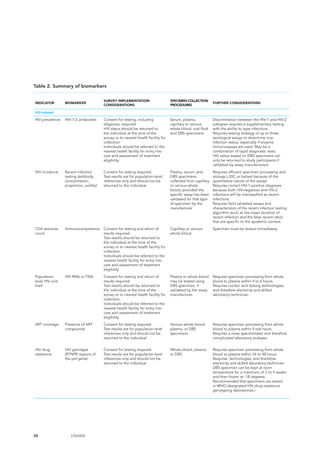
  • 37.
    35Guidelines on monitoringthe impact of the HIV epidemic using population-based surveys Pre-survey implementation planning is an essential component of a successful population- based survey. This section highlights important considerations for survey planning. The topics discussed include staff organization, mobilizing local leaders, preparing training documen- tation and training staff for survey implementation. Careful consideration of the topics presented in this section will enhance survey implementation, leading to high data quality for monitoring the epidemic and the country’s AIDS response. Within this chapter, the following recommendations are of great importance when planning survey implementation. „„ Thorough recruitment to ensure that all survey staff members are dedicated to the project and of high calibre will greatly enhance the overall data quality of the survey. „„ If multiple biomarker specimens are collected and/or tests conducted at households, a laboratory technician or nurse will be best suited to collect specimens and conduct testing. „„ If the survey includes home-based HIV testing, it is recommended that trained HIV counsellors be responsible for this portion of the biomarker component of the survey. „„ Early communication and engagement with community leaders will not only increase local ownership of the survey but also increase the survey response rates. Staff organization The staff required to conduct a population-based survey can be organized into four distinct categories: survey implementation management, field staff, data management and laboratory personnel. Annex 5 provides a bulleted list of specific roles and responsibilities for each type of personnel. A summary of the positions also follows. Survey implementation staff members include a project director, a survey director, a deputy survey director and at least two fieldwork coordinators. The project director, usually a higher-level staff member, will provide policy guidance and direction for the survey and is a critical liaison between the implementing agency and the survey steering committee (discussed below). In comparison, the survey director provides day-to-day oversight of the survey activities and is the acting manager of the survey. As acting manager, this individual works with all survey staff, including the technical committee (discussed below) by providing technical oversight for the survey activities. The deputy survey director works with the survey director to implement the survey activities. Field coordinators are responsible for ensuring high data quality throughout data collection in the field. In addition to office management staff, administrative staff, a sampling expert, a geographical information coordinator, analysts and data communication specialists may be necessary for realizing the survey. Survey implementation staff members are typically full-time employees of the agency imple- menting the survey or stakeholders coordinating survey efforts. Collectively, they are account- PLANNING SURVEY IMPLEMENTATION
  • 38.
    36 UNAIDS able forthe day-to-day operational management of the survey planning and implementation; the survey implementation staff members are responsible for the overall quality of the survey. Field staff members include supervisors, interviewers, biomarker technicians (see Box 4) and a team driver. Surveys with large questionnaires may even include a field-based editor. Using a teamwork approach, the field staff members travel in groups to collect data throughout the entire country. During data collection activities, supervisors oversee interviewing and specimen collection, manage field logistics, track questionnaires and biological specimens and determine work assignments. If an editor is included in the team, the editor conducts the primary check of questionnaire quality and ensures that errors are corrected; in surveys without an editor, the team supervisor is responsible for checking the quality of the question- naires. The interviewers conduct face-to-face interviews at the household and individual levels. In many settings, if sensitive questions will be asked, it is most appropriate for women to interview women and men to interview men. The composition of interviewers by sex on a team should reflect the ratio of women to men in the sample. The individuals responsible for the biomarker components of the survey need to understand the procedures related to obtaining consent and assent and must be able to collect, test, record, store and transfer biological specimens. When teams are being created, each team member’s workload should be carefully considered. Team members are responsible for more than one aspect of data collection and biomarker procedures. The number of field staff members required for the survey depends on the overall sample size, fieldwork timeline, the number of capable staff members available to work for the duration of the fieldwork, the number of languages into which the questionnaire has been translated, vehicle availability, the number and type of biomarkers included in the protocol and available funding. The team composition depends on the overall survey protocol, specifi- cally the field procedures for measuring biomarkers. Highly motivated, hard-working field staff members of high calibre should be recruited to produce the highest-quality data possible; all recruited individuals should be available to work for the entire duration of fieldwork. If possible and relevant to the survey context, it is recom- mended that field staff members be able to read and speak at least two of the languages in which the survey is being conducted. Survey implementing staff members should consider the strengths and limitations of hiring field staff members with previous survey implementation experience. Box 4. Recommendations for staffing for biomarker collection and testing If multiple biomarker specimens are collected and/or tests conducted at households, a labora- tory technician or nurse will be best suited to collect specimens and conduct testing. If the survey includes home-based HIV testing, it is recommended that trained HIV counsellors be responsible for this portion of the biomarker component of the survey.
  • 39.
    37Guidelines on monitoringthe impact of the HIV epidemic using population-based surveys Data management staff members are responsible for entering, cleaning and processing the survey data. If paper questionnaires are used to collect data, data management staff members include a data-processing supervisor, a secondary editor, an office editor, a questionnaire administrator and data entry staff members. Electronic data capture requires additional programmers, but positions for an office editor, a questionnaire administrator and data entry staff members are generally not required. The data management team’s primary responsi- bility is to create a standardized dataset by reducing discrepancies in the data and correcting any entry errors. Complete verification, with double data entry for paper questionnaires, is required to produce a consistent data set. If capture of the survey is used, the data manage- ment team will assist the survey implementation team in producing data quality-check tables to monitor the field teams. Laboratory personnel are an integral part of HIV surveys. Any biomarker assays conducted in a laboratory will require staff to manage specimen organization and testing. The team should have one staff member responsible for logging, labelling and storing specimens and one person responsible for managing the database of test results. In addition, a laboratory super- visor will oversee the testing for specific biomarkers. A small core of laboratory technicians should be hired to conduct the biomarker testing. It is recommended that all staff members receive in-depth training of the biomarker component of the survey, if it is not already part of their usual menu of testing. This training should provide clear instructions for receiving and storing specimens as well as conducting the assay and accurately recording the test results. In addition to managerial and logistical staff members, a population-based survey also requires oversight from a technical committee and a steering committee. A technical committee should comprise mid-level staff members from in-country stakeholder organi- zations with expertise in population-based survey implementation, including biomarker collection and testing and technical subject matter related to the survey objectives. The technical committee provides resources and support for the agency implementing the survey; specific guidance provided by the technical committee includes but is not limited to question- naire development, sample design, biomarker selection and data collection methods. The steering committee, in contrast, should provide assistance and guidance regarding the overall survey objectives, policy issues and ethical considerations and thus comprises high-level staff and officials. These two committees should include representatives from government and nongovernmental institutions. The membership of these committees can assist in mobilizing national support for the survey within the government. Including government officials, university scholars and representatives of international organizations and donor institutions on these committees can help to ensure acceptance and use of the survey data by national HIV organizations.
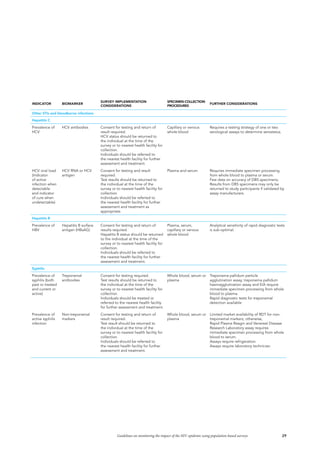
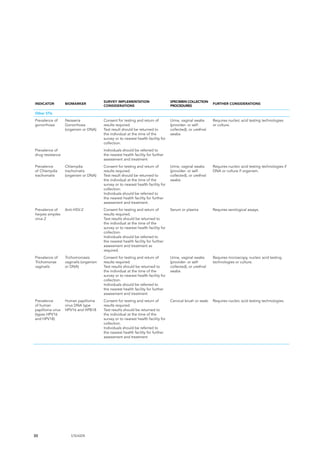
  • 40.
    38 UNAIDS Communication andcommunity mobilization To obtain national, regional and community support for the survey activities, the agency implementing the survey should use public relations activities to inform local officials about the survey objectives, protocol, need for overall community participation and use of survey results. With an understanding of the importance of the survey data, local officials may, in turn, assist in mobilizing community members to participate in the survey. In addition, community members may be mobilized through direct mechanisms, such as exposure to the survey during the initial community mapping activities; poster distribution; newspaper, radio and television shows; and social media outlets announcing the launch of the survey. Participation in the survey may increase if such activities successfully reach potential respondents. Critical components of community mobilization messaging include building awareness on procedures for biomarker collection, testing and storage, the confidentiality and anonymity of the results and the benefits of the survey to those involved. Mobilization is most effective if initiated during the survey planning stage and continued throughout the survey implementa- tion process, whereas local mobilization efforts should be rolled out at the start of survey implementation and remain ongoing until the end of survey implementation. Preparing training documentation Preparing manuals for fieldwork A critical component of survey planning is developing training manuals and other docu- mentation that provide detailed guidance for fieldwork procedures. Training manuals clearly outline the survey objectives and procedures to provide standardized training methods while providing a protocol reference for field staff members during the data collection process. Importantly, using standard training manuals ensures the comparability of data across time within the same country as well as between countries. Separate manuals should be created for each category of field staff, including a supervisor’s or editor’s manual, interviewer’s manual and biomarker technician’s manual. The supervisor’s or editor’s manual should outline guidance on supervising teams, maintaining quality assurance and tracking question- naires and specimens. The interviewer’s manual should provide guidance on how to identify households and conduct interviews, and the biomarker technician’s manual should discuss procedures for field collection and processing of biological specimens. Examples of these types of manuals are available at www.dhsprogram.com/publications. When manuals for use in training are created, it is recommended to edit standardized training documents that reflect current international guidelines rather than to create new, original manuals. By using standardized manuals as a guide, the collected data reflect current defini- tions and survey protocols, which not only enhances global monitoring of the HIV epidemic but also ensures that country-level data are as up to date as possible.
  • 41.
    39Guidelines on monitoringthe impact of the HIV epidemic using population-based surveys In addition to providing guidance for fieldwork procedures, it is also recommended that a risk-mitigation strategy be developed. This should include biomedical safety for the team members and a standard operating procedure for managing potential staff and participant security concerns. Pretest A pretest of all survey procedures, including counselling and HIV testing and administra- tion of the survey questionnaires, will highlight potential errors in training, instruments and implementation as well as the general comprehension of the respondents’ understanding of survey questions. Primary pretest objectives include checking the utility and accuracy of standard operating procedures and training materials, the fidelity of translations of the survey instruments and training manuals, the skip patterns in the questionnaires and the application of biomarkers. For surveys using electronic data collection, the pretest provides an opportunity to thoroughly check the data entry application for programming errors. Thus, it is critical that the pretest training and pretest data collection reflect the procedures that will be conducted in the main survey training and fieldwork. To ensure both high-quality and ethical data collection, biomarker field logistics, including obtaining consent and assent, sample collection, testing, storage and transport as well as counselling and referrals for clinical care based on biomarker test results (if applicable) should be a main focus of the pretest. Any problems identified during the pretest should be corrected before the main survey training. Box 5 presents general recommendations for the pretest; examples of specific recommenda- tions for conducting pretest training are outlined in DHS programme documentation entitled Survey organization manual. Box 5. Pretest recommendations Pretest timing: 2–3 months before main survey training. Pretest length (training and field practice): at least 3–4 weeks, although it depends on the survey protocol. Pretest data collection: At least 100 households over seven days in areas not included in the main survey fieldwork. Interviews should be conducted in all languages into which the instru- ments are translated.
  • 42.
    40 UNAIDS Field trainingstaff The purpose of staff training is to ensure that all field staff and data entry personnel clearly understand their roles and responsibilities and know how to carry out their tasks before the fieldwork starts. Training should emphasize the value of the survey and the resulting data, which will help survey staff to appreciate the importance of their roles and responsibilities in accurately collecting these data. One method of discussing the importance of the survey includes presenting findings from previous HIV surveys and discussing how these data influenced HIV policies and programmes within the country. During the training sessions, survey staff members should have the opportunity to discuss concerns and obtain clarifica- tion on survey operations or to share any previous experiences. All staff members should feel confident with the survey procedures in which they will be involved. Maintaining motivation among survey staff members, especially at the beginning of survey activities, will facilitate high-quality work and completion of all survey activities. Motivation of staff members can be maintained in training by: „„ developing a sense of survey ownership among staff members; „„ defining clearly the responsibilities and roles of all staff members at all levels; „„ emphasizing the importance of each person’s contribution; and „„ providing feedback on performance throughout training. The staff training influences the overall quality of population-based survey data. Intensive survey training should focus on the survey protocol using the survey manuals. All field staff candidates should be trained on how to accurately record information using the survey instruments, obtain informed consent for interview and biomarker specimen collection (when possible) and work as a team to meet the survey objectives. Important training topics include building rapport with respondents and maintaining the confidentiality of responses and test results. Discussions of field logistics and team coordination should be woven into the training. In addition, in-country guest lecturers should provide trainees with relevant information to contextualize the survey fieldwork. For example, a presentation describing the HIV epidemic in the country is appropriate for the first or second day of training. Such a presentation should include information on HIV transmission and prevention. In addition, trainees should be briefed on the country’s policies and programmes related to HIV testing and counselling, treatment, and care. When relevant, programmes discussing transmission, prevention and treatment of sexually transmitted infections should also be discussed. To maintain clarity throughout the training, it is recommended that all outside guest lectures be briefed on the survey objectives and protocol before their presentations. Box 6 presents general recommendations for training. Detailed procedures for field staff training are covered in depth in the DHS programme document Training field staff for DHS surveys (36), which
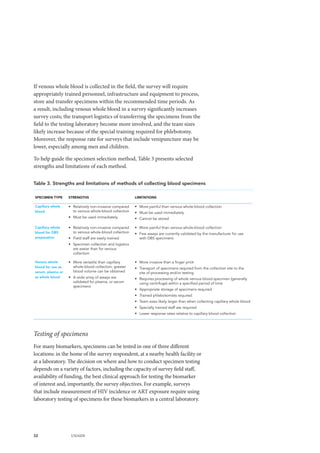
  • 43.
    41Guidelines on monitoringthe impact of the HIV epidemic using population-based surveys provides guidance on population-based survey implementation for surveys targeting the general adult population. If the survey protocol dictates that biomarker technicians are responsible for conducting specimen collection and testing, additional, separate biomarker training, including training in biomedical safety and post-exposure prophylaxis, should be provided for these individuals. Likewise, should field procedures require either laboratory technicians or HIV counsellors, these trainees must also be provided with specialized biomarker training. To prevent extra burden on field staff, only those collecting biological specimens or supervising the collection and return of results should receive biomarker training. Biomarker training should include detailed classroom discussions and demonstrations of biomarker survey instruments, blood collection techniques, storage of specimens and appropriate disposal of biohazardous waste. Ethical approaches to biomarker collection and testing should be a central theme of the training. Should a survey include any sort of field-based testing, providing respondents with results (if applicable) and clinical referrals (if required) must be emphasized; training should include guidance on how to handle potentially difficult situations with empathy through the use of role play. In addition to the above training, hands-on peer practice and mock fieldwork in households should be included. If the survey includes collection of biological specimens from children, training should involve practice in a clinic or other setting allowing practice on individuals in the relevant age groups. Field practice is an integral part of training, since it enables all field staff to rehearse sample storage and transfer logistics. At the end of the training, final selection of field staff should be based on objective criteria. Trainees should be evaluated for inclusion in the survey based on their performance on a series of written tests, observation of their performance during classroom practice and the quality of their field interviews or sample collection and testing techniques. Box 6. Main training recommendations Training timing: one month before survey fieldwork. Training length: about four weeks, depending on biomarker complexity. Training field practice: field practice is a critical component of the training. Each interviewer should interview at least five households, and each biomarker technician should collect blood and test (if applicable) all consenting individuals in at least five households over seven days in areas not included in the main survey fieldwork. Interviewers should be conducted in all languages into which the instruments are translated. Field practice should reflect the biomarker procedures included in the survey to allow biomarker trainees sufficient practice in mastering the survey protocol.
  • 44.
    42 UNAIDS The overallpurpose of a population-based survey with HIV testing is to collect high-quality data to accurately characterize the HIV epidemic in a given geographical area. To meet this objective, guidance provided in this section provides structure for field operations with the intent of maintaining high data quality. The following topics are discussed: conducting interviews, biomarker testing, providing HIV testing services, collecting GPS data and field- based data management procedures. These discussions highlight the influence of these survey implementation aspects on accurate capture of an individual’s knowledge, attitudes, behaviour and possible infections related to HIV infection. The list below presents key recommendations for survey implementation that will improve the survey’s data quality. „„ When a respondent is not at home, field staff should make three return visits to a household at different times on different days. „„ Interviews should be sex-matched, such that female field staff members interview women and male field staff members interview men. „„ The survey’s approach to home-based HIV testing services should provide respondents with their HIV status and link them to care and treatment if applicable. „„ Stringent quality control measures, including observing interview and biomarker collection and providing feedback to field staff, should be in place throughout the field operations. Conducting interviews Two common population-based survey tactics, callbacks and rapport, are used during interview operations to improve the overall survey data quality. Scheduling return visits, or callbacks, can limit non-response by reducing the number of households and individuals excluded from the survey because of absence; whereas creating good rapport between the interviewer and the respondent can limit misclassification of results and encourage respon- dents to answers the survey questions honestly. A further discussion of incorporating these two activities into survey fieldwork follows. Using return visits to limit non-response To ensure high response rates for survey participation, field staff members should follow a strict policy regarding household visits. If an individual is not at home during the interviewer’s initial visit, it is recommended that at least two additional visits be made to the household. These return visits, or callbacks, should be made on separate times of the day or on different days; if appro- priate, callbacks can be scheduled with the assistance of the primary head of the household. Field staff should carefully document the number of visits and the day and time at which the visit was conducted. Should a respondent request an appointment for the interview, the interviewer should note the time and day of the appointment and return to the household at that time. Scheduling callbacks is critical for reducing non-response. Section 5.1 discusses non-response in detail. FIELD OPERATIONS
  • 45.
    43Guidelines on monitoringthe impact of the HIV epidemic using population-based surveys Ensuring interviewer rapport Survey researchers correlate good interviewer rapport with high-quality data. When a survey respondent feels comfortable with an interviewer, the respondent is more likely to provide complete and honest answers to the survey questions. For this reason, it is recommended that individual interviews be sex-matched so that female field staff interview women and male field staff interview men. Since many of the questions used to measure HIV knowledge, attitudes and behaviour are sensitive, building good rapport between the interviewer and respondent is a driving factor of the overall data quality. The foundation of interviewer rapport is laid before the interviewing begins. The interviewer’s initial introduction to the respondent should be cordial, kind and informative. A good first impres- sion should not be underestimated in building trust between the interviewer and respondent. Following a thorough introduction, the survey’s informed consent procedures can be discussed. During discussion of the informed consent procedures, the interviewer should carefully read the consent statement to the respondent. The interviewer should communicate to the respon- dent that voluntary participation includes the right to refuse the interview, to refuse to answer any question(s) or to stop the interview before completion. Further, the interviewer should emphasize that the respondent’s answers are confidential and take time to honestly answer any initial questions the respondent may have. Should the respondent agree to participate in the interview portion of the survey, a private location must be identified to conduct the interview. Box 7 further discusses the importance of privacy. Good rapport, although established in the introduction, is solidified throughout the interview. Rapport can be maintained and even developed throughout the interview by using several approaches. First, interviewers should remain neutral while asking questions and recording the respondent’s answers. Neutrality is best practiced when an interviewer reads the questions exactly as written Box 7. The importance of privacy Although ensuring privacy is important for building good rapport with a respondent, the interviewer has an ethical obligation to maintain privacy during the interviewer. In addition, maintaining privacy communicates to the respondent that the interviewer gives priority to the promised confidentiality described in the consent statement. In particular, actions to ensure privacy of interview will emphasize that the respondent’s answers will not be disclosed. If other household or community members approach the interviewer and respondent during the interview, the interviewer should take care to communicate that the interview is private. If others do not leave, the interviewer should ask the respondent to continue the interview in a different location.
  • 46.
    44 UNAIDS in thequestionnaire and does not form expectations about how a respondent may answer a question. Reading questions as they are written allows each and every respondent to hear the same questions, and interviewing without expectations conveys a lack of judgement towards the respondent during the interview. In addition to neutrality, patience while interviewing is a fundamental approach for ensuring rapport between the interviewer and the respondent. If the interviewer patiently listens to the respondent and avoids suggesting answers, the respondent will know that his or her answers and opinions are valued. Biomarker field operations Implementing the field-based biomarker component of an HIV survey can be very compli- cated. Poorly organized or rushed sample collection, testing, storage, processing and transfer will jeopardize the overall quality and accuracy of the biomarker data. Moreover, it may compromise the safety of respondents and field staff. Box 8 presents general guidelines for biomarker field operations. Specific recommendations for collecting biomarker data using ethical approaches to optimize safety and data quality are discussed below. Obtaining informed consent Section 2.6.1 provides more detailed guidance on the ethical considerations for obtaining informed consent. This section describes the practical steps for obtaining informed consent during fieldwork. Box 8. General guidelines for field-based biomarker procedures Biomarker collection and testing should be conducted after the individual interview. Because the respondent has built good rapport with the team interviewer, he or she may feel more comfort- able consenting to biomarker collection and testing after the interview. If biomarker collection and testing are conducted after the individual interview and the respondent refuses to partici- pate in the biomarker component of the survey, interview data will not be lost because of refusal. Similar to the survey interview, all components of the biomarker collection and testing should be conducted with privacy. The quantity of biomarker supplies (appropriate blood collection tubes, syringes, needles, test kits and related supplies, timers, alcohol swabs, biohazard containers etc.) should be monitored throughout the duration of fieldwork. If supplies are running low, the team should contact the main survey implementing office for additional materials.
  • 47.
    45Guidelines on monitoringthe impact of the HIV epidemic using population-based surveys Before biomarker collection and testing, informed consent must be sought from the eligible respondent. Informed consent statements should be read exactly as they are written to ensure that the respondent is given sufficient information with which to decide whether to participate. Field staff members obtaining informed consent should clearly communicate the five basic components of the consent statement: „„ a description of the objectives of the test; „„ basic information on how the test will be conducted and the results returned; „„ assurance about the confidentiality of the results; „„ the risks and benefits of participation; and „„ a specific request for permission to collect the sample. After reading the consent statement, the respondent should be given an opportunity to ask questions related to specimen collection, testing, storage and transfer. Consent should be informative and clearly describe pathogen transmission, an individual’s likelihood of infection and the connection that the testing has to one’s overall health (37). Consent should never be coerced, and most importantly, separate informed consent should be obtained for each of the biomarkers included in the survey. If the survey protocols include specimen storage for possible future testing, the respondent should also provide consent to store the specimen for unspecified future testing without the return of the test result. If the respondent consents to biomarker collection and testing, supplies and equipment for specimen collection and specific tests consented to should be prepared in accordance with the survey protocol. If the results are to be returned to the household later or to a nearby health facility, the respondent should be clearly informed of this process. If the respondent refuses to participate in the biomarker component of the survey, the respondent should be thanked and the survey should be ended. All respondents, whether or not they agree to biomarker collection and testing, should be given an HIV informational brochure. The brochure should contain basic education informa- tion describing HIV transmission and prevention. In addition, it should also list locations of nearby centres that provide HIV testing and counselling services, HIV treatment and other health services. Collecting and handling specimens The survey protocol should outline specific standard operating procedures for field-based biomarker collection and testing applicable to the survey being conducted. Most often, the field procedures will outline step-by-step instructions for collecting high-quality capillary or venous whole-blood specimens and conducting accurate testing using rapid diagnostic tests, all while maintaining respondent confidentiality.
  • 48.
    46 UNAIDS Regardless ofthe specific combination of biomarker tests included in the survey, field opera- tions should give priority to respondent and field staff safety. Universal precautions should be followed during specimen collection, testing and handling to prevent the exposure of both field staff and respondents to bloodborne pathogens, such as hepatitis B and C or HIV (38). These universal precautions include: „„ wearing gloves during all contact with the respondent; „„ never reusing gloves; „„ using a new lancet or needle and testing supplies and equipment for each eligible, consenting respondent; „„ avoiding eating and drinking during specimen collection or near blood specimens; and „„ properly disposing of all biohazardous waste accumulated during specimen collection in an appropriate container, such as a biohazardous waste container or sharps container. If the protocol dictates collection and transfer of blood specimens outside the household, the specimen should be stored in a cool, dry place until processing and transfer. Box 9 presents instructions for storing blood specimens. Specimens may either be stored in a secure location, or if the survey protocol requires use of a laboratory to conduct non-rapid biomarker testing, the specimens may be stored in the field until transferred and tested. Box 9. Processing and storing specimens DBS: DBSs are collected either from capillary or venous whole blood and added to the filter paper via hanging drop or micropipette (if capillary) or precision pipette (if venous) for testing; the specimens should be allowed to dry and then be protected from light. It is critical that humidity levels in the storage container (such as a plastic zip-lock bag) be low; use of desiccant packets within the storage container can help to reduce moisture in the air. The humidity level can be monitored by using humidity indicator cards. Venous whole blood: if venous whole blood is collected in the survey, it should be kept cool and away from direct sunlight. Whole blood should be tested for applicable biomarkers on site such as CD4 and then processed: that is, separated into serum or plasma or used to make DBSs, as specified in the protocol. These specimens should be stored appropriately as soon as possible following collection. Serum or plasma: after collection, these specimens should be processed immediately or at least within six hours. After testing, serum or plasma specimens should be aliquoted, labelled and stored immediately. The specimens can be stored on ice packs for short duration (one to two days during transport), in the refrigerator (4–8°C) for up to one week or in the freezer (–20°C or below). Specific biomarker testing procedures will dictate actual specimen processing and storage conditions as specified in the protocol.
  • 49.
    47Guidelines on monitoringthe impact of the HIV epidemic using population-based surveys Should the specimens be tested in a field-based facility rather than a central laboratory, the team supervisor should seek a cool, well lit and well aerated room to set up a field laboratory. It is recommended that the field laboratory space have running water and a sink. There should also be adequate bench space that provides sufficient room for the required equipment and to conduct the testing. The laboratory should have a consistent electricity supply and should remain locked when not in use. If possible, the team may use laboratory facilities in the cluster’s health clinic in which all supplies and equipment should be kept in a secure cabinet. Transferring specimens To track specimens, a unique identifier or barcode should be assigned to each specimen tested in the field or transferred to a laboratory for testing. A corresponding barcode label should also be placed on the questionnaire and on the field tracking form at the time of specimen collection. The unique identifiers and barcodes are a means of linking the final test results to the information collected in the individual interview. Extreme caution should be taken to ensure that the correct barcodes are used to link the specimens and questionnaire. If the incorrect barcode is used, data on HIV knowledge, attitudes and behaviour cannot be linked to the testing results. Moreover, the correct sampling weight cannot be assigned to the test result, resulting in the exclusion of the specific data point from the final analysis. It is also strongly recommended that the specimens and tracking form be checked for barcode consistency as it is filled out, at the end of each day, and before leaving the cluster. When the specimens are transferred from the field, the team supervisor is responsible for confirming that the information recorded on the tracking form for each completed cluster is accurate. At each step of the transport, the tracking form will be completed with a confirma- tion of the number of specimens received and the number noted on the form. If inconsisten- cies arise, the rationale for the inconsistency should be noted. Use of the tracking form is critical for ensuring that the number of specimens collected in the field is in concordance with the number of specimens received in the laboratory. Providing HIV testing services, results and linkage to treatment and care The survey approach to home-based HIV testing services should be in accordance with the country’s national guidelines for both HIV testing services and the national validated HIV testing algorithm as described in Annex 2. This approach should also follow WHO recommendations outlined in the 2015 Consolidated guidelines for HIV testing services (10). Standardization of field procedures with national HIV testing service guidelines will ensure consistent training of the field staff members responsible for conducting home-based HIV testing services; use of WHO recommendations ensures that all population-based surveys incorporate consistent HIV testing services. Specific components of home-based HIV testing
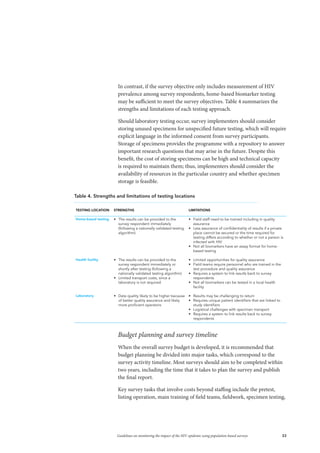
  • 50.
    48 UNAIDS services includepretest counselling, testing using HIV rapid diagnostic tests and post-test counselling. Counselling as part of HIV testing services serves two primary purposes. For the people who test HIV-negative, it is a means of promoting HIV prevention methods. For the people who test HIV-positive, it can encourage access to continuing care and counselling to prevent further transmission. HIV testing service counselling, by nature, is specialized to each individual. To address the needs of all respondents, the survey’s HIV counsellors should be well versed in counsel- ling topics, since they may need to adapt the pretest and post-test counselling discussion. Inconsistent and subpar counselling skills are a significant challenge when including HIV testing services in a population-based survey. Thus, only certified and experienced HIV counsellors should be hired as survey field staff members. Following testing, if the respondent tests HIV-positive, the HIV counsellor should refer the respondent to treatment and care in a nearby health facility and the importance of adhering to ART, both for their own health and to prevent further transmission. The HIV counsellor should discuss preventing mother-to-child transmission if applicable and treatment for other opportunistic infections such as tuberculosis and sexually transmitted infections. Conversations regarding risk reduction, positive living, family planning and education and disclosure of results should be included the post-test counselling session. For a woman who tests HIV positive and has children, HIV counsellors should also refer the woman’s children for HIV testing at the nearest health facility. If the survey includes on-site CD4 or viral load testing, all respondents who test HIV-positive should be eligible for testing following the post-test counselling session. If the respondent tests negative, the HIV counsellor should frame the post-counselling session around HIV prevention methods. In addition, depending on the ongoing risk of acquiring HIV infection, the respondent should be encouraged to be tested again. If the respondent has discrepant testing results, the HIV counsellors should refer the respon- dent for additional testing to confirm their diagnosis in a HIV testing service centre. Box 10 describes steps that should be taken when incorporating HIV testing services into surveys to assure high-quality field implementation during the survey. HIV testing services for children Recent literature (39,40) shows that home-based HIV testing has increased the uptake of HIV testing among children. In an effort to continue to reduce the gap between the number of children living with HIV and the number of children receiving HIV treatment and care, it is recommended that all children included in the survey receive home-based HIV testing services pending parental consent and child assent. Because of the circulation of maternal
  • 51.
    49Guidelines on monitoringthe impact of the HIV epidemic using population-based surveys antibodies, serological assays for children younger than 18 months should only be used to rule out HIV exposure. Virological testing at 4–6 weeks with additional testing to confirm the result is recommended. The parents or guardians of these children should be referred to Box 10. Quality assurance measures for field implementation of home-based HIV testing Ensure adequate time for HIV testing: home-based HIV testing will add 20–60 minutes of additional time spent with each survey respondent. This additional responsibility on the teams may influence the quality of counselling received as well as the overall interview data quality of the survey. Team members should be careful not to rush the HIV counsellor on to the next household in an effort to quickly finish the day’s activities; rushing HIV testing may affect the quality of the counselling received. Likewise, of partic- ular concern in surveys, interviewers may feel pressure to complete the interview as quickly as possible because of the multiple components of the survey; rushed interviewing negatively affects the overall data quality of the survey. Team supervisors should be aware of the each team member’s responsibilities and the time required to complete each task. Field schedules should be adjusted accordingly. Ensure the confidentiality of HIV results: home-based HIV testing presents unique confidentiality concerns for the survey. Similar to all biomarkers, the confidentiality of results should be given priority. Three important considerations that can threaten the confidentiality of results include the time it takes to conduct HIV testing, eligibility for supplement testing and the referral documentation. • The length of time a HIV counsellor spends with a respondent may indicate the HIV test result. This may allow other community members to infer a respondent’s HIV status. Although complete privacy may be difficult to obtain in many households, particularly in densely populated areas, it is crucial that HIV testing be conducted in seclusion. Conducting HIV testing immediately following the individual interview can also reduce concern about confidentiality by limiting the ability of other people to distinguish between the length of time in which the interview is conducted and the length of time in which HIV testing is conducted. • The survey protocol should be developed in a manner that considers how to collect blood specimens from individuals after they test HIV positive during HIV testing. Any additional specimen collection should be designed to minimize the risk of other people determining eligibility criteria. Careful consideration should be taken when developing referral documentation for individuals testing positive for HIV. Such documents should maintain the individual anonymity of results but also provide an individual with appropriate linkage to care. One possible solution for maintaining the confidentiality of results is to include referral information in the brochure. Adopt quality assurance measures for home-based HIV testing: although observation is important for maintaining high-quality biomarker data, observing HIV testing may not be possible because of privacy consid- erations. Nevertheless, without direct observation, determining whether the respondent received thorough counselling can be challenging. One alternative to direct observation is to note the length of time a HIV coun- sellor spends with a respondent during the HIV testing session. At a minimum, testing and counselling for an HIV-negative individual will span about 20–25 minutes; less time may indicate that the HIV testing was rushed.
  • 52.
    50 UNAIDS a clinicfor confirmatory HIV testing and for parental counselling rather than returning the results of the serological assay or virological test. Providing HIV testing services for children is a delicate process and should be approached with sensitivity. Although there are many examples of complex issues inherent in HIV testing services for children, one important consideration is that this testing may inadvertently disclose the parent’s HIV status. Disclosure of HIV status may present a mental burden to the parent and can inhibit consent to HIV testing services for children (41). Reducing barriers to HIV testing, creating child autonomy and incorporating a family-centred approach to treatment and care are only a few of the skills required of HIV counsellors who conduct HIV testing services for children. Survey implementers should ensure that HIV counsellors are thoroughly trained to provide consistent advice to parents regarding their child’s HIV status. If HIV testing services for children are included in the survey protocol, it is strongly recommended to hire paediatric nurses who are certified in HIV counselling as field staff responsible for field biomarker collection and testing. Since a consistent approach to HIV testing services for children is lacking, it is critical that any survey follow the country’s national guidelines for home-based HIV testing services for children. The WHO and UNICEF 2013 document Considerations for measuring the impact of PMTCT programmes using population-based surveys in selected high HIV prevalence countries (42) provides more detail about testing children as part of a population-based survey. Incorporating GPS measurements GPS data can facilitate understanding of the distribution of HIV infection in the population and document where programmes have had greater impact. GPS can be measured either during the main survey fieldwork or during the community mapping exercise. Collecting GPS data during the mapping exercise is ideal; teams have fewer responsibilities at this phase than they will have during the main survey fieldwork, and incorporating GPS measurements thus does not add to their workload. In addition, operational costs can be reduced, since there are often fewer mapping teams than survey field teams, thus requiring procurement of fewer GPS units. Most importantly, collecting GPS data earlier in the survey timeline allows the opportu- nity for GPS data to be verified before fieldwork and the coordinates to be recollected during the main survey fieldwork if this is necessary. If the survey protocol does not include separate mapping activities, GPS data can be collected during the main survey fieldwork, but team supervisors are responsible for ensuring that accurate GPS measurements are taken for each cluster. Population-based surveys include one GPS measurement per cluster, typically collected at the centre of the enumeration area. When the GPS is measured, it is critical that the GPS unit receive adequate satellite signal strength. To do so, the individual measuring the GPS point should be away from tall buildings, should not be standing underneath a tree canopy and
  • 53.
    51Guidelines on monitoringthe impact of the HIV epidemic using population-based surveys should remain in a relatively open area. If adequate satellite signal strength is not received, it is recommended that the GPS be measured at the closest large park or intersection to the centre of the cluster. Heavy cloud cover may also inhibit the GPS unit from making sufficient contact with satellites, and the team may have to delay GPS measurement until the clouds have dissipated. GPS should never be measured indoors. Before leaving the cluster, the team should confirm that the GPS point has been collected and that it is not a duplicate or pair of a previous cluster. If GPS data are collected before the survey fieldwork, GPS measurements should be recorded on a paper form and also saved within the GPS unit itself. Written GPS points may be recorded up to three times to reduce recording error. Data collected on paper provide a quality control measure, as both a backup of the electronic data and also a cross-check for validation. A DHS project document (43) provides detailed instructions for collecting GPS measure- ments during survey data collection activities.
  • 54.
    52 UNAIDS Field-based datamanagement, cleaning, validation and quality assurance Quality assurance during the period of the survey fieldwork will be ensured through effective supervision of the field teams. Both the team supervisors and senior staff from the organiza- tion implementing the survey will supervise quality control. It is recommended that imple- menting organization senior staff members periodically visit each field team throughout the fieldwork. Thorough supervision of data collection includes quality control activities that target interview data collection as well as biomarker data collection. Interview quality assurance During the survey fieldwork, three primary quality assurance procedures should be set in place to ensure that interview data are of the highest possible quality. • Spot-check as an external quality assessment measure. The team supervisor can check the quality of the interview data by briefly reinterviewing certain households and comparing this information to that collected by the interviewer. A quick spot-check is useful in determining that the interviewer recorded information correctly, particularly the age of all household members, a requirement for individual interview eligibility. It is recommended that spot-checks take place on the same day as the original interview. At least one household should be spot-checked per cluster, with each of the team members checked throughout the duration of fieldwork. • Observe interviews as for external quality assessment. With the respondent’s permission, either the team supervisor or the team editor should observe respondent interviews to evaluate the interviewer’s performance. Interview observations may highlight any challenges interviewers have with conducting the interview, such as not asking the questions as written in questionnaires, recording responses incorrectly or following skip patterns incorrectly. Further, observation will provide insight into the interviewer’s rapport with the respondent; even under observation, rapport between the interviewer and the respondent indicates the interviewer’s skill. When observing interviews, the supervisor or editor should sit close enough to the interviewer to easily view the questionnaire. The supervisor or editor should never interrupt the interview unless the interviewer makes a serious mistake. Depending on the skill level of the interviewer, observing the entire interview may not be necessary. Care should be taken when observing particularly sensitive components of the questionnaire. Following the observation, the supervisor or editor should provide the interviewer with feedback regarding his or her respondent rapport and questionnaire management. All the team interviewers should be observed during the fieldwork. • Thoroughly check completed questionnaires as a quality control measure. „„ Interviews are recorded on paper questionnaires and data entry occurs at a central office. The team editor is responsible for thoroughly checking the questionnaires for mistakes. To ensure that all questionnaires are completed with the correct skip patterns and to reduce the amount of missing information, the team editor should check all questionnaires before the team leaves the cluster. If the editor finds any mistakes, the questionnaires can be corrected while the team is still in the area. To assist the interviewers in learning from
  • 55.
    53Guidelines on monitoringthe impact of the HIV epidemic using population-based surveys their mistakes and reducing the number of errors in the future, the editor should maintain regular review sessions with each interviewer to discuss the overall quality of his or her questionnaires. If the team does not have an editor, the team supervisor is responsible for checking the completed questionnaires for accuracy. „„ Interview data are recorded on paper questions and data entry occurs in the field. The paper questionnaires should be checked for consistency and accuracy before data are entered. All questionnaires should be entered electronically before the team leaves the cluster to enable team members to revisit households and correct any mistakes. „„ Interview data are captured electronically. The questionnaire data do not need to be reviewed for skip-pattern logic. The data entry program will not allow incorrect skip patterns to be followed. When implemented at the start of the fieldwork, these quality assurance actions are extensions of survey training. Individual supervision provides interviewers with the tailored feedback on how to minimize errors while interviewing. As fieldwork continues, sustained use of these quality assurance measures encourages the development of good data collection skills among the team, greatly influencing the overall quality of the survey data. Quality assurance of specimen collection, testing and record-keeping To enhance the likelihood of accurate population estimates of HIV infection and sexually transmitted infections from survey data, it is recommended that quality assurance measures be incorporated. Important quality assurance aspects include external quality assessment of specimen collection and testing (through direct observation and supervision, regular use of quality control specimens and participation in a proficiency testing programme) and accurate recordkeeping by using a specimen tracking system. These two approaches are discussed below. Annex 6 provides additional details. External quality assessment, through observation of specimen collection, testing of external quality assurance system panels and intermittent proficiency testing panels, serves to verify whether the operator is following safe and appropriate procedures and collecting specimens of high quality. With poor-quality specimens, assays are not likely to generate accurate results. It is recommended that the entire specimen collection and testing process, from the request for informed consent to the removal of biohazardous waste from the household, be observed on site. Important observations include: „„ how the consent is recorded; „„ how the specimen is collected; „„ how the specimen is labelled; „„ how testing procedures are conducted (if applicable); „„ how the test results are recorded and status assigned and the questionnaire is completed; „„ how the specimens are packaged and/or stored during fieldwork; and „„ how the specimens are transported to the testing laboratory.

  • 56.
    54 UNAIDS Although on-sitesupervision of specimen collection and testing is strongly recommended, directly observing home-based HIV testing services may not always be possible; a short discussion of quality assurance measures for home-based HIV testing services is presented, as previously described, in Box 10. If observation is possible, after the observation, the operator’s performance should be discussed with the objective of improving specimen collection. Only individuals who were trained during the biomarker portion of the survey’s main training workshop should observe biomarker specimen collection. Additional quality assurance practices such as participating in a proficiency testing programme and using routine quality control specimens at regular intervals are important to ensure the accuracy of testing and to identify individuals who may require additional training and oversight. The laboratory training team should develop plans and use these critical elements as part of the survey. In addition to on-site observation, proper recordkeeping through the use of a specimen tracking system is another aspect of quality assurance. The specimen tracking system, as discussed in section 4.2, serves to account for each phase of the specimen transport, with the overall goal of limiting the introduction of error into the final survey dataset. Ensuring that the same number of specimens collected in the field reaches the laboratory helps to maintain the representativeness of the survey data. Likewise, use of the tracking form communicates to the field teams and office staff that specimen transport is an important component of field operations. The use of the specimen tracking forms should be carefully monitored for accuracy and completion as a key quality assurance measure for reducing missing data.
  • 57.
    55Guidelines on monitoringthe impact of the HIV epidemic using population-based surveys This section outlines crucial components of data analysis that should be conducted once fieldwork has ended. Specifically, the section discusses non-response to biomarker testing related to HIV and other biomarkers, weighting survey results, use of shell tables and methods for comparing the results with those of previous surveys. Following the recommendations presented in this section can help to improve the overall quality of analysis by ensuring that appropriate statistical methods are used. In particular, statistical methods that result in reduction of bias and improve generalizability while also accounting for the complex nature of the survey design will generate accurate and useful results. Thus, the topics presented in this section should emphasize the importance of approaching data analysis with a thoughtful plan. The following summarizes important recommendations for data analysis presented here. „„ Non-response should be thoroughly assessed to determine whether it is related to an individual’s HIV status. Although there is no clear threshold at which the non-response rate results in bias and limited generalizability, the validity of the results may be questionable when non-response rates overall or within certain subgroups reach 25%. „„ Survey results should include weights, which account for both the survey design and response to interview and biomarker testing. „„ Data analysis should focus on responding to the primary survey objectives, including presenting progress towards the 90–90–90 targets and key indicators from the Consolidated strategic information guidelines for HIV in the health sector (6). „„ Where sample sizes permit and when appropriate, data should be stratified by HIV status to better understand the exposure to and impact of HIV prevention activities. Calculating, assessing and adjusting survey weights for non-response The primary objective of a population-based survey is to generate data that reflect the population, either at the national or subnational level or within subpopulations. To meet this objective, it is critical that eligible respondents participate in the survey at both the household and individual levels. Non-response at the household level is related to absence of the entire household or refusal to participate in the household. Typically, household non-response in population-based surveys is small when the listing of the community is accurate (44). In such situations, detailed analysis examining the effect of non-response on biomarker estimates may not be needed. Non-response at the individual level, in contrast, may be related to absence at the time of interview, refusal to be interviewed, absence at the time of biomarker testing or refusal to participate in biomarker testing. Separating non-response resulting from absence and refusal is important in analysing the effects of non-response on biomarker estimates. Should a substantial number of respondents refuse to be interviewed or tested for biomarkers, the survey results may no longer reflect the whole population. Although there is no clear DATA ANALYSIS
  • 58.
    56 UNAIDS threshold atwhich the non-response rate results in bias and limited generalizability, the validity of the results may be questionable when non-response rates overall or within certain subgroups reach 25%. Moreover, if a decision to participate in biomarker testing is related to an individual’s HIV status, either perceived or actual, the biomarker data may suffer from non-response bias. The impact of non-response can differentially bias estimates upwards or downwards. If non-response is high for a group of people at high risk of acquiring HIV infection or already HIV-positive, the prevalence estimates may be biased downward. Conversely, if non-response is high for a group with low risk for HIV or sexually transmitted infections, the estimates may be biased upwards. Analytically, however, quantifying the magnitude of the impact on estimates caused by non-response bias can be very challenging. Thus, as discussed in section 4.1, reducing the overall effect of non-response requires that field teams make every effort to maximize survey participation by: „„ making at least three callback visits to those who are absent at time that they will most likely be home (such as evenings and weekends); „„ building rapport with eligible respondents; „„ emphasizing the steps to ensure confidentiality to the respondent; and „„ clearly explaining the objectives when obtaining informed consent for survey participation. Calculating non-response A first step in assessing the impact of non-response is to quantify it. In general, two over- arching types of non-response are of interest. Household non-response results from either prolonged absence of the entire household or the household refusing to participate. This type of bias historically has been very low in surveys (less than 1–2% of households). Nevertheless, accounting for this bias is required when describing overall survey non-response, since the calculations of individual-level non-response no longer include individuals that otherwise would have been eligible in these households. Individual-level non-response is typically of more concern in population-based surveys. Classifications and definitions for quantifying non-response at the individual-level are provided below. „„ Survey non-response because of absence: proportion missing because of not being at home at the time of the survey among all eligible people. Numerator: the number not at home after the study visit protocol has been followed. Denominator: the number eligible to participate in the survey. „„ Survey non-response because of interview refusal: proportion of those refusing an interview at the time of the survey among all eligible people. Numerator: the number of people refusing interview. Denominator: the number eligible to participate in the survey.
  • 59.
    57Guidelines on monitoringthe impact of the HIV epidemic using population-based surveys „„ Survey non-response because of refusing testing: proportion of those refusing a test at the time of the survey plus those refusing an interview (and therefore refusing testing) among all eligible people. Numerator: the number of people refusing a test plus refusing interview. Denominator: the number eligible to participate in the survey. „„ Testing non-response because of refusal: proportion of those refusing a test at the time of the survey among all people interviewed. Numerator: the number of people refusing a test. Denominator: the number consenting to be interviewed during the survey. To understand how the potential for non-response bias might influence HIV prevalence and other indicators, it is recommended to present the above results disaggregated by geographical area, rural and urban location, five-year age groups and sex. Disaggregation by other sociodemographic variables that may be strongly associated with HIV status (such as religion, ethnicity, recent history of testing and known self-reported HIV status) should also be explored. In general, the higher the non-response for any of the types of non-response described above, the greater the likelihood that the survey data may be inaccurate. Should non-response reach a high percentage (greater than 25%), non-response should be further assessed by background characteristics. For this reason, collecting characteristics that may be related to non-response is important to consider when designing the survey questionnaire. In addition, all calculations of non-response described above should be included in the final survey report. Assessing the impact of non-response Although several approaches may be used to determine whether non-response is related to individual and household background characteristics, analysis examining missing data provides some evidence for how non-response may influence survey results (45). Characteristics showing variation in non-response that might affect HIV prevalence estimates, for example, include sex, geographical area (HIV prevalence is likely to be lower in rural areas), age (among women, prevalence peaks mostly in the late twenties through thirties versus in the thirties and early forties among men (46)), marital status, socioeconomic status or sexual behaviour (for example, having many sexual partners is associated with a high risk of HIV infection). In particular, correlations between those who refused testing and the aforementioned background characteristics compared with correlations between those who consented to testing and these characteristics can provide some support for whether non- response is purely random. Should such analysis show differing levels of correlation between background characteristics and respective consent to HIV or other biomarker testing, further analysis should adjust for non-response through weighting techniques (discussed below). In addition to examining the variation in non-response in relation to the background charac- teristics of the population, investigators should also consider whether non-response might be
  • 60.
    58 UNAIDS related toHIV status. For example, the literature shows that knowing if one is HIV-positive can be related to refusal for HIV testing (47,48); in addition, other literature suggests that uncertainty about HIV status can also be related to refusal for HIV testing (49). Moreover, recent experiences from Kenya suggest that refusal to participate in HIV testing may be related to not being offered home-based HIV testing services (26). Self-reported HIV status or other variables directly related to participating in biomarker testing are often not measured in the survey for ethical reasons. In these instances, both assessing and adjusting for non-response require sophisticated statistical techniques. Recent analyses have suggested a range of methods, including Heckman-style selection models (50), Bayesian techniques (51) and imputation (51,52) to further understand and correct for the effects of this type of non-response. Of these methods, survey analysts may consider the use of Heckman adjustment when individual non-response either to the interview or to the biomarker testing is greater than 25% and the survey data collected include information about the interviewer. These methods are complex, however, and analysis must be conducted under the guidance of a statistician familiar with these methods. Adjusting for non-response Although several approaches can be used to adjust HIV prevalence estimates for any biases that may result from non-response, this section focuses on adjusting survey weights for non- response. This method is recommended although both the unweighted and weighted survey results should be presented in the final report. Weighting adjusts the survey results for both absence and refusal to participate in the household interview, individual interview and testing for biomarkers. In general, weighting techniques are used to make the sample of available data more like the target population. In other words, weighting provides biomarker estimates that are representative of the general population. Appropriate use of weighting techniques to adjust biomarker estimate results should account for the design weight of the cluster, the cluster response rate, the weighed household response rate, weighted individual response rate for interview and refusal to participate in testing. Section 5.2.2 further discusses this process, specifically focusing on creating response weights. Recommended method for calculating indicators—weighting survey results Population-based surveys are designed to capture data in a representative subsample of a given group to draw statistical inferences about the entire population of interest. To make such inferences, survey data require weighted adjustment to account for the overall sample design of the survey by calculating design weights as well as non-response to the survey question-
  • 61.
    59Guidelines on monitoringthe impact of the HIV epidemic using population-based surveys naires by calculating response weights. These weights are then typically normalized to the overall sample size of the data at the household and individual levels to create final sample weights. Weighted analysis ensures that survey data are representative of the general population and that bias due to non-response and non-sampling is minimized. If weights are not used, the results may not be representative of the target population, be it at the national or subnational level. DHS documentation (21) provides detailed guidance on calculation of sample weights. Further, MICS provides templates for weight calculations at http://www.childinfo.org/ mics5_sampling.html. Design weights Most population-based surveys use a multi-stage sampling design. The design weights for this method should be based on the probability of selection for each sampling stage and for each cluster. Using careful documentation, sampling parameters, such as the number of selected clusters per sampling strata, the total number of households in a cluster, the number of households selected, cluster segmentation, etc., are required for estimating the selection probabilities of each household. Within this method, the design weight is calculated by estimating the inverse probability of household selection. Although calculating design weight is not mathematically complicated, errors may result from poor documentation of sampling parameters. Response weights To reduce bias resulting from non-response and non-sampling error, data analysis of all survey designs, including self-weighting samples, should incorporate response weighting. Specifically, it is recommended that response weights be calculated at the stratum level (household, women and men and specific for each biomarker by sex). Calculation incor- porates the design weight of the cluster, the cluster response rate, the weighed household response rate and, when creating weights for men and women, weighted individual response rate for interview and the weighted response rate for biomarker testing. If the men’s survey is conducted as a subset of the total survey sample, the household response rate used in calculating the men’s response weight should reflect the subsampling. Likewise, if biomarkers are collected in a subset of the survey sample, the household response weight used in the biomarker weight calculation should account for the subsampling. Final sample weights The last step in creating survey weights is normalization. The final weights should be normal- ized so that the total number of unweighted cases equals the total number of weighted cases
  • 62.
    60 UNAIDS at thenational level. Both household weights and individual weights should be normalized to simplify interpretation of the survey results. As a method of determining the appropriate- ness of the weighting scheme, the first chapter of the survey report should present both the unweighted and weighted number of respondents by background characteristics in a table. Analysis approaches The final survey results should be organized in easy-to-read tables that describe the most important HIV indicators for policy-makers and programme officers and reflect the survey objectives of measuring the impact of HIV programmes. These tables are designed to present simple, standardized, descriptive statistics. Typically, survey results are described at the national level as well as by demographic subgroup, such as sex, age, education, marital status, relative wealth status, urban or rural residence and region of the country. Further disaggregation of indicators may be appropriate if warranted by the indicator definition. Creating sample table shells is useful for determining how results should be presented and to confirm that the presentation is comparable to that of other surveys. It is essential to create the table shells before the questionnaire is finalized to ensure that the survey captures the correct covariates and answers the key questions required by programme managers. Thus, creating shell tables can help ensure that survey data appropriately inform a country’s priorities for HIV programmes. During the survey planning period, an analysis plan should be developed that follows this described approach: begin by presenting the survey response rate and biomarker coverage, then present key indicators and conclude with bivariate presentation of indicators with the HIV treatment cascade. Table 5 offers an example of the presentation of coverage of HIV prevalence testing, as standard in DHS programme reports (10). The table title clearly describes the data presented in the table by outlining the type of statistic, the group presented and covariate presentation. This table also shows the percentage distribution of individuals eligible for testing by residence and region in the country. Coverage can also be presented by demographic characteristics, such as age, educational attainment and wealth. Similar tables should also be included that present response rates for participation for other biomarkers tested.
  • 63.
    61Guidelines on monitoringthe impact of the HIV epidemic using population-based surveys Table 5. Coverage of HIV testing among women and men, by residence and region PERCENTAGE DISTRIBUTION OF WOMEN AND MEN 15–64 YEARS OLD ELIGIBLE FOR HIV TESTING BY TESTING STATUS, ACCORDING TO RESIDENCE AND REGION (UNWEIGHTED), [COUNTRY, YEAR] Testeda Refused to provide blood Absent when blood was collected Other or missingb Residence and region Inter- viewed Not inter- viewed Inter- viewed Not inter- viewed Inter- viewed Not inter- viewed Inter- viewed Not inter- viewed Total Number WOMEN 15–64 YEARS OLD Residence Urban 100.0 Rural 100.0 Region Region 1 100.0 Region 2 100.0 Region 3 100.0 Region 4 100.0 Total 100.0 MEN 15–64 YEARS OLD Residence Urban 100.0 Rural 100.0 Region Region 1 100.0 Region 2 100.0 Region 3 100.0 Region 4 100.0 Total 15–64 years old 100.0 TOTAL AMONG WOMEN 15–64 YEARS OLD AND MEN 15–64 YEARS OLD Residence Urban 100.0 Rural 100.0 Region Region 1 100.0 Region 2 100.0 Region 3 100.0 Region 4 100.0 Total 15–64 years old 100.0 a Includes all samples tested at the laboratory and for which there is a result: positive, negative or indeterminate. Indeterminate means that the sample went through the entire algorithm but the final result was inconclusive. b Includes: (1) other results of blood collection (such as technical problems in the field), (2) lost specimens, (3) non-corresponding bar codes and (4) the laboratory results such as blood not tested for technical reasons, not enough blood to complete the algorithm, etc.
  • 64.
    62 UNAIDS Following presentationof the response rates, the results of key indica- tors should be presented, disaggregating by background characteristics when appropriate. Table 6 is an example of a shell table that presents the standard presentation of national-level HIV prevalence estimates by age in countries in which both HIV-1 and HIV-2 subtypes are prevalent (52). Estimates of HIV prevalence and incidence are limited typically to those aged 15–49 years to provide comparability in estimates across countries where the age structure of the populations differ. Of note is the disaggregation of prevalence by sex, presented alongside the HIV prevalence estimates for the entire country of men and women. Additional tables presenting HIV prevalence results should disaggregate estimates by residence and region, the socioeconomic characteristics, demographic factors and sexual behaviour characteristics of those tested. In addition, tables may be presented for people 15–24 years old, by male circumcision indicators and among couples to estimate HIV status concor- dance in partnerships. PERCENTAGE HIV-POSITIVE AMONG WOMEN AND MEN INTERVIEWED AND TESTED, BY AGE, [COUNTRY, YEAR] WOMEN MEN TOTAL Age (years) Percent- age HIV-1 positive Percent- age HIV-2 positive Percent- age HIV-1 or HIV-2 positive # Percent- age HIV-1 positive Percent- age HIV-2 positive Percent- age HIV-1 or HIV-2 positive # Percent- age HIV-1 positive Percent- age HIV-2 positive Percent- age HIV-1 or HIV-2 positive # 15–19 20–24 25–29 30–34 35–39 40–44 45–49 50–54 55–59 60–64 Total 15–49 years old Total 15–64 years old Table 6. HIV prevalence by subtype estimates, by age
  • 65.
    63Guidelines on monitoringthe impact of the HIV epidemic using population-based surveys Both Table. 5.1 and Table. 5.2 are examples of shell tables presenting HIV preva- lence biomarker data. Similar tables can be created for other biomarkers (such as viral load suppression, ARV coverage, prevalence of other sexually trans- mitted infections and bloodborne infections). If the survey has been designed with sufficient sample size, these other biomarker results may also be presented by standard stratified background characteristics. For example, in Table 7, viral suppression data can be stratified by age, sex and subnational residence. Caution should be used when presenting disaggregated results in which the sample sizes are small and the estimates are likely to be very imprecise. The DHS programme documentation (53) provides further examples of shell tables presenting HIV indicators related to behaviour, knowledge, attitudes and beliefs that are useful for designing a survey analysis plan and writing the final report. Table 7. HIV viral suppression stratified by sex and presented by age and residence NUMBER AND PERCENTAGE OF WOMEN AND MEN VIRALLY SUPPRESSED, BY AGE AND RESIDENCE, [COUNTRY, YEAR] Age (years) Number of women living with HIV Percentage virally sup- pressed Number of men living with HIV Percentage virally sup- pressed Number of people living with HIV Percentage virally sup- pressed 15–19 20–24 25–29 30–34 35–39 40–44 45–49 50–54 55–59 60–64 Total 15–64 years old Residence Urban Rural Region Region 1 Region 2 Region 3 Region 4
  • 66.
    64 UNAIDS Methods forcomparing results across population-based surveys Comparing HIV indicators from two or more population-based surveys can be useful in examining changes in HIV knowledge, behaviour, attitudes, beliefs and infection over time. Box 11 lists key considerations for comparing data between population-based surveys, and Box 12 presents specific notes regarding subnational analyses at the end of the section (54). Crude trend analysis often includes comparison of indicator point estimates across at least three surveys and their corresponding confidence limits. Considering inherent limitations in comparing a cross-sectional measure of HIV prevalence over time, standard methods of assessing prevalence trends often compare sex-stratified estimates of infection among people 15–24 years old, the standard referent group (55), since youth are more likely to have recent sexual debut and are less likely affected by AIDS-related mortality (56,57). Nevertheless, since vertically infected children may be included in this group, extreme caution should be used when considering this approach. Moreover, since most population-based surveys do not have an adequate sample size to capture changes over time, point estimate comparison provides little certainty of actual change; particularly when samples are small, as is common in esti- mating HIV incidence. Statistical modelling, in contrast, may provide a better method of assessing trends over time, accounting for the complex survey design and the nature of cross-sectional data. Before analysing trends, an appropriate statistical model should be chosen that (1) accounts for the homogeneity of clusters and (2) uses the final survey weights. Selecting a model that considers both of these aspects of survey design can improve the precision of the analysis results and reduce the likelihood of reporting incorrect results (58,59). A variety of statistical analysis programs allow for these aspects of complex survey design— that is, survey design variables and survey weights—to be accounted for in multilevel regres- sion modelling, the most appropriate statistical tool for assessing trends in population-based data. For detailed information on the use of multilevel models to analyse complex survey data, see Carle (60), Rabe-Hesketh et al. (61), and Subramanian et al (62). Box 11. Important considerations for comparing data between surveys To ensure appropriate comparison of survey results, it is important that all data sources provide equivalent measures of indicators. Comparability between surveys can be examined by assessing each survey for the following characteristics: • the population included in the survey; • the age range of the survey respondents; • indicators of interest; • specific background characteristics of interest; and • the sample domains.
  • 67.
    65Guidelines on monitoringthe impact of the HIV epidemic using population-based surveys Once an appropriate model is chosen and data from the surveys are merged, the regression model should include the year in which each survey was conducted as the primary indepen- dent variable of interest. Including a variable for survey year, categorized so that the previous survey is the referent group, allows for a change over time to be assessed with cross-sectional data. The dependent variable within the regression model is the HIV indicator of interest. It is good practice to include additional variables in the model that affect the likelihood of being infected with HIV within the country to adjust the final results for the influence of those factors. The final results of the regression model will be useful for determining whether changes to the HIV indicator have occurred over time and, if so, the magnitude of the change. Box 12. Important considerations for regional subgroup comparisons Should regional analyses be desired when the survey has not been designed to present estimates on the desired regional subgroups, using the survey sample frame, each survey’s cluster selection will need to be thoroughly examined. If cluster sampling domains differ between surveys, subgroup comparison may be possible if (1) there is more than one sampling unit per domain and (2) if included clusters can be reorganized into representative and comparable domains. Nevertheless, this process requires extreme caution, and it is highly recommended that a sampling statistician identify the most appropriate methods for cluster selection.
  • 68.
    66 UNAIDS DISSEMINATION OFSURVEY RESULTS Creating a dissemination plan can help ensure that survey data appropriately inform HIV programmes and policies. To ensure that survey data and dissemination tools are appropri- ately used, a dissemination plan should be created in collaboration with the survey steering committee, technical committee and key local stakeholders. The main components of a dissemination plan, presented in this section, include developing a survey report, commu- nicating key messages and establishing a public access dataset. A thorough dissemination plan encourages widespread use of survey results by a variety of stakeholders, which can also encourage future demand for HIV data. To promote extensive use, the survey results should be disseminated within the first 12 months after fieldwork has ended. Within this chapter, key recommendations for the dissemination of survey results include the following. „„ Beyond the final survey report, specific tools and activities should be developed for targeted audiences to use the survey data. Every effort should be made to increase the widespread use of the survey data to inform programmatic initiatives in reducing the HIV epidemic. „„ All survey data should be publicly available for use and download. Box 13. Suggested table of contents for a final survey report The final survey report presents the survey data through a combination of texts, tables and graphs and is organized by chapters, each showing data for a specific group of indicators. Below is an example of a table of contents for the final report of a stand-alone HIV survey. If the population-based survey includes indicators in addition to those specific to HIV, the table of contents should be modified to include the relevant information. • Executive summary • Chapter 1: Introduction • Chapter 2: Household characteristics and household population demographics • Chapter 3: Characteristics of the respondents • Chapter 4: HIV knowledge • Chapter 5: HIV attitudes • Chapter 6: Sexual activity and behaviour • Chapter 7: Young people and HIV • Chapter 8: HIV biomarker results: HIV prevalence and incidence, CD4 count, viral load and antiretroviral therapy • Chapter 9: HIV programme coverage indicators • Annexes: Sample design, sampling error, data quality measures, list of involved staff members, questionnaires, informed consent statements To ensure comparability between population-based surveys, the results within each chapter should be presented in accordance with the HIV indicators listed in the UNAIDS Indicator Registry (http://www.indicatorregistry.org).
  • 69.
    67Guidelines on monitoringthe impact of the HIV epidemic using population-based surveys Structuring a survey report The final survey report is the primary document used to disseminate the survey results. The final report may be written through a collaborative process that includes both key stake- holders and the staff of the agency implementing the survey, which can help to promote collective ownership of the survey results. It should be distributed widely at the local level and to all stakeholders within the country. Survey reports should also be available to the general public, both to view and to download. Box 13 presents a suggested table of contents for a stand-alone HIV final survey report. When the final survey report is organized, the introduction should clearly outline the country’s HIV programmes and policies, the survey objectives, survey methods, preparation activities, fieldwork procedures, the biomarker testing protocol, the data management system and, finally, the interview response rates. The description of the biomarker testing protocol should include both field procedures and laboratory procedures. Details of the biomarker field procedures should include the team member(s) responsible for biomarker collection and testing, biomarker supervi- sion, informed consent procedures, specimen collection, storage and transfer and quality moni- toring results. The description of the laboratory testing procedures should summarize the testing algorithm to be used, the types of tests performed, specimen transport and storage and quality assurance measures. A thorough introduction will serve as a record of fieldwork procedures and also provide context to aid in interpreting the survey results. Although the introduction provides the foundation for the final report, the biomarker data provide vital information about the context of the HIV epidemic. To appropriately convey these results, the chapters presenting biomarker results should start with a table showing the overall biomarker testing coverage. The coverage of biomarker testing should distinguish between types of non-response: that is, absence at the time of testing or refusal. It is recommended that presented coverage data be stratified by whether a completed interview was obtained for a given individual. Because high levels of non-response, as described in section 5.1, can affect the biomarker test results, it is important to show report readers the distribution of the people who consent to biomarker tests by residence, region in the country and respondents’ characteristics (such as age, educational attainment, wealth and marital status). See Table 5 for an example of standard presen- tation of non-response for HIV prevalence testing. If high levels of non-response require adjusting biomarker data, the methods of adjustment should be described in detail. Clear and transparent presentation of the biomarker results, the focal point of the survey, will promote effective moni- toring of the HIV epidemic and critical assessment of the impact of HIV programmes. The final survey report focuses on the overall survey results, presenting general themes that emerged in the data. When the final survey report is complete, a national dissemination seminar should be held to inform stakeholders, including representatives of the health ministry, AIDS organizations, donors and partners, of the key results of the survey. The final survey report should be distributed at the national seminar, where key speakers discuss the survey results in topic- specific presentations, which include subnational disaggregation of results. The seminar may also target policy-makers by including a session for applying survey findings to strategic plans and
  • 70.
    68 UNAIDS new policies.It is highly recommended that the mass media cover this one-day national seminar to help increase data utilization for policy and programme purposes. In addition, the final survey report can be posted on the national AIDS control programme website. Communicating key messages As part of the survey dissemination plan, key messages describing survey results should be communicated to specific groups. When a plan is being developed for communicating particular survey results, the following questions should be considered. „„ What is the message that the programme officer wants to communicate? „„ Who is the target audience that will receive the information? „„ How should this information be best communicated with the specific audience? Identifying target audiences that will use the survey data and presenting results that are appropriate for each audience should be the basis for developing targeted dissemination tools. Examples of dissemination tools and activities developed in conjunction with the national seminar to communicate key survey messages include: Tools • Key findings report: a summary booklet that describes the most important survey findings, using maps, charts, graphs and limited text to describe these figures. The key findings report should be disseminated simultaneously with the final survey report. • HIV fact sheets: a brochure showing the major HIV biomarker data in charts with accompanying text. The HIV biomarker results are shown by residence, sex, age, and education. • Guide for reading the final report tables: a summary of how to read and understand tables in the final report. This guide provides step-by-step instructions for interpreting the table title and subtitle, subgroup presentation, comparing data and understanding patterns and weighting of survey data. The guide for reading final report tables should be disseminated simultaneously with the final survey report. • Other topic-specific booklets (for example, focusing on youth or gender); • subnational fact sheets; • policy briefs; • educational material; and • statistical analysis: examples include a published journal article, a paper or poster for presentation at a professional meeting, a working paper or short analytical statements that permit a country to respond to policy-relevant and/or other issues.
  • 71.
    69Guidelines on monitoringthe impact of the HIV epidemic using population-based surveys Activities • Journalist workshops: provides guidance on how to interpret final survey report results for the general population to assist journalists in preparing stories for various news outlets. • Stakeholder meetings with parliamentary committees, professional organizations or small groups such as units in the health ministry, nongovernmental organizations and represen- tatives of donor organizations: a meeting to share specific messages to key stakeholders for use in policy development. • Smaller provincial-level dissemination seminars: seminars that present specific survey results for a province to share key messages. • Data users’ workshops: provide guidance on how to manipulate complex survey datasets. Developing a public access electronic dataset The culmination of a population-based survey is the release of a public access electronic dataset. Releasing the data allows responsible researchers throughout the world the opportu- nity to further examine the survey results through statistical approaches. Publishing analytical reports using the survey data further disseminates the survey results and greatly contributes to overarching policy discussion in the HIV sector, and currently, many donors will only fund surveys if the release of electronic datasets is guaranteed. Although a critical step in disseminating the survey results, release of a public access database should be approached considering maintaining respondent confidentiality and encouraging the appropriate use of survey data. To uphold these goals, there are two primary methods of data release: open, public releases and requested releases. Open, public data release involves access to the data by any interested party via public download. An advantage to open, public release is wide dissemination of the data; nevertheless, with such wide use, there is limited control on the type of analysis conducted. Examples of open, public release data include surveys conducted through the DHS and the MICS; to date there are no documented cases of breaches in respondent anonymity or unethical approaches to data use. Requested release, in contrast, involves submitting a formal proposal for review by the country owners of the data. These proposals outline an analytical plan and also discuss how the data will be protected. This release approach, although limiting the number of people who can access the data, provides an additional level of protection by ensuring both respondent confidentiality and the use of correct analytical methods to generate meaningful results. The final survey dataset will contain each individual’s interview results as well as biomarker results. Nevertheless, standard practice dictates that biomarker data be separate from interview data throughout data processing. Thus, several steps must be taken to link the data before release. These main steps are described below.
  • 72.
    70 UNAIDS 1. Thefirst step in developing a public access data set is to remove all personal identifiers, such as respondents’ names, household numbers and GPS coordinates, from the database. Removing identifiers protects survey respondents’ anonymity and maintains the assurance of confidentiality as described in the survey’s informed consent statement. 2. Next, if the survey is part of a large survey programme, such as MICS, DHS or PHIA, the survey data should be transformed into a standard recoded data file. Reformatting the data to create standardized variable names, location and value categories enables datasets to be compared across time and between countries. The DHS programme provides a detailed example of how to recode survey data (63). 3. Once the data file is free of identifiers and is recoded, the cluster and household numbers need to be rearranged. This scrambling of geographical information prevents the possibility of associating individual data to a respondent’s home. Cluster and household scrambling is set in place as an additional layer of protecting the respondents’ personal information. 4. If GPS data are collected, cluster geocoordinates are displaced (see section 2.6 for further discussion) and scrambled to match the new code of scrambled cluster numbers. This matching ensures linkability between the GPS data and the survey data. As a measure of protecting respondent confidentiality, GPS data are often released as a separate dataset from the final survey data file, based on specific requests for access. 5. Only after the aforementioned three steps have been completed and laboratory analyses have yielded final test results should the biomarker data be linked to the interview data. To promote the use of the survey data, final survey datasets should be made available in an open-access archive for download free of charge. This is current practice for many survey-imple- menting organizations, which provide free access to survey data for registered users. In addition, survey implementers should collaborate with other organizations to incorporate data into various online tools that present global estimates of HIV indicators. Box 14 provides examples of online tools that present global HIV data at the national and subnational levels. Box 14. Examples of online sources for HIV population-based survey data Several online tools present global estimates of HIV indicators, including the following: • STATcompiler (www.statcompiler.com): an online database tool that allows users to create customized tables, graphs and maps with DHS data survey data from about 90 countries and more than 200 indicators, including those related to HIV; • HIV/AIDS Surveillance Data Base (http://www.census.gov/population/international/data/ hiv/interactive): this database, maintained through collaboration between the United States Census Bureau and United States Agency for International Development, has population- based survey data for HIV indicators collected through 2012 that allows users to create tables of stratified estimates by standard background characteristics; and • AIDSinfo (http://www.unaids.org/en/dataanalysis/datatools/aidsinfo): an interactive website that presents country-level HIV indicators as well as country profiles and reports for HIV-related data and programmatic information.
  • 73.
    71Guidelines on monitoringthe impact of the HIV epidemic using population-based surveys This annex provides examples of the expected sample size required for a population-based survey according to the epidemic context and the primary survey objective of interest. The first example shows estimates of the sample sizes required at the national level at various levels of precision and expected HIV prevalence among adults aged 15 years and older. The second example presents the effect of estimating incidence, a second-level stratum indicator that depends first on HIV prevalence. Finally, the third example illustrates the expected sample size estimates for countries that want to detect a 50% change in HIV incidence between two survey periods. Example 1: Calculating sample size for HIV prevalence among adults at the national level with a relative precision of 5–20% To calculate the number of adults 15 years and older required to be tested (n) to obtain the desired level of precision [i.e., the relative standard error (RSE)] around the prevalence estimate, the following formula is used: Sample size (n) = deffPREV Í (1/prev – 1)/RSE2 Values such as the expected prevalence of HIV in the population (prev) and the root design effect (deff) can be estimated from previous surveys. A sampling statistician can advise in more detail how to calculate these values. In this example, sample sizes were calculated in four different settings where expected preva- lence levels ranged from 3% to 15%. A deffPREV of 3.4 was assumed for each setting. To explore the impact of the desired level of precision, the RSE was allowed to vary from a low of 5% to a high of 20%. Table 8 presents the results from these calculations. ANNEX 1. CALCULATING THE SAMPLE SIZE REQUIRED FOR A DESIRED LEVEL OF PRECISION AROUND HIV PREVALENCE AND INCIDENCE ESTIMATES Table 8: Estimated sample size calculated for various proportions of HIV prevalence and RSE values HIV PREVALENCE: 3% RSE SE Estimated sample size (n) to be tested 5% 0.15% 44,413 10% 0.30% 11,103 15% 0.45% 4,935 20% 0.60% 2,776 HIV PREVALENCE: 5% RSE SE Estimated sample size (n) to be tested 5% 0.25% 26,098 10% 0.50% 6,525 15% 0.75% 2,900 20% 1.00% 1,631 HIV PREVALENCE: 10% RSE SE Estimated sample size (n) to be tested 5% 0.50% 12,362 10% 1.00% 3,091 15% 1.50% 1,374 20% 2.00% 773 HIV PREVALENCE: 15% RSE SE Estimated sample size (n) to be tested 5% 0.75% 7,784 10% 1.50% 1,946 15% 2.25% 865 20% 3.00% 486
  • 74.
    72 UNAIDS The requiredsample size will be largest in settings where the expected level of prevalence is low and the level of precision desired is greater. Figure 1 illustrates the impact of varying sample size on the 95% confidence intervals around the observed HIV prevalence. Note that example above assumes that survey is powered to estimate HIV prevalence at the national level. More realistically, future population-based surveys will be powered to estimate HIV prevalence at a desired level of precision at the subnational level. In this case, sample size estimates will need to be determined for each region and the expected overall sample size of the survey will be considerably larger. Figure 1. 95% confidence intervals at (a) 3% HIV prevalence, (b) 5% HIV prevalence, (c) 10% HIV prevalence and (d) 15% prevalence based on achieving the estimated sample size 0% 1% 2% 3% 4% 5% 5% 10% 15% 20% EstimatedHIVprevalence Relative standard error HIV prevalence Expected 95% CI - LOW Expected 95% CI - HIGH a 0% 5% 10% 15% 5% 10% 15% 20% EstimatedHIVprevalence Relative standard error HIV prevalence Expected 95% CI - LOW Expected 95% CI - HIGH c 0% 1% 2% 3% 4% 5% 6% 7% 8% 9% 10% 5% 10% 15% 20% EstimatedHIVprevalence Relative standard error HIV prevalence Expected 95% CI - LOW Expected 95% CI - HIGH b 0% 5% 10% 15% 20% 25% 5% 10% 15% 20% EstimatedHIVprevalence Relative standard error HIV prevalence Expected 95% CI - LOW Expected 95% CI - HIGH d
  • 75.
    73Guidelines on monitoringthe impact of the HIV epidemic using population-based surveys Example 2: Calculating sample size (n) for estimating HIV incidence in a single survey among adults at the national level with levels of prevalence varying from 5% to 15% and a relative precision of 20% Table 9 illustrates the estimated sample sizes required to estimate HIV incidence in the adult population with a relative precision of 20%. In addition to estimating values for the parameters related to HIV prevalence and incidence, the performance characteristics of the HIV recent infection testing algorithm also must be taken into account. In this example, characteristics of the HIV incidence assay are assumed to be fixed at values similar to those expected for recent infection testing algorithm in many countries in sub-Saharan Africa. As such, the mean duration of recent infection or the average time “recent” while infected for less than a time cut-off, T, of 2 years is assumed to be 150 days with a corresponding relative standard error of 5%. The false recent ratio is 0.5%, with a corresponding relative standard error of 20%. The design effects for HIV prevalence and for the prevalence of recent infection among positives in the survey are 2.0 and 1.3, respectively, and the percentage of those who are HIV-positives tested for recency is 100%. All sample size calculations were performed using the online resource of the South African Centre for Epidemiological Modelling and Analysis for incidence estimation, available at http://www.incidence-estima- tion.org/page/tools-for-incidence-from-biomarkers-for-recent-infection. At all prevalence and incidence levels, the required sample size for estimating HIV incidence will be greater than when estimating prevalence alone. In addition, if detecting changes in HIV incidence over time is a priority, sample size values will increase even further, as illustrated below. Table 9. Estimated sample size calculated for various proportions of HIV prevalence and incidence ESTIMATED HIV PREVALENCE DURING THE SURVEY YEAR ESTIMATED HIV INCIDENCE DURING THE SURVEY YEAR ESTIMATED SAMPLE SIZE REQUIRED 5% 0.3% 30 104 0.5% 21 169 0.7% 14 648 1.0% 10 093 10% 0.3% 58 918 0.5% 26 472 0.7% 17 155 1.0% 11 283 15% 0.3% 127 218 0.5% 36 015 0.7% 21 093 1.0% 13 070
  • 76.
    74 UNAIDS Example 3:Calculating sample size (n) for detecting a 50% reduction in HIV incidence across two surveys among adults at the national level with levels of prevalence varying from 5% to 15% Figure 2–4 illustrate the sample size estimates for detecting an incidence reduction of 50% between two surveys at a prevalence of 5% (Figure 2), 10% (Figure 3) and 15% (Figure 4) and a corresponding estimated HIV incidence of 0.17%, 0.33% and 1%. Other assumptions of the power for detecting a difference, the alpha, the design effect for the prevalence of recent infection and the HIV prevalence are held constant. All sample size calculations were performed using the online resource of the South African Centre for Epidemiological Modelling and Analysis for incidence estimation, available at http://www.incidence-estimation.org/page/ tools-for-incidence-from-biomarkers-for-recent-infection. Typical characteristics of current HIV incidence assays vary, especially by subtype of infection that predominates in the area where the assay is applied, but generally, mean duration of recent infection can be assumed to be around 130–180 days and a false recent ratio ranging from 0% to 2%. In these scenarios, sample sizes would be above well above 40 000 when prevalence is 5% and incidence is 0.33% (Figure 2); however, at a higher level of prevalence of 10% with a corresponding incidence estimate of 0.67% (Figure 3) or a prevalence of 15% and a corresponding incidence estimate of 1.0%, sample size estimates would typically fall below 40 000, assuming a negligibly low (1% or lower) false recent ratio. Figure 2. Required sample size for HIV prevalence 5% and incidence 0.33% 0 50 000 100 000 150 000 200 000 250 000 300 000 0.0% 0.5% 1.5% 2.5% 1.0% 2.0% 3.0% 120 150 180 210 240 270 300 330 360 False recent ratio Mean duration of recent infection
  • 77.
    75Guidelines on monitoringthe impact of the HIV epidemic using population-based surveys Figure 3. Required sample size for HIV prevalence of 10% and incidence 0.67% 0 50 000 100 000 150 000 200 000 250 000 300 000 0.0% 0.5% 1.5% 2.5% 1.0% 2.0% 3.0% 120 150 180 210 240 270 300 330 360 False recent ratio Mean duration of recent infection Figure 4. Required sample size for HIV prevalence of 15% and incidence 1.00% 0 50 000 100 000 150 000 200 000 250 000 300 000 0.0% 0.5% 1.5% 2.5% 1.0% 2.0% 3.0% 120 150 180 210 240 270 300 330 360 False recent ratio These examples are provided for illustrative purposes. Countries may opt to include testing for recent infection at smaller sample sizes than those required to assess trends, even if it is not feasible to detect changes over time statistically.
  • 78.
    76 UNAIDS WHO recommendsstandardized testing strategies to maximize the accuracy of HIV diagnosis while minimizing cost and increasing simplicity. A testing strategy for diagnosis describes a testing sequence for the specific testing objective, of diagnosis (as opposed to screening only), considering the presumed HIV prevalence in the population. In both high- and low-prevalence settings, three different assays may be required to establish the diagnosis of HIV infection. (See Box 15). These testing strategies apply equally to facility-based testing (for example, in laboratories, stand- alone HIV testing sites, clinical facilities and other testing services) and non-facility-based testing (for example, community-based testing conducted outside conventional health facilities). Further, these testing strategies are applicable to all test formats and combinations of test formats. All personnel who perform testing, including specimen collection, the testing procedure and reporting of HIV status, should adhere to these testing strategies. This includes both laboratory personnel and other health workers who are trained for these tasks, including through task sharing. Serological testing strategy for HIV diagnosis in high-prevalence settings The testing strategy depicted in Figure 5 applies in high-prevalence settings: that is, a national or subnational prevalence of ≥5% in the population to be tested. These settings may include generalized HIV epidemics and epidemics concentrated in key populations. The figure describes the sequence of assays and the number of tests to be performed. Assay 1 (A1), assay 2 (A2) and assay 3 (A3) should be three different serological assays that do not share the same false reactivity. This testing strategy is intended for use with serological assays, but it would require adaptation if nucleic acid testing technologies are used as A2 or A3. All specimens are first tested with one assay (A1), and specimens that are non-reactive (A1−) are considered HIV-negative and reported as such. A1 should be the most sensitive assay available, taking into account diagnostic sensitivity, seroconversion sensitivity and, if a fourth- generation assay is used, analytical sensitivity. Any specimens that are reactive on the first assay (A1+) should be reflexed (tested again) using a separate and distinct second assay (A2) comprising a different antigen preparation to avoid false cross-reactivity with A1. For specimens that are reactive both on the first-line assay and the second-line assay (A1+; A2+), HIV status should be reported as HIV-positive. All individuals that are diagnosed HIV-positive should be retested before starting ART to verify their HIV-positive status (see section 3.4). ANNEX 2. STANDARDIZED TESTING STRATEGIES AND ALGORITHMS Box 15. The testing strategies for diagnosis described in this section have been developed assuming that all HIV serological assays used will have sensitivity of at least 99% (lower bound of the 95% confi- dence interval) and specificity of at least 98% (lower bound of the 95% confidence interval) and will aim to result in an overall positive predictive value for the testing strategy of 99% or higher.
  • 79.
    77Guidelines on monitoringthe impact of the HIV epidemic using population-based surveys PERFORM A1 A1+ PERFORM A2 A1− Report HIV-negative Figure 5. Testing strategy for HIV diagnosis in high-prevalence settings A1+ A2− A3+ Report HIV-inconclusive;  retest in 14 days A1+ A2− A3− Report HIV-negative if A1 is a second- or third-generation assay Report HIV-inconclusive if A1 is a fourth-generation assay; retest in 14 days A1+ A2+ Report HIV-positive A1+ A2− REPEAT A1 AND A2 A1+ A2− PERFORM A3 A1− A2− Report HIV-negative
  • 80.
    78 UNAIDS Historically, manytesting algorithms for unlinked, anonymous HIV surveillance have used two highly sensitive enzyme immunoassays, which can lead to overestimating HIV preva- lence, since those with false-positive reactions are not ruled out using a more-specific assay. Countries should be certain that their testing algorithm is consistent with returning accurate diagnostic results when HIV status is returned to the individual. Specimens that react to the first-line assay but not to the second-line assay (A1+; A2−) should be repeated using the same specimen with the same two assays. When the test uses finger- stick whole blood, a new specimen will have to be taken and the same two assays repeated. Following repeated testing, if the results remain discrepant (A1+; A2−), the specimen should be reflexed (further tested) using a separate and distinct third-line assay (A3). „„ If the third assay is reactive (A1+; A2−; A3+), an HIV-inconclusive status is reported, and the client should be asked to return in 14 days for retesting. „„ If the third-line assay is non-reactive (A1+; A2−; A3−), the HIV status is reported as HIV-negative. If the first-line assay (A1) is a fourth-generation assay, however, the test result A1+; A2−; A3− should be reported as HIV-inconclusive and the client should be asked to return for retesting in 14 days. (See Box 16). In some settings where HIV testing is offered, it may not be feasible to conduct all three assays on the same day in the same facility, for a variety of reasons. Where the third-line assay is unavailable, any individual with an initially reactive result on A1 (A1+) or discrepant results on A1 and A2 (A1+; A2−) should be referred to a higher-level facility, with a record of their test results, for additional testing. Serological testing strategy for HIV diagnosis in low-prevalence settings The testing strategy shown in Figure 6 should be used for HIV testing in low prevalence settings, that is, with an HIV prevalence of 5% in the population to be tested. This includes settings with low-level HIV epidemics and testing of the general population in areas with concentrated HIV epidemics. The figure describes the sequence of assays and number of tests to be performed. Assay 1 (A1), assay 2 (A2) and assay 3 (A3) should be three different serological assays. This testing strategy is intended for use with serological assays and would require adaptation if nucleic acid testing technologies are used as A2 or A3. Box 16. For individuals with A1+, then A2−, then A3+, using the reactive test result from the third assay as a tiebreaker to rule in HIV infection and issue an HIV-positive diagnosis is not recommended; it over-selects for false-positive results and therefore leads to greater potential for misdiagnosing HIV infection.
  • 81.
    79Guidelines on monitoringthe impact of the HIV epidemic using population-based surveys Figure 6. Testing strategy for HIV diagnosis in low-prevalence settings PERFORM TEST A1 A1+ PERFORM TEST A2 A1+ A2+ A1+ A2+ A3+ Report HIV-positive A1+ A2+ A3− Report HIV-inconclusive; retest in 14 days A1+ A2− REPEAT A1 AND A2 A1+ A2+ PERFORM TEST A3 A1− A2− Report HIV-negative A1+ A2− Report HIV-negative if A1 is a second- or third-generation assay Report HIV-inconclusive if A1 is a fourth- generation assay; retest in 14 days A1− Report HIV-negative
  • 82.
    80 UNAIDS All specimensare first tested with one assay (A1), and specimens that are non-reactive (A1−) are considered HIV-negative and reported as such. A1 should be the most sensitive assay available, taking into account diagnostic sensitivity, seroconversion sensitivity and, if a fourth- generation assay, analytical sensitivity. Any specimens that react to the first-line assay (A1+) should be retested using a separate, distinct and more-specific second assay (A2) comprised of a different antigen preparation to avoid false cross-reactivity with A1. Specimens that react to the first-line assay but not to the second-line assay (A1+; A2−) should be repeated using the same specimen with the same two assays. When the assay uses finger- stick whole blood, a new specimen will have to be taken to be tested with the same two assays. A specimen that remains reactive following repeat testing with the first assay but is non- reactive on the second assay (A1+; A2−) is considered HIV-negative and reported as an HIV-negative status. The negative predictive value of the test result of A2− is very high. If the first-line assay (A1) is a fourth-generation assay, however, the test result A1+; A2− should be reported as an HIV-inconclusive status and the client should be asked to return for retesting in 14 days. In a low-prevalence population, the positive predictive value based on two test results is too poor to provide an HIV diagnosis. Therefore, for specimens that react to the first and the second assay (A1+; A2+), a third separate and distinct assay (A3) should be used to confirm the results and issue an HIV-positive diagnosis. „„ If the third test result is also reactive (A1+; A2+; A3+), the status is reported as HIV-positive. Retesting to verify the HIV diagnosis should be performed before enrolment in care and/or ART (see section 3.4). „„ If the result of the third assay is non-reactive (A1+; A2+; A3−), then the test result is discrepant and inconclusive HIV status should be reported. The client should then be asked to return in 14 days for additional HIV testing. (See Box 17). In some settings where HIV testing is offered, it may not be feasible to conduct all three assays on the same day in the same facility. Any individual with initially reactive result on A1 (A1+), or dual reactive results on A1 and A2 (A1+; A2+) should be referred to a higher-level facility, with a record of their test results, for additional testing. Box 17. In low-prevalence populations, for individuals with A1+, then A2− test results, an HIV-negative status should be reported. There is no need for specimens to be reflexed (tested again) on a third assay; the negative predictive value of A2 is high (≥99%), meaning that the probability that the negative result observed on A2 is truly negative is ≥99%.
  • 83.
    81Guidelines on monitoringthe impact of the HIV epidemic using population-based surveys HIV testing algorithms An HIV testing algorithm describes the specific assays used in a given HIV testing strategy. Combinations of rapid diagnostic tests or combinations of rapid diagnostic tests and enzyme immunoassays can provide results as reliable as, or even more reliable than, testing using the conventional enzyme immunoassay and Western blot combination and at much lower cost when they are correctly chosen. Selecting assays for validation of testing algorithms • Order of assays to be used within a testing algorithm A given testing strategy is populated with the assays available and is then called a testing algorithm. The choice of first-line (A1), second-line (A2) and third-line (A3) assays all must be validated. First-line assays and assays used as “A0” (in test for triage, for example; see section 4.3.3) should have the ability to identify any potential HIV-positive specimen and, thus, should have superior diagnostic sensitivity. These assays (sometimes referred to as screening assays) are likely to detect all true-positive specimens an also some specimens that are false-positive. Second-line and third-line assays are used to validate the initial reactivity observed in the first-line assay, and so they should have superior diagnostic specificity, to rule out false reactivity. It is essential to minimize the potential for shared false reactivity through careful selection of the combination of HIV assays used by validating testing algorithms. Where possible, assays based on different antigen preparations should be used in combination. Assays from different manufacturers are more likely to be made of different antigen preparations. Increasingly, however, WHO has noted that manufacturers sell finished or semi-finished products to other manufacturers under rebranding or relabelling arrangements, making it difficult for the user to determine the antigen preparation used. In the absence of informa- tion about the antigen source, a validation study to determine the optimal testing algorithm should be conducted. If the validation panel is chosen carefully, this study provides data on the degree of cross-reactivity. • Performance characteristics The following performance characteristics should be considered when selecting assays to validate as testing algorithms (Table 10): Box 18. For resource-limited settings, WHO recommends testing algorithms using rapid diagnostic tests and/or combinations of rapid diagnostic test and microtitre plate enzyme immunoassay rather than enzyme immunoassay and Western blot combinations.
  • 84.
    82 UNAIDS „„ highestsensitivity (clinical, analytical, seroconversion) for first- line assay, irrespective of format; „„ highest specificity for second- and third-line assays, irrespective of format; „„ lowest invalid rate, irrespective of format; and „„ lowest interreader variability, if a visually read assay, for example, an rapid diagnostic test or simple assay. (See Box 18). • Operational characteristics In addition to performance characteristics, various operational character- istics should be considered in the selection of assays. Performance evalu- ations, including the evaluation that is part of the assessment conducted by the WHO Prequalification of In Vitro Diagnostics Programme, take into account these characteristics to assess the suitability of assays for use in both facility-based and non-facility-based testing. PERFORMANCE CHARACTERISTICS MINIMUM REQUIREMENTS OR OPTIONS Clinical sensitivity First-line assays ≥99% for rapid diagnostic tests, 100% for enzyme immunoassays Second-line and third-line assays ≥99% for rapid diagnostic tests, 100% for enzyme immunoassays Clinical specificity First-line assays ≥98% for rapid diagnostic tests and enzyme immunoassays Second-line and third-line assays ≥99% for rapid diagnostic tests and enzyme immunoassays Seroconversion sensitivity (window period) First-line assays Best possible: shortest window period Inter-reader variability (if a visually read assay) Rate of variability when the same test result is read by more than one reader ≤5%, usually a result of faint test results (test lines for rapid diagnostic tests/test spots for simple assays) Invalid rate Rate of invalid test devices, if rapid diagnostic test or simple assay; rate of invalid test runs, if enzyme immunoassay ≤5% (higher invalid rates lead to more wastage) OPERATIONAL CHARACTERISTICS MINIMUM REQUIREMENTS OR OPTIONS Specimen type Are any specimen types excluded from use on the assay? (Strictly observe the instructions for use of each assay.) Venous whole blood Capillary whole blood Serum Oral fluid Plasma (including specific anticoagulants) Detection type For second- and third-generation assays, does the assay detect each analyte separately? Combined detection of HIV-1/2 antibodies Discriminatory (separate) detection of HIV-1 and HIV-2 antibodies (additional HIV-2 supplementary testing should be available) For fourth-generation assays, does the assay detect each analyte separately? Combined detection of HIV p24 antigen and HIV-1/2 antibodies Discriminatory (separate) detection of HIV p24 antigen and HIV-1/2 antibodies (utility depends on the availability of additional p24 antigen; supplementary testing should be available, or else retest in 14 days) Table 10. Specific considerations for selection of HIV diagnostics
  • 85.
    83Guidelines on monitoringthe impact of the HIV epidemic using population-based surveys Subtype detection Relevant subtypes for testing population? Groups M, N, O Does the assay exclude any subtypes? Time to result for 1 specimen (minimum reading time) Is shorter or longer incubation time desirable? Immunofiltration rapid diagnostic test Less than 5 minutes for batch of 5 specimens Immunochromatographic rapid diagnostic test Minimum of 15 minutes, maximum of 30 minutes for batch of 10 specimens Agglutination 2 hours for batch of 15 specimens Enzyme immunoassay 2 hours for batch of 90 specimens Endpoint stability—maximum reading time How long is the test result stable? Is a longer or shorter reading time desirable? May range from “read immediately” to “stable for up to 15 minutes” Ease of use Consider combination of the following aspects Specimen collection requirements, for example, finger-stick whole blood or venous whole blood by venipuncture Number of steps in the test procedure Number of steps that require precision Ease of reading the test band, line or spot: that is, few faint bands Ease of interpretation of testing results (more bands = more complicated) Extent of infrastructure required at testing sites Are there any infrastructure requirements that would prohibit use of certain assays? Refrigeration for storage of test kits Refrigeration of reconstituted reagents and controls Electricity or generator Temperature-controlled work space Storage and stability Transport requirements for test kits (temperature and humidity) Any excursion ranges accepted during transit? Any specialized shipping requirements? In-use stability for specific reagents (temperature and humidity) Any specific requirements once reagents are opened or once the specimen is added to test device/cartridge? Equipment and consumables required but not provided in the test kit Reasonable exclusions from the test kit. Can these be obtained from the manufacturer or distributor or obtained separately? Lancets, alcohol swabs, cotton wool for finger-stick whole blood Blood collection equipment for venous whole blood Other general laboratory consumables: gloves, precision pipettes, etc. Specimen throughput and individual testing service delivery models Throughput per operator or provider Rapid diagnostic tests if ≤10 specimens per hour per operator with limited laboratory infrastructure Enzyme immunoassays if ≥40 specimens per day per operator with standard laboratory infrastructure Technical skill of staff conducting testing Number of precision steps required For example, counting of multiple drops, timing of steps required, use of precision pipette, interpretation of results Is phlebotomy required? Quality control Inclusion of procedural quality control Control line appears when human specimen is added (that is, qualitative IgG control, likely not to indicate adequate volume of specimen) and/or Control line appears when reagents only are added (that is, does not indicate addition of human specimen) Colour control upon addition of specimen and/or certain reagents with some enzyme immunoassays Availability of internal test kit controls and external quality control specimens Compatibility with quality control materials; some are available but separately from the test kit
  • 86.
    84 UNAIDS Because ofdifferences in regional or country requirements for specific operational character- istics, testing algorithms should always be validated in the context in which they will be used before large-scale implementation. Table 10 lists these considerations. Rationale for validation of testing algorithms The combination of assays used in a testing algorithm(s) should be validated at the national or regional level. It is suggested to select one testing algorithm, with a back-up for the first- line assay and a back-up that can serve as the second-line or third-line assay. The number of algorithms used in a country should be limited, with back-up options in the case of assay failures or stock-outs and to respond quickly to recalls or corrective actions recommended by the manufacturer. National or regional validation is important to ensure that the chosen testing algorithms: „„ are relevant in the testing population, for example, subtype distribution and interfering factors that might lead to cross-reactivity; „„ do not involve assays that share high levels of the same false reactivity in the testing population: for example, especially avoid A1 and A3 assays that falsely identify the same specimen as positive; and „„ are feasible to implement. Regularly reviewing the testing algorithm, every three to five years, will ensure that assays continue to perform adequately, that improved assays are introduced and that there is compe- tition among manufacturers. It is critical that testing algorithm validation studies be well conducted. The programmatic suitability of testing algorithms should be considered in any review of existing testing algorithms. Also worth considering are rates of HIV-inconclusive status, rates of discrepant test results (A1+; A2−) and invalid rates as well as needs for retraining and for revision of standard operating procedures and job aids. Suggested method for validating testing algorithms At the national or regional level, programmes should establish a working group comprised of diagnostic and programmatic experts to develop the validation study protocol, devise a list of candidate assays, conduct the study and analyse the results. For harmonization and standard- ization, programmes should inform implementing partners about the validation exercise and ask them to follow the resulting testing algorithms. „„ phase 1: identify candidate assays; „„ phase 2: conduct validation study according to the prescribed methods; and „„ phase 3: monitor implementation of the testing algorithm(s). The aim of this study is not to reconfirm the diagnostic accuracy of the assays, for example, diagnostic sensitivity and diagnostic specificity, but rather to ensure that the most appropriate testing algorithm(s) is being used in the country or region.
  • 87.
    85Guidelines on monitoringthe impact of the HIV epidemic using population-based surveys   NUMBER QUANTITY UNIT COST PER UNIT TOTAL COST Survey Survey coordination Staff time months Meeting costs Household listing training Staff time (trainers) days Venue rental Per diem (trainees) days Training supplies Household listing fieldwork Vehicle purchase or rental Fuel Field supplies Salary and per diem of field staff days Staff time – field supervision (per diem) Social mobilization Transport costs Meeting costs Media campaign costs Pretest training Staff time (trainers) days Venue rental Per diem (trainees) days Training supplies Pretest fieldwork Vehicle purchase or rental Fuel Salary and per diem of field staff days Field supplies Staff time – field supervision (per diem) days Main training Staff time (trainers) days Venue rental Per diem (trainees) days Training supplies ANNEX 3. SAMPLE BUDGET
  • 88.
    86 UNAIDS   NUMBERQUANTITY UNIT COST PER UNIT TOTAL COST Fieldwork Vehicle purchase or rental Fuel Salary and per diem of field staff days Field supplies Staff time – field supervision (per diem) days Communication Biomarker-specific costs Specimen collection and field testing Consumable supplies for specimen collection and field testing Field supervision of biomarker staff (per diem) Transport of specimen Reagents (rapid diagnostic tests) Printing of informational brochures and referral forms Specimen storage Freezers, generators, fuel, etc. Specimen testing (laboratory) Durable equipment Reagents Consumable supplies Staff time for training and testing days Data entry, processing and analysis Staff time days Computer equipment, as required Report writing Staff time days Venue rental, per diem for workshop participants Dissemination Staff time days Hall rental Printing Technical assistance Staff time and travel, as required
  • 89.
    87Guidelines on monitoringthe impact of the HIV epidemic using population-based surveys ILLUSTRATIVE TIMETABLE OF KEY ACTIVITIES IN A POPULATION-BASED SURVEY MEASURING HIV No. Survey activity Initiation and duration of activity 1 Survey design Month 1 2 Sample design Month 2 3 Questionnaire design Month 3 4 Ethics review Month 4 5 Questionnaire translation and preparation of manuals, standard operating procedures, etc. Month 5 7 Pretest Month 6 6 Laboratory assessment Month 6 8 Household listing and collection of GIS coordinates Months 6–8 9 Revision of questionnaires and manuals Month 7 10 Field staff recruitment Month 8 11 Training of field staff Months 9–10 12 Data collectiona Months 11–16 13 Data entry and editingb Months 12–17 14 Laboratory staff training Month 12 15 Laboratory testing of biomarker specimens (including ongoing external quality control)a Months 12–17 16 Final data checking (and cleaning if paper questionnaires used for data collection) Month 18 17 Preparation and review of the preliminary report Month 19 18 Production and review of the tabulations for the final report Month 20 19 Report-writing workshop Month 21 20 Review and revision of the final report Months 22–23 21 Preparation of dissemination tools Month 24 22 Printing of the final report and other materials Month 25 23 National seminar Month 26 24 Further analysis and/or other data dissemination activities Months 27+ a The length depends on the survey design. b If paper questionnaires are not used for data collection, entry and editing are not necessary. ANNEX 4. SAMPLE TIMELINE
  • 90.
    88 UNAIDS POSITION RESPONSIBILITIES Managementof survey implementation Project director A senior staff member of the implementing agency Provides policy guidance Survey director Has experience with household sample surveys related to population and health that include complex biomarkers, with a medical background Day-to-day organizational and decision-making responsibilities Participates in all phases of survey implementation: questionnaire design, pretest, training of the field staff, fieldwork, data processing, etc. A full-time position Deputy survey director Has experience with household sample surveys related to population and health that include complex biomarkers, with a medical background In the absence of the survey director, carries out survey plan and makes decisions on operational issues Fieldwork coordinator Responsible for organizing and supervising the survey fieldwork A full-time position during the preparation for fieldwork, field staff training and the fieldwork Field staff Supervisor Overall charge of the team Responsible for supervising the team’s work Assigns work to the other team members Is responsible for the vehicle, driver and team Editor Is responsible for checking the quality of the interviews Reviews all questionnaires and observes interviews Interviewer Responsible for identifying eligible households for including in the survey Responsible for identifying eligible household members for interview Conducts interviews in a private and confidential manner Biomarker technician and/or nurse Obtains informed consent for the biomarker component of the survey Responsible for biological specimen collection, storage and transport Certified and experienced HIV counsellor Conducts home-based HIV testing services within the survey Data management staff Data processing supervisor Manages data entry programme development, data entry, data editing and data cleaning Secondary editor Edits inconsistencies flagged in database during final cleaning Office editor Logs in questionnaires Performs final hand edits and coding of questionnaires Questionnaire administrator Responsible for receiving and organizing questionnaires from the field Data entry staff Responsible for double entry of questionnaire data into survey database ANNEX 5. RESPONSIBILITIES OF SURVEY STAFF MEMBERS DURING SURVEY IMPLEMENTATION
  • 91.
    89Guidelines on monitoringthe impact of the HIV epidemic using population-based surveys A quality management system can be implemented in varying degrees, but the basic prin- ciples still apply to any service providing testing results. Any site conducting testing should implement a quality management system that incorporates the elements detailed here. Laboratory quality management system: handbook (http://www.who.int/ihr/publications/lqms/en) provides further guidance on quality management systems (Figure 7). Figure 7. The 12 components of quality management systems ANNEX 6. LABORATORY QUALITY MANAGEMENT SYSTEMS
  • 92.
    90 UNAIDS 1. Organization Irrespectiveof their location, both facility-based testing services (laboratories and clinical facilities) and community-based testing services should have a commitment to assure quality. All testing services should have a quality policy that specifies the following aspects of the quality of testing: „„ ensuring that competent staff (including lay providers) are employed (see point 2 below); „„ ensuring purchase of quality-assured test kits, equipment and consumables (see points 3 and 4); „„ ensuring quality control of testing processes (see point 5); „„ creating and managing documents (see point 7); „„ keeping records confidential (see point 7); „„ recording and following up on complaints (see point 8); and „„ evaluating and following up on the results of external quality assessment schemes and proficiency testing and on-site supervision (see point 9). A generic quality policy may be developed nationally for all types of testing sites that are similar based on, for example, the assay formats used, the infrastructure available and the type of testing providers. These policies may require adaptation, based on input from management and other staff and volunteers, to ensure that they are appropriate to the specific site. This should be implemented as follows. „„ Ensure that policies, processes and procedures are relevant for the specific type of testing service. „„ Ensure that there is professional commitment to the quality of the testing, with regular management review of the quality policy. „„ Assign one staff member in each testing site as the quality representative, who champions the quality of all aspects of testing. 2. Personnel All testing services must employ the number of trained, certified and supported personnel to conduct each of the elements of testing adequate for the expected number of tests conducted and the number of people being served. To assess and manage human resource planning, tools such as the WHO Workload Indicator for Staffing Need (WISN) (http://www.who.int/hrh/ resources/wisn_user_manual/en) can be useful to calculate the number of health workers and lay providers needed to provide adequate HIV testing services. All personnel, including those taking specimens, conducting testing, providing test status reports and data clerks and other auxiliary staff, must be trained adequately. All staff should
  • 93.
    91Guidelines on monitoringthe impact of the HIV epidemic using population-based surveys have appropriate qualifications, such as certifications according to national guidelines, and demonstrated proficiency in performing the tasks within their scope of work. Both preservice and in-service training, including periodic refresher trainings, should be part of the training requirements for all testing services. This is particularly important for sites with very low specimen throughput or where testing is performed occasionally. In addition, regular supportive supervision and ongoing mentoring of all staff are essential. Ensuring the psychological and physical well-being of testing providers is critical. In particular, good vision is required for visually read assays. This should be implemented as follows. „„ Develop a site organigram that describes the roles and responsibilities of all staff members in the testing service, including who may collect specimens, who may perform testing, who may report the status and who may double-check test results and status reports. „„ Maintain training checklists for all staff. „„ Encourage a yearly bidirectional performance appraisal to discuss any issues that may affect a provider’s ability to perform his or her assigned tasks. Further, at a national level, it is critical to have: „„ national human resources planning and management systems, including human resource information systems; „„ strong preservice education institutions; „„ standardized and coordinated in-service training (with hands-on practicum and competency-based assessment); „„ an inclusive national policy that supports task sharing, with scope for lay providers to conduct testing and issue test reports; „„ recruitment and retention strategies, especially for rural and underserved areas; „„ advancement of health worker regulation and policy, including capacity-building of regulatory bodies and professional associations. 3. Equipment Regardless of where testing takes place and whether it is performed using rapid diagnostic tests or laboratory-based diagnostics, it is critical to have appropriate equipment available and fully functional. For testing services using primarily rapid diagnostic tests, it is important to have timers and access to refrigerators if ambient temperatures will exceed the manufacturer’s recommended storage temperatures.
  • 94.
    92 UNAIDS For testingsites that rely on laboratory-based techniques, calibration and maintenance of equipment is paramount for providing accurate testing results. This should be implemented as follows. „„ Maintain an inventory of all equipment. „„ Ensure that all equipment in the inventory is subject to preventive and corrective maintenance on an appropriate cycle, depending on throughput. „„ Ensure that equipment that is not working is prominently labelled as such and, therefore, not used in any process to provide testing results. „„ Ensure that standard operating procedures exist for all equipment: for example, with instructions on how to turn on and off, how to clean and any calibration the user must make. 4. Purchasing and inventory Purchasing refers to activities that must be undertaken at the programmatic level to ensure that adequate supplies of test kits and other items required for the testing process are available on site. Stock-outs of test kits or any essential consumables, such as lancets, alcohol swabs or specimen transfer devices, are one of the greatest sources of poor quality and client dissatisfaction with testing services. Lack of the first-line assay (A1) may lead to use of a less sensitive assay instead (A2 or A3 instead of A1). The lack of single-use specimen transfer devices will lead to an incorrect specimen volume added, which will increase the risk of an inaccurate test result. It is necessary to ensure that an adequate system is in place at the testing service site to track procurement of test kits, reagents and consumables (venous or capillary blood collection supplies) when they are ordered and when received. Each testing service should then track consumption of all test kits and consumables so that they can inform the central medical stores (or other purchasing body) when they need to replenish stock. As stocks are received, it is critical to take special note of expiry dates and to order ahead, allowing adequate time for the next delivery. Further information is available in WHO manual for procurement of diagnostics and related laboratory items and equipment (http://www.who.int/diagnostics_laboratory/procurement/en). A second edition is planned. This should be implemented as follows. „„ Maintain a list of inventory requirements: for example, assays, consumables or additional supplies such as gloves, lancets, alcohol swabs and disposal containers. „„ Ensure adequate physical space to store test kits (including refrigeration if room temperature is above manufacturer’s recommended storage conditions) and record storage temperatures. „„ Do not split larger test kits into smaller quantities.
  • 95.
    93Guidelines on monitoringthe impact of the HIV epidemic using population-based surveys It is critical at the national level to have regulatory processes and procedures that support the procurement of quality-assured diagnostics, equipment and other items required for providing testing services. 5. Quality control Quality control, also known as process control, refers to processes and activities to ensure that testing procedures are performed correctly, that environmental conditions are suitable and that the assay works as expected. Quality control intends to detect, evaluate and correct errors due to assay failure, environmental conditions or operator performance before test results are reported as the HIV status. Hence, quality control is a multi-step process with certain check- points throughout the testing process. „„ Before testing (pre-analytical): Check that the temperature of the testing area is within the manufacturer’s recommendations and record the temperatures. Check that stocks of test kits and required consumables are on hand. „„ While testing (analytical): Ensure that any quality control specimens have been run (for example, test kit controls and/or external quality control specimens) and that the results are within the quality control acceptance criteria. Ensure that a second reader will reread (double-check) all visually read assays. „„ After testing (post-analytical): Double-check the report of the test status to the client. (See Box 19). Internal quality control refers to processes within the assay that check whether the test procedure is working; the appearance of a control line for rapid diagnostic tests is an example of internal quality control. Only a few rapid diagnostic tests contain a control line that indicates that the specimen has been added. Instead, most rapid diagnostic tests contain a control line that indicates only the flow of liquid, rather than that the specimen has been added or that the correct volume of specimen has been added. Box 19. Ideally, a second reader should make a blinded rereading of any visually read assay. This is standard practice for visually read assays, both for HIV and for other conditions. The second reader needs to be trained only on how to read the assay and not necessarily on the test procedure itself. If the two readers interpret the test results the same way, then the status is reported as is. If the two readers do not agree, testing should be repeated using a new specimen and a new test device. Interreader disagreement for rapid diagnostic tests ranges from 0% to 1.6%.
  • 96.
    94 UNAIDS The manufacturermay supply test kit controls (known as positive and negative controls). They are standard for most assay formats, except for rapid diagnostic tests. Few rapid diagnostic tests have accompanying test kit controls, making quality control problematic. As an addition or even a substitute to the test kit controls, external quality control specimens may be produced. These are prepared and validated by the quality control specimen provider (usually the national reference laboratory or a commercial entity) for the assay separately from the manufacturer. The dried tube specimen method is useful in this regard. Any test kit controls should be run according to the manufacturer’s instructions, and external quality control specimens should be run: „„ once weekly, preferably at the beginning of the week; „„ for any new operator (including trained staff who have not conducted testing for some time); „„ for each new lot of test kits; „„ for each new shipment of test kits; and „„ when any environmental conditions (for example, temperature and humidity) fall outside the range recommended by the manufacturer. This should be implemented as follows. „„ Establish criteria for specimen acceptance or rejection and specimen storage, retention, disposal and referral of the specimen to another site for testing. „„ Establish criteria for quality control of qualitative and quantitative assays with established limits for acceptability. 6. Information management Information management consists of the paper-based and electronic systems for storing records and documents, including emails or text messages that provide testing results or reminders to clients. It is closely linked to documentation and recordkeeping. Minimizing the risk of transcription errors can assure the quality and integrity of the test status given to a client. Assigning patient identification numbers and specimen identification numbers to each subsequent specimen received from the same individual will serve to reduce the possibility of transcription errors. It will also protect the confidentiality of people under- going testing. Linking a series of test results is also critical when retesting is used to verify a client’s positive diagnosis or to confirm a client’s inconclusive status. It is critical that all information be kept confidential, with access restricted to qualified staff. Automated electronic rapid diagnostic test readers that can accommodate one or many brands of rapid diagnostic tests are increasingly becoming available. Many of these rapid diagnostic test readers can connect to 3G or 4G wireless networks. Such connectivity also can be useful for quality assurance, for procurement and for data management.
  • 97.
    95Guidelines on monitoringthe impact of the HIV epidemic using population-based surveys This should be implemented as follows. „„ Each client who enters the service should be assigned a unique client identifier so that the results of each subsequent specimen tested from the same person may be tracked. An identifier number comprised of three letters and three numbers could be used for the client identifying number: for example, AAA 000, AAA 001, etc. „„ Each specimen should be assigned a unique specimen identifying number. An 8-digit consecutively assigned number is sufficient for the specimen identifying number: for example, 0000 0001, 0000 0002, etc. 7. Documents and records Documentation is critical to ensure that a correct test result and status goes back to the correct person undergoing testing. Documents are policy, process and procedural documentation for all aspects of the testing service and its quality management system. It is critical that documents be approved before use, revised when necessary and removed from circulation when they become obsolete. Job aids are useful tools for testing services. These are short, concise documents that describe each test procedure, how to interpret test results according to the validated testing algorithm and how to refer for retesting. Records are generated as a result of performing testing activities. It is critical that these be filled out correctly and stored for up to five years. Records are particularly useful for retesting referrals to rule in or rule out infection and community-based testing services where the results may be confirmed at another testing facility. The types of records required for a quality system are: „„ specimen request forms; „„ testing or laboratory logbook, which should record details to identify the person undergoing testing: client or patient identifier, name (optional), date of birth (optional), the assays used (with lot numbers and expiry dates), the test results (preferably, band intensity when using rapid diagnostic tests), both readers’ results (when using rapid diagnostic tests), date of test run, name of operator and quality control results; „„ overall test status reports as given to the individual; „„ referral slips for retesting or other post-test services; „„ staff training records and other personnel records; „„ internal and external audit reports; „„ non-conformance and complaint records, with action taken; and „„ equipment maintenance records and inventory charts.
  • 98.
    96 UNAIDS This shouldbe implemented as follows. „„ Ensure that standard operating procedures exist for all procedures, including specimen collection and processing requirements, testing algorithms and all test procedures, with quality control and final reporting (in accordance with a validated testing algorithm). „„ Keep equipment maintenance records and temperature records for refrigerators, freezers and the testing room. „„ Keep laboratory notebooks, testing registers and forms used to record testing results. For an example of a standardized testing register, or logbook, see Improving the quality of HIV-related point-of-care testing: ensuring reliability and accuracy of test results or Guidelines for assuring the accuracy and reliability of HIV rapid testing: applying a quality system approach (http://www.who.int/diagnostics_laboratory/publications/HIVRapidsGuide.pdf). 8. Occurrence management Occurrence management refers to processes for detecting and documenting non-confor- mances and then implementing any necessary corrections. A non-conformance is something that went wrong; a problem has occurred and needs to be addressed. A non-conformance might be a lack of documented processes or procedures or when documented processes or procedures are not followed. For occurrence management to have a meaningful effect, it must be investigated and the problem corrected. The following sources of data may be used to check whether there are problems or potential mistakes made: „„ internal audit reports; „„ supervisory visit reports; „„ quality control data, including higher than expected rates of invalid results (for example, when using rapid diagnostic tests, if no control line appears or a high background on the test strip obscures the reading window); „„ the results of external quality assessment schemes (proficiency testing); and „„ a higher than expected rate of discrepant test results. This should be implemented as follows. „„ Establish a system to immediately capture quality issues or problems and then identify the root cause and implement corrective action. „„ To identify non-conformance, routinely monitor indicators, such as turnaround times for each assay, turnaround time for an overall testing report, rate of discrepant results, rate of invalid results, rate of specimen rejection, rate of stock-outs of test kits, rate of stock-outs of supplies and frequency of expiration of test kits.
  • 99.
    97Guidelines on monitoringthe impact of the HIV epidemic using population-based surveys 9. Assessment Testing services should undertake both internal and external assessment to assure the quality of testing. Internal assessment usually takes the form of an internal audit, by either a site supervisor or a district health management team, that observes testing practices at least annually but preferably every three to six months. For certain tasks, an internal audit may be performed by another staff member who does not usually perform the task but has enough familiarity with the process to conduct an audit. External quality assessment assures that assays are performed accurately, results are reproduc- ible and errors are detected and corrected to avoid misclassification or incorrect diagnosis. External quality assessment usually takes the form of participation in an external quality assessment system (also called proficiency testing), which include following up any unaccept- able external quality assessment results with corrective action. The objectives of participating in external quality assessment schemes are: „„ to evaluate testing competence; „„ to assess performance of specific testing providers; „„ to evaluate the reliability of testing procedures; „„ to establish the accuracy of reports of status; and „„ to provide information for self-evaluation. (See Box 20). Another form of external assessment is accreditation of testing sites (may be referred to as registration or certification) by an external certification body. This should be implemented as follows. „„ All testing sites (facility- and community-based) should participate in the external quality assessment scheme. „„ All testing sites (facility- and community-based) should receive support through on-site supervision. „„ All testing sites (facility- and community-based) should be registered, certified or accredited, according to national guidelines. Box 20. Rechecking specimens using DBSs as an external quality assessment mechanism is no longer recommended given the recommendation to retest all people living with HIV before starting ART.
  • 100.
    98 UNAIDS 10. Processimprovement Testing services need to identify areas requiring improvement, plan and undertake improve- ments and evaluate their effect; this is sometimes referred to as quality improvement. Depending on the improvement suggested, programmes can improve processes at the site level or at the district or national level. Local factors, which may not be predicted at the national level, may define site-level improvements such as changes to opening hours or changes to the flow of clients through the testing site. Programmes may use data from internal audits, participation in external quality assessment schemes and on-site supportive supervi- sion to improve testing processes. Corrective action is action taken to address a problem, removing its root cause or reducing or eliminating its recurrence. Preventive action is action taken to avoid a possible problem or reduce the likelihood that it will happen. Data from external quality assessment activities and process control can guide corrective and preventive action in the framework of continued process improvement. Process management links closely with activities associated with occurrence management. Site supervisors should proactively identify opportunities for improving services and then relay these to a higher level of management for implementing better working practices. 11. Client service Programmes need to ensure client (customer) satisfaction with the testing service. This includes both internal clients, such as doctors, nurses, counsellors and other health-care workers, and external clients, such as individuals undergoing testing, professional associations and regulatory agencies. Ensuring client satisfaction means meeting their expectations of quality, for example, delivering accurate results in a timely manner. This should be implemented as follows. „„ Seek feedback from clients through, for example, periodic exit interviews. Feedback may focus such on aspects as flexibility of opening hours, friendliness of the testing environment and satisfaction with post-test counselling. „„ Establish a client suggestion box for anonymous reporting, including complaints. 12. Facilities and safety It is critical that testing facilities be well designed and maintained. The testing site, including where counselling takes place, where specimens are taken and where the test is performed, should be clean and comfortable, with adequate lighting (for reading visually read assays) and free of any potential hazards.
  • 101.
    99Guidelines on monitoringthe impact of the HIV epidemic using population-based surveys It is imperative to follow the assay manufacturer’s recommendation for the ambient temperature of areas where testing is performed. Where possible, testing should take place in climate-controlled areas. There must be proper waste disposal for biological (infectious and non-infectious), chemical and paper waste and sharps. (See Box 21). It is critical to guard against harm to any client, HIV testing provider or other person at the testing site. This means that a safe working environment must be maintained by and for all staff, with necessary procedures in place. These procedures include universal precautions (assuming that all specimens are potentially infectious), prevention of and/or response to needle-stick injuries or other occupational exposures, chemical and biological safety, spill containment, waste disposal and use of personal protective equipment. This should be implemented as follows. „„ All staff members should be trained on biological and chemical safety measures. „„ One staff member at each testing site should act as a safety champion. Box 21. Facilities should be organized to protect the confidentiality of clients, including a separate waiting room for those requiring additional testing, as how long a person stays in the same waiting room or how often a person leaves and returns may imply the result of their first assay. For HIV testing that takes place outside of a facility, programmes must ensure that the providers can conduct the testing without hazard to themselves or to the clients. Providers must observe universal precautions and appropriate waste disposal procedures. In addition, providers must make all efforts to protect clients’ confidentiality and privacy.
  • 102.
    100 UNAIDS AIS AIDSIndicator Survey ART antiretroviral therapy ARV antiretroviral CD4 cluster of differentiation 4 (glycoprotein) DBS dried blood spot DHS Demographic Health Surveys GPS Global Positioning System HBsAg surface antigen of the hepatitis B virus HBV hepatitis B virus HCV hepatitis C virus HIV human immunodeficiency virus HSV-2 herpes simplex virus 2 IgG immunoglobulin G (antibody) IgM anti-HBc immunoglobulin M antibody to hepatitis B core antigen MICS Multiple Indicator Cluster Surveys PHIA Population-based HIV Impact Assessment RSE relative standard error SE standard error STI sexually transmitted infection UNAIDS United Nations Joint Programme on HIV/AIDS UNICEF United Nations Children’s Fund WHO World Health Organization ABBREVIATIONS
  • 103.
    101Guidelines on monitoringthe impact of the HIV epidemic using population-based surveys 1. UNAIDS/WHO Working Group on Global HIV/AIDS and STI Surveillance. Guidelines for measuring national HIV prevalence in population-based surveys. Geneva: UNAIDS; 2005 (http://data.unaids.org/pub/Manual/2005/20050101_GS_ GuideMeasuringPopulation_en.pdf, accessed 10 July 2015). 2. MICS tools [website]. New York: UNICEF; 2015 (http://mics.unicef.org/tools, accessed 10 July 2015). 3. Survey organization manual for Demographic and Health Surveys. Calverton (MD): MEASURE DHS, ICF International; 2012 (https://dhsprogram.com/pubs/pdf/DHSM10/ DHS6_Survey_Org_Manual_7Dec2012_DHSM10.pdf, accessed 10 July 2015). 4. UNAIDS/WHO Working Group on Global HIV/AIDS and STI Surveillance. Technical guidance note: HIV prevalence measurement in national household surveys for countries with low HIV prevalence. Geneva: UNAIDS; 2010 (http://www.unaids.org/sites/default/ files/en/media/unaids/contentassets/documents/epidemiology/20101207_HIVtesting_in_ surveys_WG_en.pdf, accessed 10 July 2015). 5. 90–90–90: an ambitious treatment target to help end the AIDS epidemic. Geneva: UNAIDS; 2014 (http://www.unaids.org/sites/default/files/media_asset/90-90-90_en_0.pdf, accessed 10 July 2015). 6. Consolidated strategic information guidelines for HIV in the health sector. Geneva: World Health Organization; 2015 (http://apps.who.int/iris/bitstream/10665/164716/1/978924150 8759_eng.pdf?ua=1ua=1, accessed 10 July 2015). 7. Rolstad S, Adler J, Rydén A. Response burden and questionnaire length: is shorter better? A review and meta-analysis. Value Health. 2011;14:1101–8. 8. UNAIDS/WHO Working Group on Global HIV/AIDS and STI Surveillance. Paediatric HIV surveillance among infants and children less than 18 years of age. Geneva: UNAIDS; 2013 (http://www.who.int/hiv/pub/surveillance/2013package/module5/en, accessed 10 July 2015). 9. Information for researchers concerning informed decision making: what is an informed consent form? Geneva: World Health Organization; 2014 (http://www.who.int/rpc/ research_ethics/Informed%20Decision%20Making.pdf?ua=1, accessed 10 July 2015). 10. Consolidated guidelines on HIV testing services. Geneva: World Health Organization; 2015. 11. Baggaley R, Johnson C, Garcia J, Sabin K, Zaba B, Obermeyer C et al. Rouine feedback of test results to participants in HIV clinic-based surveillance and surveillance surveys. Bull World Health Organ. 2015;93:352–5. 12. Johnson L, McFarland W, Sabin ML, Prybylski D, Sabin K, Baral S et al. Measuring self- reported HIV status in bio-behavioral surveys. Bull World Health Organ. 2015;93:287–8. 13. Zaba B, Reniers G, Slaymaker E, Todd J, Glynn J, Crampin A et al. Understanding why people participate in HIV surveillance. Bull World Health Organ. 2015;93:356–7. 14. Zandbergen PA. Ensuring confidentiality of geocoded health data: assessing geographic masking strategies for individual-level data. Adv Med. 2014;2014:567049. REFERENCES
  • 104.
    102 UNAIDS 15. Dupriez O,Boyko E. Dissemination of microdata files: principles, procedures and practices. Washington (DC): International Household Survey Network; 2010 (IHSN Working Paper No. 005). 16. Allshouse WB, Fitch MK, Hampton KH, Gesink DC, Doherty IA, Leone PA et al. Geomasking sensitive health data and privacy protection: An evaluation using an E911 database. Geocarto Int. 2010;25:443–52. 17. Burgert CR, Colston J, Roy T, Zachary B. Geographic displacement procedure and georeferenced data release policy for the Demographic and Health Surveys. Calverton (MD): ICF International; 2013 (DHS Spatial Analysis Reports No. 7). 18. Perez-Heydrich C, Warren JL, Burgert CR, Emch ME. Guidelines on the use of DHS GPS data. Calverton (MD): ICF International; 2013 (Spatial Analysis Reports No. 8). 19. Declaration of Helsinki. Ethical principles for medical research involving human subjects. Ferney-Voltaire:
World Medical Association; 2009. 20. Bańkowski Z. Ethics and research on human subjects: international guidelines: proceedings of the XXVIth CIOMS Conference, Geneva, Switzerland, 5–7 February 1992. Geneva: CIOMS; 1993. 21. Demographic and Health Survey sampling and household listing manual. Calverton (MD): MEASURE DHS, ICF International; 2012 (http://dhsprogram.com/pubs/pdf/DHSM4/ DHS6_Sampling_Manual_Sept2012_DHSM4.pdf, accessed 10 July 2015). 22. Kassanjee R, McWalter TA, Bärnighausen T, Welte A. A new general biomarker-based incidence estimator. Epidemiology. 2012;23:721–8. 23. Fishel JD, Barrère B, Kishor S. Validity of data on self-reported HIV Status in Malawi and Uganda and implications for measurement of ARV coverage. Rockville (MD): ICF International; 2014 (DHS Methodological Reports No. 10). 24. UNAIDS/WHO Working Group on Global HIV/AIDS/STI Surveillance. Guidelines for using HIV testing technologies in surveillance. Geneva: World Health Organization; 2009 (http://www.who.int/hiv/pub/surveillance/hiv_testing_technologies_surveillance.pdf, accessed 10 July 2015). 25. Vreeman RC, Nyandiko WM, Braitstein P, Were MC, Ayaya SO, Ndege SK et al. Acceptance of HIV testing for children aged 18 months to 13 years identified through voluntary, home-based HIV counseling and testing in western Kenya. J Acquir Immune Defic Syndr. 1999;55:e3. 26. Waruiru W, Ngare C, Ssempijja V, Gachuki T, Njoroge I, Oluoch P et al. The status of HIV testing and counseling in Kenya: results from a nationally representative population-based survey. J Acquir Immune Defic Syndr. 2014;66:S27–36. 27. Kassanjee R, Facente S, Keating S, McKinney E, Marson K, Pilcher C et al. Viral load is critical in limiting false-recent results from HIV incidence assays. Conference on Retroviruses and Opportunistic Infections, 23–26 February 2015, Seattle, WA, USA.
  • 105.
    103Guidelines on monitoringthe impact of the HIV epidemic using population-based surveys 28. UNAIDS and WHO. When and how to use assays for recent infection to estimate HIV incidence at a population level. Geneva: World Health Organization; 2011 (http://www. who.int/diagnostics_laboratory/hiv_incidence_may13_final.pdf, accessed 10 July 2015). 29. Longosz AF, Morrison CS, Chen PL, Brand HH, Arts E, Nankya I et al. Comparison of antibody responses to HIV infection in Ugandan women infected with subtypes A and D. AIDS Res Hum Retroviruses. 2015;31:421–7. 30. Kassanjee R, Pilcher CD, Keating SM, Facente SN, McKinney E, Price MA et al. Independent assessment of candidate HIV incidence assays on specimens in the CEPHIA Repository. AIDS. 2014;28:2439–49. 31. Stevens W, Gous N, Ford N, Scott LE. Feasibility of HIV point-of-care tests for resource- limited settings: challenges and solutions. BMC Med. 2014;12:173. 32. Bertagnolio S, Parkin NT, Jordan M, Brooks J, García-Lerma JG. DBSs for HIV-1 drug resistance and viral load testing: a review of current knowledge and WHO efforts for global HIV drug resistance surveillance. AIDS Rev. 2010;12:195–208. 33. HIV drug resistance [website]. Geneva: World Health Organization; 2011 (http://www.who.int/hiv/topics/drugresistance/en, accessed 10 July 2015). 34. Strategies and laboratory methods for strengthening surveillance of sexually transmitted infections. Geneva: World Health Organization; 2012 (http://www.who.int/ reproductivehealth/publications/rtis/9789241504478/en, accessed 10 July 2015). 35. Sulkowski MS. Viral hepatitis and HIV coinfection. J Hepatol. 2008;48:353–67. 36. Training field staff for DHS surveys. Calverton (MD): ICF Macro; 2009 (http://dhsprogram.com/pubs/pdf/DHSM3/Training_Field_Staff_for_DHS_Surveys_ Oct2009.pdf, accessed 10 July 2015). 37. Watkins SC, Anglewicz P, Angotti N, Kaler A, Swidler A. Accurate information as a tool to decrease HIV test refusals in research studies. Bull World Health Organ. 2015;93:5. 38. Standard precautions in health care. Geneva: World Health Organization; 2007 (http://www.who.int/csr/resources/publications/EPR_AM2_E7.pdf, accessed 10 July 2015). 39. Menzies N, Abang B, Wanyenze R, Nuwaha F, Mugisha B, Coutinho A et al. The costs and effectiveness of four HIV counseling and testing strategies in Uganda. AIDS. 2009;23:395–401. 40. Labhardt ND, Motlomelo M, Cerutti B, Pfeiffer K, Kamele M, Hobbins MA et al. Home-based versus mobile clinic HIV testing and counseling in rural Lesotho: a cluster- randomized trial. PLoS Med. 2014;11:e1001768. 41. Rwemisisi J, Wolff B, Coutinho A, Grosskurth H, Whitworth J. “What if they ask how I got it?” Dilemmas of disclosing parental HIV status and testing children for HIV in Uganda. Health Policy Planning. 2008;23:36–42. 42. Considerations for measuring the impact of PMTCT programmes using population-based surveys in selected high HIV prevalence countries. The United Nations Children’s Fund (UNICEF), 2013.
  • 106.
    104 UNAIDS 43. Incorporating geographicinformation into Demographic and Health Surveys: a field guide to GPS data collection. Calverton (MD): ICF International; 2012 (http://dhsprogram.com/ pubs/pdf/DHSM9/DHS_GPS_Manual_English_A4_24May2013_DHSM9.pdf, accessed 10 July 2015). 44. Mishra V, Barrere B, Hong R, Khan S. Evaluation of bias in HIV seroprevalence estimates from national household surveys. Sex Transm Infect. 2008;84(Suppl. 1):i63–70. 45. Little RJA, Rubin DB. Statistical analysis of missing data. New York: Wiley; 2002. 46. Gopalappa C, Stover J, Pretorius C. HIV prevalence patterns by age and sex: exploring differences among 19 countries. Calverton (MD): ICF International; 2013 (DHS Analytical Studies No. 40). 47. Reniers G, Eaton J. Refusal bias in HIV prevalence estimates from nationally representative seroprevalence surveys. AIDS. 2009;23:621–9. 48. Floyd S, Molesworth A, Dube A, Crampin AC, Houben R, Chihana M et al. Underestimation of HIV prevalence in surveys when some people already know their status, and ways to reduce the bias. AIDS. 2013;27:233–42. 49. Korenromp EL, Gouws E, Barrere B. HIV prevalence measurement in household surveys: is awareness of HIV status complicating the gold standard? AIDS. 2013;27:285–7. 50. Clark SJ, Houle B. Validation, replication, and sensitivity testing of Heckman-type selection models to adjust estimates of HIV prevalence. PLoS ONE. 2014;9:e112563. 51. McGovern ME, Bärnighausen T, Salomon JA, Canning D. Using interviewer random effects to calculate unbiased HIV prevalence estimates in the presence of non-response: a Bayesian approach. Cambridge (MA): Program on the Global Demography of Aging (PGDA) at Harvard University; 2013 (PGDA Working Paper No. 101). 52. Marston M, Harriss K, Slaymaker E. Non-response bias in estimates of HIV prevalence due to the mobility of absentees in national population-based surveys: a study of nine national surveys. Sex Transm Infect. 2008;84(Suppl. 1):i71–77. 53. Tabulation plan for DHS final report: guidelines for the MEASURE DHS Phase III final report. Rockville (MD): ICF International; 2014 (http://dhsprogram.com/pubs/pdf/ DHSM6/Final_Report_Tab_Plan_24Oct2014_DHSM6.pdf, accessed 10 July 2015). 54. West BT, Berglund P, Heeringa SG. A closer examination of subpopulation analysis of complex-sample survey data. Stata J. 2008;8:520–31. 55. Ghys DP, Kufa E, George MV. Measuring trends in prevalence and incidence of HIV infection in countries with generalised epidemics. Sex Transm Infect. 2005;82:i52–6. 56. Nyirenda M, Hosegood V, Borninghausen T, Newell M-L. Mortality levels and trends by HIV serostatus in rural South Africa. AIDS. 2007;21:S73–9. 57. Smith J, Mushati P, Kurwa F, Mason P, Gregson S, Lopman B. Changing patterns of adult mortality as the HIV epidemic matures in Manicaland, eastern Zimbabwe. AIDS. 2007;21:S81–6.
  • 107.
    105Guidelines on monitoringthe impact of the HIV epidemic using population-based surveys 58. Wu CFJ, Holt D, Holmes DJ. The effect of two-stage sampling on the F statistic. J Am Stat Assoc. 1988;83:150–9. 59. Scott AJ, Holt D. The effects of two-stage sampling on ordinary least squares methods. J Am Stat Assoc. 1982;77:848–54. 60. Carle AC. Fitting multilevel models in complex survey data with design weights: recommendations. BMC Med Res Methodol. 2009;9:49. 61. Rabe‐Hesketh S, Skrondal A. Multilevel modelling of complex survey data. J R Stat Soc A. 2006;169:805–27. 62. Subramanian SV, Jones K, Duncan C. Multilevel methods for public health researchers. Kawachi I, editor. Neighborhoods and health. New York: Oxford University Press. 2003. 63. Standard recode for DHS 6: description of the Demographic and Health Surveys 6 individual recode data file. Calverton (MD): MEASURE DHS, ICF International; 2013.
  • 110.
    UNAIDS Joint United Nations Programmeon HIV/AIDS 20 Avenue Appia 1211 Geneva 27 Switzerland +41 22 791 3666 unaids.org