The HIV Case Based Surveillance
Surveillance
• Surveillance—the ongoing, systematic collection, analysis, interpretation, and
dissemination of data regarding a health-related event for use in public health action to
reduce morbidity and mortality and to improve health.
• Surveillance data can help predict future trends and target needed prevention and
treatment programs
• Second-generation surveillance—HIV surveillance that not only tracks HIV prevalence but
also uses additional sources of data to increase the understanding of trends of the
epidemic over time. It includes biological surveillance of HIV and other sexually transmitted
infections as well as systematic surveillance of the behaviours that spread them
• Sentinel surveillance—ongoing, systematic collection and analysis of data from certain sites
(e.g., hospitals, health centers, ante-natal clinics) selected for their geographic location,
medical specialty, and populations served, and considered to have the potential to provide
an early indication of changes in the level of a disease
– Impact monitoring—tracking of health-related events, such as the prevalence or incidence of a
particular disease; in the field of public health, impact monitoring is usually referred to as
“surveillance”.
Types of surveillance
• Passive surveillance often gathers disease data
from all potential reporting health care
workers.
• Health authorities do not stimulate reporting
by reminding health care workers to report
disease nor providing feedback to individual
health workers
Types of surveillance
• An active surveillance system provides stimulus to health
care workers in the form of individual feedback or other
incentives.
• Often reporting frequency by individual health workers is
monitored; health workers who consistently fail to report or
complete the forms incorrectly are provided specific
feedback to improve their performance.
• There may also be incentives provided for complete
reporting
Types of surveillance
• Instead of attempting to gather surveillance data from all health
care workers, a sentinel surveillance system selects, either
randomly or intentionally, a small group of health workers from
whom to gather data.
• A sentinel surveillance system is used when high-quality data are
needed about a particular disease that cannot be obtained
through a passive system
• These health workers then receive greater attention from health
authorities than would be possible with universal surveillance
• Selected reporting units, with a high probability of seeing cases of
the disease in question, good laboratory facilities and experienced
well-qualified staff, identify and notify on certain diseases
HIV Surveillance
• HIV surveillance comprises both biological and behavioural surveillance.
• Biological surveillance involves repeated cross-sectional sero-surveys in
a representative population, while behavioural surveillance refers to
repeat cross-sectional surveys of behaviour in a representative
population (UNAIDS and WHO, 2000).
• With this type of survey, prevalence information is collected from
populations that are more or less representative of the general
population (such as pregnant women), as well as from populations
considered to be at high risk of infection and transmission.
• This type of survey can be linked or unlinked to anonymous testing, with
or without informed consent.
Biological surveillance
• Involves:
• Sentinel sero-surveillance in defined sub-populations.
• Regular HIV screening of donated blood.
• Regular HIV screening of occupational cohorts or
other sub-populations.
• HIV screening of specimens taken in general
population surveys.
• HIV screening of specimens taken in special
population surveys.
Behavioral surveillance
• Involves:
• Repeat cross-sectional surveys in the general
population.
• Repeat cross-sectional surveys in defined sub-
populations
Sentinel Vs Routine Surveillance
• Every second year in affected countries, the MoH determines the HIV-
prevalence of a sample of pregnant women who attend ANC clinics. This
surveillance is referred to as sentinel HIV surveillance.
• The term ‘HIV surveillance’ means that the individual’s HIV status is
determined (anonymously) when the surveillance is carried out.
• The term ‘sentinel’ means that the surveillance is undertaken in a
selected population (in this case, pregnant women attending ANC clinics
during a certain period of the year).
• Pregnant women are selected as the ‘sentinel’ population because, by
definition, they have had unprotected heterosexual sex, which is the
main way HIV is transmitted in most countries.
• The opposite of sentinel surveillance is routine
HIV surveillance, whereby the HIV status of every
patient is determined routinely (i.e. as part of a
medical visit) without exception.
• An example of routine HIV surveillance is blood-
donor HIV surveillance, where the HIV sero-status
of all donated blood is routinely determined,
before derived blood products are used.
Sentinel event
• Defined as any unanticipated event in a healthcare
setting resulting in death or serious physical or
psychological injury to a patient or patients, not
related to the natural course of the patient's illness.
• Sentinel events specifically include loss of a limb or
gross motor function, and any event for which a
recurrence would carry a risk of a serious adverse
outcome
Sentinel HIV surveillance
• HIV Sentinel Surveillance is one of the key
components of second generation surveillance
system to track the HIV epidemic in the
country with the objective of understanding
the level and trends of HIV epidemic among
different population groups as well as to
identify the spread of the epidemic to new
pockets
SS
• Sentinel surveillance: It is a reporting system based on
selected institutions or people who provide regular,
complete reports on one or more diseases occurring
ideally in a defined attachment.
• It also provides additional data on cases
• Monitoring of rate of occurrence of specific conditions to
assess the stability or change in health levels of a
population.
• It is also the study of disease rates in a specific cohort such
as in a geographic area or population subgroup to estimate
trends in larger population
Objectives of HSS
• To monitor trends in prevalence of HIV
infection over time
• To monitor the distribution and spread of HIV
prevalence in different population subgroups
and in different geographical areas
• To identify emerging pockets of HIV epidemic
in the country
Applications of the HSS data
• To estimate and project burden of HIV at state
& national levels
• To support programme prioritization and
resource allocation
• To assist evaluation of programme impact
• Advocacy
2nd
generation S
• It is the regular, systematic collection, analysis and interpretation
of information for use in tracking and describing changes in the
HIV/AIDS epidemic over time.
• It also gathers information on risk behaviours, using them to warn
of or explain changes in levels of infection.
• As such, it includes, in addition to HIV surveillance and AIDS case
reporting, STI surveillance to monitor the spread of STI in
populations at risk of HIV and behavioural surveillance to monitor
trends in risk behaviours over time.
• These different components achieve greater or lesser significance
depending of the surveillance needs of a country, determined by
the level of the epidemic it is facing: low level, concentrated or
generalized
2nd
generation S
• Second generation surveillance for HIV/AIDS is the regular, systematic
collection, analysis and interpretation of information for use in tracking
and describing changes in the HIV/AIDS epidemic over time.
• Second generation surveillance for HIV/AIDS also gathers information
on risk behaviours, using them to warn of or explain changes in levels
of infection.
• As such, second generation surveillance includes, in addition to HIV
surveillance and AIDS case reporting, STI surveillance to monitor the
spread of STI in populations at risk of HIV and behavioural surveillance
to monitor trends in risk behaviours over time.
• These different components achieve greater or lesser significance
depending of the surveillance needs of a country, determined by the
level of the epidemic it is facing: low level, concentrated or generalized
The HIV epidemic
Classification
Epidemic states- Classification
• Low level: Prevalence less than 1% in any sub group in
population.
• Concentrated: - Prevalence consistently over 5% in at least
one defined sub population.
- Prevalence below 1% in pregnant women in urban
areas
• Generalised: Prevalence between 1-15 % in ANC population
• Hyperendemic: HIV prevalence exceeds 15% in adult
population
Low level
Principles:
Prevalence < 1%
 HIV infection may have existed for many years, but
never spread to significant level in any sub population
Infection largely confined to individuals with high risk
behaviours (e.g. CSW, Drug injectors, men having sex
with men)
- the epidemic state suggests diffused network
of risks, or virus introduced only very recently.
Numerical proxy: Prevalence not consistently exceeded
5% in any sub-population
Concentrated
Principle:
Prevalence high in one or more subpopulation
HIV spread rapidly in a defined population, but not in the
general population
Epidemic state suggests active net work of risks within the sub-
population
Future trend determined by nature of links between highly
infected sub-population and the general population.
Numerical proxy:
- Prevalence consistently over 5% in at least
one defined sub population.
- Prevalence below 1% in pregnant women in
Generalised
Principle
Prevalence between 1-15% in ANC population
HIV firmly established in the general population
Sub-population at high risk continue disproportionately
continue to spread the disease
Sexual networking sufficient to sustain an epidemic
independent of sub-population at high risks
Numerical proxy: HIV prevalence consistent over 1% in
pregnant women
Hyperendemic
• HIV prevalence exceeds 15% in adult
population
• Driven by heterosexual multiple concurrent
partnerships
• Low level and inconsistent condom use
• All sexually active adults are at elevated risk
of HIV infection
Recommendations: Low level
Cross-sectional surveys of behavior in
sub-population with risk behavior
Surveillance of STIs and other biological
markers of risks
HIV surveillance in sub-population at
risks
cont
• Tracking of HIV in blood donors
• HIV program coverage disaggregated by pop
subgroups
Recommendations for
generalized epidemic
• Sentinel HIV surveillance among pregnant woman, urban and rural
• Cross-sectional surveys of behaviour in the general populations
• Cross-sectional surveys of behaviour among young people
• HIV and behavioural surveillance in sub population with high risk-
behaviour.
• Data in mobility and mortality
•
• HIV case Based Surveillance
The HIV Case Based Surveillance
Background
• HIV case based surveillance (CBS) was recommended by
WHO as early as 2006
• CBS is a means of uniquely identifying and
characterizing persons newly diagnosed with HIV or
AIDS and tracking them over time
• Uganda is now among the few countries coming on
board to implement CBS
• Others include Kenya, Ethiopia, SA, TZ, Namibia
Why Case based Surveillance
• Monitoring trends in HIV infection Prevalence
• Characterize affected populations
• Identifying the number of persons in need of
care
– and hence treatment and the allocation of
resources to those in need
• Targeting and evaluating interventions and
prevention programs
Why Case based Surveillance …
• Helps to Map the epidemic
• Measures Linkages care
• Measures retention in care
• Compliments other important evidence from:
– sero-behavioral surveys
– Size estimation studies of risk groups
– sentinel surveillance (usually from ante-natal clinics)
• to form a more complete picture of the status of the HIV epidemic in a
country or region
Ten global indicators, six collected by HIV
CBS*
*WHO. Consolidated
Strategic
Information
Structured along the continuum of care
Prevention Testing
Link to
care
Treatment
Chronic
care
PrEP
PEP
Initiation of
therapy
1st
L, 2nd
L, 3rd
L
Infant prophylaxis
HIV Diagnosis in
infants and children
TB diagnosis
CTX prophylaxis
Cardiovascular
disease
Depression
Service delivery
What is
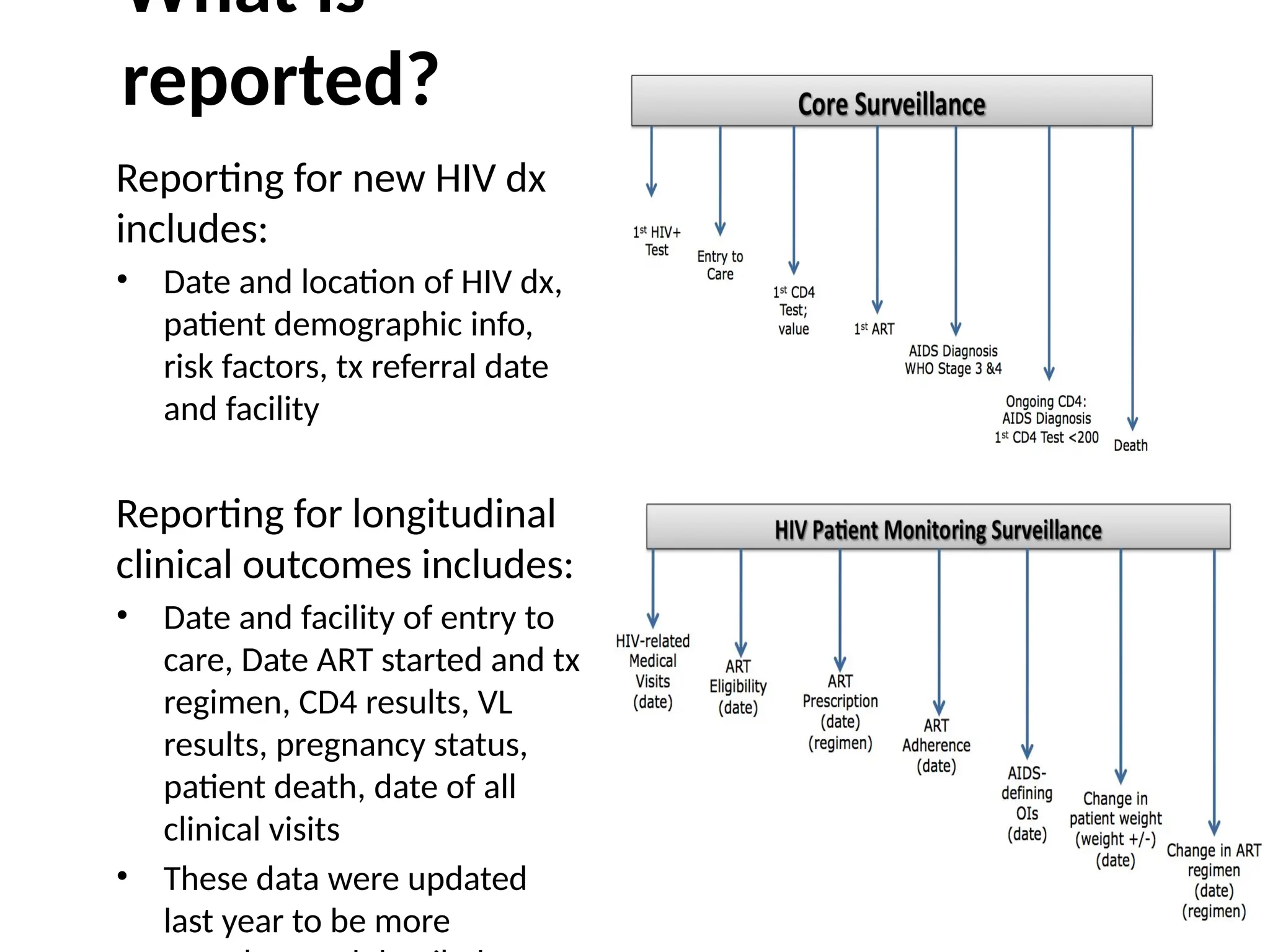
reported?
Reporting for new HIV dx
includes:
• Date and location of HIV dx,
patient demographic info,
risk factors, tx referral date
and facility
Reporting for longitudinal
clinical outcomes includes:
• Date and facility of entry to
care, Date ART started and tx
regimen, CD4 results, VL
results, pregnancy status,
patient death, date of all
clinical visits
• These data were updated
last year to be more
38
CBS implementation: The key model steps
• Based on the electronic Medical Records (EMR)
• Uniquely identifying individuals as cases
• Characterise individual case
• Assign the unique identifier per case
• Track the client along the COC
• Inter-link the facilities
• Track the patients’ sentinel events
39
Implementation: use of EMR
• Installed OpenMRS at all CBS sites
• Computers procured for all the sites
• Solar system installed for sites without power
• Data entered for the past 3 years
– ART and PMTCT
– EID
– Process finished in Kabarole and Bunyangabu
– Still on going in Hoima
40
Implementation: The unique identifier
• CBS to use finger print technology
– Technology development (completed)
– Now able to register and search a patient
• The unique identifier to be used to track
patients within and across health facilities
41
Implementation: Facility inter-linkage
• All facilities have:
– EMR
– Source of power (HEP or Solar)
– Computer
• The facility needs:
– Internet connection
– Finger print technology (completed)
42
Implementation: The central data base
• The Central data base set up
– Hosted at METS
• All facilities will sent reports to the central data base (automatic)
• Data to be extracted from the data base
• The data base will assist the program to:
– Generate reports according to Sentinel events
– De-duplicate the patients
The Case
• Cases are be:
– All HIV positive clients drawn from:
• MCH (ANC, L&D, and the PNC) PMTCT link
• T.B ward/ clinic
• HCT (Lab)
• HCT outreach
• HIV exposed Infants
• To be tracked as birth cohorts
implementation
• The EMR--facility-interlinked through use of
unique personal identifier
– and hence enable the tracking of cases and
referrals within the district to pilot this approach
• Longitudinal follow up to track sentinel events
Expected outcomes
• Compliments the already existing surveillance data from: ANC sentinel
surveillance (Annual); AIS (done every 5 years); Routine HIV data
• Ability to match care and treatment events for an individual over time
• Ability to have de-duplicated cases in a database
• More timely data on the epidemic
• More accurate calculation of the cascade of care
– # diagnosed  # linked to care  # retained in care  # prescribed ART  #
virally suppressed
• Improved monitoring of mortality
• Mapping the Epidemic at district and sub-district level (“Know your
epidemic”)
Basic Elements of HIV Case Surveillance
Define what will be reported
 HIV infection (all stages)
 Advanced stage HIV disease (stages 3,
4)
 AIDS (stage 4)

Define which events should be reported

1st
1st
positive test
viral load


 All viral loads (tracking
Cases)
CD4+ test

1st CD4+ < 200

 HIV exposure
(children)
11
Reporting
• Based on the Sentinel events
Indicators for monitoring: these are based on
the Sentinel events
• From entry into care. Time to:
• Eligibility for ART initiation
• ART initiation
• Lost to follow up
• Development of WHO clinical stage I, II,III and
IV
Indicators for monitoring: these are based on
the Sentinel events
• Development of AIDS Related OIs
– Development of T.B
– Development of Cryptococcal Meningitis
• CD4 count and change/ trend (every 6 months)
– Compared to baseline
• CD4 count (baseline and follow on)
– CD4 count <50
– CD4 count <200
– CD4 count <350
– CD4 count <500
– CD4 count >500
Sentinel events
• Viral Load
– 1st
VL
– VL <1000
– VL >5000
– VL > 10,000
• Time to viral suppression
• Treatment failure
• Switching of 2nd
Line
• Switching to 3rd
line
• Death
HIV exposed infants (HEI)
• Are be registered as birth cohorts
– Born in same month and same year
• All the identified HEI are followed up
longitudinally till 24 months of age
• Informs the program of the MTCT rate
Sentinel events for HEI- Will form the basis for
indicators
• Time from birth to registration
• Initiation of Septrin
• 1st
DNA PCR and result
• 2nd
DNA PCR and result
• Rapid test and result
HEI testing HIV positive
• Will have same Sentinel events as adults
Reporting
• Reporting will be quarterly
• The report will be structured according to Sentinel events
• Geographic mapping of the new cases
• Disaggregation
– Age
– Geographic location
– PMTCT
– Stage of HIV at identification
• HIV infection
• Advanced HIV infection
• AIDS
• Entry point
– PMTCT
– T.B
– HCT
Proposed IT Architecture
The architecture
The Central data architecture
Comprehensive HIV Case-Based
Surveillance system
 Reporting of all HIV infections (regardless of
clinical
stage)
 Persons should be reported if
they:
 Are newly diagnosed regardless of clinical stage
 Were previously diagnosed but not previously reported
 Were previously diagnosed and reported at clinical stage 1 or 2
and
progressed to stage 3 or 4
 Follow case longitudinally to get status
updates:
 sentinel events, including death
Monitor HIV disease
HIV disease sentinel events
HIV exposure
(exposed infants or
sexual
transmission)
HIV infection
1st positive
HIV test
1st
CD4 count
1st
CD4count
<350 1st 1st
viral load CD4 <200 AIDS-related
Opportunistic
Infection
Death
8
Monitor HIV disease
HIV disease sentinel events
HIV exposure
(exposed infants or
sexual
transmission)
HIV infection
1st positive
HIV test
1st
CD4 count
1st
CD4count
AIDS
reporting
<350 1st 1st
viral load CD4 <200 AIDS-related
Opportunistic
Infection
Death
9
Monitor HIV disease
HIV disease sentinel events
HIV exposure
(exposed infants or
sexual
transmission)
HIV infection
1st positive
HIV test
1st
CD4 count
1st
CD4count
HIV case
reporting
<350 1st 1st
viral load CD4 <200 AIDS-related
Opportunistic
Infection
Death
10
Examples of using CBS to track events
How many are infected, progressing to advanced
disease and dying? What care and treatment
services are needed?
Vital Signs: HIV Prevention Through Care and Treatment — United States. MMWR. December 2, 2011
/
What is the immunological
newly dx?
status of
Barbados: Immunological classification of newly registered patients at
the LRU in 2010
Source: Barbados HIV/AIDS Surveillance Report 2010
22
WHO HIV-associated CD4
immunological (cells/ mm3)
classification
Sex Total
Male Female n %
Severe < 200 27 6 33 32.0
Advanced 200 - 349 15 7 22 21.4
Mild 350 - 499 12 6 18 17.5
None or not
significant
≥ 500 13 13 26 25.2
No Classification Not Known 3 1 4 3.9
Total 70 (68.0%) 33 (32.0%) 103 100.0
How many are infected, progressing to
advanced disease and dying?
Reported HIV, AIDS andRelated Deaths, Viet Nam 1993-2011
23

HIV Case Based Surveillance 2 Lecture Oct 18.pptx

  • 1.
    The HIV CaseBased Surveillance
  • 2.
    Surveillance • Surveillance—the ongoing,systematic collection, analysis, interpretation, and dissemination of data regarding a health-related event for use in public health action to reduce morbidity and mortality and to improve health. • Surveillance data can help predict future trends and target needed prevention and treatment programs • Second-generation surveillance—HIV surveillance that not only tracks HIV prevalence but also uses additional sources of data to increase the understanding of trends of the epidemic over time. It includes biological surveillance of HIV and other sexually transmitted infections as well as systematic surveillance of the behaviours that spread them • Sentinel surveillance—ongoing, systematic collection and analysis of data from certain sites (e.g., hospitals, health centers, ante-natal clinics) selected for their geographic location, medical specialty, and populations served, and considered to have the potential to provide an early indication of changes in the level of a disease – Impact monitoring—tracking of health-related events, such as the prevalence or incidence of a particular disease; in the field of public health, impact monitoring is usually referred to as “surveillance”.
  • 3.
    Types of surveillance •Passive surveillance often gathers disease data from all potential reporting health care workers. • Health authorities do not stimulate reporting by reminding health care workers to report disease nor providing feedback to individual health workers
  • 4.
    Types of surveillance •An active surveillance system provides stimulus to health care workers in the form of individual feedback or other incentives. • Often reporting frequency by individual health workers is monitored; health workers who consistently fail to report or complete the forms incorrectly are provided specific feedback to improve their performance. • There may also be incentives provided for complete reporting
  • 5.
    Types of surveillance •Instead of attempting to gather surveillance data from all health care workers, a sentinel surveillance system selects, either randomly or intentionally, a small group of health workers from whom to gather data. • A sentinel surveillance system is used when high-quality data are needed about a particular disease that cannot be obtained through a passive system • These health workers then receive greater attention from health authorities than would be possible with universal surveillance • Selected reporting units, with a high probability of seeing cases of the disease in question, good laboratory facilities and experienced well-qualified staff, identify and notify on certain diseases
  • 6.
    HIV Surveillance • HIVsurveillance comprises both biological and behavioural surveillance. • Biological surveillance involves repeated cross-sectional sero-surveys in a representative population, while behavioural surveillance refers to repeat cross-sectional surveys of behaviour in a representative population (UNAIDS and WHO, 2000). • With this type of survey, prevalence information is collected from populations that are more or less representative of the general population (such as pregnant women), as well as from populations considered to be at high risk of infection and transmission. • This type of survey can be linked or unlinked to anonymous testing, with or without informed consent.
  • 7.
    Biological surveillance • Involves: •Sentinel sero-surveillance in defined sub-populations. • Regular HIV screening of donated blood. • Regular HIV screening of occupational cohorts or other sub-populations. • HIV screening of specimens taken in general population surveys. • HIV screening of specimens taken in special population surveys.
  • 8.
    Behavioral surveillance • Involves: •Repeat cross-sectional surveys in the general population. • Repeat cross-sectional surveys in defined sub- populations
  • 9.
    Sentinel Vs RoutineSurveillance • Every second year in affected countries, the MoH determines the HIV- prevalence of a sample of pregnant women who attend ANC clinics. This surveillance is referred to as sentinel HIV surveillance. • The term ‘HIV surveillance’ means that the individual’s HIV status is determined (anonymously) when the surveillance is carried out. • The term ‘sentinel’ means that the surveillance is undertaken in a selected population (in this case, pregnant women attending ANC clinics during a certain period of the year). • Pregnant women are selected as the ‘sentinel’ population because, by definition, they have had unprotected heterosexual sex, which is the main way HIV is transmitted in most countries.
  • 10.
    • The oppositeof sentinel surveillance is routine HIV surveillance, whereby the HIV status of every patient is determined routinely (i.e. as part of a medical visit) without exception. • An example of routine HIV surveillance is blood- donor HIV surveillance, where the HIV sero-status of all donated blood is routinely determined, before derived blood products are used.
  • 11.
    Sentinel event • Definedas any unanticipated event in a healthcare setting resulting in death or serious physical or psychological injury to a patient or patients, not related to the natural course of the patient's illness. • Sentinel events specifically include loss of a limb or gross motor function, and any event for which a recurrence would carry a risk of a serious adverse outcome
  • 12.
    Sentinel HIV surveillance •HIV Sentinel Surveillance is one of the key components of second generation surveillance system to track the HIV epidemic in the country with the objective of understanding the level and trends of HIV epidemic among different population groups as well as to identify the spread of the epidemic to new pockets
  • 13.
    SS • Sentinel surveillance:It is a reporting system based on selected institutions or people who provide regular, complete reports on one or more diseases occurring ideally in a defined attachment. • It also provides additional data on cases • Monitoring of rate of occurrence of specific conditions to assess the stability or change in health levels of a population. • It is also the study of disease rates in a specific cohort such as in a geographic area or population subgroup to estimate trends in larger population
  • 14.
    Objectives of HSS •To monitor trends in prevalence of HIV infection over time • To monitor the distribution and spread of HIV prevalence in different population subgroups and in different geographical areas • To identify emerging pockets of HIV epidemic in the country
  • 15.
    Applications of theHSS data • To estimate and project burden of HIV at state & national levels • To support programme prioritization and resource allocation • To assist evaluation of programme impact • Advocacy
  • 16.
    2nd generation S • Itis the regular, systematic collection, analysis and interpretation of information for use in tracking and describing changes in the HIV/AIDS epidemic over time. • It also gathers information on risk behaviours, using them to warn of or explain changes in levels of infection. • As such, it includes, in addition to HIV surveillance and AIDS case reporting, STI surveillance to monitor the spread of STI in populations at risk of HIV and behavioural surveillance to monitor trends in risk behaviours over time. • These different components achieve greater or lesser significance depending of the surveillance needs of a country, determined by the level of the epidemic it is facing: low level, concentrated or generalized
  • 17.
    2nd generation S • Secondgeneration surveillance for HIV/AIDS is the regular, systematic collection, analysis and interpretation of information for use in tracking and describing changes in the HIV/AIDS epidemic over time. • Second generation surveillance for HIV/AIDS also gathers information on risk behaviours, using them to warn of or explain changes in levels of infection. • As such, second generation surveillance includes, in addition to HIV surveillance and AIDS case reporting, STI surveillance to monitor the spread of STI in populations at risk of HIV and behavioural surveillance to monitor trends in risk behaviours over time. • These different components achieve greater or lesser significance depending of the surveillance needs of a country, determined by the level of the epidemic it is facing: low level, concentrated or generalized
  • 18.
  • 19.
    Epidemic states- Classification •Low level: Prevalence less than 1% in any sub group in population. • Concentrated: - Prevalence consistently over 5% in at least one defined sub population. - Prevalence below 1% in pregnant women in urban areas • Generalised: Prevalence between 1-15 % in ANC population • Hyperendemic: HIV prevalence exceeds 15% in adult population
  • 20.
    Low level Principles: Prevalence <1%  HIV infection may have existed for many years, but never spread to significant level in any sub population Infection largely confined to individuals with high risk behaviours (e.g. CSW, Drug injectors, men having sex with men) - the epidemic state suggests diffused network of risks, or virus introduced only very recently. Numerical proxy: Prevalence not consistently exceeded 5% in any sub-population
  • 22.
    Concentrated Principle: Prevalence high inone or more subpopulation HIV spread rapidly in a defined population, but not in the general population Epidemic state suggests active net work of risks within the sub- population Future trend determined by nature of links between highly infected sub-population and the general population. Numerical proxy: - Prevalence consistently over 5% in at least one defined sub population. - Prevalence below 1% in pregnant women in
  • 24.
    Generalised Principle Prevalence between 1-15%in ANC population HIV firmly established in the general population Sub-population at high risk continue disproportionately continue to spread the disease Sexual networking sufficient to sustain an epidemic independent of sub-population at high risks Numerical proxy: HIV prevalence consistent over 1% in pregnant women
  • 26.
    Hyperendemic • HIV prevalenceexceeds 15% in adult population • Driven by heterosexual multiple concurrent partnerships • Low level and inconsistent condom use • All sexually active adults are at elevated risk of HIV infection
  • 28.
    Recommendations: Low level Cross-sectionalsurveys of behavior in sub-population with risk behavior Surveillance of STIs and other biological markers of risks HIV surveillance in sub-population at risks
  • 29.
    cont • Tracking ofHIV in blood donors • HIV program coverage disaggregated by pop subgroups
  • 30.
    Recommendations for generalized epidemic •Sentinel HIV surveillance among pregnant woman, urban and rural • Cross-sectional surveys of behaviour in the general populations • Cross-sectional surveys of behaviour among young people • HIV and behavioural surveillance in sub population with high risk- behaviour. • Data in mobility and mortality • • HIV case Based Surveillance
  • 31.
    The HIV CaseBased Surveillance
  • 32.
    Background • HIV casebased surveillance (CBS) was recommended by WHO as early as 2006 • CBS is a means of uniquely identifying and characterizing persons newly diagnosed with HIV or AIDS and tracking them over time • Uganda is now among the few countries coming on board to implement CBS • Others include Kenya, Ethiopia, SA, TZ, Namibia
  • 33.
    Why Case basedSurveillance • Monitoring trends in HIV infection Prevalence • Characterize affected populations • Identifying the number of persons in need of care – and hence treatment and the allocation of resources to those in need • Targeting and evaluating interventions and prevention programs
  • 34.
    Why Case basedSurveillance … • Helps to Map the epidemic • Measures Linkages care • Measures retention in care • Compliments other important evidence from: – sero-behavioral surveys – Size estimation studies of risk groups – sentinel surveillance (usually from ante-natal clinics) • to form a more complete picture of the status of the HIV epidemic in a country or region
  • 35.
    Ten global indicators,six collected by HIV CBS* *WHO. Consolidated Strategic Information
  • 36.
    Structured along thecontinuum of care Prevention Testing Link to care Treatment Chronic care PrEP PEP Initiation of therapy 1st L, 2nd L, 3rd L Infant prophylaxis HIV Diagnosis in infants and children TB diagnosis CTX prophylaxis Cardiovascular disease Depression Service delivery
  • 37.
    What is reported? Reporting fornew HIV dx includes: • Date and location of HIV dx, patient demographic info, risk factors, tx referral date and facility Reporting for longitudinal clinical outcomes includes: • Date and facility of entry to care, Date ART started and tx regimen, CD4 results, VL results, pregnancy status, patient death, date of all clinical visits • These data were updated last year to be more
  • 38.
    38 CBS implementation: Thekey model steps • Based on the electronic Medical Records (EMR) • Uniquely identifying individuals as cases • Characterise individual case • Assign the unique identifier per case • Track the client along the COC • Inter-link the facilities • Track the patients’ sentinel events
  • 39.
    39 Implementation: use ofEMR • Installed OpenMRS at all CBS sites • Computers procured for all the sites • Solar system installed for sites without power • Data entered for the past 3 years – ART and PMTCT – EID – Process finished in Kabarole and Bunyangabu – Still on going in Hoima
  • 40.
    40 Implementation: The uniqueidentifier • CBS to use finger print technology – Technology development (completed) – Now able to register and search a patient • The unique identifier to be used to track patients within and across health facilities
  • 41.
    41 Implementation: Facility inter-linkage •All facilities have: – EMR – Source of power (HEP or Solar) – Computer • The facility needs: – Internet connection – Finger print technology (completed)
  • 42.
    42 Implementation: The centraldata base • The Central data base set up – Hosted at METS • All facilities will sent reports to the central data base (automatic) • Data to be extracted from the data base • The data base will assist the program to: – Generate reports according to Sentinel events – De-duplicate the patients
  • 43.
    The Case • Casesare be: – All HIV positive clients drawn from: • MCH (ANC, L&D, and the PNC) PMTCT link • T.B ward/ clinic • HCT (Lab) • HCT outreach • HIV exposed Infants • To be tracked as birth cohorts
  • 44.
    implementation • The EMR--facility-interlinkedthrough use of unique personal identifier – and hence enable the tracking of cases and referrals within the district to pilot this approach • Longitudinal follow up to track sentinel events
  • 45.
    Expected outcomes • Complimentsthe already existing surveillance data from: ANC sentinel surveillance (Annual); AIS (done every 5 years); Routine HIV data • Ability to match care and treatment events for an individual over time • Ability to have de-duplicated cases in a database • More timely data on the epidemic • More accurate calculation of the cascade of care – # diagnosed  # linked to care  # retained in care  # prescribed ART  # virally suppressed • Improved monitoring of mortality • Mapping the Epidemic at district and sub-district level (“Know your epidemic”)
  • 46.
    Basic Elements ofHIV Case Surveillance Define what will be reported  HIV infection (all stages)  Advanced stage HIV disease (stages 3, 4)  AIDS (stage 4)  Define which events should be reported  1st 1st positive test viral load    All viral loads (tracking Cases) CD4+ test  1st CD4+ < 200   HIV exposure (children) 11
  • 47.
    Reporting • Based onthe Sentinel events
  • 48.
    Indicators for monitoring:these are based on the Sentinel events • From entry into care. Time to: • Eligibility for ART initiation • ART initiation • Lost to follow up • Development of WHO clinical stage I, II,III and IV
  • 49.
    Indicators for monitoring:these are based on the Sentinel events • Development of AIDS Related OIs – Development of T.B – Development of Cryptococcal Meningitis • CD4 count and change/ trend (every 6 months) – Compared to baseline • CD4 count (baseline and follow on) – CD4 count <50 – CD4 count <200 – CD4 count <350 – CD4 count <500 – CD4 count >500
  • 50.
    Sentinel events • ViralLoad – 1st VL – VL <1000 – VL >5000 – VL > 10,000 • Time to viral suppression • Treatment failure • Switching of 2nd Line • Switching to 3rd line • Death
  • 51.
    HIV exposed infants(HEI) • Are be registered as birth cohorts – Born in same month and same year • All the identified HEI are followed up longitudinally till 24 months of age • Informs the program of the MTCT rate
  • 52.
    Sentinel events forHEI- Will form the basis for indicators • Time from birth to registration • Initiation of Septrin • 1st DNA PCR and result • 2nd DNA PCR and result • Rapid test and result HEI testing HIV positive • Will have same Sentinel events as adults
  • 53.
    Reporting • Reporting willbe quarterly • The report will be structured according to Sentinel events • Geographic mapping of the new cases • Disaggregation – Age – Geographic location – PMTCT – Stage of HIV at identification • HIV infection • Advanced HIV infection • AIDS • Entry point – PMTCT – T.B – HCT
  • 54.
  • 55.
  • 56.
    The Central dataarchitecture
  • 57.
    Comprehensive HIV Case-Based Surveillancesystem  Reporting of all HIV infections (regardless of clinical stage)  Persons should be reported if they:  Are newly diagnosed regardless of clinical stage  Were previously diagnosed but not previously reported  Were previously diagnosed and reported at clinical stage 1 or 2 and progressed to stage 3 or 4  Follow case longitudinally to get status updates:  sentinel events, including death
  • 58.
    Monitor HIV disease HIVdisease sentinel events HIV exposure (exposed infants or sexual transmission) HIV infection 1st positive HIV test 1st CD4 count 1st CD4count <350 1st 1st viral load CD4 <200 AIDS-related Opportunistic Infection Death 8
  • 59.
    Monitor HIV disease HIVdisease sentinel events HIV exposure (exposed infants or sexual transmission) HIV infection 1st positive HIV test 1st CD4 count 1st CD4count AIDS reporting <350 1st 1st viral load CD4 <200 AIDS-related Opportunistic Infection Death 9
  • 60.
    Monitor HIV disease HIVdisease sentinel events HIV exposure (exposed infants or sexual transmission) HIV infection 1st positive HIV test 1st CD4 count 1st CD4count HIV case reporting <350 1st 1st viral load CD4 <200 AIDS-related Opportunistic Infection Death 10
  • 61.
    Examples of usingCBS to track events
  • 62.
    How many areinfected, progressing to advanced disease and dying? What care and treatment services are needed? Vital Signs: HIV Prevention Through Care and Treatment — United States. MMWR. December 2, 2011 /
  • 63.
    What is theimmunological newly dx? status of Barbados: Immunological classification of newly registered patients at the LRU in 2010 Source: Barbados HIV/AIDS Surveillance Report 2010 22 WHO HIV-associated CD4 immunological (cells/ mm3) classification Sex Total Male Female n % Severe < 200 27 6 33 32.0 Advanced 200 - 349 15 7 22 21.4 Mild 350 - 499 12 6 18 17.5 None or not significant ≥ 500 13 13 26 25.2 No Classification Not Known 3 1 4 3.9 Total 70 (68.0%) 33 (32.0%) 103 100.0
  • 64.
    How many areinfected, progressing to advanced disease and dying? Reported HIV, AIDS andRelated Deaths, Viet Nam 1993-2011 23

Editor's Notes

  • #35 LUCY
  • #37 System was implemented in 2008 by the Haitian MoH National AIDS Program, over seen by NASTAD Data are reported two ways: Electronic interface used to report new diagnoses at the site level Monthly data feeds from 3 major EMRs Cases are matched and deduplicated using patient name, DOB and other identifiers
  • #54 OpenMRS installations at the facilities Sync with a Medical Records Database which is also OpenMRS based so provide a central location for all medical records in the country The Master Patient Index is an extract from the MRD to provide identification for patients so can be used independently – and is kept in sync with the MRD The OpenMRS instances also provide aggregate information to the National DHIS2 The analysis database is a data warehouse with anonymized data that allows for generation of CBS reports