JOURNAL CLUB
By Nicholas Ngua
Emergency Unit
UHW
Fibrinolysis for Patients with
Intermediate Risk Pulmonary
Embolism
PEITHO Trial
Published in N Engl J Med 2014; 370:1402-1411
April 10 2014
by Meyer et al
Background
 Acute right ventricular pressure overload –
determinant of severity and clinical outcome for
PE
 Submassive PE/Intermediate risk -
controversial
Clinical Question
 Among patients with submassive PE being
treated with unfractionated heparin, does
administration of tenecteplase reduce all-cause
mortality or hemodynamic decompensation at
7 days when compared to placebo?
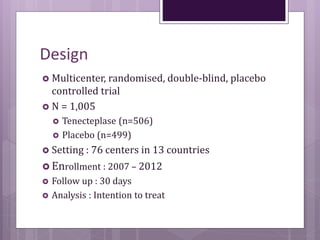
Design
 Multicenter, randomised, double-blind, placebo
controlled trial
 N = 1,005
 Tenecteplase (n=506)
 Placebo (n=499)
 Setting : 76 centers in 13 countries
 Enrollment : 2007 – 2012
 Follow up : 30 days
 Analysis : Intention to treat
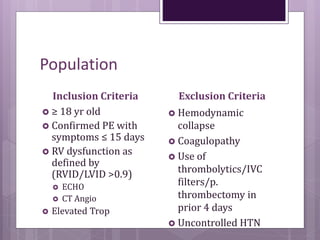
Population
Inclusion Criteria
 ≥ 18 yr old
 Confirmed PE with
symptoms ≤ 15 days
 RV dysfunction as
defined by
(RVID/LVID >0.9)
 ECHO
 CT Angio
 Elevated Trop
Exclusion Criteria
 Hemodynamic
collapse
 Coagulopathy
 Use of
thrombolytics/IVC
filters/p.
thrombectomy in
prior 4 days
 Uncontrolled HTN
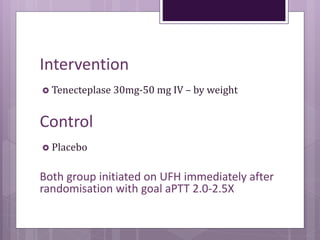
Intervention
 Tenecteplase 30mg-50 mg IV – by weight
Control
 Placebo
Both group initiated on UFH immediately after
randomisation with goal aPTT 2.0-2.5X
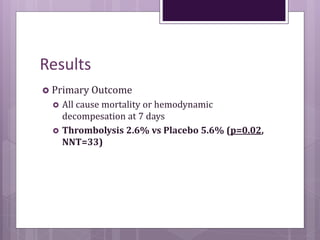
Results
 Primary Outcome
 All cause mortality or hemodynamic
decompesation at 7 days
 Thrombolysis 2.6% vs Placebo 5.6% (p=0.02,
NNT=33)
Results
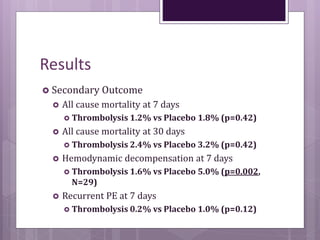
 Secondary Outcome
 All cause mortality at 7 days
 Thrombolysis 1.2% vs Placebo 1.8% (p=0.42)
 All cause mortality at 30 days
 Thrombolysis 2.4% vs Placebo 3.2% (p=0.42)
 Hemodynamic decompensation at 7 days
 Thrombolysis 1.6% vs Placebo 5.0% (p=0.002,
N=29)
 Recurrent PE at 7 days
 Thrombolysis 0.2% vs Placebo 1.0% (p=0.12)
Results
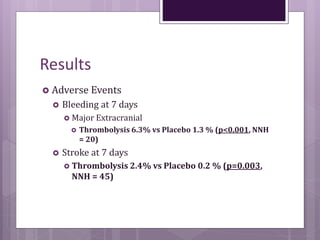
 Adverse Events
 Bleeding at 7 days
 Major Extracranial
 Thrombolysis 6.3% vs Placebo 1.3 % (p<0.001, NNH
= 20)
 Stroke at 7 days
 Thrombolysis 2.4% vs Placebo 0.2 % (p=0.003,
NNH = 45)
Results
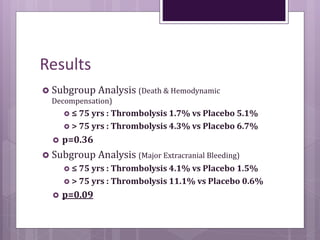
 Subgroup Analysis (Death & Hemodynamic
Decompensation)
 ≤ 75 yrs : Thrombolysis 1.7% vs Placebo 5.1%
 > 75 yrs : Thrombolysis 4.3% vs Placebo 6.7%
 p=0.36
 Subgroup Analysis (Major Extracranial Bleeding)
 ≤ 75 yrs : Thrombolysis 4.1% vs Placebo 1.5%
 > 75 yrs : Thrombolysis 11.1% vs Placebo 0.6%
 p=0.09
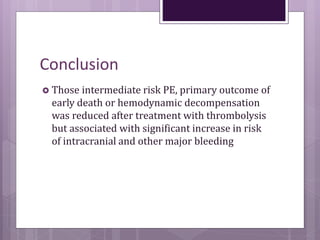
Conclusion
 Those intermediate risk PE, primary outcome of
early death or hemodynamic decompensation
was reduced after treatment with thrombolysis
but associated with significant increase in risk
of intracranial and other major bleeding
Questions
 What is the primary outcome of this study? Do
you think this is appropriate?
 What is intention to treat analysis? Give two
advantages and two disadvantages of this
method of analysis.
 At the end of this journal club, Dr Jo Mower asks
you whether it should be introduced in your
department. Give reasons to support your
stand.
THANK YOU
 Next Journal Club on 26 August 2015
 Feedback on how to improve journal club

JC PEITHO TRIAL

  • 1.
    JOURNAL CLUB By NicholasNgua Emergency Unit UHW
  • 2.
    Fibrinolysis for Patientswith Intermediate Risk Pulmonary Embolism PEITHO Trial Published in N Engl J Med 2014; 370:1402-1411 April 10 2014 by Meyer et al
  • 3.
    Background  Acute rightventricular pressure overload – determinant of severity and clinical outcome for PE  Submassive PE/Intermediate risk - controversial
  • 4.
    Clinical Question  Amongpatients with submassive PE being treated with unfractionated heparin, does administration of tenecteplase reduce all-cause mortality or hemodynamic decompensation at 7 days when compared to placebo?
  • 5.
    Design  Multicenter, randomised,double-blind, placebo controlled trial  N = 1,005  Tenecteplase (n=506)  Placebo (n=499)  Setting : 76 centers in 13 countries  Enrollment : 2007 – 2012  Follow up : 30 days  Analysis : Intention to treat
  • 6.
    Population Inclusion Criteria  ≥18 yr old  Confirmed PE with symptoms ≤ 15 days  RV dysfunction as defined by (RVID/LVID >0.9)  ECHO  CT Angio  Elevated Trop Exclusion Criteria  Hemodynamic collapse  Coagulopathy  Use of thrombolytics/IVC filters/p. thrombectomy in prior 4 days  Uncontrolled HTN
  • 7.
    Intervention  Tenecteplase 30mg-50mg IV – by weight Control  Placebo Both group initiated on UFH immediately after randomisation with goal aPTT 2.0-2.5X
  • 8.
    Results  Primary Outcome All cause mortality or hemodynamic decompesation at 7 days  Thrombolysis 2.6% vs Placebo 5.6% (p=0.02, NNT=33)
  • 9.
    Results  Secondary Outcome All cause mortality at 7 days  Thrombolysis 1.2% vs Placebo 1.8% (p=0.42)  All cause mortality at 30 days  Thrombolysis 2.4% vs Placebo 3.2% (p=0.42)  Hemodynamic decompensation at 7 days  Thrombolysis 1.6% vs Placebo 5.0% (p=0.002, N=29)  Recurrent PE at 7 days  Thrombolysis 0.2% vs Placebo 1.0% (p=0.12)
  • 10.
    Results  Adverse Events Bleeding at 7 days  Major Extracranial  Thrombolysis 6.3% vs Placebo 1.3 % (p<0.001, NNH = 20)  Stroke at 7 days  Thrombolysis 2.4% vs Placebo 0.2 % (p=0.003, NNH = 45)
  • 11.
    Results  Subgroup Analysis(Death & Hemodynamic Decompensation)  ≤ 75 yrs : Thrombolysis 1.7% vs Placebo 5.1%  > 75 yrs : Thrombolysis 4.3% vs Placebo 6.7%  p=0.36  Subgroup Analysis (Major Extracranial Bleeding)  ≤ 75 yrs : Thrombolysis 4.1% vs Placebo 1.5%  > 75 yrs : Thrombolysis 11.1% vs Placebo 0.6%  p=0.09
  • 12.
    Conclusion  Those intermediaterisk PE, primary outcome of early death or hemodynamic decompensation was reduced after treatment with thrombolysis but associated with significant increase in risk of intracranial and other major bleeding
  • 13.
    Questions  What isthe primary outcome of this study? Do you think this is appropriate?  What is intention to treat analysis? Give two advantages and two disadvantages of this method of analysis.  At the end of this journal club, Dr Jo Mower asks you whether it should be introduced in your department. Give reasons to support your stand.
  • 14.
    THANK YOU  NextJournal Club on 26 August 2015  Feedback on how to improve journal club