
Methanospirillum hungatii
DOMAIN ARCHAEA
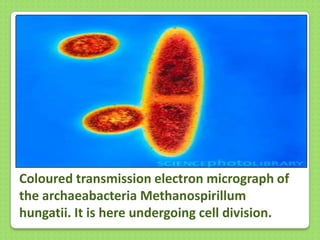
Coloured transmission electron micrograph of
the archaeabacteria Methanospirillum
hungatii. It is here undergoing cell division.
ARCHAEABACTERIA – Methanospirillum hungatii
 It is mostly gram negative, but the

multicellular filaments at the end tests as
gram positive.
 The cultures are usually yellow in
color, circular in shape, and convex with
lobate margins.
 The cells are spiral shaped (curved rods).
 It is very sensitive to oxygen (anaerobic).
ARCHAEABACTERIA – Methanospirillum hungatii
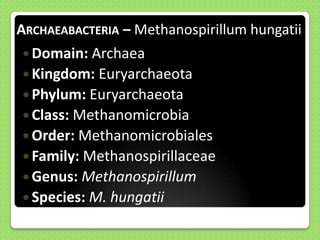
 Domain: Archaea
 Kingdom: Euryarchaeota
 Phylum: Euryarchaeota
 Class: Methanomicrobia
 Order: Methanomicrobiales
 Family: Methanospirillaceae
 Genus: Methanospirillum

 Species: M. hungatii
ARCHAEABACTERIA – Methanospirillum hungatii
 Type of Cell: Prokaryotic
 Presence of Nuclear Membrane: Absent
 Unicellular/Multicellular: Unicellular
 Presence of Mitochondria: Absent
 Mode of Reproduction: Asexual, by

means of cell division.
ARCHAEABACTERIA – Methanospirillum hungatii
 Ability to Perform Photosynthesis: No.
 Mode of Nutrition: Chemoheterotrophic
 Motility: They are motile by archaeal

flagella.
 Habitat: Live in anaerobic conditions.
ECONOMIC IMPORTANCE
• to anaerobically treat organic

wastes, such as municipal wastewater or
industrial waste; can sometimes be good
at degrading particularly complex wastes
• production of methane that can become
a source of fuel
ARCHAEABACTERIA
Methanospirillum hungatii
Streptomyces coelicolor
DOMAIN BACTERIA
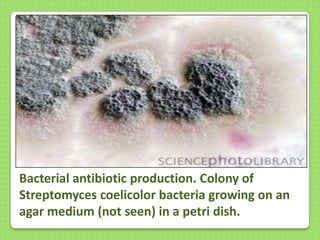
Bacterial antibiotic production. Colony of
Streptomyces coelicolor bacteria growing on an
agar medium (not seen) in a petri dish.
EUBACTERIA – Streptomyces coelicolor
 A filamentous, high G-C, gram-positive

bacteria, adaptable to environmental
stress.
 Streptomyces coelicolor release pigments
that are blue/green in alkali and red in
acidic conditions, thereby giving the
bacterial colonies those colors under the
respective conditions.
EUBACTERIA – Streptomyces coelicolor
 Domain: Bacteria
 Kingdom: Bacteria
 Phylum: Actinobacteria
 Class: Actinobacteria
 Order: Actinomycetales
 Family: Streptomycetaceae
 Genus: Streptomyces

 Species: S. coelicolor
EUBACTERIA – Streptomyces coelicolor
 Type of Cell: Prokaryotic
 Presence of Nuclear Membrane: Absent
 Unicellular/Multicellular: Unicellular
 Presence of Mitochondria: Absent
 Mode of Reproduction: Asexual, by

means of cell division then spore
formation.
EUBACTERIA – Streptomyces coelicolor
 Ability to Perform Photosynthesis: No.
 Mode of Nutrition: Chemoheterotrophic
 Motility: Non-motile, sessile.
 Habitat: Live in soil, where nutrient

conditions can change dramatically.
ECONOMIC IMPORTANCE
• metabolizing other organism's remains

• can degrade chitin and other compounds
• integral part of the global carbon cycle
• takes part in the nitrogen cycle
• produces many different types of

antibiotics

EUBACTERIA
Streptomyces coelicolor
•
•

•
•
•
•

en.wikipedia.com
www.sciencephotolibrary.com
www.uniprot.org
www.chacha.com
microbewiki.kenyon.edu
uk.ask.com/wiki

REFERENCES

Archaeabacteria and Eubacteria Sample Species (Methanospirillum hungatii & Streptomyces coelicolor)

  • 3.
  • 4.
    Coloured transmission electronmicrograph of the archaeabacteria Methanospirillum hungatii. It is here undergoing cell division.
  • 5.
    ARCHAEABACTERIA – Methanospirillumhungatii  It is mostly gram negative, but the multicellular filaments at the end tests as gram positive.  The cultures are usually yellow in color, circular in shape, and convex with lobate margins.  The cells are spiral shaped (curved rods).  It is very sensitive to oxygen (anaerobic).
  • 6.
    ARCHAEABACTERIA – Methanospirillumhungatii  Domain: Archaea  Kingdom: Euryarchaeota  Phylum: Euryarchaeota  Class: Methanomicrobia  Order: Methanomicrobiales  Family: Methanospirillaceae  Genus: Methanospirillum  Species: M. hungatii
  • 7.
    ARCHAEABACTERIA – Methanospirillumhungatii  Type of Cell: Prokaryotic  Presence of Nuclear Membrane: Absent  Unicellular/Multicellular: Unicellular  Presence of Mitochondria: Absent  Mode of Reproduction: Asexual, by means of cell division.
  • 8.
    ARCHAEABACTERIA – Methanospirillumhungatii  Ability to Perform Photosynthesis: No.  Mode of Nutrition: Chemoheterotrophic  Motility: They are motile by archaeal flagella.  Habitat: Live in anaerobic conditions.
  • 9.
    ECONOMIC IMPORTANCE • toanaerobically treat organic wastes, such as municipal wastewater or industrial waste; can sometimes be good at degrading particularly complex wastes • production of methane that can become a source of fuel ARCHAEABACTERIA Methanospirillum hungatii
  • 11.
  • 12.
    Bacterial antibiotic production.Colony of Streptomyces coelicolor bacteria growing on an agar medium (not seen) in a petri dish.
  • 13.
    EUBACTERIA – Streptomycescoelicolor  A filamentous, high G-C, gram-positive bacteria, adaptable to environmental stress.  Streptomyces coelicolor release pigments that are blue/green in alkali and red in acidic conditions, thereby giving the bacterial colonies those colors under the respective conditions.
  • 14.
    EUBACTERIA – Streptomycescoelicolor  Domain: Bacteria  Kingdom: Bacteria  Phylum: Actinobacteria  Class: Actinobacteria  Order: Actinomycetales  Family: Streptomycetaceae  Genus: Streptomyces  Species: S. coelicolor
  • 15.
    EUBACTERIA – Streptomycescoelicolor  Type of Cell: Prokaryotic  Presence of Nuclear Membrane: Absent  Unicellular/Multicellular: Unicellular  Presence of Mitochondria: Absent  Mode of Reproduction: Asexual, by means of cell division then spore formation.
  • 16.
    EUBACTERIA – Streptomycescoelicolor  Ability to Perform Photosynthesis: No.  Mode of Nutrition: Chemoheterotrophic  Motility: Non-motile, sessile.  Habitat: Live in soil, where nutrient conditions can change dramatically.
  • 17.
    ECONOMIC IMPORTANCE • metabolizingother organism's remains • can degrade chitin and other compounds • integral part of the global carbon cycle • takes part in the nitrogen cycle • produces many different types of antibiotics EUBACTERIA Streptomyces coelicolor
  • 18.