Grails – In Depth Graeme Rocher, CTO – G2One Inc TS-5764
Learn how to dramatically simplify web development on the Java™ platform with Groovy & Grails
Your Speaker Graeme Rocher Project Lead of Grails CTO of G2One Inc – The Groovy/Grails Company Member of JSR-241 Expert Group Author of “The Definitive Guide to Grails”
Agenda Introduction to Groovy & Grails Why Groovy? Getting Started Simplified ORM The Web Layer Web Services Easy Ajax
What is Groovy? Groovy is a dynamic language for the Java Virtual Machine (JVM™) Takes inspiration from Small Talk, Python and Ruby  Integrates with the Java language and platform at every  level
What is Grails? A Web  platform  that implements the full stack from build system down to ORM layer Leverages existing technologies like Spring, Hibernate, Quartz etc. avoiding re-inventing the wheel Features and extensible plug-in system and an environment for runtime configuration built on Spring
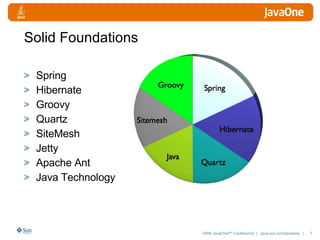
Solid Foundations Spring Hibernate Groovy Quartz SiteMesh Jetty Apache Ant Java Technology
Why Groovy & Grails? All the power  of frameworks from other platforms like Ruby on Rails, Django and TurboGears Built from the ground up on  Java technologies .  Design for Java technology by Java technology developers Leverage  existing tools and technologies Distributed caches, replicating technologies etc. Profiling, monitoring and debugging tools IDEs Reduce  context switching
Getting Started Download from  http:// grails.org /Download Extract zip to disk Set  GRAILS_HOME  variable to location on disk Add  $GRAILS_HOME/bin  to your environment variables  Download from  http:// groovy.codehaus.org Extract zip to disk Set  GROOVY_HOME  variable to location on disk Add  $GROOVY_HOME/bin  to your environment variables
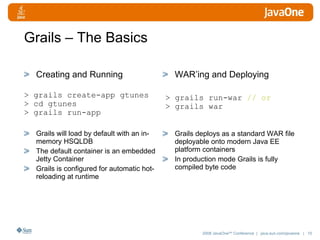
Grails – The Basics Creating and Running Grails will load by default with an in-memory HSQLDB The default container is an embedded Jetty Container Grails is configured for automatic hot-reloading at runtime WAR’ing and Deploying Grails deploys as a standard WAR file deployable onto modern Java EE platform containers  In production mode Grails is fully compiled byte code > grails create-app gtunes > cd gtunes > grails run-app > grails run-war  // or > grails war
Getting Started with Grails Creating and Running
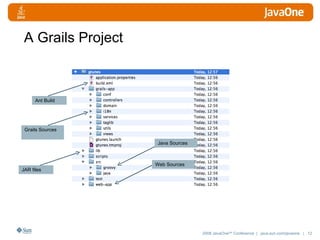
A Grails Project Ant Build JAR files Grails Sources Web Sources Java Sources
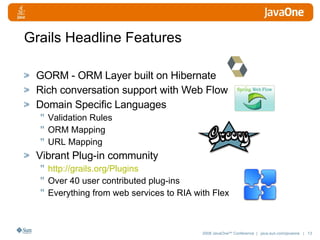
Grails Headline Features GORM - ORM Layer built on Hibernate Rich conversation support with Web Flow Domain Specific Languages Validation Rules ORM Mapping URL Mapping Vibrant Plug-in community http:// grails.org/Plugins Over 40 user contributed plug-ins Everything from web services to RIA with Flex
Grails – The Platform Java 2 Platform, Enterprise Edition (J2EE™ platform)  was too complex. Spring and Hibernate reduced that complexity and became very successful Grails represents the  next level of abstraction  for the Java EE platform Built on Spring and Hibernate, but dramatically simplifying their usage
Easy ORM with GORM class Album { String title String artist Date releaseDate static hasMany = [songs:Song] } class Song { String title Double duration } table - album table - song GORM classes, also known as domain  classes, go in the domain directory id title artist release_date id title duration album_id
GORM in Action Querying and Persistence with GORM
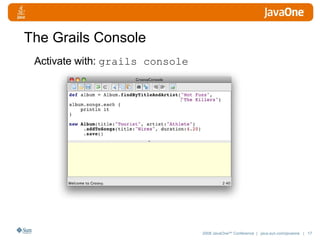
The Grails Console Activate with:  grails console
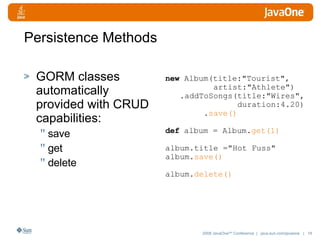
Persistence Methods GORM classes automatically provided with CRUD capabilities: save get delete new  Album(title:"Tourist",  artist:"Athlete") .addToSongs(title:"Wires", duration:4.20) . save() def  album = Album. get(1) album.title ="Hot Fuss"  album. save() album. delete()
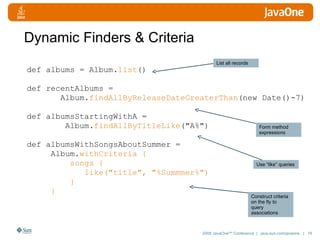
Dynamic Finders & Criteria def albums = Album. list () def recentAlbums =  Album. findAllByReleaseDateGreaterThan (new Date()-7) def albumsStartingWithA = Album. findAllByTitleLike ( "A%") def albumsWithSongsAboutSummer = Album. withCriteria { songs { like("title", "%Summmer%") } } List all records Form method expressions Use “like” queries Construct criteria on the fly to query associations
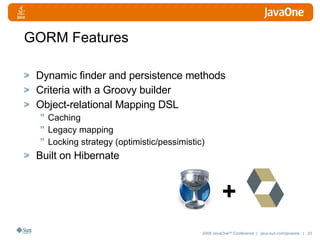
GORM Features Dynamic finder and persistence methods Criteria with a Groovy builder Object-relational Mapping DSL Caching Legacy mapping Locking strategy (optimistic/pessimistic) Built on Hibernate +
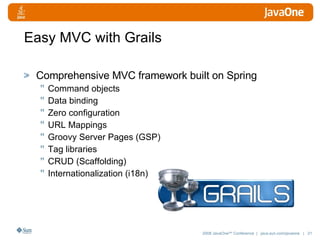
Easy MVC with Grails Comprehensive MVC framework built on Spring Command objects Data binding Zero configuration URL Mappings Groovy Server Pages (GSP)  Tag libraries CRUD (Scaffolding) Internationalization (i18n)
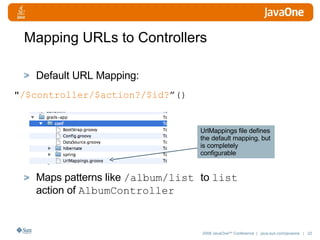
Mapping URLs to Controllers Default URL Mapping: Maps patterns like  /album/list  to  list  action of  AlbumController " /$controller/$action?/$id? ”() UrlMappings file defines the default mapping, but is completely configurable
Controllers in Action Easy MVC with Grails
Grails Controllers class AlbumController { def  search  = { def albums= Album.findByTitleLike( "%${params.q}%" )  [albumResults:albums]   } } Return a model  as a map Actions are properties assigned a block or closure Controllers go in the “controllers” directory
Trivial Tag Libraries Tag Code View def  cache = {attrs,body->  def  content= store[ attrs.id ] if (!content) content =  body() store[ attrs.id ]= content  } out  << content  } <g: cache  id= &quot;test&quot;> expensive lazy loaded content goes here </g: cache > Write to the response Read tag attributes Invoke the body Tag name matches closure name Pass tag attributes Tag libraries go in the taglib directory
Web Services Grails features built in support for REST REST = Representational State Transfer Optional support for SOAP via plug-ins (another example of not re-inventing the wheel!) Xfire –  http:// grails.org/XFire+plugin   Axis 2 –  http://grails.org/Apache+Axis2+Plugin
RESTful URL Mappings Maps to actions based on HTTP method &quot; /$controller/$id? &quot; { action =  [GET:&quot;show&quot;, POST:&quot;update&quot;, PUT:&quot;save&quot;] } Defined in URLMappings.groovy file
RESTful Marshalling Easy Web Services with Grails
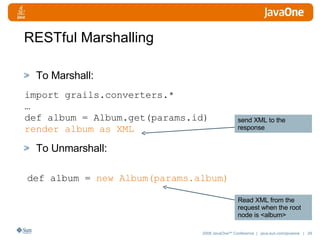
RESTful Marshalling To Marshall: To Unmarshall: import grails.converters.* … def album = Album.get(params.id) render album as XML def album =  new Album(params.album) send XML to the response Read XML from the request when the root node is <album>
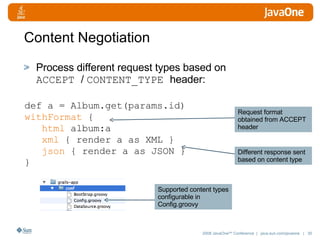
Content Negotiation Process different request types based on  ACCEPT  /  CONTENT_TYPE  header: def a = Album.get(params.id) withFormat  { html  album:a xml  { render a as XML } json  { render a as JSON } } Request format obtained from ACCEPT header Different response sent based on content type Supported content types configurable in Config.groovy
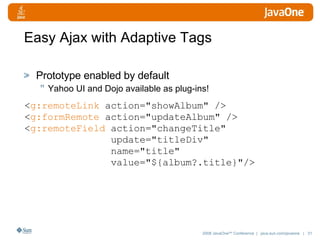
Easy Ajax with Adaptive Tags Prototype enabled by default Yahoo UI and Dojo available as plug-ins! < g:remoteLink  action=&quot;showAlbum&quot; /> < g:formRemote  action=&quot;updateAlbum&quot; /> < g:remoteField  action=&quot;changeTitle&quot; update=&quot;titleDiv&quot; name=&quot;title&quot;  value=&quot;${album?.title}&quot;/>
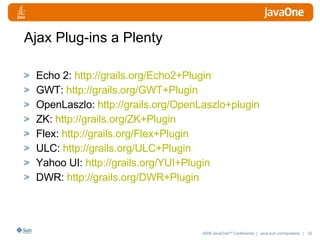
Ajax Plug-ins a Plenty Echo 2:  http://grails.org/Echo2+Plugin GWT:  http:// grails.org/GWT+Plugin OpenLaszlo:  http:// grails.org/OpenLaszlo+plugin ZK:  http:// grails.org/ZK+Plugin Flex:  http:// grails.org/Flex+Plugin ULC:  http:// grails.org/ULC+Plugin Yahoo UI:  http:// grails.org/YUI+Plugin DWR:  http:// grails.org/DWR+Plugin
Summary Grails is not just a web framework, but a web platform Grails is the next generation abstraction of the Java EE platform built on Spring and Hibernate Groovy and Grails integrate tightly with Java technology, the Java Virtual Machine at every level providing an easy migration path Grails == Simplifying Java EE platform on the web
For More Information Grails TS-5793 – Groovy and Grails: Changing the Landscape of Java Platform, Enterprise Edition (Java EE Platform) Patterns, TS-6457 - Choosing Your Java Technology-Based Web Framework: A Comparison Web Site:  http:// grails.org User Guide:  http://grails.org/doc/1.0.x/ Groovy Sessions, Panel Discussions, BOFs: PAN-5435, TS-5815, TS-6050, TS-5274, BOF-5102, BOF-5110, TS-5693, BOF-5101 http:// groovy.codehaus.org
Grails – in Depth Graeme Rocher TS-5764

JavaOne 2008 - TS-5764 - Grails in Depth

  • 1.
    Grails – InDepth Graeme Rocher, CTO – G2One Inc TS-5764
  • 2.
    Learn how todramatically simplify web development on the Java™ platform with Groovy & Grails
  • 3.
    Your Speaker GraemeRocher Project Lead of Grails CTO of G2One Inc – The Groovy/Grails Company Member of JSR-241 Expert Group Author of “The Definitive Guide to Grails”
  • 4.
    Agenda Introduction toGroovy & Grails Why Groovy? Getting Started Simplified ORM The Web Layer Web Services Easy Ajax
  • 5.
    What is Groovy?Groovy is a dynamic language for the Java Virtual Machine (JVM™) Takes inspiration from Small Talk, Python and Ruby Integrates with the Java language and platform at every level
  • 6.
    What is Grails?A Web platform that implements the full stack from build system down to ORM layer Leverages existing technologies like Spring, Hibernate, Quartz etc. avoiding re-inventing the wheel Features and extensible plug-in system and an environment for runtime configuration built on Spring
  • 7.
    Solid Foundations SpringHibernate Groovy Quartz SiteMesh Jetty Apache Ant Java Technology
  • 8.
    Why Groovy &Grails? All the power of frameworks from other platforms like Ruby on Rails, Django and TurboGears Built from the ground up on Java technologies . Design for Java technology by Java technology developers Leverage existing tools and technologies Distributed caches, replicating technologies etc. Profiling, monitoring and debugging tools IDEs Reduce context switching
  • 9.
    Getting Started Downloadfrom http:// grails.org /Download Extract zip to disk Set GRAILS_HOME variable to location on disk Add $GRAILS_HOME/bin to your environment variables Download from http:// groovy.codehaus.org Extract zip to disk Set GROOVY_HOME variable to location on disk Add $GROOVY_HOME/bin to your environment variables
  • 10.
    Grails – TheBasics Creating and Running Grails will load by default with an in-memory HSQLDB The default container is an embedded Jetty Container Grails is configured for automatic hot-reloading at runtime WAR’ing and Deploying Grails deploys as a standard WAR file deployable onto modern Java EE platform containers In production mode Grails is fully compiled byte code > grails create-app gtunes > cd gtunes > grails run-app > grails run-war // or > grails war
  • 11.
    Getting Started withGrails Creating and Running
  • 12.
    A Grails ProjectAnt Build JAR files Grails Sources Web Sources Java Sources
  • 13.
    Grails Headline FeaturesGORM - ORM Layer built on Hibernate Rich conversation support with Web Flow Domain Specific Languages Validation Rules ORM Mapping URL Mapping Vibrant Plug-in community http:// grails.org/Plugins Over 40 user contributed plug-ins Everything from web services to RIA with Flex
  • 14.
    Grails – ThePlatform Java 2 Platform, Enterprise Edition (J2EE™ platform) was too complex. Spring and Hibernate reduced that complexity and became very successful Grails represents the next level of abstraction for the Java EE platform Built on Spring and Hibernate, but dramatically simplifying their usage
  • 15.
    Easy ORM withGORM class Album { String title String artist Date releaseDate static hasMany = [songs:Song] } class Song { String title Double duration } table - album table - song GORM classes, also known as domain classes, go in the domain directory id title artist release_date id title duration album_id
  • 16.
    GORM in ActionQuerying and Persistence with GORM
  • 17.
    The Grails ConsoleActivate with: grails console
  • 18.
    Persistence Methods GORMclasses automatically provided with CRUD capabilities: save get delete new Album(title:&quot;Tourist&quot;, artist:&quot;Athlete&quot;) .addToSongs(title:&quot;Wires&quot;, duration:4.20) . save() def album = Album. get(1) album.title =&quot;Hot Fuss&quot; album. save() album. delete()
  • 19.
    Dynamic Finders &Criteria def albums = Album. list () def recentAlbums = Album. findAllByReleaseDateGreaterThan (new Date()-7) def albumsStartingWithA = Album. findAllByTitleLike ( &quot;A%&quot;) def albumsWithSongsAboutSummer = Album. withCriteria { songs { like(&quot;title&quot;, &quot;%Summmer%&quot;) } } List all records Form method expressions Use “like” queries Construct criteria on the fly to query associations
  • 20.
    GORM Features Dynamicfinder and persistence methods Criteria with a Groovy builder Object-relational Mapping DSL Caching Legacy mapping Locking strategy (optimistic/pessimistic) Built on Hibernate +
  • 21.
    Easy MVC withGrails Comprehensive MVC framework built on Spring Command objects Data binding Zero configuration URL Mappings Groovy Server Pages (GSP) Tag libraries CRUD (Scaffolding) Internationalization (i18n)
  • 22.
    Mapping URLs toControllers Default URL Mapping: Maps patterns like /album/list to list action of AlbumController &quot; /$controller/$action?/$id? ”() UrlMappings file defines the default mapping, but is completely configurable
  • 23.
    Controllers in ActionEasy MVC with Grails
  • 24.
    Grails Controllers classAlbumController { def search = { def albums= Album.findByTitleLike( &quot;%${params.q}%&quot; ) [albumResults:albums] } } Return a model as a map Actions are properties assigned a block or closure Controllers go in the “controllers” directory
  • 25.
    Trivial Tag LibrariesTag Code View def cache = {attrs,body-> def content= store[ attrs.id ] if (!content) content = body() store[ attrs.id ]= content } out << content } <g: cache id= &quot;test&quot;> expensive lazy loaded content goes here </g: cache > Write to the response Read tag attributes Invoke the body Tag name matches closure name Pass tag attributes Tag libraries go in the taglib directory
  • 26.
    Web Services Grailsfeatures built in support for REST REST = Representational State Transfer Optional support for SOAP via plug-ins (another example of not re-inventing the wheel!) Xfire – http:// grails.org/XFire+plugin Axis 2 – http://grails.org/Apache+Axis2+Plugin
  • 27.
    RESTful URL MappingsMaps to actions based on HTTP method &quot; /$controller/$id? &quot; { action = [GET:&quot;show&quot;, POST:&quot;update&quot;, PUT:&quot;save&quot;] } Defined in URLMappings.groovy file
  • 28.
    RESTful Marshalling EasyWeb Services with Grails
  • 29.
    RESTful Marshalling ToMarshall: To Unmarshall: import grails.converters.* … def album = Album.get(params.id) render album as XML def album = new Album(params.album) send XML to the response Read XML from the request when the root node is <album>
  • 30.
    Content Negotiation Processdifferent request types based on ACCEPT / CONTENT_TYPE header: def a = Album.get(params.id) withFormat { html album:a xml { render a as XML } json { render a as JSON } } Request format obtained from ACCEPT header Different response sent based on content type Supported content types configurable in Config.groovy
  • 31.
    Easy Ajax withAdaptive Tags Prototype enabled by default Yahoo UI and Dojo available as plug-ins! < g:remoteLink action=&quot;showAlbum&quot; /> < g:formRemote action=&quot;updateAlbum&quot; /> < g:remoteField action=&quot;changeTitle&quot; update=&quot;titleDiv&quot; name=&quot;title&quot; value=&quot;${album?.title}&quot;/>
  • 32.
    Ajax Plug-ins aPlenty Echo 2: http://grails.org/Echo2+Plugin GWT: http:// grails.org/GWT+Plugin OpenLaszlo: http:// grails.org/OpenLaszlo+plugin ZK: http:// grails.org/ZK+Plugin Flex: http:// grails.org/Flex+Plugin ULC: http:// grails.org/ULC+Plugin Yahoo UI: http:// grails.org/YUI+Plugin DWR: http:// grails.org/DWR+Plugin
  • 33.
    Summary Grails isnot just a web framework, but a web platform Grails is the next generation abstraction of the Java EE platform built on Spring and Hibernate Groovy and Grails integrate tightly with Java technology, the Java Virtual Machine at every level providing an easy migration path Grails == Simplifying Java EE platform on the web
  • 34.
    For More InformationGrails TS-5793 – Groovy and Grails: Changing the Landscape of Java Platform, Enterprise Edition (Java EE Platform) Patterns, TS-6457 - Choosing Your Java Technology-Based Web Framework: A Comparison Web Site: http:// grails.org User Guide: http://grails.org/doc/1.0.x/ Groovy Sessions, Panel Discussions, BOFs: PAN-5435, TS-5815, TS-6050, TS-5274, BOF-5102, BOF-5110, TS-5693, BOF-5101 http:// groovy.codehaus.org
  • 35.
    Grails – inDepth Graeme Rocher TS-5764