Agile Web Development   with Groovy and Grails Carol McDonald, Java Architect
Objective Overview of the Grails  Web Platform
Groovy Overview
What is Groovy? A dynamic language written for the JVM Generates byte code Java like syntax Easy learning curve for Java developers Seamless integration with Java A Groovy object is a Java Object Groovy application can create Java objects Java objects can create Groovy objects
A Valid Java Program import java.util.*; public class Erase { private List<String> filterLongerThan(List<String> strings, int length) { List<String> result = new ArrayList<String>(); for (String n: strings) if (n.length() <= length) result.add(n); return (result); } public static void main(String[] args) { List<String> names = new ArrayList<String>(); names.add(&quot;Ted&quot;); names.add(&quot;Fred&quot;); names.add(&quot;Jed&quot;); names.add(&quot;Ned&quot;); System.out.println(names); Erase e = new Erase(); List shortNames = e.filterLongerThan(names, 3); System.out.println(shortNames); } }
A Valid Groovy Program import java.util.*; public class Erase { private List<String> filterLongerThan(List<String> strings, int length) { List<String> result = new ArrayList<String>(); for (String n: strings) if (n.length() <= length) result.add(n); return (result); } public static void main(String[] args) { List<String> names = new ArrayList<String>(); names.add(&quot;Ted&quot;); names.add(&quot;Fred&quot;); names.add(&quot;Jed&quot;); names.add(&quot;Ned&quot;); System.out.println(names); Erase e = new Erase(); List shortNames = e.filterLongerThan(names, 3); System.out.println(shortNames); } }
The Groovy Way def names = [&quot;Ted&quot;, &quot;Fred&quot;, &quot;Jed&quot;, &quot;Ned&quot;] println names  def shortNames = names.findAll{  it.size() <= 3  } print shortNames
Grails Overview
What is Grails? An Open Source Groovy MVC framework for web applications Principles CoC – Convention over configuration DRY – Don't repeat yourself Similar to RoR but with tighter integration to the Java platform
Why Grails? ORM layer can be overly difficult to master and get right A return to POJO and annotations in JPA but still lots of stuff to learn Numerous layers and configuration files lead to chaos Adoption of frameworks a good thing, but too often lead to configuration file hell Ugly JSPs with scriptlets and complexity of JSP custom tags Grails addresses these  without  compromising their benefits
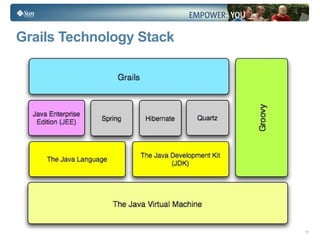
Grails Technology Stack
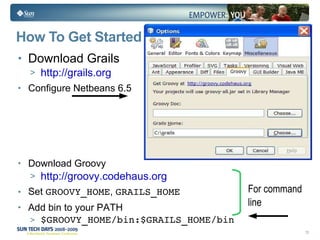
How To Get Started Download Grails http://grails.org Configure Netbeans 6.5 Download Groovy http://groovy.codehaus.org Set  GROOVY_HOME ,  GRAILS_HOME Add bin to your PATH $GROOVY_HOME/bin:$GRAILS_HOME/bin For command line
Using Grails
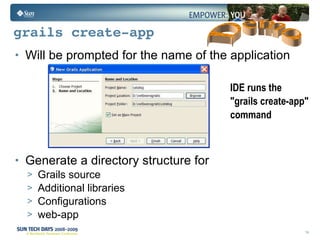
grails create-app Will be prompted for the name of the application Generate a directory structure for  Grails source Additional libraries Configurations web-app IDE runs the  &quot;grails create-app&quot;  command Demo
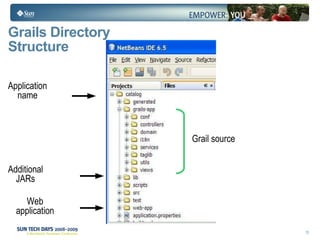
Grails Directory  Structure Application name Additional JARs Web application Grail source
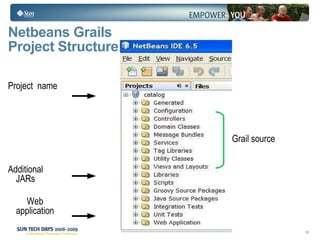
Netbeans Grails  Project Structure Project  name Grail source Additional JARs Web application
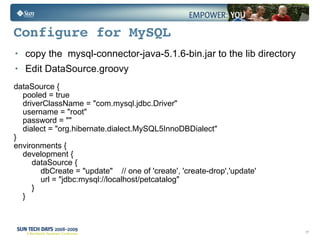
Configure for MySQL copy the  mysql-connector-java-5.1.6-bin.jar to the lib directory Edit DataSource.groovy dataSource { pooled = true driverClassName = &quot;com.mysql.jdbc.Driver&quot; username = &quot;root&quot; password = &quot;&quot;  dialect = &quot;org.hibernate.dialect.MySQL5InnoDBDialect&quot; } environments { development { dataSource { dbCreate = &quot;update&quot;  // one of 'create', 'create-drop','update' url = &quot;jdbc:mysql://localhost/petcatalog&quot; } }
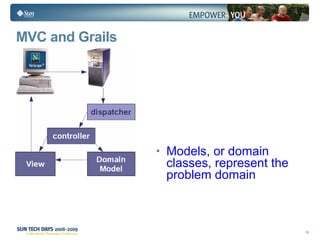
MVC and Grails Models, or domain classes, represent the problem domain
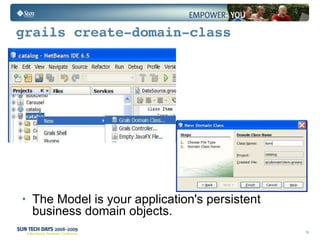
grails create-domain-class The Model is your application's persistent business domain objects.
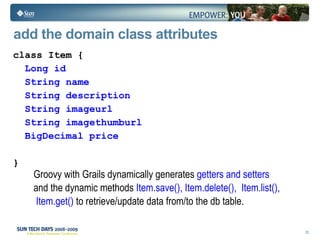
add the domain class attributes class Item { Long id String name String description String imageurl String imagethumburl BigDecimal price } Groovy with Grails dynamically generates  getters and setters  and the dynamic methods  Item.save(), Item.delete(),  Item.list(), Item.get()  to retrieve/update data from/to the db table.
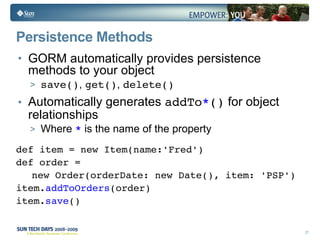
Persistence Methods GORM automatically provides persistence methods to your object save() ,  get() ,  delete() Automatically generates  addTo * ()  for object relationships Where  *  is the name of the property def item = new Item(name:'Fred') def order =  new Order(orderDate: new Date(), item: 'PSP') item. addToOrders (order) item. save ()
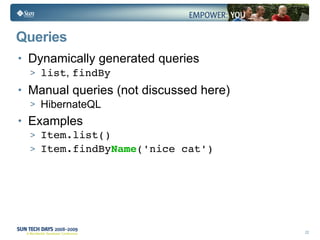
Queries Dynamically generated queries list ,  findBy Manual queries (not discussed here) HibernateQL Examples Item.list() Item.findBy Name ('nice cat')
grails domain class Define relation between objects with attributes hasMany ,  belongsTo static hasMany = [ item: Item ] Groovy hashmap Address String street String zip static hasMany = [item:Item] 1 M Item String name String description Address address
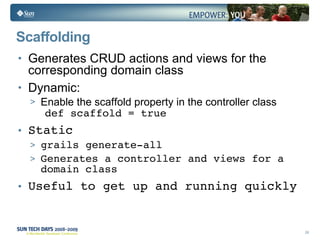
Scaffolding Generates CRUD actions and views for the corresponding domain class Dynamic: Enable the scaffold property in the controller class def scaffold = true Static grails generate-all Generates a controller and views for a domain class Useful to get up and running quickly
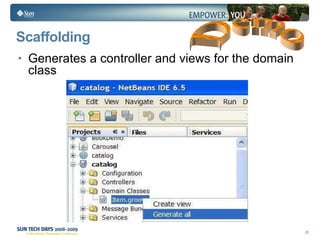
Scaffolding Generates a controller and views for the domain class Demo
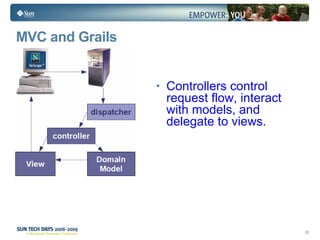
MVC and Grails Controllers control request flow, interact with models, and delegate to views.
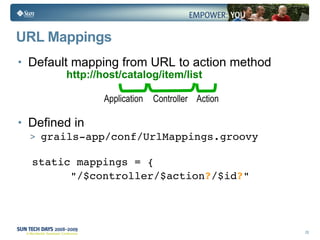
grails create-controller Controller made up of  action  methods Grails routes requests to the  action  corresponding to  URL  mapping  Default action is  index class  Item Controller   {  def  index  = { redirect(action:list,params:params) } def  list  = { if(!params.max) params.max = 10 [ itemList: Item.list( params ) ] } def  show  = {... Actions http://host/catalog/item/list
URL Mappings Default mapping from URL to action method http://host/catalog/item/list Defined in  grails-app/conf/UrlMappings.groovy static mappings = { &quot;/$controller/$action ? /$id ? &quot; Application Controller Action
grails controller class  Item Controller   {  def  index  = { redirect(action:list,params:params) } def  list  = { if(!params.max) params.max = 10 [ itemInstanceList:  Item.list ( params ) ] } def  show  = {... returns an ArrayList of item objects  retrieved from the item database table  itemInstanceList   variable  is made  available to the view
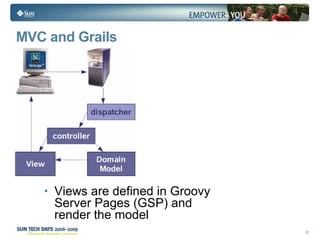
MVC and Grails Views are defined in Groovy Server Pages (GSP) and render the model
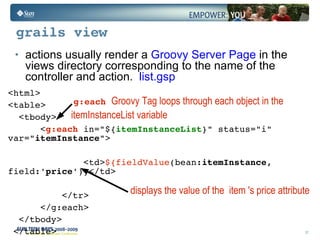
grails view actions usually render a  Groovy Server Page  in the views directory corresponding to the name of the controller and action.  list.gsp <html>  <table> <tbody> < g:each  in=&quot;${ itemInstanceList }&quot; status=&quot;i&quot; var=&quot; itemInstance &quot;> <td> ${fieldValue (bean: itemInstance , field:' price ')}</td> </tr> </g:each> </tbody> </table> g:each  Groovy Tag loops   through each object in the  itemInstanceList variable displays the value of the  item 's price attribute
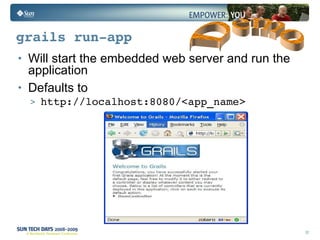
grails run-app Will start the embedded web server and run the application Defaults to http://localhost:8080/<app_name> Demo
Summary Groovy is a powerful dynamic language for the JVM Grails is a full featured web platform
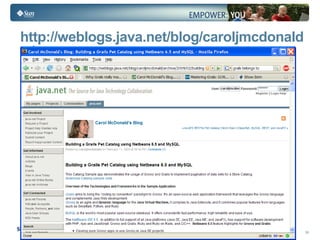
http://weblogs.java.net/blog/caroljmcdonald/
Acknowldegement Thanks to Guilaume Laforge of G2One for allowing me to use and adapt some of his slides
Presenter’s Name [email_address] Carol McDonald Java Architect Tech Days 2009
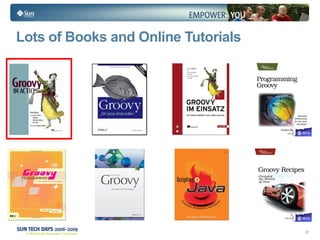
Lots of Books and Online Tutorials

Agile web development Groovy Grails with Netbeans

  • 1.
    Agile Web Development with Groovy and Grails Carol McDonald, Java Architect
  • 2.
    Objective Overview ofthe Grails Web Platform
  • 3.
  • 4.
    What is Groovy?A dynamic language written for the JVM Generates byte code Java like syntax Easy learning curve for Java developers Seamless integration with Java A Groovy object is a Java Object Groovy application can create Java objects Java objects can create Groovy objects
  • 5.
    A Valid JavaProgram import java.util.*; public class Erase { private List<String> filterLongerThan(List<String> strings, int length) { List<String> result = new ArrayList<String>(); for (String n: strings) if (n.length() <= length) result.add(n); return (result); } public static void main(String[] args) { List<String> names = new ArrayList<String>(); names.add(&quot;Ted&quot;); names.add(&quot;Fred&quot;); names.add(&quot;Jed&quot;); names.add(&quot;Ned&quot;); System.out.println(names); Erase e = new Erase(); List shortNames = e.filterLongerThan(names, 3); System.out.println(shortNames); } }
  • 6.
    A Valid GroovyProgram import java.util.*; public class Erase { private List<String> filterLongerThan(List<String> strings, int length) { List<String> result = new ArrayList<String>(); for (String n: strings) if (n.length() <= length) result.add(n); return (result); } public static void main(String[] args) { List<String> names = new ArrayList<String>(); names.add(&quot;Ted&quot;); names.add(&quot;Fred&quot;); names.add(&quot;Jed&quot;); names.add(&quot;Ned&quot;); System.out.println(names); Erase e = new Erase(); List shortNames = e.filterLongerThan(names, 3); System.out.println(shortNames); } }
  • 7.
    The Groovy Waydef names = [&quot;Ted&quot;, &quot;Fred&quot;, &quot;Jed&quot;, &quot;Ned&quot;] println names def shortNames = names.findAll{ it.size() <= 3 } print shortNames
  • 8.
  • 9.
    What is Grails?An Open Source Groovy MVC framework for web applications Principles CoC – Convention over configuration DRY – Don't repeat yourself Similar to RoR but with tighter integration to the Java platform
  • 10.
    Why Grails? ORMlayer can be overly difficult to master and get right A return to POJO and annotations in JPA but still lots of stuff to learn Numerous layers and configuration files lead to chaos Adoption of frameworks a good thing, but too often lead to configuration file hell Ugly JSPs with scriptlets and complexity of JSP custom tags Grails addresses these without compromising their benefits
  • 11.
  • 12.
    How To GetStarted Download Grails http://grails.org Configure Netbeans 6.5 Download Groovy http://groovy.codehaus.org Set GROOVY_HOME , GRAILS_HOME Add bin to your PATH $GROOVY_HOME/bin:$GRAILS_HOME/bin For command line
  • 13.
  • 14.
    grails create-app Willbe prompted for the name of the application Generate a directory structure for Grails source Additional libraries Configurations web-app IDE runs the &quot;grails create-app&quot; command Demo
  • 15.
    Grails Directory Structure Application name Additional JARs Web application Grail source
  • 16.
    Netbeans Grails Project Structure Project name Grail source Additional JARs Web application
  • 17.
    Configure for MySQLcopy the mysql-connector-java-5.1.6-bin.jar to the lib directory Edit DataSource.groovy dataSource { pooled = true driverClassName = &quot;com.mysql.jdbc.Driver&quot; username = &quot;root&quot; password = &quot;&quot; dialect = &quot;org.hibernate.dialect.MySQL5InnoDBDialect&quot; } environments { development { dataSource { dbCreate = &quot;update&quot; // one of 'create', 'create-drop','update' url = &quot;jdbc:mysql://localhost/petcatalog&quot; } }
  • 18.
    MVC and GrailsModels, or domain classes, represent the problem domain
  • 19.
    grails create-domain-class TheModel is your application's persistent business domain objects.
  • 20.
    add the domainclass attributes class Item { Long id String name String description String imageurl String imagethumburl BigDecimal price } Groovy with Grails dynamically generates getters and setters and the dynamic methods Item.save(), Item.delete(), Item.list(), Item.get() to retrieve/update data from/to the db table.
  • 21.
    Persistence Methods GORMautomatically provides persistence methods to your object save() , get() , delete() Automatically generates addTo * () for object relationships Where * is the name of the property def item = new Item(name:'Fred') def order = new Order(orderDate: new Date(), item: 'PSP') item. addToOrders (order) item. save ()
  • 22.
    Queries Dynamically generatedqueries list , findBy Manual queries (not discussed here) HibernateQL Examples Item.list() Item.findBy Name ('nice cat')
  • 23.
    grails domain classDefine relation between objects with attributes hasMany , belongsTo static hasMany = [ item: Item ] Groovy hashmap Address String street String zip static hasMany = [item:Item] 1 M Item String name String description Address address
  • 24.
    Scaffolding Generates CRUDactions and views for the corresponding domain class Dynamic: Enable the scaffold property in the controller class def scaffold = true Static grails generate-all Generates a controller and views for a domain class Useful to get up and running quickly
  • 25.
    Scaffolding Generates acontroller and views for the domain class Demo
  • 26.
    MVC and GrailsControllers control request flow, interact with models, and delegate to views.
  • 27.
    grails create-controller Controllermade up of action methods Grails routes requests to the action corresponding to URL mapping Default action is index class Item Controller { def index = { redirect(action:list,params:params) } def list = { if(!params.max) params.max = 10 [ itemList: Item.list( params ) ] } def show = {... Actions http://host/catalog/item/list
  • 28.
    URL Mappings Defaultmapping from URL to action method http://host/catalog/item/list Defined in grails-app/conf/UrlMappings.groovy static mappings = { &quot;/$controller/$action ? /$id ? &quot; Application Controller Action
  • 29.
    grails controller class Item Controller { def index = { redirect(action:list,params:params) } def list = { if(!params.max) params.max = 10 [ itemInstanceList: Item.list ( params ) ] } def show = {... returns an ArrayList of item objects retrieved from the item database table itemInstanceList variable is made available to the view
  • 30.
    MVC and GrailsViews are defined in Groovy Server Pages (GSP) and render the model
  • 31.
    grails view actionsusually render a Groovy Server Page in the views directory corresponding to the name of the controller and action. list.gsp <html> <table> <tbody> < g:each in=&quot;${ itemInstanceList }&quot; status=&quot;i&quot; var=&quot; itemInstance &quot;> <td> ${fieldValue (bean: itemInstance , field:' price ')}</td> </tr> </g:each> </tbody> </table> g:each Groovy Tag loops through each object in the itemInstanceList variable displays the value of the item 's price attribute
  • 32.
    grails run-app Willstart the embedded web server and run the application Defaults to http://localhost:8080/<app_name> Demo
  • 33.
    Summary Groovy isa powerful dynamic language for the JVM Grails is a full featured web platform
  • 34.
  • 35.
    Acknowldegement Thanks toGuilaume Laforge of G2One for allowing me to use and adapt some of his slides
  • 36.
    Presenter’s Name [email_address]Carol McDonald Java Architect Tech Days 2009
  • 37.
    Lots of Booksand Online Tutorials