Introduction to  Dynamic Languages Tugdual Grall Oracle Application Server Product Management
Simple Example public class FilterApp { public static void main(String[] args) { List<String> list = new ArrayList(); list.add(&quot;Olaf&quot;); list.add(&quot;Tug&quot;);    list.add(&quot;John&quot;); list.add(&quot;Dave&quot;);   FilterApp filter = new FilterApp(); List<String> data = filter.filterLongerThan(list,4); System.out.println(data.size()); Iterator it = data.iterator(); while (it.hasNext()) {System.out.println(it.next());}  } public List filterLongerThan(List list, int length) { List<String> result = new ArrayList(); Iterator it = list.iterator(); while (it.hasNext()) { String item = (String)it.next(); if (item.length()>= length) {result.add(item);} } return result; } }
Simple Example def list = [&quot;Olaf&quot;,&quot;Tug&quot;,&quot;John&quot;,&quot;Dave&quot;] def data = list.findAll { it.size() >= 4 } println data.size() data.each { println it } Java 25-30 Lines / Groovy 4 lines
Why Scripting? Scripting languages are in fashion (again?) AJAX with JavaScript™ technology, and Ruby on Rails with Ruby Java SE 6 integrates JSR 223 with Rhino JCP agreed to standardize Groovy (JSR 241) and BeanShell (JSR 274) Upcoming bytecode invokeDynamic (JSR 292) Microsoft also believe in dynamic languages and hire IronPython lead Need simplicity to overcome enterprise development complexity
Three Main Use Cases of Integration Prototyping/testing/scripting Shell or build scripting, data manipulation, unit testing, code generation, driving native applications Building standalone applications Small to mid-sized non-critical applications Integrating scripting in Java EE applications Programmatic configuration (less XML) Business rules externalization UI or application customizations
Java Technology & Scripting Leverage Java Platform Use scripts inside Java SE and Java EE Reuse existing Java technology skills and components Many existing languages on the Java VM Groovy, Rhino (JavaScript), BeanShell, Jython, JRuby, Pnuts, Scala… Current standardization effort around scripting languages and Java technology JSR 223, JSR 241, JSR 274, JSR 292 Let’s dive in Groovy as an example…
Why Groovy Is Relevant? Groovy is a dynamic and agile  scripting language for the Java VM OSS project hosted by Codehaus Inspired by Ruby,Python and SmallTalk Generates bytecode for the Java VM: integrates well with Java libraries However, Groovy differentiates itself GDK: additional libraries  to simplify complex APIs MOP: advanced  meta-programming features + + = Expressive Language Powerful Libraries Meta Programming
Why another Language? Want complete binary compatibility with Java No difference from Java at JVM/bytecode level No wrappers or separate islands of APIs Java code-friendly syntax Don’t want something totally foreign to Java developers Want a scripting language designed: For the Java Platform By Java developers For Java developers
Groovy Features Dynamic and (optional) static typing int a = 2 def str = &quot;Hello&quot; Native syntax for lists, maps, arrays, beans, etc. def list = [&quot;Rod&quot;, 3, new Date()] def myMap = [Neeta:32, Eric:34] Closures myMap.each( {name, age -> println &quot;$name is $age years old&quot; }) >Eric is 34 years old >Neeta is 32 years old
Groovy Features (Cont.) Regex built-in if ( &quot;name&quot; ==~ &quot;na.*&quot; ) { println &quot;match!&quot; } -> match! Operator overloading def list = [1, 2, 3] + [4, 5, 6] list.each { print it } -> 123456 Autoboxing and polymorphism across collection, array, map, bean, String, iterators, etc. String[] array = ['cat', 'dog', 'mouse'] def str = 'hello' Println&quot;${array.size()},${str.size()}, ${list.size()} -> 3,5,6
GDK Software Adds convenient methods to JDK String contains(), count(), execute(), padLeft(), center(), padRight(), reverse(), tokenize(), each(), etc. Collection count(), collect(), join(), each(), reverseEach(), find/All(), min(), max(), inject(), sort(), etc. File eachFile(), eachLine(), withPrintWriter(), write(), getText(), etc. Lots there and growing all the time You can add methods programmatically
Groovy Markup Native support for hierarchical structures in code XML XHTML Ant Swing SWT Relatively easy to add your own
AntBuilder Reuse hundreds of Ant tasks as simple method calls Even create your own build system! def ant = new  AntBuilder() def patterns = [&quot;**/*.groovy&quot;, &quot;**/*.java&quot;] ant. sequential  {   mkdir (dir: &quot;dir1&quot;)    copy (todir: &quot;dir1&quot;) {   fileset (dir: &quot;dir2&quot;) {   for(pattern in patterns)   include (name: pattern)   }   }   echo (&quot;done&quot;) }
Groovy SQL Easy to use JDBC software thanks to closures def sql = Sql.newInstance(url, usr, pwd, driver) sql.execute(&quot;insert into table values ($foo, $bar)&quot;) sql.execute(&quot;insert into table values(?,?)&quot;, [a, b]) sql.eachRow(&quot;select * from EMPLOYEES&quot;) { print it.name } def list = sql.rows(&quot;select * from EMPLOYEES&quot;) DataSet notion: poor-man ORM def set = sql.dataSet(&quot;EMPLOYEES&quot;) set.add(name: &quot;Johnny&quot;, age: 33) set.each { user -> println user.name } set.findAll  { it.age > 22 && it.age < 42 }  // LINQ J
What is the magic? The dynamic part is coming from the: MOP: Meta Object Protocol At runtime, allows you to Intercept method calls (even non-existing ones) Intercept property accesses Inject new methods or new properties You can create Domain Specific Languages (DSL) With the MOP, come the… builders Builder pattern at the syntax level! MarkupBuilder, SwingBuilder, AntBuilder...
Oracle and Groovy Manage your application server with Groovy Groovy Editor for Jdeveloper client = new OC4JClient() client.connect(&quot;localhost&quot;,&quot;23791&quot;,&quot;oc4jadmin&quot;,&quot;welcome1&quot;) defaultApp = client.helper.createGroovyMBean(client.helper.DEFAULTAPP_MBEAN_NAME); println &quot;\n--> Create ConnectionPool&quot; defaultApp.createJDBCConnectionPool(&quot;MyPool&quot;, &quot;oracle.jdbc.pool.OracleDataSource&quot;, &quot;scott&quot;, &quot;tiger&quot;, &quot;jdbc:oracle:thin:@localhost:1521:xe&quot;)
Rapid Web Application Development with
Grails: Introduction Grails: MVC web framework inspired by: Convention over Configuration Don’t Repeat Yourself (DRY) Ruby on Rails  Built on solid foundations: Spring IoC, MVC and WebFlow Hibernate SiteMesh
Demonstration Create an application
Project Infrastructure + PROJECT_HOME + grails-app + conf + controllers + domain + i18n + services + taglib + views + lib + spring + hibernate + src + web-app
The Application Domain Domain classes hold state and implement behaviour They are linked together via relationships (e.g. one-to-many) In Java domain classes have traditionally been handled by Object-Relational Mapping (ORM) Grails provides simple ORM built on Hibernate Source: Please add the source of your data here
Grails ORM (GORM) Extremely simple. No special class to extend or file to configure! class ExpenseReport { @Property Long  id @Property Long  version @Property  relatesToMany  = [ items :ExpenseItem] @Property Set  items   @Property Date submissionDate @Property String employeeName }
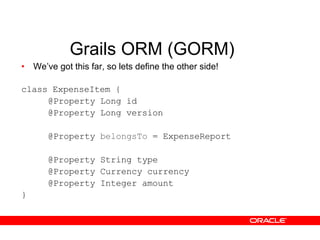
Grails ORM (GORM) We’ve got this far, so lets define the other side! class ExpenseItem { @Property Long id @Property Long version @Property  belongsTo  = ExpenseReport @Property String type @Property Currency currency @Property Integer amount }
Grails Constraints Validation constraints can be defined using the ‘constraints’ property class ExpenseItem { … @Property  constraints  = { type (inList:['travel', 'accomodation']) amount (range:1..999) } }
The Controller The controller and action name map to the URI:  /expenseReport/list class ExpenseReportController { @Property list = {   [expenseReports :  ExpenseReport.list()] } }
Data Binding & Flow Control // save action @Property  save  = {   def e = ExpenseItem.get(params.id) e.properties = params if(e. save ()){ redirect(action:show,id:e.id) } else { render( view: 'create',   model:[expenseItem:e] ) } }
Groovy Server Pages A view technology very similar to JSP, but with Groovy as the primary language  More expressive and concise with support for embedded GStrings & Tags Layout support through integration with SiteMesh Ability to define dynamic tag libraries Source: Please add the source of your data here
A GSP Example The GSP for the  list  action is named according to convention:  grails-app/views/expenseItem/list.gsp   <html> <body> <g:each in=&quot;${expenseItems}&quot;> <p> ${it.type}  – amount:  ${it.amount} </p> </g:each> </body> </html>
Oracle and Grails Grails Application Running on OracleAS Development team is working with Spring and Grails developers to integrate Grails and JPA http://www.oracle.com/technology/tech/java/grails.html
A Q & Q U E S T I O N S A N S W E R S
 

Introduction To Groovy 2005

  • 1.
  • 2.
    Introduction to Dynamic Languages Tugdual Grall Oracle Application Server Product Management
  • 3.
    Simple Example publicclass FilterApp { public static void main(String[] args) { List<String> list = new ArrayList(); list.add(&quot;Olaf&quot;); list.add(&quot;Tug&quot;); list.add(&quot;John&quot;); list.add(&quot;Dave&quot;); FilterApp filter = new FilterApp(); List<String> data = filter.filterLongerThan(list,4); System.out.println(data.size()); Iterator it = data.iterator(); while (it.hasNext()) {System.out.println(it.next());} } public List filterLongerThan(List list, int length) { List<String> result = new ArrayList(); Iterator it = list.iterator(); while (it.hasNext()) { String item = (String)it.next(); if (item.length()>= length) {result.add(item);} } return result; } }
  • 4.
    Simple Example deflist = [&quot;Olaf&quot;,&quot;Tug&quot;,&quot;John&quot;,&quot;Dave&quot;] def data = list.findAll { it.size() >= 4 } println data.size() data.each { println it } Java 25-30 Lines / Groovy 4 lines
  • 5.
    Why Scripting? Scriptinglanguages are in fashion (again?) AJAX with JavaScript™ technology, and Ruby on Rails with Ruby Java SE 6 integrates JSR 223 with Rhino JCP agreed to standardize Groovy (JSR 241) and BeanShell (JSR 274) Upcoming bytecode invokeDynamic (JSR 292) Microsoft also believe in dynamic languages and hire IronPython lead Need simplicity to overcome enterprise development complexity
  • 6.
    Three Main UseCases of Integration Prototyping/testing/scripting Shell or build scripting, data manipulation, unit testing, code generation, driving native applications Building standalone applications Small to mid-sized non-critical applications Integrating scripting in Java EE applications Programmatic configuration (less XML) Business rules externalization UI or application customizations
  • 7.
    Java Technology &Scripting Leverage Java Platform Use scripts inside Java SE and Java EE Reuse existing Java technology skills and components Many existing languages on the Java VM Groovy, Rhino (JavaScript), BeanShell, Jython, JRuby, Pnuts, Scala… Current standardization effort around scripting languages and Java technology JSR 223, JSR 241, JSR 274, JSR 292 Let’s dive in Groovy as an example…
  • 8.
    Why Groovy IsRelevant? Groovy is a dynamic and agile scripting language for the Java VM OSS project hosted by Codehaus Inspired by Ruby,Python and SmallTalk Generates bytecode for the Java VM: integrates well with Java libraries However, Groovy differentiates itself GDK: additional libraries to simplify complex APIs MOP: advanced meta-programming features + + = Expressive Language Powerful Libraries Meta Programming
  • 9.
    Why another Language?Want complete binary compatibility with Java No difference from Java at JVM/bytecode level No wrappers or separate islands of APIs Java code-friendly syntax Don’t want something totally foreign to Java developers Want a scripting language designed: For the Java Platform By Java developers For Java developers
  • 10.
    Groovy Features Dynamicand (optional) static typing int a = 2 def str = &quot;Hello&quot; Native syntax for lists, maps, arrays, beans, etc. def list = [&quot;Rod&quot;, 3, new Date()] def myMap = [Neeta:32, Eric:34] Closures myMap.each( {name, age -> println &quot;$name is $age years old&quot; }) >Eric is 34 years old >Neeta is 32 years old
  • 11.
    Groovy Features (Cont.)Regex built-in if ( &quot;name&quot; ==~ &quot;na.*&quot; ) { println &quot;match!&quot; } -> match! Operator overloading def list = [1, 2, 3] + [4, 5, 6] list.each { print it } -> 123456 Autoboxing and polymorphism across collection, array, map, bean, String, iterators, etc. String[] array = ['cat', 'dog', 'mouse'] def str = 'hello' Println&quot;${array.size()},${str.size()}, ${list.size()} -> 3,5,6
  • 12.
    GDK Software Addsconvenient methods to JDK String contains(), count(), execute(), padLeft(), center(), padRight(), reverse(), tokenize(), each(), etc. Collection count(), collect(), join(), each(), reverseEach(), find/All(), min(), max(), inject(), sort(), etc. File eachFile(), eachLine(), withPrintWriter(), write(), getText(), etc. Lots there and growing all the time You can add methods programmatically
  • 13.
    Groovy Markup Nativesupport for hierarchical structures in code XML XHTML Ant Swing SWT Relatively easy to add your own
  • 14.
    AntBuilder Reuse hundredsof Ant tasks as simple method calls Even create your own build system! def ant = new AntBuilder() def patterns = [&quot;**/*.groovy&quot;, &quot;**/*.java&quot;] ant. sequential { mkdir (dir: &quot;dir1&quot;) copy (todir: &quot;dir1&quot;) { fileset (dir: &quot;dir2&quot;) { for(pattern in patterns) include (name: pattern) } } echo (&quot;done&quot;) }
  • 15.
    Groovy SQL Easyto use JDBC software thanks to closures def sql = Sql.newInstance(url, usr, pwd, driver) sql.execute(&quot;insert into table values ($foo, $bar)&quot;) sql.execute(&quot;insert into table values(?,?)&quot;, [a, b]) sql.eachRow(&quot;select * from EMPLOYEES&quot;) { print it.name } def list = sql.rows(&quot;select * from EMPLOYEES&quot;) DataSet notion: poor-man ORM def set = sql.dataSet(&quot;EMPLOYEES&quot;) set.add(name: &quot;Johnny&quot;, age: 33) set.each { user -> println user.name } set.findAll { it.age > 22 && it.age < 42 } // LINQ J
  • 16.
    What is themagic? The dynamic part is coming from the: MOP: Meta Object Protocol At runtime, allows you to Intercept method calls (even non-existing ones) Intercept property accesses Inject new methods or new properties You can create Domain Specific Languages (DSL) With the MOP, come the… builders Builder pattern at the syntax level! MarkupBuilder, SwingBuilder, AntBuilder...
  • 17.
    Oracle and GroovyManage your application server with Groovy Groovy Editor for Jdeveloper client = new OC4JClient() client.connect(&quot;localhost&quot;,&quot;23791&quot;,&quot;oc4jadmin&quot;,&quot;welcome1&quot;) defaultApp = client.helper.createGroovyMBean(client.helper.DEFAULTAPP_MBEAN_NAME); println &quot;\n--> Create ConnectionPool&quot; defaultApp.createJDBCConnectionPool(&quot;MyPool&quot;, &quot;oracle.jdbc.pool.OracleDataSource&quot;, &quot;scott&quot;, &quot;tiger&quot;, &quot;jdbc:oracle:thin:@localhost:1521:xe&quot;)
  • 18.
    Rapid Web ApplicationDevelopment with
  • 19.
    Grails: Introduction Grails:MVC web framework inspired by: Convention over Configuration Don’t Repeat Yourself (DRY) Ruby on Rails Built on solid foundations: Spring IoC, MVC and WebFlow Hibernate SiteMesh
  • 20.
  • 21.
    Project Infrastructure +PROJECT_HOME + grails-app + conf + controllers + domain + i18n + services + taglib + views + lib + spring + hibernate + src + web-app
  • 22.
    The Application DomainDomain classes hold state and implement behaviour They are linked together via relationships (e.g. one-to-many) In Java domain classes have traditionally been handled by Object-Relational Mapping (ORM) Grails provides simple ORM built on Hibernate Source: Please add the source of your data here
  • 23.
    Grails ORM (GORM)Extremely simple. No special class to extend or file to configure! class ExpenseReport { @Property Long id @Property Long version @Property relatesToMany = [ items :ExpenseItem] @Property Set items @Property Date submissionDate @Property String employeeName }
  • 24.
    Grails ORM (GORM)We’ve got this far, so lets define the other side! class ExpenseItem { @Property Long id @Property Long version @Property belongsTo = ExpenseReport @Property String type @Property Currency currency @Property Integer amount }
  • 25.
    Grails Constraints Validationconstraints can be defined using the ‘constraints’ property class ExpenseItem { … @Property constraints = { type (inList:['travel', 'accomodation']) amount (range:1..999) } }
  • 26.
    The Controller Thecontroller and action name map to the URI: /expenseReport/list class ExpenseReportController { @Property list = { [expenseReports : ExpenseReport.list()] } }
  • 27.
    Data Binding &Flow Control // save action @Property save = { def e = ExpenseItem.get(params.id) e.properties = params if(e. save ()){ redirect(action:show,id:e.id) } else { render( view: 'create', model:[expenseItem:e] ) } }
  • 28.
    Groovy Server PagesA view technology very similar to JSP, but with Groovy as the primary language More expressive and concise with support for embedded GStrings & Tags Layout support through integration with SiteMesh Ability to define dynamic tag libraries Source: Please add the source of your data here
  • 29.
    A GSP ExampleThe GSP for the list action is named according to convention: grails-app/views/expenseItem/list.gsp <html> <body> <g:each in=&quot;${expenseItems}&quot;> <p> ${it.type} – amount: ${it.amount} </p> </g:each> </body> </html>
  • 30.
    Oracle and GrailsGrails Application Running on OracleAS Development team is working with Spring and Grails developers to integrate Grails and JPA http://www.oracle.com/technology/tech/java/grails.html
  • 31.
    A Q &Q U E S T I O N S A N S W E R S
  • 32.