London Perl Workshop
12th December 2015
Modern Perl
Web Development
Dave Cross
Magnum Solutions Ltd
dave@mag-sol.com
London Perl Workshop
12th December 2015
Web Development
• People have been developing web
applications for over 20 years
• Surely it is easy now
• Lessons have been learned
• Best practices have been worked out
London Perl Workshop
12th December 2015
History of Perl & Web
• Common Gateway Interface 1993
• Defined the interaction between a web server
and a program
• Dynamic web pages
London Perl Workshop
12th December 2015
CGI
• Request includes parameters
• Program processes parameters and produces
response
• Response includes program's output
London Perl Workshop
12th December 2015
Mid-Late 1990s
• Every web site gained dynamic pages
• Form to email
• Guestbook
• Hit counter
• Etc...
• Most of them were written in Perl
London Perl Workshop
12th December 2015
CGI Problems
• CGI can be slow
• Perl compiler starts up on every request
• Can be very slow
• Not useful for heavy traffic sites
London Perl Workshop
12th December 2015
mod_perl
• Everyone used Apache
• Apache allowed loadable modules
• mod_perl loads a Perl compiler
• Persistent Perl processes
• No more start-up costs
• Huge performance improvements
London Perl Workshop
12th December 2015
Downsides
• Can't just use your CGI programs
– ModPerl::Registry
• Program is now called as a subroutine
• Global variable issues
• Many programs needed rewrites
• Different input and output methods
London Perl Workshop
12th December 2015
Other Environments
• FastCGI
• Microsoft IIS
• nginx
• Etc...
• Lack of portability
• Hold that thought
London Perl Workshop
12th December 2015
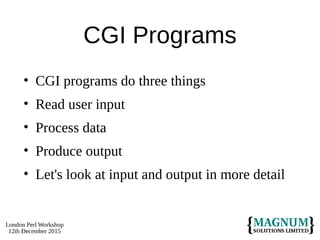
CGI Programs
• CGI programs do three things
• Read user input
• Process data
• Produce output
• Let's look at input and output in more detail
London Perl Workshop
12th December 2015
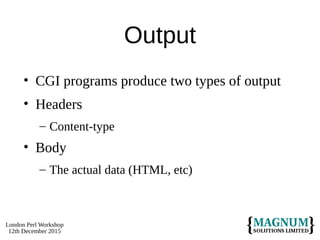
Output
• CGI programs produce two types of output
• Headers
– Content-type
• Body
– The actual data (HTML, etc)
London Perl Workshop
12th December 2015
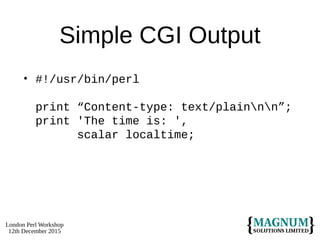
Simple CGI Output
• #!/usr/bin/perl
print “Content-type: text/plainnn”;
print 'The time is: ',
scalar localtime;
London Perl Workshop
12th December 2015
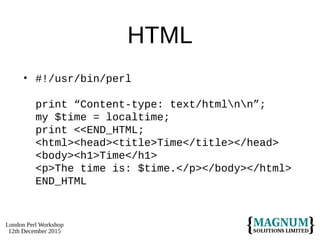
HTML
• #!/usr/bin/perl
print “Content-type: text/htmlnn”;
my $time = localtime;
print <<END_HTML;
<html><head><title>Time</title></head>
<body><h1>Time</h1>
<p>The time is: $time.</p></body></html>
END_HTML
London Perl Workshop
12th December 2015
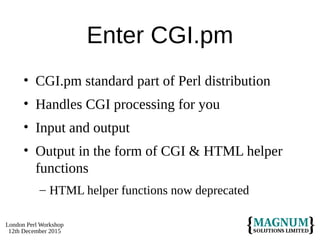
Enter CGI.pm
• CGI.pm standard part of Perl distribution
• Handles CGI processing for you
• Input and output
• Output in the form of CGI & HTML helper
functions
– HTML helper functions now deprecated
London Perl Workshop
12th December 2015
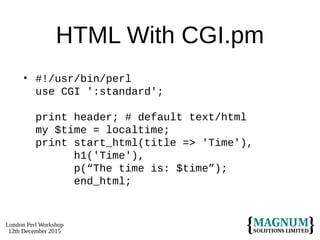
HTML With CGI.pm
• #!/usr/bin/perl
use CGI ':standard';
print header; # default text/html
my $time = localtime;
print start_html(title => 'Time'),
h1('Time'),
p(“The time is: $time”);
end_html;
London Perl Workshop
12th December 2015
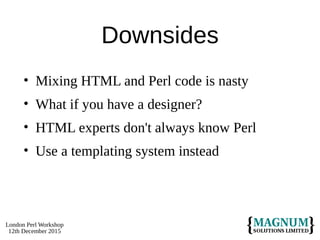
Downsides
• Mixing HTML and Perl code is nasty
• What if you have a designer?
• HTML experts don't always know Perl
• Use a templating system instead
London Perl Workshop
12th December 2015
Template Toolkit
• <html>
<head>
<title>Time</title>
</head>
<body>
<h1>Time</h1>
<p>The time is: [% time %].</p>
</body>
</html>
London Perl Workshop
12th December 2015
Template Toolkit
• <html>
<head>
<title>Time</title>
</head>
<body>
<h1>Time</h1>
<p>The time is: [% time %].</p>
</body>
</html>
London Perl Workshop
12th December 2015
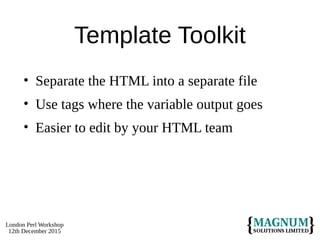
Template Toolkit
• Separate the HTML into a separate file
• Use tags where the variable output goes
• Easier to edit by your HTML team
London Perl Workshop
12th December 2015
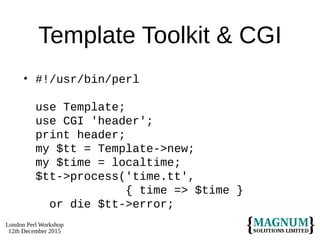
Template Toolkit & CGI
• #!/usr/bin/perl
use Template;
use CGI 'header';
print header;
my $tt = Template->new;
my $time = localtime;
$tt->process('time.tt',
{ time => $time }
or die $tt->error;
London Perl Workshop
12th December 2015
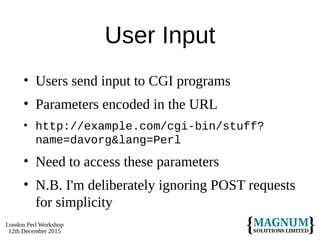
User Input
• Users send input to CGI programs
• Parameters encoded in the URL
• http://example.com/cgi-bin/stuff?
name=davorg&lang=Perl
• Need to access these parameters
• N.B. I'm deliberately ignoring POST requests
for simplicity
London Perl Workshop
12th December 2015
Old Style
• @pairs = split /&/, $ENV{QUERY_STRING};
foreach $pair (@pairs) {
($k, $v) = split /=/, $pair;
$k =~ tr/+/ /;
$k =~ s/%([a-f0-9]{2})/pack 'C', hex($1)/ieg;
$v =~ tr/+/ /;
$v =~ s/%([a-f0-9]{2})/pack 'C', hex($1)/ieg;
$form{$k} = $v;
}
# And then later...
my $name = $form{name};
London Perl Workshop
12th December 2015
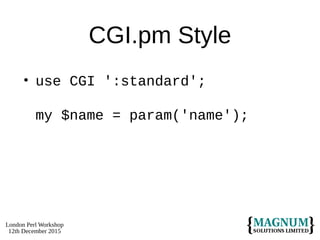
CGI.pm Style
• use CGI ':standard';
my $name = param('name');
London Perl Workshop
12th December 2015
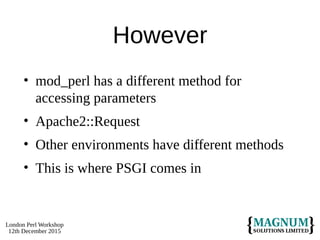
However
• mod_perl has a different method for
accessing parameters
• Apache2::Request
• Other environments have different methods
• This is where PSGI comes in
London Perl Workshop
12th December 2015
PSGI & Plack
London Perl Workshop
12th December 2015
PSGI/Plack
• “PSGI is an interface between Perl web
applications and web servers, and Plack is a
Perl module and toolkit that contains PSGI
middleware, helpers and adapters to web
servers.”
– http://plackperl.org/
London Perl Workshop
12th December 2015
PSGI/Plack
• PSGI is a specification (based on Python's
WSGI)
• Plack is a reference implementation and
toolbox (based on Ruby's Rack)
London Perl Workshop
12th December 2015
The Problem
• There are many ways to write web
applications
• There are many ways to write web
applications in Perl
• Each is subtly different
• Hard to move an application between server
architectures
London Perl Workshop
12th December 2015
Server Architectures
• CGI
• FastCGI
• mod_perl
• etc...
London Perl Workshop
12th December 2015
Frameworks
• There are many Perl web application
frameworks
• Each creates applications in subtly different
ways
• Hard to port applications between them
London Perl Workshop
12th December 2015
The Goal
• What if we had a specification that allowed
us to easily move web applications between
server architectures and frameworks
• PSGI is that specification
London Perl Workshop
12th December 2015
Separation
• We know the advantages of separating
processing from display
• PSGI separates processing from deployment
London Perl Workshop
12th December 2015
PSGI Application
• my $app = sub {
my $env = shift;
return [
200,
[ ‘Content-Type’, ‘text/plain’ ],
[ ‘Hello World’ ],
];
};
London Perl Workshop
12th December 2015
PSGI Application
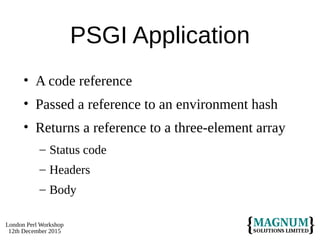
• A code reference
• Passed a reference to an environment hash
• Returns a reference to a three-element array
– Status code
– Headers
– Body
London Perl Workshop
12th December 2015
A Code Reference
• my $app = sub {
my $env = shift;
return [
200,
[ ‘Content-Type’, ‘text/plain’ ],
[ ‘Hello World’ ],
];
};
London Perl Workshop
12th December 2015
A Code Reference
• my $app = sub {
my $env = shift;
return [
200,
[ ‘Content-Type’, ‘text/plain’ ],
[ ‘Hello World’ ],
];
};
London Perl Workshop
12th December 2015
Environment Hash
• my $app = sub {
my $env = shift;
return [
200,
[ ‘Content-Type’, ‘text/plain’ ],
[ ‘Hello World’ ],
];
};
London Perl Workshop
12th December 2015
Environment Hash
• my $app = sub {
my $env = shift;
return [
200,
[ ‘Content-Type’, ‘text/plain’ ],
[ ‘Hello World’ ],
];
};
London Perl Workshop
12th December 2015
Return Array Ref
• my $app = sub {
my $env = shift;
return [
200,
[ ‘Content-Type’, ‘text/plain’ ],
[ ‘Hello World’ ],
];
};
London Perl Workshop
12th December 2015
Return Array Ref
• my $app = sub {
my $env = shift;
return [
200,
[ ‘Content-Type’, ‘text/plain’ ],
[ ‘Hello World’ ],
];
};
London Perl Workshop
12th December 2015
Return Array Ref
• my $app = sub {
my $env = shift;
return [
200,
[ ‘Content-Type’, ‘text/plain’ ],
[ ‘Hello World’ ],
];
};
London Perl Workshop
12th December 2015
Return Array Ref
• my $app = sub {
my $env = shift;
return [
200,
[ ‘Content-Type’, ‘text/plain’ ],
[ ‘Hello World’ ],
];
};
London Perl Workshop
12th December 2015
Return Array Ref
• my $app = sub {
my $env = shift;
return [
200,
[ ‘Content-Type’, ‘text/plain’ ],
[ ‘Hello World’ ],
];
};
London Perl Workshop
12th December 2015
Running PSGI App
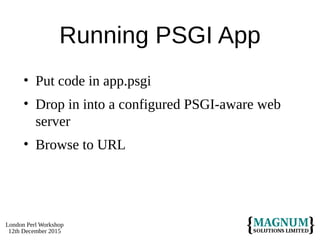
• Put code in app.psgi
• Drop in into a configured PSGI-aware web
server
• Browse to URL
London Perl Workshop
12th December 2015
PSGI-Aware Server
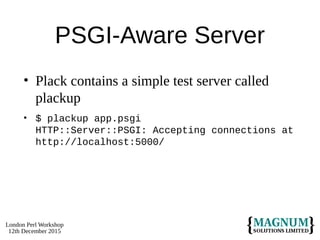
• Plack contains a simple test server called
plackup
• $ plackup app.psgi
HTTP::Server::PSGI: Accepting connections at
http://localhost:5000/
London Perl Workshop
12th December 2015
More About $env
• use Data::Dumper;
my $app = sub {
my $env = shift;
return [
200,
[ 'Content-type', 'text/plain' ],
[ Dumper $env ],
];
}
London Perl Workshop
12th December 2015
More About $env
• $VAR1 = {
'psgi.streaming' => 1,
'psgi.multithread' => '',
'HTTP_UPGRADE_INSECURE_REQUESTS' => '1',
'SERVER_PROTOCOL' => 'HTTP/1.1',
'psgi.errors' => *::STDERR,
'PATH_INFO' => '/',
'HTTP_ACCEPT_LANGUAGE' => 'en-GB,en-US;q=0.8,en;q=0.6',
'psgi.multiprocess' => '',
'SERVER_NAME' => 0,
'psgi.version' => [ 1, 1 ],
'psgix.input.buffered' => 1,
'psgi.input' => *{'HTTP::Server::PSGI::$input'},
'psgi.url_scheme' => 'http',
'REQUEST_URI' => '/',
'REMOTE_PORT' => 59948,
'HTTP_ACCEPT' =>
'text/html,application/xhtml+xml,application/xml;q=0.9,image/webp,*/*;q=0.8',
'REQUEST_METHOD' => 'GET',
'psgix.io' => bless( *Symbol::GEN1,
'IO::Socket::INET' ),
'psgi.run_once' => '',
'SCRIPT_NAME' => '',
'HTTP_ACCEPT_ENCODING' => 'gzip, deflate, sdch',
'SERVER_PORT' => 5000,
'HTTP_HOST' => 'localhost:5000',
London Perl Workshop
12th December 2015
Plack::Request
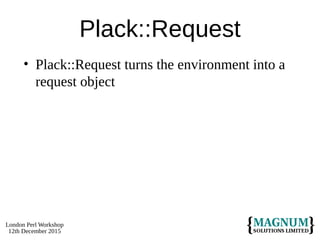
• Plack::Request turns the environment into a
request object
London Perl Workshop
12th December 2015
Plack::Request
• use Plack::Request;
use Data::Dumper;
my $app = sub {
my $req = Plack::Request->new(shift);
return [
200,
[ 'Content-type', 'text/plain' ],
[ Dumper $req ],
];
}
London Perl Workshop
12th December 2015
Plack::Request
• $VAR1 = bless( {
'env' => {
'SCRIPT_NAME' => '',
'psgi.nonblocking' => '',
'psgi.errors' => *::STDERR,
'SERVER_PROTOCOL' => 'HTTP/1.1',
'HTTP_USER_AGENT' =>
'Wget/1.16.3 (linux-gnu)',
'psgi.url_scheme' => 'http',
'REMOTE_PORT' => 57218,
'SERVER_PORT' => 5000,
'REQUEST_METHOD' => 'GET',
'REQUEST_URI' => '/',
'psgi.version' => [ 1, 1 ],
'psgix.io' =>
bless( *Symbol::GEN1, 'IO::Socket::INET' ),
London Perl Workshop
12th December 2015
Plack::Request
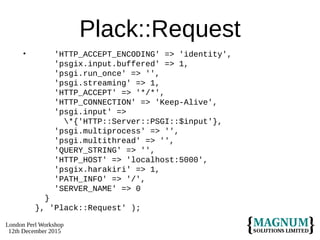
• 'HTTP_ACCEPT_ENCODING' => 'identity',
'psgix.input.buffered' => 1,
'psgi.run_once' => '',
'psgi.streaming' => 1,
'HTTP_ACCEPT' => '*/*',
'HTTP_CONNECTION' => 'Keep-Alive',
'psgi.input' =>
*{'HTTP::Server::PSGI::$input'},
'psgi.multiprocess' => '',
'psgi.multithread' => '',
'QUERY_STRING' => '',
'HTTP_HOST' => 'localhost:5000',
'psgix.harakiri' => 1,
'PATH_INFO' => '/',
'SERVER_NAME' => 0
}
}, 'Plack::Request' );
London Perl Workshop
12th December 2015
Plack::Response
• Plack::Response builds a PSGI response
object
London Perl Workshop
12th December 2015
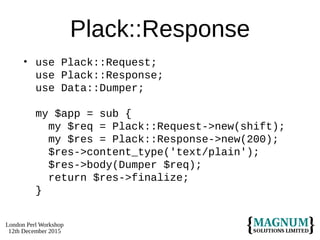
Plack::Response
• use Plack::Request;
use Plack::Response;
use Data::Dumper;
my $app = sub {
my $req = Plack::Request->new(shift);
my $res = Plack::Response->new(200);
$res->content_type('text/plain');
$res->body(Dumper $req);
return $res->finalize;
}
London Perl Workshop
12th December 2015
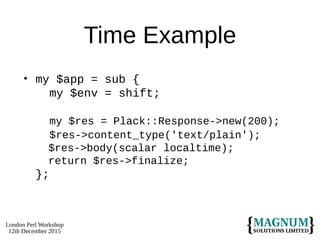
Time Example
• my $app = sub {
my $env = shift;
my $res = Plack::Response->new(200);
$res->content_type('text/plain');
$res->body(scalar localtime);
return $res->finalize;
};
London Perl Workshop
12th December 2015
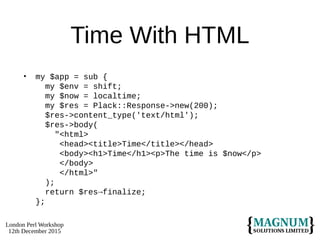
Time With HTML
• my $app = sub {
my $env = shift;
my $now = localtime;
my $res = Plack::Response->new(200);
$res->content_type('text/html');
$res->body(
"<html>
<head><title>Time</title></head>
<body><h1>Time</h1><p>The time is $now</p>
</body>
</html>"
);
return $res→finalize;
};
London Perl Workshop
12th December 2015
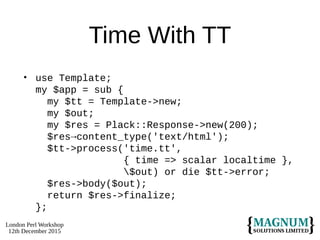
Time With TT
• use Template;
my $app = sub {
my $tt = Template->new;
my $out;
my $res = Plack::Response->new(200);
$res→content_type('text/html');
$tt->process('time.tt',
{ time => scalar localtime },
$out) or die $tt->error;
$res->body($out);
return $res->finalize;
};
London Perl Workshop
12th December 2015
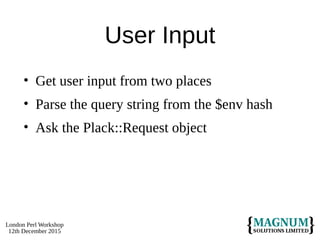
User Input
• Get user input from two places
• Parse the query string from the $env hash
• Ask the Plack::Request object
London Perl Workshop
12th December 2015
Input
• use Plack::Request;
use Data::Dumper;
my $app = sub {
my $req = Plack::Request->new(shift);
my $content;
if (keys %{$req->parameters}) {
$content = response($req);
} else {
$content = form();
}
return [ 200, [ 'Content-type', 'text/html' ],
[ $content ], ];
};
London Perl Workshop
12th December 2015
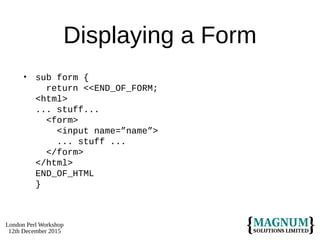
Displaying a Form
• sub form {
return <<END_OF_FORM;
<html>
... stuff...
<form>
<input name=”name”>
... stuff ...
</form>
</html>
END_OF_HTML
}
London Perl Workshop
12th December 2015
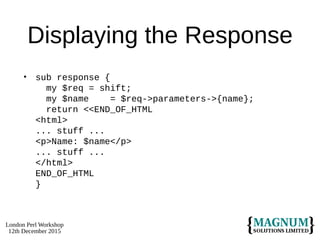
Displaying the Response
• sub response {
my $req = shift;
my $name = $req->parameters->{name};
return <<END_OF_HTML
<html>
... stuff ...
<p>Name: $name</p>
... stuff ...
</html>
END_OF_HTML
}
London Perl Workshop
12th December 2015
Using Templates
• Both form and response can be produced
using TT
• This is left as an exercise for the reader
London Perl Workshop
12th December 2015
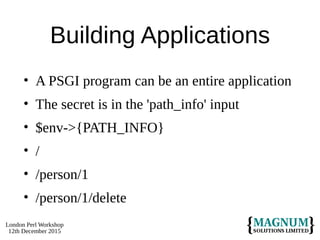
Building Applications
• A PSGI program can be an entire application
• The secret is in the 'path_info' input
• $env->{PATH_INFO}
• /
• /person/1
• /person/1/delete
London Perl Workshop
12th December 2015
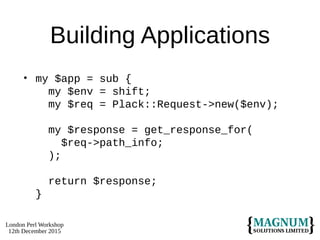
Building Applications
• my $app = sub {
my $env = shift;
my $req = Plack::Request->new($env);
my $response = get_response_for(
$req->path_info;
);
return $response;
}
London Perl Workshop
12th December 2015
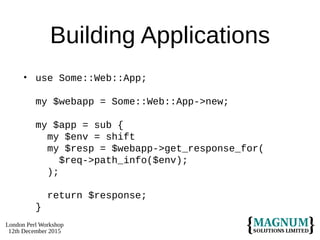
Building Applications
• use Some::Web::App;
my $webapp = Some::Web::App->new;
my $app = sub {
my $env = shift
my $resp = $webapp->get_response_for(
$req->path_info($env);
);
return $response;
}
London Perl Workshop
12th December 2015
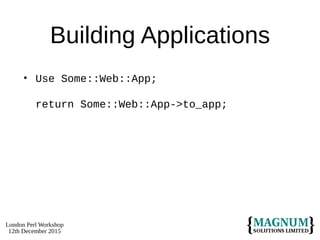
Building Applications
• Use Some::Web::App;
return Some::Web::App->to_app;
London Perl Workshop
12th December 2015
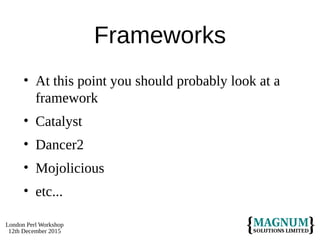
Frameworks
• At this point you should probably look at a
framework
• Catalyst
• Dancer2
• Mojolicious
• etc...
London Perl Workshop
12th December 2015
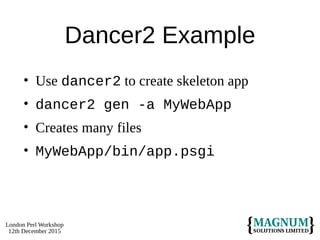
Dancer2 Example
• Use dancer2 to create skeleton app
• dancer2 gen -a MyWebApp
• Creates many files
• MyWebApp/bin/app.psgi
London Perl Workshop
12th December 2015
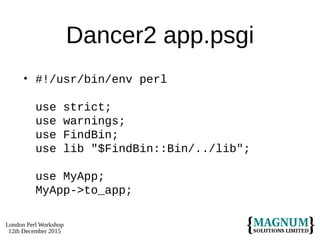
Dancer2 app.psgi
• #!/usr/bin/env perl
use strict;
use warnings;
use FindBin;
use lib "$FindBin::Bin/../lib";
use MyApp;
MyApp->to_app;
London Perl Workshop
12th December 2015
Advertisement
• This is a cut-down version of another course
• Two days in February 2016
• Insert many hours of framework-specific
examples here
• See http://mgnm.at/trn2015
London Perl Workshop
12th December 2015
Plack
Middleware
London Perl Workshop
12th December 2015
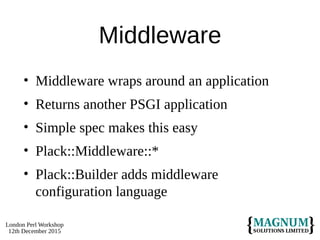
Middleware
• Middleware wraps around an application
• Returns another PSGI application
• Simple spec makes this easy
• Plack::Middleware::*
• Plack::Builder adds middleware
configuration language
London Perl Workshop
12th December 2015
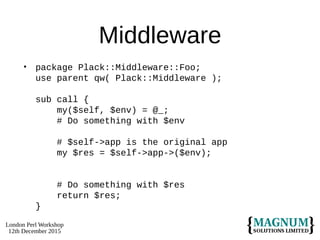
Middleware
• package Plack::Middleware::Foo;
use parent qw( Plack::Middleware );
sub call {
my($self, $env) = @_;
# Do something with $env
# $self->app is the original app
my $res = $self->app->($env);
# Do something with $res
return $res;
}
London Perl Workshop
12th December 2015
Middleware Example
• package Plack::Middleware::Runtime;
use strict;
use parent qw(Plack::Middleware);
use Plack::Util;
use Plack::Util::Accessor qw(header_name);
use Time::HiRes;
sub call {
my($self, $env) = @_;
my $start = [ Time::HiRes::gettimeofday ];
my $res = $self->app->($env);
my $header = $self->header_name || 'X-Runtime';
$self->response_cb($res, sub {
my $res = shift;
my $req_time = sprintf '%.6f',
Time::HiRes::tv_interval($start);
Plack::Util::header_set($res->[1], $header, $req_time);
});
}
London Perl Workshop
12th December 2015
Middleware Example
• use Plack::Builder;
use Plack::Middleware::Runtime;
my $app = sub {
my $env = shift;
return [
200,
[ 'Content-type', 'text/plain' ],
[ 'Hello world' ],
]
};
builder {
enable 'Runtime';
$app;
}
London Perl Workshop
12th December 2015
Middleware Example
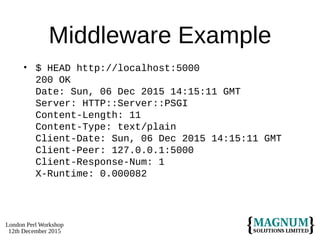
• $ HEAD http://localhost:5000
200 OK
Date: Sun, 06 Dec 2015 14:15:11 GMT
Server: HTTP::Server::PSGI
Content-Length: 11
Content-Type: text/plain
Client-Date: Sun, 06 Dec 2015 14:15:11 GMT
Client-Peer: 127.0.0.1:5000
Client-Response-Num: 1
X-Runtime: 0.000082
London Perl Workshop
12th December 2015
Middleware Example
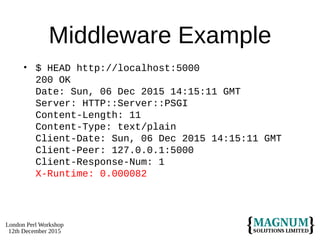
• $ HEAD http://localhost:5000
200 OK
Date: Sun, 06 Dec 2015 14:15:11 GMT
Server: HTTP::Server::PSGI
Content-Length: 11
Content-Type: text/plain
Client-Date: Sun, 06 Dec 2015 14:15:11 GMT
Client-Peer: 127.0.0.1:5000
Client-Response-Num: 1
X-Runtime: 0.000082
London Perl Workshop
12th December 2015
Middleware Examples
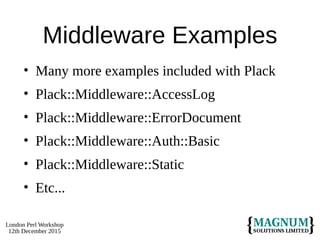
• Many more examples included with Plack
• Plack::Middleware::AccessLog
• Plack::Middleware::ErrorDocument
• Plack::Middleware::Auth::Basic
• Plack::Middleware::Static
• Etc...
London Perl Workshop
12th December 2015
Plack::Middlware::Static
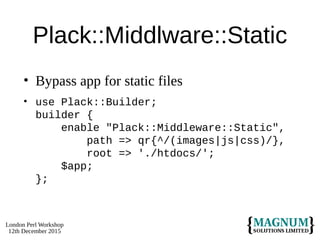
• Bypass app for static files
• use Plack::Builder;
builder {
enable "Plack::Middleware::Static",
path => qr{^/(images|js|css)/},
root => './htdocs/';
$app;
};
London Perl Workshop
12th December 2015
Plack Apps
London Perl Workshop
12th December 2015
Plack::App::*
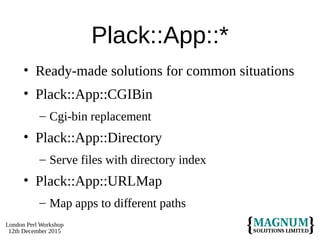
• Ready-made solutions for common situations
• Plack::App::CGIBin
– Cgi-bin replacement
• Plack::App::Directory
– Serve files with directory index
• Plack::App::URLMap
– Map apps to different paths
London Perl Workshop
12th December 2015
Plack::App::*
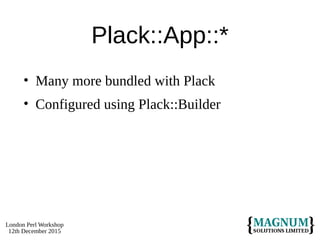
• Many more bundled with Plack
• Configured using Plack::Builder
London Perl Workshop
12th December 2015
Plack::App::CGIBin
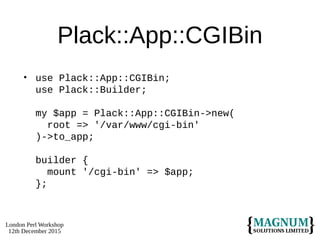
• use Plack::App::CGIBin;
use Plack::Builder;
my $app = Plack::App::CGIBin->new(
root => '/var/www/cgi-bin'
)->to_app;
builder {
mount '/cgi-bin' => $app;
};
London Perl Workshop
12th December 2015
Plack::App::Directory
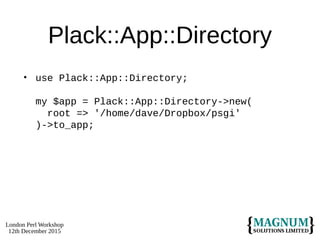
• use Plack::App::Directory;
my $app = Plack::App::Directory->new(
root => '/home/dave/Dropbox/psgi'
)->to_app;
London Perl Workshop
12th December 2015
Debugging
PSGI Apps
London Perl Workshop
12th December 2015
Debugging Web Apps
• Debugging web apps is difficult
• Hard to trace execution
• Log messages
London Perl Workshop
12th December 2015
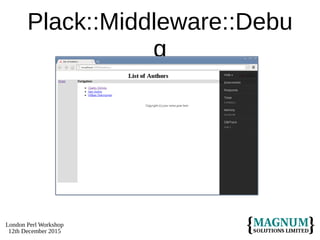
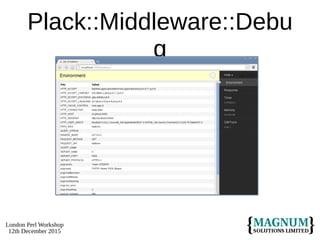
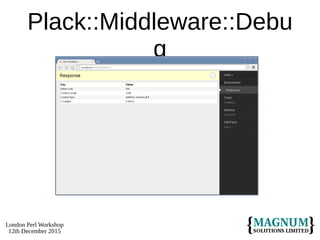
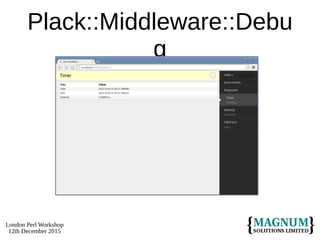
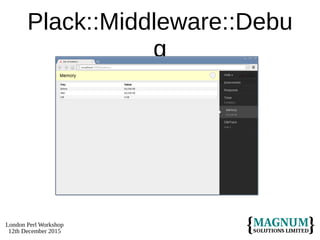
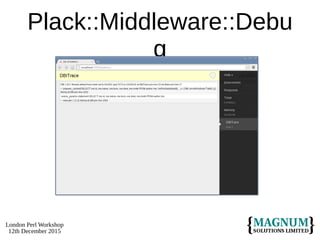
Plack::Middleware::Debug
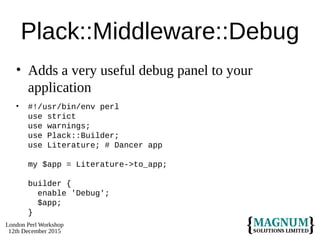
• Adds a very useful debug panel to your
application
• #!/usr/bin/env perl
use strict
use warnings;
use Plack::Builder;
use Literature; # Dancer app
my $app = Literature->to_app;
builder {
enable 'Debug';
$app;
}
London Perl Workshop
12th December 2015
Plack::Middleware::Debu
g
London Perl Workshop
12th December 2015
Plack::Middleware::Debu
g
London Perl Workshop
12th December 2015
Plack::Middleware::Debu
g
London Perl Workshop
12th December 2015
Plack::Middleware::Debu
g
London Perl Workshop
12th December 2015
Plack::Middleware::Debu
g
London Perl Workshop
12th December 2015
Plack::Middleware::Debu
g
London Perl Workshop
12th December 2015
Plack::Debugger
• Plack::Debugger is a replacement for
Plack::Middleware::Debug
• Harder to configure
• More flexible
• Work in progress
• Worth watching
London Perl Workshop
12th December 2015
Testing
PSGI Apps
London Perl Workshop
12th December 2015
Testing Web Apps
• Testing web apps is hard
• For the same reasons as debugging
• WWW::Mechanize
• Selenium
London Perl Workshop
12th December 2015
Plack::Test
• The simple Plack specification makes it easy
to write a testing layer
• Plack::Test
• Standard for all PSGI apps
• Dancer2::Test (for example) is now
deprecated
London Perl Workshop
12th December 2015
Using Plack::Test
• Three modes of use
• Examples all require the following
• use Plack::Test;
use HTTP::Request::Common;
London Perl Workshop
12th December 2015
Positional Params
• my $app = sub {
return [ 200, [], [ "Hello "] ]
};
my $client = sub {
my $cb = shift;
my $res = $cb->(GET "/");
is $res->content, "Hello";
};
test_psgi $app, $client;
London Perl Workshop
12th December 2015
Named Params
• my $app = sub {
return [ 200, [], [ "Hello "] ]
};
my $client = sub {
my $cb = shift;
my $res = $cb->("GET /");
is $res->content, “Hello”;
}
test_psgi app => $app,
client => $client;
London Perl Workshop
12th December 2015
Object Oriented
• my $app = sub {
return [ 200, [], [ "Hello "] ]
};
my $test = Plack::Test->create($app);
my $res = $test->request(GET "/");
is $res->content, "Hello";
London Perl Workshop
12th December 2015
Deploying
PSGI Apps
London Perl Workshop
12th December 2015
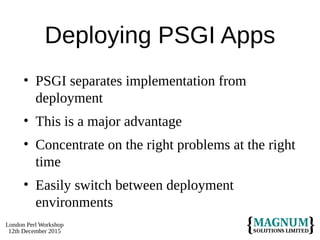
Deploying PSGI Apps
• PSGI separates implementation from
deployment
• This is a major advantage
• Concentrate on the right problems at the right
time
• Easily switch between deployment
environments
London Perl Workshop
12th December 2015
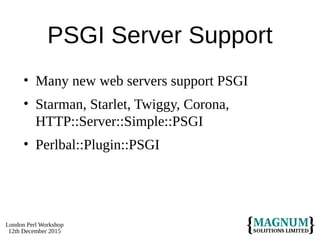
PSGI Server Support
• Many new web servers support PSGI
• Starman, Starlet, Twiggy, Corona,
HTTP::Server::Simple::PSGI
• Perlbal::Plugin::PSGI
London Perl Workshop
12th December 2015
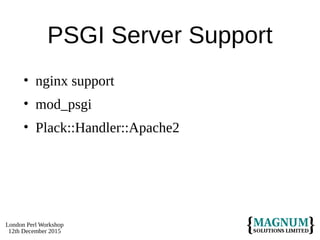
PSGI Server Support
• nginx support
• mod_psgi
• Plack::Handler::Apache2
London Perl Workshop
12th December 2015
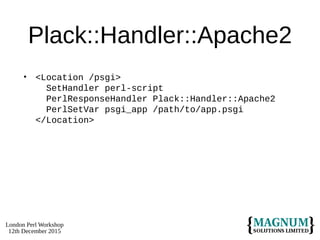
Plack::Handler::Apache2
• <Location /psgi>
SetHandler perl-script
PerlResponseHandler Plack::Handler::Apache2
PerlSetVar psgi_app /path/to/app.psgi
</Location>
London Perl Workshop
12th December 2015
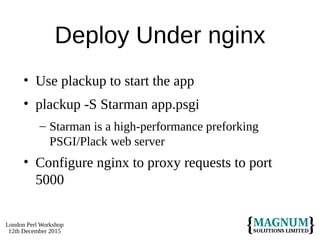
Deploy Under nginx
• Use plackup to start the app
• plackup -S Starman app.psgi
– Starman is a high-performance preforking
PSGI/Plack web server
• Configure nginx to proxy requests to port
5000
London Perl Workshop
12th December 2015
Advertisement
• Deployment will be covered in far more
detail on the extended course
• We will have practical sessions trying out
various deployment scenarios
• We will turn our app into a real service
• See http://mgnm.at/trn2015
London Perl Workshop
12th December 2015
Summary
London Perl Workshop
12th December 2015
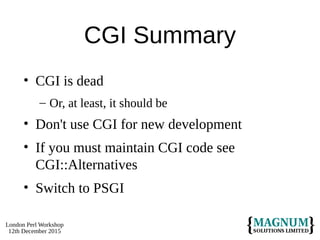
CGI Summary
• CGI is dead
– Or, at least, it should be
• Don't use CGI for new development
• If you must maintain CGI code see
CGI::Alternatives
• Switch to PSGI
London Perl Workshop
12th December 2015
PSGI/Plack Summary
• PSGI is a specification
• Plack is an implementation/toolbox
• PSGI makes your life easier
• Most of the frameworks and servers you use
already support PSGI
• No excuse not to use it
London Perl Workshop
12th December 2015
Further Information
• perldoc PSGI
• perldoc Plack
• http://plackperl.org/
• http://blog.plackperl.org/
• http://github.com/miyagawa/Plack
• #plack on irc.perl.org
London Perl Workshop
12th December 2015
That's all folks
• Any questions?

Modern Web Development with Perl

  • 1.
    London Perl Workshop 12thDecember 2015 Modern Perl Web Development Dave Cross Magnum Solutions Ltd dave@mag-sol.com
  • 2.
    London Perl Workshop 12thDecember 2015 Web Development • People have been developing web applications for over 20 years • Surely it is easy now • Lessons have been learned • Best practices have been worked out
  • 3.
    London Perl Workshop 12thDecember 2015 History of Perl & Web • Common Gateway Interface 1993 • Defined the interaction between a web server and a program • Dynamic web pages
  • 4.
    London Perl Workshop 12thDecember 2015 CGI • Request includes parameters • Program processes parameters and produces response • Response includes program's output
  • 5.
    London Perl Workshop 12thDecember 2015 Mid-Late 1990s • Every web site gained dynamic pages • Form to email • Guestbook • Hit counter • Etc... • Most of them were written in Perl
  • 6.
    London Perl Workshop 12thDecember 2015 CGI Problems • CGI can be slow • Perl compiler starts up on every request • Can be very slow • Not useful for heavy traffic sites
  • 7.
    London Perl Workshop 12thDecember 2015 mod_perl • Everyone used Apache • Apache allowed loadable modules • mod_perl loads a Perl compiler • Persistent Perl processes • No more start-up costs • Huge performance improvements
  • 8.
    London Perl Workshop 12thDecember 2015 Downsides • Can't just use your CGI programs – ModPerl::Registry • Program is now called as a subroutine • Global variable issues • Many programs needed rewrites • Different input and output methods
  • 9.
    London Perl Workshop 12thDecember 2015 Other Environments • FastCGI • Microsoft IIS • nginx • Etc... • Lack of portability • Hold that thought
  • 10.
    London Perl Workshop 12thDecember 2015 CGI Programs • CGI programs do three things • Read user input • Process data • Produce output • Let's look at input and output in more detail
  • 11.
    London Perl Workshop 12thDecember 2015 Output • CGI programs produce two types of output • Headers – Content-type • Body – The actual data (HTML, etc)
  • 12.
    London Perl Workshop 12thDecember 2015 Simple CGI Output • #!/usr/bin/perl print “Content-type: text/plainnn”; print 'The time is: ', scalar localtime;
  • 13.
    London Perl Workshop 12thDecember 2015 HTML • #!/usr/bin/perl print “Content-type: text/htmlnn”; my $time = localtime; print <<END_HTML; <html><head><title>Time</title></head> <body><h1>Time</h1> <p>The time is: $time.</p></body></html> END_HTML
  • 14.
    London Perl Workshop 12thDecember 2015 Enter CGI.pm • CGI.pm standard part of Perl distribution • Handles CGI processing for you • Input and output • Output in the form of CGI & HTML helper functions – HTML helper functions now deprecated
  • 15.
    London Perl Workshop 12thDecember 2015 HTML With CGI.pm • #!/usr/bin/perl use CGI ':standard'; print header; # default text/html my $time = localtime; print start_html(title => 'Time'), h1('Time'), p(“The time is: $time”); end_html;
  • 16.
    London Perl Workshop 12thDecember 2015 Downsides • Mixing HTML and Perl code is nasty • What if you have a designer? • HTML experts don't always know Perl • Use a templating system instead
  • 17.
    London Perl Workshop 12thDecember 2015 Template Toolkit • <html> <head> <title>Time</title> </head> <body> <h1>Time</h1> <p>The time is: [% time %].</p> </body> </html>
  • 18.
    London Perl Workshop 12thDecember 2015 Template Toolkit • <html> <head> <title>Time</title> </head> <body> <h1>Time</h1> <p>The time is: [% time %].</p> </body> </html>
  • 19.
    London Perl Workshop 12thDecember 2015 Template Toolkit • Separate the HTML into a separate file • Use tags where the variable output goes • Easier to edit by your HTML team
  • 20.
    London Perl Workshop 12thDecember 2015 Template Toolkit & CGI • #!/usr/bin/perl use Template; use CGI 'header'; print header; my $tt = Template->new; my $time = localtime; $tt->process('time.tt', { time => $time } or die $tt->error;
  • 21.
    London Perl Workshop 12thDecember 2015 User Input • Users send input to CGI programs • Parameters encoded in the URL • http://example.com/cgi-bin/stuff? name=davorg&lang=Perl • Need to access these parameters • N.B. I'm deliberately ignoring POST requests for simplicity
  • 22.
    London Perl Workshop 12thDecember 2015 Old Style • @pairs = split /&/, $ENV{QUERY_STRING}; foreach $pair (@pairs) { ($k, $v) = split /=/, $pair; $k =~ tr/+/ /; $k =~ s/%([a-f0-9]{2})/pack 'C', hex($1)/ieg; $v =~ tr/+/ /; $v =~ s/%([a-f0-9]{2})/pack 'C', hex($1)/ieg; $form{$k} = $v; } # And then later... my $name = $form{name};
  • 23.
    London Perl Workshop 12thDecember 2015 CGI.pm Style • use CGI ':standard'; my $name = param('name');
  • 24.
    London Perl Workshop 12thDecember 2015 However • mod_perl has a different method for accessing parameters • Apache2::Request • Other environments have different methods • This is where PSGI comes in
  • 25.
    London Perl Workshop 12thDecember 2015 PSGI & Plack
  • 26.
    London Perl Workshop 12thDecember 2015 PSGI/Plack • “PSGI is an interface between Perl web applications and web servers, and Plack is a Perl module and toolkit that contains PSGI middleware, helpers and adapters to web servers.” – http://plackperl.org/
  • 27.
    London Perl Workshop 12thDecember 2015 PSGI/Plack • PSGI is a specification (based on Python's WSGI) • Plack is a reference implementation and toolbox (based on Ruby's Rack)
  • 28.
    London Perl Workshop 12thDecember 2015 The Problem • There are many ways to write web applications • There are many ways to write web applications in Perl • Each is subtly different • Hard to move an application between server architectures
  • 29.
    London Perl Workshop 12thDecember 2015 Server Architectures • CGI • FastCGI • mod_perl • etc...
  • 30.
    London Perl Workshop 12thDecember 2015 Frameworks • There are many Perl web application frameworks • Each creates applications in subtly different ways • Hard to port applications between them
  • 31.
    London Perl Workshop 12thDecember 2015 The Goal • What if we had a specification that allowed us to easily move web applications between server architectures and frameworks • PSGI is that specification
  • 32.
    London Perl Workshop 12thDecember 2015 Separation • We know the advantages of separating processing from display • PSGI separates processing from deployment
  • 33.
    London Perl Workshop 12thDecember 2015 PSGI Application • my $app = sub { my $env = shift; return [ 200, [ ‘Content-Type’, ‘text/plain’ ], [ ‘Hello World’ ], ]; };
  • 34.
    London Perl Workshop 12thDecember 2015 PSGI Application • A code reference • Passed a reference to an environment hash • Returns a reference to a three-element array – Status code – Headers – Body
  • 35.
    London Perl Workshop 12thDecember 2015 A Code Reference • my $app = sub { my $env = shift; return [ 200, [ ‘Content-Type’, ‘text/plain’ ], [ ‘Hello World’ ], ]; };
  • 36.
    London Perl Workshop 12thDecember 2015 A Code Reference • my $app = sub { my $env = shift; return [ 200, [ ‘Content-Type’, ‘text/plain’ ], [ ‘Hello World’ ], ]; };
  • 37.
    London Perl Workshop 12thDecember 2015 Environment Hash • my $app = sub { my $env = shift; return [ 200, [ ‘Content-Type’, ‘text/plain’ ], [ ‘Hello World’ ], ]; };
  • 38.
    London Perl Workshop 12thDecember 2015 Environment Hash • my $app = sub { my $env = shift; return [ 200, [ ‘Content-Type’, ‘text/plain’ ], [ ‘Hello World’ ], ]; };
  • 39.
    London Perl Workshop 12thDecember 2015 Return Array Ref • my $app = sub { my $env = shift; return [ 200, [ ‘Content-Type’, ‘text/plain’ ], [ ‘Hello World’ ], ]; };
  • 40.
    London Perl Workshop 12thDecember 2015 Return Array Ref • my $app = sub { my $env = shift; return [ 200, [ ‘Content-Type’, ‘text/plain’ ], [ ‘Hello World’ ], ]; };
  • 41.
    London Perl Workshop 12thDecember 2015 Return Array Ref • my $app = sub { my $env = shift; return [ 200, [ ‘Content-Type’, ‘text/plain’ ], [ ‘Hello World’ ], ]; };
  • 42.
    London Perl Workshop 12thDecember 2015 Return Array Ref • my $app = sub { my $env = shift; return [ 200, [ ‘Content-Type’, ‘text/plain’ ], [ ‘Hello World’ ], ]; };
  • 43.
    London Perl Workshop 12thDecember 2015 Return Array Ref • my $app = sub { my $env = shift; return [ 200, [ ‘Content-Type’, ‘text/plain’ ], [ ‘Hello World’ ], ]; };
  • 44.
    London Perl Workshop 12thDecember 2015 Running PSGI App • Put code in app.psgi • Drop in into a configured PSGI-aware web server • Browse to URL
  • 45.
    London Perl Workshop 12thDecember 2015 PSGI-Aware Server • Plack contains a simple test server called plackup • $ plackup app.psgi HTTP::Server::PSGI: Accepting connections at http://localhost:5000/
  • 46.
    London Perl Workshop 12thDecember 2015 More About $env • use Data::Dumper; my $app = sub { my $env = shift; return [ 200, [ 'Content-type', 'text/plain' ], [ Dumper $env ], ]; }
  • 47.
    London Perl Workshop 12thDecember 2015 More About $env • $VAR1 = { 'psgi.streaming' => 1, 'psgi.multithread' => '', 'HTTP_UPGRADE_INSECURE_REQUESTS' => '1', 'SERVER_PROTOCOL' => 'HTTP/1.1', 'psgi.errors' => *::STDERR, 'PATH_INFO' => '/', 'HTTP_ACCEPT_LANGUAGE' => 'en-GB,en-US;q=0.8,en;q=0.6', 'psgi.multiprocess' => '', 'SERVER_NAME' => 0, 'psgi.version' => [ 1, 1 ], 'psgix.input.buffered' => 1, 'psgi.input' => *{'HTTP::Server::PSGI::$input'}, 'psgi.url_scheme' => 'http', 'REQUEST_URI' => '/', 'REMOTE_PORT' => 59948, 'HTTP_ACCEPT' => 'text/html,application/xhtml+xml,application/xml;q=0.9,image/webp,*/*;q=0.8', 'REQUEST_METHOD' => 'GET', 'psgix.io' => bless( *Symbol::GEN1, 'IO::Socket::INET' ), 'psgi.run_once' => '', 'SCRIPT_NAME' => '', 'HTTP_ACCEPT_ENCODING' => 'gzip, deflate, sdch', 'SERVER_PORT' => 5000, 'HTTP_HOST' => 'localhost:5000',
  • 48.
    London Perl Workshop 12thDecember 2015 Plack::Request • Plack::Request turns the environment into a request object
  • 49.
    London Perl Workshop 12thDecember 2015 Plack::Request • use Plack::Request; use Data::Dumper; my $app = sub { my $req = Plack::Request->new(shift); return [ 200, [ 'Content-type', 'text/plain' ], [ Dumper $req ], ]; }
  • 50.
    London Perl Workshop 12thDecember 2015 Plack::Request • $VAR1 = bless( { 'env' => { 'SCRIPT_NAME' => '', 'psgi.nonblocking' => '', 'psgi.errors' => *::STDERR, 'SERVER_PROTOCOL' => 'HTTP/1.1', 'HTTP_USER_AGENT' => 'Wget/1.16.3 (linux-gnu)', 'psgi.url_scheme' => 'http', 'REMOTE_PORT' => 57218, 'SERVER_PORT' => 5000, 'REQUEST_METHOD' => 'GET', 'REQUEST_URI' => '/', 'psgi.version' => [ 1, 1 ], 'psgix.io' => bless( *Symbol::GEN1, 'IO::Socket::INET' ),
  • 51.
    London Perl Workshop 12thDecember 2015 Plack::Request • 'HTTP_ACCEPT_ENCODING' => 'identity', 'psgix.input.buffered' => 1, 'psgi.run_once' => '', 'psgi.streaming' => 1, 'HTTP_ACCEPT' => '*/*', 'HTTP_CONNECTION' => 'Keep-Alive', 'psgi.input' => *{'HTTP::Server::PSGI::$input'}, 'psgi.multiprocess' => '', 'psgi.multithread' => '', 'QUERY_STRING' => '', 'HTTP_HOST' => 'localhost:5000', 'psgix.harakiri' => 1, 'PATH_INFO' => '/', 'SERVER_NAME' => 0 } }, 'Plack::Request' );
  • 52.
    London Perl Workshop 12thDecember 2015 Plack::Response • Plack::Response builds a PSGI response object
  • 53.
    London Perl Workshop 12thDecember 2015 Plack::Response • use Plack::Request; use Plack::Response; use Data::Dumper; my $app = sub { my $req = Plack::Request->new(shift); my $res = Plack::Response->new(200); $res->content_type('text/plain'); $res->body(Dumper $req); return $res->finalize; }
  • 54.
    London Perl Workshop 12thDecember 2015 Time Example • my $app = sub { my $env = shift; my $res = Plack::Response->new(200); $res->content_type('text/plain'); $res->body(scalar localtime); return $res->finalize; };
  • 55.
    London Perl Workshop 12thDecember 2015 Time With HTML • my $app = sub { my $env = shift; my $now = localtime; my $res = Plack::Response->new(200); $res->content_type('text/html'); $res->body( "<html> <head><title>Time</title></head> <body><h1>Time</h1><p>The time is $now</p> </body> </html>" ); return $res→finalize; };
  • 56.
    London Perl Workshop 12thDecember 2015 Time With TT • use Template; my $app = sub { my $tt = Template->new; my $out; my $res = Plack::Response->new(200); $res→content_type('text/html'); $tt->process('time.tt', { time => scalar localtime }, $out) or die $tt->error; $res->body($out); return $res->finalize; };
  • 57.
    London Perl Workshop 12thDecember 2015 User Input • Get user input from two places • Parse the query string from the $env hash • Ask the Plack::Request object
  • 58.
    London Perl Workshop 12thDecember 2015 Input • use Plack::Request; use Data::Dumper; my $app = sub { my $req = Plack::Request->new(shift); my $content; if (keys %{$req->parameters}) { $content = response($req); } else { $content = form(); } return [ 200, [ 'Content-type', 'text/html' ], [ $content ], ]; };
  • 59.
    London Perl Workshop 12thDecember 2015 Displaying a Form • sub form { return <<END_OF_FORM; <html> ... stuff... <form> <input name=”name”> ... stuff ... </form> </html> END_OF_HTML }
  • 60.
    London Perl Workshop 12thDecember 2015 Displaying the Response • sub response { my $req = shift; my $name = $req->parameters->{name}; return <<END_OF_HTML <html> ... stuff ... <p>Name: $name</p> ... stuff ... </html> END_OF_HTML }
  • 61.
    London Perl Workshop 12thDecember 2015 Using Templates • Both form and response can be produced using TT • This is left as an exercise for the reader
  • 62.
    London Perl Workshop 12thDecember 2015 Building Applications • A PSGI program can be an entire application • The secret is in the 'path_info' input • $env->{PATH_INFO} • / • /person/1 • /person/1/delete
  • 63.
    London Perl Workshop 12thDecember 2015 Building Applications • my $app = sub { my $env = shift; my $req = Plack::Request->new($env); my $response = get_response_for( $req->path_info; ); return $response; }
  • 64.
    London Perl Workshop 12thDecember 2015 Building Applications • use Some::Web::App; my $webapp = Some::Web::App->new; my $app = sub { my $env = shift my $resp = $webapp->get_response_for( $req->path_info($env); ); return $response; }
  • 65.
    London Perl Workshop 12thDecember 2015 Building Applications • Use Some::Web::App; return Some::Web::App->to_app;
  • 66.
    London Perl Workshop 12thDecember 2015 Frameworks • At this point you should probably look at a framework • Catalyst • Dancer2 • Mojolicious • etc...
  • 67.
    London Perl Workshop 12thDecember 2015 Dancer2 Example • Use dancer2 to create skeleton app • dancer2 gen -a MyWebApp • Creates many files • MyWebApp/bin/app.psgi
  • 68.
    London Perl Workshop 12thDecember 2015 Dancer2 app.psgi • #!/usr/bin/env perl use strict; use warnings; use FindBin; use lib "$FindBin::Bin/../lib"; use MyApp; MyApp->to_app;
  • 69.
    London Perl Workshop 12thDecember 2015 Advertisement • This is a cut-down version of another course • Two days in February 2016 • Insert many hours of framework-specific examples here • See http://mgnm.at/trn2015
  • 70.
    London Perl Workshop 12thDecember 2015 Plack Middleware
  • 71.
    London Perl Workshop 12thDecember 2015 Middleware • Middleware wraps around an application • Returns another PSGI application • Simple spec makes this easy • Plack::Middleware::* • Plack::Builder adds middleware configuration language
  • 72.
    London Perl Workshop 12thDecember 2015 Middleware • package Plack::Middleware::Foo; use parent qw( Plack::Middleware ); sub call { my($self, $env) = @_; # Do something with $env # $self->app is the original app my $res = $self->app->($env); # Do something with $res return $res; }
  • 73.
    London Perl Workshop 12thDecember 2015 Middleware Example • package Plack::Middleware::Runtime; use strict; use parent qw(Plack::Middleware); use Plack::Util; use Plack::Util::Accessor qw(header_name); use Time::HiRes; sub call { my($self, $env) = @_; my $start = [ Time::HiRes::gettimeofday ]; my $res = $self->app->($env); my $header = $self->header_name || 'X-Runtime'; $self->response_cb($res, sub { my $res = shift; my $req_time = sprintf '%.6f', Time::HiRes::tv_interval($start); Plack::Util::header_set($res->[1], $header, $req_time); }); }
  • 74.
    London Perl Workshop 12thDecember 2015 Middleware Example • use Plack::Builder; use Plack::Middleware::Runtime; my $app = sub { my $env = shift; return [ 200, [ 'Content-type', 'text/plain' ], [ 'Hello world' ], ] }; builder { enable 'Runtime'; $app; }
  • 75.
    London Perl Workshop 12thDecember 2015 Middleware Example • $ HEAD http://localhost:5000 200 OK Date: Sun, 06 Dec 2015 14:15:11 GMT Server: HTTP::Server::PSGI Content-Length: 11 Content-Type: text/plain Client-Date: Sun, 06 Dec 2015 14:15:11 GMT Client-Peer: 127.0.0.1:5000 Client-Response-Num: 1 X-Runtime: 0.000082
  • 76.
    London Perl Workshop 12thDecember 2015 Middleware Example • $ HEAD http://localhost:5000 200 OK Date: Sun, 06 Dec 2015 14:15:11 GMT Server: HTTP::Server::PSGI Content-Length: 11 Content-Type: text/plain Client-Date: Sun, 06 Dec 2015 14:15:11 GMT Client-Peer: 127.0.0.1:5000 Client-Response-Num: 1 X-Runtime: 0.000082
  • 77.
    London Perl Workshop 12thDecember 2015 Middleware Examples • Many more examples included with Plack • Plack::Middleware::AccessLog • Plack::Middleware::ErrorDocument • Plack::Middleware::Auth::Basic • Plack::Middleware::Static • Etc...
  • 78.
    London Perl Workshop 12thDecember 2015 Plack::Middlware::Static • Bypass app for static files • use Plack::Builder; builder { enable "Plack::Middleware::Static", path => qr{^/(images|js|css)/}, root => './htdocs/'; $app; };
  • 79.
    London Perl Workshop 12thDecember 2015 Plack Apps
  • 80.
    London Perl Workshop 12thDecember 2015 Plack::App::* • Ready-made solutions for common situations • Plack::App::CGIBin – Cgi-bin replacement • Plack::App::Directory – Serve files with directory index • Plack::App::URLMap – Map apps to different paths
  • 81.
    London Perl Workshop 12thDecember 2015 Plack::App::* • Many more bundled with Plack • Configured using Plack::Builder
  • 82.
    London Perl Workshop 12thDecember 2015 Plack::App::CGIBin • use Plack::App::CGIBin; use Plack::Builder; my $app = Plack::App::CGIBin->new( root => '/var/www/cgi-bin' )->to_app; builder { mount '/cgi-bin' => $app; };
  • 83.
    London Perl Workshop 12thDecember 2015 Plack::App::Directory • use Plack::App::Directory; my $app = Plack::App::Directory->new( root => '/home/dave/Dropbox/psgi' )->to_app;
  • 84.
    London Perl Workshop 12thDecember 2015 Debugging PSGI Apps
  • 85.
    London Perl Workshop 12thDecember 2015 Debugging Web Apps • Debugging web apps is difficult • Hard to trace execution • Log messages
  • 86.
    London Perl Workshop 12thDecember 2015 Plack::Middleware::Debug • Adds a very useful debug panel to your application • #!/usr/bin/env perl use strict use warnings; use Plack::Builder; use Literature; # Dancer app my $app = Literature->to_app; builder { enable 'Debug'; $app; }
  • 87.
    London Perl Workshop 12thDecember 2015 Plack::Middleware::Debu g
  • 88.
    London Perl Workshop 12thDecember 2015 Plack::Middleware::Debu g
  • 89.
    London Perl Workshop 12thDecember 2015 Plack::Middleware::Debu g
  • 90.
    London Perl Workshop 12thDecember 2015 Plack::Middleware::Debu g
  • 91.
    London Perl Workshop 12thDecember 2015 Plack::Middleware::Debu g
  • 92.
    London Perl Workshop 12thDecember 2015 Plack::Middleware::Debu g
  • 93.
    London Perl Workshop 12thDecember 2015 Plack::Debugger • Plack::Debugger is a replacement for Plack::Middleware::Debug • Harder to configure • More flexible • Work in progress • Worth watching
  • 94.
    London Perl Workshop 12thDecember 2015 Testing PSGI Apps
  • 95.
    London Perl Workshop 12thDecember 2015 Testing Web Apps • Testing web apps is hard • For the same reasons as debugging • WWW::Mechanize • Selenium
  • 96.
    London Perl Workshop 12thDecember 2015 Plack::Test • The simple Plack specification makes it easy to write a testing layer • Plack::Test • Standard for all PSGI apps • Dancer2::Test (for example) is now deprecated
  • 97.
    London Perl Workshop 12thDecember 2015 Using Plack::Test • Three modes of use • Examples all require the following • use Plack::Test; use HTTP::Request::Common;
  • 98.
    London Perl Workshop 12thDecember 2015 Positional Params • my $app = sub { return [ 200, [], [ "Hello "] ] }; my $client = sub { my $cb = shift; my $res = $cb->(GET "/"); is $res->content, "Hello"; }; test_psgi $app, $client;
  • 99.
    London Perl Workshop 12thDecember 2015 Named Params • my $app = sub { return [ 200, [], [ "Hello "] ] }; my $client = sub { my $cb = shift; my $res = $cb->("GET /"); is $res->content, “Hello”; } test_psgi app => $app, client => $client;
  • 100.
    London Perl Workshop 12thDecember 2015 Object Oriented • my $app = sub { return [ 200, [], [ "Hello "] ] }; my $test = Plack::Test->create($app); my $res = $test->request(GET "/"); is $res->content, "Hello";
  • 101.
    London Perl Workshop 12thDecember 2015 Deploying PSGI Apps
  • 102.
    London Perl Workshop 12thDecember 2015 Deploying PSGI Apps • PSGI separates implementation from deployment • This is a major advantage • Concentrate on the right problems at the right time • Easily switch between deployment environments
  • 103.
    London Perl Workshop 12thDecember 2015 PSGI Server Support • Many new web servers support PSGI • Starman, Starlet, Twiggy, Corona, HTTP::Server::Simple::PSGI • Perlbal::Plugin::PSGI
  • 104.
    London Perl Workshop 12thDecember 2015 PSGI Server Support • nginx support • mod_psgi • Plack::Handler::Apache2
  • 105.
    London Perl Workshop 12thDecember 2015 Plack::Handler::Apache2 • <Location /psgi> SetHandler perl-script PerlResponseHandler Plack::Handler::Apache2 PerlSetVar psgi_app /path/to/app.psgi </Location>
  • 106.
    London Perl Workshop 12thDecember 2015 Deploy Under nginx • Use plackup to start the app • plackup -S Starman app.psgi – Starman is a high-performance preforking PSGI/Plack web server • Configure nginx to proxy requests to port 5000
  • 107.
    London Perl Workshop 12thDecember 2015 Advertisement • Deployment will be covered in far more detail on the extended course • We will have practical sessions trying out various deployment scenarios • We will turn our app into a real service • See http://mgnm.at/trn2015
  • 108.
    London Perl Workshop 12thDecember 2015 Summary
  • 109.
    London Perl Workshop 12thDecember 2015 CGI Summary • CGI is dead – Or, at least, it should be • Don't use CGI for new development • If you must maintain CGI code see CGI::Alternatives • Switch to PSGI
  • 110.
    London Perl Workshop 12thDecember 2015 PSGI/Plack Summary • PSGI is a specification • Plack is an implementation/toolbox • PSGI makes your life easier • Most of the frameworks and servers you use already support PSGI • No excuse not to use it
  • 111.
    London Perl Workshop 12thDecember 2015 Further Information • perldoc PSGI • perldoc Plack • http://plackperl.org/ • http://blog.plackperl.org/ • http://github.com/miyagawa/Plack • #plack on irc.perl.org
  • 112.
    London Perl Workshop 12thDecember 2015 That's all folks • Any questions?