www.oeclib.in
Submitted By:
Odisha Electronics Control Library
Seminar
On
Java
Content
 INTRODUCTION OF JAVA
 KEY FEATURES OF JAVA
 FEATURES OF PACKAGES
 STANDARD JAVA PACKAGES
 JAVA.LANG PACKAGE
 JAVA.IO PACKAGE
 CREATING A PACKAGE
 ADVANTAGES OF JAVA
 DISADVANTAGES OF JAVA
 CONCLUSIONS
 REFERENCES
INTRODUCTION OF JAVA
 Java is a programming language and environment
invented by James Gosling and others in 1994.
 Java was originaly named Oak and was developed as a
part of the Green project at the Sun Company.
 Java is an object-oriented programming language with a
built-in application programming interface (API) that
can handle graphics and user interfaces and that can be
used to create applications or applets.
KEY FEATURES OF JAVA
 Plateform Independence
 Encapsulation
 Dynamic binding
 Robust
 Distributed
 Portable
 Performance
 Multithreaded
 Interpreted & Compiler
 Architecture Neutral
FEATURES OF PACKAGES
 Package names can be used to identify your classes.
 Reusability of code is one of the most important
requirements in the software industry.
 Reusability saves time, effort and also ensures
consistency.
 In Java, the codes which can be reused by other
programs is put into a “Package”.
 A Package is a collection of classes, interfaces and/or
other packages.
 Packages are essentially a means of organizing classes
together as groups.
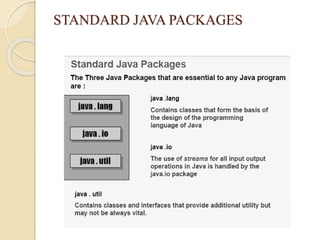
STANDARD JAVA PACKAGES
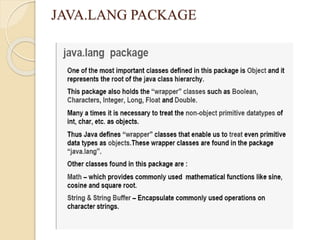
JAVA.LANG PACKAGE
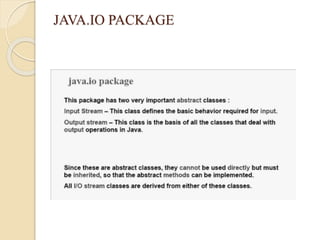
JAVA.IO PACKAGE
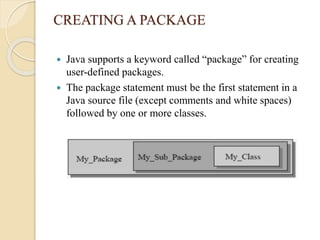
CREATING A PACKAGE
 Java supports a keyword called “package” for creating
user-defined packages.
 The package statement must be the first statement in a
Java source file (except comments and white spaces)
followed by one or more classes.
ADVANTAGES OF JAVA
1.Java is easy to learn.
2.Java is object-oriented.
3.Java is platform-independent.
4.Java is distributed.
5.Java is secure.
6.Java is robust.
7.Java is multithreaded
DISADVANTAGES OF JAVA
 Slow
 Environment limitations
 Applet limitations imposed due to security model
 Uncertain status of security
 Programming language limitations
 Platform limitations
 General stability concerns
CONCLUSIONS
 Java offers the real possibility that most programs can
be written in a type-safe language.
 However, for Java to be broadly useful, it needs to have
more expressive power than it does at present.
REFERENCES
 www.google.com
 www.wikipedia.com
 www.oeclib.in
Thanks

Java ppt

  • 1.
    www.oeclib.in Submitted By: Odisha ElectronicsControl Library Seminar On Java
  • 2.
    Content  INTRODUCTION OFJAVA  KEY FEATURES OF JAVA  FEATURES OF PACKAGES  STANDARD JAVA PACKAGES  JAVA.LANG PACKAGE  JAVA.IO PACKAGE  CREATING A PACKAGE  ADVANTAGES OF JAVA  DISADVANTAGES OF JAVA  CONCLUSIONS  REFERENCES
  • 3.
    INTRODUCTION OF JAVA Java is a programming language and environment invented by James Gosling and others in 1994.  Java was originaly named Oak and was developed as a part of the Green project at the Sun Company.  Java is an object-oriented programming language with a built-in application programming interface (API) that can handle graphics and user interfaces and that can be used to create applications or applets.
  • 4.
    KEY FEATURES OFJAVA  Plateform Independence  Encapsulation  Dynamic binding  Robust  Distributed  Portable  Performance  Multithreaded  Interpreted & Compiler  Architecture Neutral
  • 5.
    FEATURES OF PACKAGES Package names can be used to identify your classes.  Reusability of code is one of the most important requirements in the software industry.  Reusability saves time, effort and also ensures consistency.  In Java, the codes which can be reused by other programs is put into a “Package”.  A Package is a collection of classes, interfaces and/or other packages.  Packages are essentially a means of organizing classes together as groups.
  • 6.
  • 7.
  • 8.
  • 9.
    CREATING A PACKAGE Java supports a keyword called “package” for creating user-defined packages.  The package statement must be the first statement in a Java source file (except comments and white spaces) followed by one or more classes.
  • 10.
    ADVANTAGES OF JAVA 1.Javais easy to learn. 2.Java is object-oriented. 3.Java is platform-independent. 4.Java is distributed. 5.Java is secure. 6.Java is robust. 7.Java is multithreaded
  • 11.
    DISADVANTAGES OF JAVA Slow  Environment limitations  Applet limitations imposed due to security model  Uncertain status of security  Programming language limitations  Platform limitations  General stability concerns
  • 12.
    CONCLUSIONS  Java offersthe real possibility that most programs can be written in a type-safe language.  However, for Java to be broadly useful, it needs to have more expressive power than it does at present.
  • 13.
  • 14.

Editor's Notes