Object	
  Orientated	
  Programming	
  with	
  
                   Java	
  
               Jussi	
  Pohjolainen	
  
   Tampere	
  University	
  of	
  Applied	
  Sciences	
  
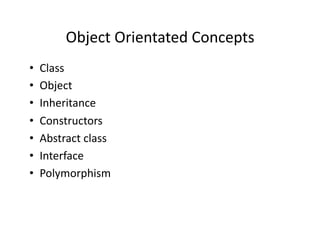
Object	
  Orientated	
  Concepts
                                           	
  
•    Class	
  
•    Object	
  
•    Inheritance	
  
•    Constructors	
  
•    Abstract	
  class	
  
•    Interface	
  
•    Polymorphism	
  
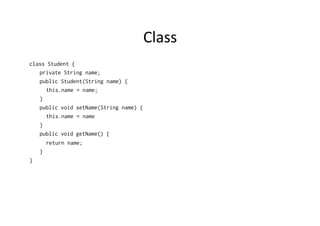
Class
                                            	
  
class Student {
   private String name;
   public Student(String name) {
      this.name = name;
   }
   public void setName(String name) {
      this.name = name
   }
   public void getName() {
      return name;
   }
}
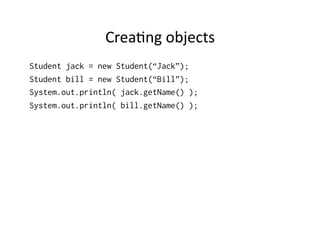
CreaAng	
  objects
                                 	
  
Student jack = new Student(“Jack”);
Student bill = new Student(“Bill”);
System.out.println( jack.getName() );
System.out.println( bill.getName() );
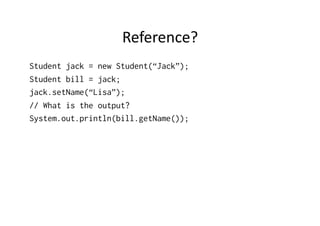
Reference?	
  
Student jack = new Student(“Jack”);
Student bill = jack;
jack.setName(“Lisa”);
// What is the output?
System.out.println(bill.getName());
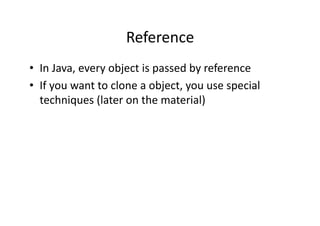
Reference	
  
•  In	
  Java,	
  every	
  object	
  is	
  passed	
  by	
  reference	
  
•  If	
  you	
  want	
  to	
  clone	
  a	
  object,	
  you	
  use	
  special	
  
   techniques	
  (later	
  on	
  the	
  material)	
  
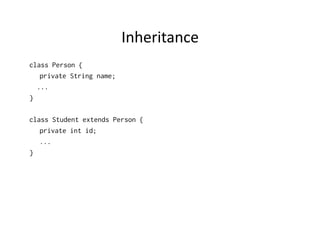
Inheritance	
  
class Person {
   private String name;
  ...
}

class Student extends Person {
   private int id;
   ...
}
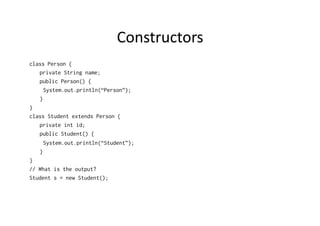
Constructors
                                        	
  
class Person {
   private String name;
   public Person() {
     System.out.println(“Person”);
   }
}
class Student extends Person {
   private int id;
   public Student() {
     System.out.println(“Student”);
   }
}
// What is the output?
Student s = new Student();
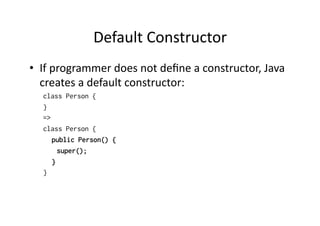
Default	
  Constructor
                                       	
  
•  If	
  programmer	
  does	
  not	
  define	
  a	
  constructor,	
  Java	
  
   creates	
  a	
  default	
  constructor:	
  
    class Person {
    }
    =>
    class Person {
       public Person() {
         super();
       }
    }
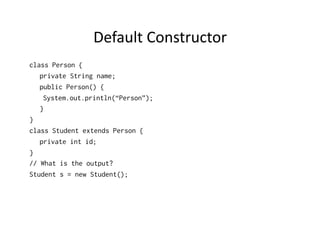
Default	
  Constructor
                                      	
  
class Person {
   private String name;
   public Person() {
    System.out.println(“Person”);
   }
}
class Student extends Person {
   private int id;
}
// What is the output?
Student s = new Student();
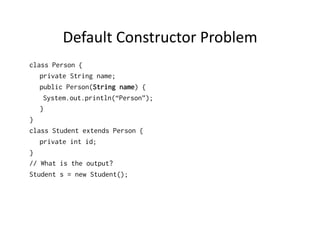
Default	
  Constructor	
  Problem	
  
class Person {
   private String name;
   public Person(String name) {
    System.out.println(“Person”);
   }
}
class Student extends Person {
   private int id;
}
// What is the output?
Student s = new Student();
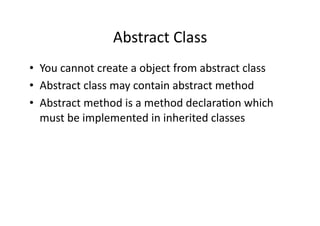
Abstract	
  Class
                                         	
  
•  You	
  cannot	
  create	
  a	
  object	
  from	
  abstract	
  class	
  
•  Abstract	
  class	
  may	
  contain	
  abstract	
  method	
  
•  Abstract	
  method	
  is	
  a	
  method	
  declaraAon	
  which	
  
   must	
  be	
  implemented	
  in	
  inherited	
  classes	
  
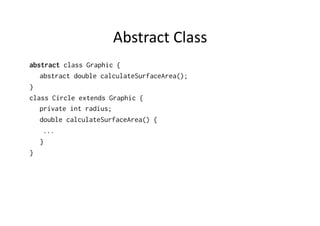
Abstract	
  Class
                                      	
  
abstract class Graphic {
   abstract double calculateSurfaceArea();
}
class Circle extends Graphic {
   private int radius;
   double calculateSurfaceArea() {
    ...
   }
}
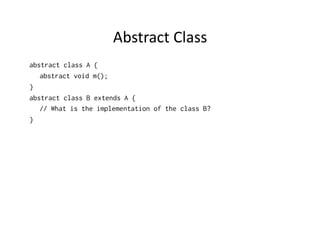
Abstract	
  Class
                                      	
  
abstract class A {
   abstract void m();
}
abstract class B extends A {
   // What is the implementation of the class B?
}
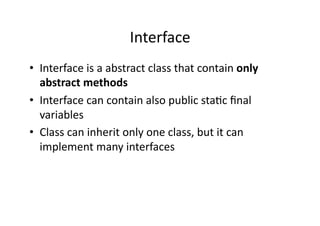
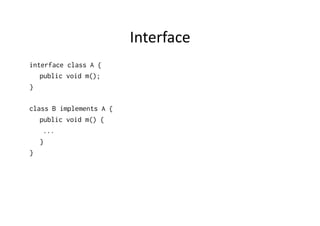
Interface	
  
•  Interface	
  is	
  a	
  abstract	
  class	
  that	
  contain	
  only	
  
   abstract	
  methods	
  
•  Interface	
  can	
  contain	
  also	
  public	
  staAc	
  final	
  
   variables	
  
•  Class	
  can	
  inherit	
  only	
  one	
  class,	
  but	
  it	
  can	
  
   implement	
  many	
  interfaces	
  
Interface	
  
interface class A {
   public void m();
}

class B implements A {
   public void m() {
    ...
   }
}
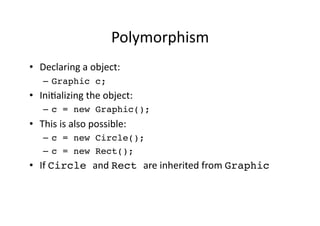
Polymorphism	
  
•  Declaring	
  a	
  object:	
  
     –  Graphic c;!
•  IniAalizing	
  the	
  object:	
  
     –  c = new Graphic();!
•  This	
  is	
  also	
  possible:	
  
     –  c = new Circle();!
     –  c = new Rect();!
•  If	
  Circle and	
  Rect are	
  inherited	
  from	
  Graphic!
Polymorphism	
  
class Polymorphism {
   public static void main(String [] args) {
    // What are the possible objects to be passed?
    method(??)
   }
   public static void method(Graphic c) {
    ...
   }
}
Polymorphism	
  
interface R {
   ...
}
class Polymorphism {
   public static void main(String [] args) {
    // What are the possible objects to be passed?
    method(??)
   }
   public static void method(R r) {
    ...
   }
}
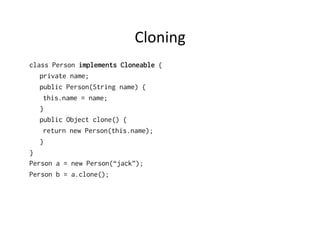
Cloning	
  
class Person implements Cloneable {
   private name;
   public Person(String name) {
    this.name = name;
   }
   public Object clone() {
    return new Person(this.name);
   }
}
Person a = new Person(“jack”);
Person b = a.clone();
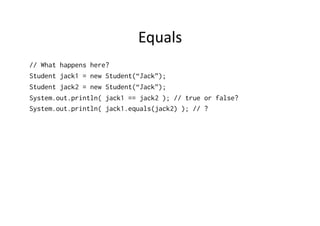
Equals
                                 	
  
// What happens here?
Student jack1 = new Student(“Jack”);
Student jack2 = new Student(“Jack”);
System.out.println( jack1 == jack2 ); // true or false?
System.out.println( jack1.equals(jack2) ); // ?

Java OO Revisited

  • 1.
    Object  Orientated  Programming  with   Java   Jussi  Pohjolainen   Tampere  University  of  Applied  Sciences  
  • 2.
    Object  Orientated  Concepts   •  Class   •  Object   •  Inheritance   •  Constructors   •  Abstract  class   •  Interface   •  Polymorphism  
  • 3.
    Class   class Student { private String name; public Student(String name) { this.name = name; } public void setName(String name) { this.name = name } public void getName() { return name; } }
  • 4.
    CreaAng  objects   Student jack = new Student(“Jack”); Student bill = new Student(“Bill”); System.out.println( jack.getName() ); System.out.println( bill.getName() );
  • 5.
    Reference?   Student jack= new Student(“Jack”); Student bill = jack; jack.setName(“Lisa”); // What is the output? System.out.println(bill.getName());
  • 6.
    Reference   •  In  Java,  every  object  is  passed  by  reference   •  If  you  want  to  clone  a  object,  you  use  special   techniques  (later  on  the  material)  
  • 7.
    Inheritance   class Person{ private String name; ... } class Student extends Person { private int id; ... }
  • 8.
    Constructors   class Person { private String name; public Person() { System.out.println(“Person”); } } class Student extends Person { private int id; public Student() { System.out.println(“Student”); } } // What is the output? Student s = new Student();
  • 9.
    Default  Constructor   •  If  programmer  does  not  define  a  constructor,  Java   creates  a  default  constructor:   class Person { } => class Person { public Person() { super(); } }
  • 10.
    Default  Constructor   class Person { private String name; public Person() { System.out.println(“Person”); } } class Student extends Person { private int id; } // What is the output? Student s = new Student();
  • 11.
    Default  Constructor  Problem   class Person { private String name; public Person(String name) { System.out.println(“Person”); } } class Student extends Person { private int id; } // What is the output? Student s = new Student();
  • 12.
    Abstract  Class   •  You  cannot  create  a  object  from  abstract  class   •  Abstract  class  may  contain  abstract  method   •  Abstract  method  is  a  method  declaraAon  which   must  be  implemented  in  inherited  classes  
  • 13.
    Abstract  Class   abstract class Graphic { abstract double calculateSurfaceArea(); } class Circle extends Graphic { private int radius; double calculateSurfaceArea() { ... } }
  • 14.
    Abstract  Class   abstract class A { abstract void m(); } abstract class B extends A { // What is the implementation of the class B? }
  • 15.
    Interface   •  Interface  is  a  abstract  class  that  contain  only   abstract  methods   •  Interface  can  contain  also  public  staAc  final   variables   •  Class  can  inherit  only  one  class,  but  it  can   implement  many  interfaces  
  • 16.
    Interface   interface classA { public void m(); } class B implements A { public void m() { ... } }
  • 17.
    Polymorphism   •  Declaring  a  object:   –  Graphic c;! •  IniAalizing  the  object:   –  c = new Graphic();! •  This  is  also  possible:   –  c = new Circle();! –  c = new Rect();! •  If  Circle and  Rect are  inherited  from  Graphic!
  • 18.
    Polymorphism   class Polymorphism{ public static void main(String [] args) { // What are the possible objects to be passed? method(??) } public static void method(Graphic c) { ... } }
  • 19.
    Polymorphism   interface R{ ... } class Polymorphism { public static void main(String [] args) { // What are the possible objects to be passed? method(??) } public static void method(R r) { ... } }
  • 20.
    Cloning   class Personimplements Cloneable { private name; public Person(String name) { this.name = name; } public Object clone() { return new Person(this.name); } } Person a = new Person(“jack”); Person b = a.clone();
  • 21.
    Equals   // What happens here? Student jack1 = new Student(“Jack”); Student jack2 = new Student(“Jack”); System.out.println( jack1 == jack2 ); // true or false? System.out.println( jack1.equals(jack2) ); // ?