Liang, Introduction to Java Programming, Ninth Edition, (c) 2013 Pearson Education, Inc. All
rights reserved.
1
Chapter 11 Inheritance and
Polymorphism
Liang, Introduction to Java Programming, Ninth Edition, (c) 2013 Pearson Education, Inc. All
rights reserved.
2
Motivations
Suppose you will define classes to model circles,
rectangles, and triangles. These classes have many
common features. What is the best way to design
these classes so to avoid redundancy? The answer
is to use inheritance.
Liang, Introduction to Java Programming, Ninth Edition, (c) 2013 Pearson Education, Inc. All
rights reserved.
3
Objectives
 To define a subclass from a superclass through inheritance (§11.2).
 To invoke the superclass’s constructors and methods using the super keyword
(§11.3).
 To override instance methods in the subclass (§11.4).
 To distinguish differences between overriding and overloading (§11.5).
 To explore the toString() method in the Object class (§11.6).
 To discover polymorphism and dynamic binding (§§11.7–11.8).
 To describe casting and explain why explicit downcasting is necessary (§11.9).
 To explore the equals method in the Object class (§11.10).
 To store, retrieve, and manipulate objects in an ArrayList (§11.11).
 To implement a Stack class using ArrayList (§11.12).
 To enable data and methods in a superclass accessible from subclasses using the
protected visibility modifier (§11.13).
 To prevent class extending and method overriding using the final modifier
(§11.14).
Liang, Introduction to Java Programming, Ninth Edition, (c) 2013 Pearson Education, Inc. All
rights reserved.
4
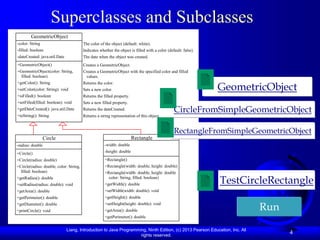
Superclasses and Subclasses
GeometricObject
TestCircleRectangle
Run
GeometricObject
-color: String
-filled: boolean
-dateCreated: java.util.Date
+GeometricObject()
+GeometricObject(color: String,
filled: boolean)
+getColor(): String
+setColor(color: String): void
+isFilled(): boolean
+setFilled(filled: boolean): void
+getDateCreated(): java.util.Date
+toString(): String
The color of the object (default: white).
Indicates whether the object is filled with a color (default: false).
The date when the object was created.
Creates a GeometricObject.
Creates a GeometricObject with the specified color and filled
values.
Returns the color.
Sets a new color.
Returns the filled property.
Sets a new filled property.
Returns the dateCreated.
Returns a string representation of this object.
Circle
-radius: double
+Circle()
+Circle(radius: double)
+Circle(radius: double, color: String,
filled: boolean)
+getRadius(): double
+setRadius(radius: double): void
+getArea(): double
+getPerimeter(): double
+getDiameter(): double
+printCircle(): void
Rectangle
-width: double
-height: double
+Rectangle()
+Rectangle(width: double, height: double)
+Rectangle(width: double, height: double
color: String, filled: boolean)
+getWidth(): double
+setWidth(width: double): void
+getHeight(): double
+setHeight(height: double): void
+getArea(): double
+getPerimeter(): double
CircleFromSimpleGeometricObject
RectangleFromSimpleGeometricObject
Liang, Introduction to Java Programming, Ninth Edition, (c) 2013 Pearson Education, Inc. All
rights reserved.
5
Are superclass’s Constructor
Inherited?
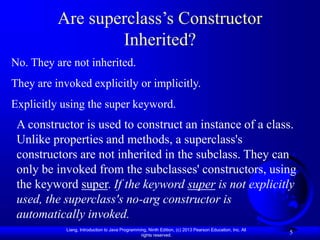
No. They are not inherited.
They are invoked explicitly or implicitly.
Explicitly using the super keyword.
A constructor is used to construct an instance of a class.
Unlike properties and methods, a superclass's
constructors are not inherited in the subclass. They can
only be invoked from the subclasses' constructors, using
the keyword super. If the keyword super is not explicitly
used, the superclass's no-arg constructor is
automatically invoked.
Liang, Introduction to Java Programming, Ninth Edition, (c) 2013 Pearson Education, Inc. All
rights reserved.
6
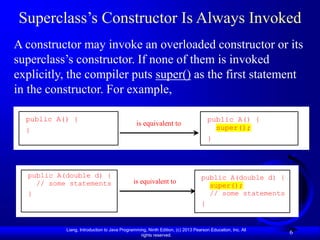
Superclass’s Constructor Is Always Invoked
A constructor may invoke an overloaded constructor or its
superclass’s constructor. If none of them is invoked
explicitly, the compiler puts super() as the first statement
in the constructor. For example,
public A(double d) {
// some statements
}
is equivalent to
public A(double d) {
super();
// some statements
}
public A() {
}
is equivalent to
public A() {
super();
}
Liang, Introduction to Java Programming, Ninth Edition, (c) 2013 Pearson Education, Inc. All
rights reserved.
7
Using the Keyword super
 To call a superclass constructor
 To call a superclass method
The keyword super refers to the superclass
of the class in which super appears. This
keyword can be used in two ways:
Liang, Introduction to Java Programming, Ninth Edition, (c) 2013 Pearson Education, Inc. All
rights reserved.
8
CAUTION
You must use the keyword super to call the
superclass constructor. Invoking a
superclass constructor’s name in a subclass
causes a syntax error. Java requires that the
statement that uses the keyword super
appear first in the constructor.
Liang, Introduction to Java Programming, Ninth Edition, (c) 2013 Pearson Education, Inc. All
rights reserved.
9
Constructor Chaining
public class Faculty extends Employee {
public static void main(String[] args) {
new Faculty();
}
public Faculty() {
System.out.println("(4) Faculty's no-arg constructor is invoked");
}
}
class Employee extends Person {
public Employee() {
this("(2) Invoke Employee’s overloaded constructor");
System.out.println("(3) Employee's no-arg constructor is invoked");
}
public Employee(String s) {
System.out.println(s);
}
}
class Person {
public Person() {
System.out.println("(1) Person's no-arg constructor is invoked");
}
}
Constructing an instance of a class invokes all the superclasses’ constructors
along the inheritance chain. This is called constructor chaining.
Liang, Introduction to Java Programming, Ninth Edition, (c) 2013 Pearson Education, Inc. All
rights reserved.
10
Trace Execution
public class Faculty extends Employee {
public static void main(String[] args) {
new Faculty();
}
public Faculty() {
System.out.println("(4) Faculty's no-arg constructor is invoked");
}
}
class Employee extends Person {
public Employee() {
this("(2) Invoke Employee’s overloaded constructor");
System.out.println("(3) Employee's no-arg constructor is invoked");
}
public Employee(String s) {
System.out.println(s);
}
}
class Person {
public Person() {
System.out.println("(1) Person's no-arg constructor is invoked");
}
}
1. Start from the
main method
animation
Liang, Introduction to Java Programming, Ninth Edition, (c) 2013 Pearson Education, Inc. All
rights reserved.
11
Trace Execution
public class Faculty extends Employee {
public static void main(String[] args) {
new Faculty();
}
public Faculty() {
System.out.println("(4) Faculty's no-arg constructor is invoked");
}
}
class Employee extends Person {
public Employee() {
this("(2) Invoke Employee’s overloaded constructor");
System.out.println("(3) Employee's no-arg constructor is invoked");
}
public Employee(String s) {
System.out.println(s);
}
}
class Person {
public Person() {
System.out.println("(1) Person's no-arg constructor is invoked");
}
}
2. Invoke Faculty
constructor
animation
Liang, Introduction to Java Programming, Ninth Edition, (c) 2013 Pearson Education, Inc. All
rights reserved.
12
Trace Execution
public class Faculty extends Employee {
public static void main(String[] args) {
new Faculty();
}
public Faculty() {
System.out.println("(4) Faculty's no-arg constructor is invoked");
}
}
class Employee extends Person {
public Employee() {
this("(2) Invoke Employee’s overloaded constructor");
System.out.println("(3) Employee's no-arg constructor is invoked");
}
public Employee(String s) {
System.out.println(s);
}
}
class Person {
public Person() {
System.out.println("(1) Person's no-arg constructor is invoked");
}
}
3. Invoke Employee’s no-
arg constructor
animation
Liang, Introduction to Java Programming, Ninth Edition, (c) 2013 Pearson Education, Inc. All
rights reserved.
13
Trace Execution
public class Faculty extends Employee {
public static void main(String[] args) {
new Faculty();
}
public Faculty() {
System.out.println("(4) Faculty's no-arg constructor is invoked");
}
}
class Employee extends Person {
public Employee() {
this("(2) Invoke Employee’s overloaded constructor");
System.out.println("(3) Employee's no-arg constructor is invoked");
}
public Employee(String s) {
System.out.println(s);
}
}
class Person {
public Person() {
System.out.println("(1) Person's no-arg constructor is invoked");
}
}
4. Invoke Employee(String)
constructor
animation
Liang, Introduction to Java Programming, Ninth Edition, (c) 2013 Pearson Education, Inc. All
rights reserved.
14
Trace Execution
public class Faculty extends Employee {
public static void main(String[] args) {
new Faculty();
}
public Faculty() {
System.out.println("(4) Faculty's no-arg constructor is invoked");
}
}
class Employee extends Person {
public Employee() {
this("(2) Invoke Employee’s overloaded constructor");
System.out.println("(3) Employee's no-arg constructor is invoked");
}
public Employee(String s) {
System.out.println(s);
}
}
class Person {
public Person() {
System.out.println("(1) Person's no-arg constructor is invoked");
}
}
5. Invoke Person() constructor
animation
Liang, Introduction to Java Programming, Ninth Edition, (c) 2013 Pearson Education, Inc. All
rights reserved.
15
Trace Execution
public class Faculty extends Employee {
public static void main(String[] args) {
new Faculty();
}
public Faculty() {
System.out.println("(4) Faculty's no-arg constructor is invoked");
}
}
class Employee extends Person {
public Employee() {
this("(2) Invoke Employee’s overloaded constructor");
System.out.println("(3) Employee's no-arg constructor is invoked");
}
public Employee(String s) {
System.out.println(s);
}
}
class Person {
public Person() {
System.out.println("(1) Person's no-arg constructor is invoked");
}
}
6. Execute println
animation
Liang, Introduction to Java Programming, Ninth Edition, (c) 2013 Pearson Education, Inc. All
rights reserved.
16
Trace Execution
public class Faculty extends Employee {
public static void main(String[] args) {
new Faculty();
}
public Faculty() {
System.out.println("(4) Faculty's no-arg constructor is invoked");
}
}
class Employee extends Person {
public Employee() {
this("(2) Invoke Employee’s overloaded constructor");
System.out.println("(3) Employee's no-arg constructor is invoked");
}
public Employee(String s) {
System.out.println(s);
}
}
class Person {
public Person() {
System.out.println("(1) Person's no-arg constructor is invoked");
}
}
7. Execute println
animation
Liang, Introduction to Java Programming, Ninth Edition, (c) 2013 Pearson Education, Inc. All
rights reserved.
17
Trace Execution
public class Faculty extends Employee {
public static void main(String[] args) {
new Faculty();
}
public Faculty() {
System.out.println("(4) Faculty's no-arg constructor is invoked");
}
}
class Employee extends Person {
public Employee() {
this("(2) Invoke Employee’s overloaded constructor");
System.out.println("(3) Employee's no-arg constructor is invoked");
}
public Employee(String s) {
System.out.println(s);
}
}
class Person {
public Person() {
System.out.println("(1) Person's no-arg constructor is invoked");
}
}
8. Execute println
animation
Liang, Introduction to Java Programming, Ninth Edition, (c) 2013 Pearson Education, Inc. All
rights reserved.
18
Trace Execution
public class Faculty extends Employee {
public static void main(String[] args) {
new Faculty();
}
public Faculty() {
System.out.println("(4) Faculty's no-arg constructor is invoked");
}
}
class Employee extends Person {
public Employee() {
this("(2) Invoke Employee’s overloaded constructor");
System.out.println("(3) Employee's no-arg constructor is invoked");
}
public Employee(String s) {
System.out.println(s);
}
}
class Person {
public Person() {
System.out.println("(1) Person's no-arg constructor is invoked");
}
}
9. Execute println
animation
Liang, Introduction to Java Programming, Ninth Edition, (c) 2013 Pearson Education, Inc. All
rights reserved.
19
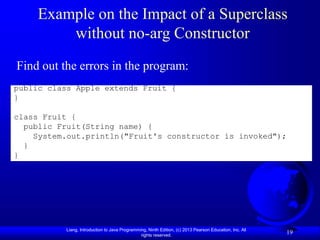
Example on the Impact of a Superclass
without no-arg Constructor
public class Apple extends Fruit {
}
class Fruit {
public Fruit(String name) {
System.out.println("Fruit's constructor is invoked");
}
}
Find out the errors in the program:
Liang, Introduction to Java Programming, Ninth Edition, (c) 2013 Pearson Education, Inc. All
rights reserved.
20
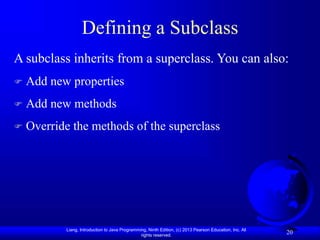
Defining a Subclass
A subclass inherits from a superclass. You can also:
 Add new properties
 Add new methods
 Override the methods of the superclass
Liang, Introduction to Java Programming, Ninth Edition, (c) 2013 Pearson Education, Inc. All
rights reserved.
21
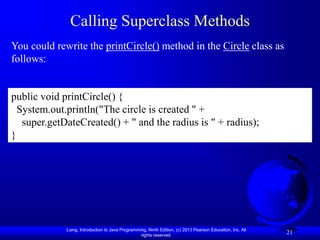
Calling Superclass Methods
You could rewrite the printCircle() method in the Circle class as
follows:
public void printCircle() {
System.out.println("The circle is created " +
super.getDateCreated() + " and the radius is " + radius);
}
Liang, Introduction to Java Programming, Ninth Edition, (c) 2013 Pearson Education, Inc. All
rights reserved.
22
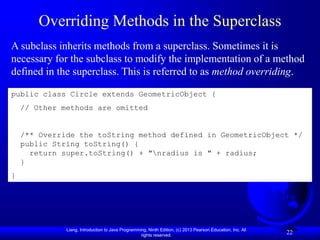
Overriding Methods in the Superclass
A subclass inherits methods from a superclass. Sometimes it is
necessary for the subclass to modify the implementation of a method
defined in the superclass. This is referred to as method overriding.
public class Circle extends GeometricObject {
// Other methods are omitted
/** Override the toString method defined in GeometricObject */
public String toString() {
return super.toString() + "nradius is " + radius;
}
}
Liang, Introduction to Java Programming, Ninth Edition, (c) 2013 Pearson Education, Inc. All
rights reserved.
23
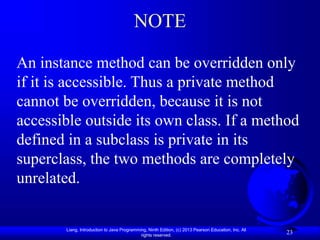
NOTE
An instance method can be overridden only
if it is accessible. Thus a private method
cannot be overridden, because it is not
accessible outside its own class. If a method
defined in a subclass is private in its
superclass, the two methods are completely
unrelated.
Liang, Introduction to Java Programming, Ninth Edition, (c) 2013 Pearson Education, Inc. All
rights reserved.
24
NOTE
Like an instance method, a static method
can be inherited. However, a static method
cannot be overridden. If a static method
defined in the superclass is redefined in a
subclass, the method defined in the
superclass is hidden.
Liang, Introduction to Java Programming, Ninth Edition, (c) 2013 Pearson Education, Inc. All
rights reserved.
25
Overriding vs. Overloading
public class Test {
public static void main(String[] args) {
A a = new A();
a.p(10);
a.p(10.0);
}
}
class B {
public void p(double i) {
System.out.println(i * 2);
}
}
class A extends B {
// This method overrides the method in B
public void p(double i) {
System.out.println(i);
}
}
public class Test {
public static void main(String[] args) {
A a = new A();
a.p(10);
a.p(10.0);
}
}
class B {
public void p(double i) {
System.out.println(i * 2);
}
}
class A extends B {
// This method overloads the method in B
public void p(int i) {
System.out.println(i);
}
}
Liang, Introduction to Java Programming, Ninth Edition, (c) 2013 Pearson Education, Inc. All
rights reserved.
26
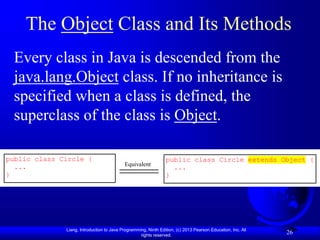
The Object Class and Its Methods
Every class in Java is descended from the
java.lang.Object class. If no inheritance is
specified when a class is defined, the
superclass of the class is Object.
public class Circle {
...
}
Equivalent
public class Circle extends Object {
...
}
Liang, Introduction to Java Programming, Ninth Edition, (c) 2013 Pearson Education, Inc. All
rights reserved.
27
The toString() method in Object
The toString() method returns a string representation of the
object. The default implementation returns a string consisting
of a class name of which the object is an instance, the at sign
(@), and a number representing this object.
Loan loan = new Loan();
System.out.println(loan.toString());
The code displays something like Loan@15037e5 . This
message is not very helpful or informative. Usually you should
override the toString method so that it returns a digestible string
representation of the object.
Liang, Introduction to Java Programming, Ninth Edition, (c) 2013 Pearson Education, Inc. All
rights reserved.
28
Polymorphism, Dynamic Binding and Generic Programming
public class PolymorphismDemo {
public static void main(String[] args) {
m(new GraduateStudent());
m(new Student());
m(new Person());
m(new Object());
}
public static void m(Object x) {
System.out.println(x.toString());
}
}
class GraduateStudent extends Student {
}
class Student extends Person {
public String toString() {
return "Student";
}
}
class Person extends Object {
public String toString() {
return "Person";
}
}
Method m takes a parameter
of the Object type. You can
invoke it with any object.
An object of a subtype can be used wherever its
supertype value is required. This feature is
known as polymorphism.
When the method m(Object x) is executed, the
argument x’s toString method is invoked. x
may be an instance of GraduateStudent,
Student, Person, or Object. Classes
GraduateStudent, Student, Person, and Object
have their own implementation of the toString
method. Which implementation is used will be
determined dynamically by the Java Virtual
Machine at runtime. This capability is known
as dynamic binding.
DynamicBindingDemo
Run
Liang, Introduction to Java Programming, Ninth Edition, (c) 2013 Pearson Education, Inc. All
rights reserved.
29
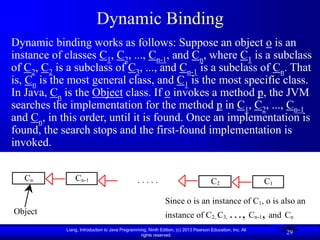
Dynamic Binding
Dynamic binding works as follows: Suppose an object o is an
instance of classes C1, C2, ..., Cn-1, and Cn, where C1 is a subclass
of C2, C2 is a subclass of C3, ..., and Cn-1 is a subclass of Cn. That
is, Cn is the most general class, and C1 is the most specific class.
In Java, Cn is the Object class. If o invokes a method p, the JVM
searches the implementation for the method p in C1, C2, ..., Cn-1
and Cn, in this order, until it is found. Once an implementation is
found, the search stops and the first-found implementation is
invoked.
Cn Cn-1 . . . . . C2 C1
Object
Since o is an instance of C1, o is also an
instance of C2, C3, …, Cn-1, and Cn
Liang, Introduction to Java Programming, Ninth Edition, (c) 2013 Pearson Education, Inc. All
rights reserved.
30
Method Matching vs. Binding
Matching a method signature and binding a method
implementation are two issues. The compiler finds a
matching method according to parameter type, number
of parameters, and order of the parameters at
compilation time. A method may be implemented in
several subclasses. The Java Virtual Machine
dynamically binds the implementation of the method at
runtime.
Liang, Introduction to Java Programming, Ninth Edition, (c) 2013 Pearson Education, Inc. All
rights reserved.
31
Generic Programming
public class PolymorphismDemo {
public static void main(String[] args) {
m(new GraduateStudent());
m(new Student());
m(new Person());
m(new Object());
}
public static void m(Object x) {
System.out.println(x.toString());
}
}
class GraduateStudent extends Student {
}
class Student extends Person {
public String toString() {
return "Student";
}
}
class Person extends Object {
public String toString() {
return "Person";
}
}
Polymorphism allows methods to be used
generically for a wide range of object
arguments. This is known as generic
programming. If a method’s parameter
type is a superclass (e.g., Object), you
may pass an object to this method of any
of the parameter’s subclasses (e.g.,
Student or String). When an object (e.g., a
Student object or a String object) is used
in the method, the particular
implementation of the method of the
object that is invoked (e.g., toString) is
determined dynamically.
Liang, Introduction to Java Programming, Ninth Edition, (c) 2013 Pearson Education, Inc. All
rights reserved.
32
Casting Objects
You have already used the casting operator to convert variables of
one primitive type to another. Casting can also be used to convert an
object of one class type to another within an inheritance hierarchy. In
the preceding section, the statement
m(new Student());
assigns the object new Student() to a parameter of the Object type.
This statement is equivalent to:
Object o = new Student(); // Implicit casting
m(o);
The statement Object o = new Student(), known as
implicit casting, is legal because an instance of
Student is automatically an instance of Object.
Liang, Introduction to Java Programming, Ninth Edition, (c) 2013 Pearson Education, Inc. All
rights reserved.
33
Why Casting Is Necessary?
Suppose you want to assign the object reference o to a variable of the
Student type using the following statement:
Student b = o;
A compile error would occur. Why does the statement Object o =
new Student() work and the statement Student b = o doesn’t? This is
because a Student object is always an instance of Object, but an
Object is not necessarily an instance of Student. Even though you can
see that o is really a Student object, the compiler is not so clever to
know it. To tell the compiler that o is a Student object, use an explicit
casting. The syntax is similar to the one used for casting among
primitive data types. Enclose the target object type in parentheses and
place it before the object to be cast, as follows:
Student b = (Student)o; // Explicit casting
Liang, Introduction to Java Programming, Ninth Edition, (c) 2013 Pearson Education, Inc. All
rights reserved.
34
Casting from
Superclass to Subclass
Explicit casting must be used when casting an
object from a superclass to a subclass. This type
of casting may not always succeed.
Apple x = (Apple)fruit;
Orange x = (Orange)fruit;
Liang, Introduction to Java Programming, Ninth Edition, (c) 2013 Pearson Education, Inc. All
rights reserved.
35
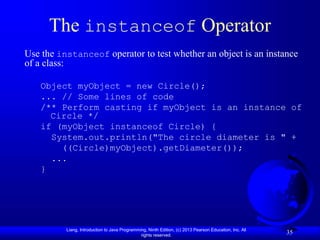
The instanceof Operator
Use the instanceof operator to test whether an object is an instance
of a class:
Object myObject = new Circle();
... // Some lines of code
/** Perform casting if myObject is an instance of
Circle */
if (myObject instanceof Circle) {
System.out.println("The circle diameter is " +
((Circle)myObject).getDiameter());
...
}
Liang, Introduction to Java Programming, Ninth Edition, (c) 2013 Pearson Education, Inc. All
rights reserved.
36
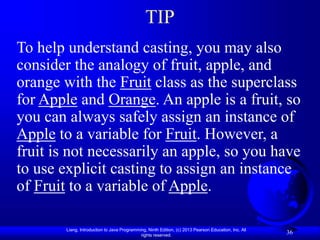
TIP
To help understand casting, you may also
consider the analogy of fruit, apple, and
orange with the Fruit class as the superclass
for Apple and Orange. An apple is a fruit, so
you can always safely assign an instance of
Apple to a variable for Fruit. However, a
fruit is not necessarily an apple, so you have
to use explicit casting to assign an instance
of Fruit to a variable of Apple.
Liang, Introduction to Java Programming, Ninth Edition, (c) 2013 Pearson Education, Inc. All
rights reserved.
37
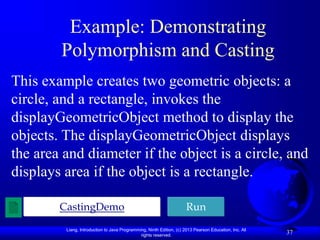
Example: Demonstrating
Polymorphism and Casting
This example creates two geometric objects: a
circle, and a rectangle, invokes the
displayGeometricObject method to display the
objects. The displayGeometricObject displays
the area and diameter if the object is a circle, and
displays area if the object is a rectangle.
CastingDemo Run
Liang, Introduction to Java Programming, Ninth Edition, (c) 2013 Pearson Education, Inc. All
rights reserved.
38
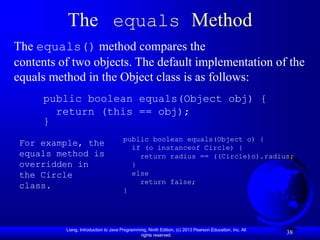
The equals Method
The equals() method compares the
contents of two objects. The default implementation of the
equals method in the Object class is as follows:
public boolean equals(Object obj) {
return (this == obj);
}
For example, the
equals method is
overridden in
the Circle
class.
public boolean equals(Object o) {
if (o instanceof Circle) {
return radius == ((Circle)o).radius;
}
else
return false;
}
Liang, Introduction to Java Programming, Ninth Edition, (c) 2013 Pearson Education, Inc. All
rights reserved.
39
NOTE
The == comparison operator is used for
comparing two primitive data type values or for
determining whether two objects have the same
references. The equals method is intended to
test whether two objects have the same
contents, provided that the method is modified
in the defining class of the objects. The ==
operator is stronger than the equals method, in
that the == operator checks whether the two
reference variables refer to the same object.
Liang, Introduction to Java Programming, Ninth Edition, (c) 2013 Pearson Education, Inc. All
rights reserved.
40
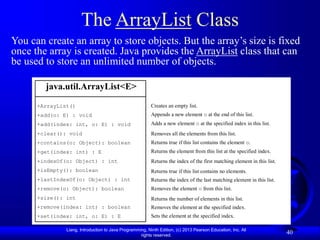
The ArrayList Class
You can create an array to store objects. But the array’s size is fixed
once the array is created. Java provides the ArrayList class that can
be used to store an unlimited number of objects.
java.util.ArrayList<E>
+ArrayList()
+add(o: E) : void
+add(index: int, o: E) : void
+clear(): void
+contains(o: Object): boolean
+get(index: int) : E
+indexOf(o: Object) : int
+isEmpty(): boolean
+lastIndexOf(o: Object) : int
+remove(o: Object): boolean
+size(): int
+remove(index: int) : boolean
+set(index: int, o: E) : E
Creates an empty list.
Appends a new element o at the end of this list.
Adds a new element o at the specified index in this list.
Removes all the elements from this list.
Returns true if this list contains the element o.
Returns the element from this list at the specified index.
Returns the index of the first matching element in this list.
Returns true if this list contains no elements.
Returns the index of the last matching element in this list.
Removes the element o from this list.
Returns the number of elements in this list.
Removes the element at the specified index.
Sets the element at the specified index.
Liang, Introduction to Java Programming, Ninth Edition, (c) 2013 Pearson Education, Inc. All
rights reserved.
41
Generic Type
ArrayList is known as a generic class with a generic
type E. You can specify a concrete type to replace E
when creating an ArrayList. For example, the
following statement creates an ArrayList and assigns
its reference to variable cities. This ArrayList object
can be used to store strings.
TestArrayList Run
ArrayList<String> cities = new ArrayList<String>();
Liang, Introduction to Java Programming, Ninth Edition, (c) 2013 Pearson Education, Inc. All
rights reserved.
42
Differences and Similarities between
Arrays and ArrayList
Operation Array ArrayList
Creating an array/ArrayList String[] a = new String[10] ArrayList<String> list = new ArrayList<>();
Accessing an element a[index] list.get(index);
Updating an element a[index] = "London"; list.set(index, "London");
Returning size a.length list.size();
Adding a new element list.add("London");
Inserting a new element list.add(index, "London");
Removing an element list.remove(index);
Removing an element list.remove(Object);
Removing all elements list.clear();
DistinctNumbers Run
Liang, Introduction to Java Programming, Ninth Edition, (c) 2013 Pearson Education, Inc. All
rights reserved.
43
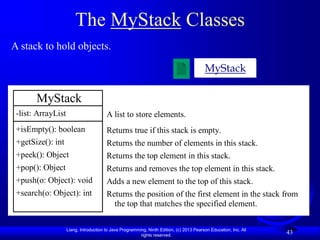
The MyStack Classes
A stack to hold objects.
MyStack
MyStack
-list: ArrayList
+isEmpty(): boolean
+getSize(): int
+peek(): Object
+pop(): Object
+push(o: Object): void
+search(o: Object): int
Returns true if this stack is empty.
Returns the number of elements in this stack.
Returns the top element in this stack.
Returns and removes the top element in this stack.
Adds a new element to the top of this stack.
Returns the position of the first element in the stack from
the top that matches the specified element.
A list to store elements.
Liang, Introduction to Java Programming, Ninth Edition, (c) 2013 Pearson Education, Inc. All
rights reserved.
44
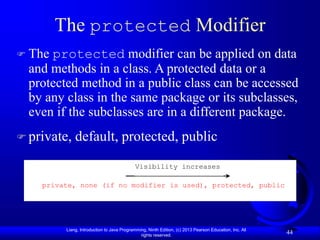
The protected Modifier
 The protected modifier can be applied on data
and methods in a class. A protected data or a
protected method in a public class can be accessed
by any class in the same package or its subclasses,
even if the subclasses are in a different package.
 private, default, protected, public
private, none (if no modifier is used), protected, public
Visibility increases
Liang, Introduction to Java Programming, Ninth Edition, (c) 2013 Pearson Education, Inc. All
rights reserved.
45
Accessibility Summary
Modifier
on members
in a class
Accessed
from the
same class
Accessed
from the
same package
Accessed
from a
subclass
Accessed
from a different
package
public
protected -
default - -
private - - -
Liang, Introduction to Java Programming, Ninth Edition, (c) 2013 Pearson Education, Inc. All
rights reserved.
46
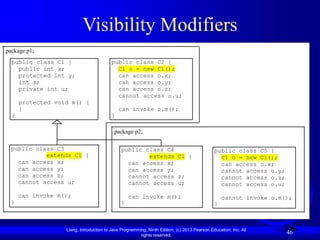
Visibility Modifiers
public class C1 {
public int x;
protected int y;
int z;
private int u;
protected void m() {
}
}
public class C2 {
C1 o = new C1();
can access o.x;
can access o.y;
can access o.z;
cannot access o.u;
can invoke o.m();
}
public class C3
extends C1 {
can access x;
can access y;
can access z;
cannot access u;
can invoke m();
}
package p1;
public class C4
extends C1 {
can access x;
can access y;
cannot access z;
cannot access u;
can invoke m();
}
package p2;
public class C5 {
C1 o = new C1();
can access o.x;
cannot access o.y;
cannot access o.z;
cannot access o.u;
cannot invoke o.m();
}
Liang, Introduction to Java Programming, Ninth Edition, (c) 2013 Pearson Education, Inc. All
rights reserved.
47
A Subclass Cannot Weaken the Accessibility
A subclass may override a protected
method in its superclass and change its
visibility to public. However, a subclass
cannot weaken the accessibility of a
method defined in the superclass. For
example, if a method is defined as public
in the superclass, it must be defined as
public in the subclass.
Liang, Introduction to Java Programming, Ninth Edition, (c) 2013 Pearson Education, Inc. All
rights reserved.
48
NOTE
The modifiers are used on classes and
class members (data and methods), except
that the final modifier can also be used on
local variables in a method. A final local
variable is a constant inside a method.
Liang, Introduction to Java Programming, Ninth Edition, (c) 2013 Pearson Education, Inc. All
rights reserved.
49
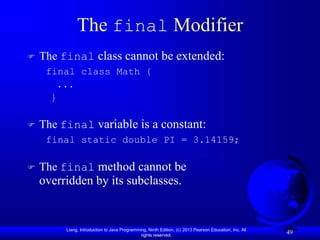
The final Modifier
 The final class cannot be extended:
final class Math {
...
}
 The final variable is a constant:
final static double PI = 3.14159;
 The final method cannot be
overridden by its subclasses.

11slide.ppt

  • 1.
    Liang, Introduction toJava Programming, Ninth Edition, (c) 2013 Pearson Education, Inc. All rights reserved. 1 Chapter 11 Inheritance and Polymorphism
  • 2.
    Liang, Introduction toJava Programming, Ninth Edition, (c) 2013 Pearson Education, Inc. All rights reserved. 2 Motivations Suppose you will define classes to model circles, rectangles, and triangles. These classes have many common features. What is the best way to design these classes so to avoid redundancy? The answer is to use inheritance.
  • 3.
    Liang, Introduction toJava Programming, Ninth Edition, (c) 2013 Pearson Education, Inc. All rights reserved. 3 Objectives  To define a subclass from a superclass through inheritance (§11.2).  To invoke the superclass’s constructors and methods using the super keyword (§11.3).  To override instance methods in the subclass (§11.4).  To distinguish differences between overriding and overloading (§11.5).  To explore the toString() method in the Object class (§11.6).  To discover polymorphism and dynamic binding (§§11.7–11.8).  To describe casting and explain why explicit downcasting is necessary (§11.9).  To explore the equals method in the Object class (§11.10).  To store, retrieve, and manipulate objects in an ArrayList (§11.11).  To implement a Stack class using ArrayList (§11.12).  To enable data and methods in a superclass accessible from subclasses using the protected visibility modifier (§11.13).  To prevent class extending and method overriding using the final modifier (§11.14).
  • 4.
    Liang, Introduction toJava Programming, Ninth Edition, (c) 2013 Pearson Education, Inc. All rights reserved. 4 Superclasses and Subclasses GeometricObject TestCircleRectangle Run GeometricObject -color: String -filled: boolean -dateCreated: java.util.Date +GeometricObject() +GeometricObject(color: String, filled: boolean) +getColor(): String +setColor(color: String): void +isFilled(): boolean +setFilled(filled: boolean): void +getDateCreated(): java.util.Date +toString(): String The color of the object (default: white). Indicates whether the object is filled with a color (default: false). The date when the object was created. Creates a GeometricObject. Creates a GeometricObject with the specified color and filled values. Returns the color. Sets a new color. Returns the filled property. Sets a new filled property. Returns the dateCreated. Returns a string representation of this object. Circle -radius: double +Circle() +Circle(radius: double) +Circle(radius: double, color: String, filled: boolean) +getRadius(): double +setRadius(radius: double): void +getArea(): double +getPerimeter(): double +getDiameter(): double +printCircle(): void Rectangle -width: double -height: double +Rectangle() +Rectangle(width: double, height: double) +Rectangle(width: double, height: double color: String, filled: boolean) +getWidth(): double +setWidth(width: double): void +getHeight(): double +setHeight(height: double): void +getArea(): double +getPerimeter(): double CircleFromSimpleGeometricObject RectangleFromSimpleGeometricObject
  • 5.
    Liang, Introduction toJava Programming, Ninth Edition, (c) 2013 Pearson Education, Inc. All rights reserved. 5 Are superclass’s Constructor Inherited? No. They are not inherited. They are invoked explicitly or implicitly. Explicitly using the super keyword. A constructor is used to construct an instance of a class. Unlike properties and methods, a superclass's constructors are not inherited in the subclass. They can only be invoked from the subclasses' constructors, using the keyword super. If the keyword super is not explicitly used, the superclass's no-arg constructor is automatically invoked.
  • 6.
    Liang, Introduction toJava Programming, Ninth Edition, (c) 2013 Pearson Education, Inc. All rights reserved. 6 Superclass’s Constructor Is Always Invoked A constructor may invoke an overloaded constructor or its superclass’s constructor. If none of them is invoked explicitly, the compiler puts super() as the first statement in the constructor. For example, public A(double d) { // some statements } is equivalent to public A(double d) { super(); // some statements } public A() { } is equivalent to public A() { super(); }
  • 7.
    Liang, Introduction toJava Programming, Ninth Edition, (c) 2013 Pearson Education, Inc. All rights reserved. 7 Using the Keyword super  To call a superclass constructor  To call a superclass method The keyword super refers to the superclass of the class in which super appears. This keyword can be used in two ways:
  • 8.
    Liang, Introduction toJava Programming, Ninth Edition, (c) 2013 Pearson Education, Inc. All rights reserved. 8 CAUTION You must use the keyword super to call the superclass constructor. Invoking a superclass constructor’s name in a subclass causes a syntax error. Java requires that the statement that uses the keyword super appear first in the constructor.
  • 9.
    Liang, Introduction toJava Programming, Ninth Edition, (c) 2013 Pearson Education, Inc. All rights reserved. 9 Constructor Chaining public class Faculty extends Employee { public static void main(String[] args) { new Faculty(); } public Faculty() { System.out.println("(4) Faculty's no-arg constructor is invoked"); } } class Employee extends Person { public Employee() { this("(2) Invoke Employee’s overloaded constructor"); System.out.println("(3) Employee's no-arg constructor is invoked"); } public Employee(String s) { System.out.println(s); } } class Person { public Person() { System.out.println("(1) Person's no-arg constructor is invoked"); } } Constructing an instance of a class invokes all the superclasses’ constructors along the inheritance chain. This is called constructor chaining.
  • 10.
    Liang, Introduction toJava Programming, Ninth Edition, (c) 2013 Pearson Education, Inc. All rights reserved. 10 Trace Execution public class Faculty extends Employee { public static void main(String[] args) { new Faculty(); } public Faculty() { System.out.println("(4) Faculty's no-arg constructor is invoked"); } } class Employee extends Person { public Employee() { this("(2) Invoke Employee’s overloaded constructor"); System.out.println("(3) Employee's no-arg constructor is invoked"); } public Employee(String s) { System.out.println(s); } } class Person { public Person() { System.out.println("(1) Person's no-arg constructor is invoked"); } } 1. Start from the main method animation
  • 11.
    Liang, Introduction toJava Programming, Ninth Edition, (c) 2013 Pearson Education, Inc. All rights reserved. 11 Trace Execution public class Faculty extends Employee { public static void main(String[] args) { new Faculty(); } public Faculty() { System.out.println("(4) Faculty's no-arg constructor is invoked"); } } class Employee extends Person { public Employee() { this("(2) Invoke Employee’s overloaded constructor"); System.out.println("(3) Employee's no-arg constructor is invoked"); } public Employee(String s) { System.out.println(s); } } class Person { public Person() { System.out.println("(1) Person's no-arg constructor is invoked"); } } 2. Invoke Faculty constructor animation
  • 12.
    Liang, Introduction toJava Programming, Ninth Edition, (c) 2013 Pearson Education, Inc. All rights reserved. 12 Trace Execution public class Faculty extends Employee { public static void main(String[] args) { new Faculty(); } public Faculty() { System.out.println("(4) Faculty's no-arg constructor is invoked"); } } class Employee extends Person { public Employee() { this("(2) Invoke Employee’s overloaded constructor"); System.out.println("(3) Employee's no-arg constructor is invoked"); } public Employee(String s) { System.out.println(s); } } class Person { public Person() { System.out.println("(1) Person's no-arg constructor is invoked"); } } 3. Invoke Employee’s no- arg constructor animation
  • 13.
    Liang, Introduction toJava Programming, Ninth Edition, (c) 2013 Pearson Education, Inc. All rights reserved. 13 Trace Execution public class Faculty extends Employee { public static void main(String[] args) { new Faculty(); } public Faculty() { System.out.println("(4) Faculty's no-arg constructor is invoked"); } } class Employee extends Person { public Employee() { this("(2) Invoke Employee’s overloaded constructor"); System.out.println("(3) Employee's no-arg constructor is invoked"); } public Employee(String s) { System.out.println(s); } } class Person { public Person() { System.out.println("(1) Person's no-arg constructor is invoked"); } } 4. Invoke Employee(String) constructor animation
  • 14.
    Liang, Introduction toJava Programming, Ninth Edition, (c) 2013 Pearson Education, Inc. All rights reserved. 14 Trace Execution public class Faculty extends Employee { public static void main(String[] args) { new Faculty(); } public Faculty() { System.out.println("(4) Faculty's no-arg constructor is invoked"); } } class Employee extends Person { public Employee() { this("(2) Invoke Employee’s overloaded constructor"); System.out.println("(3) Employee's no-arg constructor is invoked"); } public Employee(String s) { System.out.println(s); } } class Person { public Person() { System.out.println("(1) Person's no-arg constructor is invoked"); } } 5. Invoke Person() constructor animation
  • 15.
    Liang, Introduction toJava Programming, Ninth Edition, (c) 2013 Pearson Education, Inc. All rights reserved. 15 Trace Execution public class Faculty extends Employee { public static void main(String[] args) { new Faculty(); } public Faculty() { System.out.println("(4) Faculty's no-arg constructor is invoked"); } } class Employee extends Person { public Employee() { this("(2) Invoke Employee’s overloaded constructor"); System.out.println("(3) Employee's no-arg constructor is invoked"); } public Employee(String s) { System.out.println(s); } } class Person { public Person() { System.out.println("(1) Person's no-arg constructor is invoked"); } } 6. Execute println animation
  • 16.
    Liang, Introduction toJava Programming, Ninth Edition, (c) 2013 Pearson Education, Inc. All rights reserved. 16 Trace Execution public class Faculty extends Employee { public static void main(String[] args) { new Faculty(); } public Faculty() { System.out.println("(4) Faculty's no-arg constructor is invoked"); } } class Employee extends Person { public Employee() { this("(2) Invoke Employee’s overloaded constructor"); System.out.println("(3) Employee's no-arg constructor is invoked"); } public Employee(String s) { System.out.println(s); } } class Person { public Person() { System.out.println("(1) Person's no-arg constructor is invoked"); } } 7. Execute println animation
  • 17.
    Liang, Introduction toJava Programming, Ninth Edition, (c) 2013 Pearson Education, Inc. All rights reserved. 17 Trace Execution public class Faculty extends Employee { public static void main(String[] args) { new Faculty(); } public Faculty() { System.out.println("(4) Faculty's no-arg constructor is invoked"); } } class Employee extends Person { public Employee() { this("(2) Invoke Employee’s overloaded constructor"); System.out.println("(3) Employee's no-arg constructor is invoked"); } public Employee(String s) { System.out.println(s); } } class Person { public Person() { System.out.println("(1) Person's no-arg constructor is invoked"); } } 8. Execute println animation
  • 18.
    Liang, Introduction toJava Programming, Ninth Edition, (c) 2013 Pearson Education, Inc. All rights reserved. 18 Trace Execution public class Faculty extends Employee { public static void main(String[] args) { new Faculty(); } public Faculty() { System.out.println("(4) Faculty's no-arg constructor is invoked"); } } class Employee extends Person { public Employee() { this("(2) Invoke Employee’s overloaded constructor"); System.out.println("(3) Employee's no-arg constructor is invoked"); } public Employee(String s) { System.out.println(s); } } class Person { public Person() { System.out.println("(1) Person's no-arg constructor is invoked"); } } 9. Execute println animation
  • 19.
    Liang, Introduction toJava Programming, Ninth Edition, (c) 2013 Pearson Education, Inc. All rights reserved. 19 Example on the Impact of a Superclass without no-arg Constructor public class Apple extends Fruit { } class Fruit { public Fruit(String name) { System.out.println("Fruit's constructor is invoked"); } } Find out the errors in the program:
  • 20.
    Liang, Introduction toJava Programming, Ninth Edition, (c) 2013 Pearson Education, Inc. All rights reserved. 20 Defining a Subclass A subclass inherits from a superclass. You can also:  Add new properties  Add new methods  Override the methods of the superclass
  • 21.
    Liang, Introduction toJava Programming, Ninth Edition, (c) 2013 Pearson Education, Inc. All rights reserved. 21 Calling Superclass Methods You could rewrite the printCircle() method in the Circle class as follows: public void printCircle() { System.out.println("The circle is created " + super.getDateCreated() + " and the radius is " + radius); }
  • 22.
    Liang, Introduction toJava Programming, Ninth Edition, (c) 2013 Pearson Education, Inc. All rights reserved. 22 Overriding Methods in the Superclass A subclass inherits methods from a superclass. Sometimes it is necessary for the subclass to modify the implementation of a method defined in the superclass. This is referred to as method overriding. public class Circle extends GeometricObject { // Other methods are omitted /** Override the toString method defined in GeometricObject */ public String toString() { return super.toString() + "nradius is " + radius; } }
  • 23.
    Liang, Introduction toJava Programming, Ninth Edition, (c) 2013 Pearson Education, Inc. All rights reserved. 23 NOTE An instance method can be overridden only if it is accessible. Thus a private method cannot be overridden, because it is not accessible outside its own class. If a method defined in a subclass is private in its superclass, the two methods are completely unrelated.
  • 24.
    Liang, Introduction toJava Programming, Ninth Edition, (c) 2013 Pearson Education, Inc. All rights reserved. 24 NOTE Like an instance method, a static method can be inherited. However, a static method cannot be overridden. If a static method defined in the superclass is redefined in a subclass, the method defined in the superclass is hidden.
  • 25.
    Liang, Introduction toJava Programming, Ninth Edition, (c) 2013 Pearson Education, Inc. All rights reserved. 25 Overriding vs. Overloading public class Test { public static void main(String[] args) { A a = new A(); a.p(10); a.p(10.0); } } class B { public void p(double i) { System.out.println(i * 2); } } class A extends B { // This method overrides the method in B public void p(double i) { System.out.println(i); } } public class Test { public static void main(String[] args) { A a = new A(); a.p(10); a.p(10.0); } } class B { public void p(double i) { System.out.println(i * 2); } } class A extends B { // This method overloads the method in B public void p(int i) { System.out.println(i); } }
  • 26.
    Liang, Introduction toJava Programming, Ninth Edition, (c) 2013 Pearson Education, Inc. All rights reserved. 26 The Object Class and Its Methods Every class in Java is descended from the java.lang.Object class. If no inheritance is specified when a class is defined, the superclass of the class is Object. public class Circle { ... } Equivalent public class Circle extends Object { ... }
  • 27.
    Liang, Introduction toJava Programming, Ninth Edition, (c) 2013 Pearson Education, Inc. All rights reserved. 27 The toString() method in Object The toString() method returns a string representation of the object. The default implementation returns a string consisting of a class name of which the object is an instance, the at sign (@), and a number representing this object. Loan loan = new Loan(); System.out.println(loan.toString()); The code displays something like Loan@15037e5 . This message is not very helpful or informative. Usually you should override the toString method so that it returns a digestible string representation of the object.
  • 28.
    Liang, Introduction toJava Programming, Ninth Edition, (c) 2013 Pearson Education, Inc. All rights reserved. 28 Polymorphism, Dynamic Binding and Generic Programming public class PolymorphismDemo { public static void main(String[] args) { m(new GraduateStudent()); m(new Student()); m(new Person()); m(new Object()); } public static void m(Object x) { System.out.println(x.toString()); } } class GraduateStudent extends Student { } class Student extends Person { public String toString() { return "Student"; } } class Person extends Object { public String toString() { return "Person"; } } Method m takes a parameter of the Object type. You can invoke it with any object. An object of a subtype can be used wherever its supertype value is required. This feature is known as polymorphism. When the method m(Object x) is executed, the argument x’s toString method is invoked. x may be an instance of GraduateStudent, Student, Person, or Object. Classes GraduateStudent, Student, Person, and Object have their own implementation of the toString method. Which implementation is used will be determined dynamically by the Java Virtual Machine at runtime. This capability is known as dynamic binding. DynamicBindingDemo Run
  • 29.
    Liang, Introduction toJava Programming, Ninth Edition, (c) 2013 Pearson Education, Inc. All rights reserved. 29 Dynamic Binding Dynamic binding works as follows: Suppose an object o is an instance of classes C1, C2, ..., Cn-1, and Cn, where C1 is a subclass of C2, C2 is a subclass of C3, ..., and Cn-1 is a subclass of Cn. That is, Cn is the most general class, and C1 is the most specific class. In Java, Cn is the Object class. If o invokes a method p, the JVM searches the implementation for the method p in C1, C2, ..., Cn-1 and Cn, in this order, until it is found. Once an implementation is found, the search stops and the first-found implementation is invoked. Cn Cn-1 . . . . . C2 C1 Object Since o is an instance of C1, o is also an instance of C2, C3, …, Cn-1, and Cn
  • 30.
    Liang, Introduction toJava Programming, Ninth Edition, (c) 2013 Pearson Education, Inc. All rights reserved. 30 Method Matching vs. Binding Matching a method signature and binding a method implementation are two issues. The compiler finds a matching method according to parameter type, number of parameters, and order of the parameters at compilation time. A method may be implemented in several subclasses. The Java Virtual Machine dynamically binds the implementation of the method at runtime.
  • 31.
    Liang, Introduction toJava Programming, Ninth Edition, (c) 2013 Pearson Education, Inc. All rights reserved. 31 Generic Programming public class PolymorphismDemo { public static void main(String[] args) { m(new GraduateStudent()); m(new Student()); m(new Person()); m(new Object()); } public static void m(Object x) { System.out.println(x.toString()); } } class GraduateStudent extends Student { } class Student extends Person { public String toString() { return "Student"; } } class Person extends Object { public String toString() { return "Person"; } } Polymorphism allows methods to be used generically for a wide range of object arguments. This is known as generic programming. If a method’s parameter type is a superclass (e.g., Object), you may pass an object to this method of any of the parameter’s subclasses (e.g., Student or String). When an object (e.g., a Student object or a String object) is used in the method, the particular implementation of the method of the object that is invoked (e.g., toString) is determined dynamically.
  • 32.
    Liang, Introduction toJava Programming, Ninth Edition, (c) 2013 Pearson Education, Inc. All rights reserved. 32 Casting Objects You have already used the casting operator to convert variables of one primitive type to another. Casting can also be used to convert an object of one class type to another within an inheritance hierarchy. In the preceding section, the statement m(new Student()); assigns the object new Student() to a parameter of the Object type. This statement is equivalent to: Object o = new Student(); // Implicit casting m(o); The statement Object o = new Student(), known as implicit casting, is legal because an instance of Student is automatically an instance of Object.
  • 33.
    Liang, Introduction toJava Programming, Ninth Edition, (c) 2013 Pearson Education, Inc. All rights reserved. 33 Why Casting Is Necessary? Suppose you want to assign the object reference o to a variable of the Student type using the following statement: Student b = o; A compile error would occur. Why does the statement Object o = new Student() work and the statement Student b = o doesn’t? This is because a Student object is always an instance of Object, but an Object is not necessarily an instance of Student. Even though you can see that o is really a Student object, the compiler is not so clever to know it. To tell the compiler that o is a Student object, use an explicit casting. The syntax is similar to the one used for casting among primitive data types. Enclose the target object type in parentheses and place it before the object to be cast, as follows: Student b = (Student)o; // Explicit casting
  • 34.
    Liang, Introduction toJava Programming, Ninth Edition, (c) 2013 Pearson Education, Inc. All rights reserved. 34 Casting from Superclass to Subclass Explicit casting must be used when casting an object from a superclass to a subclass. This type of casting may not always succeed. Apple x = (Apple)fruit; Orange x = (Orange)fruit;
  • 35.
    Liang, Introduction toJava Programming, Ninth Edition, (c) 2013 Pearson Education, Inc. All rights reserved. 35 The instanceof Operator Use the instanceof operator to test whether an object is an instance of a class: Object myObject = new Circle(); ... // Some lines of code /** Perform casting if myObject is an instance of Circle */ if (myObject instanceof Circle) { System.out.println("The circle diameter is " + ((Circle)myObject).getDiameter()); ... }
  • 36.
    Liang, Introduction toJava Programming, Ninth Edition, (c) 2013 Pearson Education, Inc. All rights reserved. 36 TIP To help understand casting, you may also consider the analogy of fruit, apple, and orange with the Fruit class as the superclass for Apple and Orange. An apple is a fruit, so you can always safely assign an instance of Apple to a variable for Fruit. However, a fruit is not necessarily an apple, so you have to use explicit casting to assign an instance of Fruit to a variable of Apple.
  • 37.
    Liang, Introduction toJava Programming, Ninth Edition, (c) 2013 Pearson Education, Inc. All rights reserved. 37 Example: Demonstrating Polymorphism and Casting This example creates two geometric objects: a circle, and a rectangle, invokes the displayGeometricObject method to display the objects. The displayGeometricObject displays the area and diameter if the object is a circle, and displays area if the object is a rectangle. CastingDemo Run
  • 38.
    Liang, Introduction toJava Programming, Ninth Edition, (c) 2013 Pearson Education, Inc. All rights reserved. 38 The equals Method The equals() method compares the contents of two objects. The default implementation of the equals method in the Object class is as follows: public boolean equals(Object obj) { return (this == obj); } For example, the equals method is overridden in the Circle class. public boolean equals(Object o) { if (o instanceof Circle) { return radius == ((Circle)o).radius; } else return false; }
  • 39.
    Liang, Introduction toJava Programming, Ninth Edition, (c) 2013 Pearson Education, Inc. All rights reserved. 39 NOTE The == comparison operator is used for comparing two primitive data type values or for determining whether two objects have the same references. The equals method is intended to test whether two objects have the same contents, provided that the method is modified in the defining class of the objects. The == operator is stronger than the equals method, in that the == operator checks whether the two reference variables refer to the same object.
  • 40.
    Liang, Introduction toJava Programming, Ninth Edition, (c) 2013 Pearson Education, Inc. All rights reserved. 40 The ArrayList Class You can create an array to store objects. But the array’s size is fixed once the array is created. Java provides the ArrayList class that can be used to store an unlimited number of objects. java.util.ArrayList<E> +ArrayList() +add(o: E) : void +add(index: int, o: E) : void +clear(): void +contains(o: Object): boolean +get(index: int) : E +indexOf(o: Object) : int +isEmpty(): boolean +lastIndexOf(o: Object) : int +remove(o: Object): boolean +size(): int +remove(index: int) : boolean +set(index: int, o: E) : E Creates an empty list. Appends a new element o at the end of this list. Adds a new element o at the specified index in this list. Removes all the elements from this list. Returns true if this list contains the element o. Returns the element from this list at the specified index. Returns the index of the first matching element in this list. Returns true if this list contains no elements. Returns the index of the last matching element in this list. Removes the element o from this list. Returns the number of elements in this list. Removes the element at the specified index. Sets the element at the specified index.
  • 41.
    Liang, Introduction toJava Programming, Ninth Edition, (c) 2013 Pearson Education, Inc. All rights reserved. 41 Generic Type ArrayList is known as a generic class with a generic type E. You can specify a concrete type to replace E when creating an ArrayList. For example, the following statement creates an ArrayList and assigns its reference to variable cities. This ArrayList object can be used to store strings. TestArrayList Run ArrayList<String> cities = new ArrayList<String>();
  • 42.
    Liang, Introduction toJava Programming, Ninth Edition, (c) 2013 Pearson Education, Inc. All rights reserved. 42 Differences and Similarities between Arrays and ArrayList Operation Array ArrayList Creating an array/ArrayList String[] a = new String[10] ArrayList<String> list = new ArrayList<>(); Accessing an element a[index] list.get(index); Updating an element a[index] = "London"; list.set(index, "London"); Returning size a.length list.size(); Adding a new element list.add("London"); Inserting a new element list.add(index, "London"); Removing an element list.remove(index); Removing an element list.remove(Object); Removing all elements list.clear(); DistinctNumbers Run
  • 43.
    Liang, Introduction toJava Programming, Ninth Edition, (c) 2013 Pearson Education, Inc. All rights reserved. 43 The MyStack Classes A stack to hold objects. MyStack MyStack -list: ArrayList +isEmpty(): boolean +getSize(): int +peek(): Object +pop(): Object +push(o: Object): void +search(o: Object): int Returns true if this stack is empty. Returns the number of elements in this stack. Returns the top element in this stack. Returns and removes the top element in this stack. Adds a new element to the top of this stack. Returns the position of the first element in the stack from the top that matches the specified element. A list to store elements.
  • 44.
    Liang, Introduction toJava Programming, Ninth Edition, (c) 2013 Pearson Education, Inc. All rights reserved. 44 The protected Modifier  The protected modifier can be applied on data and methods in a class. A protected data or a protected method in a public class can be accessed by any class in the same package or its subclasses, even if the subclasses are in a different package.  private, default, protected, public private, none (if no modifier is used), protected, public Visibility increases
  • 45.
    Liang, Introduction toJava Programming, Ninth Edition, (c) 2013 Pearson Education, Inc. All rights reserved. 45 Accessibility Summary Modifier on members in a class Accessed from the same class Accessed from the same package Accessed from a subclass Accessed from a different package public protected - default - - private - - -
  • 46.
    Liang, Introduction toJava Programming, Ninth Edition, (c) 2013 Pearson Education, Inc. All rights reserved. 46 Visibility Modifiers public class C1 { public int x; protected int y; int z; private int u; protected void m() { } } public class C2 { C1 o = new C1(); can access o.x; can access o.y; can access o.z; cannot access o.u; can invoke o.m(); } public class C3 extends C1 { can access x; can access y; can access z; cannot access u; can invoke m(); } package p1; public class C4 extends C1 { can access x; can access y; cannot access z; cannot access u; can invoke m(); } package p2; public class C5 { C1 o = new C1(); can access o.x; cannot access o.y; cannot access o.z; cannot access o.u; cannot invoke o.m(); }
  • 47.
    Liang, Introduction toJava Programming, Ninth Edition, (c) 2013 Pearson Education, Inc. All rights reserved. 47 A Subclass Cannot Weaken the Accessibility A subclass may override a protected method in its superclass and change its visibility to public. However, a subclass cannot weaken the accessibility of a method defined in the superclass. For example, if a method is defined as public in the superclass, it must be defined as public in the subclass.
  • 48.
    Liang, Introduction toJava Programming, Ninth Edition, (c) 2013 Pearson Education, Inc. All rights reserved. 48 NOTE The modifiers are used on classes and class members (data and methods), except that the final modifier can also be used on local variables in a method. A final local variable is a constant inside a method.
  • 49.
    Liang, Introduction toJava Programming, Ninth Edition, (c) 2013 Pearson Education, Inc. All rights reserved. 49 The final Modifier  The final class cannot be extended: final class Math { ... }  The final variable is a constant: final static double PI = 3.14159;  The final method cannot be overridden by its subclasses.