Nadar Saraswathi college of
Arts and science Theni
Presented by:
S.Swetha
I M.sc(IT)
The Security Layer
Department of CS and iT
Network and internet
security
Index
•
Wireless Transport Layer Security (WTLS)
•
IP Security
•
IPsec Protocols
•
Internet Key Exchange (IKE) Protocol
•
Security Association (SA)
•
Authentication Header (AH)
•
Encapsulating Security Payload (ESP)
•
IPsec key management
Wireless Transport Layer
Security (WTLS)
•
It can be integrated into WAP(Wireless
Application Protocol) architecture on top of
WDP(Wireless Datagram Protocol).
•
It supports Datagram and connection
oriented transport layer protocols.
•
Based on TLS/SSL protocol.It can provide
different levels of security.
•
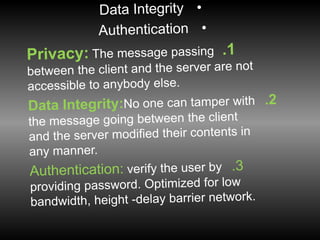
Privacy
IP Security
What is IP Security
•
Framework of open standards to ensure
secure communications over the Internet
In short: It is the network layer Internet
Security Protocol
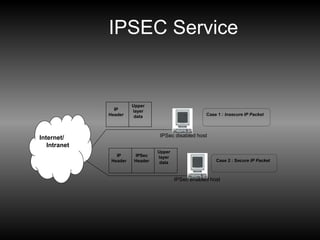
IPSEC Service
Internet/
Intranet
IPSec disabled host
Case 1 : Insecure IP Packet
IPSec enabled host
Case 2 : Secure IP Packet
IP
Header
Upper
layer
data
IP
Header
IPSec
Header
Upper
layer
data
IPSec
•
general IP Security mechanisms
•
provides
–
authentication
–
confidentiality
–
key management
•
applicable to use over LANs, across public
& private WANs, & for the Internet
IP sec Application
•
IPSec provides the capability to secure
communications across a LAN, across private
and public WANs, and across the Internet.
–
Secure branch office connectivity over the Internet
–
Secure remote access over the Internet
–
Establishing extranet and intranet connectivity with partners
–
Enhancing electronic commerce security
Security Associations
•
One of the most important concepts in IPSec is called a
Security Association (SA). Defined in RFC 1825.
•
SAs are the combination of a given Security Parameter
Index (SPI) and Destination Address.
•
SAs are one way. A minimum of two SAs are required
for a single IPSec connection.
•
SAs contain parameters including:
–
Authentication algorithm and algorithm mode
–
Encryption algorithm and algorithm mode
–
Key(s) used with the authentication/encryption algorithm(s)
–
Lifetime of the key
–
Lifetime of the SA
–
Source Address(es) of the SA
–
Sensitivity level (ie Secret or Unclassified)
IP security scenario
scenario of IPSec usage
•
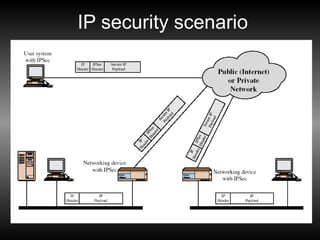
An organization maintains LANs at dispersed
locations
•
Non secure IP traffic is conducted on each LAN.
•
IPSec protocols are used
•
These protocols operate in networking devices
that connect each LAN to the outside world.
(router, firewall )
•
The IPSec networking device will typically
encrypt and compress all traffic going into the
WAN, and decrypt and decompress traffic
coming from the WAN
Why not use IPSec?
•
Processor overhead to encrypt & verify
each packet can be great.
•
Added complexity in network design.
Benefits of IPSec
•
in a firewall/router provides strong security
to all traffic crossing the perimeter
•
in a firewall/router is resistant to bypass
•
is below transport layer, hence transparent
to applications
•
can be transparent to end users
•
can provide security for individual users
•
secures routing architecture
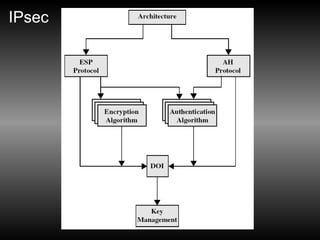
IPsec
Network Layer Security
•
IP security (IPsec)
–
Two protocols
•
Authentication protocol, using an Authentication Header (AH)
•
Encryption/authentication protocol, called the Encapsulating
Security Payload (ESP)
–
Two modes of operation
•
Transport mode: provides protection for upper-layer
protocols
•
Tunnel mode: protects the entire IP datagram
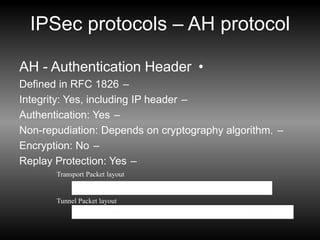
IPSec protocols – AH protocol
•
AH - Authentication Header
–
Defined in RFC 1826
–
Integrity: Yes, including IP header
–
Authentication: Yes
–
Non-repudiation: Depends on cryptography algorithm.
–
Encryption: No
–
Replay Protection: Yes
IP Header AH Header Payload (TCP, UDP, etc)
IP Header AH Header Payload (TCP. UDP,etc)
IP Header
Transport Packet layout
Tunnel Packet layout
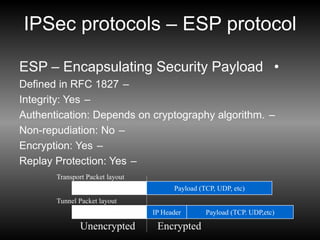
IPSec protocols – ESP protocol
•
ESP – Encapsulating Security Payload
–
Defined in RFC 1827
–
Integrity: Yes
–
Authentication: Depends on cryptography algorithm.
–
Non-repudiation: No
–
Encryption: Yes
–
Replay Protection: Yes
IP Header ESP Header Payload (TCP, UDP, etc)
IP Header ESP Header Payload (TCP. UDP,etc)
IP Header
Transport Packet layout
Tunnel Packet layout
Unencrypted Encrypted
What protocol to use?
•
Differences between AH and ESP:
–
ESP provides encryption, AH does not.
–
AH provides integrity of the IP header, ESP does not.
–
AH can provide non-repudiation. ESP does not.
•
However, we don’t have to choose since both
protocols can be used in together.
•
Why have two protocols?
–
Some countries have strict laws on encryption. If you
can’t use encryption in those countries, AH still
provides good security mechanisms. Two protocols
ensures wide acceptance of IPSec on the Internet.
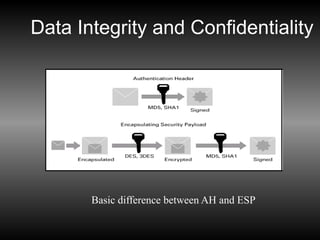
Data Integrity and Confidentiality
Basic difference between AH and ESP
IPSec Protocols (cont)
Algorithms Used:
Encryption:
Symmetric – As IP packets may arrive out of order and
Asymmetric algorithms are incredible slow.
E.g. DES (Data Encryption Standard)

Authentication:
MAC (Message Authentication Codes) based on symmetric
encryption algorithms.
One way hash functions. (MD5 or SHA-1)
Transport Versus Tunnel Mode
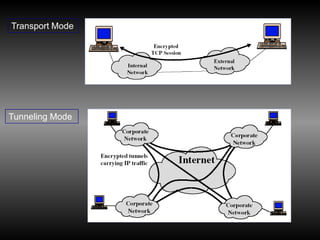
Transport Mode:
•
Used for Peer to Peer communication security
•
Data is encrypted
Tunnel Mode:
•
Used for site-to-site communication security
•
Entire packet is encrypted.
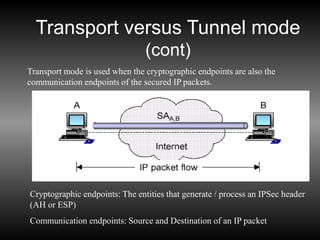
Transport versus Tunnel mode
(cont)
Transport mode is used when the cryptographic endpoints are also the
communication endpoints of the secured IP packets.
Cryptographic endpoints: The entities that generate / process an IPSec header
(AH or ESP)
Communication endpoints: Source and Destination of an IP packet
Transport versus Tunnel mode
(cont)
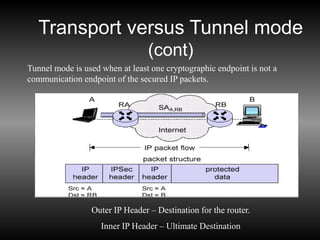
Tunnel mode is used when at least one cryptographic endpoint is not a
communication endpoint of the secured IP packets.
Outer IP Header – Destination for the router.
Inner IP Header – Ultimate Destination
Transport Mode
Tunneling Mode
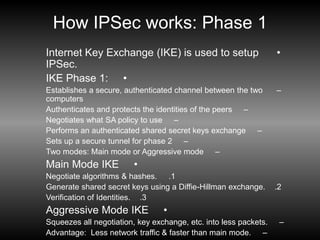
How IPSec works: Phase 1
•
Internet Key Exchange (IKE) is used to setup
IPSec.
•
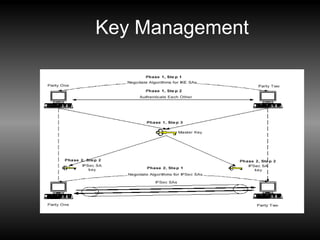
IKE Phase 1:
–
Establishes a secure, authenticated channel between the two
computers
–
Authenticates and protects the identities of the peers
–
Negotiates what SA policy to use
–
Performs an authenticated shared secret keys exchange
–
Sets up a secure tunnel for phase 2
–
Two modes: Main mode or Aggressive mode
•
Main Mode IKE
.1
Negotiate algorithms & hashes.
.2
Generate shared secret keys using a Diffie-Hillman exchange.
.3
Verification of Identities.
•
Aggressive Mode IKE
–
Squeezes all negotiation, key exchange, etc. into less packets.
–
Advantage: Less network traffic & faster than main mode.
How IPSec works: Phase 2
–
An AH or ESP packet is then sent using the agreed
upon “main” SA during the IKE phase 1.
–
IKE Phase 2
•
Negotiates IPSec SA parameters
•
Establishes IPSec security associations for specific
connections (like FTP, telnet, etc)
•
Renegotiates IPSec SAs periodically
•
Optionally performs an additional Diffie-Hellman exchange
How IPSec works: Communication
•
Once Phase 2 has established an SA for a
particular connection, all traffic on that
connection is communicated using the SA.
•
IKE Phase 1 exchange uses UDP Port 500.
•
AH uses IP protocol 51.
•
ESP uses IP protocol 50.
Key Management

The Security layer

  • 1.
    Nadar Saraswathi collegeof Arts and science Theni Presented by: S.Swetha I M.sc(IT) The Security Layer Department of CS and iT
  • 2.
  • 3.
    Index • Wireless Transport LayerSecurity (WTLS) • IP Security • IPsec Protocols • Internet Key Exchange (IKE) Protocol • Security Association (SA) • Authentication Header (AH) • Encapsulating Security Payload (ESP) • IPsec key management
  • 4.
    Wireless Transport Layer Security(WTLS) • It can be integrated into WAP(Wireless Application Protocol) architecture on top of WDP(Wireless Datagram Protocol). • It supports Datagram and connection oriented transport layer protocols. • Based on TLS/SSL protocol.It can provide different levels of security. • Privacy
  • 6.
  • 7.
    What is IPSecurity • Framework of open standards to ensure secure communications over the Internet In short: It is the network layer Internet Security Protocol
  • 8.
    IPSEC Service Internet/ Intranet IPSec disabledhost Case 1 : Insecure IP Packet IPSec enabled host Case 2 : Secure IP Packet IP Header Upper layer data IP Header IPSec Header Upper layer data
  • 9.
    IPSec • general IP Securitymechanisms • provides – authentication – confidentiality – key management • applicable to use over LANs, across public & private WANs, & for the Internet
  • 10.
    IP sec Application • IPSecprovides the capability to secure communications across a LAN, across private and public WANs, and across the Internet. – Secure branch office connectivity over the Internet – Secure remote access over the Internet – Establishing extranet and intranet connectivity with partners – Enhancing electronic commerce security
  • 11.
    Security Associations • One ofthe most important concepts in IPSec is called a Security Association (SA). Defined in RFC 1825. • SAs are the combination of a given Security Parameter Index (SPI) and Destination Address. • SAs are one way. A minimum of two SAs are required for a single IPSec connection. • SAs contain parameters including: – Authentication algorithm and algorithm mode – Encryption algorithm and algorithm mode – Key(s) used with the authentication/encryption algorithm(s) – Lifetime of the key – Lifetime of the SA – Source Address(es) of the SA – Sensitivity level (ie Secret or Unclassified)
  • 12.
  • 13.
    scenario of IPSecusage • An organization maintains LANs at dispersed locations • Non secure IP traffic is conducted on each LAN. • IPSec protocols are used • These protocols operate in networking devices that connect each LAN to the outside world. (router, firewall ) • The IPSec networking device will typically encrypt and compress all traffic going into the WAN, and decrypt and decompress traffic coming from the WAN
  • 14.
    Why not useIPSec? • Processor overhead to encrypt & verify each packet can be great. • Added complexity in network design.
  • 15.
    Benefits of IPSec • ina firewall/router provides strong security to all traffic crossing the perimeter • in a firewall/router is resistant to bypass • is below transport layer, hence transparent to applications • can be transparent to end users • can provide security for individual users • secures routing architecture
  • 16.
  • 17.
    Network Layer Security • IPsecurity (IPsec) – Two protocols • Authentication protocol, using an Authentication Header (AH) • Encryption/authentication protocol, called the Encapsulating Security Payload (ESP) – Two modes of operation • Transport mode: provides protection for upper-layer protocols • Tunnel mode: protects the entire IP datagram
  • 18.
    IPSec protocols –AH protocol • AH - Authentication Header – Defined in RFC 1826 – Integrity: Yes, including IP header – Authentication: Yes – Non-repudiation: Depends on cryptography algorithm. – Encryption: No – Replay Protection: Yes IP Header AH Header Payload (TCP, UDP, etc) IP Header AH Header Payload (TCP. UDP,etc) IP Header Transport Packet layout Tunnel Packet layout
  • 19.
    IPSec protocols –ESP protocol • ESP – Encapsulating Security Payload – Defined in RFC 1827 – Integrity: Yes – Authentication: Depends on cryptography algorithm. – Non-repudiation: No – Encryption: Yes – Replay Protection: Yes IP Header ESP Header Payload (TCP, UDP, etc) IP Header ESP Header Payload (TCP. UDP,etc) IP Header Transport Packet layout Tunnel Packet layout Unencrypted Encrypted
  • 20.
    What protocol touse? • Differences between AH and ESP: – ESP provides encryption, AH does not. – AH provides integrity of the IP header, ESP does not. – AH can provide non-repudiation. ESP does not. • However, we don’t have to choose since both protocols can be used in together. • Why have two protocols? – Some countries have strict laws on encryption. If you can’t use encryption in those countries, AH still provides good security mechanisms. Two protocols ensures wide acceptance of IPSec on the Internet.
  • 21.
    Data Integrity andConfidentiality Basic difference between AH and ESP
  • 22.
    IPSec Protocols (cont) AlgorithmsUsed: Encryption: Symmetric – As IP packets may arrive out of order and Asymmetric algorithms are incredible slow. E.g. DES (Data Encryption Standard)  Authentication: MAC (Message Authentication Codes) based on symmetric encryption algorithms. One way hash functions. (MD5 or SHA-1)
  • 23.
    Transport Versus TunnelMode Transport Mode: • Used for Peer to Peer communication security • Data is encrypted Tunnel Mode: • Used for site-to-site communication security • Entire packet is encrypted.
  • 24.
    Transport versus Tunnelmode (cont) Transport mode is used when the cryptographic endpoints are also the communication endpoints of the secured IP packets. Cryptographic endpoints: The entities that generate / process an IPSec header (AH or ESP) Communication endpoints: Source and Destination of an IP packet
  • 25.
    Transport versus Tunnelmode (cont) Tunnel mode is used when at least one cryptographic endpoint is not a communication endpoint of the secured IP packets. Outer IP Header – Destination for the router. Inner IP Header – Ultimate Destination
  • 26.
  • 27.
    How IPSec works:Phase 1 • Internet Key Exchange (IKE) is used to setup IPSec. • IKE Phase 1: – Establishes a secure, authenticated channel between the two computers – Authenticates and protects the identities of the peers – Negotiates what SA policy to use – Performs an authenticated shared secret keys exchange – Sets up a secure tunnel for phase 2 – Two modes: Main mode or Aggressive mode • Main Mode IKE .1 Negotiate algorithms & hashes. .2 Generate shared secret keys using a Diffie-Hillman exchange. .3 Verification of Identities. • Aggressive Mode IKE – Squeezes all negotiation, key exchange, etc. into less packets. – Advantage: Less network traffic & faster than main mode.
  • 28.
    How IPSec works:Phase 2 – An AH or ESP packet is then sent using the agreed upon “main” SA during the IKE phase 1. – IKE Phase 2 • Negotiates IPSec SA parameters • Establishes IPSec security associations for specific connections (like FTP, telnet, etc) • Renegotiates IPSec SAs periodically • Optionally performs an additional Diffie-Hellman exchange
  • 29.
    How IPSec works:Communication • Once Phase 2 has established an SA for a particular connection, all traffic on that connection is communicated using the SA. • IKE Phase 1 exchange uses UDP Port 500. • AH uses IP protocol 51. • ESP uses IP protocol 50.
  • 30.