Swipe
Python - Network Programming
Python provides two levels of access to network
services.
At a low level, you can access the basic socket
support in the underlying operating system, which
allows you to implement clients and servers for
both connection-oriented and connectionless
protocols.
Python also has libraries that provide higher-level
access to specific application-level network
protocols, such as FTP, HTTP, and so on.
This PDF gives you understanding on most famous
concept in Networking - Socket Programming.
Python - Network Programming
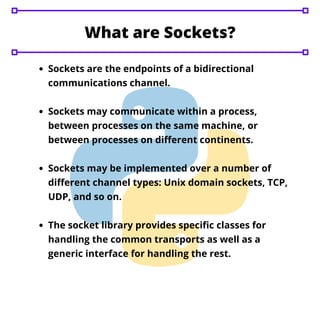
Sockets are the endpoints of a bidirectional
communications channel.
Sockets may communicate within a process,
between processes on the same machine, or
between processes on different continents.
Sockets may be implemented over a number of
different channel types: Unix domain sockets, TCP,
UDP, and so on.
The socket library provides specific classes for
handling the common transports as well as a
generic interface for handling the rest.
What are Sockets?
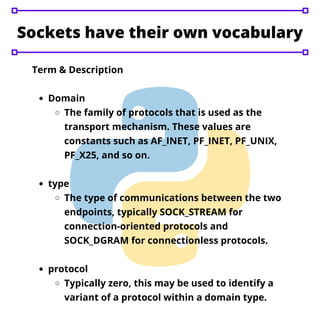
Sockets have their own vocabulary
Domain
The family of protocols that is used as the
transport mechanism. These values are
constants such as AF_INET, PF_INET, PF_UNIX,
PF_X25, and so on.
type
The type of communications between the two
endpoints, typically SOCK_STREAM for
connection-oriented protocols and
SOCK_DGRAM for connectionless protocols.
protocol
Typically zero, this may be used to identify a
variant of a protocol within a domain type.
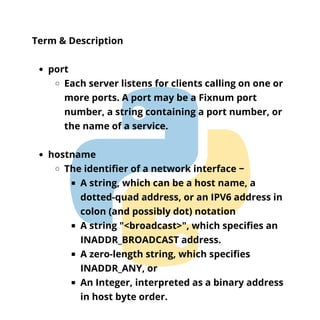
Term & Description
port
Each server listens for clients calling on one or
more ports. A port may be a Fixnum port
number, a string containing a port number, or
the name of a service.
hostname
The identifier of a network interface −
A string, which can be a host name, a
dotted-quad address, or an IPV6 address in
colon (and possibly dot) notation
A string "<broadcast>", which specifies an
INADDR_BROADCAST address.
A zero-length string, which specifies
INADDR_ANY, or
An Integer, interpreted as a binary address
in host byte order.
Term & Description
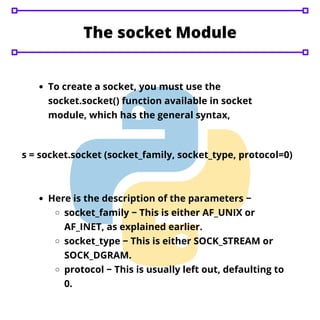
The socket Module
To create a socket, you must use the
socket.socket() function available in socket
module, which has the general syntax,
s = socket.socket (socket_family, socket_type, protocol=0)
Here is the description of the parameters −
socket_family − This is either AF_UNIX or
AF_INET, as explained earlier.
socket_type − This is either SOCK_STREAM or
SOCK_DGRAM.
protocol − This is usually left out, defaulting to
0.
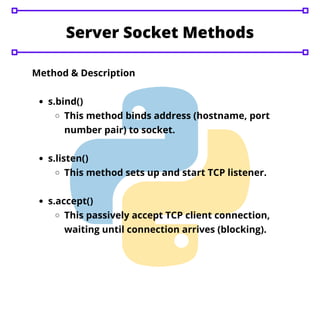
Server Socket Methods
s.bind()
This method binds address (hostname, port
number pair) to socket.
s.listen()
This method sets up and start TCP listener.
s.accept()
This passively accept TCP client connection,
waiting until connection arrives (blocking).
Method & Description
Client Socket Methods
s.connect()
This method actively initiates TCP server
connection.
Method & Description
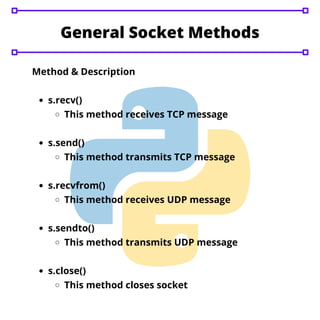
General Socket Methods
s.recv()
This method receives TCP message
s.send()
This method transmits TCP message
s.recvfrom()
This method receives UDP message
s.sendto()
This method transmits UDP message
s.close()
This method closes socket
Method & Description
Python - XML Processing
Python - Multithreaded
Programming
Stay Tuned with
Topics for next Post

Python network programming

  • 1.
  • 2.
    Python provides twolevels of access to network services. At a low level, you can access the basic socket support in the underlying operating system, which allows you to implement clients and servers for both connection-oriented and connectionless protocols. Python also has libraries that provide higher-level access to specific application-level network protocols, such as FTP, HTTP, and so on. This PDF gives you understanding on most famous concept in Networking - Socket Programming. Python - Network Programming
  • 3.
    Sockets are theendpoints of a bidirectional communications channel. Sockets may communicate within a process, between processes on the same machine, or between processes on different continents. Sockets may be implemented over a number of different channel types: Unix domain sockets, TCP, UDP, and so on. The socket library provides specific classes for handling the common transports as well as a generic interface for handling the rest. What are Sockets?
  • 4.
    Sockets have theirown vocabulary Domain The family of protocols that is used as the transport mechanism. These values are constants such as AF_INET, PF_INET, PF_UNIX, PF_X25, and so on. type The type of communications between the two endpoints, typically SOCK_STREAM for connection-oriented protocols and SOCK_DGRAM for connectionless protocols. protocol Typically zero, this may be used to identify a variant of a protocol within a domain type. Term & Description
  • 5.
    port Each server listensfor clients calling on one or more ports. A port may be a Fixnum port number, a string containing a port number, or the name of a service. hostname The identifier of a network interface − A string, which can be a host name, a dotted-quad address, or an IPV6 address in colon (and possibly dot) notation A string "<broadcast>", which specifies an INADDR_BROADCAST address. A zero-length string, which specifies INADDR_ANY, or An Integer, interpreted as a binary address in host byte order. Term & Description
  • 6.
    The socket Module Tocreate a socket, you must use the socket.socket() function available in socket module, which has the general syntax, s = socket.socket (socket_family, socket_type, protocol=0) Here is the description of the parameters − socket_family − This is either AF_UNIX or AF_INET, as explained earlier. socket_type − This is either SOCK_STREAM or SOCK_DGRAM. protocol − This is usually left out, defaulting to 0.
  • 7.
    Server Socket Methods s.bind() Thismethod binds address (hostname, port number pair) to socket. s.listen() This method sets up and start TCP listener. s.accept() This passively accept TCP client connection, waiting until connection arrives (blocking). Method & Description
  • 8.
    Client Socket Methods s.connect() Thismethod actively initiates TCP server connection. Method & Description
  • 9.
    General Socket Methods s.recv() Thismethod receives TCP message s.send() This method transmits TCP message s.recvfrom() This method receives UDP message s.sendto() This method transmits UDP message s.close() This method closes socket Method & Description
  • 10.
    Python - XMLProcessing Python - Multithreaded Programming Stay Tuned with Topics for next Post