Java Networking
Chapter 4
java networking
 Java Networking is a concept of connecting two
or more computing devices together so that we
can share resources. Java socket programming
provides facility to share data between different
computing devices.
Advantage of Java Networking
1. sharing resources
2. centralize software management
Java Networking Terminology
 The widely used java networking terminologies are
given below:
1. IP Address
2. Protocol
3. Port Number
4. MAC Address
5. Connection-oriented and connection-less protocol
6. Socket
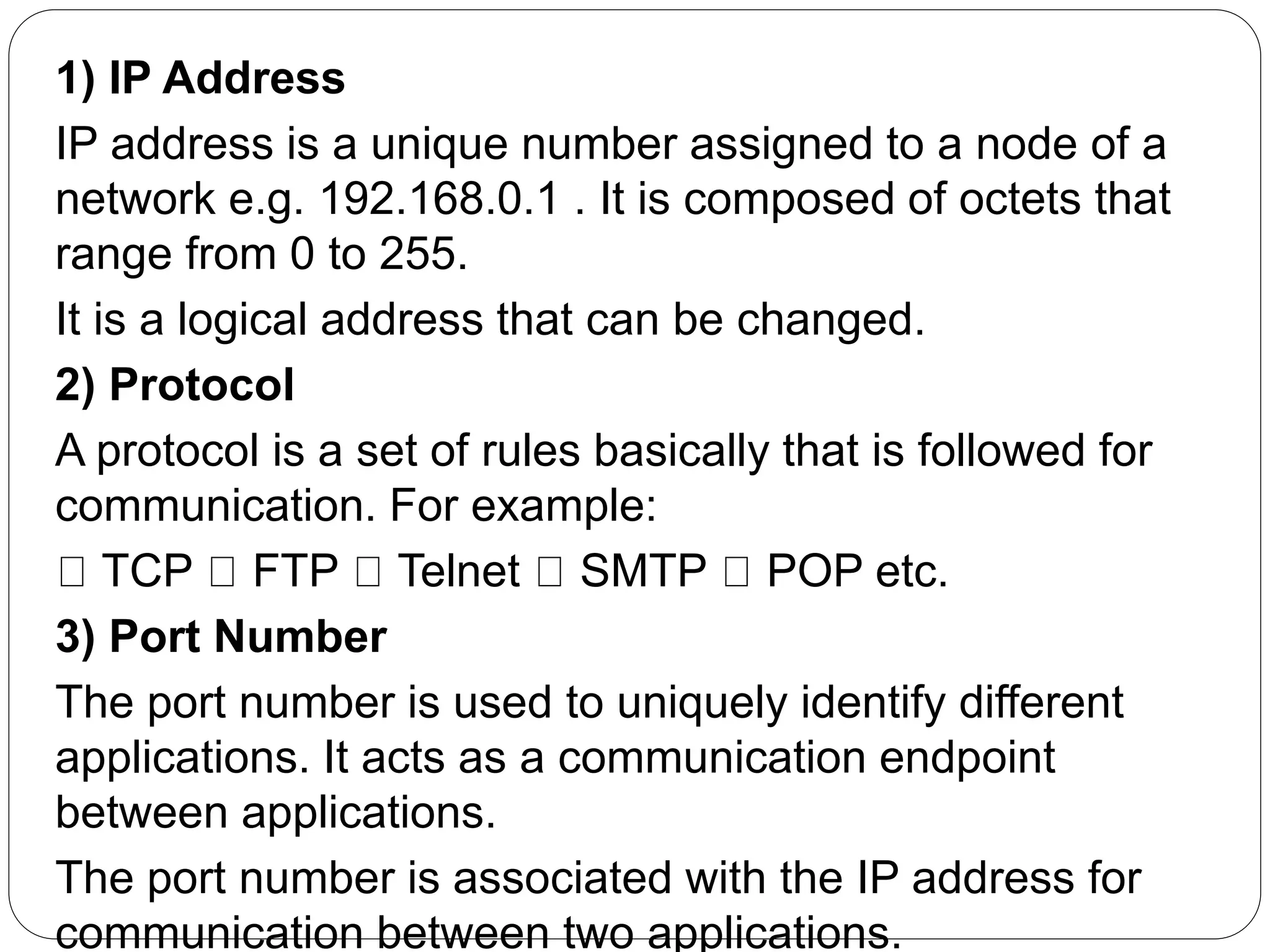
1) IP Address
IP address is a unique number assigned to a node of a
network e.g. 192.168.0.1 . It is composed of octets that
range from 0 to 255.
It is a logical address that can be changed.
2) Protocol
A protocol is a set of rules basically that is followed for
communication. For example:
TCP FTP Telnet SMTP POP etc.
3) Port Number
The port number is used to uniquely identify different
applications. It acts as a communication endpoint
between applications.
The port number is associated with the IP address for
communication between two applications.
4) MAC Address
MAC (Media Access Control) Address is a unique
identifier of NIC (Network Interface Controller). A network
node can have multiple NIC but each with unique MAC.
5) Connection-oriented and connection-less protocol
In connection-oriented protocol, acknowledgement is sent
by the receiver. So it is reliable but slow. The example of
connection-oriented protocol is TCP. But, in connection-
less protocol, acknowledgement is not sent by the
receiver. So it is not reliable but fast. The example of
connection-less protocol is UDP.
6) Socket
A socket is an endpoint between two way
communications.
Java Socket Programming
 Java Socket programming is used for communication
between the applications running on different JRE.
Java Socket programming can be connection-oriented
or connection-less.
 Socket and ServerSocket classes are used for
connection-oriented socket programming and
DatagramSocket and DatagramPacket classes are
used for connection-less socket programming.
 The client in socket programming must know two
information:
1. IP Address of Server, and
2. Port number.
Socket class
 A socket is simply an endpoint for communications
between the machines. The Socket class can be
used to create a socket.
Important methods
ServerSocket class
 The ServerSocket class can be used to create a
server socket. This object is used to establish
communication with the clients.
Important methods
Example of Java Socket
Programming
 Let's see a simple of java socket programming in which
client sends a text and server receives it.
File: MyServer.java
1. import java.io.*;
2. import java.net.*;
3. public class MyServer {
4. public static void main(String[] args){
5. try{
6. ServerSocket ss=new ServerSocket(6666);
7. Socket s=ss.accept();//establishes connection
8. DataInputStream dis=new
DataInputStream(s.getInputStream());
9. String str=(String)dis.readUTF();
10. System.out.println("message= "+str);
11. ss.close();
12. }catch(Exception e){System.out.println(e);} } }
 File: MyClient.java
1. import java.io.*;
2. import java.net.*;
3. public class MyClient {
4. public static void main(String[] args) {
5. try{
6. Socket s=new Socket("localhost",6666);
7. DataOutputStream dout=new
DataOutputStream(s.getOutputStream());
8. dout.writeUTF("Hello Server");
9. dout.flush();
10. dout.close();
11. s.close();
12. }catch(Exception e){System.out.println(e);} } }
Java URL
 The Java URL class represents an URL. URL is an
acronym for Uniform Resource Locator. It points to a
resource on the World Wide Web.
For example: 1. http://www.javatpoint.com/java-
tutorial
 A URL contains many information:
1. Protocol: In this case, http is the protocol.
2. Server name or IP Address: In this case,
www.javatpoint.com is the server name.
3. Port Number: It is an optional attribute. If we write
http//ww.javatpoint.com:80/sonoojaiswal/ , 80 is the
port number. If port number is not mentioned in the
URL, it returns -1. 4. File Name or directory name: In
this case, index.jsp is the file name.

Commonly used methods of Java
URL class
 The java.net.URL class provides many methods.
The important methods of URL class are given
below.
 Example of Java URL class
1. //URLDemo.java
2. import java.io.*;
3. import java.net.*;
4. public class URLDemo{
5. public static void main(String[] args){
6. try{
7. URL url=new URL("http://www.javatpoint.com/java-tutorial");
8. System.out.println("Protocol: "+url.getProtocol());
9. System.out.println("Host Name: "+url.getHost());
10. System.out.println("Port Number: "+url.getPort());
11. System.out.println("File Name: "+url.getFile());
12. }catch(Exception e){System.out.println(e);}
13. }
14. } Output: Protocol: http
Host Name: www.javatpoint.com
Port Number: -1
File Name: /java-tutorial

Chapter 4

  • 1.
  • 2.
    java networking  JavaNetworking is a concept of connecting two or more computing devices together so that we can share resources. Java socket programming provides facility to share data between different computing devices. Advantage of Java Networking 1. sharing resources 2. centralize software management
  • 3.
    Java Networking Terminology The widely used java networking terminologies are given below: 1. IP Address 2. Protocol 3. Port Number 4. MAC Address 5. Connection-oriented and connection-less protocol 6. Socket
  • 4.
    1) IP Address IPaddress is a unique number assigned to a node of a network e.g. 192.168.0.1 . It is composed of octets that range from 0 to 255. It is a logical address that can be changed. 2) Protocol A protocol is a set of rules basically that is followed for communication. For example: TCP FTP Telnet SMTP POP etc. 3) Port Number The port number is used to uniquely identify different applications. It acts as a communication endpoint between applications. The port number is associated with the IP address for communication between two applications.
  • 5.
    4) MAC Address MAC(Media Access Control) Address is a unique identifier of NIC (Network Interface Controller). A network node can have multiple NIC but each with unique MAC. 5) Connection-oriented and connection-less protocol In connection-oriented protocol, acknowledgement is sent by the receiver. So it is reliable but slow. The example of connection-oriented protocol is TCP. But, in connection- less protocol, acknowledgement is not sent by the receiver. So it is not reliable but fast. The example of connection-less protocol is UDP. 6) Socket A socket is an endpoint between two way communications.
  • 6.
    Java Socket Programming Java Socket programming is used for communication between the applications running on different JRE. Java Socket programming can be connection-oriented or connection-less.  Socket and ServerSocket classes are used for connection-oriented socket programming and DatagramSocket and DatagramPacket classes are used for connection-less socket programming.  The client in socket programming must know two information: 1. IP Address of Server, and 2. Port number.
  • 7.
    Socket class  Asocket is simply an endpoint for communications between the machines. The Socket class can be used to create a socket. Important methods
  • 8.
    ServerSocket class  TheServerSocket class can be used to create a server socket. This object is used to establish communication with the clients. Important methods
  • 9.
    Example of JavaSocket Programming  Let's see a simple of java socket programming in which client sends a text and server receives it. File: MyServer.java 1. import java.io.*; 2. import java.net.*; 3. public class MyServer { 4. public static void main(String[] args){ 5. try{ 6. ServerSocket ss=new ServerSocket(6666); 7. Socket s=ss.accept();//establishes connection 8. DataInputStream dis=new DataInputStream(s.getInputStream()); 9. String str=(String)dis.readUTF(); 10. System.out.println("message= "+str); 11. ss.close(); 12. }catch(Exception e){System.out.println(e);} } }
  • 10.
     File: MyClient.java 1.import java.io.*; 2. import java.net.*; 3. public class MyClient { 4. public static void main(String[] args) { 5. try{ 6. Socket s=new Socket("localhost",6666); 7. DataOutputStream dout=new DataOutputStream(s.getOutputStream()); 8. dout.writeUTF("Hello Server"); 9. dout.flush(); 10. dout.close(); 11. s.close(); 12. }catch(Exception e){System.out.println(e);} } }
  • 11.
    Java URL  TheJava URL class represents an URL. URL is an acronym for Uniform Resource Locator. It points to a resource on the World Wide Web. For example: 1. http://www.javatpoint.com/java- tutorial  A URL contains many information: 1. Protocol: In this case, http is the protocol. 2. Server name or IP Address: In this case, www.javatpoint.com is the server name. 3. Port Number: It is an optional attribute. If we write http//ww.javatpoint.com:80/sonoojaiswal/ , 80 is the port number. If port number is not mentioned in the URL, it returns -1. 4. File Name or directory name: In this case, index.jsp is the file name. 
  • 12.
    Commonly used methodsof Java URL class  The java.net.URL class provides many methods. The important methods of URL class are given below.
  • 13.
     Example ofJava URL class 1. //URLDemo.java 2. import java.io.*; 3. import java.net.*; 4. public class URLDemo{ 5. public static void main(String[] args){ 6. try{ 7. URL url=new URL("http://www.javatpoint.com/java-tutorial"); 8. System.out.println("Protocol: "+url.getProtocol()); 9. System.out.println("Host Name: "+url.getHost()); 10. System.out.println("Port Number: "+url.getPort()); 11. System.out.println("File Name: "+url.getFile()); 12. }catch(Exception e){System.out.println(e);} 13. } 14. } Output: Protocol: http Host Name: www.javatpoint.com Port Number: -1 File Name: /java-tutorial