




Teach-Back: Make Sure they Understand
Kelly Pick MSN RN-BC NPD
Patient and Community Education
PeaceHealth Southwest Medical Center
Last Trip to that Store
2
Who needs Teach-Back?
employee colleague
child
3
Key Resources
AMA Health Literacy and Patient Safety: Help Patients
Understand. Manual for Clinicians, Weiss et al. (2007)
AHRQ Universal Precautions Toolkit, DeWalt, et al. (2010)
Always Use Teach-back! Training Toolkit, AMA, Picker Institute,
UnityPoint Health, Des Moines University, et al. (2014)
http://www.teachbacktraining.org/
4
Health Literacy
Weiss, B.D. (2007) 5
…for Low Health Literacy
• Can’t tell by looking
• Communicate clearly with everyone
• Confirm understanding with everyone
Universal Precautions…
DeWalt, et al. (2010) AHRQ Universal Precautions Toolkit 6
Clear Communication
• Slow down
• Use plain, non-medical language
“living room language”
• Show or draw pictures
• Create a shame-free environment
• Use Teach-Back
Weiss, B. (2007) 7
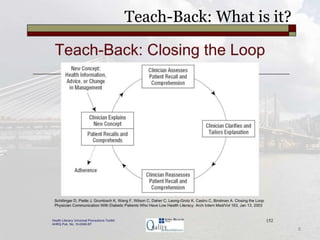
Teach-Back: What is it?
8
How does Teach-Back help?
Health Care
• Patient safety
• Patient engagement and
satisfaction
• Reduces:
–unnecessary clinic visits
–emergency room visits
–hospital re-admissions
9
Business/Government/Education
• Provides clarity
• Improves customer/constituent
satisfaction
Family and Friends
• Better relationships
All: Quick and easy way to assess understanding
“I don’t have time”
Studies and Pilot Projects
10
Start small:
• One patient encounter per day (last visit)
• Work up to more as you get more
comfortable
• Practice at home
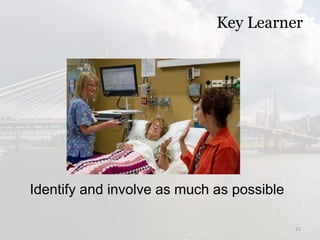
Key Learner
Identify and involve as much as possible
11
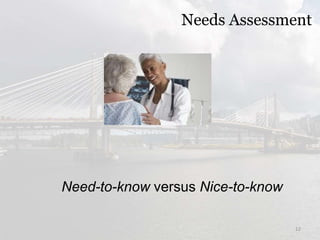
Need-to-know versus Nice-to-know
Needs Assessment
12
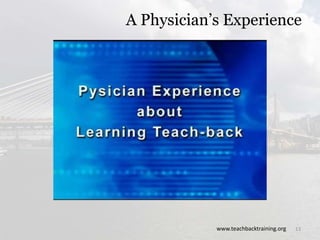
A Physician’s Experience
www.teachbacktraining.org 13
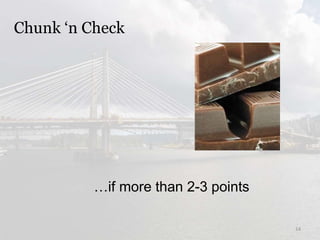
Chunk ‘n Check
…if more than 2-3 points
14
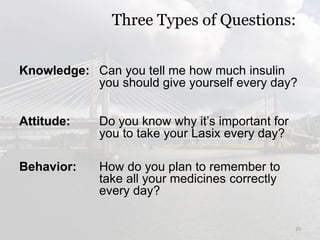
Knowledge: Can you tell me how much insulin
you should give yourself every day?
Attitude: Do you know why it’s important for
you to take your Lasix every day?
Behavior: How do you plan to remember to
take all your medicines correctly
every day?
Three Types of Questions:
15
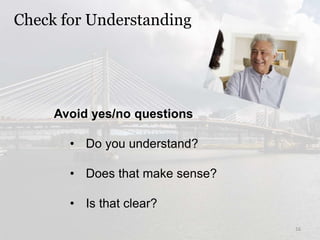
Avoid yes/no questions
• Do you understand?
• Does that make sense?
• Is that clear?
Check for Understanding
16
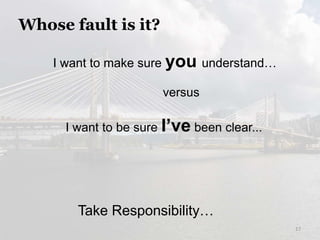
Take Responsibility…
I want to make sure you understand…
Whose fault is it?
17
versus
I want to be sure I’ve been clear...
Repeat back
Avoid the Parrot
18
versus
Teach back in your own words
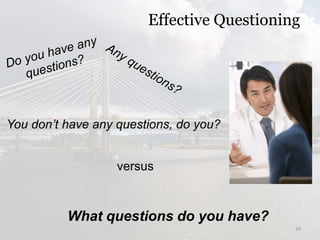
What questions do you have?
You don’t have any questions, do you?
Effective Questioning
versus
19
Teach-Back Reminder Card
Keep card with you to refer to for Teach-Back
20
Demo and Practice
• Teach your partner how to use the call light
(less than a minute)
• Use Teach-Back card to remind you of the steps:
1. Teach concept
2. Take responsibility
3. Ask for Teach-Back in own words
4. Ask for questions
• Switch roles
21
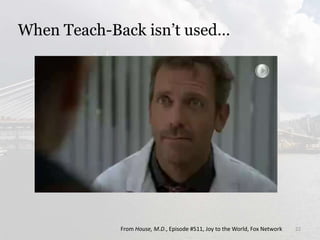
When Teach-Back isn’t used…
From House, M.D., Episode #511, Joy to the World, Fox Network 22
What questions do you have?
Kelly Pick MSN, RN-BC NPD
Patient and Community Health Education
PeaceHealth Southwest Medical Center
23
References and Further Reading
5 Million Lives Campaign. (2008). Getting started kit: Improved care for patients with congestive heart failure
how-to guide. Cambridge, MA: Institute for Healthcare Improvement. (Available at www.ihi.org)
The Advisory Board Company. (2011). Innovating on 'teach-back' to prevent avoidable readmissions. Retrieved
from The Advisory Board Company.
Brach C., Dreyer, B., Schyve, P., Hernandez L.M., Baur, C., Lemerise, A. J., Parker, R. (2012). Ten attributes of health
literate health care organizations. Institute of Medicine Roundtable on Health Literacy. Retrieved from: http://
www.iom.edu/~/media/Files/Perspectives-Files/2012/Discussion-Papers/BPH_HLit_Attributes.pdf
Centers for Disease Control and Prevention (2009). Simply put: A guide for creating easy-to-understand
materials. Third Edition. Atlanta, GA. Retrieved from http://stacks.cdc.gov/view/cdc/11938/
DeWalt D. A., Callahan, L.F., Hawk, V. H., Broucksou, K. A., Hink, A., Rudd, R., & Brach, C. (April 2010). Health
Literacy Universal Precautions Toolkit. Rockville, MD: Agency for Healthcare Research and Quality. AHRQ
Publication No. 10-0046-EF. Retrieved from http://www.ahrq.gov/qual/literacy/index.html
Fidyk, L., Ventura, K. & Green, K. (2014). Teaching nurses how to teach: Strategies to enhance the quality of patient
education. Journal for Nurses in Professional Development, 30(5): 248-253.
Healthcare Benchmarks and Quality Improvement. (December, 2010). Readmission rates for HF reduced by 30%.
Volume 17(12), p.137-138. Retrieved from http://www.henryfordconnect.com/documents/Sladen
%20Library/HBQI-December2010.pdf
24
In Focus: Topics in Health Care Ethics (April, 2006). Teach back: A tool for improving provider patient
communication. National Center for Ethics in Health Care.
Institute for Healthcare Improvement (2008). Good heart failure care follows patients home. Cambridge, MA:
Institute for Healthcare Improvement (Available at www.ihi.org).
Institute of Medicine (2004). Health literacy: A prescription to end confusion. Washington DC: The National
Academies Press.
Kripalani, S., Bengtzen, R., Henderson, L.E., & Jacobson, T. A. (2008). Clinical research in low-literacy populations:
Using Teach-Back to assess comprehension of informed consent and privacy information. IRB: Ethics and
Human Research. March-April, pp.13-19.
Kutner, M., Greenberg, E., Jin, Y., & Paulsen, C. (2006). The Health Literacy of America’s Adults: Results From
the 2003 National Assessment of Adult Literacy. U.S. Department of Education. Washington, DC: National
Center for Education Statistics. (NCES 2006–483)
London, F. (2009) No time to teach: The essence of patient and family education for health care providers. Atlanta,
GA: Pritchett & Hull.
National Quality Forum (2010). Safe Practices for Better Healthcare – 2010 Update. Retrieved from
http://www.qualityforum.org/Publications/2010/04/Safe_Practices_for_Better_Healthcare_%e2%80%9
3_2010_Update.aspx
25
Osborne H. (2011). In other words...Confirming understanding with the Teach-Back Technique. Health Literacy
Consulting. Retrieved from http://www.healthliteracy.com/article.asp?PageID=6714
Press, V., Arora, V., Shah, L., Lewis, S., Charbeneau, J., Naureckas, E., & Krishnan, J. (2012). Teaching the use of
respiratory inhalers to hospitalized patients with asthma or COPD: A randomized trial. Journal of
General Internal Medicine, 27(10), 1317-1325.
Sandberg, E., Sharma, R., & Sandberg, W. (2012). Deficits in retention for verbally presented medical
information. Anesthesiology, 117(4), 772-779.
Schillinger, D., Piette, J., Grumbach, K., Wang, F., Wilson, C., Daher, C., … Bindman, A. B. (2003). Closing the
loop: Physician communications with diabetic patients who have low health literacy. Archives of Internal
Medicine; 163:83–90.
US Department of Health and Human Services. (2010). Health literacy. Retrieved from
www.health.gov/communication/literacy/quickguide/factsbasic.htm
Weiss, B.D. (2007). Health literacy and patient safety: Help patients understand, manual for clinicians, Second
edition, A Continuing Medical Education opportunity. Date of most recent activity review April 2009.
Chicago, IL: American Medical Association Foundation and American Medical Association.
26

Kelly Pick - Teach Back: Make Sure They Understand

  • 1.
    Teach-Back: Make Surethey Understand Kelly Pick MSN RN-BC NPD Patient and Community Education PeaceHealth Southwest Medical Center
  • 2.
    Last Trip tothat Store 2
  • 3.
  • 4.
    Key Resources AMA HealthLiteracy and Patient Safety: Help Patients Understand. Manual for Clinicians, Weiss et al. (2007) AHRQ Universal Precautions Toolkit, DeWalt, et al. (2010) Always Use Teach-back! Training Toolkit, AMA, Picker Institute, UnityPoint Health, Des Moines University, et al. (2014) http://www.teachbacktraining.org/ 4
  • 5.
  • 6.
    …for Low HealthLiteracy • Can’t tell by looking • Communicate clearly with everyone • Confirm understanding with everyone Universal Precautions… DeWalt, et al. (2010) AHRQ Universal Precautions Toolkit 6
  • 7.
    Clear Communication • Slowdown • Use plain, non-medical language “living room language” • Show or draw pictures • Create a shame-free environment • Use Teach-Back Weiss, B. (2007) 7
  • 8.
  • 9.
    How does Teach-Backhelp? Health Care • Patient safety • Patient engagement and satisfaction • Reduces: –unnecessary clinic visits –emergency room visits –hospital re-admissions 9 Business/Government/Education • Provides clarity • Improves customer/constituent satisfaction Family and Friends • Better relationships All: Quick and easy way to assess understanding
  • 10.
    “I don’t havetime” Studies and Pilot Projects 10 Start small: • One patient encounter per day (last visit) • Work up to more as you get more comfortable • Practice at home
  • 11.
    Key Learner Identify andinvolve as much as possible 11
  • 12.
  • 13.
  • 14.
    Chunk ‘n Check …ifmore than 2-3 points 14
  • 15.
    Knowledge: Can youtell me how much insulin you should give yourself every day? Attitude: Do you know why it’s important for you to take your Lasix every day? Behavior: How do you plan to remember to take all your medicines correctly every day? Three Types of Questions: 15
  • 16.
    Avoid yes/no questions •Do you understand? • Does that make sense? • Is that clear? Check for Understanding 16
  • 17.
    Take Responsibility… I wantto make sure you understand… Whose fault is it? 17 versus I want to be sure I’ve been clear...
  • 18.
    Repeat back Avoid theParrot 18 versus Teach back in your own words
  • 19.
    What questions doyou have? You don’t have any questions, do you? Effective Questioning versus 19
  • 20.
    Teach-Back Reminder Card Keepcard with you to refer to for Teach-Back 20
  • 21.
    Demo and Practice •Teach your partner how to use the call light (less than a minute) • Use Teach-Back card to remind you of the steps: 1. Teach concept 2. Take responsibility 3. Ask for Teach-Back in own words 4. Ask for questions • Switch roles 21
  • 22.
    When Teach-Back isn’tused… From House, M.D., Episode #511, Joy to the World, Fox Network 22
  • 23.
    What questions doyou have? Kelly Pick MSN, RN-BC NPD Patient and Community Health Education PeaceHealth Southwest Medical Center 23
  • 24.
    References and FurtherReading 5 Million Lives Campaign. (2008). Getting started kit: Improved care for patients with congestive heart failure how-to guide. Cambridge, MA: Institute for Healthcare Improvement. (Available at www.ihi.org) The Advisory Board Company. (2011). Innovating on 'teach-back' to prevent avoidable readmissions. Retrieved from The Advisory Board Company. Brach C., Dreyer, B., Schyve, P., Hernandez L.M., Baur, C., Lemerise, A. J., Parker, R. (2012). Ten attributes of health literate health care organizations. Institute of Medicine Roundtable on Health Literacy. Retrieved from: http:// www.iom.edu/~/media/Files/Perspectives-Files/2012/Discussion-Papers/BPH_HLit_Attributes.pdf Centers for Disease Control and Prevention (2009). Simply put: A guide for creating easy-to-understand materials. Third Edition. Atlanta, GA. Retrieved from http://stacks.cdc.gov/view/cdc/11938/ DeWalt D. A., Callahan, L.F., Hawk, V. H., Broucksou, K. A., Hink, A., Rudd, R., & Brach, C. (April 2010). Health Literacy Universal Precautions Toolkit. Rockville, MD: Agency for Healthcare Research and Quality. AHRQ Publication No. 10-0046-EF. Retrieved from http://www.ahrq.gov/qual/literacy/index.html Fidyk, L., Ventura, K. & Green, K. (2014). Teaching nurses how to teach: Strategies to enhance the quality of patient education. Journal for Nurses in Professional Development, 30(5): 248-253. Healthcare Benchmarks and Quality Improvement. (December, 2010). Readmission rates for HF reduced by 30%. Volume 17(12), p.137-138. Retrieved from http://www.henryfordconnect.com/documents/Sladen %20Library/HBQI-December2010.pdf 24
  • 25.
    In Focus: Topicsin Health Care Ethics (April, 2006). Teach back: A tool for improving provider patient communication. National Center for Ethics in Health Care. Institute for Healthcare Improvement (2008). Good heart failure care follows patients home. Cambridge, MA: Institute for Healthcare Improvement (Available at www.ihi.org). Institute of Medicine (2004). Health literacy: A prescription to end confusion. Washington DC: The National Academies Press. Kripalani, S., Bengtzen, R., Henderson, L.E., & Jacobson, T. A. (2008). Clinical research in low-literacy populations: Using Teach-Back to assess comprehension of informed consent and privacy information. IRB: Ethics and Human Research. March-April, pp.13-19. Kutner, M., Greenberg, E., Jin, Y., & Paulsen, C. (2006). The Health Literacy of America’s Adults: Results From the 2003 National Assessment of Adult Literacy. U.S. Department of Education. Washington, DC: National Center for Education Statistics. (NCES 2006–483) London, F. (2009) No time to teach: The essence of patient and family education for health care providers. Atlanta, GA: Pritchett & Hull. National Quality Forum (2010). Safe Practices for Better Healthcare – 2010 Update. Retrieved from http://www.qualityforum.org/Publications/2010/04/Safe_Practices_for_Better_Healthcare_%e2%80%9 3_2010_Update.aspx 25
  • 26.
    Osborne H. (2011).In other words...Confirming understanding with the Teach-Back Technique. Health Literacy Consulting. Retrieved from http://www.healthliteracy.com/article.asp?PageID=6714 Press, V., Arora, V., Shah, L., Lewis, S., Charbeneau, J., Naureckas, E., & Krishnan, J. (2012). Teaching the use of respiratory inhalers to hospitalized patients with asthma or COPD: A randomized trial. Journal of General Internal Medicine, 27(10), 1317-1325. Sandberg, E., Sharma, R., & Sandberg, W. (2012). Deficits in retention for verbally presented medical information. Anesthesiology, 117(4), 772-779. Schillinger, D., Piette, J., Grumbach, K., Wang, F., Wilson, C., Daher, C., … Bindman, A. B. (2003). Closing the loop: Physician communications with diabetic patients who have low health literacy. Archives of Internal Medicine; 163:83–90. US Department of Health and Human Services. (2010). Health literacy. Retrieved from www.health.gov/communication/literacy/quickguide/factsbasic.htm Weiss, B.D. (2007). Health literacy and patient safety: Help patients understand, manual for clinicians, Second edition, A Continuing Medical Education opportunity. Date of most recent activity review April 2009. Chicago, IL: American Medical Association Foundation and American Medical Association. 26

Editor's Notes

  • #2 Introduce myself. Photo- bridge under construction…bridging the communication gap
  • #3 Resource: Last Trip to That Store LAST TRIP TO THAT STORE!   When I was ready to check out and pay for my groceries, the cashier said, "Strip down, facing me." Making a mental note so I could complain to our congressman about this Homeland Security running amok crap, I did just as the clerk had instructed. After the shrieking and hysterical remarks finally subsided, I found out that he was referring to how I should position my credit card. None the less, I've been asked to shop elsewhere in the future. They really need to make their instructions a little clearer for seniors.....
  • #4 So who needs Teach-Back? Raise your hand if you have direct contact with patients… students? An employee? Colleagues? A boss? A partner (either at work or domestic)? A spouse? A child? A friend? As you can see, this can really affect anyone who talks to anyone. Most of the examples in this program are in the healthcare field, but it’s applicable to any relationship.
  • #5 A few of the important resources that I used to make this presentation are…
  • #6 What is Health Literacy? This video was taken from the AMA CME; these are real patients and real providers, and they will give us a clearer idea of the importance of health literacy in health care today.
  • #7 Resource: AHRQ Toolkit Were you surprised that some of the people in the video had a health literacy issue, or could you tell just by looking at them? Can’t really tell.
  • #8 Resource: Heart Failure booklet I adapted for PHSW Is anyone worried about offending your patients by ‘dumbing things down’? If you know your patient well, and they are asking high level questions, go ahead and use more clinical words. Otherwise, it’s best to start low and go up if needed. In the research, no one has ever complained about their providers being too clear. Everybody wants clear communication. My parents as an example with the HF booklet- not offended by low literacy HF booklet.
  • #9 What is Teach-Back? Closed loop communication.
  • #11 Resource: Two research articles on Teach-Back and time factor
  • #12 Institute for Healthcare Improvement (IHI)
  • #13 How many of you do a needs assessment before giving your spiel to a patient, staff member, or student? What does that do? Identifies knowledge base, barriers to understanding, misunderstandings, and shows adult learners respect- they want to know that you know that they know stuff. Also can save time if they already know it all.
  • #14 Resource: Teachbacktraining.org
  • #21 Do demo with volunteer
  • #22 Resource: Teachback cheat cards and cheat sheet With a partner, teach your key learner how to use the call bell, and ask them to teach it back to you in their own words to determine your patient’s/key learner’s understanding. 5 min max Switch.
  • #23 Resource: Dr House Asthma video. Start out and tell them that the patient has just said “It’s my asthma. The doctors said they’d fix it but it hasn’t made any difference at all”…