LET’S TALK ABOUT THE FLU
Communicating Health Prevention
to Hard-to-Reach, At-Risk Populations
Steve Sparks
Director
Wisconsin Health Literacy
a division of Wisconsin Literacy, Inc.
March 13, 2015
PLAIN TALK
in Complex Times
Division of Wisconsin Literacy
 73 member literacy agencies
18,000 adult learners; 3300 volunteer tutors
Training, Consultation and Interventions
on Health Literacy
Health Literacy Summit: April 14-15, 2015
WisconsinHealthLiteracy.org
Wisconsin Health Literacy
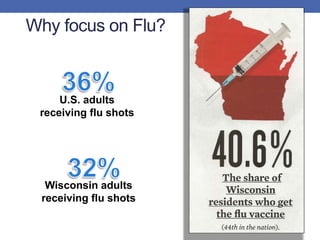
Why focus on Flu?
U.S. adults
receiving flu shots
Wisconsin adults
receiving flu shots
IS IT A FLU SHOT?
Or an influenza immunization?
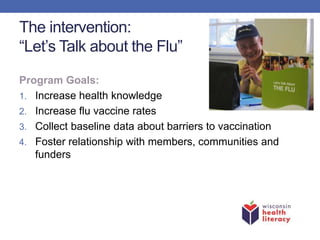
The intervention:
“Let’s Talk about the Flu”
Program Goals:
1. Increase health knowledge
2. Increase flu vaccine rates
3. Collect baseline data about barriers to vaccination
4. Foster relationship with members, communities and
funders
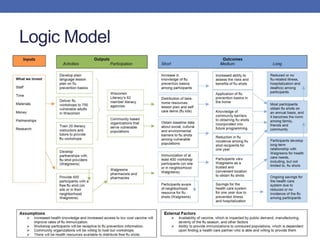
Logic Model
The strategy
Focus on groups with anticipated lower health
literacy and lower immunization rates
• Adults with low literacy
• Disadvantaged adults
• Immigrants/refugees
• Homeless adults
• Racial/ethnic groups
• Seniors
Ethnic minorities & health literacy
Below basic health literacy:
• 9% - Caucasians
• 25% - American Indians and Alaskan Natives
• 24% - African Americans
• 41% - Latinos
NAAL, 2003
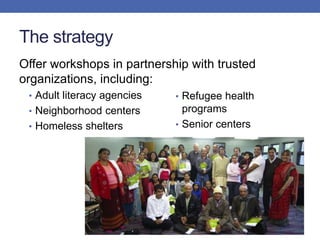
The strategy
Offer workshops in partnership with trusted
organizations, including:
• Adult literacy agencies
• Neighborhood centers
• Homeless shelters
• Refugee health
programs
• Senior centers
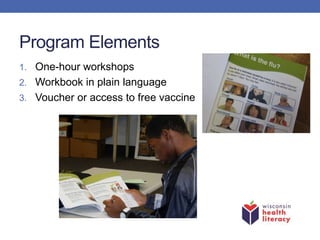
Program Elements
1. One-hour workshops
2. Workbook in plain language
3. Voucher or access to free vaccine
Program Elements
Flu Prevention Kit as incentive
Program Resources
1. Instructor Guide
2. Myths and misconceptions
3. Partner Stipends
4. Promotional Support
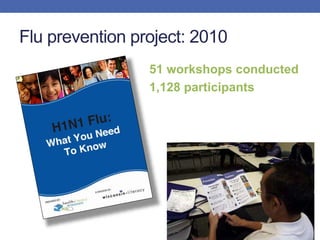
Flu prevention project: 2010
51 workshops conducted
1,128 participants
Flu prevention project: 2010
What we learned:
• Need to measure behavior
change
• Consider flu clinics
• Confirm understanding:
“I heard you can get
immunity from the shot.”
• Answer common questions
Flu prevention project: 2010
Common comments and questions:
• I know someone who got sick from the shot.
• How often do I need the shot?
• How long does immunity take?
• What is stomach flu?
• Does flu cause pneumonia?
• Where can I get a free shot?
Flu prevention project: 2011
53 workshops conducted
943 participants
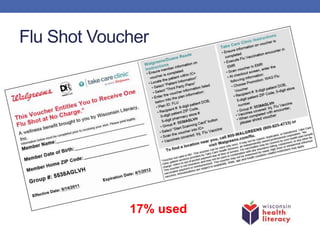
Flu Shot Voucher
17% used
Flu prevention project: 2011
What we learned:
• Challenge to measure
actual vaccination rates
• Need child care
• Address cultural myths
• PowerPoints optional
• Adapt for educational vs.
non-educational settings
Flu prevention project: 2013
21 workshops conducted
467 participants
The booklet
Tested through literacy
partners
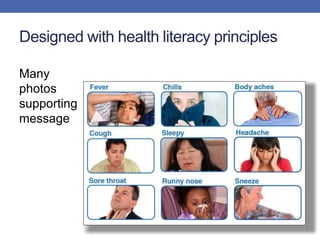
Designed with health literacy principles
Many
photos
supporting
message
Designed with health literacy principles
Lots of white space
Larger type,
plain language
Designed with health literacy principles
Easy-to-follow
organization
Designed with health literacy principles
Making it
personal
Designed with health literacy principles
Check for understanding
Types of Evaluation
• Needs assessments – What do we need?
• Previous workshop experience
• Interviews with public and community health authorities
• Literature reviews
• Process evaluations – How did we do it?
• Staff survey
• Feedback from community contacts
• Outcome evaluations – What happened as a result?
• Participant pre-and post-tests
• Change in vaccination intention
• Change in vaccination behavior
• Public relations outcomes
Pre- and post-tests
Outcome Objectives: Know, Think, Do
• KNOW (Learning objectives)
• Ex. By the end of the workshop, all 750 learners should be able to
identify symptoms of the flu, including cough, sore throat and fever
• THINK (Belief objectives)
• Ex. By the end of the workshop, all 750 learners should be able to
discuss personal beliefs about flu vaccines, including whom they
trust to make important health care decisions
• DO (Behavioral objectives)
• Within 3 months of the workshop, 400 learners will obtain a flu
vaccine
Results – Outcome objectives
KNOW (Learning objectives)
• Average pre-test score: 55.7%
• Average post-test score: 82.7%
THINK (Belief objectives)
• Intend to vaccinate before workshop: 73.9%
• Intend to vaccinate after workshop: 83.1%
• Open-ended responses to reasons why/why not vaccinated in the past
DO (Behavior objectives)
• Vaccinated before workshop: 12.2%
• Used Walgreens voucher: 17.1%
• Obtained on-site flu vaccine: 13.1%
• Obtained flu vaccine in clinical setting: unknown
• Total vaccinated (minimum): 42.4%
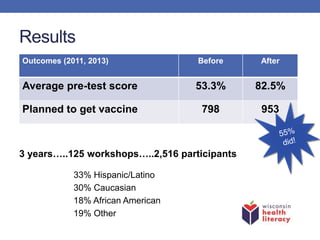
Results
33% Hispanic/Latino
30% Caucasian
18% African American
19% Other
Outcomes (2011, 2013) Before After
Average pre-test score 53.3% 82.5%
Planned to get vaccine 798 953
3 years…..125 workshops…..2,516 participants
#1 reason people got a shot:
(of those who gave a reason)
“I want to protect myself.
I don’t want to get sick”
Other common reasons:
Doctor recommended it
In a high risk group (age, health condition)
Required (by employer, school, prison)
#1 reason people didn’t get a flu shot:
(of those who gave a reason)
“I am healthy,
never had the flu”
Other barriers:
Worried about side effects; made me or someone I know get sick
Just don’t want it; don’t think it’s necessary
Couldn’t afford it; don’t have insurance
Hurts; hate needles
What we’d do different in the future
• Provide materials translation
• More on-the-spot clinics following workshops
• Offer program for general audiences
The future of “Let’s Talk about the Flu”
Steve Sparks, Health Literacy Director
steve@wisconsinliteracy.org

Steve Sparks - "Let's Talk about the Flu": Communicating Health Prevention to Hard-to-Reach, At-Risk Populations

  • 1.
    LET’S TALK ABOUTTHE FLU Communicating Health Prevention to Hard-to-Reach, At-Risk Populations Steve Sparks Director Wisconsin Health Literacy a division of Wisconsin Literacy, Inc. March 13, 2015 PLAIN TALK in Complex Times
  • 2.
    Division of WisconsinLiteracy  73 member literacy agencies 18,000 adult learners; 3300 volunteer tutors Training, Consultation and Interventions on Health Literacy Health Literacy Summit: April 14-15, 2015 WisconsinHealthLiteracy.org Wisconsin Health Literacy
  • 3.
    Why focus onFlu? U.S. adults receiving flu shots Wisconsin adults receiving flu shots
  • 4.
    IS IT AFLU SHOT? Or an influenza immunization?
  • 5.
    The intervention: “Let’s Talkabout the Flu” Program Goals: 1. Increase health knowledge 2. Increase flu vaccine rates 3. Collect baseline data about barriers to vaccination 4. Foster relationship with members, communities and funders
  • 6.
  • 7.
    The strategy Focus ongroups with anticipated lower health literacy and lower immunization rates • Adults with low literacy • Disadvantaged adults • Immigrants/refugees • Homeless adults • Racial/ethnic groups • Seniors
  • 8.
    Ethnic minorities &health literacy Below basic health literacy: • 9% - Caucasians • 25% - American Indians and Alaskan Natives • 24% - African Americans • 41% - Latinos NAAL, 2003
  • 9.
    The strategy Offer workshopsin partnership with trusted organizations, including: • Adult literacy agencies • Neighborhood centers • Homeless shelters • Refugee health programs • Senior centers
  • 10.
    Program Elements 1. One-hourworkshops 2. Workbook in plain language 3. Voucher or access to free vaccine
  • 11.
  • 12.
    Program Resources 1. InstructorGuide 2. Myths and misconceptions 3. Partner Stipends 4. Promotional Support
  • 13.
    Flu prevention project:2010 51 workshops conducted 1,128 participants
  • 14.
    Flu prevention project:2010 What we learned: • Need to measure behavior change • Consider flu clinics • Confirm understanding: “I heard you can get immunity from the shot.” • Answer common questions
  • 15.
    Flu prevention project:2010 Common comments and questions: • I know someone who got sick from the shot. • How often do I need the shot? • How long does immunity take? • What is stomach flu? • Does flu cause pneumonia? • Where can I get a free shot?
  • 16.
    Flu prevention project:2011 53 workshops conducted 943 participants
  • 17.
  • 18.
    Flu prevention project:2011 What we learned: • Challenge to measure actual vaccination rates • Need child care • Address cultural myths • PowerPoints optional • Adapt for educational vs. non-educational settings
  • 19.
    Flu prevention project:2013 21 workshops conducted 467 participants
  • 20.
    The booklet Tested throughliteracy partners
  • 21.
    Designed with healthliteracy principles Many photos supporting message
  • 22.
    Designed with healthliteracy principles Lots of white space Larger type, plain language
  • 23.
    Designed with healthliteracy principles Easy-to-follow organization
  • 24.
    Designed with healthliteracy principles Making it personal
  • 25.
    Designed with healthliteracy principles Check for understanding
  • 26.
    Types of Evaluation •Needs assessments – What do we need? • Previous workshop experience • Interviews with public and community health authorities • Literature reviews • Process evaluations – How did we do it? • Staff survey • Feedback from community contacts • Outcome evaluations – What happened as a result? • Participant pre-and post-tests • Change in vaccination intention • Change in vaccination behavior • Public relations outcomes
  • 27.
  • 28.
    Outcome Objectives: Know,Think, Do • KNOW (Learning objectives) • Ex. By the end of the workshop, all 750 learners should be able to identify symptoms of the flu, including cough, sore throat and fever • THINK (Belief objectives) • Ex. By the end of the workshop, all 750 learners should be able to discuss personal beliefs about flu vaccines, including whom they trust to make important health care decisions • DO (Behavioral objectives) • Within 3 months of the workshop, 400 learners will obtain a flu vaccine
  • 29.
    Results – Outcomeobjectives KNOW (Learning objectives) • Average pre-test score: 55.7% • Average post-test score: 82.7% THINK (Belief objectives) • Intend to vaccinate before workshop: 73.9% • Intend to vaccinate after workshop: 83.1% • Open-ended responses to reasons why/why not vaccinated in the past DO (Behavior objectives) • Vaccinated before workshop: 12.2% • Used Walgreens voucher: 17.1% • Obtained on-site flu vaccine: 13.1% • Obtained flu vaccine in clinical setting: unknown • Total vaccinated (minimum): 42.4%
  • 30.
    Results 33% Hispanic/Latino 30% Caucasian 18%African American 19% Other Outcomes (2011, 2013) Before After Average pre-test score 53.3% 82.5% Planned to get vaccine 798 953 3 years…..125 workshops…..2,516 participants
  • 31.
    #1 reason peoplegot a shot: (of those who gave a reason) “I want to protect myself. I don’t want to get sick” Other common reasons: Doctor recommended it In a high risk group (age, health condition) Required (by employer, school, prison)
  • 32.
    #1 reason peopledidn’t get a flu shot: (of those who gave a reason) “I am healthy, never had the flu” Other barriers: Worried about side effects; made me or someone I know get sick Just don’t want it; don’t think it’s necessary Couldn’t afford it; don’t have insurance Hurts; hate needles
  • 33.
    What we’d dodifferent in the future • Provide materials translation • More on-the-spot clinics following workshops • Offer program for general audiences
  • 34.
    The future of“Let’s Talk about the Flu” Steve Sparks, Health Literacy Director steve@wisconsinliteracy.org

Editor's Notes

  • #3 Wisconsin Literacy, Inc. is a coalition of 70 adult literacy agencies in Wisconsin We have four focus areas: Workforce development Members & communities Governmental advocacy Health literacy Health Literacy efforts formalized into a new division in 2010, Health Literacy Wisconsin 4 regional literacy consultants in four corners of the state Working with between 15-20 adult literacy agencies per region
  • #6 Program Goals: Increase health knowledge on the topic of flu prevention basics among vulnerable populations; Increase flu vaccine rates among vulnerable populations by removing barriers related to knowledge, access and cost; and Collect baseline data about additional barriers to immunization, including social, cultural and environmental barriers. Foster relationship with members, communities and funder through appropriate and timely PR practices
  • #7 Logic Model A visual representation of the relationship between the elements of your program strategy Inputs (staff, time, materials, money) Outputs (activities) Outcomes (short, medium and long-term)
  • #8 Based on objectives, selected strategies Spoke with many stakeholders, including public health and community health workers, past participants, and staff Conducted a comprehensive literature review on appropriate strategies for engaging vulnerable populations on health topics, with a specific emphasis on how to change vaccination decisions Lesson plan pre-tested by a medical student with five of Wisconsin Literacy’s partners, including staff and students at selected member agencies.  
  • #9 Based on objectives, selected strategies Spoke with many stakeholders, including public health and community health workers, past participants, and staff Conducted a comprehensive literature review on appropriate strategies for engaging vulnerable populations on health topics, with a specific emphasis on how to change vaccination decisions Lesson plan pre-tested by a medical student with five of Wisconsin Literacy’s partners, including staff and students at selected member agencies.  
  • #10 Literature shows best results from meeting people where they live, learn, work, pray and play. Literacy agencies – insight into challenges of their clients
  • #14 2010: grant to do H1N1 messaging to vulnerable populations, including immigrants and refugees from Wisconsin Department of Health Services, Division of Public Health, through a CDC grant. 51 workshops for 1,128 people Anecdotal feedback was very positive Information we did not capture How would we know if we did a good job? Did we change anyone’s health behavior as a result of our efforts?
  • #15 2010: grant to do H1N1 messaging to vulnerable populations, including immigrants and refugees from Wisconsin Department of Health Services, Division of Public Health, through a CDC grant. 51 workshops for 1,128 people Anecdotal feedback was very positive Information we did not capture How would we know if we did a good job? Did we change anyone’s health behavior as a result of our efforts?
  • #16 2010: grant to do H1N1 messaging to vulnerable populations, including immigrants and refugees from Wisconsin Department of Health Services, Division of Public Health, through a CDC grant. 51 workshops for 1,128 people Anecdotal feedback was very positive Information we did not capture How would we know if we did a good job? Did we change anyone’s health behavior as a result of our efforts?
  • #17 2011: funding from Anthem Blue Cross and Blue Shield 53 workshops for 943 people build upon the basic concept and answer some of these questions. Focused on social marketing strategies removing barriers to vaccination and tracking flu vaccination outcomes Define outcomes we wanted to measure
  • #18 756- Distributed 157 – Used (17%)
  • #19 Cultural myths: Flu shot causes sterilization Causes people to get sick
  • #20 2012: No application due to changed schedules and requirements 2013: Reapplied to Anthem – funded less than requested, reduced # workshops. 21 workshops for 467 people
  • #21 2012: No application due to changed schedules and requirements 2013: Reapplied to Anthem – funded less than requested, reduced # workshops. 21 workshops for 467 people
  • #27 Needs assessments – What do we need? Considers the needs of stakeholders to develop appropriate goals Tool for strategic planning and priority-setting Process evaluations – How did we do it? Determine if a program is being conducted as planned Determine how processes can be improved Outcome evaluations – What happened as a result? Determine if a program is meeting its goals Compares current performance against prior performance While we conducted a comprehensive evaluation, including a needs assessment and a process evaluation, I will focus today on outcome evaluations, which focus on concrete outcomes that happened as a result of our efforts. These were measured through participant pre and post-tests, tracking of vaccination outcomes, and tracking of public relations efforts.
  • #29 Objectives are the building blocks or steps towards achieving a program's goals. Objectives are specific and concise statements that state who will make what change, by how much, where and by when. As a result of this program, project or activity, what do we want our constituents to: Know? Think? Do? Objectives can be: Short-term Intermediate Long-term
  • #31 In 2013 of 467 participants: 215 were planning to get shot before workshop 261 planned to get shot after workshop (257 did) In 2011, of 943 learners; 756 vouchers distributed; 17% used 21.8% were seniors; 78.2% Adults 241 were ELL students PR Results Feature-length articles in 3 statewide publications Results shared at 4 statewide/national conferences Video clips for use in HLW public relations 2012: Health Literacy Innovator Award – 1st Place, “ReadsEasy” Publication Award