
Janet futures
Jeremy Sharp
December 2017
1
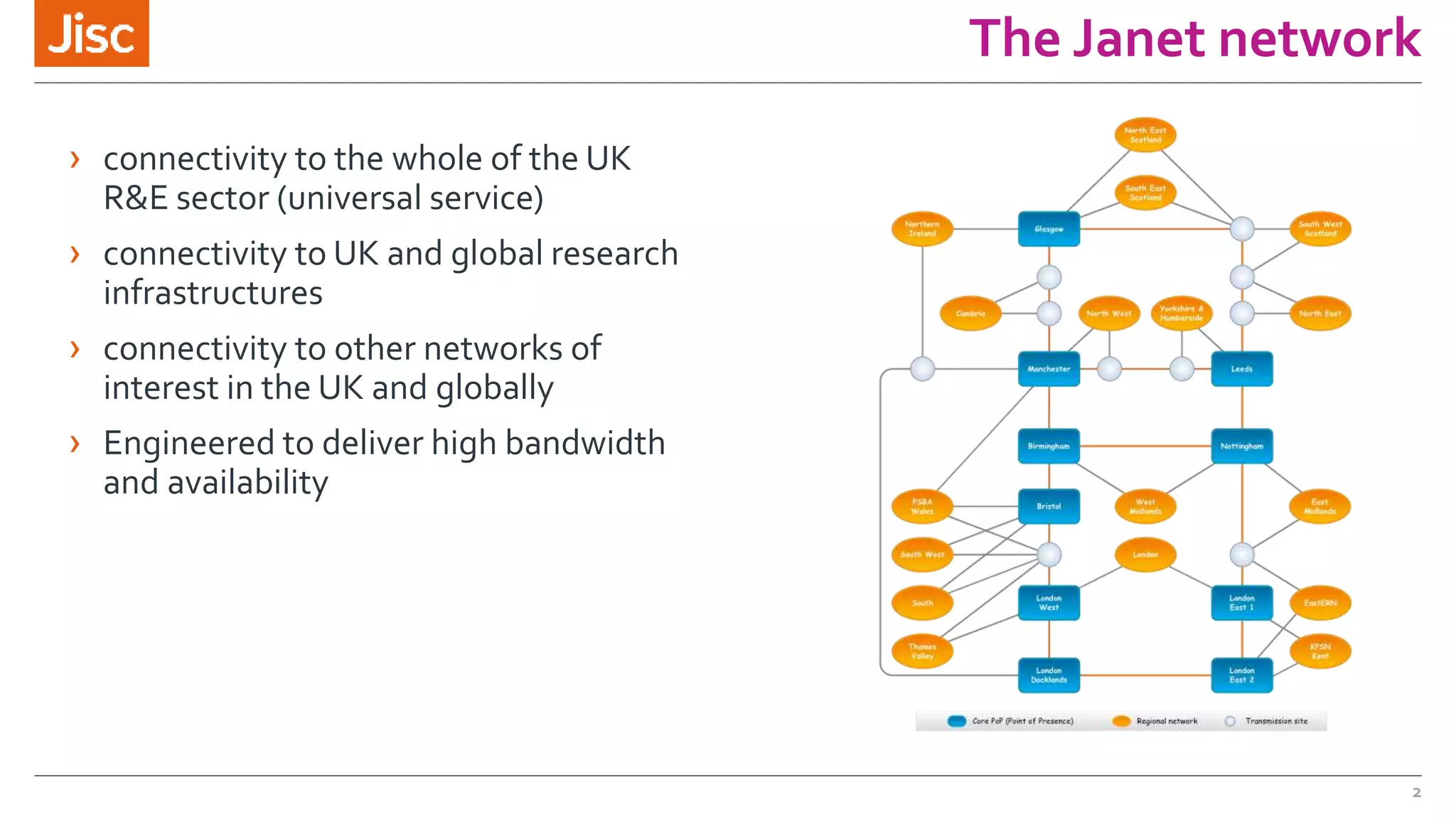
The Janet network
› connectivity to the whole of the UK
R&E sector (universal service)
› connectivity to UK and global research
infrastructures
› connectivity to other networks of
interest in the UK and globally
› Engineered to deliver high bandwidth
and availability
2
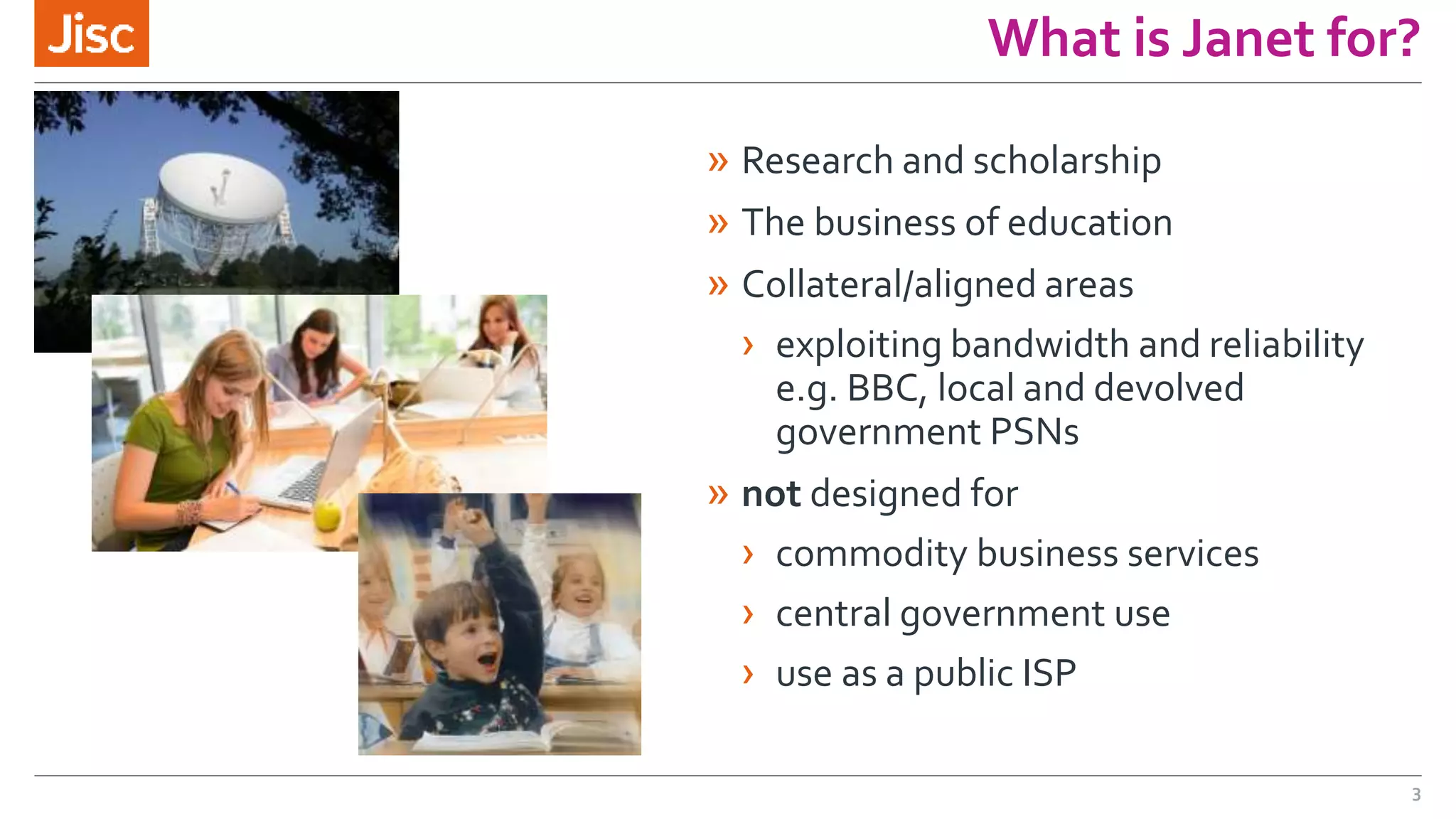
What is Janet for?
» Research and scholarship
» The business of education
» Collateral/aligned areas
› exploiting bandwidth and reliability
e.g. BBC, local and devolved
government PSNs
» not designed for
› commodity business services
› central government use
› use as a public ISP
3
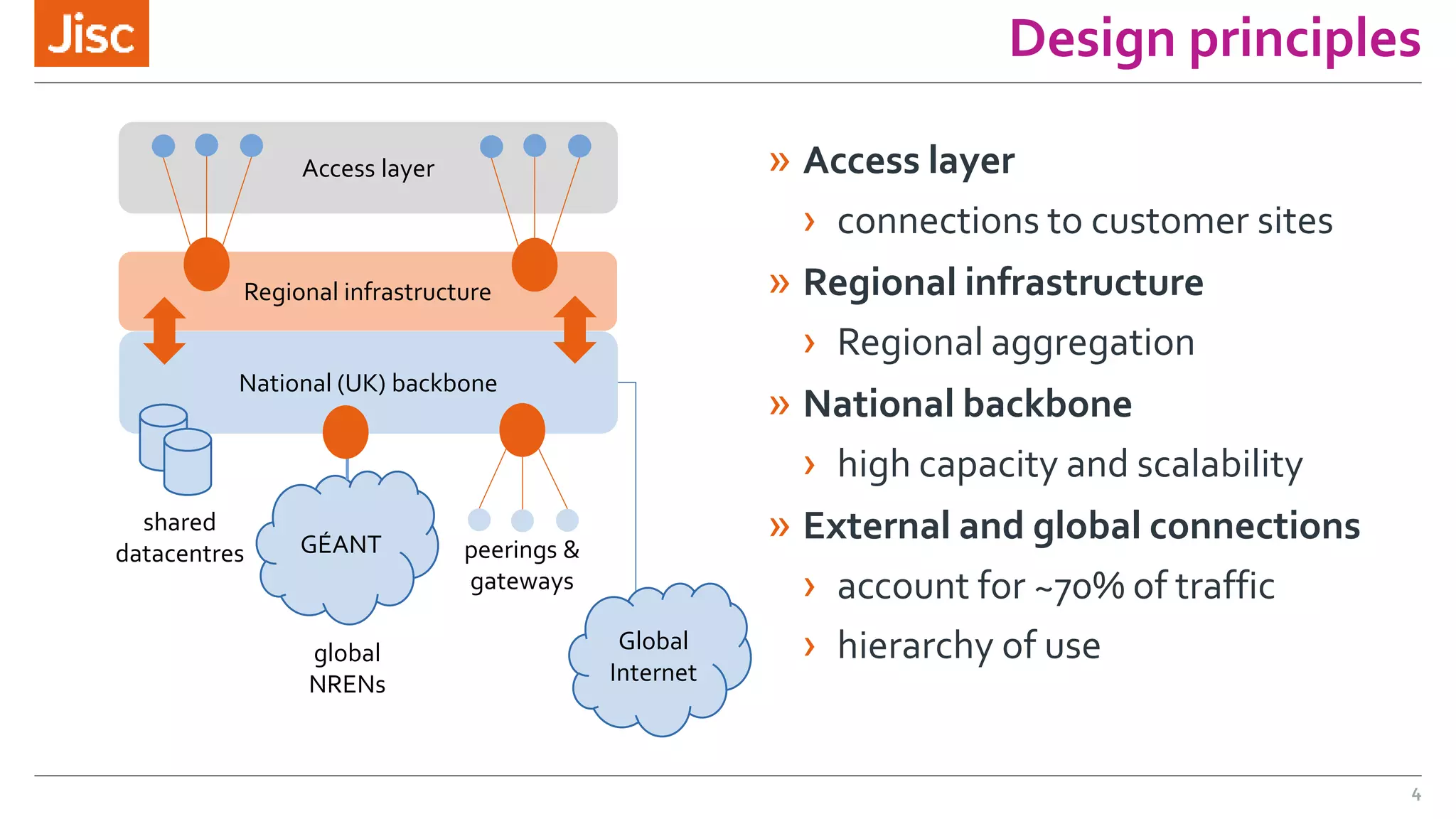
Design principles
» Access layer
› connections to customer sites
» Regional infrastructure
› Regional aggregation
» National backbone
› high capacity and scalability
» External and global connections
› account for ~70% of traffic
› hierarchy of use
Regional infrastructure
National (UK) backbone
shared
datacentres
Global
Internet
GÉANT peerings &
gateways
Access layer
global
NRENs
4
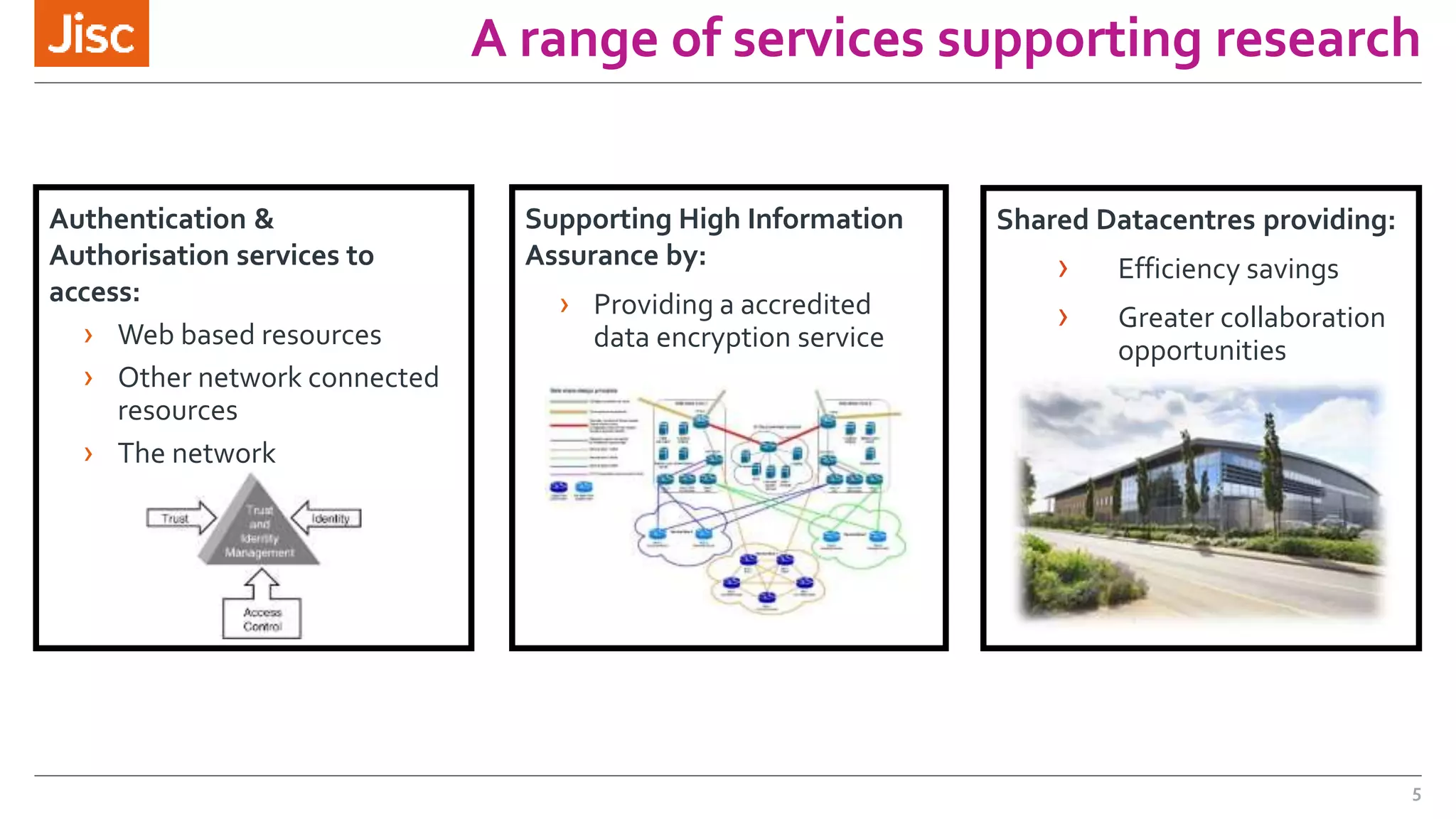
A range of services supporting research
Authentication &
Authorisation services to
access:
› Web based resources
› Other network connected
resources
› The network
Supporting High Information
Assurance by:
› Providing a accredited
data encryption service
Shared Datacentres providing:
› Efficiency savings
› Greater collaboration
opportunities
5
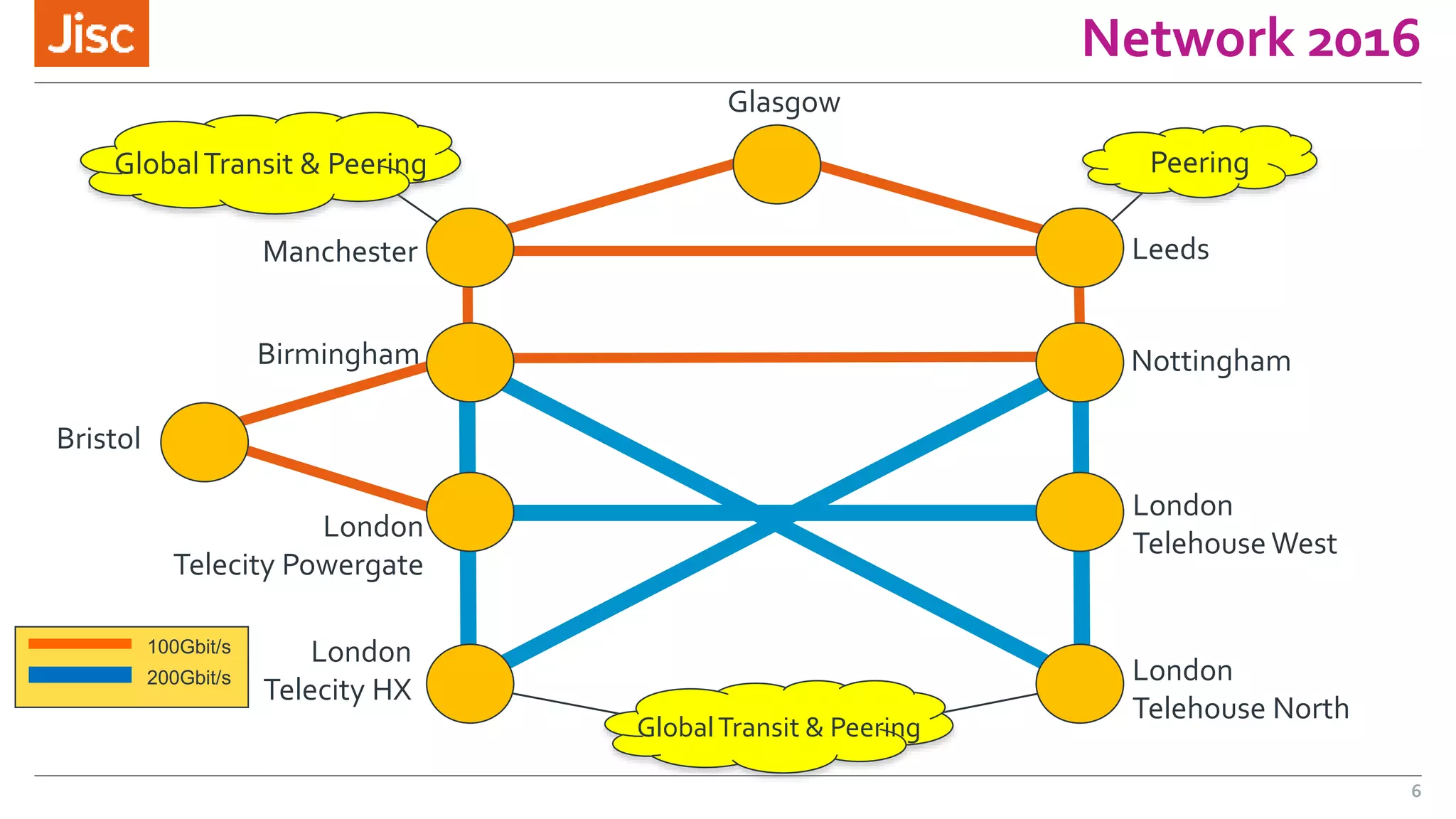
Glasgow
Leeds
London
Telehouse West
Bristol
Manchester
London
Telecity Powergate
Birmingham Nottingham
London
Telehouse North
London
Telecity HX
GlobalTransit & Peering Peering
GlobalTransit & Peering
100Gbit/s
200Gbit/s
Network 2016
6
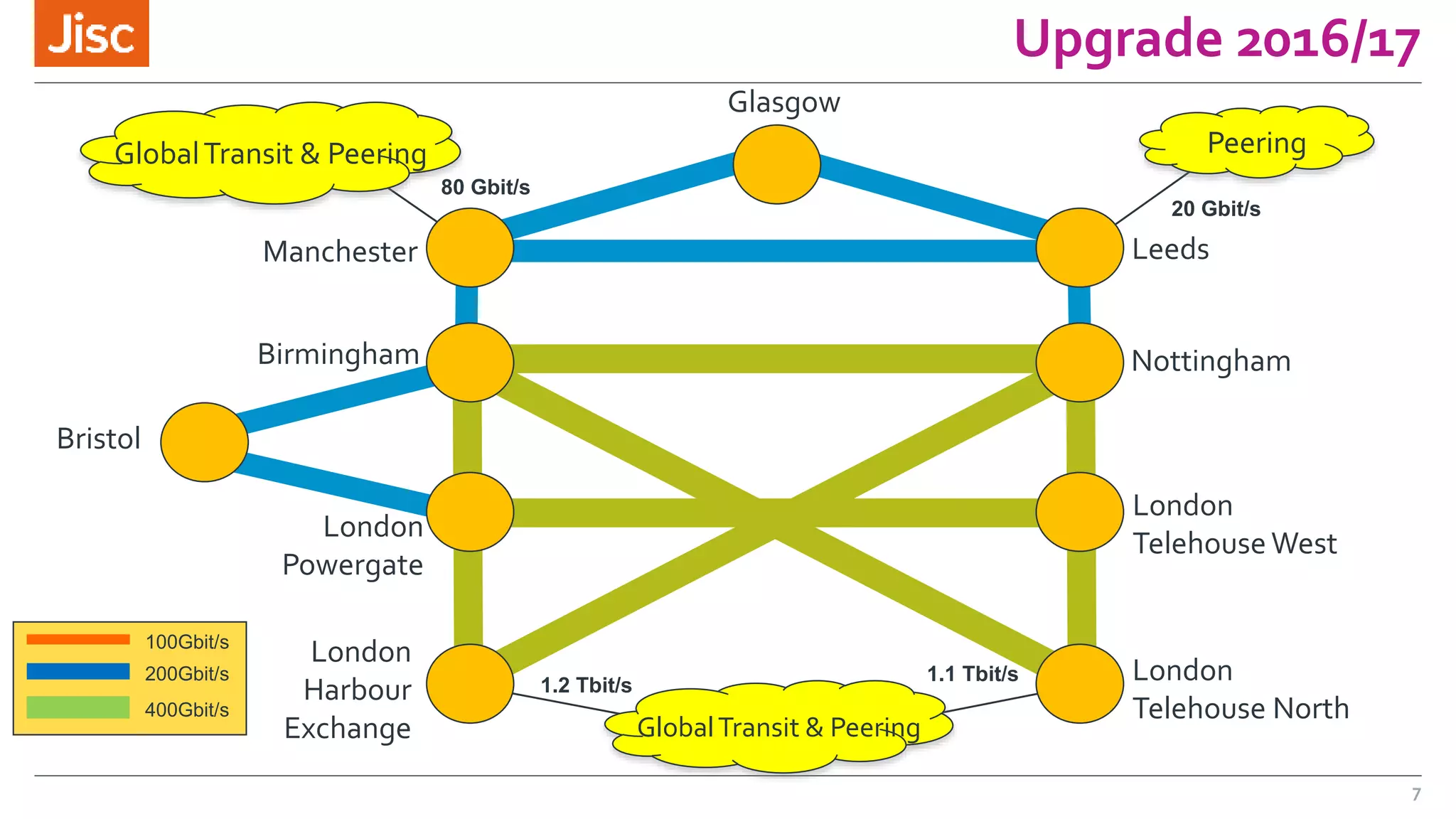
Leeds
London
Telehouse West
Bristol
Manchester
London
Powergate
Birmingham Nottingham
London
Telehouse North
London
Harbour
Exchange
GlobalTransit & Peering Peering
GlobalTransit & Peering
100Gbit/s
200Gbit/s
400Gbit/s
Upgrade 2016/17
Glasgow
1.2 Tbit/s
1.1 Tbit/s
80 Gbit/s
20 Gbit/s
7
Telecity
Powergate
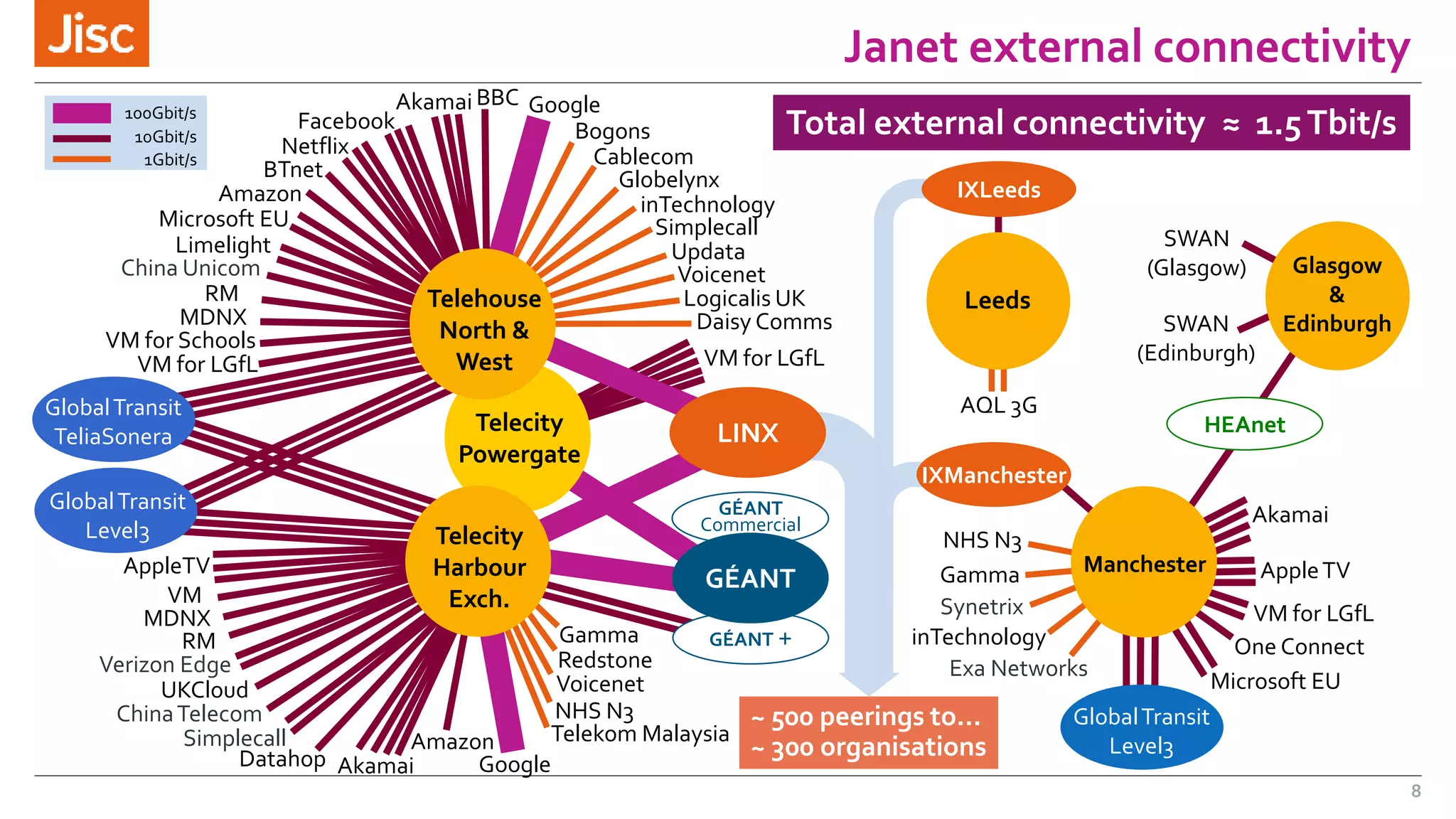
Janet external connectivity
Total external connectivity ≈ 1.5Tbit/s
Netflix
Voicenet
Akamai
Daisy Comms
Bogons
Logicalis UK
BTnet
Amazon
inTechnology
Simplecall
Gamma
Google
Simplecall
Redstone
Updata
Cablecom
Voicenet
Google
Limelight
UKCloud
Akamai BBC
Datahop
Microsoft EU
Telekom Malaysia
Globelynx
10Gbit/s
1Gbit/s
100Gbit/s
GÉANT +
Akamai
VM for LGfL
Gamma
NHS N3
Exa Networks
Synetrix
One Connect
Glasgow
&
Edinburgh
HEAnet
inTechnology
NHS N3
SWAN
(Glasgow)
SWAN
(Edinburgh)
Telehouse
North &
West
VM
RM
VM for LGfL
RM
GlobalTransit
TeliaSonera
IXLeeds
GlobalTransit
Level3
GlobalTransit
Level3
Microsoft EU
China Unicom
ChinaTelecom ~ 500 peerings to…
~ 300 organisations
IXManchester
LINX
Manchester
AQL 3G
Leeds
Amazon
Verizon Edge
AppleTV
VM for LGfL
Telecity
Harbour
Exch.
GÉANT
Commercial
GÉANT
MDNX
MDNX
VM for Schools
AppleTV
Facebook
8
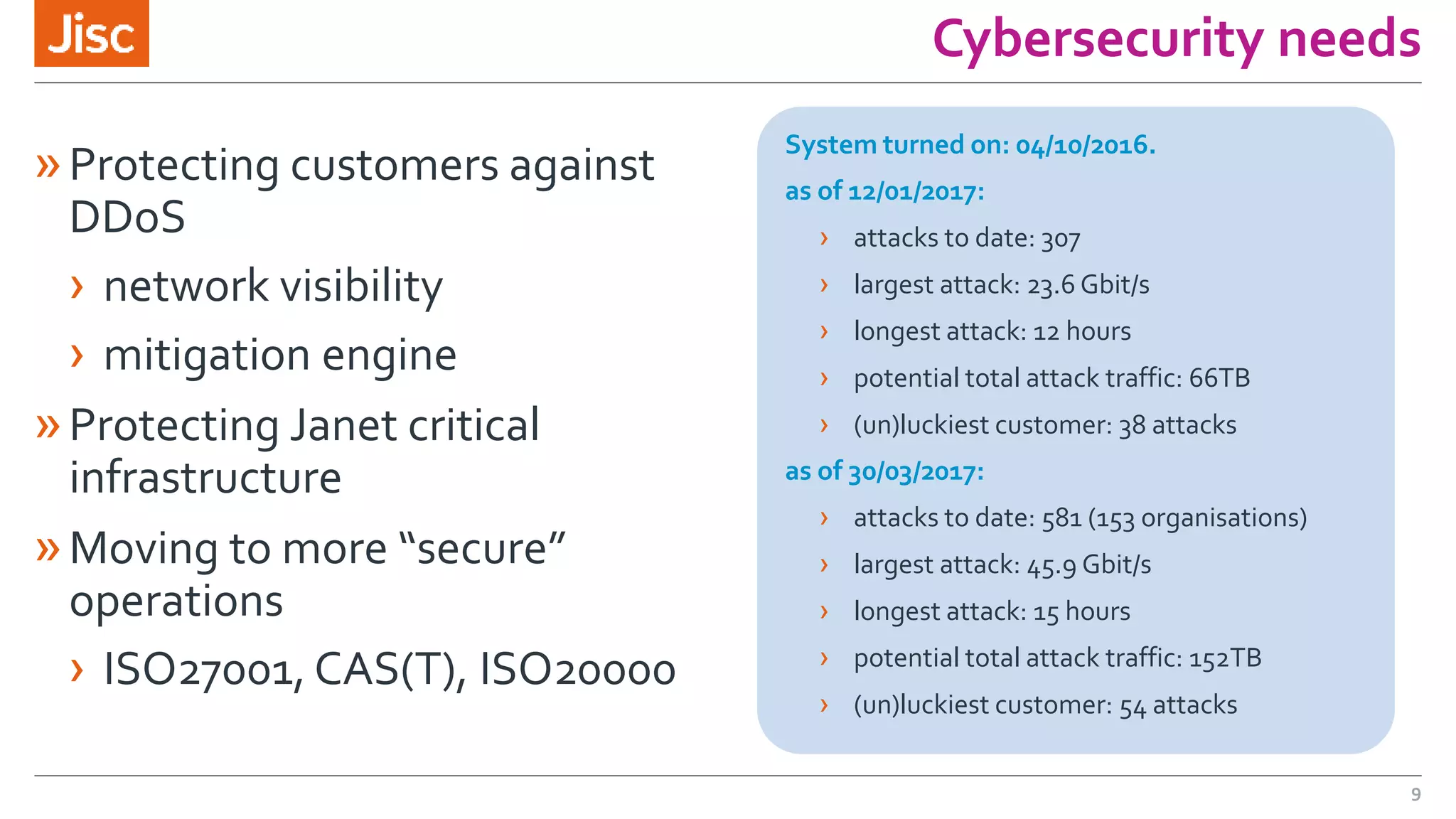
Cybersecurity needs
»Protecting customers against
DDoS
› network visibility
› mitigation engine
»Protecting Janet critical
infrastructure
»Moving to more “secure”
operations
› ISO27001, CAS(T), ISO20000
System turned on: 04/10/2016.
as of 12/01/2017:
› attacks to date: 307
› largest attack: 23.6 Gbit/s
› longest attack: 12 hours
› potential total attack traffic: 66TB
› (un)luckiest customer: 38 attacks
as of 30/03/2017:
› attacks to date: 581 (153 organisations)
› largest attack: 45.9 Gbit/s
› longest attack: 15 hours
› potential total attack traffic: 152TB
› (un)luckiest customer: 54 attacks
9
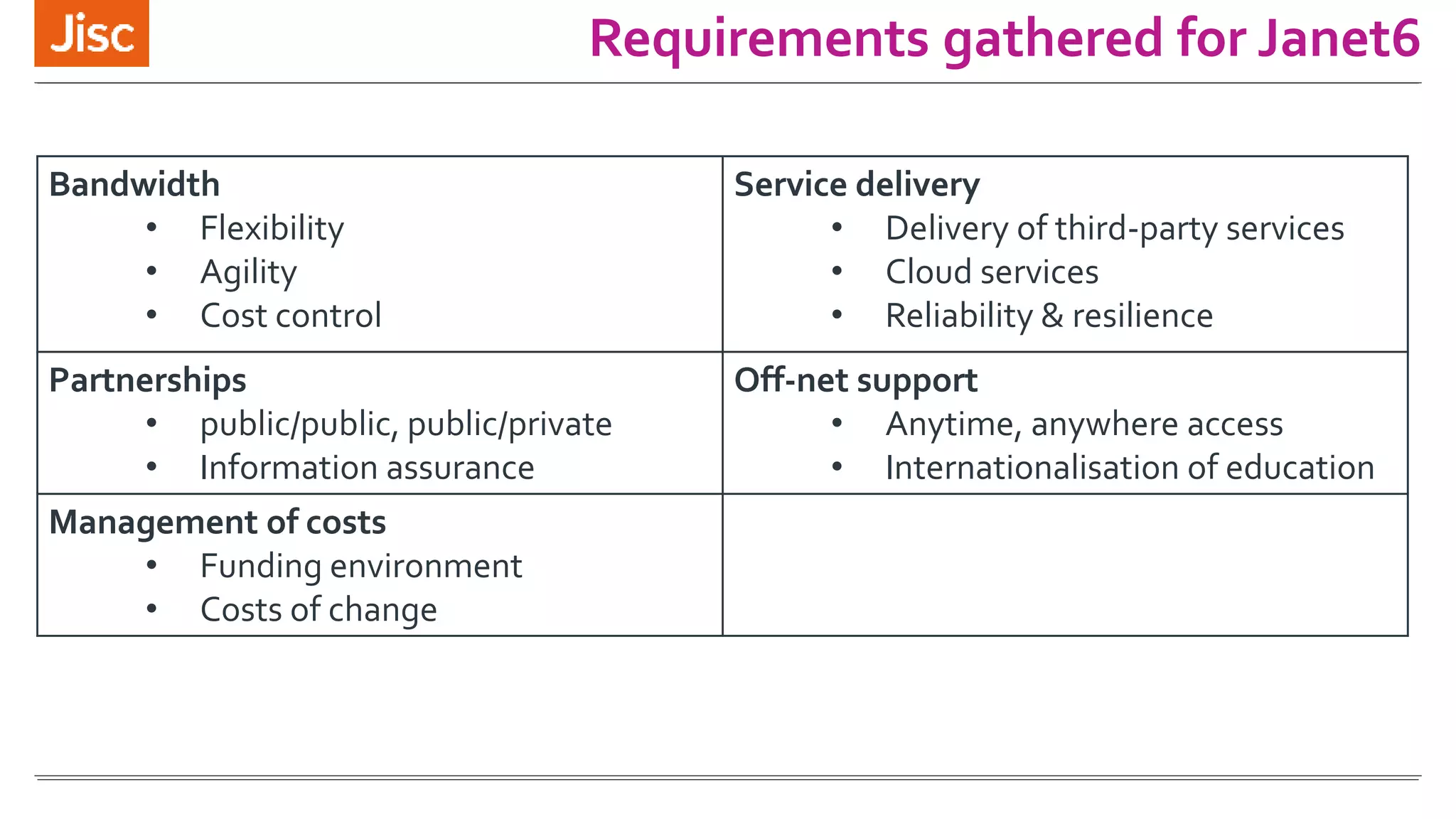
Requirements gathered for Janet6
Bandwidth
• Flexibility
• Agility
• Cost control
Service delivery
• Delivery of third-party services
• Cloud services
• Reliability & resilience
Partnerships
• public/public, public/private
• Information assurance
Off-net support
• Anytime, anywhere access
• Internationalisation of education
Management of costs
• Funding environment
• Costs of change
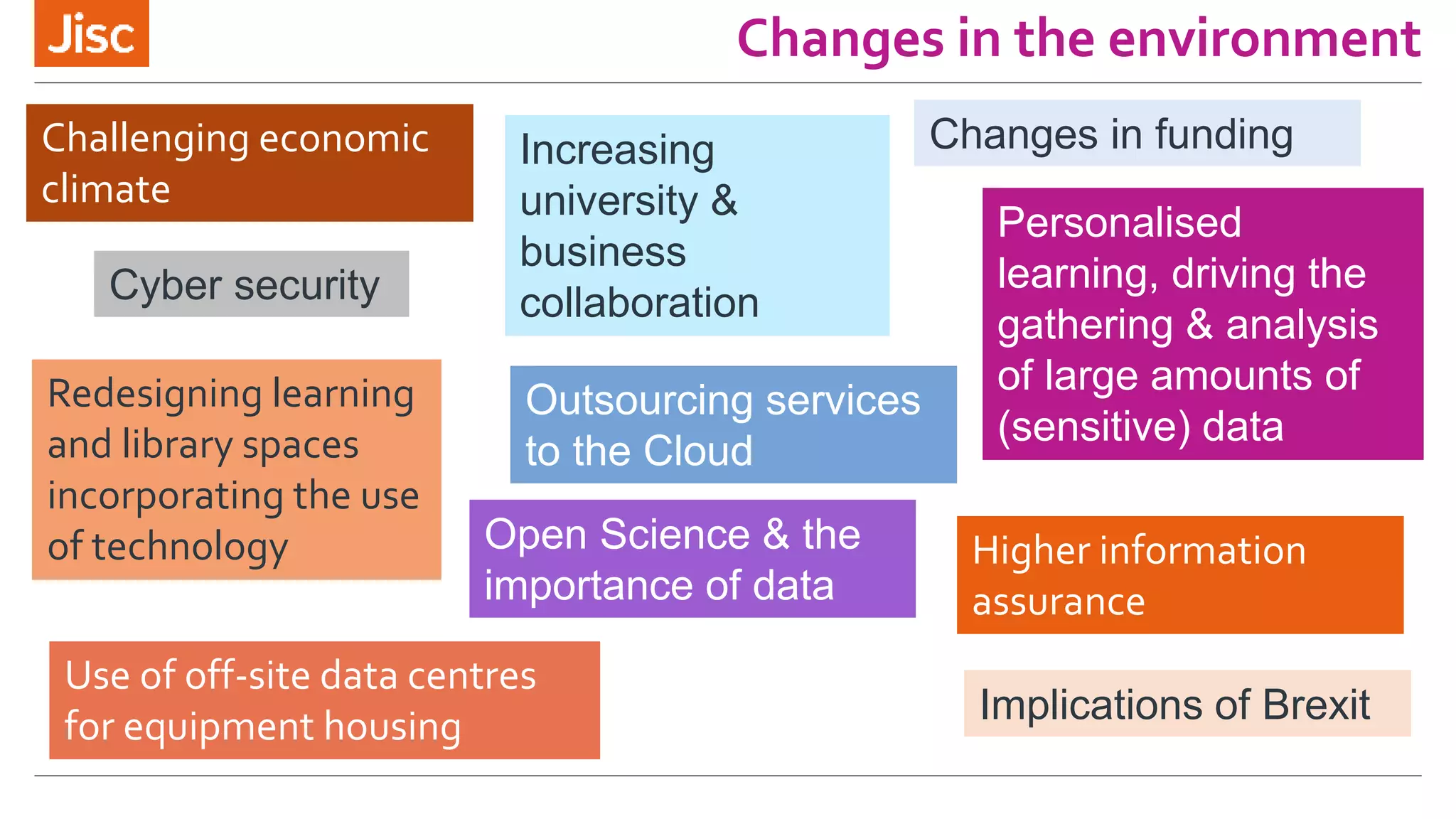
Changes in the environment
Changes in funding
Higher information
assurance
Use of off-site data centres
for equipment housing
Challenging economic
climate
Cyber security
Outsourcing services
to the Cloud
Open Science & the
importance of data
Implications of Brexit
Increasing
university &
business
collaboration
Redesigning learning
and library spaces
incorporating the use
of technology
Personalised
learning, driving the
gathering & analysis
of large amounts of
(sensitive) data
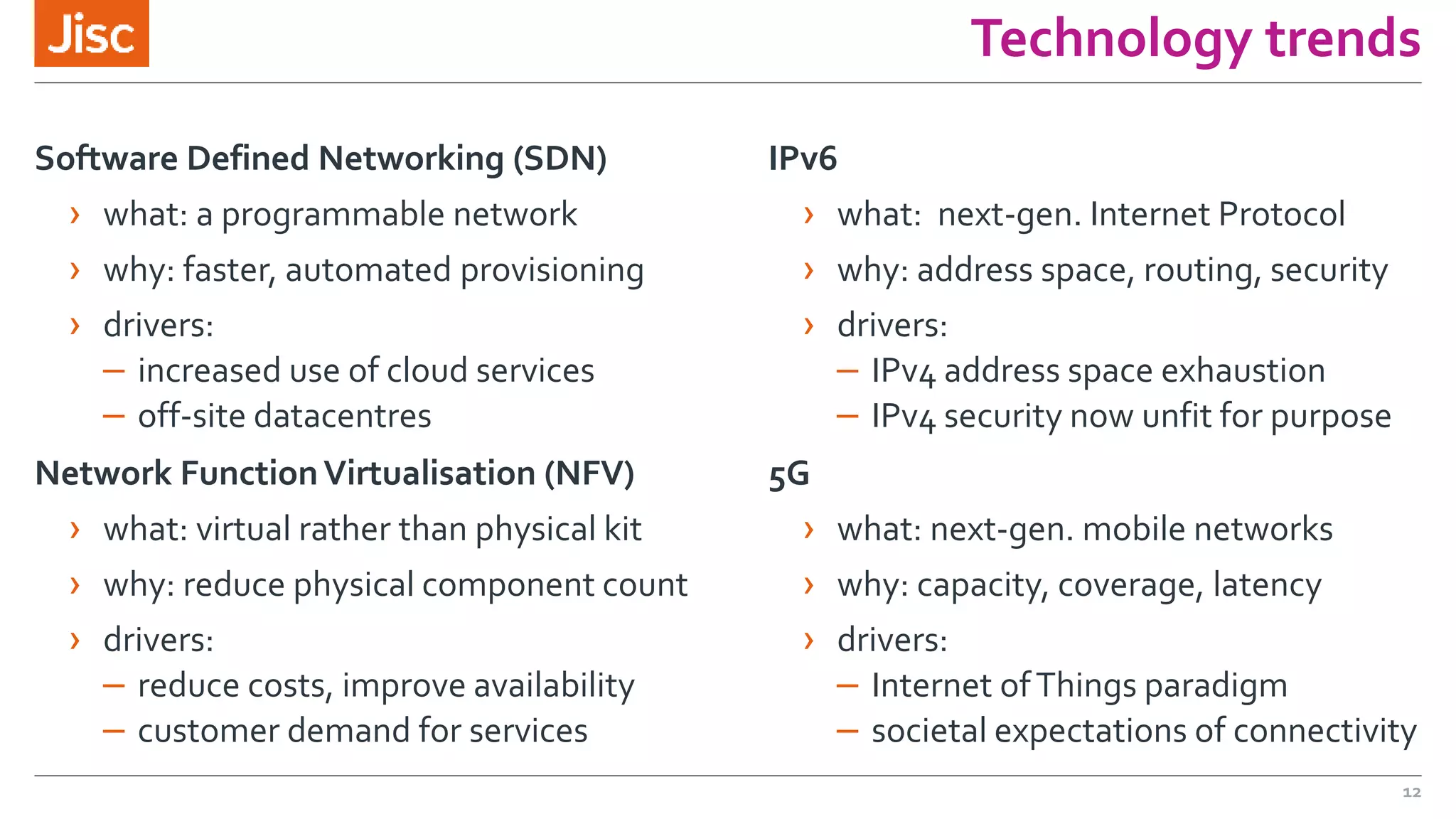
Technology trends
Software Defined Networking (SDN)
› what: a programmable network
› why: faster, automated provisioning
› drivers:
– increased use of cloud services
– off-site datacentres
Network FunctionVirtualisation (NFV)
› what: virtual rather than physical kit
› why: reduce physical component count
› drivers:
– reduce costs, improve availability
– customer demand for services
IPv6
› what: next-gen. Internet Protocol
› why: address space, routing, security
› drivers:
– IPv4 address space exhaustion
– IPv4 security now unfit for purpose
5G
› what: next-gen. mobile networks
› why: capacity, coverage, latency
› drivers:
– Internet ofThings paradigm
– societal expectations of connectivity
12
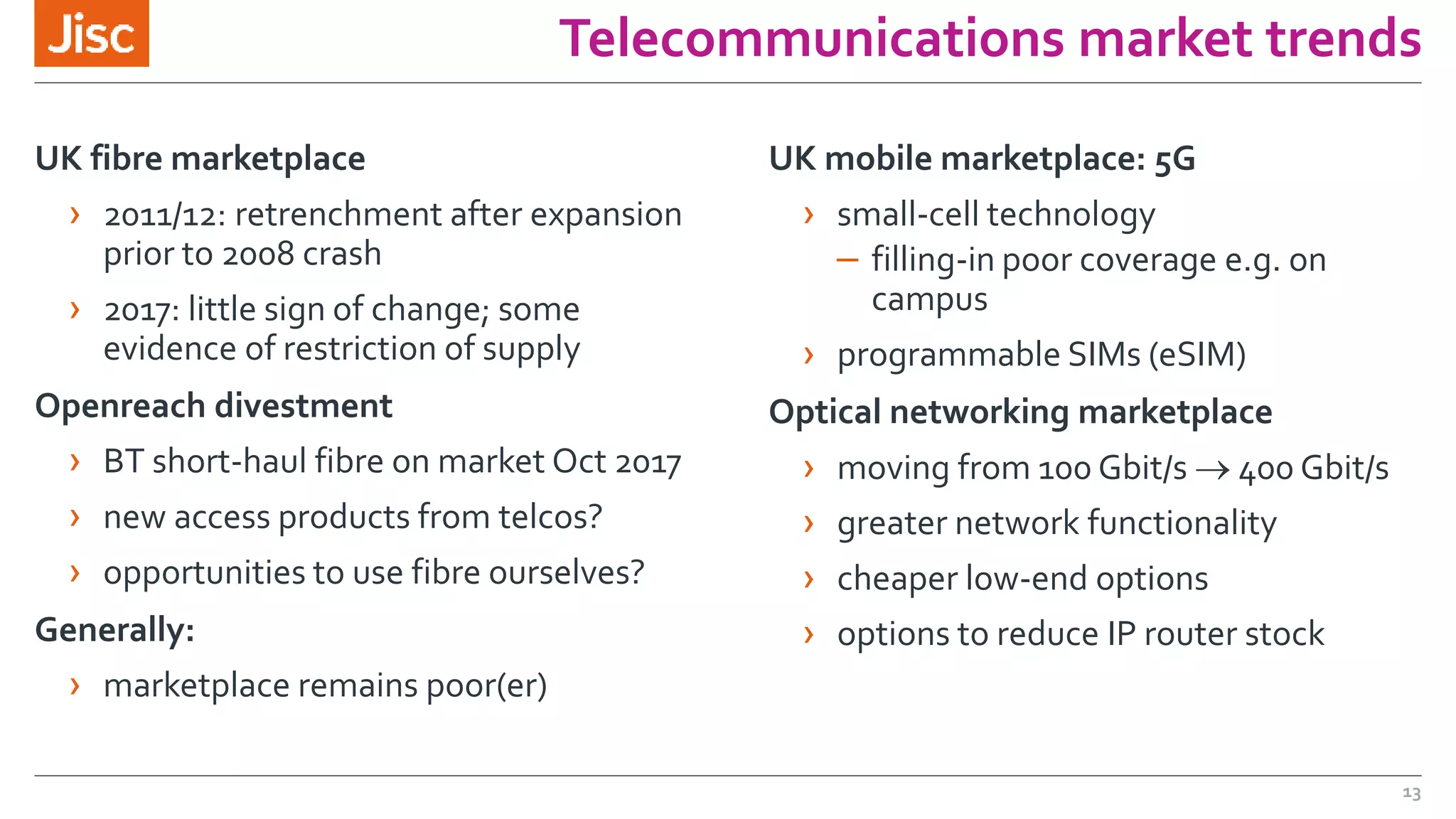
Telecommunications market trends
UK fibre marketplace
› 2011/12: retrenchment after expansion
prior to 2008 crash
› 2017: little sign of change; some
evidence of restriction of supply
Openreach divestment
› BT short-haul fibre on market Oct 2017
› new access products from telcos?
› opportunities to use fibre ourselves?
Generally:
› marketplace remains poor(er)
UK mobile marketplace: 5G
› small-cell technology
– filling-in poor coverage e.g. on
campus
› programmable SIMs (eSIM)
Optical networking marketplace
› moving from 100 Gbit/s  400 Gbit/s
› greater network functionality
› cheaper low-end options
› options to reduce IP router stock
13
Janet Access Infrastructure developments
Stephen Percival
14
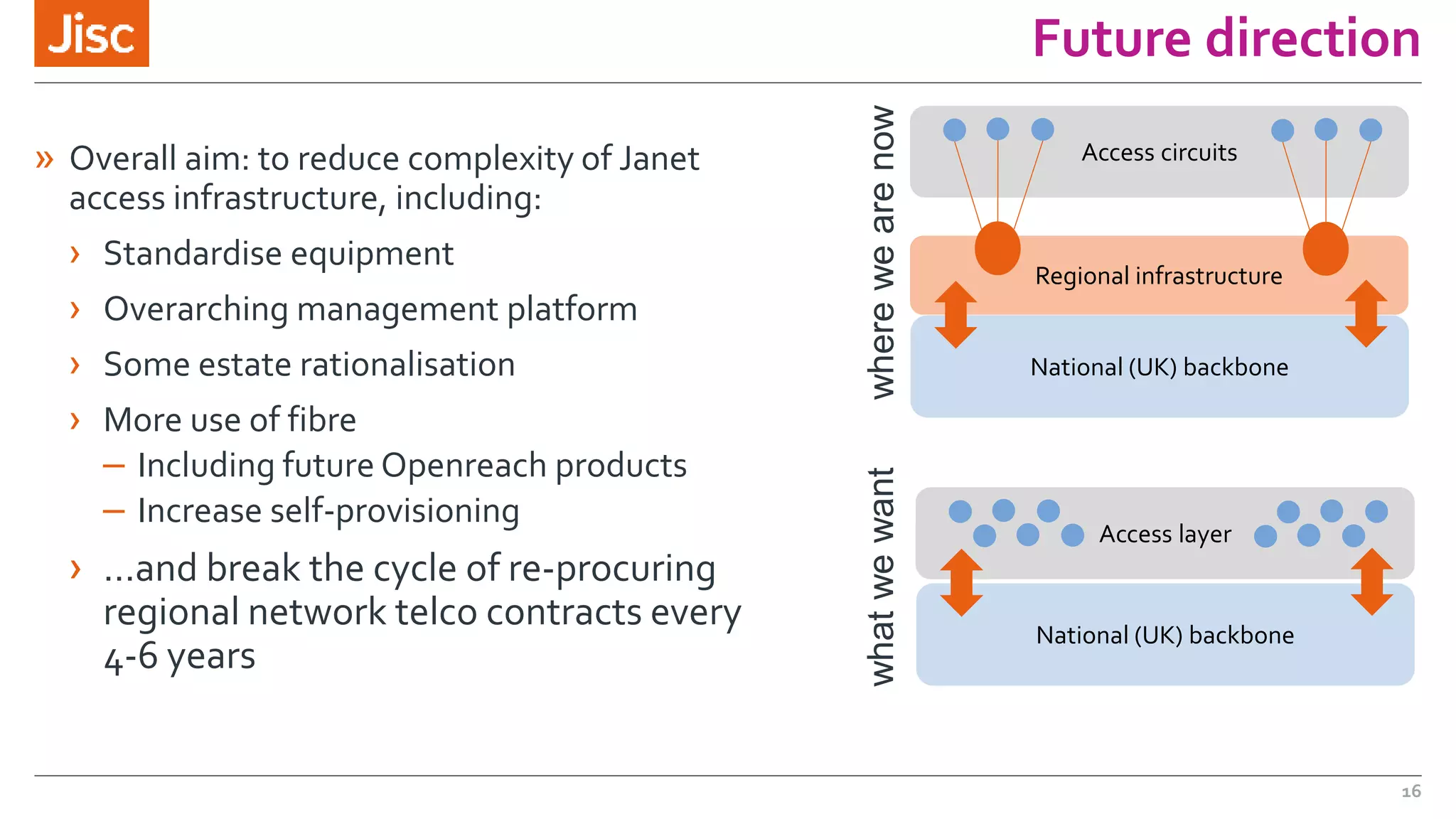
Current access infrastructure
» 18 Regional Networks
› Delivering ~1500 Janet connections
› RNs developed autonomously; now
managed by Jisc following in-sourcing
programme, 2010-2015
› Reflect political boundaries
› Individual designs & wide variety of:
– Optical, routing and switching equipment
– Transmission technologies and suppliers
– Contract arrangements
Regional infrastructure
National (UK) backbone
Access circuits
15
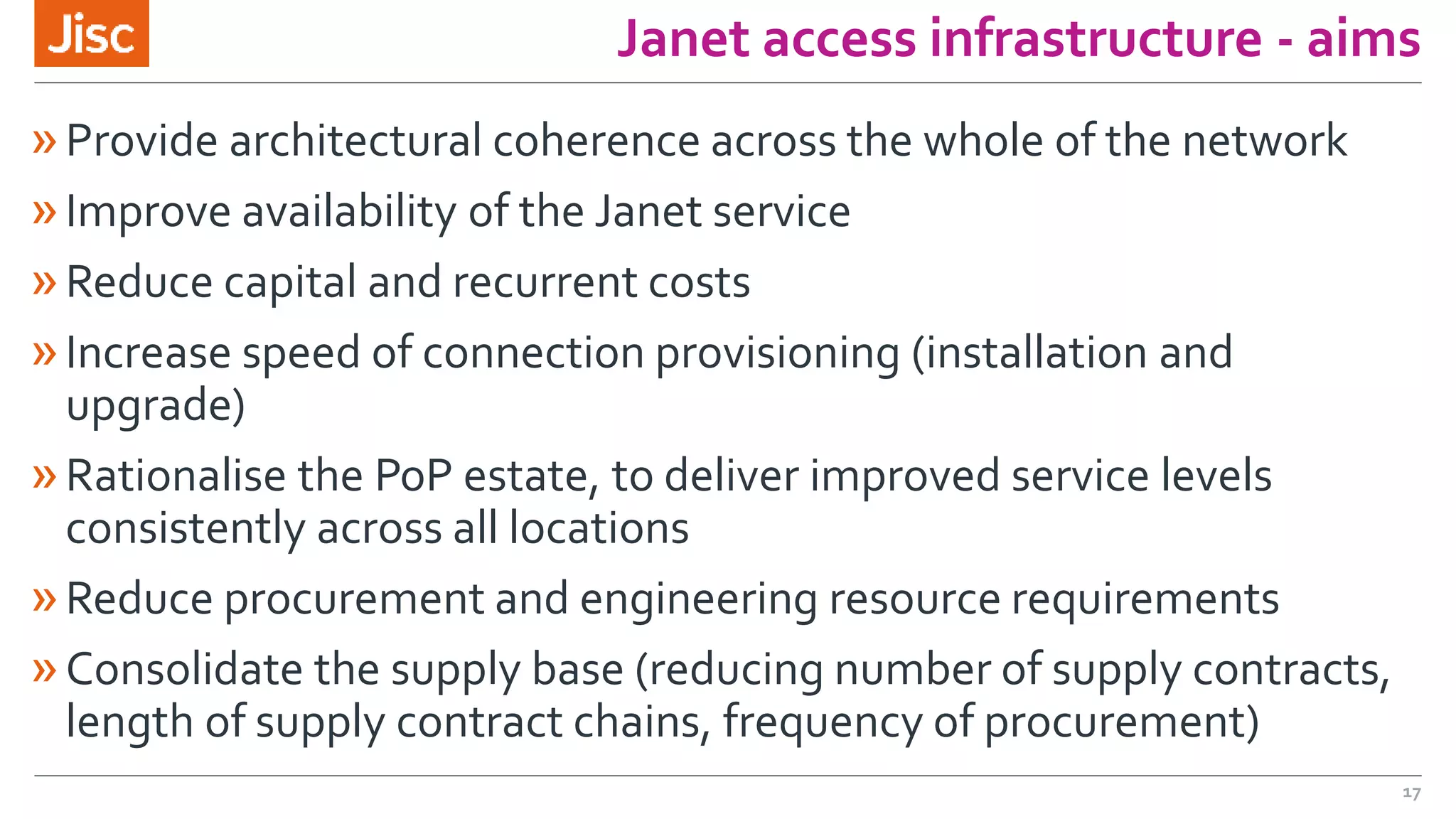
Future direction
» Overall aim: to reduce complexity of Janet
access infrastructure, including:
› Standardise equipment
› Overarching management platform
› Some estate rationalisation
› More use of fibre
– Including future Openreach products
– Increase self-provisioning
› …and break the cycle of re-procuring
regional network telco contracts every
4-6 years
Regional infrastructure
National (UK) backbone
Access circuits
National (UK) backbone
Access layer
wherewearenowwhatwewant
16
Janet access infrastructure - aims
»Provide architectural coherence across the whole of the network
»Improve availability of the Janet service
»Reduce capital and recurrent costs
»Increase speed of connection provisioning (installation and
upgrade)
»Rationalise the PoP estate, to deliver improved service levels
consistently across all locations
»Reduce procurement and engineering resource requirements
»Consolidate the supply base (reducing number of supply contracts,
length of supply contract chains, frequency of procurement)
17
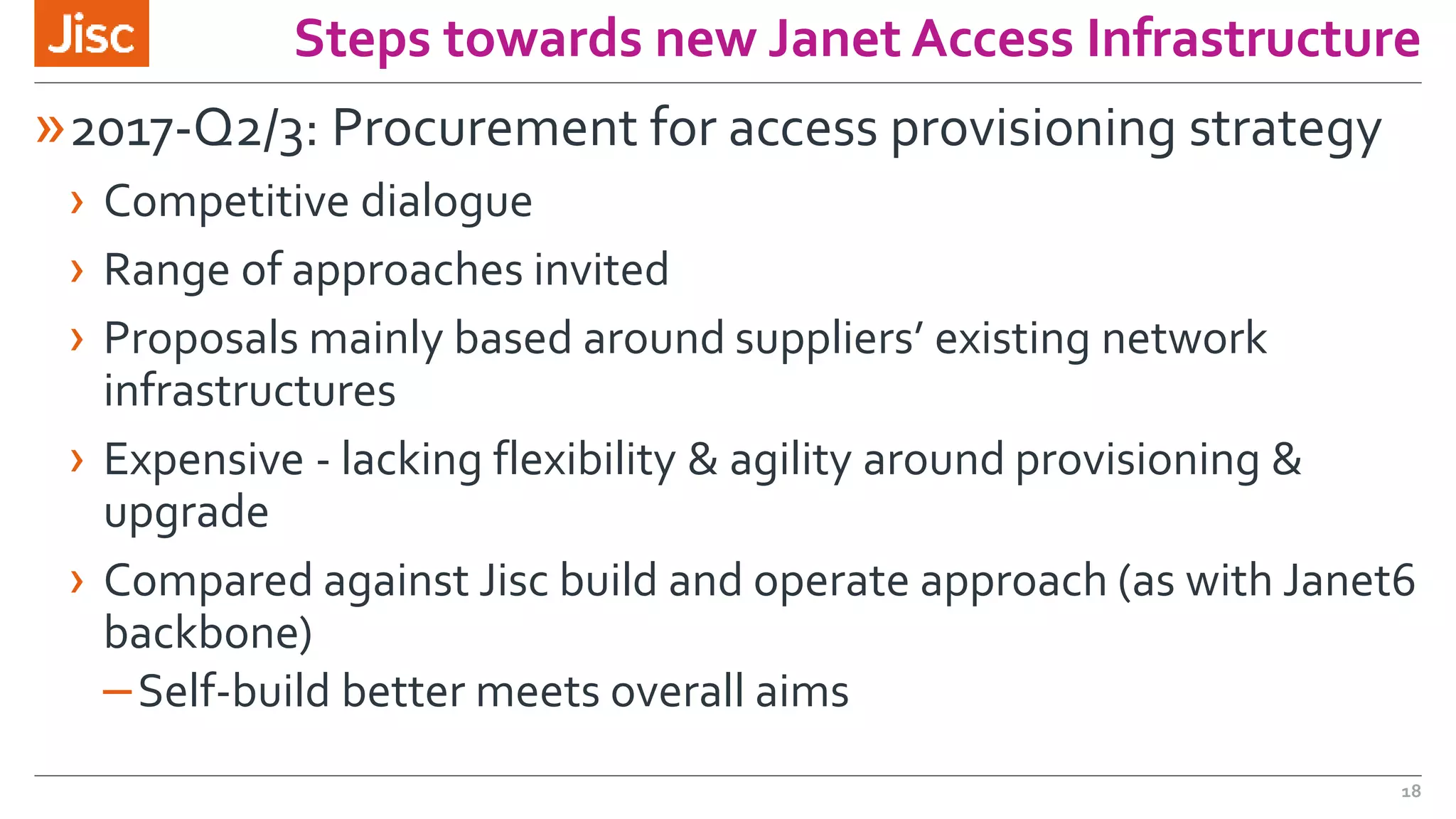
Steps towards new Janet Access Infrastructure
»2017-Q2/3: Procurement for access provisioning strategy
› Competitive dialogue
› Range of approaches invited
› Proposals mainly based around suppliers’ existing network
infrastructures
› Expensive - lacking flexibility & agility around provisioning &
upgrade
› Compared against Jisc build and operate approach (as with Janet6
backbone)
–Self-build better meets overall aims
18
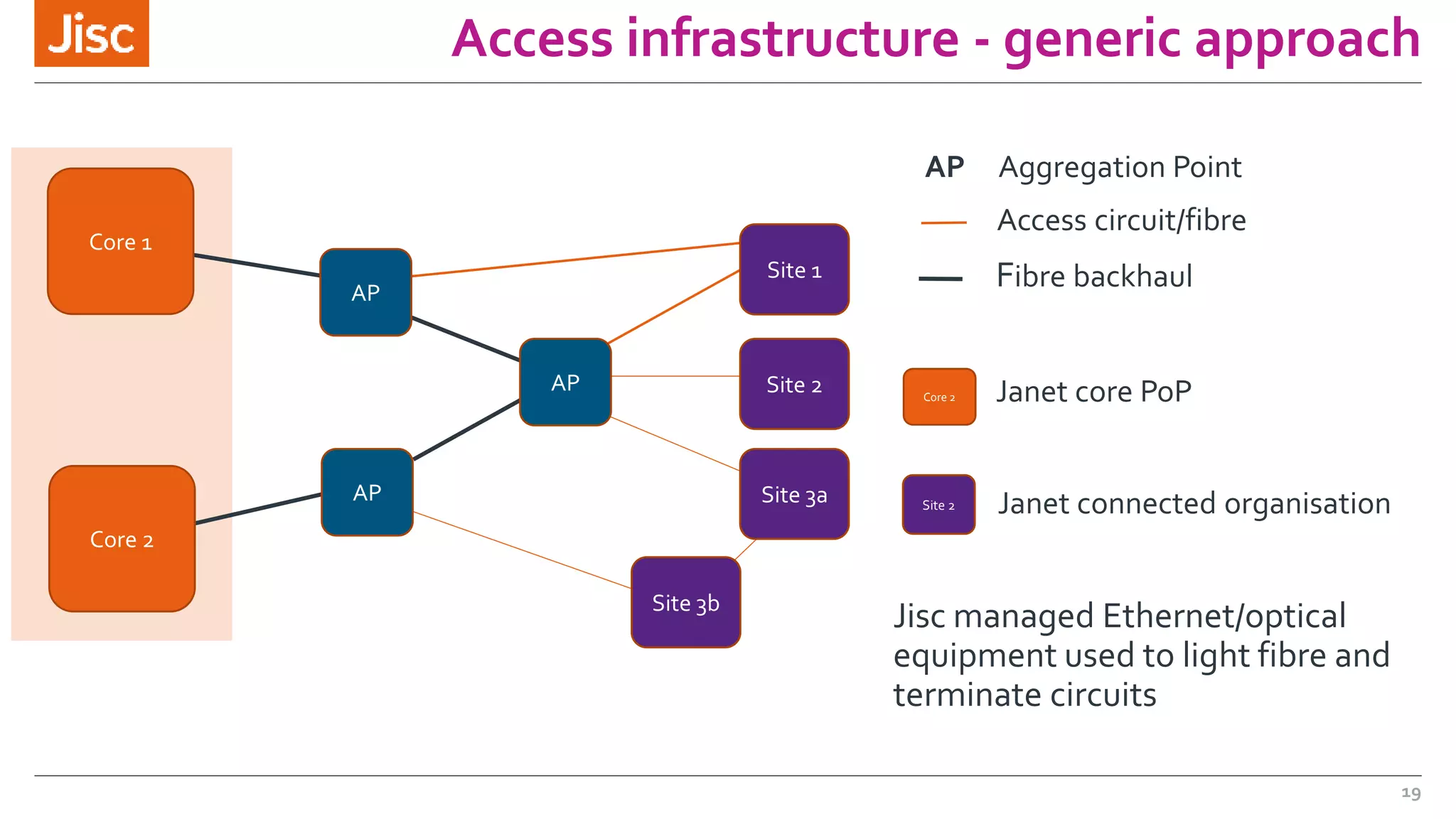
Access infrastructure - generic approach
Core 1
Core 2
AP
Site 3a
AP
AP
Site 2
Site 1
Site 3b
AP Aggregation Point
Access circuit/fibre
Fibre backhaul
Janet core PoP
Janet connected organisation
Jisc managed Ethernet/optical
equipment used to light fibre and
terminate circuits
Core 2
Site 2
19
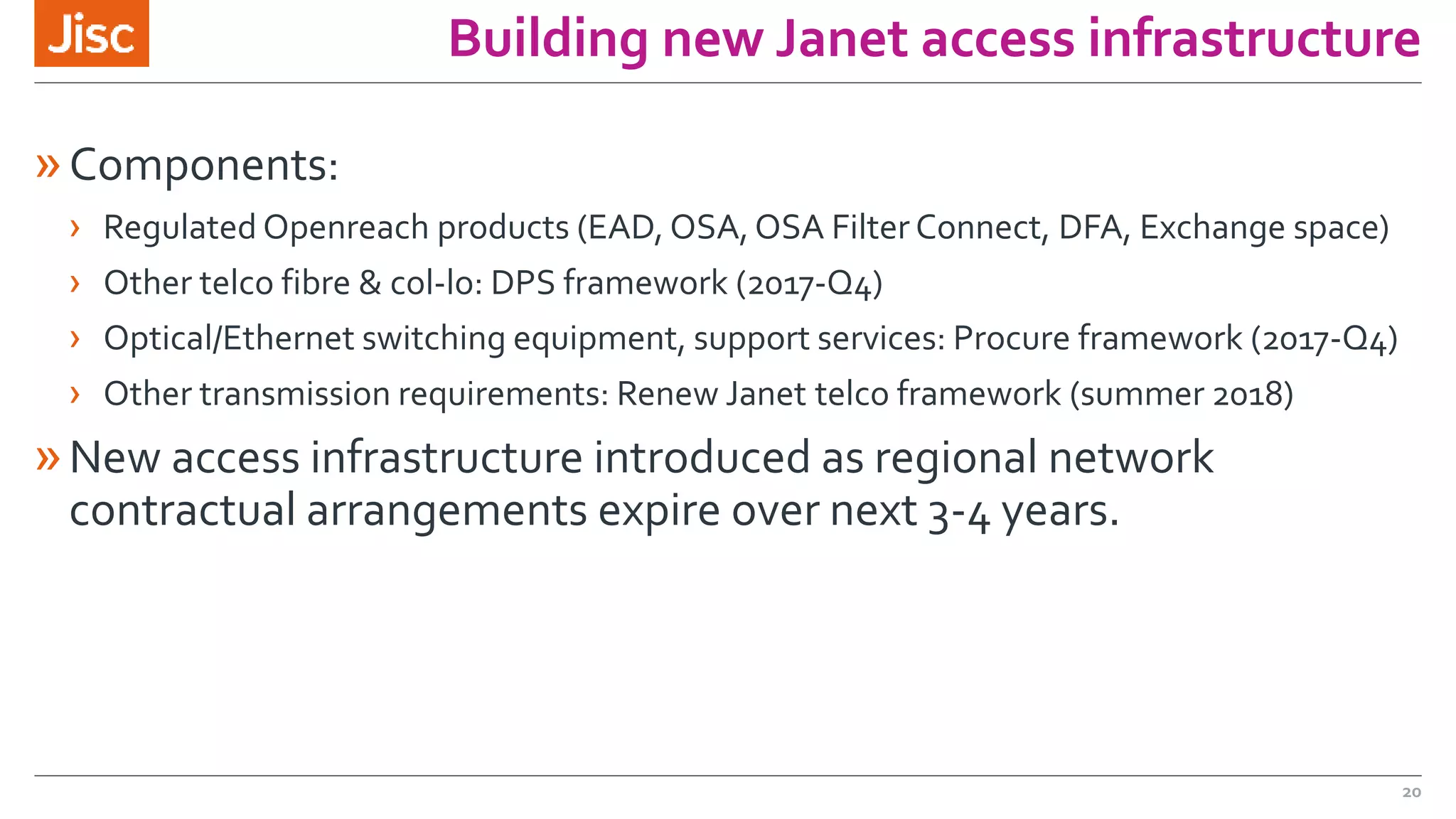
Building new Janet access infrastructure
»Components:
› Regulated Openreach products (EAD, OSA,OSA Filter Connect, DFA, Exchange space)
› Other telco fibre & col-lo: DPS framework (2017-Q4)
› Optical/Ethernet switching equipment, support services: Procure framework (2017-Q4)
› Other transmission requirements: Renew Janet telco framework (summer 2018)
»New access infrastructure introduced as regional network
contractual arrangements expire over next 3-4 years.
20
Questions
21

Janet Futures

  • 1.
  • 2.
    The Janet network ›connectivity to the whole of the UK R&E sector (universal service) › connectivity to UK and global research infrastructures › connectivity to other networks of interest in the UK and globally › Engineered to deliver high bandwidth and availability 2
  • 3.
    What is Janetfor? » Research and scholarship » The business of education » Collateral/aligned areas › exploiting bandwidth and reliability e.g. BBC, local and devolved government PSNs » not designed for › commodity business services › central government use › use as a public ISP 3
  • 4.
    Design principles » Accesslayer › connections to customer sites » Regional infrastructure › Regional aggregation » National backbone › high capacity and scalability » External and global connections › account for ~70% of traffic › hierarchy of use Regional infrastructure National (UK) backbone shared datacentres Global Internet GÉANT peerings & gateways Access layer global NRENs 4
  • 5.
    A range ofservices supporting research Authentication & Authorisation services to access: › Web based resources › Other network connected resources › The network Supporting High Information Assurance by: › Providing a accredited data encryption service Shared Datacentres providing: › Efficiency savings › Greater collaboration opportunities 5
  • 6.
    Glasgow Leeds London Telehouse West Bristol Manchester London Telecity Powergate BirminghamNottingham London Telehouse North London Telecity HX GlobalTransit & Peering Peering GlobalTransit & Peering 100Gbit/s 200Gbit/s Network 2016 6
  • 7.
    Leeds London Telehouse West Bristol Manchester London Powergate Birmingham Nottingham London TelehouseNorth London Harbour Exchange GlobalTransit & Peering Peering GlobalTransit & Peering 100Gbit/s 200Gbit/s 400Gbit/s Upgrade 2016/17 Glasgow 1.2 Tbit/s 1.1 Tbit/s 80 Gbit/s 20 Gbit/s 7
  • 8.
    Telecity Powergate Janet external connectivity Totalexternal connectivity ≈ 1.5Tbit/s Netflix Voicenet Akamai Daisy Comms Bogons Logicalis UK BTnet Amazon inTechnology Simplecall Gamma Google Simplecall Redstone Updata Cablecom Voicenet Google Limelight UKCloud Akamai BBC Datahop Microsoft EU Telekom Malaysia Globelynx 10Gbit/s 1Gbit/s 100Gbit/s GÉANT + Akamai VM for LGfL Gamma NHS N3 Exa Networks Synetrix One Connect Glasgow & Edinburgh HEAnet inTechnology NHS N3 SWAN (Glasgow) SWAN (Edinburgh) Telehouse North & West VM RM VM for LGfL RM GlobalTransit TeliaSonera IXLeeds GlobalTransit Level3 GlobalTransit Level3 Microsoft EU China Unicom ChinaTelecom ~ 500 peerings to… ~ 300 organisations IXManchester LINX Manchester AQL 3G Leeds Amazon Verizon Edge AppleTV VM for LGfL Telecity Harbour Exch. GÉANT Commercial GÉANT MDNX MDNX VM for Schools AppleTV Facebook 8
  • 9.
    Cybersecurity needs »Protecting customersagainst DDoS › network visibility › mitigation engine »Protecting Janet critical infrastructure »Moving to more “secure” operations › ISO27001, CAS(T), ISO20000 System turned on: 04/10/2016. as of 12/01/2017: › attacks to date: 307 › largest attack: 23.6 Gbit/s › longest attack: 12 hours › potential total attack traffic: 66TB › (un)luckiest customer: 38 attacks as of 30/03/2017: › attacks to date: 581 (153 organisations) › largest attack: 45.9 Gbit/s › longest attack: 15 hours › potential total attack traffic: 152TB › (un)luckiest customer: 54 attacks 9
  • 10.
    Requirements gathered forJanet6 Bandwidth • Flexibility • Agility • Cost control Service delivery • Delivery of third-party services • Cloud services • Reliability & resilience Partnerships • public/public, public/private • Information assurance Off-net support • Anytime, anywhere access • Internationalisation of education Management of costs • Funding environment • Costs of change
  • 11.
    Changes in theenvironment Changes in funding Higher information assurance Use of off-site data centres for equipment housing Challenging economic climate Cyber security Outsourcing services to the Cloud Open Science & the importance of data Implications of Brexit Increasing university & business collaboration Redesigning learning and library spaces incorporating the use of technology Personalised learning, driving the gathering & analysis of large amounts of (sensitive) data
  • 12.
    Technology trends Software DefinedNetworking (SDN) › what: a programmable network › why: faster, automated provisioning › drivers: – increased use of cloud services – off-site datacentres Network FunctionVirtualisation (NFV) › what: virtual rather than physical kit › why: reduce physical component count › drivers: – reduce costs, improve availability – customer demand for services IPv6 › what: next-gen. Internet Protocol › why: address space, routing, security › drivers: – IPv4 address space exhaustion – IPv4 security now unfit for purpose 5G › what: next-gen. mobile networks › why: capacity, coverage, latency › drivers: – Internet ofThings paradigm – societal expectations of connectivity 12
  • 13.
    Telecommunications market trends UKfibre marketplace › 2011/12: retrenchment after expansion prior to 2008 crash › 2017: little sign of change; some evidence of restriction of supply Openreach divestment › BT short-haul fibre on market Oct 2017 › new access products from telcos? › opportunities to use fibre ourselves? Generally: › marketplace remains poor(er) UK mobile marketplace: 5G › small-cell technology – filling-in poor coverage e.g. on campus › programmable SIMs (eSIM) Optical networking marketplace › moving from 100 Gbit/s  400 Gbit/s › greater network functionality › cheaper low-end options › options to reduce IP router stock 13
  • 14.
    Janet Access Infrastructuredevelopments Stephen Percival 14
  • 15.
    Current access infrastructure »18 Regional Networks › Delivering ~1500 Janet connections › RNs developed autonomously; now managed by Jisc following in-sourcing programme, 2010-2015 › Reflect political boundaries › Individual designs & wide variety of: – Optical, routing and switching equipment – Transmission technologies and suppliers – Contract arrangements Regional infrastructure National (UK) backbone Access circuits 15
  • 16.
    Future direction » Overallaim: to reduce complexity of Janet access infrastructure, including: › Standardise equipment › Overarching management platform › Some estate rationalisation › More use of fibre – Including future Openreach products – Increase self-provisioning › …and break the cycle of re-procuring regional network telco contracts every 4-6 years Regional infrastructure National (UK) backbone Access circuits National (UK) backbone Access layer wherewearenowwhatwewant 16
  • 17.
    Janet access infrastructure- aims »Provide architectural coherence across the whole of the network »Improve availability of the Janet service »Reduce capital and recurrent costs »Increase speed of connection provisioning (installation and upgrade) »Rationalise the PoP estate, to deliver improved service levels consistently across all locations »Reduce procurement and engineering resource requirements »Consolidate the supply base (reducing number of supply contracts, length of supply contract chains, frequency of procurement) 17
  • 18.
    Steps towards newJanet Access Infrastructure »2017-Q2/3: Procurement for access provisioning strategy › Competitive dialogue › Range of approaches invited › Proposals mainly based around suppliers’ existing network infrastructures › Expensive - lacking flexibility & agility around provisioning & upgrade › Compared against Jisc build and operate approach (as with Janet6 backbone) –Self-build better meets overall aims 18
  • 19.
    Access infrastructure -generic approach Core 1 Core 2 AP Site 3a AP AP Site 2 Site 1 Site 3b AP Aggregation Point Access circuit/fibre Fibre backhaul Janet core PoP Janet connected organisation Jisc managed Ethernet/optical equipment used to light fibre and terminate circuits Core 2 Site 2 19
  • 20.
    Building new Janetaccess infrastructure »Components: › Regulated Openreach products (EAD, OSA,OSA Filter Connect, DFA, Exchange space) › Other telco fibre & col-lo: DPS framework (2017-Q4) › Optical/Ethernet switching equipment, support services: Procure framework (2017-Q4) › Other transmission requirements: Renew Janet telco framework (summer 2018) »New access infrastructure introduced as regional network contractual arrangements expire over next 3-4 years. 20
  • 21.