CHEM 121 Friday Jan 10
•
•
•
•

Roll sheet, please sign
Reading Quiz 11.1-11.2
Remember to bring a scientific calculator
Chapter 11
– 11.1
– 11.2

Gases, Liquids, and Solids
Intermolecular Forces
Teams – sit with your teams in class, you may
have a different study group outside of class
1 Anayeli, Emily Green, Frank, Fernando
2 Yumna, Nicole, Chrisitian, Max
3 Chandler, Alyssa Hernandez, Joseph, Brenda
4 Oliver, Arley, Valerie, Monica
5 Adrian, Jeannette, Miriam, Tezira
6 Catherine Conte, Saman, Evelina, Catherine Trempe
7 Yazmin, Kaitlyn, Jency, Veronica
8 Clayton, Alexandra, Sweta, Camila
9 Alyssa Domico, Matt Kozlowski, Ignacio, Nikita
10 Jacob, Katy, Marissa, Ryan
Gen. Chem. Lab
• No Lab this week
• Lab begins next week!
– Lab Safety and Math Review

• No lab week of January 20 (MLK Week)
• Lab resumes week the week after
Office Hours
My office is Parmer 324
• MWF 10:30-11:30 here in Lewis Hall
• Or by appointment (e-mail me)

• Office hours will be posted on the myDU
page each week (if there are changes)
Pre-Class Reading Assignment
Reading for Mon. Jan. 13:
Sections 11.3-11.4
There will be a Reading Quiz at
the beginning of class.
(Note that the assigned reading schedule is in
the syllabus. You are expected to do the
reading even if I do not announce it in class!)
Chapter 11 Homework
• Homework/Problems
• Read 11.3-11.4, reading quiz Monday 11.3-11.4
• Work on these over the weekend & turn in on
Monday
– 9, 15, 17, 19, 21, 23, 25, 27

• Next week start these questions from sections
11.3-11.6
–
–
–
–

Due Wednesday in class
33, 35, 39, 45
Due Friday in class
7, 49, 51, 53, 55, 57, 59, 61, 73

• Quiz on above homework problems on Friday
Jan. 17 in class.
5 Main points of 11.1-11.2
Phases of Matter and IMF
1. Liquids and solids have strong IMF
• Gases have weak interparticle interaction
2. Heating/cooling or changes in pressure changes the phase of a
substance
3. IMF forces are weaker than ionic, metallic and covalent bonds
4. Boiling points and melting points reflect the strengths of IMF
5. 4 types of IMF
1. London dispersion
2. dipole–dipole
3. Hydrogen bonding
4. Ion dipole
How do solids, liquids, and
gases differ?
How can you interconvert
matter between these 3
phases?
A Molecular Comparison of Liquids
and Solids

9
4 types of Intermolecular Forces

1.London dispersion
2.dipole–dipole
3.Hydrogen bonding
4.Ion dipole
London Dispersion Forces
• London dispersion forces exist between all
molecules
• Instantaneous dipole
• Polarizability – ease of electron cloud distortion
• The larger the molecule (the greater the number of
electrons) the more polarizable.
• As molecular weight increases, LDF increases.
London Dispersion Forces
• Depend on the shape of the molecule.
– The greater the surface area available for contact, the
greater the dispersion forces.
– London dispersion forces between spherical molecules
are lower than between rod-like molecules.
Which of these has the greatest London
Dispersion force?
Cl2, Br2, I2

Propane vs. octane
He, Ne, Ar
Dipole-Dipole Forces (stronger than LD)
•
•
•
•

exist between polar covalent molecules
Permanent Dipole
What is a dipole?
How do we know if a molecule is polar?
(meaning the molecule has a dipole)
Polarity of Molecules
Dipole Moments of Polyatomic Molecules
Example: in CO2, each C-O dipole is canceled
because the molecule is linear. In H2O, the H-O
dipoles do not cancel because the molecule is bent.
Polarity of Molecules
Which of these are polar? Nonpolar?
Polarity of Molecules
Which of these are polar? Nonpolar?
Have dipole-dipole
interactions

Boron trifluoride and carbon tetrafluoride are non
polar and do not have dipole dipole interactions
Intermolecular Forces
Dipole-Dipole Forces
• There is a mix of attractive
and repulsive dipole-dipole
forces as the molecules
tumble.
• If two molecules have
about the same mass and
size, then dipole-dipole
forces increase with
increasing polarity.
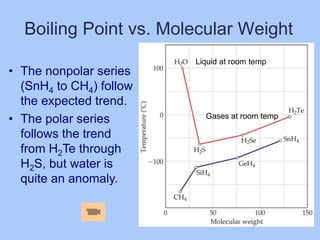
Boiling Point vs. Molecular Weight
• The nonpolar series
(SnH4 to CH4) follow
the expected trend.
• The polar series
follows the trend
from H2Te through
H2S, but water is
quite an anomaly.

Liquid at room temp

Gases at room temp
Hydrogen Bonds
• The dipole-dipole
interactions experienced
when H is bonded to
N, O, or F are unusually
strong.
• We call these interactions
hydrogen bonds.
• Must have a lone pair of
electrons on N,O,F
Which of the following molecules
has hydrogen bonding?
a. NH3
b. CH3OH
c. H2O
d. HF
e. all of the above
CH3CH2OH

CH3OCH3

CH3CH2COOH
Intermolecular Forces
Hydrogen Bonding

Ice is less dense than liquid water
Intermolecular Forces
Ion-Dipole Forces (only with water solutions)
•Ionic compounds dissolve to form ions that interact
with the polar solvents. This is why ionic
compounds dissolve in polar solvents and do not
dissolve in non-polar solvents.
Intermolecular Forces
Ion-Dipole Forces (only with water solutions)
•Ionic compounds dissolve to form ions that interact
with the polar solvents. This is why ionic
compounds dissolve in polar solvents and do not
dissolve in non-polar solvents.
NaCl (s)
Na+ (aq) + Cl- (aq)
H

H

H

H

O

O

O

Cl

H
H
O

H

H

Na
O

H

H
O

H

H
Summarizing Intermolecular Forces
1.
2.
3.
4.

Are ions present?
Is the molecule polar?
O,N,F?
Molecular weight?
Sample Exercise 11.2
List the substances BaCl2
H2, CO, HF, Ne in order of increasing
boiling point
1.
2.
3.
4.

Are ions present?
Is the molecule polar?
O,N,F?
Molecular weight?
Homework Due Monday
• 9, 15, 17, 19, 21, 23, 25, 27
• Class Participation points
• Get into your groups and work on 17a and 27a

Jan10

  • 1.
    CHEM 121 FridayJan 10 • • • • Roll sheet, please sign Reading Quiz 11.1-11.2 Remember to bring a scientific calculator Chapter 11 – 11.1 – 11.2 Gases, Liquids, and Solids Intermolecular Forces
  • 2.
    Teams – sitwith your teams in class, you may have a different study group outside of class 1 Anayeli, Emily Green, Frank, Fernando 2 Yumna, Nicole, Chrisitian, Max 3 Chandler, Alyssa Hernandez, Joseph, Brenda 4 Oliver, Arley, Valerie, Monica 5 Adrian, Jeannette, Miriam, Tezira 6 Catherine Conte, Saman, Evelina, Catherine Trempe 7 Yazmin, Kaitlyn, Jency, Veronica 8 Clayton, Alexandra, Sweta, Camila 9 Alyssa Domico, Matt Kozlowski, Ignacio, Nikita 10 Jacob, Katy, Marissa, Ryan
  • 3.
    Gen. Chem. Lab •No Lab this week • Lab begins next week! – Lab Safety and Math Review • No lab week of January 20 (MLK Week) • Lab resumes week the week after
  • 4.
    Office Hours My officeis Parmer 324 • MWF 10:30-11:30 here in Lewis Hall • Or by appointment (e-mail me) • Office hours will be posted on the myDU page each week (if there are changes)
  • 5.
    Pre-Class Reading Assignment Readingfor Mon. Jan. 13: Sections 11.3-11.4 There will be a Reading Quiz at the beginning of class. (Note that the assigned reading schedule is in the syllabus. You are expected to do the reading even if I do not announce it in class!)
  • 6.
    Chapter 11 Homework •Homework/Problems • Read 11.3-11.4, reading quiz Monday 11.3-11.4 • Work on these over the weekend & turn in on Monday – 9, 15, 17, 19, 21, 23, 25, 27 • Next week start these questions from sections 11.3-11.6 – – – – Due Wednesday in class 33, 35, 39, 45 Due Friday in class 7, 49, 51, 53, 55, 57, 59, 61, 73 • Quiz on above homework problems on Friday Jan. 17 in class.
  • 7.
    5 Main pointsof 11.1-11.2 Phases of Matter and IMF 1. Liquids and solids have strong IMF • Gases have weak interparticle interaction 2. Heating/cooling or changes in pressure changes the phase of a substance 3. IMF forces are weaker than ionic, metallic and covalent bonds 4. Boiling points and melting points reflect the strengths of IMF 5. 4 types of IMF 1. London dispersion 2. dipole–dipole 3. Hydrogen bonding 4. Ion dipole
  • 8.
    How do solids,liquids, and gases differ? How can you interconvert matter between these 3 phases?
  • 9.
    A Molecular Comparisonof Liquids and Solids 9
  • 10.
    4 types ofIntermolecular Forces 1.London dispersion 2.dipole–dipole 3.Hydrogen bonding 4.Ion dipole
  • 11.
    London Dispersion Forces •London dispersion forces exist between all molecules • Instantaneous dipole • Polarizability – ease of electron cloud distortion • The larger the molecule (the greater the number of electrons) the more polarizable. • As molecular weight increases, LDF increases.
  • 12.
    London Dispersion Forces •Depend on the shape of the molecule. – The greater the surface area available for contact, the greater the dispersion forces. – London dispersion forces between spherical molecules are lower than between rod-like molecules.
  • 13.
    Which of thesehas the greatest London Dispersion force? Cl2, Br2, I2 Propane vs. octane He, Ne, Ar
  • 14.
    Dipole-Dipole Forces (strongerthan LD) • • • • exist between polar covalent molecules Permanent Dipole What is a dipole? How do we know if a molecule is polar? (meaning the molecule has a dipole)
  • 15.
    Polarity of Molecules DipoleMoments of Polyatomic Molecules Example: in CO2, each C-O dipole is canceled because the molecule is linear. In H2O, the H-O dipoles do not cancel because the molecule is bent.
  • 16.
    Polarity of Molecules Whichof these are polar? Nonpolar?
  • 17.
    Polarity of Molecules Whichof these are polar? Nonpolar? Have dipole-dipole interactions Boron trifluoride and carbon tetrafluoride are non polar and do not have dipole dipole interactions
  • 18.
    Intermolecular Forces Dipole-Dipole Forces •There is a mix of attractive and repulsive dipole-dipole forces as the molecules tumble. • If two molecules have about the same mass and size, then dipole-dipole forces increase with increasing polarity.
  • 20.
    Boiling Point vs.Molecular Weight • The nonpolar series (SnH4 to CH4) follow the expected trend. • The polar series follows the trend from H2Te through H2S, but water is quite an anomaly. Liquid at room temp Gases at room temp
  • 21.
    Hydrogen Bonds • Thedipole-dipole interactions experienced when H is bonded to N, O, or F are unusually strong. • We call these interactions hydrogen bonds. • Must have a lone pair of electrons on N,O,F
  • 22.
    Which of thefollowing molecules has hydrogen bonding? a. NH3 b. CH3OH c. H2O d. HF e. all of the above CH3CH2OH CH3OCH3 CH3CH2COOH
  • 23.
    Intermolecular Forces Hydrogen Bonding Iceis less dense than liquid water
  • 24.
    Intermolecular Forces Ion-Dipole Forces(only with water solutions) •Ionic compounds dissolve to form ions that interact with the polar solvents. This is why ionic compounds dissolve in polar solvents and do not dissolve in non-polar solvents.
  • 25.
    Intermolecular Forces Ion-Dipole Forces(only with water solutions) •Ionic compounds dissolve to form ions that interact with the polar solvents. This is why ionic compounds dissolve in polar solvents and do not dissolve in non-polar solvents. NaCl (s) Na+ (aq) + Cl- (aq) H H H H O O O Cl H H O H H Na O H H O H H
  • 26.
    Summarizing Intermolecular Forces 1. 2. 3. 4. Areions present? Is the molecule polar? O,N,F? Molecular weight?
  • 27.
    Sample Exercise 11.2 Listthe substances BaCl2 H2, CO, HF, Ne in order of increasing boiling point 1. 2. 3. 4. Are ions present? Is the molecule polar? O,N,F? Molecular weight?
  • 28.
    Homework Due Monday •9, 15, 17, 19, 21, 23, 25, 27 • Class Participation points • Get into your groups and work on 17a and 27a