Prospectus
           2011-2012


Jamia Millia Islamia
(A Central University by an Act of Parliament)


                                                 i
ii
CONTENTS
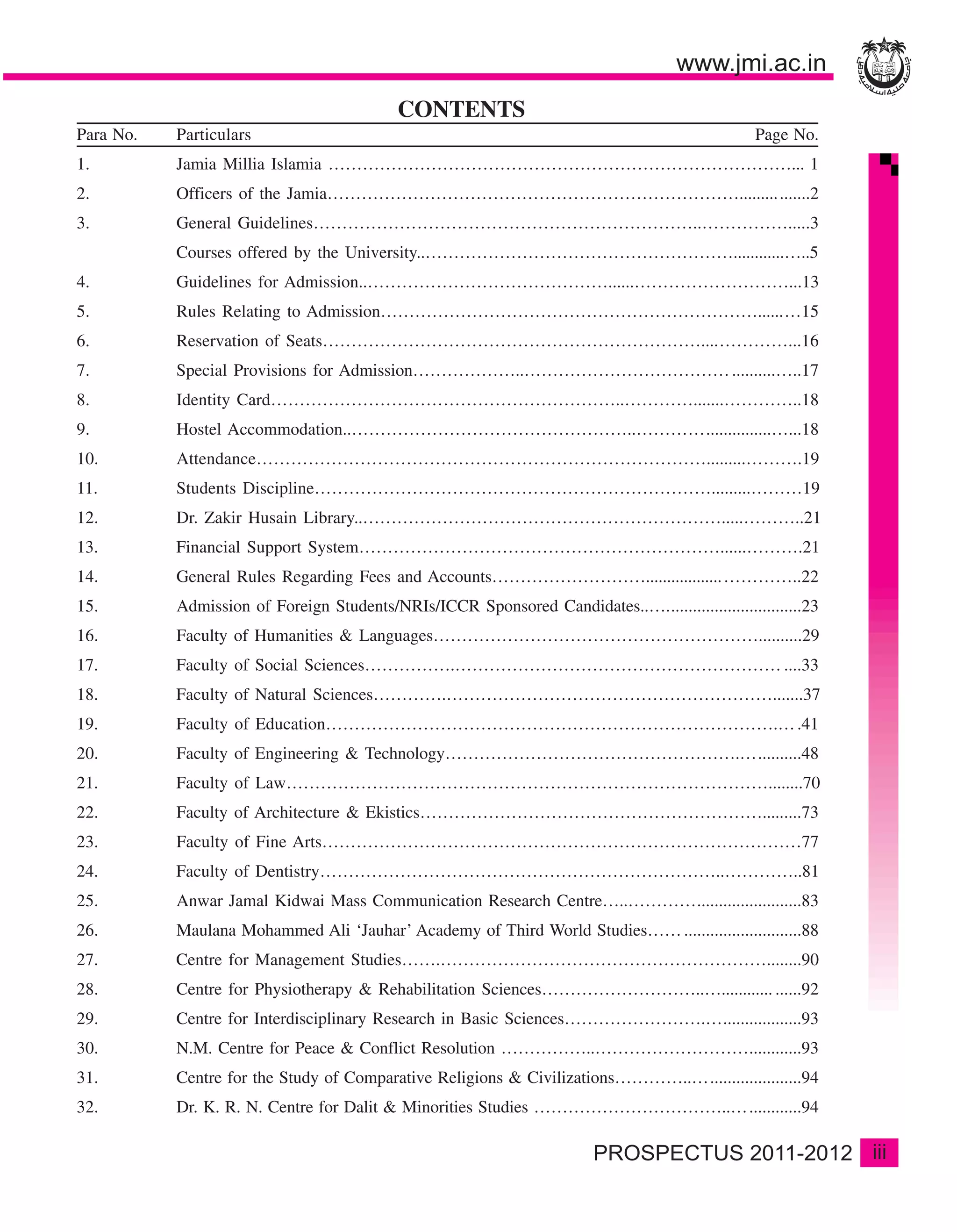
Para No.   Particulars                                                                           Page No.
1.         Jamia Millia Islamia ………………………………………………………………………... 1
2.         Officers of the Jamia………………………………………………………………......... .......2
3.         General Guidelines…………………………………………………………..…………….....3
           Courses offered by the University..………………………………………………............…..5
4.         Guidelines for Admission..……………………………………......………………………...13
5.         Rules Relating to Admission…………………………………………………………......…15
6.         Reservation of Seats…………………………………………………………....…………...16
7.         Special Provisions for Admission………………..……………………………… ..........…..17
8.         Identity Card……………………………………………………..………….......…………..18
9.         Hostel Accommodation..…………………………………………..…………...............…...18
10.        Attendance…………………………………………………………………….........……….19
11.        Students Discipline…………………………………………………………….........………19
12.        Dr. Zakir Husain Library..……………………………………………………….....………..21
13.        Financial Support System………………………………………………………......……….21
14.        General Rules Regarding Fees and Accounts………………………..................…………..22
15.        Admission of Foreign Students/NRIs/ICCR Sponsored Candidates..…...............................23
16.        Faculty of Humanities & Languages…………………………………………………..........29
17.        Faculty of Social Sciences…………….………………………………………………… ....33
18.        Faculty of Natural Sciences………….………………………………………………….......37
19.        Faculty of Education…………………………………………………………………….… .41
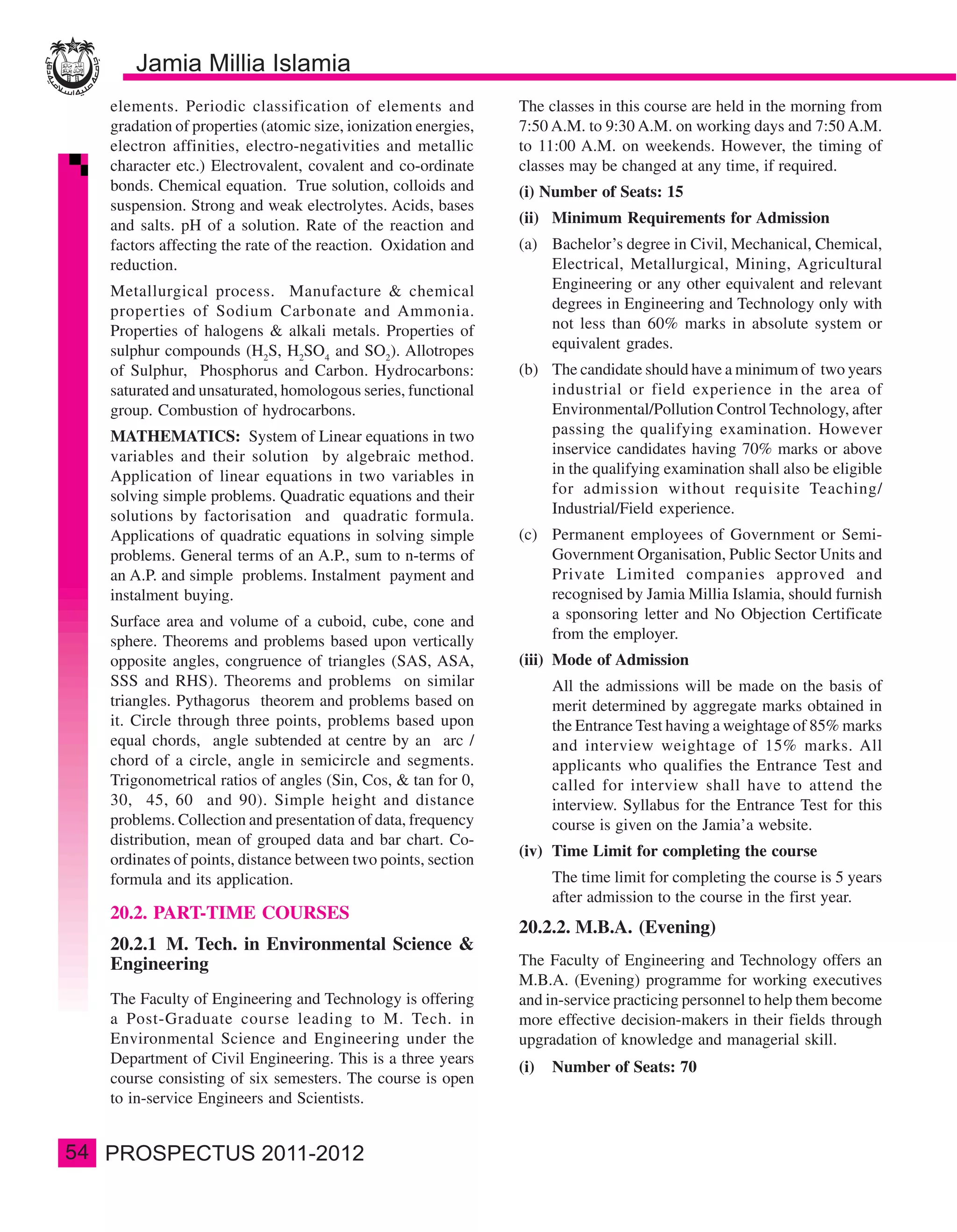
20.        Faculty of Engineering & Technology…………………………………………….…..........48
21.        Faculty of Law…………………………………………………………………………........70
22.        Faculty of Architecture & Ekistics…………………………………………………….........73
23.        Faculty of Fine Arts…………………………………………………………………………77
24.        Faculty of Dentistry……………………………………………………………..…………..81
25.        Anwar Jamal Kidwai Mass Communication Research Centre…..…………........................83
26.        Maulana Mohammed Ali ‘Jauhar’ Academy of Third World Studies…… ...........................88
27.        Centre for Management Studies…….…………………………………………………........90
28.        Centre for Physiotherapy & Rehabilitation Sciences………………………..…............ ......92
29.        Centre for Interdisciplinary Research in Basic Sciences…………………….…..................93
30.        N.M. Centre for Peace & Conflict Resolution ……………..………………………............93
31.        Centre for the Study of Comparative Religions & Civilizations…………..….....................94
32.        Dr. K. R. N. Centre for Dalit & Minorities Studies ……………………………..…............94

                                                                                                              iii
33.   Centre for Spanish & Latin American Studies………….………………………..…............95
     34.   Centre for West Asian Studies……………………………….………………………..….....95
     35.   Centre for Jawaharlal Nehru Studies……………………..………………………..… .........96
     36.   Centre for Culture, Media & Governance……………………………………………..........96
     37.   India Arab Cultural Centre …………………………………………..………………..…....97
     38.   F. T. K. Centre for Information Technology ……………………………………..…............97
     39.   Centre for Theoretical Physics………………………………………………………..….....97
     40.   Centre for Early Childhood Development & Research.........................................................98
     41.   A. S. Centre for Distance & Open Learning……………….……………………..…...........98
     42.   Jamia’s Premchand Archives & Literary Centre………………………………..…..............99
     43.   Sarojini Naidu Centre for Women’s Studies…………..……………………………............99
     44.   Dr. Zakir Hussain Institute of Islamic Studies…………..…………………………............100
     45.   Barkat Ali Firaq State Resource Centre…………………………………………..….........100
     46.   Academic Staff College………………………………………..………………………..…100
     47.   Zakir Hussain Studies Centre……………………….………..…………………………....100
     48.   Gandhian Studies Centre……………………….………..………………………………...101
     49.   Academy of Professional Development of Urdu Medium Teachers...… ............................101
     50.   Centre for Coaching & Career Planning..……….………..………………………….........101
     51.   University Placement Cell……………………….………..……………………..…...........101
     52.   Jamia Schools…………………….……………………….………..………………...........101
     53.   Fee-Structure of all courses of the University….………..……………………… ..............102
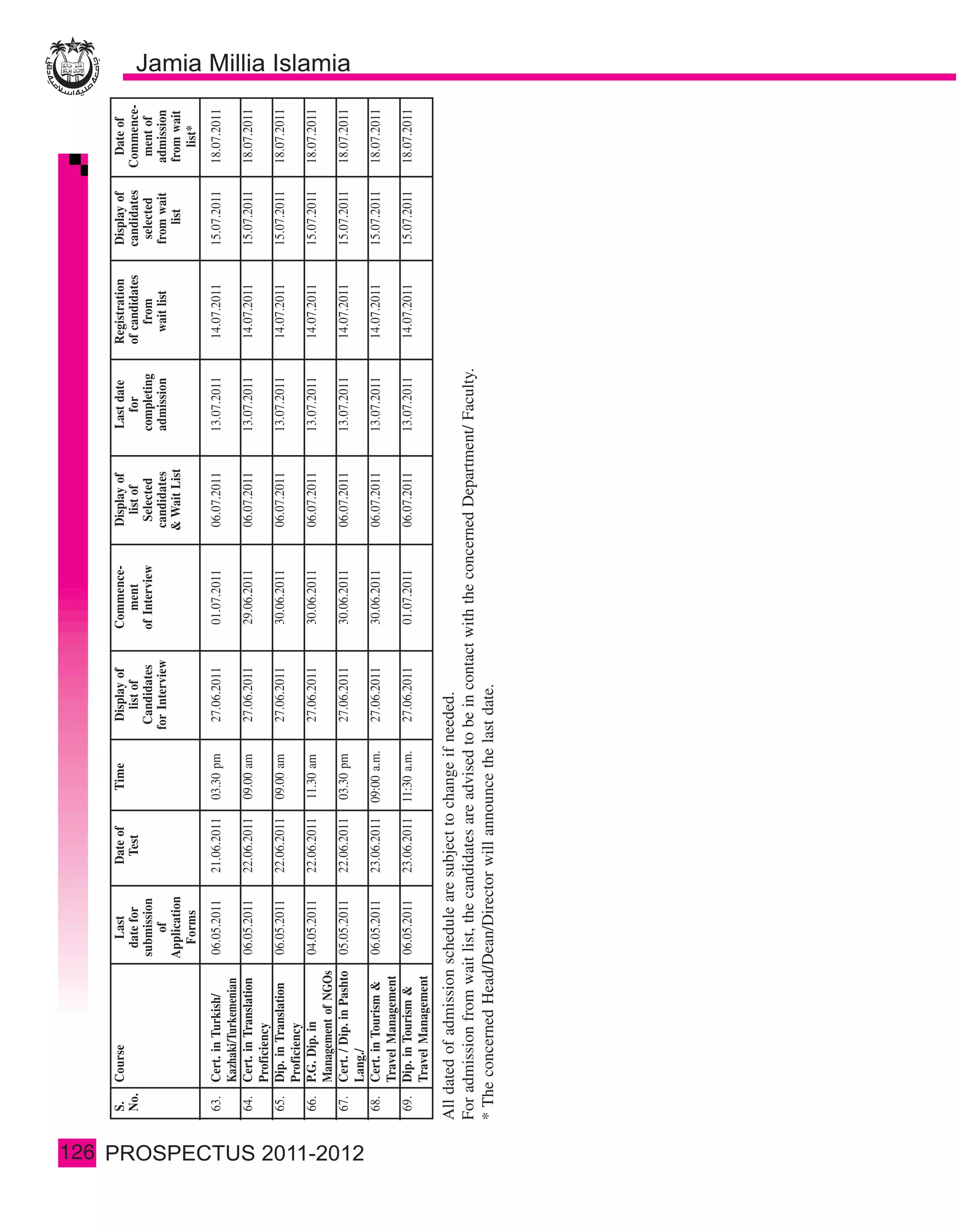
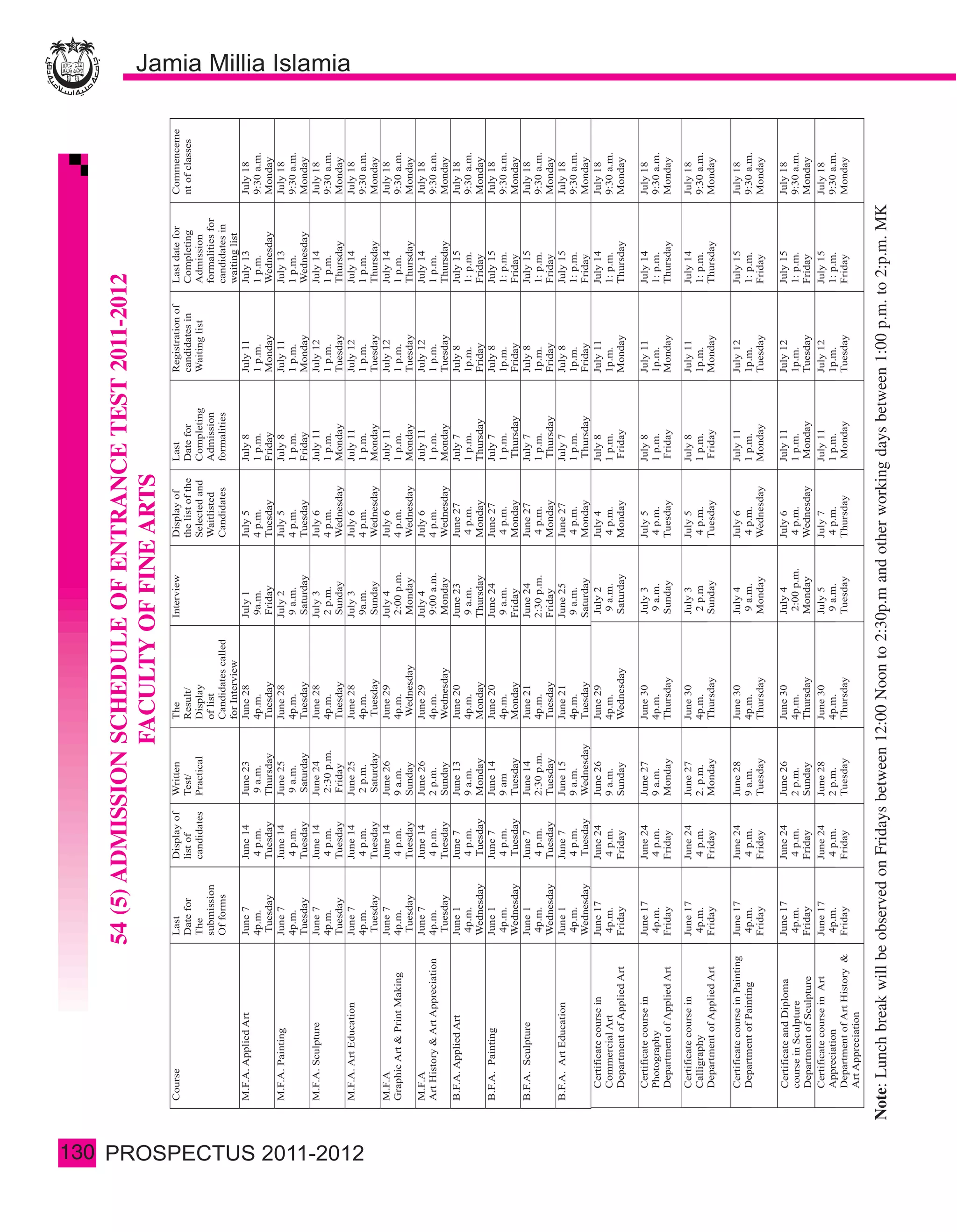
     54.   Admission Schedule of Courses offered by the University………………….....................122
     55.   Recognized Courses of Arabic Madarsas/Institutions…………………….. .......................134
     56.   Important Telephone numbers of Deans/HoDs/Directors of the Centres............................135


iv
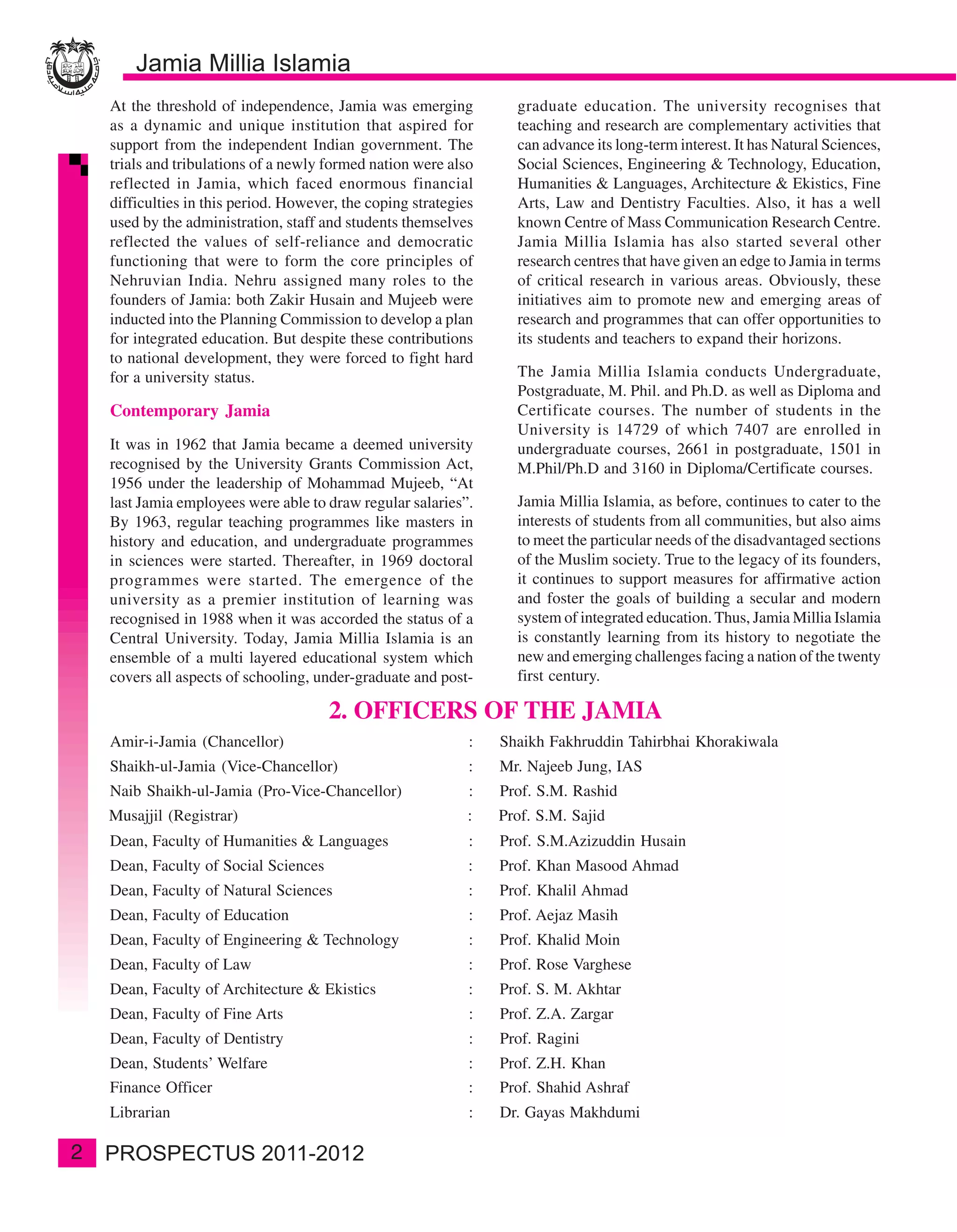
1. JAMIA MILLIA ISLAMIA
Jamia was established in 1920 by a group of nationalist        of the Aligarh College campus, was also a difficult one
Muslim intelligentsia at Aligarh (Uttar Pradesh). Its          with lack of funds and infrastructure. The new university
campus shifted from Aligarh to Delhi in 1925 and the           demonstrated that a society with diverse cultures could
foundation stone of the present campus was laid on 1           be groomed into a modern nation on the basis of a shared
March 1930. Since then, the university has expanded and        culture and perspective. In Jamia, Hindu, Muslim and
become known as a premier educational institution of           other students not only studied together, they also ate
the country. Recognising its contributions in the field of     and lived together in a spartan lifestyle. Teachers came
teaching, research and extension work, the University          from all over the country and lived the same simple
Grants Commission (UGC) bestowed the “deemed                   lifestyles. The use of ‘khaddar’ for uniforms epitomised
university” status to it in 1962, and it was designated a      the nationalist principle that was to follow throughout its
Central University in 1988. The journey from Aligarh to        development.
Delhi, not only presents the physical expansion of Jamia,
but also presents a lesson for those who want to build         In 1924, after the withdrawal of khilafat, the institution
educational institutions for the nation. It is therefore not   faced a serious threat of closure. It then moved to Delhi
surprising that Rabindranath Tagore once called the            and its reins were handed over to Dr Zakir Husain in
University as “one of the most progressive educational         1926 who aptly remarked: “The biggest objective of Jamia
institutions of the country”.                                  is to prepare a roadmap for the future of Indian Muslims
                                                               with the religion of Islam at its core and to fill that
Jamia and the Nationalist Alternative                          roadmap with the colour of the civilisation of India in
                                                               such a way that it merges with the colours of the life of
Jamia was conceived as the National Muslim University          the common man.” Jamia survived this transitional phase
in October 1920 on the campus of the Mohammedan                with the active support and involvement of leaders like
Anglo-Oriental College set up by Sir Syed Ahmed Khan           Hakim Ajmal Khan, M.A. Ansari, Abid Hussain and
at Aligarh. Since its inception in 1892, the Aligarh College   Mohammad Mujeeb who shared Zakir Husain’s vision
had produced an elite and middle class leadership that         for the institution. This phase of Jamia’s development
was actively involved with the nationalist movement in         was characterised by the equal sacrifices that were made
one manner or the other. The landed gentry connected           by the staff and students of the university, and were ably
with the Aligarh College had helped to form the All India      aided by Gandhiji in their fund collection.
Muslim League in 1906. At the same time, the educated
and secular Muslim intelligentsia from the college was         Jamia: A reflection of a self reliant modern and
associated with the khilafat and non-cooperation               secular nation
movements led by Gandhiji and whose main plank of
political mobilisation was Hindu-Muslim unity. The             From its inception, the Jamia had catered to students from
changing character of the nationalist movement in the          disadvantaged backgrounds (in contrast to the elite
Gandhian leadership had its impact on those connected          Aligarh College) and its course curriculum was suited to
with the Aligarh College. The syndicate of the college         meet the needs of such students. The medium of
proclaimed that it had been founded to turn out “worthy        instruction and learning was Hindi, Urdu and English.
and useful subjects of the British Crown”. In contrast,        By 1937, when the Jamia campus had already shifted to
freedom fighters like, Mohamed Ali (the khilafat leader        Okhla. The university was an active participant in
and the first vice-chancellor) and Hakim Ajmal Khan            spreading Gandhiji’s idea of nai talim which was
wanted to build an educational institution which would         popularly known as the ‘Wardha Scheme’. Under the
serve to inculcate both, modern education and nationalist      leadership of Zakir Husain, the chief architect of Wardha
ideals in students from all communities, particularly the      Scheme, Jamia started the “Book Bank” project, the
Muslims. They also actively opposed the “two nation            “Village (dehat) Project”, and “Subzi Mandi Project”.
theory” propagated by the Muslim League. This stand            They also started programmes on sehat aur safai (health
brought about a split between the Muslim intelligentsia        and hygiene), kapda (weaving), carpentry and soap
and the Jamia was born out of this ideological conflict.       making where students learnt the merits of combining
                                                               manual labour along with broadening their intellectual
The formation of Jamia was supported by Gandhiji and           horizons. Vocational training and school education
Tagore who had himself initiated such an effort in Shanti      became one of the cornerstones of Jamia education and
Niketan. The start, which was made in Krishna Ashram           models for innovative teaching.


                                                                                                                             1
At the threshold of independence, Jamia was emerging            graduate education. The university recognises that
    as a dynamic and unique institution that aspired for            teaching and research are complementary activities that
    support from the independent Indian government. The             can advance its long-term interest. It has Natural Sciences,
    trials and tribulations of a newly formed nation were also      Social Sciences, Engineering & Technology, Education,
    reflected in Jamia, which faced enormous financial              Humanities & Languages, Architecture & Ekistics, Fine
    difficulties in this period. However, the coping strategies     Arts, Law and Dentistry Faculties. Also, it has a well
    used by the administration, staff and students themselves       known Centre of Mass Communication Research Centre.
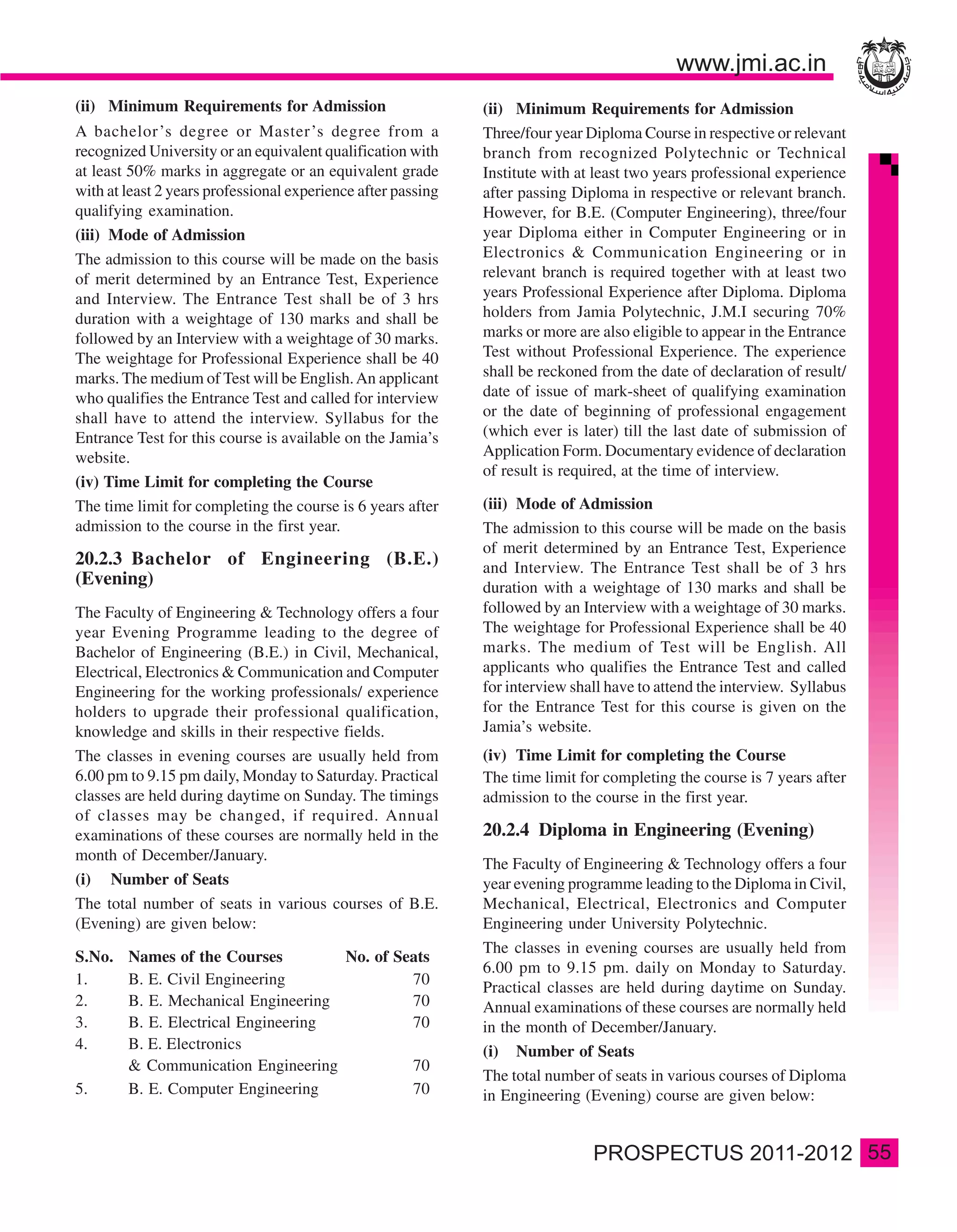
    reflected the values of self-reliance and democratic            Jamia Millia Islamia has also started several other
    functioning that were to form the core principles of            research centres that have given an edge to Jamia in terms
    Nehruvian India. Nehru assigned many roles to the               of critical research in various areas. Obviously, these
    founders of Jamia: both Zakir Husain and Mujeeb were            initiatives aim to promote new and emerging areas of
    inducted into the Planning Commission to develop a plan         research and programmes that can offer opportunities to
    for integrated education. But despite these contributions       its students and teachers to expand their horizons.
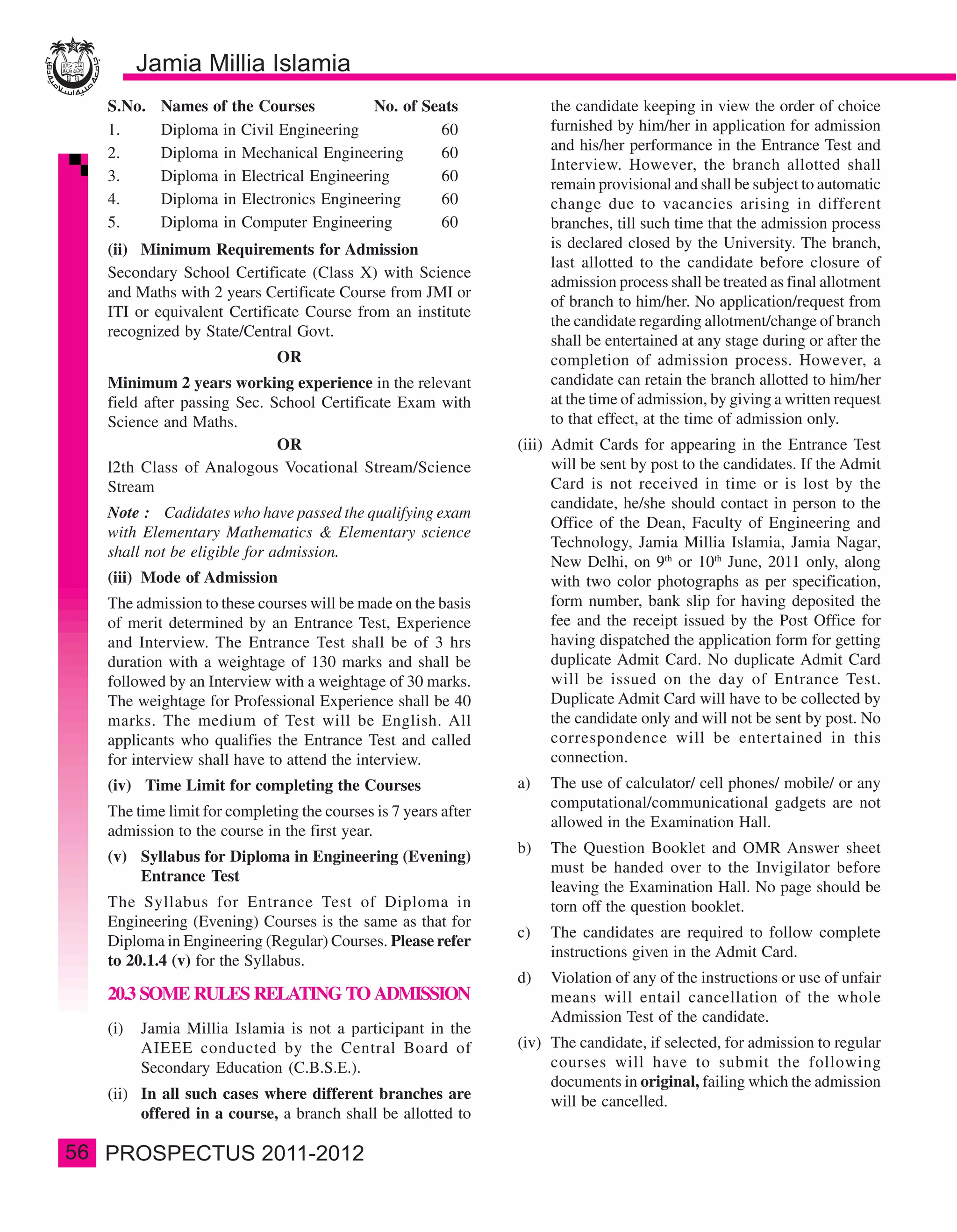
    to national development, they were forced to fight hard
    for a university status.                                        The Jamia Millia Islamia conducts Undergraduate,
                                                                    Postgraduate, M. Phil. and Ph.D. as well as Diploma and
    Contemporary Jamia                                              Certificate courses. The number of students in the
                                                                    University is 14729 of which 7407 are enrolled in
    It was in 1962 that Jamia became a deemed university            undergraduate courses, 2661 in postgraduate, 1501 in
    recognised by the University Grants Commission Act,             M.Phil/Ph.D and 3160 in Diploma/Certificate courses.
    1956 under the leadership of Mohammad Mujeeb, “At
    last Jamia employees were able to draw regular salaries”.       Jamia Millia Islamia, as before, continues to cater to the
    By 1963, regular teaching programmes like masters in            interests of students from all communities, but also aims
    history and education, and undergraduate programmes             to meet the particular needs of the disadvantaged sections
    in sciences were started. Thereafter, in 1969 doctoral          of the Muslim society. True to the legacy of its founders,
    programmes were started. The emergence of the                   it continues to support measures for affirmative action
    university as a premier institution of learning was             and foster the goals of building a secular and modern
    recognised in 1988 when it was accorded the status of a         system of integrated education. Thus, Jamia Millia Islamia
    Central University. Today, Jamia Millia Islamia is an           is constantly learning from its history to negotiate the
    ensemble of a multi layered educational system which            new and emerging challenges facing a nation of the twenty
    covers all aspects of schooling, under-graduate and post-       first century.

                                       2. OFFICERS OF THE JAMIA
    Amir-i-Jamia (Chancellor)                                 :   Shaikh Fakhruddin Tahirbhai Khorakiwala
    Shaikh-ul-Jamia (Vice-Chancellor)                         :   Mr. Najeeb Jung, IAS
    Naib Shaikh-ul-Jamia (Pro-Vice-Chancellor)                :   Prof. S.M. Rashid
    Musajjil (Registrar)                                      :   Prof. S.M. Sajid
    Dean, Faculty of Humanities & Languages                   :   Prof. S.M.Azizuddin Husain
    Dean, Faculty of Social Sciences                          :   Prof. Khan Masood Ahmad
    Dean, Faculty of Natural Sciences                         :   Prof. Khalil Ahmad
    Dean, Faculty of Education                                :   Prof. Aejaz Masih
    Dean, Faculty of Engineering & Technology                 :   Prof. Khalid Moin
    Dean, Faculty of Law                                      :   Prof. Rose Varghese
    Dean, Faculty of Architecture & Ekistics                  :   Prof. S. M. Akhtar
    Dean, Faculty of Fine Arts                                :   Prof. Z.A. Zargar
    Dean, Faculty of Dentistry                                :   Prof. Ragini
    Dean, Students’ Welfare                                   :   Prof. Z.H. Khan
    Finance Officer                                           :   Prof. Shahid Ashraf
    Librarian                                                 :   Dr. Gayas Makhdumi

2
3. GENERAL GUIDELINES
1.   Candidates are required to read the prospectus               Application Form. However, if a candidate wishes
     carefully before filling in the Application Form             to apply in more than four courses from a group
     for Admission to the courses of studies in the               or desires to apply in the courses from two or more
     Jamia. The Prospectus provides general                       different groups, he/ she will have to fill a separate
     information and is subject to the provisions of the          Application From in each such case.
     Act, Statutes, Ordinances, Regulations and
     relevant Resolutions of the Academic Council/           5.   There shall also be a Common Entrance Test for
     Executive Council of Jamia.                                  the courses shown below:

2.   Admission to all courses shall be done through               i). PG Diploma in Digital Cartography/PG
     an Entrance Test (85% weightage) and Interview               Diploma in Remote Sensing & GIS Applications.
     (15% weightage).                                        Note: Application Forms for the above courses are
3.   All seats in all Undergraduate Courses offered by            to be submitted in the office of the Head,
     the Faculty of Humanities & Languages, Social                Department of Geography, JMI
     Sciences and Natural Sciences shall be filled                ii). Master of Computer Application (MCA)/
     through Common Entrance Tests conducted for                  PGDCA.
     different groups of subjects as detailed below:
                                                             Note: Application Forms for the above courses are
     a) Social Sciences                                           to be submitted in the office of the Head,
     Group – I BBS/B.Com/B.A. (Hons.)Economics/                   Department of Computer Sciences, JMI
     BACA                                                         iii). M. A. in Conflict Analaysis & Peace Building/
     Group – II B.A./B.A. (Hons.) Sociology/Political             M.A. in Social Exclusion & Inclusive Policy/M.A.
     Science/ Psychology/ Geography/ History/ Social              in Media Governance/ M.A. in Comparative
     Work/ Hotel Management, Travel & Tourism                     Religions/M.A. in Early Childhood Development.

Note: Application Forms for the above courses are            Note: Application Forms for the above courses are
     to be submitted in the office of the Dean,                   to be submitted in the office of the Director
     Faculty of Social Sciences, JMI                              Nelson Mandela Centre for Peace & Conflict
                                                                  Resolution, JMI
     b) Humanities & Languages
                                                             6.   An Application Form, for a group of up to four
     B.A. (Hons.) Arabic/English/Hindi/Islamic                    (4) courses in which a Common Entrance Test will
     Studies/Mass Media Hindi/Persian/Urdu                        be conducted, as mentioned in Para 3 and 5 above,
                                                                  may be obtained by paying Rs. 300/- only.
Note: Application Forms for the above courses are
     to be submitted in the office of the Dean,              7.   Candidates (execpt SC/ST) obtaining less than
     Faculty of Humanities & Languages, JMI                       33% marks in undergraduate and diploma courses
     c) Natural Sciences                                          and 36% marks in postgraduate courses in the
                                                                  Entrance Test (except BDS) will not be eligible
     Group – I B. Sc./B. Sc. (Instrumentation)/B. Sc.             for Interview. However, the candiates belonging
     (Hons.) Physics/Chemistry/B.A./B. Sc. (Hons.)                to the scheduled castes and scheduled tribes will
     Mathematics.                                                 be given a relaxation to the extent of 5% in the
                                                                  minimum prescribed marks to qualify the Entrance
     Group – II B. Sc. Biosciences/Biotechnolgoy.
                                                                  Test to make them eligible to be called for
Note: Application Forms for the above courses are                 Interview.
     to be submitted in the office of the Dean,
                                                             8.   The candidates (except SC/ST) obtaining less than
     Faculty of Natural Sciences, JMI
                                                                  50% marks for all categories of the applicants and
4.   The applicants may apply for up to a maximum                 the SC/ST obtaining less than 40% of marks in
     of four (04) courses from one of the group of                the Entrance Test will not be eligible to be called
     subjects referred in Para 3 above by filling a single        for interview for admission to BDS course.

                                                                                                                           3
9.    There will be no negative marking in the Entrance      16.   Online application forms for admission can also
          Test in any course of Jamia Millia Islamia.                  be downloaded from Jamia website (http://
                                                                       www.jmi.ac.in).
    10.   All applicants for admission to any course in Jamia
          shall have to appear in both Entrance Test &           17.   No candidate shall be entitled to claim admission
          Interview.                                                   as a matter of right.
    11.   The absence of a candidate in either of the test/      18.   Admission to any course of the Jamia can be
          interveiw will forfeit his/her claim for admission.          cancelled, at any time, if any information furnished
                                                                       by the candidate at the time of admission is found
    12.   No application/request from candidates for
                                                                       to be incorrect.
          rechecking/re-evaluation of Answer Scripts of
          Entrance Tests shall be entertained.                   19.   The candidates, who have appeared at the
                                                                       qualifying examination but whose results have not
    13.   There is no provision of nomination on any seat
                                                                       been declared may also apply for admission. They
          by any authority of the Jamia and no application /
                                                                       must, however, submit their results/marks sheet
          request shall be entertained in this regard.
                                                                       by the last date of admission as per the list in which
    14.   Students admitted shall be subject to the provisions         the name of the student figures. The candidates of
          of the Act, Statutes, Ordinances and Regulations             the Faculty of Engineering & Technology and
          of the Jamia.                                                Faculty of Dentistry must produce their results/
                                                                       marks sheet at the time of interview.
    15.   Jamia reserves the right to make any change/
          modification in the provisions made in this            20.   The candidates admitted to various courses in
          Prospectus and the same shall be duly notified.              Jamia shall be liable to submit an affidavit on
          The candidates shall not be informed of any such             Rs. 10/- Non-Judicial Stamp Paper certified by
          change individually.                                         a first class Magistrate assuring not to indulge
                                                                       in any form of ragging, in a form obtainable
                                                                       from the office of the Department/Faculty/
                                                                       Centre concerned.


                                                      IMPORTANT NOTE

                        Applicants for the Academic Year 2011-2012 should note that the Jamia
                        Millia Islamia has been declared a Minority Educational Institution under
                        Article 30(1) of the Constitution of India read with Section 2(g) of the
                        National Commission for Minority Educational Institutions Act. As a
                        consequence of this, the university admission policy towards the statutory
                        reservation of seats for students applying for admission for 2011-2012 is
                        expected to be modified. The modification to this effect will be notified
                        on the university website: www.jmi.ac.in. Applicants are advised to be
                        vigilant regarding any notification to this effect.


4
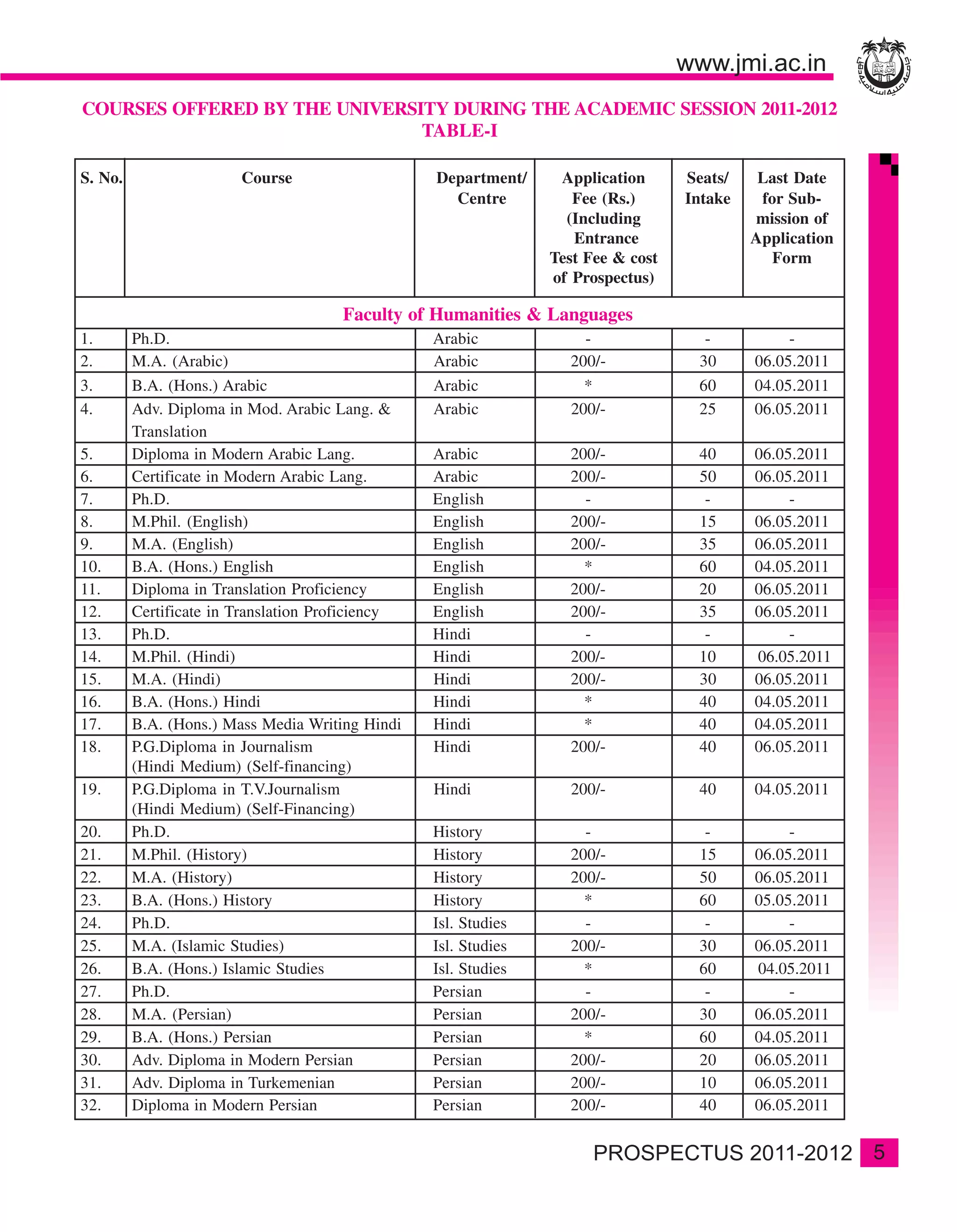
COURSES OFFERED BY THE UNIVERSITY DURING THE ACADEMIC SESSION 2011-2012
                               TABLE-I

S. No.                  Course                    Department/     Application      Seats/    Last Date
                                                    Centre          Fee (Rs.)      Intake    for Sub-
                                                                   (Including               mission of
                                                                    Entrance                Application
                                                                 Test Fee & cost               Form
                                                                 of Prospectus)

                                      Faculty of Humanities & Languages
1.       Ph.D.                                    Arabic             -               -           -
2.       M.A. (Arabic)                            Arabic           200/-            30      06.05.2011
3.       B.A. (Hons.) Arabic                      Arabic             *              60      04.05.2011
4.       Adv. Diploma in Mod. Arabic Lang. &      Arabic           200/-            25      06.05.2011
         Translation
5.       Diploma in Modern Arabic Lang.           Arabic           200/-            40      06.05.2011
6.       Certificate in Modern Arabic Lang.       Arabic           200/-            50      06.05.2011
7.       Ph.D.                                    English            -               -           -
8.       M.Phil. (English)                        English          200/-            15      06.05.2011
9.       M.A. (English)                           English          200/-            35      06.05.2011
10.      B.A. (Hons.) English                     English            *              60      04.05.2011
11.      Diploma in Translation Proficiency       English          200/-            20      06.05.2011
12.      Certificate in Translation Proficiency   English          200/-            35      06.05.2011
13.      Ph.D.                                    Hindi              -               -           -
14.      M.Phil. (Hindi)                          Hindi            200/-            10      06.05.2011
15.      M.A. (Hindi)                             Hindi            200/-            30      06.05.2011
16.      B.A. (Hons.) Hindi                       Hindi              *              40      04.05.2011
17.      B.A. (Hons.) Mass Media Writing Hindi    Hindi              *              40      04.05.2011
18.      P.G.Diploma in Journalism                Hindi            200/-            40      06.05.2011
         (Hindi Medium) (Self-financing)
19.      P.G.Diploma in T.V.Journalism            Hindi            200/-            40      04.05.2011
         (Hindi Medium) (Self-Financing)
20.      Ph.D.                                    History            -               -           -
21.      M.Phil. (History)                        History          200/-            15      06.05.2011
22.      M.A. (History)                           History          200/-            50      06.05.2011
23.      B.A. (Hons.) History                     History            *              60      05.05.2011
24.      Ph.D.                                    Isl. Studies       -               -           -
25.      M.A. (Islamic Studies)                   Isl. Studies     200/-            30      06.05.2011
26.      B.A. (Hons.) Islamic Studies             Isl. Studies       *              60      04.05.2011
27.      Ph.D.                                    Persian            -               -           -
28.      M.A. (Persian)                           Persian          200/-            30      06.05.2011
29.      B.A. (Hons.) Persian                     Persian            *              60      04.05.2011
30.      Adv. Diploma in Modern Persian           Persian          200/-            20      06.05.2011
31.      Adv. Diploma in Turkemenian              Persian          200/-            10      06.05.2011
32.      Diploma in Modern Persian                Persian          200/-            40      06.05.2011

                                                                                                          5
S. No.                    Course                   Department/     Application      Seats/    Last Date
                                                         Centre          Fee (Rs.)      Intake    for Sub-
                                                                        (Including               mission of
                                                                         Entrance                Application
                                                                      Test Fee & cost               Form
                                                                      of Prospectus)
    33.      Diploma in Kazhaki                        Persian             200/-         20      06.05.2011
    34.      Diploma in Turkemenian                    Persian             200/-         10      06.05.2011
    35.      Diploma in Pashto Language                Persian             200/-         10      05.05.2011
    36.      Certificate in Modern Persian             Persian             200/-         40      06.05.2011
    37.      Certificate in Kazhaki                    Persian             200/-         20      06.05.2011
    38.      Certificate in Turkemenian                Persian             200/-         10      06.05.2011
    39.      Certificate in Pashto Language            Persian             200/-         10      05.05.2011
    40.      Ph.D.                                     Urdu                  -            -           -
    41.      M.Phil. (Urdu)                            Urdu                200/-         20      06.05.2011
    42.      M.A. (Urdu)                               Urdu                200/-         30      06.05.2011
    43.      B.A. (Hons.) Urdu                         Urdu                  *           60      04.05.2011
    44.      P.G. Diploma in Urdu Mass Media           Urdu                200/-         30      06.05.2011
    45.      B. A. (Hons.) Hotel Management,           F/o Hum. &            *           30      05.05.2011
             Travel and Tourism (BHMTT)                 Lang.
    46.      Diploma in Tourism & Travel Mgt.          F/o Hum. &          200/-         30      06.05.2011
                                                       Lang.
    47.      Certificate in Tourism & Travel Mgt.      F/o Hum. &          200/-         30      06.05.2011
                                                       Lang
    48.      Adv. Diploma in Turkish                   F/o Hum. &          200/-         20      06.05.2011
                                                       Lang
    49.      Diploma in Turkish                        F/o Hum. &          200/-         20      06.05.2011
                                                       Lang
    50.      Certificate in Turkish                    F/o Hum. &          200/-         40      06.05.2011
                                                       Lang
                                              Faculty of Social Sciences
    51.      B.A.                                      F/o Soc. Sc.        200/-         50      05.05.2011
    52.      Ph.D.                                     Commerce              -            -           -
    53.      M.Com. (Business Mgt.)                    Commerce            200/-         30      04.05.2011
    54.      M.I.B.                                    Commerce            200/-         65      04.05.2011
    55.      B.Com. (Hons.)                            Commerce              *           50      05.05.2011
    56.      B.B.S.                                    Commerce              *           40      05.05.2011
    57.      Ph.D.                                     Economics             -            -           -
    58.      M.A. (Economics)                          Economics           200/-         45      04.05.2011
    59.      B.A. (Hons.) Economics                    Economics             *           50      05.05.2011
    60.      B.A. with Comp. Appl. (B.A.C.A.)          Economics             *           30      05.05.2011
    61.      Ph.D.                                     Pol. Science          -            -           -
    62.      M.A. (Political Science)                  Pol. Science        200/-         45      04.05.2011
    63.      M.A. (Human Rights & Duties Edu.)         Pol. Science        200/-         30      04.05.2011
    64.      M.A. (Public Administration)              Pol. Science        200/-         40      04.05.2011


6
S. No.                   Course                     Department/        Application      Seats/    Last Date
                                                      Centre             Fee (Rs.)      Intake    for Sub-
                                                                        (Including               mission of
                                                                         Entrance                Application
                                                                      Test Fee & cost               Form
                                                                      of Prospectus)
65.      B.A. (Hons.) Political Science            Pol. Science           *              50      05.05.2011
66.      Ph.D.                                     Psychology             -               -           -
67.      M.A. ( Applied Psychology)                Psychology           200/-            36      04.05.2011
68.      B.A. (Hons.) Psychology                   Psychology             *              40      05.05.2011
69.      Advanced Diploma in Counsel. Psychology   Psychology           200/-            25      04.05.2011
70.      Ph.D.                                     Social Work            -               -           -
71.      M.A. (Social Work)                        Social Work          200/-            30      04.05.2011
72.      M.A. (Human Resource Mgt.)                Social Work          200/-            20      04.05.2011
73.      B.A. (Hons.) Social Work                  Social Work            *              25      05.05.2011
74.      P.G. Diploma in Mgt. of NGOs.             Social Work          200/-            45      04.05.2011
75.      Ph.D.                                     Sociology              -               -           -
76.      M.A. (Sociology)                          Sociology            200/-            30      04.05.2011
77.      B.A. (Hons.) Sociology                    Sociology              *              40      05.05.2011
78       Ph. D.                                    Adult & CEE            -               -           -
79.      B.Lib. & Information Science              Lib. & Info. Sc.     200/-            35      06.05.2011

                                          Faculty of Natural Sciences
80.      B.Sc.                                     F/o Nat. Sc.           *              45      04.05.2011
81.      Ph.D.                                     Biosciences            -               -           -
82.      M.Sc. Biosciences                         Biosciences          200/-            30      05.05.2011
83.      M.Sc. Biochemistry (S.F.)                 Biosciences          200/-            20      05.05.2011
84.      B.Sc. Biosciences                         Biosciences            *              40      04.05.2011
85.      Ph.D.                                     Biotechnology          -               -           -
86.      M.Sc. Biotechnology (S.F.)                Biotechnology        200/-            30      05.05.2011
87.      B.Sc. Biotechnology                       Biotechnology          *              25      04.05.2011
88.      Ph.D.                                     Chemistry              -               -           -
89.      M.Sc. Chemistry                           Chemistry            200/-            40      05.05.2011
90.      B.Sc. (Hons.) Chemistry                   Chemistry              *              40      04.05.2011
91.      Ph.D.                                     Comp. Sc.              -               -           -
92.      M.Sc. Bioinformatics (S.F.)               Comp. Sc.            200/-            40      05.05.2011
93.      M.C.A.                                    Comp. Sc.              *              50      05.05.2011
94.      P.G. Diploma in Computer Applications     Comp. Sc.              *              30      05.05.2011


                                                                                                               7
S. No.                   Course                      Department/       Application      Seats/    Last Date
                                                           Centre            Fee (Rs.)      Intake    for Sub-
                                                                            (Including               mission of
                                                                             Entrance                Application
                                                                          Test Fee & cost               Form
                                                                          of Prospectus)

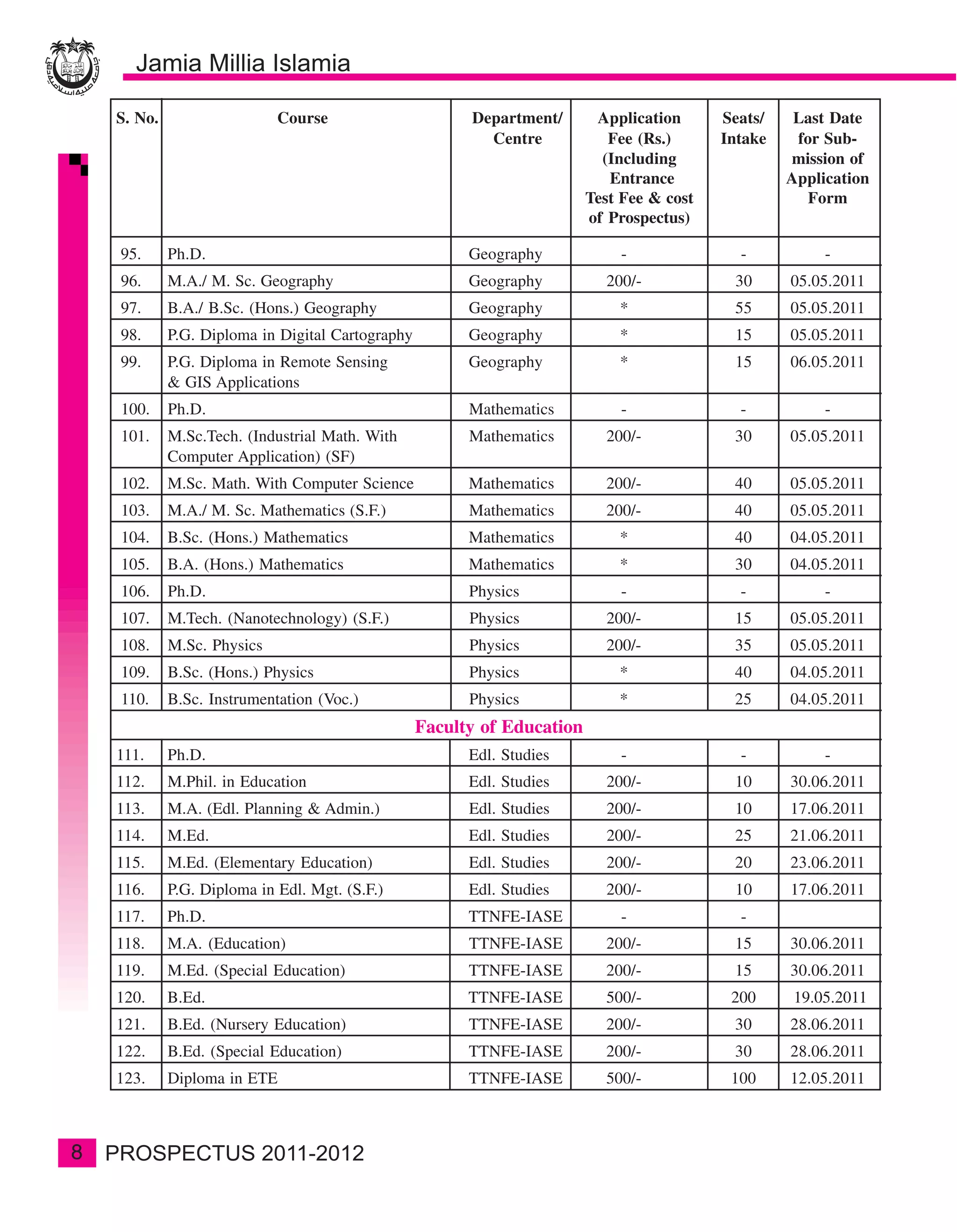
    95.      Ph.D.                                       Geography            -               -           -
    96.      M.A./ M. Sc. Geography                      Geography          200/-            30      05.05.2011
    97.      B.A./ B.Sc. (Hons.) Geography               Geography            *              55      05.05.2011
    98.      P.G. Diploma in Digital Cartography         Geography            *              15      05.05.2011
    99.      P.G. Diploma in Remote Sensing              Geography            *              15      06.05.2011
             & GIS Applications
    100.     Ph.D.                                       Mathematics          -               -           -
    101.     M.Sc.Tech. (Industrial Math. With           Mathematics        200/-            30      05.05.2011
             Computer Application) (SF)
    102.     M.Sc. Math. With Computer Science           Mathematics        200/-            40      05.05.2011
    103.     M.A./ M. Sc. Mathematics (S.F.)             Mathematics        200/-            40      05.05.2011
    104.     B.Sc. (Hons.) Mathematics                   Mathematics          *              40      04.05.2011
    105.     B.A. (Hons.) Mathematics                    Mathematics          *              30      04.05.2011
    106.     Ph.D.                                       Physics              -               -           -
    107.     M.Tech. (Nanotechnology) (S.F.)             Physics            200/-            15      05.05.2011
    108.     M.Sc. Physics                               Physics            200/-            35      05.05.2011
    109.     B.Sc. (Hons.) Physics                       Physics              *              40      04.05.2011
    110.     B.Sc. Instrumentation (Voc.)                Physics              *              25      04.05.2011
                                                   Faculty of Education
    111.     Ph.D.                                       Edl. Studies         -               -           -
    112.     M.Phil. in Education                        Edl. Studies       200/-            10      30.06.2011
    113.     M.A. (Edl. Planning & Admin.)               Edl. Studies       200/-            10      17.06.2011
    114.     M.Ed.                                       Edl. Studies       200/-            25      21.06.2011
    115.     M.Ed. (Elementary Education)                Edl. Studies       200/-            20      23.06.2011
    116.     P.G. Diploma in Edl. Mgt. (S.F.)            Edl. Studies       200/-            10      17.06.2011
    117.     Ph.D.                                       TTNFE-IASE           -               -
    118.     M.A. (Education)                            TTNFE-IASE         200/-            15      30.06.2011
    119.     M.Ed. (Special Education)                   TTNFE-IASE         200/-            15      30.06.2011
    120.     B.Ed.                                       TTNFE-IASE         500/-            200      19.05.2011
    121.     B.Ed. (Nursery Education)                   TTNFE-IASE         200/-            30      28.06.2011
    122.     B.Ed. (Special Education)                   TTNFE-IASE         200/-            30      28.06.2011
    123.     Diploma in ETE                              TTNFE-IASE         500/-            100     12.05.2011


8
S. No.                   Course                       Department/        Application       Seats/      Last Date
                                                        Centre             Fee (Rs.)       Intake      for Sub-
                                                                          (Including                  mission of
                                                                           Entrance                   Application
                                                                        Test Fee & cost                  Form
                                                                        of Prospectus)

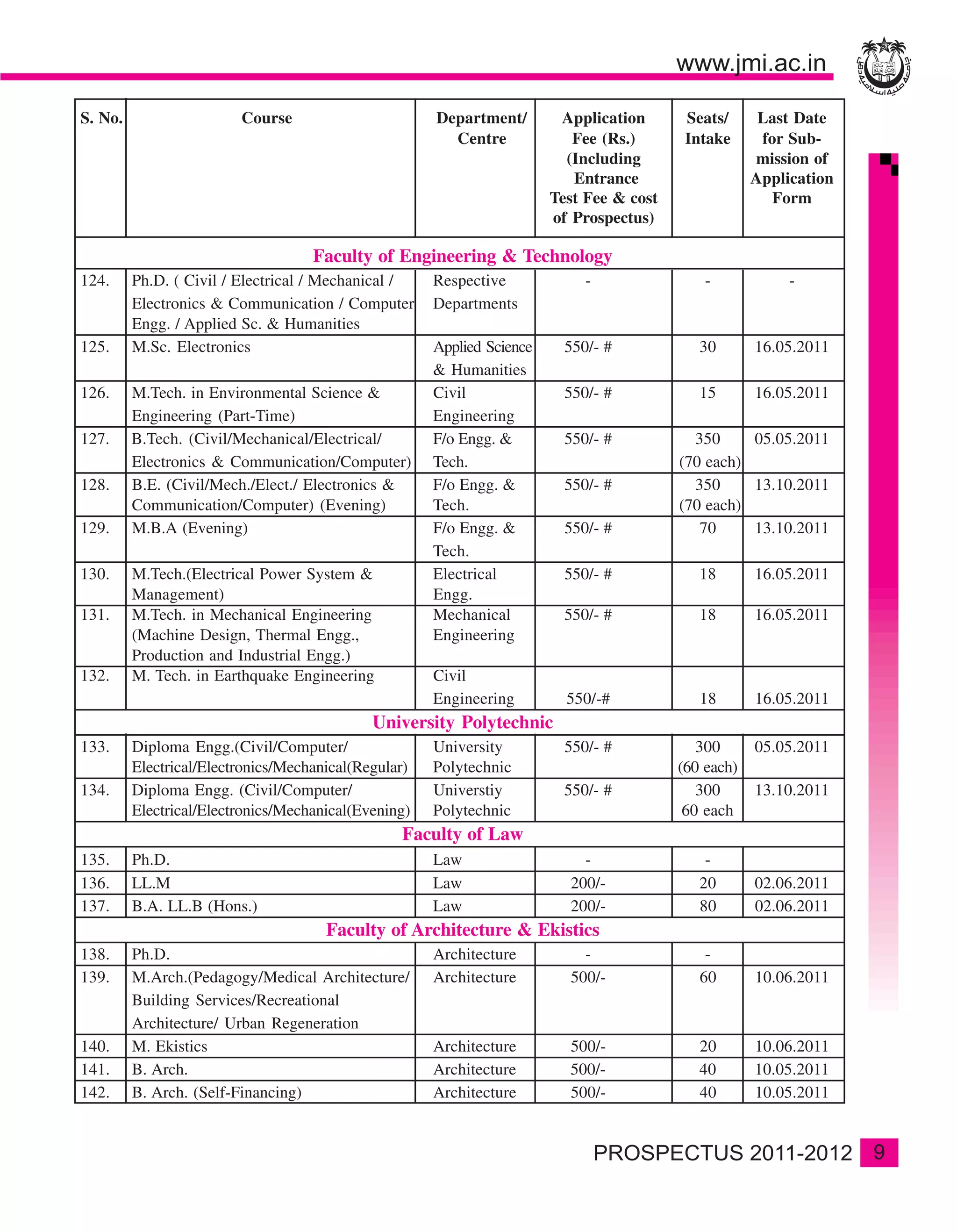
                                    Faculty of Engineering & Technology
124.     Ph.D. ( Civil / Electrical / Mechanical /    Respective             -                -            -
         Electronics & Communication / Computer       Departments
         Engg. / Applied Sc. & Humanities
125.     M.Sc. Electronics                            Applied Science     550/- #            30       16.05.2011
                                                      & Humanities
126.     M.Tech. in Environmental Science &           Civil               550/- #            15       16.05.2011
         Engineering (Part-Time)                      Engineering
127.     B.Tech. (Civil/Mechanical/Electrical/        F/o Engg. &         550/- #           350     05.05.2011
         Electronics & Communication/Computer)        Tech.                               (70 each)
128.     B.E. (Civil/Mech./Elect./ Electronics &      F/o Engg. &         550/- #           350     13.10.2011
         Communication/Computer) (Evening)            Tech.                               (70 each)
129.     M.B.A (Evening)                              F/o Engg. &         550/- #            70     13.10.2011
                                                      Tech.
130.     M.Tech.(Electrical Power System &            Electrical          550/- #            18       16.05.2011
         Management)                                  Engg.
131.     M.Tech. in Mechanical Engineering            Mechanical          550/- #            18       16.05.2011
         (Machine Design, Thermal Engg.,              Engineering
         Production and Industrial Engg.)
132.     M. Tech. in Earthquake Engineering           Civil
                                                      Engineering         550/-#             18       16.05.2011
                                             University Polytechnic
133.     Diploma Engg.(Civil/Computer/                University          550/- #            300      05.05.2011
         Electrical/Electronics/Mechanical(Regular)   Polytechnic                         (60 each)
134.     Diploma Engg. (Civil/Computer/               Universtiy          550/- #            300      13.10.2011
         Electrical/Electronics/Mechanical(Evening)   Polytechnic                          60 each
                                                 Faculty of Law
135.     Ph.D.                                        Law                   -                 -
136.     LL.M                                         Law                 200/-              20       02.06.2011
137.     B.A. LL.B (Hons.)                            Law                 200/-              80       02.06.2011
                                      Faculty of Architecture & Ekistics
138.     Ph.D.                                        Architecture          -                 -
139.     M.Arch.(Pedagogy/Medical Architecture/       Architecture        500/-              60       10.06.2011
         Building Services/Recreational
         Architecture/ Urban Regeneration
140.     M. Ekistics                                  Architecture        500/-              20       10.06.2011
141.     B. Arch.                                     Architecture        500/-              40       10.05.2011
142.     B. Arch. (Self-Financing)                    Architecture        500/-              40       10.05.2011


                                                                                                                    9
S. No.                    Course                     Department/       Application       Seats/     Last Date
                                                            Centre            Fee (Rs.)       Intake     for Sub-
                                                                             (Including                 mission of
                                                                              Entrance                  Application
                                                                           Test Fee & cost                 Form
                                                                           of Prospectus)
                                                    Faculty of Fine Arts
     143.     MFA Painting/Sculpture/Applied Art          Fine Arts          200/-           08+05+08 07.06.2011
     144.     MFA Art Education/Art History/
              Graphic Art                                 Fine Arts          200/-            7+10+8    07.06.2011
     145.     BFA Applied Art                             Applied Art        200/-              30      01.06.2011
     146.     BFA Painting                                Painting           200/-              20      01.06.2011
     147.     BFA Sculpture                               Sculpture          200/-              10      01.06.2011
     148.     BFA Art Education                           Art Education      200/-              20      01.06.2011
     149.     Certificate in Commercial Art/              Applied Art        200/-            20 each   17.06.2011
              Photography
     150.     Certificate in Calligraphy                  Applied Art        200/-              21      17.06.2011
     151.     Diploma in Sculpture                        Sculpture          200/-              10      17.06.2011
     152.     Certificate in Sculpture                    Sculpture          200/-              10      17.06.2011
     153.     Certificate in Painting                     Painting           200/-              20      17.06.2011
     154.     Certificate in Art Appreciation             Art History        200/-              25      17.06.2011
                                                    Faculty of Dentistry
     155.     Bachelor of Dental Surgery                  F/o Dentistry      500/-              50      02.05.2011
                                 A.J. Kidwai Mass Communication Research Centre
     156.     Ph.D.                                       AJK-MCRC             -                 -           -
     157.     M.A. in Mass Communication                  AJK-MCRC           500/-              50      26.04.2011
     158.     M.A. in Convergent Journalism               AJK-MCRC           500/-              20      26.04.2011
     159.     P.G. Diploma in Development                 AJK-MCRC           500/-              40      26.04.2011
              Communication
     160.     P.G. Diploma in Broadcast Technology        AJK-MCRC           500/-              20      26.04.2011
     161.     P.G. Diploma in Still Photography &         AJK-MCRC           500/-              20      26.04.2011
              Visual Communication
     162.     P.G. Diploma in Graphics & Animation        AJK-MCRC           500/-              20      26.04.2011
                                   M.M. Ali Johar Academy of Third World Studies
     163.     Ph.D.                                       MMAJ-ATWS            -                 -           -
     164.     M.Phil.                                     MMAJ-ATWS          200/-              20      07.06.2011
     165.     Diploma in Uzbek                            MMAJ-ATWS          200/-              10      07.06.2011
     166.     Certificate in Uzbek                        MMAJ-ATWS          200/-              20      07.06.2011
     167.     Certificate in Kyrgyz                       MMAJ-ATWS          200/-              10      07.06.2011

10
S. No.                   Course                       Department/    Application      Seats/    Last Date
                                                        Centre         Fee (Rs.)      Intake    for Sub-
                                                                      (Including               mission of
                                                                       Entrance                Application
                                                                    Test Fee & cost               Form
                                                                    of Prospectus)

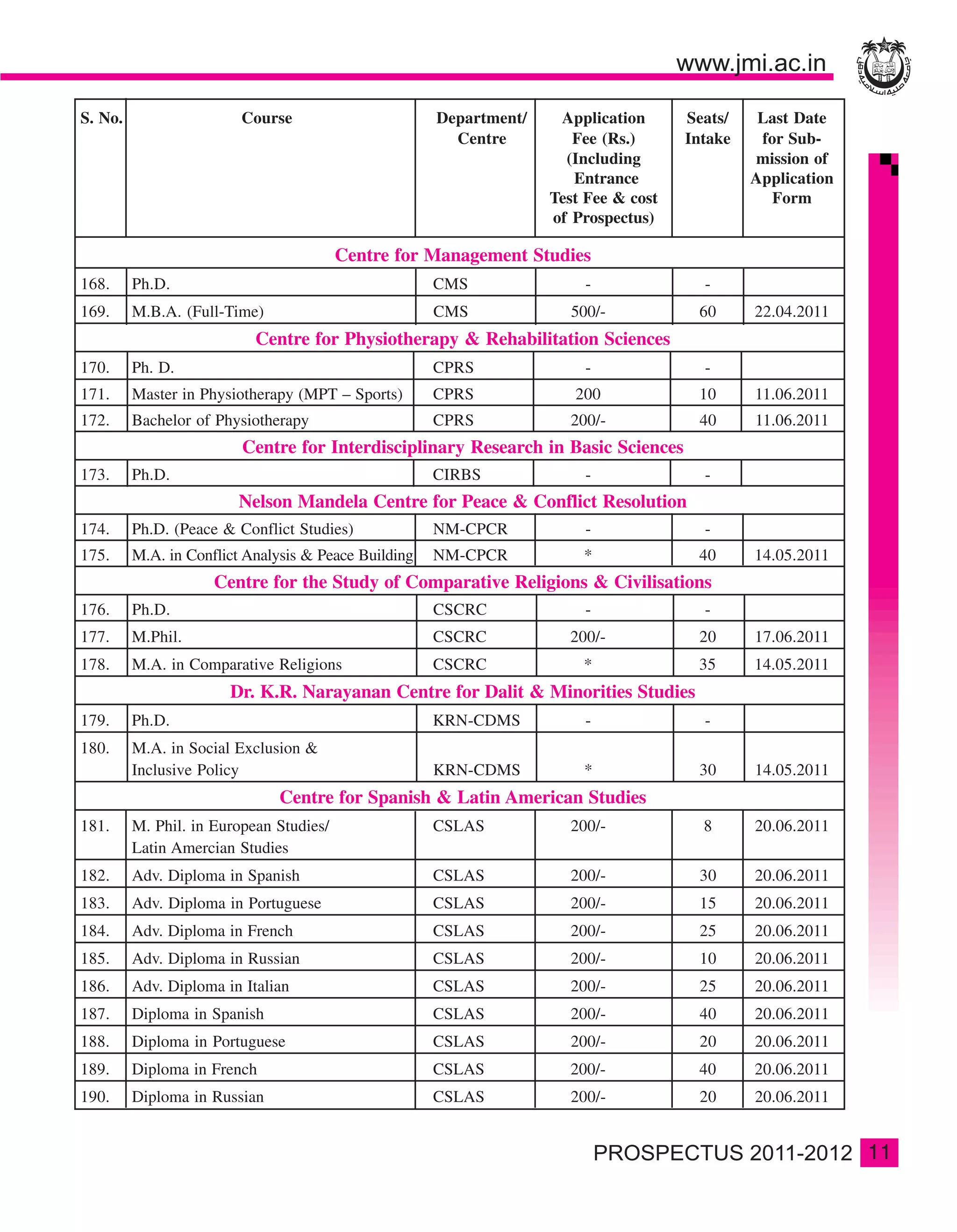
                                         Centre for Management Studies
168.     Ph.D.                                        CMS               -               -
169.     M.B.A. (Full-Time)                           CMS             500/-            60      22.04.2011
                           Centre for Physiotherapy & Rehabilitation Sciences
170.     Ph. D.                                       CPRS              -               -
171.     Master in Physiotherapy (MPT – Sports)       CPRS             200             10      11.06.2011
172.     Bachelor of Physiotherapy                    CPRS            200/-            40      11.06.2011
                         Centre for Interdisciplinary Research in Basic Sciences
173.     Ph.D.                                        CIRBS             -               -
                        Nelson Mandela Centre for Peace & Conflict Resolution
174.     Ph.D. (Peace & Conflict Studies)             NM-CPCR           -               -
175.     M.A. in Conflict Analysis & Peace Building   NM-CPCR           *              40      14.05.2011
                     Centre for the Study of Comparative Religions & Civilisations
176.     Ph.D.                                        CSCRC             -               -
177.     M.Phil.                                      CSCRC           200/-            20      17.06.2011
178.     M.A. in Comparative Religions                CSCRC             *              35      14.05.2011
                       Dr. K.R. Narayanan Centre for Dalit & Minorities Studies
179.     Ph.D.                                        KRN-CDMS          -               -
180.     M.A. in Social Exclusion &
         Inclusive Policy                             KRN-CDMS          *              30      14.05.2011
                              Centre for Spanish & Latin American Studies
181.     M. Phil. in European Studies/                CSLAS           200/-             8      20.06.2011
         Latin Amercian Studies
182.     Adv. Diploma in Spanish                      CSLAS           200/-            30      20.06.2011
183.     Adv. Diploma in Portuguese                   CSLAS           200/-            15      20.06.2011
184.     Adv. Diploma in French                       CSLAS           200/-            25      20.06.2011
185.     Adv. Diploma in Russian                      CSLAS           200/-            10      20.06.2011
186.     Adv. Diploma in Italian                      CSLAS           200/-            25      20.06.2011
187.     Diploma in Spanish                           CSLAS           200/-            40      20.06.2011
188.     Diploma in Portuguese                        CSLAS           200/-            20      20.06.2011
189.     Diploma in French                            CSLAS           200/-            40      20.06.2011
190.     Diploma in Russian                           CSLAS           200/-            20      20.06.2011


                                                                                                             11
S. No.                     Course                      Department/     Application       Seats/     Last Date
                                                              Centre          Fee (Rs.)       Intake     for Sub-
                                                                             (Including                 mission of
                                                                              Entrance                  Application
                                                                           Test Fee & cost                 Form
                                                                           of Prospectus)

     191.     Diploma in Italian                            CSLAS             200/-             30      20.06.2011
     192.     Diploma in Catalan                            CSLAS             200/-             15      20.06.2011
     193.     Certificate in Spanish                        CSLAS             200/-             50      20.06.2011
     194.     Certificate in Portuguese                     CSLAS             200/-             30      20.06.2011
     195.     Certificate in French                         CSLAS             200/-             50      20.06.2011
     196.     Certificate in Russian                        CSLAS             200/-             30      20.06.2011
     197.     Certificate in Italian                        CSLAS             200/-             40      20.06.2011
     198.     Certificate in Catalan                        CSLAS             200/-             20      20.06.2011
                                              Centre for West Asian Studies
     199.     Ph.D.                                         CWAS                -                -
     200.     M.Phil                                        CWAS              200/-             15      30.06.2011
                                          Centre for Jawahar Lal Nehru Studies
     201.     Ph.D.                                         CJNS                -                -
     202.     M.Phil                                        CJNS              200/-              8      30.06.2011
                                         Centre for Culture, Media & Governance
     203.     Ph.D.                                         CCMG                -                -
     204.     M.A. in Media Governance                      CCMG                *               25      14.05.2011
                                               India Arab Cultural Centre
     205.     P.G. Diploma in Iranology (Part-Time)         IACC              200/-             20      24.06.2011
                                 Centre for Early Childhood Development & Research
     206.     M.A. in Early Childhood Development           CECDR               *               15      14.05.2011


     NOTE:      *      For Appplication Fee, refer to Para 6 above.
                #      Rs 600/- for downloaded Form for courses offered by the Faculty of Engineering & Technology.
                **     Refer to Para-53 “FEE-STRUCTURE OF ALL COURSES” of the Prospectus.


12
4. GUIDELINES FOR ADMISSION
4.1. How to obtain Application Forms:                              p.m. (except lunch hours) on all working days. The
1.    Candidates seeking admission to any course (except           Jamia remains closed on Saturday and Sunday
      Ph.D. programme) at Jamia Millia Islamia during              besides the holidays recognised by the Jamia.
      the academic session 2011-2012 may obtain the           (ii) Payment of fee by cheque/ IPO/ MO shall not
      prescribed Application Form along with the                   be accepted.
      Prospectus from the University Counter at Jamia
      Millia Islamia on cash payment (Inclusive of            (iii) Demand Drafts in favour of “Jamia Millia Islamia”
      Entrance Test fee) as shown in Table-I (under the             payable only at Delhi/ New Delhi branches will be
      column Application Fee).                                      accepted.

2.    The application form may also be downloaded from        (iv) The Application Fee is non-refundable and no
      the Jamia’s website at http://www.jmi.ac.in and              correspondence on this subject will be entertained.
      submitted along with the prescribed fee as              (v) Three recent (passport size) colored
      mentioned above.                                            photographs duly self-attested should be affixed
3.    The Application Form and Prospectus may also be             and covered with transparent tape on the
      obtained through post by sending crossed Demand             application form. The application forms with
      Draft of an amount as shown in Table-I (under the           different photographs are liable to be rejected.
      column Application Fee) drawn in favour of “Jamia           These photographs are to be pasted with gum
      Millia Islamia” payable at Delhi/ New Delhi along           and should not be stapled or pinned. Xerox
      with a self-addressed envelop of 30x25 c.m. size            copies of photographs are not acceptable.
      affixing postage stamps worth Rs.150/- clearly          Note: Applicants for courses offered by Faculty of
      indicating the name of the course for which the             Engineering & Technology should refer to para
      Application Form is required. The request for               20.8 for instructions.
      sending a set of Application Form and prospectus
      should be addressed to the Registrar, Jamia Millia      (vi) Candidates are required to fill an application form
      Islamia, Jamia Nagar, New Delhi - 110025.                    in his/her own handwriting. If a candidate submits
                                                                   more than one application form for the same course,
4.    The cost of Prospectus along with the Application            his/ her candidature is liable to be rejected.
      Form for each course includes the Entrance Test
      Fee. No other fee is required to be submitted at the    (vii) The applicants of the B. Tech., Diploma
      time of submission of the Application Form.                   Engineering (Regular/Evening), M. Tech.
                                                                    Mechanical Engineering, M. Arch., M. Sc.
4.2. Submission of Application Forms for Ph.D.                      Chemistry Courses should give their choice of
     programme                                                      the branch /specialization in the respective box/
                                                                    oval as provided in the Application form for the
Application form along with the general guidelines for
                                                                    Admission. The choice or order of preference
admission to Ph. D. Programme may be downloaded
                                                                    about various branches as filled by the applicant
from the Jamia’s website at http://www.jmi.ac.in. The
                                                                    in the Application form for the admission shall
duly filled up application form along with a demand
                                                                    be treated as final except for various courses of
draft of Rs. 1000/- drawn in favour of Jamia Millia
                                                                    Faculty of Engineering & Technology.
Islamia is to be submitted in the office of concerned
Department of studies/Faculty/Centre.                         (viii)Application Form must be filled in and duly signed
                                                                    by the applicant.
4.3. Submission of Application Form
                                                              (ix) The applicants to all courses under various
(i)   Application on prescribed form completed in all              reserved categories must submit alongwith the
      respects for all courses should be submitted either          application forms attested photocopies of the
      in person or by post, in the office of the respective        certificate of verification of the reserved
      Faculty/Department/Centre on or before last date             category issued by the competent authority.
      of submission of application form. Admission
      forms will be accepted between 09:00 a.m. to 04:00


                                                                                                                         13
(x) Incomplete application form (s) shall be summarily           Department/ Centre concerned as well as Jamia’s
         rejected.                                                    website. No intimation will be sent to the individual
                                                                      candidates.
     (xi) Candidates whose results have not been declared,
          may also apply for admission provided they             (iii) Persons accompanying the candidates are not
          produce the result/ certificate of the qualifying            allowed to enter the Examination Centres.
          examination by the last date of admission as per
                                                                 (iv) Only those candidates who possess a valid Admit
          the list in which the name of the student figures.
                                                                      Card for Entrance Test shall be permitted to take
          Any subsequent production of result/ certificate of
                                                                      the Entrance Test.
          the qualifying examination shall not vest in the
          candidate any right of admission.                      (v) The list of the candidates selected for interview
                                                                     shall be displayed in ascending order of their
     (xii) The last dates for acceptance of application forms
                                                                     Entrance Test Roll No. The lists will be put up on
           for each of the courses is shown in Table- I and II
                                                                     the Notice Board of the Faculty/ Department/
           (Para-54) “ADMISSION SCHEDULE OF
                                                                     Centre concerned as well as on the Jamia’s website
           COURSES OFFERED BY THE UNIVERSITY
                                                                     on the dates given in the admission schedule.
           DURING THE ACADEMIC SESSION 2011-
           2012” of the Prospectus.                              (vi) The lists of provisionally selected candidates as
                                                                      well as of those who are on the waiting list, for
     (xiii)It must be noted that Application Forms will
                                                                      admission will be put on the Notice Boards of the
           also be accepted by Mail/ Courier at the
                                                                      Faculty/ Department/ Centre concerned as well as
           concerned Faculty/ Department/ Centre (as
                                                                      Jamia’s website on the dates given in the schedule.
           shown in Table-I) only, upto the last date of
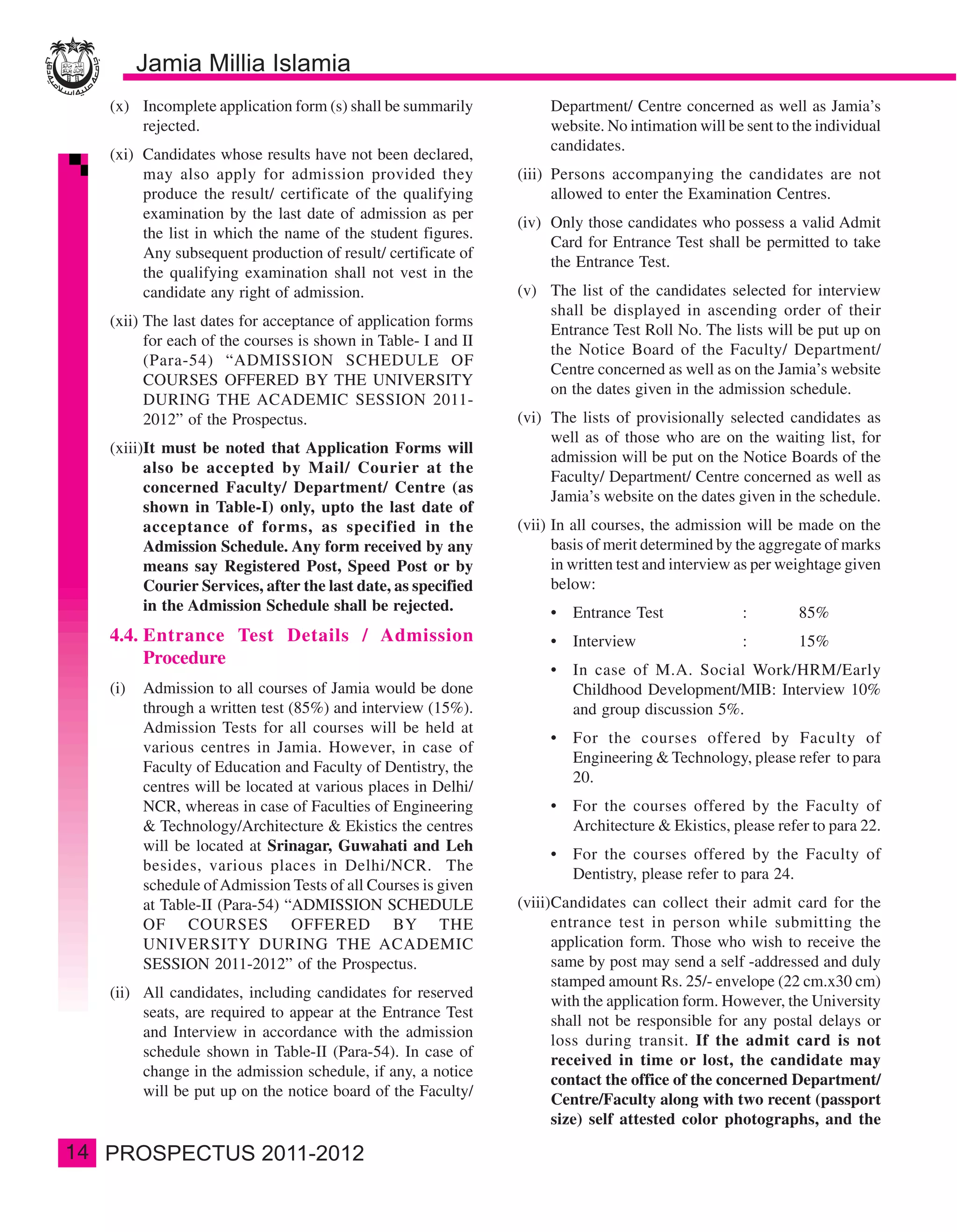
           acceptance of forms, as specified in the              (vii) In all courses, the admission will be made on the
           Admission Schedule. Any form received by any                basis of merit determined by the aggregate of marks
           means say Registered Post, Speed Post or by                 in written test and interview as per weightage given
           Courier Services, after the last date, as specified         below:
           in the Admission Schedule shall be rejected.               •   Entrance Test             :        85%
     4.4. Entrance Test Details / Admission                           •   Interview                 :        15%
          Procedure
                                                                      •   In case of M.A. Social Work/HRM/Early
     (i)   Admission to all courses of Jamia would be done                Childhood Development/MIB: Interview 10%
           through a written test (85%) and interview (15%).              and group discussion 5%.
           Admission Tests for all courses will be held at
                                                                      •   For the courses offered by Faculty of
           various centres in Jamia. However, in case of
                                                                          Engineering & Technology, please refer to para
           Faculty of Education and Faculty of Dentistry, the
                                                                          20.
           centres will be located at various places in Delhi/
           NCR, whereas in case of Faculties of Engineering           •   For the courses offered by the Faculty of
           & Technology/Architecture & Ekistics the centres               Architecture & Ekistics, please refer to para 22.
           will be located at Srinagar, Guwahati and Leh
                                                                      •   For the courses offered by the Faculty of
           besides, various places in Delhi/NCR. The
                                                                          Dentistry, please refer to para 24.
           schedule of Admission Tests of all Courses is given
           at Table-II (Para-54) “ADMISSION SCHEDULE             (viii)Candidates can collect their admit card for the
           OF COURSES OFFERED BY THE                                   entrance test in person while submitting the
           UNIVERSITY DURING THE ACADEMIC                              application form. Those who wish to receive the
           SESSION 2011-2012” of the Prospectus.                       same by post may send a self -addressed and duly
                                                                       stamped amount Rs. 25/- envelope (22 cm.x30 cm)
     (ii) All candidates, including candidates for reserved
                                                                       with the application form. However, the University
          seats, are required to appear at the Entrance Test
                                                                       shall not be responsible for any postal delays or
          and Interview in accordance with the admission
                                                                       loss during transit. If the admit card is not
          schedule shown in Table-II (Para-54). In case of
                                                                       received in time or lost, the candidate may
          change in the admission schedule, if any, a notice
                                                                       contact the office of the concerned Department/
          will be put up on the notice board of the Faculty/
                                                                       Centre/Faculty along with two recent (passport
                                                                       size) self attested color photographs, and the

14
receipt issued by the post office for having             •    In case an intervening period/gap is involved, a
     dispatched the application form, for getting                  certificate/ affidavit from a Class 1 Gazetted
     duplicate Admit Card, at least one-day in                     Officer/ Notary Public for the entire intervening
     advance of the date of Entrance Test.                         period/gap showing candidate’s pre occupation and
                                                                   non indulgence in any criminal activities after
     For courses offered by the Faculty of
                                                                   leaving the Institution last attended will be required.
     Engineering & Technology and Dentistry, the
     Admit Cards/Hall Tickets will be sent to the             •    Proof of permanent address as declared in the
     candidates by post. Please also see 20.3.(iii) and            Application Form with the name of the Police
     (24) for other information relating to Admit                  Station and the District.
     Cards.
                                                              (xi) It is the sole responsibility of the candidate to
(ix) Candidates called for interview shall be generally            ensure his/her eligibility before applying for
     three times the total number of seats in the course           admission to a particular course. No claim of any
     concerned provided that they have secured at least            sort in this matter shall be entertained.
     33% marks in the entrance test at Undergraduate
                                                              (xii) The Syllabus for the Entrance Test can be seen at
     and Diploma Courses and 36% marks in
                                                                    the Jamia’s website.
     Postgraduate Courses other than BDS. In case of
     BDS candidates obtaining less than 50% marks             (xiii)Applicants are advised to read all the instructions
     for all categories of the applicants and the SC/               given in the Prospectus carefully before filling up
                                                                    the Application Form.
     ST obtaining less than 40% of marks in the
     Entrance Test will not be eligible to be called                 5. RULES RELATING TO
     for interview.                                                         ADMISSION
(x) Candidates selected for interview are required to
                                                              1.   Admission of candidates to all Courses shall be
    bring their Admit Card issued for Entrance Test
                                                                   subject to clearance from the Proctorial Department
    and attested true copies along with the original of
                                                                   of Jamia Millia Islamia.
    the following documents at the time of interview:
                                                              2.   List of selected candidates shall be displayed on
                                                                   the Notice Board of the Faculty/ Department/
•    Proof of passing the qualifying examination
                                                                   Centre concerned as well as at the Jamia’s website.
     together with the marks sheet in accordance with
                                                                   No intimation to the selected candidates will be
     the eligibility requirements for admission as
                                                                   sent by post. The candidates shall be required to
     mentioned in this prospectus.
                                                                   get their admission completed by the date given in
•    Proof of age based on the certificate of High                 the schedule.
     School/Secondary School or an equivalent
                                                              3.   All the candidates are required to submit Transfer
     examination.
                                                                   Certificate/Migration Certificate in original within
•    Character Certificate from the institution last               60 days from the date of admission, failing which
     attended.                                                     the admission of the student is liable to be
•    Experience Certificate for candidates of Evening/             cancelled.
     Part time Courses. Self-employed candidates shall        4.   If a candidate fails to complete the admission
     provide authentic evidence in support of their self           formalities by the prescribed date, he/she will
     employment.                                                   automatically forfeit his/her right of admission.
•    Proof of entitlement for a particular reserved           5.   Admission of a candidate may be cancelled at any
     category issued by the competent authority.                   time, if any information furnished by the candidate
•    No objection Certificate from present employer for            at the time of admission is found to be incorrect or
     candidates of evening/Part-time courses or                    that the candidate has been wrongly admitted due
     sponsored candidates.                                         to any reason.

•    Certificate from an M.B.B.S. doctor or govt.             6.   The admission of a candidate will not be completed
     hospital certifying blood group (after final selection        unless he/she has an Identity Card issued by the
     of the candidate).                                            Proctor ’s Office. Admission is liable to be

                                                                                                                             15
cancelled, if a student does not have an Identity              to be charged provided the dues are cleared within
          Card issued and entered in the Proctor’s Office                one months. After this, the name of student shall
          register within the stipulated time.                           be struck off from the rolls and he/she may be re-
     7.   No candidate will be allowed to take up a job while            admitted after getting permission from the Vice-
          pursuing a full time Course. Those, who are                    Chancellor with and additional late fee of Rs. 500.
          employed at the time of admission, will be required      14. In case the re-admission formalities could not be
          to produce a certificate of leave from their employer        completed by a student due to the reason of the
          within one month from the date of admission failing          non-declaration of the result, he/she may be
          which their admission will be cancelled.                     provisionally allowed to attend the classes.
     8.   No candidate, studying a regular full time Course        15. Jamia Millia Islamia recognizes the approved
          in Jamia will be allowed to take any other regular           degrees of all central universities, state universities,
          examination, except courses under Career Oriented            institutions of national importance and reputed
          Programmes of UGC, simultaneously either from                foreign universities, provided that their equivalence
          Jamia or any other university/Institution etc.               has been established by the Association of Indian
     9.   A student of any course who could not appear in              Universities (AIU). Besides, the university also
          the examination due to shortage of attendance or             recognizes certain qualifications from the reputed
          any other reason or who fails in the examinations            madrasas as well, the details of which are given in
          may be given re-admission in the same class of               para 55 of the prospectus.
          that course in the next academic session.                16. A student shall not ordinarily be allowed to change
     10. A candidate, who has taken admission to any                   the optional/subsidiary subject(s) of a course, unless
         Course as a full time regular student will forfeit            the same is applied for and permitted within four
         his/her right as an ex-student in Jamia and will not          weeks from the date of admission. Such applications
         be allowed to appear at any Examination of Jamia              should be submitted to the Dean of the Faculty with
         as an ex-student, except in the case of improvement.          the consent of the Head(s) of the Department(s)
                                                                       concerned.
     11. Candidate seeking admission for regular courses
         after a gap of three or more academic years after         17. The verification process of students admitted
         taking Certificate/ Diploma/ Degree/ Post-Graduate            in various courses of the University shall be done
         Degree, may be considered for admission by the                by the office of the Dean of the concerned
         Admission Review Committee consisting of the                  Faculty/Centre after completing admission
         Shaikh-ul-Jamia (Vice-Chancellor), the Dean,                  process and in case any discrepancy,
         Students’ Welfare, the Dean of the Faculty                    appropriate police/criminal action shall be taken
         concerned, the Head of the Department concerned,              against the erring students.
         and the Proctor.
     12. The admission to all courses will be granted only
                                                                         6. RESERVATION OF SEATS
         to those applicants whose result of the qualifying        6.1. General Guidelines
         examinations are completed in all respect by the
                                                                   (i)   Seats in various courses shall be reserved or special
         last date of admission as per the list in which the
                                                                         provisions be made for certain categories of
         name of applicant figures. The candidates of the
                                                                         candidates, and procedure to be adopted for purpose
         Faculty of Engineering &Technology and Faculty
                                                                         of admission as per details given below or as may be
         of Dentistry must produce their results/marks sheet
                                                                         decided from time to time by the Majlis-I-Talimi
         at the time of interview.
                                                                         (Academic Council).
     13. Re-admission: All the students other than those
                                                                   (ii) Candidates seeking admission under the reserved
         of 1st year/Ist Semester of a Course must complete
                                                                        categories shall be required to fulfil the prescribed
         re-admission within 15 days from the date of
                                                                        admission requirement of the course.
         commencement of academic session/by the
         prescribed date, whichever is later. In case of failure   (iii) The relaxation in the minimum prescribed
         to pay the fee as mentioned above, an additional                percentage of marks in the qualifying examination
         amount of: (i) Rs. 100/- to be charged, provided                for admission to a course shall be permissible only
         the dues are cleared within 10 days, (ii) Rs. 500/-             in one of the categories.


16
(iv) If a candidate in the reserved category qualifies for   (v) An Application Form received without the
     admission in the general category he/she shall be           certificate of varification of the claimed category
     transferred to the general category.                        is liable to be rejected.
(v) The relaxation of marks as given in para 7.1.3,          (vi) The vacant seats of SC/ST which can not be filled,
    7.2.1 and 7.3.1 below will not be applicable to               due to non-availability of either Scheduled Caste
    the candidates applying for admission to the                  or Scheduled Tribe candidates or both, with the
    courses offered by the Faculty of Architecture                pass marks in the entrance test, if any, may be
    & Ekistics, Engineering & Technology and                      thrown open to the general category in that year
    Dentistry and the part-time/evening courses.                  after notification and obtaining concurrence of the
                                                                  Special Commission for Scheduled Castes/Tribes
6.2. Scheduled Castes and Scheduled Tribes                        of the University Grants Commission and Ministry
      22.5 % of seats in all courses will be reserved for         of Human Resource Development.
      Scheduled Castes and Scheduled Tribes candidates       6.3. Persons with Disabilities
      in the following order:                                3% seats in all courses will be reserved for physically
(i)   15% of seats will be reserved for Scheduled Castes     challenged persons in accordance with the Persons with
      and 7.5 % for Scheduled Tribes.                        Disabilities (Equal Opportunities, Protection of Rights
                                                             and Full Participation) Act 1995. Candidates under this
(ii) The reservation, as mentioned in sub-para 6.2(i)        category will be given relaxation to the extent of 5%
     above, is interchangeable i.e. if sufficient number     marks in the qualifying examination. Person suffering
     of candidates are not available to fill up the seats    from not less than forty percent (40%) of any disability
     reserved for Scheduled Tribes, they may be filled       as certified by a competent medical authority, would be
     up by suitable candidates from Scheduled Castes         considered for admission under this category.
     and Vice-versa.
                                                             It is clarified that the maximum prescribed period(s) for
(iii) Candidates belonging to Scheduled Castes and           passing the examination of a Course shall be extended
      Scheduled Tribes will be given relaxation to the       by two years in case of Physically Challenged persons.
      extent of 5% in the aggregate of marks obtained in     However, in appropriate and very exceptional cases, the
      the qualifying examination. In case of Bachelor of     Shaikhul Jamia (Vice-Chancellor) may further extend
      Dental Surgery (BDS) refer Para 24.1. (ii).            the said period by another period of one year in case of
                                                             Visually Challenged persons only.
(iv) The applicant in this category must submit at the
     time of interview a certificate of verification from    6.4. Internal (Jamia) Students
     one of the following authorities:                       25% seats in all courses will be filled by internal students
      (a) District Magistrate/ Additional District           of Jamia who have passed their qualifying examination
          Magistrate/ Collector/ Deputy Commissioner/        from the Jamia provided they fulfil the minimum
          Additional Deputy Commissioner/Deputy              requirements for the course and qualify the prescribed
                                                             Entrance Test(s), unless otherwise specified.
          Collector/First Class Stipendiary Magistrate/
          City Magistrate (not below the rank of First       NOTE: Students permitted to appear in various
          Class Stipendiary Magistrate)/ Sub-Divisional      examinations of Jamia as Private Candidates/Distance
          Magistrate/ Taluka Magistrate/ Executive           Mode, shall not be entitled for consideration under the
          Magistrate/Extra Assistant Commissioner.           internal (Jamia) category.
      (b) Chief Presidency Magistrate/ Additional Chief
          Presidency Magistrate/Presidency Magistrate/            7. SPECIAL PROVISIONS FOR
          Revenue Officer not below the rank of
          Tehsildar.
                                                                           ADMISSIONS
      (c) Sub-Divisional Officer of the area where the       7.1. Outstanding Players
          candidate and/or his/her family normally           1.    A specified number of seats not exceeding 5% in
          resides.                                                 both the under-graduate and post-graduate courses
      (d) Administrator/Secretary to Administrator/                may be earmarked by the Academic Council for
          Development Officer (Locative and Minicoy                admission of outstanding players and sports
          Islands).                                                persons, who have represented their Universities/


                                                                                                                            17
Region/State, provided that they fulfill the                    3. The relaxation of marks on the basis of N.C.C.
          minimum eligibility requirements prescribed for                    Certificate shall be permissible only on the
          seeking admission to various Courses.                              production of a certificate duly verified by the
                                                                             N.C.C. Officer of the Jamia.
     2.   Such students will be nominated by the Shaikhul
          Jamia (Vice-Chancellor) over and above the seats         7.3. N.S.S. Volunteers
          allotted to each Course, on the recommendation of             1. N.S.S. Volunteers, who have attended two 10 days’
          the Games and Sports Committee.                                  Special Camps and one National Integration Camp
                                                                           or Republic Day Camp may be given a relaxation
     3.   Relaxation to the extent of 5% of marks in the
                                                                           of 2% marks in the aggregate or in subject
          aggregate or in the subject concerned, as the case
                                                                           concerned as the case may be, for admission to all
          may be, will be given to such candidates.                        Courses (excluding, part-time/evening courses).
     4.   There shall be no such provision of admission for             2. Relaxation of marks given on the basis of N.S.S.
          outstanding sports persons in courses in the                     certificates shall be permissible only on the
          Faculties of Engineering & Technology,                           production of relevant certificates duly verified by
          Architecture & Ekistics, Dentistry and the Centre                the N.S.S. Programme Coordinator of the Jamia.
          for Physiotherapy and Rehabilitation Sciences, and
          in such other courses as prescribed by Academic               • The above relaxations are subject to provisions of
                                                                          Para 6.1 (v)
          Council from time to time.
                                                                   7.4. Kashmiri Migrants
     5.   Undertaking from the sportsmen/ sportswomen:
                                                                   1.     Kashmiri migrants need to apply and go through
          (a) All the sports persons selected for admission
                                                                          the complete process of admission. Their admission
              under sports quota, shall have to give an                   will be considered over and above the total number
              affidavit for their conduct/ participation in               of seats but not exceeding one seat in technical/
              practice/ representing university team on being             professional courses and in other courses not
              selected to do so, before they are admitted.                exceeding 5% of the total seats in a course.
          (b) All the original sports certificates shall be kept   2.     The candidates seeking concession in admission
              in the custody of Office of the Games and Sports            under this category will be required to submit
              for at least one year. The Director, Physical               certificates in support of their claim of being
              Education shall get the certificates of at least            Kashmiri migrants obtainable from the registered
              10% of the candidates admitted under sports                 Divisional Commissioner, Govt. NCT of Delhi,
              quota verified from the authority issuing the               New Delhi.
              certificates.
                                                                                 8. IDENTITY CARD
          (c) At the time of submission of sports form, a trial
              slip containing the photograph of the player         The admission of a candidate will not be completed
              shall be issued which the candidate has to bring     unless he/she has an Identity Card issued by the Proctor’s
              at the time of the trial.                            Office. The admission is liable to be cancelled, if a
                                                                   student does not have an Identity Card issued and
     7.2. N.C.C. Cadets                                            entered in the Proctor’s Office Register within a
          1. Relaxation to the extent of 5% of marks in the        month of admission.
             aggregate or in subject concerned, as the case
             may be, will be given to N.C.C. cadets having          9. HOSTEL ACCOMMODATION
             the following N.C.C. Certificates for admission
             to all Courses (excluding, part-time/evening          1.     Limited Hostel Accommodation for the students
             courses).                                                    exists at present.
          •  “A” or “B” Certificate for admission to               2.     The students desirous to be admitted in the hostels
             undergraduate courses.                                       should contact Provost, Halls of Residence Boys/
          • “C” Certificate for admission to Postgraduate                 Girls, Jamia Millia Islamia, New Delhi.
             Courses.
                                                                   3.     Students allotted hostels are required to pay fees
          2. Students admitted on the basis of N.C.C. shall               and other hostel charges the details of which are
             have to continue in the N.C.C. at least for one              provided in the Hostel Bye-laws and notifications
             year.

18
issued from time to time which may be obtained           5.   Attendance of the students shall be counted from
     from the Office of the Provost (Boys/Girls) against           the date of the commencement of classes.
     payment of prescribed cost.
                                                              6.   If a student is found to be continuously absent from
4.   No hostel facility is available for part-time/evening,        the class without information for a period of 30
     distance mode and private candidates of any                   days or more (15 days in case of Faculties of
     Course.                                                       Engineering & Technology/Architecture &
                                                                   Ekistics/Education/Dentistry) his/her name shall be
             10. ATTENDANCE                                        struck off the rolls.
1.   Students shall be required to be regular in their        7.   The statement of attendance will be displayed on
     classes and attend not less than 75% of the                   the Notice Board of the Faculty/Department/Centre
     aggregate of lectures/ tutorials/ practicals of all           after every two months. Students are required to
     compulsory/ optional/ honours and subsidiary                  keep themselves acquainted with regard to the
     subjects in order to be eligible to appear in the             position of their attendance.
     examinations. In the case of B.A. (Hons.) Social
                                                              8.   A relaxation to the maximum extent of 15% of the
     Work, M.A. Social Work and M.A. HRM the
                                                                   total attendance shall be accorded to student on
     students shall be required to fulfill this requirement
                                                                   account of sickness, participation in official
     separately for theory classes and field work and
                                                                   functions of N.C.C., N.S.S., University Sports and
     the attendance of the two components shall not be
                                                                   prescribed educational tours/field trips/field work
     merged.
                                                                   on such terms and conditions as prescribed in the
2.   A student must pay his/her fees and obtain his/her            relevant Ordinance. The request for any such
     admission slip. This must be presented to concerned           relaxation must be sent to the Dean of the Faculty/
     teachers in order to get the name included in the             Head of the Department/Director of the Centre
     attendance register of the subject concerned.                 within 15 days of the function/activity.
3.   If a student does not get his name registered in
     the classes within 30 days of depositing the fee,             11. STUDENTS DISCIPLINE
     his admission shall stand cancelled. No requests
     for re-admission shall be entertained.                   Discipline includes the observance of good conduct and
                                                              orderly behaviour by the students of the University. The
4.   In case of B. A. LL.B. (Hons.), as per the
                                                              following and such other rules as framed by the
     requirements of the Bar Council of India, no student
                                                              University from time to time shall be strictly observed
     shall be allowed to take the End Semester
                                                              by the students of Jamia:
     Examination in a subject if the student concerned
     has not attended a minimum of 70% of the classes         1.   Every student of Jamia shall maintain discipline
     held in the subject concerned as also in the moot             and consider it his/her duty to behave decently at
     court room exercises, tutorials and practical training        all places. Men students shall, in particular, show
     conducted in the subject taken together.                      due courtesy and regard to women students.
     Provided that if a student for any exceptional           2.   No student shall visit places or areas declared by
     reasons fails to attend 70% of the classes held in            the Proctor as “Out of Bounds” for the students.
     any subject, the Vice-Chancellor on the                  3.   Every student shall always carry his / her Identity
     recommendation of the Dean of the Faculty may                 Card issued by the Proctor. Every student, who
     allow the student to take the examination if the              has been issued the Identity Card shall have to
     student concerned attended at least 65% of the                produce or surrender the Identity Card, as and
     classes held in the subject concerned and attended            when required by the Proctorial Staff, Teaching
     70% of classes in all the subjects taken together.            and Library Staff and the Officials of the
     Provided further that a list of such students allowed         University.
     to take the Examination with reasons recorded be         4.   Any student found guilty of impersonation or of
     forwarded to the Bar Council of India. The above              giving a false name or found guilty of forgery shall
     exclusion is subject to other conditions and                  be liable to disciplinary action.
     requirements laid down by the Academic Council
     from time to time.

                                                                                                                          19
5.    The loss of the Identity Card, whenever it occurs,     (xiv)Refusing to produce or surrender the Identity Card
           shall immediately be reported in writing to the             as and when required by Proctorial and other Staff
           Proctor.                                                    of the University;
     6.    Ragging in any form is prohibited in the               (xv) Any other conduct anywhere, which is considered
           University and those found indulging in act(s)              to be unbecoming of a student. Students found
           of ragging shall be punished.                               guilty of breach of discipline shall be liable to such
                                                                       punishment, as FINE, CAMPUS BAN,
     11.1. Breach of Discipline, inter-alia, shall                     EXPULSION, OR RUSTICATION.
         Include:
                                                                  (xvi) However, no such punishment shall be imposed
     (i)   No Smoking, Mobile Phone or eatables are allowed             on an erring student unless he is given a fair chance
           inside the studios/control room, editing rooms or            to defend himself. This shall not preclude the
           classrooms. Students shall maintain professional             Shaikhul Jamia (Vice-Chancellor) from suspending
           decorum and consider it their duty to behave                 an erring student during the pendency of
           decently at all times and places. No instances of            disciplinary proceedings against him.
           misbehaviour or sexual harassment shall be
           tolerated. The rules for discipline and classroom      (xvii)All powers relating to discipline and disciplinary
           behaviour will be given at the time of admission.            action in relation to student shall vest in Shaikhul
                                                                        Jamia (Vice-Chancellor). However, the Shaikhul
     (ii) Irregularity in attendance, persistent idleness or            Jamia (Vice-Chancellor) may delegate all or any
          negligence or indifference towards the work                   of his powers as he deems proper to the Proctor or
          assigned;                                                     to the Discipline Committee as the case may be or
     (iii) Causing disturbance to classes, offices, libraries,          any other functionary of the University.
           auditoriums, play grounds etc. ;                       (xviii)Powers relating to discipline/misconduct shall be
     (iv) Disobeying the instructions of teachers or the                regulated by Statute 31 read with Section 30 of
          authorities;                                                  J.M.I. Act, 1988.

     (v) Misconduct or misbehavior of any nature at the           (xix)All admissions shall be subject to vetting of past
         time of elections to the student bodies or at                 conduct of the applicant by the Proctorial
         meetings or during curricular or extra-curricular             Department of the University.
         activities of the University;                            Note: In order to maintain peace and to ensure academic
     (vi) Misconduct or misbehavior of any nature at the                stability on the Campus, the character antecedents
          Examination Centre;                                           of all applicants shall be duly scrutinised by the
                                                                        Proctorial Department of the University. Jamia
     (vii) Misconduct or misbehavior of any nature towards              Millia Islamia reserves the right to deny applicants
           a teacher or any employee of the University or any           with tainted record of indiscipline, admission(s)
           visitor to the University;                                   on the rolls of the University.
     (viii)Causing damage to spoiling or disfiguring the
           property/ equipment of the University;                 11.2. Rules and regulations regarding Care of
     (ix) Inciting others to do any of the aforesaid acts;              Equipment:
     (x) Giving publicity to misleading accounts or rumours       Equipment is an important resource of the University. It
         amongst the students;                                    is highly expensive and hard to replace. Rules for issue,
                                                                  handling and return of equipment will be prescribed from
     (xi) Mischief, misbehavior and / or nuisance committed
                                                                  time to time which students would be required to follow
          by the residents of the hostels;
                                                                  strictly. In particular, the following discipline in the
     (xii) Visiting places or areas declared by the Proctor as    matter of handling the equipment will be observed by
           out of bounds for the students;                        all students:
     (xiii)Not carrying the Identity Card issued by the Proctor       (i) Equipment will be issued by the Stores officer
           without any valid reason;                                      to the students on due authorization by the
                                                                          teacher concerned.


20
(ii) Each student to whom equipment has been                (xii) Cost of any damage by a student to the
       issued will sign a receipt.                                  equipment of the Jamia will be determined by
                                                                    the Jamia and realised within the time
 (iii) Equipment issued from Technical stores is not
                                                                    prescribed by the authorities. Failure to make
       transferable. Any physical damage to
                                                                    goods the loss would lead to cancellation of
       equipment will be the direct responsibility of
                                                                    admission.
       the students/group of students in whose name
       equipment is issued.                                  (xiii) In case of damage or loss to any equipment by
                                                                    students working in a group, the fine will be
 (iv) Equipment once issued should be returned to                   levied collectively on the assigned group.
      the Stores within the due date of return.
      Students returning the equipment late will be          (xiv) At the time of admission an undertaking will
      fined.                                                       also be taken from the student to this effect.

  (v) No student will handle equipment without the                   12. DR. ZAKIR HUSAIN
      authorization of a teacher or an instructor.
                                                                            LIBRARY
 (vi) Booking of in house equipment facilities duly
      signed by authorized staff should be submitted        Dr. Zakir Husain Library is the Central Library of the
      in advance.                                           University. The Library has a rich collection of about
                                                            3.50 lac books, microforms, periodical volumes,
(vii) If any booking of equipment/production                manuscripts and rare books. The library subscribes to
      facilities or transport is cancelled by the student   450 print journals and provides access to about 6,000
      without proper authorization, the student will        full-text e-journals on Sciences, Social Sciences, Arts,
      be suitably penalized.                                Humanities, Islamic Studies, Law, Engineering and
                                                            Technology through 26 major e-databases. Besides, there
(viii) Students must immediately inform the
                                                            are specialized subject collections in some Faculty and
       maintenance staff and teacher, of any faults they
                                                            Centre Libraries.
       experience while handling the equipment.
                                                            The library has online catalogue of its collections, and
 (ix) Students will use the equipment or any other          provides automated circulation. The library provides
      facility strictly for making programmes               inter-library loan services, and is a member of Delnet,
      assigned to them by their teachers. In no case        Inflibnet, British Library and American Centre Libraries.
      are they allowed to use the equipment for             The library’s Digital Resource Centre provides access
      making programmes for outside agencies.               to the e-journals, e-thesis (Jamia) and other e-resources.
      Breach of this instruction will be treated as         The library facilities are open to all bonafide students
      breach of discipline and render a student liable      of Jamia. The students are advised to enroll for
      to severest disciplinary action.                      membership and obtain bar-coded library cards.
  (x) If a student loses or damages equipment issued
      to him or her, he or she should immediately                 13. FINANCIAL SUPPORT
      inform the office i.e. Stores/Faculty/
      Administration giving full details of
                                                                           SYSTEM
      circumstances leading to the loss or damage of        The University offers a number of scholarships, both to
      equipment.                                            undergraduate and postgraduate students. Most of these
                                                            scholarships are merit based. However, support is also
 (xi) Student who has lost or damaged the equipment
                                                            available to students belonging to economically weaker
      will be required to replace it within reasonable
                                                            sections of the society through the Students Aid Fund.
      time, the identical piece(s) or part of the
                                                            The office of the Dean, Students’ Welfare also processes
      equipment or pay the current market value of
                                                            various scholarships instituted by state governments for
      the equipment. Failing this, student will not be
                                                            students belonging to Scheduled Castes and Scheduled
      permitted to attend the classes and he/she will
                                                            Tribes as well as those instituted by Private Trusts and
      not be allowed to appear in the examination
                                                            Foundations. Further details of these scholarships are
      and his/her admission will also be cancelled.
                                                            available on the university website as also with the office
      Simultaneously, the loss or theft of equipment
                                                            of the Dean, Students’ Welfare. The students of distance
      will be reported to the police.

                                                                                                                          21
mode and part-time courses are not eligible for                   b)   Admission Fee
     Scholarships/ Aid Fund.                                           c)   Sessional/ Syllabus Fee
                                                                       d)   Examination Fee
                                                                       e)   Subject Association Fee
              14. GENERAL RULES
                                                                       f)   Caution Money
             REGARDING FEES AND
                                                                  (ix)(a) Regarding Fees, other than courses based on
                   ACCOUNTS                                               Semester System (except Ist year):
     (i)   Fees shall be accepted by the bankers of the Jamia
                                                                     (i)    Without Late Fee: Within 15 days from the date
           in cash and not by cheques. Demand Draft will be
                                                                            of commencement of the academic session or
           accepted by the Cash Section, Finance & Accounts
                                                                            by the prescribed date, whichever is later,
           Office, JMI.
     (ii) All fees are payable in lump sum at the time of            (ii) With a Late Fee of Rs.100/-: Within 10 days
          admission. Course-wise Fees is shown at Para 53.                from the date given on the ‘fee-slip’,

     (iii) Part payment is not allowed except in those courses,      (iii) With a Late Fee of Rs. 500/-: Within one month
           which have notified this facility in the prospectus.            from the date of commencement of the
                                                                           academic session or by the prescribed date,
     (iv) After completing all admission formalities for 1st
                                                                           whichever is later,
          year, if a student changes his/her course of studies,
          full fee for the new course shall be paid by the           (iv) If the fee is not deposited within the time limit
          student by the prescribed date of new course,                   fixed at clause his/her name will be struck off
          however the deposited full fee of old course may                from the rolls but he/she may only be re-
          be refunded.                                                    admitted after getting permission from the
     (v) In case of cancellation of admission within a month,             Vice-Chancellor with an additional late fee
         all charges except admission fee will be refunded.               of Rs. 500/-.
         However, in case of self-financing courses, 80%          (ix) (b) In case of failure to pay fee (except Ist semester)
         of the fees will be refunded. In other cases, the              in courses under semester system within 15 days
         fees except caution money shall not be refunded/               from the date of commencement of the academic
         adjusted/ carried over in any circumstances. No                session/by the prescribed date, whichever is later,
         correspondence in this regard will be entertained.             additional amount of Rs. 100/- will be charged
         (No Fee refund is permissible in B. Lib. &                     provided the dues are cleared within 10 days from
         Information Science (BLIS) course.)                            the given date.
     (vi) If a student does not claim the refund of his/her
          credit balance within one year of leaving the Jamia,    (x) In case of Re-evaluation/Compartment
          the amount standing to his/her credit shall be              Examination:
          credited to the Central Scholarship Fund.                    (i) Without Late Fee: Within 15 days from the date
     (vii) The Caution Money will be refunded only after                   of announcement of result with the permission
           examination results are announced. If it remains                from the Dean/Director/Principal concerned,
           unclaimed for more than one year from the date of
                                                                       (ii) After this, he/she may only be re-admitted after
           announcement of the result, it shall not be refunded
                                                                            getting permission from the Vice-Chancellor.
           and shall be credited to the Central Scholarship
           Fund.
                                                                  (xi) In case of failure to pay fee (except Ist year/Ist
     (viii)Students admitted to the Part-time Evening Courses          semester) in respect of the B. A. (Hons.) Social
           of Advanced Diploma, Diploma and Certificate in             Work, M. A. Social Work and M. A. HRM course,
           addition to full-time course of the Jamia shall be          within 15 days from the date of commencement of
           charged the following fees.                                 the academic session /by the prescribed date,
           a) Tuition Fee                                              whichever is later, additional amount of Rs. 100/-
                                                                       will be charged provided the dues are cleared within
                                                                       one week. No further opportunity will thereafter


22
be provided for readmission. Late submission of               15. ADMISSION OF FOREIGN
     fee in spite of paying the late fee will not entitle
     the students for seeking any relaxation in                        STUDENTS/ N.R.Is/ ICCR
     attendance for either theory classes or fieldwork.               SPONSORED CANDIDATES
(xii) Fee for activities like educational tour/camps etc.       I. PROSPECTUS & APPLICATION FORM
      are left to the Department to decide considering
      the number of students and the expenses to be             The University Prospectus, stating all admission
      incurred on tours/camps. No subsidy of any kind           guidelines, eligibility criteria and application forms
      would be available for this activity from Jamia           can be accessed on the Jamia Millia Islamia website
      except where educational tour is a part of syllabus       www.jmi.ac.in.
      and its marks are counted for determining the
                                                                II. ELIGIBILITY
      division
                                                                Eligibility qualifications for international students will
(xiii)Dependants of staff members of Jamia shall not be         be the same as for Indian students in each course/
      required to pay caution money, if a staff member          programme.
      gives guarantee in writing to the effect that the
      caution money, whenever required to be paid may           III. VISA REQUIREMENTS
      be deducted from his/ her salary.
                                                                On being granted admission, all applicants (except
(xiv)The employees of Jamia and their sons/ daughters/          those applying for research visa) should produce their
     spouse are exempted from the payment of tuition            Students Visa within one month of completion of
     fee and medical fee except in self-financed courses        admission formalities. (Ph.D. applicants must have a
     and courses with differential fee.                         valid RESEARCH VISA when they come to complete
                                                                admission formalities).
(xv) The fee given in the prospectus is only for one
                                                                IV. CATEGORIES OF FOREIGN STUDENTS
     academic year and enhancement of fee will be
     applicable to all the concerned classes of different
     years.

(xvi)Old Students shall pay the fee as per prospectus
     issued for the current academic session.

(xvii) The fee from the old students who are admitted in
       such courses, which do not exist presently, shall
       be governed by the old prospectus.

(xviii)If the last date for payment of fees falls on holiday,
       the fees shall be paid on the next working day
       without fine.

(xix)Fee deposited through prescribed fee slip within
     due date (given on fee-slip) shall be accepted for
     the purpose of admission. No correspondence shall
     be entertained for refund/adjustment etc., If
     payment was not made on proper fee slip issued
     by the authorised office and / or without due date.

NOTE: All fees and charges, wherever given in the
   Prospectus, are subject to revision even during the
   academic session 2011-2012.


                                                                                                                             23
1.   ICCR applicants - These are nominated/               and visa etc. to the Office of the Foreign Students’
          sponsored by Government of India under               Advisor, Department of English, Jamia Millia Islamia,
          various Cultural Schemes of the Indian Council       New Delhi-110025 (E-mail: fsa@jmi.ac.in)
          for Cultural Relations (ICCR). Candidates are
          advised to contact the nearest Indian Diplomatic     10% of supernumerary seats shall be earmarked for
          Mission for necessary information about these        foreigners.
          scholarships.
                                                               An applicant shall be considered a “Foreigner” on
     2.   General applicants - These are applicants who        satisfying the following terms and conditions: -
          qualify for admission after clearing the regular
                                                               (i)    Possess a valid foreign passport.
          entrance test and interview. The fee structure
          is indicated in the relevant table of fees.          (ii)   Possess a valid visa issued by a competent
                                                                      authority of the Indian Government clarifying
          The forms on which to apply shall be the same
                                                                      the reasons of his/her stay in the country.
          as those for the Indian nationals and shall be
          available at the sale counter of the university.     All foreign applicants and NRIs have to be declared
          The form can also be downloaded from the             medically fit by the Medical Officer of the Dr. Ansari
          website of the university. A bank draft of the       Health Centre.
          prescribed fee, mentioned in the University
          Prospectus, is required to be posted with            NRIs An applicant shall be considered an NRI on
          downloaded forms. The form should be                 satisfying the following condition:
          submitted to the Head/Dean of the concerned
          Department/Faculty by the last date mentioned        The term”Non-Resident Indian” shall be as per the
          in the Prospectus for Indian students.               Income Tax Law. However, notwithstanding any
                                                               amendment in such laws, all rights, obligations and
     3.   Supernumerary applicants - These are                 duties flowing and subsisting at the time of submission
          applicants who fulfill the eligibility criteria of   of application shall be respected and mandated till
          the Course of their choice but do not wish to        finalization of the course applied for.
          appear for the entrance test and interview. The
          admission shall be given purely on the basis of      The following documents required with the
          the marks obtained in the qualifying                 application form:
          examination. The fee structure is indicated in
                                                               (i)    Copy of passport of parent working abroad
          the relevant table of fees. For Ph. D. applicants,
          this category does not apply.                        (ii) Copy of work permit
     Applicants seeking admission under Supernumerary          (iii) Copy of residence permit
     Category are advised to send their applications on
     the prescribed form (which can be had from the Office     (iv) Letter from the employer
     of the Foreign Students’ Advisor on payment of Rs.
     500/- or can be downloaded from the university            (v) Affidavit from the parent for financial
     website (www.jmi.ac.in). A bank draft of Rs. 500/- is         support
     to be attached with the downloaded application forms
                                                               (vi) NRI Status certificate issued by the Indian
     along with translated, attested copies of required
                                                                    Embassy in the concerned country
     certificates and transcripts, photocopies of passport


24
V.    SCHEDULE FOR ADMISSION
1. General (Foreign) Students:
ADMISSION SCHEDULE FOR THIS CATEGORY SHALL REMAIN SAME AS FOR INDIAN STUDENTS
FOR EACH COURSE/PROGRAMME.
2. Supernumerary Category:


The applicants are advised to collect their admission          2.   Foreign nationals who have a gap of more than 6
letter personally or send their authorized representatives          years after the qualifying examination shall not be
to collect the same from the Office of the Foreign                  eligible to apply for the regular courses of the
Students Advisor.                                                   university. This shall not apply to Ph.D. applicants.
                                                               3.   Foreign students seeking admission under
VI. Ph.D. ADMISSION
                                                                    supernumerary category may be given admission
The admission processes in Ph. D. starts in July and                without asking them for a certificate/affidavit
January each year. The schedule of admission and the                regarding the gap after passing their last
guidelines are displayed on Jamia’s Website accordingly.            examination.
(i)   The forms shall be submitted to the concerned            4.   Applicants should fulfill the minimum eligibility
      Faculty/centre/department.                                    conditions prescribed for admissions as per the
                                                                    requirements of the course applied for.
(ii) The equivalence shall be verified after qualifying
     of the entrance test by the Foreign Students Advisor.     5.   The course on which eligibility is to be relied upon
                                                                    must be included in the list of the Association of
(iii) If a candidate found eligible for admission to Ph.D.          Indian Universities (AIU).
      programme he/she shall apply for Research Visa.
                                                               6.   In case the University/Board is not included in the
      The form is available with the Office of the Foreign
                                                                    said list, the candidate has to obtain and submit an
      Students Advisor. This form should be filled in 6
                                                                    Equivalence Certificate to this effect from the
      sets (6 copies of Certificate of Affiliation, 6 copies
                                                                    Association of Indian Universities.
      of form for Approval and 6 copies of synopsis). A
      duly filled form will come to the FSA Office after       7.   All attestation must be done by the concerned
      the signature of Head and Dean of the concerned               Embassy/High Commission/Consulate of the
      department/faculty and will go to the Ministry                relevant country in India. Documents without
      through the Registrar OR can be submitted to                  attestation shall be summarily rejected.
      Indian Embassy in the concerned country by the           8.   Foreign students (except Ph.D. students) admitted
      candidate himself/herself. It takes minimums a                in Jamia shall produce STUDENT VISA within
      period of 4 months.                                           one month of completion of admission. In case of
(iv) Under no circumstances can the topic of research               failure to obtain a visa within the stipulated period,
     be changed after the approval of H.R.D. Ministry.              the admission shall stand cancelled. A copy of this
                                                                    visa is to be submitted in the Office of the Foreign
(v) Final admission to a Ph.D. programme is given only              Students’ Advisor, JMI.
    on production of RESEARCH VISA.
                                                               9.   As per Government of India requirements, foreign
VII. GENERAL              RULES          REGARDING                  diplomats wishing to study in Jamia Millia Islamia
     ADMISSION                                                      will be required to undergo a change of their visa
                                                                    status i.e. they will be permitted to pursue studies
1.    Foreign students shall be exempted from
                                                                    on a STUDENT VISA/RESEARCH VISA only
      compulsory Urdu/Hindi at undergraduate courses.
                                                                    and not on a DIPLOMATIC VISA.

                                                                                                                             25
10. Candidates applying from their own country should           days of joining the course. Bonafide certificates
         get their transcripts attested by the concerned             shall not be issued if this is not complied with.
         accredited authorized government agency as also         13. Course Material will be provided on payment, if
         duly certified by the Indian Embassy or Consulate.          required.
     11. English translation of transcripts, duly attested,      14. Field Studies will be organized as per the decision
         should be provided wherever necessary.                      of the Faculty/Centre.
     12. All foreign students (old/new) are required to fill a   15. All new foreign students are required to submit a
         registration form available with the Office of              certificate for HIV Test duly attested by the Medical
         Foreign Students Advisor (FSA), JMI within 15               Officer, Ansari Health Centre, Jamia Millia Islamia,
                                                                     New Delhi.
                                               VIII. (a) FEE STRUCTURE
                                                ICCR Sponsored Candidates
            Course(s)                                           Developing Countries*       Developed Countries*
      1.    All courses of the University                         At par with Indian             At par with
            (except BDS)                                               students                Indian students
                                                  General (Foreign) Candidates
      2.    Ph.D. (all subjects)                                    US $ 1200 p.a.              US $ 2500 p.a.
      3.    All courses of the university (except BDS, science,
            Professional and courses of AJK MCRC                    US $ 500 p.a.               US $ 1000 p.a.
      4.    All science & professional courses of the
            university (except courses of AJK MCRC)                 US $ 2000 p.a.              US $ 2000 p.a.
      5.    Courses of AJK MCRC                                     US $ 2000 p.a.              US $ 3500 p.a.
                                                      Supernumerary Seats
      6.    AJK MCRC (All courses)                                  US $ 5000 p.a.              US $ 8000 p.a.
      7.    Faculty of Architecture & Ekistics/
            Engineering & Technology
            (including University Polytechnic)                      US $ 3500 p.a.              US $ 5000 p.a.
      8.    Non-Professional courses of the Faculty
            of Natural Sciences                                     US $ 3000 p.a.              US $ 3500 p.a.
      9.    Professional courses of the Faculty of
            Natural Sciences                                        US $ 3500 p.a.              US $ 5000 p.a.
      10.   Non-Professional courses of the Faculty
            of Social Sciences/Humanities & Languages               US $ 2500 p.a.              US $ 3000 p.a.
      11.   Professional courses of the Faculty of
            Social Sciences/Humanities & Languages                  US $ 3500 p.a.              US $ 4000 p.a.
      12.   Faculty of Education and Law                            US $ 3500 p.a.              US $ 4000 p.a.
      13.   Faculty of Fine Arts                                    US $ 3500 p.a.              US $ 5000 p.a.
      14.   Centre for Physiotherapy &
            Rehabilition Science                                    US $ 3500 p.a.              US $ 5000 p.a.
      15.   Centre for Management Studies                           US $ 3500 p.a.              US $ 5000 p.a.
      16.   Non-Professional Certificate/
            Diploma/ Advance Diploma courses of all
            Faculties & Centres.                                    US $ 2000 p.a.              US $ 2500 p.a.
     * The Country classification into Developing and Developed Countries will be based on the critarion adopted by
     the Planning Commission, Government of India.

26
NOTE for Supernumerary Category:-                            12. If a student does not claim the refund of his/ her
An amount of Rs. 2000/- as admission fee and Rs. 8000/-          credit balance within one year of leaving the Jamia,
as refundable security shall be charged at the time of           the amount standing to his/ her credit shall be
admission.                                                       considered to have been donated to the Central
                                                                 Scholarship Fund.
(b) RULES FOR FEES & ACCOUNTS
                                                             13. Old students shall pay the fee as per prospectus
    (Foreign Students and NRI’s)
                                                                 issued for the current academic session.
1.  All fees are payable in lump sum at the time of
    admission on or before notified Dates.                   IX. HOSTEL ACCOMMODATION FOR
2. NRI candidates shall pay the fee according to the             FOREIGN STUDENTS
    country of their parent’s residence.                     1.   Jamia Millia Islamia will not be able to provide
3. Part payment is not allowed.                                   Hostel facilities to all students seeking admission
4. Dollars in the form of currency note/ cheque are               under the category of “Foreign Students/ NRIs”
    not acceptable.                                               on account of very limited availability of hostel
5. Security Deposit shall be deposited in cash with               accommodation.
    the Cashier in the Accounts Office.                      2.   Students seeking hostel admission should contact
6. Fee may be deposited in cash equivalent to US $ at             Provost (Boys/Girls) Jamia Millia Islamia, New
    the Indian Bank, Jamia Millia Islamia, New Delhi.             Delhi.
    It can also be deposited in Jamia’s Accounts Section     3.   Hostels fee details may be obtained from the
    as demand draft made out by Indian Bank, Jamia                Provost Offices. The particulars regarding rules,
    Millia Islamia.                                               fees etc. are given in the Hostel Bye-Laws, which
7. In case of cancellation of admission under                     may be had from the Provost Office against
    Supernumerary/ Self Financing category is to be               payment.
    made within a month, 80% of the fees will be             4.   Limited seats shall be available in the International
    refunded in Indian Rupees within one year from                Boys Hostel for Ph.D. scholars and Postgraduate
    the date of cancellation. In other cases, the fees            students at Noam Chomsky Complex. For details
    except Security Deposit shall not be refunded/                of fee and admission procedure, students may
    adjusted/ carried over in any circumstances. No               contact to the Office of the Foreign Students’
    correspondence in this regard will be entertained.            Advisor, Jamia Millia Islamia, New Delhi.
8. (a) In case of failure to pay fee other than Ph. D.       FEE STRUCTURE FOR INTERNATIONAL
        Scholars, (except in 1st year) within one month      BOYS HOSTEL
        from the date of announcement of result or by
        the prescribed date, whichever is later, an
        additional amount of Rs.1000/- will be charged
        upto 10 days. After this, the name of the student
        will be struck off from the rolls and he/ she will
        be re-admitted on payment of an additional
        Rs.2000/- within two months from the date of
        announcement of result or by the prescribed
        date, whichever is later.
    (b) In case of Ph. D. Scholars fails to pay the annual
        fee within 15 days of the due date an additional
        amount of Rs. 1000/- per month will be charge.
9. Fees given in the prospectus is only for one
    academic year.
10. All fees and charges are subject to revision.
11. Calculation of the arrears of fee will be governed
    by the rules given in the prospectus of that year for
    which the fee is being charged.


                                                                                                                          27
X. OTHER INFORMATION                                      University Campus, which transacts all normal
                                                               banking business for benefits of students, staff and
     1. English Language Course
                                                               faculty members.
     It is optional for all foreign students in Jamia Millia
                                                               8. Registration with the Foreigners Regional
     Islamia to enroll for the English Language Course
                                                               Registration Office (FRRO)
     for foreign students. The Course shall assist them in
     English speaking and writing skills required for study    Upon arrival in India, every foreign student must be
     in the university. The duration of the course is 2        registered with the FRRO within 14 days from the
     months. A fee of Rs. 2000/- shall be charged for this     date of first entry into India. The FRRO can impose
     course.                                                   heavy fines if this registration is delayed or not done.
                                                               The following is the address of FRRO:
     2. Scholarships
                                                               EAST BLOCK, NO.-8, LEVEL-II, R.K. PURAM,
     The university does not have any provision for
                                                               SECTOR–I, NEW DELHI.
     scholarships for foreign students. However, some
     scholarships are granted by the Government of India       The following documents are required to be submitted
     under various schemes. Candidates are advised to          for the registration:-
     contact the nearest Indian Diplomatic Mission for         1.   3 copies of relevant passport page with personal
     necessary information about these scholarships.                details.
     3. Climate and Clothing                                   2.   3 copies of passport page with visa.
     The university campus is situated in South Delhi. The     3.   3 copies of Bonafide Certificate (to be obtained
     climate varies considerably through the year. The              from FSA office)
     maximum temperature in summer varies between 400
                                                               4.   3 copies of proof of residence (to be obtained from
     C and 450 C. In the winter, it is in the range of 180 C        Provost office)
     and 220 C. Students, therefore, require warm winter
     clothing as well as light summer clothing.                5.   2 copies of letter of acceptance from the University.

     4. Employment                                             6.   12 passport size photographs.

     As per Jamia rules, international students are not        9. Certificates & documents required with the
     allowed to seek employment in India.                      application form under Supernumerary Category

     5. Ansari Health Center                                   (a) Proof of Date of Birth

     All resident foreign students in the university campus    (b) Translated and attested copy of Mark sheet/
     have to be registered with the Ansari Health Centre.          provisional certificate (front & back).
     The Centre shall refer them to hospitals as and when      (c) Conduct and character certificate from the
     necessary.                                                    institution last attended.
     All foreign students shall have to undergo HIV/AIDS       (d) Certificate of Medical fitness to be signed by a
     test done at this Centre.                                     Registered Medical Practitioner holding a degree
     6. Assistance on Arrival (ICCR Scholars)                      not lower than MBBS. HIV test certificate to be
                                                                   submitted at the time of admission.
     Before leaving for India, students may write to the
     Indian Council for Cultural Relations, Azad Bhawan,       (e) Attested copy of passport and visa.
     Indraprastha Estate, New Delhi-110002, whose                   *(a) The definition of NRI is applicable as per the
     representatives will do their best to meet them on             Income Tax Act and the Rules/ Notification framed
     arrival.                                                       there under.
     7. Banking                                                     (b) Save as provided aforesaid, NRI sponsored
                                                                    (popularly termed as “NRI SPONSORED
     Students should get Indian currency at the time of             CANDIDATES”) is NOT PERMISSIBLE in Jamia.
     arrival to meet their immediate needs. There is a
     branch of Indian Bank, Jamia Millia Islamia in the

28
16. FACULTY OF HUMANITIES &                                 Eligibility: Senior Secondary School Certificate or an
                                                            equivalent examination with not less than 45% marks
         LANGUAGES                                          in aggregate or 50% marks in the subject concerned.
The Faculty has seven departments: Arabic, English,         5.   Advanced Diploma in Modern Arabic
Hindi, History and Culture, Islamic Studies, Persian, and        Language and Translation
Urdu offering Ph.D, M.Phil. postgraduate,
undergraduate, diploma and certificate programmes. The      Duration: 1 Year
curricula of the Faculty focuses upon the composite         Eligibility: B.A. 1st year with Arabic or Diploma in
nature of the rich and myriad facets of the literatures,    Modern Arabic with not less than 45% marks in subject
history, culture and religions of India and various other   or in aggregate.
regions. The Departments of History and Culture,
                                                            6.   Diploma in Modern Arabic Language
English and Urdu, have been accorded the status of DRS
under SAP by the U.G.C.                                     Duration: 1 Year
16.1. COURSES AND REQUIREMENTS                              Eligibility: Higher Secondary or Senior Secondary
                                                            School Certificate with Arabic or Certificate in Modem
Unless otherwise stated, admission to all courses is made   Arabic of a recognised University/Board/Institution with
on the basis of merit determined by the aggregate of        not less than 45% marks in English or a Degree from
marks obtained in written test (85%) and interview          Arabic Madrasas recognized by the Jamia.
(15%).
                                                            7.   Certificate in Modern Arabic Language
1.   Doctor of Philosophy (Ph.D.)
                                                            Duration: 1 Year
All Departments of the faculty offer Ph.D. programmes.
The admission process in Ph. D. starts in July and          Eligibility: Senior Secondary School Certificate or a
January each year. The schedule of admission and the        Higher Degree with not less than 45% marks in
guidelines are displayed on Jamia’s Website accordingly.    aggregate and ability to read and write Urdu.
2.   Master of Philosophy (M. Phil.) English                8.   P.G. Diploma in Urdu Mass Media
     Literature/ Urdu/ / Hindi / History**                  Duration: 1 Year
Duration: 4 Semesters (spread over 2 years)                 Eligibility: At least 55% marks in Urdu/ Persian/ Arabic
Eligibility: Master’s degree with not less than 55%         at under graduate level.
marks of a University or a degree recognized by the         9.   P.G. Diploma in Journalism (Hindi Medium)
University as its equivalent in the subject concerned or         (Self- financing)
in a subject allied thereto.
                                                            Duration: 1 Year
** Prospective M. Phil candidates in History will have
to submit a brief statement of purpose not exceeding        Eligibility: Graduation with not less than 45% marks
500 words at the time of interview.                         in the aggregate. Working knowledge of Hindi is
                                                            essential.
3.   Master of Arts (M.A.) Arabic/ English/ Hindi/
     History/ Islamic Studies/ Persian/ Urdu                10. P.G. Diploma in TV Journalism (Hindi
                                                                Medium) (Self-financing)
Duration: 4 Semesters (spread over 2 years)
                                                            Duration: 1 Year
Eligibility : B.A/B.Sc. or B.A/B.Sc./B.Com.(Hons.)
with not less than 45% marks in aggregate Or 50% in         Eligibility: Graduation with not less than 45% marks
subject concerned. For admission to M. A.(English) :-       in the aggregate.
Bachelor’s degree with not less than 50% marks in           11. Advanced Diploma in Modern Persian
aggregate or in the subject concerned.
                                                            Duration: 1 Year
4.   B.A. (Hons.) Arabic/ English/ Islamic Studies/
     Hindi/ Mass Media Hindi/ History/ Urdu/                Eligibility: B.A. with Persian or Diploma in Modern
     Persian/ Hotel Management, Travel and                  Persian from a recognised institution with not less than
     Tourism                                                45% marks in aggregate.

Duration: 3 Years

                                                                                                                       29
12.   Advanced Diploma in Turkish                          18.   Diploma in Turkemenian
     Duration: 1 Year                                           Duration: 1 Year
     Eligibility : Senior Secondary/ Higher Secondary or        Eligibility: Senior Secondary/ Higher Secondary or
     equivalent School Certificate with not less than 45%       equivalent School Certificate with not less than 45%
     marks in aggregate along with Diploma in Turkish,          marks in aggregate along with Certificate in
                                                                Turkemenian,
                               OR
                                                                                           OR
     B.A. in any discipline with 45% marks in aggregate with
                                                                B.A. in any discipline with 45% marks in aggregate with
     Diploma in Turkish language.
                                                                Certificate in Turkemenian language.
     13.   Advanced Diploma in Turkemenian
                                                                19.   Certificate in Modern Persian
     Duration : 1 Year                                          Duration: 1 Year
     Eligibility : Senior Secondary/ Higher Secondary or        Eligibility: Senior Secondary School Certificate/ Higher
     equivalent School Certificate with not less than 45%       Secondary or equivalent certificate from a recognized
     marks in aggregate along with Diploma in Turkemenian,      institution with not less than 45% marks in aggregate.
                               OR                               20.   Certificate in Pashto Language
     B.A. in any discipline with 45% marks in aggregate with    Duration: 1 Year
     Diploma in Turkemenian language.                           Eligibility: Senior Secondary/ Higher Secondary or
     14.   Diploma in Modern Persian                            equivalent certificate with not less than 45% marks in
                                                                aggregate.
     Duration : 1 Year
                                                                21.   Certificate in Turkish
     Eligibility : Hr. Sec./ Sr. Secondary School Certificate   Duration: 1 Year
     with Persian not less than 45% marks or a Degree from
                                                                Eligibility: Senior Secondary/ Higher Secondary or
     Arabic Madarsa recognished by Jamia.
                                                                equivalent certificate with not less than 45% marks in
     15.   Diploma in Pashto Language                           aggregate.
     Duration : 1 Year                                          22.   Certificate in Kazhaki
     Eligibility : Senior Secondary/ Higher Secondary with      Duration: 1 Year
     not less than 45% marks along with the Certificate in      Eligibility: Senior Secondary/ Higher Secondary or
     Pashto Language with not less than 45% marks in            equivalent certificate with not less than 45% marks in
     aggregate.                                                 aggregate.
     16.   Diploma in Turkish                                   23.   Certificate in Turkemenian
     Duration : 1 Year                                          Duration: 1 Year
     Eligibility : Senior Secondary/ Higher Secondary or        Eligibility: Senior Secondary/ Higher Secondary or
     equivalent School Certificate with not less than 45%       equivalent School Certificate with not less than 45%
     marks in aggregate and Certificate in Turkish with 45%     marks in aggregate.
     marks.                                                     24.   Certificate in Translation Proficiency
                              OR
                                                                Duration: 1 Year
     B.A. in any discipline with 45% marks in aggregate         Eligibility: Senior Secondary/Higher Secondary or
     along with Certificate in Turkish language.                equivalent school certificate with not less than 50%
     17.   Diploma in Kazhaki                                   marks in aggregate.
     Duration : 1 Year                                          25.   Diploma in Translation Proficiency

     Eligibility : Senior Secondary/ Higher Secondary/          Duration: 1 Year
     Certificate in Pashto Language with not less than 45%      Eligibility: Graduation with not less than 45% marks
     marks in aggregate.                                        in aggregeate


30
OR                              (3)      The students who have studied Urdu Language
Certificate in Translation Proficiency from any                     as subject in Secondary School (Class X) as
recognized University and Senior Secondary/Higher                   reflected in the marksheet will be exempted from
Secondary or equivalent school certificate with not less            studying Elementary Urdu/Urdu Language as
than 50% marks in aggregeate.                                       compulsory subject.

26.   Diploma in Tourism & Travel Management               (4)      All those students who have not studied Urdu at
                                                                    any level (except Foreign students) shall have to
Duration: 1 Year                                                    opt Elementary Urdu.
Eligibility: Graduation in any discipline or any other     (ii)     Main/ Subsidiary Subjects for B.A. (Hons.)
equivalent examination
                                                           Students offering anyone of the following as a main
                           OR                              subject from the three groups shall offer two more as
Senior Secnondary School Certificate or an equivalent      their subsidiary subjects selecting not more than one
examination with Certificate in Tourism & Travel           from a group:
Management of a minimum of six months duration
offered by a recognized University/Institution with at
least 45% marks in aggregate.
Desirable - Working knowledge of English                   0
27.   Certificate in Tourism & Travel Management
Duration: 1 Year
Eligibility: Senior Secondary School Certificate or an
equivalent examination from a recognized Board with
not less than 45% marks in aggregate
Desirable - Working knowledge of English
16.2. COMPULSORY /OPTIONAL/
      SUBSIDIARY SUBJECTS                                  Note: The subjects to be offered for B.A. programme are shown at
                                                                Para 17.1.16
(i)       Compulsory Subjects for B.A. (Hons.)             *      These subject shall only be offered as subsidiary subjects.
                                                           •      A candidate can offer not more than two language/literature
1.    General English                                             courses.
                                                           •      The number of seats available in different disciplines is indicated
2.    Islamiat or Hindu Religious Studies or Indian
                                                                  in para 16.4 below.
      Religions & Culture                                  •      Mass Media Hindi can only be taken as Hons. subject.
3.    Elementary Urdu or Urdu Language,
                                                           16.3. MAXIMUM TIME LIMIT FOR
Candidates from Arabic Madrasas shall have to offer
                                                                 COMPLETION OF COURSES
Hindu Religious Studies or Indian Religions & Culture
Note:                                                      As per Jamia rules students are required to complete
                                                           their courses within the time frame specified below:
(1)     The Compulsory subjects shall be offered by the
        students of all under-graduate courses of the
        Faculty of Humanities & Languages/Social
        Sciences/Natural Sciences (Except Foreign
        Students) including in those courses where there
        is no subsidiary such as BSW, BBS, B. Com.,
        Bioscience & Biotechnology etc.
(2)     The students who have studied Elementary Urdu
        at Senior Secondary level shall have to opt Urdu
        Language.


                                                                                                                                        31
16.4. SEATS IN VARIOUS COURSES OF FACULTY OF HUMANITIES & LANGUAGES

     S.     Course                           M.Phil.   M.A.    B.A.     P.G.   Adv.   Dip.   Certi-
      No.                                                     (Hons.)   Dip.   Dip.          ficate
     1.     English                            15       35      60       -      -      -       -
     2.     Urdu                               20       30      60       -      -      -       -
     3.     History                            15       50      60       -      -      -       -
     4.     Hindi                              10       30      40       -      -      -       -
     5.     Arabic                              -       30      60       -      25    40      50
     6.     Islamic Studies                     -       30      60       -      -      -       -
     7.     Persian                             -       30      60       -      20    40      40
     8.     Mass Media Writing (Hindi)          -       -       40       -      -      -       -
     9.     Hotel Management,
            Travel and Tourism                  -       -       30       -      -      -       -
     10..   Urdu Mass Media                     -       -        -      30      -      -       -
     11.    Journalism (Hindi Medium)           -       -        -      40      -      -       -
     12.    T.V. Journalism (Hindi Medium)      -       -        -      40      -      -       -
     13.    Modern Arabic Language &
            Translation (Eve.)                  -       -        -       -     25      -
     14.    Modern Arabic Language (Eve.)       -       -        -       -      -     40      50
     15.    French (Subsidiary)                 -       -        -       -      -      -      40
     16.    Women Studies (Subsidiary)          -       -        -       -      -      -      40
     17.    Modern Persian (Evening)            -       -        -       -     20     40      40
     18.    Pashto Language                     -       -        -       -      -     10      10
     19.    Kazhaki                             -       -        -       -      -     20      20
     20.    Turkish                             -       -        -       -     20     20      40
     21.    Turkemenian                         -       -        -       -      10    10      10
     22.    Tourism & Travel Management         -       -        -       -      -     30      30
     23.    Translation Proficiency             -       -        -       -      -     20      35


32
17. FACULTY OF SOCIAL                               6.     Master of Arts (M.A.) Public Administration
                                                           Duration : 4 Semesters (spread over 2 years)
               SCIENCES                                    Eligibility: Degree in any discipline from a recognized
The Faculty of Social Sciences is one of the largest       university or equivalent institution with 50% marks in
faculties of Jamia in terms of number of departments       aggregate.
and number of students. Besides courses offered by
different departments, the faculty also manages            7.     Master of Arts (M.A.) Applied Psychology
Bachelor’s courses in Library and Information Sciences.    Duration: 4 Semesters (spread over 2 years)
The departments of the faculty are: Economics, Political   Eligibility: (i) B.A. (Hons.) in Psychology with not less
Science, Psychology, Sociology, Social Work,               than 50% marks.
Commerce & Business Studies and Adult and                                             OR
Continuing Education and Extension. The programmes         (ii)   B.A./B.Sc./B. Com. or B.A., B.Sc., B.Com.
of these Departments include Ph.D., Post-graduate,                (Hons.) or B.Sc. (Home Science) with not less
Under-graduate courses and postgraduate Diploma                   than 55% marks in aggregate OR B.A. with
courses.                                                          Psychology with not less than 55% marks in
17.1. COURSES AND REQUIREMENTS                                    aggregate and in Psychology.
                                                           8.    Master of Arts (M.A.) Social Work
1.     Doctor of Philosophy (Ph.D.)
                                                           Duration: 4 Semesters (spread over 2 years)
All the Departments offer Ph. D. programmes in different
                                                           Eligibility : (a) B.A.(Hons.) three years course in Social
areas. The admission processes in Ph. D. starts in July
                                                           Work/ Sociology/ Psychology/ Economics/ Political
and January each year. The schedule of admission and
                                                           Science/ History/ B.A.(Pass) three years course with any
the guidelines are displayed on Jamia’s Website
                                                           two of the following subjects: Sociology/ Psychology/
accordingly.                                               Economics/ Political Science/ History from a recognized
2.     Master of Arts (M.A.) Sociology                     University with not less than 50% marks in aggregate.
Duration: 4 Semesters (spread over 2 years)                                           OR
Eligibility: Three years Bachelor degree in any            (b)    B.Sc. (Hons.) Home Science, three years course
discipline with not less than 50% marks in aggregate.             from recognised university with not less than 50%
3.     Master of Arts (M.A.) Economics                            marks in aggregate.
Duration: 4 Semesters (spread over 2 years)                                           OR
Eligibility: B.A./B.A.(Hons.) in subject concerned with
                                                           (c)    B.A./B.Sc./B.Com. or B.A./B.Sc./B.Com.
not less than 50% marks in aggregate.
                                                                  (Hons.), three years course from a recognized
4.     Master of Arts (M.A.) Political Science                    University in any discipline(s) other than those
Duration: 4 Semesters (spread over 2 years)                       mentioned at (a) and (b) above with not less than
Eligibility: (i) B.A. (Hons.) in Political Science with           55% marks in aggregate.
not less than 50% marks in aggregate.                                                 OR
                         OR
(ii) B.A. with Political Science with not less than 50%    (d)    60% marks in any discipline other than mentioned
       marks in aggregate.                                        at (a), (b) and (c) from a recognized university
                         OR                                9.     Master of Arts (M.A.) Human Resource
(iii) B.A./B.Sc./B.Com. or B.A./B.Sc./B.Com.                      Management
       (Hons.) with not less than 55% marks in             Duration: 4 Semesters (spread over 2 years)
       aggregate.                                          Eligibility: (a) B.B.S./B.Com. (Hons.) or B.A. (Hons),
5.     Master of Arts (M.A.) Human Rights and              three years course from a recognized university in Social
       Duties Education                                    Work/Sociology/ Psychology /Economics/ Political
Duration: 4 Semesters (spread over 2 years)                Science/ History with not less than 50% marks in
Eligibility: Degree from a recognized University or an     aggregate.
equivalent institution with not less than 50% marks in
aggregate. Preference will be given to students holding
Postgraduate Diploma in Human Rights and Duties
Education.

                                                                                                                        33
OR                               13.    B.A. (Hons.) Sociology/Psychology/Economics/
     (b)   B.A. (three years course) from a recognized                Social Work/Bachelor of Business Studies
           university with any two of the following subjects          (BBS).
           and with not less than 50% marks in aggregate.      Duration: 3 Years
           Subjects: Sociology/ Psychology/ Economics/         Eligibility: Senior Secondary School Certificate or an
           Political Science and History.                      equivalent examination with not less than 50% marks
                                                               in aggregate.
                              OR
                                                               14. B.A. (Hons.) (Political Science)
     (c)   B.Com./ B.A./ B.Sc. or B. Com./B.A./ B.Sc.
                                                               Duration: 3 Years
           (Hons), (three years course) from a recognized
                                                               Eligibility: Senior Secondary School Certificate or an
           university in any discipline(s) other than
                                                               equivalent examination with 50% marks in aggregate
           mentioned at (a) and (b) above with not less than
                                                               or 45% marks in Political Science and in aggregate.
           55% marks in aggregate.
                              OR                               15. B.A. with Computer Application (B.A.C.A.)
                                                               Duration: 3 Years
     (d)   60% marks in any discipline other than mentioned    Eligibility: Senior Secondary School Certificate or an
           at (a), (b) and (c) from a recognized university    equivalent examination with not less than 50% marks
     10. Master of Commerce (Business Management)              in aggregate with mathematics as one of the subjects.
     Duration: 4 Semesters (spread over 2 years)               Economics, Mathematics and Computer Applications
     Eligibility: B.Com./ BBS/ BBA/ BIBF/ B.Com.(Pass)         shall be compulsory in B.A. with Computer Applications
     or an equivalent examination with 55% marks in            (B.A.C.A).
     aggregate or B.Com./ BBS/ BBA/ BIBF(Hons.) with           16. Bachelor of Arts (B.A.)
     not less than 50% marks in aggregate.                     The Faculty of Social Sciences offers three years
     11.    Master of International Business (M.I.B.)          modified BA Programme with an option to select 03
            (Self-Finance)                                     subjects in Ist & IInd year out of the following core
     Duration: 4 Semesters (spread over 2 years)               subjects:
     Eligibility: A graduate degree under 10+2+3 pattern in    1. Public Administration,
     any discipline from a recognized University/Institution   2. History
     having at least 50% marks in aggregate.
                                                               3. Geography
     Note: Visit Para 17.1.20 for the Guidelines for           4. Sociology
          admission in MIB under Business Sponsored
                                                               The students will also be given an opportunity to choose
          Category.
                                                               a professional course in IIIrd year out of the following
     12. Bachelor of Commerce (B.Com.) (Hons.)                 subjects:
     Duration: 3 Years                                         1. Computer Applications
     Eligibility: Senior Secondary School Certificate or an    2. Tourism, Hospitality & Heritage Studies
     equivalent examination with not less than 50% marks       The course structure of the BA programme is given
     in aggregate or in the subject concerned.                 below:


34
Duration: 3 Years                                               Objection Certificate” and also an undertaking that
Seats     : 50                                                  all expenses incurred in pursuing the MIB
Eligibility: Senior Secondary School Certificate with           programme will be borne by the company.
not less than 50% marks.                                   3.   The candidates should have 3 (Three) years of
Mode of Admission: The admission will be made on                experience in industry.
the basis of merit determined by the aggregate of marks    4.   The following documents in original together with
in written test and Interview as per weightage given            one set of attested copies of the following
below.                                                          documents must be submitted by the candidates at
Entrance Test :           85%                                   the time of interview.
Interview         :       15%
                                                           a)   Attested copy of Registration Certificate/
17. Advanced Diploma in Counseling Psychology                   Memorandum of Understanding and Articles of
     (Self-Financing)                                           Association of the company sponsoring the
Duration: I Year                                                candidate.
Eligibility: M.A. Psychology with 50% marks in             b)   Proof that the company is listed on stock exchange.
aggregate.
                                                           c)   No Objection Certificate and Sponsorship
18. P.G. Diploma in Management of NGOs (Self-                   Certificate as mentioned in Para 2 above giving
      Financed - Part-Time)                                     reasons as to why the company is sponsoring the
Duration: 2 Semesters                                           candidate.
Eligibility: Graduate degree from a recognized
                                                           d)   Copy of the Annual Report of the company for
university/ institution in any discipline with 45% marks
                                                                last three financial years (Audited).
in the aggregate and with 2 years of work experience in
the field or Programme Management with an NGO or           e)   Brief description of job profile of the candidate to
other Development Organisations                                 be furnished by the company sponsoring the
                                                                candidate.
                          OR
                                                           f)   Experience certificate as mentioned in para 3
A Master degree or equivalent in any discipline from a
                                                                above.
recognized university/ institution.
                                                           g)   Salary slips of the candidate for preceding one year
19. Bachelor of Library & Information Science                   generated by the pay-roll system of the sponsoring
      (BLIS) (Self-Financed)                                    company.
Duration: 1 Year
Eligibility: B.A./B.Sc./B.Com. or M.A./M.Sc./M.Com.        5.   In addition, the following documents are also
from a recognized university with not less than 50%             required to be submitted by candidates seeking
marks in aggregate or B.A./B.Sc./B.Com. or M.A./                admission under “Business Sponsored Category”.
M.Sc./ M.Com. with 45% marks in aggregate with five             a) Proof of passing the qualifying examination
years work experience in University, College, Centre or            together with the marks sheet (s) in accordance
State Library.                                                     with the eligibility requirement for admission
                                                                   as mentioned in the Prospectus.
20. Guidelines for admission in MIB under Business
                                                                b) Proof of age based on the certificate of High
     Sponsored category.
                                                                   School/Secondary School or an Equivalent
1.   The candidates seeking admission under the                    Examination.
     category will be required to appear in the MIB
                                                                c) Character Certificate from the institution last
     Entrance Test conducted for other categories
                                                                   attended.
     followed by Group Discussion and personal
     interview (GDPI) like other candidates.                    d) Certificate from an MBBS doctor or govt.
                                                                   hospital certifying blood group.
2.   The candidates should be sponsored by companies
     that are listed on Stock Exchange having a turnover        e) Proof of residence (Voter-ID, Passport, Driving
     not less than Rs. 500 crores. The company                     License, Ration Card etc.)
     sponsoring the candidate should give a “No


                                                                                                                       35
17.2.COMPULSORY / OPTIONAL                               Note: The subjects to be offered for BA Programme
          SUBJECTS FOR UNDERGRADUATE                               are shown at Para 17.1.16
                                                              *    These subjects shall only be offered as subsidiary subjects.
          COURSES                                             •    A candidate can offer not more than two language/literature
                                                                   courses.
     (I) Compulsory Subjects for all Undergraduate            •    The number of seats available in different disciplines is indicated
          Courses                                                  in para 17.4 below.
                                                              •    Mass Media Hindi can only be taken as Hons. subject.
     1.   General English
     2.   Islamiat or Hindu Religious Studies or Indian       NOTE: The allotment of subsidiary subjects will be
          Religions & Culture.                                decided by the Subject Allotment Committee of each
                                                              department. Students may apply for a subsidiary/optional
     3.   Urdu Language or Elementary Urdu.                   subject as per the terms and conditions stated above to
                                                              the concerned Department.
     Note:
     (1) The Compulsory subjects shall be offered by the      17.3. TIME LIMIT FOR COMPLETION
         students of all under-graduate courses of the              OF COURSES
         Faculty of Humanities & Languages/Social
                                                              As per Ordinance maximum time period to complete
         Sciences/Natural Sciences (Except Foreign
                                                              the courses is specified below:
         Students) including in those courses where there
         is no subsidiary such as BSW, BBS, B. Com.,
         Bioscience & Biotech. etc.
     (2) The students who have studied Elementary Urdu
         at Senior Secondary level shall have to opt Urdu
         Language.
     (3) The students who have studied Urdu Language as
         subject in Secondary School (Class X) as reflected
         in the marksheet will be exempted from studying
         Elementary Urdu/Urdu Language as compulsory
         subject.
     (4) All those students who have not studied Urdu at
         any level (except Foreign students) shall have to
         opt Elementary Urdu.
     (II) Main/ Subsidiary Subject for B.A. (Hons.)
     Students offering anyone of the following as a main
     subject from the three groups shall offer two more as
     their subsidiary subjects selecting not more than one
     from a group:


36
17.4. SEATS IN VARIOUS COURSES OF FACULTY OF SOCIAL SCIENCES
 S. No. Course                                              M.A.            B.A./B.A.               Adv./P.G.
                                                                             (Hons.)                  Dip.
 1.      Economics                                            45               50                       -
 2.      Political Science                                    45               50                       -
 3.      Social Work                                          30               25                       -
 4.      Human Resource Management                            20                -                       -
 5.      Sociology                                            30               40                       -
 6.      Psychology                                           36               40                       -
 7.      Commerce                                             30               50                       -
 8.      Public Administration                                40                -                       -
 9.      Human Rights & Duties Education                      30                -                       -
 10.     Master of International Business (MIB)             50+8*
                                                           +7# = 65              -                       -
 11.     Counselling Psychology                                                  -                      25
 12.     Management of NGOs                                     -                -                      45
 13.     B.B.S                                                  -               40                       -
 14.     B.A. with Computer Applications (B.A.C.A.)             -               30                       -
 15.     B. Lib & Inf. Sc.                                      -               35                       -
 16.     B.A.                                                                   50

 * Foreign students, # Indian Business Enterprises sponsored.

       18.FACULTY OF NATURAL                                                          OR
               SCIENCES                                     (ii) B.A./ B.Sc. (General) with not less than 50% marks
                                                                 in aggregate as well as in Mathematics.
The Faculty of Natural Sciences consisting of seven                                   OR
Departments - Physics, Chemistry, Mathematics,
                                                            (iii) B.E./ B.Tech./ B.Sc.(Engg.) with not less than 55%
Biosciences, Biotechnology, Geography, and Computer
                                                                  marks in aggregate.
Science offers Ph.D., Post-graduation, Under-
graduation, P.G. Diploma courses, etc. The Faculty has      3. M. Tech. (Nanotechnology): (Self Financing)
interdisciplinary approach in teaching as well as in        Duration : 4 Semesters (spread over 2 years)
research.                                                   Eligibility: (i) M. Sc. in Physics / Chemistry (with
                                                            Mathematics upto at least Graduation level) / Electronics
18.1. COURSES AND REQUIREMENTS                              / Material Science / Electronics Instrumentation with
                                                            not less than 55% marks in aggregate.
1. Doctor of Philosophy (Ph.D.)
All the Departments offer Ph.D. program in different                                  OR
areas. The admission processes in Ph. D. starts in July     (ii) Bachelor’s degree in Electrical/ Mechanical/
and January each year. The schedule of admission and             Electronics & Communication/ Computer Engg./
the guidelines are displayed on Jamia’s Website                  Instrumentation or equivalent examination, with
accordingly.                                                     not less than 65 C.P.I. or 60% marks in the absolute
2.    M.Sc. Tech. (Industrial Maths with Computer                system.
      Applications): (Self Financing) (Evening)             4. Master of Science (M. Sc.) Physics/ Chemistry*
Duration: 6 Semesters (spread over 3 years)                 Duration: 4 Semesters (spread over 2 years)
Eligibility: (i) B.A./B.Sc. Mathematics (Hons.) with not    Eligibility: B.Sc. with not less than 50% marks in
less than 50% marks in aggregate.                           aggregate and at least 55% marks in the subject
                                                            concerned.

                                                                                                                        37
* The Department of Chemistry offers specialization in      Eligibility: Bachelor’s Degree in Science/Engineering/
     Material (Polymers and Advanced Ceramics), Inorganic,       Medicine/ Pharmacy with Mathematics as a subject in
     Organic and Physical Chemistry with 10 seats in each        class X with at least 50% marks in aggregate or
     branch. The candidates seeking admission in M.Sc.           equivalent grade.
     (Chemistry) will have to furnish their choice of            11. M.Sc. (Biotechnology) (Self-Financing)
     specialization in order of preference for the above four    Duration: 4 Semesters (spread over 2 years)
     branches and an undertaking to this effect. The allotment   Eligibility: B.Pharma/ B.Sc./ B.Sc. (Hons.) in
     for specialization will be made strictly on the merit of    Biosciences/ Biotechnology/ Biotechnology
     Entrance Test. Once the specialization allotted, no         (Vocational)/ Bio-Chemistry/ Microbiology/ Genetics
     change will be allowed.                                     or in any area of Modern Biology with not less than
     5. Master of Science (M. Sc.) in Biosciences                50% marks in aggregate.
     Duration: 4 Semesters (spread over 2 years)                 12. M.Sc. (Biochemistry) (Self-Financing- Evening)
     Eligibility: B.Sc. in any area of Biosciences/              Duration : 4 Semesters (spread over 2 years)
     Biotechnology with not less than 50% marks in               Eligibility : B.Sc./ B.Sc. (Hons.) in any area of Biology
     aggregate.                                                  or Chemistry (with Biology subject as Subsidiary) with
     6. M. A. / M.Sc. Geography                                  at least 50% marks in aggregate.
     Duration: 4 Semesters (spread over 2 years)                 13. B.Sc. Hons. Physics/ Mathematics/ Chemistry
     Eligibility: B.A./B.Sc. (Hons.) Geography, three years      Duration: 3 Years
     course with not less than 50% marks in aggregate.           Eligibility: Senior Secondary School Certificate or an
                               OR                                equivalent examination with not less than 50% marks
     B.A/ B.Sc. with not less than 55% marks in Geography        in aggregate of Physics, Chemistry and Mathematics
     and 50% marks in aggregate.                                 and in the subject concerned.
     7. M.Sc. Mathematics with Computer Science                  14. B.A. Hons. Mathematics
     Duration: 4 Semesters (spread over 2 years)                 Duration: 3 Years
     Eligibility: B.A./ B.Sc. (Hons.) in Mathematics with 50%    Eligibility: Senior Secondary School Certificate or an
          marks in aggregate.                                    equivalent examination with not less than 45% marks
                                                                 in aggregate and in Mathematics.
                               OR
                                                                 15. B.A./ B.Sc. (Hons.) Geography
     B.A./ B.Sc. with Mathematics securing not less than 50%
                                                                 Duration: 3 Years
     marks both in aggregate and in Mathematics.
                                                                 Eligibility: Senior Secondary School Certificate or an
     8.    M.A./ M.Sc. Mathematics (Self-Financing-              equivalent examination with not less than 50% marks
           Evening)                                              in aggregate or in the subject concerned.
     Duration: 4 Semesters (spread over 2 years)
                                                                 16. B.Sc. Biosciences
     Eligibility: BA/ B.Sc. (Hons.) in Mathematics with at
                                                                 Duration: 3 Years
     least 45% marks in aggregate.
                                                                 Eligibility: Senior Secondary School Certificate or an
                               OR                                equivalent examination with not less than 50% marks
     B.A./ B.Sc. with Mathematics having not less than 45%       in each science subject i.e. Physics, Chemistry and
     marks both in aggregate and in Mathematics                  Biology/ Mathematics.
                              OR                                 17. B.Sc. Biotechnology
     B. El. Ed./ Physical Education with at least 50% marks      Duration: 3 Years
     in aggregate and in Mathematics.                            Eligibility: Senior Secondary School Certificate or an
     9. M.C.A. (Master of Computer Application)                  equivalent examination with not less than 50% marks
     Duration: 6 Semester (spread over 3 years)                  in each science subject i.e. Physics, Chemistry and
     Eligibility: Bachelor’s degree under (10+2+3) system        Biology/ Mathematics.
     from a recognized University/Institution with 50%           18. B.Sc. Instrumentation (Vocational) #/ Bachelor
     marks in aggregate and Mathematics at 10+2 level.                of Science (B.Sc.)*
     10. M.Sc. Bioinformatics (Self- financing -                 Duration: 3 Years
         Evening)                                                Eligibility: Senior Secondary School Certificate or
     Duration: 4 Semesters (spread over 2 years)                 an equivalent examination with not less than 45%

38
marks in each of the science subject i.e. Physics,                 subsidiary such as BSW,BBS, B. Com., Bioscience
Chemistry and Mathematics and 45% marks in                         & Biotech. etc.
aggregate.                                                   2.    The students who have studied Elementary Urdu
# This course is being coordinated by the Department               at Senior Secondary level shall have to opt Urdu
of Physics.                                                        Language.
*Form to be submitted in the Office of the Dean, Faculty
of Natural Sciences.                                         3.    The students who have studied Urdu Language as
                                                                   subject in Secondary School (Class X) as reflected
19. P. G. Diploma in Computer Applications                         in the marksheet will be exempted from studying
Duration: 1 Year                                                   Elementary Urdu/Urdu Language as compulsory
Eligibility: Bachelor’s degree under (10+2+3) system               subject.
from a recognized Univeristy/Institution with 50% marks
                                                             4.    All those students who have not studied Urdu at
in aggregate and Mathematics at 10+2 level.
                                                                   any level (except Foreign students) shall have to
20. P.G. Diploma in Digital Cartography**                          opt Elementary Urdu.
Duration: 2 Semesters with project work.
                                                             (II) Main/ Subsidiary Subjects for B. Sc. (Hons.)
Eligibility: B.A./B. Sc. in Geography and allied
                                                             Students offering anyone of the following as a main
subjects (Geology, Agriculture Sciences,
                                                             subject in B.Sc. (Hons.) from the three groups, shall
Environmental Sciences, Civil Engg., Planning &
                                                             offer two more as subsidiary subjects from other two
Architecture) with 50% marks.
                                                             groups (*)
Note: 50% of the seats will be filled by the candidates
having qualifying degree in Geography as a subject.
21. P.G. Diploma in Remote Sensing and GIS
    Applications**
Duration: 2 Semesters with project work
                                                               The allotment of subsidiary subjects will be decided
                                                             (*)
Eligibility: B.A./B. Sc. in Geography and allied
                                                             by the subject allotment committee of each department.
subjects (Geology, Agriculture Sciences,
                                                             Students may apply for a subsidiary/ optional subject as
Environmental Sciences, Civil Engg., Planning &
                                                             per the terms and conditions stated above to the
Architecture) with 50% marks.
                                                             concerned departments.
Note: 50% of the seats will be filled by the candidates
having qualifying degree in Geography as a subject.          (III) Subjects for B.Sc.
** There will be Common Entrance Test for both PG            Students will be required to opt any one of the following
Diploma in Remote Sensing & GIS Applications and             groups:
PG Diploma in Digital Cartography.
     18.2. COMPULSORY/ OPTIONAL/
            SUBSIDIARY SUBJECTS
(I) Compulsory Subjects for B.Sc. (Hons.)/ B.A.
    (Hons.)/ B. Sc. Bioscience/ B. Sc./ B.Sc.
    Biotechnology.
                                                             (IV) Subjects for B.Sc. Bioscience/ Biotechnology
     1 Islamiat or Hindu Religious Studies or Indian         Course
     Religions & Culture
                                                             All papers are compulsory (For details see syllabus on
     2 Elementary Urdu or Urdu Language                      Jamia Website).
     3 General English
                                                             (V) Subjects for B.Sc. with Instrumentation Course
Note:
                                                                 Mathematics
1.   The Compulsory subjects shall be offered by the             Physics
     students of all under-graduate courses of the Faculty
                                                                 Instrumentation
     of Humanities & Languages/Social Sciences/
     Natural Sciences (Except Foreign Students)
     including in those courses where there is no


                                                                                                                         39
18.3. MAXIMUM TIME LIMIT FOR COMPLETION OF COURSES
     As per Jamia’s rules students are required to complete their courses within the time frame specified below:


     18.4. SEATS IN VARIOUS COURSES

      S. No.        Courses                                                                                  Seats
      1.            M. Sc. Tech. (Industrial Mathematics with Computer Applications)                           30
      2.            M. Tech. (Nanotechnology) (Self-Financing)                                                 15
      3.            M.Sc. Physics                                                                              35
      4.            M.Sc. Chemistry                                                                           40*
      5.            M.Sc./ M.A. Maths (Self-Financing -Evening)                                                40
      6.            M.Sc. Maths with Computer Science                                                          40
      7.            M.Sc. Biosciences                                                                          30
      8.            M.Sc. Biotechnology                                                                        30
      9.            M.Sc. Biochemistry (Self-Financing -Evening)                                               20
      10.           M.Sc. Bioinformatics (Self-Financing -Evening)                                             40
      11.           M.Sc./ M.A. Geography                                                                      30
      12.           M.C.A.                                                                                     50
      13.           B.Sc. Biosciences                                                                          40
      14.           B.Sc. Biotechnology                                                                        25
      15.           B.Sc.(H) Physics/ Chemistry/ Mathematics                                               40 (each)
      16.           B.A. (H) Mathematics                                                                       30
      17.           B.Sc./ B.A. (Hons.) Geography                                                              55
      18.           B.Sc.                                                                                      45
      19.           B.Sc. Instrumentation (Vocational)                                                         25
      20.           P.G. Diploma in Computer Application                                                       30
      21.           P.G. Diploma in Digital Cartography                                                        15
      22.           P.G. Diploma in Remote-Sensing and GIS Applications                                        15

      *10 seats each in four branches of Chemistry i.e Material, Inorganic, Physical and Organic.


40
19. FACULTY OF EDUCATION                                    Number of Seats : 25
                                                            As per following category- wise distribution:
Teacher’s Training Institute was established in 1938
                                                                 General                     :        13
under the inspiring leadership of Dr. Zakir Husain for
the purpose of training teachers for Basic Schools               SC/ST                       :        05 (3+2)
according to the Scheme of Basic Education.                      Jamia                       :        06
                                                                 Persons with Disabilities   :        01
After independence it was renamed Teachers’ College.             Total                       :        25
The College initiated Teacher Education Programme for
                                                            Admission Procedure: Admission will be made on the
Art & Craft Teachers and in Art Education. It also
                                                            basis of merit determined by aggregate of Marks
organized post graduate course in Education and Art as
                                                            obtained in written test (85 marks) and interview (15
well as research in Education.
                                                            marks). Written test will comprise of Multiple choice
The Teachers’ College has since been reconstituted into     questions of 70 marks and Descriptive questions of 15
the Faculty of Education with two Departments viz.          marks.
Department of Educational Studies and Department of         4.    Master of Education (M. Ed.) (Elementary
Teacher Training and Non-Formal Education (Institute              Education)
of Advanced Studies in Education)                           The course is designed to impart comprehensive
                                                            understanding of elementary education, teacher
19.1. DEPARTMENT OF EDUCATIONAL                             preparation for elementary schools and administration
      STUDIES                                               of elementary education. This course would enable
                                                            students to secure placements in agencies/institutions
1. Doctor of Philosophy (Ph.D.) in Education                facilitating universalization of elementary education and
The Department offers Ph.D. program in different areas      those which run teacher preparation courses for
of education. The admission processes in Ph. D. starts      elementary schools like DIETs, SCERTs etc.
in July and January each year. The schedule of admission    Duration: 2 Semesters
and the guidelines are displayed on Jamia’s Website
                                                            Eligibility: At least 50% marks in Theory papers in
accordingly.                                                B.Ed. / B.Ed. (Nursery)/B.El.Ed.
2. Master of Philosophy (M. Phil.) in Education                                         OR
Duration: 4 Semesters (spread over 2 years)                 B.Ed./B. Ed. (Nursery)/B. El. Ed. plus a Master’s degree
Eligibility: Not less than 55% in Master’s degree           with at least 50% marks.
examination in Education or in any allied field viz.        Number of Seats: 20
Philosophy, Sociology, Psychology, etc.                           General                        :       10
Number of Seats: 10                                               SC/ST                          :       04 (3+1)
Admission Procedure: Selection will be made on the                Jamia                          :       05
basis of merit determined by the aggregate of marks               Persons with Disabilities      :       01
obtained in written test (85%) and interview (15%). The           Total                          :       20
test is an attempt to assess the candidate’s awareness of
                                                            Admission Procedure: Admission will be made on the
contemporary issues having relevance to education in
                                                            basis of merit determined by aggregate of Marks
different forms and levels.
                                                            obtained in written test (85 marks) and interview (15
3. Master of Education (M. Ed.)                             marks). Written test will comprise of Multiple choice
Duration: 2 Semesters                                       questions of 70 marks and Descriptive questions of 15
                                                            marks.
Eligibility: At least 50% marks in theory in the B. Ed.
or its equivalent Examination.                              5. M.A. (Educational Planning & Administration)
                           OR                               Duration: 4 Semesters (spread over 2 years).
A B.Ed. degree from a recognized university or an           Eligibility: A candidate for the admission to the Course
equivalent qualification plus a Master’s degree with at     should have passed the Bachelor’s degree examination
least 50% marks.                                            (a three year course after 10+ 2) of the Jamia or an
                                                            equivalent examination from a University recognized
*Those employed but on leave for the academic session
                                                            by the Jamia with 50% marks.
may be admitted as full-time students, provided they
fulfill all other requirements.
                                                                                                                        41
Number of Seats: 10                                         2. M. A. (Education)
     As per the following distribution of seats:                 The course has been designed to train teachers, teacher-
           General      :       5                                educators and research workers in areas like Language
           SC/ST        :       2 (1+1)                          Education, Social Science Education, Science Education
           Jamia        :       3                                and Educational Technology.
           Total        :       10                               Duration : 4 Semesters (spread over 2 years ).
     Admission Procedure: Admission will be made on the          Eligibility : 50% marks in the Bachelor’s degree
     basis of merit determined by aggregate of Marks             examination [excluding B.A. (Vocational)]
     obtained in written test (85 marks) and interview (15                                   OR
     marks). Written test will comprise of Multiple choice       B.Ed./ B.Ed. Nursery/ B.El.Ed. with 50% marks in
     questions.
                                                                 theory component.
     6. Post Graduate Diploma in Educational
           Management (Self-Financed)                            Number of Seats: 15
     The course is open to Principals, Headmasters, Teachers,    Category-wise distribution of seats:
     Education Officers, Personnel working in the                     General                        :        7
     Universities, Colleges, State Department of Education            SC/ST                          :        3 (2+1)
     and DIETs etc. or freshers who have done graduation
     but are not employed.                                            Jamia                          :        4
     Duration: One year                                               Persons with Disabilities      :        1
     Eligibility: A candidate who has done graduation in any          Total                          :        15
     discipline with 50% marks or post graduation shall be       Admission Procedure: Selection will be made on the
     eligible for the admission to the course. Admission will         basis of merit determined by aggregate of marks
     be based on the performance of the candidate in written          obtained in Written Test and Interview. The Written
     test (85 marks) and the interview (15 marks).                    Test of 85 marks will comprise of the following:
     Number of seats: 10
                                                                      General Intelligence:          30
     Distribution of seats:
                                                                      General Awareness :            30
           General      :       05
                                                                      Teaching Aptitude :            25
           SC/ST        :       02 (1+1)
                                                                      Total                  :       85
           Jamia        :       03
                                                                 A minimum of 33% marks in the Test is an essential
           Total        :       10
                                                                 condition for calling candidates for Interview. 15 marks
     Admission Procedure: Admission will be made on the          are allotted to Interview. The test will be in English
           basis of merit determined by the aggregate of marks
           obtained in Written Test (85 marks) and Interview     medium. The test will consist of multiple choice
           (15 marks).The Written Test of 85 marks will          questions.
           comprise the following :                              3. M. Ed. (Special Education)
           Question with multiple choice         :        70     The course leads to specialization in education of the
           to assess the General Intelligence                    Physically Challenged in areas of Visual Impairment and
           and General Awareness                                 Learning Disabilities. This Department offers M.Ed.
           Short answer questions on the         :        15     (Spl. Ed.) with specialization in Visual Impairment and
                                                                 Learning disabilities.
           issues concerning Education/
           Educational Management                                Duration: 2 Semesters (full-time).
           Total                                 :        85     Eligibility : B.A. or B.Sc. (except B.A./ B.Sc. Vocational
                                                                 or B.Com.) from Jamia or any other university recognized
     19.2.DEPARTMENT OF TEACHER TRAINING                         by the Jamia and 50% marks in B. Ed. (Special Education)
          AND NON - FORMAL EDUCATION                             with specialisation in Visual Impairment or Learning
          (INSTITUTE OF ADVANCED STUDIES IN                      Disabilities.
          EDUCATION)                                                                         OR
     1. Doctor of Philosophy (Ph.D.) in Education                B.A. or B.Sc. (except B.A./ B.Sc. Vocational or B.Com.)
     The Department offers Ph.D. program in different areas      from Jamia or any other university recognized by the
     of education. The admission processes in Ph. D. starts      Jamia and 50% marks in B. Ed. degree and 50% marks
     in July and January each year. The schedule of admission    in One Year Course in Special Education with
     and the guidelines are displayed on Jamia’s Website         specialisation in Visual Impairment or Learning
     accordingly.                                                Disabilities.

42
OR                                      General English/Compulsory Hindi will not be
B.A. or B.Sc. (except B.A./ B.Sc. Vocational or B.Com.)             accepted as teaching subjects. Subject such as
from Jamia or any other university recognized by the                Mathematical Physics, Electronics/Bio Tech. etc.
Jamia and 50% marks in Diploma for Secondary School                 will not be considered as a teaching subject.
teachers of Visually Handicapped or Learning Disability             However, if a teaching subject which has been
from Institution recognized by Rehabilitation Council               studied at graduate level for two or more years and
of India.                                                           its marks had been counted in awarding the
Number of Seats: 15                                                 division, may be opted as a teaching subject.
Category-wise distribution of seats:                          NOT ELIGIBLE:
                      Visual        Learning Total            Those who have passed:
                   Impairment Disabilities                    (i) B.Com. (Hons.), B.Com (Pass), B.A. (Hons.)/ Pass
                                                                    in Commerce), B.A./ B.Sc. (Pass/ Hons. in
     General             3               4          7               Vocational Subjects);
     SC/ST              1/1              1          3         (ii) B.A. Examination in one language only, after
     Jamia               2               2          4               completing an examination conducted by Language
     Persons with                                                   Education institutions (e.g. Sahitya Rattan, Adib-e-
     Disabilities        -               -          1               Kamil etc.);
     Total               7               7         15         (iii) M.Sc. (Biochemistry), M.Sc. (Biophysics), M.Sc.
Admission Procedure: Selection will be made on the                  (Environmental Botany/Sc.) etc. These candidates
basis of merit determined by aggregate of marks                     can apply on the basis of their graduation
obtained in Written Test and Interview. The Written Test            qualification if the same is as per the eligibility
of 85 marks will comprise of the following:                         conditions.
     General Intelligence & Awareness :                30     NOTE:
     Subject Comprehension Test relating                      (i) All the certificates / degrees should be from Jamia
     to Visual Impairment or Learning                               Millia Islamia or Universities recognized by
                                                                    Association of Indian Universities.
     Disabilities                            :         30
     Teaching Aptitude                       :         25     (ii) A Bachelor’s Degree should be based on a 3 years
                                                                    course after 10+2 school examination.
     Total                                   :         85
                                                              (iii) While calculating the percentage of marks secured
 A minimum of 33% marks in the Test is an essential                 by a candidate, only those marks shall be considered
condition to be called for Interview. 15 marks are allotted         which are taken into account by the University
to Interview. The test will be in English medium. The               concerned for the purpose of awarding division/
test will consist of multiple choice questions.                     class. In case of result declared in the form of letter
4.   B. Ed. (Bachelor of Education)                                 grades, it will be responsibility of the candidate to
This course has been designed for training teachers in              supply a certified copy of marks equivalent to the
various subjects for secondary and senior/ higher                   grade obtained.
secondary schools. The Department offers training in          The teaching subjects offered by the Department are as
17 school subjects.                                           under:
Duration : 1 Year full-time course
Eligibility : Bachelor’s Degree with not less than 50%
marks (except B.A./ B.Sc. Vocation courses).
                          OR
Bachelor’s Degree with not less than 45% marks except
B.A./ B.Sc. (vocational) courses AND at least 50%             (i)  Besides the subjects listed above, “Social Science”
marks in Master’s Degree Examination in any School                 can also be offered as a second teaching subject
teaching subjects.                                                 only
     Applicants for teaching of Commerce must possess         (ii) A candidate shall be required to offer two teaching
     a Master’s Degree in Commerce with at least 50%               subjects from among the subjects listed above and
     marks.                                                        studied at the graduation/post-graduation level,
     A candidate must have passed at least two teaching            only one of which (not a subsidiary subject) will
     subjects at graduation/ post graduation level.                have to be mentioned in the Application Form as
     However, a compulsory subject like General Urdu/

                                                                                                                              43
his/her main teaching subject which shall not be       Number of Seats:
           changed later. Second teaching subject will be         (i) There are separate seats for English/Hindi & Urdu
           decided by the Department.                                   medium Sections. The candidates are required to
     (iii) Sociology cannot be opted as a main teaching                 clearly mention the medium in the Application
            subject. However, the students who have studied             Form for Admission. Medium once offered shall
            Sociology at the graduation/post graduation level           not be changed.
            may be allotted “Social Sciences” as a second         (ii) For Urdu medium candidates, there are 41 seats
            teaching subject.                                           in Language Group, 30 seats in Social Science
     (iv) In Biological Sciences only those candidates can              Group and 19 seats in Science Group.
            apply who have done their B.Sc. (Hons.) in            (iii) Candidates selected against Urdu Medium seats
            Zoology, Botany or Biosciences or B.Sc. (Pass)              will be provided instruction in Urdu medium.
            with Zoology/Botany and Chemistry and M.Sc.                 These seats are specially meant to prepare teachers
            with Zoology, Botany and Biosciences. The                   for Urdu medium schools.
            second teaching subject will be allotted to the       (iv) Hindi/ English medium and Urdu medium seats
            candidate by the Interview Board.                           are NOT interchangeable/ transferable.


                                    CATEGORY WISE DISTRIBUTION OF SEATS:

      B. Ed. (Hindi/ English Medium)           General          SC/ST         Jamia          Persons          Total
                                                                                         with Disabilities
      Language Group
      English                                      5                2           2               —              9
      Hindi                                        5                2           3               —              10
      Group Total                                  10               4           5               1              20
                                                      Social Science Group
      History                                      6                3           3               —              12
      Pol. Science                                  6               3           3               —              12
      Islamic Studies                               1               -           1               —               2
      Geography                                    4                2           2               —              8
      Economics                                    3                1           2               —              6
      Commerce                                     3                1           2               —              6
      Group Total                                  23              10          13               1              47
                                                         Science Group
      Physics                                      5                2           2               —               9
      Chemistry                                    5                2           2               —               9
      Bio. Science                                 5                2           2               —               9
      Mathematics                                  3                2           3               —               8
      Home Science                                 3                2          —                —               5
      Group total                                  21              10           9               1              41
      Grand Total                                  54              24          27               3              108
                                                              (16 SC/ 8 ST)
      B. Ed. (Urdu Medium)
      Urdu                                         16             6             6                -             28
      Arabic                                       3              1             2                -             6
      Persian                                      3              1             2                -             6
      Group Total                                  22             8            10               01             41


44
Social Science Group
 Geography                                    3               2            2                 -             7
 Economics                                    3               1            1                 -             5
 Commerce                                     3               1            1                 -             5
 History                                      2               1            1                 -             4
 Political Science                            2               1            1                 -             4
 Islamic Studies                              4               1            1                 -             6
 Group Total                                  17              7            7                 1             32
                                                   Science Group
 Bio                                          1               1            1                 -             3
 Chemistry                                    1               1            1                 -             3
 Physics                                      2               1            1                 -             4
 Home Science                                 2               1            -                 -             3
 Maths                                        2               1            2                 -             5
 Group Total                                  8               5            5                 1             19
 Grand Total                                  47             20
                                                        (13 SC/ 7 ST)     22                 3             92


Admission Procedure : The selection of the candidates        (ii) Language Proficiency Test will consist of objective
will be made on the basis of Written Test of 170 Marks       type and short answer type questions. B. Ed. students
followed by Interview of 30 Marks.                           are divided into sections made on the basis of medium
                                                             of instructions. On Admission a candidate will be
Written Test for B. Ed. Will comprise of following three
                                                             allotted a section for which he/ she has taken the
parts:
                                                             Language Proficiency Test.
   Part I    General Ability Test           : 75 Marks
                                                             Part-III - Subject Comprehension Test:
   Part II   Language Proficiency test : 35 Marks
                                                             (i)    A candidate has to take subject proficiency test in
   Part III Subject Comprehension Test : 60 Marks
                                                                    subject he/she has applied for.
A minimum of 33% marks in each part of the Test is
                                                             (ii)   The test will consist of 60 multiple choice test
necessary to be called for interview.
                                                                    items.
Part-I - General Ability Test : General Ability Test
                                                             (iii) The test will be constructed in English except for
will consist of multiple choice items only. The test will
                                                                   the languages. However, test in Arabic and Persian
be constructed in English medium only. The areas
                                                                   will be in Urdu only.
covered in the test are:
                                                             (iv) The test in this paper will cover content up to
   General Intelligence                     : 25 Marks
                                                                  graduation level.
   General Awareness                        : 25 Marks
                                                             5.     B. Ed. (Nursery Education)
   Teaching Aptitude                        : 25 Marks
                                                             The course is intended to prepare nursery teachers and
Part-II - Language Proficiency Test:                         teacher-educators.

(i) A candidate has to take a Language Proficiency Test      Duration: 1 Year full-time
in the language he/ she has opted as medium of
                                                             Eligibility: Bachelor’s Degree with not less than 50%
instruction viz. English or Hindi or Urdu.
                                                             marks. (Excluding B.A. /B.Sc.Vocational Studies).
                                                                                        OR


                                                                                                                          45
Bachelor’s Degree with not less than 45% and at least                Language guoup – Hindi, English, Urdu
     50% marks in Master’s Degree Examination.
                                                                          Social Science group – History, Political Science,
     Number of Seats: 30                                                  Geography, Economics, Sociology, Psychology
     Medium/ Category wise distribution of seats:                         Science group – Physics, Chemistry Zoology,
                                                                          Botany, Biosciences/Life Sciences, Home Science
     Category            Hindi/English       Urdu        Total
                                                                          Mathematics
                              Medium        Medium
     General                       7           7           14      Number of Seats: 30
     SC/ST                         4           3           7                 Medium/ Category wise distribution of seats:
     Jamia                         4           4           8
     Persons with                  -           -           1        Category                 Hindi/ Eng.     Urdu      Total
     Disabilities
                                                                                                 Medium    Medium
     Total                      15             14          30
     Admission Procedure: Selection will be on the basis           General              VH         4            3          7
     of merit determined by aggregate of marks obtained in                              LD         3            4          7
     Written Test and Interview. The Written Test of 85 Marks      SC/ ST               VH         3            1          4
     will comprise of the following:                                                    LD         1            2          3
                                                                   Jamia                VH         2            2          4
            General Intelligence                :          30
                                                                                        LD         2            2          4
            General Awareness                   :          30      Persons with                    -            -          1
            Teaching Aptitude                   :          25
                                                                   Disabilities
            Total                               :          85
                                                                   Total                           15           14        30
     A minimum of 33% marks in the test is an essential
     condition for calling any candidate for Interview. 15         Admission Procedure: Selection will be made on the
     Marks are allotted to Interview. The test will be in          basis of merit determined by aggregate of marks
     English medium. The test will consist of multiple choice      obtained in Written Test and Interview. The Written Test
     questions.                                                    of 85 marks comprise of the following:
                                                                        General Awareness :                30
     6.      B. Ed. (Special Education)
                                                                        General Intelligence :             30
     This course has been designed to prepare teachers for
     teaching children with special needs specially Visually            Teaching Aptitude :                25
     Handicapped Children and Children with Learning
     Disabilities.                                                      Total                :             85

     Duration: 1 Year full-time                                     A minimum of 33% marks in the Test is necessary for
                                                                   calling any candidate for Interview. 15 marks are allotted
     Eligibility:                                                  to Interview. The test will be in English medium. The
                                                                   test will consist of multiple choice questions.
     (i)      An applicant must have at least 50% marks in his/
              her Bachelor’s Degree examination of the Jamia       7.    Diploma in Elementary Teacher Education
              Millia Islamia or equivalent degree from any other         (Diploma E.T.E.)
              recognized university or institution, OR A
              candidate, who has obtained at least 45% marks       Duration: 2 Years full-time
              in his/her Bachelor’s Degree examination and has
              obtained 50% marks in the Master’s Degree            Eligibility: Senior Secondary School Certificate
              examination.                                         Examination (Except Vocational Courses) with not less
                                                                   than 50% marks.
     (ii)     The candidates applying for this course must have
                                                                    An applicant to ETE must have studied at least two of
              studied at least one of the following subjects for
                                                                   the following subjects at Senior Secondary level (not
              two years at graduation level:
                                                                   more than one from any group).


46
Group I: Hindi, English, Urdu                            The test will cover content up to class-X. The test paper
     Group II: Political Science, Geography, History,         will consist of multiple choice items in Urdu and Hindi.
     Enconmics, Sociology.                                    (iii) Language Proficiency Test      :    35 marks
     Group III: Physics, Chemistry, Biological/Life                 A candidate may opt either Urdu or Hindi, as one
     Science (Zooloyg, Botony), Bio-Technology,                     of the languages.
     Home Science.                                                  Language Proficiency Test will consist of objective
     Group IV: Mathematics.                                         type and short answer type questions.
Number of Seats: 100                                          (iv) A minimum of 33% marks in each part of the test is
                                                              essential for candidate to be called for Interview except
Category/ Medium wise distribution of seats:                  for SC/ ST candidates.
 Category            Hindi        Urdu              Total     (v) 30 Marks are allotted to Interview.
                     Medium        Medium                     NOTE: -
General                 24                26           50     General guidelines for admission to IASE courses:
SC/ ST                  12                10           22
                                                              (1)   Admission to all the courses in IASE will be made
Jamia                   12                13           25           on the basis of merit determined by aggregate of
Persons with            02                01           03           marks obtained in Written Test having a weightage
Disabilities                                                        of 85% marks and Interview with weightage of
Total                   50                50          100           15% marks.
Admission Procedure: Selection will be made on the            (2)   Candidates called for the interview shall be
basis of merit determined by aggregate of marks                     selected from the merit list prepared on the basis
obtained in Written Test and Interview. The entrance                of tests scores to the extent of approximately three
test for admission to Diploma in Elementary Teacher                 times the number of seats to be filled in each
Education will comprise of following three parts:                   teaching subject/ reserved category, from amongst
   Part I      General Ability Test            :   75 Marks         the candidates securing at least 33% marks in the
                                                                    Written Test. However, this condition of minimum
   Part II     Teaching Subjects
                                                                    33% marks in test will not apply to SC/ ST
               Comprehension Test              :   60 Marks
                                                                    candidates.
   Part III    Language                        :   35 marks
               Proficiency Test                               (3)   All the candidates having the minimum qualifying
                                                                    marks for General Seats will be considered for
(i) General Ability Test will consist of multiple choice
                                                                    General Seats also irrespective of the category to
items only. The test will be constructed in Hindi as well
                                                                    which they belong.
as Urdu. The areas covered in the test are:
                                                              (4)   Candidates for reserved category should opt for
    General Intelligence              :    25 Marks
                                                                    one category only. Category once offered will not
    General Awareness                 :    25 Marks                 be changed on the demand of students.
      Teaching Aptitude           : 25 Marks                  (5)      In case, two or more candidates are bracketed
      Total                       : 75 Marks                        for the last position on Merit List due to equal
(ii) Teaching Subjects Comprehension Test will consists             scores, the Admission Committee shall select one
of items on the following:                                          of these candidates on the basis of the marks
                                                                    obtained in the Admission Test. In case, two or
    Science                           :    15 Marks
                                                                    more candidates are still bracketed for the last
    Maths                             :   15 Marks                  position the Admission Committee shall select one
    Social Science                    :   15 Marks                  of these candidates on the basis of higher
                                                                    percentage of marks in the qualifying examination.
    English                           :    15 Marks
    Total                             :    60 Marks           (6)   Hindi/ English Medium and Urdu Medium seats
                                                                    are not interchangeable/ transferable.

                                                                                                                           47
(7)   The distribution of SC/ ST reserved seats in the
           ratio of 2:1 (15% & 7 ½ %) will apply to total
           numbers of seats and not to individual subjects or
           subject category.
     (8)   Candidates seeking admission in B. Ed, B. Ed.
           (Spl. Educaiton) and B. Ed. (Nursery Education)
           under Jamia category (25%) must have obtained
           the Bachelor degree from Jamia Millia Islamia as
           a regular student.
     (9)   If seats are left unfilled in any category, such seats   20. FACULTY OF ENGINEERING
           shall be transferred to the General Category.
                                                                        & TECHNOLOGY
           However, the transfer of unfilled seats reserved
           for SC/ ST candidates to the general category shall      Faculty of Engineering and Technology was established
           be governed under the provision of para 6.2 (vi)         in the year 1985. The Faculty is presently running
           of the Prospectus.                                       undergraduate courses leading to the degree of B. Tech.
                                                                    in Civil, Electrical, Mechanical, Electronics &
     (10) Urdu Medium Seats: The candidates applying for            Communication and Computer Engineering branches.
          Urdu Medium seats in Social Science and Science           Post-graduate courses leading to degree of M. Tech. in
          Groups should have passed High School or higher           Environmental Science and Engineering, Electrical
          examination with Urdu as an optional subject.             Power System Management, Mechanical Engineeirng
          Easy Urdu or Elementary Urdu will not be                  and Earthquake Engineering. Master of Business
                                                                    Administration (evening) and M.Sc. Electronics courses
          treated as a subject for consideration under this
                                                                    are also offered. Research Programmes leading to the
          category.                                                 degree of Ph.D. are also offered by all the departments.
     (11) Those who have passed their B.A. Examination              The Faculty is also running Evening Courses (part-time)
                                                                    in Civil, Electrical, Mechanical, Electronics &
          in one language only, after completing an
                                                                    Communication and Computer Engineering at
          examination conducted by language education
                                                                    undergraduate (B.E.) level. The Evening Courses at B.E.
          institution (e.g. Sahitya Ratna, Adib-i-Kamil) are        level are designed and conducted to provide
          NOT eligible for admission.                               opportunities to improve technical qualification of in-
                                                                    service Diploma holders with the objective to equip the
     (12) While calculating the percentage of marks secured
                                                                    students with the knowledge and experience of modern
          by a candidate only those marks shall be
                                                                    technology relevant to their profession. The M.B.A.
          considered which are taken into account by the            (Evening) Course is being run in the Faculty for in-
          concerned board/ university for the purpose of            service engineers, executives and managers. In addition
          awarding Division/ Class. In case results declared        to these courses, Jamia Polytechnic offers Diploma
          in form of letter grades, it will be responsibility of    Engineering courses in Civil, Electronics, Electrical,
          the candidate to supply a certified copy of marks         Mechanical and Computer Engineering branches. As an
                                                                    extension of continuing education program, Jamia
          equivalent to the grade obtained.
                                                                    Polytechnic also offers part- time Diploma Engineering
     (13) Scholars enrolled in Ph.D. programme shall not            courses in Civil, Electronics, Electrical, Mechanical and
          be given admission to B.Ed. or any other course           Computer Engineering branches in the evening for in-
          of the Faculty of Education.                              service vocational professionals.

     19.1. Maximum Time Limit for Completion of                     Faculty of Engineering and Technology has well
           Each Course in Faculty of Education                      qualified faculty members in all the departments. The
                                                                    laboratories of all the departments are well equipped
     Maximum permissible periods for completion of each
     course shall be as per the following table:


48
and strengthening of these laboratories are continuously     20.1.2. Post-graduate Programme:
pursued. The Faculty has its own library and computer
centre in addition to the central library and a Centre for   The Departments of the Faculty offer Post-graduate
Information Technolgoy to cater to the specialised needs     programme leading to M. Tech. & M. Sc. degrees.
of the students of the Faculty. The University has an        (i) Mode of admission in M. Tech. & M. Sc. courses.
excellent facility for the games & sports (indoor and        All the admissions will be made on the basis of merit
outdoor both) and gymnastics, which is shared by all         determined by aggregate marks obtained in the Entrance
the faculties.                                               Test having a weightage of 85% marks and interview
In all such courses that follow Semester System, each        weightage of 15% marks. Attending the interview shall
                                                             be compulsory for the candidates who qualify in the
Academic Year is divided into two semesters viz. odd
                                                             Entrance Test. Syllabus for the entrance test for these
semesters and even semesters each of which is ordinarily
                                                             courses is available on Jamia’s website.
of 20 weeks duration followed by Winter Vacation and
Summer Vacation respectively. The Academic Schedule          (ii) Time limit for completing the course:
for all the semesters is notified by Dean’s office at the    The maximum time limit for completing the course is 4
commencement of the Annual Academic session. End             years for full-time and 5 years for part-time students
Semester Examinations are conducted and completed            after admission to the course in the first year.
in two weeks time allotted for this purpose. Under           20.1.2.1.M. Tech. in Electrical Power System
normal circumstances, a maximum gap of one day                        Management [EPSM] (Department of
between End Semester examinations of two theory                       Electrical Engineering)
courses of a Semester is permissible.
The Training & Placement Office of the University is         The course will have full-time candidates, both fresh
                                                             graduates and also in-service Engineers duly sponsored
actively looking after the training and placement needs
                                                             by their respective employers. The sponsored candidates
of the students of Faculty of Engineering & Technology.
                                                             (full-time) will complete the course in four semesters
A large number of leading organizations are regularly        along with the regular students. The sponsored
visiting for campus placements. The graduates of earlier     candidates can also complete the course in six semesters
batches have been gainfully employed in reputed public       as a part-time programme, for which their classes will
and private sector organizations in India and abroad.        be arranged along with the full-time students.
Many have opted for higher education in India and            A sponsored candidate should be a teacher/researcher
abroad.                                                      in a Government, Semi government or Private
Faculty of Engineering and Technology comprises of           Educational Institution with two years teaching /
the following:                                               research experience after passing the qualifying
1. Department of Civil Engineering                           examination. A sponsored candidate can also be an
                                                             employee in a Government or Semi-government
2. Department of Mechanical Engineering                      organization / Public Sector Unit, with not less than two
3. Department of Electrical Engineering                      years Industrial or field experience in the relevant area
4. Department of Electronics & Communication                 after passing the qualifying examination. Preference
      Engineering                                            will be given to the candidates in the academic
                                                             profession or with R & D organisations.
5. Department of Computer Engineering
6. Department of Applied Sciences & Humanities               (i)   Number of Seats
7. University Polytechnic                                    As per the AICTE approval, 10 non-sponsored
                                                             candidates and 5 sponsored candidates will be admitted
20.1. REGULAR COURSES                                        to the M. Tech. course. Three seats for SC/ ST candidates
20.1.1. Ph.D. Programme                                      shall be over and above the intake, as per the AICTE
                                                             approval.
All the Departments of the Faculty offer Ph.D.
                                                             (ii) Minimum Requirements for Admission
programme. The admission process in Ph. D. starts in
July and January each year. The schedule of admission        Bachelor Degree in Electrical Engineering from a
                                                             recognized University with not less than 60% marks in
and the guidelines are displayed on Jamia’s Website
                                                             an absolute system or a minimum grade of 6.75 on a 10
accordingly.
                                                             point scale will be considered for admission.


                                                                                                                         49
20.1.2.2. M. Tech. in Mechanical Engineering                  (i) Minimum requirements for Admisison:
         [Machine Design, Thermal Engineering,                     Bachelor degree in Civil Engineering form a recognized
         Production & Industrial Engineering],                     University with not less than 60% marks in an absolute
         (Department of Mechanical Engineering).                   system or a minimum grade of 6.75 on a 10 point scale.
     The Faculty is offering a four-semester postgraduate          (ii) Number of seats :
     course leading to the degree of M.Tech. (Mechanical           As per AICTE approval, a total of 18 candidates shall
     Engineering) with specialization in three streams,            be admitted to the programme.
     namely Machine Design, Thermal Engineering and
     Production-Industrial Engineering. The courses deal           20.1.2.4. M. Sc. [Electronics] (Department of
     with both theoretical and experimental aspects. The                     Applied Sciences & Humanities)
     Department of Mechanical Engineering has well                 The Faculty of Engineering & Technology is offering a
     equipped, state of the art laboratories, interacts with the   two-year Post-graduate Programme in Electronics in the
     industries, and emerging and real life problems are taken     Department of Applied Sciences and Humanities. The
     as project work for students.                                 course lays strong emphasis on the fundamentals of
     This is a full time regular course and will have only         Electronic Science and its applied aspects. It also
     full-time candidates, both fresh graduates and also in-       exposes the students to the state of art in design of
     service engineers duly sponsored by their respective          electronic circuits and systems.
     employers.                                                    (i)      Number of Seats: 30
     (i) Minimum requirement for admission                         (ii)     Minimum Requirements for Admission
     (a) First Class Bachelor’s Degree in Mechanical               B.Sc. (Hons.) Electronics/ Physics/ Instrumentation or
           Engineering, Production Engineering, Automobile         B. Appl. Sc. (Hons) in Instrumentation/ B. Applied Sc.
           Engineering, Manufacturing and Automation               in Instrumentation/ B.Sc. Instrumentation/ B.Sc
           Engineering from a recognized University.               (Electronics)/ B.Sc. (pass) with Physics, Maths as
     (b) The candidate having valid GATE Score will be             optional subjects with at least 50% marks or equivalent
           preferred. However, at the moment, no scholarship       grade in qualifying examination.
           is available under this category.
     (ii) Number of Seats
                                                                   20.1.3. Bachelor of Technology (B. Tech.)
     Machine Design:                               6               The Faculty of Engineering and Technology offers four
     Thermal Engineering:                          6               year (8 Semesters) Under-graduate courses leading to
     Production & Industrial Engineering:          6               the degree of B. Tech. in Civil, Mechanical, Electrical,
                                                                   Electronics & Communication, and Computer
     Total -                                       18              Engineering.
     20.1.2.3. M. Tech. in Earthquake Engineering                  (i) Number of Seats
         (Department of Civil Engineering)                         The total number of seats in B. Tech courses are given
                                                                   below:
     The Faculty of Engineering & Technology offers a Post-
     graduate course leading to the degree of M. Tech.             S.No. Names of the Courses                 No. of
     (Earthquake Engineering) to fresh/in service/sponsored                                                    Seats
     civil engineering graduates. The minimum duration of          1.     B. Tech. (Civil Engineering)           70
     the course shall be four semester. For in-service/            2.     B. Tech. (Mechanical Engineering) 70
     sponsored candidates, the minimum duration of the
                                                                   3.     B. Tech. (Electrical Engineering)      70
     course shall be six semesters. An in-service/sponsored
     candidate should be an emplyee in the government, semi-       4.     B. Tech. (Electronics &
     government or private institution/organization with a                Communication Engineering)             70
     minimum experience of two years in teaching/research/         5.     B. Tech. (Computer Engineering)        70
     field, after passing the qualifying examination. The
                                                                   (ii) Minimum Requirements for Admission
     classes for this course will be held between 9 am to 5:30
     p.m on working days.                                          Sr. Sec. School Certificate (10+2) / Intermediate or its
                                                                   equivalent of a recognized Board with Physics, Chemistry


50
and Mathematics as their main subjects, with not less than    in a capacitor, electric current, Ohm’s law, Series and
45% marks in PCM.                                             parallel arrangement of resistances and cells, Krichoff’s
Age: Not less than 17 years as on October 1, 2011.            Laws, Wheatstone bridge and its applications, heating
                                                              effect of current, current carrying wire in a magnetic
(iii) Mode of Admission                                       field, moving coil, galvanometer, ammeter, voltmeter,
The admission to these courses will be made on the basis      Ampere’s law, Faraday’s Law, Lorentz Force, effect of
of merit determined by an Entrance Test of 3 hours            magnetic field on current carrying conductors,
duration with a weightage of 170 (Physics 55 +                Maxwell’s equations, curved mirrors and thin lenses,
Chemistry 55 + Maths 60) marks followed by an                 magnification, microscope and telescope, wave nature
Interview with a weightage of 30 marks to be conducted        of light, interference phenomena, Young’s double silt
by a duly constituted Interview Committee. The medium         experiment, fringe width, polarisation of light, cathode
of Entrance Test will be English. All applicants who          rays radioactive law of decay, half life, photo-electric
qualifies the Entrance Test and called for interview shall    effect, Bohr’s theory of hydrogen like atoms, X-rays
have to attend the interview.                                 production and properties, diode rectification and triode
                                                              amplification, Atomic nucleus, binding energy, nuclear
(iv) Time Limit for completing the Courses                    energy by fission and fusion, elementary properties of
The time limit for completing the courses is 7 years after    semi conductors and devices based on them, Michelson
admission to the course in the first year.                    Morley experiment, postulates of special theory of
                                                              relativity.
(v) Syllabus for B. Tech. Entrance Test
There shall be one paper containing three sections viz.       Chemistry:
Physics, Chemistry & Maths. All questions will be of
objective type.                                               General Chemistry/ Physical Chemistry: Atomic mass,
                                                              extraction of metals, gas laws, ideal gas equation, Kinetic
Physics:                                                      molecular theory of gases, constituents of the atom,
                                                              nuclear model of atom, Bohr’s atomic model
Units and dimensions, SI units, displacement, velocity,       (Mathematical details excluded), Quantum mechanical
kinematics in one and two dimensions with constant            model of atom. Aufbau principle, Hund’s Rule. Paul’s
acceleration, projectiles, motion, concepts of relative       exclusion principle, de Broglie equation, Uncertainty
motion, circular motion. Newton’s Laws of motion,             principle, shapes of obitals, Modern periodic table,
concepts of inertial frame, momentum and energy,              periodic trends in properties, ionization energy, electron
universal law of gravitation, variation of the acceleration   affinity, atomic radii and electronegativity, Chemical
due to gravity with altitude and latitude. Kepler’s Law       bonds, quantum theory of covalent bonds, hydrogen
of motion of planets and satellites, simple harmonic          bond, hybridization involving s.p. & d orbital, shapes
motion. Centre of mass of a system of particles, elastic      of molecules, VSEPR Concept, molecular orbital theory,
and inelastic collision in one dimension, rigid bodies,       solid state, X-ray studies of crystals, packing in crystals,
moments of inertia of simple shapes like ring, disc,          crystal lattices, Internal energy, enthalpy, Hess’s Law,
cylinder and sphere, angular momentum, torque,                entropy, free energy, heat of reactions, concept of
conservation of angular momentum. Hook’s law,                 chemical equilibrium, Law of Equilibrium, Le
Young’s Modulus shear and bulk moduli, principle of           Chatelier’s Principle and its applications, ionisation of
buoyancy, pressure in a fluid wave motion, concepts of        electrolytes, acid base equilibrium, solubility product,
amplitude, frequency and phase, longitudinal and              ionization of water, pH, redox reactions, Galvanic cell
transverse waves, progressive and stationary waves,           and its EMF, electrode potential, effects of temperature
vibration of string and air columns, resonance, Doppler’s     and concentration, electrolysis, Oxidation number,
effect, Thermal expansion of solids, liquids, and gas,        Solutions, lowering of vapour pressure, Raoult’s Law,
gas laws, absolute temperature, specific heat, Cp, Cv,        chemical kinetics, rates of reaction, its dependence on
isothermal and adiabatic processes, calorimetry, latent       concentration, order of a reaction, factors affecting rate
heat, equivalence of heat and work, conduction,               of a reaction, rate constant, half life period of first order
convection and radiation, Elements of Kinetic Theory          reaction, absorption, colloidal state, preparation and
of gases, pressure of an ideal gas equipartition of energy,   properties of colloidal solutions, gold no, radioactivity,
Coulomb’s law, electric field, lines of force, electric       half life, Carbon dating, chemical thermodynamics.
potential. capacitors in series and parallel, energy stored


                                                                                                                              51
Inorganic Chemistry: Preparation and Properties of            applications of dot (scalar) and cross (vector) product
     the following : Hydrogen, Oxygen, Halogens, Noble             of two, three and four vectors.
     gases, Water, Hydrogen peroxide, Nitrogen, Boron,             Plane and Solid Geometry - Classification of curves
     Silicon, Phosphorous, sulphur, sodium, potassium,             represented by general polynomial equations
     magnesium, calcium, aluminium, iron, copper, silver,          (homogeneous and non- homogeneous) of second
     gold, zinc, mercury, tin, lead, transition elements, inner    degree in x and y, Homogeneous equations of nth degree,
     transition elements, cement, glass, plastics, soaps,          Detailed study of families of Straight lines and Circles,
     detergents, coordination compound.                            Parabola, Ellipse and Hyperbola, condition of tangency
     Organic Chemistry: Organic radicals, ions, inductive,         of a line to a curve of any positive integral degree in x
     electromeric and resonance effects, isomerism,                and, simple problems on plane, straight line in space
     Homologous series. General preparation and functional         and sphere.
     group properties of the following with emphasis on            Trigonometry -Trigonometrical conditional identities
     points noted against each of them.                            and equations, Relations between sides, angles and radii
     (a) Alkanes (free radical substitution) alkenes               of incircle, circum circle and excribed circle associated
         (electrophilic addition, Markownikoffs addition,          with triangle, Inverse circular functions, Polar form of
         peroxide effect) and alkynes                              complex number, Euler’s formula, Values of (a + ib)p/q
     (b) Alcohol, distinctions, holoform reaction                  , Applications of De-Moivre’s theorem.
     (c) Alkyl halides (Nucleophlic substitution)                  Determinants and matrices - Multiplications of
     (d) Carbonyl compounds (Nucleophilic, Addition,               determinants and matrices, adjoint and inverse of
         polymerization and condensation)                          matrices, rank ‘of matrix, Cramer’s rule, Applications
                                                                   of determinants and matrices, Geometrical
     (e) Ethers and carboxylic acids                               transformations (i.e. reflection, rotation, translation,
     (f)   Amines (classification, distinction, basic nature)      enlargement), their composition and representation by
     (g) Benzene (resonance), Toluene, Phenol, glycerol,           matrices. Limit, Continuity, Monotonocity,
         Oils and Fats; Proteins, nucleic acids.                   Differentiability, Differentiation of composite function,
         Carbohydrates and lipids.                                 Implicit relation, Parametric forms, logarithmic
                                                                   differentiation, differentiation by transformations,
     Mathematics:                                                  increasing and decreasing functions, Tangent, Normal,
                                                                   Maxima and Minima of a function of one variable,
     Set Theory and Higher Algebra -Algebra of sets,               velocity, Acceleration, Rolle’s theorem, Lagrange’s
     relation, One, Many one, Onto and Into Mappings,              mean value theorem, standard results on successive
     Inverse mapping, Composite mapping, Bounded and               (ordinary and partial) differentiation. L ‘Hospital’s rule,
     unbounded sets Neighbourhood of a point, domain,              Seven indeterminate forms, Euler’s theorem on
     Codomain, Range. Square roots of polynomial quadratic         homogenous function for partial differentiation, Simple
     surds, unity, A.P., H.P., G.P. and other related              problems on Leibnitz’s theorem. Equations of tangent
     miscellaneous series, A.G.P., Method of differences,          plane and normal line at any point of 3 D figures.
     Sum of the squares and cubes of first n natural numbers,
     Simple geometrical problems of permutations and               Integral Calculus - Integration by well known standard
     combinations, General terms in the expansions of              results, by substitutions, by parts, by partial fractions,
     Logarithmic, Exponential series, binomial and                 some well known definite integrals, properties of definite
     multinomial theorems, remainder theorem, Factor               integrals, Reduction formulae, Applications of definite
     theorem, rationalising factor of binomial surd of different   integral in finding the area of bounded region in x-y
     orders, Conversion of a fraction and a quadratic surds        plane, Volume and lateral (curved) surface area of some
     into a continued fraction, Inequalities. Periodic function,   well known 3-D solids obtained by revolution, Mean
     hyperbolic function, Inverse hyperbolic functions,            value, Mean square value, root mean square value of a
     Greatest integer functions, Absolute function, Signum         function for a given interval, Calculation of a interval
     function, Even and Odd functions, Transcendental              in which the value of a given definite integral exists.
     functions, Rational and Irrational algebraic functions etc.   Differential Equations - Formation of ordinary and
                                                                   partial differential equations, General and particular
     Vector Algebra - Linear combination of vectors, linear        solution of O.D.E. of I order and I degree (i.e. variable
     dependence and independence of vectors, Geometrical

52
separable for, homogeneous form, linear form, exact        Note : Cadidates who have passed the qualifying exam
form and their reducible form obtained by some             with Elementary Mathematics & Elementary Science
transformations and integrating factors), O.D.E. of I      shall not be eligible for admission.
order but not of I degree, General solution of dny/dxn =   (iii) Mode of Admission
G(x), d2y/dx2 = H(y).
                                                           The admission to this course will be made on the basis
Mathematical Statistics - Karl Pearson’s simple            of merit determined by an Entrance Test of 3 hours
correlation coefficient for a tabulated function between   duration with a weightage of 170 marks followed by an
two variable Coefficients of covariance and variation,     Interview with a weightage of 30 marks to be conducted
Lines of Regression, regression coefficients Properties    by a duly constituted Interview Committee. The medium
of binomial, normal and poission distributions. Measures   of Test will be English. All applicants who qualifies the
of skewness and Kurtosis.                                  Entrance Test and called for interview shall have to
Dynamics and Statics: Standard formulas and                attend the interview.
elementary problems.                                       (iv) Time Limit for completing the Course
20.1.4 Diploma in Engineering (Regular)                    The time limit for completing the course is 6 years after
                                                           admission to the course.
Faculty of Engineering & Technology offers three year
                                                           (v) Syllabus for Diploma in Engineering (Regular
regular programme leading to the award of Diploma in
                                                               & Evening) Entrance Test
Civil, Mechanical, Electrical, Electronics &
Communication and Computer Engineering under               There shall be one paper containing three sections viz
University Polytechnic.                                    Physic, Chemistry & Maths. All questions will be
                                                           objective type as expected in the Secondary School
(i) Number of Seats
                                                           Examination. The distribution of marks for Physics,
The total number of seats in various courses of Diploma    Chemistry and Mathematics portions shall be 30%, 30%
in Engineering (Regular) are given below:                  and 40% respectively.
S.No. Names of the Courses                No. of Seats     PHYSICS: Distance and displacement, Scalar and
1.    Diploma in Civil Engineering                   60    Vector quantities, addition and subtraction of Vectors,
2.    Diploma in Mechanical Engineering              60    resolution of Vector. Speed and velocity, uniform and
3.    Diploma in Electrical Engineering              60    non-uniform motion, circular motion, mass and weight;
4.    Diploma in Electronics Engineering             60    momentum, impulse, laws of motion, conservation of
5.    Diploma in Computer Engineering                60    momentum; work, power and energy, conservation of
                                                           energy. Characteristics of sound waves, longitudinal and
(ii) Minimum Requirements for Admission
                                                           transverse waves, v =n relation.
Secondary School/High School Certificate of a
                                                           Spherical mirror, mirror formulae, laws of reflection and
recognized Board with not less than 45% marks in
                                                           refraction, refraction through a glass slab and prism, total
Science and Maths, or PCM as the case may be (Other
                                                           internal reflection, dispersion of light. Lens formulae,
than Bio-Sc.).
                                                           power of a lens. Microscope and Telescope.
                          OR
                                                           Coulomb’s law, electric current, electric potential and
Senior Secondary School Certificate / Intermediate or      potential difference; Ohm’s law. Law of resistance in
an equivalent exam. from a recognized Board with not       series and parallel. Heating effect of current -electric
less than 40% marks in aggregate of Science and Maths      energy, electric power. Chemical effect of current -
or PCM as the case may be (other than Bio-Sc.).            electroplating and electrolysis. Magnetic effect of
                          OR                               current-electric motor, generator- A.C. and D.C.
Equivalent certificate course from an institute            Nuclear Fission and Fusion, chain reaction.
recognized by State/Central Govt. or Sr. Sec. School       CHEMISTRY: Atomic and molecular mass, mole
Certificate in Vocational Engg. with not less than 50%     concept, Avogadro’s Number, Avogadro’s law, ideal gas,
marks in aggregate.                                        gas laws, ideal gas equation, diffusion, STP.
Age: Not less than 15 years as on October 1, 2011.         Fundamental particles, isotopes and isobars in an atom,
                                                           cathode rays, Rutherford’s experiment, Postulates of
                                                           Bohr’s theory, Electronic configuration of first twenty

                                                                                                                          53
elements. Periodic classification of elements and            The classes in this course are held in the morning from
     gradation of properties (atomic size, ionization energies,   7:50 A.M. to 9:30 A.M. on working days and 7:50 A.M.
     electron affinities, electro-negativities and metallic       to 11:00 A.M. on weekends. However, the timing of
     character etc.) Electrovalent, covalent and co-ordinate      classes may be changed at any time, if required.
     bonds. Chemical equation. True solution, colloids and        (i) Number of Seats: 15
     suspension. Strong and weak electrolytes. Acids, bases
     and salts. pH of a solution. Rate of the reaction and        (ii) Minimum Requirements for Admission
     factors affecting the rate of the reaction. Oxidation and    (a) Bachelor’s degree in Civil, Mechanical, Chemical,
     reduction.                                                       Electrical, Metallurgical, Mining, Agricultural
     Metallurgical process. Manufacture & chemical                    Engineering or any other equivalent and relevant
     properties of Sodium Carbonate and Ammonia.                      degrees in Engineering and Technology only with
     Properties of halogens & alkali metals. Properties of            not less than 60% marks in absolute system or
     sulphur compounds (H2S, H2SO4 and SO2). Allotropes               equivalent grades.
     of Sulphur, Phosphorus and Carbon. Hydrocarbons:             (b) The candidate should have a minimum of two years
     saturated and unsaturated, homologous series, functional         industrial or field experience in the area of
     group. Combustion of hydrocarbons.                               Environmental/Pollution Control Technology, after
     MATHEMATICS: System of Linear equations in two                   passing the qualifying examination. However
     variables and their solution by algebraic method.                inservice candidates having 70% marks or above
     Application of linear equations in two variables in              in the qualifying examination shall also be eligible
     solving simple problems. Quadratic equations and their           for admission without requisite Teaching/
     solutions by factorisation and quadratic formula.                Industrial/Field experience.
     Applications of quadratic equations in solving simple        (c) Permanent employees of Government or Semi-
     problems. General terms of an A.P., sum to n-terms of            Government Organisation, Public Sector Units and
     an A.P. and simple problems. Instalment payment and              Private Limited companies approved and
     instalment buying.                                               recognised by Jamia Millia Islamia, should furnish
     Surface area and volume of a cuboid, cube, cone and              a sponsoring letter and No Objection Certificate
     sphere. Theorems and problems based upon vertically              from the employer.
     opposite angles, congruence of triangles (SAS, ASA,          (iii) Mode of Admission
     SSS and RHS). Theorems and problems on similar                     All the admissions will be made on the basis of
     triangles. Pythagorus theorem and problems based on                merit determined by aggregate marks obtained in
     it. Circle through three points, problems based upon               the Entrance Test having a weightage of 85% marks
     equal chords, angle subtended at centre by an arc /                and interview weightage of 15% marks. All
     chord of a circle, angle in semicircle and segments.               applicants who qualifies the Entrance Test and
     Trigonometrical ratios of angles (Sin, Cos, & tan for 0,           called for interview shall have to attend the
     30, 45, 60 and 90). Simple height and distance                     interview. Syllabus for the Entrance Test for this
     problems. Collection and presentation of data, frequency           course is given on the Jamia’a website.
     distribution, mean of grouped data and bar chart. Co-
                                                                  (iv) Time Limit for completing the course
     ordinates of points, distance between two points, section
     formula and its application.                                       The time limit for completing the course is 5 years
                                                                        after admission to the course in the first year.
     20.2. PART-TIME COURSES
                                                                  20.2.2. M.B.A. (Evening)
     20.2.1 M. Tech. in Environmental Science &
     Engineering                                                  The Faculty of Engineering and Technology offers an
                                                                  M.B.A. (Evening) programme for working executives
     The Faculty of Engineering and Technology is offering        and in-service practicing personnel to help them become
     a Post-Graduate course leading to M. Tech. in                more effective decision-makers in their fields through
     Environmental Science and Engineering under the              upgradation of knowledge and managerial skill.
     Department of Civil Engineering. This is a three years
                                                                  (i)   Number of Seats: 70
     course consisting of six semesters. The course is open
     to in-service Engineers and Scientists.


54
(ii) Minimum Requirements for Admission                       (ii) Minimum Requirements for Admission
A bachelor ’s degree or Master’s degree from a                Three/four year Diploma Course in respective or relevant
recognized University or an equivalent qualification with     branch from recognized Polytechnic or Technical
at least 50% marks in aggregate or an equivalent grade        Institute with at least two years professional experience
with at least 2 years professional experience after passing   after passing Diploma in respective or relevant branch.
qualifying examination.                                       However, for B.E. (Computer Engineering), three/four
(iii) Mode of Admission                                       year Diploma either in Computer Engineering or in
The admission to this course will be made on the basis        Electronics & Communication Engineering or in
of merit determined by an Entrance Test, Experience           relevant branch is required together with at least two
and Interview. The Entrance Test shall be of 3 hrs            years Professional Experience after Diploma. Diploma
duration with a weightage of 130 marks and shall be           holders from Jamia Polytechnic, J.M.I securing 70%
followed by an Interview with a weightage of 30 marks.        marks or more are also eligible to appear in the Entrance
The weightage for Professional Experience shall be 40         Test without Professional Experience. The experience
marks. The medium of Test will be English. An applicant       shall be reckoned from the date of declaration of result/
who qualifies the Entrance Test and called for interview      date of issue of mark-sheet of qualifying examination
shall have to attend the interview. Syllabus for the          or the date of beginning of professional engagement
Entrance Test for this course is available on the Jamia’s     (which ever is later) till the last date of submission of
website.                                                      Application Form. Documentary evidence of declaration
                                                              of result is required, at the time of interview.
(iv) Time Limit for completing the Course
The time limit for completing the course is 6 years after     (iii) Mode of Admission
admission to the course in the first year.                    The admission to this course will be made on the basis
                                                              of merit determined by an Entrance Test, Experience
20.2.3 Bachelor of Engineering (B.E.)                         and Interview. The Entrance Test shall be of 3 hrs
(Evening)                                                     duration with a weightage of 130 marks and shall be
The Faculty of Engineering & Technology offers a four         followed by an Interview with a weightage of 30 marks.
year Evening Programme leading to the degree of               The weightage for Professional Experience shall be 40
Bachelor of Engineering (B.E.) in Civil, Mechanical,          marks. The medium of Test will be English. All
Electrical, Electronics & Communication and Computer          applicants who qualifies the Entrance Test and called
Engineering for the working professionals/ experience         for interview shall have to attend the interview. Syllabus
holders to upgrade their professional qualification,          for the Entrance Test for this course is given on the
knowledge and skills in their respective fields.              Jamia’s website.
The classes in evening courses are usually held from          (iv) Time Limit for completing the Course
6.00 pm to 9.15 pm daily, Monday to Saturday. Practical       The time limit for completing the course is 7 years after
classes are held during daytime on Sunday. The timings        admission to the course in the first year.
of classes may be changed, if required. Annual
examinations of these courses are normally held in the        20.2.4 Diploma in Engineering (Evening)
month of December/January.
                                                              The Faculty of Engineering & Technology offers a four
(i) Number of Seats                                           year evening programme leading to the Diploma in Civil,
The total number of seats in various courses of B.E.          Mechanical, Electrical, Electronics and Computer
(Evening) are given below:                                    Engineering under University Polytechnic.
                                                              The classes in evening courses are usually held from
S.No.   Names of the Courses         No. of Seats
                                                              6.00 pm to 9.15 pm. daily on Monday to Saturday.
1.      B. E. Civil Engineering               70
                                                              Practical classes are held during daytime on Sunday.
2.      B. E. Mechanical Engineering          70              Annual examinations of these courses are normally held
3.      B. E. Electrical Engineering          70              in the month of December/January.
4.      B. E. Electronics                                     (i) Number of Seats
        & Communication Engineering           70
                                                              The total number of seats in various courses of Diploma
5.      B. E. Computer Engineering            70              in Engineering (Evening) course are given below:


                                                                                                                           55
S.No.   Names of the Courses           No. of Seats               the candidate keeping in view the order of choice
     1.      Diploma in Civil Engineering            60                furnished by him/her in application for admission
     2.      Diploma in Mechanical Engineering       60                and his/her performance in the Entrance Test and
                                                                       Interview. However, the branch allotted shall
     3.      Diploma in Electrical Engineering       60
                                                                       remain provisional and shall be subject to automatic
     4.      Diploma in Electronics Engineering      60                change due to vacancies arising in different
     5.      Diploma in Computer Engineering         60                branches, till such time that the admission process
     (ii) Minimum Requirements for Admission                           is declared closed by the University. The branch,
                                                                       last allotted to the candidate before closure of
     Secondary School Certificate (Class X) with Science
                                                                       admission process shall be treated as final allotment
     and Maths with 2 years Certificate Course from JMI or
                                                                       of branch to him/her. No application/request from
     ITI or equivalent Certificate Course from an institute
                                                                       the candidate regarding allotment/change of branch
     recognized by State/Central Govt.
                                                                       shall be entertained at any stage during or after the
                                OR                                     completion of admission process. However, a
     Minimum 2 years working experience in the relevant                candidate can retain the branch allotted to him/her
     field after passing Sec. School Certificate Exam with             at the time of admission, by giving a written request
     Science and Maths.                                                to that effect, at the time of admission only.
                               OR                                 (iii) Admit Cards for appearing in the Entrance Test
     l2th Class of Analogous Vocational Stream/Science                  will be sent by post to the candidates. If the Admit
     Stream                                                             Card is not received in time or is lost by the
                                                                        candidate, he/she should contact in person to the
     Note : Cadidates who have passed the qualifying exam
                                                                        Office of the Dean, Faculty of Engineering and
     with Elementary Mathematics & Elementary science
                                                                        Technology, Jamia Millia Islamia, Jamia Nagar,
     shall not be eligible for admission.
                                                                        New Delhi, on 9th or 10th June, 2011 only, along
     (iii) Mode of Admission                                            with two color photographs as per specification,
     The admission to these courses will be made on the basis           form number, bank slip for having deposited the
     of merit determined by an Entrance Test, Experience                fee and the receipt issued by the Post Office for
     and Interview. The Entrance Test shall be of 3 hrs                 having dispatched the application form for getting
     duration with a weightage of 130 marks and shall be                duplicate Admit Card. No duplicate Admit Card
     followed by an Interview with a weightage of 30 marks.             will be issued on the day of Entrance Test.
     The weightage for Professional Experience shall be 40              Duplicate Admit Card will have to be collected by
     marks. The medium of Test will be English. All                     the candidate only and will not be sent by post. No
     applicants who qualifies the Entrance Test and called              correspondence will be entertained in this
     for interview shall have to attend the interview.                  connection.
     (iv) Time Limit for completing the Courses                   a)   The use of calculator/ cell phones/ mobile/ or any
                                                                       computational/communicational gadgets are not
     The time limit for completing the courses is 7 years after
                                                                       allowed in the Examination Hall.
     admission to the course in the first year.
                                                                  b)   The Question Booklet and OMR Answer sheet
     (v) Syllabus for Diploma in Engineering (Evening)
                                                                       must be handed over to the Invigilator before
         Entrance Test
                                                                       leaving the Examination Hall. No page should be
     The Syllabus for Entrance Test of Diploma in                      torn off the question booklet.
     Engineering (Evening) Courses is the same as that for
                                                                  c)   The candidates are required to follow complete
     Diploma in Engineering (Regular) Courses. Please refer
                                                                       instructions given in the Admit Card.
     to 20.1.4 (v) for the Syllabus.
                                                                  d)   Violation of any of the instructions or use of unfair
     20.3 SOME RULES RELATING TO ADMISSION                             means will entail cancellation of the whole
                                                                       Admission Test of the candidate.
     (i)   Jamia Millia Islamia is not a participant in the
           AIEEE conducted by the Central Board of                (iv) The candidate, if selected, for admission to regular
           Secondary Education (C.B.S.E.).                             courses will have to submit the following
                                                                       documents in original, failing which the admission
     (ii) In all such cases where different branches are               will be cancelled.
          offered in a course, a branch shall be allotted to

56
(a) Marks sheet of Sr. Sec. School and birth certificate               (b) Character Certificate from the present employer.
    (in case of B. Tech.)                                              (vi) Migration/Transfer Certificate in original from the
(b) Marks sheet of Class X and birth certificate (in case                   Institution last attended will have to be submitted
    of Diploma Engg.)                                                       within one month of admission.
(Note: The original Marks sheet / Certificates will                   20.4 TIME LIMIT FOR COMPLETION OF
be returned to candidates after six months).                               EACH COURSE
(v) In case of admission to all Part-Time courses, the                The attention of all those seeking admission to JMI is
    candidates will have to submit the following                      directed to the following Ordinance: “No person shall
    documents in original:                                            be allowed to appear in the examination after the expiry
(a) No Objection Certificate from the present                         of the period specified against each course as noted
    employer,                                                         below”:


 Name of the Course                                                         Maximum Duration in the Years
                                                                       (After admission to the course in First Year)
 M.Tech.                                                                           4 years for full-time
                                                                                   5 years for part-time
 M.B.A. (Evening)                                                                            6
 M.Sc. (Electronics)                                                                              4
 B.Tech.                                                                                          7
 B.E. (Evening)                                                                                   7
 Diploma Engineering (Regular Course)                                                             6
 Diploma Engineering (Evening Course)                                                             7

                 20.5 DETAILS OF ADMISSION TEST, INTERVIEW & EXPERIENCE
 Course of Study                              No. of Papers/                                   Marks
                                             Duration of Test                Test              Interview           Experience
 M. Tech. (Electrical Power System             One/ 2 hours                   85                      15                       -
 Management)
 M.Tech. (Mechanical Engineering)              One/ 2 hours                 85                        15                  -
 M.Tech. (Earthquake Engineering)              One/ 2 hours                 85                        15
 M. Sc. Electronics                            One/ 3 hours                170                        30                  -
 B. Tech.                                      One/3 hours                 170                        30                  -
                                                                       (Physics 55 +
                                                                      Chemistry 55 +
                                                                         Maths 60)
 Diploma Engineering                            One/3 hours                170                        30                  -
 (Regular courses)
 M. Tech. (Environmental                       One/ 2 hours                   85                      15                  -
 Sc. & Engineering)
 M.B.A. (Evening)                              One/ 3 hours                  130                      30                 40
 B.E. (Evening)                                One/3 hours                   130                      30                 40
 Diploma Engineering (Evening)                 One/3 hours                   130                      30                 40
NOTE:
1. The medium of test will be English.
2. Attending the Interview is compulsory.
3. Detailed syllabi for entrance tests of various regular courses are given in the Prospectus and the details of Part-time courses are
   given on the Jamia’s Website.

                                                                                                                                         57
20.6 SPECIMEN OMR ANSWER SHEETS AND INSTRUCTIONS FOR M. TECH. COURSE


58
M. Tech. ( Earthquake Engg.)


                               59
20.7   SPECIMEN OMR ANSWER SHEETS AND INSTRUCTIONS


60
61
20.8 INSTRUCTIONS FOR FILLING AND SUBMITTING THE APPLICATION FORM
     GENERAL INSTRUCTIONS
     i)     Separate Form should be submitted for each course.
     ii)    The candidate seeking admission is required:-
            • to go through the Prospectus carefully;
            • to satisfy eligibility requirement to appear in the entrance test;
            • to send the application on the prescribed Application Form complete in all respect;
            • to write complete mailing address (in CAPITAL LETTERS only) with Postal Pin Code and contact Telephone
              No. in the Application Form;
            • to fill in the Application Form in own handwriting in CAPITAL LETTERS in English only, using BLACK
              BALL POINT PEN, within the prescribed boxes. Use BLACK BALL POINT PEN for darkening the
              appropriate oval(s) also. In case of any discrepancy between the information filled in the boxes and the
              darkened ovals, the information provided in the darkened ovals shall be treated as final.
            • to ensure that signature, address and photograph are within the space provided.
     iii) The photograph must have been taken within last three months.
     iv) For downloaded form, fill the Bank Demand draft No., date of issue and name of the Bank. Also write full name
         and date of birth of the candidate on the reverse side of demand draft.
     v)     Overwriting, cuttings, erasings in the application form and incomplete form may lead to rejection of form and
            should be avoided. Any error arising on this account shall be the responsibility of the candidate.
          Note: Candidates are advised to take a photocopy of the blank Application Form and fill all the entries on the
          photocopy including darkening the appropriate ovals. Having satisfied himself/herself of filling all the entries
          correctly on the photocopy, candidate should fill the original Application Form. Submit the original Application
          Form only and not the photocopy of the form.
     vi) The Application Form duly filled in should be sent to THE DEAN, FACULTY OF ENGINEERING &
         TECHNOLOGY JAMIA MILLIA ISLAMIA NEW DELHI – 110025 in the printed envelope supplied by Jamia
         so that it reaches positively by the prescribed last date of submission of the application form.
     vii) The photo of applicant must measure 4 cm by 5 cm with the face centered in the frame as shown below.


     •       The photo must be a full face view and it should cover at least 75% of the photo area.
     •       The applicant should not look down up or to either side, in photo.
     •       Side or angled views are NOT acceptable.
             The photo should be in color, and must have only a white or off-white background. Blurred photos or photos
             with dark, busy, or patterned backgrounds will not be accepted.

62
INSTRUCTIONS FOR FILLING OF FORM (SIDE – 1)
Item 1 & 2:   Fill in the name of the course along with code in the Boxes and darken appropriate oval.
Item 3 :      Fill in the category claimed by the Applicant along with the code in the Boxes and darken appropriate
              oval.

Item 4 :      Fill ‘Y’, if the applicant is Kashmiri migrant, else fill ‘N’ in the Box and darken appropriate oval. Applicant
              has to provide proper certificate, at the time of interview, to claim this category.

Item 5 :      Fill ‘Y’, if the applicant is Physically Disabled (as defined in the Prospectus), else fill ‘N’ in the Box and
              darken appropriate oval. Applicant has to provide proper certificate to claim this category at the time of
              interview.

Item 6 :      For applicants of B. Tech. /Diploma Engg. and Diploma Engg. (Evening) courses only. Fill in the
              preference in the boxes and darken appropriate ovals. The preference shall be treated as final and cannot
              be changed at later stage.

Item 7 :      For applicants of M. Tech. EPSM only. Applicant should specify his/her status by filling appropriate
              code in the Box and darkening oval as Sponsored/non Sponsored candidate.

Item 8 :      For applicants of M. Tech. Mechanical Engg. only. Fill in the preference in the boxes and darken
              appropriate ovals. The preference would be treated as final and cannot be changed at later stage.

Item 9:       Name: Applicant should write his/her name, in capital letters as given in Class X Certificate of Board/
              University. Each letter should be filled in one box. Leave a blank Box between first, middle and last
              name. Before filling in the Application Form, write on a plain paper and verify the correctness of spellings.
              Applicant should also darken appropriate ovals under each Box. Example :

              Candidate’s Name : SEEMA KHAN


Item 10 :     Date of BirthEnter date of birth as given in Your High School (Class X) certificate in the space provided
              and must darken the appropriate ovals.
              Example: If your date of birth is September 01, 1992, fill it as shown below:


Item 11:      Gender: Fill in the Gender of the Applicant along with code (1 for male and 2 for female), and darken
              the appropriate oval.
Item 12       Center Choice for B. Tech. only: Fill in the choice of city for Centre along with code and darken
              appropriate oval as choice of city. Darken only one oval.
              Outstation test centres: Srinagar, Guwahati and Leh. Allotment of test Centres will be the sole
              discretion of Jamia Millia Islamia.
Item 13 :     Qualifying Exam Details: The codes for qualifying examinations (to determine the eligibility for
              admission to the course being applied for) are given in Table 1.In the boxes, write code of the qualifying
              examination on the basis of which you are seeking admission to the course you are applying for. Applicant
              should also darken the appropriate ovals.
              Example: 10+2 is the qualifying examination for admission to B.Tech. write 02 in the boxes as shown
              below:


                                                                                                                                63
Board/ University: The codes for Boards/Universities are given in Table 2. Write the code of the Board/
                       University from where you have passed the qualifying examination in the boxes. Also darken the
                       appropriate ovals.Example: If you are applying for Diploma Engg. and have passed the qualifying
                       examination from CBSE, the code will be 05. Write this code in the boxes as shown below:


                       Year of Passing/ Appearing: Write year of passing/appearing the qualifying examination in the boxes
                       provided and darken the corresponding ovals.
                       Example: Write 2011 if you have passed / are appearing, in the qualifying examination in 2011, as
                       shown below:


                       Percentage: Write the percentage of marks, obtained in the qualifying examination as mentioned under
                       “Minimum Requirements for Admission”, in the Boxes and darken appropriate ovals. Calculate the
                       percentage correctly and round off upto second decimal place. Leave the boxes blank, if your result for
                       the qualifying examination is awaited. The applicants should refer to Table 3 for calculating the percentage
                       of marks.
                       Example: If you are applying for B.Tech. write the percentage marks of PCM. If your PCM is 83.95,
                       write as shown below:


      Item 14:         State of Domicile: Codes of Indian States are listed in Table 4 at the end of these instructions. Write
                       the code of state of your domicile in the boxes and darken appropriate ovals
      Item 15 :        Address: Write your complete mailing address where you want your Hall Ticket to be sent. USE CAPITAL
                       LETTERS ONLY. Also write your contact Telephone No. Any request for change in address will not be
                       entertained. Use black ballpoint pen only.
      Item 16 :        Photograph: A recent photograph of the size and specifications as described above in General Instructions.
      Item 17 :        Signature: The candidate must sign within the box using black ballpoint pen.


     SIDE 2
     All the entries on Side 2 of the Application Form should be filled in by the candidate in his/her own handwriting using black
     ball point pen only. Form should be duly signed by the Guardian and the applicant at appropriate locations. Candidate should
     also put his/her thumb impression (left thumb for male / right thumb for female) at the location mentioned in the form.

                                       Table 1: Qualifying Exam Code (for Item No. 13)


64
65
Table 3: Criteria for Percentage of Marks (for Item No. 13)

     Application for the Course                         Criteria for percentage of marks

     Diploma Engg.(Regular/Evening)                     Science (excluding Biology) and Maths or PCM as the
                                                        case may be, if class X is the qualifying examination.
                                                        PCM if class XII is the qualifying examination.
     B.Tech.                                            PCM in class XII
     B.E (Evening)                                      Equivalent marks of Final Cumulative Performance
                                                        Index (FCPI) or final Aggregate percentage of marks
                                                        in the qualifying examination.
     M.Tech / MSc. (Electronics) / MBA (Evening)        Equivalent marks of Final Cumulative Performance
                                                        Index (FCPI) or final Aggregate percentage of marks
                                                        in the qualifying examination.


66
67
20.9 SPECIMEN APPLICATION FORM


68
69
21. FACULTY OF LAW                                               Objective Type Questions      :        45 Marks
                                                                      Subjective Type Questions :            40 Marks
     The Faculty of Law, Jamia Millia Islamia was
     established in 1989 making its modest appearance in         NOTE: The test ordinarily will be of one and a half
     the field of legal education by introducing a three year       hours’ duration.
     LL.B. programme. Over the past two decades, the             Time Limit for completion of the Course: As per Jamia
     Faculty has made significant progress in terms of           rules students are required to complete the course within
     restructuring of courses and syllabi, introducing new       Four Years.
     courses, experimenting with innovative techniques of
     imparting legal education and strengthening its clinical    3.   B.A., LL. B. (Hons.)
     programme in order to give due emphasis to the              Duration & Academic Terms: 5 Academic Years
     expanding horizons of the legal profession.                 (Comprising of two Semesters in each Academic Year)
     In its continuous endeavors in this regard, the Faculty     Eligibility : A candidate for admission to the B.A., LL.B.
     has since introduced a five year integrated B.A., LL.B.     (Hons.) Course is required to have:
     (Hons.) Programme from the academic session 2002-
     2003 thereby replacing the three year LL.B. Course, a       (a) “Passed the class XII examination in the 10 + 2
     four semesters Post-graduate Programme (LL.M.) in               scheme or its equivalent in any discipline securing
     three specialized streams of Personal Laws, Corporate           in the aggregate not less than 50% of the total marks
     Laws and Criminal Laws and a Ph.D. programme, both              in all the core subjects and English Language put
     having commenced from the academic session 2000-                together” and
     2001.
                                                                 (b) “Not completed the age of 21 years as on July 1 of
     COURSES AND REQUIREMENTS                                        the year of admisison”.
     Unless otherwise stated, admission to all courses is made   Number of Seats : 80
     on the basis of merit determined by the aggregate of
     marks obtained in the written test (85% ) and an            Medium: The medium of instruction in teaching and
     interview (15%).                                            examinations shall be English.
     1.   Doctor of Philosophy (Ph.D.)                           Admission Test: (a) Admission to the B.A.,
                                                                 LL.B.(Hons.) first year shall be made on the basis of an
     The Faculty offers a Ph.D. programme in different areas
                                                                 All-India Entrance Test.
     of Law. The admission processes in Ph. D. starts in July
     and January each year. The schedule of admission and        (b) The standard of Admission Test will be of class 12
     the guidelines are displayed on Jamia’s Website                 (10+2 system) of the CBSE, Delhi. The test
     accordingly.                                                    ordinarily will be of one and a half hours’ duration
                                                                     with objective type questions and will cover broadly
     2.   Master of Laws (LL. M.)                                    four areas, i.e., General English, General
     Duration : 4 Semesters (Spread over two years)                  Knowledge, Logical Reasoning and Legal
                                                                     Aptitude.
     Eligibility : LL.B. with not less than 50% marks in the
     aggregate or equivalent grade points.                       Time Limit for Completion of the Course: As per the
                                                                 Jamia rules students are required to complete the Course
     Number of Seats : 20
                                                                 within Eight Years.
     Admission Test : The Entrance Test for the LL.M.
     course will be based on the LL.B. Course. The question
     paper for the Entrance Test of LL.M. will consist of
     two parts:


70
71
72
22. FACULTY OF ARCHITECTURE                                3.   Masters in Ekistics (M. Ekistics)
                                                           Duration : 4 Semesters (Spread over two years)
    & EKISTICS
                                                           Number of seats : 20
The Department of Architecture was established under
the Faculty of Engineering and Technology in the           Eligibility: Bachelor’s degree in Architecture or
Year2001-2002. In a very short span of time Jamia has      equivalent recognized by Council of Architecture with
created a history by establishing its ‘Faculty of          not less than 50% marks in absolute system or a
Architecture & Ekistics’, which is aimed to establish a    minimum grade corresponding to 50% marks on a 10
seat of excellence for the education of architecture and   point scale will be considered for admission.
associated disciplines and facilitate multidisciplinary
research to deal with the complexities of Human            Selection procedure : The Selection will be made on
settlements as a whole.                                    the basis of percentage of Marks secured in Entrance
                                                           Test followed by interview.
Consultancy Cell: As per the recommendations of the
COA the Faculty is equipped with a consultancy cell             Marks of Entrance Test                 -   85%
where live projects are handled by the faculty to give
                                                                Interview                              -   15%
the students practical experience & keep them updated
with the latest trends of the profession.
1.   Ph.D. Programme:                                      Syllabus for M.Arch/ M. Ekistics Entrance Exam
The Faculty of Architecture & Ekistics offers a Ph. D.
                                                           City Planning: Origin and growth of Human
programme. The admission processes in Ph. D. starts in
                                                           Settlement. Biological and behavioral responses to
July and January each year. The schedule of admission
                                                           human settlement Role of River Banks in growth of
and the guidelines are displayed on Jamia’s Website
                                                           human settlement. Western world, River valley
accordingly.
                                                           settlements, Greek, Roman, Medieval, Renaissance and
2.   M. Arch.                                              modern. principles of Ekistics Linear, Radial and Grid
Number of Seats: 60                                        Iron layout patterns. Planning theories of the twentieth
                                                           century, Industrial revolution and modern city, Garden
The M. Arch. shall be offered in the following five        City, Satellite town Current theories on Physical
specialized areas:                                         Planning. Socio-economic Dynamics of Urbanization.
 S.No. Name of the Course                 No. of           Methodology of conducting town planning, surveys and
                                          Seats            analysis of data, collected, use of G.I.S. Preparation of
 1.      Pedagogy                          10              Master plans. Zoning and development controls
 2.      Medical Architecture              10              Building byelaws; sustainable development.
 3.      Building Services                 10              Traffic Characteristics: Composition, speed, volume and
 4.      Recreational Architecture         10              direction of movement. Urban road systems and
 5.      Urban Regeneration                20              geometry. Capacity of roads and intersections.
Duration : 4 Semesters (Spread over two years)             Housing: Concept of housing; neighborhood concept;
Eligibility Requirements : Bachelor’s degree in            site planning principles; housing typology; housing
Architecture or equivalent recognized by Council of        standards; housing infrastructure; housing policies,
Architecture with not less than 50% marks in absolute      finance and management; housing programs in India;
system or a minimum grade corresponding (grade             self help housing.
equivalent to 10 point scale) will be considered for       Landscape Design: Site study and analysis, Site
admission.                                                 planning principles. Contour interpretation and slope
Selection procedure : The Selection will be made on        analysis, principles and elements of landscape designs,
the basis of percentage of Marks secured in Entrance       study of landscape features and their use to
Test followed by interview.                                contemporary landscape projects, understanding of
                                                           construction detail and use of material in landscape
     Marks of Entrance Test                -    85%
                                                           features. History of landscape styles, plant materials:
     Interview                             -    15%        Types, names of familiar plants and their characteristics

                                                                                                                       73
Computer Applications in Architecture: Introduction           Structural Systems: Elements of Earthquake
     to various softwares available for documentation,             Engineering, zoning, base shear, Lateral forces, synthesis
     presentation & Drawing purpose. Introduction to Auto          of force systems to create Structural system. Vector
     CAD: Basic 2D commands their function and                     Active, Surface Active and Bulk Active systems. Theory
     application, Layers and Colors. Understanding of              of Folded Plates, Domes, Shell, Vault. Space Frame, Flat
     commands line pline, spline, x-ref, attributes, model         Slabs, Hollow Floor, Portal Frame, Cables and
     space, paper space etc. introduction to basic 3D              Suspension Structures. Structure System for Seismic
     commands, Introduction to Revit, Basic working                Zone Inflatable Structure, principles of pre-stressing:
     commands for Adobe Photoshop, Corel Draw, 3D Max              Pre-tensioning and Post Tensioning of Concrete
     as applications helpful in architectural commands.            members.
     Environmental Studies in Building Science:                    Infrastructure, Services and Amenities: Principles of
     Components of Ecosystem; ecological principles                water supply and sanitation systems; water treatment;
     concerning environment; climate responsive design;            solid waste disposal systems; waste treatment, recycle
     energy efficient building design; thermal comfort; solar      & reuse; urban rainwater harvesting; power supply and
     architecture; principles of lighting and styles for           communication systems — network, design &
     illumination; basic principles of architectural acoustics;    guidelines; demography related standards at various
     environment pollution, their control & abatement.             levels of the settlements for health, education, recreation,
                                                                   religious & public-semi public facilities.
     Visual and Urban Design: Principles of visual
     composition; proportion, scale, rhythm, symmetry,             Development Administration and Management:
     harmony, datum, balance, form, colour, texture; sense         Planning laws; development control and zoning
     of place and space, division of space; barrier free design;   regulations; laws relating to land acquisition;
     focal point, vista, image ability, visual survey, figure-     development enforcements, urban land ceiling; land
     background relationship.                                      management techniques; planning and municipal
                                                                   administration; disaster mitigation management; 73rd
     History of Architecture: Indian – Indus valley, Vedic,
                                                                   & 74th Constitutional amendments; valuation &
     Buddhist, Indo-Aryan, Dravidian and Mughal periods;
                                                                   taxation; revenue resources and fiscal management;
     European – Egyptian, Greek, Roman, medieval and
                                                                   public participation and role of NGO & CBO;
     renaissance periods construction and architectural styles;
                                                                   Institutional networking & capacity building.
     vernacular and traditional architecture.
                                                                   4. Bachelor of Architecture (B. Arch.)
     Development of Contemporary Architecture:
     Architectural developments and impacts on society since       The Faculty of Architecture & Ekistics offers two five
     industrial revolution; influence of modern art on             year Under-Graduate Programme leading to the degree
     architecture; works of national and international             of B. Arch.
     architects; art novuea, eclecticism, international styles,
     post modernism, deconstruction in architecture.                S. No     Programme                         No. of seats
                                                                    1         B. Arch.                                 40
     Building Services: Water supply, sewerage and drainage
     systems; sanitary fittings and fixtures; plumbing systems,     2         B. Arch. (Self Financing)                40
     principles of internal & external drainage systems,
     principles of electrification of buildings, intelligent       Minimum requirements for Admission
     buildings; elevators & escalators, their standards and              A candidate who has passed 10 + 2 Examination
     uses; air conditioning systems; fire fighting systems,              and has secured not less than 50% marks in
     building safety and security systems.                               aggregate with Mathematics, English, Physics, and
     Building Construction and Management: Building                      Chemistry as subjects shall be eligible for
     construction techniques, methods and details; building              admission to first year of the B. Arch. Course,
     systems and prefabrication of building elements;                    subject to an aptitude test.
     principles of modular coordination; estimation,                     A 3 - year Diploma (10+3) recognized by Central/
     specification, valuation, professional practice; project            State government provided that the candidate
     management techniques e.g., PERT, CPM etc;                          passed the Diploma with 50% marks in aggregate.


74
Mode of Admission                                            bodies, moments of inertia of simple shapes like ring,
The admission to this course will be made on the basis       disc, cylinder and sphere, angular momentum, torque,
of merit determined by an Entrance Test of two papers        conservation of angular momentum. Hook’s law,
of 2 hrs & 3 hrs duration with a weightage of 70             Young’s Modulus shear and bulk moduli, principle of
(Physics, Chemistry , Maths ) marks & weightage of           buoyancy, pressure in a fluid wave motion, concepts of
100 (Aptitude Test) marks followed by an Interview with      amplitude, frequency and phase, longitudinal and
a weightage of 30 marks to be conducted by a duly            transverse waves, progressive and stationary waves,
constituted Interview Committee. The medium of               vibration of string and air columns, resonance, Doppler’s
Entrance Test will be English. All applicants who            effect, Thermal expansion of solids, liquids, and gas,
qualifies the Entrance Test and called for interview shall   gas laws, absolute temperature, specific heat, Cp, Cv
have to attend the interview.                                and isothermal and adiabatic processes, calorimetry,
                                                             latent heat, equivalence of heat and work, conduction,
Preference of course
                                                             convection and radiation, Elements of Kinetic Theory
Candidates are required to specify the preference of         of gases, pressure of an ideal gas equipartition of energy,
course B. Arch. / B. Arch. (self financing) as I, II or N    coulomb’s law, electric field, lines of force, electric
(N-No choice).                                               potential. capacitors in series and parallel, energy stored
Time Limit for completing the Course                         in a capacitor, electric current, Ohm’s law, Series and
                                                             parallel arrangement of resistances and cells, Krichoff’s
The maximum time limit for completing the course is 8        Law, Wheatstone bridge and application, heating effect
years after admission to the course in the first year.       of current, current carrying wire in a magnetic field,
B. Arch. Entrance Test                                       moving coil, galvanometer and ammeter, Amphere’s
                                                             law, Faraday’s Law, Lorentz Force, effect of magnetic
There shall be two papers, the first (PCM) containing
                                                             field on current carrying conductors, Maxwell’s
three sections viz. Physics, Chemistry & Maths. The
                                                             equations, curved mirrors and thin lenses, magnification,
questions in the first (PCM) test will be objective types
& Aptitude Test will contain subjective (illustrative) as    microscope telescope, wave nature of light, interference
well as objective questions. The student has to secure at    phenomenon, Young’s double silt experiment, fringe
least 33% marks in both PCM & Aptitude Test                  width, polarisation of light, cathode rays radioactivity
separately.                                                  law of decay, half life, photo-electric effect, Byohr’s
                                                             theory of hydrogen like atoms, X-rays production and
Details of Marks                                             properties, diode rectification and triode amplification,
                                                             Atomic nucleus, binding energy, nuclear energy by
                                                             fission and fusion, element4ary properties of semi
                                                             conductors and devices based on them, Michelson
                                                             Morley experiment, postulates of special theory of
                                                             relativity.

NOTE: 1. The medium of test will be English.                 Chemistry:
SYLLABUS FOR P.C.M.                                          General Chemistry/ Physical Chemistry: Atomic mass,
                                                             extraction of metals, gas laws, ideal gas equation, Kinetic
Physics:                                                     molecular theory of gases, constituents of the atom,
Units and dimensions, SI units, displacement, velocity,      nuclear model of atom, Bohr’s atomic model
kinematics in one and two dimensions with constant           (Mathematical details excluded), Quantum mechanical
acceleration, projectiles, concepts of relative motion,      model of atom. Aufbau principle, Hund’s Rule. Paul’s
circular motion. Newton’s Laws of motion, concepts of        exclusion principle, de Broglie equation, Uncertainty
inertial frame, momentum and energy, universal law of        principle, shapes of obitals, Modern periodic table,
gravitation, variation of the acceleration due to gravity    periodic trends in properties, ionization energy, electron
with altitude and latitude. Kepler’s Law of motion of        affinity, atomic radii and electronegativity, Chemical
planets and satellites assuming circular orbits, simple      bonds, quantum theory of covalent bonds, hydrogen
harmonic motion. Centre of mass of a system of particles,    bond, hybridization involving s.p. & d orbital, shapes
elastic and inelastic collision in one dimension, rigid      of molecules, VSEPR Concept, molecular orbital theory,

                                                                                                                           75
solid state, X-ray studies of crystals, packing in crystals,    unbounded sets Neighbourhood of a point, domain,
     crystal lattices, Internal energy, enthalpy, Hess’s Law,        Codomain, Range. Square roots of polynomial quadratic
     entropy, free energy, heat of reactions, concept of             surds, unity, A.P., H.P., G.P. and other related
     chemical equilibrium, Law of Equilibrium, Le                    miscellaneous series, A.G.P., Method of differences,
     Chatelier’s Principle and its applications, ionisation of       Sum of the squares and cubes of sum of the squares and
     electrolytes, acid base equilibrium, solubility product,        cubes of first n nature numbers, Simple geometrical
     ionization of water, pH, redox reactions, Galvanic cell         problems of permutations and combinations, General
                                                                     terms in the expansions of Logarithmic, Exponential
     and its EMF, electrode potential, effects of temperature
                                                                     series, binomial and multinomial theorems, remainder
     and concentration, electrolysis, Oxidation number,
                                                                     theorem, Factor theorem, rationalising factor of binomial
     Solutions, lowering of vapour pressure, Raoult’s Law,
                                                                     surd of different orders, Conversion of a fraction and a
     chemical kinetics, rates of reaction, its dependence on         quadratic surds into a continued fraction, Inequalities.
     concentration, order of a reaction, factors affecting rate      Periodic function, hyperbolic function, Inverse
     of a reaction, rate constant, half life period of first order   hyperbolic functions, Greatest integer functions,
     reaction, absorption, colloidal state, preparation and          Absolute function, Sisgnum function, Even and Odd
     properties of colloidal solutions, gold no, radioactivity,      functions, Transcendental functions, Rational and
     half life, Carbon dating, chemical thermodynamics.              Irrational algebraic functions etc.
     Inorganic Chemistry: Preparation and Properties of              Vector Algebra -Linear combination of vectors, linear
     the following : Hydrogen, Oxygen, Halogens, Noble               dependence and independence of vectors, Geometrical
     gases, Water, Hydrogen peroxide, Nitrogen, Boron,               applications of dot (scalar) and cross (vector) product
     Silicon, Phosphorous, sulphur, sodium, potassium,               of two, three and four vectors.
     magnesium,
                                                                     Plane and Solid Geometry - Classification of curves
     calcium, aluminium, iron, copper, silver, gold, zinc,           represented by general polynomial equations
     mercury, tin, lead, transition elements, inner transition       (homogeneous and non- homogeneous) of second
     elements, cement, glass, plastics, soaps, detergents,           degree in x and y, Homogeneous equations of nth degree,
     coordinate compound.                                            Detailed study of families of Straight lines and Circles,
                                                                     Parabola, Ellipse and Hyperbola, condition of tangency
     Organic Chemistry: Organic radicals, ions, inductive,           of a line to a curve of any positive integral degree in x
     electromeric and resonance effects, isomerism,                  and, simple problems on plane, straight line in space
     Homologous series. General preparation and functional           and sphere.
     group properties of the following with emphasis on
     points noted against each of them.                              Trigonometry - Trigonometrical conditional identities
                                                                     and equations, Relations between sides, angles and radii
     (a)   Alkanes (free radical substitution) alkenes               of incircle, circum circle and excribed circle associated
           (electrophilic addition, Markownikoffs addition,          with triangle, Inverse circular functions, Polar form of
           peroxide effect) and alkynes                              complex number, Euler’s formula, Values of (a + ib )p/
     (b)   Alcohol, distinctions, holoform reaction                  q , Applications of De-Moivre’s theorem.
     (c)   Alkyl halides (Nucleophlic substitution)                  Determinants and matrices - Multiplications of
     (d)   Carbonyl compounds (Nucleophilic, Addition,               determinants and matrices, adjoint and inverse of
           polymerization and condensation)                          matrices, rank ‘of matrix, Cramer’s rule, Applications
                                                                     of determinants and matrices, Geometrical
     (e)   Ethers and carboxylic acids
                                                                     transformations (i.e. reflection, rotation, translation,
     (f)   Amines (classification, distinction, basic nature)        enlargement), their composition and representation by
     (g)   Benzene (resonance), Toluene, Phenol, glycerol,           matrices. Limit, Continuity, Monotonocity,
           Oils and Fats; Proteins, nucleic acids.                   Differentiability, Differentiation of composite function,
           Carbohydrates and lipids.                                 Implicit relation, Parametric forms, logarithmic
     Mathematics:                                                    differentiation, differentiation by transformations,
                                                                     increasing and decreasing functions, Tangent, Normal,
     Set Theory and Higher Algebra -Algebra of sets,                 Maxima and Minima of a function of one variable,
     relation, One, Many one, Onto and Into Mappings,                velocity, Acceleration, rolle’s theorem, Lagrange’s mean
     Inverse mapping, Composite mapping, Bounded and                 value theorem, standard results on successive (ordinary

76
and partial) differentiation. L ‘Hospital’s rule, Seven      Abstract Drawing- Exercises to complete an abstract
indeterminate forms, Euler’s theorem on homogenous           figure provided into a creative pattern or art based on
function for partial differentiation, Simple problems on     visualisation, imagination and creativity.
Leibnitz’s theorem. Equations of tangent plane and
                                                             Sketching of Scene- Sketching of scenes from everyday
normal line at any point of 3 D figures.
                                                             urban and rural life commonly observed such as markets,
Integral Calculus - Integration by well known standard       festival, mela, ghats, playgrounds, railway stations, bus
results, by substitutions, by parts, by partial fractions,   stops etc; from memory. Ability to draw objects from
some well known definite integrals, properties of definite   imagination with details like colour, texture, materials
integrals, Reduction formulae, Applications of definite      etc;
integral in finding the area of bounded region in z- y
                                                             Colouring- Colouring in pencil, water/poster colours or
plane, Volume and lateral (curved) surface area of some
                                                             any other medium for colouring techniques and
well known 3-D solids obtained by revolution, Mean
                                                             composition of colours.
value, Mean square value, root mean square value of a
function for a given interval, Calculation of a interval
in which the value of a given definite integral exists.
Differential Equations - Formation of ordinary and
partial differential equations, General and particular
solution of O.D.E. of I order and I degree (i.e. variable
separable for, homogeneous form, linear form, exact
form and their reducible form obtained by some
transformations and integrating factors), O.D.E. of I
order but not of I degree, General solution of dny/dxn =
G(x), d2y/dx2 = H(y).
                                                             23. FACULTY OF FINE ARTS
Karl Pearson’s simple correlation coefficient for a          Faculty of Fine Arts was established in 1951 as Art
tabulated function between two variable Coefficients of      Institute, when Mr. Abul Kalam laid the foundation at
covariance and variation, Lines of Regression,               the Jamia Millia Islamia. The objective was to impart
regression coefficients Properties of binomial, normal       training to Art and Craft teachers with the modern
and poission distributions. Measures of skewness and         concept and methods of Art Education. In 1967 the Arts
Kurtosis.                                                    Institute became the Department of Art and Craft
                                                             Education and a part of the Teachers’ Training College.
SYLLABUS FOR APTITUDE TEST                                   In the year 1980-81 it became the Department of Fine
                                                             Arts and Art Education and started the professional
Reasoning and Awareness (Objective Type)                     Courses in B.F.A. Painting, Applied Art and Sculpture.
Current affairs- Science & Technology, Sports &              The B.A (Hons.) course in Art and Art Education has
Entertainment, Place & Buildings, Personalities etc.         now been modified to B.F.A. in Art Education to develop
                                                             into a comprehensive degree program for Art teachers.
Social and Cultural Awareness.
                                                             Later on December3, 2007 it was declared as “Faculty
Reasoning- Simple reasoning to select the odd one out        of Fine Arts”.
from the set of entities, to find sequence in progression.
                                                             Faculty of Fine Arts in Jamia Millia Islamia comprises
Drawing (Subjective Type)
                                                             the following Departments:
Free Hand Sketching- Free hand sketching of simple
objects from everyday life such as furniture,                1. Department of Painting
kitchenware, vehicles and natural elements such as           2. Department of Sculpture
flowers, leaves, plants, trees etc from observation and
                                                             3. Department of Applied Art
recall from memory. Sense of Scale and proportion.
Enlargement & Reduction- Enlargement and reduction           4. Department of Art Education
of given figures, understanding of scale and proportion.     5. Department of Art History & Art Appreciation
Geometrical Drawing- Drawing of basic geometrical
shapes such as lines, angles, triangles, polygons, circles   6. Department of Graphic Art
etc and their compositions.


                                                                                                                         77
COURSES AND REQUIREMENTS:                                   Certificate Course in Photography (S.F.)
     M.F.A. APPLIED ART:                                         Duration: 01 (One) year
     Duration: 4 Semesters (Spread over Two Years)               Number of seats: 20
     Number of seats: 8
     As per the following category-wise distribution of seats:

                                                                 * If there is no candidate in Physically Challenged
                                                                 Category the seat will be transferred to General
                                                                 Category.
     Eligibility: A candidate for admission to M.F.A Applied
     Art should have passed (10+2+4) Four Year B.F.A.            Certificate in Calligraphy (S.F.)
     Applied Art degree course from Jamia Millia Islamia or      Duration: 01 (One) year
     any University /Institution recognized by Jamia Millia
     Islamia with at least 60% of marks.                         Number of seats: 7
     Admission Procedure: Admission to the courses will
     be made on the basis of merit determined by aggregate
     of marks in admission written test 85 marks (50 marks
     practical & 35 marks for theory and interview (15
     marks).                                                     * If the candidate is not available in any discipline
     B. F. A. APPLIED ART:                                       (Calligraphy-Hindi, Urdu & English), the seats will be
                                                                 transferred to other discipline.
     Duration: 4 year full time
                                                                 Eligibility: The minimum educational requirements will
     Number of seats: 30                                         be (10th class) Secondary School Examination pass with
     As per the following category-wise distribution of seats:   40% marks.
                                                                 Admission Procedure: Admission to the Certificate
                                                                 Courses will be made on the basis of practical and
                                                                 interview for 100 marks (85 marks for practical and 15
     Eligibility: Applicants for this course should have         marks for interview.)
     passed Senior School Certificate examination or any         M.F.A. PAINTING
     other equivalent examination recognized by Jamia Millia
     Islamia and secured at least 50% marks in aggregate of      Duration: 02 years (Full Time) 04 Semester
     subjects taken into account for awarding divisions.         Number of seats: 8
                               OR
     Candidates who have passed Senior School Certificate
     or equivalent examination are also eligible, provided
                                                                 Eligibility: A candidate for admission to M.F.A. should
     they have obtained at least 50% marks in Bachelor’s
                                                                 have passed B.F.A. Painting (10+2+4) or equivalent
     Degree Examination.
                                                                 from Jamia Millia Islamia with 60% marks or a four or
     Admission Procedure: Admission to the course will           five year B.F.A. Painting course from any University
     be made on the basis of practical and interview for 100     recognized by Jamia Millia Islamia with at least 60% of
     Marks. 50 marks for practical, 35 marks for theory and      marks.
     15 marks for interview.
                                                                 Admission Procedure: Admission to the course will
     Certificate in Commercial Art (S.F.)                        be made on the basis of merit determined by aggregate
                                                                 of marks secured in admission test which is for 100
     Duration: 01 (One) year
                                                                 marks (50 marks practical, 35 marks theory and 15 marks
                                                                 for interview). Candidate should bring their original
                                                                 paintings, drawing, sketches at the time of interview.


78
B.F.A. PAINTING                                            Admission Procedure: The admission to the course will
                                                           be made on the basis of merit determined by an aggregate
Duration: 4 years (Full Time).                             of marks in admission test of 85 marks (i.e.50 marks for
Number of Seats – 20                                       practical, 35 marks for theory) and 15 marks fjor
                                                           Interview.
                                                           BFA Art Education
Eligibility: An applicant for this course should have      Duration: 4 year (full time)
passed Senior School Certificate Examination or any        Number of Seats – 20
other equivalent examination recognized by Jamia Millia
Islamia and secured at least 50% marks in aggregate of
subjects taken into account for awarding divisions.
Candidate who have passed Senior School Certificate
or equivalent examination are also eligible, provided
they have obtained at least 50% marks in Bachelor’s
Degree Examination.
Admission Procedure: Admission to the course will
be made on the basis of merit determined by aggregate      Eligibility : An applicant should have passed Senior
of marks secured in admission test which is for 100        School Certificate examination or any other examination
marks. Life Drawing 25 marks, Composition 25 marks,        recognize by Jamia with at least 50% marks in aggregate
Written Test 35 marks and 15 marksfor interview.           of subjects taken into account for awarding division.
Certificate in Painting                                    Admission Procedure: The Admission to the BFA Art
Duration: 1 year (Self Financing Part Time Evening).       Education course will be made on the basis of Test and
Number of Seats – 20                                       interview for 100 Marks. 50 marks for Practical, 35
                                                           marks for theory and 15 marks for interview.
                                                           MFA Sculpture
                                                           Duration: 4 Semester (spread over Two years)
Eligibility: The minimum educational requirement will
be Secondary School Examination pass with 40%.             Number of Seats – 5
Admission Procedure: Admission to the course will
be made on the basis of practical test and interview for
100 marks (85 marks practical and 15 marks interview).
MFA Art Education
Duration: 4 Semester (spread over Two years)
                                                           Eligibility: A candidate for the admission of MFA should
Number of Seats – 8                                        have passed BFA (10+2+4) or four year Degree course
                                                           from a recognize University/ Institution with at least 60%
                                                           marks in aggregate.
                                                           Admission Procedure: The admission to the course will
                                                           be made on the basis of merit determined by aggregate
                                                           of marks in admission test for 100 marks. 50 marks for
                                                           practical, 35 marks for theory and 15 marks for
                                                           Interview.
Eligibility: A candidate for the admission of MFA should
have passed BFA (10+2+4) or four year Degree course
from a recognized University/ Institution with at least
60% marks in aggregate.


                                                                                                                        79
BFA Sculpture                                              Number of seats: 10
     Duration: 4 year (full time)
     Number of Seats – 10


                                                                Admission Procedure: Admission to the courses will
                                                                be made on the basis of the merit determined by an
     Eligibility: An applicant should have passed Senior        aggregate of marks in admission test of 85 marks and
     School Certificate examination or any other examination    15 marks for interview.
     recognized by Jamia with at least an aggregate of 50%
     marks in subjects taken into account for awarding
                                                                CERTIFICATE IN ART APPRECIATION
     division.                                                  Duration: 6 weeks
     Admission Procedure: The Admission to the course           Two classes of three hours twice a week once annually.
     will be made on the basis of Test and interview for 100
                                                                Number of seats: 25
     Marks. 50 marks for Practical, 35 marks for theory and
     15 marks for interview.                                    Eligibility: The minimum educational requirement will
                                                                be Secondary School Examination pass with 40% marks.
     Diploma in Sculpture:
                                                                Admission Procedure: The selection of Candidates will
     Duration: 2 years
                                                                be based on merit determined through a written entrance
     Number of Seats – 10
                                                                test 85% and intervidew 15%.
                                                                M.F.A. GRAPHIC ART (Print Making)
                                                                Duration: 4 semesters (spread over two years)
                                                                Number of seats: 8
     Certificate in Sculpture:
     Duration: 1 years
     Number of Seats – 10

                                                                Eligibility: A candidate for admission to MFA Graphic
                                                                Art should have passed BFA (10+2+4) or a four years
                                                                degree course from a recognized University/Institution
                                                                with at least 60% of marks.
     Eligibility: Passed Secondary School/ Senior Secondary
                                                                Admission Procedure: Admission to the courses will
     School Certificate examination (Class XII) with at least
                                                                be made on the basis of the merit determined by
     40% marks. The admission to the course will be made
                                                                aggregate of marks in admission test of 85 marks. 50
     on the basis of practical test 85 marks and 15 marks for
                                                                marks for practical, 35 marks for theory and 15 marks
     Interview.                                                 for interview.
     M. F. A. ART HISTORY & ART                                 General Guidelines for admission to the courses of
     APPRECIATION                                               Faculty of Fine Arts:
                                                                i)   The candidates applying for Urdu medium seats
     Duration: 4 Semesters (Spread over Two Years)
                                                                     should have passed High School or higher
     Eligibility: The Candidates having a four year course           examination with Urdu as an optional subject. Easy
     in Art History or have completed B.A. (H) in Humanities         Urdu or Elementary Urdu will not be treated as a
     with at least an aggreagate of 60% marks from a                 subject for consideration under this category.
     recognized University /Institution are also eligible to    ii) The candidate who has been admitted in the B.F.A.
     apply in MFA Art History.                                      courses shall have to study easy Urdu, if they have


80
not studied it at least Xth standard and / or have       Bachelor of Dental Surgery (BDS)
     not obtained any Certificate for having passed an        1. Duration: 5 years
     examination in Urdu. It will be essential for the        Number of seats: 50
     students to pass the examination in easy Urdu in
                                                              Eligibility:
     order to get the degree. However, foreign student
     visually handicapped / impaired student will             i)    Age Limit: Candidate should complete the age of
     exempted from this clause.                                     17 years on or before December 31, 2011
iii) It is compulsory to the candidate to appear in all       ii)   An applicant must have passed Senior Secondary
     the three respective tests, and in interview with              School Certificate Examination (10+2) or its
     portfolio.                                                     equivalent examination of a recognized Board with
                                                                    Physics, Chemistry, Biology and English
     If a candidate has missed the first test he / she will
                                                                    individually and must have obtained a minimum
     not be allowed to appear for the other two.
                                                                    of 50% marks taken together in Physics, Chemistry
iv) Materials required for test: Colors, brushes,                   and Biology at the qualifying examination and in
    pencils 2B, 3B, 4B, 6B, water colour, Rubber, water             addition must have come in the merit list by
    bowl, acrylic colour, count stick, charcoal stick,              securing not less than 50% marks in Physics,
    drawing board, eraser, water proof black ink,                   Chemistry and Biology taken together in the
    instrument box with set square, scissors for paper              Entrance Test. In respect of the candidates
    cutting, glue stick/gum etc.                                    belonging to scheduled castes, scheduled tribes or
                                                                    any other categories notified by the Government,
v)   Paper will be provided by the Department.
                                                                    the marks obtained in the Physics, Chemistry and
vi) Candidate should have to bring their original                   the Biology taken together in qualifying
    paintigs, drawing, sketches at the time of interview.           examination and competitive examination shall be
                                                                    40%.
 24. FACULTY OF DENTISTRY                                     2.    Mode of Admission
                                                              i)    The admission to the Bachelor of Dental Surgery
The Faculty of Dentistry was established in 2009 with a
                                                                    course shall be made on the basis of merit
vision to develop a community of professionally
                                                                    determined by an Entrance Test and Interview.
qualified dental surgeons and to provide dental services
to all sections of the society.                               ii)   Entrance Test shall comprise of 170 Multiple
                                                                    Choice Questions (MCQ’s) in Physics, Chemistry
The Faculty is backed by a team of academically
                                                                    and Biology (Zoology & Botany) set out of the
qualified faculty members committed to cater to the
                                                                    prescribed syllabi. The test shall be followed by
specific needs of the students admitted to its Bachelor
                                                                    an Interview with a weightage of 30 marks.
of Dental Surgery programme. Its future endeavors
include the introduction of Masters Degree programs in        iii) The medium of the Entrance Test will be English.
various branches of Dentistry, besides offering essential
support systems for undertaking research in dentistry in      3. Entrance Test Details/Admission Procedure
collaboration with other national and international           i. Admission to Bachelor of Dental Surgery (BDS)
institutions of medical sciences.                                 course would be done through a written test
The Faculty practical training laboratories/clinics are           followed by an Interview. The written test will be
well equipped with necessary infrastructure and the latest        held at various Centres in Jamia and at the other
instruments/equipments required in dental surgery. To             places in Delhi/NCR. The Centres details for the
cater to the specialized training of the students of the          Entrance Test will be displayed at the Jamia
Faculty, a hundred bedded general hospital is under               website: http://jmi.ac.in.
construction, which will offer specialized healthcare         ii.   The Admit cards for Entrance Test will be sent by
services. Meanwhile, under an agreement with the                    post. Applications on the prescribed forms must
Ministry of Labour, Government of India the Faculty of              be accompanied by a self-addressed envelope of
Dentistry, JMI will use ESI General Hospital at Okhla               10 cm x 23 cm size affixing postage stamp of Rs.
for clinical training of the students as per curriculum.            25.


                                                                                                                         81
4.    General Guidelines for admission to Bachelor           Syllabus for Bachelor of Dental Surgery (BDS)
           of Dental Surgery (BDS) Course:                        Entrance Test
     1.    Candidates obtaining less than 50% marks for all       Chemistry
           categories of the applicants except SC/ST who must
                                                                  Some basic concepts of Chemistry, Structure of Atom,
           obtain at least 40% marks in the Entrance Test will
                                                                  Classification of elements and periodicity in properties,
           not be eligible for admission. There will be no
                                                                  Chemical bonding and molecular structure, States of
           negative marking in the Entrance Test.
                                                                  Matter, Gases and Liquids, Thermodynamics,
     2.    The selected/wait listed candidates must report to     Equilibrium, Redox Reactions, Solid State Solution
           the Office of the Dean, Faculty of Dentistry along     Electrochemistry, Chemical Kinetics, Surface Chemistry,
           with the Admit Card issued for the Entrance Test,      Hydrogen, General principles and process of isolation
           and the original and self-attested copy of the         of elements, Studies of s & p-block elements, Studies
           following documents on the Date and Time as per        of d & f-block elements, Coordination Compounds,
           the schedule for Interview:                            Organic Chemistry, Some basic principles & techniques,
     (i)   Proof of passing examinations mentioned by the         Hydrocarbons, Environmental Chemistry, Haloalkanes
           candidates in the application form together with       and Haloarenes, Alcohols, Phenols and Ethers,
           mark–sheet of the Senior Secondary School or           Aldehydes, Ketones and Carboxylic acids, Organic
           equivalent examination passed from a recognized        compounds containing nitrogen, Biomolecules,
           Board.                                                 Polymers, Chemistry in everyday life.
     (ii) Birth Certificate (Secondary School Certificate or      Physics
          High School Certificate or an equivalent certificate)   Physical World and Measurement, Kinematics, Laws of
     (iii) Character Certificate from the Head of the             Motion, Work, Energy and Power, Motion of System of
           institution last attended.                             Particles and Rigid Body, Gravitation, Properties of Bulk
                                                                  Matter, Thermodynamics, Behavior of Perfect Gas and
     (iv) In case of intervening period, a certificate from a
          Ist Class Gazetted Officer/Notary for the entire        Kinetics, Theory of Gases, Oscillations and Waves,
          intervening period showing candidate’s                  Electrostatics, Current, Electricity, Magnetic Effect of
          preoccupations after leaving the institution last       Current and Magnetism, Electromagnetic Induction and
          attended will be required.                              Alternating Current, Electromagnetic Waves, Optics,
                                                                  Dual Nature of Matter and Radiation Atoms and Nuclei,
     (v) Three copies of recent passport size coloured            Electronic Devices, Communication Systems.
         photographs to be pasted on the Application Form
         and the Admit Card.                                      Biology

     (vi) Certificate of verification of the reserved category    Zoology : Diversity in living organism, Classification
          issued by the competent authority.                      of living organisms, Systematics and binomial system
                                                                  of nomenclature, Zoological parks and museums,
     (vii) All original certificates/mark sheets and relevant     Tissues in animals, Morphology, Anatomy and functions
           documents shall be deposited by the candidates at      of different systems of an amnelia (earthworm), an insect
           the time of Admission. The documents will be           (cockroach) and an amphibian (frog). Biomolecules of
           returned to the concern candidates only after one
                                                                  cell, Enzymes, Digestion and absorption, Breathing and
           year from the date of admission.
                                                                  Respiration, Body fluids and circulation, Excretory
     (viii)No candidate, admitted to the Bachelor of Dental       products and elimination, Locomotion and movement,
           Surgery (BDS) course in Jamia will be allowed to       Control and coordination, Human Reproduction –
           take any other regular examination.                    Reproductive health, birth control, contraception and
     3.    The candidates admitted to BDS course shall under      sexually transmitted disease, Human genetics - Sex
           go thorough Medical Examination.                       determination in human being, Lineage and crossing
                                                                  over, Inheritance pattern of hemophilia and blood groups
     4.    A student of I-year/semester of any course who is      in human beings, Genome and Human Genome Project,
           detained due to shortage of attendance will no         DNA fingerprinting, Evolution (Theories Evidences),
           longer remain the student of the University. Such      Zoology in human welfare, Animal husbandry, Concepts
           students will have to seek fresh admission and will    of immunology, Vaccines, Pathogens, Parasites, Cancer
           be required to go through the entire admission         and AIDS, Adolescence and drug alcohol abuse,
           process.

82
Applications of Biotechnology, Recombinant DNA             25.ANWAR JAMAL KIDWAI
technology and its application in health, Species,
Population, Community, Animal ecological adaptation,          MASS COMMUNICATION
Wildlife Conservation.
                                                              RESEARCH CENTRE
Botany : Biological Classification (5 Kingdom System       The AJK Mass Communication Research Centre is a
/ Classification); Classification of Angiosperms upto      premier media institution in India. Founded in 1982 by
Subclass Level, Botanical Gardens and Herbaria             Anwar Jamal Kidwai (former VC of Jamia Millia Islamia
Kingdom: Monera (Archaebacteria & Eubacteria),             and later, Chairman of the Centre), the MCRC offers
Kingdom: Fungi Phycomycetes, Ascomycetes,                  post-graduate courses in the art, craft and technology of
Basidiomycetes, Deuteromycetes Kingdom: Plantae            the modern media. The MCRC provides the highest
Algae, Bryophyta, Pteridophyta, Gymnosperms And            standard of media education and training with a
Angiosperms; Viruses, Viroids & Lichens, Structural        professionally and academically accomplished faculty
Organization in Plants Morphology of Flowering Plants      and a broad spectrum of visiting professionals.
Root, Stem, Leaf and their Modifications, Inflorescence,   The AJK MCRC was established in collaboration with
Flowers, Fruit and Seed; Description of Following Plant    York University, Toronto and the Canadian International
Families : (A) Fabaceae (B) Solanaceae (C) Liliaceae.      Development Aid Agency. The CIDA provided the
                                                           MCRC with a range of sophisticated production
Anatomy of Flowering Plants: Tissues: Meristematic
                                                           equipment while York University sent the first
and Permanent, Simple and Complex Tissue System,
                                                           generation of teachers. The team from York was led by
Anatomy of Root, Stem & Leaf (Monocot & Dicot),            distinguished documentary filmmaker James Beveridge,
Secondary Growth in Stem & Root; Cell Structure and        a close associate of documentary pioneer John Grierson,
Function: Cell Wall, Cell Membrane and Cell                founder of the National Film Board of Canada.
Organelles, Plastids, Mitochondria, Endosplasmic           Beveridge, who had worked closely with the Burma
Reticulum, Golgi Bodies, Ribosomes, Lysosomes,             Shell Film Company and Films Division in India, was
Vacuoles, Centrioles, Nuclear Organization and             uniquely placed to design the syllabus of this new media
Microbodies; Cell Division : Cell Cycle, Mitosis and       institute.
Meiosis, Plant Physiology; Transport In Plants, Mineral,
Nutrition, Photo Synthesis in Higher Plants, Respiration   AJ Kidwai envisioned the institute as providing an
in Plants, Plants Growth and Development, Plant            intensive and integrated media education that would
                                                           enable students to develop their individual expertise and
Reproduction: Reproduction in Organisms,
                                                           skills within a secular and collaborative working
Reproduction in Flowering plants, Pollution and
                                                           environment. The institute was expected to give students
fertilization, Double fertilization, Development of seed
                                                           a comprehensive media education that would nurture
and fruit, Apomixes and polyembryony, Development
                                                           the individual aspirations of students while inspiring
of seeds and fruits.                                       them to make a meaningful contribution to the social
                                                           environment within which they worked. The MCRC
Mendelian Inheritance, Chromosomal Basis of
                                                           continues to work within this broad mandate while
Inheritance, Deviations from Mendelian ratio (Gene
                                                           regularly updating its courses to meet the growing
interaction), Incomplete dominance, Complimentary
                                                           challenges of contemporary media. All the media courses
genes, Multiple alleles and co-dominance; Molecular
                                                           at the MCRC seek to create competent and thoughtful
Basis of Inheritance, DNA Structure, Replication,
                                                           media practitioners whose engagement with the world
Transcription, Translation, Regulations of Gene            of media is both professional and intellectual.
Expression, Plant Breeding, Plant Tissue Culture, Food
Production, Microbes in household, Food processing,        COURSES OF STUDY
Industrial production, Sewage treatment and energy         The Centre presently offers the following full time
generation; Biotechnology and its Applications,            programmes/courses:
Recombinant DNA technology- Applications in
agriculture and industry, Genetically modified (GM)        1.   Doctor of Philosophy (Ph.D.)
organisms - Insulin and Bt. Cotton, Bio-safety issues;     The Centre offers a Ph.D. programme in different areas
Ecology and Environment, Ecosystem : Components,           of Mass Communication and Journalism. The admission
Types and energy flow, Ecological adaptations in plants,   processes in Ph. D. starts in July and January each year.
Environmental issues.                                      The schedule of admission and the guidelines are
                                                           displayed accordingly on the Jamia Website.

                                                                                                                       83
2. M.A. in Mass Communication [Duration: 4                  interventions in various development processes. To this
     Semesters (Spread over two years)]                          end the course attempts to train students to understand
                                                                 the use and potential of both interpersonal and mass
     The course offers a systematic progression of hand on-
                                                                 media processes in order to make effective
     production and theoretical papers that allow students to
                                                                 communication interventions around issues pertinent to
     experience the full range technical expertise, conceptual
                                                                 developing countries in general and India in particular.
     skills and artistic expression required to become
     accomplished practitioners of the electronic media and      5.   P.G. Diploma in Still Photography & Visual
     16mm Film production.                                            Communication [Duration: 2 Semesters (Spread
                                                                      over one year)]
     Through a comprehensive education in extensive
     production skills (in Photography, Radio, Video, TV and     The objective of the course is to educate still
     Film Production) and theoretical knowledge the course       photography practitioners within a larger framework of
     encourages the student to adopt a creative, professional    imaging studies and new digital technologies. Students
     and scholarly approach to media practices. The course       are exposed to a range of specializations such as
     also allows the studnets to explore contemporary            Photojournalism, Advertising Photography, Industrial
     performative practices. Over the years, the graduates of    Photography, Science, Life Style, Documentary and
     the MCRC have distinguished themselves in a diversity       Research based photography.
     of media related careers as television producers, feature
                                                                 6.   P.G. Diploma in Graphics and Animation
     film directors, documentary filmmakers, reporters,
                                                                      [Duration: 2 Semesters (Spread over one year)]
     editors, camerapersons, production designers, graphic
     novelists, installation artists, writers, teachers and      The course is an intensive one year programme, designed
     scholars.                                                   to immerse students in the art and the craft of animation
                                                                 and visual effects. Covering the entire range of processes
     3.   M.A. in Convergent Journalism [Duration: 4
                                                                 involved – from learning the principles of animation to
          Semesters (Spread over two years)]
                                                                 scripting, story boarding and production on high-end
     Responding to the professional challenges of the
                                                                 3D/2D software packages – the student is provided a
     journalism industry, the AJK MCRC started a P.G.
                                                                 thorough introduction to the discipline. Addressing the
     Diploma course in Convergent Journalism in 2005. The
                                                                 growing demands of the computer graphics and
     enthusiastic response to the course, led to its being
                                                                 animation industry, the course seeks to produce creative
     converted into a two-year Masters course in 2007.
                                                                 animation filmmakers. .
     Through an integrated programme in Print, Broadcast
     (Radio and Television), Online, and Photo Journalism,       7.   P.G. Diploma in Broadcast Technology
     the course seeks to produce skilled and trained                  [Duration: 2 Semesters (Spread over one year)]
     journalists, for all the four streams of journalism as      The course seeks to produce trained personnel who can
     reporters, news writers, copy editors and producers.        manage and maintain the technical infrastructure
     Students of the course are expected to envelop an           required for media production and transmission. The
     international perspective through student exchange,         course objective is to teach working principles and
     study abroad programs and pre-professional training         operational aspects of various technical systems
     experience. The graduates of the course are expected to     employed in content acquisition, production and
     distinguish themselves by their professionalism and a       transmission in Radio and TV. Hands-on training in
     commitment to media ethics, social concerns and issues      real working environment, familiarization with
     of human rights and civil liberties.                        broadcast stations and industry internship are part of
                                                                 the curriculum. After the completion of the course,
     4.   P.G. Diploma in Development Communication
                                                                 students find immediate employment in different sectors
          [Duration: 2 Semesters (Spread over one year)]
                                                                 of the media industry.
     The objective of this course is to produce professional
     communicators who can make effective and strategic


84
Eligibility Requirements and Entrance Examinations for each Course

Courses of Study   Duration     No.             Eligibility           Admission Process / Entrance Test
                    (Years)   of Seats

M.A in Mass         2            50      Graduation in any       The students are not required to submit their
Communication                            discipline (10+2+3)     portfolio & Statement of Purpose
                                         with not less than 50   encapsulating all their extra curricular
                                         %      marks       in   activities at the time of submission of
                                         aggregate.              application form, but are expected to bring it
                                                                 in case of selection to the interview stage. The
                                                                 examination will comprise of a written test
                                                                 and an interview. Students selected in the
                                                                 written test will be called for the interview.
                                                                 The following is the distribution of marks for
                                                                 the Entrance Test & Interview.
                                                                 Paper I : 60 marks (Media Analysis)
                                                                 Paper II : 150 marks (Evaluation of Knowledge
                                                                            and Aptitude)
                                                                 Interview : 45 marks
                                                                 Portfolio in media related activities : 45 marks
M.A in               2           20      Graduation in any       The students are not required to submit their
Convergent                               discipline (10+2+3)     portfolio & Statement of Purpose
Journalism                               with not less than      encapsulating all their extra curricular
                                         50% marks in            activities at the time of submission of
                                         aggregate.              application form, but are expected to bring it
                                                                 in case of selection to the interview stage. The
                                                                 examination will comprise of a written test
                                                                 and an interview. Students selected in the
                                                                 written test will be called for the interview.
                                                                 The following is the distribution of marks for
                                                                 the Entrance Test & Interveiw.
                                                                 Written Exam:
                                                                 Paper I: Multiple Choice Questions: 100 marks
                                                                 Paper II: Descriptive: 100 marks
                                                                 Interview: 45 marks
                                                                 Portfolio: 55 marks
P.G.Diploma in      1            40      Graduation in any       The students are not required to submit their
Development                              discipline (10+2+3)     portfolio & Statement of Purpose
Communication                            with not less than      encapsulating all their extra curricular
                                         50 % marks in           activities at the time of submission of
                                         aggregate.              application form, but are expected to bring it
                                                                 in case of selection to the interview stage. The
                                                                 examination will comprise of a written test and
                                                                 an Interview. Students selected in the written
                                                                 test will be called for the interview. The
                                                                 following is the distribution of marks for the
                                                                 Entrance Test & Interview.
                                                                 Written Exam :150 marks
                                                                 Interview:30 marks
                                                                 Portfolio : 20 makrs


                                                                                                                    85
Courses of Study   Duration     No.             Eligibility           Admission/ Process / Entrance Test
                         (Years)   of Seats

     P.G. Diploma        1            20      Graduation in any       The students are not required to submit their
     in Still                                 discipline (10+2+3)     portfolio & Statement of Purpose
     Photography&                             with not less than 50   encapsulating all their extra curricular
     Visual                                   %      marks       in   activities at the time of submission of
     Communication                            aggregate.              application form, but are expected to bring it
                                                                      in case of selection to the interview stage. The
                                                                      examination will comprise of a written test and
                                                                      an Interview. Students selected in the written
                                                                      test will be called for the interview. The
                                                                      following is the distribution of marks for the
                                                                      Entrance Test & Interview.
                                                                      Written Exam : 200 marks
                                                                      Interview : 45 marks
                                                                      Portfolio : 55 marks
     P.G. Diplomain       1           20      Graduation in any       Applicants must be proficient in Windows and
     Graphics &                               discipline (10+2+3)     it is desirable to have knowledge of Adobe
     Animation                                with not less than      Photoshop/ Corel Draw/Adobe Illustrator/
                                              50 % marks in           Free Hand. The students are not required to
                                              aggregate.              submit their portfolio & Statement of Purpose
                                                                      encapsulating all their extra curricular
                                                                      activities at the time of submission of
                                                                      application form, but are expected to bring it
                                                                      in case of selection to the interview stage. The
                                                                      examination will comprise of a written test
                                                                      and an Interview. Students selected in the
                                                                      written test will be called for the interview.
                                                                      The following is the distribution of marks for
                                                                      the Entrance Test & Interview.
                                                                      Written Exam : 200 marks
                                                                      Interview : 45 marks
                                                                      Portfolio : 55 marks
     P.G. Diplomain      1            20      Graduation in the       The examination will comprise of a written
     Broadcast                                discipline      of      test and an Interview. Students selected in the
     Technology                               Physics         or      written test will be called for the interview.The
                                              Electronics             following is the distribution of marks for the
                                              (10+2+3)        or      Entrance Test & Interview.
                                              Engineering             Written Exam : 170 marks
                                              (Electronics/ Tele      Interview : 30 marks
                                              communications/
                                              Electrical/
                                              Computer Science/
                                              IT), with not less
                                              than 50 % marks in
                                              aggregate.


86
EDUCATIONAL PROGRAMMES FOR THE                                laboratories for students of Animation, Photography, and
CENTRE FOR EDUCATIONAL CONSORTIUM                             Broadcast System Maintenance.
(CEC) OF UNIVERSITY GRANTS COMMISSION
                                                              MEDIA LIBRARY
For the last four two decades the AJK MCRC has been
                                                              For the benefit of its students, the AJK MCRC runs a
at the forefront of producing high quality educational
                                                              Media Library which has an expansive collection of
programmes for the CEC of the University Grants
                                                              books, journals, films, DVDs, video and audio cassettes
Commission (U.G.C.). The CEC programming follows
                                                              along with an archive of stock shots and press clippings.
from the legacy of the UGC started its UGC-INSAT
                                                              Apart from the specialized focus of the Media Library
Television Project in 1984, to cater to the needs of
                                                              at the centre, students of the AJK MCRC are also entitled
undergraduate students studying in rural and semi-urban
                                                              to use the Dr. Zakir Hussain Library of the University
places. The AJKMCRC has so far produced over 1000
                                                              for their wider intellectual interest.
Programmes of a substantive number are award-winners.
Today it is a leading production centre of educational        MEDIA RESOURCE CENTRE
programmes for the CEC.                                       The James Beveridge Media Resource Centre (JB MRC)
RADIO JAMIA                                                   at the AJK MCRC was set up with a grant from the Sir
                                                              Ratan Tata Trust (SRTT), Mumbai. The MRC is devoted
As part of its social commitment to the area in which
                                                              to archiving, research and theoretical studies with a
the University is located, AJK MCRC, runs a community
                                                              special focus on Documentary Films and Asian Cinema.
radio station on 90.4 FM. Addressing itself to the
                                                              In order to engage with a wide range of contemporary
residents of the Jamia area, RADIO JAMIA broadcasts
                                                              works that deploy a diversity of narrative styles, the term
programmes that serve to educate and enrich its listeners
                                                              documentary is defined expansively. It houses a
through addressing a wide range of socio-cultural issues.
                                                              comprehensive and curated collection of fiction, non-
The programmes are produced by the students and
                                                              fiction and experimental films, journals, books,
faculty of the centre in collaboration with diversity of
                                                              monographs and catalogues. Over a period of time, the
groups and organizations in Delhi. In view of the
                                                              MRC hopes to archive photographic collections, posters
exponential growth of radio in the country, Radio Jamia
                                                              and other memorabilia associated with diverse
conducts internships for interested students of mass
                                                              documentary practices. The MRC also holds seminars,
communication and related disciplines.
                                                              conferences, workshops, special screenings, public
PRODUCTION FACILITIES AT THE AJK MCRC                         lectures and experimental courses.
The AJKMCRC is distinguished by its cutting edge              THE ANNUAL A.J. KIDWAI MEMORIAL
technical infrastructure and production facilities. There     LECTURE
are three fully equipped TV studios for multi-camera
                                                              In 2006, the AJK MCRC initiated the Annual Anwar
productions and an adequate number of DV cameras
                                                              Jamal Kidwai Memorial Lecture series in honour of
(PD-150, PD-170, Z1, DSR 570 and Panasonic DVX
                                                              the founder and first Chairman of the MCRC. The 1st
100) with accessories for single camera shoots. Other
                                                              AJ Kidwai Memorial Lecture titled Media and
production facilities include Final Cut Pro and Avid
                                                              Minorities: Divesting Minorities of their Citizenship was
Adrenaline Media non-linear editing machines.
                                                              delivered by noted journalist and social activist Teesta
Additionally, the students are taught on Film cameras
                                                              Setalwad. The 2nd Lecture titled Nehru’s India was
(16SR-3), Steenbeck Film Editing machines, Digital
                                                              delivered by distinguished journalist M.J. Akbar, while
Audio Work Stations, Graphics and Animation systems
                                                              the 3rd Lecture titled “Making of the Films I have Made”
and Still Photography equipment. The MCRC constantly
                                                              was delivered by renowned filmmaker, Shyam Benegal.
seeks to upgrade its production facilities in order to keep
pace with the changing technological demands of the           IMPORTANT INSTRUCTIONS
profession. The Centre is in the process of upgrading         1. The Entrance Test will be held on as per the Admission
its production facilities with state of the art equipment     Schedule given in Table – 54.
by a special grant from the government. The students
of Journalism are trained in a Multimedia Lab with 50         2. The Entrance Test(s) will be held at various Centres
work stations loaded with software such as Quark              located in Jamia Millia Islamia. The Interview of the
Express, Final Cut Pro, Nuendo, Photoshop and Corel           qualifying candidates will be conducted at AJK MCRC,
Draw. There are dedicated and fully-equipped media            Jamia Millia Islamia as per the Admission Schedule.


                                                                                                                            87
3. The list of short-listed candidates for written test and   security, proper handling and safe return. In group/team
     interview, and final list of selected candidates shall be     exercises, all members will be held equally responsible.
     displayed on the Notice Board of AJK MCRC and the             Any expense incurred due to damage or loss of the
     Jamia’s website as per the admission schedule.                equipment will have to be borne by all members of the
                                                                   assigned team/group.
     4. The candidates may collect their Hall Tickets
     personally from the Centre on any of the working days         26. MAULANA MOHAMMED ALI
     at least one day before the Entrance Test.
                                                                       ‘JAUHAR’ ACADEMY OF
     The prospectus and other details of the courses are also
     available on our website www.ajkmcrc.org.                         THIRD WORLD STUDIES
                                                                   The Academy of Third World Studies (later named after
     FOR QUERIES CONTACT:
                                                                   Maulana Mohamed Ali ‘Jauhar’) was established in
     ADMISSION CELL, AJKMCRC 26986812/13,                          1988 at the initiative of the then Prime Minister of India,
     26987285                                                      Shri. Rajiv Gandhi, initially as a Project of the University
                                                                   under the Honorary Directorship of Mr. U.S. Bajpai. It
     Fax 26986811, Email: admissions@ajkmcrc.org                   was conceived as an inter-disciplinary centre to conduct
                                                                   researches on political, social and economic issues
     RULES APPLICABLE                   TO      ADMITTED
                                                                   specific to developing societies. It continued to function
     STUDENTS
                                                                   as a project till 1998, when the University Grants
     Performance and Evaluation                                    Commission accorded to the Academy the formal status
     Students are expected to aspire for 100% attendance           of a full-fledged centre of research.
     even though the required minimum is 75%. Regularity           The Academy is an interdisciplinary research institute
     and punctuality are basic and essential requirements of       that undertakes studies in a comparative frame on
     the course. The performance of students will be               strategies of planning and socio-economic development,
     evaluated regularly through internal assignments,             international relations, national movements and cultural
     competency tests and practical exercises. The procedure       relations. It investigates and documents case studies of
     of evaluation may vary due to difference in the nature        economic, social, cultural and political changes and
     of the subjects being taught. The detailed rules of           studies institutional structures set up for planning and
     evaluation and examination shall be made available to         development. Besides organizing regular international
     the students on getting admission. The Production             and national seminars, workshops and discussions, the
     courses require students to learn to use sophisticated        Academy prepares research monographs and maintains
     and expensive equipments. The permission to issue and         a fairly large library - Dr. Abid Husain Library - with
     handle such equipment is contingent upon successful           16,000 books and 5000 periodicals.
     clearing of competency tests and students abiding by
                                                                   The Academy maintains regular interactions with
     the rules and guidelines laid down by the Centre. The
                                                                   universities, research institutes, and other relevant
     Centre reserves the right to make changes in the syllabus
                                                                   institutions in developing countries and with agencies
     from time-to-time in keeping with the demands and
                                                                   of the United Nations, engaged in the tasks covered by
     requirements of the discipline and profession or which
                                                                   the Academy. The Academy also provides consultancy
     the students are being trained.
                                                                   services in the fields of development, planning and
     CONSUMABLES & CARE OF EQUIPMENT                               administration.
     Students, on authorization by their teachers will be          COURSES OFFERED AND NUMBER OF
     issued various quantities of film, tapes, CDs and other       SEATS
     consumable items for hands-on Production courses etc
     depending on the quantum of work they have to do.             (I)      M.Phil. in International Studies :              20
     Given that such material is expensive, students are           (II)     Diploma in Uzbek:                               10
     expected to demonstrate a sense of discretion and
     responsibility. When equipment is issued in the name          (III)    Certificate in Uzbek:                           20
     of student, they will be held responsible for its safety,     (IV)     Certificate in Kyrgyz:                          10


88
DOCTOR OF PHILOSOPHY (PH.D.) AND                             2.   Master of           Philosophy         (M.Phil.)
MASTER OF PHILOSOPHY (M.PHIL.)                                    Programme
PROGRAMMES IN INTERNATIONAL
STUDIES                                                      Eligibility: Candidates with a minimum of 55% marks
                                                             in M.A. examination of this University or an equivalent
The Academy is the only unit in Jamia Millia Islamia         examination of another University shall be eligible to
that specializes in international studies. It offers Ph.D.   apply for the course. For admission the candidates shall
and M.Phil. programmes in International Studies. These       be required to take a written test followed by an
programmes include the study of international relations,     interview.
economy, geopolitics, society and culture.                   Duration: The duration of the programme shall be four
                                                             semesters. The first two semesters shall be devoted to
The Academy offers research programmes in the
                                                             formal instructions in the classroom. The maximum time
following areas:
                                                             allowed to a student to complete the course is six
(i) Central Asia                                             semesters (3 years).
(ii) West Asia                                               Semester I: July to December. Students have to do two
(iii) South Asia                                             compulsory and one optional courses.
(iv) Pakistan                                                Semester II:     January to June
(v) Dalit and Minority Studies                               Students have to do one compulsory and two optional
(vi) China and South East Asia                               courses.
(vii) Africa                                                 The courses to be done by the research scholars will be
(viii) Indian Ocean Studies Programme                        decided upon by the Research Committee.
The following broad subjects are covered:                    Semester III-IV: July to April

(i) Third World Economic History;                            Dissertation
(ii) Dalit and Minority Issues and Human Rights;             Evaluation: Students shall be evaluated on the basis of
(iii) Cultural Studies and Multiculturalism;                 one term paper in each course, which they are required
                                                             to present and defend apart from the end-semester
(iv) Economy and Trade in the Third World;                   examination.
(v) Religious Revivalism;
(vi) Security;                                               UZBEK LANGUAGE COURSES
(vii) Developmental studies;                                 The languages of Central Asia have close affinity with
(viii) Environment;                                          the Turkish family of languages with, by and large,
(ix) Terrorism and the Changing Nature of Warfare;           common rules of grammar and vocabulary. Uzbek or
(x) Globalization and the Third World;                       Chagtai Turkish has a rich literary heritage.
                                                             Nevertheless, Uzbek is the lingua franca in the Central
(xi) Political Geography;                                    Asia region.
(xii) Rural Area Development;
                                                             3.   Diploma in Uzbek Language
(xiii) Africa;
(xiv) Central Asian Studies;                                 Eligibility: A candidate who has passed the Certificate
                                                             course in Uzbek language from any university or
The Academy offers the following courses.                    recognized institution with 45% marks in the aggregate
                                                             or an equivalent qualification from an Indian
1.   Doctor of Philosophy (Ph.D.)                            Educational Board/University or a Foreign University.

The Academy of Third World Studies offers a Ph. D.           Admission will be made on the basis of marks obtained
Programmes in different areas. The admission processes       in the Entrance Test (85%) and interview (15%). Those
                                                             candidates who have completed their certificate course
in Ph. D. starts in July and January each year. The
                                                             from Jamia will only be considered in the Jamia category.
schedule of admission and the guidelines are displayed
on Jamia’s Website accordingly.                              Number of seats: 10
                                                             Duration: One academic year

                                                                                                                         89
The course is open to all India and foreign students,        Courses of Studies:
     research scholars, academicians, diplomats,
     businessmen and general public, interested in Central        1. Ph.D. Programme
     Asia. This course is also open to candidates sponsored       The Centre offers Ph.D. program in management. The
     by the Government of India and those working under           admission processes in Ph. D. starts in July and January
     different programmes approved by the Government of           each year. The schedule of admission and the guidelines
     India.                                                       are displayed on Jamia’s Website accordingly.
     4.   Certificate in Uzbek                                    2. MBA (Full-Time) Programme
     Eligibility: Senior Secondary School Certificate             Eligibility: Applicants must hold a Bachelor’s Degree
     Examinations (10+2) with 45% marks in the aggregate          (10+2+3) from a recognized University in any discipline
     or an equivalent qualification from an Indian                with at least 50% Marks in aggregate or an equivalent
     Educational Board/University or a foreign University.        Grade.
     Admission will be made on the basis of marks obtained        Duration: 4 Semesters (spread over 2 years)
     in the Entrance Test (85%) and interview (15%). Those
     candidates who have done 10+2 from Jamia as regular          Number of Seats: 60
     students will only be considered in the Jamia category.      Major Highlights of the MBA (Full Time) Program are:
     Number of seats: 20                                          1.    Focus on Global Business Management
     Duration: One academic year                                  2.    Qualified full-time Faculty supported by strong
                                                                        network of in-house multidisciplinary support in
     5.   Certificate in Kyrgyz
                                                                        allied areas
     The objective of the course is to generate basic skills in
                                                                  3.    Strong university industry interface to facilitate
     Kyrgyz language: listening, speaking, reading and
                                                                        industry interaction and hands on training
     writing.
                                                                  4.    Interactive learning process
     Eligibility : Senior Secondary School Examination
     (10+2) with 45% marks in the aggregate or an equivalent      5.    Extensive Information Technology application
     qualification from an Indian Educational Board/              To develop an understanding of actual managerial
     University or a foreign University.                          practices, each student is required to undergo practical
      Admission will be made on the basis of marks obtained       training of 8-10 weeks after two semesters.
     in the Entrance Test (85%) and interview (15%). Those        Admission Procedure: Admission to the MBA (Full
     candidates who have done 10+2 from Jamia as regular          Time) program shall be granted strictly on the basis of
     students will only be considered in the Jamia category.      combined merit of the Entrance Test, Group Discussion
     Number of seats: 10                                          and Interview. The relative weights of each of the above
                                                                  shall be as under:
     Duration: One academic year
                                                                       Entrance Test             :     170 Marks (85%)
     27. CENTRE FOR MANAGEMENT
                                                                       Group Discussion          :     10 Marks (5%)
         STUDIES
                                                                       Interview                 :     20 Marks (10%)
     In order to respond to the ever increasing demand for
                                                                       Total                     :     200 Marks (100%)
     full-time quality MBA program, university has
     established a Centre for Management Studies. The             Details of entrance test, group discussion and
     University constituted an Advisory Committee under the       interview:
     Chairmanship of the Vice-Chancellor with prominent           The applicants for admission to MBA (Full Time)
     academics and professionals in management and                Program will be required to undertake Entrance Test of
     business education as member to oversee and guide the        Three-hours duration on the time, date and Centre
     programs of the Centre.                                      assigned to them.
     The course content, duration and methodology of the          The Entrance Test shall comprise of 170 Multiple Choice
     MBA (Full-time) Programme is based on latest UGC             Questions spread over the following Sections:
     model curriculum for MBA.

90
Section I : English Comprehension: This section shall          Section V: Knowledge about current affairs
comprise questions on:                                         and Economic & Business Environment:
Verbal Ability: Intended to test the candidate’s               Intended to evaluate candidates’ ability to prossess
understanding of the basic rules of grammar and English        general knowledge about current affairs. It will
usage, this section will cover Pronouns, Misplaced             also have questions that will test candidates’
Modifiers, Subject-Verb agreement, Parallel                    knowledge and awarness about current enconmics
Construction, Verbs, Quantifiers, Comparatives and
                                                               & business environment.
Idiomatic Expression, Vocabulary, Synonyms and
Antonyms and Sentence completion.                              Special Assistance for MBA (Full Time)
Critical Reasoning: Intended to assess aspirants’ ability      Students:
to analyze arguments, find underlying assumptions,             (I) Merit Scholarship: Three Cash
discern flaws in arguments and ascertain their validity
                                                                   Scholarships shall be given as under -
and also to assess aspirants’ ability to critically evaluate
statements and situations; the questions in this part shall    1.   Cash Scholarship of Rs.20,000/- to the student who
be based on short passages.                                         secures highest marks in the combined merit of
                                                                    semester I and semester II of the MBA (Full Time)
Reading Comprehension : Intended to assess
                                                                    programme.
candidates’ ability to understand and analyze information
presented in text and also to assess aspirants’ ability to     2.   Cash Scholarship of Rs.15,000/- to the student who
apply concepts and information presented in a passage               secures second highest marks in the combined merit
to parallel situations, in this part, candidates shall be           of semester I and semester II of the MBA (Full
provided one or more passages accompanied by sets of                Time) programme.
questions.
                                                               3.   Cash Scholarship of Rs.10,000/- to the student who
Section II : Quantitative Aptitude & numerical                      secures third highest marks in the combined merit
ability ; This section is intended to assess the                    of semester I and semester II of the MBA (Full
quantitative aptitudes of the applicants. Intended to               Time) programme.
evaluate aspirants’ understanding and ability to apply
                                                               4.   The Merit Scholarship shall be distributed through
the knowledge of basic mathematical concepts, this
                                                                    the Dean, Students’ Welfare on the basis of marks
section shall have questions pertaining to functions,
                                                                    as certified by the Controller of Examinations.
algebra, coordinate system, inequalities, time, speed,
distance, ratios and proportions, sets, profit & loss,         (II) Means Scholarship:
simple and compound interest and elementary statistics              A Maximum of 12 Scholarships of Rs.20,000/- each
central tendency, dispersion, Probability.                     to be paid on the basis of their application to such
Section III : Data Analysis and Sufficiency: Intended          students who have successfully completed the First Two
to measure candidates’ ability to analyze a situation and      Semesters of their MBA (Full-Time) Programme and
make decisions based on available data, this section shall     whose family income is less than Rs.1.8 Lakh Per
have questions based on data given either in a tabular         Annum. The Means Scholarships shall be effected as
form or in the form of diagrams of different types, this       under - (II) Means Scholarship: A Maximum of 12
section shall comprise of questions based on graphs,
                                                               Scholarships of Rs.20,000/- each to be paid on the basis
tables, bar chart etc.
                                                               of their application to such students who have
Section IV : Reasoning and General                             successfully completed the First Two Semesters of their
Intelligence: Intended to assess aspirants’ ability            MBA (Full-Time) Programme and whose family income
and capacity to draw inferences from various given             is less than Rs.1.8 Lakh Per Annum. The Means
                                                               Scholarships shall be effected as under -
situations and their ability to use logic and general
intelligence, this section will have questions that            1.   The application for Means scholarships shall be
will require aspirants to use logic to draw                         invited by the Director of the Centre for
inferences and make effective decisions.                            Management Studies and the applications so
                                                                    received shall be forwarded to the Dean, Students’
                                                                    Welfare (DSW).


                                                                                                                          91
2.   The scholarship shall be awarded by a Committee                    28. CENTRE FOR
          comprising the DSW as Chairman, Director,
          Centre for Management Studies, one faculty                        PHYSIOTHERAPY &
          member of the Centre for Management Studies                    REHABILITATION SCIENCES
          and one nominee of the DSW.
     3.   While awarding the means scholarship, the                    The Centre established during the X Plan period
          Committee will pay due attention to the need-                endeavors to prepare highly skilled professionals
          cum-merit of students so as to grant scholarship             with thorough knowledge of theoretical and
          to the most needy and meritorious students;                  practical aspects in Bio-Medical Sciences and
     4.   If the need be, the committee may conduct                    Biotechnology through meaningful programme of
          interviews of the applicants and may ask the                 teaching & research. Having recognized the
          applicants to produce such documents as it deems             growing importance of this field of allied health
          fit to assess the social and economic needs and              Sciences, Jamia Millia Islamia has taken lead in
          merit of the applicants.                                     establishing a Centre, which is first of its kind in
     (III) Scholarship for International Exchange                      a Central University.
          Programme:
                                                                       Courses of Studies
     1.   The University has entered into MoUs with a
          number of international universities and                     1.   Ph.D Programme
          institutions of higher education. In order to
          extend the benefit of educational exchange                   The Centre offers Ph.D Programme in Physiotherapy
          programme to the students, the Centre for                    and in allied disciplines. The admission processes in
          Management Studies encourages its students to                Ph. D. starts in July and January each year. The schedule
          participate in such academic exchange                        of admission and the guidelines are displayed on Jamia’s
          programme as summer schools, winter schools,                 Website accordingly.
          internships, seminars, symposia conferences etc.
                                                                       2. Master in Physiotherapy (MPT-Sports)
     2.   To facilitate the participation of MBA (Full-
          Time) students in the above activities,                      Duration: 4 semesters (spread over 2 years)
          scholarship in the form of contribution to the
                                                                       Seats: 10
          extent of 50% of the travel expenses and
          Registration Fees for the course as prescribed               Eligibility: Bachelor in Physiotherapy (4 ½ years
          by the partner universities shall be provided to             duration) with minimum of 50% marks in main subjects.
          the selected students out of the CMS Scholarship             Mode of admission: Entrance Test: 85% and interview
          funds, subject to the availability of funds.
                                                                       15%.
     3.   The selection of the students shall be on the basis
          of their (a) academic performance; (b) ability to            3. Bachelor of Physiotherapy (B.P.T.)
          effectively represent Jamia Millia Islamia; (c)
          ability to participate and benefit from the academic         Duration: 4 ½ years (4 years course followed by 6
          and extra-curricular activities of the summer                months internship)
          school; and (d) willingness and ability to meet the          Seats: 40
          Registration Fees and one-half of their travel cost
                                                                       Eligibility: Intermediate or equivalent examinations
          and the selection shall be made by a committee
                                                                       under 10+2 system with Biology, Physics, Chemistry &
          comprising of the Subject Association Advisor,
                                                                       English securing at least 50% marks in aggregate of PCB
          Training & Placement Coordinator and Director
                                                                       from a recognized Board/University.
          of the Centre for Management Studies.
                                                                       Mode of admission: Entrance Test: 85% and interview
     4.   This scholarship shall be released by the DSW on the
                                                                       15%
          basis of selection of students by the partner universities
          abroad and on the recommendation of the Director
          of the Centre for Management Studies.


92
29. CENTRE FOR                                         30. NELSON MANDELA CENTRE
    INTERDISCIPLINARY                                            FOR PEACE & CONFLICT
RESEARCH IN BASIC SCIENCES                                            RESOLUTION
The Centre is meant to provide opportunities to those        The Nelson Mandela Centre for Peace and Conflict
who are trained in Basic Sciences (Chemistry, Computer       Resolution was launched in 2004, and was one of the
Science, Mathematics and Physics) and Biosciences and        first centres for peace and conflict resolution to be
desire to pursue research in novel areas of Biological       established at an Indian university. While the chief focus
Sciences. It provides facilities for the Interdisciplinary   of the Centre is comparative and contemporary studies,
scientific research leading to M. Phil and Ph. D. degrees.   it also aims to fill a gap in Indian academic life - the
                                                             lack of serious and purposeful analysis of types and
Ph. D Programme:
                                                             sources of conflict in our country & neighborhood, and
The Centre provides opportunities to pursue research in      the methods of dealing with them that India has adopted.
(1) Molecular Virology (2) Molecular Reproduction &          There is a wealth of Indian literature on war-making
Development (3) Structural Biology (4) Bio-                  and peace settlements through the ages - but it has not
nanotechnology (5) Systems Biology (6) Bioinformatics        yet been collected or analyzed from a doctrinal point of
(7) Medicinal Chemistry, and (8) Biomathematics.             view.
The admission process in Ph. D. starts in July and
                                                             The Center has, and hopes to develop further, an active
January each year. The schedule of admission and the
                                                             programme of: research, curriculum development,
guidelines are displayed on Jamia’s Website accordingly.
                                                             teaching, seminars/conferences and training courses for
Pre- Ph. D Course: A two Semester Pre-Ph.D. course           faculty, administration and civil society, as well as
is offered to candidates admitted to the Ph. D.              partnerships with other university centres/departments
Programme by the Centre. The course details are as given     and institutions working in the field of peace and conflict
below:                                                       studies.
Semester I                                                   COURSES OFFERED
For studnets coming from the stream of Life Sciences
                                                             1) Ph.D. in Peace and Conflict Studies
(Module A):
1. Fundamentals of Computing for Bioinformatics              The Centre offers Ph.D. programme in Peace & Conflict
2. Mathematics for Biologistc                                Studies. The admission process in Ph. D. starts in July
3. Fundamentals of Physics                                   and January each year. The schedule of admission and
4. Chemistry for Biologists                                  the guidelines are displayed on Jamia’s Website
5. Seminar                                                   accordingly.
For studnets coming from the stream of Basic                 2) M.A. in Conflict Analysis and Peace
Sciences (Module B):                                            Building
1. Fundamentals of Computing for Bioinformatics
                                                             Duration: 4 Semesters (spread over 2 years)
2. Cell and Molecular Biology
                                                             Seats: 40
3. Biochemistry and Biophysics                               Eligibility:
4. Biotechnology                                             (a) Bachelor ’s degree in any discipline from a
5. Seminar                                                        recognized University with a minimum of 50%
Semester II                                                       marks in the aggregate.
A. Two of the following seven subjects have to be opted:     (b) Candidates must possess working knowledge of
1. Protein Structural Biology                                     English.
2. Biomathematics                                            Mode of Admission: The admission will be based on
3. Nanotechnology                                            an Entrance Test, Group Discussion and Interview with
4. Systems Biology                                           the weightage of marks as detailed below:
5. Molecular Endocrinology
                                                                 Written Test                   :     (85 Marks)
6. Medicinal Chemistry
7. Molecular Virology                                            Group discussion               :     (5 Marks)
B. Practical Course (Compulsory)                                 Interview                      :     (10 Marks)

                                                                                                                           93
31. CENTRE FOR THE STUDY OF                                        32. Dr. K. R. NARAYANAN
        COMPARATIVE RELIGIONS &                                          CENTRE FOR DALIT &
             CIVILIZATIONS                                               MINORITIES STUDIES
     The Centre for the Study of Comparative Religions &         Established in February 2005, the Centre for Dalit &
     Civilizations was launched in 2005. One of the few of       Minorities Studies was rechristened as Dr. K.R.
     its kind to be established at an Indian University, the     Narayanan Centre for Dalit & Minorities Studies in
     Centre takes a serious look at the neglected field of       recognition of the yeoman service that the former
     Religious Studies in India. The newly emergent              President of India unceasingly rendered for advocating
     discipline of Religious Studies does not form part of       the cause of social justice, equality and egalitarianism.
     any academic curricula and, has therefore, not found a
                                                                 At the core of the Centre’s academic activities lie
     sound footing in the Indian academia. One of the
                                                                 research and teaching combined with efforts to develop
     concerns of the Centre is to redress this imbalance and
                                                                 suitable interlinkages with other academic,
     to create a site for an academic study of Comparative
                                                                 policymaking bodies and civil society organizations.
     Religions that forms a part of mainstream liberal art
     education curricula in India.                               The pedagogical and research approaches at the Centre
                                                                 accentuate upon inter-disciplinarity and pluralism in
     The Centre is committed to develop a cross – cultural,
                                                                 their effort to understand the complex nature of social
     interdisciplinary programme of research, curriculum
                                                                 reality. The idea is fourfold: firstly, to understand the
     development, teaching, seminars, conferences and
                                                                 processes and dimensions of social exclusion; secondly,
     academic dialogues between disciplines, and among
                                                                 to generate knowledge on the structural contexts and
     various departments and Centres of our University, as
                                                                 processes of social exclusion and understand their
     well as collaborations and institutional links with other
                                                                 subsequent impact upon the socially excluded; thirdly,
     University and research institutions in India aboard.
                                                                 to disseminate new knowledge forms and facilitate
     1.   Ph.D.                                                  informed discussions and debates in the wider academia
                                                                 and society; and finally, to establish the Centre as a nodal
     The Centre offers Ph.D. programme in Comparative
                                                                 Centre of studies on social exclusion.
     Religions & Civilizations. The admission processes in
     Ph. D. starts in July and January each year. The schedule   The Dr. K.R. Narayanan Centre for Dalit & Minorities
     of admission and the guidelines are displayed on Jamia’s    Studies is credited with initiating the first-ever ‘Masters
     Website accordingly.                                        Programme on Social Exclusion and Inclusive Policy’
                                                                 in India. Acknowledging the pioneering work of the
     2.   M. Phil.                                               Centre, the University Grants Commission sanctioned
     Duration: 4 Semesters (spread over 2 years)                 the ‘Programme on Social Exclusion and Inclusive
                                                                 Policy’ in 2008 and has since been incorporated within
     Seats: 20
                                                                 the existing focus of the Centre.
     Eligibility: Master’s degree with at least 55% marks in
     any subject from a recognized university.                   COURSES OFFERED
     Mode of Admission: Admission in the programme will          1.   Ph.D. Programme
     be made on the basis of Entrance Test and Interview.
     The interview for the M. Phil programme would be based      The Centre offers Ph. D. programme. The admission
     on a brief Research Proposal presented by the candidate.    process in Ph. D. starts in July and January each year.
                                                                 The schedule of admission and the guidelines are
     3.   M.A. in Comparative Religions                          displayed on Jamia’s Website accordingly.
     Duration: 4 Semesters (spread over 2 years)                 2.   Master Programme in Social Exclusion
     Seats: 35                                                        and Inclusive Policy
     Eligibility: Graduation in any subject from a recognized    Duration: 4 Semesters (spread over 2 years)
     university with at least 45% marks in aggregate.
                                                                 Eligibility:
     Mode of Admission: Admission in the programme will
                                                                 1. Bachelor’s degree under 10+2+3 pattern with an
     be made on the basis of Entrance Test (85%) and
                                                                      aggregate of 45% marks from a recognized
     Interview (15%).
                                                                      University or an equivalent institution.

94
2.   Admission will be based on entrance test                3.   Diploma in Catalan/French/Russian/
     comprising of a written test (85%) and an interview          Italian/ Portuguese/ Spanish
     (15%).
                                                             Duration: One academic year (Part-Time)
     33. CENTRE FOR SPANISH &                                Eligibility: All students who have successfully
       LATIN AMERICAN STUDIES                                completed Certificate of Proficiency or an equivalent
                                                             exam from a University or a recognized institution in
The Centre for Spanish & Latin American Studies
                                                             the concerned language are eligible to seek admission
(CSLAS) conducts research and teaching on Latin
                                                             to the Diploma Programme.
America and the Caribbean as well as on different
European countries like France, Italy, Portugal, Russia      4.   Certificate in Italian/ French/Portuguese/
and Spain. Keeping this objective in mind, the Centre             Russian/Spanish/Catalan
undertakes various academic activities with an
                                                             Duration: One academic year (Part-Time)
interdisciplinary focus that cover a wide range of areas
like culture, society, politics, history, and literary and   Eligibility: 10+2 or equivalent qualification with a
cultural studies of these regions. The Centre offers M.      minimum of 40% marks.
Phil programme in European Stuies and Latin American
                                                             ·       Applicants to all courses are required to take
Studies.
                                                             an entrance exam details of which are available with
In addition, the Centre also offers language proficiency     the Centre.
programmes in various languages in order to create a
corpus of persons well versed in the languages of these      34. CENTRE FOR WEST ASIAN
societies like Catalan, French, Italian, Portuguese,
Russian and Spanish who would be able to conduct study
                                                                 STUDIES
and research of the area specified in the languages of       The Centre for West Asian Studies was established in
these regions. These programs also help students opt         July 2004. The Centre strives for comprehensive
for professional careers given the growing demand for        understanding of the region, bringing together different
these languages in the current job scenario in India.        perspectives to study the region as a resource base.
COURSES OFFEREDCOURSES OFFERED                               Courses of Studies:
1.   M. Phil in European Studies / Latin                     1.   Ph.D.
     American Studies
                                                             The Centre offers Ph. D. Programme. The admission
Duration: 4 Semesters (spread over 2 years).                 processes in Ph. D. starts in July and January each year.
                                                             The schedule of admission and the guidelines are
Eligibility: Not less than 55% marks in Master’s Degree
                                                             displayed on Jamia’s Website accordingly.
from a recognized University. Candidates called for the
interview will have to come with their C.V., research        2.   Master of Philosophy (M. Phil)
proposal and published work if any.
                                                             Duration: 4 Semester (Spread over 2 years).
Selection Procedure: Selection will be made on the
                                                             Intake: 20
basis of merit determined by the aggregate of marks
obtained in the written test (85%) and interview (15%).      Eligibility: Master Degree in any discipline from a
                                                             recognized University or equivalent Institution with not less
2.   Advanced Diploma in French/Italian/
                                                             than 55% marks in aggregate.
     Portuguese/ Russian/ Spanish
                                                             Admission Procedure: Admission to this course will
Duration: One academic year (Part-Time)
                                                             be made on the basis of an Entrance Test comprising
Eligibility: All students who have successfully              the Written Test (85% marks) and Interview (15%
completed Diploma or an equivalent exam from a               marks).
University or a recognized institution in the concerned
language are eligible to seek admission to the Advanced
Diploma Programme.


                                                                                                                             95
35. CENTRE FOR JAWAHARLAL                                            Candidates called for the interview will have to come
                                                                         with their CV, research proposal and published work
            NEHRU STUDIES                                                (if any).
     Founded on 2004, the Centre for Jawaharlal Nehru            Number of Seats: 8
     Studies focuses on teaching and research on
                                                                 Admission Procedure: Selection will be made on the
     development processes that have impacted the making
                                                                 basis of merit determined by the aggregate of marks
     of modern Indian nation, the foundations of which were
                                                                 obtained in written test (85%) and interview (l5%).
     laid in the Nehruvian period. The Centre focuses on the
     study of debates and ideas of Nehru and his
     contemporaries to analyse and understand the current             36. CENTRE FOR CULTURE,
     context of developments in the Indian society. The areas
     of research in the Centre include political economy and           MEDIA & GOVERNANCE
     development theory, dalit, tribal, minority and gender
                                                                 The Centre for Culture, Media and Governance was
     studies, education, health and the environment. The
                                                                 initiated with the objective of developing a policy
     Centre houses as comprehensive library on these issues.
                                                                 oriented understanding of Culture, Media and
     It also does research projects and national and
                                                                 Governance and the interplay between them in India and
     international seminars in partnership with national level
                                                                 the South Asian region.
     research, government and non-government institutions.
                                                                 The objectives of the centre is to study the interlink age
     The Centre encourages inter-disciplinary studies and
                                                                 between media and governance in their various forms,
     research in social sciences through its M. Phil and Ph.D.
                                                                 at different sites and their grounding in wider political,
     Programme in Development Studies. This
                                                                 economic and historical processes. It aims to develop
     interdisciplinary programme seeks to train students to
                                                                 pedagogical innovations in both academia and
     research in matters crucial to public policy and their
                                                                 professional training; to initiate debate, sharing research
     implementation. It also helps them to acquire knowledge
                                                                 and encouraging dialogue between academia,
     and skills that will help them find a career either with
                                                                 government, civil society and industry at the local,
     government or development sector apart from
                                                                 national and global levels. The centre strives to work as
     academics.
                                                                 a think tank in addressing the dilemmas of governance
     The M. Phil is a two year programme (Four Semesters).       in the new epoch of mediated culture.
     The first two semesters of the programme consist of
     course work. In the second year students are expected       COURSES OFFERED
     to submit a dissertation which is based on both primary
     and secondary research. The Ph.D. programme is a three      1.   Ph. D. Programme
     year programme in which students are expected to do
                                                                 The Centre offers Ph.D. Programme. The admission
     advanced and original research on development issues.
                                                                 process in Ph. D. starts in July and January each year.
     More details of both programmes regarding eligibility
                                                                 The schedule of admission and the guidelines are
     and admissions are available on http://www.jmi.ac.in        displayed on Jamia’s Website accordingly.
     1.   Ph. D Programme:
                                                                 2.   M.A. in Media Governance
     The Centre offers an inter-disciplinary Ph.D. Programme
     which will cover all aspects of contemporary politics,      Duration: 4 Semesters (spread over 2 years)
     society and economy with special focus on India. The        Seats        : 25
     admission process in Ph. D. starts in July and January
                                                                 Eligibility: Not less than 50% marks in aggregate in
     each year. The schedule of admission and the guidelines
                                                                 Bachelor degree or any discipline from a recognized
     are displayed on Jamia’s Website accordingly.
                                                                 University or equivalent institution.
     2.   Master of Philosophy (M. Phil.)
     Duration: 4 Semesters (spread over 2 years)
     Eligibility: Not less than 55% marks in Master’s Degree
     from a recognized university.


96
37. INDIA ARAB CULTURAL                                   activities at the operational and management level, the
                                                              center has been developing and maintaining the “Jamia-
             CENTRE                                           MIS” (University ERP) system for past seven-years. Like
The vision and mission of the India Arab Cultural Centre,     all other services of the centre, the Jamia MIS is also
is to facilitate the rejuvenation of the civilization ties    critical services which remain operational on 365x24x7
between India and the Arab world since antiquity. The         basis and provides fundamental support to all academic
centre is emerging as an important nodal point for the        and administrative activities in the University.
promotion of Indian culture in Arab countries and Arab        In addition, the center regularly undertakes ICT capacity
culture in India through literary and cultural exchanges      development activities by conducting training
and its other multi-dimensional activities.                   programmes, workshops and conferences for the ICT
                                                              users in Jamia and other Universities. Recently, the
Course of Study:
                                                              Centre has also started Ph.D. program. The FTK-Centre
1. P.G. Diploma in Iranology (Par-Time                        for Information Technology is also partnering with other
course)                                                       premier institutions of the country like IIT Kanpur, IIT
                                                              Roorkee, AMU, IGNOU etc. in development of Open
Duration: 1 year                                              Source ERP for Universities under the ERP Mission
Eligibility: Bachelors degree in any discipline from a        Project.
recognized University or equivalent institution with 50%
marks in aggregate.                                           COURSES OFFERED
Seats: 20                                                     Ph.D. Programme
Admission Process: Candidate will be admitted in the          The Centre offers Ph.D. Programme. The schedule
course after appearing in an examination which will           of admission and its guidelines are announced and
include a written test of 85 marks and an interview of
                                                              displayed on the University’s website.
15 marks.

        38. FAKHRUDDIN                                                  39. CENTRE FOR
  T. KHORAKIWALA CENTRE FOR                                           THEORETICAL PHYSICS
   INFORMATION TECHNOLOGY                                     Center for Theoretical Physics (CTP) has a very
The FTK-Centre for Information Technology was                 active research program in Cosmology and High
originally started as Computer Centre in the year 1984-       Energy Physics. In fact, this is probably first of
85 with the objective of providing basic computing            its kinds in the area of Theoretical Physics. The
facilities to students and faculty members of Jamia. Since
then, it has grown into a state-of-the-art ICT facility for
                                                              (CTP) has strong collaborative programme with
the entire University community. Presently, the Centre        other premier Research Institutes in India and
provides several critical ICT services on “round-the-         abroad. The Centre provides a suitable plateform
clock” basis to all departments, offices and hostels of       for interaction of visitors with the faculties and
Jamia through a Local Area Network comprising of              students.
4000+ nodes, 2200+ PCs and several WiFi installations
across the campus. The centre also manages 34 Mbps            COURSES OFFERED
Internet bandwidth through 3-Radio link connections.
Simultaneously, 1-Gbps link under National Knowledge          1.   Ph. D. Programme
Network project of Ministry of Human Resource                 The Centre offers the Ph. D. Programme in Theoretical
Development has also be set up. For achieving optimum         Physics. The thrust areas of research include Gravitation,
communication and administrative efficiency, the Centre       Cosmology and Particle Physics. The admission process
has also provided E-Mail facilities to all faculty            in Ph. D. starts in July and January each year. The
members, officers and other staff of the University. In       schedule of admission and the guidelines are displayed
addition, the centre manages the University website           on Jamia’s Website accordingly. A two semesters course
which in the past ten-years has grown to 15000+ pages.        is offered to students joining Centre for Ph.D. Program.
To provide support for the data and transactional


                                                                                                                           97
The broad areas which will be covered in the                COURSE OFFERED
     course work are:                                            M.A. Early Childhood Development
     1st Semester                                                Duration: 4 Semesters (spread over 2 years)
     1.    Mathematical Physics-I
                                                                 Seats     : 15
     2.    Quantum Field Theory
                                                                 Eligibility: Three years Bachelor’s Degree in Child
     3.    General Relativity and Cosmology - I
                                                                 Development, Home Science, Psychology, Social Work
     4.    Structure and evolution of scientific thoughts.       with at least 50% marks in the aggregate or equvivalent.
     2nd   Semester
                                                                                           OR
     1.    Mathematical Physics-II
     2.    Practical Physics                                     Three years Bachelor’s Degree with at least 55% marks
                                                                 in the aggregate or equvivalent.
     3.    General Relativity and Cosmology - II
     4.    Topical course (based on current trends in            41. ARJUN SINGH CENTRE FOR
           theoretical physics of interest the Centre. Such          DISTANCE AND OPEN LEARNING
           lecture course will be delivered either by faculty
           or renowned visitors whenever need arises).           The Centre for Distance & Open Learning started in
                                                                 Jamia Millia Islamia with the assistance of Distance
     40. CENTRE FOR EARLY CHILDHOOD                              Education Council in September 2002. Major objective
         DEVELOPMENT AND RESEARCH                                of the Centre is to provide opportunities for higher
                                                                 education to those who are not able to draw benefits
     The Jamia has established a Centre for Early Childhood      from formal system of education.
     Development and Research with the ongoing funding
                                                                 The Open Learning System allows a learner to determine
     of the Save the Children, India. The vision of the
                                                                 his pace of learning and provides education at the
     CECDR is to see an India in which every young child is
                                                                 doorstep of the learner. The mode of transaction is
     provided a nurturing and stimulating environment for
                                                                 through self-learning print material, supplemented by
     his/her optimal, holistic development. To move in this
                                                                 audio and video programmes. It has further scope of
     direction, the purpose of the CECDR is to create an
                                                                 students accessing material through internet and various
     enabling environment for enlightened policy and
                                                                 other media.
     practice for ECD particularly with reference to children
     who ar most marginalized, through sustained attention       The centre started functioning in the session 2003, it
     and efforts of the Government and Civil Society based       became a full fledged centre in 2009. The Centre for
     on a scienctific understanding of children’s                Distance and Open Learning is approved by Ministry
     developmental needs.                                        of Human Resourse Development Govt of India in 2009
                                                                 and all the programmes running by Centre for Distance
     The Centre is expected to play the role of a catalyst and
                                                                 and Open Learning are recognized by joint committee
     watchdog to sustain and increase national attention on
                                                                 DEC,AICTE,UGC/ NCTE. The centre has established
     ECD; bring key stakeholders together ; help bridge gaps
                                                                 31 study/programme centres. These centres are located
     between theory, research, policy and practice; support
                                                                 at various places in UP, Rajasthan, Bihar, Chahattisgarh,
     sector reform; build hyman resources for ECD at various
                                                                 Gujarat, Orissa and Maharashtra.
     levels; help develop quality frameworks and also
     position itself as a technical resource centre for the      Centre for Distance and Open Learning is offering
     Ministry of Women and Child Development and the             the following programmes.
     Ministrry o Health and Family Welfare as it relates to      1. M.A English MEG
     children’s development. Thus , the broader intension        2. M.A Hindi MHD
     of the CECDR is to develop as national resource in ECD      3. M.A History MAH
     over time. It will visualise responces to the multiple      4. M.A Sociology MAS
     challenges at different levels of making quality ECD        5. Bachelor of Education B.Ed
     happen. Furthermore, the CECDR will be informed by          6. Bachelor of Commerce B.com
     a child rights perspective, which recognises children not   7. Bachelor of Intrenational Business and Finance
     only as future productive adults, but recognises                 BIBF
     childhood as a value in itself.                             8. Bachelor of Banking and Insurance BBI

98
9. Post Graduate Diploma in Geoinformatics PGDGI           to memory of Munshi Premchand, the most secular
10. Post Graduate Diploma in Guidance and                  icon and an intellect who gave Indian literature a new
    Counselling PGDGC                                      meaning and purpose. The Centre collects and
11. Adv. Diploma in Computer Hardware & Network            preserves manuscripts, photographs, his letter and his
    Technology ADCHNT                                      writings-published and unpublished-works on him
12. Diploma in Electrical Engineering DEE                  and his work-translation.
13. Diploma in Power Generation Engineering DPGE
                                                           In addition to Premchand, the Archives also houses
14. Diploma in Early Childhood Care &Education
                                                           private papers, photographs and personal collections
    DECCE
                                                           of national leaders like:
15. Certificate in Computer Information Technology
    CCIT                                                        Maulana Shaukat Ali (1873-1936)
                                                                Maulana Mohammed Ali Jauhar (1878-1931).
16. Bachelor of Arts (General) B.A (General)
                                                                Dr. M. A. Ansari (1880-1936).
The Centre also runs and Urdu Certificate Course. Its           Dr. Zakir Husain (1897-1969).
purpose is to teach Urdu by means of different languages        Asaf Ali (1888-1953). and of the literary stalwarts
(Hindi & English) through distance mode. This                   like:
certificate programme is offered free of cost. But the          Pandit Banarsidas Chaturvedi (1892-1985).
candidate shall remit Rs. 100/- through Postal Order to         Qurratullain Hyder, the Urdu writer and journalist
meet the Postal Charges for the dispatch of books and           (1926-2007).
correspondence. Candidates from outside India should       The archives also welcomes present-day creative writers
send an amount equivalent to US$ 20/- in case of           to preserve their writings, biographies, critical works
SAARC nations and US$ 50/- in case of countries other      and audio visual material in Indian as well as foreign
than SAARC by bank draft drawn in favour “Jamia            languages in the archives.
Millia Islamia” payable at “New Delhi”. The admission
is open througout the year for the Urdu Certificate        Trained staff in Conservation and Archival Record
Course. (For further details, syllabus, admission form     Management is available to assist those intrested in
and the list of study centres write to the Hony.           research and reference of the archival material.
Director, Centre for Distance and Open Learning,           The literary and cultural wing of Jamia’s Premchand
Jamia Millia Islamia, New Delhi -110025).                  Archives concerns itself with organizing regular literary
New Session Will Start from the month of August            activities public interface to inform, interact and
and Admission Forms are available from May every           encourage use and interpretation of archival material.
year.                                                      43. SAROJINI NAIDU CENTRE FOR
     42. JAMIA’S PREMCHAND                                     WOMEN’S STUDIES
      ARCHIVES & LITERARY                                  The introduction of ‘Women’s Studies’ in the Indian
             CENTRE                                        university system came about more than three decades
                                                           ago. Women’s studies centers were set up to mainstream
Prof. Mushirul Hasan at the Jamia Convocation in           women’s/gender issues, to carry out research from a
2004 in the presence of the then President of Indian       gender perspective and to integrate both conceptual and
Republic, Dr. A. P. J. Abdul Kalam and the Hon’ble         empirical facets of gender issues and gender relations
Minister for Human Resource Development, Shri              into teaching. Keeping these concerns in mind, Sarojini
Arjun Singh mooted the idea of an Archives on              Naidu Centre for Women’s Studies was established in
Munshi Premchand. Recognizing and acknowledging            Jamia Millia Islamia under the aegis of the University
Premchand as the father of Hindi/Urdu novel, and a         Grants Commission in September 2000. The Centre
great writer whose writings have not only influenced       presently strives towards achieving excellence in the
social, political and cultural consciousness in India      areas of research and teaching. It offers a
at a popular level but also whose life and works made      multidisciplinary approach to understand the changing
him the spirit behind the anti-colonial struggle of the    nature of gender relations in general and women’s
Indian people. As a representative institution of          experiences in particular. In the past ten years, the Centre
Premchand legacy as well as composite culture of           has acquired to its credit many documentations and
Urdu and Hindi, the University dedicated its Archives      publications and has conducted number of lectures,


                                                                                                                          99
workshops, seminars; refresher courses for teaching          Populaiton and Development Education is an integral
      faculty in the area of ‘Gender Studies’ are organized on     part of all services of BAFSRC. It also develops pilot
      regular bases. The Centre also publishes a theme based       and demostrations to address population and
      newsletter ‘Expressions’.                                    development issues. Sensitization, training, advocacy
                                                                   and capacity building programme are also conducted
      From 2005 onwards, the Centre has offered women
                                                                   for cross section of beneficiaries. In view of the demands
      studies as a subsidiary (optional) subject in B.A (Hon)
                                                                   of current social scenario, special focus is on adolescent
      course but in the current academic session, B.A students
                                                                   reproductive and sexual health, female foeticide and
      can opt it as a main subject too. Apart from teaching,
      the Centre is committed to assist students and research      HIV/AIDS.
      scholars of the university in incorporating gender related
      inputs in their research, to make available translation of   46. ACADEMIC STAFF COLLEGE
      basic reading materials into Urdu and Hindi, to create
      awareness on gender and women’s issues in the                It was established in 1987, taking into cognizance the
      university and the communities around it and works for       beneficial experience of different countries, which
      the empowerment of women from minority                       initiated “Staff Development Programmes” for
      communities.                                                 promoting quality of higher education. It has 100%
                                                                   funding of all its activities/ training programmes by the
              44. DR. ZAKIR HUSAIN                                 UGC. The Academic Staff College is expected to
             INSTITUTE OF ISLAMIC                                  develop an understanding among the college and
                                                                   university teachers of the environment they are working
                     STUDIES                                       in and also an insight into pedagogy and psychology of
      Dr. Zakir Husain Institute of Islamic Studies, Jamia         learning and educational technology and help them
      Millia Islamia, New Delhi, was established in 1971 in        communicate more effectively with their students.
      memory of late Dr. Zakir Husain, one of the main
      promoters and sustainers of the Jamia Millia Islamia, a
      great educationist and a former President of India, who
                                                                      47. ZAKIR HUSAIN STUDIES
      believed in the creative civilisational Core of Islam. The               CENTRE
      Institute was set up with a view to promote the rational
                                                                   The Centre for Zakir Husain studies undertakes research
      understanding of Islam with special reference to the
                                                                   studies and organises seminars, symposia, and lectures
      points which can help in solving the problems of the
                                                                   on the philosophy, thought, writings and personality of
      modern age. It also aims at the study of movements of
                                                                   India’s great statesman, educationist and freedom fighter
      liberalization and modernization in Islamic countries.
                                                                   - Dr. Zakir Husain - who personified the glorious values
      Apart from the “Monthly Jamia”, the Institute brings
                                                                   of India’s composite culture that developed during the
      out two quarterly journals; one in English and other in
                                                                   course of long centuries of the medieval period and
      Urdu namely “Islam and the Modern Age” and “Islam
                                                                   enriched by the Bhakti movement and Sufi traditions.
      Aur Asr-e-Jadeed” respectively. The Institute also
      organizes symposia, seminars and extension lectures on       The Centre is unique of its kind in the academic world
      subjects relevant to its objectives.                         in the sense that it strives to revisit the remarkable
                                                                   synthesis of the norms of modernity and tradition which
       45. BARKAT ALI FIRAQ STATE                                  Dr. Zakir Husain and his colleagues cherished and
            RESOURCE CENTRE                                        promoted in their quest to carve and nourish an academic
                                                                   centre of secular and modern learning - Jamia Millia
      The Centre provides tools and technical resource support     Islamia - committed to the ideals of renaissance at the
      to adult education programme run under the aegis of          same time firmly rooted in their religio-cultural heritage.
      the National Literacy Mission. This support includes
                                                                   The brute realities of politics with which the educational
      preparation of curricula, teaching material and
                                                                   system in the country is beset, requires universalization
      environmental modules. The Centre coordinates its
                                                                   of the ideas of the visionary educationist, Dr. Zakir
      efforts with the Directorate of Adult Education and
      Ministry of Human Resource Development,                      Husain, and this Centre endeavours towards that end.
      Government of India.


100
48. GANDHIAN STUDIES CENTRE                                    50. CENTRE FOR COACHING &
                                                                     CAREER PLANNING
The Gandhi Studies Centre [formerly Centre for
                                                              The Centre for Coaching & Career Planning provides
Gandhian Studies] was launched in May 2005 and has,           coaching facilities to students belonging to SC, ST, OBC
since then set out on an eventful and productive life.        Women and Minority categories. It provides coaching
The Centre seeks to recover a critical discursive space       to students preparing for Group A and B. services of the
on the Mahatma in the Indian public sphere as also to         Central and State Governments, Public Sector
re-examine the relevance of his life and message on the       Undertakings etc. It also provides coaching for UGC/
global stage. In order to push forth such aims, this Centre   CSIR NET/JRF, and prepares students for admission to
organizes public lectures, national and local conferences,    B. Tech., Diploma Engineering, B. Ed. and ETE.
symposia and workshops. In pursuit of its objectives,         Students are selected for various coaching programmes
                                                              on the basis of merit/entrance test/interview organized
the Centre maintains a liaison with institutions of
                                                              by the Centre. All coaching is provided free of cost.
eminence and organizes collaborative programmes. Its
rich library on the life and works on Mahatma Gandhi
is an asset.                                                    51. UNIVERSITY PLACEMENT
                                                                           CELL
                                                              University stated its Training & Placement Cell in 2006.
 49.ACADEMY OF PROFESSIONAL                                   University Placement Cell is very active in Co-
DEVELOPMENT OF URDU MEDIUM                                    ordinating the training and Placement of studetns of
          TEACHERS                                            various professional courses. Placement Cell keeps a
Jamia Millia Islamia has started an Academy of                close interaction with the industry and identifies the
Professional Development of Urdu Medium Teachers              potential employees and their contemporary needs. It
since October 2006. It has responsibility of Urdu             facilitates the companies which are willing to recruit
                                                              students. Placement Cell Co-ordinates various
medium schools including Madrasas and those schools
                                                              departments, teacher, Co-ordinators, student placement
where Urdu is taught as first, second and third language
                                                              committee for better campus placement.
in Delhi, Haryana, Punjab, Rajasthan, Himachal
Pradesh, Jammu & Kashmir, Madhya Pradesh and                  It organizes industry-institute interaction through career
                                                              fairs, pre-placement talks, seminars, lectures and
Chattisgarh.
                                                              discussions. Training & Placement Cell conducts pre-
The Academy is engaged in various activities to develop       placement training seminars to prepare students better
the teaching abilities and efficiency of in-service Urdu      for the jobs. Most of the reputed companies, public
teachers; improves the communication skills in Urdu;          sector undertakings and govt. agencies have visited our
provides help books, hand books, Urdu style manual,           campus and recruited students from various courses.
reference books, other teaching and reading material. It      (Please refer our website for details).
conducts short-term training programmes for Urdu                        52. JAMIA SCHOOLS
medium teachers/Urdu language teachers also assists the       Jamia also imparts education from Nursery to Senior
State Governments in preparing text books, teaching           Secondary level. It maintains the Nursery School,
materials for Urdu/Urdu medium teachers, it provides          Middle School, Senior Secondary School and Balak
extension and consultancy services to teachers and            Mata Centres. Separate prospectus is notified for
provides solutions/answers/informations of any question       admission to Schools.
or querry related to Urdu/Urdu medium teaching.               Balak Mata Centre:
Courses which the Academy conducts are: Short term            Situated in three different localities of the walled city
orientation course, Urdu Translation Course; Urdu             of Delhi, these centres aim at establishing an
Pronunciation Course for Urdu teachers as well as media       educational- cum-professional support system for
persons; Guidance/Preparation Course material for             women and children of the deprived classes. Nursery
competitive examinations for Civil Services and for           and primary education, along with tailoring & cutting,
BUMS; in Urdu, online Urdu course, and Noting and             embroidery skills, computer and other skill development
                                                              courses for women beautician, textile designing are
Drafting course in Urdu.
                                                              imparted here.

                                                                                                                           101
53. FEE STRUCTURE OF ALL COURSES
      1.       FACULTY OF HUMANITIES & LANGUAGES
       S. No. Particulars                    M. Phil./ M.A./      M. A./      Adv. Dip./ Dip./     P.G. Dip. in   P.G. Dip. in
                                                B.A./ Adv.       B.A.(H)       Cert. Course      T.V. Journalism  Journalism
                                                Dip./ Dip./      Persian      in D/o Persian     (Hindi Medium) (Hindi Medium)
                                                Certificate                      & Turkish             (S.F)          (S.F.)
                                              (except course                     Language
                                             in D/o Persian)

       1.     Tuition Fee                        1000              540             100              25,000         12,500
       2.     Admission Fee                      100                50              50               100            100
       3.     Enrolment Fee                       50               50               50                50             50
       4.     Medical Fee                         100              100              0                  0              0
       5.     Identity Card                       50               50               50                50             50
       6.     Syllabus/ Sessional                 100              100             100                100            100
       7.     Examination Fee                     750              60              50                 750            750
       8.     Garden Fee                           50               0               0                 50             50
       9.     Lib. Fee                            200               50              40                200            200
       10.    Games Fund                          200              200             200                 0              0
       11.    Subject Associations                150               0               0                 150            150
       12.    Students Aid Fund                  100               100             100               100            100
       13.    University Magazine                 50                0               0                 50             50
       14.    Cultural Activities                150               150             150                0              0
       15.    Library Caution Money              500               50               50               500            500
       16.    Development Fund                   1000               0               0                1000           1000
       17.    IT Development Fund                400               400             400               400            400
       18.    Canteen Establishment               50                0               0                 50             50
       19.    NSS                                  20               20              20                 20             20
       20.    Foundation Day Celebration          100              100             100                100            100
       21.    Jamia Radio Fee                     50               50              50                 50             50
       22.    University Counseling &             50               50              50                 50             50
              Guidance Fee
       23.    Student Union Fee                   50               50                0                50             50
              Total                              5270             2170             1560             28,820         16,320

      NOTES:
      1. All Students of B.A. (Hons.) History Ist IInd IIIrd year and M.A. History (Previous/Final Year) will also pay Rs.150/-
         per annum as Short Education Tour. This fee will be collected by Concerned Department.


102
1 (1) FEE STRUCTURE FOR THE COURSES IN TOURISM AND TRAVEL MANAGEMENT
S. No.   Particulars                             B.A. (H). Hotel Management,           Certificate         Diploma
                                                      Travel and Tourism
1.       Tuition Fee                                          1000                        1000               1000
2.       Differential Tution Fee                             16000                       10,500             14,000
3.       Admission Fee                                        100                         100                100
4.       Enrollment Fee                                        50                          50                 50
5.       Medical fee                                          100                         100                100
6.       Identity card                                         50                          50                 50
7.       Syllabus/ Sessionals                                 100                         100                100
8.       Examination Fee                                      750                         750                750
9.       Garden Fee                                            50                          50                 50
10.      Lib. fee                                             200                         200                200
11.      Subject Associations                                 150                         150                150
12.      Student Aid Fund                                     100                         100                100
13.      University Magazine                                   50                          50                 50
14.      Cultural Activities                                  150                         150                150
15.      Lib. Caution Money                                   500                         500                500
16.      Development Fund                                     1000                        1000               1000
17.      IT Development Fund                                  400                         400                400
18.      Canteen Establishment                                 50                          50                 50
19.      N.S.S.                                                20                          20                 20
20.      Foundation Day Celebration                           100                         100                100
21.      Games fee                                            200                         200                200
22.      Jamia Radio                                           50                          50                 50
23.      University Coun. & Guidance fee                       50                          50                 50
24.      Student Union fee                                     50                          50                 50
         Total (All Amounts in Rs.)                          21270                       15770              19270

1 (2) FEE STRUCTURE FOR THE CERT. & AND DIP. COURSES IN TRANSLATION
      PROFICIENCY
S. No.   Particulars                                             Certificate in                  Diploma in
                                                             Translation Proficiency        Translation Proficiency
1.       Tuition Fee                                                  1000                           1000
2        Differential Tuition Fee                                     1,250                         3,000
3.       Admission Fee                                                 100                            100
4.       Enrolment Fee                                                 50                             50
5.       Medical Fee                                                   100                            100
6.       Identity Card                                                 50                             50
7.       Syllabus/ Sessionals                                          100                            100
8.       Examination Fee                                               750                            750
9.       Garden Fee                                                    50                             50
10.      Lib. Fee                                                      200                            200
11.      Games Fund                                                    200                            200
12.      Subject Associations                                          150                            150
13.      Students Aid Fund                                             100                            100
14.      University Magazine                                           50                             50
15.      Cultural Activities                                           150                            150
16.      Library Caution Money                                         500                            500
17.      Development Fund                                             1000                           1000
18.      IT Development Fund                                           400                            400
19.      Canteen Establishment                                         50                             50
20.      NSS                                                            20                             20
21.      Foundation Day Celebration                                    100                            100
22.      Jamia Radion Fee                                              50                             50
23.      University Counselling & Guidance Fee                         50                             50
24.      Student’s Union Fee                                           50                             50
25.      Project Work/Field Work                                        0                             500
         Total(in Rs.)                                                6,520                          8,770

                                                                                                                      103
2.    FACULTY OF SOCIAL SCIENCES
       S. Particulars                    B.A./ B.Com/ M.Com. / B.A.         B.B.S.     B.A.        M.A.        B.A.     M.A.      M.A
       No.                               (Econ)/ M.A. (Econ.) B.A.                    Psych-     Applied      Social   Social    H.R.M.
                                         (with Computer Applications)                 ology     Psychology    Work     Work.
                                         B.A. (Pol. Sc.)/ M.A. (Pol.Sc.)/
                                         M.A. (Pub. Admin.)/
                                         M.A. in Hum. Rights &
                                         Duties Edn./ B.A.
                                         (Sociology)/ M.A. (Sociology)
       1.   Tuition Fee                            1000                     1000       1000        1000        1000     1000      1000
       2.   Admission Fee                           100                      100       100          100        100       100      100
       3.   Enrolment Fee                           50                       50         50          50          50       50        50
       4.   Medical Fee                             100                      100       100          100        100       100      100
       5.   Identity Card                           50                       50         50          50          50       50        50
       6.   Syllabus/ Sessionals                    100                      100       100          100        100       100      100
       7.   Examination Fee                         750                      750       750          750        750       750      750
       8.   Garden Fee                              50                       50         50          50          50       50        50
       9.   Lib. Fee                                200                      200       200          200        200       200      200
       10. Games Fund                               200                      200       200          200        200       200      200
       11. Subject Associations                     150                      150       150          150        150       150      150
       12. Students Aid Fund                        100                      100       100          100        100       100      100
       13. University Magazine                      50                       50         50          50          50       50        50
       14. Cultural Activities                      150                      150       150          150        150       150      150
       15. Library Caution Money                    500                      500       500          500        500       500      500
       16. Lab. Caution Money                        0                       100       100          100          0        0         0
       17. Development Fund                        1000                     1000       1000        1000        1000     1000      1000
       18. IT Development Fund                      400                      400       400          400        400       400      400
       19. Canteen Establishment                    50                       50         50          50          50       50        50
       20. NSS                                      20                       20         20          20          20       20        20
       21. Lab Fee p.a.                              0                       300       300          500          0        0         0
       22. Field Work                                0                        0          0          700        600       700      700
       23. Sessional Work                            0                       500         0           0           0        0         0
       24. Foundation Day Celebration               100                      100       100          100        100       100      100
       25. Placement Brochure Fee                    0                        0          0          500          0      1000      1000
       26. Jamia Radio Fee                          50                       50         50          50          50       50        50
       27. University Counselling                   50                       50         50          50          50       50        50
            & Guidance Fee
       28. Student’s Union Fee                      50                       50         50          50          50       50        50
       29. Skill Lab Fee                            0                         0         0            0          0       200       200
           Total                                   5270                     6170       5670        7070        5870     7170      7170
      NOTE:
      1. Students of B. Com./BBS (II/III year) shall pay Rs.1000/- in addition to their regular fee for computer Lab.
      2. (a) Students of B.A.(H) Social Work II year and M.A. (I Semester) Social Work will pay Rs.1200/- as Camp Fee.
         (b) Students of MA (I- Semester) HRM will pay Rs. 1500/- as fee for self Management and Development Module. (Fee mentioned
         under 2 (a & b) to be collected by the department concerned.
      3. B.A. (Eco.)/ M.A.(Eco.) students opting for optional paper of Computer Applications shall pay Rs.2500/- as Lab. Fee (Rs.500/- and
         Rs.2000/-). This fee to be collected by the department concerned.
      4. B.B.S. III year students shall also pay Rs.500/- for fieldwork survey project.
104
2 (1) FEE FOR SELF-FINANCING COURSES IN FACULTY OF SOCIAL SCIENCES
 S.      Particulars                               Advanced Dip.            B.I.B.F.          B. Lib.             P.G. Diploma in
 No.                                               in Couns. Psy.                            & Info. Sc.            Management
                                                                                                                     of NGOs
 1.      Tuition Fee                                    12,000                4300              5,000                  9,000
 2.      Admission Fee                                   100                  100                100                       100
 3.      Enrolment Fee                                    50                   50                50                        50
 4.      Medical Fee                                      0                     0                 0                         0
 5.      Identity Card                                    50                   50                50                        50
 6.      Syllabus/ Sessionals                            100                  100                100                       100
 7.      Examination Fee                                 750                  750                750                       750
 8.      Garden Fee                                       0                     0                 0                        50
 9.      Lib. Fee                                        200                  200                200                       200
 10.     Games Fund                                       0                     0                 0                         0
 11.     Subject Associations                            150                  150                150                       150
 12.     Student Aid Fund                                100                  100                100                       100
 13.     University Magazine                              50                   50                50                        50
 14.     Library Caution Money                           500                  500                500                       500
 15.     Lab. Caution Money                              500                  200                 0                         0
 16.     Development Fund                                1000                 1000              1000                   1000
 17.     IT Development Fund                             400                  400                400                       400
 18.     Canteen Establishment                            50                   50                50                        50
 19.     NSS                                              20                   20                20                        20
 20.     Lab. Fee per annum                             1,500                 300                 0                        250
 21.     Field Work                                     2,000                   0                200                        0
 22.     Departmental Cultural Activities                 0                     0                 0                        150
 23.     Foundation Day Celebration                      100                  100                100                       100
 24.     Jamia Radio Fee                                  50                   50                50                        50
 25.     University Counselling &                         50                   50                50                        50
         Guidance Fee
 26.     Student’s Union Fee                              50                  50                 50                      50
         Total                                          19,770               8,570              8,970                  13,220

NOTE:
1. B.I.B.F. (IIIrd year) students shall pay an additional fee of Rs.500/- for fieldwork and Rs. 1000/- for computer lab.


                                                                                                                                    105
2 (2) FEE FOR M.I.B. PROGRAMME (FACULTY OF SOCIAL SCIENCES)
       S. No.      Particulars                                         Business                       All Other (Rs.)
                                                                    Sponsored (Rs.)

       1.          Tuition Fee                                          30,000                            15,000

       2.          Admission Fee                                          100                              100

       3.          Enrolment Fee                                          50                                50

       4.          Medical Fee                                            100                              100

       5.          Identity Card                                          50                                50

       6.          Syllabus/Sessionals                                    200                              200

       7.          Examination Fee                                       1,000                            1,000

       8.          Garden Fee                                             50                                50

       9.          Lib. Fee                                               200                              200

       10.         Games Fund                                             200                              200

       11.         University Magazine                                    50                                50

       12.         Student Aid Fund                                       100                              100

       13.         Library Caution Money                                  500                              500

       14.         Lab. Caution Money                                     200                              200

       15.         Development Fund                                      1000                              1000

       16.         IT Development Fund                                    400                              400

       17.         Canteen Establishment                                  50                                50

       18.         NSS                                                    20                                20

       19.         Lab. Fee per annum                                     300                              300

       20.         Foundation Day Celebration                             100                              100

       21.         Jamia Radio Fee                                        50                                50

       22.         University Counselling & Guidance Fee                  50                                50

       23.         Student’s Union Fee                                    50                                50
                   Total                                                34,820                            19,820


      Note: All the students of various categories have to pay Rs. 1500/- each with III Semester fee for Placement Brochure.
      At the beginning of II, III, IV Semesters of the MIB course, students will pay the following Tuition Fee :

      Category                              Fee for II Semester    Fee for III Semester             Fee for IV Semester
      Business sponsored students           Rs. 10,000/-           Rs. 10,000/- Annual Charges      Rs. 10,000/-
      All others                            Rs. 5,000/-            Rs. 5,000/- Annual Charges       Rs. 5,000/-


106
3.   FACULTY OF NATURAL SCIENCES

 S. Particulars                              M.Sc. Chem/      MCA       B.Sc./ B.Sc.    B.Sc.         P.G.           P.G.
 No.                                         Bio.Sc./ Phy./             Inst./ B.Sc.   Biotech.     Diploma       Diploma
                                             Geog./ M.Sc.              Bio.Sc./ B.A/               in Remote      inDigital
                                             Maths. with               B.Sc. Geog./                Sensing &     Cartography
                                              Computer                 Phy./ Chem./                   GIS
                                               Science/               B.A.(H)Maths./              Applications
                                               PGDCA                  B.Sc.(H)Maths.
 1. Tuition Fee                                  1000         1000        1000         1,000         1000           1000
 2. Admission Fee                                100          100          100          100           100           100
 3. Enrolment Fee                                 50           50          50            50           50             50
 4. Medical Fee                                  100          100          100          100           100           100
 5. Identity Card                                 50           50          50            50           50             50
 6. Syllabus/ Sessional Fee                      100          100          100          100           100           100
 7. Examination Fee                              750          750          750          750           750           750
 8. Garden Fee                                    50           50          50            50           50             50
 9. Lib. Fee                                     200          200          200          200           200           200
 10. Games Fund                                  200          200          200          200           200           200
 11. Subject Associations Fund                   150          150          150          150           150           150
 12. Students Aid Fund                           100          100          100          100           100           100
 13. UniversityMagazine Fund                      50           50          50            50           50             50
 14. Cultural Activities                         150          150          150          150           150           150
 15. Library Caution Money                       500          500          500          500           500           500
 16. Lab. Caution Money                          100          500          100          500           100           100
 17. Development Fund                            1000         1000        1000          1000         1000           1000
 18. IT Development Fund                         400          400          400          400           400           400
 19. Canteen Establishment                        50          50           50            50           50             50
 20. NSS                                          20           20          20            20           20             20
 21. Lab. Fee Per annum                          500          500          500          500          2000           500
 22. Foundation Day                              100          100          100          100           100           100
 23. Jamia Radio Fee                              50           50          50            50           50             50
 24. University Counselling & Guidance Fee        50           50          50            50           50             50
 25. Student’s Union Fee                          50          50           50            50           50             50
 26. Training & Placement Assistance Fee           0          500           0             0            0             0
 27. Department Development                        0           0            0             0            0             0
     Total                                       5,870        6,770       5,870         6,270     7370+375*       5870+375*

*Fee for next 6 months


                                                                                                                               107
3(1) FEE FOR SELF-FINANCE COURSES IN FACULTY OF NATURAL SCIENCES
      S.    Particulars                 M.Tech.          M.Sc.Tech. M.A./M.Sc.  M. Sc.     M.Sc.        M.Sc.
      No.                               (Nanotech.)      (Industrial  Maths.   Biochem.   Biotech.   Bioinform.
                                                        Mathematics    (S.F.)   Annual    Annual       Annual
                                                            with      Annual     (S.F.)    (S.F.)       (S.F.)
                                                         Computer
                                                        Applications)
                                                           Annual
      1.    Tuition Fee           Per          15,000     15,100    13,250      20,000    20,100      20,000
                                  semester
      2.    Admission Fee         Annual        100        100        100       100       100         100
      3.    Enrolment Fee         Once          50         50         50        50        50          50
      4.    Identity Card Fee     Annual         50         50         50       50        50          50
      5.    Syllabus/             -             100        100        100       100       100         100
            Sessionals Fee
      6.    Examination Fee       Per           750        750        750       750       750         750
                                  semester
      7.    Lib. Fee              Annual        200        200        200       200       200         200
      8.    University            -              0         50         50        50        50          50
            Magazine Fund
      9.    Library Caution       Re-           500        500        500       500       500         500
            Money                 fundable
      10.   Lab. Caution          Re-           500        500         0        500       500         500
            Money                 fundable
      11.   Development           Annual        1000       1000      1000       1000      1000        1000
            Fund
      12.   IT Development Fund   400           400        400        400       400       400
      13.   Student Aid Fund                    100        100        100       100       100         100
      14.   Canteen               Annual         50         50         50       50        50          50
            Establishment
      15.   NSS                   Annual        20         20         20        20        20          20
      16.   Lab. Fee              Annual        500        500        500       500       500         500
            Per annum
      17.   Lab. Consumable       Per           5000        0         500       5000      5500        0
            fee                   semester
      18.   Placement Fee         -              0         500         0        0         0           0
      19.   Foundation Day        Annual        100        100        100       100       100         100
            Celebration
      20.   Jamia Radio Fee       Annual         50         50        50        50        50          50
      21.   University            Annual         50         50        50        50        50          50
            Counselling &
            Guidance Fee
      22.   Student’s Union       -               0         50         0        0         50          50
            Fee
      23.   Graduation            -               0         0          0        0         200         0
            Ceremony
      24.   Subject               -               0         0          0        150       200         0
            Association
            Total                              24,520     20,220    17,820      29,720    30,220      24,220


108
3(2) EDUCATIONAL TOUR FEE (FACULTY OF NATURAL SCIENCES)
     (To be collected by the department concerned)
 1.    M.A./ M.Sc. (Pre.) Geography, Socio-Economic Survey                                               250/-
 2.    M.A./ M.Sc. Geography (Final)/P.G. Diploma in Remote Sensing & G.I.S.Applications                 250/-
 3.    M.Sc. Bio-Sciences (Previous)                                                                   1,000/-
 4.    M.Sc. Tech. (Industrial Mathematics with Computer Applications)                                 1,000/-
 5.    M.Sc. (Final) Chemistry                                                                         1,000/-
 6.    M.C.A.                                                                                            500/-
 7.    M.Sc. (Bioinformatics)                                                                            500/-
 8.    P.G.D.C.A.                                                                                        500/-
 9.    B.Sc. Biotechnology III year                                                                    1,000/-
 10.   B.Sc. Bio-Sciences III year                                                                     1,000/-
 11.   B.Sc. (Hon) Final Chemistry                                                                     1,000/-
 12.   M. Sc. Biochemistry                                                                             1,000/-
 13.   M. Sc. Biotechnology                                                                            1,000/-
 14.   M. Sc. (P) Physics                                                                              1,000/-
 15.   B. Sc. (H) Physics IIIrd Year                                                                   1,000/-


4.     FACULTY OF EDUCATION
 S. Particulars                                         B.Ed./ B.Ed. Spl. Edu./ B.Ed. Nursery/   P.G. Diploma
 No.                                                     M.Ed./ M.Ed. Spl. Edu./ M.Ed. Ele.      in Educational
                                                       Edu./M.A.Ed./ M.A. (Ed. Plan. & Admin.)    Management
                                                                  /Dip. ETE/ M.Phil                   (S.F)
 1.    Tuition Fee                                                       1000                        3,000
 2.    Admission Fee                                                      100                         100
 3.    Enrollment Fee                                                     50                           50
 4.    Medical fee                                                        100                          00
 5.    Identity card                                                      50                           50
 6.    Syllabus/ Sessionals                                               100                         100
 7.    Examination Fee                                                    750                         750
 8.    Garden Fee                                                         50                           50
 9.    Lib. fee                                                           200                         200
 10.   Games Fund                                                         200                         200
 11.   Sub. Assoc.                                                        150                         150
 12.   Student Aid Fund                                                   100                         100
 13.   Univ. Magazine                                                     50                           50
 14.   Cultural Activities                                                150                         150
 15.   Lib. Caution Money                                                 500                         500
 16.   Development Fund                                                  1000                        1000
 17.   IT Development Fund                                                400                         400
 18.   Canteen Establishment                                              50                           50
 19.   Faculty Magazine                                                   50                            0
 20.   Foundation Day Celebration                                         100                         100
 21.   N.S.S.                                                              20                          20
 22.   Camp/Tour                                                          150                           0
 23.   Jamia Radio Fee                                                    50                           50
 24.   University Counselling & Guidance Fee                              50                           50
 25.   Student’s Union Fee                                                50                           50
       Total                                                             5,470                       7,170


                                                                                                                  109
5.     FACULTY OF ENGINEERING & TECHNOLOGY
             The candidates selected for admission will have to pay the following fees at the time of admission
       S.     Particulars                 B.Tech./      M.Tech.      B.E.     M.Tech.      B.E.    M.B.A.    Diploma    Diploma
       No.                                  M.Sc.       (EPSM /     (Civil)   in Env.    Mech./ (Evening)     Engg.      Engg.
                                         Electronics   Mechanical)/            Sc. &      Elect./           (Regular)   (Evening)
                                                       Earthquake              Engg.    Electronic
                                                                                        & Comm./
                                                                                         Comp.
                                                                                          Engg.

       1.     Tuition Fee                  2,000          2000       2000      2000      10,000   18,000      1,200      6,000
       2.     Admission Fee                 100            100        100      100        100      100        100         100
       3.     Enrolment Fee                  50             50        50        50         50       50         50          50
       4.     Library Fee                   200            200        200      200        200      200        200         200
       5.     Medical Fee                   100            100         0        0          0        0         100          0
       6.     Identity Card Fee              50             50        50        50         50       50         50          50
       7.     Syllabus/Sessionals           500            500        500      500        500      500        500         500
       8.     Examination Fee               750            750        750      750        750      750        750         750
       9.     Garden Fee                     50             50        50        50         50       50         50          50
       10.    Laboratory Fee                500            400        400      400        400      400        400         400
       11.    Games Fund                    200            200         0        0          0        0         200          0
       12.    Subject Assn. Fun             150            150        150      150        150      150        150         150
       13.    Student Aid Fund              100            100        100      100        100      100        100         100
       14.    University Magazine            50             50         0        0          0        0          50          0
       15.    Cultural Activities           150            150        150      150        150      150        150         150
       16.    Educational Tour               0              0          0        0          0        0          0           0
       17.    Library Caution money         500            500        500      500        500      500        500         500
       18.    Laboratory Caution money      200            500        200      200        200      200        200         200
       19.    Development Fund              1000          1000       1000      1000       1000     1000       1000       1000
       20.    IT Development Fund           400            400        400      400        400      400        400         400
       21.    Faculty Magazine               50             50        50        50         50       50         50          50
       22.    Lab. Estab. Fee                0              0          0        0         2,000   2,000        0         2,000
       23.    Canteen Estab. Fee             50             50        50        50         50       50         50          50
       24.    N.S.S.                         20             20        20        20         20       20         20          20
       25.    Foundation Day Celebrations 100              100        100      100        100      100        100         100
       26.    Lab. Development Fee           0            1,000        0        0          0        0          0           0
       27.    Departmental Library/          0            1,000        0        0          0        0          0           0
              Seminar Fund
       28.    Comp. Centre Estab.          1,000          1,000      1,000     1000       1,000   1,000        0           0
              Fee (one time)
       29.    Placement Assistance          500            500         0        0          0        0         500          0
              fee (one time)
       30.    Students’ Union Fee            50             50         0        0          0        0          50          0
       31.    Jamia Radio Fee                50             50        50        50         50       50         50          50
       32.    Univ. Counselling &
              Guidance Fee                   50             50        50        50         50       50         50          50
              Total                        8,920          11,120     7,920     7,920     17,920   25,920      7,020      12,920

      Educational Tour Fee: B. Tech. (Pre-final year) Rs.1000/-. This fee will be collected by the Finance & Accounts office.
      Note: Additional fee of Rs.500/- shall be charged for the courses following semester system. For more information please
      see General Rules Regarding Fees and Accounts.

110
6.     FACULTY OF LAW
 S. No.   Particulars                                                     LL.M.               B.A.LL.B. (Hons.)
 1.       Tuition Fee                                                     2,000                    2,000
 2.       Admission Fee                                                    100                      100
 3.       Enrolment Fee                                                     50                       50
 4.       Medical Fee                                                      100                      100
 5.       Identity Card Fee                                                 50                       50
 6.       Syllabus                                                         100                      100
 7.       Examination Fee                                                  750                      750
 8.       Garden Fee                                                        50                       50
 9.       Lib. Fee                                                         200                      200
 10.      Games Fund                                                       200                      200
 11.      Subject Associations                                             150                      150
 12.      Students Aid Fund                                                100                      100
 13.      University Magazine                                               50                       50
 14.      Cultural Activities                                              150                      150
 15.      Lab. Caution Money                                               300                      300
 16.      Library Caution Money                                            500                      500
 17.      Development Fund                                                 1000                     1000
 18.      IT Development Fund                                              400                      400
 19.      Canteen Establishment                                             50                       50
 20.      Study Material                                                    0                       500
 21.      Practical Training & Court Visit Fee                              0                       1200
 22.      NSS                                                               20                       20
 23.      Foundation Day Celebration                                       100                      100
 24.      Faculty Magazine                                                 100                      100
 25.      Jamia Radio Fee                                                   50                       50
 26.      University Counselling & Guidance Fee                             50                       50
 27.      Student’s Union Fee                                               50                       50
          Total                                                           6,670                    8,370

7.     FACULTY OF ARCHITECTURE & EKISTICS
       The candidates selected for admission will have to pay the following fees at the time of admission.
 S.No.     Particulars                                      M. Arch./              B. Arch.           B. Arch.
                                                            M. Ekistics           (Regular)           (Self-Financing)
 1.         Tuition Fee                                       2,000                 2,000                  30,000
 2.         Admission Fee                                      100                    100                    100
 3.         Enrolment Fee                                       50                    50                     50
 4.         Library Fee                                        200                    200                    200
 5.         Medical Fee                                        100                    100                    100
 6.         Identity Card Fee                                   50                    50                     50
 7.         Syllabus/ Sessionals                               500                    300                    100
 8.         Examination Fee                                    750                    750                    750
 9.         Garden Fee                                          50                    50                     50
 10.        Laboratory Fee                                     400                    400                   4000
 11.        Games Fund                                         200                    200                    200
 12.        Subject Assn. Fund                                  150                   150                    150
 13.        Student Aid Fund                                   100                    100                    100
 14.        University Magazine                                 50                    50                     50
 15.        Cultural Activities                                150                    150                    150
 16.        Field Study fees                                   500                    500                   1500
 17.        Library Caution money                              500                    500                    500
 18.        Laboratory Caution money                           500                    200                     0
 19.        Development Fund                                   1000                 1000                    1000
 20.        IT Development Fund                                400                    400                    400
 21.        Faculty Magazine                                    50                    50                     50

                                                                                                                         111
22.       Lab. Estab. Fee                                              50                   50                  1000
        23.       Canteen Estab. Fee                                             50                 50                   00
        24.       N.S.S.                                                        20                   20                  20
        25.       Foundation Day Celebrations                                  100                  100                 100
        26.       Course Development Fee                                       00                   00                  3000
        27.       Computer Centre Fund                                         100                  100                1,000
        28.       Placement Assistance fee (one time)                          500                  500                  0
        29.       Jamia Radio                                                  50                   50                   50
        30.       University Counselling & Guidance Fee                        50                   50                   50
        31.       Student Union Fee                                            50                   50                   0
        32.       Modernisation of Lab                                         00                   00                 4,000
        33.       NASA                                                         00                   200                 100
        34.       Caution Money                                                500                  500                 500
                  Total                                                       9,270                8,970               49,320


      8.      FACULTY OF FINE ART
        S. No.   Particulars                                         MFA Painting, App.          B.F.A.       Diploma Sculpture/
                                                                   Art, Sculpture, Art Edu.,   Painting,    Certificate in Calligraphy
                                                                         Graphic Art           App. Art,        Commercial Art,
                                                                        (print making)         Sculpture,    Photography, Painting,
                                                                          Art History           Art Edu.        Sculpture, (S.F.)
        1.       Tuition Fee                                                 1000                 1000                 9,000
        2.       Admission Fee                                                100                 100                   500
        3.       Enrollment Fee                                                50                  50                   100
        4.       Medical fee                                                  100                 100                    0
        5.       Identity card                                                100                 100                    50
        6.       Syllabus/ Sessionals                                         100                 100                   100
        7.       Examination Fee                                              750                 750                   750
        8.       Garden Fee                                                    50                  50                    50
        9.       Lib. fee                                                     200                 200                   200
        10.      Games Fund                                                   200                 200                     0
        11.      Sub. Assoc./ Co- Curr. Activities                            150                 150                   150
        12.      Student Aid Fund                                             100                 100                   100
        13.      Univ. Magazine                                                50                  50                    50
        14.      Cultural Activities                                          150                 150                    0
        15.      Lib. Caution Money                                           500                 500                   500
        16.      Development Fund                                            1000                 1000                 1000
        17.      IT Development Fund                                          400                 400                   400
        18.      Canteen Establishment                                         50                  50                    50
        19.      Faculty Magazine                                              50                  50                     0
        20.      Foundation Day Celebration                                   100                 100                   100
        21.      N.S.S.                                                        20                  20                    20
        22.      Sessional Work                                               500                 500                   500
        23.      Camp/Tour                                                   1000                 1000                    0
        24.      Jamia Radio Fee                                               50                  50                    50
        25.      University Counselling & Guidance Fee                         50                  50                    50
        26.      Student’s Union Fee                                           50                  50                     0
        27.      Department Development Fund                                  300                 300                     0
        28.      Security (Refundable after Completion of Course             1000                 1000                    0
                 Total                                                       8,170               8,170                13,720
      Note:
      i)      Camp/Tour fee will not be charged from MFA Painting students.
      ii)     The Certificate Course in Art Appreciation is offered as an extension programme. A nominal fee Rs. 150
              would be charged.

112
9. FACULTY OF DENTISTRY

S. No.   Particulars                  BDS
1.       Tuition Fee                  12,000
2.       Admission Fee                 100
3.       Enrollment Fee                50
4.       Medical fee                   100
5.       Identity card                 50
6.       Syllabus/ Sessionals          300
7.       Examination Fee               750
8.       Garden Fee                    50
9.       Lib. fee                      200
10.      Lab fee                      1000
11.      Games fund                    200
12.      Subject Association fund      150
13.      Student Aid Fund              100
14.      Univ. Magazine                50
15.      Cultural Activities           200
16.      Lib. Caution Money            500
17.      Lab Caution Money             500
18.      Development Fund             1000
19.      IT Development Fund           400
20.      Faculty Magazine              100
21.      Lab Establishment fee        2000
22.      Foundation Day Celebration    100
23.      Lab Consumable fee           5000
24.      CDE Programme                 200
25.      Computer Centre fee           200
26.      Jamia Radio Fee               50
27.      University Counselling &      50
         Guidance Fee
28.      Student’s Union Fee           50
29.      NSS                           20
30.      Canteen Establishment fee     50
         Total                        25,520


                                               113
10. AJK-MASS COMMUNICATION RESEARCH CENTRE
      S. Items/Particulars                  M.A.(P)     M.A. (F)     M.A. (P)     M.A. (F)        P.G.         P.G.          P.G.         P.G.
      No.                                    Mass         Mass      Convergent   Convergent    Diploma in   Diploma in    Diploma in   Diploma in
                                          Communica-   Communica-   Journalism   Journalism   Development      Still       Graphics    Broadcast
                                             tion         tion                                Communica-    Photography   Animation    Technology
                                                                                                  tion       & Visual
                                                                                                             Coomuni-
                                                                                                              cation
      A      Admission Charges
      i.     Admission Fee                   100          100          100          100          100           100           100          100
      ii.    Enrolment Fee                    50           0           50            0            50            50           50           50
             (if not already enrolled)
      iii.   Library Admission Fee           100           0           100           0           100           100           100          100
             (When the student joins
             Jamia first time)
      i.     Identity Card Fee                50           50          50           50            50            50           50           50
      B      Annual Fees
      I.     Canteen Establishment
             Charges                          50           50          50           50            50            50           50           50
      II.    Community Radio/ Misc           160          160          160          160          160           160           160          160
      III.   Cultural Activities             150          150          150          150          150           150          150           150
      IV.    Equipment Caution              20,000        —-          10,000                    10,000        10,000       10,000        10,000
             Money (Refundable)
      V.    Examination Fees                 750          750          750          750          750           750           750          750
      VI.   Foundation Day                   100          100          100          100          100           100           100          100
            Celebration
      VII. Garden Fees/Campus                100          100          100          100           100          100           100          100
            Maint. Fee
      VIII. Library Caution Money           2,000          0          2,000          0           2,000        2,000         2,000        2,000
             (Refundable)
      IX.    Medical Fee                     100          100          100          100          100           100           100          100
      X.     Sports and Games                150          150          150          150          150           150           150          150
      XI.    Student Aid Fund                100          100          100          100          100           100           100          100
      XII. Subject Association Fund          150          150         150          150           150            150         150           150
      XIII. University development           1000         1000        1000         1000          1000          1000         1000         1000
            fund
      XIV. IT Development Fund               400          400          400          400          400           400           400          400
      XV. University Magazine                 50           50          50           50            50            50           50           50
      C      Tuition Fees                   2,000        2,000        25,000       25,000       18,500        25,000       25,000        25,000
      D      Industrial Training              0            0            0            0             0            0             0          1,500
      E      Workshops/ Seminar               0            0          7,000        7,000           0            0             0          1,000
      F      Consumables charges            20,000       20,650       2,000        2,000        17,500        25,000        20,000       1,500
      G      Training & Production Fees     7,500        10,000         0            0           3,000        10,000       15,000          0
      H      UNI Subscription                 0             0         3,000        3,000           0             0            0            0
             Charges
      I      Broad band Connection
             charges                          0            0          5,000        5,000          0             0             0            0
      J      Study Tour                       0            0          8,000        8,000          0             0             0           500
      K      Institutional Charges            0            0          3,750        3,750          0             0             0            0
                                                                    (7.5 % on    (7.5 % on
                                                                     50,000 )     50,000 )
      L      Equipment charges                0            0            0            0             0            0             0          9,500
             Grand Total                    55,060       36,060       69,310       57,160       54,560        75,560       75,560        54,560

114
11. MMAJ-ACADEMY OF THIRD WORLD STUDIES
      The candidates selected for admission will have to pay the following fees at the time of admission.
S.  Particulars                                                                    M. Phil.            Diploma /
No.                                                                                                   Certificate in
                                                                                                     Uzbek / Kyrgyz
1.    Tuition Fee                                                                      1000                100
2.    Admission Fee                                                                    100                 50
3.    Enrolment Fee                                                                     50                 50
4.    Examination Fee                                                                  750                 50
5.    Medical Fee                                                                      100                  0
6.    Identity Card                                                                     50                 50
7.    Syllabus/ Sessionals                                                             100                 100
8.    Garden Fee                                                                        50                  0
9.    Library Fee                                                                      200                 40
10.   Games Fund                                                                       200                 200
11.   Subject Associations                                                             150                  0
12.   Students Aid Fund                                                                100                 100
13.   University Magazine                                                               50                  0
14.   Cultural Activities                                                              150                 150
15.   Library Caution Money (Refundable)                                               500                 50
16.   Development Fund                                                                 1000               1000
17.   IT Development Fund                                                              400                 400
18.   Canteen Establishment                                                             50                  0
19.   NSS                                                                               20                 20
20.   Field Work                                                                       100                  0
21.   Foundation Day Celebration                                                       100                 100
22.   Jamia Radio Fee                                                                   50                 50
23.   University Counselling & Guidance Fee                                             50                 50
24.   Student’s Union Fee                                                               50                 50
      Total                                                                            5370               2560


12. CENTRE FOR MANAGEMENT STUDIES
      Fees for M.B.A. (Full Time) Programme
S. No.    Particulars                                                       Periodicity           Amount in Rs.
1.        Tuition Fees                                                        Annual                   2,000
2.        Admission Fees                                                      Annual                   100
3.        Enrollment Fees                                                      Once                     50
4.        Library Fees                                                        Annual                   200
5.        Medical Fees                                                        Annual                   100
6.        Identity Card Fees                                                  Annual                    50
7.        Examination Fees                                                  Per Semester               750
8.        Garden Fees                                                         Annual                    50
9.        Laboratory Fees                                                     Annual                   300
10.       Syllabus                                                             Once                    100
11.       Games Fund                                                          Annual                   200
12.       Student Aid Fund                                                    Annual                   100
13.       University Magazine                                                 Annual                    50
14.       Cultural Activities                                                 Annual                   150


                                                                                                                       115
15.        Library Caution Money                                                       Refundable                     500
       16.        Lab Caution Money                                                           Refundable                     100
       17.        Foundation Day Celebration                                                    Annual                       100
       18.        NSS                                                                           Annual                        20
       19.        Placement,                                                                    Annual                       500
       20.        Study Material                                                                Annual                      2,000
       21.        Subject Association & Journal                                                 Annual                       250
       22.        Development Fund                                                              Annual                      1000
       23.        IT Development Fund                                                           Annual                       400
       24.        Field Work                                                                    Annual                       300
       25.        Scholarship Fund                                                              Annual                      2,000
                  Total Deposit Account                                                            -                       11,370

      @ The NRI/Foreign Students shall be required to pay their fees in US$
      * The NRI/ Foreign Students shall be required to pay $1000 per Semester.


      13. CENTRE FOR PHYSIOTHERAPY & REHABILITATION SCIENCES
       S. No.     Particulars                                                                   M.P.T.                      B.P.T.
       1.         Tuition Fee                                                                   2000                        2,000
       2.         Admission Fee                                                                   100                        100
       3.         Enrolment Fee                                                                   50                          50
       4.         Medical Fee                                                                     100                        100
       5.         Identity Card                                                                   50                          50
       6.         Syllabus/ Sessional Fee                                                         100                        100
       7.         Examination Fee                                                                 750                        750
       8.         Garden Fee                                                                      50                          50
       9.         Lib. Fee                                                                        200                        200
       10.        Games Fund                                                                      200                        200
       11.        Subject Associations Fee                                                        400                        150
       12.        Students Aid Fund                                                               100                        100
       13.        University Magazine Fund                                                        50                          50
       14.        Cultural Activities                                                             150                        150
       15.        Library Caution Money                                                           500                        500
       16.        Lab. Caution Money                                                              500                        500
       17.        Development Fund                                                               1000                       1000
       18.        IT Development Fund                                                             400                        400
       19.        Canteen Establishment                                                           50                          50
       20.        NSS                                                                             20                          20
       21.        Lab. Fee Per annum                                                              500                        500
       22.        Foundation Day Celebration                                                      100                        100
       23.        Jamia Radio Fee                                                                 50                          50
       24.        University Counselling & Guidance Fee                                           50                          50
       25.        Lab. Consumable Fee                                                            8000                       4,000
       26.        Guest Faculty and Training Assistance Fee                                      18000                      9,000
       27.        Student’s Union Fee                                                             50                          50
                  Total                                                                         33,520                     20,270

             Educational tour fee of Rs.1000/- shall be charged from the students of Bachelor of Physiotherapy (III and IV Year) and shall be
             collected by the Concerned Centre.

116
14. NELSON MANDELA CENTRE FOR PEACE & CONFLICT RESOLUTION
 S. No.   Particulars                                    M.A. in Conflict
                                                         Analysis & Peace
                                                            Building
 1.       Tuition Fee                                         1000
 2.       Admission Fee                                        100
 3.       Enrolment Fee                                         50
 4.       Medical Fee                                          100
 5.       Identity Card                                         50
 6.       Syllabus/ Sessionals                                 100
 7.       Examination Fee                                      750
 8.       Garden Fee                                            50
 9.       Lib. Fee                                             200
 10.      Department Library Fee                                 0
 11.      Games Fund                                           200
 12.      Subject Associations                                 150
 13.      Students Aid Fund                                    100
 14.      University Magazine                                   50
 15.      Cultural Activities                                  150
 16.      Library Caution Money                                500
 17.      Department Lib. Caution Money                          0
 18.      Field Work Fee                                       500
 19.      Development Fund                                    1000
 20.      IT Development Fund                                  400
 21.      Canteen Establishment                                 50
 22.      NSS                                                   20
 23.      Departmental Cultural Activities                       0
 24.      Foundation Day Celebration                           100
 25.      Jamia Radio Fee                                       50
 26.      University Counselling & Guidance Fee                 50
 27.      Student’s Union Fee                                   50
          Total                                               5,770


15. CENTRE FOR THE STUDY OF COMPARATIVE RELIGIONS & CIVILISATIONS
S. No.    Particulars                                    M. Phil. / M.A.
1.        Tuition Fee                                        1000
2.        Admission Fee                                      100
3.        Enrolment Fee                                      50
4.        Examination Fee                                    750
5.        Medical Fee                                        100
6.        Identity Card                                      50
7.        Syllabus/ Sessionals                               100
8.        Garden Fee                                         50
9.        Library Fee                                        200
10.       Games Fund                                         200
11.       Subject Associations                               150


                                                                            117
12.      Students Aid Fund                                       100
      13.      University Magazine                                     50
      14.      Cultural Activities                                     150
      15.      Library Caution Money (Refundable)                        500
      16.      Development Fund                                         1000
      17.      IT Development Fund                                       400
      18.      Canteen Establishment                                     50
      19.      NSS                                                       20
      20.      Foundation Day Celebration                               100
      21.      Jamia Radio Fee                                           50
      22.      University Counselling & Guidance Fee                     50
      23.      Student’s Union Fee                                       50
               Total                                                   5, 270


      16. DR. K.R. NARAYANAN CENTRE FOR DALIT & MINORITIES STUDIES
      S. No.   Particulars                                    M.A. in Social Exclusion
                                                                & Inclusive Policy
      1.       Tuition Fee                                             1000
      2.       Admission Fee                                            100
      3.       Enrolment Fee                                            50
      4.       Medical Fee                                              100
      5.       Identity Card                                            50
      6.       Syllabus/ Sessionals                                     100
      7.       Examination Fee                                          750
      8.       Garden Fee                                               50
      9.       Lib. Fee                                                 200
      10.      Games Fund                                               200
      11.      Subject Associations                                     150
      12.      Students Aid Fund                                        100
      13.      University Magazine                                      50
      14.      Cultural Activities                                      150
      15.      Library Caution Money                                    500
      16.      Development Fund                                        1000
      17.      IT Development Fund                                      400
      18.      Canteen Establishment                                    50
      19.      NSS                                                      20
      20.      Departmental Cultural Activities                         00
      21.      Foundation Day Celebration                               100
      22.      Jamia Radio Fee                                          50
      23.      University Counselling & Guidance Fee                     50
      24.      Student’s Union Fee                                       50
               Total                                                   5,270


118
17. CENTRE FOR SPANISH & LATIN AMERICAN STUDIES

 S. No.   Particulars                                                    *M. Phil             Advanced Diploma /
                                                                                         Diploma / Certificate in French/
                                                                                            Russian/ Italian/ Spanish/
                                                                                              Portuguese/Catalan
 1.       Tuition Fee                                                                                 1000
 2.       Admission Fee                                                                                   100
 3.       Enrolment Fee                                                                                   50
 4.       Identity Card                                                                                   50
 5.       Syllabus                                                                                        100
 6.       Examination Fee                                                                                 750
 7.       Cultural Activities                                                                             100
 8.       Development Fund                                                                            1000
 9.       IT Development Fund                                                                          400
 10.      Foundation Day Celebration                                                                      100
 11.      Lib. Fee                                                                                        200
 12.      Library Caution Money (Refundable)                                                              500
 13.      Students Aid Fund                                                                               100
          Total                                                                                       4450

* Fee for M. Phil will be same as being charged for M.Phil Offered by other centres of Jamia.

18. CENTRE FOR CULTURE, MEDIA & GOVERNANCE
S. No.       Particulars                                                             M. A. (Media Governance)
1.           Tuition Fee                                                                          1000
2.           Admission Fee                                                                        100
3.           Enrolment Fee                                                                         50
4.           Medical Fee                                                                          100
5.           Identity Card                                                                         50
6.           Syllabus/ Sessionals                                                                 100
7.           Examination Fee                                                                      750
8.           Garden Fee                                                                            50
9.           Lib. Fee                                                                             200
10.          Games Fund                                                                           200
11.          Subject Associations                                                                 150
12.          Students Aid Fund                                                                    100
13.          University Magazine                                                                   50
14.          Cultural Activities                                                                  150
15.          Library Caution Money                                                                500
16.          Development Fund                                                                     1000
17.          IT Development Fund                                                                  400
18.          Canteen Establishment                                                                 50
19.          NSS                                                                                   20
20.          Field Work                                                                           400
21.          Foundation Day Celebration                                                           100
22.          Jamia Radio Fee                                                                       50
23.          University Counselling & Guidance Fee                                                 50
24.          Student’s Union Fee                                                                   50
             Total                                                                               5, 670


                                                                                                                            119
19. CENTRE FOR JAWAHARLAL NEHRU STUDIES
      S. No.   Particulars                             M. Phil. *
      1.       Tuition Fee                              1000
      2.       Admission Fee                             100
      3.       Enrolment Fee                              50
      4.       Examination Fee                           750
      5.       Medical Fee                               100
      6.       Identity Card                              50
      7.       Syllabus/ Sessionals                      100
      8.       Garden Fee                                 50
      9.       Library Fee                               200
      10.      Games Fund                                200
      11.      Subject Associations                      150
      12.      Students Aid Fund                         100
      13.      University Magazine                        50
      14.      Cultural Activities                       150
      15.      Library Caution Money (Refundable)        500
      16.      Development Fund                         1000
      17.      IT Development Fund                       400
      18.      Canteen Establishment                      50
      19.      NSS                                        20
      20.      Foundation Day Celebration                100
      21.      Jamia Radio Fee                            50
      22.      University Counselling & Guidance Fee      50
      23.      Student’s Union Fee                        50
               Total                                    5270

      20. CENTRE FOR WEST ASIAN STUDIES
      S. No.   Particulars                             M. Phil.*
      1.       Tuition Fee                              1000
      2.       Admission Fee                             100
      3.       Enrolment Fee                              50
      4.       Examination Fee                           750
      5.       Medical Fee                               100
      6.       Identity Card                              50
      7.       Syllabus/ Sessionals                      100
      8.       Garden Fee                                 50
      9.       Library Fee                               200
      10.      Games Fund                                200
      11.      Subject Associations                      150
      12.      Students Aid Fund                         100
      13.      University Magazine                        50
      14.      Cultural Activities                       150
      15.      Library Caution Money (Refundable)        500
      16.      Development Fund                         1000
      17.      IT Development Fund                       400
      18.      Canteen Establishment                      50
      19.      NSS                                        20
      20.      Foundation Day Celebration                100
      21.      Jamia Radio Fee                            50
      22.      University Counselling & Guidance Fee      50
      23.      Student’s Union Fee                        50
               Total                                    5270

120
21. INDIA ARAB CULTURAL CENTRE
  S. No.      Particulars                                                                                        P.G. Diploma in
                                                                                                              Iranology (part-time)
  1.          Tuition Fee                                                                                             1000
  2.          Admission Fee                                                                                            100
  3.          Enrolment Fee                                                                                            50
  4.          Examination Fee                                                                                          750
  5.          Medical Fee                                                                                              100
  6.          Identity Card                                                                                            50
  7.          Syllabus/ Sessionals                                                                                     100
  8.          Garden Fee                                                                                               50
  9.          Library Fee                                                                                              200
  10.         Games Fund                                                                                               200
  11.         Subject Associations                                                                                     150
  12.         Students Aid Fund                                                                                        100
  13.         University Magazine                                                                                      50
  14.         Cultural Activities                                                                                      150
  15.         Library Caution Money (Refundable)                                                                       500
  16.         Development Fund                                                                                        1000
  17.         IT Development Fund                                                                                      400
  17.         Canteen Establishment                                                                                    50
  18.         NSS                                                                                                      20
  19.         Foundation Day Celebration                                                                               100
  20.         Jamia Radio Fee                                                                                          50
  21.         University Counselling & Guidance Fee                                                                    50
  22.         Student’s Union Fee                                                                                      50
              Total                                                                                                   5270


22. FEE FOR Ph.D. (INDIAN SCHOLARS)
  1        Registration Fee                                                          Rs.250/
  2        Enrolment Fee                                                             Rs.100/
  3        Library Caution Money                                                     Rs.1000/
  4        Lab. Caution Money                                                        Rs.300/
  5        Supervision Fee                                                           Rs.1200/ per annum
  6        Library Fee                                                               Rs.200/ per annum
  7        Examination Fee                                                           Rs.1000/
  8        Lab. Fee for Science/Engineering Students                                 Rs.300/ per annum
  9        University Development Fund                                               Rs.1000/ per annum
  10.      IT Development Fund                                                       Rs. 400/ per annum
  11.      Identity Card                                                             Rs.50/ per annum
  12.      Late Fee                                                                  Rs.50/ per month
  13.      Jamia Radio                                                               Rs.50/ per annum
  14.      University Counselling & Guidance Fee                                     Rs.50/ per annum
(i)     Jamia employees are exempted from the payment of supervision fee, library and lab fee and caution money, but shall pay (as special fee)
        Rs.100/- per annum.
(ii)    Son/daughter/spouse/ of Jamia employees and the permanent teachers of the recognized institutions are exempted from the payment of
        supervision fee but shall pay (as special fee.) Rs.100/- per annum.
(iii)   In case of re-admission of Ph.D. scholar, the arrears of fees for the previous period will be payable by the scholar.
(iv)    All the fees and charges are subject to revision.
(v)     Calculation of the arrears of fee to be governed by the rules given in the Prospectus of that year for which the fee is being charged.
(vi)    In case of Ph.D. in Social Work and Human Resource Management, the following fee will also be charged in the 1st Semester:
        i) Extension Lecture Fee: Rs. 500/-
        ii) Computer Laboratory Fee: Rs. 500

                                                                                                                                                  121
122
                                                                                   TABLE – II-A
                          54. ADMISSION SCHEDULE FOR THE ACADEMIC SESSION 2011-2012
                                  For Undergraduate courses of Faculty of Hum. & Langs., Social Sciences, Natural Sciences
                                                              (Venue of Entrance Test: Department of Mathematics, JMI)

      S. Course                        Last       Date of      Time        Display of    Commence-        Display of    Last date     Registration    Display of      Date of
      No.                            date for      Test                      list of         ment           list of        for        of candidates   candidates   Commence-
                                   submission                             Candidates     of Interview      Selected     completing        from         selected      ment of
                                        of                               for Interview                    candidates    admission        wait list    from wait     admission
                                   Application                                                            & Wait List                                     list      from wait
                                      Forms                                                                                                                            list*

                                                                               SOCIAL SCIENCES : GROUP I
      1.   BBS                     05.05.2011    02.06.2011   09:00 am    15.06.2011     23-24 .06.2011   01.07.2011    08..07.2011    11.07.2011     12.07.2011   14.07.2011
      2.   B. Com.                 05.05.2011    02.06.2011   09:00 am    15.06.2011     24-25 .06.2011   01.07.2011    08.07.2011     11.07.2011     12.07.2011   14.07.2011
      3.   B. A. C.A.              05.05.2011    02.06.2011   09:00 am    15.06.2011     22-23 .06.2011   01.07.2011    08..07.2011    11.07.2011     12.07.2011   14.07.2011
      4.   B.A. (H) Economics      05.05.2011    02.06.2011   09:00 am    15.06.2011     27-28 .06.2011   01.07.2011    08.07.2011     11.07.2011     12.07.2011   14.07.2011
                                                                             NATURAL SCIENCES : GROUP II
      1.   B. Sc. Bioscience       04.05.2011    02.06.2011   11:30 am    11.06.2011     20-21 .06.2011   29.06.2011    07.07.2011     11.07.2011     12.07.2011   14.07.2011
      2.   B. Sc. Biotechnology    04.05.2011    02.06.2011   11:30 am    11.06.2011     21-22 .06.2011   30.06.2011    07.07.2011     11.07.2011     12.07.2011   14.07.2011
                                                                               SOCIAL SCIENCES : GROUP II
      1.   B. A. (H) Hotel         05.05.2011    02.06.2011   3:30 pm     13.06.2011     20-21 .06.2011   29.06.2011    08.07.2011     11.07.2011     12.07.2011   13.07.2011
           Management,
           Travel & Tourism
      2.   B. A.                   05.05.2011    02.06.2011   03.30 pm    13 .06.2011    21-22 .06.2011   29.06.2011    08.07.2011     11.07.2011     12.07.2011   13.07.2011
      3.   B. A. (H) Sociology     05.05.2011    02.06.2011   03.30 pm    13.06.2011     22-23 .06.2011   30.06.2011    08.07.2011     11.07.2011     12.07.2011   13.07.2011
      4.   B. A. (H) Political     05.05.2011    02.06.2011   03.30 pm    13.06.2011     23-24. 06.2011   30.06.2011    08.07.2011     11.07.2011     12.07.2011   13.07.2011
           Science
      5.   B. A. (H) Psychology    05.05.2011    02.06.2011   03.30 pm    13.06.2011     24-25 .06.2011   01.07.2011    08.07.2011     11.07.2011     12.07.2011   13.07.2011
      6.   B. A. /B. Sc.(H)        05.05.2011    02.06.2011   03.30 pm    13 .06.2011    25-27 .06.2011   01.07.2011    08.07.2011     11.07.2011     12.07.2011   13.07.2011
           Geography
      7.   B. A. (H) Social Work 05.05.2011      02.06.2011   03.30 pm    13.06.2011     27-28 .06.2011   05.07.2011    12.07.2011    13.07.2011      14.07.2011   15.07.2011
      8.   B. A. (H) History       05.05.2011    02.06.2011   03.30 pm    17.06.2011     28-29.06.2011    05.07.2011    12.07.2011    13.07.2011      14.07.2011   15.07.2011
S. Course                       Last       Date of      Time        Display of    Commence-       Display of    Last date    Registration    Display of      Date of
      No.                           date for      Test                      list of         ment          list of        for       of candidates   candidates   Commence-
                                  submission                             Candidates     of Interview     Selected     completing       from         selected      ment of
                                       of                               for Interview                   candidates    admission       wait list    from wait     admission
                                  Application                                                           & Wait List                                    list      from wait
                                     Forms                                                                                                                          list*
                                                                              HUMANITIES & LANGUAGES
      1.   B.A. (H) Arabic        04.05.2011    03.06.2011   09.00 am    13.06.2011     15-16.06.2011   24.06.2011    01.07.2011   04.07.2011      05.07.2011   08.07.2011
      2.   B.A.(H) Hindi          04.05.2011    03.06.2011   09.00 am    13.06.2011     15-16.06.2011   24.06.2011    01.07.2011   04.07.2011      05.07.2011   08.07.2011
      3.   B. A. (H) Persian      04.05.2011    03.06.2011   09.00 am    13.06.2011     16-17.06.2011   24.06.2011    01.07.2011   04.07.2011      05.07.2011   08.07.2011
      4.   B. A. (H) English      04.05.2011    03.06.2011   09.00 am    13.06.2011     17-18.06.2011   24.06.2011    01.07.2011   04.07.2011      05.07.2011   08.07.2011
      5.   B. A. (H) M. M.        04.05.2011    03.06.2011   09.00 am    13.06.2011     18-20.06.2011   27.06.2011    04.07.2011   05.07.2011      06.07.2011   08.07.2011
           Writing Hindi
      6.   B. A. (H) Urdu         04.05.2011    03.06.2011   09.00 am    13.06.2011     20-21.06.2011   27.06.2011    04.07.2011   05.07.2011      06.07.2011   08.07.2011
      7.   B. A. (H) Islamic      04.05.2011    03.06.2011   09.00 am    13.06.2011     21-22.06.2011   27.06.2011    04.07.2011   05.07.2011      06.07.2011   08.07.2011
           Studies
                                                                              NATURAL SCIENCES: GROUP I
      1.   B. Sc.                 04.05.2011    03.06.2011   03:30 pm    13.06.2011     20-21.06.2011   27.06.2011    06.07.2011   07.07.2011      08.07.2011   11.07.2011
      2.   B. Sc. Instrumentation 04.05.2011    03.06.2011   03:30 pm    13.06.2011     20-21.06.2011   27.06.2011    06.07.2011   07.07.2011      08.07.2011   11.07.2011
           (Vocational)
      3.   B. Sc. (H) Physics     04.05.2011    03.06.2011   03:30 pm    13.06.2011     21-22.06.2011   28.06.2011    06.07.2011   07.07.2011      08.07.2011   11.07.2011
      4.   B. Sc. (H) Chemistry   04.05.2011    03.06.2011   03:30 pm    15.06.2011     22-23.06.2011   29.06.2011    06.07.2011   07.07.2011      08.07.2011   11.07.2011
      5.   B. Sc. (H) Mathematics 04.05.2011    03.06.2011   03:30 pm    15.06.2011     23-24.06.2011   30.06.2011    06.07.2011   07.07.2011      08.07.2011   11.07.2011
      6.   B. A. (H) Mathematics 04.05.2011     03.06.2011   03:30 pm    15.06.2011     24-25.06.2011   30.06.2011    06.07.2011   07.07.2011      08.07.2011   11.07.2011


123
124
                                                                                      TABLE – II-B
                          54. ADMISSION SCHEDULE FOR THE ACADEMIC SESSION 2011-2012
              For Postgraduate & other courses of Faculty of Hum. & Langs. Social Sciences, Natural Sciences & Law (UG & PG)
                                                                (Venue of Entrance Test: Department of Mathematics, JMI)

      S. Course                         Last       Date of      Time          Display of    Commence-      Display of    Last date    Registration    Display of      Date of
      No.                             date for      Test                        list of         ment         list of        for       of candidates   candidates   Commence-
                                    submission                               Candidates     of Interview    Selected     completing       from         selected      ment of
                                         of                                 for Interview                  candidates    admission       wait list    from wait     admission
                                    Application                                                            & Wait List                                    list      from wait
                                       Forms                                                                                                                           list*
      15.   B.A., LL.B. (Hons)      02.06.2011    14.06.2011   10.00 am      20.06.2011     27.06.2011     04.07.2011    11.07.2011   13.07.2011      14.07.2011   15.07.2011
      16.   LL.M.                   02.06.2011    14.06.2011   03.30 pm      20.06.2011     30.06.2011     07.07.2011    12.07.2011   13.07.2011      14.07.2011   15.07.2011
      17.   M. Sc. Bio Chemistry 05.05.2011       04.06.2011   09.00 am      13.06.2011     20.06.2011     27.06.2011    05.07.2011   11.07.2011      12.07.2011   14.07.2011
      18.   M. Sc. Biotech          05.05.2011    04.06.2011   11.30 am      13.06.2011      22.6.2011     29.06.2011    06.07.2011   11.07.2011      12.07.2011   14.07.2011
      19.   M. Sc. Biosciences      05.05.2011    04.06.2011   03.30 pm      13.06.2011     21.06.2011     28.06.2011    08.07.2011   11.07.2011      12.07.2011   14.07.2011
      20.   M.A. Political Science 04.05.2011     07.06.2011   09.00 am      15.06.2011     22.06.2011     29.06.2011    08.07.2011   11.07.2011      13.07.2011   15.07.2011
      21.   M. Sc. Maths with       05.05.2011    07.06.2011   09.00 am      15.06.2011     22.06.2011     29.06.2011    08.07.2011   11.07.2011      13.07.2011   15.07.2011
            Comp. Science
      22.   M.A. Sociology          04.05.2011    07.06.2011   11.30   am    15.06.2011     21.06.2011     28.06.2011    08.07.2011    11.07.2011     13.07.2011   15.07.2011
      23.   M. Sc. Chemistry        05.05.2011    07.06.2011   11.30   am    15.06.2011     21.06.2011     28.06.2011    08.07.2011    11.07.2011     13.07.2011   15.07.2011
      24.   M. Phil Hindi           06.05.2011    07.06.2011   03.30   pm    15.06.2011     20.06.2011     27.06.2011    08.07.2011    11.07.2011     13.07.2011   15.07.2011
      25.   M.A. Hindi              06.05.2011    07.06.2011   03.30   pm    15.06.2011     22.06.2011     29.06.2011    08.07.2011    11.07.2011     12.07.2011   14.07.2011
      26.   M. Sc. Tech.            05.05.2011    07.06.2011   03.30   pm    15.06.2011     17.06.2011     24.06.2011    08.07.2011    11.07.2011     12.07.2011   14.07.2011
            (I. Maths with
            Computer Applications)
      27.   M.A. History            06.05.2011    08.06.2011   09.00 am      17.06.2011     23.06.2011     30.06.2011    08.07.2011    11.07.2011     13.07.2011   15.07.2011
      28.   M. Phil History         06.05.2011    08.06.2011   09.00 am      17.06.2011     22.06.2011     30.06.2011    08.07.2011    11.07.2011     13.07.2011   15.07.2011
      29.   M. Sc. Bio-Informatics  05.05.2011    08.06.2011   09.00 am      17.06.2011     22.06.2011     30.06.2011    08.07.2011    11.07.2011     12.07.2011   14.07.2011
      30.   P.G. Dip. in Journalism 06.05.2011    08.06.2011   11.30 am      17.06.2011     23.06.2011     30.06.2011    08.07.2011    11.07.2011     12.07.2011   14.07.2011
            (Hindi Medium) (SF)
      31.   M.C.A. / PGDCA          05.05.2011    08.06.2011   03.30 pm      17.06.2011     24.06.2011     01.07.2011    11.07.2011   12.07.2011      13.07.2011   15.07.2011
      32.   M. Com. (Business Mgt.) 04.05.2011    09.06.2011   09.00 am      18.06.2011     24.06.2011     30.06.2011    08.07.2011   11.07.2011      12.07.2011   14.07.2011
      33.   M.A. Economics          04.05.2011    09.06.2011   11.30 am      18.06.2011     25.06.2011     01.07.2011    11.07.2011   12.07.2011      13.07.2011   15.07.2011
      34.   M.A. Urdu               06.05.2011    09.06.2011   03.30 pm      18.06.2011     24.06.2011     30.06.2011    08.07.2011   11.07.2011      12.07.2011   14.07.2011
      35.   M. Phil Urdu            06.05.2011    09.06.2011   03.30 pm      18.06.2011     25.06.2011     01.07.2011    08.07.2011   11.07.2011      12.07.2011   14.07.2011
      36.   M.A. Arabic             06.05.2011    10.06.2011   09.00 am      20.06.2011     25.06.2011     30.06.2011    08.07.2011   11.07.2011      12.07.2011   14.07.2011
      37.   M. Sc. Physics          05.05.2011    10.06.2011   09.00 am      20.06.2011     25.06.2011     30.06.2011    08.07.2011   11.07.2011      12.07.2011   14.07.2011
      38.   Adv. Dip. in            04.05.2011    10.06.2011   11.30 am      20.06.2011     27.06.2011     04.07.2011    11.07.2011   12.07.2011      13.07.2011   15.07.2011
            Counseling Psychology
      39.   M. A./M. Sc.            05.05.2011    10.06.2011   11.30 am      20.06.2011     27.06.2011     04.07.2011    11.07.2011   12.07.2011      13.07.2011   15.07.2011
            Maths (Eve.)
      40.   M.A. H.R.M.             04.05.2011    10.06.2011   03.30 pm      17.06.2011     22.06.2011     04.07.2011    11.07.2011   12.07.2011      13.07.2011   15.07.2011
S. Course                         Last       Date of      Time        Display of     Commence-         Display of    Last date    Registration    Display of      Date of
      No.                             date for      Test                      list of          ment            list of        for       of candidates   candidates   Commence-
                                    submission                             Candidates      of Interview       Selected     completing       from         selected      ment of
                                         of                               for Interview                      candidates    admission       wait list    from wait     admission
                                    Application                                                              & Wait List                                    list      from wait
                                       Forms                                                                                                                             list*
      41.   B. Lib. & Information 06.05.2011      15.06.2011   09.00 am    20.06.2011       27.06.2011       04.07.2011    11.07.2011   12.07.2011      13.07.2011   15.07.2011
            Science
      42.   P.G. Dip. in            04.05.2011    15.06.2011   11.30 pm    22.06.2011       27.06.2011       04.07.2011    11.07.2011   12.07.2011      13.07.2011   15.07.2011
            T.V. Journalism
      43.   M.Tech.                 05.05.2011    15.06.2011   03.30 pm    22.06.2011       27.06.2011       04.07.2011    11.07.2011   12.07.2011      13.07.2011   15.07.2011
            Nanotechnology
      44.   M.A. Persian            06.05.2011    16.06.2011   09.00 am    22.06.2011        27.06.2011      04.07.2011    11.07.2011   12.07.2011      13.07.2011   15.07.2011
      45.   Adv. Dip. / Diploma/ 06.05.2011       16.06.2011   09.00 am    23.06.2011     28 – 30 .06.2011   06.07.2011    13.07.2011   14.07.2011      15.07.2011   18.07.2011
            Certificate in
            Modern Persian
      46.   M.A. /M. Sc.Geography 05.05.2011      16.06.2011   11.30 am    23.06.2011       29.06.2011       04.07.2011    11.07.2011   12.07.2011      13.07.2011   15.07.2011
      47.   M.A. Social Work        04.05.2011    16.06.2011   03.30 pm    22.06.2011       27.06.2011       05.07.2011    12.07.2011   01.07.2011      14.07.2011   15.07.2011
      48.   M.A. Applied Psychology 04.05.2011    18.06.2011   09.00 am    24.06.2011       29.06.2011       04.07.2011    11.07.2011   12.07.2011      13.07.2011   15.07.2011
      49.   M.I.B.                  04.05.2011    18.06.2011   11.30 am    25.06.2011       28.06.2011       05.07.2011    12.7.2011    13.7.2011       14.7.2011    15.7.2011
      50.   M.A. Islamic Studies 06.05.2011       18.06.2011   11.30 am    24.06.2011       29.06.2011       04.07.2011    11.07.2011   12.07.2011      13.07.2011   15.07.2011
      51.   M. Phil English         06.05.2011    18.06.2011   03.30 pm    24.06.2011       28.06.2011       04.07.2011    11.07.2011   12.07.2011      13.07.2011   15.07.2011
      52.   M.A. English            06.05.2011    18.06.2011   03.30 pm    24.06.2011       30.06.2011       04.07.2011    11.07.2011   12.07.2011      13.07.2011   15.07.2011
      53.   Cert. in Modern         06.05.2011    20.06.2011   09.00 am    25.06.2011       01.07.2011       06.07.2011    13.07.2011   14.07.2011      15.07.2011   18.07.2011
            Arabic Lang. &
            Translation
      54.   Dip. in Modern Arabic   06.05.2011    20.06.2011   09.00 am    25.06.2011       02.07.2011       07.07.2011    13.07.2011   14.07.2011      15.07.2011   18.07.2011
            Lang. & Translation
      55.   Adv. Dip. in Modern 06.05.2011        20.06.2011   09.00 am    25.06.2011       03.07.2011       08.07.2011    13.07.2011   14.07.2011      15.07.2011   18.07.2011
            Arabic Lang. &
            Translation
      56.   M.A. Public             04.05.2011    20.06.2011   11.30 am    25.06.2011       28.06.2011       05.07.2011    11.07.2011   12.07.2011      13.07.2011   15.07.2011
            Administration
      57.   M A. in Human Rights    04.05.2011    20.06.2011   03.30 pm    25.06.2011       30.06.2011       05.07.2011    11.07.2011   12.07.2011      13.07.2011   15.07.2011
            & Duties Education
      58.   P.G. Diploma in         05.05.2011    21.06.2011   09.00 am    27.06.2011       29.06.2011       05.07.2011    13.07.2011   14.07.2011      15.07.2011   18.07.2011
            Digital Cartography
      59.   PG Dip. in RS &         06.05.2011    21.06.2011   09.00 am    27.06.2011       30.06.2011       06.07.2011    13.07.2011   14.07.2011      15.07.2011   18.07.2011
            GIS Applications
      60.   P.G. Dip. in Urdu       06.05.2011    21.06.2011   11.30 am    27.06.2011       30.06.2011       06.07.2011    13.07.2011   14.07.2011      15.07.2011   18.07.2011
            Mass Media
      61.   Adv. Dip. in Turkish/ 06.05.2011      21.06.2011   03.30 pm    27.06.2011       29.06.2011       06.07.2011    13.07.2011   14.07.2011      15.07.2011   18.07.2011
            Turkemenian
      62.   Dip. in Turkish/        06.05.2011    21.06.2011   03.30 pm    27.06.2011       30.06.2011       06.07.2011    13.07.2011   14.07.2011      15.07.2011   18.07.2011
            Kazhaki/Turkemenian


125
126
       S. Course                          Last       Date of       Time         Display of    Commence-      Display of    Last date    Registration    Display of      Date of
       No.                              date for      Test                        list of         ment         list of        for       of candidates   candidates   Commence-
                                      submission                               Candidates     of Interview    Selected     completing       from         selected      ment of
                                           of                                 for Interview                  candidates    admission       wait list    from wait     admission
                                      Application                                                            & Wait List                                    list      from wait
                                         Forms                                                                                                                           list*
       63.   Cert. in Turkish/        06.05.2011    21.06.2011   03.30 pm      27.06.2011     01.07.2011     06.07.2011    13.07.2011   14.07.2011      15.07.2011   18.07.2011
             Kazhaki/Turkemenian
       64.   Cert. in Translation     06.05.2011    22.06.2011   09.00 am      27.06.2011     29.06.2011     06.07.2011    13.07.2011   14.07.2011      15.07.2011   18.07.2011
             Proficiency
       65.   Dip. in Translation      06.05.2011    22.06.2011   09.00 am      27.06.2011     30.06.2011     06.07.2011    13.07.2011   14.07.2011      15.07.2011   18.07.2011
             Proficiency
       66.   P.G. Dip. in             04.05.2011    22.06.2011   11.30 am      27.06.2011     30.06.2011     06.07.2011    13.07.2011   14.07.2011      15.07.2011   18.07.2011
             Management of NGOs
       67.   Cert. / Dip. in Pashto   05.05.2011    22.06.2011   03.30 pm      27.06.2011     30.06.2011     06.07.2011    13.07.2011   14.07.2011      15.07.2011   18.07.2011
             Lang./
       68.   Cert. in Tourism &       06.05.2011    23.06.2011   09:00 a.m.    27.06.2011     30.06.2011     06.07.2011    13.07.2011   14.07.2011      15.07.2011   18.07.2011
             Travel Management
       69.   Dip. in Tourism &        06.05.2011    23.06.2011   11:30 a.m.    27.06.2011     01.07.2011     06.07.2011    13.07.2011   14.07.2011      15.07.2011   18.07.2011
             Travel Management
      All dated of admission schedule are subject to change if needed.
      For admission from wait list, the candidates are advised to be in contact with the concerned Department/ Faculty.
      * The concerned Head/Dean/Director will announce the last date.
54 (1) ADMISSION SCHEDULE OF ENTRANCE TEST 2011-2012
                  FACULTY OF EDUCATION


127
128
                                                          ADMISSION SCHEDULE 2011-2012
                                                54 (2) FACULTY OF ENGINEERING & TECHNOLOGY


      NOTE: (1) All dates of admission schedule are subject to change if needed. (2) Application Form for admission to Part-time B.E., MBA, and Diploma Engineering courses will
      be accepted w.e.f. 23.08.2011 till the last date of acceptance as mentioned above. (3) Admission Schedule of the Waitlisted Candidates will be notified along with the Main Selection
      List. Waitlisted candidates will have to report to the concerned offices in person for their registration on the dates mentioned in their respective waiting lists. Admissions to such
      candidates will be granted subject to vacancy. (4) Candidates are advised to personally check the interview/admission lists on the notice boards of Faculty of Engineering &
      Technology and lamia Polytechnic (for Diploma Engineering courses) on the above mentioned dates. No correspondence will be made in the respect. The results will also be
      available on the lamia website (http://jmi.ac.in).
54 (3) ADMISSION SCHEDULE OF ENTRANCE TEST 2011-2012
                                             Faculty of Architecture & Ekistics


      *Note: For admission from wait list, the candidates are advised to be in contact with the Dean, Flo Architecture & Ekistics

                                             54 (4) ADMISSION SCHEDULE 2011 – 2012
                                                        Faculty of Dentistry


      Note: The date of Commencement of classes is August 1, 2011.


129
130
                              54 (5) ADMISSION SCHEDULE OF ENTRANCE TEST 2011-2012
                                               FACULTY OF FINE ARTS


      Note: Lunch break will be observed on Fridays between 12:00 Noon to 2:30p.m and other working days between 1:00 p.m. to 2:p.m. MK
54 (6) ADMISSION SCHEDULE 2011-2012
      (AJK MASS COMMUNICATION RESEARCH CENTRE/CENTRE FOR MANAGEMENT STUDIES)


131
132
Note:   Entrance Tests of the following Courses will be held in the Building of the AJKMCRC.
              1. P.G. Diploma in Development Communication.
              2. P.G. Diploma in Graphic & Animation.
              3. P.G. Diploma in Still Photography & Visual Communication.
              4. P.G. Diploma in Broadcast Technology.


133
55. RECOGNIZED COURSES OF ARABIC MADRASAS/ INSTITUTIONS
      (1)   The following courses, with English of Senior School         38.  Fazilat of Al-Mahadul Islamia As-Salafi, Richa Bareilly
            Certificate (10+2)/Intermediate standard, have been               (U.P.)
            recognized for purposes of admission to the B.A. (Pass/      39. Alimiat of Darul Uloom Warsia, Vishal Khand - 4, Gomti
            Hons.) Ist year courses:-                                         Nagar, Lucknow (U.P.)
      1     Fazil-e-Adab of Lucknow University                           40. Fazilat of Bhado Jamia Islahul Muslemeen, Malda, West
      2     Dabeer Kamil of Lucknow University                                Bengal.
      3     Alimiat of Darul Uloom Nadvatul Ulema, Lucknow               41. Fazilat of Jamiatulbanat Almuslimat, Sambhal Road,
      4     Fazeelat of Madarstul Islah, Saraimir, Azamgarh                   Moradabad (U.P.)
      5     Alimiat of Jamiatul Falah, Bilariaganj, Azamgarh             42. Alimiat of Jamia Islamia Muzaffarnagar, Azamgarh, (U.P.)
      6     Alimiat of Jamiatur Rashad, Azamgarh                         43. Aali of Jamea-tul-Hidaya, Jaipur (Rajasthan)
      7     Fazil of West Bengal Madrasa Education Board, Calcutta       44. Alimiat of Jamiatul Banat Al-Islamia, Abul Fazal Enclave
      8     Alimiat of Bihar State Madrasa Edcaction Board, Patna             – II, Jamia Nagar, New Delhi - 25
      9     Alimiat of Darnl Uloom, Tajul Masajid, Bhopal                (2) The Graduates of the following Madrasas, having passed
      10    Alimiat of Jamia Darus Salam, Oomerabad (Tamil Nadu)              the Examination in English of Senior School Certificate/
      11    Alimiat of Jamia Serajul Uloom, AI Salafiah, Jhanda Nagar,        Intermediate standard from Jamia Millia Islamia or any
            Nepal                                                             recognized University or Board separately, may be
      12    Alimiat of Jamia Islamia Kashiful Uloom, Aurangabad,              admitted to B.A. (Pass/Hons.) Ist year course:
            Maharashtra                                                  1    Darul Uloom, Deoband
      13    Alimiat of Al-Jamiatus Salafiah (Markazi Darul Uloom),       2    Madras-i-Alia, Calcutta
            Reori Talab, Varanasi                                        3    Madrasa-i-Alia, Fatehpuri, Delhi
      14    Alimiat of Jamia Syed Nazir Hussain Muhaddis, Phatak         4    Madrasa Mazahirul Uloom, Saharanpur
            Habash Khan, Delhi                                           5    Madrastul Uloom Husain Bakhsh, Delhi
      15    Alimiat of Jamia Alia Arabia, Mau Nath Bhanjan, (U.P.)       6    Alimiat of Jame-ul-Uloom Furquania, Rampur, U.P.
      16    Alimiat of Al-Jamiatul Islamia, Tilkhana, Sidharth Nagar,    7    Alimiat of Jamia Islamia, Sanabil, Opp. Kalindi Kunj, New
            Basti (U.P.)                                                      Delhi
      17    Fazilat of Madrasa Riyazul Uloom, Urdu Bazar, lama           8    Alimiat of Jamiatus Salehat, Rampur, U.P.
            Masjid, Delhi                                                9    Fazil of Madrasa Aminia, Kashmiri Gate, Delhi
      18    Fazilat of Jamiatus Salehat, Rampur (U.P.)                   10 Alimiat of Kashafia Educational & Preaching Centre,
      19    Fazilat of Jamia Islamia, Sanabil, New Delhi                      Banihal, Kashmir
      20    Fazilat of Jamia Mohammadia, PO Box 144, Melegaon            11 Alimat of Madarsa Rizul Uloom, Jama Masjid, Delhi.
            (Maharashtra)                                                12 Almiat of Jamia Asaria, Darul Hadees, Mau Nath Bhanjan
      21    Fazilat of Calcutta Madrasah College, Calcutta                    (U.P)
      22    Fazilat of Darul Uloom Ashrafia Misbahul Uloom               13 Alim of Jamia Arabic Shamsul Uloom, Shahdara, Delhi-
            Mubarkpur, Azamgarh                                               32.
      23    Alim, U.P. Board of Arabic & Persian, Allahabad, U.P.        14 Almiat/Fazilat of Jamiatul-Taiyebat, Kanpur,
      24    Alimiat of Jamia Ibn Taimiya, Champaran-Pin 845312,          15 Almiat of Jamia Sirajul Uloom, Bondihar, Ganda (U.P)
            Bihar.                                                       16 Almiat of AI-Jamiah-AI-Islamia,Khairul Uloom, Domaria
      25    Almiat of Noorul Islam Educational Society, Niswan,               Ganj, Sidharta Nagar (U.P)
            Lucknow.                                                     17 Almiat of Jamiatul Banat, Gaya (Bihar)
      26    Fazilat of Jamia Darus Salam Malerkotla, Punjab.             18 Fazilat of Jamia Ahsanul Banat, Moradabad (UP)
      27    Alim of Tauheed Education Trust, Kishanganj, Bihar.          19. Alimiat of Jamia Mohammadia, Maligaon, Nasik,
      28    Alimiah of Jamia Misbahul Uloom, Siddharth Nagar, (U.             (Maharashtra)
            P.)                                                          20. Fazilat of Jamia Husainia Arabia, Raigad, (Maharashtra)
      29    Alim of Darul Uloom Al-Islamia, Basti (U.P.)                 Such other Madarsas as may be recognised by the Jamia from
      30    Almiat of Darul Uloom Ahmadia Salafia, Darbhanga, Bihar.          time to time.
      31.   Shahadatul Ikhtisas of Al-Mahadul Aali Al-Islami,            (3) The graduates of the Madrass recognised by the Jamia and
            Hyderabad                                                         listed under item (2) above may be permitted to appear as
      32.   Fazilat of Al-Jamia Al-Islamia Darul-Uloom, Maunath               private candidates only at the English Examination of Jamia
            Bhanjan (U.P.)                                                    Senior School Certificate (10+2) scheme.
      33.   Fazilat of Al-Madrasatul Islamia, Raghonagar, Bhavara,       (4) Adib Kamil of Jamia Urdu, Aligarh, having passed English
            Madhubani (Bihar)                                                 of B.A. standard from Aligarh Muslim University, Aligarh
      34.   Moulavi Fazil Saqafi of Markazu Ssaquafthi Ssunniyya,             or any other University separately has been recognized for
            Karanthur Khozhikode, Kerala.                                     admission to the M.A. Urdu Course.
      35.   Alimiat of Jamia Syed Ahmad Shaheed, Malihabad,              (5). SANVI Certificate of Jamiatul Hidaya, Jaipur Equivalent
            Lucknow (U.P.)                                                    to Sr. School Certificate (Class X) of Jamia Millia Islamia
      36.   Alimiat of Darul Uloom Alimia, Jamda Shahi, Basti (U.P.)          for admission to XI Class in all streams and for appearing
      37.   Aliya of Darul Hoda Islamic Academy, Kerala                       in the Entrance Test of Jamia’s Diploma Engineering
                                                                              courses.
134
56. IMPORTANT TELEPHONE NUMBERS
                                                                                             Extn. No.
Jamia Millia Islamia EPABX Nos.                                               26981717 -
Prof. S.M. Azizuddin Husain, Dean, Faculty of Humanities and Languages        26983578           2800
Prof. Khan Masood Ahmad, Dean, Faculty of Social Sciences                     26985178           3500
Prof. Khalil Ahmad, Dean, Faculty of Natural Sciences                         26985177           3200
Prof. Aejaz Masih, Dean, Faculty of Education                                 26981772           2100
Prof. Khalid Moin, Dean, Faculty of Engineering & Technology                  26985831           2200
Prof. Rose Varghese, Dean, Faculty of Law                                     26841143           3100
Prof. S.M. Akhtar, Dean, Faculty of Architecture & Ekistics                   26983169           2470
Prof. Ragini, Dean, Faculty of Dentistry                                      26983046             ---
Prof. Z.A. Zargar, Dean, Faculty of Fine Arts                                 26983513           3700
Prof. Z.H. Khan, Dean, Student's Welfare                                      26980164           1700
FACULTY OF HUMANITES & LANGUAGES
Prof. Farhana Siddiqui, Head, Deptt. of Arabic                                26981717     2870 -2874
Prof. Shyamala A. Narayan, Head, Deptt. of English                            26981717           2950
Prof. Abdul Bismillah, Head, Deptt. of Hindi                                  26989669     2930 -2933
Prof. R. Gopinath, Head, Deptt. of History & Culture                          26980171      2810-2812
Prof. Akhtarul Wasey, Head, Deptt. of Islamic Studies                         26836077      2850-2852
Prof. Mohd. Iqbal, Head, Deptt. of Persian                                    26981717           2910
Prof. Khalid Mahmood, Head, Deptt. of Urdu                                                 2830 - 2833
FACULTY OF SOCIAL SCIENCES
Prof. S. K. Bhati, Head, Deptt. of Adult & Continuing Education & Extension   26843940     3650 - 3653
Prof. Shahid Ashraf, Head, Deptt. of Economics                                26985243     3510 - 3514
Prof. Nisarul Haq, Head, Deptt. of Political Science                                             3530
Prof. Waheeda Khan, Head, Deptt. of Psychology                                26984403     3610 - 3613
Prof. Sheena Jain, Head, Deptt. of Sociology                                                     3570
Prof. Zubair Meenai, Head, Deptt. of Social Work                              26981270     3550 - 3553
FACULTY OF NATURAL SCIENCES
Prof. Mohd. Abdul Wahab, Head, Deptt. of Physics                              26981717     3210 - 3212
Prof. Sharif Ahmad, Head, Deptt. of Chemistry                                              3250 - 3256
Prof. Mohd. Hasan Shahid, Head, Deptt. of Mathematics                                      3350 - 3358
Prof. Rocket Ibrahim, Head, Deptt. of Geography                               26988384           3310
Prof. Luqman Ahmad Khan, Head, Deptt. of Bioscience                                        3410 - 3416
Dr. Khurram Mustafa, Head, Deptt. of Computer Science                         26980014           3450
Prof. Arif Ali, Head, Deptt. of Biotechnology                                 26988335           3415
FACULTY OF EDUCATION
Prof. Najma Amin, Head, Deptt. of Educational Studies                         26981717      2110-2115
Prof. Sohrab Ali, Head, IASE (Institute of Advanced Studies in Education)     26823108      2140-2142
FACULTY OF ENGINEERING & TECHNOLOGY
Prof. Mehtab Alam, Head, Deptt. of Civil Engineering                          26985227     2310 - 2315
Prof. Abid Halim, Head, Deptt. of Mech. Engineering                           26981259           2410


                                                                                                         135
Prof. A.Q. Ansari, Head, Deptt. of Electrical Engineering                                      26982651                  2340
      Prof. Syed Naseem Ahmad, Head, Deptt. of Electronics & Communication Engg                      26981284                  2370
      Prof. S. S. Islam, Head, Deptt. of Applied Sciences & Humanities                               26988846        2530-26980532
      Prof. M.N. Doja, Head, Deptt. of Computer Engineering                                          26980281                  2440
      Prof. N.U. Khan, Hony. Director, University Polytechnic                                        26980665                  2610
      FACULTY OF ARCHITECTURE & EKISTICS
      Prof. S. M. Akhtar, Head Deptt. of Architecture & Ekistics                                     26983169                  2470
      FACULTY OF FINE ARTS
      Prof. Sadre Alam, Head, Deptt. of Painting                                                     26981717                  3770
      Mr. S. M. Shahid, Head, Deptt. of Sculpture                                                    26981717                  3810
      Prof. S. G. H. Zaidi, Head, Deptt. of Applied Arts                                             26981717                  3710
      Prof. M. G. Kidwai, Head, Deptt. of Art Education                                              26981717                  3730
      Prof. Z.A. Zargar, Head, Deptt. of Graphic Art                                                 26981717                  3790
      Prof. Z.A. Zargar, Offg. Head, Deptt. of Art History & Art Appreciation                        26981717                  3750
      CENTRES
      Prof. Mohd. Obaid Siddiqui Director, Anwar Jamal Kidwai Mass Communication                     26986812                  4100
      Research Centre                                                                                26986813, 26985176        4170
      Prof. Shri Prakash, Director, Maulana Mohammed Ali `Jauhar' Academy of Third World Studies     26844438, 26331327        4300
      Prof. U.M. Amin, Hony. Director, Centre for Management Studies                                 26985579             3450-4351
      Prof. M. Ejaz Hussain, Director, Centre for Physiotheraphy & Rehabilitation Sciences           26981717                  3412
      Prof. Faizan Ahmad, Director, Centre for Interdisciplinary Research in Basic Sciences          26981717             4490-4492
      Prof. Tasneem Meenai, Hony. Director, N.M. Centre for Peace & Conflict Resolution              26985473                  4360
      Prof. Madhu Khanna, Director, Centre for the Study for Comparative Religions & Civilisations   26981717                  4410
      Prof. Azra Razzack, Director, Dr. K.R. Centre for Dalit & Minorities Studies                   26981717             4370-4373
      Dr. Javed Ahmad Khan, Hony. Director, Centre for West Asian Studies                            26983292             4420-4422
      Prof. Sonya Surbhi Gupta, Director, Centre for Spanish & Latin American Studies                26981717             4400, 4403
      Prof. Shakti Kak, Director, Centre for Jawaharlal Nehru Studies                                26935306             4380, 4382
      Prof. Biswajit Das, Director, Centre for Culture, Media & Governance                           26933810                  4500
      Prof. Masood Alam, Proctor                                                                     26981717             1800, 1802
      Dr. Ameena K Ansari, Foreign Students Advisor                                                  26981717             2959, 1760
      Mr. I.U. Khan, Dy. Registrar (Admn.)                                                           26982783             1120, 1123
      Dr. Simi Malhotra, Offg. Media Coordinator                                                     26980090             1050, 1051
      Mr. Zafar Nawaz Hashmi, Secretary to Vice-Chancellor                                           26984650                  1001
      Mr. Aftab Ahmad, Asstt. Registrar (Academic & Council Branch), Registrar's Office)             26985179                  1150


136

Jamia

  • 1.
    Prospectus 2011-2012 Jamia Millia Islamia (A Central University by an Act of Parliament) i
  • 2.
  • 3.
    CONTENTS Para No. Particulars Page No. 1. Jamia Millia Islamia ………………………………………………………………………... 1 2. Officers of the Jamia………………………………………………………………......... .......2 3. General Guidelines…………………………………………………………..…………….....3 Courses offered by the University..………………………………………………............…..5 4. Guidelines for Admission..……………………………………......………………………...13 5. Rules Relating to Admission…………………………………………………………......…15 6. Reservation of Seats…………………………………………………………....…………...16 7. Special Provisions for Admission………………..……………………………… ..........…..17 8. Identity Card……………………………………………………..………….......…………..18 9. Hostel Accommodation..…………………………………………..…………...............…...18 10. Attendance…………………………………………………………………….........……….19 11. Students Discipline…………………………………………………………….........………19 12. Dr. Zakir Husain Library..……………………………………………………….....………..21 13. Financial Support System………………………………………………………......……….21 14. General Rules Regarding Fees and Accounts………………………..................…………..22 15. Admission of Foreign Students/NRIs/ICCR Sponsored Candidates..…...............................23 16. Faculty of Humanities & Languages…………………………………………………..........29 17. Faculty of Social Sciences…………….………………………………………………… ....33 18. Faculty of Natural Sciences………….………………………………………………….......37 19. Faculty of Education…………………………………………………………………….… .41 20. Faculty of Engineering & Technology…………………………………………….…..........48 21. Faculty of Law…………………………………………………………………………........70 22. Faculty of Architecture & Ekistics…………………………………………………….........73 23. Faculty of Fine Arts…………………………………………………………………………77 24. Faculty of Dentistry……………………………………………………………..…………..81 25. Anwar Jamal Kidwai Mass Communication Research Centre…..…………........................83 26. Maulana Mohammed Ali ‘Jauhar’ Academy of Third World Studies…… ...........................88 27. Centre for Management Studies…….…………………………………………………........90 28. Centre for Physiotherapy & Rehabilitation Sciences………………………..…............ ......92 29. Centre for Interdisciplinary Research in Basic Sciences…………………….…..................93 30. N.M. Centre for Peace & Conflict Resolution ……………..………………………............93 31. Centre for the Study of Comparative Religions & Civilizations…………..….....................94 32. Dr. K. R. N. Centre for Dalit & Minorities Studies ……………………………..…............94 iii
  • 4.
    33. Centre for Spanish & Latin American Studies………….………………………..…............95 34. Centre for West Asian Studies……………………………….………………………..….....95 35. Centre for Jawaharlal Nehru Studies……………………..………………………..… .........96 36. Centre for Culture, Media & Governance……………………………………………..........96 37. India Arab Cultural Centre …………………………………………..………………..…....97 38. F. T. K. Centre for Information Technology ……………………………………..…............97 39. Centre for Theoretical Physics………………………………………………………..….....97 40. Centre for Early Childhood Development & Research.........................................................98 41. A. S. Centre for Distance & Open Learning……………….……………………..…...........98 42. Jamia’s Premchand Archives & Literary Centre………………………………..…..............99 43. Sarojini Naidu Centre for Women’s Studies…………..……………………………............99 44. Dr. Zakir Hussain Institute of Islamic Studies…………..…………………………............100 45. Barkat Ali Firaq State Resource Centre…………………………………………..….........100 46. Academic Staff College………………………………………..………………………..…100 47. Zakir Hussain Studies Centre……………………….………..…………………………....100 48. Gandhian Studies Centre……………………….………..………………………………...101 49. Academy of Professional Development of Urdu Medium Teachers...… ............................101 50. Centre for Coaching & Career Planning..……….………..………………………….........101 51. University Placement Cell……………………….………..……………………..…...........101 52. Jamia Schools…………………….……………………….………..………………...........101 53. Fee-Structure of all courses of the University….………..……………………… ..............102 54. Admission Schedule of Courses offered by the University………………….....................122 55. Recognized Courses of Arabic Madarsas/Institutions…………………….. .......................134 56. Important Telephone numbers of Deans/HoDs/Directors of the Centres............................135 iv
  • 5.
    1. JAMIA MILLIAISLAMIA Jamia was established in 1920 by a group of nationalist of the Aligarh College campus, was also a difficult one Muslim intelligentsia at Aligarh (Uttar Pradesh). Its with lack of funds and infrastructure. The new university campus shifted from Aligarh to Delhi in 1925 and the demonstrated that a society with diverse cultures could foundation stone of the present campus was laid on 1 be groomed into a modern nation on the basis of a shared March 1930. Since then, the university has expanded and culture and perspective. In Jamia, Hindu, Muslim and become known as a premier educational institution of other students not only studied together, they also ate the country. Recognising its contributions in the field of and lived together in a spartan lifestyle. Teachers came teaching, research and extension work, the University from all over the country and lived the same simple Grants Commission (UGC) bestowed the “deemed lifestyles. The use of ‘khaddar’ for uniforms epitomised university” status to it in 1962, and it was designated a the nationalist principle that was to follow throughout its Central University in 1988. The journey from Aligarh to development. Delhi, not only presents the physical expansion of Jamia, but also presents a lesson for those who want to build In 1924, after the withdrawal of khilafat, the institution educational institutions for the nation. It is therefore not faced a serious threat of closure. It then moved to Delhi surprising that Rabindranath Tagore once called the and its reins were handed over to Dr Zakir Husain in University as “one of the most progressive educational 1926 who aptly remarked: “The biggest objective of Jamia institutions of the country”. is to prepare a roadmap for the future of Indian Muslims with the religion of Islam at its core and to fill that Jamia and the Nationalist Alternative roadmap with the colour of the civilisation of India in such a way that it merges with the colours of the life of Jamia was conceived as the National Muslim University the common man.” Jamia survived this transitional phase in October 1920 on the campus of the Mohammedan with the active support and involvement of leaders like Anglo-Oriental College set up by Sir Syed Ahmed Khan Hakim Ajmal Khan, M.A. Ansari, Abid Hussain and at Aligarh. Since its inception in 1892, the Aligarh College Mohammad Mujeeb who shared Zakir Husain’s vision had produced an elite and middle class leadership that for the institution. This phase of Jamia’s development was actively involved with the nationalist movement in was characterised by the equal sacrifices that were made one manner or the other. The landed gentry connected by the staff and students of the university, and were ably with the Aligarh College had helped to form the All India aided by Gandhiji in their fund collection. Muslim League in 1906. At the same time, the educated and secular Muslim intelligentsia from the college was Jamia: A reflection of a self reliant modern and associated with the khilafat and non-cooperation secular nation movements led by Gandhiji and whose main plank of political mobilisation was Hindu-Muslim unity. The From its inception, the Jamia had catered to students from changing character of the nationalist movement in the disadvantaged backgrounds (in contrast to the elite Gandhian leadership had its impact on those connected Aligarh College) and its course curriculum was suited to with the Aligarh College. The syndicate of the college meet the needs of such students. The medium of proclaimed that it had been founded to turn out “worthy instruction and learning was Hindi, Urdu and English. and useful subjects of the British Crown”. In contrast, By 1937, when the Jamia campus had already shifted to freedom fighters like, Mohamed Ali (the khilafat leader Okhla. The university was an active participant in and the first vice-chancellor) and Hakim Ajmal Khan spreading Gandhiji’s idea of nai talim which was wanted to build an educational institution which would popularly known as the ‘Wardha Scheme’. Under the serve to inculcate both, modern education and nationalist leadership of Zakir Husain, the chief architect of Wardha ideals in students from all communities, particularly the Scheme, Jamia started the “Book Bank” project, the Muslims. They also actively opposed the “two nation “Village (dehat) Project”, and “Subzi Mandi Project”. theory” propagated by the Muslim League. This stand They also started programmes on sehat aur safai (health brought about a split between the Muslim intelligentsia and hygiene), kapda (weaving), carpentry and soap and the Jamia was born out of this ideological conflict. making where students learnt the merits of combining manual labour along with broadening their intellectual The formation of Jamia was supported by Gandhiji and horizons. Vocational training and school education Tagore who had himself initiated such an effort in Shanti became one of the cornerstones of Jamia education and Niketan. The start, which was made in Krishna Ashram models for innovative teaching. 1
  • 6.
    At the thresholdof independence, Jamia was emerging graduate education. The university recognises that as a dynamic and unique institution that aspired for teaching and research are complementary activities that support from the independent Indian government. The can advance its long-term interest. It has Natural Sciences, trials and tribulations of a newly formed nation were also Social Sciences, Engineering & Technology, Education, reflected in Jamia, which faced enormous financial Humanities & Languages, Architecture & Ekistics, Fine difficulties in this period. However, the coping strategies Arts, Law and Dentistry Faculties. Also, it has a well used by the administration, staff and students themselves known Centre of Mass Communication Research Centre. reflected the values of self-reliance and democratic Jamia Millia Islamia has also started several other functioning that were to form the core principles of research centres that have given an edge to Jamia in terms Nehruvian India. Nehru assigned many roles to the of critical research in various areas. Obviously, these founders of Jamia: both Zakir Husain and Mujeeb were initiatives aim to promote new and emerging areas of inducted into the Planning Commission to develop a plan research and programmes that can offer opportunities to for integrated education. But despite these contributions its students and teachers to expand their horizons. to national development, they were forced to fight hard for a university status. The Jamia Millia Islamia conducts Undergraduate, Postgraduate, M. Phil. and Ph.D. as well as Diploma and Contemporary Jamia Certificate courses. The number of students in the University is 14729 of which 7407 are enrolled in It was in 1962 that Jamia became a deemed university undergraduate courses, 2661 in postgraduate, 1501 in recognised by the University Grants Commission Act, M.Phil/Ph.D and 3160 in Diploma/Certificate courses. 1956 under the leadership of Mohammad Mujeeb, “At last Jamia employees were able to draw regular salaries”. Jamia Millia Islamia, as before, continues to cater to the By 1963, regular teaching programmes like masters in interests of students from all communities, but also aims history and education, and undergraduate programmes to meet the particular needs of the disadvantaged sections in sciences were started. Thereafter, in 1969 doctoral of the Muslim society. True to the legacy of its founders, programmes were started. The emergence of the it continues to support measures for affirmative action university as a premier institution of learning was and foster the goals of building a secular and modern recognised in 1988 when it was accorded the status of a system of integrated education. Thus, Jamia Millia Islamia Central University. Today, Jamia Millia Islamia is an is constantly learning from its history to negotiate the ensemble of a multi layered educational system which new and emerging challenges facing a nation of the twenty covers all aspects of schooling, under-graduate and post- first century. 2. OFFICERS OF THE JAMIA Amir-i-Jamia (Chancellor) : Shaikh Fakhruddin Tahirbhai Khorakiwala Shaikh-ul-Jamia (Vice-Chancellor) : Mr. Najeeb Jung, IAS Naib Shaikh-ul-Jamia (Pro-Vice-Chancellor) : Prof. S.M. Rashid Musajjil (Registrar) : Prof. S.M. Sajid Dean, Faculty of Humanities & Languages : Prof. S.M.Azizuddin Husain Dean, Faculty of Social Sciences : Prof. Khan Masood Ahmad Dean, Faculty of Natural Sciences : Prof. Khalil Ahmad Dean, Faculty of Education : Prof. Aejaz Masih Dean, Faculty of Engineering & Technology : Prof. Khalid Moin Dean, Faculty of Law : Prof. Rose Varghese Dean, Faculty of Architecture & Ekistics : Prof. S. M. Akhtar Dean, Faculty of Fine Arts : Prof. Z.A. Zargar Dean, Faculty of Dentistry : Prof. Ragini Dean, Students’ Welfare : Prof. Z.H. Khan Finance Officer : Prof. Shahid Ashraf Librarian : Dr. Gayas Makhdumi 2
  • 7.
    3. GENERAL GUIDELINES 1. Candidates are required to read the prospectus Application Form. However, if a candidate wishes carefully before filling in the Application Form to apply in more than four courses from a group for Admission to the courses of studies in the or desires to apply in the courses from two or more Jamia. The Prospectus provides general different groups, he/ she will have to fill a separate information and is subject to the provisions of the Application From in each such case. Act, Statutes, Ordinances, Regulations and relevant Resolutions of the Academic Council/ 5. There shall also be a Common Entrance Test for Executive Council of Jamia. the courses shown below: 2. Admission to all courses shall be done through i). PG Diploma in Digital Cartography/PG an Entrance Test (85% weightage) and Interview Diploma in Remote Sensing & GIS Applications. (15% weightage). Note: Application Forms for the above courses are 3. All seats in all Undergraduate Courses offered by to be submitted in the office of the Head, the Faculty of Humanities & Languages, Social Department of Geography, JMI Sciences and Natural Sciences shall be filled ii). Master of Computer Application (MCA)/ through Common Entrance Tests conducted for PGDCA. different groups of subjects as detailed below: Note: Application Forms for the above courses are a) Social Sciences to be submitted in the office of the Head, Group – I BBS/B.Com/B.A. (Hons.)Economics/ Department of Computer Sciences, JMI BACA iii). M. A. in Conflict Analaysis & Peace Building/ Group – II B.A./B.A. (Hons.) Sociology/Political M.A. in Social Exclusion & Inclusive Policy/M.A. Science/ Psychology/ Geography/ History/ Social in Media Governance/ M.A. in Comparative Work/ Hotel Management, Travel & Tourism Religions/M.A. in Early Childhood Development. Note: Application Forms for the above courses are Note: Application Forms for the above courses are to be submitted in the office of the Dean, to be submitted in the office of the Director Faculty of Social Sciences, JMI Nelson Mandela Centre for Peace & Conflict Resolution, JMI b) Humanities & Languages 6. An Application Form, for a group of up to four B.A. (Hons.) Arabic/English/Hindi/Islamic (4) courses in which a Common Entrance Test will Studies/Mass Media Hindi/Persian/Urdu be conducted, as mentioned in Para 3 and 5 above, may be obtained by paying Rs. 300/- only. Note: Application Forms for the above courses are to be submitted in the office of the Dean, 7. Candidates (execpt SC/ST) obtaining less than Faculty of Humanities & Languages, JMI 33% marks in undergraduate and diploma courses c) Natural Sciences and 36% marks in postgraduate courses in the Entrance Test (except BDS) will not be eligible Group – I B. Sc./B. Sc. (Instrumentation)/B. Sc. for Interview. However, the candiates belonging (Hons.) Physics/Chemistry/B.A./B. Sc. (Hons.) to the scheduled castes and scheduled tribes will Mathematics. be given a relaxation to the extent of 5% in the minimum prescribed marks to qualify the Entrance Group – II B. Sc. Biosciences/Biotechnolgoy. Test to make them eligible to be called for Note: Application Forms for the above courses are Interview. to be submitted in the office of the Dean, 8. The candidates (except SC/ST) obtaining less than Faculty of Natural Sciences, JMI 50% marks for all categories of the applicants and 4. The applicants may apply for up to a maximum the SC/ST obtaining less than 40% of marks in of four (04) courses from one of the group of the Entrance Test will not be eligible to be called subjects referred in Para 3 above by filling a single for interview for admission to BDS course. 3
  • 8.
    9. There will be no negative marking in the Entrance 16. Online application forms for admission can also Test in any course of Jamia Millia Islamia. be downloaded from Jamia website (http:// www.jmi.ac.in). 10. All applicants for admission to any course in Jamia shall have to appear in both Entrance Test & 17. No candidate shall be entitled to claim admission Interview. as a matter of right. 11. The absence of a candidate in either of the test/ 18. Admission to any course of the Jamia can be interveiw will forfeit his/her claim for admission. cancelled, at any time, if any information furnished by the candidate at the time of admission is found 12. No application/request from candidates for to be incorrect. rechecking/re-evaluation of Answer Scripts of Entrance Tests shall be entertained. 19. The candidates, who have appeared at the qualifying examination but whose results have not 13. There is no provision of nomination on any seat been declared may also apply for admission. They by any authority of the Jamia and no application / must, however, submit their results/marks sheet request shall be entertained in this regard. by the last date of admission as per the list in which 14. Students admitted shall be subject to the provisions the name of the student figures. The candidates of of the Act, Statutes, Ordinances and Regulations the Faculty of Engineering & Technology and of the Jamia. Faculty of Dentistry must produce their results/ marks sheet at the time of interview. 15. Jamia reserves the right to make any change/ modification in the provisions made in this 20. The candidates admitted to various courses in Prospectus and the same shall be duly notified. Jamia shall be liable to submit an affidavit on The candidates shall not be informed of any such Rs. 10/- Non-Judicial Stamp Paper certified by change individually. a first class Magistrate assuring not to indulge in any form of ragging, in a form obtainable from the office of the Department/Faculty/ Centre concerned. IMPORTANT NOTE Applicants for the Academic Year 2011-2012 should note that the Jamia Millia Islamia has been declared a Minority Educational Institution under Article 30(1) of the Constitution of India read with Section 2(g) of the National Commission for Minority Educational Institutions Act. As a consequence of this, the university admission policy towards the statutory reservation of seats for students applying for admission for 2011-2012 is expected to be modified. The modification to this effect will be notified on the university website: www.jmi.ac.in. Applicants are advised to be vigilant regarding any notification to this effect. 4
  • 9.
    COURSES OFFERED BYTHE UNIVERSITY DURING THE ACADEMIC SESSION 2011-2012 TABLE-I S. No. Course Department/ Application Seats/ Last Date Centre Fee (Rs.) Intake for Sub- (Including mission of Entrance Application Test Fee & cost Form of Prospectus) Faculty of Humanities & Languages 1. Ph.D. Arabic - - - 2. M.A. (Arabic) Arabic 200/- 30 06.05.2011 3. B.A. (Hons.) Arabic Arabic * 60 04.05.2011 4. Adv. Diploma in Mod. Arabic Lang. & Arabic 200/- 25 06.05.2011 Translation 5. Diploma in Modern Arabic Lang. Arabic 200/- 40 06.05.2011 6. Certificate in Modern Arabic Lang. Arabic 200/- 50 06.05.2011 7. Ph.D. English - - - 8. M.Phil. (English) English 200/- 15 06.05.2011 9. M.A. (English) English 200/- 35 06.05.2011 10. B.A. (Hons.) English English * 60 04.05.2011 11. Diploma in Translation Proficiency English 200/- 20 06.05.2011 12. Certificate in Translation Proficiency English 200/- 35 06.05.2011 13. Ph.D. Hindi - - - 14. M.Phil. (Hindi) Hindi 200/- 10 06.05.2011 15. M.A. (Hindi) Hindi 200/- 30 06.05.2011 16. B.A. (Hons.) Hindi Hindi * 40 04.05.2011 17. B.A. (Hons.) Mass Media Writing Hindi Hindi * 40 04.05.2011 18. P.G.Diploma in Journalism Hindi 200/- 40 06.05.2011 (Hindi Medium) (Self-financing) 19. P.G.Diploma in T.V.Journalism Hindi 200/- 40 04.05.2011 (Hindi Medium) (Self-Financing) 20. Ph.D. History - - - 21. M.Phil. (History) History 200/- 15 06.05.2011 22. M.A. (History) History 200/- 50 06.05.2011 23. B.A. (Hons.) History History * 60 05.05.2011 24. Ph.D. Isl. Studies - - - 25. M.A. (Islamic Studies) Isl. Studies 200/- 30 06.05.2011 26. B.A. (Hons.) Islamic Studies Isl. Studies * 60 04.05.2011 27. Ph.D. Persian - - - 28. M.A. (Persian) Persian 200/- 30 06.05.2011 29. B.A. (Hons.) Persian Persian * 60 04.05.2011 30. Adv. Diploma in Modern Persian Persian 200/- 20 06.05.2011 31. Adv. Diploma in Turkemenian Persian 200/- 10 06.05.2011 32. Diploma in Modern Persian Persian 200/- 40 06.05.2011 5
  • 10.
    S. No. Course Department/ Application Seats/ Last Date Centre Fee (Rs.) Intake for Sub- (Including mission of Entrance Application Test Fee & cost Form of Prospectus) 33. Diploma in Kazhaki Persian 200/- 20 06.05.2011 34. Diploma in Turkemenian Persian 200/- 10 06.05.2011 35. Diploma in Pashto Language Persian 200/- 10 05.05.2011 36. Certificate in Modern Persian Persian 200/- 40 06.05.2011 37. Certificate in Kazhaki Persian 200/- 20 06.05.2011 38. Certificate in Turkemenian Persian 200/- 10 06.05.2011 39. Certificate in Pashto Language Persian 200/- 10 05.05.2011 40. Ph.D. Urdu - - - 41. M.Phil. (Urdu) Urdu 200/- 20 06.05.2011 42. M.A. (Urdu) Urdu 200/- 30 06.05.2011 43. B.A. (Hons.) Urdu Urdu * 60 04.05.2011 44. P.G. Diploma in Urdu Mass Media Urdu 200/- 30 06.05.2011 45. B. A. (Hons.) Hotel Management, F/o Hum. & * 30 05.05.2011 Travel and Tourism (BHMTT) Lang. 46. Diploma in Tourism & Travel Mgt. F/o Hum. & 200/- 30 06.05.2011 Lang. 47. Certificate in Tourism & Travel Mgt. F/o Hum. & 200/- 30 06.05.2011 Lang 48. Adv. Diploma in Turkish F/o Hum. & 200/- 20 06.05.2011 Lang 49. Diploma in Turkish F/o Hum. & 200/- 20 06.05.2011 Lang 50. Certificate in Turkish F/o Hum. & 200/- 40 06.05.2011 Lang Faculty of Social Sciences 51. B.A. F/o Soc. Sc. 200/- 50 05.05.2011 52. Ph.D. Commerce - - - 53. M.Com. (Business Mgt.) Commerce 200/- 30 04.05.2011 54. M.I.B. Commerce 200/- 65 04.05.2011 55. B.Com. (Hons.) Commerce * 50 05.05.2011 56. B.B.S. Commerce * 40 05.05.2011 57. Ph.D. Economics - - - 58. M.A. (Economics) Economics 200/- 45 04.05.2011 59. B.A. (Hons.) Economics Economics * 50 05.05.2011 60. B.A. with Comp. Appl. (B.A.C.A.) Economics * 30 05.05.2011 61. Ph.D. Pol. Science - - - 62. M.A. (Political Science) Pol. Science 200/- 45 04.05.2011 63. M.A. (Human Rights & Duties Edu.) Pol. Science 200/- 30 04.05.2011 64. M.A. (Public Administration) Pol. Science 200/- 40 04.05.2011 6
  • 11.
    S. No. Course Department/ Application Seats/ Last Date Centre Fee (Rs.) Intake for Sub- (Including mission of Entrance Application Test Fee & cost Form of Prospectus) 65. B.A. (Hons.) Political Science Pol. Science * 50 05.05.2011 66. Ph.D. Psychology - - - 67. M.A. ( Applied Psychology) Psychology 200/- 36 04.05.2011 68. B.A. (Hons.) Psychology Psychology * 40 05.05.2011 69. Advanced Diploma in Counsel. Psychology Psychology 200/- 25 04.05.2011 70. Ph.D. Social Work - - - 71. M.A. (Social Work) Social Work 200/- 30 04.05.2011 72. M.A. (Human Resource Mgt.) Social Work 200/- 20 04.05.2011 73. B.A. (Hons.) Social Work Social Work * 25 05.05.2011 74. P.G. Diploma in Mgt. of NGOs. Social Work 200/- 45 04.05.2011 75. Ph.D. Sociology - - - 76. M.A. (Sociology) Sociology 200/- 30 04.05.2011 77. B.A. (Hons.) Sociology Sociology * 40 05.05.2011 78 Ph. D. Adult & CEE - - - 79. B.Lib. & Information Science Lib. & Info. Sc. 200/- 35 06.05.2011 Faculty of Natural Sciences 80. B.Sc. F/o Nat. Sc. * 45 04.05.2011 81. Ph.D. Biosciences - - - 82. M.Sc. Biosciences Biosciences 200/- 30 05.05.2011 83. M.Sc. Biochemistry (S.F.) Biosciences 200/- 20 05.05.2011 84. B.Sc. Biosciences Biosciences * 40 04.05.2011 85. Ph.D. Biotechnology - - - 86. M.Sc. Biotechnology (S.F.) Biotechnology 200/- 30 05.05.2011 87. B.Sc. Biotechnology Biotechnology * 25 04.05.2011 88. Ph.D. Chemistry - - - 89. M.Sc. Chemistry Chemistry 200/- 40 05.05.2011 90. B.Sc. (Hons.) Chemistry Chemistry * 40 04.05.2011 91. Ph.D. Comp. Sc. - - - 92. M.Sc. Bioinformatics (S.F.) Comp. Sc. 200/- 40 05.05.2011 93. M.C.A. Comp. Sc. * 50 05.05.2011 94. P.G. Diploma in Computer Applications Comp. Sc. * 30 05.05.2011 7
  • 12.
    S. No. Course Department/ Application Seats/ Last Date Centre Fee (Rs.) Intake for Sub- (Including mission of Entrance Application Test Fee & cost Form of Prospectus) 95. Ph.D. Geography - - - 96. M.A./ M. Sc. Geography Geography 200/- 30 05.05.2011 97. B.A./ B.Sc. (Hons.) Geography Geography * 55 05.05.2011 98. P.G. Diploma in Digital Cartography Geography * 15 05.05.2011 99. P.G. Diploma in Remote Sensing Geography * 15 06.05.2011 & GIS Applications 100. Ph.D. Mathematics - - - 101. M.Sc.Tech. (Industrial Math. With Mathematics 200/- 30 05.05.2011 Computer Application) (SF) 102. M.Sc. Math. With Computer Science Mathematics 200/- 40 05.05.2011 103. M.A./ M. Sc. Mathematics (S.F.) Mathematics 200/- 40 05.05.2011 104. B.Sc. (Hons.) Mathematics Mathematics * 40 04.05.2011 105. B.A. (Hons.) Mathematics Mathematics * 30 04.05.2011 106. Ph.D. Physics - - - 107. M.Tech. (Nanotechnology) (S.F.) Physics 200/- 15 05.05.2011 108. M.Sc. Physics Physics 200/- 35 05.05.2011 109. B.Sc. (Hons.) Physics Physics * 40 04.05.2011 110. B.Sc. Instrumentation (Voc.) Physics * 25 04.05.2011 Faculty of Education 111. Ph.D. Edl. Studies - - - 112. M.Phil. in Education Edl. Studies 200/- 10 30.06.2011 113. M.A. (Edl. Planning & Admin.) Edl. Studies 200/- 10 17.06.2011 114. M.Ed. Edl. Studies 200/- 25 21.06.2011 115. M.Ed. (Elementary Education) Edl. Studies 200/- 20 23.06.2011 116. P.G. Diploma in Edl. Mgt. (S.F.) Edl. Studies 200/- 10 17.06.2011 117. Ph.D. TTNFE-IASE - - 118. M.A. (Education) TTNFE-IASE 200/- 15 30.06.2011 119. M.Ed. (Special Education) TTNFE-IASE 200/- 15 30.06.2011 120. B.Ed. TTNFE-IASE 500/- 200 19.05.2011 121. B.Ed. (Nursery Education) TTNFE-IASE 200/- 30 28.06.2011 122. B.Ed. (Special Education) TTNFE-IASE 200/- 30 28.06.2011 123. Diploma in ETE TTNFE-IASE 500/- 100 12.05.2011 8
  • 13.
    S. No. Course Department/ Application Seats/ Last Date Centre Fee (Rs.) Intake for Sub- (Including mission of Entrance Application Test Fee & cost Form of Prospectus) Faculty of Engineering & Technology 124. Ph.D. ( Civil / Electrical / Mechanical / Respective - - - Electronics & Communication / Computer Departments Engg. / Applied Sc. & Humanities 125. M.Sc. Electronics Applied Science 550/- # 30 16.05.2011 & Humanities 126. M.Tech. in Environmental Science & Civil 550/- # 15 16.05.2011 Engineering (Part-Time) Engineering 127. B.Tech. (Civil/Mechanical/Electrical/ F/o Engg. & 550/- # 350 05.05.2011 Electronics & Communication/Computer) Tech. (70 each) 128. B.E. (Civil/Mech./Elect./ Electronics & F/o Engg. & 550/- # 350 13.10.2011 Communication/Computer) (Evening) Tech. (70 each) 129. M.B.A (Evening) F/o Engg. & 550/- # 70 13.10.2011 Tech. 130. M.Tech.(Electrical Power System & Electrical 550/- # 18 16.05.2011 Management) Engg. 131. M.Tech. in Mechanical Engineering Mechanical 550/- # 18 16.05.2011 (Machine Design, Thermal Engg., Engineering Production and Industrial Engg.) 132. M. Tech. in Earthquake Engineering Civil Engineering 550/-# 18 16.05.2011 University Polytechnic 133. Diploma Engg.(Civil/Computer/ University 550/- # 300 05.05.2011 Electrical/Electronics/Mechanical(Regular) Polytechnic (60 each) 134. Diploma Engg. (Civil/Computer/ Universtiy 550/- # 300 13.10.2011 Electrical/Electronics/Mechanical(Evening) Polytechnic 60 each Faculty of Law 135. Ph.D. Law - - 136. LL.M Law 200/- 20 02.06.2011 137. B.A. LL.B (Hons.) Law 200/- 80 02.06.2011 Faculty of Architecture & Ekistics 138. Ph.D. Architecture - - 139. M.Arch.(Pedagogy/Medical Architecture/ Architecture 500/- 60 10.06.2011 Building Services/Recreational Architecture/ Urban Regeneration 140. M. Ekistics Architecture 500/- 20 10.06.2011 141. B. Arch. Architecture 500/- 40 10.05.2011 142. B. Arch. (Self-Financing) Architecture 500/- 40 10.05.2011 9
  • 14.
    S. No. Course Department/ Application Seats/ Last Date Centre Fee (Rs.) Intake for Sub- (Including mission of Entrance Application Test Fee & cost Form of Prospectus) Faculty of Fine Arts 143. MFA Painting/Sculpture/Applied Art Fine Arts 200/- 08+05+08 07.06.2011 144. MFA Art Education/Art History/ Graphic Art Fine Arts 200/- 7+10+8 07.06.2011 145. BFA Applied Art Applied Art 200/- 30 01.06.2011 146. BFA Painting Painting 200/- 20 01.06.2011 147. BFA Sculpture Sculpture 200/- 10 01.06.2011 148. BFA Art Education Art Education 200/- 20 01.06.2011 149. Certificate in Commercial Art/ Applied Art 200/- 20 each 17.06.2011 Photography 150. Certificate in Calligraphy Applied Art 200/- 21 17.06.2011 151. Diploma in Sculpture Sculpture 200/- 10 17.06.2011 152. Certificate in Sculpture Sculpture 200/- 10 17.06.2011 153. Certificate in Painting Painting 200/- 20 17.06.2011 154. Certificate in Art Appreciation Art History 200/- 25 17.06.2011 Faculty of Dentistry 155. Bachelor of Dental Surgery F/o Dentistry 500/- 50 02.05.2011 A.J. Kidwai Mass Communication Research Centre 156. Ph.D. AJK-MCRC - - - 157. M.A. in Mass Communication AJK-MCRC 500/- 50 26.04.2011 158. M.A. in Convergent Journalism AJK-MCRC 500/- 20 26.04.2011 159. P.G. Diploma in Development AJK-MCRC 500/- 40 26.04.2011 Communication 160. P.G. Diploma in Broadcast Technology AJK-MCRC 500/- 20 26.04.2011 161. P.G. Diploma in Still Photography & AJK-MCRC 500/- 20 26.04.2011 Visual Communication 162. P.G. Diploma in Graphics & Animation AJK-MCRC 500/- 20 26.04.2011 M.M. Ali Johar Academy of Third World Studies 163. Ph.D. MMAJ-ATWS - - - 164. M.Phil. MMAJ-ATWS 200/- 20 07.06.2011 165. Diploma in Uzbek MMAJ-ATWS 200/- 10 07.06.2011 166. Certificate in Uzbek MMAJ-ATWS 200/- 20 07.06.2011 167. Certificate in Kyrgyz MMAJ-ATWS 200/- 10 07.06.2011 10
  • 15.
    S. No. Course Department/ Application Seats/ Last Date Centre Fee (Rs.) Intake for Sub- (Including mission of Entrance Application Test Fee & cost Form of Prospectus) Centre for Management Studies 168. Ph.D. CMS - - 169. M.B.A. (Full-Time) CMS 500/- 60 22.04.2011 Centre for Physiotherapy & Rehabilitation Sciences 170. Ph. D. CPRS - - 171. Master in Physiotherapy (MPT – Sports) CPRS 200 10 11.06.2011 172. Bachelor of Physiotherapy CPRS 200/- 40 11.06.2011 Centre for Interdisciplinary Research in Basic Sciences 173. Ph.D. CIRBS - - Nelson Mandela Centre for Peace & Conflict Resolution 174. Ph.D. (Peace & Conflict Studies) NM-CPCR - - 175. M.A. in Conflict Analysis & Peace Building NM-CPCR * 40 14.05.2011 Centre for the Study of Comparative Religions & Civilisations 176. Ph.D. CSCRC - - 177. M.Phil. CSCRC 200/- 20 17.06.2011 178. M.A. in Comparative Religions CSCRC * 35 14.05.2011 Dr. K.R. Narayanan Centre for Dalit & Minorities Studies 179. Ph.D. KRN-CDMS - - 180. M.A. in Social Exclusion & Inclusive Policy KRN-CDMS * 30 14.05.2011 Centre for Spanish & Latin American Studies 181. M. Phil. in European Studies/ CSLAS 200/- 8 20.06.2011 Latin Amercian Studies 182. Adv. Diploma in Spanish CSLAS 200/- 30 20.06.2011 183. Adv. Diploma in Portuguese CSLAS 200/- 15 20.06.2011 184. Adv. Diploma in French CSLAS 200/- 25 20.06.2011 185. Adv. Diploma in Russian CSLAS 200/- 10 20.06.2011 186. Adv. Diploma in Italian CSLAS 200/- 25 20.06.2011 187. Diploma in Spanish CSLAS 200/- 40 20.06.2011 188. Diploma in Portuguese CSLAS 200/- 20 20.06.2011 189. Diploma in French CSLAS 200/- 40 20.06.2011 190. Diploma in Russian CSLAS 200/- 20 20.06.2011 11
  • 16.
    S. No. Course Department/ Application Seats/ Last Date Centre Fee (Rs.) Intake for Sub- (Including mission of Entrance Application Test Fee & cost Form of Prospectus) 191. Diploma in Italian CSLAS 200/- 30 20.06.2011 192. Diploma in Catalan CSLAS 200/- 15 20.06.2011 193. Certificate in Spanish CSLAS 200/- 50 20.06.2011 194. Certificate in Portuguese CSLAS 200/- 30 20.06.2011 195. Certificate in French CSLAS 200/- 50 20.06.2011 196. Certificate in Russian CSLAS 200/- 30 20.06.2011 197. Certificate in Italian CSLAS 200/- 40 20.06.2011 198. Certificate in Catalan CSLAS 200/- 20 20.06.2011 Centre for West Asian Studies 199. Ph.D. CWAS - - 200. M.Phil CWAS 200/- 15 30.06.2011 Centre for Jawahar Lal Nehru Studies 201. Ph.D. CJNS - - 202. M.Phil CJNS 200/- 8 30.06.2011 Centre for Culture, Media & Governance 203. Ph.D. CCMG - - 204. M.A. in Media Governance CCMG * 25 14.05.2011 India Arab Cultural Centre 205. P.G. Diploma in Iranology (Part-Time) IACC 200/- 20 24.06.2011 Centre for Early Childhood Development & Research 206. M.A. in Early Childhood Development CECDR * 15 14.05.2011 NOTE: * For Appplication Fee, refer to Para 6 above. # Rs 600/- for downloaded Form for courses offered by the Faculty of Engineering & Technology. ** Refer to Para-53 “FEE-STRUCTURE OF ALL COURSES” of the Prospectus. 12
  • 17.
    4. GUIDELINES FORADMISSION 4.1. How to obtain Application Forms: p.m. (except lunch hours) on all working days. The 1. Candidates seeking admission to any course (except Jamia remains closed on Saturday and Sunday Ph.D. programme) at Jamia Millia Islamia during besides the holidays recognised by the Jamia. the academic session 2011-2012 may obtain the (ii) Payment of fee by cheque/ IPO/ MO shall not prescribed Application Form along with the be accepted. Prospectus from the University Counter at Jamia Millia Islamia on cash payment (Inclusive of (iii) Demand Drafts in favour of “Jamia Millia Islamia” Entrance Test fee) as shown in Table-I (under the payable only at Delhi/ New Delhi branches will be column Application Fee). accepted. 2. The application form may also be downloaded from (iv) The Application Fee is non-refundable and no the Jamia’s website at http://www.jmi.ac.in and correspondence on this subject will be entertained. submitted along with the prescribed fee as (v) Three recent (passport size) colored mentioned above. photographs duly self-attested should be affixed 3. The Application Form and Prospectus may also be and covered with transparent tape on the obtained through post by sending crossed Demand application form. The application forms with Draft of an amount as shown in Table-I (under the different photographs are liable to be rejected. column Application Fee) drawn in favour of “Jamia These photographs are to be pasted with gum Millia Islamia” payable at Delhi/ New Delhi along and should not be stapled or pinned. Xerox with a self-addressed envelop of 30x25 c.m. size copies of photographs are not acceptable. affixing postage stamps worth Rs.150/- clearly Note: Applicants for courses offered by Faculty of indicating the name of the course for which the Engineering & Technology should refer to para Application Form is required. The request for 20.8 for instructions. sending a set of Application Form and prospectus should be addressed to the Registrar, Jamia Millia (vi) Candidates are required to fill an application form Islamia, Jamia Nagar, New Delhi - 110025. in his/her own handwriting. If a candidate submits more than one application form for the same course, 4. The cost of Prospectus along with the Application his/ her candidature is liable to be rejected. Form for each course includes the Entrance Test Fee. No other fee is required to be submitted at the (vii) The applicants of the B. Tech., Diploma time of submission of the Application Form. Engineering (Regular/Evening), M. Tech. Mechanical Engineering, M. Arch., M. Sc. 4.2. Submission of Application Forms for Ph.D. Chemistry Courses should give their choice of programme the branch /specialization in the respective box/ oval as provided in the Application form for the Application form along with the general guidelines for Admission. The choice or order of preference admission to Ph. D. Programme may be downloaded about various branches as filled by the applicant from the Jamia’s website at http://www.jmi.ac.in. The in the Application form for the admission shall duly filled up application form along with a demand be treated as final except for various courses of draft of Rs. 1000/- drawn in favour of Jamia Millia Faculty of Engineering & Technology. Islamia is to be submitted in the office of concerned Department of studies/Faculty/Centre. (viii)Application Form must be filled in and duly signed by the applicant. 4.3. Submission of Application Form (ix) The applicants to all courses under various (i) Application on prescribed form completed in all reserved categories must submit alongwith the respects for all courses should be submitted either application forms attested photocopies of the in person or by post, in the office of the respective certificate of verification of the reserved Faculty/Department/Centre on or before last date category issued by the competent authority. of submission of application form. Admission forms will be accepted between 09:00 a.m. to 04:00 13
  • 18.
    (x) Incomplete applicationform (s) shall be summarily Department/ Centre concerned as well as Jamia’s rejected. website. No intimation will be sent to the individual candidates. (xi) Candidates whose results have not been declared, may also apply for admission provided they (iii) Persons accompanying the candidates are not produce the result/ certificate of the qualifying allowed to enter the Examination Centres. examination by the last date of admission as per (iv) Only those candidates who possess a valid Admit the list in which the name of the student figures. Card for Entrance Test shall be permitted to take Any subsequent production of result/ certificate of the Entrance Test. the qualifying examination shall not vest in the candidate any right of admission. (v) The list of the candidates selected for interview shall be displayed in ascending order of their (xii) The last dates for acceptance of application forms Entrance Test Roll No. The lists will be put up on for each of the courses is shown in Table- I and II the Notice Board of the Faculty/ Department/ (Para-54) “ADMISSION SCHEDULE OF Centre concerned as well as on the Jamia’s website COURSES OFFERED BY THE UNIVERSITY on the dates given in the admission schedule. DURING THE ACADEMIC SESSION 2011- 2012” of the Prospectus. (vi) The lists of provisionally selected candidates as well as of those who are on the waiting list, for (xiii)It must be noted that Application Forms will admission will be put on the Notice Boards of the also be accepted by Mail/ Courier at the Faculty/ Department/ Centre concerned as well as concerned Faculty/ Department/ Centre (as Jamia’s website on the dates given in the schedule. shown in Table-I) only, upto the last date of acceptance of forms, as specified in the (vii) In all courses, the admission will be made on the Admission Schedule. Any form received by any basis of merit determined by the aggregate of marks means say Registered Post, Speed Post or by in written test and interview as per weightage given Courier Services, after the last date, as specified below: in the Admission Schedule shall be rejected. • Entrance Test : 85% 4.4. Entrance Test Details / Admission • Interview : 15% Procedure • In case of M.A. Social Work/HRM/Early (i) Admission to all courses of Jamia would be done Childhood Development/MIB: Interview 10% through a written test (85%) and interview (15%). and group discussion 5%. Admission Tests for all courses will be held at • For the courses offered by Faculty of various centres in Jamia. However, in case of Engineering & Technology, please refer to para Faculty of Education and Faculty of Dentistry, the 20. centres will be located at various places in Delhi/ NCR, whereas in case of Faculties of Engineering • For the courses offered by the Faculty of & Technology/Architecture & Ekistics the centres Architecture & Ekistics, please refer to para 22. will be located at Srinagar, Guwahati and Leh • For the courses offered by the Faculty of besides, various places in Delhi/NCR. The Dentistry, please refer to para 24. schedule of Admission Tests of all Courses is given at Table-II (Para-54) “ADMISSION SCHEDULE (viii)Candidates can collect their admit card for the OF COURSES OFFERED BY THE entrance test in person while submitting the UNIVERSITY DURING THE ACADEMIC application form. Those who wish to receive the SESSION 2011-2012” of the Prospectus. same by post may send a self -addressed and duly stamped amount Rs. 25/- envelope (22 cm.x30 cm) (ii) All candidates, including candidates for reserved with the application form. However, the University seats, are required to appear at the Entrance Test shall not be responsible for any postal delays or and Interview in accordance with the admission loss during transit. If the admit card is not schedule shown in Table-II (Para-54). In case of received in time or lost, the candidate may change in the admission schedule, if any, a notice contact the office of the concerned Department/ will be put up on the notice board of the Faculty/ Centre/Faculty along with two recent (passport size) self attested color photographs, and the 14
  • 19.
    receipt issued bythe post office for having • In case an intervening period/gap is involved, a dispatched the application form, for getting certificate/ affidavit from a Class 1 Gazetted duplicate Admit Card, at least one-day in Officer/ Notary Public for the entire intervening advance of the date of Entrance Test. period/gap showing candidate’s pre occupation and non indulgence in any criminal activities after For courses offered by the Faculty of leaving the Institution last attended will be required. Engineering & Technology and Dentistry, the Admit Cards/Hall Tickets will be sent to the • Proof of permanent address as declared in the candidates by post. Please also see 20.3.(iii) and Application Form with the name of the Police (24) for other information relating to Admit Station and the District. Cards. (xi) It is the sole responsibility of the candidate to (ix) Candidates called for interview shall be generally ensure his/her eligibility before applying for three times the total number of seats in the course admission to a particular course. No claim of any concerned provided that they have secured at least sort in this matter shall be entertained. 33% marks in the entrance test at Undergraduate (xii) The Syllabus for the Entrance Test can be seen at and Diploma Courses and 36% marks in the Jamia’s website. Postgraduate Courses other than BDS. In case of BDS candidates obtaining less than 50% marks (xiii)Applicants are advised to read all the instructions for all categories of the applicants and the SC/ given in the Prospectus carefully before filling up the Application Form. ST obtaining less than 40% of marks in the Entrance Test will not be eligible to be called 5. RULES RELATING TO for interview. ADMISSION (x) Candidates selected for interview are required to 1. Admission of candidates to all Courses shall be bring their Admit Card issued for Entrance Test subject to clearance from the Proctorial Department and attested true copies along with the original of of Jamia Millia Islamia. the following documents at the time of interview: 2. List of selected candidates shall be displayed on the Notice Board of the Faculty/ Department/ • Proof of passing the qualifying examination Centre concerned as well as at the Jamia’s website. together with the marks sheet in accordance with No intimation to the selected candidates will be the eligibility requirements for admission as sent by post. The candidates shall be required to mentioned in this prospectus. get their admission completed by the date given in • Proof of age based on the certificate of High the schedule. School/Secondary School or an equivalent 3. All the candidates are required to submit Transfer examination. Certificate/Migration Certificate in original within • Character Certificate from the institution last 60 days from the date of admission, failing which attended. the admission of the student is liable to be • Experience Certificate for candidates of Evening/ cancelled. Part time Courses. Self-employed candidates shall 4. If a candidate fails to complete the admission provide authentic evidence in support of their self formalities by the prescribed date, he/she will employment. automatically forfeit his/her right of admission. • Proof of entitlement for a particular reserved 5. Admission of a candidate may be cancelled at any category issued by the competent authority. time, if any information furnished by the candidate • No objection Certificate from present employer for at the time of admission is found to be incorrect or candidates of evening/Part-time courses or that the candidate has been wrongly admitted due sponsored candidates. to any reason. • Certificate from an M.B.B.S. doctor or govt. 6. The admission of a candidate will not be completed hospital certifying blood group (after final selection unless he/she has an Identity Card issued by the of the candidate). Proctor ’s Office. Admission is liable to be 15
  • 20.
    cancelled, if astudent does not have an Identity to be charged provided the dues are cleared within Card issued and entered in the Proctor’s Office one months. After this, the name of student shall register within the stipulated time. be struck off from the rolls and he/she may be re- 7. No candidate will be allowed to take up a job while admitted after getting permission from the Vice- pursuing a full time Course. Those, who are Chancellor with and additional late fee of Rs. 500. employed at the time of admission, will be required 14. In case the re-admission formalities could not be to produce a certificate of leave from their employer completed by a student due to the reason of the within one month from the date of admission failing non-declaration of the result, he/she may be which their admission will be cancelled. provisionally allowed to attend the classes. 8. No candidate, studying a regular full time Course 15. Jamia Millia Islamia recognizes the approved in Jamia will be allowed to take any other regular degrees of all central universities, state universities, examination, except courses under Career Oriented institutions of national importance and reputed Programmes of UGC, simultaneously either from foreign universities, provided that their equivalence Jamia or any other university/Institution etc. has been established by the Association of Indian 9. A student of any course who could not appear in Universities (AIU). Besides, the university also the examination due to shortage of attendance or recognizes certain qualifications from the reputed any other reason or who fails in the examinations madrasas as well, the details of which are given in may be given re-admission in the same class of para 55 of the prospectus. that course in the next academic session. 16. A student shall not ordinarily be allowed to change 10. A candidate, who has taken admission to any the optional/subsidiary subject(s) of a course, unless Course as a full time regular student will forfeit the same is applied for and permitted within four his/her right as an ex-student in Jamia and will not weeks from the date of admission. Such applications be allowed to appear at any Examination of Jamia should be submitted to the Dean of the Faculty with as an ex-student, except in the case of improvement. the consent of the Head(s) of the Department(s) concerned. 11. Candidate seeking admission for regular courses after a gap of three or more academic years after 17. The verification process of students admitted taking Certificate/ Diploma/ Degree/ Post-Graduate in various courses of the University shall be done Degree, may be considered for admission by the by the office of the Dean of the concerned Admission Review Committee consisting of the Faculty/Centre after completing admission Shaikh-ul-Jamia (Vice-Chancellor), the Dean, process and in case any discrepancy, Students’ Welfare, the Dean of the Faculty appropriate police/criminal action shall be taken concerned, the Head of the Department concerned, against the erring students. and the Proctor. 12. The admission to all courses will be granted only 6. RESERVATION OF SEATS to those applicants whose result of the qualifying 6.1. General Guidelines examinations are completed in all respect by the (i) Seats in various courses shall be reserved or special last date of admission as per the list in which the provisions be made for certain categories of name of applicant figures. The candidates of the candidates, and procedure to be adopted for purpose Faculty of Engineering &Technology and Faculty of admission as per details given below or as may be of Dentistry must produce their results/marks sheet decided from time to time by the Majlis-I-Talimi at the time of interview. (Academic Council). 13. Re-admission: All the students other than those (ii) Candidates seeking admission under the reserved of 1st year/Ist Semester of a Course must complete categories shall be required to fulfil the prescribed re-admission within 15 days from the date of admission requirement of the course. commencement of academic session/by the prescribed date, whichever is later. In case of failure (iii) The relaxation in the minimum prescribed to pay the fee as mentioned above, an additional percentage of marks in the qualifying examination amount of: (i) Rs. 100/- to be charged, provided for admission to a course shall be permissible only the dues are cleared within 10 days, (ii) Rs. 500/- in one of the categories. 16
  • 21.
    (iv) If acandidate in the reserved category qualifies for (v) An Application Form received without the admission in the general category he/she shall be certificate of varification of the claimed category transferred to the general category. is liable to be rejected. (v) The relaxation of marks as given in para 7.1.3, (vi) The vacant seats of SC/ST which can not be filled, 7.2.1 and 7.3.1 below will not be applicable to due to non-availability of either Scheduled Caste the candidates applying for admission to the or Scheduled Tribe candidates or both, with the courses offered by the Faculty of Architecture pass marks in the entrance test, if any, may be & Ekistics, Engineering & Technology and thrown open to the general category in that year Dentistry and the part-time/evening courses. after notification and obtaining concurrence of the Special Commission for Scheduled Castes/Tribes 6.2. Scheduled Castes and Scheduled Tribes of the University Grants Commission and Ministry 22.5 % of seats in all courses will be reserved for of Human Resource Development. Scheduled Castes and Scheduled Tribes candidates 6.3. Persons with Disabilities in the following order: 3% seats in all courses will be reserved for physically (i) 15% of seats will be reserved for Scheduled Castes challenged persons in accordance with the Persons with and 7.5 % for Scheduled Tribes. Disabilities (Equal Opportunities, Protection of Rights and Full Participation) Act 1995. Candidates under this (ii) The reservation, as mentioned in sub-para 6.2(i) category will be given relaxation to the extent of 5% above, is interchangeable i.e. if sufficient number marks in the qualifying examination. Person suffering of candidates are not available to fill up the seats from not less than forty percent (40%) of any disability reserved for Scheduled Tribes, they may be filled as certified by a competent medical authority, would be up by suitable candidates from Scheduled Castes considered for admission under this category. and Vice-versa. It is clarified that the maximum prescribed period(s) for (iii) Candidates belonging to Scheduled Castes and passing the examination of a Course shall be extended Scheduled Tribes will be given relaxation to the by two years in case of Physically Challenged persons. extent of 5% in the aggregate of marks obtained in However, in appropriate and very exceptional cases, the the qualifying examination. In case of Bachelor of Shaikhul Jamia (Vice-Chancellor) may further extend Dental Surgery (BDS) refer Para 24.1. (ii). the said period by another period of one year in case of Visually Challenged persons only. (iv) The applicant in this category must submit at the time of interview a certificate of verification from 6.4. Internal (Jamia) Students one of the following authorities: 25% seats in all courses will be filled by internal students (a) District Magistrate/ Additional District of Jamia who have passed their qualifying examination Magistrate/ Collector/ Deputy Commissioner/ from the Jamia provided they fulfil the minimum Additional Deputy Commissioner/Deputy requirements for the course and qualify the prescribed Entrance Test(s), unless otherwise specified. Collector/First Class Stipendiary Magistrate/ City Magistrate (not below the rank of First NOTE: Students permitted to appear in various Class Stipendiary Magistrate)/ Sub-Divisional examinations of Jamia as Private Candidates/Distance Magistrate/ Taluka Magistrate/ Executive Mode, shall not be entitled for consideration under the Magistrate/Extra Assistant Commissioner. internal (Jamia) category. (b) Chief Presidency Magistrate/ Additional Chief Presidency Magistrate/Presidency Magistrate/ 7. SPECIAL PROVISIONS FOR Revenue Officer not below the rank of Tehsildar. ADMISSIONS (c) Sub-Divisional Officer of the area where the 7.1. Outstanding Players candidate and/or his/her family normally 1. A specified number of seats not exceeding 5% in resides. both the under-graduate and post-graduate courses (d) Administrator/Secretary to Administrator/ may be earmarked by the Academic Council for Development Officer (Locative and Minicoy admission of outstanding players and sports Islands). persons, who have represented their Universities/ 17
  • 22.
    Region/State, provided thatthey fulfill the 3. The relaxation of marks on the basis of N.C.C. minimum eligibility requirements prescribed for Certificate shall be permissible only on the seeking admission to various Courses. production of a certificate duly verified by the N.C.C. Officer of the Jamia. 2. Such students will be nominated by the Shaikhul Jamia (Vice-Chancellor) over and above the seats 7.3. N.S.S. Volunteers allotted to each Course, on the recommendation of 1. N.S.S. Volunteers, who have attended two 10 days’ the Games and Sports Committee. Special Camps and one National Integration Camp or Republic Day Camp may be given a relaxation 3. Relaxation to the extent of 5% of marks in the of 2% marks in the aggregate or in subject aggregate or in the subject concerned, as the case concerned as the case may be, for admission to all may be, will be given to such candidates. Courses (excluding, part-time/evening courses). 4. There shall be no such provision of admission for 2. Relaxation of marks given on the basis of N.S.S. outstanding sports persons in courses in the certificates shall be permissible only on the Faculties of Engineering & Technology, production of relevant certificates duly verified by Architecture & Ekistics, Dentistry and the Centre the N.S.S. Programme Coordinator of the Jamia. for Physiotherapy and Rehabilitation Sciences, and in such other courses as prescribed by Academic • The above relaxations are subject to provisions of Para 6.1 (v) Council from time to time. 7.4. Kashmiri Migrants 5. Undertaking from the sportsmen/ sportswomen: 1. Kashmiri migrants need to apply and go through (a) All the sports persons selected for admission the complete process of admission. Their admission under sports quota, shall have to give an will be considered over and above the total number affidavit for their conduct/ participation in of seats but not exceeding one seat in technical/ practice/ representing university team on being professional courses and in other courses not selected to do so, before they are admitted. exceeding 5% of the total seats in a course. (b) All the original sports certificates shall be kept 2. The candidates seeking concession in admission in the custody of Office of the Games and Sports under this category will be required to submit for at least one year. The Director, Physical certificates in support of their claim of being Education shall get the certificates of at least Kashmiri migrants obtainable from the registered 10% of the candidates admitted under sports Divisional Commissioner, Govt. NCT of Delhi, quota verified from the authority issuing the New Delhi. certificates. 8. IDENTITY CARD (c) At the time of submission of sports form, a trial slip containing the photograph of the player The admission of a candidate will not be completed shall be issued which the candidate has to bring unless he/she has an Identity Card issued by the Proctor’s at the time of the trial. Office. The admission is liable to be cancelled, if a student does not have an Identity Card issued and 7.2. N.C.C. Cadets entered in the Proctor’s Office Register within a 1. Relaxation to the extent of 5% of marks in the month of admission. aggregate or in subject concerned, as the case may be, will be given to N.C.C. cadets having 9. HOSTEL ACCOMMODATION the following N.C.C. Certificates for admission to all Courses (excluding, part-time/evening 1. Limited Hostel Accommodation for the students courses). exists at present. • “A” or “B” Certificate for admission to 2. The students desirous to be admitted in the hostels undergraduate courses. should contact Provost, Halls of Residence Boys/ • “C” Certificate for admission to Postgraduate Girls, Jamia Millia Islamia, New Delhi. Courses. 3. Students allotted hostels are required to pay fees 2. Students admitted on the basis of N.C.C. shall and other hostel charges the details of which are have to continue in the N.C.C. at least for one provided in the Hostel Bye-laws and notifications year. 18
  • 23.
    issued from timeto time which may be obtained 5. Attendance of the students shall be counted from from the Office of the Provost (Boys/Girls) against the date of the commencement of classes. payment of prescribed cost. 6. If a student is found to be continuously absent from 4. No hostel facility is available for part-time/evening, the class without information for a period of 30 distance mode and private candidates of any days or more (15 days in case of Faculties of Course. Engineering & Technology/Architecture & Ekistics/Education/Dentistry) his/her name shall be 10. ATTENDANCE struck off the rolls. 1. Students shall be required to be regular in their 7. The statement of attendance will be displayed on classes and attend not less than 75% of the the Notice Board of the Faculty/Department/Centre aggregate of lectures/ tutorials/ practicals of all after every two months. Students are required to compulsory/ optional/ honours and subsidiary keep themselves acquainted with regard to the subjects in order to be eligible to appear in the position of their attendance. examinations. In the case of B.A. (Hons.) Social 8. A relaxation to the maximum extent of 15% of the Work, M.A. Social Work and M.A. HRM the total attendance shall be accorded to student on students shall be required to fulfill this requirement account of sickness, participation in official separately for theory classes and field work and functions of N.C.C., N.S.S., University Sports and the attendance of the two components shall not be prescribed educational tours/field trips/field work merged. on such terms and conditions as prescribed in the 2. A student must pay his/her fees and obtain his/her relevant Ordinance. The request for any such admission slip. This must be presented to concerned relaxation must be sent to the Dean of the Faculty/ teachers in order to get the name included in the Head of the Department/Director of the Centre attendance register of the subject concerned. within 15 days of the function/activity. 3. If a student does not get his name registered in the classes within 30 days of depositing the fee, 11. STUDENTS DISCIPLINE his admission shall stand cancelled. No requests for re-admission shall be entertained. Discipline includes the observance of good conduct and orderly behaviour by the students of the University. The 4. In case of B. A. LL.B. (Hons.), as per the following and such other rules as framed by the requirements of the Bar Council of India, no student University from time to time shall be strictly observed shall be allowed to take the End Semester by the students of Jamia: Examination in a subject if the student concerned has not attended a minimum of 70% of the classes 1. Every student of Jamia shall maintain discipline held in the subject concerned as also in the moot and consider it his/her duty to behave decently at court room exercises, tutorials and practical training all places. Men students shall, in particular, show conducted in the subject taken together. due courtesy and regard to women students. Provided that if a student for any exceptional 2. No student shall visit places or areas declared by reasons fails to attend 70% of the classes held in the Proctor as “Out of Bounds” for the students. any subject, the Vice-Chancellor on the 3. Every student shall always carry his / her Identity recommendation of the Dean of the Faculty may Card issued by the Proctor. Every student, who allow the student to take the examination if the has been issued the Identity Card shall have to student concerned attended at least 65% of the produce or surrender the Identity Card, as and classes held in the subject concerned and attended when required by the Proctorial Staff, Teaching 70% of classes in all the subjects taken together. and Library Staff and the Officials of the Provided further that a list of such students allowed University. to take the Examination with reasons recorded be 4. Any student found guilty of impersonation or of forwarded to the Bar Council of India. The above giving a false name or found guilty of forgery shall exclusion is subject to other conditions and be liable to disciplinary action. requirements laid down by the Academic Council from time to time. 19
  • 24.
    5. The loss of the Identity Card, whenever it occurs, (xiv)Refusing to produce or surrender the Identity Card shall immediately be reported in writing to the as and when required by Proctorial and other Staff Proctor. of the University; 6. Ragging in any form is prohibited in the (xv) Any other conduct anywhere, which is considered University and those found indulging in act(s) to be unbecoming of a student. Students found of ragging shall be punished. guilty of breach of discipline shall be liable to such punishment, as FINE, CAMPUS BAN, 11.1. Breach of Discipline, inter-alia, shall EXPULSION, OR RUSTICATION. Include: (xvi) However, no such punishment shall be imposed (i) No Smoking, Mobile Phone or eatables are allowed on an erring student unless he is given a fair chance inside the studios/control room, editing rooms or to defend himself. This shall not preclude the classrooms. Students shall maintain professional Shaikhul Jamia (Vice-Chancellor) from suspending decorum and consider it their duty to behave an erring student during the pendency of decently at all times and places. No instances of disciplinary proceedings against him. misbehaviour or sexual harassment shall be tolerated. The rules for discipline and classroom (xvii)All powers relating to discipline and disciplinary behaviour will be given at the time of admission. action in relation to student shall vest in Shaikhul Jamia (Vice-Chancellor). However, the Shaikhul (ii) Irregularity in attendance, persistent idleness or Jamia (Vice-Chancellor) may delegate all or any negligence or indifference towards the work of his powers as he deems proper to the Proctor or assigned; to the Discipline Committee as the case may be or (iii) Causing disturbance to classes, offices, libraries, any other functionary of the University. auditoriums, play grounds etc. ; (xviii)Powers relating to discipline/misconduct shall be (iv) Disobeying the instructions of teachers or the regulated by Statute 31 read with Section 30 of authorities; J.M.I. Act, 1988. (v) Misconduct or misbehavior of any nature at the (xix)All admissions shall be subject to vetting of past time of elections to the student bodies or at conduct of the applicant by the Proctorial meetings or during curricular or extra-curricular Department of the University. activities of the University; Note: In order to maintain peace and to ensure academic (vi) Misconduct or misbehavior of any nature at the stability on the Campus, the character antecedents Examination Centre; of all applicants shall be duly scrutinised by the Proctorial Department of the University. Jamia (vii) Misconduct or misbehavior of any nature towards Millia Islamia reserves the right to deny applicants a teacher or any employee of the University or any with tainted record of indiscipline, admission(s) visitor to the University; on the rolls of the University. (viii)Causing damage to spoiling or disfiguring the property/ equipment of the University; 11.2. Rules and regulations regarding Care of (ix) Inciting others to do any of the aforesaid acts; Equipment: (x) Giving publicity to misleading accounts or rumours Equipment is an important resource of the University. It amongst the students; is highly expensive and hard to replace. Rules for issue, handling and return of equipment will be prescribed from (xi) Mischief, misbehavior and / or nuisance committed time to time which students would be required to follow by the residents of the hostels; strictly. In particular, the following discipline in the (xii) Visiting places or areas declared by the Proctor as matter of handling the equipment will be observed by out of bounds for the students; all students: (xiii)Not carrying the Identity Card issued by the Proctor (i) Equipment will be issued by the Stores officer without any valid reason; to the students on due authorization by the teacher concerned. 20
  • 25.
    (ii) Each studentto whom equipment has been (xii) Cost of any damage by a student to the issued will sign a receipt. equipment of the Jamia will be determined by the Jamia and realised within the time (iii) Equipment issued from Technical stores is not prescribed by the authorities. Failure to make transferable. Any physical damage to goods the loss would lead to cancellation of equipment will be the direct responsibility of admission. the students/group of students in whose name equipment is issued. (xiii) In case of damage or loss to any equipment by students working in a group, the fine will be (iv) Equipment once issued should be returned to levied collectively on the assigned group. the Stores within the due date of return. Students returning the equipment late will be (xiv) At the time of admission an undertaking will fined. also be taken from the student to this effect. (v) No student will handle equipment without the 12. DR. ZAKIR HUSAIN authorization of a teacher or an instructor. LIBRARY (vi) Booking of in house equipment facilities duly signed by authorized staff should be submitted Dr. Zakir Husain Library is the Central Library of the in advance. University. The Library has a rich collection of about 3.50 lac books, microforms, periodical volumes, (vii) If any booking of equipment/production manuscripts and rare books. The library subscribes to facilities or transport is cancelled by the student 450 print journals and provides access to about 6,000 without proper authorization, the student will full-text e-journals on Sciences, Social Sciences, Arts, be suitably penalized. Humanities, Islamic Studies, Law, Engineering and Technology through 26 major e-databases. Besides, there (viii) Students must immediately inform the are specialized subject collections in some Faculty and maintenance staff and teacher, of any faults they Centre Libraries. experience while handling the equipment. The library has online catalogue of its collections, and (ix) Students will use the equipment or any other provides automated circulation. The library provides facility strictly for making programmes inter-library loan services, and is a member of Delnet, assigned to them by their teachers. In no case Inflibnet, British Library and American Centre Libraries. are they allowed to use the equipment for The library’s Digital Resource Centre provides access making programmes for outside agencies. to the e-journals, e-thesis (Jamia) and other e-resources. Breach of this instruction will be treated as The library facilities are open to all bonafide students breach of discipline and render a student liable of Jamia. The students are advised to enroll for to severest disciplinary action. membership and obtain bar-coded library cards. (x) If a student loses or damages equipment issued to him or her, he or she should immediately 13. FINANCIAL SUPPORT inform the office i.e. Stores/Faculty/ Administration giving full details of SYSTEM circumstances leading to the loss or damage of The University offers a number of scholarships, both to equipment. undergraduate and postgraduate students. Most of these scholarships are merit based. However, support is also (xi) Student who has lost or damaged the equipment available to students belonging to economically weaker will be required to replace it within reasonable sections of the society through the Students Aid Fund. time, the identical piece(s) or part of the The office of the Dean, Students’ Welfare also processes equipment or pay the current market value of various scholarships instituted by state governments for the equipment. Failing this, student will not be students belonging to Scheduled Castes and Scheduled permitted to attend the classes and he/she will Tribes as well as those instituted by Private Trusts and not be allowed to appear in the examination Foundations. Further details of these scholarships are and his/her admission will also be cancelled. available on the university website as also with the office Simultaneously, the loss or theft of equipment of the Dean, Students’ Welfare. The students of distance will be reported to the police. 21
  • 26.
    mode and part-timecourses are not eligible for b) Admission Fee Scholarships/ Aid Fund. c) Sessional/ Syllabus Fee d) Examination Fee e) Subject Association Fee 14. GENERAL RULES f) Caution Money REGARDING FEES AND (ix)(a) Regarding Fees, other than courses based on ACCOUNTS Semester System (except Ist year): (i) Fees shall be accepted by the bankers of the Jamia (i) Without Late Fee: Within 15 days from the date in cash and not by cheques. Demand Draft will be of commencement of the academic session or accepted by the Cash Section, Finance & Accounts by the prescribed date, whichever is later, Office, JMI. (ii) All fees are payable in lump sum at the time of (ii) With a Late Fee of Rs.100/-: Within 10 days admission. Course-wise Fees is shown at Para 53. from the date given on the ‘fee-slip’, (iii) Part payment is not allowed except in those courses, (iii) With a Late Fee of Rs. 500/-: Within one month which have notified this facility in the prospectus. from the date of commencement of the academic session or by the prescribed date, (iv) After completing all admission formalities for 1st whichever is later, year, if a student changes his/her course of studies, full fee for the new course shall be paid by the (iv) If the fee is not deposited within the time limit student by the prescribed date of new course, fixed at clause his/her name will be struck off however the deposited full fee of old course may from the rolls but he/she may only be re- be refunded. admitted after getting permission from the (v) In case of cancellation of admission within a month, Vice-Chancellor with an additional late fee all charges except admission fee will be refunded. of Rs. 500/-. However, in case of self-financing courses, 80% (ix) (b) In case of failure to pay fee (except Ist semester) of the fees will be refunded. In other cases, the in courses under semester system within 15 days fees except caution money shall not be refunded/ from the date of commencement of the academic adjusted/ carried over in any circumstances. No session/by the prescribed date, whichever is later, correspondence in this regard will be entertained. additional amount of Rs. 100/- will be charged (No Fee refund is permissible in B. Lib. & provided the dues are cleared within 10 days from Information Science (BLIS) course.) the given date. (vi) If a student does not claim the refund of his/her credit balance within one year of leaving the Jamia, (x) In case of Re-evaluation/Compartment the amount standing to his/her credit shall be Examination: credited to the Central Scholarship Fund. (i) Without Late Fee: Within 15 days from the date (vii) The Caution Money will be refunded only after of announcement of result with the permission examination results are announced. If it remains from the Dean/Director/Principal concerned, unclaimed for more than one year from the date of (ii) After this, he/she may only be re-admitted after announcement of the result, it shall not be refunded getting permission from the Vice-Chancellor. and shall be credited to the Central Scholarship Fund. (xi) In case of failure to pay fee (except Ist year/Ist (viii)Students admitted to the Part-time Evening Courses semester) in respect of the B. A. (Hons.) Social of Advanced Diploma, Diploma and Certificate in Work, M. A. Social Work and M. A. HRM course, addition to full-time course of the Jamia shall be within 15 days from the date of commencement of charged the following fees. the academic session /by the prescribed date, a) Tuition Fee whichever is later, additional amount of Rs. 100/- will be charged provided the dues are cleared within one week. No further opportunity will thereafter 22
  • 27.
    be provided forreadmission. Late submission of 15. ADMISSION OF FOREIGN fee in spite of paying the late fee will not entitle the students for seeking any relaxation in STUDENTS/ N.R.Is/ ICCR attendance for either theory classes or fieldwork. SPONSORED CANDIDATES (xii) Fee for activities like educational tour/camps etc. I. PROSPECTUS & APPLICATION FORM are left to the Department to decide considering the number of students and the expenses to be The University Prospectus, stating all admission incurred on tours/camps. No subsidy of any kind guidelines, eligibility criteria and application forms would be available for this activity from Jamia can be accessed on the Jamia Millia Islamia website except where educational tour is a part of syllabus www.jmi.ac.in. and its marks are counted for determining the II. ELIGIBILITY division Eligibility qualifications for international students will (xiii)Dependants of staff members of Jamia shall not be be the same as for Indian students in each course/ required to pay caution money, if a staff member programme. gives guarantee in writing to the effect that the caution money, whenever required to be paid may III. VISA REQUIREMENTS be deducted from his/ her salary. On being granted admission, all applicants (except (xiv)The employees of Jamia and their sons/ daughters/ those applying for research visa) should produce their spouse are exempted from the payment of tuition Students Visa within one month of completion of fee and medical fee except in self-financed courses admission formalities. (Ph.D. applicants must have a and courses with differential fee. valid RESEARCH VISA when they come to complete admission formalities). (xv) The fee given in the prospectus is only for one IV. CATEGORIES OF FOREIGN STUDENTS academic year and enhancement of fee will be applicable to all the concerned classes of different years. (xvi)Old Students shall pay the fee as per prospectus issued for the current academic session. (xvii) The fee from the old students who are admitted in such courses, which do not exist presently, shall be governed by the old prospectus. (xviii)If the last date for payment of fees falls on holiday, the fees shall be paid on the next working day without fine. (xix)Fee deposited through prescribed fee slip within due date (given on fee-slip) shall be accepted for the purpose of admission. No correspondence shall be entertained for refund/adjustment etc., If payment was not made on proper fee slip issued by the authorised office and / or without due date. NOTE: All fees and charges, wherever given in the Prospectus, are subject to revision even during the academic session 2011-2012. 23
  • 28.
    1. ICCR applicants - These are nominated/ and visa etc. to the Office of the Foreign Students’ sponsored by Government of India under Advisor, Department of English, Jamia Millia Islamia, various Cultural Schemes of the Indian Council New Delhi-110025 (E-mail: fsa@jmi.ac.in) for Cultural Relations (ICCR). Candidates are advised to contact the nearest Indian Diplomatic 10% of supernumerary seats shall be earmarked for Mission for necessary information about these foreigners. scholarships. An applicant shall be considered a “Foreigner” on 2. General applicants - These are applicants who satisfying the following terms and conditions: - qualify for admission after clearing the regular (i) Possess a valid foreign passport. entrance test and interview. The fee structure is indicated in the relevant table of fees. (ii) Possess a valid visa issued by a competent authority of the Indian Government clarifying The forms on which to apply shall be the same the reasons of his/her stay in the country. as those for the Indian nationals and shall be available at the sale counter of the university. All foreign applicants and NRIs have to be declared The form can also be downloaded from the medically fit by the Medical Officer of the Dr. Ansari website of the university. A bank draft of the Health Centre. prescribed fee, mentioned in the University Prospectus, is required to be posted with NRIs An applicant shall be considered an NRI on downloaded forms. The form should be satisfying the following condition: submitted to the Head/Dean of the concerned Department/Faculty by the last date mentioned The term”Non-Resident Indian” shall be as per the in the Prospectus for Indian students. Income Tax Law. However, notwithstanding any amendment in such laws, all rights, obligations and 3. Supernumerary applicants - These are duties flowing and subsisting at the time of submission applicants who fulfill the eligibility criteria of of application shall be respected and mandated till the Course of their choice but do not wish to finalization of the course applied for. appear for the entrance test and interview. The admission shall be given purely on the basis of The following documents required with the the marks obtained in the qualifying application form: examination. The fee structure is indicated in (i) Copy of passport of parent working abroad the relevant table of fees. For Ph. D. applicants, this category does not apply. (ii) Copy of work permit Applicants seeking admission under Supernumerary (iii) Copy of residence permit Category are advised to send their applications on the prescribed form (which can be had from the Office (iv) Letter from the employer of the Foreign Students’ Advisor on payment of Rs. 500/- or can be downloaded from the university (v) Affidavit from the parent for financial website (www.jmi.ac.in). A bank draft of Rs. 500/- is support to be attached with the downloaded application forms (vi) NRI Status certificate issued by the Indian along with translated, attested copies of required Embassy in the concerned country certificates and transcripts, photocopies of passport 24
  • 29.
    V. SCHEDULE FOR ADMISSION 1. General (Foreign) Students: ADMISSION SCHEDULE FOR THIS CATEGORY SHALL REMAIN SAME AS FOR INDIAN STUDENTS FOR EACH COURSE/PROGRAMME. 2. Supernumerary Category: The applicants are advised to collect their admission 2. Foreign nationals who have a gap of more than 6 letter personally or send their authorized representatives years after the qualifying examination shall not be to collect the same from the Office of the Foreign eligible to apply for the regular courses of the Students Advisor. university. This shall not apply to Ph.D. applicants. 3. Foreign students seeking admission under VI. Ph.D. ADMISSION supernumerary category may be given admission The admission processes in Ph. D. starts in July and without asking them for a certificate/affidavit January each year. The schedule of admission and the regarding the gap after passing their last guidelines are displayed on Jamia’s Website accordingly. examination. (i) The forms shall be submitted to the concerned 4. Applicants should fulfill the minimum eligibility Faculty/centre/department. conditions prescribed for admissions as per the requirements of the course applied for. (ii) The equivalence shall be verified after qualifying of the entrance test by the Foreign Students Advisor. 5. The course on which eligibility is to be relied upon must be included in the list of the Association of (iii) If a candidate found eligible for admission to Ph.D. Indian Universities (AIU). programme he/she shall apply for Research Visa. 6. In case the University/Board is not included in the The form is available with the Office of the Foreign said list, the candidate has to obtain and submit an Students Advisor. This form should be filled in 6 Equivalence Certificate to this effect from the sets (6 copies of Certificate of Affiliation, 6 copies Association of Indian Universities. of form for Approval and 6 copies of synopsis). A duly filled form will come to the FSA Office after 7. All attestation must be done by the concerned the signature of Head and Dean of the concerned Embassy/High Commission/Consulate of the department/faculty and will go to the Ministry relevant country in India. Documents without through the Registrar OR can be submitted to attestation shall be summarily rejected. Indian Embassy in the concerned country by the 8. Foreign students (except Ph.D. students) admitted candidate himself/herself. It takes minimums a in Jamia shall produce STUDENT VISA within period of 4 months. one month of completion of admission. In case of (iv) Under no circumstances can the topic of research failure to obtain a visa within the stipulated period, be changed after the approval of H.R.D. Ministry. the admission shall stand cancelled. A copy of this visa is to be submitted in the Office of the Foreign (v) Final admission to a Ph.D. programme is given only Students’ Advisor, JMI. on production of RESEARCH VISA. 9. As per Government of India requirements, foreign VII. GENERAL RULES REGARDING diplomats wishing to study in Jamia Millia Islamia ADMISSION will be required to undergo a change of their visa status i.e. they will be permitted to pursue studies 1. Foreign students shall be exempted from on a STUDENT VISA/RESEARCH VISA only compulsory Urdu/Hindi at undergraduate courses. and not on a DIPLOMATIC VISA. 25
  • 30.
    10. Candidates applyingfrom their own country should days of joining the course. Bonafide certificates get their transcripts attested by the concerned shall not be issued if this is not complied with. accredited authorized government agency as also 13. Course Material will be provided on payment, if duly certified by the Indian Embassy or Consulate. required. 11. English translation of transcripts, duly attested, 14. Field Studies will be organized as per the decision should be provided wherever necessary. of the Faculty/Centre. 12. All foreign students (old/new) are required to fill a 15. All new foreign students are required to submit a registration form available with the Office of certificate for HIV Test duly attested by the Medical Foreign Students Advisor (FSA), JMI within 15 Officer, Ansari Health Centre, Jamia Millia Islamia, New Delhi. VIII. (a) FEE STRUCTURE ICCR Sponsored Candidates Course(s) Developing Countries* Developed Countries* 1. All courses of the University At par with Indian At par with (except BDS) students Indian students General (Foreign) Candidates 2. Ph.D. (all subjects) US $ 1200 p.a. US $ 2500 p.a. 3. All courses of the university (except BDS, science, Professional and courses of AJK MCRC US $ 500 p.a. US $ 1000 p.a. 4. All science & professional courses of the university (except courses of AJK MCRC) US $ 2000 p.a. US $ 2000 p.a. 5. Courses of AJK MCRC US $ 2000 p.a. US $ 3500 p.a. Supernumerary Seats 6. AJK MCRC (All courses) US $ 5000 p.a. US $ 8000 p.a. 7. Faculty of Architecture & Ekistics/ Engineering & Technology (including University Polytechnic) US $ 3500 p.a. US $ 5000 p.a. 8. Non-Professional courses of the Faculty of Natural Sciences US $ 3000 p.a. US $ 3500 p.a. 9. Professional courses of the Faculty of Natural Sciences US $ 3500 p.a. US $ 5000 p.a. 10. Non-Professional courses of the Faculty of Social Sciences/Humanities & Languages US $ 2500 p.a. US $ 3000 p.a. 11. Professional courses of the Faculty of Social Sciences/Humanities & Languages US $ 3500 p.a. US $ 4000 p.a. 12. Faculty of Education and Law US $ 3500 p.a. US $ 4000 p.a. 13. Faculty of Fine Arts US $ 3500 p.a. US $ 5000 p.a. 14. Centre for Physiotherapy & Rehabilition Science US $ 3500 p.a. US $ 5000 p.a. 15. Centre for Management Studies US $ 3500 p.a. US $ 5000 p.a. 16. Non-Professional Certificate/ Diploma/ Advance Diploma courses of all Faculties & Centres. US $ 2000 p.a. US $ 2500 p.a. * The Country classification into Developing and Developed Countries will be based on the critarion adopted by the Planning Commission, Government of India. 26
  • 31.
    NOTE for SupernumeraryCategory:- 12. If a student does not claim the refund of his/ her An amount of Rs. 2000/- as admission fee and Rs. 8000/- credit balance within one year of leaving the Jamia, as refundable security shall be charged at the time of the amount standing to his/ her credit shall be admission. considered to have been donated to the Central Scholarship Fund. (b) RULES FOR FEES & ACCOUNTS 13. Old students shall pay the fee as per prospectus (Foreign Students and NRI’s) issued for the current academic session. 1. All fees are payable in lump sum at the time of admission on or before notified Dates. IX. HOSTEL ACCOMMODATION FOR 2. NRI candidates shall pay the fee according to the FOREIGN STUDENTS country of their parent’s residence. 1. Jamia Millia Islamia will not be able to provide 3. Part payment is not allowed. Hostel facilities to all students seeking admission 4. Dollars in the form of currency note/ cheque are under the category of “Foreign Students/ NRIs” not acceptable. on account of very limited availability of hostel 5. Security Deposit shall be deposited in cash with accommodation. the Cashier in the Accounts Office. 2. Students seeking hostel admission should contact 6. Fee may be deposited in cash equivalent to US $ at Provost (Boys/Girls) Jamia Millia Islamia, New the Indian Bank, Jamia Millia Islamia, New Delhi. Delhi. It can also be deposited in Jamia’s Accounts Section 3. Hostels fee details may be obtained from the as demand draft made out by Indian Bank, Jamia Provost Offices. The particulars regarding rules, Millia Islamia. fees etc. are given in the Hostel Bye-Laws, which 7. In case of cancellation of admission under may be had from the Provost Office against Supernumerary/ Self Financing category is to be payment. made within a month, 80% of the fees will be 4. Limited seats shall be available in the International refunded in Indian Rupees within one year from Boys Hostel for Ph.D. scholars and Postgraduate the date of cancellation. In other cases, the fees students at Noam Chomsky Complex. For details except Security Deposit shall not be refunded/ of fee and admission procedure, students may adjusted/ carried over in any circumstances. No contact to the Office of the Foreign Students’ correspondence in this regard will be entertained. Advisor, Jamia Millia Islamia, New Delhi. 8. (a) In case of failure to pay fee other than Ph. D. FEE STRUCTURE FOR INTERNATIONAL Scholars, (except in 1st year) within one month BOYS HOSTEL from the date of announcement of result or by the prescribed date, whichever is later, an additional amount of Rs.1000/- will be charged upto 10 days. After this, the name of the student will be struck off from the rolls and he/ she will be re-admitted on payment of an additional Rs.2000/- within two months from the date of announcement of result or by the prescribed date, whichever is later. (b) In case of Ph. D. Scholars fails to pay the annual fee within 15 days of the due date an additional amount of Rs. 1000/- per month will be charge. 9. Fees given in the prospectus is only for one academic year. 10. All fees and charges are subject to revision. 11. Calculation of the arrears of fee will be governed by the rules given in the prospectus of that year for which the fee is being charged. 27
  • 32.
    X. OTHER INFORMATION University Campus, which transacts all normal banking business for benefits of students, staff and 1. English Language Course faculty members. It is optional for all foreign students in Jamia Millia 8. Registration with the Foreigners Regional Islamia to enroll for the English Language Course Registration Office (FRRO) for foreign students. The Course shall assist them in English speaking and writing skills required for study Upon arrival in India, every foreign student must be in the university. The duration of the course is 2 registered with the FRRO within 14 days from the months. A fee of Rs. 2000/- shall be charged for this date of first entry into India. The FRRO can impose course. heavy fines if this registration is delayed or not done. The following is the address of FRRO: 2. Scholarships EAST BLOCK, NO.-8, LEVEL-II, R.K. PURAM, The university does not have any provision for SECTOR–I, NEW DELHI. scholarships for foreign students. However, some scholarships are granted by the Government of India The following documents are required to be submitted under various schemes. Candidates are advised to for the registration:- contact the nearest Indian Diplomatic Mission for 1. 3 copies of relevant passport page with personal necessary information about these scholarships. details. 3. Climate and Clothing 2. 3 copies of passport page with visa. The university campus is situated in South Delhi. The 3. 3 copies of Bonafide Certificate (to be obtained climate varies considerably through the year. The from FSA office) maximum temperature in summer varies between 400 4. 3 copies of proof of residence (to be obtained from C and 450 C. In the winter, it is in the range of 180 C Provost office) and 220 C. Students, therefore, require warm winter clothing as well as light summer clothing. 5. 2 copies of letter of acceptance from the University. 4. Employment 6. 12 passport size photographs. As per Jamia rules, international students are not 9. Certificates & documents required with the allowed to seek employment in India. application form under Supernumerary Category 5. Ansari Health Center (a) Proof of Date of Birth All resident foreign students in the university campus (b) Translated and attested copy of Mark sheet/ have to be registered with the Ansari Health Centre. provisional certificate (front & back). The Centre shall refer them to hospitals as and when (c) Conduct and character certificate from the necessary. institution last attended. All foreign students shall have to undergo HIV/AIDS (d) Certificate of Medical fitness to be signed by a test done at this Centre. Registered Medical Practitioner holding a degree 6. Assistance on Arrival (ICCR Scholars) not lower than MBBS. HIV test certificate to be submitted at the time of admission. Before leaving for India, students may write to the Indian Council for Cultural Relations, Azad Bhawan, (e) Attested copy of passport and visa. Indraprastha Estate, New Delhi-110002, whose *(a) The definition of NRI is applicable as per the representatives will do their best to meet them on Income Tax Act and the Rules/ Notification framed arrival. there under. 7. Banking (b) Save as provided aforesaid, NRI sponsored (popularly termed as “NRI SPONSORED Students should get Indian currency at the time of CANDIDATES”) is NOT PERMISSIBLE in Jamia. arrival to meet their immediate needs. There is a branch of Indian Bank, Jamia Millia Islamia in the 28
  • 33.
    16. FACULTY OFHUMANITIES & Eligibility: Senior Secondary School Certificate or an equivalent examination with not less than 45% marks LANGUAGES in aggregate or 50% marks in the subject concerned. The Faculty has seven departments: Arabic, English, 5. Advanced Diploma in Modern Arabic Hindi, History and Culture, Islamic Studies, Persian, and Language and Translation Urdu offering Ph.D, M.Phil. postgraduate, undergraduate, diploma and certificate programmes. The Duration: 1 Year curricula of the Faculty focuses upon the composite Eligibility: B.A. 1st year with Arabic or Diploma in nature of the rich and myriad facets of the literatures, Modern Arabic with not less than 45% marks in subject history, culture and religions of India and various other or in aggregate. regions. The Departments of History and Culture, 6. Diploma in Modern Arabic Language English and Urdu, have been accorded the status of DRS under SAP by the U.G.C. Duration: 1 Year 16.1. COURSES AND REQUIREMENTS Eligibility: Higher Secondary or Senior Secondary School Certificate with Arabic or Certificate in Modem Unless otherwise stated, admission to all courses is made Arabic of a recognised University/Board/Institution with on the basis of merit determined by the aggregate of not less than 45% marks in English or a Degree from marks obtained in written test (85%) and interview Arabic Madrasas recognized by the Jamia. (15%). 7. Certificate in Modern Arabic Language 1. Doctor of Philosophy (Ph.D.) Duration: 1 Year All Departments of the faculty offer Ph.D. programmes. The admission process in Ph. D. starts in July and Eligibility: Senior Secondary School Certificate or a January each year. The schedule of admission and the Higher Degree with not less than 45% marks in guidelines are displayed on Jamia’s Website accordingly. aggregate and ability to read and write Urdu. 2. Master of Philosophy (M. Phil.) English 8. P.G. Diploma in Urdu Mass Media Literature/ Urdu/ / Hindi / History** Duration: 1 Year Duration: 4 Semesters (spread over 2 years) Eligibility: At least 55% marks in Urdu/ Persian/ Arabic Eligibility: Master’s degree with not less than 55% at under graduate level. marks of a University or a degree recognized by the 9. P.G. Diploma in Journalism (Hindi Medium) University as its equivalent in the subject concerned or (Self- financing) in a subject allied thereto. Duration: 1 Year ** Prospective M. Phil candidates in History will have to submit a brief statement of purpose not exceeding Eligibility: Graduation with not less than 45% marks 500 words at the time of interview. in the aggregate. Working knowledge of Hindi is essential. 3. Master of Arts (M.A.) Arabic/ English/ Hindi/ History/ Islamic Studies/ Persian/ Urdu 10. P.G. Diploma in TV Journalism (Hindi Medium) (Self-financing) Duration: 4 Semesters (spread over 2 years) Duration: 1 Year Eligibility : B.A/B.Sc. or B.A/B.Sc./B.Com.(Hons.) with not less than 45% marks in aggregate Or 50% in Eligibility: Graduation with not less than 45% marks subject concerned. For admission to M. A.(English) :- in the aggregate. Bachelor’s degree with not less than 50% marks in 11. Advanced Diploma in Modern Persian aggregate or in the subject concerned. Duration: 1 Year 4. B.A. (Hons.) Arabic/ English/ Islamic Studies/ Hindi/ Mass Media Hindi/ History/ Urdu/ Eligibility: B.A. with Persian or Diploma in Modern Persian/ Hotel Management, Travel and Persian from a recognised institution with not less than Tourism 45% marks in aggregate. Duration: 3 Years 29
  • 34.
    12. Advanced Diploma in Turkish 18. Diploma in Turkemenian Duration: 1 Year Duration: 1 Year Eligibility : Senior Secondary/ Higher Secondary or Eligibility: Senior Secondary/ Higher Secondary or equivalent School Certificate with not less than 45% equivalent School Certificate with not less than 45% marks in aggregate along with Diploma in Turkish, marks in aggregate along with Certificate in Turkemenian, OR OR B.A. in any discipline with 45% marks in aggregate with B.A. in any discipline with 45% marks in aggregate with Diploma in Turkish language. Certificate in Turkemenian language. 13. Advanced Diploma in Turkemenian 19. Certificate in Modern Persian Duration : 1 Year Duration: 1 Year Eligibility : Senior Secondary/ Higher Secondary or Eligibility: Senior Secondary School Certificate/ Higher equivalent School Certificate with not less than 45% Secondary or equivalent certificate from a recognized marks in aggregate along with Diploma in Turkemenian, institution with not less than 45% marks in aggregate. OR 20. Certificate in Pashto Language B.A. in any discipline with 45% marks in aggregate with Duration: 1 Year Diploma in Turkemenian language. Eligibility: Senior Secondary/ Higher Secondary or 14. Diploma in Modern Persian equivalent certificate with not less than 45% marks in aggregate. Duration : 1 Year 21. Certificate in Turkish Eligibility : Hr. Sec./ Sr. Secondary School Certificate Duration: 1 Year with Persian not less than 45% marks or a Degree from Eligibility: Senior Secondary/ Higher Secondary or Arabic Madarsa recognished by Jamia. equivalent certificate with not less than 45% marks in 15. Diploma in Pashto Language aggregate. Duration : 1 Year 22. Certificate in Kazhaki Eligibility : Senior Secondary/ Higher Secondary with Duration: 1 Year not less than 45% marks along with the Certificate in Eligibility: Senior Secondary/ Higher Secondary or Pashto Language with not less than 45% marks in equivalent certificate with not less than 45% marks in aggregate. aggregate. 16. Diploma in Turkish 23. Certificate in Turkemenian Duration : 1 Year Duration: 1 Year Eligibility : Senior Secondary/ Higher Secondary or Eligibility: Senior Secondary/ Higher Secondary or equivalent School Certificate with not less than 45% equivalent School Certificate with not less than 45% marks in aggregate and Certificate in Turkish with 45% marks in aggregate. marks. 24. Certificate in Translation Proficiency OR Duration: 1 Year B.A. in any discipline with 45% marks in aggregate Eligibility: Senior Secondary/Higher Secondary or along with Certificate in Turkish language. equivalent school certificate with not less than 50% 17. Diploma in Kazhaki marks in aggregate. Duration : 1 Year 25. Diploma in Translation Proficiency Eligibility : Senior Secondary/ Higher Secondary/ Duration: 1 Year Certificate in Pashto Language with not less than 45% Eligibility: Graduation with not less than 45% marks marks in aggregate. in aggregeate 30
  • 35.
    OR (3) The students who have studied Urdu Language Certificate in Translation Proficiency from any as subject in Secondary School (Class X) as recognized University and Senior Secondary/Higher reflected in the marksheet will be exempted from Secondary or equivalent school certificate with not less studying Elementary Urdu/Urdu Language as than 50% marks in aggregeate. compulsory subject. 26. Diploma in Tourism & Travel Management (4) All those students who have not studied Urdu at any level (except Foreign students) shall have to Duration: 1 Year opt Elementary Urdu. Eligibility: Graduation in any discipline or any other (ii) Main/ Subsidiary Subjects for B.A. (Hons.) equivalent examination Students offering anyone of the following as a main OR subject from the three groups shall offer two more as Senior Secnondary School Certificate or an equivalent their subsidiary subjects selecting not more than one examination with Certificate in Tourism & Travel from a group: Management of a minimum of six months duration offered by a recognized University/Institution with at least 45% marks in aggregate. Desirable - Working knowledge of English 0 27. Certificate in Tourism & Travel Management Duration: 1 Year Eligibility: Senior Secondary School Certificate or an equivalent examination from a recognized Board with not less than 45% marks in aggregate Desirable - Working knowledge of English 16.2. COMPULSORY /OPTIONAL/ SUBSIDIARY SUBJECTS Note: The subjects to be offered for B.A. programme are shown at Para 17.1.16 (i) Compulsory Subjects for B.A. (Hons.) * These subject shall only be offered as subsidiary subjects. • A candidate can offer not more than two language/literature 1. General English courses. • The number of seats available in different disciplines is indicated 2. Islamiat or Hindu Religious Studies or Indian in para 16.4 below. Religions & Culture • Mass Media Hindi can only be taken as Hons. subject. 3. Elementary Urdu or Urdu Language, 16.3. MAXIMUM TIME LIMIT FOR Candidates from Arabic Madrasas shall have to offer COMPLETION OF COURSES Hindu Religious Studies or Indian Religions & Culture Note: As per Jamia rules students are required to complete their courses within the time frame specified below: (1) The Compulsory subjects shall be offered by the students of all under-graduate courses of the Faculty of Humanities & Languages/Social Sciences/Natural Sciences (Except Foreign Students) including in those courses where there is no subsidiary such as BSW, BBS, B. Com., Bioscience & Biotechnology etc. (2) The students who have studied Elementary Urdu at Senior Secondary level shall have to opt Urdu Language. 31
  • 36.
    16.4. SEATS INVARIOUS COURSES OF FACULTY OF HUMANITIES & LANGUAGES S. Course M.Phil. M.A. B.A. P.G. Adv. Dip. Certi- No. (Hons.) Dip. Dip. ficate 1. English 15 35 60 - - - - 2. Urdu 20 30 60 - - - - 3. History 15 50 60 - - - - 4. Hindi 10 30 40 - - - - 5. Arabic - 30 60 - 25 40 50 6. Islamic Studies - 30 60 - - - - 7. Persian - 30 60 - 20 40 40 8. Mass Media Writing (Hindi) - - 40 - - - - 9. Hotel Management, Travel and Tourism - - 30 - - - - 10.. Urdu Mass Media - - - 30 - - - 11. Journalism (Hindi Medium) - - - 40 - - - 12. T.V. Journalism (Hindi Medium) - - - 40 - - - 13. Modern Arabic Language & Translation (Eve.) - - - - 25 - 14. Modern Arabic Language (Eve.) - - - - - 40 50 15. French (Subsidiary) - - - - - - 40 16. Women Studies (Subsidiary) - - - - - - 40 17. Modern Persian (Evening) - - - - 20 40 40 18. Pashto Language - - - - - 10 10 19. Kazhaki - - - - - 20 20 20. Turkish - - - - 20 20 40 21. Turkemenian - - - - 10 10 10 22. Tourism & Travel Management - - - - - 30 30 23. Translation Proficiency - - - - - 20 35 32
  • 37.
    17. FACULTY OFSOCIAL 6. Master of Arts (M.A.) Public Administration Duration : 4 Semesters (spread over 2 years) SCIENCES Eligibility: Degree in any discipline from a recognized The Faculty of Social Sciences is one of the largest university or equivalent institution with 50% marks in faculties of Jamia in terms of number of departments aggregate. and number of students. Besides courses offered by different departments, the faculty also manages 7. Master of Arts (M.A.) Applied Psychology Bachelor’s courses in Library and Information Sciences. Duration: 4 Semesters (spread over 2 years) The departments of the faculty are: Economics, Political Eligibility: (i) B.A. (Hons.) in Psychology with not less Science, Psychology, Sociology, Social Work, than 50% marks. Commerce & Business Studies and Adult and OR Continuing Education and Extension. The programmes (ii) B.A./B.Sc./B. Com. or B.A., B.Sc., B.Com. of these Departments include Ph.D., Post-graduate, (Hons.) or B.Sc. (Home Science) with not less Under-graduate courses and postgraduate Diploma than 55% marks in aggregate OR B.A. with courses. Psychology with not less than 55% marks in 17.1. COURSES AND REQUIREMENTS aggregate and in Psychology. 8. Master of Arts (M.A.) Social Work 1. Doctor of Philosophy (Ph.D.) Duration: 4 Semesters (spread over 2 years) All the Departments offer Ph. D. programmes in different Eligibility : (a) B.A.(Hons.) three years course in Social areas. The admission processes in Ph. D. starts in July Work/ Sociology/ Psychology/ Economics/ Political and January each year. The schedule of admission and Science/ History/ B.A.(Pass) three years course with any the guidelines are displayed on Jamia’s Website two of the following subjects: Sociology/ Psychology/ accordingly. Economics/ Political Science/ History from a recognized 2. Master of Arts (M.A.) Sociology University with not less than 50% marks in aggregate. Duration: 4 Semesters (spread over 2 years) OR Eligibility: Three years Bachelor degree in any (b) B.Sc. (Hons.) Home Science, three years course discipline with not less than 50% marks in aggregate. from recognised university with not less than 50% 3. Master of Arts (M.A.) Economics marks in aggregate. Duration: 4 Semesters (spread over 2 years) OR Eligibility: B.A./B.A.(Hons.) in subject concerned with (c) B.A./B.Sc./B.Com. or B.A./B.Sc./B.Com. not less than 50% marks in aggregate. (Hons.), three years course from a recognized 4. Master of Arts (M.A.) Political Science University in any discipline(s) other than those Duration: 4 Semesters (spread over 2 years) mentioned at (a) and (b) above with not less than Eligibility: (i) B.A. (Hons.) in Political Science with 55% marks in aggregate. not less than 50% marks in aggregate. OR OR (ii) B.A. with Political Science with not less than 50% (d) 60% marks in any discipline other than mentioned marks in aggregate. at (a), (b) and (c) from a recognized university OR 9. Master of Arts (M.A.) Human Resource (iii) B.A./B.Sc./B.Com. or B.A./B.Sc./B.Com. Management (Hons.) with not less than 55% marks in Duration: 4 Semesters (spread over 2 years) aggregate. Eligibility: (a) B.B.S./B.Com. (Hons.) or B.A. (Hons), 5. Master of Arts (M.A.) Human Rights and three years course from a recognized university in Social Duties Education Work/Sociology/ Psychology /Economics/ Political Duration: 4 Semesters (spread over 2 years) Science/ History with not less than 50% marks in Eligibility: Degree from a recognized University or an aggregate. equivalent institution with not less than 50% marks in aggregate. Preference will be given to students holding Postgraduate Diploma in Human Rights and Duties Education. 33
  • 38.
    OR 13. B.A. (Hons.) Sociology/Psychology/Economics/ (b) B.A. (three years course) from a recognized Social Work/Bachelor of Business Studies university with any two of the following subjects (BBS). and with not less than 50% marks in aggregate. Duration: 3 Years Subjects: Sociology/ Psychology/ Economics/ Eligibility: Senior Secondary School Certificate or an Political Science and History. equivalent examination with not less than 50% marks in aggregate. OR 14. B.A. (Hons.) (Political Science) (c) B.Com./ B.A./ B.Sc. or B. Com./B.A./ B.Sc. Duration: 3 Years (Hons), (three years course) from a recognized Eligibility: Senior Secondary School Certificate or an university in any discipline(s) other than equivalent examination with 50% marks in aggregate mentioned at (a) and (b) above with not less than or 45% marks in Political Science and in aggregate. 55% marks in aggregate. OR 15. B.A. with Computer Application (B.A.C.A.) Duration: 3 Years (d) 60% marks in any discipline other than mentioned Eligibility: Senior Secondary School Certificate or an at (a), (b) and (c) from a recognized university equivalent examination with not less than 50% marks 10. Master of Commerce (Business Management) in aggregate with mathematics as one of the subjects. Duration: 4 Semesters (spread over 2 years) Economics, Mathematics and Computer Applications Eligibility: B.Com./ BBS/ BBA/ BIBF/ B.Com.(Pass) shall be compulsory in B.A. with Computer Applications or an equivalent examination with 55% marks in (B.A.C.A). aggregate or B.Com./ BBS/ BBA/ BIBF(Hons.) with 16. Bachelor of Arts (B.A.) not less than 50% marks in aggregate. The Faculty of Social Sciences offers three years 11. Master of International Business (M.I.B.) modified BA Programme with an option to select 03 (Self-Finance) subjects in Ist & IInd year out of the following core Duration: 4 Semesters (spread over 2 years) subjects: Eligibility: A graduate degree under 10+2+3 pattern in 1. Public Administration, any discipline from a recognized University/Institution 2. History having at least 50% marks in aggregate. 3. Geography Note: Visit Para 17.1.20 for the Guidelines for 4. Sociology admission in MIB under Business Sponsored The students will also be given an opportunity to choose Category. a professional course in IIIrd year out of the following 12. Bachelor of Commerce (B.Com.) (Hons.) subjects: Duration: 3 Years 1. Computer Applications Eligibility: Senior Secondary School Certificate or an 2. Tourism, Hospitality & Heritage Studies equivalent examination with not less than 50% marks The course structure of the BA programme is given in aggregate or in the subject concerned. below: 34
  • 39.
    Duration: 3 Years Objection Certificate” and also an undertaking that Seats : 50 all expenses incurred in pursuing the MIB Eligibility: Senior Secondary School Certificate with programme will be borne by the company. not less than 50% marks. 3. The candidates should have 3 (Three) years of Mode of Admission: The admission will be made on experience in industry. the basis of merit determined by the aggregate of marks 4. The following documents in original together with in written test and Interview as per weightage given one set of attested copies of the following below. documents must be submitted by the candidates at Entrance Test : 85% the time of interview. Interview : 15% a) Attested copy of Registration Certificate/ 17. Advanced Diploma in Counseling Psychology Memorandum of Understanding and Articles of (Self-Financing) Association of the company sponsoring the Duration: I Year candidate. Eligibility: M.A. Psychology with 50% marks in b) Proof that the company is listed on stock exchange. aggregate. c) No Objection Certificate and Sponsorship 18. P.G. Diploma in Management of NGOs (Self- Certificate as mentioned in Para 2 above giving Financed - Part-Time) reasons as to why the company is sponsoring the Duration: 2 Semesters candidate. Eligibility: Graduate degree from a recognized d) Copy of the Annual Report of the company for university/ institution in any discipline with 45% marks last three financial years (Audited). in the aggregate and with 2 years of work experience in the field or Programme Management with an NGO or e) Brief description of job profile of the candidate to other Development Organisations be furnished by the company sponsoring the candidate. OR f) Experience certificate as mentioned in para 3 A Master degree or equivalent in any discipline from a above. recognized university/ institution. g) Salary slips of the candidate for preceding one year 19. Bachelor of Library & Information Science generated by the pay-roll system of the sponsoring (BLIS) (Self-Financed) company. Duration: 1 Year Eligibility: B.A./B.Sc./B.Com. or M.A./M.Sc./M.Com. 5. In addition, the following documents are also from a recognized university with not less than 50% required to be submitted by candidates seeking marks in aggregate or B.A./B.Sc./B.Com. or M.A./ admission under “Business Sponsored Category”. M.Sc./ M.Com. with 45% marks in aggregate with five a) Proof of passing the qualifying examination years work experience in University, College, Centre or together with the marks sheet (s) in accordance State Library. with the eligibility requirement for admission as mentioned in the Prospectus. 20. Guidelines for admission in MIB under Business b) Proof of age based on the certificate of High Sponsored category. School/Secondary School or an Equivalent 1. The candidates seeking admission under the Examination. category will be required to appear in the MIB c) Character Certificate from the institution last Entrance Test conducted for other categories attended. followed by Group Discussion and personal interview (GDPI) like other candidates. d) Certificate from an MBBS doctor or govt. hospital certifying blood group. 2. The candidates should be sponsored by companies that are listed on Stock Exchange having a turnover e) Proof of residence (Voter-ID, Passport, Driving not less than Rs. 500 crores. The company License, Ration Card etc.) sponsoring the candidate should give a “No 35
  • 40.
    17.2.COMPULSORY / OPTIONAL Note: The subjects to be offered for BA Programme SUBJECTS FOR UNDERGRADUATE are shown at Para 17.1.16 * These subjects shall only be offered as subsidiary subjects. COURSES • A candidate can offer not more than two language/literature courses. (I) Compulsory Subjects for all Undergraduate • The number of seats available in different disciplines is indicated Courses in para 17.4 below. • Mass Media Hindi can only be taken as Hons. subject. 1. General English 2. Islamiat or Hindu Religious Studies or Indian NOTE: The allotment of subsidiary subjects will be Religions & Culture. decided by the Subject Allotment Committee of each department. Students may apply for a subsidiary/optional 3. Urdu Language or Elementary Urdu. subject as per the terms and conditions stated above to the concerned Department. Note: (1) The Compulsory subjects shall be offered by the 17.3. TIME LIMIT FOR COMPLETION students of all under-graduate courses of the OF COURSES Faculty of Humanities & Languages/Social As per Ordinance maximum time period to complete Sciences/Natural Sciences (Except Foreign the courses is specified below: Students) including in those courses where there is no subsidiary such as BSW, BBS, B. Com., Bioscience & Biotech. etc. (2) The students who have studied Elementary Urdu at Senior Secondary level shall have to opt Urdu Language. (3) The students who have studied Urdu Language as subject in Secondary School (Class X) as reflected in the marksheet will be exempted from studying Elementary Urdu/Urdu Language as compulsory subject. (4) All those students who have not studied Urdu at any level (except Foreign students) shall have to opt Elementary Urdu. (II) Main/ Subsidiary Subject for B.A. (Hons.) Students offering anyone of the following as a main subject from the three groups shall offer two more as their subsidiary subjects selecting not more than one from a group: 36
  • 41.
    17.4. SEATS INVARIOUS COURSES OF FACULTY OF SOCIAL SCIENCES S. No. Course M.A. B.A./B.A. Adv./P.G. (Hons.) Dip. 1. Economics 45 50 - 2. Political Science 45 50 - 3. Social Work 30 25 - 4. Human Resource Management 20 - - 5. Sociology 30 40 - 6. Psychology 36 40 - 7. Commerce 30 50 - 8. Public Administration 40 - - 9. Human Rights & Duties Education 30 - - 10. Master of International Business (MIB) 50+8* +7# = 65 - - 11. Counselling Psychology - 25 12. Management of NGOs - - 45 13. B.B.S - 40 - 14. B.A. with Computer Applications (B.A.C.A.) - 30 - 15. B. Lib & Inf. Sc. - 35 - 16. B.A. 50 * Foreign students, # Indian Business Enterprises sponsored. 18.FACULTY OF NATURAL OR SCIENCES (ii) B.A./ B.Sc. (General) with not less than 50% marks in aggregate as well as in Mathematics. The Faculty of Natural Sciences consisting of seven OR Departments - Physics, Chemistry, Mathematics, (iii) B.E./ B.Tech./ B.Sc.(Engg.) with not less than 55% Biosciences, Biotechnology, Geography, and Computer marks in aggregate. Science offers Ph.D., Post-graduation, Under- graduation, P.G. Diploma courses, etc. The Faculty has 3. M. Tech. (Nanotechnology): (Self Financing) interdisciplinary approach in teaching as well as in Duration : 4 Semesters (spread over 2 years) research. Eligibility: (i) M. Sc. in Physics / Chemistry (with Mathematics upto at least Graduation level) / Electronics 18.1. COURSES AND REQUIREMENTS / Material Science / Electronics Instrumentation with not less than 55% marks in aggregate. 1. Doctor of Philosophy (Ph.D.) All the Departments offer Ph.D. program in different OR areas. The admission processes in Ph. D. starts in July (ii) Bachelor’s degree in Electrical/ Mechanical/ and January each year. The schedule of admission and Electronics & Communication/ Computer Engg./ the guidelines are displayed on Jamia’s Website Instrumentation or equivalent examination, with accordingly. not less than 65 C.P.I. or 60% marks in the absolute 2. M.Sc. Tech. (Industrial Maths with Computer system. Applications): (Self Financing) (Evening) 4. Master of Science (M. Sc.) Physics/ Chemistry* Duration: 6 Semesters (spread over 3 years) Duration: 4 Semesters (spread over 2 years) Eligibility: (i) B.A./B.Sc. Mathematics (Hons.) with not Eligibility: B.Sc. with not less than 50% marks in less than 50% marks in aggregate. aggregate and at least 55% marks in the subject concerned. 37
  • 42.
    * The Departmentof Chemistry offers specialization in Eligibility: Bachelor’s Degree in Science/Engineering/ Material (Polymers and Advanced Ceramics), Inorganic, Medicine/ Pharmacy with Mathematics as a subject in Organic and Physical Chemistry with 10 seats in each class X with at least 50% marks in aggregate or branch. The candidates seeking admission in M.Sc. equivalent grade. (Chemistry) will have to furnish their choice of 11. M.Sc. (Biotechnology) (Self-Financing) specialization in order of preference for the above four Duration: 4 Semesters (spread over 2 years) branches and an undertaking to this effect. The allotment Eligibility: B.Pharma/ B.Sc./ B.Sc. (Hons.) in for specialization will be made strictly on the merit of Biosciences/ Biotechnology/ Biotechnology Entrance Test. Once the specialization allotted, no (Vocational)/ Bio-Chemistry/ Microbiology/ Genetics change will be allowed. or in any area of Modern Biology with not less than 5. Master of Science (M. Sc.) in Biosciences 50% marks in aggregate. Duration: 4 Semesters (spread over 2 years) 12. M.Sc. (Biochemistry) (Self-Financing- Evening) Eligibility: B.Sc. in any area of Biosciences/ Duration : 4 Semesters (spread over 2 years) Biotechnology with not less than 50% marks in Eligibility : B.Sc./ B.Sc. (Hons.) in any area of Biology aggregate. or Chemistry (with Biology subject as Subsidiary) with 6. M. A. / M.Sc. Geography at least 50% marks in aggregate. Duration: 4 Semesters (spread over 2 years) 13. B.Sc. Hons. Physics/ Mathematics/ Chemistry Eligibility: B.A./B.Sc. (Hons.) Geography, three years Duration: 3 Years course with not less than 50% marks in aggregate. Eligibility: Senior Secondary School Certificate or an OR equivalent examination with not less than 50% marks B.A/ B.Sc. with not less than 55% marks in Geography in aggregate of Physics, Chemistry and Mathematics and 50% marks in aggregate. and in the subject concerned. 7. M.Sc. Mathematics with Computer Science 14. B.A. Hons. Mathematics Duration: 4 Semesters (spread over 2 years) Duration: 3 Years Eligibility: B.A./ B.Sc. (Hons.) in Mathematics with 50% Eligibility: Senior Secondary School Certificate or an marks in aggregate. equivalent examination with not less than 45% marks in aggregate and in Mathematics. OR 15. B.A./ B.Sc. (Hons.) Geography B.A./ B.Sc. with Mathematics securing not less than 50% Duration: 3 Years marks both in aggregate and in Mathematics. Eligibility: Senior Secondary School Certificate or an 8. M.A./ M.Sc. Mathematics (Self-Financing- equivalent examination with not less than 50% marks Evening) in aggregate or in the subject concerned. Duration: 4 Semesters (spread over 2 years) 16. B.Sc. Biosciences Eligibility: BA/ B.Sc. (Hons.) in Mathematics with at Duration: 3 Years least 45% marks in aggregate. Eligibility: Senior Secondary School Certificate or an OR equivalent examination with not less than 50% marks B.A./ B.Sc. with Mathematics having not less than 45% in each science subject i.e. Physics, Chemistry and marks both in aggregate and in Mathematics Biology/ Mathematics. OR 17. B.Sc. Biotechnology B. El. Ed./ Physical Education with at least 50% marks Duration: 3 Years in aggregate and in Mathematics. Eligibility: Senior Secondary School Certificate or an 9. M.C.A. (Master of Computer Application) equivalent examination with not less than 50% marks Duration: 6 Semester (spread over 3 years) in each science subject i.e. Physics, Chemistry and Eligibility: Bachelor’s degree under (10+2+3) system Biology/ Mathematics. from a recognized University/Institution with 50% 18. B.Sc. Instrumentation (Vocational) #/ Bachelor marks in aggregate and Mathematics at 10+2 level. of Science (B.Sc.)* 10. M.Sc. Bioinformatics (Self- financing - Duration: 3 Years Evening) Eligibility: Senior Secondary School Certificate or Duration: 4 Semesters (spread over 2 years) an equivalent examination with not less than 45% 38
  • 43.
    marks in eachof the science subject i.e. Physics, subsidiary such as BSW,BBS, B. Com., Bioscience Chemistry and Mathematics and 45% marks in & Biotech. etc. aggregate. 2. The students who have studied Elementary Urdu # This course is being coordinated by the Department at Senior Secondary level shall have to opt Urdu of Physics. Language. *Form to be submitted in the Office of the Dean, Faculty of Natural Sciences. 3. The students who have studied Urdu Language as subject in Secondary School (Class X) as reflected 19. P. G. Diploma in Computer Applications in the marksheet will be exempted from studying Duration: 1 Year Elementary Urdu/Urdu Language as compulsory Eligibility: Bachelor’s degree under (10+2+3) system subject. from a recognized Univeristy/Institution with 50% marks 4. All those students who have not studied Urdu at in aggregate and Mathematics at 10+2 level. any level (except Foreign students) shall have to 20. P.G. Diploma in Digital Cartography** opt Elementary Urdu. Duration: 2 Semesters with project work. (II) Main/ Subsidiary Subjects for B. Sc. (Hons.) Eligibility: B.A./B. Sc. in Geography and allied Students offering anyone of the following as a main subjects (Geology, Agriculture Sciences, subject in B.Sc. (Hons.) from the three groups, shall Environmental Sciences, Civil Engg., Planning & offer two more as subsidiary subjects from other two Architecture) with 50% marks. groups (*) Note: 50% of the seats will be filled by the candidates having qualifying degree in Geography as a subject. 21. P.G. Diploma in Remote Sensing and GIS Applications** Duration: 2 Semesters with project work The allotment of subsidiary subjects will be decided (*) Eligibility: B.A./B. Sc. in Geography and allied by the subject allotment committee of each department. subjects (Geology, Agriculture Sciences, Students may apply for a subsidiary/ optional subject as Environmental Sciences, Civil Engg., Planning & per the terms and conditions stated above to the Architecture) with 50% marks. concerned departments. Note: 50% of the seats will be filled by the candidates having qualifying degree in Geography as a subject. (III) Subjects for B.Sc. ** There will be Common Entrance Test for both PG Students will be required to opt any one of the following Diploma in Remote Sensing & GIS Applications and groups: PG Diploma in Digital Cartography. 18.2. COMPULSORY/ OPTIONAL/ SUBSIDIARY SUBJECTS (I) Compulsory Subjects for B.Sc. (Hons.)/ B.A. (Hons.)/ B. Sc. Bioscience/ B. Sc./ B.Sc. Biotechnology. (IV) Subjects for B.Sc. Bioscience/ Biotechnology 1 Islamiat or Hindu Religious Studies or Indian Course Religions & Culture All papers are compulsory (For details see syllabus on 2 Elementary Urdu or Urdu Language Jamia Website). 3 General English (V) Subjects for B.Sc. with Instrumentation Course Note: Mathematics 1. The Compulsory subjects shall be offered by the Physics students of all under-graduate courses of the Faculty Instrumentation of Humanities & Languages/Social Sciences/ Natural Sciences (Except Foreign Students) including in those courses where there is no 39
  • 44.
    18.3. MAXIMUM TIMELIMIT FOR COMPLETION OF COURSES As per Jamia’s rules students are required to complete their courses within the time frame specified below: 18.4. SEATS IN VARIOUS COURSES S. No. Courses Seats 1. M. Sc. Tech. (Industrial Mathematics with Computer Applications) 30 2. M. Tech. (Nanotechnology) (Self-Financing) 15 3. M.Sc. Physics 35 4. M.Sc. Chemistry 40* 5. M.Sc./ M.A. Maths (Self-Financing -Evening) 40 6. M.Sc. Maths with Computer Science 40 7. M.Sc. Biosciences 30 8. M.Sc. Biotechnology 30 9. M.Sc. Biochemistry (Self-Financing -Evening) 20 10. M.Sc. Bioinformatics (Self-Financing -Evening) 40 11. M.Sc./ M.A. Geography 30 12. M.C.A. 50 13. B.Sc. Biosciences 40 14. B.Sc. Biotechnology 25 15. B.Sc.(H) Physics/ Chemistry/ Mathematics 40 (each) 16. B.A. (H) Mathematics 30 17. B.Sc./ B.A. (Hons.) Geography 55 18. B.Sc. 45 19. B.Sc. Instrumentation (Vocational) 25 20. P.G. Diploma in Computer Application 30 21. P.G. Diploma in Digital Cartography 15 22. P.G. Diploma in Remote-Sensing and GIS Applications 15 *10 seats each in four branches of Chemistry i.e Material, Inorganic, Physical and Organic. 40
  • 45.
    19. FACULTY OFEDUCATION Number of Seats : 25 As per following category- wise distribution: Teacher’s Training Institute was established in 1938 General : 13 under the inspiring leadership of Dr. Zakir Husain for the purpose of training teachers for Basic Schools SC/ST : 05 (3+2) according to the Scheme of Basic Education. Jamia : 06 Persons with Disabilities : 01 After independence it was renamed Teachers’ College. Total : 25 The College initiated Teacher Education Programme for Admission Procedure: Admission will be made on the Art & Craft Teachers and in Art Education. It also basis of merit determined by aggregate of Marks organized post graduate course in Education and Art as obtained in written test (85 marks) and interview (15 well as research in Education. marks). Written test will comprise of Multiple choice The Teachers’ College has since been reconstituted into questions of 70 marks and Descriptive questions of 15 the Faculty of Education with two Departments viz. marks. Department of Educational Studies and Department of 4. Master of Education (M. Ed.) (Elementary Teacher Training and Non-Formal Education (Institute Education) of Advanced Studies in Education) The course is designed to impart comprehensive understanding of elementary education, teacher 19.1. DEPARTMENT OF EDUCATIONAL preparation for elementary schools and administration STUDIES of elementary education. This course would enable students to secure placements in agencies/institutions 1. Doctor of Philosophy (Ph.D.) in Education facilitating universalization of elementary education and The Department offers Ph.D. program in different areas those which run teacher preparation courses for of education. The admission processes in Ph. D. starts elementary schools like DIETs, SCERTs etc. in July and January each year. The schedule of admission Duration: 2 Semesters and the guidelines are displayed on Jamia’s Website Eligibility: At least 50% marks in Theory papers in accordingly. B.Ed. / B.Ed. (Nursery)/B.El.Ed. 2. Master of Philosophy (M. Phil.) in Education OR Duration: 4 Semesters (spread over 2 years) B.Ed./B. Ed. (Nursery)/B. El. Ed. plus a Master’s degree Eligibility: Not less than 55% in Master’s degree with at least 50% marks. examination in Education or in any allied field viz. Number of Seats: 20 Philosophy, Sociology, Psychology, etc. General : 10 Number of Seats: 10 SC/ST : 04 (3+1) Admission Procedure: Selection will be made on the Jamia : 05 basis of merit determined by the aggregate of marks Persons with Disabilities : 01 obtained in written test (85%) and interview (15%). The Total : 20 test is an attempt to assess the candidate’s awareness of Admission Procedure: Admission will be made on the contemporary issues having relevance to education in basis of merit determined by aggregate of Marks different forms and levels. obtained in written test (85 marks) and interview (15 3. Master of Education (M. Ed.) marks). Written test will comprise of Multiple choice Duration: 2 Semesters questions of 70 marks and Descriptive questions of 15 marks. Eligibility: At least 50% marks in theory in the B. Ed. or its equivalent Examination. 5. M.A. (Educational Planning & Administration) OR Duration: 4 Semesters (spread over 2 years). A B.Ed. degree from a recognized university or an Eligibility: A candidate for the admission to the Course equivalent qualification plus a Master’s degree with at should have passed the Bachelor’s degree examination least 50% marks. (a three year course after 10+ 2) of the Jamia or an equivalent examination from a University recognized *Those employed but on leave for the academic session by the Jamia with 50% marks. may be admitted as full-time students, provided they fulfill all other requirements. 41
  • 46.
    Number of Seats:10 2. M. A. (Education) As per the following distribution of seats: The course has been designed to train teachers, teacher- General : 5 educators and research workers in areas like Language SC/ST : 2 (1+1) Education, Social Science Education, Science Education Jamia : 3 and Educational Technology. Total : 10 Duration : 4 Semesters (spread over 2 years ). Admission Procedure: Admission will be made on the Eligibility : 50% marks in the Bachelor’s degree basis of merit determined by aggregate of Marks examination [excluding B.A. (Vocational)] obtained in written test (85 marks) and interview (15 OR marks). Written test will comprise of Multiple choice B.Ed./ B.Ed. Nursery/ B.El.Ed. with 50% marks in questions. theory component. 6. Post Graduate Diploma in Educational Management (Self-Financed) Number of Seats: 15 The course is open to Principals, Headmasters, Teachers, Category-wise distribution of seats: Education Officers, Personnel working in the General : 7 Universities, Colleges, State Department of Education SC/ST : 3 (2+1) and DIETs etc. or freshers who have done graduation but are not employed. Jamia : 4 Duration: One year Persons with Disabilities : 1 Eligibility: A candidate who has done graduation in any Total : 15 discipline with 50% marks or post graduation shall be Admission Procedure: Selection will be made on the eligible for the admission to the course. Admission will basis of merit determined by aggregate of marks be based on the performance of the candidate in written obtained in Written Test and Interview. The Written test (85 marks) and the interview (15 marks). Test of 85 marks will comprise of the following: Number of seats: 10 General Intelligence: 30 Distribution of seats: General Awareness : 30 General : 05 Teaching Aptitude : 25 SC/ST : 02 (1+1) Total : 85 Jamia : 03 A minimum of 33% marks in the Test is an essential Total : 10 condition for calling candidates for Interview. 15 marks Admission Procedure: Admission will be made on the are allotted to Interview. The test will be in English basis of merit determined by the aggregate of marks obtained in Written Test (85 marks) and Interview medium. The test will consist of multiple choice (15 marks).The Written Test of 85 marks will questions. comprise the following : 3. M. Ed. (Special Education) Question with multiple choice : 70 The course leads to specialization in education of the to assess the General Intelligence Physically Challenged in areas of Visual Impairment and and General Awareness Learning Disabilities. This Department offers M.Ed. Short answer questions on the : 15 (Spl. Ed.) with specialization in Visual Impairment and Learning disabilities. issues concerning Education/ Educational Management Duration: 2 Semesters (full-time). Total : 85 Eligibility : B.A. or B.Sc. (except B.A./ B.Sc. Vocational or B.Com.) from Jamia or any other university recognized 19.2.DEPARTMENT OF TEACHER TRAINING by the Jamia and 50% marks in B. Ed. (Special Education) AND NON - FORMAL EDUCATION with specialisation in Visual Impairment or Learning (INSTITUTE OF ADVANCED STUDIES IN Disabilities. EDUCATION) OR 1. Doctor of Philosophy (Ph.D.) in Education B.A. or B.Sc. (except B.A./ B.Sc. Vocational or B.Com.) The Department offers Ph.D. program in different areas from Jamia or any other university recognized by the of education. The admission processes in Ph. D. starts Jamia and 50% marks in B. Ed. degree and 50% marks in July and January each year. The schedule of admission in One Year Course in Special Education with and the guidelines are displayed on Jamia’s Website specialisation in Visual Impairment or Learning accordingly. Disabilities. 42
  • 47.
    OR General English/Compulsory Hindi will not be B.A. or B.Sc. (except B.A./ B.Sc. Vocational or B.Com.) accepted as teaching subjects. Subject such as from Jamia or any other university recognized by the Mathematical Physics, Electronics/Bio Tech. etc. Jamia and 50% marks in Diploma for Secondary School will not be considered as a teaching subject. teachers of Visually Handicapped or Learning Disability However, if a teaching subject which has been from Institution recognized by Rehabilitation Council studied at graduate level for two or more years and of India. its marks had been counted in awarding the Number of Seats: 15 division, may be opted as a teaching subject. Category-wise distribution of seats: NOT ELIGIBLE: Visual Learning Total Those who have passed: Impairment Disabilities (i) B.Com. (Hons.), B.Com (Pass), B.A. (Hons.)/ Pass in Commerce), B.A./ B.Sc. (Pass/ Hons. in General 3 4 7 Vocational Subjects); SC/ST 1/1 1 3 (ii) B.A. Examination in one language only, after Jamia 2 2 4 completing an examination conducted by Language Persons with Education institutions (e.g. Sahitya Rattan, Adib-e- Disabilities - - 1 Kamil etc.); Total 7 7 15 (iii) M.Sc. (Biochemistry), M.Sc. (Biophysics), M.Sc. Admission Procedure: Selection will be made on the (Environmental Botany/Sc.) etc. These candidates basis of merit determined by aggregate of marks can apply on the basis of their graduation obtained in Written Test and Interview. The Written Test qualification if the same is as per the eligibility of 85 marks will comprise of the following: conditions. General Intelligence & Awareness : 30 NOTE: Subject Comprehension Test relating (i) All the certificates / degrees should be from Jamia to Visual Impairment or Learning Millia Islamia or Universities recognized by Association of Indian Universities. Disabilities : 30 Teaching Aptitude : 25 (ii) A Bachelor’s Degree should be based on a 3 years course after 10+2 school examination. Total : 85 (iii) While calculating the percentage of marks secured A minimum of 33% marks in the Test is an essential by a candidate, only those marks shall be considered condition to be called for Interview. 15 marks are allotted which are taken into account by the University to Interview. The test will be in English medium. The concerned for the purpose of awarding division/ test will consist of multiple choice questions. class. In case of result declared in the form of letter 4. B. Ed. (Bachelor of Education) grades, it will be responsibility of the candidate to This course has been designed for training teachers in supply a certified copy of marks equivalent to the various subjects for secondary and senior/ higher grade obtained. secondary schools. The Department offers training in The teaching subjects offered by the Department are as 17 school subjects. under: Duration : 1 Year full-time course Eligibility : Bachelor’s Degree with not less than 50% marks (except B.A./ B.Sc. Vocation courses). OR Bachelor’s Degree with not less than 45% marks except B.A./ B.Sc. (vocational) courses AND at least 50% (i) Besides the subjects listed above, “Social Science” marks in Master’s Degree Examination in any School can also be offered as a second teaching subject teaching subjects. only Applicants for teaching of Commerce must possess (ii) A candidate shall be required to offer two teaching a Master’s Degree in Commerce with at least 50% subjects from among the subjects listed above and marks. studied at the graduation/post-graduation level, A candidate must have passed at least two teaching only one of which (not a subsidiary subject) will subjects at graduation/ post graduation level. have to be mentioned in the Application Form as However, a compulsory subject like General Urdu/ 43
  • 48.
    his/her main teachingsubject which shall not be Number of Seats: changed later. Second teaching subject will be (i) There are separate seats for English/Hindi & Urdu decided by the Department. medium Sections. The candidates are required to (iii) Sociology cannot be opted as a main teaching clearly mention the medium in the Application subject. However, the students who have studied Form for Admission. Medium once offered shall Sociology at the graduation/post graduation level not be changed. may be allotted “Social Sciences” as a second (ii) For Urdu medium candidates, there are 41 seats teaching subject. in Language Group, 30 seats in Social Science (iv) In Biological Sciences only those candidates can Group and 19 seats in Science Group. apply who have done their B.Sc. (Hons.) in (iii) Candidates selected against Urdu Medium seats Zoology, Botany or Biosciences or B.Sc. (Pass) will be provided instruction in Urdu medium. with Zoology/Botany and Chemistry and M.Sc. These seats are specially meant to prepare teachers with Zoology, Botany and Biosciences. The for Urdu medium schools. second teaching subject will be allotted to the (iv) Hindi/ English medium and Urdu medium seats candidate by the Interview Board. are NOT interchangeable/ transferable. CATEGORY WISE DISTRIBUTION OF SEATS: B. Ed. (Hindi/ English Medium) General SC/ST Jamia Persons Total with Disabilities Language Group English 5 2 2 — 9 Hindi 5 2 3 — 10 Group Total 10 4 5 1 20 Social Science Group History 6 3 3 — 12 Pol. Science 6 3 3 — 12 Islamic Studies 1 - 1 — 2 Geography 4 2 2 — 8 Economics 3 1 2 — 6 Commerce 3 1 2 — 6 Group Total 23 10 13 1 47 Science Group Physics 5 2 2 — 9 Chemistry 5 2 2 — 9 Bio. Science 5 2 2 — 9 Mathematics 3 2 3 — 8 Home Science 3 2 — — 5 Group total 21 10 9 1 41 Grand Total 54 24 27 3 108 (16 SC/ 8 ST) B. Ed. (Urdu Medium) Urdu 16 6 6 - 28 Arabic 3 1 2 - 6 Persian 3 1 2 - 6 Group Total 22 8 10 01 41 44
  • 49.
    Social Science Group Geography 3 2 2 - 7 Economics 3 1 1 - 5 Commerce 3 1 1 - 5 History 2 1 1 - 4 Political Science 2 1 1 - 4 Islamic Studies 4 1 1 - 6 Group Total 17 7 7 1 32 Science Group Bio 1 1 1 - 3 Chemistry 1 1 1 - 3 Physics 2 1 1 - 4 Home Science 2 1 - - 3 Maths 2 1 2 - 5 Group Total 8 5 5 1 19 Grand Total 47 20 (13 SC/ 7 ST) 22 3 92 Admission Procedure : The selection of the candidates (ii) Language Proficiency Test will consist of objective will be made on the basis of Written Test of 170 Marks type and short answer type questions. B. Ed. students followed by Interview of 30 Marks. are divided into sections made on the basis of medium of instructions. On Admission a candidate will be Written Test for B. Ed. Will comprise of following three allotted a section for which he/ she has taken the parts: Language Proficiency Test. Part I General Ability Test : 75 Marks Part-III - Subject Comprehension Test: Part II Language Proficiency test : 35 Marks (i) A candidate has to take subject proficiency test in Part III Subject Comprehension Test : 60 Marks subject he/she has applied for. A minimum of 33% marks in each part of the Test is (ii) The test will consist of 60 multiple choice test necessary to be called for interview. items. Part-I - General Ability Test : General Ability Test (iii) The test will be constructed in English except for will consist of multiple choice items only. The test will the languages. However, test in Arabic and Persian be constructed in English medium only. The areas will be in Urdu only. covered in the test are: (iv) The test in this paper will cover content up to General Intelligence : 25 Marks graduation level. General Awareness : 25 Marks 5. B. Ed. (Nursery Education) Teaching Aptitude : 25 Marks The course is intended to prepare nursery teachers and Part-II - Language Proficiency Test: teacher-educators. (i) A candidate has to take a Language Proficiency Test Duration: 1 Year full-time in the language he/ she has opted as medium of Eligibility: Bachelor’s Degree with not less than 50% instruction viz. English or Hindi or Urdu. marks. (Excluding B.A. /B.Sc.Vocational Studies). OR 45
  • 50.
    Bachelor’s Degree withnot less than 45% and at least Language guoup – Hindi, English, Urdu 50% marks in Master’s Degree Examination. Social Science group – History, Political Science, Number of Seats: 30 Geography, Economics, Sociology, Psychology Medium/ Category wise distribution of seats: Science group – Physics, Chemistry Zoology, Botany, Biosciences/Life Sciences, Home Science Category Hindi/English Urdu Total Mathematics Medium Medium General 7 7 14 Number of Seats: 30 SC/ST 4 3 7 Medium/ Category wise distribution of seats: Jamia 4 4 8 Persons with - - 1 Category Hindi/ Eng. Urdu Total Disabilities Medium Medium Total 15 14 30 Admission Procedure: Selection will be on the basis General VH 4 3 7 of merit determined by aggregate of marks obtained in LD 3 4 7 Written Test and Interview. The Written Test of 85 Marks SC/ ST VH 3 1 4 will comprise of the following: LD 1 2 3 Jamia VH 2 2 4 General Intelligence : 30 LD 2 2 4 General Awareness : 30 Persons with - - 1 Teaching Aptitude : 25 Disabilities Total : 85 Total 15 14 30 A minimum of 33% marks in the test is an essential condition for calling any candidate for Interview. 15 Admission Procedure: Selection will be made on the Marks are allotted to Interview. The test will be in basis of merit determined by aggregate of marks English medium. The test will consist of multiple choice obtained in Written Test and Interview. The Written Test questions. of 85 marks comprise of the following: General Awareness : 30 6. B. Ed. (Special Education) General Intelligence : 30 This course has been designed to prepare teachers for teaching children with special needs specially Visually Teaching Aptitude : 25 Handicapped Children and Children with Learning Disabilities. Total : 85 Duration: 1 Year full-time A minimum of 33% marks in the Test is necessary for calling any candidate for Interview. 15 marks are allotted Eligibility: to Interview. The test will be in English medium. The test will consist of multiple choice questions. (i) An applicant must have at least 50% marks in his/ her Bachelor’s Degree examination of the Jamia 7. Diploma in Elementary Teacher Education Millia Islamia or equivalent degree from any other (Diploma E.T.E.) recognized university or institution, OR A candidate, who has obtained at least 45% marks Duration: 2 Years full-time in his/her Bachelor’s Degree examination and has obtained 50% marks in the Master’s Degree Eligibility: Senior Secondary School Certificate examination. Examination (Except Vocational Courses) with not less than 50% marks. (ii) The candidates applying for this course must have An applicant to ETE must have studied at least two of studied at least one of the following subjects for the following subjects at Senior Secondary level (not two years at graduation level: more than one from any group). 46
  • 51.
    Group I: Hindi,English, Urdu The test will cover content up to class-X. The test paper Group II: Political Science, Geography, History, will consist of multiple choice items in Urdu and Hindi. Enconmics, Sociology. (iii) Language Proficiency Test : 35 marks Group III: Physics, Chemistry, Biological/Life A candidate may opt either Urdu or Hindi, as one Science (Zooloyg, Botony), Bio-Technology, of the languages. Home Science. Language Proficiency Test will consist of objective Group IV: Mathematics. type and short answer type questions. Number of Seats: 100 (iv) A minimum of 33% marks in each part of the test is essential for candidate to be called for Interview except Category/ Medium wise distribution of seats: for SC/ ST candidates. Category Hindi Urdu Total (v) 30 Marks are allotted to Interview. Medium Medium NOTE: - General 24 26 50 General guidelines for admission to IASE courses: SC/ ST 12 10 22 (1) Admission to all the courses in IASE will be made Jamia 12 13 25 on the basis of merit determined by aggregate of Persons with 02 01 03 marks obtained in Written Test having a weightage Disabilities of 85% marks and Interview with weightage of Total 50 50 100 15% marks. Admission Procedure: Selection will be made on the (2) Candidates called for the interview shall be basis of merit determined by aggregate of marks selected from the merit list prepared on the basis obtained in Written Test and Interview. The entrance of tests scores to the extent of approximately three test for admission to Diploma in Elementary Teacher times the number of seats to be filled in each Education will comprise of following three parts: teaching subject/ reserved category, from amongst Part I General Ability Test : 75 Marks the candidates securing at least 33% marks in the Written Test. However, this condition of minimum Part II Teaching Subjects 33% marks in test will not apply to SC/ ST Comprehension Test : 60 Marks candidates. Part III Language : 35 marks Proficiency Test (3) All the candidates having the minimum qualifying marks for General Seats will be considered for (i) General Ability Test will consist of multiple choice General Seats also irrespective of the category to items only. The test will be constructed in Hindi as well which they belong. as Urdu. The areas covered in the test are: (4) Candidates for reserved category should opt for General Intelligence : 25 Marks one category only. Category once offered will not General Awareness : 25 Marks be changed on the demand of students. Teaching Aptitude : 25 Marks (5) In case, two or more candidates are bracketed Total : 75 Marks for the last position on Merit List due to equal (ii) Teaching Subjects Comprehension Test will consists scores, the Admission Committee shall select one of items on the following: of these candidates on the basis of the marks obtained in the Admission Test. In case, two or Science : 15 Marks more candidates are still bracketed for the last Maths : 15 Marks position the Admission Committee shall select one Social Science : 15 Marks of these candidates on the basis of higher percentage of marks in the qualifying examination. English : 15 Marks Total : 60 Marks (6) Hindi/ English Medium and Urdu Medium seats are not interchangeable/ transferable. 47
  • 52.
    (7) The distribution of SC/ ST reserved seats in the ratio of 2:1 (15% & 7 ½ %) will apply to total numbers of seats and not to individual subjects or subject category. (8) Candidates seeking admission in B. Ed, B. Ed. (Spl. Educaiton) and B. Ed. (Nursery Education) under Jamia category (25%) must have obtained the Bachelor degree from Jamia Millia Islamia as a regular student. (9) If seats are left unfilled in any category, such seats 20. FACULTY OF ENGINEERING shall be transferred to the General Category. & TECHNOLOGY However, the transfer of unfilled seats reserved for SC/ ST candidates to the general category shall Faculty of Engineering and Technology was established be governed under the provision of para 6.2 (vi) in the year 1985. The Faculty is presently running of the Prospectus. undergraduate courses leading to the degree of B. Tech. in Civil, Electrical, Mechanical, Electronics & (10) Urdu Medium Seats: The candidates applying for Communication and Computer Engineering branches. Urdu Medium seats in Social Science and Science Post-graduate courses leading to degree of M. Tech. in Groups should have passed High School or higher Environmental Science and Engineering, Electrical examination with Urdu as an optional subject. Power System Management, Mechanical Engineeirng Easy Urdu or Elementary Urdu will not be and Earthquake Engineering. Master of Business Administration (evening) and M.Sc. Electronics courses treated as a subject for consideration under this are also offered. Research Programmes leading to the category. degree of Ph.D. are also offered by all the departments. (11) Those who have passed their B.A. Examination The Faculty is also running Evening Courses (part-time) in Civil, Electrical, Mechanical, Electronics & in one language only, after completing an Communication and Computer Engineering at examination conducted by language education undergraduate (B.E.) level. The Evening Courses at B.E. institution (e.g. Sahitya Ratna, Adib-i-Kamil) are level are designed and conducted to provide NOT eligible for admission. opportunities to improve technical qualification of in- service Diploma holders with the objective to equip the (12) While calculating the percentage of marks secured students with the knowledge and experience of modern by a candidate only those marks shall be technology relevant to their profession. The M.B.A. considered which are taken into account by the (Evening) Course is being run in the Faculty for in- concerned board/ university for the purpose of service engineers, executives and managers. In addition awarding Division/ Class. In case results declared to these courses, Jamia Polytechnic offers Diploma in form of letter grades, it will be responsibility of Engineering courses in Civil, Electronics, Electrical, the candidate to supply a certified copy of marks Mechanical and Computer Engineering branches. As an extension of continuing education program, Jamia equivalent to the grade obtained. Polytechnic also offers part- time Diploma Engineering (13) Scholars enrolled in Ph.D. programme shall not courses in Civil, Electronics, Electrical, Mechanical and be given admission to B.Ed. or any other course Computer Engineering branches in the evening for in- of the Faculty of Education. service vocational professionals. 19.1. Maximum Time Limit for Completion of Faculty of Engineering and Technology has well Each Course in Faculty of Education qualified faculty members in all the departments. The laboratories of all the departments are well equipped Maximum permissible periods for completion of each course shall be as per the following table: 48
  • 53.
    and strengthening ofthese laboratories are continuously 20.1.2. Post-graduate Programme: pursued. The Faculty has its own library and computer centre in addition to the central library and a Centre for The Departments of the Faculty offer Post-graduate Information Technolgoy to cater to the specialised needs programme leading to M. Tech. & M. Sc. degrees. of the students of the Faculty. The University has an (i) Mode of admission in M. Tech. & M. Sc. courses. excellent facility for the games & sports (indoor and All the admissions will be made on the basis of merit outdoor both) and gymnastics, which is shared by all determined by aggregate marks obtained in the Entrance the faculties. Test having a weightage of 85% marks and interview In all such courses that follow Semester System, each weightage of 15% marks. Attending the interview shall be compulsory for the candidates who qualify in the Academic Year is divided into two semesters viz. odd Entrance Test. Syllabus for the entrance test for these semesters and even semesters each of which is ordinarily courses is available on Jamia’s website. of 20 weeks duration followed by Winter Vacation and Summer Vacation respectively. The Academic Schedule (ii) Time limit for completing the course: for all the semesters is notified by Dean’s office at the The maximum time limit for completing the course is 4 commencement of the Annual Academic session. End years for full-time and 5 years for part-time students Semester Examinations are conducted and completed after admission to the course in the first year. in two weeks time allotted for this purpose. Under 20.1.2.1.M. Tech. in Electrical Power System normal circumstances, a maximum gap of one day Management [EPSM] (Department of between End Semester examinations of two theory Electrical Engineering) courses of a Semester is permissible. The Training & Placement Office of the University is The course will have full-time candidates, both fresh graduates and also in-service Engineers duly sponsored actively looking after the training and placement needs by their respective employers. The sponsored candidates of the students of Faculty of Engineering & Technology. (full-time) will complete the course in four semesters A large number of leading organizations are regularly along with the regular students. The sponsored visiting for campus placements. The graduates of earlier candidates can also complete the course in six semesters batches have been gainfully employed in reputed public as a part-time programme, for which their classes will and private sector organizations in India and abroad. be arranged along with the full-time students. Many have opted for higher education in India and A sponsored candidate should be a teacher/researcher abroad. in a Government, Semi government or Private Faculty of Engineering and Technology comprises of Educational Institution with two years teaching / the following: research experience after passing the qualifying 1. Department of Civil Engineering examination. A sponsored candidate can also be an employee in a Government or Semi-government 2. Department of Mechanical Engineering organization / Public Sector Unit, with not less than two 3. Department of Electrical Engineering years Industrial or field experience in the relevant area 4. Department of Electronics & Communication after passing the qualifying examination. Preference Engineering will be given to the candidates in the academic profession or with R & D organisations. 5. Department of Computer Engineering 6. Department of Applied Sciences & Humanities (i) Number of Seats 7. University Polytechnic As per the AICTE approval, 10 non-sponsored candidates and 5 sponsored candidates will be admitted 20.1. REGULAR COURSES to the M. Tech. course. Three seats for SC/ ST candidates 20.1.1. Ph.D. Programme shall be over and above the intake, as per the AICTE approval. All the Departments of the Faculty offer Ph.D. (ii) Minimum Requirements for Admission programme. The admission process in Ph. D. starts in July and January each year. The schedule of admission Bachelor Degree in Electrical Engineering from a recognized University with not less than 60% marks in and the guidelines are displayed on Jamia’s Website an absolute system or a minimum grade of 6.75 on a 10 accordingly. point scale will be considered for admission. 49
  • 54.
    20.1.2.2. M. Tech.in Mechanical Engineering (i) Minimum requirements for Admisison: [Machine Design, Thermal Engineering, Bachelor degree in Civil Engineering form a recognized Production & Industrial Engineering], University with not less than 60% marks in an absolute (Department of Mechanical Engineering). system or a minimum grade of 6.75 on a 10 point scale. The Faculty is offering a four-semester postgraduate (ii) Number of seats : course leading to the degree of M.Tech. (Mechanical As per AICTE approval, a total of 18 candidates shall Engineering) with specialization in three streams, be admitted to the programme. namely Machine Design, Thermal Engineering and Production-Industrial Engineering. The courses deal 20.1.2.4. M. Sc. [Electronics] (Department of with both theoretical and experimental aspects. The Applied Sciences & Humanities) Department of Mechanical Engineering has well The Faculty of Engineering & Technology is offering a equipped, state of the art laboratories, interacts with the two-year Post-graduate Programme in Electronics in the industries, and emerging and real life problems are taken Department of Applied Sciences and Humanities. The as project work for students. course lays strong emphasis on the fundamentals of This is a full time regular course and will have only Electronic Science and its applied aspects. It also full-time candidates, both fresh graduates and also in- exposes the students to the state of art in design of service engineers duly sponsored by their respective electronic circuits and systems. employers. (i) Number of Seats: 30 (i) Minimum requirement for admission (ii) Minimum Requirements for Admission (a) First Class Bachelor’s Degree in Mechanical B.Sc. (Hons.) Electronics/ Physics/ Instrumentation or Engineering, Production Engineering, Automobile B. Appl. Sc. (Hons) in Instrumentation/ B. Applied Sc. Engineering, Manufacturing and Automation in Instrumentation/ B.Sc. Instrumentation/ B.Sc Engineering from a recognized University. (Electronics)/ B.Sc. (pass) with Physics, Maths as (b) The candidate having valid GATE Score will be optional subjects with at least 50% marks or equivalent preferred. However, at the moment, no scholarship grade in qualifying examination. is available under this category. (ii) Number of Seats 20.1.3. Bachelor of Technology (B. Tech.) Machine Design: 6 The Faculty of Engineering and Technology offers four Thermal Engineering: 6 year (8 Semesters) Under-graduate courses leading to Production & Industrial Engineering: 6 the degree of B. Tech. in Civil, Mechanical, Electrical, Electronics & Communication, and Computer Total - 18 Engineering. 20.1.2.3. M. Tech. in Earthquake Engineering (i) Number of Seats (Department of Civil Engineering) The total number of seats in B. Tech courses are given below: The Faculty of Engineering & Technology offers a Post- graduate course leading to the degree of M. Tech. S.No. Names of the Courses No. of (Earthquake Engineering) to fresh/in service/sponsored Seats civil engineering graduates. The minimum duration of 1. B. Tech. (Civil Engineering) 70 the course shall be four semester. For in-service/ 2. B. Tech. (Mechanical Engineering) 70 sponsored candidates, the minimum duration of the 3. B. Tech. (Electrical Engineering) 70 course shall be six semesters. An in-service/sponsored candidate should be an emplyee in the government, semi- 4. B. Tech. (Electronics & government or private institution/organization with a Communication Engineering) 70 minimum experience of two years in teaching/research/ 5. B. Tech. (Computer Engineering) 70 field, after passing the qualifying examination. The (ii) Minimum Requirements for Admission classes for this course will be held between 9 am to 5:30 p.m on working days. Sr. Sec. School Certificate (10+2) / Intermediate or its equivalent of a recognized Board with Physics, Chemistry 50
  • 55.
    and Mathematics astheir main subjects, with not less than in a capacitor, electric current, Ohm’s law, Series and 45% marks in PCM. parallel arrangement of resistances and cells, Krichoff’s Age: Not less than 17 years as on October 1, 2011. Laws, Wheatstone bridge and its applications, heating effect of current, current carrying wire in a magnetic (iii) Mode of Admission field, moving coil, galvanometer, ammeter, voltmeter, The admission to these courses will be made on the basis Ampere’s law, Faraday’s Law, Lorentz Force, effect of of merit determined by an Entrance Test of 3 hours magnetic field on current carrying conductors, duration with a weightage of 170 (Physics 55 + Maxwell’s equations, curved mirrors and thin lenses, Chemistry 55 + Maths 60) marks followed by an magnification, microscope and telescope, wave nature Interview with a weightage of 30 marks to be conducted of light, interference phenomena, Young’s double silt by a duly constituted Interview Committee. The medium experiment, fringe width, polarisation of light, cathode of Entrance Test will be English. All applicants who rays radioactive law of decay, half life, photo-electric qualifies the Entrance Test and called for interview shall effect, Bohr’s theory of hydrogen like atoms, X-rays have to attend the interview. production and properties, diode rectification and triode amplification, Atomic nucleus, binding energy, nuclear (iv) Time Limit for completing the Courses energy by fission and fusion, elementary properties of The time limit for completing the courses is 7 years after semi conductors and devices based on them, Michelson admission to the course in the first year. Morley experiment, postulates of special theory of relativity. (v) Syllabus for B. Tech. Entrance Test There shall be one paper containing three sections viz. Chemistry: Physics, Chemistry & Maths. All questions will be of objective type. General Chemistry/ Physical Chemistry: Atomic mass, extraction of metals, gas laws, ideal gas equation, Kinetic Physics: molecular theory of gases, constituents of the atom, nuclear model of atom, Bohr’s atomic model Units and dimensions, SI units, displacement, velocity, (Mathematical details excluded), Quantum mechanical kinematics in one and two dimensions with constant model of atom. Aufbau principle, Hund’s Rule. Paul’s acceleration, projectiles, motion, concepts of relative exclusion principle, de Broglie equation, Uncertainty motion, circular motion. Newton’s Laws of motion, principle, shapes of obitals, Modern periodic table, concepts of inertial frame, momentum and energy, periodic trends in properties, ionization energy, electron universal law of gravitation, variation of the acceleration affinity, atomic radii and electronegativity, Chemical due to gravity with altitude and latitude. Kepler’s Law bonds, quantum theory of covalent bonds, hydrogen of motion of planets and satellites, simple harmonic bond, hybridization involving s.p. & d orbital, shapes motion. Centre of mass of a system of particles, elastic of molecules, VSEPR Concept, molecular orbital theory, and inelastic collision in one dimension, rigid bodies, solid state, X-ray studies of crystals, packing in crystals, moments of inertia of simple shapes like ring, disc, crystal lattices, Internal energy, enthalpy, Hess’s Law, cylinder and sphere, angular momentum, torque, entropy, free energy, heat of reactions, concept of conservation of angular momentum. Hook’s law, chemical equilibrium, Law of Equilibrium, Le Young’s Modulus shear and bulk moduli, principle of Chatelier’s Principle and its applications, ionisation of buoyancy, pressure in a fluid wave motion, concepts of electrolytes, acid base equilibrium, solubility product, amplitude, frequency and phase, longitudinal and ionization of water, pH, redox reactions, Galvanic cell transverse waves, progressive and stationary waves, and its EMF, electrode potential, effects of temperature vibration of string and air columns, resonance, Doppler’s and concentration, electrolysis, Oxidation number, effect, Thermal expansion of solids, liquids, and gas, Solutions, lowering of vapour pressure, Raoult’s Law, gas laws, absolute temperature, specific heat, Cp, Cv, chemical kinetics, rates of reaction, its dependence on isothermal and adiabatic processes, calorimetry, latent concentration, order of a reaction, factors affecting rate heat, equivalence of heat and work, conduction, of a reaction, rate constant, half life period of first order convection and radiation, Elements of Kinetic Theory reaction, absorption, colloidal state, preparation and of gases, pressure of an ideal gas equipartition of energy, properties of colloidal solutions, gold no, radioactivity, Coulomb’s law, electric field, lines of force, electric half life, Carbon dating, chemical thermodynamics. potential. capacitors in series and parallel, energy stored 51
  • 56.
    Inorganic Chemistry: Preparationand Properties of applications of dot (scalar) and cross (vector) product the following : Hydrogen, Oxygen, Halogens, Noble of two, three and four vectors. gases, Water, Hydrogen peroxide, Nitrogen, Boron, Plane and Solid Geometry - Classification of curves Silicon, Phosphorous, sulphur, sodium, potassium, represented by general polynomial equations magnesium, calcium, aluminium, iron, copper, silver, (homogeneous and non- homogeneous) of second gold, zinc, mercury, tin, lead, transition elements, inner degree in x and y, Homogeneous equations of nth degree, transition elements, cement, glass, plastics, soaps, Detailed study of families of Straight lines and Circles, detergents, coordination compound. Parabola, Ellipse and Hyperbola, condition of tangency Organic Chemistry: Organic radicals, ions, inductive, of a line to a curve of any positive integral degree in x electromeric and resonance effects, isomerism, and, simple problems on plane, straight line in space Homologous series. General preparation and functional and sphere. group properties of the following with emphasis on Trigonometry -Trigonometrical conditional identities points noted against each of them. and equations, Relations between sides, angles and radii (a) Alkanes (free radical substitution) alkenes of incircle, circum circle and excribed circle associated (electrophilic addition, Markownikoffs addition, with triangle, Inverse circular functions, Polar form of peroxide effect) and alkynes complex number, Euler’s formula, Values of (a + ib)p/q (b) Alcohol, distinctions, holoform reaction , Applications of De-Moivre’s theorem. (c) Alkyl halides (Nucleophlic substitution) Determinants and matrices - Multiplications of (d) Carbonyl compounds (Nucleophilic, Addition, determinants and matrices, adjoint and inverse of polymerization and condensation) matrices, rank ‘of matrix, Cramer’s rule, Applications of determinants and matrices, Geometrical (e) Ethers and carboxylic acids transformations (i.e. reflection, rotation, translation, (f) Amines (classification, distinction, basic nature) enlargement), their composition and representation by (g) Benzene (resonance), Toluene, Phenol, glycerol, matrices. Limit, Continuity, Monotonocity, Oils and Fats; Proteins, nucleic acids. Differentiability, Differentiation of composite function, Carbohydrates and lipids. Implicit relation, Parametric forms, logarithmic differentiation, differentiation by transformations, Mathematics: increasing and decreasing functions, Tangent, Normal, Maxima and Minima of a function of one variable, Set Theory and Higher Algebra -Algebra of sets, velocity, Acceleration, Rolle’s theorem, Lagrange’s relation, One, Many one, Onto and Into Mappings, mean value theorem, standard results on successive Inverse mapping, Composite mapping, Bounded and (ordinary and partial) differentiation. L ‘Hospital’s rule, unbounded sets Neighbourhood of a point, domain, Seven indeterminate forms, Euler’s theorem on Codomain, Range. Square roots of polynomial quadratic homogenous function for partial differentiation, Simple surds, unity, A.P., H.P., G.P. and other related problems on Leibnitz’s theorem. Equations of tangent miscellaneous series, A.G.P., Method of differences, plane and normal line at any point of 3 D figures. Sum of the squares and cubes of first n natural numbers, Simple geometrical problems of permutations and Integral Calculus - Integration by well known standard combinations, General terms in the expansions of results, by substitutions, by parts, by partial fractions, Logarithmic, Exponential series, binomial and some well known definite integrals, properties of definite multinomial theorems, remainder theorem, Factor integrals, Reduction formulae, Applications of definite theorem, rationalising factor of binomial surd of different integral in finding the area of bounded region in x-y orders, Conversion of a fraction and a quadratic surds plane, Volume and lateral (curved) surface area of some into a continued fraction, Inequalities. Periodic function, well known 3-D solids obtained by revolution, Mean hyperbolic function, Inverse hyperbolic functions, value, Mean square value, root mean square value of a Greatest integer functions, Absolute function, Signum function for a given interval, Calculation of a interval function, Even and Odd functions, Transcendental in which the value of a given definite integral exists. functions, Rational and Irrational algebraic functions etc. Differential Equations - Formation of ordinary and partial differential equations, General and particular Vector Algebra - Linear combination of vectors, linear solution of O.D.E. of I order and I degree (i.e. variable dependence and independence of vectors, Geometrical 52
  • 57.
    separable for, homogeneousform, linear form, exact Note : Cadidates who have passed the qualifying exam form and their reducible form obtained by some with Elementary Mathematics & Elementary Science transformations and integrating factors), O.D.E. of I shall not be eligible for admission. order but not of I degree, General solution of dny/dxn = (iii) Mode of Admission G(x), d2y/dx2 = H(y). The admission to this course will be made on the basis Mathematical Statistics - Karl Pearson’s simple of merit determined by an Entrance Test of 3 hours correlation coefficient for a tabulated function between duration with a weightage of 170 marks followed by an two variable Coefficients of covariance and variation, Interview with a weightage of 30 marks to be conducted Lines of Regression, regression coefficients Properties by a duly constituted Interview Committee. The medium of binomial, normal and poission distributions. Measures of Test will be English. All applicants who qualifies the of skewness and Kurtosis. Entrance Test and called for interview shall have to Dynamics and Statics: Standard formulas and attend the interview. elementary problems. (iv) Time Limit for completing the Course 20.1.4 Diploma in Engineering (Regular) The time limit for completing the course is 6 years after admission to the course. Faculty of Engineering & Technology offers three year (v) Syllabus for Diploma in Engineering (Regular regular programme leading to the award of Diploma in & Evening) Entrance Test Civil, Mechanical, Electrical, Electronics & Communication and Computer Engineering under There shall be one paper containing three sections viz University Polytechnic. Physic, Chemistry & Maths. All questions will be objective type as expected in the Secondary School (i) Number of Seats Examination. The distribution of marks for Physics, The total number of seats in various courses of Diploma Chemistry and Mathematics portions shall be 30%, 30% in Engineering (Regular) are given below: and 40% respectively. S.No. Names of the Courses No. of Seats PHYSICS: Distance and displacement, Scalar and 1. Diploma in Civil Engineering 60 Vector quantities, addition and subtraction of Vectors, 2. Diploma in Mechanical Engineering 60 resolution of Vector. Speed and velocity, uniform and 3. Diploma in Electrical Engineering 60 non-uniform motion, circular motion, mass and weight; 4. Diploma in Electronics Engineering 60 momentum, impulse, laws of motion, conservation of 5. Diploma in Computer Engineering 60 momentum; work, power and energy, conservation of energy. Characteristics of sound waves, longitudinal and (ii) Minimum Requirements for Admission transverse waves, v =n relation. Secondary School/High School Certificate of a Spherical mirror, mirror formulae, laws of reflection and recognized Board with not less than 45% marks in refraction, refraction through a glass slab and prism, total Science and Maths, or PCM as the case may be (Other internal reflection, dispersion of light. Lens formulae, than Bio-Sc.). power of a lens. Microscope and Telescope. OR Coulomb’s law, electric current, electric potential and Senior Secondary School Certificate / Intermediate or potential difference; Ohm’s law. Law of resistance in an equivalent exam. from a recognized Board with not series and parallel. Heating effect of current -electric less than 40% marks in aggregate of Science and Maths energy, electric power. Chemical effect of current - or PCM as the case may be (other than Bio-Sc.). electroplating and electrolysis. Magnetic effect of OR current-electric motor, generator- A.C. and D.C. Equivalent certificate course from an institute Nuclear Fission and Fusion, chain reaction. recognized by State/Central Govt. or Sr. Sec. School CHEMISTRY: Atomic and molecular mass, mole Certificate in Vocational Engg. with not less than 50% concept, Avogadro’s Number, Avogadro’s law, ideal gas, marks in aggregate. gas laws, ideal gas equation, diffusion, STP. Age: Not less than 15 years as on October 1, 2011. Fundamental particles, isotopes and isobars in an atom, cathode rays, Rutherford’s experiment, Postulates of Bohr’s theory, Electronic configuration of first twenty 53
  • 58.
    elements. Periodic classificationof elements and The classes in this course are held in the morning from gradation of properties (atomic size, ionization energies, 7:50 A.M. to 9:30 A.M. on working days and 7:50 A.M. electron affinities, electro-negativities and metallic to 11:00 A.M. on weekends. However, the timing of character etc.) Electrovalent, covalent and co-ordinate classes may be changed at any time, if required. bonds. Chemical equation. True solution, colloids and (i) Number of Seats: 15 suspension. Strong and weak electrolytes. Acids, bases and salts. pH of a solution. Rate of the reaction and (ii) Minimum Requirements for Admission factors affecting the rate of the reaction. Oxidation and (a) Bachelor’s degree in Civil, Mechanical, Chemical, reduction. Electrical, Metallurgical, Mining, Agricultural Metallurgical process. Manufacture & chemical Engineering or any other equivalent and relevant properties of Sodium Carbonate and Ammonia. degrees in Engineering and Technology only with Properties of halogens & alkali metals. Properties of not less than 60% marks in absolute system or sulphur compounds (H2S, H2SO4 and SO2). Allotropes equivalent grades. of Sulphur, Phosphorus and Carbon. Hydrocarbons: (b) The candidate should have a minimum of two years saturated and unsaturated, homologous series, functional industrial or field experience in the area of group. Combustion of hydrocarbons. Environmental/Pollution Control Technology, after MATHEMATICS: System of Linear equations in two passing the qualifying examination. However variables and their solution by algebraic method. inservice candidates having 70% marks or above Application of linear equations in two variables in in the qualifying examination shall also be eligible solving simple problems. Quadratic equations and their for admission without requisite Teaching/ solutions by factorisation and quadratic formula. Industrial/Field experience. Applications of quadratic equations in solving simple (c) Permanent employees of Government or Semi- problems. General terms of an A.P., sum to n-terms of Government Organisation, Public Sector Units and an A.P. and simple problems. Instalment payment and Private Limited companies approved and instalment buying. recognised by Jamia Millia Islamia, should furnish Surface area and volume of a cuboid, cube, cone and a sponsoring letter and No Objection Certificate sphere. Theorems and problems based upon vertically from the employer. opposite angles, congruence of triangles (SAS, ASA, (iii) Mode of Admission SSS and RHS). Theorems and problems on similar All the admissions will be made on the basis of triangles. Pythagorus theorem and problems based on merit determined by aggregate marks obtained in it. Circle through three points, problems based upon the Entrance Test having a weightage of 85% marks equal chords, angle subtended at centre by an arc / and interview weightage of 15% marks. All chord of a circle, angle in semicircle and segments. applicants who qualifies the Entrance Test and Trigonometrical ratios of angles (Sin, Cos, & tan for 0, called for interview shall have to attend the 30, 45, 60 and 90). Simple height and distance interview. Syllabus for the Entrance Test for this problems. Collection and presentation of data, frequency course is given on the Jamia’a website. distribution, mean of grouped data and bar chart. Co- (iv) Time Limit for completing the course ordinates of points, distance between two points, section formula and its application. The time limit for completing the course is 5 years after admission to the course in the first year. 20.2. PART-TIME COURSES 20.2.2. M.B.A. (Evening) 20.2.1 M. Tech. in Environmental Science & Engineering The Faculty of Engineering and Technology offers an M.B.A. (Evening) programme for working executives The Faculty of Engineering and Technology is offering and in-service practicing personnel to help them become a Post-Graduate course leading to M. Tech. in more effective decision-makers in their fields through Environmental Science and Engineering under the upgradation of knowledge and managerial skill. Department of Civil Engineering. This is a three years (i) Number of Seats: 70 course consisting of six semesters. The course is open to in-service Engineers and Scientists. 54
  • 59.
    (ii) Minimum Requirementsfor Admission (ii) Minimum Requirements for Admission A bachelor ’s degree or Master’s degree from a Three/four year Diploma Course in respective or relevant recognized University or an equivalent qualification with branch from recognized Polytechnic or Technical at least 50% marks in aggregate or an equivalent grade Institute with at least two years professional experience with at least 2 years professional experience after passing after passing Diploma in respective or relevant branch. qualifying examination. However, for B.E. (Computer Engineering), three/four (iii) Mode of Admission year Diploma either in Computer Engineering or in The admission to this course will be made on the basis Electronics & Communication Engineering or in of merit determined by an Entrance Test, Experience relevant branch is required together with at least two and Interview. The Entrance Test shall be of 3 hrs years Professional Experience after Diploma. Diploma duration with a weightage of 130 marks and shall be holders from Jamia Polytechnic, J.M.I securing 70% followed by an Interview with a weightage of 30 marks. marks or more are also eligible to appear in the Entrance The weightage for Professional Experience shall be 40 Test without Professional Experience. The experience marks. The medium of Test will be English. An applicant shall be reckoned from the date of declaration of result/ who qualifies the Entrance Test and called for interview date of issue of mark-sheet of qualifying examination shall have to attend the interview. Syllabus for the or the date of beginning of professional engagement Entrance Test for this course is available on the Jamia’s (which ever is later) till the last date of submission of website. Application Form. Documentary evidence of declaration of result is required, at the time of interview. (iv) Time Limit for completing the Course The time limit for completing the course is 6 years after (iii) Mode of Admission admission to the course in the first year. The admission to this course will be made on the basis of merit determined by an Entrance Test, Experience 20.2.3 Bachelor of Engineering (B.E.) and Interview. The Entrance Test shall be of 3 hrs (Evening) duration with a weightage of 130 marks and shall be The Faculty of Engineering & Technology offers a four followed by an Interview with a weightage of 30 marks. year Evening Programme leading to the degree of The weightage for Professional Experience shall be 40 Bachelor of Engineering (B.E.) in Civil, Mechanical, marks. The medium of Test will be English. All Electrical, Electronics & Communication and Computer applicants who qualifies the Entrance Test and called Engineering for the working professionals/ experience for interview shall have to attend the interview. Syllabus holders to upgrade their professional qualification, for the Entrance Test for this course is given on the knowledge and skills in their respective fields. Jamia’s website. The classes in evening courses are usually held from (iv) Time Limit for completing the Course 6.00 pm to 9.15 pm daily, Monday to Saturday. Practical The time limit for completing the course is 7 years after classes are held during daytime on Sunday. The timings admission to the course in the first year. of classes may be changed, if required. Annual examinations of these courses are normally held in the 20.2.4 Diploma in Engineering (Evening) month of December/January. The Faculty of Engineering & Technology offers a four (i) Number of Seats year evening programme leading to the Diploma in Civil, The total number of seats in various courses of B.E. Mechanical, Electrical, Electronics and Computer (Evening) are given below: Engineering under University Polytechnic. The classes in evening courses are usually held from S.No. Names of the Courses No. of Seats 6.00 pm to 9.15 pm. daily on Monday to Saturday. 1. B. E. Civil Engineering 70 Practical classes are held during daytime on Sunday. 2. B. E. Mechanical Engineering 70 Annual examinations of these courses are normally held 3. B. E. Electrical Engineering 70 in the month of December/January. 4. B. E. Electronics (i) Number of Seats & Communication Engineering 70 The total number of seats in various courses of Diploma 5. B. E. Computer Engineering 70 in Engineering (Evening) course are given below: 55
  • 60.
    S.No. Names of the Courses No. of Seats the candidate keeping in view the order of choice 1. Diploma in Civil Engineering 60 furnished by him/her in application for admission 2. Diploma in Mechanical Engineering 60 and his/her performance in the Entrance Test and Interview. However, the branch allotted shall 3. Diploma in Electrical Engineering 60 remain provisional and shall be subject to automatic 4. Diploma in Electronics Engineering 60 change due to vacancies arising in different 5. Diploma in Computer Engineering 60 branches, till such time that the admission process (ii) Minimum Requirements for Admission is declared closed by the University. The branch, last allotted to the candidate before closure of Secondary School Certificate (Class X) with Science admission process shall be treated as final allotment and Maths with 2 years Certificate Course from JMI or of branch to him/her. No application/request from ITI or equivalent Certificate Course from an institute the candidate regarding allotment/change of branch recognized by State/Central Govt. shall be entertained at any stage during or after the OR completion of admission process. However, a Minimum 2 years working experience in the relevant candidate can retain the branch allotted to him/her field after passing Sec. School Certificate Exam with at the time of admission, by giving a written request Science and Maths. to that effect, at the time of admission only. OR (iii) Admit Cards for appearing in the Entrance Test l2th Class of Analogous Vocational Stream/Science will be sent by post to the candidates. If the Admit Stream Card is not received in time or is lost by the candidate, he/she should contact in person to the Note : Cadidates who have passed the qualifying exam Office of the Dean, Faculty of Engineering and with Elementary Mathematics & Elementary science Technology, Jamia Millia Islamia, Jamia Nagar, shall not be eligible for admission. New Delhi, on 9th or 10th June, 2011 only, along (iii) Mode of Admission with two color photographs as per specification, The admission to these courses will be made on the basis form number, bank slip for having deposited the of merit determined by an Entrance Test, Experience fee and the receipt issued by the Post Office for and Interview. The Entrance Test shall be of 3 hrs having dispatched the application form for getting duration with a weightage of 130 marks and shall be duplicate Admit Card. No duplicate Admit Card followed by an Interview with a weightage of 30 marks. will be issued on the day of Entrance Test. The weightage for Professional Experience shall be 40 Duplicate Admit Card will have to be collected by marks. The medium of Test will be English. All the candidate only and will not be sent by post. No applicants who qualifies the Entrance Test and called correspondence will be entertained in this for interview shall have to attend the interview. connection. (iv) Time Limit for completing the Courses a) The use of calculator/ cell phones/ mobile/ or any computational/communicational gadgets are not The time limit for completing the courses is 7 years after allowed in the Examination Hall. admission to the course in the first year. b) The Question Booklet and OMR Answer sheet (v) Syllabus for Diploma in Engineering (Evening) must be handed over to the Invigilator before Entrance Test leaving the Examination Hall. No page should be The Syllabus for Entrance Test of Diploma in torn off the question booklet. Engineering (Evening) Courses is the same as that for c) The candidates are required to follow complete Diploma in Engineering (Regular) Courses. Please refer instructions given in the Admit Card. to 20.1.4 (v) for the Syllabus. d) Violation of any of the instructions or use of unfair 20.3 SOME RULES RELATING TO ADMISSION means will entail cancellation of the whole Admission Test of the candidate. (i) Jamia Millia Islamia is not a participant in the AIEEE conducted by the Central Board of (iv) The candidate, if selected, for admission to regular Secondary Education (C.B.S.E.). courses will have to submit the following documents in original, failing which the admission (ii) In all such cases where different branches are will be cancelled. offered in a course, a branch shall be allotted to 56
  • 61.
    (a) Marks sheetof Sr. Sec. School and birth certificate (b) Character Certificate from the present employer. (in case of B. Tech.) (vi) Migration/Transfer Certificate in original from the (b) Marks sheet of Class X and birth certificate (in case Institution last attended will have to be submitted of Diploma Engg.) within one month of admission. (Note: The original Marks sheet / Certificates will 20.4 TIME LIMIT FOR COMPLETION OF be returned to candidates after six months). EACH COURSE (v) In case of admission to all Part-Time courses, the The attention of all those seeking admission to JMI is candidates will have to submit the following directed to the following Ordinance: “No person shall documents in original: be allowed to appear in the examination after the expiry (a) No Objection Certificate from the present of the period specified against each course as noted employer, below”: Name of the Course Maximum Duration in the Years (After admission to the course in First Year) M.Tech. 4 years for full-time 5 years for part-time M.B.A. (Evening) 6 M.Sc. (Electronics) 4 B.Tech. 7 B.E. (Evening) 7 Diploma Engineering (Regular Course) 6 Diploma Engineering (Evening Course) 7 20.5 DETAILS OF ADMISSION TEST, INTERVIEW & EXPERIENCE Course of Study No. of Papers/ Marks Duration of Test Test Interview Experience M. Tech. (Electrical Power System One/ 2 hours 85 15 - Management) M.Tech. (Mechanical Engineering) One/ 2 hours 85 15 - M.Tech. (Earthquake Engineering) One/ 2 hours 85 15 M. Sc. Electronics One/ 3 hours 170 30 - B. Tech. One/3 hours 170 30 - (Physics 55 + Chemistry 55 + Maths 60) Diploma Engineering One/3 hours 170 30 - (Regular courses) M. Tech. (Environmental One/ 2 hours 85 15 - Sc. & Engineering) M.B.A. (Evening) One/ 3 hours 130 30 40 B.E. (Evening) One/3 hours 130 30 40 Diploma Engineering (Evening) One/3 hours 130 30 40 NOTE: 1. The medium of test will be English. 2. Attending the Interview is compulsory. 3. Detailed syllabi for entrance tests of various regular courses are given in the Prospectus and the details of Part-time courses are given on the Jamia’s Website. 57
  • 62.
    20.6 SPECIMEN OMRANSWER SHEETS AND INSTRUCTIONS FOR M. TECH. COURSE 58
  • 63.
    M. Tech. (Earthquake Engg.) 59
  • 64.
    20.7 SPECIMEN OMR ANSWER SHEETS AND INSTRUCTIONS 60
  • 65.
  • 66.
    20.8 INSTRUCTIONS FORFILLING AND SUBMITTING THE APPLICATION FORM GENERAL INSTRUCTIONS i) Separate Form should be submitted for each course. ii) The candidate seeking admission is required:- • to go through the Prospectus carefully; • to satisfy eligibility requirement to appear in the entrance test; • to send the application on the prescribed Application Form complete in all respect; • to write complete mailing address (in CAPITAL LETTERS only) with Postal Pin Code and contact Telephone No. in the Application Form; • to fill in the Application Form in own handwriting in CAPITAL LETTERS in English only, using BLACK BALL POINT PEN, within the prescribed boxes. Use BLACK BALL POINT PEN for darkening the appropriate oval(s) also. In case of any discrepancy between the information filled in the boxes and the darkened ovals, the information provided in the darkened ovals shall be treated as final. • to ensure that signature, address and photograph are within the space provided. iii) The photograph must have been taken within last three months. iv) For downloaded form, fill the Bank Demand draft No., date of issue and name of the Bank. Also write full name and date of birth of the candidate on the reverse side of demand draft. v) Overwriting, cuttings, erasings in the application form and incomplete form may lead to rejection of form and should be avoided. Any error arising on this account shall be the responsibility of the candidate. Note: Candidates are advised to take a photocopy of the blank Application Form and fill all the entries on the photocopy including darkening the appropriate ovals. Having satisfied himself/herself of filling all the entries correctly on the photocopy, candidate should fill the original Application Form. Submit the original Application Form only and not the photocopy of the form. vi) The Application Form duly filled in should be sent to THE DEAN, FACULTY OF ENGINEERING & TECHNOLOGY JAMIA MILLIA ISLAMIA NEW DELHI – 110025 in the printed envelope supplied by Jamia so that it reaches positively by the prescribed last date of submission of the application form. vii) The photo of applicant must measure 4 cm by 5 cm with the face centered in the frame as shown below. • The photo must be a full face view and it should cover at least 75% of the photo area. • The applicant should not look down up or to either side, in photo. • Side or angled views are NOT acceptable. The photo should be in color, and must have only a white or off-white background. Blurred photos or photos with dark, busy, or patterned backgrounds will not be accepted. 62
  • 67.
    INSTRUCTIONS FOR FILLINGOF FORM (SIDE – 1) Item 1 & 2: Fill in the name of the course along with code in the Boxes and darken appropriate oval. Item 3 : Fill in the category claimed by the Applicant along with the code in the Boxes and darken appropriate oval. Item 4 : Fill ‘Y’, if the applicant is Kashmiri migrant, else fill ‘N’ in the Box and darken appropriate oval. Applicant has to provide proper certificate, at the time of interview, to claim this category. Item 5 : Fill ‘Y’, if the applicant is Physically Disabled (as defined in the Prospectus), else fill ‘N’ in the Box and darken appropriate oval. Applicant has to provide proper certificate to claim this category at the time of interview. Item 6 : For applicants of B. Tech. /Diploma Engg. and Diploma Engg. (Evening) courses only. Fill in the preference in the boxes and darken appropriate ovals. The preference shall be treated as final and cannot be changed at later stage. Item 7 : For applicants of M. Tech. EPSM only. Applicant should specify his/her status by filling appropriate code in the Box and darkening oval as Sponsored/non Sponsored candidate. Item 8 : For applicants of M. Tech. Mechanical Engg. only. Fill in the preference in the boxes and darken appropriate ovals. The preference would be treated as final and cannot be changed at later stage. Item 9: Name: Applicant should write his/her name, in capital letters as given in Class X Certificate of Board/ University. Each letter should be filled in one box. Leave a blank Box between first, middle and last name. Before filling in the Application Form, write on a plain paper and verify the correctness of spellings. Applicant should also darken appropriate ovals under each Box. Example : Candidate’s Name : SEEMA KHAN Item 10 : Date of BirthEnter date of birth as given in Your High School (Class X) certificate in the space provided and must darken the appropriate ovals. Example: If your date of birth is September 01, 1992, fill it as shown below: Item 11: Gender: Fill in the Gender of the Applicant along with code (1 for male and 2 for female), and darken the appropriate oval. Item 12 Center Choice for B. Tech. only: Fill in the choice of city for Centre along with code and darken appropriate oval as choice of city. Darken only one oval. Outstation test centres: Srinagar, Guwahati and Leh. Allotment of test Centres will be the sole discretion of Jamia Millia Islamia. Item 13 : Qualifying Exam Details: The codes for qualifying examinations (to determine the eligibility for admission to the course being applied for) are given in Table 1.In the boxes, write code of the qualifying examination on the basis of which you are seeking admission to the course you are applying for. Applicant should also darken the appropriate ovals. Example: 10+2 is the qualifying examination for admission to B.Tech. write 02 in the boxes as shown below: 63
  • 68.
    Board/ University: Thecodes for Boards/Universities are given in Table 2. Write the code of the Board/ University from where you have passed the qualifying examination in the boxes. Also darken the appropriate ovals.Example: If you are applying for Diploma Engg. and have passed the qualifying examination from CBSE, the code will be 05. Write this code in the boxes as shown below: Year of Passing/ Appearing: Write year of passing/appearing the qualifying examination in the boxes provided and darken the corresponding ovals. Example: Write 2011 if you have passed / are appearing, in the qualifying examination in 2011, as shown below: Percentage: Write the percentage of marks, obtained in the qualifying examination as mentioned under “Minimum Requirements for Admission”, in the Boxes and darken appropriate ovals. Calculate the percentage correctly and round off upto second decimal place. Leave the boxes blank, if your result for the qualifying examination is awaited. The applicants should refer to Table 3 for calculating the percentage of marks. Example: If you are applying for B.Tech. write the percentage marks of PCM. If your PCM is 83.95, write as shown below: Item 14: State of Domicile: Codes of Indian States are listed in Table 4 at the end of these instructions. Write the code of state of your domicile in the boxes and darken appropriate ovals Item 15 : Address: Write your complete mailing address where you want your Hall Ticket to be sent. USE CAPITAL LETTERS ONLY. Also write your contact Telephone No. Any request for change in address will not be entertained. Use black ballpoint pen only. Item 16 : Photograph: A recent photograph of the size and specifications as described above in General Instructions. Item 17 : Signature: The candidate must sign within the box using black ballpoint pen. SIDE 2 All the entries on Side 2 of the Application Form should be filled in by the candidate in his/her own handwriting using black ball point pen only. Form should be duly signed by the Guardian and the applicant at appropriate locations. Candidate should also put his/her thumb impression (left thumb for male / right thumb for female) at the location mentioned in the form. Table 1: Qualifying Exam Code (for Item No. 13) 64
  • 69.
  • 70.
    Table 3: Criteriafor Percentage of Marks (for Item No. 13) Application for the Course Criteria for percentage of marks Diploma Engg.(Regular/Evening) Science (excluding Biology) and Maths or PCM as the case may be, if class X is the qualifying examination. PCM if class XII is the qualifying examination. B.Tech. PCM in class XII B.E (Evening) Equivalent marks of Final Cumulative Performance Index (FCPI) or final Aggregate percentage of marks in the qualifying examination. M.Tech / MSc. (Electronics) / MBA (Evening) Equivalent marks of Final Cumulative Performance Index (FCPI) or final Aggregate percentage of marks in the qualifying examination. 66
  • 71.
  • 72.
  • 73.
  • 74.
    21. FACULTY OFLAW Objective Type Questions : 45 Marks Subjective Type Questions : 40 Marks The Faculty of Law, Jamia Millia Islamia was established in 1989 making its modest appearance in NOTE: The test ordinarily will be of one and a half the field of legal education by introducing a three year hours’ duration. LL.B. programme. Over the past two decades, the Time Limit for completion of the Course: As per Jamia Faculty has made significant progress in terms of rules students are required to complete the course within restructuring of courses and syllabi, introducing new Four Years. courses, experimenting with innovative techniques of imparting legal education and strengthening its clinical 3. B.A., LL. B. (Hons.) programme in order to give due emphasis to the Duration & Academic Terms: 5 Academic Years expanding horizons of the legal profession. (Comprising of two Semesters in each Academic Year) In its continuous endeavors in this regard, the Faculty Eligibility : A candidate for admission to the B.A., LL.B. has since introduced a five year integrated B.A., LL.B. (Hons.) Course is required to have: (Hons.) Programme from the academic session 2002- 2003 thereby replacing the three year LL.B. Course, a (a) “Passed the class XII examination in the 10 + 2 four semesters Post-graduate Programme (LL.M.) in scheme or its equivalent in any discipline securing three specialized streams of Personal Laws, Corporate in the aggregate not less than 50% of the total marks Laws and Criminal Laws and a Ph.D. programme, both in all the core subjects and English Language put having commenced from the academic session 2000- together” and 2001. (b) “Not completed the age of 21 years as on July 1 of COURSES AND REQUIREMENTS the year of admisison”. Unless otherwise stated, admission to all courses is made Number of Seats : 80 on the basis of merit determined by the aggregate of marks obtained in the written test (85% ) and an Medium: The medium of instruction in teaching and interview (15%). examinations shall be English. 1. Doctor of Philosophy (Ph.D.) Admission Test: (a) Admission to the B.A., LL.B.(Hons.) first year shall be made on the basis of an The Faculty offers a Ph.D. programme in different areas All-India Entrance Test. of Law. The admission processes in Ph. D. starts in July and January each year. The schedule of admission and (b) The standard of Admission Test will be of class 12 the guidelines are displayed on Jamia’s Website (10+2 system) of the CBSE, Delhi. The test accordingly. ordinarily will be of one and a half hours’ duration with objective type questions and will cover broadly 2. Master of Laws (LL. M.) four areas, i.e., General English, General Duration : 4 Semesters (Spread over two years) Knowledge, Logical Reasoning and Legal Aptitude. Eligibility : LL.B. with not less than 50% marks in the aggregate or equivalent grade points. Time Limit for Completion of the Course: As per the Jamia rules students are required to complete the Course Number of Seats : 20 within Eight Years. Admission Test : The Entrance Test for the LL.M. course will be based on the LL.B. Course. The question paper for the Entrance Test of LL.M. will consist of two parts: 70
  • 75.
  • 76.
  • 77.
    22. FACULTY OFARCHITECTURE 3. Masters in Ekistics (M. Ekistics) Duration : 4 Semesters (Spread over two years) & EKISTICS Number of seats : 20 The Department of Architecture was established under the Faculty of Engineering and Technology in the Eligibility: Bachelor’s degree in Architecture or Year2001-2002. In a very short span of time Jamia has equivalent recognized by Council of Architecture with created a history by establishing its ‘Faculty of not less than 50% marks in absolute system or a Architecture & Ekistics’, which is aimed to establish a minimum grade corresponding to 50% marks on a 10 seat of excellence for the education of architecture and point scale will be considered for admission. associated disciplines and facilitate multidisciplinary research to deal with the complexities of Human Selection procedure : The Selection will be made on settlements as a whole. the basis of percentage of Marks secured in Entrance Test followed by interview. Consultancy Cell: As per the recommendations of the COA the Faculty is equipped with a consultancy cell Marks of Entrance Test - 85% where live projects are handled by the faculty to give Interview - 15% the students practical experience & keep them updated with the latest trends of the profession. 1. Ph.D. Programme: Syllabus for M.Arch/ M. Ekistics Entrance Exam The Faculty of Architecture & Ekistics offers a Ph. D. City Planning: Origin and growth of Human programme. The admission processes in Ph. D. starts in Settlement. Biological and behavioral responses to July and January each year. The schedule of admission human settlement Role of River Banks in growth of and the guidelines are displayed on Jamia’s Website human settlement. Western world, River valley accordingly. settlements, Greek, Roman, Medieval, Renaissance and 2. M. Arch. modern. principles of Ekistics Linear, Radial and Grid Number of Seats: 60 Iron layout patterns. Planning theories of the twentieth century, Industrial revolution and modern city, Garden The M. Arch. shall be offered in the following five City, Satellite town Current theories on Physical specialized areas: Planning. Socio-economic Dynamics of Urbanization. S.No. Name of the Course No. of Methodology of conducting town planning, surveys and Seats analysis of data, collected, use of G.I.S. Preparation of 1. Pedagogy 10 Master plans. Zoning and development controls 2. Medical Architecture 10 Building byelaws; sustainable development. 3. Building Services 10 Traffic Characteristics: Composition, speed, volume and 4. Recreational Architecture 10 direction of movement. Urban road systems and 5. Urban Regeneration 20 geometry. Capacity of roads and intersections. Duration : 4 Semesters (Spread over two years) Housing: Concept of housing; neighborhood concept; Eligibility Requirements : Bachelor’s degree in site planning principles; housing typology; housing Architecture or equivalent recognized by Council of standards; housing infrastructure; housing policies, Architecture with not less than 50% marks in absolute finance and management; housing programs in India; system or a minimum grade corresponding (grade self help housing. equivalent to 10 point scale) will be considered for Landscape Design: Site study and analysis, Site admission. planning principles. Contour interpretation and slope Selection procedure : The Selection will be made on analysis, principles and elements of landscape designs, the basis of percentage of Marks secured in Entrance study of landscape features and their use to Test followed by interview. contemporary landscape projects, understanding of construction detail and use of material in landscape Marks of Entrance Test - 85% features. History of landscape styles, plant materials: Interview - 15% Types, names of familiar plants and their characteristics 73
  • 78.
    Computer Applications inArchitecture: Introduction Structural Systems: Elements of Earthquake to various softwares available for documentation, Engineering, zoning, base shear, Lateral forces, synthesis presentation & Drawing purpose. Introduction to Auto of force systems to create Structural system. Vector CAD: Basic 2D commands their function and Active, Surface Active and Bulk Active systems. Theory application, Layers and Colors. Understanding of of Folded Plates, Domes, Shell, Vault. Space Frame, Flat commands line pline, spline, x-ref, attributes, model Slabs, Hollow Floor, Portal Frame, Cables and space, paper space etc. introduction to basic 3D Suspension Structures. Structure System for Seismic commands, Introduction to Revit, Basic working Zone Inflatable Structure, principles of pre-stressing: commands for Adobe Photoshop, Corel Draw, 3D Max Pre-tensioning and Post Tensioning of Concrete as applications helpful in architectural commands. members. Environmental Studies in Building Science: Infrastructure, Services and Amenities: Principles of Components of Ecosystem; ecological principles water supply and sanitation systems; water treatment; concerning environment; climate responsive design; solid waste disposal systems; waste treatment, recycle energy efficient building design; thermal comfort; solar & reuse; urban rainwater harvesting; power supply and architecture; principles of lighting and styles for communication systems — network, design & illumination; basic principles of architectural acoustics; guidelines; demography related standards at various environment pollution, their control & abatement. levels of the settlements for health, education, recreation, religious & public-semi public facilities. Visual and Urban Design: Principles of visual composition; proportion, scale, rhythm, symmetry, Development Administration and Management: harmony, datum, balance, form, colour, texture; sense Planning laws; development control and zoning of place and space, division of space; barrier free design; regulations; laws relating to land acquisition; focal point, vista, image ability, visual survey, figure- development enforcements, urban land ceiling; land background relationship. management techniques; planning and municipal administration; disaster mitigation management; 73rd History of Architecture: Indian – Indus valley, Vedic, & 74th Constitutional amendments; valuation & Buddhist, Indo-Aryan, Dravidian and Mughal periods; taxation; revenue resources and fiscal management; European – Egyptian, Greek, Roman, medieval and public participation and role of NGO & CBO; renaissance periods construction and architectural styles; Institutional networking & capacity building. vernacular and traditional architecture. 4. Bachelor of Architecture (B. Arch.) Development of Contemporary Architecture: Architectural developments and impacts on society since The Faculty of Architecture & Ekistics offers two five industrial revolution; influence of modern art on year Under-Graduate Programme leading to the degree architecture; works of national and international of B. Arch. architects; art novuea, eclecticism, international styles, post modernism, deconstruction in architecture. S. No Programme No. of seats 1 B. Arch. 40 Building Services: Water supply, sewerage and drainage systems; sanitary fittings and fixtures; plumbing systems, 2 B. Arch. (Self Financing) 40 principles of internal & external drainage systems, principles of electrification of buildings, intelligent Minimum requirements for Admission buildings; elevators & escalators, their standards and A candidate who has passed 10 + 2 Examination uses; air conditioning systems; fire fighting systems, and has secured not less than 50% marks in building safety and security systems. aggregate with Mathematics, English, Physics, and Building Construction and Management: Building Chemistry as subjects shall be eligible for construction techniques, methods and details; building admission to first year of the B. Arch. Course, systems and prefabrication of building elements; subject to an aptitude test. principles of modular coordination; estimation, A 3 - year Diploma (10+3) recognized by Central/ specification, valuation, professional practice; project State government provided that the candidate management techniques e.g., PERT, CPM etc; passed the Diploma with 50% marks in aggregate. 74
  • 79.
    Mode of Admission bodies, moments of inertia of simple shapes like ring, The admission to this course will be made on the basis disc, cylinder and sphere, angular momentum, torque, of merit determined by an Entrance Test of two papers conservation of angular momentum. Hook’s law, of 2 hrs & 3 hrs duration with a weightage of 70 Young’s Modulus shear and bulk moduli, principle of (Physics, Chemistry , Maths ) marks & weightage of buoyancy, pressure in a fluid wave motion, concepts of 100 (Aptitude Test) marks followed by an Interview with amplitude, frequency and phase, longitudinal and a weightage of 30 marks to be conducted by a duly transverse waves, progressive and stationary waves, constituted Interview Committee. The medium of vibration of string and air columns, resonance, Doppler’s Entrance Test will be English. All applicants who effect, Thermal expansion of solids, liquids, and gas, qualifies the Entrance Test and called for interview shall gas laws, absolute temperature, specific heat, Cp, Cv have to attend the interview. and isothermal and adiabatic processes, calorimetry, latent heat, equivalence of heat and work, conduction, Preference of course convection and radiation, Elements of Kinetic Theory Candidates are required to specify the preference of of gases, pressure of an ideal gas equipartition of energy, course B. Arch. / B. Arch. (self financing) as I, II or N coulomb’s law, electric field, lines of force, electric (N-No choice). potential. capacitors in series and parallel, energy stored Time Limit for completing the Course in a capacitor, electric current, Ohm’s law, Series and parallel arrangement of resistances and cells, Krichoff’s The maximum time limit for completing the course is 8 Law, Wheatstone bridge and application, heating effect years after admission to the course in the first year. of current, current carrying wire in a magnetic field, B. Arch. Entrance Test moving coil, galvanometer and ammeter, Amphere’s law, Faraday’s Law, Lorentz Force, effect of magnetic There shall be two papers, the first (PCM) containing field on current carrying conductors, Maxwell’s three sections viz. Physics, Chemistry & Maths. The equations, curved mirrors and thin lenses, magnification, questions in the first (PCM) test will be objective types & Aptitude Test will contain subjective (illustrative) as microscope telescope, wave nature of light, interference well as objective questions. The student has to secure at phenomenon, Young’s double silt experiment, fringe least 33% marks in both PCM & Aptitude Test width, polarisation of light, cathode rays radioactivity separately. law of decay, half life, photo-electric effect, Byohr’s theory of hydrogen like atoms, X-rays production and Details of Marks properties, diode rectification and triode amplification, Atomic nucleus, binding energy, nuclear energy by fission and fusion, element4ary properties of semi conductors and devices based on them, Michelson Morley experiment, postulates of special theory of relativity. NOTE: 1. The medium of test will be English. Chemistry: SYLLABUS FOR P.C.M. General Chemistry/ Physical Chemistry: Atomic mass, extraction of metals, gas laws, ideal gas equation, Kinetic Physics: molecular theory of gases, constituents of the atom, Units and dimensions, SI units, displacement, velocity, nuclear model of atom, Bohr’s atomic model kinematics in one and two dimensions with constant (Mathematical details excluded), Quantum mechanical acceleration, projectiles, concepts of relative motion, model of atom. Aufbau principle, Hund’s Rule. Paul’s circular motion. Newton’s Laws of motion, concepts of exclusion principle, de Broglie equation, Uncertainty inertial frame, momentum and energy, universal law of principle, shapes of obitals, Modern periodic table, gravitation, variation of the acceleration due to gravity periodic trends in properties, ionization energy, electron with altitude and latitude. Kepler’s Law of motion of affinity, atomic radii and electronegativity, Chemical planets and satellites assuming circular orbits, simple bonds, quantum theory of covalent bonds, hydrogen harmonic motion. Centre of mass of a system of particles, bond, hybridization involving s.p. & d orbital, shapes elastic and inelastic collision in one dimension, rigid of molecules, VSEPR Concept, molecular orbital theory, 75
  • 80.
    solid state, X-raystudies of crystals, packing in crystals, unbounded sets Neighbourhood of a point, domain, crystal lattices, Internal energy, enthalpy, Hess’s Law, Codomain, Range. Square roots of polynomial quadratic entropy, free energy, heat of reactions, concept of surds, unity, A.P., H.P., G.P. and other related chemical equilibrium, Law of Equilibrium, Le miscellaneous series, A.G.P., Method of differences, Chatelier’s Principle and its applications, ionisation of Sum of the squares and cubes of sum of the squares and electrolytes, acid base equilibrium, solubility product, cubes of first n nature numbers, Simple geometrical ionization of water, pH, redox reactions, Galvanic cell problems of permutations and combinations, General terms in the expansions of Logarithmic, Exponential and its EMF, electrode potential, effects of temperature series, binomial and multinomial theorems, remainder and concentration, electrolysis, Oxidation number, theorem, Factor theorem, rationalising factor of binomial Solutions, lowering of vapour pressure, Raoult’s Law, surd of different orders, Conversion of a fraction and a chemical kinetics, rates of reaction, its dependence on quadratic surds into a continued fraction, Inequalities. concentration, order of a reaction, factors affecting rate Periodic function, hyperbolic function, Inverse of a reaction, rate constant, half life period of first order hyperbolic functions, Greatest integer functions, reaction, absorption, colloidal state, preparation and Absolute function, Sisgnum function, Even and Odd properties of colloidal solutions, gold no, radioactivity, functions, Transcendental functions, Rational and half life, Carbon dating, chemical thermodynamics. Irrational algebraic functions etc. Inorganic Chemistry: Preparation and Properties of Vector Algebra -Linear combination of vectors, linear the following : Hydrogen, Oxygen, Halogens, Noble dependence and independence of vectors, Geometrical gases, Water, Hydrogen peroxide, Nitrogen, Boron, applications of dot (scalar) and cross (vector) product Silicon, Phosphorous, sulphur, sodium, potassium, of two, three and four vectors. magnesium, Plane and Solid Geometry - Classification of curves calcium, aluminium, iron, copper, silver, gold, zinc, represented by general polynomial equations mercury, tin, lead, transition elements, inner transition (homogeneous and non- homogeneous) of second elements, cement, glass, plastics, soaps, detergents, degree in x and y, Homogeneous equations of nth degree, coordinate compound. Detailed study of families of Straight lines and Circles, Parabola, Ellipse and Hyperbola, condition of tangency Organic Chemistry: Organic radicals, ions, inductive, of a line to a curve of any positive integral degree in x electromeric and resonance effects, isomerism, and, simple problems on plane, straight line in space Homologous series. General preparation and functional and sphere. group properties of the following with emphasis on points noted against each of them. Trigonometry - Trigonometrical conditional identities and equations, Relations between sides, angles and radii (a) Alkanes (free radical substitution) alkenes of incircle, circum circle and excribed circle associated (electrophilic addition, Markownikoffs addition, with triangle, Inverse circular functions, Polar form of peroxide effect) and alkynes complex number, Euler’s formula, Values of (a + ib )p/ (b) Alcohol, distinctions, holoform reaction q , Applications of De-Moivre’s theorem. (c) Alkyl halides (Nucleophlic substitution) Determinants and matrices - Multiplications of (d) Carbonyl compounds (Nucleophilic, Addition, determinants and matrices, adjoint and inverse of polymerization and condensation) matrices, rank ‘of matrix, Cramer’s rule, Applications of determinants and matrices, Geometrical (e) Ethers and carboxylic acids transformations (i.e. reflection, rotation, translation, (f) Amines (classification, distinction, basic nature) enlargement), their composition and representation by (g) Benzene (resonance), Toluene, Phenol, glycerol, matrices. Limit, Continuity, Monotonocity, Oils and Fats; Proteins, nucleic acids. Differentiability, Differentiation of composite function, Carbohydrates and lipids. Implicit relation, Parametric forms, logarithmic Mathematics: differentiation, differentiation by transformations, increasing and decreasing functions, Tangent, Normal, Set Theory and Higher Algebra -Algebra of sets, Maxima and Minima of a function of one variable, relation, One, Many one, Onto and Into Mappings, velocity, Acceleration, rolle’s theorem, Lagrange’s mean Inverse mapping, Composite mapping, Bounded and value theorem, standard results on successive (ordinary 76
  • 81.
    and partial) differentiation.L ‘Hospital’s rule, Seven Abstract Drawing- Exercises to complete an abstract indeterminate forms, Euler’s theorem on homogenous figure provided into a creative pattern or art based on function for partial differentiation, Simple problems on visualisation, imagination and creativity. Leibnitz’s theorem. Equations of tangent plane and Sketching of Scene- Sketching of scenes from everyday normal line at any point of 3 D figures. urban and rural life commonly observed such as markets, Integral Calculus - Integration by well known standard festival, mela, ghats, playgrounds, railway stations, bus results, by substitutions, by parts, by partial fractions, stops etc; from memory. Ability to draw objects from some well known definite integrals, properties of definite imagination with details like colour, texture, materials integrals, Reduction formulae, Applications of definite etc; integral in finding the area of bounded region in z- y Colouring- Colouring in pencil, water/poster colours or plane, Volume and lateral (curved) surface area of some any other medium for colouring techniques and well known 3-D solids obtained by revolution, Mean composition of colours. value, Mean square value, root mean square value of a function for a given interval, Calculation of a interval in which the value of a given definite integral exists. Differential Equations - Formation of ordinary and partial differential equations, General and particular solution of O.D.E. of I order and I degree (i.e. variable separable for, homogeneous form, linear form, exact form and their reducible form obtained by some transformations and integrating factors), O.D.E. of I order but not of I degree, General solution of dny/dxn = G(x), d2y/dx2 = H(y). 23. FACULTY OF FINE ARTS Karl Pearson’s simple correlation coefficient for a Faculty of Fine Arts was established in 1951 as Art tabulated function between two variable Coefficients of Institute, when Mr. Abul Kalam laid the foundation at covariance and variation, Lines of Regression, the Jamia Millia Islamia. The objective was to impart regression coefficients Properties of binomial, normal training to Art and Craft teachers with the modern and poission distributions. Measures of skewness and concept and methods of Art Education. In 1967 the Arts Kurtosis. Institute became the Department of Art and Craft Education and a part of the Teachers’ Training College. SYLLABUS FOR APTITUDE TEST In the year 1980-81 it became the Department of Fine Arts and Art Education and started the professional Reasoning and Awareness (Objective Type) Courses in B.F.A. Painting, Applied Art and Sculpture. Current affairs- Science & Technology, Sports & The B.A (Hons.) course in Art and Art Education has Entertainment, Place & Buildings, Personalities etc. now been modified to B.F.A. in Art Education to develop into a comprehensive degree program for Art teachers. Social and Cultural Awareness. Later on December3, 2007 it was declared as “Faculty Reasoning- Simple reasoning to select the odd one out of Fine Arts”. from the set of entities, to find sequence in progression. Faculty of Fine Arts in Jamia Millia Islamia comprises Drawing (Subjective Type) the following Departments: Free Hand Sketching- Free hand sketching of simple objects from everyday life such as furniture, 1. Department of Painting kitchenware, vehicles and natural elements such as 2. Department of Sculpture flowers, leaves, plants, trees etc from observation and 3. Department of Applied Art recall from memory. Sense of Scale and proportion. Enlargement & Reduction- Enlargement and reduction 4. Department of Art Education of given figures, understanding of scale and proportion. 5. Department of Art History & Art Appreciation Geometrical Drawing- Drawing of basic geometrical shapes such as lines, angles, triangles, polygons, circles 6. Department of Graphic Art etc and their compositions. 77
  • 82.
    COURSES AND REQUIREMENTS: Certificate Course in Photography (S.F.) M.F.A. APPLIED ART: Duration: 01 (One) year Duration: 4 Semesters (Spread over Two Years) Number of seats: 20 Number of seats: 8 As per the following category-wise distribution of seats: * If there is no candidate in Physically Challenged Category the seat will be transferred to General Category. Eligibility: A candidate for admission to M.F.A Applied Art should have passed (10+2+4) Four Year B.F.A. Certificate in Calligraphy (S.F.) Applied Art degree course from Jamia Millia Islamia or Duration: 01 (One) year any University /Institution recognized by Jamia Millia Islamia with at least 60% of marks. Number of seats: 7 Admission Procedure: Admission to the courses will be made on the basis of merit determined by aggregate of marks in admission written test 85 marks (50 marks practical & 35 marks for theory and interview (15 marks). * If the candidate is not available in any discipline B. F. A. APPLIED ART: (Calligraphy-Hindi, Urdu & English), the seats will be transferred to other discipline. Duration: 4 year full time Eligibility: The minimum educational requirements will Number of seats: 30 be (10th class) Secondary School Examination pass with As per the following category-wise distribution of seats: 40% marks. Admission Procedure: Admission to the Certificate Courses will be made on the basis of practical and interview for 100 marks (85 marks for practical and 15 Eligibility: Applicants for this course should have marks for interview.) passed Senior School Certificate examination or any M.F.A. PAINTING other equivalent examination recognized by Jamia Millia Islamia and secured at least 50% marks in aggregate of Duration: 02 years (Full Time) 04 Semester subjects taken into account for awarding divisions. Number of seats: 8 OR Candidates who have passed Senior School Certificate or equivalent examination are also eligible, provided Eligibility: A candidate for admission to M.F.A. should they have obtained at least 50% marks in Bachelor’s have passed B.F.A. Painting (10+2+4) or equivalent Degree Examination. from Jamia Millia Islamia with 60% marks or a four or Admission Procedure: Admission to the course will five year B.F.A. Painting course from any University be made on the basis of practical and interview for 100 recognized by Jamia Millia Islamia with at least 60% of Marks. 50 marks for practical, 35 marks for theory and marks. 15 marks for interview. Admission Procedure: Admission to the course will Certificate in Commercial Art (S.F.) be made on the basis of merit determined by aggregate of marks secured in admission test which is for 100 Duration: 01 (One) year marks (50 marks practical, 35 marks theory and 15 marks for interview). Candidate should bring their original paintings, drawing, sketches at the time of interview. 78
  • 83.
    B.F.A. PAINTING Admission Procedure: The admission to the course will be made on the basis of merit determined by an aggregate Duration: 4 years (Full Time). of marks in admission test of 85 marks (i.e.50 marks for Number of Seats – 20 practical, 35 marks for theory) and 15 marks fjor Interview. BFA Art Education Eligibility: An applicant for this course should have Duration: 4 year (full time) passed Senior School Certificate Examination or any Number of Seats – 20 other equivalent examination recognized by Jamia Millia Islamia and secured at least 50% marks in aggregate of subjects taken into account for awarding divisions. Candidate who have passed Senior School Certificate or equivalent examination are also eligible, provided they have obtained at least 50% marks in Bachelor’s Degree Examination. Admission Procedure: Admission to the course will be made on the basis of merit determined by aggregate Eligibility : An applicant should have passed Senior of marks secured in admission test which is for 100 School Certificate examination or any other examination marks. Life Drawing 25 marks, Composition 25 marks, recognize by Jamia with at least 50% marks in aggregate Written Test 35 marks and 15 marksfor interview. of subjects taken into account for awarding division. Certificate in Painting Admission Procedure: The Admission to the BFA Art Duration: 1 year (Self Financing Part Time Evening). Education course will be made on the basis of Test and Number of Seats – 20 interview for 100 Marks. 50 marks for Practical, 35 marks for theory and 15 marks for interview. MFA Sculpture Duration: 4 Semester (spread over Two years) Eligibility: The minimum educational requirement will be Secondary School Examination pass with 40%. Number of Seats – 5 Admission Procedure: Admission to the course will be made on the basis of practical test and interview for 100 marks (85 marks practical and 15 marks interview). MFA Art Education Duration: 4 Semester (spread over Two years) Eligibility: A candidate for the admission of MFA should Number of Seats – 8 have passed BFA (10+2+4) or four year Degree course from a recognize University/ Institution with at least 60% marks in aggregate. Admission Procedure: The admission to the course will be made on the basis of merit determined by aggregate of marks in admission test for 100 marks. 50 marks for practical, 35 marks for theory and 15 marks for Interview. Eligibility: A candidate for the admission of MFA should have passed BFA (10+2+4) or four year Degree course from a recognized University/ Institution with at least 60% marks in aggregate. 79
  • 84.
    BFA Sculpture Number of seats: 10 Duration: 4 year (full time) Number of Seats – 10 Admission Procedure: Admission to the courses will be made on the basis of the merit determined by an Eligibility: An applicant should have passed Senior aggregate of marks in admission test of 85 marks and School Certificate examination or any other examination 15 marks for interview. recognized by Jamia with at least an aggregate of 50% marks in subjects taken into account for awarding CERTIFICATE IN ART APPRECIATION division. Duration: 6 weeks Admission Procedure: The Admission to the course Two classes of three hours twice a week once annually. will be made on the basis of Test and interview for 100 Number of seats: 25 Marks. 50 marks for Practical, 35 marks for theory and 15 marks for interview. Eligibility: The minimum educational requirement will be Secondary School Examination pass with 40% marks. Diploma in Sculpture: Admission Procedure: The selection of Candidates will Duration: 2 years be based on merit determined through a written entrance Number of Seats – 10 test 85% and intervidew 15%. M.F.A. GRAPHIC ART (Print Making) Duration: 4 semesters (spread over two years) Number of seats: 8 Certificate in Sculpture: Duration: 1 years Number of Seats – 10 Eligibility: A candidate for admission to MFA Graphic Art should have passed BFA (10+2+4) or a four years degree course from a recognized University/Institution with at least 60% of marks. Eligibility: Passed Secondary School/ Senior Secondary Admission Procedure: Admission to the courses will School Certificate examination (Class XII) with at least be made on the basis of the merit determined by 40% marks. The admission to the course will be made aggregate of marks in admission test of 85 marks. 50 on the basis of practical test 85 marks and 15 marks for marks for practical, 35 marks for theory and 15 marks Interview. for interview. M. F. A. ART HISTORY & ART General Guidelines for admission to the courses of APPRECIATION Faculty of Fine Arts: i) The candidates applying for Urdu medium seats Duration: 4 Semesters (Spread over Two Years) should have passed High School or higher Eligibility: The Candidates having a four year course examination with Urdu as an optional subject. Easy in Art History or have completed B.A. (H) in Humanities Urdu or Elementary Urdu will not be treated as a with at least an aggreagate of 60% marks from a subject for consideration under this category. recognized University /Institution are also eligible to ii) The candidate who has been admitted in the B.F.A. apply in MFA Art History. courses shall have to study easy Urdu, if they have 80
  • 85.
    not studied itat least Xth standard and / or have Bachelor of Dental Surgery (BDS) not obtained any Certificate for having passed an 1. Duration: 5 years examination in Urdu. It will be essential for the Number of seats: 50 students to pass the examination in easy Urdu in Eligibility: order to get the degree. However, foreign student visually handicapped / impaired student will i) Age Limit: Candidate should complete the age of exempted from this clause. 17 years on or before December 31, 2011 iii) It is compulsory to the candidate to appear in all ii) An applicant must have passed Senior Secondary the three respective tests, and in interview with School Certificate Examination (10+2) or its portfolio. equivalent examination of a recognized Board with Physics, Chemistry, Biology and English If a candidate has missed the first test he / she will individually and must have obtained a minimum not be allowed to appear for the other two. of 50% marks taken together in Physics, Chemistry iv) Materials required for test: Colors, brushes, and Biology at the qualifying examination and in pencils 2B, 3B, 4B, 6B, water colour, Rubber, water addition must have come in the merit list by bowl, acrylic colour, count stick, charcoal stick, securing not less than 50% marks in Physics, drawing board, eraser, water proof black ink, Chemistry and Biology taken together in the instrument box with set square, scissors for paper Entrance Test. In respect of the candidates cutting, glue stick/gum etc. belonging to scheduled castes, scheduled tribes or any other categories notified by the Government, v) Paper will be provided by the Department. the marks obtained in the Physics, Chemistry and vi) Candidate should have to bring their original the Biology taken together in qualifying paintigs, drawing, sketches at the time of interview. examination and competitive examination shall be 40%. 24. FACULTY OF DENTISTRY 2. Mode of Admission i) The admission to the Bachelor of Dental Surgery The Faculty of Dentistry was established in 2009 with a course shall be made on the basis of merit vision to develop a community of professionally determined by an Entrance Test and Interview. qualified dental surgeons and to provide dental services to all sections of the society. ii) Entrance Test shall comprise of 170 Multiple Choice Questions (MCQ’s) in Physics, Chemistry The Faculty is backed by a team of academically and Biology (Zoology & Botany) set out of the qualified faculty members committed to cater to the prescribed syllabi. The test shall be followed by specific needs of the students admitted to its Bachelor an Interview with a weightage of 30 marks. of Dental Surgery programme. Its future endeavors include the introduction of Masters Degree programs in iii) The medium of the Entrance Test will be English. various branches of Dentistry, besides offering essential support systems for undertaking research in dentistry in 3. Entrance Test Details/Admission Procedure collaboration with other national and international i. Admission to Bachelor of Dental Surgery (BDS) institutions of medical sciences. course would be done through a written test The Faculty practical training laboratories/clinics are followed by an Interview. The written test will be well equipped with necessary infrastructure and the latest held at various Centres in Jamia and at the other instruments/equipments required in dental surgery. To places in Delhi/NCR. The Centres details for the cater to the specialized training of the students of the Entrance Test will be displayed at the Jamia Faculty, a hundred bedded general hospital is under website: http://jmi.ac.in. construction, which will offer specialized healthcare ii. The Admit cards for Entrance Test will be sent by services. Meanwhile, under an agreement with the post. Applications on the prescribed forms must Ministry of Labour, Government of India the Faculty of be accompanied by a self-addressed envelope of Dentistry, JMI will use ESI General Hospital at Okhla 10 cm x 23 cm size affixing postage stamp of Rs. for clinical training of the students as per curriculum. 25. 81
  • 86.
    4. General Guidelines for admission to Bachelor Syllabus for Bachelor of Dental Surgery (BDS) of Dental Surgery (BDS) Course: Entrance Test 1. Candidates obtaining less than 50% marks for all Chemistry categories of the applicants except SC/ST who must Some basic concepts of Chemistry, Structure of Atom, obtain at least 40% marks in the Entrance Test will Classification of elements and periodicity in properties, not be eligible for admission. There will be no Chemical bonding and molecular structure, States of negative marking in the Entrance Test. Matter, Gases and Liquids, Thermodynamics, 2. The selected/wait listed candidates must report to Equilibrium, Redox Reactions, Solid State Solution the Office of the Dean, Faculty of Dentistry along Electrochemistry, Chemical Kinetics, Surface Chemistry, with the Admit Card issued for the Entrance Test, Hydrogen, General principles and process of isolation and the original and self-attested copy of the of elements, Studies of s & p-block elements, Studies following documents on the Date and Time as per of d & f-block elements, Coordination Compounds, the schedule for Interview: Organic Chemistry, Some basic principles & techniques, (i) Proof of passing examinations mentioned by the Hydrocarbons, Environmental Chemistry, Haloalkanes candidates in the application form together with and Haloarenes, Alcohols, Phenols and Ethers, mark–sheet of the Senior Secondary School or Aldehydes, Ketones and Carboxylic acids, Organic equivalent examination passed from a recognized compounds containing nitrogen, Biomolecules, Board. Polymers, Chemistry in everyday life. (ii) Birth Certificate (Secondary School Certificate or Physics High School Certificate or an equivalent certificate) Physical World and Measurement, Kinematics, Laws of (iii) Character Certificate from the Head of the Motion, Work, Energy and Power, Motion of System of institution last attended. Particles and Rigid Body, Gravitation, Properties of Bulk Matter, Thermodynamics, Behavior of Perfect Gas and (iv) In case of intervening period, a certificate from a Ist Class Gazetted Officer/Notary for the entire Kinetics, Theory of Gases, Oscillations and Waves, intervening period showing candidate’s Electrostatics, Current, Electricity, Magnetic Effect of preoccupations after leaving the institution last Current and Magnetism, Electromagnetic Induction and attended will be required. Alternating Current, Electromagnetic Waves, Optics, Dual Nature of Matter and Radiation Atoms and Nuclei, (v) Three copies of recent passport size coloured Electronic Devices, Communication Systems. photographs to be pasted on the Application Form and the Admit Card. Biology (vi) Certificate of verification of the reserved category Zoology : Diversity in living organism, Classification issued by the competent authority. of living organisms, Systematics and binomial system of nomenclature, Zoological parks and museums, (vii) All original certificates/mark sheets and relevant Tissues in animals, Morphology, Anatomy and functions documents shall be deposited by the candidates at of different systems of an amnelia (earthworm), an insect the time of Admission. The documents will be (cockroach) and an amphibian (frog). Biomolecules of returned to the concern candidates only after one cell, Enzymes, Digestion and absorption, Breathing and year from the date of admission. Respiration, Body fluids and circulation, Excretory (viii)No candidate, admitted to the Bachelor of Dental products and elimination, Locomotion and movement, Surgery (BDS) course in Jamia will be allowed to Control and coordination, Human Reproduction – take any other regular examination. Reproductive health, birth control, contraception and 3. The candidates admitted to BDS course shall under sexually transmitted disease, Human genetics - Sex go thorough Medical Examination. determination in human being, Lineage and crossing over, Inheritance pattern of hemophilia and blood groups 4. A student of I-year/semester of any course who is in human beings, Genome and Human Genome Project, detained due to shortage of attendance will no DNA fingerprinting, Evolution (Theories Evidences), longer remain the student of the University. Such Zoology in human welfare, Animal husbandry, Concepts students will have to seek fresh admission and will of immunology, Vaccines, Pathogens, Parasites, Cancer be required to go through the entire admission and AIDS, Adolescence and drug alcohol abuse, process. 82
  • 87.
    Applications of Biotechnology,Recombinant DNA 25.ANWAR JAMAL KIDWAI technology and its application in health, Species, Population, Community, Animal ecological adaptation, MASS COMMUNICATION Wildlife Conservation. RESEARCH CENTRE Botany : Biological Classification (5 Kingdom System The AJK Mass Communication Research Centre is a / Classification); Classification of Angiosperms upto premier media institution in India. Founded in 1982 by Subclass Level, Botanical Gardens and Herbaria Anwar Jamal Kidwai (former VC of Jamia Millia Islamia Kingdom: Monera (Archaebacteria & Eubacteria), and later, Chairman of the Centre), the MCRC offers Kingdom: Fungi Phycomycetes, Ascomycetes, post-graduate courses in the art, craft and technology of Basidiomycetes, Deuteromycetes Kingdom: Plantae the modern media. The MCRC provides the highest Algae, Bryophyta, Pteridophyta, Gymnosperms And standard of media education and training with a Angiosperms; Viruses, Viroids & Lichens, Structural professionally and academically accomplished faculty Organization in Plants Morphology of Flowering Plants and a broad spectrum of visiting professionals. Root, Stem, Leaf and their Modifications, Inflorescence, The AJK MCRC was established in collaboration with Flowers, Fruit and Seed; Description of Following Plant York University, Toronto and the Canadian International Families : (A) Fabaceae (B) Solanaceae (C) Liliaceae. Development Aid Agency. The CIDA provided the MCRC with a range of sophisticated production Anatomy of Flowering Plants: Tissues: Meristematic equipment while York University sent the first and Permanent, Simple and Complex Tissue System, generation of teachers. The team from York was led by Anatomy of Root, Stem & Leaf (Monocot & Dicot), distinguished documentary filmmaker James Beveridge, Secondary Growth in Stem & Root; Cell Structure and a close associate of documentary pioneer John Grierson, Function: Cell Wall, Cell Membrane and Cell founder of the National Film Board of Canada. Organelles, Plastids, Mitochondria, Endosplasmic Beveridge, who had worked closely with the Burma Reticulum, Golgi Bodies, Ribosomes, Lysosomes, Shell Film Company and Films Division in India, was Vacuoles, Centrioles, Nuclear Organization and uniquely placed to design the syllabus of this new media Microbodies; Cell Division : Cell Cycle, Mitosis and institute. Meiosis, Plant Physiology; Transport In Plants, Mineral, Nutrition, Photo Synthesis in Higher Plants, Respiration AJ Kidwai envisioned the institute as providing an in Plants, Plants Growth and Development, Plant intensive and integrated media education that would enable students to develop their individual expertise and Reproduction: Reproduction in Organisms, skills within a secular and collaborative working Reproduction in Flowering plants, Pollution and environment. The institute was expected to give students fertilization, Double fertilization, Development of seed a comprehensive media education that would nurture and fruit, Apomixes and polyembryony, Development the individual aspirations of students while inspiring of seeds and fruits. them to make a meaningful contribution to the social environment within which they worked. The MCRC Mendelian Inheritance, Chromosomal Basis of continues to work within this broad mandate while Inheritance, Deviations from Mendelian ratio (Gene regularly updating its courses to meet the growing interaction), Incomplete dominance, Complimentary challenges of contemporary media. All the media courses genes, Multiple alleles and co-dominance; Molecular at the MCRC seek to create competent and thoughtful Basis of Inheritance, DNA Structure, Replication, media practitioners whose engagement with the world Transcription, Translation, Regulations of Gene of media is both professional and intellectual. Expression, Plant Breeding, Plant Tissue Culture, Food Production, Microbes in household, Food processing, COURSES OF STUDY Industrial production, Sewage treatment and energy The Centre presently offers the following full time generation; Biotechnology and its Applications, programmes/courses: Recombinant DNA technology- Applications in agriculture and industry, Genetically modified (GM) 1. Doctor of Philosophy (Ph.D.) organisms - Insulin and Bt. Cotton, Bio-safety issues; The Centre offers a Ph.D. programme in different areas Ecology and Environment, Ecosystem : Components, of Mass Communication and Journalism. The admission Types and energy flow, Ecological adaptations in plants, processes in Ph. D. starts in July and January each year. Environmental issues. The schedule of admission and the guidelines are displayed accordingly on the Jamia Website. 83
  • 88.
    2. M.A. inMass Communication [Duration: 4 interventions in various development processes. To this Semesters (Spread over two years)] end the course attempts to train students to understand the use and potential of both interpersonal and mass The course offers a systematic progression of hand on- media processes in order to make effective production and theoretical papers that allow students to communication interventions around issues pertinent to experience the full range technical expertise, conceptual developing countries in general and India in particular. skills and artistic expression required to become accomplished practitioners of the electronic media and 5. P.G. Diploma in Still Photography & Visual 16mm Film production. Communication [Duration: 2 Semesters (Spread over one year)] Through a comprehensive education in extensive production skills (in Photography, Radio, Video, TV and The objective of the course is to educate still Film Production) and theoretical knowledge the course photography practitioners within a larger framework of encourages the student to adopt a creative, professional imaging studies and new digital technologies. Students and scholarly approach to media practices. The course are exposed to a range of specializations such as also allows the studnets to explore contemporary Photojournalism, Advertising Photography, Industrial performative practices. Over the years, the graduates of Photography, Science, Life Style, Documentary and the MCRC have distinguished themselves in a diversity Research based photography. of media related careers as television producers, feature 6. P.G. Diploma in Graphics and Animation film directors, documentary filmmakers, reporters, [Duration: 2 Semesters (Spread over one year)] editors, camerapersons, production designers, graphic novelists, installation artists, writers, teachers and The course is an intensive one year programme, designed scholars. to immerse students in the art and the craft of animation and visual effects. Covering the entire range of processes 3. M.A. in Convergent Journalism [Duration: 4 involved – from learning the principles of animation to Semesters (Spread over two years)] scripting, story boarding and production on high-end Responding to the professional challenges of the 3D/2D software packages – the student is provided a journalism industry, the AJK MCRC started a P.G. thorough introduction to the discipline. Addressing the Diploma course in Convergent Journalism in 2005. The growing demands of the computer graphics and enthusiastic response to the course, led to its being animation industry, the course seeks to produce creative converted into a two-year Masters course in 2007. animation filmmakers. . Through an integrated programme in Print, Broadcast (Radio and Television), Online, and Photo Journalism, 7. P.G. Diploma in Broadcast Technology the course seeks to produce skilled and trained [Duration: 2 Semesters (Spread over one year)] journalists, for all the four streams of journalism as The course seeks to produce trained personnel who can reporters, news writers, copy editors and producers. manage and maintain the technical infrastructure Students of the course are expected to envelop an required for media production and transmission. The international perspective through student exchange, course objective is to teach working principles and study abroad programs and pre-professional training operational aspects of various technical systems experience. The graduates of the course are expected to employed in content acquisition, production and distinguish themselves by their professionalism and a transmission in Radio and TV. Hands-on training in commitment to media ethics, social concerns and issues real working environment, familiarization with of human rights and civil liberties. broadcast stations and industry internship are part of the curriculum. After the completion of the course, 4. P.G. Diploma in Development Communication students find immediate employment in different sectors [Duration: 2 Semesters (Spread over one year)] of the media industry. The objective of this course is to produce professional communicators who can make effective and strategic 84
  • 89.
    Eligibility Requirements andEntrance Examinations for each Course Courses of Study Duration No. Eligibility Admission Process / Entrance Test (Years) of Seats M.A in Mass 2 50 Graduation in any The students are not required to submit their Communication discipline (10+2+3) portfolio & Statement of Purpose with not less than 50 encapsulating all their extra curricular % marks in activities at the time of submission of aggregate. application form, but are expected to bring it in case of selection to the interview stage. The examination will comprise of a written test and an interview. Students selected in the written test will be called for the interview. The following is the distribution of marks for the Entrance Test & Interview. Paper I : 60 marks (Media Analysis) Paper II : 150 marks (Evaluation of Knowledge and Aptitude) Interview : 45 marks Portfolio in media related activities : 45 marks M.A in 2 20 Graduation in any The students are not required to submit their Convergent discipline (10+2+3) portfolio & Statement of Purpose Journalism with not less than encapsulating all their extra curricular 50% marks in activities at the time of submission of aggregate. application form, but are expected to bring it in case of selection to the interview stage. The examination will comprise of a written test and an interview. Students selected in the written test will be called for the interview. The following is the distribution of marks for the Entrance Test & Interveiw. Written Exam: Paper I: Multiple Choice Questions: 100 marks Paper II: Descriptive: 100 marks Interview: 45 marks Portfolio: 55 marks P.G.Diploma in 1 40 Graduation in any The students are not required to submit their Development discipline (10+2+3) portfolio & Statement of Purpose Communication with not less than encapsulating all their extra curricular 50 % marks in activities at the time of submission of aggregate. application form, but are expected to bring it in case of selection to the interview stage. The examination will comprise of a written test and an Interview. Students selected in the written test will be called for the interview. The following is the distribution of marks for the Entrance Test & Interview. Written Exam :150 marks Interview:30 marks Portfolio : 20 makrs 85
  • 90.
    Courses of Study Duration No. Eligibility Admission/ Process / Entrance Test (Years) of Seats P.G. Diploma 1 20 Graduation in any The students are not required to submit their in Still discipline (10+2+3) portfolio & Statement of Purpose Photography& with not less than 50 encapsulating all their extra curricular Visual % marks in activities at the time of submission of Communication aggregate. application form, but are expected to bring it in case of selection to the interview stage. The examination will comprise of a written test and an Interview. Students selected in the written test will be called for the interview. The following is the distribution of marks for the Entrance Test & Interview. Written Exam : 200 marks Interview : 45 marks Portfolio : 55 marks P.G. Diplomain 1 20 Graduation in any Applicants must be proficient in Windows and Graphics & discipline (10+2+3) it is desirable to have knowledge of Adobe Animation with not less than Photoshop/ Corel Draw/Adobe Illustrator/ 50 % marks in Free Hand. The students are not required to aggregate. submit their portfolio & Statement of Purpose encapsulating all their extra curricular activities at the time of submission of application form, but are expected to bring it in case of selection to the interview stage. The examination will comprise of a written test and an Interview. Students selected in the written test will be called for the interview. The following is the distribution of marks for the Entrance Test & Interview. Written Exam : 200 marks Interview : 45 marks Portfolio : 55 marks P.G. Diplomain 1 20 Graduation in the The examination will comprise of a written Broadcast discipline of test and an Interview. Students selected in the Technology Physics or written test will be called for the interview.The Electronics following is the distribution of marks for the (10+2+3) or Entrance Test & Interview. Engineering Written Exam : 170 marks (Electronics/ Tele Interview : 30 marks communications/ Electrical/ Computer Science/ IT), with not less than 50 % marks in aggregate. 86
  • 91.
    EDUCATIONAL PROGRAMMES FORTHE laboratories for students of Animation, Photography, and CENTRE FOR EDUCATIONAL CONSORTIUM Broadcast System Maintenance. (CEC) OF UNIVERSITY GRANTS COMMISSION MEDIA LIBRARY For the last four two decades the AJK MCRC has been For the benefit of its students, the AJK MCRC runs a at the forefront of producing high quality educational Media Library which has an expansive collection of programmes for the CEC of the University Grants books, journals, films, DVDs, video and audio cassettes Commission (U.G.C.). The CEC programming follows along with an archive of stock shots and press clippings. from the legacy of the UGC started its UGC-INSAT Apart from the specialized focus of the Media Library Television Project in 1984, to cater to the needs of at the centre, students of the AJK MCRC are also entitled undergraduate students studying in rural and semi-urban to use the Dr. Zakir Hussain Library of the University places. The AJKMCRC has so far produced over 1000 for their wider intellectual interest. Programmes of a substantive number are award-winners. Today it is a leading production centre of educational MEDIA RESOURCE CENTRE programmes for the CEC. The James Beveridge Media Resource Centre (JB MRC) RADIO JAMIA at the AJK MCRC was set up with a grant from the Sir Ratan Tata Trust (SRTT), Mumbai. The MRC is devoted As part of its social commitment to the area in which to archiving, research and theoretical studies with a the University is located, AJK MCRC, runs a community special focus on Documentary Films and Asian Cinema. radio station on 90.4 FM. Addressing itself to the In order to engage with a wide range of contemporary residents of the Jamia area, RADIO JAMIA broadcasts works that deploy a diversity of narrative styles, the term programmes that serve to educate and enrich its listeners documentary is defined expansively. It houses a through addressing a wide range of socio-cultural issues. comprehensive and curated collection of fiction, non- The programmes are produced by the students and fiction and experimental films, journals, books, faculty of the centre in collaboration with diversity of monographs and catalogues. Over a period of time, the groups and organizations in Delhi. In view of the MRC hopes to archive photographic collections, posters exponential growth of radio in the country, Radio Jamia and other memorabilia associated with diverse conducts internships for interested students of mass documentary practices. The MRC also holds seminars, communication and related disciplines. conferences, workshops, special screenings, public PRODUCTION FACILITIES AT THE AJK MCRC lectures and experimental courses. The AJKMCRC is distinguished by its cutting edge THE ANNUAL A.J. KIDWAI MEMORIAL technical infrastructure and production facilities. There LECTURE are three fully equipped TV studios for multi-camera In 2006, the AJK MCRC initiated the Annual Anwar productions and an adequate number of DV cameras Jamal Kidwai Memorial Lecture series in honour of (PD-150, PD-170, Z1, DSR 570 and Panasonic DVX the founder and first Chairman of the MCRC. The 1st 100) with accessories for single camera shoots. Other AJ Kidwai Memorial Lecture titled Media and production facilities include Final Cut Pro and Avid Minorities: Divesting Minorities of their Citizenship was Adrenaline Media non-linear editing machines. delivered by noted journalist and social activist Teesta Additionally, the students are taught on Film cameras Setalwad. The 2nd Lecture titled Nehru’s India was (16SR-3), Steenbeck Film Editing machines, Digital delivered by distinguished journalist M.J. Akbar, while Audio Work Stations, Graphics and Animation systems the 3rd Lecture titled “Making of the Films I have Made” and Still Photography equipment. The MCRC constantly was delivered by renowned filmmaker, Shyam Benegal. seeks to upgrade its production facilities in order to keep pace with the changing technological demands of the IMPORTANT INSTRUCTIONS profession. The Centre is in the process of upgrading 1. The Entrance Test will be held on as per the Admission its production facilities with state of the art equipment Schedule given in Table – 54. by a special grant from the government. The students of Journalism are trained in a Multimedia Lab with 50 2. The Entrance Test(s) will be held at various Centres work stations loaded with software such as Quark located in Jamia Millia Islamia. The Interview of the Express, Final Cut Pro, Nuendo, Photoshop and Corel qualifying candidates will be conducted at AJK MCRC, Draw. There are dedicated and fully-equipped media Jamia Millia Islamia as per the Admission Schedule. 87
  • 92.
    3. The listof short-listed candidates for written test and security, proper handling and safe return. In group/team interview, and final list of selected candidates shall be exercises, all members will be held equally responsible. displayed on the Notice Board of AJK MCRC and the Any expense incurred due to damage or loss of the Jamia’s website as per the admission schedule. equipment will have to be borne by all members of the assigned team/group. 4. The candidates may collect their Hall Tickets personally from the Centre on any of the working days 26. MAULANA MOHAMMED ALI at least one day before the Entrance Test. ‘JAUHAR’ ACADEMY OF The prospectus and other details of the courses are also available on our website www.ajkmcrc.org. THIRD WORLD STUDIES The Academy of Third World Studies (later named after FOR QUERIES CONTACT: Maulana Mohamed Ali ‘Jauhar’) was established in ADMISSION CELL, AJKMCRC 26986812/13, 1988 at the initiative of the then Prime Minister of India, 26987285 Shri. Rajiv Gandhi, initially as a Project of the University under the Honorary Directorship of Mr. U.S. Bajpai. It Fax 26986811, Email: admissions@ajkmcrc.org was conceived as an inter-disciplinary centre to conduct researches on political, social and economic issues RULES APPLICABLE TO ADMITTED specific to developing societies. It continued to function STUDENTS as a project till 1998, when the University Grants Performance and Evaluation Commission accorded to the Academy the formal status Students are expected to aspire for 100% attendance of a full-fledged centre of research. even though the required minimum is 75%. Regularity The Academy is an interdisciplinary research institute and punctuality are basic and essential requirements of that undertakes studies in a comparative frame on the course. The performance of students will be strategies of planning and socio-economic development, evaluated regularly through internal assignments, international relations, national movements and cultural competency tests and practical exercises. The procedure relations. It investigates and documents case studies of of evaluation may vary due to difference in the nature economic, social, cultural and political changes and of the subjects being taught. The detailed rules of studies institutional structures set up for planning and evaluation and examination shall be made available to development. Besides organizing regular international the students on getting admission. The Production and national seminars, workshops and discussions, the courses require students to learn to use sophisticated Academy prepares research monographs and maintains and expensive equipments. The permission to issue and a fairly large library - Dr. Abid Husain Library - with handle such equipment is contingent upon successful 16,000 books and 5000 periodicals. clearing of competency tests and students abiding by The Academy maintains regular interactions with the rules and guidelines laid down by the Centre. The universities, research institutes, and other relevant Centre reserves the right to make changes in the syllabus institutions in developing countries and with agencies from time-to-time in keeping with the demands and of the United Nations, engaged in the tasks covered by requirements of the discipline and profession or which the Academy. The Academy also provides consultancy the students are being trained. services in the fields of development, planning and CONSUMABLES & CARE OF EQUIPMENT administration. Students, on authorization by their teachers will be COURSES OFFERED AND NUMBER OF issued various quantities of film, tapes, CDs and other SEATS consumable items for hands-on Production courses etc depending on the quantum of work they have to do. (I) M.Phil. in International Studies : 20 Given that such material is expensive, students are (II) Diploma in Uzbek: 10 expected to demonstrate a sense of discretion and responsibility. When equipment is issued in the name (III) Certificate in Uzbek: 20 of student, they will be held responsible for its safety, (IV) Certificate in Kyrgyz: 10 88
  • 93.
    DOCTOR OF PHILOSOPHY(PH.D.) AND 2. Master of Philosophy (M.Phil.) MASTER OF PHILOSOPHY (M.PHIL.) Programme PROGRAMMES IN INTERNATIONAL STUDIES Eligibility: Candidates with a minimum of 55% marks in M.A. examination of this University or an equivalent The Academy is the only unit in Jamia Millia Islamia examination of another University shall be eligible to that specializes in international studies. It offers Ph.D. apply for the course. For admission the candidates shall and M.Phil. programmes in International Studies. These be required to take a written test followed by an programmes include the study of international relations, interview. economy, geopolitics, society and culture. Duration: The duration of the programme shall be four semesters. The first two semesters shall be devoted to The Academy offers research programmes in the formal instructions in the classroom. The maximum time following areas: allowed to a student to complete the course is six (i) Central Asia semesters (3 years). (ii) West Asia Semester I: July to December. Students have to do two (iii) South Asia compulsory and one optional courses. (iv) Pakistan Semester II: January to June (v) Dalit and Minority Studies Students have to do one compulsory and two optional (vi) China and South East Asia courses. (vii) Africa The courses to be done by the research scholars will be (viii) Indian Ocean Studies Programme decided upon by the Research Committee. The following broad subjects are covered: Semester III-IV: July to April (i) Third World Economic History; Dissertation (ii) Dalit and Minority Issues and Human Rights; Evaluation: Students shall be evaluated on the basis of (iii) Cultural Studies and Multiculturalism; one term paper in each course, which they are required to present and defend apart from the end-semester (iv) Economy and Trade in the Third World; examination. (v) Religious Revivalism; (vi) Security; UZBEK LANGUAGE COURSES (vii) Developmental studies; The languages of Central Asia have close affinity with (viii) Environment; the Turkish family of languages with, by and large, (ix) Terrorism and the Changing Nature of Warfare; common rules of grammar and vocabulary. Uzbek or (x) Globalization and the Third World; Chagtai Turkish has a rich literary heritage. Nevertheless, Uzbek is the lingua franca in the Central (xi) Political Geography; Asia region. (xii) Rural Area Development; 3. Diploma in Uzbek Language (xiii) Africa; (xiv) Central Asian Studies; Eligibility: A candidate who has passed the Certificate course in Uzbek language from any university or The Academy offers the following courses. recognized institution with 45% marks in the aggregate or an equivalent qualification from an Indian 1. Doctor of Philosophy (Ph.D.) Educational Board/University or a Foreign University. The Academy of Third World Studies offers a Ph. D. Admission will be made on the basis of marks obtained Programmes in different areas. The admission processes in the Entrance Test (85%) and interview (15%). Those candidates who have completed their certificate course in Ph. D. starts in July and January each year. The from Jamia will only be considered in the Jamia category. schedule of admission and the guidelines are displayed on Jamia’s Website accordingly. Number of seats: 10 Duration: One academic year 89
  • 94.
    The course isopen to all India and foreign students, Courses of Studies: research scholars, academicians, diplomats, businessmen and general public, interested in Central 1. Ph.D. Programme Asia. This course is also open to candidates sponsored The Centre offers Ph.D. program in management. The by the Government of India and those working under admission processes in Ph. D. starts in July and January different programmes approved by the Government of each year. The schedule of admission and the guidelines India. are displayed on Jamia’s Website accordingly. 4. Certificate in Uzbek 2. MBA (Full-Time) Programme Eligibility: Senior Secondary School Certificate Eligibility: Applicants must hold a Bachelor’s Degree Examinations (10+2) with 45% marks in the aggregate (10+2+3) from a recognized University in any discipline or an equivalent qualification from an Indian with at least 50% Marks in aggregate or an equivalent Educational Board/University or a foreign University. Grade. Admission will be made on the basis of marks obtained Duration: 4 Semesters (spread over 2 years) in the Entrance Test (85%) and interview (15%). Those candidates who have done 10+2 from Jamia as regular Number of Seats: 60 students will only be considered in the Jamia category. Major Highlights of the MBA (Full Time) Program are: Number of seats: 20 1. Focus on Global Business Management Duration: One academic year 2. Qualified full-time Faculty supported by strong network of in-house multidisciplinary support in 5. Certificate in Kyrgyz allied areas The objective of the course is to generate basic skills in 3. Strong university industry interface to facilitate Kyrgyz language: listening, speaking, reading and industry interaction and hands on training writing. 4. Interactive learning process Eligibility : Senior Secondary School Examination (10+2) with 45% marks in the aggregate or an equivalent 5. Extensive Information Technology application qualification from an Indian Educational Board/ To develop an understanding of actual managerial University or a foreign University. practices, each student is required to undergo practical Admission will be made on the basis of marks obtained training of 8-10 weeks after two semesters. in the Entrance Test (85%) and interview (15%). Those Admission Procedure: Admission to the MBA (Full candidates who have done 10+2 from Jamia as regular Time) program shall be granted strictly on the basis of students will only be considered in the Jamia category. combined merit of the Entrance Test, Group Discussion Number of seats: 10 and Interview. The relative weights of each of the above shall be as under: Duration: One academic year Entrance Test : 170 Marks (85%) 27. CENTRE FOR MANAGEMENT Group Discussion : 10 Marks (5%) STUDIES Interview : 20 Marks (10%) In order to respond to the ever increasing demand for Total : 200 Marks (100%) full-time quality MBA program, university has established a Centre for Management Studies. The Details of entrance test, group discussion and University constituted an Advisory Committee under the interview: Chairmanship of the Vice-Chancellor with prominent The applicants for admission to MBA (Full Time) academics and professionals in management and Program will be required to undertake Entrance Test of business education as member to oversee and guide the Three-hours duration on the time, date and Centre programs of the Centre. assigned to them. The course content, duration and methodology of the The Entrance Test shall comprise of 170 Multiple Choice MBA (Full-time) Programme is based on latest UGC Questions spread over the following Sections: model curriculum for MBA. 90
  • 95.
    Section I :English Comprehension: This section shall Section V: Knowledge about current affairs comprise questions on: and Economic & Business Environment: Verbal Ability: Intended to test the candidate’s Intended to evaluate candidates’ ability to prossess understanding of the basic rules of grammar and English general knowledge about current affairs. It will usage, this section will cover Pronouns, Misplaced also have questions that will test candidates’ Modifiers, Subject-Verb agreement, Parallel knowledge and awarness about current enconmics Construction, Verbs, Quantifiers, Comparatives and & business environment. Idiomatic Expression, Vocabulary, Synonyms and Antonyms and Sentence completion. Special Assistance for MBA (Full Time) Critical Reasoning: Intended to assess aspirants’ ability Students: to analyze arguments, find underlying assumptions, (I) Merit Scholarship: Three Cash discern flaws in arguments and ascertain their validity Scholarships shall be given as under - and also to assess aspirants’ ability to critically evaluate statements and situations; the questions in this part shall 1. Cash Scholarship of Rs.20,000/- to the student who be based on short passages. secures highest marks in the combined merit of semester I and semester II of the MBA (Full Time) Reading Comprehension : Intended to assess programme. candidates’ ability to understand and analyze information presented in text and also to assess aspirants’ ability to 2. Cash Scholarship of Rs.15,000/- to the student who apply concepts and information presented in a passage secures second highest marks in the combined merit to parallel situations, in this part, candidates shall be of semester I and semester II of the MBA (Full provided one or more passages accompanied by sets of Time) programme. questions. 3. Cash Scholarship of Rs.10,000/- to the student who Section II : Quantitative Aptitude & numerical secures third highest marks in the combined merit ability ; This section is intended to assess the of semester I and semester II of the MBA (Full quantitative aptitudes of the applicants. Intended to Time) programme. evaluate aspirants’ understanding and ability to apply 4. The Merit Scholarship shall be distributed through the knowledge of basic mathematical concepts, this the Dean, Students’ Welfare on the basis of marks section shall have questions pertaining to functions, as certified by the Controller of Examinations. algebra, coordinate system, inequalities, time, speed, distance, ratios and proportions, sets, profit & loss, (II) Means Scholarship: simple and compound interest and elementary statistics A Maximum of 12 Scholarships of Rs.20,000/- each central tendency, dispersion, Probability. to be paid on the basis of their application to such Section III : Data Analysis and Sufficiency: Intended students who have successfully completed the First Two to measure candidates’ ability to analyze a situation and Semesters of their MBA (Full-Time) Programme and make decisions based on available data, this section shall whose family income is less than Rs.1.8 Lakh Per have questions based on data given either in a tabular Annum. The Means Scholarships shall be effected as form or in the form of diagrams of different types, this under - (II) Means Scholarship: A Maximum of 12 section shall comprise of questions based on graphs, Scholarships of Rs.20,000/- each to be paid on the basis tables, bar chart etc. of their application to such students who have Section IV : Reasoning and General successfully completed the First Two Semesters of their Intelligence: Intended to assess aspirants’ ability MBA (Full-Time) Programme and whose family income and capacity to draw inferences from various given is less than Rs.1.8 Lakh Per Annum. The Means Scholarships shall be effected as under - situations and their ability to use logic and general intelligence, this section will have questions that 1. The application for Means scholarships shall be will require aspirants to use logic to draw invited by the Director of the Centre for inferences and make effective decisions. Management Studies and the applications so received shall be forwarded to the Dean, Students’ Welfare (DSW). 91
  • 96.
    2. The scholarship shall be awarded by a Committee 28. CENTRE FOR comprising the DSW as Chairman, Director, Centre for Management Studies, one faculty PHYSIOTHERAPY & member of the Centre for Management Studies REHABILITATION SCIENCES and one nominee of the DSW. 3. While awarding the means scholarship, the The Centre established during the X Plan period Committee will pay due attention to the need- endeavors to prepare highly skilled professionals cum-merit of students so as to grant scholarship with thorough knowledge of theoretical and to the most needy and meritorious students; practical aspects in Bio-Medical Sciences and 4. If the need be, the committee may conduct Biotechnology through meaningful programme of interviews of the applicants and may ask the teaching & research. Having recognized the applicants to produce such documents as it deems growing importance of this field of allied health fit to assess the social and economic needs and Sciences, Jamia Millia Islamia has taken lead in merit of the applicants. establishing a Centre, which is first of its kind in (III) Scholarship for International Exchange a Central University. Programme: Courses of Studies 1. The University has entered into MoUs with a number of international universities and 1. Ph.D Programme institutions of higher education. In order to extend the benefit of educational exchange The Centre offers Ph.D Programme in Physiotherapy programme to the students, the Centre for and in allied disciplines. The admission processes in Management Studies encourages its students to Ph. D. starts in July and January each year. The schedule participate in such academic exchange of admission and the guidelines are displayed on Jamia’s programme as summer schools, winter schools, Website accordingly. internships, seminars, symposia conferences etc. 2. Master in Physiotherapy (MPT-Sports) 2. To facilitate the participation of MBA (Full- Time) students in the above activities, Duration: 4 semesters (spread over 2 years) scholarship in the form of contribution to the Seats: 10 extent of 50% of the travel expenses and Registration Fees for the course as prescribed Eligibility: Bachelor in Physiotherapy (4 ½ years by the partner universities shall be provided to duration) with minimum of 50% marks in main subjects. the selected students out of the CMS Scholarship Mode of admission: Entrance Test: 85% and interview funds, subject to the availability of funds. 15%. 3. The selection of the students shall be on the basis of their (a) academic performance; (b) ability to 3. Bachelor of Physiotherapy (B.P.T.) effectively represent Jamia Millia Islamia; (c) ability to participate and benefit from the academic Duration: 4 ½ years (4 years course followed by 6 and extra-curricular activities of the summer months internship) school; and (d) willingness and ability to meet the Seats: 40 Registration Fees and one-half of their travel cost Eligibility: Intermediate or equivalent examinations and the selection shall be made by a committee under 10+2 system with Biology, Physics, Chemistry & comprising of the Subject Association Advisor, English securing at least 50% marks in aggregate of PCB Training & Placement Coordinator and Director from a recognized Board/University. of the Centre for Management Studies. Mode of admission: Entrance Test: 85% and interview 4. This scholarship shall be released by the DSW on the 15% basis of selection of students by the partner universities abroad and on the recommendation of the Director of the Centre for Management Studies. 92
  • 97.
    29. CENTRE FOR 30. NELSON MANDELA CENTRE INTERDISCIPLINARY FOR PEACE & CONFLICT RESEARCH IN BASIC SCIENCES RESOLUTION The Centre is meant to provide opportunities to those The Nelson Mandela Centre for Peace and Conflict who are trained in Basic Sciences (Chemistry, Computer Resolution was launched in 2004, and was one of the Science, Mathematics and Physics) and Biosciences and first centres for peace and conflict resolution to be desire to pursue research in novel areas of Biological established at an Indian university. While the chief focus Sciences. It provides facilities for the Interdisciplinary of the Centre is comparative and contemporary studies, scientific research leading to M. Phil and Ph. D. degrees. it also aims to fill a gap in Indian academic life - the lack of serious and purposeful analysis of types and Ph. D Programme: sources of conflict in our country & neighborhood, and The Centre provides opportunities to pursue research in the methods of dealing with them that India has adopted. (1) Molecular Virology (2) Molecular Reproduction & There is a wealth of Indian literature on war-making Development (3) Structural Biology (4) Bio- and peace settlements through the ages - but it has not nanotechnology (5) Systems Biology (6) Bioinformatics yet been collected or analyzed from a doctrinal point of (7) Medicinal Chemistry, and (8) Biomathematics. view. The admission process in Ph. D. starts in July and The Center has, and hopes to develop further, an active January each year. The schedule of admission and the programme of: research, curriculum development, guidelines are displayed on Jamia’s Website accordingly. teaching, seminars/conferences and training courses for Pre- Ph. D Course: A two Semester Pre-Ph.D. course faculty, administration and civil society, as well as is offered to candidates admitted to the Ph. D. partnerships with other university centres/departments Programme by the Centre. The course details are as given and institutions working in the field of peace and conflict below: studies. Semester I COURSES OFFERED For studnets coming from the stream of Life Sciences 1) Ph.D. in Peace and Conflict Studies (Module A): 1. Fundamentals of Computing for Bioinformatics The Centre offers Ph.D. programme in Peace & Conflict 2. Mathematics for Biologistc Studies. The admission process in Ph. D. starts in July 3. Fundamentals of Physics and January each year. The schedule of admission and 4. Chemistry for Biologists the guidelines are displayed on Jamia’s Website 5. Seminar accordingly. For studnets coming from the stream of Basic 2) M.A. in Conflict Analysis and Peace Sciences (Module B): Building 1. Fundamentals of Computing for Bioinformatics Duration: 4 Semesters (spread over 2 years) 2. Cell and Molecular Biology Seats: 40 3. Biochemistry and Biophysics Eligibility: 4. Biotechnology (a) Bachelor ’s degree in any discipline from a 5. Seminar recognized University with a minimum of 50% Semester II marks in the aggregate. A. Two of the following seven subjects have to be opted: (b) Candidates must possess working knowledge of 1. Protein Structural Biology English. 2. Biomathematics Mode of Admission: The admission will be based on 3. Nanotechnology an Entrance Test, Group Discussion and Interview with 4. Systems Biology the weightage of marks as detailed below: 5. Molecular Endocrinology Written Test : (85 Marks) 6. Medicinal Chemistry 7. Molecular Virology Group discussion : (5 Marks) B. Practical Course (Compulsory) Interview : (10 Marks) 93
  • 98.
    31. CENTRE FORTHE STUDY OF 32. Dr. K. R. NARAYANAN COMPARATIVE RELIGIONS & CENTRE FOR DALIT & CIVILIZATIONS MINORITIES STUDIES The Centre for the Study of Comparative Religions & Established in February 2005, the Centre for Dalit & Civilizations was launched in 2005. One of the few of Minorities Studies was rechristened as Dr. K.R. its kind to be established at an Indian University, the Narayanan Centre for Dalit & Minorities Studies in Centre takes a serious look at the neglected field of recognition of the yeoman service that the former Religious Studies in India. The newly emergent President of India unceasingly rendered for advocating discipline of Religious Studies does not form part of the cause of social justice, equality and egalitarianism. any academic curricula and, has therefore, not found a At the core of the Centre’s academic activities lie sound footing in the Indian academia. One of the research and teaching combined with efforts to develop concerns of the Centre is to redress this imbalance and suitable interlinkages with other academic, to create a site for an academic study of Comparative policymaking bodies and civil society organizations. Religions that forms a part of mainstream liberal art education curricula in India. The pedagogical and research approaches at the Centre accentuate upon inter-disciplinarity and pluralism in The Centre is committed to develop a cross – cultural, their effort to understand the complex nature of social interdisciplinary programme of research, curriculum reality. The idea is fourfold: firstly, to understand the development, teaching, seminars, conferences and processes and dimensions of social exclusion; secondly, academic dialogues between disciplines, and among to generate knowledge on the structural contexts and various departments and Centres of our University, as processes of social exclusion and understand their well as collaborations and institutional links with other subsequent impact upon the socially excluded; thirdly, University and research institutions in India aboard. to disseminate new knowledge forms and facilitate 1. Ph.D. informed discussions and debates in the wider academia and society; and finally, to establish the Centre as a nodal The Centre offers Ph.D. programme in Comparative Centre of studies on social exclusion. Religions & Civilizations. The admission processes in Ph. D. starts in July and January each year. The schedule The Dr. K.R. Narayanan Centre for Dalit & Minorities of admission and the guidelines are displayed on Jamia’s Studies is credited with initiating the first-ever ‘Masters Website accordingly. Programme on Social Exclusion and Inclusive Policy’ in India. Acknowledging the pioneering work of the 2. M. Phil. Centre, the University Grants Commission sanctioned Duration: 4 Semesters (spread over 2 years) the ‘Programme on Social Exclusion and Inclusive Policy’ in 2008 and has since been incorporated within Seats: 20 the existing focus of the Centre. Eligibility: Master’s degree with at least 55% marks in any subject from a recognized university. COURSES OFFERED Mode of Admission: Admission in the programme will 1. Ph.D. Programme be made on the basis of Entrance Test and Interview. The interview for the M. Phil programme would be based The Centre offers Ph. D. programme. The admission on a brief Research Proposal presented by the candidate. process in Ph. D. starts in July and January each year. The schedule of admission and the guidelines are 3. M.A. in Comparative Religions displayed on Jamia’s Website accordingly. Duration: 4 Semesters (spread over 2 years) 2. Master Programme in Social Exclusion Seats: 35 and Inclusive Policy Eligibility: Graduation in any subject from a recognized Duration: 4 Semesters (spread over 2 years) university with at least 45% marks in aggregate. Eligibility: Mode of Admission: Admission in the programme will 1. Bachelor’s degree under 10+2+3 pattern with an be made on the basis of Entrance Test (85%) and aggregate of 45% marks from a recognized Interview (15%). University or an equivalent institution. 94
  • 99.
    2. Admission will be based on entrance test 3. Diploma in Catalan/French/Russian/ comprising of a written test (85%) and an interview Italian/ Portuguese/ Spanish (15%). Duration: One academic year (Part-Time) 33. CENTRE FOR SPANISH & Eligibility: All students who have successfully LATIN AMERICAN STUDIES completed Certificate of Proficiency or an equivalent exam from a University or a recognized institution in The Centre for Spanish & Latin American Studies the concerned language are eligible to seek admission (CSLAS) conducts research and teaching on Latin to the Diploma Programme. America and the Caribbean as well as on different European countries like France, Italy, Portugal, Russia 4. Certificate in Italian/ French/Portuguese/ and Spain. Keeping this objective in mind, the Centre Russian/Spanish/Catalan undertakes various academic activities with an Duration: One academic year (Part-Time) interdisciplinary focus that cover a wide range of areas like culture, society, politics, history, and literary and Eligibility: 10+2 or equivalent qualification with a cultural studies of these regions. The Centre offers M. minimum of 40% marks. Phil programme in European Stuies and Latin American · Applicants to all courses are required to take Studies. an entrance exam details of which are available with In addition, the Centre also offers language proficiency the Centre. programmes in various languages in order to create a corpus of persons well versed in the languages of these 34. CENTRE FOR WEST ASIAN societies like Catalan, French, Italian, Portuguese, Russian and Spanish who would be able to conduct study STUDIES and research of the area specified in the languages of The Centre for West Asian Studies was established in these regions. These programs also help students opt July 2004. The Centre strives for comprehensive for professional careers given the growing demand for understanding of the region, bringing together different these languages in the current job scenario in India. perspectives to study the region as a resource base. COURSES OFFEREDCOURSES OFFERED Courses of Studies: 1. M. Phil in European Studies / Latin 1. Ph.D. American Studies The Centre offers Ph. D. Programme. The admission Duration: 4 Semesters (spread over 2 years). processes in Ph. D. starts in July and January each year. The schedule of admission and the guidelines are Eligibility: Not less than 55% marks in Master’s Degree displayed on Jamia’s Website accordingly. from a recognized University. Candidates called for the interview will have to come with their C.V., research 2. Master of Philosophy (M. Phil) proposal and published work if any. Duration: 4 Semester (Spread over 2 years). Selection Procedure: Selection will be made on the Intake: 20 basis of merit determined by the aggregate of marks obtained in the written test (85%) and interview (15%). Eligibility: Master Degree in any discipline from a recognized University or equivalent Institution with not less 2. Advanced Diploma in French/Italian/ than 55% marks in aggregate. Portuguese/ Russian/ Spanish Admission Procedure: Admission to this course will Duration: One academic year (Part-Time) be made on the basis of an Entrance Test comprising Eligibility: All students who have successfully the Written Test (85% marks) and Interview (15% completed Diploma or an equivalent exam from a marks). University or a recognized institution in the concerned language are eligible to seek admission to the Advanced Diploma Programme. 95
  • 100.
    35. CENTRE FORJAWAHARLAL Candidates called for the interview will have to come with their CV, research proposal and published work NEHRU STUDIES (if any). Founded on 2004, the Centre for Jawaharlal Nehru Number of Seats: 8 Studies focuses on teaching and research on Admission Procedure: Selection will be made on the development processes that have impacted the making basis of merit determined by the aggregate of marks of modern Indian nation, the foundations of which were obtained in written test (85%) and interview (l5%). laid in the Nehruvian period. The Centre focuses on the study of debates and ideas of Nehru and his contemporaries to analyse and understand the current 36. CENTRE FOR CULTURE, context of developments in the Indian society. The areas of research in the Centre include political economy and MEDIA & GOVERNANCE development theory, dalit, tribal, minority and gender The Centre for Culture, Media and Governance was studies, education, health and the environment. The initiated with the objective of developing a policy Centre houses as comprehensive library on these issues. oriented understanding of Culture, Media and It also does research projects and national and Governance and the interplay between them in India and international seminars in partnership with national level the South Asian region. research, government and non-government institutions. The objectives of the centre is to study the interlink age The Centre encourages inter-disciplinary studies and between media and governance in their various forms, research in social sciences through its M. Phil and Ph.D. at different sites and their grounding in wider political, Programme in Development Studies. This economic and historical processes. It aims to develop interdisciplinary programme seeks to train students to pedagogical innovations in both academia and research in matters crucial to public policy and their professional training; to initiate debate, sharing research implementation. It also helps them to acquire knowledge and encouraging dialogue between academia, and skills that will help them find a career either with government, civil society and industry at the local, government or development sector apart from national and global levels. The centre strives to work as academics. a think tank in addressing the dilemmas of governance The M. Phil is a two year programme (Four Semesters). in the new epoch of mediated culture. The first two semesters of the programme consist of course work. In the second year students are expected COURSES OFFERED to submit a dissertation which is based on both primary and secondary research. The Ph.D. programme is a three 1. Ph. D. Programme year programme in which students are expected to do The Centre offers Ph.D. Programme. The admission advanced and original research on development issues. process in Ph. D. starts in July and January each year. More details of both programmes regarding eligibility The schedule of admission and the guidelines are and admissions are available on http://www.jmi.ac.in displayed on Jamia’s Website accordingly. 1. Ph. D Programme: 2. M.A. in Media Governance The Centre offers an inter-disciplinary Ph.D. Programme which will cover all aspects of contemporary politics, Duration: 4 Semesters (spread over 2 years) society and economy with special focus on India. The Seats : 25 admission process in Ph. D. starts in July and January Eligibility: Not less than 50% marks in aggregate in each year. The schedule of admission and the guidelines Bachelor degree or any discipline from a recognized are displayed on Jamia’s Website accordingly. University or equivalent institution. 2. Master of Philosophy (M. Phil.) Duration: 4 Semesters (spread over 2 years) Eligibility: Not less than 55% marks in Master’s Degree from a recognized university. 96
  • 101.
    37. INDIA ARABCULTURAL activities at the operational and management level, the center has been developing and maintaining the “Jamia- CENTRE MIS” (University ERP) system for past seven-years. Like The vision and mission of the India Arab Cultural Centre, all other services of the centre, the Jamia MIS is also is to facilitate the rejuvenation of the civilization ties critical services which remain operational on 365x24x7 between India and the Arab world since antiquity. The basis and provides fundamental support to all academic centre is emerging as an important nodal point for the and administrative activities in the University. promotion of Indian culture in Arab countries and Arab In addition, the center regularly undertakes ICT capacity culture in India through literary and cultural exchanges development activities by conducting training and its other multi-dimensional activities. programmes, workshops and conferences for the ICT users in Jamia and other Universities. Recently, the Course of Study: Centre has also started Ph.D. program. The FTK-Centre 1. P.G. Diploma in Iranology (Par-Time for Information Technology is also partnering with other course) premier institutions of the country like IIT Kanpur, IIT Roorkee, AMU, IGNOU etc. in development of Open Duration: 1 year Source ERP for Universities under the ERP Mission Eligibility: Bachelors degree in any discipline from a Project. recognized University or equivalent institution with 50% marks in aggregate. COURSES OFFERED Seats: 20 Ph.D. Programme Admission Process: Candidate will be admitted in the The Centre offers Ph.D. Programme. The schedule course after appearing in an examination which will of admission and its guidelines are announced and include a written test of 85 marks and an interview of displayed on the University’s website. 15 marks. 38. FAKHRUDDIN 39. CENTRE FOR T. KHORAKIWALA CENTRE FOR THEORETICAL PHYSICS INFORMATION TECHNOLOGY Center for Theoretical Physics (CTP) has a very The FTK-Centre for Information Technology was active research program in Cosmology and High originally started as Computer Centre in the year 1984- Energy Physics. In fact, this is probably first of 85 with the objective of providing basic computing its kinds in the area of Theoretical Physics. The facilities to students and faculty members of Jamia. Since then, it has grown into a state-of-the-art ICT facility for (CTP) has strong collaborative programme with the entire University community. Presently, the Centre other premier Research Institutes in India and provides several critical ICT services on “round-the- abroad. The Centre provides a suitable plateform clock” basis to all departments, offices and hostels of for interaction of visitors with the faculties and Jamia through a Local Area Network comprising of students. 4000+ nodes, 2200+ PCs and several WiFi installations across the campus. The centre also manages 34 Mbps COURSES OFFERED Internet bandwidth through 3-Radio link connections. Simultaneously, 1-Gbps link under National Knowledge 1. Ph. D. Programme Network project of Ministry of Human Resource The Centre offers the Ph. D. Programme in Theoretical Development has also be set up. For achieving optimum Physics. The thrust areas of research include Gravitation, communication and administrative efficiency, the Centre Cosmology and Particle Physics. The admission process has also provided E-Mail facilities to all faculty in Ph. D. starts in July and January each year. The members, officers and other staff of the University. In schedule of admission and the guidelines are displayed addition, the centre manages the University website on Jamia’s Website accordingly. A two semesters course which in the past ten-years has grown to 15000+ pages. is offered to students joining Centre for Ph.D. Program. To provide support for the data and transactional 97
  • 102.
    The broad areaswhich will be covered in the COURSE OFFERED course work are: M.A. Early Childhood Development 1st Semester Duration: 4 Semesters (spread over 2 years) 1. Mathematical Physics-I Seats : 15 2. Quantum Field Theory Eligibility: Three years Bachelor’s Degree in Child 3. General Relativity and Cosmology - I Development, Home Science, Psychology, Social Work 4. Structure and evolution of scientific thoughts. with at least 50% marks in the aggregate or equvivalent. 2nd Semester OR 1. Mathematical Physics-II 2. Practical Physics Three years Bachelor’s Degree with at least 55% marks in the aggregate or equvivalent. 3. General Relativity and Cosmology - II 4. Topical course (based on current trends in 41. ARJUN SINGH CENTRE FOR theoretical physics of interest the Centre. Such DISTANCE AND OPEN LEARNING lecture course will be delivered either by faculty or renowned visitors whenever need arises). The Centre for Distance & Open Learning started in Jamia Millia Islamia with the assistance of Distance 40. CENTRE FOR EARLY CHILDHOOD Education Council in September 2002. Major objective DEVELOPMENT AND RESEARCH of the Centre is to provide opportunities for higher education to those who are not able to draw benefits The Jamia has established a Centre for Early Childhood from formal system of education. Development and Research with the ongoing funding The Open Learning System allows a learner to determine of the Save the Children, India. The vision of the his pace of learning and provides education at the CECDR is to see an India in which every young child is doorstep of the learner. The mode of transaction is provided a nurturing and stimulating environment for through self-learning print material, supplemented by his/her optimal, holistic development. To move in this audio and video programmes. It has further scope of direction, the purpose of the CECDR is to create an students accessing material through internet and various enabling environment for enlightened policy and other media. practice for ECD particularly with reference to children who ar most marginalized, through sustained attention The centre started functioning in the session 2003, it and efforts of the Government and Civil Society based became a full fledged centre in 2009. The Centre for on a scienctific understanding of children’s Distance and Open Learning is approved by Ministry developmental needs. of Human Resourse Development Govt of India in 2009 and all the programmes running by Centre for Distance The Centre is expected to play the role of a catalyst and and Open Learning are recognized by joint committee watchdog to sustain and increase national attention on DEC,AICTE,UGC/ NCTE. The centre has established ECD; bring key stakeholders together ; help bridge gaps 31 study/programme centres. These centres are located between theory, research, policy and practice; support at various places in UP, Rajasthan, Bihar, Chahattisgarh, sector reform; build hyman resources for ECD at various Gujarat, Orissa and Maharashtra. levels; help develop quality frameworks and also position itself as a technical resource centre for the Centre for Distance and Open Learning is offering Ministry of Women and Child Development and the the following programmes. Ministrry o Health and Family Welfare as it relates to 1. M.A English MEG children’s development. Thus , the broader intension 2. M.A Hindi MHD of the CECDR is to develop as national resource in ECD 3. M.A History MAH over time. It will visualise responces to the multiple 4. M.A Sociology MAS challenges at different levels of making quality ECD 5. Bachelor of Education B.Ed happen. Furthermore, the CECDR will be informed by 6. Bachelor of Commerce B.com a child rights perspective, which recognises children not 7. Bachelor of Intrenational Business and Finance only as future productive adults, but recognises BIBF childhood as a value in itself. 8. Bachelor of Banking and Insurance BBI 98
  • 103.
    9. Post GraduateDiploma in Geoinformatics PGDGI to memory of Munshi Premchand, the most secular 10. Post Graduate Diploma in Guidance and icon and an intellect who gave Indian literature a new Counselling PGDGC meaning and purpose. The Centre collects and 11. Adv. Diploma in Computer Hardware & Network preserves manuscripts, photographs, his letter and his Technology ADCHNT writings-published and unpublished-works on him 12. Diploma in Electrical Engineering DEE and his work-translation. 13. Diploma in Power Generation Engineering DPGE In addition to Premchand, the Archives also houses 14. Diploma in Early Childhood Care &Education private papers, photographs and personal collections DECCE of national leaders like: 15. Certificate in Computer Information Technology CCIT Maulana Shaukat Ali (1873-1936) Maulana Mohammed Ali Jauhar (1878-1931). 16. Bachelor of Arts (General) B.A (General) Dr. M. A. Ansari (1880-1936). The Centre also runs and Urdu Certificate Course. Its Dr. Zakir Husain (1897-1969). purpose is to teach Urdu by means of different languages Asaf Ali (1888-1953). and of the literary stalwarts (Hindi & English) through distance mode. This like: certificate programme is offered free of cost. But the Pandit Banarsidas Chaturvedi (1892-1985). candidate shall remit Rs. 100/- through Postal Order to Qurratullain Hyder, the Urdu writer and journalist meet the Postal Charges for the dispatch of books and (1926-2007). correspondence. Candidates from outside India should The archives also welcomes present-day creative writers send an amount equivalent to US$ 20/- in case of to preserve their writings, biographies, critical works SAARC nations and US$ 50/- in case of countries other and audio visual material in Indian as well as foreign than SAARC by bank draft drawn in favour “Jamia languages in the archives. Millia Islamia” payable at “New Delhi”. The admission is open througout the year for the Urdu Certificate Trained staff in Conservation and Archival Record Course. (For further details, syllabus, admission form Management is available to assist those intrested in and the list of study centres write to the Hony. research and reference of the archival material. Director, Centre for Distance and Open Learning, The literary and cultural wing of Jamia’s Premchand Jamia Millia Islamia, New Delhi -110025). Archives concerns itself with organizing regular literary New Session Will Start from the month of August activities public interface to inform, interact and and Admission Forms are available from May every encourage use and interpretation of archival material. year. 43. SAROJINI NAIDU CENTRE FOR 42. JAMIA’S PREMCHAND WOMEN’S STUDIES ARCHIVES & LITERARY The introduction of ‘Women’s Studies’ in the Indian CENTRE university system came about more than three decades ago. Women’s studies centers were set up to mainstream Prof. Mushirul Hasan at the Jamia Convocation in women’s/gender issues, to carry out research from a 2004 in the presence of the then President of Indian gender perspective and to integrate both conceptual and Republic, Dr. A. P. J. Abdul Kalam and the Hon’ble empirical facets of gender issues and gender relations Minister for Human Resource Development, Shri into teaching. Keeping these concerns in mind, Sarojini Arjun Singh mooted the idea of an Archives on Naidu Centre for Women’s Studies was established in Munshi Premchand. Recognizing and acknowledging Jamia Millia Islamia under the aegis of the University Premchand as the father of Hindi/Urdu novel, and a Grants Commission in September 2000. The Centre great writer whose writings have not only influenced presently strives towards achieving excellence in the social, political and cultural consciousness in India areas of research and teaching. It offers a at a popular level but also whose life and works made multidisciplinary approach to understand the changing him the spirit behind the anti-colonial struggle of the nature of gender relations in general and women’s Indian people. As a representative institution of experiences in particular. In the past ten years, the Centre Premchand legacy as well as composite culture of has acquired to its credit many documentations and Urdu and Hindi, the University dedicated its Archives publications and has conducted number of lectures, 99
  • 104.
    workshops, seminars; refreshercourses for teaching Populaiton and Development Education is an integral faculty in the area of ‘Gender Studies’ are organized on part of all services of BAFSRC. It also develops pilot regular bases. The Centre also publishes a theme based and demostrations to address population and newsletter ‘Expressions’. development issues. Sensitization, training, advocacy and capacity building programme are also conducted From 2005 onwards, the Centre has offered women for cross section of beneficiaries. In view of the demands studies as a subsidiary (optional) subject in B.A (Hon) of current social scenario, special focus is on adolescent course but in the current academic session, B.A students reproductive and sexual health, female foeticide and can opt it as a main subject too. Apart from teaching, the Centre is committed to assist students and research HIV/AIDS. scholars of the university in incorporating gender related inputs in their research, to make available translation of 46. ACADEMIC STAFF COLLEGE basic reading materials into Urdu and Hindi, to create awareness on gender and women’s issues in the It was established in 1987, taking into cognizance the university and the communities around it and works for beneficial experience of different countries, which the empowerment of women from minority initiated “Staff Development Programmes” for communities. promoting quality of higher education. It has 100% funding of all its activities/ training programmes by the 44. DR. ZAKIR HUSAIN UGC. The Academic Staff College is expected to INSTITUTE OF ISLAMIC develop an understanding among the college and university teachers of the environment they are working STUDIES in and also an insight into pedagogy and psychology of Dr. Zakir Husain Institute of Islamic Studies, Jamia learning and educational technology and help them Millia Islamia, New Delhi, was established in 1971 in communicate more effectively with their students. memory of late Dr. Zakir Husain, one of the main promoters and sustainers of the Jamia Millia Islamia, a great educationist and a former President of India, who 47. ZAKIR HUSAIN STUDIES believed in the creative civilisational Core of Islam. The CENTRE Institute was set up with a view to promote the rational The Centre for Zakir Husain studies undertakes research understanding of Islam with special reference to the studies and organises seminars, symposia, and lectures points which can help in solving the problems of the on the philosophy, thought, writings and personality of modern age. It also aims at the study of movements of India’s great statesman, educationist and freedom fighter liberalization and modernization in Islamic countries. - Dr. Zakir Husain - who personified the glorious values Apart from the “Monthly Jamia”, the Institute brings of India’s composite culture that developed during the out two quarterly journals; one in English and other in course of long centuries of the medieval period and Urdu namely “Islam and the Modern Age” and “Islam enriched by the Bhakti movement and Sufi traditions. Aur Asr-e-Jadeed” respectively. The Institute also organizes symposia, seminars and extension lectures on The Centre is unique of its kind in the academic world subjects relevant to its objectives. in the sense that it strives to revisit the remarkable synthesis of the norms of modernity and tradition which 45. BARKAT ALI FIRAQ STATE Dr. Zakir Husain and his colleagues cherished and RESOURCE CENTRE promoted in their quest to carve and nourish an academic centre of secular and modern learning - Jamia Millia The Centre provides tools and technical resource support Islamia - committed to the ideals of renaissance at the to adult education programme run under the aegis of same time firmly rooted in their religio-cultural heritage. the National Literacy Mission. This support includes The brute realities of politics with which the educational preparation of curricula, teaching material and system in the country is beset, requires universalization environmental modules. The Centre coordinates its of the ideas of the visionary educationist, Dr. Zakir efforts with the Directorate of Adult Education and Ministry of Human Resource Development, Husain, and this Centre endeavours towards that end. Government of India. 100
  • 105.
    48. GANDHIAN STUDIESCENTRE 50. CENTRE FOR COACHING & CAREER PLANNING The Gandhi Studies Centre [formerly Centre for The Centre for Coaching & Career Planning provides Gandhian Studies] was launched in May 2005 and has, coaching facilities to students belonging to SC, ST, OBC since then set out on an eventful and productive life. Women and Minority categories. It provides coaching The Centre seeks to recover a critical discursive space to students preparing for Group A and B. services of the on the Mahatma in the Indian public sphere as also to Central and State Governments, Public Sector re-examine the relevance of his life and message on the Undertakings etc. It also provides coaching for UGC/ global stage. In order to push forth such aims, this Centre CSIR NET/JRF, and prepares students for admission to organizes public lectures, national and local conferences, B. Tech., Diploma Engineering, B. Ed. and ETE. symposia and workshops. In pursuit of its objectives, Students are selected for various coaching programmes on the basis of merit/entrance test/interview organized the Centre maintains a liaison with institutions of by the Centre. All coaching is provided free of cost. eminence and organizes collaborative programmes. Its rich library on the life and works on Mahatma Gandhi is an asset. 51. UNIVERSITY PLACEMENT CELL University stated its Training & Placement Cell in 2006. 49.ACADEMY OF PROFESSIONAL University Placement Cell is very active in Co- DEVELOPMENT OF URDU MEDIUM ordinating the training and Placement of studetns of TEACHERS various professional courses. Placement Cell keeps a Jamia Millia Islamia has started an Academy of close interaction with the industry and identifies the Professional Development of Urdu Medium Teachers potential employees and their contemporary needs. It since October 2006. It has responsibility of Urdu facilitates the companies which are willing to recruit students. Placement Cell Co-ordinates various medium schools including Madrasas and those schools departments, teacher, Co-ordinators, student placement where Urdu is taught as first, second and third language committee for better campus placement. in Delhi, Haryana, Punjab, Rajasthan, Himachal Pradesh, Jammu & Kashmir, Madhya Pradesh and It organizes industry-institute interaction through career fairs, pre-placement talks, seminars, lectures and Chattisgarh. discussions. Training & Placement Cell conducts pre- The Academy is engaged in various activities to develop placement training seminars to prepare students better the teaching abilities and efficiency of in-service Urdu for the jobs. Most of the reputed companies, public teachers; improves the communication skills in Urdu; sector undertakings and govt. agencies have visited our provides help books, hand books, Urdu style manual, campus and recruited students from various courses. reference books, other teaching and reading material. It (Please refer our website for details). conducts short-term training programmes for Urdu 52. JAMIA SCHOOLS medium teachers/Urdu language teachers also assists the Jamia also imparts education from Nursery to Senior State Governments in preparing text books, teaching Secondary level. It maintains the Nursery School, materials for Urdu/Urdu medium teachers, it provides Middle School, Senior Secondary School and Balak extension and consultancy services to teachers and Mata Centres. Separate prospectus is notified for provides solutions/answers/informations of any question admission to Schools. or querry related to Urdu/Urdu medium teaching. Balak Mata Centre: Courses which the Academy conducts are: Short term Situated in three different localities of the walled city orientation course, Urdu Translation Course; Urdu of Delhi, these centres aim at establishing an Pronunciation Course for Urdu teachers as well as media educational- cum-professional support system for persons; Guidance/Preparation Course material for women and children of the deprived classes. Nursery competitive examinations for Civil Services and for and primary education, along with tailoring & cutting, BUMS; in Urdu, online Urdu course, and Noting and embroidery skills, computer and other skill development courses for women beautician, textile designing are Drafting course in Urdu. imparted here. 101
  • 106.
    53. FEE STRUCTUREOF ALL COURSES 1. FACULTY OF HUMANITIES & LANGUAGES S. No. Particulars M. Phil./ M.A./ M. A./ Adv. Dip./ Dip./ P.G. Dip. in P.G. Dip. in B.A./ Adv. B.A.(H) Cert. Course T.V. Journalism Journalism Dip./ Dip./ Persian in D/o Persian (Hindi Medium) (Hindi Medium) Certificate & Turkish (S.F) (S.F.) (except course Language in D/o Persian) 1. Tuition Fee 1000 540 100 25,000 12,500 2. Admission Fee 100 50 50 100 100 3. Enrolment Fee 50 50 50 50 50 4. Medical Fee 100 100 0 0 0 5. Identity Card 50 50 50 50 50 6. Syllabus/ Sessional 100 100 100 100 100 7. Examination Fee 750 60 50 750 750 8. Garden Fee 50 0 0 50 50 9. Lib. Fee 200 50 40 200 200 10. Games Fund 200 200 200 0 0 11. Subject Associations 150 0 0 150 150 12. Students Aid Fund 100 100 100 100 100 13. University Magazine 50 0 0 50 50 14. Cultural Activities 150 150 150 0 0 15. Library Caution Money 500 50 50 500 500 16. Development Fund 1000 0 0 1000 1000 17. IT Development Fund 400 400 400 400 400 18. Canteen Establishment 50 0 0 50 50 19. NSS 20 20 20 20 20 20. Foundation Day Celebration 100 100 100 100 100 21. Jamia Radio Fee 50 50 50 50 50 22. University Counseling & 50 50 50 50 50 Guidance Fee 23. Student Union Fee 50 50 0 50 50 Total 5270 2170 1560 28,820 16,320 NOTES: 1. All Students of B.A. (Hons.) History Ist IInd IIIrd year and M.A. History (Previous/Final Year) will also pay Rs.150/- per annum as Short Education Tour. This fee will be collected by Concerned Department. 102
  • 107.
    1 (1) FEESTRUCTURE FOR THE COURSES IN TOURISM AND TRAVEL MANAGEMENT S. No. Particulars B.A. (H). Hotel Management, Certificate Diploma Travel and Tourism 1. Tuition Fee 1000 1000 1000 2. Differential Tution Fee 16000 10,500 14,000 3. Admission Fee 100 100 100 4. Enrollment Fee 50 50 50 5. Medical fee 100 100 100 6. Identity card 50 50 50 7. Syllabus/ Sessionals 100 100 100 8. Examination Fee 750 750 750 9. Garden Fee 50 50 50 10. Lib. fee 200 200 200 11. Subject Associations 150 150 150 12. Student Aid Fund 100 100 100 13. University Magazine 50 50 50 14. Cultural Activities 150 150 150 15. Lib. Caution Money 500 500 500 16. Development Fund 1000 1000 1000 17. IT Development Fund 400 400 400 18. Canteen Establishment 50 50 50 19. N.S.S. 20 20 20 20. Foundation Day Celebration 100 100 100 21. Games fee 200 200 200 22. Jamia Radio 50 50 50 23. University Coun. & Guidance fee 50 50 50 24. Student Union fee 50 50 50 Total (All Amounts in Rs.) 21270 15770 19270 1 (2) FEE STRUCTURE FOR THE CERT. & AND DIP. COURSES IN TRANSLATION PROFICIENCY S. No. Particulars Certificate in Diploma in Translation Proficiency Translation Proficiency 1. Tuition Fee 1000 1000 2 Differential Tuition Fee 1,250 3,000 3. Admission Fee 100 100 4. Enrolment Fee 50 50 5. Medical Fee 100 100 6. Identity Card 50 50 7. Syllabus/ Sessionals 100 100 8. Examination Fee 750 750 9. Garden Fee 50 50 10. Lib. Fee 200 200 11. Games Fund 200 200 12. Subject Associations 150 150 13. Students Aid Fund 100 100 14. University Magazine 50 50 15. Cultural Activities 150 150 16. Library Caution Money 500 500 17. Development Fund 1000 1000 18. IT Development Fund 400 400 19. Canteen Establishment 50 50 20. NSS 20 20 21. Foundation Day Celebration 100 100 22. Jamia Radion Fee 50 50 23. University Counselling & Guidance Fee 50 50 24. Student’s Union Fee 50 50 25. Project Work/Field Work 0 500 Total(in Rs.) 6,520 8,770 103
  • 108.
    2. FACULTY OF SOCIAL SCIENCES S. Particulars B.A./ B.Com/ M.Com. / B.A. B.B.S. B.A. M.A. B.A. M.A. M.A No. (Econ)/ M.A. (Econ.) B.A. Psych- Applied Social Social H.R.M. (with Computer Applications) ology Psychology Work Work. B.A. (Pol. Sc.)/ M.A. (Pol.Sc.)/ M.A. (Pub. Admin.)/ M.A. in Hum. Rights & Duties Edn./ B.A. (Sociology)/ M.A. (Sociology) 1. Tuition Fee 1000 1000 1000 1000 1000 1000 1000 2. Admission Fee 100 100 100 100 100 100 100 3. Enrolment Fee 50 50 50 50 50 50 50 4. Medical Fee 100 100 100 100 100 100 100 5. Identity Card 50 50 50 50 50 50 50 6. Syllabus/ Sessionals 100 100 100 100 100 100 100 7. Examination Fee 750 750 750 750 750 750 750 8. Garden Fee 50 50 50 50 50 50 50 9. Lib. Fee 200 200 200 200 200 200 200 10. Games Fund 200 200 200 200 200 200 200 11. Subject Associations 150 150 150 150 150 150 150 12. Students Aid Fund 100 100 100 100 100 100 100 13. University Magazine 50 50 50 50 50 50 50 14. Cultural Activities 150 150 150 150 150 150 150 15. Library Caution Money 500 500 500 500 500 500 500 16. Lab. Caution Money 0 100 100 100 0 0 0 17. Development Fund 1000 1000 1000 1000 1000 1000 1000 18. IT Development Fund 400 400 400 400 400 400 400 19. Canteen Establishment 50 50 50 50 50 50 50 20. NSS 20 20 20 20 20 20 20 21. Lab Fee p.a. 0 300 300 500 0 0 0 22. Field Work 0 0 0 700 600 700 700 23. Sessional Work 0 500 0 0 0 0 0 24. Foundation Day Celebration 100 100 100 100 100 100 100 25. Placement Brochure Fee 0 0 0 500 0 1000 1000 26. Jamia Radio Fee 50 50 50 50 50 50 50 27. University Counselling 50 50 50 50 50 50 50 & Guidance Fee 28. Student’s Union Fee 50 50 50 50 50 50 50 29. Skill Lab Fee 0 0 0 0 0 200 200 Total 5270 6170 5670 7070 5870 7170 7170 NOTE: 1. Students of B. Com./BBS (II/III year) shall pay Rs.1000/- in addition to their regular fee for computer Lab. 2. (a) Students of B.A.(H) Social Work II year and M.A. (I Semester) Social Work will pay Rs.1200/- as Camp Fee. (b) Students of MA (I- Semester) HRM will pay Rs. 1500/- as fee for self Management and Development Module. (Fee mentioned under 2 (a & b) to be collected by the department concerned. 3. B.A. (Eco.)/ M.A.(Eco.) students opting for optional paper of Computer Applications shall pay Rs.2500/- as Lab. Fee (Rs.500/- and Rs.2000/-). This fee to be collected by the department concerned. 4. B.B.S. III year students shall also pay Rs.500/- for fieldwork survey project. 104
  • 109.
    2 (1) FEEFOR SELF-FINANCING COURSES IN FACULTY OF SOCIAL SCIENCES S. Particulars Advanced Dip. B.I.B.F. B. Lib. P.G. Diploma in No. in Couns. Psy. & Info. Sc. Management of NGOs 1. Tuition Fee 12,000 4300 5,000 9,000 2. Admission Fee 100 100 100 100 3. Enrolment Fee 50 50 50 50 4. Medical Fee 0 0 0 0 5. Identity Card 50 50 50 50 6. Syllabus/ Sessionals 100 100 100 100 7. Examination Fee 750 750 750 750 8. Garden Fee 0 0 0 50 9. Lib. Fee 200 200 200 200 10. Games Fund 0 0 0 0 11. Subject Associations 150 150 150 150 12. Student Aid Fund 100 100 100 100 13. University Magazine 50 50 50 50 14. Library Caution Money 500 500 500 500 15. Lab. Caution Money 500 200 0 0 16. Development Fund 1000 1000 1000 1000 17. IT Development Fund 400 400 400 400 18. Canteen Establishment 50 50 50 50 19. NSS 20 20 20 20 20. Lab. Fee per annum 1,500 300 0 250 21. Field Work 2,000 0 200 0 22. Departmental Cultural Activities 0 0 0 150 23. Foundation Day Celebration 100 100 100 100 24. Jamia Radio Fee 50 50 50 50 25. University Counselling & 50 50 50 50 Guidance Fee 26. Student’s Union Fee 50 50 50 50 Total 19,770 8,570 8,970 13,220 NOTE: 1. B.I.B.F. (IIIrd year) students shall pay an additional fee of Rs.500/- for fieldwork and Rs. 1000/- for computer lab. 105
  • 110.
    2 (2) FEEFOR M.I.B. PROGRAMME (FACULTY OF SOCIAL SCIENCES) S. No. Particulars Business All Other (Rs.) Sponsored (Rs.) 1. Tuition Fee 30,000 15,000 2. Admission Fee 100 100 3. Enrolment Fee 50 50 4. Medical Fee 100 100 5. Identity Card 50 50 6. Syllabus/Sessionals 200 200 7. Examination Fee 1,000 1,000 8. Garden Fee 50 50 9. Lib. Fee 200 200 10. Games Fund 200 200 11. University Magazine 50 50 12. Student Aid Fund 100 100 13. Library Caution Money 500 500 14. Lab. Caution Money 200 200 15. Development Fund 1000 1000 16. IT Development Fund 400 400 17. Canteen Establishment 50 50 18. NSS 20 20 19. Lab. Fee per annum 300 300 20. Foundation Day Celebration 100 100 21. Jamia Radio Fee 50 50 22. University Counselling & Guidance Fee 50 50 23. Student’s Union Fee 50 50 Total 34,820 19,820 Note: All the students of various categories have to pay Rs. 1500/- each with III Semester fee for Placement Brochure. At the beginning of II, III, IV Semesters of the MIB course, students will pay the following Tuition Fee : Category Fee for II Semester Fee for III Semester Fee for IV Semester Business sponsored students Rs. 10,000/- Rs. 10,000/- Annual Charges Rs. 10,000/- All others Rs. 5,000/- Rs. 5,000/- Annual Charges Rs. 5,000/- 106
  • 111.
    3. FACULTY OF NATURAL SCIENCES S. Particulars M.Sc. Chem/ MCA B.Sc./ B.Sc. B.Sc. P.G. P.G. No. Bio.Sc./ Phy./ Inst./ B.Sc. Biotech. Diploma Diploma Geog./ M.Sc. Bio.Sc./ B.A/ in Remote inDigital Maths. with B.Sc. Geog./ Sensing & Cartography Computer Phy./ Chem./ GIS Science/ B.A.(H)Maths./ Applications PGDCA B.Sc.(H)Maths. 1. Tuition Fee 1000 1000 1000 1,000 1000 1000 2. Admission Fee 100 100 100 100 100 100 3. Enrolment Fee 50 50 50 50 50 50 4. Medical Fee 100 100 100 100 100 100 5. Identity Card 50 50 50 50 50 50 6. Syllabus/ Sessional Fee 100 100 100 100 100 100 7. Examination Fee 750 750 750 750 750 750 8. Garden Fee 50 50 50 50 50 50 9. Lib. Fee 200 200 200 200 200 200 10. Games Fund 200 200 200 200 200 200 11. Subject Associations Fund 150 150 150 150 150 150 12. Students Aid Fund 100 100 100 100 100 100 13. UniversityMagazine Fund 50 50 50 50 50 50 14. Cultural Activities 150 150 150 150 150 150 15. Library Caution Money 500 500 500 500 500 500 16. Lab. Caution Money 100 500 100 500 100 100 17. Development Fund 1000 1000 1000 1000 1000 1000 18. IT Development Fund 400 400 400 400 400 400 19. Canteen Establishment 50 50 50 50 50 50 20. NSS 20 20 20 20 20 20 21. Lab. Fee Per annum 500 500 500 500 2000 500 22. Foundation Day 100 100 100 100 100 100 23. Jamia Radio Fee 50 50 50 50 50 50 24. University Counselling & Guidance Fee 50 50 50 50 50 50 25. Student’s Union Fee 50 50 50 50 50 50 26. Training & Placement Assistance Fee 0 500 0 0 0 0 27. Department Development 0 0 0 0 0 0 Total 5,870 6,770 5,870 6,270 7370+375* 5870+375* *Fee for next 6 months 107
  • 112.
    3(1) FEE FORSELF-FINANCE COURSES IN FACULTY OF NATURAL SCIENCES S. Particulars M.Tech. M.Sc.Tech. M.A./M.Sc. M. Sc. M.Sc. M.Sc. No. (Nanotech.) (Industrial Maths. Biochem. Biotech. Bioinform. Mathematics (S.F.) Annual Annual Annual with Annual (S.F.) (S.F.) (S.F.) Computer Applications) Annual 1. Tuition Fee Per 15,000 15,100 13,250 20,000 20,100 20,000 semester 2. Admission Fee Annual 100 100 100 100 100 100 3. Enrolment Fee Once 50 50 50 50 50 50 4. Identity Card Fee Annual 50 50 50 50 50 50 5. Syllabus/ - 100 100 100 100 100 100 Sessionals Fee 6. Examination Fee Per 750 750 750 750 750 750 semester 7. Lib. Fee Annual 200 200 200 200 200 200 8. University - 0 50 50 50 50 50 Magazine Fund 9. Library Caution Re- 500 500 500 500 500 500 Money fundable 10. Lab. Caution Re- 500 500 0 500 500 500 Money fundable 11. Development Annual 1000 1000 1000 1000 1000 1000 Fund 12. IT Development Fund 400 400 400 400 400 400 13. Student Aid Fund 100 100 100 100 100 100 14. Canteen Annual 50 50 50 50 50 50 Establishment 15. NSS Annual 20 20 20 20 20 20 16. Lab. Fee Annual 500 500 500 500 500 500 Per annum 17. Lab. Consumable Per 5000 0 500 5000 5500 0 fee semester 18. Placement Fee - 0 500 0 0 0 0 19. Foundation Day Annual 100 100 100 100 100 100 Celebration 20. Jamia Radio Fee Annual 50 50 50 50 50 50 21. University Annual 50 50 50 50 50 50 Counselling & Guidance Fee 22. Student’s Union - 0 50 0 0 50 50 Fee 23. Graduation - 0 0 0 0 200 0 Ceremony 24. Subject - 0 0 0 150 200 0 Association Total 24,520 20,220 17,820 29,720 30,220 24,220 108
  • 113.
    3(2) EDUCATIONAL TOURFEE (FACULTY OF NATURAL SCIENCES) (To be collected by the department concerned) 1. M.A./ M.Sc. (Pre.) Geography, Socio-Economic Survey 250/- 2. M.A./ M.Sc. Geography (Final)/P.G. Diploma in Remote Sensing & G.I.S.Applications 250/- 3. M.Sc. Bio-Sciences (Previous) 1,000/- 4. M.Sc. Tech. (Industrial Mathematics with Computer Applications) 1,000/- 5. M.Sc. (Final) Chemistry 1,000/- 6. M.C.A. 500/- 7. M.Sc. (Bioinformatics) 500/- 8. P.G.D.C.A. 500/- 9. B.Sc. Biotechnology III year 1,000/- 10. B.Sc. Bio-Sciences III year 1,000/- 11. B.Sc. (Hon) Final Chemistry 1,000/- 12. M. Sc. Biochemistry 1,000/- 13. M. Sc. Biotechnology 1,000/- 14. M. Sc. (P) Physics 1,000/- 15. B. Sc. (H) Physics IIIrd Year 1,000/- 4. FACULTY OF EDUCATION S. Particulars B.Ed./ B.Ed. Spl. Edu./ B.Ed. Nursery/ P.G. Diploma No. M.Ed./ M.Ed. Spl. Edu./ M.Ed. Ele. in Educational Edu./M.A.Ed./ M.A. (Ed. Plan. & Admin.) Management /Dip. ETE/ M.Phil (S.F) 1. Tuition Fee 1000 3,000 2. Admission Fee 100 100 3. Enrollment Fee 50 50 4. Medical fee 100 00 5. Identity card 50 50 6. Syllabus/ Sessionals 100 100 7. Examination Fee 750 750 8. Garden Fee 50 50 9. Lib. fee 200 200 10. Games Fund 200 200 11. Sub. Assoc. 150 150 12. Student Aid Fund 100 100 13. Univ. Magazine 50 50 14. Cultural Activities 150 150 15. Lib. Caution Money 500 500 16. Development Fund 1000 1000 17. IT Development Fund 400 400 18. Canteen Establishment 50 50 19. Faculty Magazine 50 0 20. Foundation Day Celebration 100 100 21. N.S.S. 20 20 22. Camp/Tour 150 0 23. Jamia Radio Fee 50 50 24. University Counselling & Guidance Fee 50 50 25. Student’s Union Fee 50 50 Total 5,470 7,170 109
  • 114.
    5. FACULTY OF ENGINEERING & TECHNOLOGY The candidates selected for admission will have to pay the following fees at the time of admission S. Particulars B.Tech./ M.Tech. B.E. M.Tech. B.E. M.B.A. Diploma Diploma No. M.Sc. (EPSM / (Civil) in Env. Mech./ (Evening) Engg. Engg. Electronics Mechanical)/ Sc. & Elect./ (Regular) (Evening) Earthquake Engg. Electronic & Comm./ Comp. Engg. 1. Tuition Fee 2,000 2000 2000 2000 10,000 18,000 1,200 6,000 2. Admission Fee 100 100 100 100 100 100 100 100 3. Enrolment Fee 50 50 50 50 50 50 50 50 4. Library Fee 200 200 200 200 200 200 200 200 5. Medical Fee 100 100 0 0 0 0 100 0 6. Identity Card Fee 50 50 50 50 50 50 50 50 7. Syllabus/Sessionals 500 500 500 500 500 500 500 500 8. Examination Fee 750 750 750 750 750 750 750 750 9. Garden Fee 50 50 50 50 50 50 50 50 10. Laboratory Fee 500 400 400 400 400 400 400 400 11. Games Fund 200 200 0 0 0 0 200 0 12. Subject Assn. Fun 150 150 150 150 150 150 150 150 13. Student Aid Fund 100 100 100 100 100 100 100 100 14. University Magazine 50 50 0 0 0 0 50 0 15. Cultural Activities 150 150 150 150 150 150 150 150 16. Educational Tour 0 0 0 0 0 0 0 0 17. Library Caution money 500 500 500 500 500 500 500 500 18. Laboratory Caution money 200 500 200 200 200 200 200 200 19. Development Fund 1000 1000 1000 1000 1000 1000 1000 1000 20. IT Development Fund 400 400 400 400 400 400 400 400 21. Faculty Magazine 50 50 50 50 50 50 50 50 22. Lab. Estab. Fee 0 0 0 0 2,000 2,000 0 2,000 23. Canteen Estab. Fee 50 50 50 50 50 50 50 50 24. N.S.S. 20 20 20 20 20 20 20 20 25. Foundation Day Celebrations 100 100 100 100 100 100 100 100 26. Lab. Development Fee 0 1,000 0 0 0 0 0 0 27. Departmental Library/ 0 1,000 0 0 0 0 0 0 Seminar Fund 28. Comp. Centre Estab. 1,000 1,000 1,000 1000 1,000 1,000 0 0 Fee (one time) 29. Placement Assistance 500 500 0 0 0 0 500 0 fee (one time) 30. Students’ Union Fee 50 50 0 0 0 0 50 0 31. Jamia Radio Fee 50 50 50 50 50 50 50 50 32. Univ. Counselling & Guidance Fee 50 50 50 50 50 50 50 50 Total 8,920 11,120 7,920 7,920 17,920 25,920 7,020 12,920 Educational Tour Fee: B. Tech. (Pre-final year) Rs.1000/-. This fee will be collected by the Finance & Accounts office. Note: Additional fee of Rs.500/- shall be charged for the courses following semester system. For more information please see General Rules Regarding Fees and Accounts. 110
  • 115.
    6. FACULTY OF LAW S. No. Particulars LL.M. B.A.LL.B. (Hons.) 1. Tuition Fee 2,000 2,000 2. Admission Fee 100 100 3. Enrolment Fee 50 50 4. Medical Fee 100 100 5. Identity Card Fee 50 50 6. Syllabus 100 100 7. Examination Fee 750 750 8. Garden Fee 50 50 9. Lib. Fee 200 200 10. Games Fund 200 200 11. Subject Associations 150 150 12. Students Aid Fund 100 100 13. University Magazine 50 50 14. Cultural Activities 150 150 15. Lab. Caution Money 300 300 16. Library Caution Money 500 500 17. Development Fund 1000 1000 18. IT Development Fund 400 400 19. Canteen Establishment 50 50 20. Study Material 0 500 21. Practical Training & Court Visit Fee 0 1200 22. NSS 20 20 23. Foundation Day Celebration 100 100 24. Faculty Magazine 100 100 25. Jamia Radio Fee 50 50 26. University Counselling & Guidance Fee 50 50 27. Student’s Union Fee 50 50 Total 6,670 8,370 7. FACULTY OF ARCHITECTURE & EKISTICS The candidates selected for admission will have to pay the following fees at the time of admission. S.No. Particulars M. Arch./ B. Arch. B. Arch. M. Ekistics (Regular) (Self-Financing) 1. Tuition Fee 2,000 2,000 30,000 2. Admission Fee 100 100 100 3. Enrolment Fee 50 50 50 4. Library Fee 200 200 200 5. Medical Fee 100 100 100 6. Identity Card Fee 50 50 50 7. Syllabus/ Sessionals 500 300 100 8. Examination Fee 750 750 750 9. Garden Fee 50 50 50 10. Laboratory Fee 400 400 4000 11. Games Fund 200 200 200 12. Subject Assn. Fund 150 150 150 13. Student Aid Fund 100 100 100 14. University Magazine 50 50 50 15. Cultural Activities 150 150 150 16. Field Study fees 500 500 1500 17. Library Caution money 500 500 500 18. Laboratory Caution money 500 200 0 19. Development Fund 1000 1000 1000 20. IT Development Fund 400 400 400 21. Faculty Magazine 50 50 50 111
  • 116.
    22. Lab. Estab. Fee 50 50 1000 23. Canteen Estab. Fee 50 50 00 24. N.S.S. 20 20 20 25. Foundation Day Celebrations 100 100 100 26. Course Development Fee 00 00 3000 27. Computer Centre Fund 100 100 1,000 28. Placement Assistance fee (one time) 500 500 0 29. Jamia Radio 50 50 50 30. University Counselling & Guidance Fee 50 50 50 31. Student Union Fee 50 50 0 32. Modernisation of Lab 00 00 4,000 33. NASA 00 200 100 34. Caution Money 500 500 500 Total 9,270 8,970 49,320 8. FACULTY OF FINE ART S. No. Particulars MFA Painting, App. B.F.A. Diploma Sculpture/ Art, Sculpture, Art Edu., Painting, Certificate in Calligraphy Graphic Art App. Art, Commercial Art, (print making) Sculpture, Photography, Painting, Art History Art Edu. Sculpture, (S.F.) 1. Tuition Fee 1000 1000 9,000 2. Admission Fee 100 100 500 3. Enrollment Fee 50 50 100 4. Medical fee 100 100 0 5. Identity card 100 100 50 6. Syllabus/ Sessionals 100 100 100 7. Examination Fee 750 750 750 8. Garden Fee 50 50 50 9. Lib. fee 200 200 200 10. Games Fund 200 200 0 11. Sub. Assoc./ Co- Curr. Activities 150 150 150 12. Student Aid Fund 100 100 100 13. Univ. Magazine 50 50 50 14. Cultural Activities 150 150 0 15. Lib. Caution Money 500 500 500 16. Development Fund 1000 1000 1000 17. IT Development Fund 400 400 400 18. Canteen Establishment 50 50 50 19. Faculty Magazine 50 50 0 20. Foundation Day Celebration 100 100 100 21. N.S.S. 20 20 20 22. Sessional Work 500 500 500 23. Camp/Tour 1000 1000 0 24. Jamia Radio Fee 50 50 50 25. University Counselling & Guidance Fee 50 50 50 26. Student’s Union Fee 50 50 0 27. Department Development Fund 300 300 0 28. Security (Refundable after Completion of Course 1000 1000 0 Total 8,170 8,170 13,720 Note: i) Camp/Tour fee will not be charged from MFA Painting students. ii) The Certificate Course in Art Appreciation is offered as an extension programme. A nominal fee Rs. 150 would be charged. 112
  • 117.
    9. FACULTY OFDENTISTRY S. No. Particulars BDS 1. Tuition Fee 12,000 2. Admission Fee 100 3. Enrollment Fee 50 4. Medical fee 100 5. Identity card 50 6. Syllabus/ Sessionals 300 7. Examination Fee 750 8. Garden Fee 50 9. Lib. fee 200 10. Lab fee 1000 11. Games fund 200 12. Subject Association fund 150 13. Student Aid Fund 100 14. Univ. Magazine 50 15. Cultural Activities 200 16. Lib. Caution Money 500 17. Lab Caution Money 500 18. Development Fund 1000 19. IT Development Fund 400 20. Faculty Magazine 100 21. Lab Establishment fee 2000 22. Foundation Day Celebration 100 23. Lab Consumable fee 5000 24. CDE Programme 200 25. Computer Centre fee 200 26. Jamia Radio Fee 50 27. University Counselling & 50 Guidance Fee 28. Student’s Union Fee 50 29. NSS 20 30. Canteen Establishment fee 50 Total 25,520 113
  • 118.
    10. AJK-MASS COMMUNICATIONRESEARCH CENTRE S. Items/Particulars M.A.(P) M.A. (F) M.A. (P) M.A. (F) P.G. P.G. P.G. P.G. No. Mass Mass Convergent Convergent Diploma in Diploma in Diploma in Diploma in Communica- Communica- Journalism Journalism Development Still Graphics Broadcast tion tion Communica- Photography Animation Technology tion & Visual Coomuni- cation A Admission Charges i. Admission Fee 100 100 100 100 100 100 100 100 ii. Enrolment Fee 50 0 50 0 50 50 50 50 (if not already enrolled) iii. Library Admission Fee 100 0 100 0 100 100 100 100 (When the student joins Jamia first time) i. Identity Card Fee 50 50 50 50 50 50 50 50 B Annual Fees I. Canteen Establishment Charges 50 50 50 50 50 50 50 50 II. Community Radio/ Misc 160 160 160 160 160 160 160 160 III. Cultural Activities 150 150 150 150 150 150 150 150 IV. Equipment Caution 20,000 —- 10,000 10,000 10,000 10,000 10,000 Money (Refundable) V. Examination Fees 750 750 750 750 750 750 750 750 VI. Foundation Day 100 100 100 100 100 100 100 100 Celebration VII. Garden Fees/Campus 100 100 100 100 100 100 100 100 Maint. Fee VIII. Library Caution Money 2,000 0 2,000 0 2,000 2,000 2,000 2,000 (Refundable) IX. Medical Fee 100 100 100 100 100 100 100 100 X. Sports and Games 150 150 150 150 150 150 150 150 XI. Student Aid Fund 100 100 100 100 100 100 100 100 XII. Subject Association Fund 150 150 150 150 150 150 150 150 XIII. University development 1000 1000 1000 1000 1000 1000 1000 1000 fund XIV. IT Development Fund 400 400 400 400 400 400 400 400 XV. University Magazine 50 50 50 50 50 50 50 50 C Tuition Fees 2,000 2,000 25,000 25,000 18,500 25,000 25,000 25,000 D Industrial Training 0 0 0 0 0 0 0 1,500 E Workshops/ Seminar 0 0 7,000 7,000 0 0 0 1,000 F Consumables charges 20,000 20,650 2,000 2,000 17,500 25,000 20,000 1,500 G Training & Production Fees 7,500 10,000 0 0 3,000 10,000 15,000 0 H UNI Subscription 0 0 3,000 3,000 0 0 0 0 Charges I Broad band Connection charges 0 0 5,000 5,000 0 0 0 0 J Study Tour 0 0 8,000 8,000 0 0 0 500 K Institutional Charges 0 0 3,750 3,750 0 0 0 0 (7.5 % on (7.5 % on 50,000 ) 50,000 ) L Equipment charges 0 0 0 0 0 0 0 9,500 Grand Total 55,060 36,060 69,310 57,160 54,560 75,560 75,560 54,560 114
  • 119.
    11. MMAJ-ACADEMY OFTHIRD WORLD STUDIES The candidates selected for admission will have to pay the following fees at the time of admission. S. Particulars M. Phil. Diploma / No. Certificate in Uzbek / Kyrgyz 1. Tuition Fee 1000 100 2. Admission Fee 100 50 3. Enrolment Fee 50 50 4. Examination Fee 750 50 5. Medical Fee 100 0 6. Identity Card 50 50 7. Syllabus/ Sessionals 100 100 8. Garden Fee 50 0 9. Library Fee 200 40 10. Games Fund 200 200 11. Subject Associations 150 0 12. Students Aid Fund 100 100 13. University Magazine 50 0 14. Cultural Activities 150 150 15. Library Caution Money (Refundable) 500 50 16. Development Fund 1000 1000 17. IT Development Fund 400 400 18. Canteen Establishment 50 0 19. NSS 20 20 20. Field Work 100 0 21. Foundation Day Celebration 100 100 22. Jamia Radio Fee 50 50 23. University Counselling & Guidance Fee 50 50 24. Student’s Union Fee 50 50 Total 5370 2560 12. CENTRE FOR MANAGEMENT STUDIES Fees for M.B.A. (Full Time) Programme S. No. Particulars Periodicity Amount in Rs. 1. Tuition Fees Annual 2,000 2. Admission Fees Annual 100 3. Enrollment Fees Once 50 4. Library Fees Annual 200 5. Medical Fees Annual 100 6. Identity Card Fees Annual 50 7. Examination Fees Per Semester 750 8. Garden Fees Annual 50 9. Laboratory Fees Annual 300 10. Syllabus Once 100 11. Games Fund Annual 200 12. Student Aid Fund Annual 100 13. University Magazine Annual 50 14. Cultural Activities Annual 150 115
  • 120.
    15. Library Caution Money Refundable 500 16. Lab Caution Money Refundable 100 17. Foundation Day Celebration Annual 100 18. NSS Annual 20 19. Placement, Annual 500 20. Study Material Annual 2,000 21. Subject Association & Journal Annual 250 22. Development Fund Annual 1000 23. IT Development Fund Annual 400 24. Field Work Annual 300 25. Scholarship Fund Annual 2,000 Total Deposit Account - 11,370 @ The NRI/Foreign Students shall be required to pay their fees in US$ * The NRI/ Foreign Students shall be required to pay $1000 per Semester. 13. CENTRE FOR PHYSIOTHERAPY & REHABILITATION SCIENCES S. No. Particulars M.P.T. B.P.T. 1. Tuition Fee 2000 2,000 2. Admission Fee 100 100 3. Enrolment Fee 50 50 4. Medical Fee 100 100 5. Identity Card 50 50 6. Syllabus/ Sessional Fee 100 100 7. Examination Fee 750 750 8. Garden Fee 50 50 9. Lib. Fee 200 200 10. Games Fund 200 200 11. Subject Associations Fee 400 150 12. Students Aid Fund 100 100 13. University Magazine Fund 50 50 14. Cultural Activities 150 150 15. Library Caution Money 500 500 16. Lab. Caution Money 500 500 17. Development Fund 1000 1000 18. IT Development Fund 400 400 19. Canteen Establishment 50 50 20. NSS 20 20 21. Lab. Fee Per annum 500 500 22. Foundation Day Celebration 100 100 23. Jamia Radio Fee 50 50 24. University Counselling & Guidance Fee 50 50 25. Lab. Consumable Fee 8000 4,000 26. Guest Faculty and Training Assistance Fee 18000 9,000 27. Student’s Union Fee 50 50 Total 33,520 20,270 Educational tour fee of Rs.1000/- shall be charged from the students of Bachelor of Physiotherapy (III and IV Year) and shall be collected by the Concerned Centre. 116
  • 121.
    14. NELSON MANDELACENTRE FOR PEACE & CONFLICT RESOLUTION S. No. Particulars M.A. in Conflict Analysis & Peace Building 1. Tuition Fee 1000 2. Admission Fee 100 3. Enrolment Fee 50 4. Medical Fee 100 5. Identity Card 50 6. Syllabus/ Sessionals 100 7. Examination Fee 750 8. Garden Fee 50 9. Lib. Fee 200 10. Department Library Fee 0 11. Games Fund 200 12. Subject Associations 150 13. Students Aid Fund 100 14. University Magazine 50 15. Cultural Activities 150 16. Library Caution Money 500 17. Department Lib. Caution Money 0 18. Field Work Fee 500 19. Development Fund 1000 20. IT Development Fund 400 21. Canteen Establishment 50 22. NSS 20 23. Departmental Cultural Activities 0 24. Foundation Day Celebration 100 25. Jamia Radio Fee 50 26. University Counselling & Guidance Fee 50 27. Student’s Union Fee 50 Total 5,770 15. CENTRE FOR THE STUDY OF COMPARATIVE RELIGIONS & CIVILISATIONS S. No. Particulars M. Phil. / M.A. 1. Tuition Fee 1000 2. Admission Fee 100 3. Enrolment Fee 50 4. Examination Fee 750 5. Medical Fee 100 6. Identity Card 50 7. Syllabus/ Sessionals 100 8. Garden Fee 50 9. Library Fee 200 10. Games Fund 200 11. Subject Associations 150 117
  • 122.
    12. Students Aid Fund 100 13. University Magazine 50 14. Cultural Activities 150 15. Library Caution Money (Refundable) 500 16. Development Fund 1000 17. IT Development Fund 400 18. Canteen Establishment 50 19. NSS 20 20. Foundation Day Celebration 100 21. Jamia Radio Fee 50 22. University Counselling & Guidance Fee 50 23. Student’s Union Fee 50 Total 5, 270 16. DR. K.R. NARAYANAN CENTRE FOR DALIT & MINORITIES STUDIES S. No. Particulars M.A. in Social Exclusion & Inclusive Policy 1. Tuition Fee 1000 2. Admission Fee 100 3. Enrolment Fee 50 4. Medical Fee 100 5. Identity Card 50 6. Syllabus/ Sessionals 100 7. Examination Fee 750 8. Garden Fee 50 9. Lib. Fee 200 10. Games Fund 200 11. Subject Associations 150 12. Students Aid Fund 100 13. University Magazine 50 14. Cultural Activities 150 15. Library Caution Money 500 16. Development Fund 1000 17. IT Development Fund 400 18. Canteen Establishment 50 19. NSS 20 20. Departmental Cultural Activities 00 21. Foundation Day Celebration 100 22. Jamia Radio Fee 50 23. University Counselling & Guidance Fee 50 24. Student’s Union Fee 50 Total 5,270 118
  • 123.
    17. CENTRE FORSPANISH & LATIN AMERICAN STUDIES S. No. Particulars *M. Phil Advanced Diploma / Diploma / Certificate in French/ Russian/ Italian/ Spanish/ Portuguese/Catalan 1. Tuition Fee 1000 2. Admission Fee 100 3. Enrolment Fee 50 4. Identity Card 50 5. Syllabus 100 6. Examination Fee 750 7. Cultural Activities 100 8. Development Fund 1000 9. IT Development Fund 400 10. Foundation Day Celebration 100 11. Lib. Fee 200 12. Library Caution Money (Refundable) 500 13. Students Aid Fund 100 Total 4450 * Fee for M. Phil will be same as being charged for M.Phil Offered by other centres of Jamia. 18. CENTRE FOR CULTURE, MEDIA & GOVERNANCE S. No. Particulars M. A. (Media Governance) 1. Tuition Fee 1000 2. Admission Fee 100 3. Enrolment Fee 50 4. Medical Fee 100 5. Identity Card 50 6. Syllabus/ Sessionals 100 7. Examination Fee 750 8. Garden Fee 50 9. Lib. Fee 200 10. Games Fund 200 11. Subject Associations 150 12. Students Aid Fund 100 13. University Magazine 50 14. Cultural Activities 150 15. Library Caution Money 500 16. Development Fund 1000 17. IT Development Fund 400 18. Canteen Establishment 50 19. NSS 20 20. Field Work 400 21. Foundation Day Celebration 100 22. Jamia Radio Fee 50 23. University Counselling & Guidance Fee 50 24. Student’s Union Fee 50 Total 5, 670 119
  • 124.
    19. CENTRE FORJAWAHARLAL NEHRU STUDIES S. No. Particulars M. Phil. * 1. Tuition Fee 1000 2. Admission Fee 100 3. Enrolment Fee 50 4. Examination Fee 750 5. Medical Fee 100 6. Identity Card 50 7. Syllabus/ Sessionals 100 8. Garden Fee 50 9. Library Fee 200 10. Games Fund 200 11. Subject Associations 150 12. Students Aid Fund 100 13. University Magazine 50 14. Cultural Activities 150 15. Library Caution Money (Refundable) 500 16. Development Fund 1000 17. IT Development Fund 400 18. Canteen Establishment 50 19. NSS 20 20. Foundation Day Celebration 100 21. Jamia Radio Fee 50 22. University Counselling & Guidance Fee 50 23. Student’s Union Fee 50 Total 5270 20. CENTRE FOR WEST ASIAN STUDIES S. No. Particulars M. Phil.* 1. Tuition Fee 1000 2. Admission Fee 100 3. Enrolment Fee 50 4. Examination Fee 750 5. Medical Fee 100 6. Identity Card 50 7. Syllabus/ Sessionals 100 8. Garden Fee 50 9. Library Fee 200 10. Games Fund 200 11. Subject Associations 150 12. Students Aid Fund 100 13. University Magazine 50 14. Cultural Activities 150 15. Library Caution Money (Refundable) 500 16. Development Fund 1000 17. IT Development Fund 400 18. Canteen Establishment 50 19. NSS 20 20. Foundation Day Celebration 100 21. Jamia Radio Fee 50 22. University Counselling & Guidance Fee 50 23. Student’s Union Fee 50 Total 5270 120
  • 125.
    21. INDIA ARABCULTURAL CENTRE S. No. Particulars P.G. Diploma in Iranology (part-time) 1. Tuition Fee 1000 2. Admission Fee 100 3. Enrolment Fee 50 4. Examination Fee 750 5. Medical Fee 100 6. Identity Card 50 7. Syllabus/ Sessionals 100 8. Garden Fee 50 9. Library Fee 200 10. Games Fund 200 11. Subject Associations 150 12. Students Aid Fund 100 13. University Magazine 50 14. Cultural Activities 150 15. Library Caution Money (Refundable) 500 16. Development Fund 1000 17. IT Development Fund 400 17. Canteen Establishment 50 18. NSS 20 19. Foundation Day Celebration 100 20. Jamia Radio Fee 50 21. University Counselling & Guidance Fee 50 22. Student’s Union Fee 50 Total 5270 22. FEE FOR Ph.D. (INDIAN SCHOLARS) 1 Registration Fee Rs.250/ 2 Enrolment Fee Rs.100/ 3 Library Caution Money Rs.1000/ 4 Lab. Caution Money Rs.300/ 5 Supervision Fee Rs.1200/ per annum 6 Library Fee Rs.200/ per annum 7 Examination Fee Rs.1000/ 8 Lab. Fee for Science/Engineering Students Rs.300/ per annum 9 University Development Fund Rs.1000/ per annum 10. IT Development Fund Rs. 400/ per annum 11. Identity Card Rs.50/ per annum 12. Late Fee Rs.50/ per month 13. Jamia Radio Rs.50/ per annum 14. University Counselling & Guidance Fee Rs.50/ per annum (i) Jamia employees are exempted from the payment of supervision fee, library and lab fee and caution money, but shall pay (as special fee) Rs.100/- per annum. (ii) Son/daughter/spouse/ of Jamia employees and the permanent teachers of the recognized institutions are exempted from the payment of supervision fee but shall pay (as special fee.) Rs.100/- per annum. (iii) In case of re-admission of Ph.D. scholar, the arrears of fees for the previous period will be payable by the scholar. (iv) All the fees and charges are subject to revision. (v) Calculation of the arrears of fee to be governed by the rules given in the Prospectus of that year for which the fee is being charged. (vi) In case of Ph.D. in Social Work and Human Resource Management, the following fee will also be charged in the 1st Semester: i) Extension Lecture Fee: Rs. 500/- ii) Computer Laboratory Fee: Rs. 500 121
  • 126.
    122 TABLE – II-A 54. ADMISSION SCHEDULE FOR THE ACADEMIC SESSION 2011-2012 For Undergraduate courses of Faculty of Hum. & Langs., Social Sciences, Natural Sciences (Venue of Entrance Test: Department of Mathematics, JMI) S. Course Last Date of Time Display of Commence- Display of Last date Registration Display of Date of No. date for Test list of ment list of for of candidates candidates Commence- submission Candidates of Interview Selected completing from selected ment of of for Interview candidates admission wait list from wait admission Application & Wait List list from wait Forms list* SOCIAL SCIENCES : GROUP I 1. BBS 05.05.2011 02.06.2011 09:00 am 15.06.2011 23-24 .06.2011 01.07.2011 08..07.2011 11.07.2011 12.07.2011 14.07.2011 2. B. Com. 05.05.2011 02.06.2011 09:00 am 15.06.2011 24-25 .06.2011 01.07.2011 08.07.2011 11.07.2011 12.07.2011 14.07.2011 3. B. A. C.A. 05.05.2011 02.06.2011 09:00 am 15.06.2011 22-23 .06.2011 01.07.2011 08..07.2011 11.07.2011 12.07.2011 14.07.2011 4. B.A. (H) Economics 05.05.2011 02.06.2011 09:00 am 15.06.2011 27-28 .06.2011 01.07.2011 08.07.2011 11.07.2011 12.07.2011 14.07.2011 NATURAL SCIENCES : GROUP II 1. B. Sc. Bioscience 04.05.2011 02.06.2011 11:30 am 11.06.2011 20-21 .06.2011 29.06.2011 07.07.2011 11.07.2011 12.07.2011 14.07.2011 2. B. Sc. Biotechnology 04.05.2011 02.06.2011 11:30 am 11.06.2011 21-22 .06.2011 30.06.2011 07.07.2011 11.07.2011 12.07.2011 14.07.2011 SOCIAL SCIENCES : GROUP II 1. B. A. (H) Hotel 05.05.2011 02.06.2011 3:30 pm 13.06.2011 20-21 .06.2011 29.06.2011 08.07.2011 11.07.2011 12.07.2011 13.07.2011 Management, Travel & Tourism 2. B. A. 05.05.2011 02.06.2011 03.30 pm 13 .06.2011 21-22 .06.2011 29.06.2011 08.07.2011 11.07.2011 12.07.2011 13.07.2011 3. B. A. (H) Sociology 05.05.2011 02.06.2011 03.30 pm 13.06.2011 22-23 .06.2011 30.06.2011 08.07.2011 11.07.2011 12.07.2011 13.07.2011 4. B. A. (H) Political 05.05.2011 02.06.2011 03.30 pm 13.06.2011 23-24. 06.2011 30.06.2011 08.07.2011 11.07.2011 12.07.2011 13.07.2011 Science 5. B. A. (H) Psychology 05.05.2011 02.06.2011 03.30 pm 13.06.2011 24-25 .06.2011 01.07.2011 08.07.2011 11.07.2011 12.07.2011 13.07.2011 6. B. A. /B. Sc.(H) 05.05.2011 02.06.2011 03.30 pm 13 .06.2011 25-27 .06.2011 01.07.2011 08.07.2011 11.07.2011 12.07.2011 13.07.2011 Geography 7. B. A. (H) Social Work 05.05.2011 02.06.2011 03.30 pm 13.06.2011 27-28 .06.2011 05.07.2011 12.07.2011 13.07.2011 14.07.2011 15.07.2011 8. B. A. (H) History 05.05.2011 02.06.2011 03.30 pm 17.06.2011 28-29.06.2011 05.07.2011 12.07.2011 13.07.2011 14.07.2011 15.07.2011
  • 127.
    S. Course Last Date of Time Display of Commence- Display of Last date Registration Display of Date of No. date for Test list of ment list of for of candidates candidates Commence- submission Candidates of Interview Selected completing from selected ment of of for Interview candidates admission wait list from wait admission Application & Wait List list from wait Forms list* HUMANITIES & LANGUAGES 1. B.A. (H) Arabic 04.05.2011 03.06.2011 09.00 am 13.06.2011 15-16.06.2011 24.06.2011 01.07.2011 04.07.2011 05.07.2011 08.07.2011 2. B.A.(H) Hindi 04.05.2011 03.06.2011 09.00 am 13.06.2011 15-16.06.2011 24.06.2011 01.07.2011 04.07.2011 05.07.2011 08.07.2011 3. B. A. (H) Persian 04.05.2011 03.06.2011 09.00 am 13.06.2011 16-17.06.2011 24.06.2011 01.07.2011 04.07.2011 05.07.2011 08.07.2011 4. B. A. (H) English 04.05.2011 03.06.2011 09.00 am 13.06.2011 17-18.06.2011 24.06.2011 01.07.2011 04.07.2011 05.07.2011 08.07.2011 5. B. A. (H) M. M. 04.05.2011 03.06.2011 09.00 am 13.06.2011 18-20.06.2011 27.06.2011 04.07.2011 05.07.2011 06.07.2011 08.07.2011 Writing Hindi 6. B. A. (H) Urdu 04.05.2011 03.06.2011 09.00 am 13.06.2011 20-21.06.2011 27.06.2011 04.07.2011 05.07.2011 06.07.2011 08.07.2011 7. B. A. (H) Islamic 04.05.2011 03.06.2011 09.00 am 13.06.2011 21-22.06.2011 27.06.2011 04.07.2011 05.07.2011 06.07.2011 08.07.2011 Studies NATURAL SCIENCES: GROUP I 1. B. Sc. 04.05.2011 03.06.2011 03:30 pm 13.06.2011 20-21.06.2011 27.06.2011 06.07.2011 07.07.2011 08.07.2011 11.07.2011 2. B. Sc. Instrumentation 04.05.2011 03.06.2011 03:30 pm 13.06.2011 20-21.06.2011 27.06.2011 06.07.2011 07.07.2011 08.07.2011 11.07.2011 (Vocational) 3. B. Sc. (H) Physics 04.05.2011 03.06.2011 03:30 pm 13.06.2011 21-22.06.2011 28.06.2011 06.07.2011 07.07.2011 08.07.2011 11.07.2011 4. B. Sc. (H) Chemistry 04.05.2011 03.06.2011 03:30 pm 15.06.2011 22-23.06.2011 29.06.2011 06.07.2011 07.07.2011 08.07.2011 11.07.2011 5. B. Sc. (H) Mathematics 04.05.2011 03.06.2011 03:30 pm 15.06.2011 23-24.06.2011 30.06.2011 06.07.2011 07.07.2011 08.07.2011 11.07.2011 6. B. A. (H) Mathematics 04.05.2011 03.06.2011 03:30 pm 15.06.2011 24-25.06.2011 30.06.2011 06.07.2011 07.07.2011 08.07.2011 11.07.2011 123
  • 128.
    124 TABLE – II-B 54. ADMISSION SCHEDULE FOR THE ACADEMIC SESSION 2011-2012 For Postgraduate & other courses of Faculty of Hum. & Langs. Social Sciences, Natural Sciences & Law (UG & PG) (Venue of Entrance Test: Department of Mathematics, JMI) S. Course Last Date of Time Display of Commence- Display of Last date Registration Display of Date of No. date for Test list of ment list of for of candidates candidates Commence- submission Candidates of Interview Selected completing from selected ment of of for Interview candidates admission wait list from wait admission Application & Wait List list from wait Forms list* 15. B.A., LL.B. (Hons) 02.06.2011 14.06.2011 10.00 am 20.06.2011 27.06.2011 04.07.2011 11.07.2011 13.07.2011 14.07.2011 15.07.2011 16. LL.M. 02.06.2011 14.06.2011 03.30 pm 20.06.2011 30.06.2011 07.07.2011 12.07.2011 13.07.2011 14.07.2011 15.07.2011 17. M. Sc. Bio Chemistry 05.05.2011 04.06.2011 09.00 am 13.06.2011 20.06.2011 27.06.2011 05.07.2011 11.07.2011 12.07.2011 14.07.2011 18. M. Sc. Biotech 05.05.2011 04.06.2011 11.30 am 13.06.2011 22.6.2011 29.06.2011 06.07.2011 11.07.2011 12.07.2011 14.07.2011 19. M. Sc. Biosciences 05.05.2011 04.06.2011 03.30 pm 13.06.2011 21.06.2011 28.06.2011 08.07.2011 11.07.2011 12.07.2011 14.07.2011 20. M.A. Political Science 04.05.2011 07.06.2011 09.00 am 15.06.2011 22.06.2011 29.06.2011 08.07.2011 11.07.2011 13.07.2011 15.07.2011 21. M. Sc. Maths with 05.05.2011 07.06.2011 09.00 am 15.06.2011 22.06.2011 29.06.2011 08.07.2011 11.07.2011 13.07.2011 15.07.2011 Comp. Science 22. M.A. Sociology 04.05.2011 07.06.2011 11.30 am 15.06.2011 21.06.2011 28.06.2011 08.07.2011 11.07.2011 13.07.2011 15.07.2011 23. M. Sc. Chemistry 05.05.2011 07.06.2011 11.30 am 15.06.2011 21.06.2011 28.06.2011 08.07.2011 11.07.2011 13.07.2011 15.07.2011 24. M. Phil Hindi 06.05.2011 07.06.2011 03.30 pm 15.06.2011 20.06.2011 27.06.2011 08.07.2011 11.07.2011 13.07.2011 15.07.2011 25. M.A. Hindi 06.05.2011 07.06.2011 03.30 pm 15.06.2011 22.06.2011 29.06.2011 08.07.2011 11.07.2011 12.07.2011 14.07.2011 26. M. Sc. Tech. 05.05.2011 07.06.2011 03.30 pm 15.06.2011 17.06.2011 24.06.2011 08.07.2011 11.07.2011 12.07.2011 14.07.2011 (I. Maths with Computer Applications) 27. M.A. History 06.05.2011 08.06.2011 09.00 am 17.06.2011 23.06.2011 30.06.2011 08.07.2011 11.07.2011 13.07.2011 15.07.2011 28. M. Phil History 06.05.2011 08.06.2011 09.00 am 17.06.2011 22.06.2011 30.06.2011 08.07.2011 11.07.2011 13.07.2011 15.07.2011 29. M. Sc. Bio-Informatics 05.05.2011 08.06.2011 09.00 am 17.06.2011 22.06.2011 30.06.2011 08.07.2011 11.07.2011 12.07.2011 14.07.2011 30. P.G. Dip. in Journalism 06.05.2011 08.06.2011 11.30 am 17.06.2011 23.06.2011 30.06.2011 08.07.2011 11.07.2011 12.07.2011 14.07.2011 (Hindi Medium) (SF) 31. M.C.A. / PGDCA 05.05.2011 08.06.2011 03.30 pm 17.06.2011 24.06.2011 01.07.2011 11.07.2011 12.07.2011 13.07.2011 15.07.2011 32. M. Com. (Business Mgt.) 04.05.2011 09.06.2011 09.00 am 18.06.2011 24.06.2011 30.06.2011 08.07.2011 11.07.2011 12.07.2011 14.07.2011 33. M.A. Economics 04.05.2011 09.06.2011 11.30 am 18.06.2011 25.06.2011 01.07.2011 11.07.2011 12.07.2011 13.07.2011 15.07.2011 34. M.A. Urdu 06.05.2011 09.06.2011 03.30 pm 18.06.2011 24.06.2011 30.06.2011 08.07.2011 11.07.2011 12.07.2011 14.07.2011 35. M. Phil Urdu 06.05.2011 09.06.2011 03.30 pm 18.06.2011 25.06.2011 01.07.2011 08.07.2011 11.07.2011 12.07.2011 14.07.2011 36. M.A. Arabic 06.05.2011 10.06.2011 09.00 am 20.06.2011 25.06.2011 30.06.2011 08.07.2011 11.07.2011 12.07.2011 14.07.2011 37. M. Sc. Physics 05.05.2011 10.06.2011 09.00 am 20.06.2011 25.06.2011 30.06.2011 08.07.2011 11.07.2011 12.07.2011 14.07.2011 38. Adv. Dip. in 04.05.2011 10.06.2011 11.30 am 20.06.2011 27.06.2011 04.07.2011 11.07.2011 12.07.2011 13.07.2011 15.07.2011 Counseling Psychology 39. M. A./M. Sc. 05.05.2011 10.06.2011 11.30 am 20.06.2011 27.06.2011 04.07.2011 11.07.2011 12.07.2011 13.07.2011 15.07.2011 Maths (Eve.) 40. M.A. H.R.M. 04.05.2011 10.06.2011 03.30 pm 17.06.2011 22.06.2011 04.07.2011 11.07.2011 12.07.2011 13.07.2011 15.07.2011
  • 129.
    S. Course Last Date of Time Display of Commence- Display of Last date Registration Display of Date of No. date for Test list of ment list of for of candidates candidates Commence- submission Candidates of Interview Selected completing from selected ment of of for Interview candidates admission wait list from wait admission Application & Wait List list from wait Forms list* 41. B. Lib. & Information 06.05.2011 15.06.2011 09.00 am 20.06.2011 27.06.2011 04.07.2011 11.07.2011 12.07.2011 13.07.2011 15.07.2011 Science 42. P.G. Dip. in 04.05.2011 15.06.2011 11.30 pm 22.06.2011 27.06.2011 04.07.2011 11.07.2011 12.07.2011 13.07.2011 15.07.2011 T.V. Journalism 43. M.Tech. 05.05.2011 15.06.2011 03.30 pm 22.06.2011 27.06.2011 04.07.2011 11.07.2011 12.07.2011 13.07.2011 15.07.2011 Nanotechnology 44. M.A. Persian 06.05.2011 16.06.2011 09.00 am 22.06.2011 27.06.2011 04.07.2011 11.07.2011 12.07.2011 13.07.2011 15.07.2011 45. Adv. Dip. / Diploma/ 06.05.2011 16.06.2011 09.00 am 23.06.2011 28 – 30 .06.2011 06.07.2011 13.07.2011 14.07.2011 15.07.2011 18.07.2011 Certificate in Modern Persian 46. M.A. /M. Sc.Geography 05.05.2011 16.06.2011 11.30 am 23.06.2011 29.06.2011 04.07.2011 11.07.2011 12.07.2011 13.07.2011 15.07.2011 47. M.A. Social Work 04.05.2011 16.06.2011 03.30 pm 22.06.2011 27.06.2011 05.07.2011 12.07.2011 01.07.2011 14.07.2011 15.07.2011 48. M.A. Applied Psychology 04.05.2011 18.06.2011 09.00 am 24.06.2011 29.06.2011 04.07.2011 11.07.2011 12.07.2011 13.07.2011 15.07.2011 49. M.I.B. 04.05.2011 18.06.2011 11.30 am 25.06.2011 28.06.2011 05.07.2011 12.7.2011 13.7.2011 14.7.2011 15.7.2011 50. M.A. Islamic Studies 06.05.2011 18.06.2011 11.30 am 24.06.2011 29.06.2011 04.07.2011 11.07.2011 12.07.2011 13.07.2011 15.07.2011 51. M. Phil English 06.05.2011 18.06.2011 03.30 pm 24.06.2011 28.06.2011 04.07.2011 11.07.2011 12.07.2011 13.07.2011 15.07.2011 52. M.A. English 06.05.2011 18.06.2011 03.30 pm 24.06.2011 30.06.2011 04.07.2011 11.07.2011 12.07.2011 13.07.2011 15.07.2011 53. Cert. in Modern 06.05.2011 20.06.2011 09.00 am 25.06.2011 01.07.2011 06.07.2011 13.07.2011 14.07.2011 15.07.2011 18.07.2011 Arabic Lang. & Translation 54. Dip. in Modern Arabic 06.05.2011 20.06.2011 09.00 am 25.06.2011 02.07.2011 07.07.2011 13.07.2011 14.07.2011 15.07.2011 18.07.2011 Lang. & Translation 55. Adv. Dip. in Modern 06.05.2011 20.06.2011 09.00 am 25.06.2011 03.07.2011 08.07.2011 13.07.2011 14.07.2011 15.07.2011 18.07.2011 Arabic Lang. & Translation 56. M.A. Public 04.05.2011 20.06.2011 11.30 am 25.06.2011 28.06.2011 05.07.2011 11.07.2011 12.07.2011 13.07.2011 15.07.2011 Administration 57. M A. in Human Rights 04.05.2011 20.06.2011 03.30 pm 25.06.2011 30.06.2011 05.07.2011 11.07.2011 12.07.2011 13.07.2011 15.07.2011 & Duties Education 58. P.G. Diploma in 05.05.2011 21.06.2011 09.00 am 27.06.2011 29.06.2011 05.07.2011 13.07.2011 14.07.2011 15.07.2011 18.07.2011 Digital Cartography 59. PG Dip. in RS & 06.05.2011 21.06.2011 09.00 am 27.06.2011 30.06.2011 06.07.2011 13.07.2011 14.07.2011 15.07.2011 18.07.2011 GIS Applications 60. P.G. Dip. in Urdu 06.05.2011 21.06.2011 11.30 am 27.06.2011 30.06.2011 06.07.2011 13.07.2011 14.07.2011 15.07.2011 18.07.2011 Mass Media 61. Adv. Dip. in Turkish/ 06.05.2011 21.06.2011 03.30 pm 27.06.2011 29.06.2011 06.07.2011 13.07.2011 14.07.2011 15.07.2011 18.07.2011 Turkemenian 62. Dip. in Turkish/ 06.05.2011 21.06.2011 03.30 pm 27.06.2011 30.06.2011 06.07.2011 13.07.2011 14.07.2011 15.07.2011 18.07.2011 Kazhaki/Turkemenian 125
  • 130.
    126 S. Course Last Date of Time Display of Commence- Display of Last date Registration Display of Date of No. date for Test list of ment list of for of candidates candidates Commence- submission Candidates of Interview Selected completing from selected ment of of for Interview candidates admission wait list from wait admission Application & Wait List list from wait Forms list* 63. Cert. in Turkish/ 06.05.2011 21.06.2011 03.30 pm 27.06.2011 01.07.2011 06.07.2011 13.07.2011 14.07.2011 15.07.2011 18.07.2011 Kazhaki/Turkemenian 64. Cert. in Translation 06.05.2011 22.06.2011 09.00 am 27.06.2011 29.06.2011 06.07.2011 13.07.2011 14.07.2011 15.07.2011 18.07.2011 Proficiency 65. Dip. in Translation 06.05.2011 22.06.2011 09.00 am 27.06.2011 30.06.2011 06.07.2011 13.07.2011 14.07.2011 15.07.2011 18.07.2011 Proficiency 66. P.G. Dip. in 04.05.2011 22.06.2011 11.30 am 27.06.2011 30.06.2011 06.07.2011 13.07.2011 14.07.2011 15.07.2011 18.07.2011 Management of NGOs 67. Cert. / Dip. in Pashto 05.05.2011 22.06.2011 03.30 pm 27.06.2011 30.06.2011 06.07.2011 13.07.2011 14.07.2011 15.07.2011 18.07.2011 Lang./ 68. Cert. in Tourism & 06.05.2011 23.06.2011 09:00 a.m. 27.06.2011 30.06.2011 06.07.2011 13.07.2011 14.07.2011 15.07.2011 18.07.2011 Travel Management 69. Dip. in Tourism & 06.05.2011 23.06.2011 11:30 a.m. 27.06.2011 01.07.2011 06.07.2011 13.07.2011 14.07.2011 15.07.2011 18.07.2011 Travel Management All dated of admission schedule are subject to change if needed. For admission from wait list, the candidates are advised to be in contact with the concerned Department/ Faculty. * The concerned Head/Dean/Director will announce the last date.
  • 131.
    54 (1) ADMISSIONSCHEDULE OF ENTRANCE TEST 2011-2012 FACULTY OF EDUCATION 127
  • 132.
    128 ADMISSION SCHEDULE 2011-2012 54 (2) FACULTY OF ENGINEERING & TECHNOLOGY NOTE: (1) All dates of admission schedule are subject to change if needed. (2) Application Form for admission to Part-time B.E., MBA, and Diploma Engineering courses will be accepted w.e.f. 23.08.2011 till the last date of acceptance as mentioned above. (3) Admission Schedule of the Waitlisted Candidates will be notified along with the Main Selection List. Waitlisted candidates will have to report to the concerned offices in person for their registration on the dates mentioned in their respective waiting lists. Admissions to such candidates will be granted subject to vacancy. (4) Candidates are advised to personally check the interview/admission lists on the notice boards of Faculty of Engineering & Technology and lamia Polytechnic (for Diploma Engineering courses) on the above mentioned dates. No correspondence will be made in the respect. The results will also be available on the lamia website (http://jmi.ac.in).
  • 133.
    54 (3) ADMISSIONSCHEDULE OF ENTRANCE TEST 2011-2012 Faculty of Architecture & Ekistics *Note: For admission from wait list, the candidates are advised to be in contact with the Dean, Flo Architecture & Ekistics 54 (4) ADMISSION SCHEDULE 2011 – 2012 Faculty of Dentistry Note: The date of Commencement of classes is August 1, 2011. 129
  • 134.
    130 54 (5) ADMISSION SCHEDULE OF ENTRANCE TEST 2011-2012 FACULTY OF FINE ARTS Note: Lunch break will be observed on Fridays between 12:00 Noon to 2:30p.m and other working days between 1:00 p.m. to 2:p.m. MK
  • 135.
    54 (6) ADMISSIONSCHEDULE 2011-2012 (AJK MASS COMMUNICATION RESEARCH CENTRE/CENTRE FOR MANAGEMENT STUDIES) 131
  • 136.
  • 137.
    Note: Entrance Tests of the following Courses will be held in the Building of the AJKMCRC. 1. P.G. Diploma in Development Communication. 2. P.G. Diploma in Graphic & Animation. 3. P.G. Diploma in Still Photography & Visual Communication. 4. P.G. Diploma in Broadcast Technology. 133
  • 138.
    55. RECOGNIZED COURSESOF ARABIC MADRASAS/ INSTITUTIONS (1) The following courses, with English of Senior School 38. Fazilat of Al-Mahadul Islamia As-Salafi, Richa Bareilly Certificate (10+2)/Intermediate standard, have been (U.P.) recognized for purposes of admission to the B.A. (Pass/ 39. Alimiat of Darul Uloom Warsia, Vishal Khand - 4, Gomti Hons.) Ist year courses:- Nagar, Lucknow (U.P.) 1 Fazil-e-Adab of Lucknow University 40. Fazilat of Bhado Jamia Islahul Muslemeen, Malda, West 2 Dabeer Kamil of Lucknow University Bengal. 3 Alimiat of Darul Uloom Nadvatul Ulema, Lucknow 41. Fazilat of Jamiatulbanat Almuslimat, Sambhal Road, 4 Fazeelat of Madarstul Islah, Saraimir, Azamgarh Moradabad (U.P.) 5 Alimiat of Jamiatul Falah, Bilariaganj, Azamgarh 42. Alimiat of Jamia Islamia Muzaffarnagar, Azamgarh, (U.P.) 6 Alimiat of Jamiatur Rashad, Azamgarh 43. Aali of Jamea-tul-Hidaya, Jaipur (Rajasthan) 7 Fazil of West Bengal Madrasa Education Board, Calcutta 44. Alimiat of Jamiatul Banat Al-Islamia, Abul Fazal Enclave 8 Alimiat of Bihar State Madrasa Edcaction Board, Patna – II, Jamia Nagar, New Delhi - 25 9 Alimiat of Darnl Uloom, Tajul Masajid, Bhopal (2) The Graduates of the following Madrasas, having passed 10 Alimiat of Jamia Darus Salam, Oomerabad (Tamil Nadu) the Examination in English of Senior School Certificate/ 11 Alimiat of Jamia Serajul Uloom, AI Salafiah, Jhanda Nagar, Intermediate standard from Jamia Millia Islamia or any Nepal recognized University or Board separately, may be 12 Alimiat of Jamia Islamia Kashiful Uloom, Aurangabad, admitted to B.A. (Pass/Hons.) Ist year course: Maharashtra 1 Darul Uloom, Deoband 13 Alimiat of Al-Jamiatus Salafiah (Markazi Darul Uloom), 2 Madras-i-Alia, Calcutta Reori Talab, Varanasi 3 Madrasa-i-Alia, Fatehpuri, Delhi 14 Alimiat of Jamia Syed Nazir Hussain Muhaddis, Phatak 4 Madrasa Mazahirul Uloom, Saharanpur Habash Khan, Delhi 5 Madrastul Uloom Husain Bakhsh, Delhi 15 Alimiat of Jamia Alia Arabia, Mau Nath Bhanjan, (U.P.) 6 Alimiat of Jame-ul-Uloom Furquania, Rampur, U.P. 16 Alimiat of Al-Jamiatul Islamia, Tilkhana, Sidharth Nagar, 7 Alimiat of Jamia Islamia, Sanabil, Opp. Kalindi Kunj, New Basti (U.P.) Delhi 17 Fazilat of Madrasa Riyazul Uloom, Urdu Bazar, lama 8 Alimiat of Jamiatus Salehat, Rampur, U.P. Masjid, Delhi 9 Fazil of Madrasa Aminia, Kashmiri Gate, Delhi 18 Fazilat of Jamiatus Salehat, Rampur (U.P.) 10 Alimiat of Kashafia Educational & Preaching Centre, 19 Fazilat of Jamia Islamia, Sanabil, New Delhi Banihal, Kashmir 20 Fazilat of Jamia Mohammadia, PO Box 144, Melegaon 11 Alimat of Madarsa Rizul Uloom, Jama Masjid, Delhi. (Maharashtra) 12 Almiat of Jamia Asaria, Darul Hadees, Mau Nath Bhanjan 21 Fazilat of Calcutta Madrasah College, Calcutta (U.P) 22 Fazilat of Darul Uloom Ashrafia Misbahul Uloom 13 Alim of Jamia Arabic Shamsul Uloom, Shahdara, Delhi- Mubarkpur, Azamgarh 32. 23 Alim, U.P. Board of Arabic & Persian, Allahabad, U.P. 14 Almiat/Fazilat of Jamiatul-Taiyebat, Kanpur, 24 Alimiat of Jamia Ibn Taimiya, Champaran-Pin 845312, 15 Almiat of Jamia Sirajul Uloom, Bondihar, Ganda (U.P) Bihar. 16 Almiat of AI-Jamiah-AI-Islamia,Khairul Uloom, Domaria 25 Almiat of Noorul Islam Educational Society, Niswan, Ganj, Sidharta Nagar (U.P) Lucknow. 17 Almiat of Jamiatul Banat, Gaya (Bihar) 26 Fazilat of Jamia Darus Salam Malerkotla, Punjab. 18 Fazilat of Jamia Ahsanul Banat, Moradabad (UP) 27 Alim of Tauheed Education Trust, Kishanganj, Bihar. 19. Alimiat of Jamia Mohammadia, Maligaon, Nasik, 28 Alimiah of Jamia Misbahul Uloom, Siddharth Nagar, (U. (Maharashtra) P.) 20. Fazilat of Jamia Husainia Arabia, Raigad, (Maharashtra) 29 Alim of Darul Uloom Al-Islamia, Basti (U.P.) Such other Madarsas as may be recognised by the Jamia from 30 Almiat of Darul Uloom Ahmadia Salafia, Darbhanga, Bihar. time to time. 31. Shahadatul Ikhtisas of Al-Mahadul Aali Al-Islami, (3) The graduates of the Madrass recognised by the Jamia and Hyderabad listed under item (2) above may be permitted to appear as 32. Fazilat of Al-Jamia Al-Islamia Darul-Uloom, Maunath private candidates only at the English Examination of Jamia Bhanjan (U.P.) Senior School Certificate (10+2) scheme. 33. Fazilat of Al-Madrasatul Islamia, Raghonagar, Bhavara, (4) Adib Kamil of Jamia Urdu, Aligarh, having passed English Madhubani (Bihar) of B.A. standard from Aligarh Muslim University, Aligarh 34. Moulavi Fazil Saqafi of Markazu Ssaquafthi Ssunniyya, or any other University separately has been recognized for Karanthur Khozhikode, Kerala. admission to the M.A. Urdu Course. 35. Alimiat of Jamia Syed Ahmad Shaheed, Malihabad, (5). SANVI Certificate of Jamiatul Hidaya, Jaipur Equivalent Lucknow (U.P.) to Sr. School Certificate (Class X) of Jamia Millia Islamia 36. Alimiat of Darul Uloom Alimia, Jamda Shahi, Basti (U.P.) for admission to XI Class in all streams and for appearing 37. Aliya of Darul Hoda Islamic Academy, Kerala in the Entrance Test of Jamia’s Diploma Engineering courses. 134
  • 139.
    56. IMPORTANT TELEPHONENUMBERS Extn. No. Jamia Millia Islamia EPABX Nos. 26981717 - Prof. S.M. Azizuddin Husain, Dean, Faculty of Humanities and Languages 26983578 2800 Prof. Khan Masood Ahmad, Dean, Faculty of Social Sciences 26985178 3500 Prof. Khalil Ahmad, Dean, Faculty of Natural Sciences 26985177 3200 Prof. Aejaz Masih, Dean, Faculty of Education 26981772 2100 Prof. Khalid Moin, Dean, Faculty of Engineering & Technology 26985831 2200 Prof. Rose Varghese, Dean, Faculty of Law 26841143 3100 Prof. S.M. Akhtar, Dean, Faculty of Architecture & Ekistics 26983169 2470 Prof. Ragini, Dean, Faculty of Dentistry 26983046 --- Prof. Z.A. Zargar, Dean, Faculty of Fine Arts 26983513 3700 Prof. Z.H. Khan, Dean, Student's Welfare 26980164 1700 FACULTY OF HUMANITES & LANGUAGES Prof. Farhana Siddiqui, Head, Deptt. of Arabic 26981717 2870 -2874 Prof. Shyamala A. Narayan, Head, Deptt. of English 26981717 2950 Prof. Abdul Bismillah, Head, Deptt. of Hindi 26989669 2930 -2933 Prof. R. Gopinath, Head, Deptt. of History & Culture 26980171 2810-2812 Prof. Akhtarul Wasey, Head, Deptt. of Islamic Studies 26836077 2850-2852 Prof. Mohd. Iqbal, Head, Deptt. of Persian 26981717 2910 Prof. Khalid Mahmood, Head, Deptt. of Urdu 2830 - 2833 FACULTY OF SOCIAL SCIENCES Prof. S. K. Bhati, Head, Deptt. of Adult & Continuing Education & Extension 26843940 3650 - 3653 Prof. Shahid Ashraf, Head, Deptt. of Economics 26985243 3510 - 3514 Prof. Nisarul Haq, Head, Deptt. of Political Science 3530 Prof. Waheeda Khan, Head, Deptt. of Psychology 26984403 3610 - 3613 Prof. Sheena Jain, Head, Deptt. of Sociology 3570 Prof. Zubair Meenai, Head, Deptt. of Social Work 26981270 3550 - 3553 FACULTY OF NATURAL SCIENCES Prof. Mohd. Abdul Wahab, Head, Deptt. of Physics 26981717 3210 - 3212 Prof. Sharif Ahmad, Head, Deptt. of Chemistry 3250 - 3256 Prof. Mohd. Hasan Shahid, Head, Deptt. of Mathematics 3350 - 3358 Prof. Rocket Ibrahim, Head, Deptt. of Geography 26988384 3310 Prof. Luqman Ahmad Khan, Head, Deptt. of Bioscience 3410 - 3416 Dr. Khurram Mustafa, Head, Deptt. of Computer Science 26980014 3450 Prof. Arif Ali, Head, Deptt. of Biotechnology 26988335 3415 FACULTY OF EDUCATION Prof. Najma Amin, Head, Deptt. of Educational Studies 26981717 2110-2115 Prof. Sohrab Ali, Head, IASE (Institute of Advanced Studies in Education) 26823108 2140-2142 FACULTY OF ENGINEERING & TECHNOLOGY Prof. Mehtab Alam, Head, Deptt. of Civil Engineering 26985227 2310 - 2315 Prof. Abid Halim, Head, Deptt. of Mech. Engineering 26981259 2410 135
  • 140.
    Prof. A.Q. Ansari,Head, Deptt. of Electrical Engineering 26982651 2340 Prof. Syed Naseem Ahmad, Head, Deptt. of Electronics & Communication Engg 26981284 2370 Prof. S. S. Islam, Head, Deptt. of Applied Sciences & Humanities 26988846 2530-26980532 Prof. M.N. Doja, Head, Deptt. of Computer Engineering 26980281 2440 Prof. N.U. Khan, Hony. Director, University Polytechnic 26980665 2610 FACULTY OF ARCHITECTURE & EKISTICS Prof. S. M. Akhtar, Head Deptt. of Architecture & Ekistics 26983169 2470 FACULTY OF FINE ARTS Prof. Sadre Alam, Head, Deptt. of Painting 26981717 3770 Mr. S. M. Shahid, Head, Deptt. of Sculpture 26981717 3810 Prof. S. G. H. Zaidi, Head, Deptt. of Applied Arts 26981717 3710 Prof. M. G. Kidwai, Head, Deptt. of Art Education 26981717 3730 Prof. Z.A. Zargar, Head, Deptt. of Graphic Art 26981717 3790 Prof. Z.A. Zargar, Offg. Head, Deptt. of Art History & Art Appreciation 26981717 3750 CENTRES Prof. Mohd. Obaid Siddiqui Director, Anwar Jamal Kidwai Mass Communication 26986812 4100 Research Centre 26986813, 26985176 4170 Prof. Shri Prakash, Director, Maulana Mohammed Ali `Jauhar' Academy of Third World Studies 26844438, 26331327 4300 Prof. U.M. Amin, Hony. Director, Centre for Management Studies 26985579 3450-4351 Prof. M. Ejaz Hussain, Director, Centre for Physiotheraphy & Rehabilitation Sciences 26981717 3412 Prof. Faizan Ahmad, Director, Centre for Interdisciplinary Research in Basic Sciences 26981717 4490-4492 Prof. Tasneem Meenai, Hony. Director, N.M. Centre for Peace & Conflict Resolution 26985473 4360 Prof. Madhu Khanna, Director, Centre for the Study for Comparative Religions & Civilisations 26981717 4410 Prof. Azra Razzack, Director, Dr. K.R. Centre for Dalit & Minorities Studies 26981717 4370-4373 Dr. Javed Ahmad Khan, Hony. Director, Centre for West Asian Studies 26983292 4420-4422 Prof. Sonya Surbhi Gupta, Director, Centre for Spanish & Latin American Studies 26981717 4400, 4403 Prof. Shakti Kak, Director, Centre for Jawaharlal Nehru Studies 26935306 4380, 4382 Prof. Biswajit Das, Director, Centre for Culture, Media & Governance 26933810 4500 Prof. Masood Alam, Proctor 26981717 1800, 1802 Dr. Ameena K Ansari, Foreign Students Advisor 26981717 2959, 1760 Mr. I.U. Khan, Dy. Registrar (Admn.) 26982783 1120, 1123 Dr. Simi Malhotra, Offg. Media Coordinator 26980090 1050, 1051 Mr. Zafar Nawaz Hashmi, Secretary to Vice-Chancellor 26984650 1001 Mr. Aftab Ahmad, Asstt. Registrar (Academic & Council Branch), Registrar's Office) 26985179 1150 136