1
Organisational Climate : Current Problems & Future
Challenges of Higher Education
[This paper was published in Higher Education—Developmental Issues (ISBN 81-7169-620-1) pp. 1-
19, edited by Dr. K. M. Joshi (2000) and published by Commonwealth Publishers, New Delhi
when the author was Associate Professor & Head, Department of English, Bhupal Nobles’ P G
College, Udaipur-313002.]
Our position today, at the threshold of the 21st century, has assumed
an unprecedented giganticity as compared to our counterparts in any other
century since we have ushered in a new millennium of enlightenment,
brought about through democratisation and consequently universalisation
of education along with a fast striding advancement of technology as well
as explosion of information. According to a guestimate the existing
knowledge Anno Domini took 1750 years to get doubled. The second
doubling took 150 years, the third 50 and the fourth 10 years (Ahuja and
Ahuja 1991:83) and so on. That is, by now it must have become 300-times.
Universalisation of education is a salutary symptom for the overall
progress of any society, or the entire mankind for that matter. “There can
hardly be any denying that education is the most efficacious and efficient
means for the multi-faceted development of human personality which, in
turn, helps in the overall progress of the community at large.” (Rathore
1997:1)
According to Delors Committee Report to UNESCO (1997), education
is “one of the principal means available to foster a deeper and more
harmonious form of human development and thereby to reduce poverty,
exclusion, ignorance, oppression and war.” (Delors et al. 1997:11)
2
Realising the significance of education the doors of education were
flung wide open to every citizen not only in independent India but the
world over. Consequently, the latter half of the twentieth century has
witnessed tremendous growth of educational institutions, including
universities, throughout the world. The UNESCO studies reveal that
during the period from the early 60s to the mid-70s, university enrolment
exploded in different parts of the world, and envisaged that the process
was still on and it was estimated that this would affect the growing size
and number of the universities until the end of the century.
The forecast has turned out to be true. The 25 traditional universities
in pre-independence India have flourished to a huge number of 226
universities, including Agricultural Universities, Institutions of National
Importance and Deemed Universities (Commonwealth 1997-98:6-8). The
more than nine-times growth is indeed incredible. As a result “universities
have now become universal organisations. They are losing their élite
character.....and despite important variations in them......show very many
similarities that cross international boundaries.” (Sharma 1985:1-2)
Recently, speaking in the congress on ‘Higher Education by the Year 2000’
in Frankfurt, Dietrich Goldschmidt (1983) remarked that “universities
nowadays serve as the main part of tertiary education in almost all the
countries of the world.” We shall return to it at a later stage.
Why Universities
Now, the future of any nation very much depends upon the quality of
product which is being shaped in its universities. Therefore, it will not be
erroneous to say that just as a man is known by the company he keeps, a
nation is known by the standards its universities maintain. Before we
proceed any further, let us understand what a university stands for.
3
Mudaliar (1960) cites Cardinal Newman’s views on it, “A university
is a place of concourse, whither students come from every quarter for every
kind of knowledge..... It is a place which wins the admiration of the young
by its celebrity, kindles the affections of the middle-aged by its beauty, and
rivets the fidelity of the old by its associations. It is a seat of wisdom, a
light of the world, a minister of the faith, an alma mater of the rising
generation.” (71)
The scholarly statesman Pt. Nehru (1947) views it thus : “A university
stands for humanity, for tolerance, for reason, for the adventure of ideas
and for search of truth. It stands for onward march of human race towards
ever higher objectives. If the universities discharge their duties adequately,
then it is well with the nation and the people.” (74)
The Education Commission Report (1964-66) very succinctly
enumerates the objectives of universities : “The principal object is to
deepen man’s understanding of the universe and of himself—in body,
mind and spirit, to disseminate this understanding throughout society and
to apply it in the service of mankind. They are the dwelling places of ideas
and idealism, expect high standards of conduct and integrity from all their
members. Theirs is the pursuit of truth and excellence in all its diversity—
a pursuit which needs, above all, courage and fearlessness. Great
universities and timid people go ill together.” (274) That is, one of the chief
objectives of university education is to inculcate ‘abhay’ (vHk;), the
capability to defy injustice in any walk of life.
Indian Tradition
A review of Indian tradition of higher education is warranted to have a
preview of our present scenario. Our nation, one of the great ancient
civilizations, enjoys a very rich heritage in the field of learning, unlike a
large number of other countries, including the most developed ones. We
4
can well boast of a golden past when learning and education were looked
upon as the highest pursuits of mankind—almost synonymous with the
religious dedication to God. There were ‘gurukulas’ or ‘ashramas’, each run
by an individual scholar of great attainments and lofty eminence, known as
‘guru’ (i.e. the greatest of all). Takshashila and Nalanda universities had
achieved great renown as seats of learning by the 7th century B.C.
During his historic visit to India, the Chinese traveller Huen Tsang
made remarkable observations, of which one is quoted by Das (1957) :
“They instruct the inert and sharpen the dull, and the teachers doggedly
persevere in giving instruction to those who are addicted to idleness.” (83)
There were many important seats of higher learning spread
throughout the length and breadth of the country, viz. Purushpura
(Peshawar), Jagdal, Vikramshila and Odantipuri (in Bengal), Nalanda (in
Bihar), Jayendra Vihar (in Kashmir), Kanchi (in Tamilnadu), and Vallabhi (in
Saurashtra). According to Mukerjee (1972), “These universities were richly
endowed, attracted students from far and near, many of the savants had an
international reputation, and studies were fairly comprehensive.” (166)
Nevertheless, gradually with the beginning of Muslim period, these
institutions started losing their lustre and character. By the advent of the
modern period, these ancient seats of learning and knowledge appear to
have completely outlived their utility to serve the needs and aspirations of
the community and hence vanished.
About a century and half ago universities re-entered on to the Indian
stage, which were modelled after western universities, particularly like
those in Britain. The earliest of these were the universities of Bombay,
Calcutta and Madras—founded in 1857, i.e. the year of the great Sepoy
Mutiny. Then came the University of Allahabad in 1887. All of them came
up as purely examining bodies, which continued till the inception of the
last century. At the time of India’s independence we had merely 25
5
universities, which number has taken tremendous strides and reached an
enviable figure of 226.
This is because of the fact that university education is considered to
best serve the social and economic promotion of both the individual and
that of the society through committed and critically conscious individuals.
Universities should, therefore, be a positive and progressive force for this
type of transformation of individuals and of society for overall progress. A
university must be a ferment of ideas that affect the future of a nation. Its
products should act as catalytic agents to generate desirable change.
Present Scenario
Thus, we see that the history of modern universities in India is a century
and a half old, during which span their character has undergone changes in
several important aspects—retaining a few of its earlier characteristics,
colour and contours, of course. However, one of the deplorable facts
remains that through all these years of physical developments, Indian
universities have failed to shape themselves according to the unique
character of the Indian polity. Dissatisfaction was expressed even at the
existent condition when the University Education Commission 1948 under
the chairmanship of the eminent educationist Dr. Radhakrishnan opined in
the introductory note : “The marked deterioration of standards in teaching
and examinations and increasing dissatisfaction with the conduct of the
university administration and election to universities as the makers of the
future cannot persist in old patterns, however valid they may have been in
their own way. With the increasing complexity of society and its shifting
patterns, universities have to change their objectives and methods, if they
are to function effectively in our national life.”
What Sir Erich Ashby (1972) observes on this issue is also relevant :
“Looking at Indian universities a century after their foundation, one cannot
6
help but feel that they have failed to adapt themselves sufficiently to the
vast and unique opportunities which surround them. They seem to have
lost enthusiasm and initiative under the crushing problems which have
beset them. Despite three major commissions, they have not been able to
extricate themselves from their own brief history.... The universities
remain alien implantations, not integrated into the New-India as the
writers of the Radhakrishnan Report hoped they might be.” (277)
Today Indian education in general and university education in
particular is felt to be not adequately related to the developmental national
needs and country’s emergent goals. Aiyyar (1979) aptly bewails : “The
Indian university is organised as an examination conducting body rather
than as a community of scholars in the pursuit of truth.” (121) So does
Goldschmidt (1983) : “In most cases universities have grown to such an
extent that they have lost their character as closed academic communities
of masters and students bound together by fairly common academic life
and ideals.” (66)
The growing dissatisfaction all around impinges upon all concerned
to realise that indeed there is something wrong somewhere and to put our
heads together to revitalise and rejuvenate the present system. This need
for revamping of higher educational system, extremely vital for India’s
future, is also supported in the Report of Education Commission (1964-66) :
“There is imperative need to reassess the structure and function of the
universities to that end that they are related to the life, needs and
aspirations of the people, and thereby made powerful instruments of
social, economic and cultural transformation,”
Aetiology
In the paragraphs that follow, an attempt will be made to trace the
aetiology of the malaise of the university organisation that is felt all around
7
which will suggest both diagnosis and remedy. Unfortunately, our
university authorities have all through remained nonchalant towards this
approach. Even the efforts to diagnose and improve the existing climate of
the universities are lacking, which have assumed serious dimensions.
In the wake of the recent knowledge available in the fields of
‘Organisational Behaviour’, ‘Organisational Psychology’ and
‘Organisational Systems’, emerging out of ‘Industrial Psychology’ and
‘Personnel Management’, the institution of tertiary (university) education
needs to be studied in the modern context in the manner analogous to the
methods used in the study of the behaviour of individuals, in which an
institution is looked upon as a living organism (individual). In fact, an
organisational pattern and functioning of the institution is seen according
to the physiological structure and psychological approaches employed in
the study of the personality and behaviour of an individual. Terms like
‘sick’ and ‘healthy’ are becoming more and more popular pertaining to
institutional studies. Just as individuals are perceived as having different
types of personality, so too are organisations. Halpin (1966) explains,
“Analogously, personality is to the individual what organisational climate
is to the organisation.” (7)
Three Organs
We have seen that the overall climate of our centres of higher education is
not healthy, that the universities have not been able to develop a strong
personality of their own in congruity with the national character. This is
evident from the day-to-day strikes, violence and hooliganism rampant on
our campuses. Here it will be pertinent to note that the term ‘university’ is
an abstract entity, neither signifying a place nor a person(s), but a non-
concrete concept of a curriculum-framing, testing-and-evaluating, funds-
getting-and-disbursing institution, which operates through three organs,
8
viz. (1) students, (2) faculty teaching in constituent or affiliated colleges,
and (3) the administrators. Therefore, the health or sickness of the
organisation of the university will depend upon intraorganic (i.e. between
one organ-part and the other) and interorganic (i.e. between one organ and
the other) relationship, i.e. whether organ-parts and organs function in
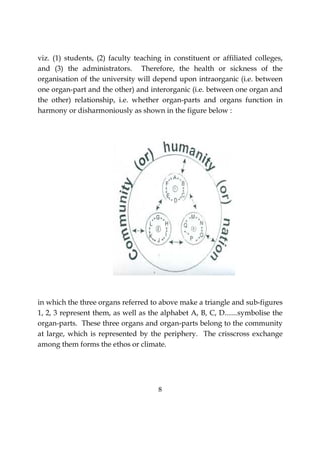
harmony or disharmoniously as shown in the figure below :
in which the three organs referred to above make a triangle and sub-figures
1, 2, 3 represent them, as well as the alphabet A, B, C, D.......symbolise the
organ-parts. These three organs and organ-parts belong to the community
at large, which is represented by the periphery. The crisscross exchange
among them forms the ethos or climate.
9
Students
The first and the foremost of these organs is the students since it is for them
that the university exists, and hence they form the basis of the triangle.
There was time, when higher education was the privilege of the élite and
was purported to serve the interests of the élite in cloistered ivory towers.
In the post-independence era the masses came to understand that
education was the most essential and important tool for self-development,
socio-economic advancement as well as self-realisation. Therefore, when
the doors of the temples of learning were opened wide for all students
without discrimination of caste, creed or gender, in the wake of the general
consciousness regarding the utilitarian significance of education, the
universities started losing their élitist esoteric character due to
democratisation. This gave rise to misconstrued universalisation and
resultant vast expansion of higher education in an unplanned manner. All
these factors and forces affected the health of our universities, for which
they were not prepared. The heterogeneity of those admitted caused
problems of its own, the ‘universities’ became ‘multiversities’ and
consequently developed symptoms of sickness.
No doubt, it is the duty of any welfare state to arrange for such
education for each of its citizens as may enable them to discriminate right
from wrong, good from bad, moral from immoral, i.e. do’s and dont’s. In
this context secondary education should be deemed sufficient and the state
must ensure that every boy/girl attains education to that level in a
satisfactory manner.
Nevertheless, the case with higher education is different. This needs
to be restricted to a selected deserving few. At this stage discrimination is
a must. Whereas professional education prepares professionals to serve
the community, the general education should aim at developing a band of
intellectuals, thinkers, planners, and executors of policies. Sheer job-
seekers have to be stratified at every stage right from the school-leaving
10
one so that those who reach the higher rungs represent a better image of
the nation. Education is a life-time process and should not be deemed
merely a means to earn livelihood although it develops the mind in such a
way as to equip a person to get one. Thus, the elimination at each stage
will strain in intellectuals endowed with a deep sympathetic high
understanding, powerful imagination, initiative and individuality out of
which ablest statesmen, poets and scientists are moulded.
God has distributed intelligence almost equally without
discrimination; however, one has to groom it in relation to the family
background and overall social environment, which generates the chasms of
differences. The Darwinian ‘survival-of-the-fittest’ theory ever holds
water. Democracy only grants equality of opportunities which does not
mean equality between deserving and undeserving. The British Prime
Minister Tony Blair has recently said, “One of the most important
contributions we can make is to ensure that our universities and colleges
are open to able students around the world.” (Humphries 1999:10) Here
the word ‘able’ is particularly noticeable. It entails that only painstaking
devoted students deserve admission to colleges/universities, and that it is
a criminal waste to squander the expensive tertiary education at the cost of
the tax-payer on every undeserving Tom, Dick and Harry. The library,
laboratory and other facilities are already insufficient and the escalating
cost of equipment, chemicals and other consumables will go on telling
upon the system.
The mediocre third-divisioner students beget several other problems
on the campus. Since they are not serious about studies, they create an
environment of indiscipline. Such students easily get attracted to
unhealthy student-politics and easily fall a prey to the dirty politicians who
never desist from spreading communalism and fomenting troubles. Once
these students have tasted the joys of cheap popularity and misuse of
union-funds, they always try to remain on the campus as long as possible,
11
vitiating the entire atmosphere. After having finished one course, they
seek admission to another. Because they are not studious and depend on
24-hour or 1-week series of bazaar-notes, they blatantly resort to unfair
means in the examination. Obviously when they are stopped from
cheating they will cross all limits for their selfish gains, because they do not
have much at stake.
There is another aspect of this problem. Because of the regulations of
the governments/universities, those students who cannot be admitted as
regular students in colleges are allowed to take examinations as non-
collegiate/private candidates; a big crowd of good-for-nothing graduates
and post-graduates is passed out. The former Vice-chancellor of Jawaharlal
Nehru University, Prof. M.S. Agwani speaking on the Teachers’ Day on 5
Sept. 1996 in my college very aptly remarked, “Most of the young men we
admit to our colleges are unteachable and most of those we turn out are
unemployable.”
Yet another corollary of the issue is that new areas under
‘Information Technology’ have invaded the higher education system with
many spurious educational institutions mushrooming all over the country
which award sub-standard degrees/diplomas. The private colleges, in
utter disregard to the quality of education, admit those undeserving
students in professional and other colleges who do not fulfil the basic
norms, simply because they can pay capitation or whose parents wield
political/administrative influence. Even so, the extra funds so generated
do not benefit the students but the Management, who do not hesitate to
misappropriate or misutilize funds, thus creating the culture of corruption
and immorality.
That signifies that :
12
(1)Only a fairly, good number of deserving meritorious students keen to
pursue their studies seriously are admitted in colleges. The optimum
teacher-taught ratio will fetch desirable results.
(2)No party politics is allowed in the union elections. It is our duty to
safeguard our inexperienced, immature youth with dare-devil
psychology, acting in the heat of emotions against the trouble-
monger politicians working for their ulterior motives.
(3)Poisonous atmosphere of caste-based acrimony engendered by union
elections will have to be done away with. Student-elections will have
to be based on the election of the ablest, devoid of dirty party politics.
(4)Alternatively, active debating, dramatic, literary, cultural, athletic
societies will have to be boosted to engage the students in self-
building through constructive activities.
(5)Dignity of manual labour as well as the other national values will
have to be inculcated through various activities. In this respect
N.S.S., unlike now, can play a very significant role.
(6)Adequate facilities for an overall grooming of the students will have
to be ensured.
(7)The present highly subsidised system of education will have to be
done away with. Students should fairly pay for their higher
education. However, needy students can be granted scholarships
and/or interest-free loans.
Faculty
If the students form the basis of the university organisation, the organ of
faculty is the most vital since it is through professors that the desirable
change in the behaviour of the students, which symbolises education, is
13
brought about. The entire university policies get executed through this
organ.
In ancient India, a professor enjoyed a very high prestige. Our
scriptures say that his status was extremely high to be equated to a god :
“ekr` nsoks Hko] fir` nsoks Hko] vkpk;Z nsoks Hko”. Nay, he was put on par with the
Almighty : “xq:cZãk xq:foZ”.kq xq:nsZoks egs’oj”. Nevertheless, his position got
much lowered in the colonial feudal rule in which power, pelf and glamour
got predominance over academic achievements. Unfortunately, we have
not been able to come out of that legacy we inherited even after a full half
century of independent India.
As a result of this a breed of mediocre teachers entered the
profession. If brilliant people joined, they took it either as a stop-gap
arrangement or as a stepping stone. Quite a sizeable number of them try
for administrative or other more lucrative jobs and quit the fold. It is so
because a professor is supposed to be extremely erudite and versatile,
possessing extraordinary abilities with encyclopaedic knowledge, but what
he gets is much less than what is expected to be performed. A satisfied
teacher can do miracles, but his present socio-economic status does not
guarantee this. The community expects him to play the role-model, but he
remains lowly paid. He has no professional freedom as he is handed over
a time-table and syllabi to be covered. He has large unmanageable classes.
Then, the promotion avenues are very few and they are snatched away by
manipulative people contributing nothing to the field of academics. This
quite naturally breeds intragroup jealousy and frustration.
Further professional preparation for a college-teacher is absent, both
at the entry point and during service. The number of orientation and
refresher courses organised is a mere drop in the ocean. He adopts the
teaching methodology employed by his best teacher as a model and uses
the authoritarian monologous unidirectional lecture method which blunts
the curiosity of the passive student. Shri Madbhagwadgita counsels
14
questioning and re-questioning to attain better knowledge, along with
reverence and assistance “rf}f) Áf.kikrsu ifjÁ’usu lso;k”. How can we expect
these passive listeners to think, create and take decisions independently in
actual life?
Again, academic climate is totally absent on the campus. Professors,
when they meet, hardly discuss any academic issues. The libraries upon
which they depend to keep themselves abreast of the latest information are
dumped with useless books and periodicals purchased or subscribed, for
reasons beyond their understanding.
The foregoing discussion concludes that :
(1)The most brilliant lot of youth with commitment to teaching will
have to be attracted with more freedom. Their entry will have to be
strictly scrupulous with tenure of 5 to 10 years. Only merit, and no
caste-based reservations, should prevail.
(2)Continuous enrichment will have to be ensured through various
exposures, like seminars, conferences, innovative courses, visits to
sister institutions, research, extension, and so on.
(3)Infighting within the teaching community should end, through
automatic promotion scheme, better promotional avenues and wider
scope for intellectual achievements.
(4)An orientation at the entry point and regular refresher courses will
have to be organised.
(5)In the new learner-centred approach the collegiate teacher will have
to alter his culturally-embedded deep-rooted attitude of omniscience
as well as dominance and “step out of his didactic role in order to be a
‘human among humans’.” (Littlewood 1981:84) He will have to act as
a facilitator creating a congenial environ for better learning.
15
Administrators
This organ of the system is at the helm but operated more as a hindrance
than help. Modern management has done wonders in different walks of
life, such as industry, business, banking but the field of educational
management seems not to have learnt any lessons from it. Educational
managers still have their own styles without any scientific bent or basis
provided by the management theories.
They look at professors with suspicion and insist on adherence to
tender-quotation culture, in which there is a lot of scope to misuse and
misappropriate funds. It is they who corrupt and suppress professors.
They are quite prone to pressures from various pressure-groups including
those of their own substandard subordinates. Since many appointments
are political, the gestures of influential politicians are well heeded to.
Then, most of the managers heading different university bodies have
had hardly any training. They rise to these positions through hierarchical
system, in which “every fool is bound to rise” as the maxim says. Hence,
their decision making is whimsical, varying from individual to individual,
delaying in pursuance of red-tapism.
Therefore, what is needed is a whole race of well-groomed race of
educational administrators, just as we have health administrators.
Educational management, being an independent and import discipline,
needs to be exposed to these managers, preferably from among professors
with say five years of experience having been familiar with milieu and
problems of the field. Only highly motivated dutiful persons with a high
sense of responsibility will have to be recruited. Some kind of
accountability will have to be fixed for them with compliance to be
reported.
16
Conclusion
At the turn of the millennium it has been more than appropriate to have
retrospected and introspected whether the present system of higher
education has been working as desired; if not, what have been the causes
responsible for malfunctioning and also to have suggested ways for
amelioration. However, it needs to be well appreciated that, unlike
agriculture, what we sow in the field of education today can be reaped
after about fifty years. Therefore, all the aforesaid suggestions will have to
be implemented together, and not piecemeal.
I can only wish with Shakespeare’s Macbeth :
.................thou couldst, doctor, cast
The water of my land, find her disease,
And purge it to a sound and pristine health,
I would applaud thee to the very echo,
That should applaud again.............
(Macbeth V iii, 50-54)
REFERENCES
1. Ahuja, Pramila and G.C. Ahuja (1991). Learning to Read Effectively and Efficiently. New
Delhi : Sterling Publishing Pvt. Ltd.
2. Aiyyar, S.P. (1979). Academic Freedom and Indian Universities (in Educational Reforms in
India by AIRAN. Ajmer : Barnbas & Shah).
3. Ashby, Eric (1962). Bulletin of International Association of Universiities, Nov. (as cited in the
Report of the Education Commission 1964-66. New Delhi : Ministry of Education, Govt. of
India).
4. Commonwealth University Yearbook 1997-98. London : Association of Commonwealth
Universities.
5. Das, S.K. (1957). The Educational System of Ancient India (cited in M.P. Sharma (1985 : 5)
op. cit.).
17
6. Delors, Jacques et al. (1997). Learning : The Treasure Within : Report of UNESCO. New
York : International Commission of Education for the 21st Century.
7. Goldschmidt, D. (1983). The University as an Institution : Present Problems & Future
Trends (Spotlight at the Congress ‘Higher Education by the year 2000’, Frankfurt, 7
September, 1983). Journal of Higher Education, Vol. 9, No. 1, Monsoon.
8. Halpin, A.W. (1966). Theory and Research in Administration. New York : The Macmillan
Co.
9. Humphries, Nick (1999). A helping hand. Newsletter. Vol. XII, No. 10. New Delhi :
British Council.
10. Littlewood, W. (1981). Communicative Language Teaching. Cambridge : Cambridge Univ.
Press.
11. Mudaliar, A.L. (1960). Education in India. Bombay : Asia Publishing House.
12. Mukerjee, S.N. (1972). Education in India, Today and Tomorrow. Baroda : Acharya Book
Depot.
13. Nehru, Jawaharlal (1947). “Convocation Address to the University of Allahabad”
(reported in Education Commission Report 1964-66. New Delhi : Ministry of Education,
Govt. of India).
14. Rathore, G.S. (1997). Towards higher standards of higher education, University News,
Vol. 35, No. 47, Nov.
15. Report of the Education Commission (1964-66). New Delhi : Ministry of Education, Govt. of
India.
16. Report of the University Education Commission (1948). New Delhi : Ministry of Education,
Govt. of India.
17. Sharma, M.P. (1985). Organisational Structure and Climate of Universities in Rajasthan.
Unpublished Ph.D. dissertation submitted to MLS University, Udaipur.

Organisational Climate

  • 1.
    1 Organisational Climate :Current Problems & Future Challenges of Higher Education [This paper was published in Higher Education—Developmental Issues (ISBN 81-7169-620-1) pp. 1- 19, edited by Dr. K. M. Joshi (2000) and published by Commonwealth Publishers, New Delhi when the author was Associate Professor & Head, Department of English, Bhupal Nobles’ P G College, Udaipur-313002.] Our position today, at the threshold of the 21st century, has assumed an unprecedented giganticity as compared to our counterparts in any other century since we have ushered in a new millennium of enlightenment, brought about through democratisation and consequently universalisation of education along with a fast striding advancement of technology as well as explosion of information. According to a guestimate the existing knowledge Anno Domini took 1750 years to get doubled. The second doubling took 150 years, the third 50 and the fourth 10 years (Ahuja and Ahuja 1991:83) and so on. That is, by now it must have become 300-times. Universalisation of education is a salutary symptom for the overall progress of any society, or the entire mankind for that matter. “There can hardly be any denying that education is the most efficacious and efficient means for the multi-faceted development of human personality which, in turn, helps in the overall progress of the community at large.” (Rathore 1997:1) According to Delors Committee Report to UNESCO (1997), education is “one of the principal means available to foster a deeper and more harmonious form of human development and thereby to reduce poverty, exclusion, ignorance, oppression and war.” (Delors et al. 1997:11)
  • 2.
    2 Realising the significanceof education the doors of education were flung wide open to every citizen not only in independent India but the world over. Consequently, the latter half of the twentieth century has witnessed tremendous growth of educational institutions, including universities, throughout the world. The UNESCO studies reveal that during the period from the early 60s to the mid-70s, university enrolment exploded in different parts of the world, and envisaged that the process was still on and it was estimated that this would affect the growing size and number of the universities until the end of the century. The forecast has turned out to be true. The 25 traditional universities in pre-independence India have flourished to a huge number of 226 universities, including Agricultural Universities, Institutions of National Importance and Deemed Universities (Commonwealth 1997-98:6-8). The more than nine-times growth is indeed incredible. As a result “universities have now become universal organisations. They are losing their élite character.....and despite important variations in them......show very many similarities that cross international boundaries.” (Sharma 1985:1-2) Recently, speaking in the congress on ‘Higher Education by the Year 2000’ in Frankfurt, Dietrich Goldschmidt (1983) remarked that “universities nowadays serve as the main part of tertiary education in almost all the countries of the world.” We shall return to it at a later stage. Why Universities Now, the future of any nation very much depends upon the quality of product which is being shaped in its universities. Therefore, it will not be erroneous to say that just as a man is known by the company he keeps, a nation is known by the standards its universities maintain. Before we proceed any further, let us understand what a university stands for.
  • 3.
    3 Mudaliar (1960) citesCardinal Newman’s views on it, “A university is a place of concourse, whither students come from every quarter for every kind of knowledge..... It is a place which wins the admiration of the young by its celebrity, kindles the affections of the middle-aged by its beauty, and rivets the fidelity of the old by its associations. It is a seat of wisdom, a light of the world, a minister of the faith, an alma mater of the rising generation.” (71) The scholarly statesman Pt. Nehru (1947) views it thus : “A university stands for humanity, for tolerance, for reason, for the adventure of ideas and for search of truth. It stands for onward march of human race towards ever higher objectives. If the universities discharge their duties adequately, then it is well with the nation and the people.” (74) The Education Commission Report (1964-66) very succinctly enumerates the objectives of universities : “The principal object is to deepen man’s understanding of the universe and of himself—in body, mind and spirit, to disseminate this understanding throughout society and to apply it in the service of mankind. They are the dwelling places of ideas and idealism, expect high standards of conduct and integrity from all their members. Theirs is the pursuit of truth and excellence in all its diversity— a pursuit which needs, above all, courage and fearlessness. Great universities and timid people go ill together.” (274) That is, one of the chief objectives of university education is to inculcate ‘abhay’ (vHk;), the capability to defy injustice in any walk of life. Indian Tradition A review of Indian tradition of higher education is warranted to have a preview of our present scenario. Our nation, one of the great ancient civilizations, enjoys a very rich heritage in the field of learning, unlike a large number of other countries, including the most developed ones. We
  • 4.
    4 can well boastof a golden past when learning and education were looked upon as the highest pursuits of mankind—almost synonymous with the religious dedication to God. There were ‘gurukulas’ or ‘ashramas’, each run by an individual scholar of great attainments and lofty eminence, known as ‘guru’ (i.e. the greatest of all). Takshashila and Nalanda universities had achieved great renown as seats of learning by the 7th century B.C. During his historic visit to India, the Chinese traveller Huen Tsang made remarkable observations, of which one is quoted by Das (1957) : “They instruct the inert and sharpen the dull, and the teachers doggedly persevere in giving instruction to those who are addicted to idleness.” (83) There were many important seats of higher learning spread throughout the length and breadth of the country, viz. Purushpura (Peshawar), Jagdal, Vikramshila and Odantipuri (in Bengal), Nalanda (in Bihar), Jayendra Vihar (in Kashmir), Kanchi (in Tamilnadu), and Vallabhi (in Saurashtra). According to Mukerjee (1972), “These universities were richly endowed, attracted students from far and near, many of the savants had an international reputation, and studies were fairly comprehensive.” (166) Nevertheless, gradually with the beginning of Muslim period, these institutions started losing their lustre and character. By the advent of the modern period, these ancient seats of learning and knowledge appear to have completely outlived their utility to serve the needs and aspirations of the community and hence vanished. About a century and half ago universities re-entered on to the Indian stage, which were modelled after western universities, particularly like those in Britain. The earliest of these were the universities of Bombay, Calcutta and Madras—founded in 1857, i.e. the year of the great Sepoy Mutiny. Then came the University of Allahabad in 1887. All of them came up as purely examining bodies, which continued till the inception of the last century. At the time of India’s independence we had merely 25
  • 5.
    5 universities, which numberhas taken tremendous strides and reached an enviable figure of 226. This is because of the fact that university education is considered to best serve the social and economic promotion of both the individual and that of the society through committed and critically conscious individuals. Universities should, therefore, be a positive and progressive force for this type of transformation of individuals and of society for overall progress. A university must be a ferment of ideas that affect the future of a nation. Its products should act as catalytic agents to generate desirable change. Present Scenario Thus, we see that the history of modern universities in India is a century and a half old, during which span their character has undergone changes in several important aspects—retaining a few of its earlier characteristics, colour and contours, of course. However, one of the deplorable facts remains that through all these years of physical developments, Indian universities have failed to shape themselves according to the unique character of the Indian polity. Dissatisfaction was expressed even at the existent condition when the University Education Commission 1948 under the chairmanship of the eminent educationist Dr. Radhakrishnan opined in the introductory note : “The marked deterioration of standards in teaching and examinations and increasing dissatisfaction with the conduct of the university administration and election to universities as the makers of the future cannot persist in old patterns, however valid they may have been in their own way. With the increasing complexity of society and its shifting patterns, universities have to change their objectives and methods, if they are to function effectively in our national life.” What Sir Erich Ashby (1972) observes on this issue is also relevant : “Looking at Indian universities a century after their foundation, one cannot
  • 6.
    6 help but feelthat they have failed to adapt themselves sufficiently to the vast and unique opportunities which surround them. They seem to have lost enthusiasm and initiative under the crushing problems which have beset them. Despite three major commissions, they have not been able to extricate themselves from their own brief history.... The universities remain alien implantations, not integrated into the New-India as the writers of the Radhakrishnan Report hoped they might be.” (277) Today Indian education in general and university education in particular is felt to be not adequately related to the developmental national needs and country’s emergent goals. Aiyyar (1979) aptly bewails : “The Indian university is organised as an examination conducting body rather than as a community of scholars in the pursuit of truth.” (121) So does Goldschmidt (1983) : “In most cases universities have grown to such an extent that they have lost their character as closed academic communities of masters and students bound together by fairly common academic life and ideals.” (66) The growing dissatisfaction all around impinges upon all concerned to realise that indeed there is something wrong somewhere and to put our heads together to revitalise and rejuvenate the present system. This need for revamping of higher educational system, extremely vital for India’s future, is also supported in the Report of Education Commission (1964-66) : “There is imperative need to reassess the structure and function of the universities to that end that they are related to the life, needs and aspirations of the people, and thereby made powerful instruments of social, economic and cultural transformation,” Aetiology In the paragraphs that follow, an attempt will be made to trace the aetiology of the malaise of the university organisation that is felt all around
  • 7.
    7 which will suggestboth diagnosis and remedy. Unfortunately, our university authorities have all through remained nonchalant towards this approach. Even the efforts to diagnose and improve the existing climate of the universities are lacking, which have assumed serious dimensions. In the wake of the recent knowledge available in the fields of ‘Organisational Behaviour’, ‘Organisational Psychology’ and ‘Organisational Systems’, emerging out of ‘Industrial Psychology’ and ‘Personnel Management’, the institution of tertiary (university) education needs to be studied in the modern context in the manner analogous to the methods used in the study of the behaviour of individuals, in which an institution is looked upon as a living organism (individual). In fact, an organisational pattern and functioning of the institution is seen according to the physiological structure and psychological approaches employed in the study of the personality and behaviour of an individual. Terms like ‘sick’ and ‘healthy’ are becoming more and more popular pertaining to institutional studies. Just as individuals are perceived as having different types of personality, so too are organisations. Halpin (1966) explains, “Analogously, personality is to the individual what organisational climate is to the organisation.” (7) Three Organs We have seen that the overall climate of our centres of higher education is not healthy, that the universities have not been able to develop a strong personality of their own in congruity with the national character. This is evident from the day-to-day strikes, violence and hooliganism rampant on our campuses. Here it will be pertinent to note that the term ‘university’ is an abstract entity, neither signifying a place nor a person(s), but a non- concrete concept of a curriculum-framing, testing-and-evaluating, funds- getting-and-disbursing institution, which operates through three organs,
  • 8.
    8 viz. (1) students,(2) faculty teaching in constituent or affiliated colleges, and (3) the administrators. Therefore, the health or sickness of the organisation of the university will depend upon intraorganic (i.e. between one organ-part and the other) and interorganic (i.e. between one organ and the other) relationship, i.e. whether organ-parts and organs function in harmony or disharmoniously as shown in the figure below : in which the three organs referred to above make a triangle and sub-figures 1, 2, 3 represent them, as well as the alphabet A, B, C, D.......symbolise the organ-parts. These three organs and organ-parts belong to the community at large, which is represented by the periphery. The crisscross exchange among them forms the ethos or climate.
  • 9.
    9 Students The first andthe foremost of these organs is the students since it is for them that the university exists, and hence they form the basis of the triangle. There was time, when higher education was the privilege of the élite and was purported to serve the interests of the élite in cloistered ivory towers. In the post-independence era the masses came to understand that education was the most essential and important tool for self-development, socio-economic advancement as well as self-realisation. Therefore, when the doors of the temples of learning were opened wide for all students without discrimination of caste, creed or gender, in the wake of the general consciousness regarding the utilitarian significance of education, the universities started losing their élitist esoteric character due to democratisation. This gave rise to misconstrued universalisation and resultant vast expansion of higher education in an unplanned manner. All these factors and forces affected the health of our universities, for which they were not prepared. The heterogeneity of those admitted caused problems of its own, the ‘universities’ became ‘multiversities’ and consequently developed symptoms of sickness. No doubt, it is the duty of any welfare state to arrange for such education for each of its citizens as may enable them to discriminate right from wrong, good from bad, moral from immoral, i.e. do’s and dont’s. In this context secondary education should be deemed sufficient and the state must ensure that every boy/girl attains education to that level in a satisfactory manner. Nevertheless, the case with higher education is different. This needs to be restricted to a selected deserving few. At this stage discrimination is a must. Whereas professional education prepares professionals to serve the community, the general education should aim at developing a band of intellectuals, thinkers, planners, and executors of policies. Sheer job- seekers have to be stratified at every stage right from the school-leaving
  • 10.
    10 one so thatthose who reach the higher rungs represent a better image of the nation. Education is a life-time process and should not be deemed merely a means to earn livelihood although it develops the mind in such a way as to equip a person to get one. Thus, the elimination at each stage will strain in intellectuals endowed with a deep sympathetic high understanding, powerful imagination, initiative and individuality out of which ablest statesmen, poets and scientists are moulded. God has distributed intelligence almost equally without discrimination; however, one has to groom it in relation to the family background and overall social environment, which generates the chasms of differences. The Darwinian ‘survival-of-the-fittest’ theory ever holds water. Democracy only grants equality of opportunities which does not mean equality between deserving and undeserving. The British Prime Minister Tony Blair has recently said, “One of the most important contributions we can make is to ensure that our universities and colleges are open to able students around the world.” (Humphries 1999:10) Here the word ‘able’ is particularly noticeable. It entails that only painstaking devoted students deserve admission to colleges/universities, and that it is a criminal waste to squander the expensive tertiary education at the cost of the tax-payer on every undeserving Tom, Dick and Harry. The library, laboratory and other facilities are already insufficient and the escalating cost of equipment, chemicals and other consumables will go on telling upon the system. The mediocre third-divisioner students beget several other problems on the campus. Since they are not serious about studies, they create an environment of indiscipline. Such students easily get attracted to unhealthy student-politics and easily fall a prey to the dirty politicians who never desist from spreading communalism and fomenting troubles. Once these students have tasted the joys of cheap popularity and misuse of union-funds, they always try to remain on the campus as long as possible,
  • 11.
    11 vitiating the entireatmosphere. After having finished one course, they seek admission to another. Because they are not studious and depend on 24-hour or 1-week series of bazaar-notes, they blatantly resort to unfair means in the examination. Obviously when they are stopped from cheating they will cross all limits for their selfish gains, because they do not have much at stake. There is another aspect of this problem. Because of the regulations of the governments/universities, those students who cannot be admitted as regular students in colleges are allowed to take examinations as non- collegiate/private candidates; a big crowd of good-for-nothing graduates and post-graduates is passed out. The former Vice-chancellor of Jawaharlal Nehru University, Prof. M.S. Agwani speaking on the Teachers’ Day on 5 Sept. 1996 in my college very aptly remarked, “Most of the young men we admit to our colleges are unteachable and most of those we turn out are unemployable.” Yet another corollary of the issue is that new areas under ‘Information Technology’ have invaded the higher education system with many spurious educational institutions mushrooming all over the country which award sub-standard degrees/diplomas. The private colleges, in utter disregard to the quality of education, admit those undeserving students in professional and other colleges who do not fulfil the basic norms, simply because they can pay capitation or whose parents wield political/administrative influence. Even so, the extra funds so generated do not benefit the students but the Management, who do not hesitate to misappropriate or misutilize funds, thus creating the culture of corruption and immorality. That signifies that :
  • 12.
    12 (1)Only a fairly,good number of deserving meritorious students keen to pursue their studies seriously are admitted in colleges. The optimum teacher-taught ratio will fetch desirable results. (2)No party politics is allowed in the union elections. It is our duty to safeguard our inexperienced, immature youth with dare-devil psychology, acting in the heat of emotions against the trouble- monger politicians working for their ulterior motives. (3)Poisonous atmosphere of caste-based acrimony engendered by union elections will have to be done away with. Student-elections will have to be based on the election of the ablest, devoid of dirty party politics. (4)Alternatively, active debating, dramatic, literary, cultural, athletic societies will have to be boosted to engage the students in self- building through constructive activities. (5)Dignity of manual labour as well as the other national values will have to be inculcated through various activities. In this respect N.S.S., unlike now, can play a very significant role. (6)Adequate facilities for an overall grooming of the students will have to be ensured. (7)The present highly subsidised system of education will have to be done away with. Students should fairly pay for their higher education. However, needy students can be granted scholarships and/or interest-free loans. Faculty If the students form the basis of the university organisation, the organ of faculty is the most vital since it is through professors that the desirable change in the behaviour of the students, which symbolises education, is
  • 13.
    13 brought about. Theentire university policies get executed through this organ. In ancient India, a professor enjoyed a very high prestige. Our scriptures say that his status was extremely high to be equated to a god : “ekr` nsoks Hko] fir` nsoks Hko] vkpk;Z nsoks Hko”. Nay, he was put on par with the Almighty : “xq:cZãk xq:foZ”.kq xq:nsZoks egs’oj”. Nevertheless, his position got much lowered in the colonial feudal rule in which power, pelf and glamour got predominance over academic achievements. Unfortunately, we have not been able to come out of that legacy we inherited even after a full half century of independent India. As a result of this a breed of mediocre teachers entered the profession. If brilliant people joined, they took it either as a stop-gap arrangement or as a stepping stone. Quite a sizeable number of them try for administrative or other more lucrative jobs and quit the fold. It is so because a professor is supposed to be extremely erudite and versatile, possessing extraordinary abilities with encyclopaedic knowledge, but what he gets is much less than what is expected to be performed. A satisfied teacher can do miracles, but his present socio-economic status does not guarantee this. The community expects him to play the role-model, but he remains lowly paid. He has no professional freedom as he is handed over a time-table and syllabi to be covered. He has large unmanageable classes. Then, the promotion avenues are very few and they are snatched away by manipulative people contributing nothing to the field of academics. This quite naturally breeds intragroup jealousy and frustration. Further professional preparation for a college-teacher is absent, both at the entry point and during service. The number of orientation and refresher courses organised is a mere drop in the ocean. He adopts the teaching methodology employed by his best teacher as a model and uses the authoritarian monologous unidirectional lecture method which blunts the curiosity of the passive student. Shri Madbhagwadgita counsels
  • 14.
    14 questioning and re-questioningto attain better knowledge, along with reverence and assistance “rf}f) Áf.kikrsu ifjÁ’usu lso;k”. How can we expect these passive listeners to think, create and take decisions independently in actual life? Again, academic climate is totally absent on the campus. Professors, when they meet, hardly discuss any academic issues. The libraries upon which they depend to keep themselves abreast of the latest information are dumped with useless books and periodicals purchased or subscribed, for reasons beyond their understanding. The foregoing discussion concludes that : (1)The most brilliant lot of youth with commitment to teaching will have to be attracted with more freedom. Their entry will have to be strictly scrupulous with tenure of 5 to 10 years. Only merit, and no caste-based reservations, should prevail. (2)Continuous enrichment will have to be ensured through various exposures, like seminars, conferences, innovative courses, visits to sister institutions, research, extension, and so on. (3)Infighting within the teaching community should end, through automatic promotion scheme, better promotional avenues and wider scope for intellectual achievements. (4)An orientation at the entry point and regular refresher courses will have to be organised. (5)In the new learner-centred approach the collegiate teacher will have to alter his culturally-embedded deep-rooted attitude of omniscience as well as dominance and “step out of his didactic role in order to be a ‘human among humans’.” (Littlewood 1981:84) He will have to act as a facilitator creating a congenial environ for better learning.
  • 15.
    15 Administrators This organ ofthe system is at the helm but operated more as a hindrance than help. Modern management has done wonders in different walks of life, such as industry, business, banking but the field of educational management seems not to have learnt any lessons from it. Educational managers still have their own styles without any scientific bent or basis provided by the management theories. They look at professors with suspicion and insist on adherence to tender-quotation culture, in which there is a lot of scope to misuse and misappropriate funds. It is they who corrupt and suppress professors. They are quite prone to pressures from various pressure-groups including those of their own substandard subordinates. Since many appointments are political, the gestures of influential politicians are well heeded to. Then, most of the managers heading different university bodies have had hardly any training. They rise to these positions through hierarchical system, in which “every fool is bound to rise” as the maxim says. Hence, their decision making is whimsical, varying from individual to individual, delaying in pursuance of red-tapism. Therefore, what is needed is a whole race of well-groomed race of educational administrators, just as we have health administrators. Educational management, being an independent and import discipline, needs to be exposed to these managers, preferably from among professors with say five years of experience having been familiar with milieu and problems of the field. Only highly motivated dutiful persons with a high sense of responsibility will have to be recruited. Some kind of accountability will have to be fixed for them with compliance to be reported.
  • 16.
    16 Conclusion At the turnof the millennium it has been more than appropriate to have retrospected and introspected whether the present system of higher education has been working as desired; if not, what have been the causes responsible for malfunctioning and also to have suggested ways for amelioration. However, it needs to be well appreciated that, unlike agriculture, what we sow in the field of education today can be reaped after about fifty years. Therefore, all the aforesaid suggestions will have to be implemented together, and not piecemeal. I can only wish with Shakespeare’s Macbeth : .................thou couldst, doctor, cast The water of my land, find her disease, And purge it to a sound and pristine health, I would applaud thee to the very echo, That should applaud again............. (Macbeth V iii, 50-54) REFERENCES 1. Ahuja, Pramila and G.C. Ahuja (1991). Learning to Read Effectively and Efficiently. New Delhi : Sterling Publishing Pvt. Ltd. 2. Aiyyar, S.P. (1979). Academic Freedom and Indian Universities (in Educational Reforms in India by AIRAN. Ajmer : Barnbas & Shah). 3. Ashby, Eric (1962). Bulletin of International Association of Universiities, Nov. (as cited in the Report of the Education Commission 1964-66. New Delhi : Ministry of Education, Govt. of India). 4. Commonwealth University Yearbook 1997-98. London : Association of Commonwealth Universities. 5. Das, S.K. (1957). The Educational System of Ancient India (cited in M.P. Sharma (1985 : 5) op. cit.).
  • 17.
    17 6. Delors, Jacqueset al. (1997). Learning : The Treasure Within : Report of UNESCO. New York : International Commission of Education for the 21st Century. 7. Goldschmidt, D. (1983). The University as an Institution : Present Problems & Future Trends (Spotlight at the Congress ‘Higher Education by the year 2000’, Frankfurt, 7 September, 1983). Journal of Higher Education, Vol. 9, No. 1, Monsoon. 8. Halpin, A.W. (1966). Theory and Research in Administration. New York : The Macmillan Co. 9. Humphries, Nick (1999). A helping hand. Newsletter. Vol. XII, No. 10. New Delhi : British Council. 10. Littlewood, W. (1981). Communicative Language Teaching. Cambridge : Cambridge Univ. Press. 11. Mudaliar, A.L. (1960). Education in India. Bombay : Asia Publishing House. 12. Mukerjee, S.N. (1972). Education in India, Today and Tomorrow. Baroda : Acharya Book Depot. 13. Nehru, Jawaharlal (1947). “Convocation Address to the University of Allahabad” (reported in Education Commission Report 1964-66. New Delhi : Ministry of Education, Govt. of India). 14. Rathore, G.S. (1997). Towards higher standards of higher education, University News, Vol. 35, No. 47, Nov. 15. Report of the Education Commission (1964-66). New Delhi : Ministry of Education, Govt. of India. 16. Report of the University Education Commission (1948). New Delhi : Ministry of Education, Govt. of India. 17. Sharma, M.P. (1985). Organisational Structure and Climate of Universities in Rajasthan. Unpublished Ph.D. dissertation submitted to MLS University, Udaipur.