Jami Masjid
Ahemedabad
Presented by-
Preeti Gautam
Ridhi Saxena
Introduction
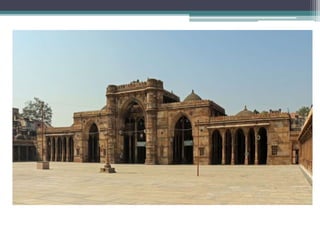
• It is also known as “jumma masjid”
• Location – Ahmedabad
• Built by Sultan Ahmed Shah in A.D. 1423.
• Architectural type – mosque
• Architectural style - Indo-Islamic architecture
• Materials used - Yellow sandstone and marble
• It is designated as NHL -National Monument of
Importance due to its magnificient features.
• At the west side of the Mosque there are three tombs
of Sultan Ahmed Shah I, his son Mohammad Shah
and his grandson Ahmed Shah Rauza. The tombs of
the queen and other wives of emperor (Rani Ka
hazira) are also lying nearby.
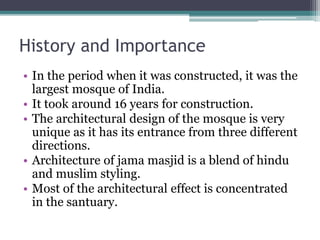
History and Importance
• In the period when it was constructed, it was the
largest mosque of India.
• It took around 16 years for construction.
• The architectural design of the mosque is very
unique as it has its entrance from three different
directions.
• Architecture of jama masjid is a blend of hindu
and muslim styling.
• Most of the architectural effect is concentrated
in the santuary.
Architectural features
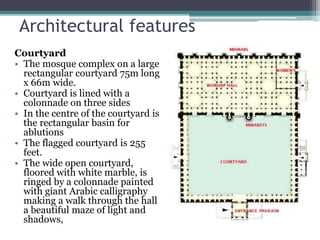
Courtyard
• The mosque complex on a large
rectangular courtyard 75m long
x 66m wide.
• Courtyard is lined with a
colonnade on three sides
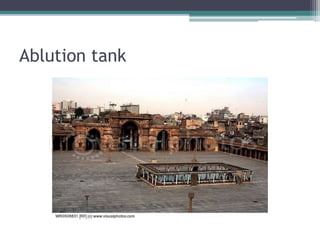
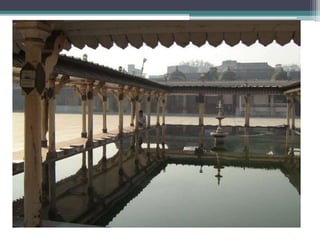
• In the centre of the courtyard is
the rectangular basin for
ablutions
• The flagged courtyard is 255
feet.
• The wide open courtyard,
floored with white marble, is
ringed by a colonnade painted
with giant Arabic calligraphy
making a walk through the hall
a beautiful maze of light and
shadows,
Ablution tank
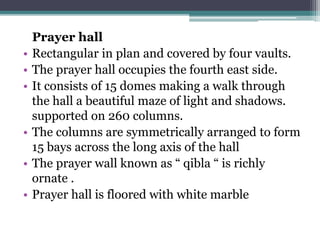
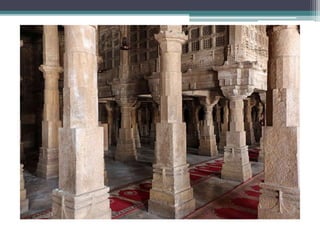
Prayer hall
• Rectangular in plan and covered by four vaults.
• The prayer hall occupies the fourth east side.
• It consists of 15 domes making a walk through
the hall a beautiful maze of light and shadows.
supported on 260 columns.
• The columns are symmetrically arranged to form
15 bays across the long axis of the hall
• The prayer wall known as “ qibla “ is richly
ornate .
• Prayer hall is floored with white marble
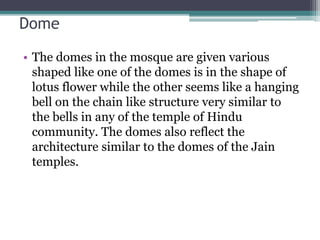
Dome
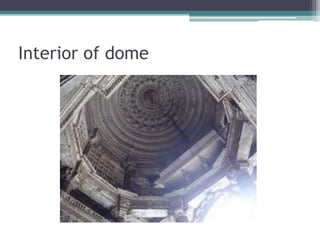
• The domes in the mosque are given various
shaped like one of the domes is in the shape of
lotus flower while the other seems like a hanging
bell on the chain like structure very similar to
the bells in any of the temple of Hindu
community. The domes also reflect the
architecture similar to the domes of the Jain
temples.
Interior of dome
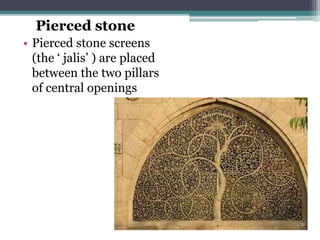
Pierced stone
• Pierced stone screens
(the ‘ jalis’ ) are placed
between the two pillars
of central openings
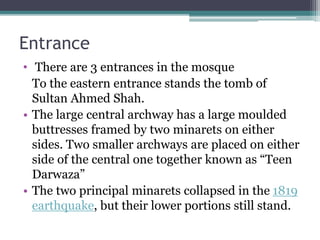
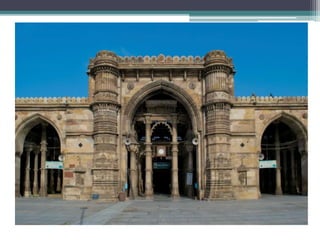
Entrance
• There are 3 entrances in the mosque
To the eastern entrance stands the tomb of
Sultan Ahmed Shah.
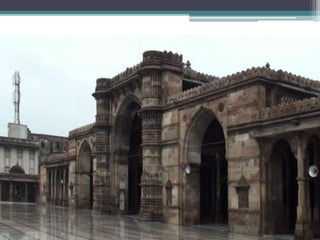
• The large central archway has a large moulded
buttresses framed by two minarets on either
sides. Two smaller archways are placed on either
side of the central one together known as “Teen
Darwaza”
• The two principal minarets collapsed in the 1819
earthquake, but their lower portions still stand.
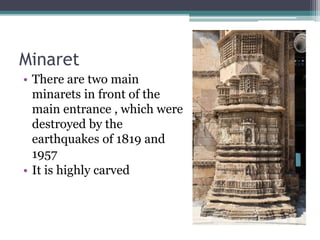
Minaret
• There are two main
minarets in front of the
main entrance , which were
destroyed by the
earthquakes of 1819 and
1957
• It is highly carved
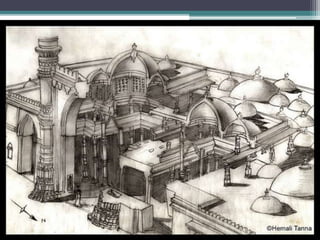
Sanctuary Interior:
The sanctuary is a hypostyle hall is 210' X 95'.
• The central compartment of the nave rises up to
3 storeys, the side aisles are 2 storeys and the
rest of the hall is single storeyed.
• The nave is composed of two pillared galleries
one above the other. The enclosed triple height
space which is overlooked from the galleries
is square in plan on the first floor and octagonal
on the second and is covered by a dome.
• Each overlooking balcony is provided with an
asana or a sloping backed seat as seen in
temples.
• Around the exterior of the balconies are pillared
verandahs or loggias and in the arcade between
the pillars are stone jalis through which the
galleries are illuminated
Thank you

Jami masjid

  • 1.
  • 2.
    Introduction • It isalso known as “jumma masjid” • Location – Ahmedabad • Built by Sultan Ahmed Shah in A.D. 1423. • Architectural type – mosque • Architectural style - Indo-Islamic architecture • Materials used - Yellow sandstone and marble • It is designated as NHL -National Monument of Importance due to its magnificient features. • At the west side of the Mosque there are three tombs of Sultan Ahmed Shah I, his son Mohammad Shah and his grandson Ahmed Shah Rauza. The tombs of the queen and other wives of emperor (Rani Ka hazira) are also lying nearby.
  • 4.
    History and Importance •In the period when it was constructed, it was the largest mosque of India. • It took around 16 years for construction. • The architectural design of the mosque is very unique as it has its entrance from three different directions. • Architecture of jama masjid is a blend of hindu and muslim styling. • Most of the architectural effect is concentrated in the santuary.
  • 5.
    Architectural features Courtyard • Themosque complex on a large rectangular courtyard 75m long x 66m wide. • Courtyard is lined with a colonnade on three sides • In the centre of the courtyard is the rectangular basin for ablutions • The flagged courtyard is 255 feet. • The wide open courtyard, floored with white marble, is ringed by a colonnade painted with giant Arabic calligraphy making a walk through the hall a beautiful maze of light and shadows,
  • 6.
  • 8.
    Prayer hall • Rectangularin plan and covered by four vaults. • The prayer hall occupies the fourth east side. • It consists of 15 domes making a walk through the hall a beautiful maze of light and shadows. supported on 260 columns. • The columns are symmetrically arranged to form 15 bays across the long axis of the hall • The prayer wall known as “ qibla “ is richly ornate . • Prayer hall is floored with white marble
  • 10.
    Dome • The domesin the mosque are given various shaped like one of the domes is in the shape of lotus flower while the other seems like a hanging bell on the chain like structure very similar to the bells in any of the temple of Hindu community. The domes also reflect the architecture similar to the domes of the Jain temples.
  • 12.
  • 13.
    Pierced stone • Piercedstone screens (the ‘ jalis’ ) are placed between the two pillars of central openings
  • 14.
    Entrance • There are3 entrances in the mosque To the eastern entrance stands the tomb of Sultan Ahmed Shah. • The large central archway has a large moulded buttresses framed by two minarets on either sides. Two smaller archways are placed on either side of the central one together known as “Teen Darwaza” • The two principal minarets collapsed in the 1819 earthquake, but their lower portions still stand.
  • 17.
    Minaret • There aretwo main minarets in front of the main entrance , which were destroyed by the earthquakes of 1819 and 1957 • It is highly carved
  • 18.
    Sanctuary Interior: The sanctuaryis a hypostyle hall is 210' X 95'. • The central compartment of the nave rises up to 3 storeys, the side aisles are 2 storeys and the rest of the hall is single storeyed. • The nave is composed of two pillared galleries one above the other. The enclosed triple height space which is overlooked from the galleries is square in plan on the first floor and octagonal on the second and is covered by a dome.
  • 19.
    • Each overlookingbalcony is provided with an asana or a sloping backed seat as seen in temples. • Around the exterior of the balconies are pillared verandahs or loggias and in the arcade between the pillars are stone jalis through which the galleries are illuminated
  • 20.