New York April 25, 2019
TIM MALEENY
Strategy &
Innovation
2
3
Some things to bear in mind
A working definition of innovation
Why new isn’t always better and change isn’t always good
The Black Mirror dilemma
History lessons about our future
The upside of considering the downside
An innovative approach to innovation
Some things to bear in mind
that we’ll come back to later…
4
5
Successful innovations need a meaningful purpose
We are all users of interim technology
Even the best innovations have unintended consequences
If we change the way we approach innovation, it may be
possible to chart a path forward that saves us all from a
dystopian future
6
A working definition
of innovation
7
Innovation is
a big word
that simply means changing something for
the better.
A new product or new way of doing things, or
both.
A breakthrough invention, a radical redesign
of a product or process, something that
modifies behavior or fulfills an unmet need or
desire.
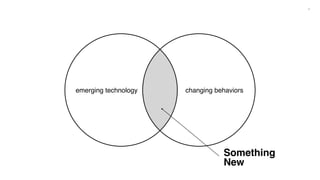
Innovation is typically made possible by the
application of technology and design.
Throughout history, the most powerful
innovations have occurred at the intersection
of emerging technology and changing
behaviors.
8
emerging technology changing behaviors
Something
New
9
emerging technology changing behaviors
Something
Better
10
But remember, new
isn’t always better
and change isn’t
always good…
17
You just might get lucky
with a new product or
service, but it always
helps to define a
meaningful purpose for
your innovation or
idea…
18
You just might get lucky
with a new product or
service, but it always
helps to define a
meaningful purpose for
your innovation or
idea…
…ideally based on shared values,
common frustrations, collective desires,
or universal human truth.
19
In other words, are we developing
the kind of innovations that will
help shape a future in which we all
want to live?
The black mirror
dilemma
20
28
29
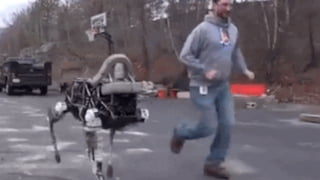
“Robots are pretty stupid now.
However, eventually they'll be as smart
as a mouse, then a rat, then a rabbit,
then a cat, then a dog. By the end of the
century, they may be as smart as a
monkey, but by end of the century, yeah,
Elon Musk is right. They could become
self-aware. At that point they're
dangerous.”
— Michio Kaku on the Curiosity podcast
30
32
Wait a minute, isn’t this
a little far-fetched?
33
Wait a minute, isn’t this
a little far-fetched?
I thought this guy was going

to talk about marketing?
35
“We are—if not yet Terminators—at least
a little more integrated with our
machines.
No, the phones are not encased in our
tissue, but our reliance on them could
hardly be more narcotic if they were.
Does it really matter that the chip is not
implanted in our heads—yet? How much
of your day do you spend engaged with
some communications device? Is there
an intelligible difference between
tracking it and tracking you?”
—Our Cyborg Future, Law Policy and Implications
Brookings Instutute
September 2014
36
The question isn’t
whether something is
possible.
37
The question isn’t
whether something is
possible.
The only question is what we should do with that
something once we make it real.
38
39
40
41
42
43
History lessons about
our future
44
What if our innovation
succeeds beyond our
wildest expectations?
45
46
47
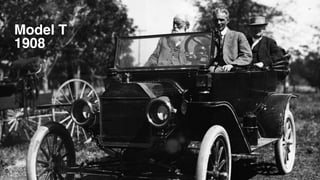
Model T
1908
48
49
New always co-exists with Old
until Old is obsolete
50
What is intuitive for the inventor
may not be intuitive for the user
51
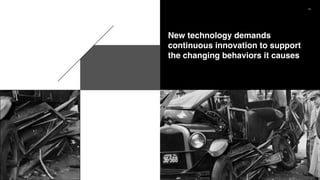
New technology demands
continuous innovation to support
the changing behaviors it causes
52
New behaviors require a new
ecosystem to support them
53
55
When it happens, change comes
faster than anyone expected
56
57
58
59
60
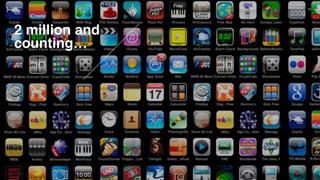
2 million and
counting…
62
63
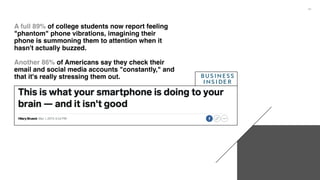
A full 89% of college students now report feeling
"phantom" phone vibrations, imagining their
phone is summoning them to attention when it
hasn't actually buzzed.
Another 86% of Americans say they check their
email and social media accounts "constantly," and
that it's really stressing them out.
64
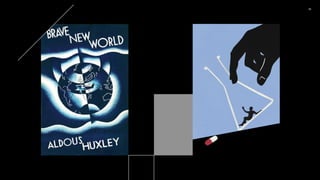
Selfie Deaths are
an Epidemic
A recent report found that 259 people died between 2001 and
2017 while stepping in front of the camera in often dangerous
destinations.
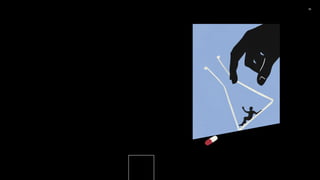
Our writer went deep on the psychology of selfies to figue out
what’s behind our obsession with capturing extreme risk-talking.
65
There is no doubt that smartphones
provide immense benefit to society, but
their cost is becoming more and more
apparent. Studies are beginning to show
links between smartphone usage and
increased levels of anxiety and
depression, poor sleep quality, and
increased risk of car injury or death.
Many of us wish we spent less time on
our phones but find it incredibly difficult
to disconnect.
— Dopamine, smartphones and you: the battle for your time
Trevor Hayes, Harvard Medical School
66
68
69
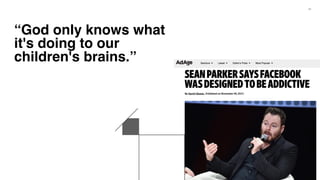
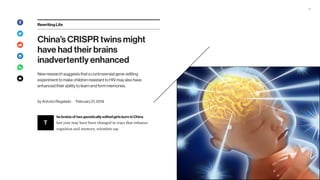
“God only knows what
it's doing to our
children's brains.”
70
71
72
73
“History isn’t just the story of bad
people doing bad things.
It’s quite as much the story of good
people trying to do good things. But
somehow, something goes wrong.”
— C.S. Lewis
74
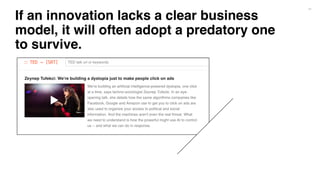
If an innovation lacks a clear business
model, it will often adopt a predatory one
to survive.
75
Your business model isn’t your stock price.
Building an audience isn’t the same thing as
building a platform. Or a community.
Treating customers like neighbors instead of
targets will drive not only short-term gains but
long-term advocacy.
77
Gartner predicts that by 2020, the
average person will have more daily
conversations with an AI-bot than with
their spouse.
78
79
82
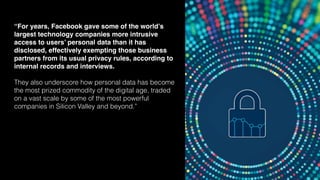
“For years, Facebook gave some of the world’s
largest technology companies more intrusive
access to users’ personal data than it has
disclosed, effectively exempting those business
partners from its usual privacy rules, according to
internal records and interviews.
They also underscore how personal data has become
the most prized commodity of the digital age, traded
on a vast scale by some of the most powerful
companies in Silicon Valley and beyond.”
83
84
What could
possibly go wrong?
85
“Nosedive”
86
America invented the three-digit credit
score. Now companies in China are
taking the idea to the extreme, using big
data to track and rank what you do—
your purchases, your pastimes, your
mistakes.
— Mara Hvistendahl, Wired 12/14/2017
87
88
90
And if that doesn’t

scare you, how
about this…
91
92
94
Needless to say,
things are getting
out of hand.
95
Needless to say,
things are getting
out of hand.
But maybe there’s an upside to considering the downside.
96
97
Consumer
behavior
Competitive
Weaknesses
Company
Strengths
98
Consumer
behavior
Competitive
Weaknesses
Company
Strengths
Business
Opportunity
99
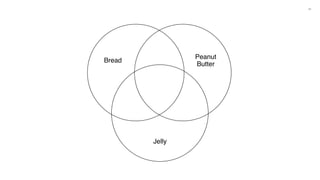
Bread
Peanut
Butter
Jelly
100
101
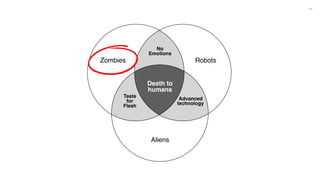
Zombies Robots
Aliens
102
No
Emotions
Taste
for
Flesh
Advanced
technology
Zombies Robots
Aliens
103
No
Emotions
Taste
for
Flesh
Advanced
technology
Death to
humans
Zombies Robots
Aliens
104
No
Emotions
Taste
for
Flesh
Advanced
technology
Death to
humans
Zombies Robots
Aliens
107
The 10th Man
The Devil’s Advocate
The Odd One Out
108
The 10th Man
The Devil’s Advocate
The Odd One Out
109
The Team Contrarian
110
Consumer
behavior
Competitive
Weaknesses
Company
Strengths
Business
Opportunity
111
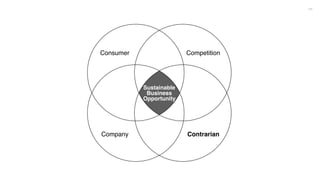
Consumer Competition
Company Contrarian
Sustainable
Business
Opportunity
112
Consumer Competition
Company Contrarian
Sustainable
Business
Opportunity
113
Your Team Contrarian has the
power to ask:
What if this really takes off and becomes the next big thing?
What does loyalty look like?
What could possibly go wrong?
Can this innovation be weaponized?
Will we be our own first customers?
Would we make this for ourselves? For our kids?
114
Will this make
things better for
everyone?
115
How can
we build
meaning
into
everything
we do?
116
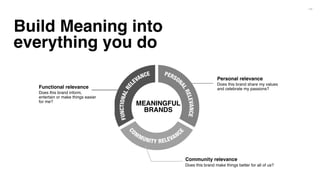
Build Meaning into
everything you do
Functional relevance
Does this brand inform,
entertain or make things easier
for me?
Personal relevance
Does this brand share my values
and celebrate my passions?
Community relevance
Does this brand make things better for all of us?
MEANINGFUL
BRANDS
PERSON
ALRELEVANCE
C
OMMUNITY RELEVANC
E
FUNCTIONALREL
EVANCE
117
So what
have we
learned?
118
Successful innovations need a meaningful purpose
We are all users of interim technology (and always have been)
Even the best innovations have unintended consequences
If we change the way we approach innovation, it may be possible
to chart a path forward that saves us all from a dystopian future
120
Thank you!
Any Questions?
122
Contact:
tim@timmaleeny.com

Tim Maleeny