The Organic School Garden
Hands-on teaching of environmental health and social values
By Meghan Taylor

At Beyond Pesticides’ 22nd National Pesticide Form, held in April        author and owner of the famous Chez Panisse restaurant in
2004, forum participants had the opportunity to visit several of         San Francisco, had an idea to create a school garden. Her idea
Berkeley, California’s organic school gardens. Beebo Turman,             was transformed into reality through outreach with landscape
project director at Berkeley Community Garden Collaborative              architects, chefs, gardeners, teachers, and other design pro-
(BCGC), led the tour. The following is a portrayal of the school         fessionals. Now, in 2005 the garden provides an invaluable
gardens that were toured, The Edible Schoolyard and the Willard          resource for students, staff and the entire community.
Greening Project, with lessons on how you can start an organic
garden at your community’s school. This article is dedicated to
Karl Linn, an inspiration to the Berkeley and national community
                                                                         Seed to table
                                                                         The Edible Schoolyard teaches students the fundamental lesson
gardening movements, who died on February 3, 2005.
                                                                         of “seed to table.” This lesson creates a bond between students
                                                                         and the natural world. Students learn every aspect of how their
The Edible Schoolyard: A model                                           food is created. They start with seeds and work in the soil,
                                                                         composting, caring for plants, learning to respect ecosystems,
for the country                                                          and learning the dangers of chemicals and pesticides. The
Overlooking the San Francisco Bay and Golden Gate bridge, a              children learn an important lesson: to tolerate certain insects,
one-acre organic garden rests on the campus of Martin Luther             worms and other beneficial organisms, and to keep the garden
King Jr. Middle School in Berkeley, CA. The soil is bursting with        healthy from detrimental insects.
fresh produce, herbs, vines, berries and flowers, all surrounded              “Seeds” are transformed into lessons of the “table” through
by fruit trees. On a shed hangs scores of blue, green and red            cooking classes incorporated with student electives and humani-
gloves. Shovels, hoes and handmade signs marking tomatoes                ties curriculum. Students learn origins of staple ingredients, grind-
and other vegetables sit waiting for the students to make use            ing wheat into flour and making their own butter. They learn
of them in their outdoor classroom. In the center of the gar-            about a diversity of plants and foods, growing food from other
den sits the circular Ramada, which means shade structure in             cultures and cooking international cuisine. They prepare menus,
Spanish, covered with deciduous vines and climbing annuals               cook and taste, set tables and bring in fresh flowers from the gar-
including kiwi, runner beans, and chayote. A compost area,               den. They share in food, conversation and cleanup. The lesson
chicken coop, wood fired oven, and picnic tables all add to the           comes full circle when the students compost food scraps from
vitality and richness of the Edible Schoolyard.                          their meal to help their own garden grow more healthfully.
   Ten years ago, this haven for vegetables, wildlife and stu-               Foods are grown year-round, and the summer time is no
dents was an asphalt parking lot. In 1995, Alice Waters, chef,           exception. Edible Schoolyard provides a valuable model, as it

Page 20                                                   Pesticides and You                                   Vol. 24, No. 4, 2004–2005
                                    Beyond Pesticides/National Coalition Against the Misuse of Pesticides
is the only school garden with a summer program. Students                   permaculture garden in the back. Ms. Turman said of Karl Linn,
garden, weed, and harvest for two hours in the morning, and                 “He believes in community gardens to bring the people together
prepare their lunch from their work, eating on the garden’s                 to meet each other. There’s a whole feeling of working together
picnic tables.                                                              that is something that you just can’t replace anywhere else.”


Funding the garden                                                          The Willard Greening Project:
Edible Schoolyard began through the support of two private                  Facing challenges head on
foundations: Chez Panisse Foundation and the Center for
                                                                            The Willard Greening Project at the Berkeley Unified School
Ecoliteracy. Currently, it is supported by a number of founda-
                                                                            District (BUSD) was begun by PTA member Yolanda Huang,
tions, individual gifts and benefit events. When staff is inspired
                                                                            and has provided immeasurable benefits to the school and
with new ideas such as a pizza oven or a tool shed, they write
                                                                            surrounding community. Unfortunately, in June 2004, Ameri-
grant proposals to make it happen.
                                                                            corps, a principal sponsor of Willard Greening, pulled its fund-
   In addition, this particular school garden is a high publicity
                                                                            ing due to what many Willard Greening advocates say is the
spot. Both Fred Rodgers and Martha Stewart have filmed there
                                                                            faulty accounting methods of BUSD. Since then, the garden
in the past, which helps with the fundraising. Beebo Turman
                                                                            has been struggling. Ms. Huang and others in the community
pointed out that there are other
                                                                                                           are putting up a fight for its
monies available for school
                                                                                                           survival. During the Beyond
gardens, high publicity or not.
                                                                                                           Pesticides tour in April 2004,
See Lessons Learned later in this
                                                                                                           the participants witnessed the
article for tips on how to fund a
                                                                                                           garden’s beauty and invaluable
school garden.
                                                                                                           benefits that they are trying so
                                                                                                           hard to maintain today.
Community
outreach and                                                                                                    What the
education                                                                                                       garden gives
Edible Schoolyard conducts                                                                                        Before Willard Greening, the
community activities that raise                                                                                   soil on the school property
both awareness and funds. They                                                                                    was abysmal, unable to support
once had a fundraiser in the                                                                                      any life. The project began by
school gym, food included, and                                                                                    ripping up the concrete and
showed an environmental film.                                                                                      filling the space with soil. City
As a result, $13,000 was raised                                                                                   compost was applied to begin
for the garden. “It was for the                                                                                   to bring back the health of the
Edible Schoolyard but also to                                                                                     land. Since then, the soil has
inform the neighbors and others                                                                                   been cover cropped and sifted
in the area about what’s hap-                                                                                     to promote its health. As the
pening, that this is not the only                                                                                 land was repaired and beauti-
school doing this, and to help                                                                                    fied with a plethora of plants
the community support school                                                                                      and crops, a community came
                                            Students collect eggs from their chickens at the Edible Schoolyard.
gardens,” said Ms. Turman.                                                                                        together. Students were excited.
   Other areas of the com-                                                                                        So were residents. The change
munity are also involved with the Edible Schoolyard. Staff at                     that occurred was immense.
the Berkeley Horticulture Nursery have been regulars at the                            Students learned about composting, rotating crops, proper
Edible Schoolyard’s garden committee meetings for the past                        watering and irrigation, how cover crops work, and other prin-
ten years. The Nursery donates plants, as well as time. One                       ciples that exemplify and instill the fact that chemicals are not
employee visits the garden once a week for two hours to work                      necessary to grow healthy food. Willard Greening head gardener
with the students.                                                                Matt Tseng pointed out the garden’s healthful bounty of peas,
   Another active community member, Karl Linn, a landscape                        potatoes, strawberries, carrots, tomatoes, peppers, artichokes
architect, psychologist, retired University of California Berkeley                and fava beans among a multitude of other crops.
professor and national community garden advocate, helped                               Overall, the Willard Greening Project incorporates a nu-
found the EcoHouse Project. The EcoHouse, located directly                        trition class, a gardening club, lunches and beautification
adjacent to the Karl Linn community garden, is a solar power                      projects in addition to helping students learn how to grow
demonstration house that teaches children about renewable                         and cook food and care for land organically. It is a community-
energy and resources. It is made of recycled wood and has a                       wide treasure.

Vol. 24, No. 4, 2004–2005                                     Pesticides and You                                                         Page 21
                                        Beyond Pesticides/National Coalition Against the Misuse of Pesticides
A school garden is a great project that can

                                                                                                  appeal to an eclectic mix of the community,

                                                                                                       including local environmental groups,

                                                                                                  organic advocates (find some at your local

                                                                                                      organic store), gardening clubs, cooking

                                                                                                   clubs, and the Parent Teacher Association

                                                                                                  (PTA) or Parent Teacher Organization (PTO).
These seedlings will eventually produce food for lunch at Martin Luther King Jr. Middle School.


Transforming the food culture                                                                     you in this rewarding endeavor. A great resource of this in-
                                                                                                  formation, and something to look at in detail when planning
Willard Greening’s nutrition class has been monumental in                                         a school garden, is the Edible Schoolyard website at www.
student’s understanding of food in culture. Mr. Tseng says that                                   edibleschoolyard.org.
the first lesson students learn is the benefits to eating “whole
foods,” as opposed to processed foods. The students learn to read
labels and decipher a healthful food choice from an unhealthful
                                                                                                  Getting started
one. At the same time, Berkeley Unified School District does not                                   ■   Reach out to the public for support. A school garden is a
have soda and candy machines and is making a concerted effort                                         great project that can appeal to an eclectic mix of the com-
to provide healthier food. Great change has occurred. “We’ve                                          munity, including local environmental groups, organic ad-
seen that the kids are more open in that they try things they                                         vocates (find some at your local organic store), gardening
never would have tried. The question is whether they make the                                         clubs, cooking clubs, and the Parent Teacher Association
change in their daily lives. That’s a lot harder because we’re up                                     (PTA) or Parent Teacher Organization (PTO).
against how all of society eats, and the fast food lifestyle. Many
                                                                                                  ■   School garden advocates should hold a meeting with
kids here are not sitting down to eat a meal [at home], either
                                                                                                      school administrators and landscape architects, chefs, and
because both parents are working or just different family situa-
                                                                                                      designers to help, as Alice Waters did at Martin Luther
tions. On a smaller scale, we’ve been successful in getting kids
                                                                                                      King Jr. Middle School.
to realize that something that is green and goes on your noodles
isn’t nasty. It’s pesto and it’s delicious,” said Mr. Tseng.                                      ■   Custodial staff may have concerns about the garden and
    Willard Greening has been a doorway for students to live                                          kitchen proposal, such as attracting pests and mainte-
healthier lives. The challenge of confronting the societal value                                      nance problems. Be understanding of their concerns and
of convenience and the promotion of processed and fast food is a                                      work together to create a solution.
daunting one. However, teaching young, developing minds about
healthy alternatives hands-on, and letting them actually feel the                                 Creating the garden
difference, is a vital step toward a deeper cultural understanding
of the importance of whole, healthful foods that do not depend                                    ■   Create a space where the class will meet at the beginning
on chemicals in their production and processing.                                                      and end of each gardening session. For example, Edible
                                                                                                      Schoolyard fashioned a shade structure and hay bale seats.
                                                                                                  ■   Make the garden organic and naturally sustainable. Con-
Lessons learned: Tips for starting                                                                    sider your locale’s native flora, fauna and grass species,
                                                                                                      as well as the climate in deciding which plants to grow
a school garden in your community                                                                     throughout the year.
Through the words and actions of Mr. Tseng and Beebo Tur-
man, and other garden staff of the Berkeley Community Gar-                                        ■   Leave room in the soil for flowers, as these will add a
den Collaborative, much can be learned about how to start an                                          sense of beauty to the entire space.
organic school garden, and how to thoughtfully incorporate                                        ■   Treat the land as a whole garden for the entire school,
the garden into student life. Following are some tips to assist                                       instead of dividing it up into sections for each class.

Page 22                                                                            Pesticides and You                                Vol. 24, No. 4, 2004–2005
                                                     Beyond Pesticides/National Coalition Against the Misuse of Pesticides
Working with students                                                  ■     Community awareness cultivates support from people,
                                                                             organizations and local businesses that would like to
■   Begin classes with a greeting ritual.                                    become involved, donate supplies or funds, or volunteer
■   Adult supervision is very important. Set boundaries so                   their time.
    that students will know where they are allowed to go.              ■     While individual assistance and donations are vital, it is
■   Engage students in hands-on applications for a memo-                     important to acquire grants that will bring your garden to
    rable learning experience—not just pencil and paper                      life and sustain it.
    exercises.                                                         ■     There are local, state and national grants available. Seek
■   Construct lessons so that students can work together in                  out those that concentrate on environmental programs,
    small groups.                                                            science education, gardens and habitats.
■   Trust the students in designing and planting.                      ■     Edible Schoolyard and the Willard Greening Project both
                                                                             receive funding from the California Nutrition Network,
■   Highlight a multi-cultural approach in raising foods and                 a state agency that acts to enable low-income residents
    planning menus. Focusing on new, international experi-                   of the state to “adopt healthy eating and physical activ-
    ences is a great learning technique that can complement                  ity patterns as part of a healthy lifestyle.” The Network’s
    other classes students are taking.                                       funding is principally from contributions from state
■   Incorporate a time for reflection of activities so that stu-              and local governments that qualify for Federal Finan-
    dents can learn from mistakes and try new methods.                       cial Participation dollars from the U. S. Department of
                                                                             Agriculture’s Food Stamp Program. Check out similar
■   Incorporate a cooking element to the curriculum so that                  programs in your state.
    students can cook the food they grow. Introduce each
    class session with ingredients and methods, and encour-            ■     Resources for grants on the web:
    age tasting throughout.                                                  •     Schoolgrants.org is a great web resource for tips on
■   Have students set a table, with plates and utensils and                        grant writing for school projects like gardens, and
    perhaps a floral centerpiece from the garden. After the                         includes sample proposals and listings of foundations
    meal, engage students in designated cleanup jobs.                              and opportunities. They also publish a bi-weekly
                                                                                   newsletter listing grant opportunities.
■   Define set times for cleanup.
                                                                             •     The North American Association for Environmental
Teacher collaboration                                                              Education also provides a comprehensive listing of
                                                                                   grant opportunities. Check their site out at http://
■   There should be both full-time garden and kitchen                              eelink.net/grants-eespecificresources.html.
    teachers.
                                                                             •     Kids Gardening has a searchable database of grants by
■   Teachers and the garden and kitchen staff should meet                          region on their website at: http://www.kidsgardening.
    regularly to discuss curriculum development. Lessons                           com/resources/resource.asp.
    taught in the classroom can complement the experiences
    that students have in the kitchen and garden, making the
    entire learning process integrated.
■   Use blocks of time of 90 minutes or longer for the most
    successful and intensive garden and kitchen experiences.


Community outreach and
fundraising
■   Heightening community awareness of the benefits the
    school garden to the entire community is a great way to
    raise funds.
■   Hold community-wide events in the garden: show a film,
    have a bake sale.
■   During events, hand out fliers or pamphlets on the benefits
    of the garden to the entire community. Students can help
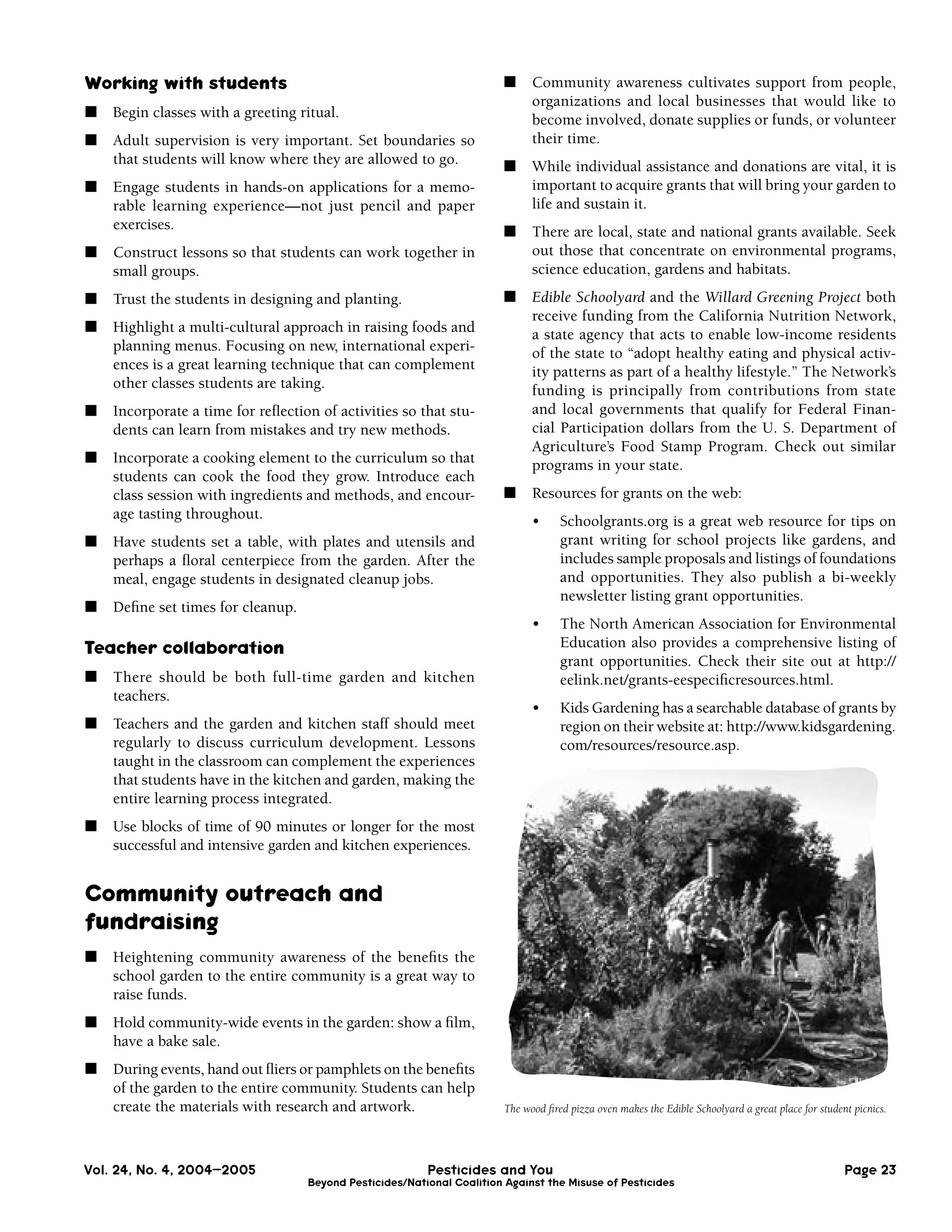
    create the materials with research and artwork.                    The wood fired pizza oven makes the Edible Schoolyard a great place for student picnics.


Vol. 24, No. 4, 2004–2005                                Pesticides and You                                                                         Page 23
                                   Beyond Pesticides/National Coalition Against the Misuse of Pesticides

The Organic School Garden

  • 1.
    The Organic SchoolGarden Hands-on teaching of environmental health and social values By Meghan Taylor At Beyond Pesticides’ 22nd National Pesticide Form, held in April author and owner of the famous Chez Panisse restaurant in 2004, forum participants had the opportunity to visit several of San Francisco, had an idea to create a school garden. Her idea Berkeley, California’s organic school gardens. Beebo Turman, was transformed into reality through outreach with landscape project director at Berkeley Community Garden Collaborative architects, chefs, gardeners, teachers, and other design pro- (BCGC), led the tour. The following is a portrayal of the school fessionals. Now, in 2005 the garden provides an invaluable gardens that were toured, The Edible Schoolyard and the Willard resource for students, staff and the entire community. Greening Project, with lessons on how you can start an organic garden at your community’s school. This article is dedicated to Karl Linn, an inspiration to the Berkeley and national community Seed to table The Edible Schoolyard teaches students the fundamental lesson gardening movements, who died on February 3, 2005. of “seed to table.” This lesson creates a bond between students and the natural world. Students learn every aspect of how their The Edible Schoolyard: A model food is created. They start with seeds and work in the soil, composting, caring for plants, learning to respect ecosystems, for the country and learning the dangers of chemicals and pesticides. The Overlooking the San Francisco Bay and Golden Gate bridge, a children learn an important lesson: to tolerate certain insects, one-acre organic garden rests on the campus of Martin Luther worms and other beneficial organisms, and to keep the garden King Jr. Middle School in Berkeley, CA. The soil is bursting with healthy from detrimental insects. fresh produce, herbs, vines, berries and flowers, all surrounded “Seeds” are transformed into lessons of the “table” through by fruit trees. On a shed hangs scores of blue, green and red cooking classes incorporated with student electives and humani- gloves. Shovels, hoes and handmade signs marking tomatoes ties curriculum. Students learn origins of staple ingredients, grind- and other vegetables sit waiting for the students to make use ing wheat into flour and making their own butter. They learn of them in their outdoor classroom. In the center of the gar- about a diversity of plants and foods, growing food from other den sits the circular Ramada, which means shade structure in cultures and cooking international cuisine. They prepare menus, Spanish, covered with deciduous vines and climbing annuals cook and taste, set tables and bring in fresh flowers from the gar- including kiwi, runner beans, and chayote. A compost area, den. They share in food, conversation and cleanup. The lesson chicken coop, wood fired oven, and picnic tables all add to the comes full circle when the students compost food scraps from vitality and richness of the Edible Schoolyard. their meal to help their own garden grow more healthfully. Ten years ago, this haven for vegetables, wildlife and stu- Foods are grown year-round, and the summer time is no dents was an asphalt parking lot. In 1995, Alice Waters, chef, exception. Edible Schoolyard provides a valuable model, as it Page 20 Pesticides and You Vol. 24, No. 4, 2004–2005 Beyond Pesticides/National Coalition Against the Misuse of Pesticides
  • 2.
    is the onlyschool garden with a summer program. Students permaculture garden in the back. Ms. Turman said of Karl Linn, garden, weed, and harvest for two hours in the morning, and “He believes in community gardens to bring the people together prepare their lunch from their work, eating on the garden’s to meet each other. There’s a whole feeling of working together picnic tables. that is something that you just can’t replace anywhere else.” Funding the garden The Willard Greening Project: Edible Schoolyard began through the support of two private Facing challenges head on foundations: Chez Panisse Foundation and the Center for The Willard Greening Project at the Berkeley Unified School Ecoliteracy. Currently, it is supported by a number of founda- District (BUSD) was begun by PTA member Yolanda Huang, tions, individual gifts and benefit events. When staff is inspired and has provided immeasurable benefits to the school and with new ideas such as a pizza oven or a tool shed, they write surrounding community. Unfortunately, in June 2004, Ameri- grant proposals to make it happen. corps, a principal sponsor of Willard Greening, pulled its fund- In addition, this particular school garden is a high publicity ing due to what many Willard Greening advocates say is the spot. Both Fred Rodgers and Martha Stewart have filmed there faulty accounting methods of BUSD. Since then, the garden in the past, which helps with the fundraising. Beebo Turman has been struggling. Ms. Huang and others in the community pointed out that there are other are putting up a fight for its monies available for school survival. During the Beyond gardens, high publicity or not. Pesticides tour in April 2004, See Lessons Learned later in this the participants witnessed the article for tips on how to fund a garden’s beauty and invaluable school garden. benefits that they are trying so hard to maintain today. Community outreach and What the education garden gives Edible Schoolyard conducts Before Willard Greening, the community activities that raise soil on the school property both awareness and funds. They was abysmal, unable to support once had a fundraiser in the any life. The project began by school gym, food included, and ripping up the concrete and showed an environmental film. filling the space with soil. City As a result, $13,000 was raised compost was applied to begin for the garden. “It was for the to bring back the health of the Edible Schoolyard but also to land. Since then, the soil has inform the neighbors and others been cover cropped and sifted in the area about what’s hap- to promote its health. As the pening, that this is not the only land was repaired and beauti- school doing this, and to help fied with a plethora of plants the community support school and crops, a community came Students collect eggs from their chickens at the Edible Schoolyard. gardens,” said Ms. Turman. together. Students were excited. Other areas of the com- So were residents. The change munity are also involved with the Edible Schoolyard. Staff at that occurred was immense. the Berkeley Horticulture Nursery have been regulars at the Students learned about composting, rotating crops, proper Edible Schoolyard’s garden committee meetings for the past watering and irrigation, how cover crops work, and other prin- ten years. The Nursery donates plants, as well as time. One ciples that exemplify and instill the fact that chemicals are not employee visits the garden once a week for two hours to work necessary to grow healthy food. Willard Greening head gardener with the students. Matt Tseng pointed out the garden’s healthful bounty of peas, Another active community member, Karl Linn, a landscape potatoes, strawberries, carrots, tomatoes, peppers, artichokes architect, psychologist, retired University of California Berkeley and fava beans among a multitude of other crops. professor and national community garden advocate, helped Overall, the Willard Greening Project incorporates a nu- found the EcoHouse Project. The EcoHouse, located directly trition class, a gardening club, lunches and beautification adjacent to the Karl Linn community garden, is a solar power projects in addition to helping students learn how to grow demonstration house that teaches children about renewable and cook food and care for land organically. It is a community- energy and resources. It is made of recycled wood and has a wide treasure. Vol. 24, No. 4, 2004–2005 Pesticides and You Page 21 Beyond Pesticides/National Coalition Against the Misuse of Pesticides
  • 3.
    A school gardenis a great project that can appeal to an eclectic mix of the community, including local environmental groups, organic advocates (find some at your local organic store), gardening clubs, cooking clubs, and the Parent Teacher Association (PTA) or Parent Teacher Organization (PTO). These seedlings will eventually produce food for lunch at Martin Luther King Jr. Middle School. Transforming the food culture you in this rewarding endeavor. A great resource of this in- formation, and something to look at in detail when planning Willard Greening’s nutrition class has been monumental in a school garden, is the Edible Schoolyard website at www. student’s understanding of food in culture. Mr. Tseng says that edibleschoolyard.org. the first lesson students learn is the benefits to eating “whole foods,” as opposed to processed foods. The students learn to read labels and decipher a healthful food choice from an unhealthful Getting started one. At the same time, Berkeley Unified School District does not ■ Reach out to the public for support. A school garden is a have soda and candy machines and is making a concerted effort great project that can appeal to an eclectic mix of the com- to provide healthier food. Great change has occurred. “We’ve munity, including local environmental groups, organic ad- seen that the kids are more open in that they try things they vocates (find some at your local organic store), gardening never would have tried. The question is whether they make the clubs, cooking clubs, and the Parent Teacher Association change in their daily lives. That’s a lot harder because we’re up (PTA) or Parent Teacher Organization (PTO). against how all of society eats, and the fast food lifestyle. Many ■ School garden advocates should hold a meeting with kids here are not sitting down to eat a meal [at home], either school administrators and landscape architects, chefs, and because both parents are working or just different family situa- designers to help, as Alice Waters did at Martin Luther tions. On a smaller scale, we’ve been successful in getting kids King Jr. Middle School. to realize that something that is green and goes on your noodles isn’t nasty. It’s pesto and it’s delicious,” said Mr. Tseng. ■ Custodial staff may have concerns about the garden and Willard Greening has been a doorway for students to live kitchen proposal, such as attracting pests and mainte- healthier lives. The challenge of confronting the societal value nance problems. Be understanding of their concerns and of convenience and the promotion of processed and fast food is a work together to create a solution. daunting one. However, teaching young, developing minds about healthy alternatives hands-on, and letting them actually feel the Creating the garden difference, is a vital step toward a deeper cultural understanding of the importance of whole, healthful foods that do not depend ■ Create a space where the class will meet at the beginning on chemicals in their production and processing. and end of each gardening session. For example, Edible Schoolyard fashioned a shade structure and hay bale seats. ■ Make the garden organic and naturally sustainable. Con- Lessons learned: Tips for starting sider your locale’s native flora, fauna and grass species, as well as the climate in deciding which plants to grow a school garden in your community throughout the year. Through the words and actions of Mr. Tseng and Beebo Tur- man, and other garden staff of the Berkeley Community Gar- ■ Leave room in the soil for flowers, as these will add a den Collaborative, much can be learned about how to start an sense of beauty to the entire space. organic school garden, and how to thoughtfully incorporate ■ Treat the land as a whole garden for the entire school, the garden into student life. Following are some tips to assist instead of dividing it up into sections for each class. Page 22 Pesticides and You Vol. 24, No. 4, 2004–2005 Beyond Pesticides/National Coalition Against the Misuse of Pesticides
  • 4.
    Working with students ■ Community awareness cultivates support from people, organizations and local businesses that would like to ■ Begin classes with a greeting ritual. become involved, donate supplies or funds, or volunteer ■ Adult supervision is very important. Set boundaries so their time. that students will know where they are allowed to go. ■ While individual assistance and donations are vital, it is ■ Engage students in hands-on applications for a memo- important to acquire grants that will bring your garden to rable learning experience—not just pencil and paper life and sustain it. exercises. ■ There are local, state and national grants available. Seek ■ Construct lessons so that students can work together in out those that concentrate on environmental programs, small groups. science education, gardens and habitats. ■ Trust the students in designing and planting. ■ Edible Schoolyard and the Willard Greening Project both receive funding from the California Nutrition Network, ■ Highlight a multi-cultural approach in raising foods and a state agency that acts to enable low-income residents planning menus. Focusing on new, international experi- of the state to “adopt healthy eating and physical activ- ences is a great learning technique that can complement ity patterns as part of a healthy lifestyle.” The Network’s other classes students are taking. funding is principally from contributions from state ■ Incorporate a time for reflection of activities so that stu- and local governments that qualify for Federal Finan- dents can learn from mistakes and try new methods. cial Participation dollars from the U. S. Department of Agriculture’s Food Stamp Program. Check out similar ■ Incorporate a cooking element to the curriculum so that programs in your state. students can cook the food they grow. Introduce each class session with ingredients and methods, and encour- ■ Resources for grants on the web: age tasting throughout. • Schoolgrants.org is a great web resource for tips on ■ Have students set a table, with plates and utensils and grant writing for school projects like gardens, and perhaps a floral centerpiece from the garden. After the includes sample proposals and listings of foundations meal, engage students in designated cleanup jobs. and opportunities. They also publish a bi-weekly newsletter listing grant opportunities. ■ Define set times for cleanup. • The North American Association for Environmental Teacher collaboration Education also provides a comprehensive listing of grant opportunities. Check their site out at http:// ■ There should be both full-time garden and kitchen eelink.net/grants-eespecificresources.html. teachers. • Kids Gardening has a searchable database of grants by ■ Teachers and the garden and kitchen staff should meet region on their website at: http://www.kidsgardening. regularly to discuss curriculum development. Lessons com/resources/resource.asp. taught in the classroom can complement the experiences that students have in the kitchen and garden, making the entire learning process integrated. ■ Use blocks of time of 90 minutes or longer for the most successful and intensive garden and kitchen experiences. Community outreach and fundraising ■ Heightening community awareness of the benefits the school garden to the entire community is a great way to raise funds. ■ Hold community-wide events in the garden: show a film, have a bake sale. ■ During events, hand out fliers or pamphlets on the benefits of the garden to the entire community. Students can help create the materials with research and artwork. The wood fired pizza oven makes the Edible Schoolyard a great place for student picnics. Vol. 24, No. 4, 2004–2005 Pesticides and You Page 23 Beyond Pesticides/National Coalition Against the Misuse of Pesticides