
J2EE Container & Components
Presented By
Keshab Nath
J2EE???
• J2EE defines a standard platform for developing multi-tier
enterprise applications that are highly flexible.
• The Java2 Enterprise Edition(J2EE) provides a distributed
environment for developing, deploying and executing
applications.
• J2EE allows to focus on business logic in the program.
J2EE Components
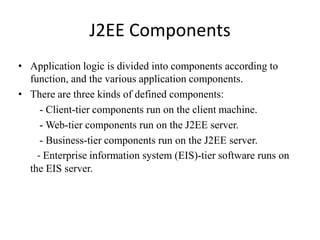
• Application logic is divided into components according to
function, and the various application components.
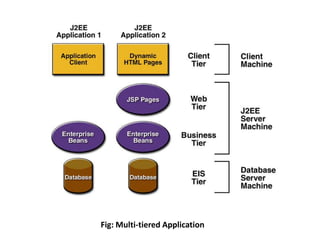
• There are three kinds of defined components:
- Client-tier components run on the client machine.
- Web-tier components run on the J2EE server.
- Business-tier components run on the J2EE server.
- Enterprise information system (EIS)-tier software runs on
the EIS server.
Fig: Multi-tiered Application
Client Component
• Application clients and applet clients are components
that run on the client.
• An application client runs on a client machine and
provides a way for users to access the J2EE services.
• A web page received from the web tier can include an
embedded applet. An applet is a small client
application written in Java language that executes in
the Java virtual machine installed in the web browser.
Web Component
• J2EE web components are either servlets or pages
created using JSP technology(JSP Pages).
• Servlets are Java programming language classes that
dynamically process requests and construct
responses.
• JSP are server-side programming that accept,store
and search data coming from client application. They
converts to servlets before processing.
Business Component
• Business code, which is logic that solves the needs of
a particular business domain such as banking, retail,
or finance, is handled by enterprise beans running in
the business tier.
• Enterprise JavaBeans are server-side, modular, and
reusable components that comprise specific units of
functionality.
• There are three kinds of enterprise beans:
session beans, entity beans, and message-driven
beans.
Business Component (contd…)
• Session beans: These may be
either stateful or stateless, and are primarily used to
encapsulate business logic, carry out tasks on behalf of a
client, and act as controllers for other beans.
• Entity beans: An entity bean represents persistent data
stored in one row of a database table. If the client terminates or
if the server shuts down,the underlying services ensure that the
entity bean data is saved.
• Message-driven beans: Message-driven beans listen
asynchronously for Java Message Service (JMS) messages
from any client or component.
Enterprise Information System Tier
• The enterprise information system tier handles J2EE
architecture’s connectivity to resources that are not
part of J2EE.
• These include a variety of resources such as
enterprise resource planning(ERP),database systems,
and other legacy information systems.
• This tier provides flexibility.
J2EE Container
• The application server maintains control and provides
services through an interface or framework known as
a container.
• J2EE containers provide runtime support for J2EE
application components.
• J2EE application components use the protocols and
methods of the container to access other application
components and services provided by the server.
J2EE Container (contd…)
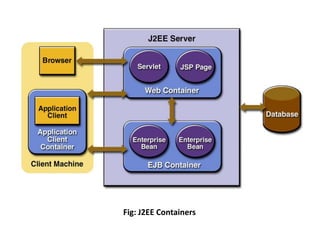
• There are five defined container types in the J2EE
specification.
• Two of these are server-side containers:
An EJB container, A Web container.
• The other two container types are client-side:
An application container, An applet container.
Fig: J2EE Containers
The web container
• The Web Container is a J2EE container that hosts
web applications.
• Manages the execution of JSP page and servlet
components for J2EE applications.
• Web components and their container run on the J2EE
server.
The EJB Container
• The EJB container acts as an interface between an
enterprise bean and the clients.
• Manages the execution of enterprise beans for J2EE
applications.
• Enterprise beans and their container run on the J2EE server.
• The container is responsible for creating the enterprise bean,
binding the enterprise bean to the naming service.
• It provides security by ensuring that only authorized clients
have access to the enterprise bean and its business methods.
• It saves the bean’s state to persistent storage, and activating
or passivating the bean when necessary.
Application Client Container
• Manages the execution of application client
containers.
• Application clients and their container run on the
client.
Applet container
• Manages the execution of applets.
• It consists of a web browser and Java Plug-in running
on the client together.
Thanks

J2 ee container & components

  • 1.
    J2EE Container &Components Presented By Keshab Nath
  • 2.
    J2EE??? • J2EE definesa standard platform for developing multi-tier enterprise applications that are highly flexible. • The Java2 Enterprise Edition(J2EE) provides a distributed environment for developing, deploying and executing applications. • J2EE allows to focus on business logic in the program.
  • 3.
    J2EE Components • Applicationlogic is divided into components according to function, and the various application components. • There are three kinds of defined components: - Client-tier components run on the client machine. - Web-tier components run on the J2EE server. - Business-tier components run on the J2EE server. - Enterprise information system (EIS)-tier software runs on the EIS server.
  • 4.
  • 5.
    Client Component • Applicationclients and applet clients are components that run on the client. • An application client runs on a client machine and provides a way for users to access the J2EE services. • A web page received from the web tier can include an embedded applet. An applet is a small client application written in Java language that executes in the Java virtual machine installed in the web browser.
  • 6.
    Web Component • J2EEweb components are either servlets or pages created using JSP technology(JSP Pages). • Servlets are Java programming language classes that dynamically process requests and construct responses. • JSP are server-side programming that accept,store and search data coming from client application. They converts to servlets before processing.
  • 7.
    Business Component • Businesscode, which is logic that solves the needs of a particular business domain such as banking, retail, or finance, is handled by enterprise beans running in the business tier. • Enterprise JavaBeans are server-side, modular, and reusable components that comprise specific units of functionality. • There are three kinds of enterprise beans: session beans, entity beans, and message-driven beans.
  • 8.
    Business Component (contd…) •Session beans: These may be either stateful or stateless, and are primarily used to encapsulate business logic, carry out tasks on behalf of a client, and act as controllers for other beans. • Entity beans: An entity bean represents persistent data stored in one row of a database table. If the client terminates or if the server shuts down,the underlying services ensure that the entity bean data is saved. • Message-driven beans: Message-driven beans listen asynchronously for Java Message Service (JMS) messages from any client or component.
  • 9.
    Enterprise Information SystemTier • The enterprise information system tier handles J2EE architecture’s connectivity to resources that are not part of J2EE. • These include a variety of resources such as enterprise resource planning(ERP),database systems, and other legacy information systems. • This tier provides flexibility.
  • 10.
    J2EE Container • Theapplication server maintains control and provides services through an interface or framework known as a container. • J2EE containers provide runtime support for J2EE application components. • J2EE application components use the protocols and methods of the container to access other application components and services provided by the server.
  • 11.
    J2EE Container (contd…) •There are five defined container types in the J2EE specification. • Two of these are server-side containers: An EJB container, A Web container. • The other two container types are client-side: An application container, An applet container.
  • 12.
  • 13.
    The web container •The Web Container is a J2EE container that hosts web applications. • Manages the execution of JSP page and servlet components for J2EE applications. • Web components and their container run on the J2EE server.
  • 14.
    The EJB Container •The EJB container acts as an interface between an enterprise bean and the clients. • Manages the execution of enterprise beans for J2EE applications. • Enterprise beans and their container run on the J2EE server. • The container is responsible for creating the enterprise bean, binding the enterprise bean to the naming service. • It provides security by ensuring that only authorized clients have access to the enterprise bean and its business methods. • It saves the bean’s state to persistent storage, and activating or passivating the bean when necessary.
  • 15.
    Application Client Container •Manages the execution of application client containers. • Application clients and their container run on the client.
  • 16.
    Applet container • Managesthe execution of applets. • It consists of a web browser and Java Plug-in running on the client together.
  • 17.