International Journal Of Computational Engineering Research (ijceronline.com) Vol. 2 Issue. 6


   Comparison of Current Controllers for a Five-level Cascaded H-Bridge
                          Multilevel Inverter
                    Sundararajan K1, Alamelu Nachiappan2, Veerapathiran G3
                                                   1
                                                    Sathyabama University, Chennai,
                                     2, 3
                                            Pondicherry Engineering College, Puducherry, India,


Abstract:
         The hysteresis current controller provides excellent dynamic performance, whereas the Proportional-Integral
controller provides instantaneous current control and wave shaping, fixed inverter switching frequency resulting in only known
harmonics. A comparative study between Hysteresis current control and Proportional-Integral (PI) current control using
sinusoidal pulse width modulation (SPWM) techniques for a five-level cascaded H-bridge multilevel inverter is presented in
this paper. A comparison has been made in terms of total harmonic distortion (THD) level at the three phase load current. The
simulation study has been carried out with the help of MATLAB Simulink software and the performance of such controllers has
been observed during load variations.

Keywords: Cascaded H-Bridge, Current controller, Hysteresis controller, Multilevel inverter, PI controller, Sinusoidal pulse
width modulation (SPWM), Total harmonic distortion (THD)

1. Introduction
         Presently, large electric drives and utility applications require advanced power electronics converters to meet the high
power demands. As a result, multilevel inverter technology is a very efficient alternative for medium-voltage and high-power
applications because of its fruitful advantages [1-4]. It can realize high voltage and high power output by using semiconductor
switches without the use of transformer and dynamic voltage balance circuits. When the number of output levels increases, the
harmonic content in the output voltage and current as well as electromagnetic interference decreases. The basic concept of a
multilevel inverter is to achieve high power by using a series of power semiconductor switches with several lower dc voltage
sources to perform the power conversion by synthesizing a staircase voltage waveform [4]. To obtain a low distortion output
voltage nearly sinusoidal, a triggering signal should be generated to control the switching frequency of each power
semiconductor switch. In the proposed study the triggering signals to multi level inverter (MLI) are designed by using the
Sinusoidal Pulse Width Modulation (SPWM) technique.
         The well-established topologies of multilevel inverters include neutral point clamped (NPC), flying capacitor and
Cascaded H-bridge (CHB). These inverters have several advantages over the traditional inverters. The CHB inverter
configuration has recently become very popular in high-power AC supplies and adjustable-speed drive applications. The CHB
multilevel inverter is designed with a series of H-bridge (single-phase full bridge) inverter units in each of its three phases. The
main focus of this paper is on the CHB inverter with different current control techniques including PI current control and
hysteresis current control. These current control techniques are studied and compared with each other for analyzing their
advantages and disadvantages. The current control techniques are also analyzed and compared based on current tracking,
output quality, Total Harmonic distortion (THD), Modulation index and Load variations. To show the performance of the
proposed CHB inverter, the MATLAB-simulink is used to simulate the five-level CHB inverter with the proposed current
control techniques. The design and simulation of the five-level CHB inverter with predictive current control has to be
introduced as a future work of this paper.

2. Inverter Model
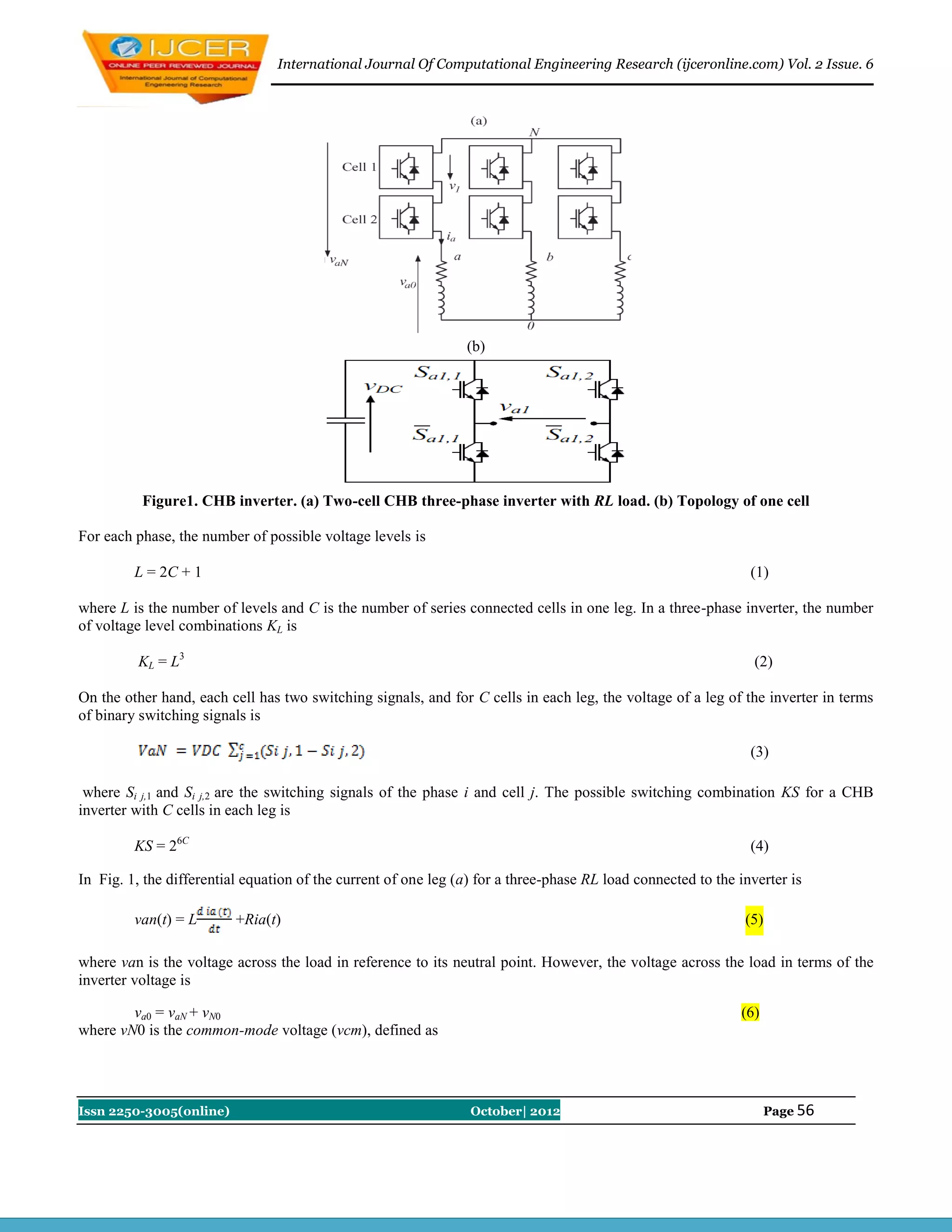
         The cascaded H-bridge multilevel inverter model is based on the series connection of H-bridges with separate dc
sources. Since the output terminals of the H-bridges are connected in series, the dc sources must be isolated from each other
(Fig.1). Owing to this property, CHB-MLIs have also been proposed to be used with fuel cells or photovoltaic arrays in order
to achieve higher levels [1,5-7]. The resulting ac output voltage is synthesized by the addition of the voltages generated by
different H-bridge cells. Each single phase H-bridge generates three voltage levels as +Vdc, 0, -Vdc by connecting the dc
source to the ac output by different combinations of four switches (S11 , S12 ,S13 and S14).


Issn 2250-3005(online)                                             October| 2012                                 Page 55
International Journal Of Computational Engineering Research (ijceronline.com) Vol. 2 Issue. 6


                                                                 (b)


          Figure1. CHB inverter. (a) Two-cell CHB three-phase inverter with RL load. (b) Topology of one cell

For each phase, the number of possible voltage levels is

         L = 2C + 1                                                                                             (1)

where L is the number of levels and C is the number of series connected cells in one leg. In a three-phase inverter, the number
of voltage level combinations KL is

          KL = L3                                                                                                (2)

On the other hand, each cell has two switching signals, and for C cells in each leg, the voltage of a leg of the inverter in terms
of binary switching signals is

                                                                                                                (3)

 where Si j,1 and Si j,2 are the switching signals of the phase i and cell j. The possible switching combination KS for a CHB
inverter with C cells in each leg is

         KS = 26C                                                                                               (4)

In Fig. 1, the differential equation of the current of one leg (a) for a three-phase RL load connected to the inverter is

         van(t) = L       +Ria(t)                                                                              (5)

where van is the voltage across the load in reference to its neutral point. However, the voltage across the load in terms of the
inverter voltage is

        va0 = vaN + vN0                                                                                       (6)
where vN0 is the common-mode voltage (vcm), defined as


Issn 2250-3005(online)                                           October| 2012                                      Page 56
International Journal Of Computational Engineering Research (ijceronline.com) Vol. 2 Issue. 6


                                                                                                             (7)

The load model can be expressed also as a vector equation using the following vectorial transformation:


                                                                                                      (8)
where a, b, and c are the three-phase variables of voltage or current, and α and β are the vectorial variables. Using this
transformation, (5) can be described in terms of the vectorial variables α−β as

                                                                                                             (9)
where vα,β is the inverter voltage vector and iα,β is the load current vector.

3. Modulation Techniques For CHB Inverter
          There are different modulation techniques available for a CHB multilevel inverter [8-10]. Among all those techniques,
PWM technique which produces less total harmonic distortion (THD) values is most preferable. Phase Shifted PWM (PS-
PWM) and Level-shifted PWM (LS-PWM) are the natural extension of traditional PWM techniques. For generating triggering
pulses to MLI, pure sinusoidal wave as modulating signal and multi carrier signal which is of triangular in shape have been
considered [11]. For an L-level CHB inverter, (L-1) carrier signals are required.
          In PSPWM, a phase shift is introduced between the carrier signals of contiguous cells, producing a phase-shifted
switching pattern between them. When connected together, a stepped multilevel waveform is originated. It has been
demonstrated that the lowest distortion can be achieved when the phase shifts between carriers are 180°/C (where C is the
number of power cells) (Fig.2). The phase-shifts of the carriers produce multiplicative effect, which means that the total output
voltage has a switching pattern with C times the frequency of the switching pattern of each cell. Hence, better total harmonic
distortion (THD) is obtained at the output, using C times lower frequency carriers.


                                           Figure 2. Phase Shifted PWM (PS-PWM)

          In Level-shifted PWM (LS-PWM), the L-1 carriers are arranged in vertical shifts instead of the phase-shift used in PS-
PWM. The carriers span the whole amplitude range that can be generated by the inverter.
     They can be arranged in vertical shifts, with all the signals in phase with each other, called phase disposition (PD-PWM);
with all the positive carriers in phase with each other and in opposite phase of the negative carriers, known as phase opposition
disposition (POD-PWM); and alternate phase opposition disposition (APOD-PWM), which is obtained by alternating the phase
between adjacent carriers [12]. An example of the phase disposition (PD-PWM) for the five-level CHB inverter (thus four
carriers) is given in Fig. 3.


                                            Figure 3. Phase disposition (PD-PWM)
Issn 2250-3005(online)                                           October| 2012                                 Page 57
International Journal Of Computational Engineering Research (ijceronline.com) Vol. 2 Issue. 6


4. Analysis of Current Controllers

4.1. Hysteresis current controller
         The hysteresis modulation for power electronic converters is attractive in many different applications because of its
unmatched dynamic response and wide command-tracking bandwidth. The hysteresis modulation is a feedback current control
method where the load current tracks the reference current within a hysteresis band in nonlinear load application of CHB
multilevel inverter. The block diagram of a hysteresis control of an H-bridge is shown in Fig.4a and the operation principle of
the hysteresis modulation in Fig.4b. The controller generates the sinusoidal reference current of desired magnitude and
frequency that is compared with the actual line current. If the current exceeds the upper limit of the hysteresis band, the next
higher voltage level should be selected to attempt to force the current error towards zero. However, the new inverter voltage
level may not be sufficient to return the current error to zero and inverter should switch to next higher voltage level until the
correct voltage level is selected. As a result, the current gets back into the hysteresis band, and the actual current is forced to
track the reference current within the hysteresis band. Three hysteresis controllers which are used to implement the correct
voltage level selection are defined as double offset band three level, double band three level, and time-based three level
hysteresis controllers [13, 14].
         The switching frequency changes according to variations of the load parameters and operating conditions. This is one
of the major drawbacks [15] of hysteresis control, since variable switching frequency can cause resonance problems. In
addition, the switching losses restrict the application of hysteresis control to lower power levels.


                                                                          (b)
  Figure 4. Hysteresis current control: (a) block diagram of an H-bridge cell with hysteresis controller, (b) hysteresis
                                   current band and voltage curves of load feedback


4.2. Proportional-Integral Current Controller Using PWM
         The PI current controller with PWM control scheme is shown in Fig.5. The error between the reference and the
measured load current is processed by the PI controller to generate the reference voltages. A modulator is needed to generate
the drive signals for the inverter switches. The reference load voltages are compared with a triangular carrier signal, and the
output of each comparator is used to drive the CHB multilevel inverter.


Issn 2250-3005(online)                                          October| 2012                                   Page 58
International Journal Of Computational Engineering Research (ijceronline.com) Vol. 2 Issue. 6


                                     Fig. 5. The block diagram of PI current controller.
5. Simulation Results
         Simulations of the CHB inverter were carried out using Matlab/Simulink. The load used for simulation results is an RL
load. The input dc voltage, VDC = 100 V is considered for each cell.

                                               Table.1. Simulation parameters

                                     Parameters                            Values
                                     Input voltage(Vdc)                    100 V
                                     Load resistance(R)                    47 Ω
                                     Load inductance(L)                    15 mH
                                     Hysteresis Band Width(δ)              ±0.1
                                     Carrier Frequency(PI controller)      2.5KHz
                                     Reference current                     4A

        The simulation parameters are given in table 1. The comparison of the PI current control with the Hysteresis current
control is done by Current THD with variations in load.
          The harmonic spectrum of load current waveform is analyzed using the Fast Fourier transform (FFT) and measured
the THD of load current for different values of RL. Fig. 6.(a) shows the load voltage waveform and load current waveform for
the hysteresis current controller and Fig. 6.(b) shows the reference current waveform for hysteresis controller. Fig.7.(a) shows
the load voltage waveform and load current waveform for the PI controller. Fig.7(b) shows the reference current waveform for
hysteresis controller. Fig.8(a-d) shows the harmonic spectrum of load current for the hysteresis current controller and Fig.9.(a-
d) shows the harmonic spectrum of load current for the PI controller, respectively.


                         Figure 6(a). Load voltage and current waveform for hysteresis controller


Issn 2250-3005(online)                                         October| 2012                                   Page 59
International Journal Of Computational Engineering Research (ijceronline.com) Vol. 2 Issue. 6


                         Figure 6(b). Reference current waveform for Hysteresis controller


                         Figure 7(a). Load voltage and current waveform for PI controller


                         Figure 7(b). Reference current waveform for hysteresis controller


                     Figure 8(a). Harmonic spectrum for hysteresis controller (R=96Ω,L=35mH)


                     Figure 8(b). Harmonic spectrum for hysteresis controller (R=96Ω,L=30mH)


                     Figure 8(c). Harmonic spectrum for hysteresis controller (R=47Ω,L=15mH)


Issn 2250-3005(online)                                    October| 2012                                Page 60
International Journal Of Computational Engineering Research (ijceronline.com) Vol. 2 Issue. 6


                     Figure 8(d). Harmonic spectrum for hysteresis controller (R=47Ω,L=10mH)


                         Figure 9(a). Harmonic spectrum for PI controller(R=96Ω,L=35mH)


                         Figure 9(b). Harmonic spectrum for PI controller(R=96Ω,L=30mH)


                         Figure 9(c). Harmonic spectrum for PI controller(R=47Ω,L=15mH)


                         Figure 9 (d). Harmonic spectrum for PI controller(R=47Ω,L=10mH)


Issn 2250-3005(online)                                    October| 2012                                Page 61
International Journal Of Computational Engineering Research (ijceronline.com) Vol. 2 Issue. 6


                         Table 2. Comparison of parameters for hysteresis and PI current controller

                         Different Loads        PI Current Controller          Hysteresis Current Controller

                        R=96Ω ,L=35mH                 THD=3.38%                          THD=6.96%

                        R=96Ω ,L=30mH                 THD=3.95%                          THD=6.90%

                        R=47Ω ,L=15mH                 THD=8.51%                          THD=10.76%

                        R=47Ω ,L=10mH                 THD=10.15%                         THD=12.14%
          The different load parameters were tested and observed for the comparison of the performance of the hysteresis
control and PI control with PWM techniques. The comparison results are shown in the table 2. As the load value increases, the
THD value also increases but the PI current controller shows better response compared to the Hysteresis Controller. From fig.8
(a-d), it can be observed that the hysteresis control produces continuous and wide frequency range output current spectrum,
which is considered as a disadvantage of this method. From fig. 9 (a-d), it is observed that the harmonic content generated
when using the PI current control, is concentrated around the carrier frequency. This is considered as an advantage of the PI
current control over the hysteresis control.

6. Conclusion
          The CHB multilevel inverter's current has been controlled by the Hysteresis and Proportional - Integral (PI) current
controllers. Hysteresis controller shows good dynamic response but with some noticeable disturbances in voltage and current
waveforms. The PI current controller with PWM modulation technique shows slower response due to the dynamics of the
closed current loops, but performed better compared to the hysteresis current controller. The harmonic spectrums for the two
control methods were compared and the simulation results show that the current spectrum obtained with PI current control is
better than the hysteresis current controller.

References
[1]    J.Rodriguez, J.-S. Lai, and F. Z. Peng, “Multilevel inverters: A survey of topologies, controls, and applications,” IEEE Trans. Ind.
       Electron., vol. 49, no. 4, , pp. 724–738 Aug. 2002.
[2].   Holmes, D.G, McGrath, B.P., “Multicarrier PWM strategies for multilevel inverters”, IEEE Trans. Ind. Electron., Vol. 49, issue:4,
       pp.858-867, Aug 2002
[3].   Yan Deng, Hongyan Wang, Chao Zhang, Lei Hu and Xiangning He, “Multilevel PWM Methods Based On Control Degrees Of
       Freedom Combination And Its Theoretical Analysis”, IEEE IAS 2005 Conference record no.:0-7803-9208-6/05, pp.1692 – 1699,
       2005.
[4].   J. Rodriguez, B. Wu, S. Bernet, J. Pontt, and S. Kouro, “Multilevel voltage source-converter topologies for industrial medium-voltage
       drives”, IEEE Trans. Ind. Electron., vol. 54, no. 6, pp. 2930–2945, Dec. 2007.
[5]    Panagis P, Stergiopoulos F, Marabeas P, Manias S. Comparison of state of the art multilevel inverters. In: Proceedings of IEEE
       annual power electronics specialist conference PESC „08, Rhodes (Greece), 2008.
[6]    Hochgraf C, Lasseter R, Divan D, Lipo TA. “Comparison of multilevel inverters for static VAR compensation”, In: Proceedings of
       IEEE ind appl society annual meeting, 1994.
[7]    Kuhn H, Ruger NE, Mertens A., “ Control strategy for multilevel inverter with non-ideal dc sources”, In Proceedings of IEEE power
       electronics specialists conf. Orlando (USA), 2007.
[8]    S. Bernet, Tutorial, “Multi Level converters”, in Proc. Power Electron. Spec. Conf. (PESC 04), Aachen, Germany, Jun 20, 2004.
[9]    B.Wu, “High Power converters and AC motor drives”, in Proc. Power Electron. Spec. Conf. (PESC 05), Recife, Brazil, Jun. 2005.
[10]   J. Rodrı´guez, S. Kouro, and P. Lezana, B, “Tutorial on multilevel converters”, in Proc. Power Electron. Intell.
       Contr. Energy Conserv. (PELINCEC 2005), Warsaw, Poland, Oct. 2005.
[11]   J. Rodrı´guez, Ed., B, “ Special section on multilevel inverters”, Part I, IEEE Trans. Ind. Electron., vol. 49, Aug. 2002.
[12]   G. Carrara, S. Gardella, M. Marchesoni, R. Salutari, and G. Sciutto, B, “A new multilevel PWM method: A theoretical analysis”,
       IEEE Trans. Power Electron., vol. 7, Jul. 1992, pp. 497–505.
[13]   Bojovi RI, Griva G, Bostan V, Guerreiro M, Farina F, Profumo F., “Current control strategy for power conditioners using sinusoidal
       signal integrators in synchronous reference frame”, IEEE Trans Power Electron, 2005; 20:pp.1402–12.
[14]   Kang BJ, Liaw CM., “Random hysteresis PWM inverter with robust spectrum shaping”, IEEE Trans Aerospace Electron Syst
       2001;37:619–28.
[15]   Carl N.M.,Victor S.P. Cheung, and Henry S.H. Chung, “Constant Frequency Hysteresis Current Control of Grid-Connected VSI
       without Bandwidth Control”, Energy Conversion Congress and Exposition, 2009. ECCE 2009.

Issn 2250-3005(online)                                              October| 2012                                       Page 62

J026055062

  • 1.
    International Journal OfComputational Engineering Research (ijceronline.com) Vol. 2 Issue. 6 Comparison of Current Controllers for a Five-level Cascaded H-Bridge Multilevel Inverter Sundararajan K1, Alamelu Nachiappan2, Veerapathiran G3 1 Sathyabama University, Chennai, 2, 3 Pondicherry Engineering College, Puducherry, India, Abstract: The hysteresis current controller provides excellent dynamic performance, whereas the Proportional-Integral controller provides instantaneous current control and wave shaping, fixed inverter switching frequency resulting in only known harmonics. A comparative study between Hysteresis current control and Proportional-Integral (PI) current control using sinusoidal pulse width modulation (SPWM) techniques for a five-level cascaded H-bridge multilevel inverter is presented in this paper. A comparison has been made in terms of total harmonic distortion (THD) level at the three phase load current. The simulation study has been carried out with the help of MATLAB Simulink software and the performance of such controllers has been observed during load variations. Keywords: Cascaded H-Bridge, Current controller, Hysteresis controller, Multilevel inverter, PI controller, Sinusoidal pulse width modulation (SPWM), Total harmonic distortion (THD) 1. Introduction Presently, large electric drives and utility applications require advanced power electronics converters to meet the high power demands. As a result, multilevel inverter technology is a very efficient alternative for medium-voltage and high-power applications because of its fruitful advantages [1-4]. It can realize high voltage and high power output by using semiconductor switches without the use of transformer and dynamic voltage balance circuits. When the number of output levels increases, the harmonic content in the output voltage and current as well as electromagnetic interference decreases. The basic concept of a multilevel inverter is to achieve high power by using a series of power semiconductor switches with several lower dc voltage sources to perform the power conversion by synthesizing a staircase voltage waveform [4]. To obtain a low distortion output voltage nearly sinusoidal, a triggering signal should be generated to control the switching frequency of each power semiconductor switch. In the proposed study the triggering signals to multi level inverter (MLI) are designed by using the Sinusoidal Pulse Width Modulation (SPWM) technique. The well-established topologies of multilevel inverters include neutral point clamped (NPC), flying capacitor and Cascaded H-bridge (CHB). These inverters have several advantages over the traditional inverters. The CHB inverter configuration has recently become very popular in high-power AC supplies and adjustable-speed drive applications. The CHB multilevel inverter is designed with a series of H-bridge (single-phase full bridge) inverter units in each of its three phases. The main focus of this paper is on the CHB inverter with different current control techniques including PI current control and hysteresis current control. These current control techniques are studied and compared with each other for analyzing their advantages and disadvantages. The current control techniques are also analyzed and compared based on current tracking, output quality, Total Harmonic distortion (THD), Modulation index and Load variations. To show the performance of the proposed CHB inverter, the MATLAB-simulink is used to simulate the five-level CHB inverter with the proposed current control techniques. The design and simulation of the five-level CHB inverter with predictive current control has to be introduced as a future work of this paper. 2. Inverter Model The cascaded H-bridge multilevel inverter model is based on the series connection of H-bridges with separate dc sources. Since the output terminals of the H-bridges are connected in series, the dc sources must be isolated from each other (Fig.1). Owing to this property, CHB-MLIs have also been proposed to be used with fuel cells or photovoltaic arrays in order to achieve higher levels [1,5-7]. The resulting ac output voltage is synthesized by the addition of the voltages generated by different H-bridge cells. Each single phase H-bridge generates three voltage levels as +Vdc, 0, -Vdc by connecting the dc source to the ac output by different combinations of four switches (S11 , S12 ,S13 and S14). Issn 2250-3005(online) October| 2012 Page 55
  • 2.
    International Journal OfComputational Engineering Research (ijceronline.com) Vol. 2 Issue. 6 (b) Figure1. CHB inverter. (a) Two-cell CHB three-phase inverter with RL load. (b) Topology of one cell For each phase, the number of possible voltage levels is L = 2C + 1 (1) where L is the number of levels and C is the number of series connected cells in one leg. In a three-phase inverter, the number of voltage level combinations KL is KL = L3 (2) On the other hand, each cell has two switching signals, and for C cells in each leg, the voltage of a leg of the inverter in terms of binary switching signals is (3) where Si j,1 and Si j,2 are the switching signals of the phase i and cell j. The possible switching combination KS for a CHB inverter with C cells in each leg is KS = 26C (4) In Fig. 1, the differential equation of the current of one leg (a) for a three-phase RL load connected to the inverter is van(t) = L +Ria(t) (5) where van is the voltage across the load in reference to its neutral point. However, the voltage across the load in terms of the inverter voltage is va0 = vaN + vN0 (6) where vN0 is the common-mode voltage (vcm), defined as Issn 2250-3005(online) October| 2012 Page 56
  • 3.
    International Journal OfComputational Engineering Research (ijceronline.com) Vol. 2 Issue. 6 (7) The load model can be expressed also as a vector equation using the following vectorial transformation: (8) where a, b, and c are the three-phase variables of voltage or current, and α and β are the vectorial variables. Using this transformation, (5) can be described in terms of the vectorial variables α−β as (9) where vα,β is the inverter voltage vector and iα,β is the load current vector. 3. Modulation Techniques For CHB Inverter There are different modulation techniques available for a CHB multilevel inverter [8-10]. Among all those techniques, PWM technique which produces less total harmonic distortion (THD) values is most preferable. Phase Shifted PWM (PS- PWM) and Level-shifted PWM (LS-PWM) are the natural extension of traditional PWM techniques. For generating triggering pulses to MLI, pure sinusoidal wave as modulating signal and multi carrier signal which is of triangular in shape have been considered [11]. For an L-level CHB inverter, (L-1) carrier signals are required. In PSPWM, a phase shift is introduced between the carrier signals of contiguous cells, producing a phase-shifted switching pattern between them. When connected together, a stepped multilevel waveform is originated. It has been demonstrated that the lowest distortion can be achieved when the phase shifts between carriers are 180°/C (where C is the number of power cells) (Fig.2). The phase-shifts of the carriers produce multiplicative effect, which means that the total output voltage has a switching pattern with C times the frequency of the switching pattern of each cell. Hence, better total harmonic distortion (THD) is obtained at the output, using C times lower frequency carriers. Figure 2. Phase Shifted PWM (PS-PWM) In Level-shifted PWM (LS-PWM), the L-1 carriers are arranged in vertical shifts instead of the phase-shift used in PS- PWM. The carriers span the whole amplitude range that can be generated by the inverter. They can be arranged in vertical shifts, with all the signals in phase with each other, called phase disposition (PD-PWM); with all the positive carriers in phase with each other and in opposite phase of the negative carriers, known as phase opposition disposition (POD-PWM); and alternate phase opposition disposition (APOD-PWM), which is obtained by alternating the phase between adjacent carriers [12]. An example of the phase disposition (PD-PWM) for the five-level CHB inverter (thus four carriers) is given in Fig. 3. Figure 3. Phase disposition (PD-PWM) Issn 2250-3005(online) October| 2012 Page 57
  • 4.
    International Journal OfComputational Engineering Research (ijceronline.com) Vol. 2 Issue. 6 4. Analysis of Current Controllers 4.1. Hysteresis current controller The hysteresis modulation for power electronic converters is attractive in many different applications because of its unmatched dynamic response and wide command-tracking bandwidth. The hysteresis modulation is a feedback current control method where the load current tracks the reference current within a hysteresis band in nonlinear load application of CHB multilevel inverter. The block diagram of a hysteresis control of an H-bridge is shown in Fig.4a and the operation principle of the hysteresis modulation in Fig.4b. The controller generates the sinusoidal reference current of desired magnitude and frequency that is compared with the actual line current. If the current exceeds the upper limit of the hysteresis band, the next higher voltage level should be selected to attempt to force the current error towards zero. However, the new inverter voltage level may not be sufficient to return the current error to zero and inverter should switch to next higher voltage level until the correct voltage level is selected. As a result, the current gets back into the hysteresis band, and the actual current is forced to track the reference current within the hysteresis band. Three hysteresis controllers which are used to implement the correct voltage level selection are defined as double offset band three level, double band three level, and time-based three level hysteresis controllers [13, 14]. The switching frequency changes according to variations of the load parameters and operating conditions. This is one of the major drawbacks [15] of hysteresis control, since variable switching frequency can cause resonance problems. In addition, the switching losses restrict the application of hysteresis control to lower power levels. (b) Figure 4. Hysteresis current control: (a) block diagram of an H-bridge cell with hysteresis controller, (b) hysteresis current band and voltage curves of load feedback 4.2. Proportional-Integral Current Controller Using PWM The PI current controller with PWM control scheme is shown in Fig.5. The error between the reference and the measured load current is processed by the PI controller to generate the reference voltages. A modulator is needed to generate the drive signals for the inverter switches. The reference load voltages are compared with a triangular carrier signal, and the output of each comparator is used to drive the CHB multilevel inverter. Issn 2250-3005(online) October| 2012 Page 58
  • 5.
    International Journal OfComputational Engineering Research (ijceronline.com) Vol. 2 Issue. 6 Fig. 5. The block diagram of PI current controller. 5. Simulation Results Simulations of the CHB inverter were carried out using Matlab/Simulink. The load used for simulation results is an RL load. The input dc voltage, VDC = 100 V is considered for each cell. Table.1. Simulation parameters Parameters Values Input voltage(Vdc) 100 V Load resistance(R) 47 Ω Load inductance(L) 15 mH Hysteresis Band Width(δ) ±0.1 Carrier Frequency(PI controller) 2.5KHz Reference current 4A The simulation parameters are given in table 1. The comparison of the PI current control with the Hysteresis current control is done by Current THD with variations in load. The harmonic spectrum of load current waveform is analyzed using the Fast Fourier transform (FFT) and measured the THD of load current for different values of RL. Fig. 6.(a) shows the load voltage waveform and load current waveform for the hysteresis current controller and Fig. 6.(b) shows the reference current waveform for hysteresis controller. Fig.7.(a) shows the load voltage waveform and load current waveform for the PI controller. Fig.7(b) shows the reference current waveform for hysteresis controller. Fig.8(a-d) shows the harmonic spectrum of load current for the hysteresis current controller and Fig.9.(a- d) shows the harmonic spectrum of load current for the PI controller, respectively. Figure 6(a). Load voltage and current waveform for hysteresis controller Issn 2250-3005(online) October| 2012 Page 59
  • 6.
    International Journal OfComputational Engineering Research (ijceronline.com) Vol. 2 Issue. 6 Figure 6(b). Reference current waveform for Hysteresis controller Figure 7(a). Load voltage and current waveform for PI controller Figure 7(b). Reference current waveform for hysteresis controller Figure 8(a). Harmonic spectrum for hysteresis controller (R=96Ω,L=35mH) Figure 8(b). Harmonic spectrum for hysteresis controller (R=96Ω,L=30mH) Figure 8(c). Harmonic spectrum for hysteresis controller (R=47Ω,L=15mH) Issn 2250-3005(online) October| 2012 Page 60
  • 7.
    International Journal OfComputational Engineering Research (ijceronline.com) Vol. 2 Issue. 6 Figure 8(d). Harmonic spectrum for hysteresis controller (R=47Ω,L=10mH) Figure 9(a). Harmonic spectrum for PI controller(R=96Ω,L=35mH) Figure 9(b). Harmonic spectrum for PI controller(R=96Ω,L=30mH) Figure 9(c). Harmonic spectrum for PI controller(R=47Ω,L=15mH) Figure 9 (d). Harmonic spectrum for PI controller(R=47Ω,L=10mH) Issn 2250-3005(online) October| 2012 Page 61
  • 8.
    International Journal OfComputational Engineering Research (ijceronline.com) Vol. 2 Issue. 6 Table 2. Comparison of parameters for hysteresis and PI current controller Different Loads PI Current Controller Hysteresis Current Controller R=96Ω ,L=35mH THD=3.38% THD=6.96% R=96Ω ,L=30mH THD=3.95% THD=6.90% R=47Ω ,L=15mH THD=8.51% THD=10.76% R=47Ω ,L=10mH THD=10.15% THD=12.14% The different load parameters were tested and observed for the comparison of the performance of the hysteresis control and PI control with PWM techniques. The comparison results are shown in the table 2. As the load value increases, the THD value also increases but the PI current controller shows better response compared to the Hysteresis Controller. From fig.8 (a-d), it can be observed that the hysteresis control produces continuous and wide frequency range output current spectrum, which is considered as a disadvantage of this method. From fig. 9 (a-d), it is observed that the harmonic content generated when using the PI current control, is concentrated around the carrier frequency. This is considered as an advantage of the PI current control over the hysteresis control. 6. Conclusion The CHB multilevel inverter's current has been controlled by the Hysteresis and Proportional - Integral (PI) current controllers. Hysteresis controller shows good dynamic response but with some noticeable disturbances in voltage and current waveforms. The PI current controller with PWM modulation technique shows slower response due to the dynamics of the closed current loops, but performed better compared to the hysteresis current controller. The harmonic spectrums for the two control methods were compared and the simulation results show that the current spectrum obtained with PI current control is better than the hysteresis current controller. References [1] J.Rodriguez, J.-S. Lai, and F. Z. Peng, “Multilevel inverters: A survey of topologies, controls, and applications,” IEEE Trans. Ind. Electron., vol. 49, no. 4, , pp. 724–738 Aug. 2002. [2]. Holmes, D.G, McGrath, B.P., “Multicarrier PWM strategies for multilevel inverters”, IEEE Trans. Ind. Electron., Vol. 49, issue:4, pp.858-867, Aug 2002 [3]. Yan Deng, Hongyan Wang, Chao Zhang, Lei Hu and Xiangning He, “Multilevel PWM Methods Based On Control Degrees Of Freedom Combination And Its Theoretical Analysis”, IEEE IAS 2005 Conference record no.:0-7803-9208-6/05, pp.1692 – 1699, 2005. [4]. J. Rodriguez, B. Wu, S. Bernet, J. Pontt, and S. Kouro, “Multilevel voltage source-converter topologies for industrial medium-voltage drives”, IEEE Trans. Ind. Electron., vol. 54, no. 6, pp. 2930–2945, Dec. 2007. [5] Panagis P, Stergiopoulos F, Marabeas P, Manias S. Comparison of state of the art multilevel inverters. In: Proceedings of IEEE annual power electronics specialist conference PESC „08, Rhodes (Greece), 2008. [6] Hochgraf C, Lasseter R, Divan D, Lipo TA. “Comparison of multilevel inverters for static VAR compensation”, In: Proceedings of IEEE ind appl society annual meeting, 1994. [7] Kuhn H, Ruger NE, Mertens A., “ Control strategy for multilevel inverter with non-ideal dc sources”, In Proceedings of IEEE power electronics specialists conf. Orlando (USA), 2007. [8] S. Bernet, Tutorial, “Multi Level converters”, in Proc. Power Electron. Spec. Conf. (PESC 04), Aachen, Germany, Jun 20, 2004. [9] B.Wu, “High Power converters and AC motor drives”, in Proc. Power Electron. Spec. Conf. (PESC 05), Recife, Brazil, Jun. 2005. [10] J. Rodrı´guez, S. Kouro, and P. Lezana, B, “Tutorial on multilevel converters”, in Proc. Power Electron. Intell. Contr. Energy Conserv. (PELINCEC 2005), Warsaw, Poland, Oct. 2005. [11] J. Rodrı´guez, Ed., B, “ Special section on multilevel inverters”, Part I, IEEE Trans. Ind. Electron., vol. 49, Aug. 2002. [12] G. Carrara, S. Gardella, M. Marchesoni, R. Salutari, and G. Sciutto, B, “A new multilevel PWM method: A theoretical analysis”, IEEE Trans. Power Electron., vol. 7, Jul. 1992, pp. 497–505. [13] Bojovi RI, Griva G, Bostan V, Guerreiro M, Farina F, Profumo F., “Current control strategy for power conditioners using sinusoidal signal integrators in synchronous reference frame”, IEEE Trans Power Electron, 2005; 20:pp.1402–12. [14] Kang BJ, Liaw CM., “Random hysteresis PWM inverter with robust spectrum shaping”, IEEE Trans Aerospace Electron Syst 2001;37:619–28. [15] Carl N.M.,Victor S.P. Cheung, and Henry S.H. Chung, “Constant Frequency Hysteresis Current Control of Grid-Connected VSI without Bandwidth Control”, Energy Conversion Congress and Exposition, 2009. ECCE 2009. Issn 2250-3005(online) October| 2012 Page 62