FarmMATCH: Matching Agricultural Technologies to Context and Household
Jeroen Groot1, Martin Guthrie1, Jean-Marc Delore1, Francis Muthoni2, Lieven Claessens2, Beliyou Haile3, Carlo Azzarri3
1WUR, 2IITA, 3IFPRI
This poster is licensed for use under the Creative Commons Attribution 4.0 International Licence.
September 2019
We thank farmers and local partners in Africa RISING sites for their contributions to this work. We also acknowledge the
support of all donors which globally support the work of the CGIAR centers and their partners through their
contributions to the CGIAR system
Tested technologies from the Africa RISING project, such as crops and
cultivars, tillage techniques, animal breeds, feeds, animal housing,
soil and water conservation practices, post-harvest technologies, etc.
Where was the technology tested?
Which farms and households have used the technology?
Required information:
• Biophysical conditions (altitude, temperature, rainfall, etc.)
• Socio-economic conditions (input costs, product prices, demography, etc.)
• Household and farm features (number of HH members, education level, farm size, livestock ownership, etc.)
Would the technology also fit sustainably,
in other places with similar biophysical and socio-economic context,
for households and farms with similar features?
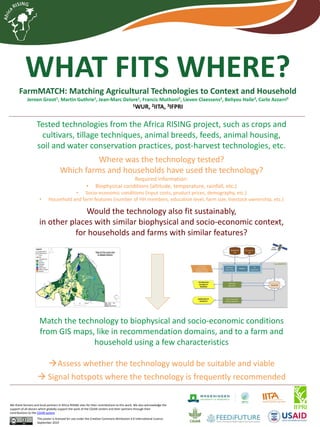
Match the technology to biophysical and socio-economic conditions
from GIS maps, like in recommendation domains, and to a farm and
household using a few characteristics
Assess whether the technology would be suitable and viable
 Signal hotspots where the technology is frequently recommended

What fits where? FarmMATCH: Matching Agricultural Technologies to Context and Household

  • 1.
    FarmMATCH: Matching AgriculturalTechnologies to Context and Household Jeroen Groot1, Martin Guthrie1, Jean-Marc Delore1, Francis Muthoni2, Lieven Claessens2, Beliyou Haile3, Carlo Azzarri3 1WUR, 2IITA, 3IFPRI This poster is licensed for use under the Creative Commons Attribution 4.0 International Licence. September 2019 We thank farmers and local partners in Africa RISING sites for their contributions to this work. We also acknowledge the support of all donors which globally support the work of the CGIAR centers and their partners through their contributions to the CGIAR system Tested technologies from the Africa RISING project, such as crops and cultivars, tillage techniques, animal breeds, feeds, animal housing, soil and water conservation practices, post-harvest technologies, etc. Where was the technology tested? Which farms and households have used the technology? Required information: • Biophysical conditions (altitude, temperature, rainfall, etc.) • Socio-economic conditions (input costs, product prices, demography, etc.) • Household and farm features (number of HH members, education level, farm size, livestock ownership, etc.) Would the technology also fit sustainably, in other places with similar biophysical and socio-economic context, for households and farms with similar features? Match the technology to biophysical and socio-economic conditions from GIS maps, like in recommendation domains, and to a farm and household using a few characteristics Assess whether the technology would be suitable and viable  Signal hotspots where the technology is frequently recommended