Download to read offline
![Multi-cracking modelling in concrete solved by a modified DR method 375
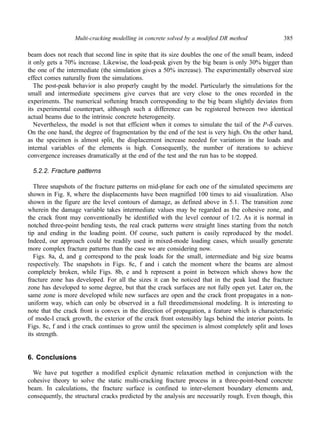
Then we update the internal force vector and obtain the accelerations and corrected velocities:
(9)
(10)
–1
t + 1 = M 1
+ --ΔtC
t + 1 [ – ]
ext Fint un
t + 1 = u ·
t + 1 + 1
--Δtu··
t + 1
Please notice that Eqs. (7) through (10) are obtained from the explicit Newmark scheme, which
dictates C to be diagonal. Additionally, as pointed out by Cook, et al. (1989), the presence of damping
in the plicit Newmark scheme raises the stability limit, which is in contrast to other forms of the
central-difference method in which no change, or a decrease in the stability limit, are observed.
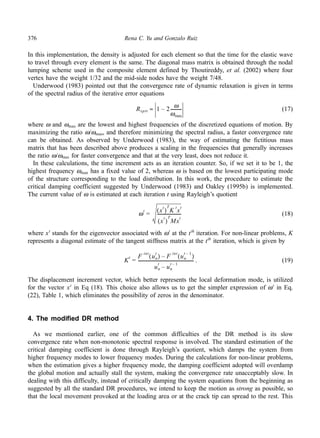
It is customary to eliminate C through the following equation
(11)
where ξ is the damping ratio, and to set both fictitious mass M and damping C matrices to be
diagonal to preserve the explicit form of the time-stepping integrator.
To ensure that the mode associated with the applied loading condition is critically damped, ξ is
generally set to be
(12)
where ω is the undamped natural frequency corresponding to the participating mode of loading.
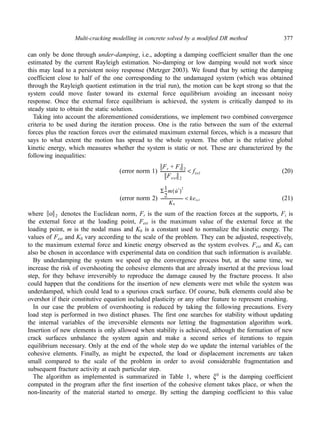
Since both the inertia and damping terms are artificial, the dynamic relaxation parameters,
including the mass matrix M, the damping coefficient ξ and the time step Δt, can be selected to
produce faster and more stable convergence to the static solution of the real physical system.
Owing to the explicit formulation the time step can be conservatively estimated from the
undamped system. It must satisfy the stability condition
(13)
where hmin is the size of the smallest element and cd is the dilatational wave speed, which in turn,
can be related to ωmax, the highest undamped frequency of the discretized system
ωmax = 2cd /hmin (14)
For an elastic material, the dilatational wave speed is calculated as
(15)
where λ and G are the Lamé constants, while ρ is the material density. Eqs. (13), (14) and (15)
provide a correlation between the maximum admissible time step, Δtcr = 2/ωmax, and the fictitious
mass matrix:
(16)
u··
n
2
Fn
t + 1 – ( ) Cu·
pred
u ·
n
npred
2
n
C = ξM
ξ = 2ω
Δt hmin ≤ /cd
cd = (λ + 2G)/ρ
ρ ≥ (λ + 2G) Δtct
2
--------
h](https://image.slidesharecdn.com/j2004yuruizcac-141031131515-conversion-gate02/85/J-2004-yu_ruiz_cac-5-320.jpg)
![378 Rena C. Yu and Gonzalo Ruiz
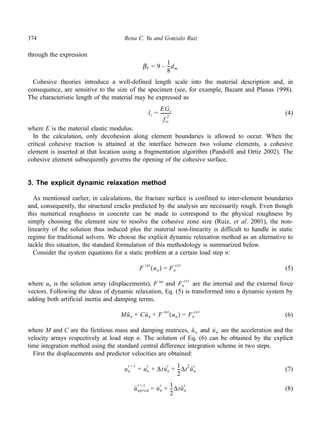
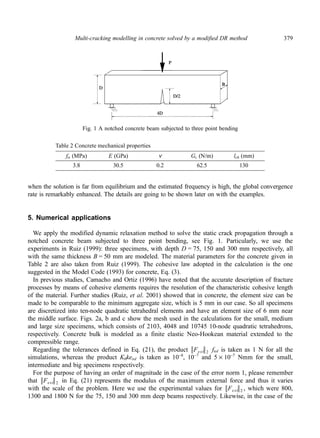
Table 1 Modified explicit dynamic relaxation algorithm
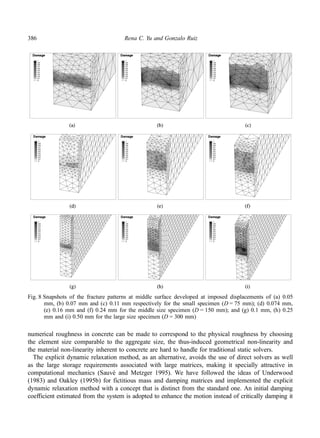
1. Get Fint from initial condition and initialize M for Δt = 1.01 for each element.
2. At iteration t
(i) compute displacements and predictor velocities at t + 1:
,
t + 1/2Δt2u··
;
t + Δtu·
t + 1 = un
un
n
u ·
t + 1 = u ·
npred
t + 1/2Δt2u··
n
t ( )
Fint un
(ii) compute internal forces and calculate residuals
t
n
;
ext−Fint un
t = Fn
Rn
(iii.1) evaluate current damping coefficient ξ t:
t ( )
,
, (22)
t – 1 –
t un
t ( ) Fint
( t – Ft – 1 )
int
------------------------------------------
t ( )TM Δun
;
Δun = un
ωt = Δun
Δun
ξt = 2ωt
(iii.2) if error norm 1 > 1.1 ftol and ξ t > 0.3 ξmax, set ξ t = ξ0;
(iv) compute accelerations and velocities at t + 1:
,
t ( )
t + 1 ( )−ξtMu·
t [ ]
;
(v) check error norm
t + 1 = M 1/2Δtξt( + M) –1
,
;
t
n
u··
n
ext Fin t – un
Fn
npred
u ·
t + 1 = u ·
n
t + 1 + 1/2Δtu··
npred
t + 1
n
Fr Fi + 2
Fext 2
---------------------- ftol <
Σ1
2
--m u·
( t )2
n
K0
----------------------- ket ol <
if satisfied, compute stress and strain vectors, update internal variables and move to the next load step n+1;
(vi). Otherwise, go to (i) ant set t = t + 1.](https://image.slidesharecdn.com/j2004yuruizcac-141031131515-conversion-gate02/85/J-2004-yu_ruiz_cac-8-320.jpg)
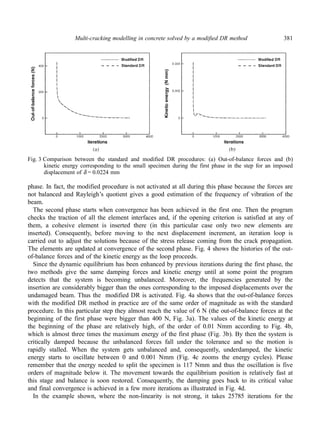
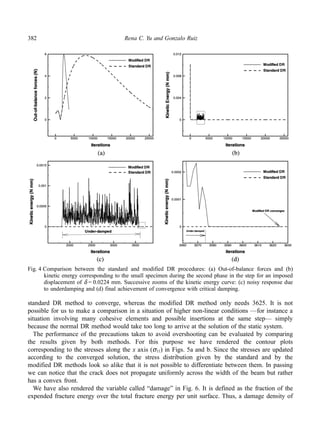
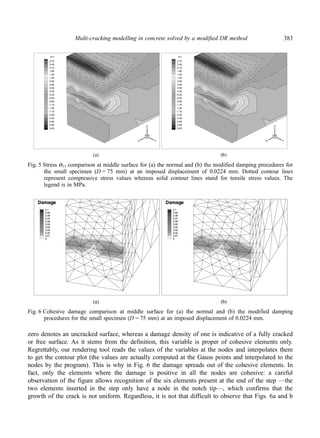
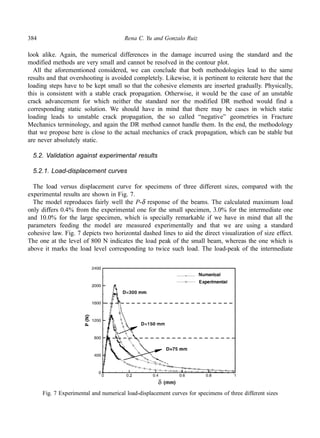

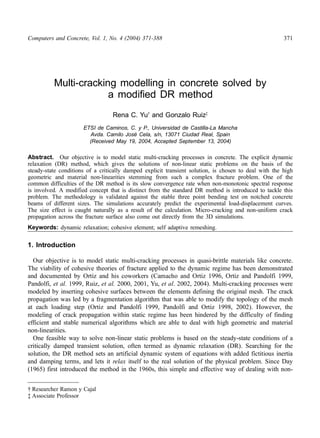
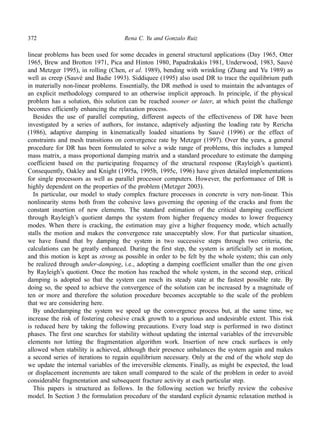
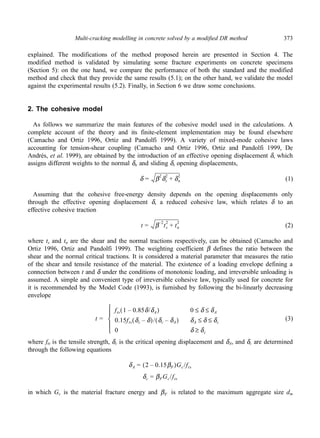
This document describes a modified dynamic relaxation (DR) method for modeling multi-cracking in concrete. The standard DR method solves nonlinear static problems by finding the steady-state of a simulated dynamic system, but can converge slowly for problems with non-monotonic responses, like cracking. The modified method introduces two-step damping - first under-damping to propagate motion through the system, then critical damping for fast convergence. It was validated on 3D simulations of concrete beam fracture tests, accurately predicting load-displacement curves and capturing size effects, micro-cracking and non-uniform crack propagation.


