IxDA Redux
   Ian Hooper
Social Innovation with Impact
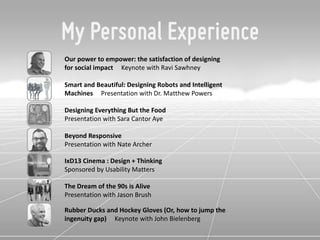
My Personal Experience
Our power to empower: the satisfaction of designing
for social impact Keynote with Ravi Sawhney

Smart and Beautiful: Designing Robots and Intelligent
Machines Presentation with Dr. Matthew Powers

Designing Everything But the Food
Presentation with Sara Cantor Aye

Beyond Responsive
Presentation with Nate Archer

IxD13 Cinema : Design + Thinking
Sponsored by Usability Matters

The Dream of the 90s is Alive
Presentation with Jason Brush

Rubber Ducks and Hockey Gloves (Or, how to jump the
ingenuity gap) Keynote with John Bielenberg
My Personal Experience
Our power to empower: the satisfaction of designing
for social impact Keynote with Ravi Sawhney

Smart and Beautiful: Designing Robots and Intelligent
Machines Presentation with Dr. Matthew Powers

Designing Everything But the Food
Presentation with Sara Cantor Aye

Beyond Responsive
Presentation with Nate Archer

IxD13 Cinema : Design + Thinking
Sponsored by Usability Matters

The Dream of the 90s is Alive
Presentation with Jason Brush

Rubber Ducks and Hockey Gloves (Or, how to jump the
ingenuity gap) Keynote with John Bielenberg
Am I at the right conference…?


     Our Power to Empower
      We can look outside of our world and see that
        many who have had great influences on our
          world, in fact while not labeled designers,
       designed and impacted society, business and
      our world. We too can be as influential as the
                           great minds in the world.
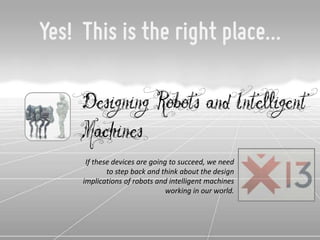
Yes! This is the right place…

    Designing Robots and Intelligent
    Machines
      If these devices are going to succeed, we need
             to step back and think about the design
     implications of robots and intelligent machines
                                working in our world.
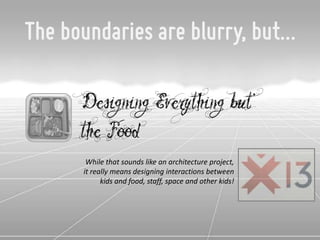
The boundaries are blurry, but…

      Designing Everything but
      the Food
       While that sounds like an architecture project,
      it really means designing interactions between
            kids and food, staff, space and other kids!
…things are coming into focus.


     Beyond Responsive
          The presentation aims to start a dialogue
      within the community and link web designers
              and more product oriented designers
        together, as their two worlds blur together
So sit back and relax!


 Design + Thinking
  Inspired by design thinking, this documentary
  grabs businessmen, designers, social change-
   makers and individuals to portray what they
  have in common when facing this ambiguous
                                    21st century.
That reminds me of something...

                       The Dream of the 90                                 s
                       is Alive
                          With the accelerated rate of change this era
                             ushered in, it’s easy not to look back, and
                         consider how we arrived where we are; we’re
                          too busy identifying the next trend, the next
                                            platform, the next big idea.


Read my full review of this presentation at dux.typepad.com
Be Bold. Make Stuff.

How to Jump the Ingenuity
Gap
    Humans have the capacity for developing
  ingenious solutions to these challenges and
  designers are well positioned to fill this gap
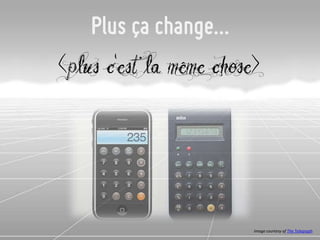
Plus ça change…
(plus c'est la même chose)


                         Image courtesy of The Telegraph
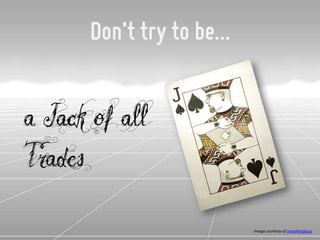
Don’t try to be…


a Jack of all
Trades

                          Image courtesy of smashingbuzz
And beware of the…

Race to the Bottom!

IxDA redux

  • 1.
    IxDA Redux Ian Hooper
  • 2.
  • 3.
  • 4.
    My Personal Experience Ourpower to empower: the satisfaction of designing for social impact Keynote with Ravi Sawhney Smart and Beautiful: Designing Robots and Intelligent Machines Presentation with Dr. Matthew Powers Designing Everything But the Food Presentation with Sara Cantor Aye Beyond Responsive Presentation with Nate Archer IxD13 Cinema : Design + Thinking Sponsored by Usability Matters The Dream of the 90s is Alive Presentation with Jason Brush Rubber Ducks and Hockey Gloves (Or, how to jump the ingenuity gap) Keynote with John Bielenberg
  • 5.
    My Personal Experience Ourpower to empower: the satisfaction of designing for social impact Keynote with Ravi Sawhney Smart and Beautiful: Designing Robots and Intelligent Machines Presentation with Dr. Matthew Powers Designing Everything But the Food Presentation with Sara Cantor Aye Beyond Responsive Presentation with Nate Archer IxD13 Cinema : Design + Thinking Sponsored by Usability Matters The Dream of the 90s is Alive Presentation with Jason Brush Rubber Ducks and Hockey Gloves (Or, how to jump the ingenuity gap) Keynote with John Bielenberg
  • 6.
    Am I atthe right conference…? Our Power to Empower We can look outside of our world and see that many who have had great influences on our world, in fact while not labeled designers, designed and impacted society, business and our world. We too can be as influential as the great minds in the world.
  • 7.
    Yes! This isthe right place… Designing Robots and Intelligent Machines If these devices are going to succeed, we need to step back and think about the design implications of robots and intelligent machines working in our world.
  • 8.
    The boundaries areblurry, but… Designing Everything but the Food While that sounds like an architecture project, it really means designing interactions between kids and food, staff, space and other kids!
  • 9.
    …things are cominginto focus. Beyond Responsive The presentation aims to start a dialogue within the community and link web designers and more product oriented designers together, as their two worlds blur together
  • 10.
    So sit backand relax! Design + Thinking Inspired by design thinking, this documentary grabs businessmen, designers, social change- makers and individuals to portray what they have in common when facing this ambiguous 21st century.
  • 11.
    That reminds meof something... The Dream of the 90 s is Alive With the accelerated rate of change this era ushered in, it’s easy not to look back, and consider how we arrived where we are; we’re too busy identifying the next trend, the next platform, the next big idea. Read my full review of this presentation at dux.typepad.com
  • 12.
    Be Bold. MakeStuff. How to Jump the Ingenuity Gap Humans have the capacity for developing ingenious solutions to these challenges and designers are well positioned to fill this gap
  • 13.
    Plus ça change… (plusc'est la même chose) Image courtesy of The Telegraph
  • 14.
    Don’t try tobe… a Jack of all Trades Image courtesy of smashingbuzz
  • 15.
    And beware ofthe… Race to the Bottom!

Editor's Notes

  • #2 Recap/Impressions from the 2013 IxDA conference
  • #3 Held in my hometown!
  • #4 I was not sure what “Social Innovation with Impact Meant”
  • #5 I went to a lot more talks, but these are the ones that resonated for me.
  • #6 Although some of my comments might seem critical, overall I really enjoyed the conference and I got a lot out of it.
  • #7 Our power to empower: the satisfaction of designing for social impactKeynote with Ravi SawhneyAs designers we have the unique ability to reach beyond the borders of our own talents and capabilities. We can look outside of our world and see that many who have had great influences on our world, in fact while not labeled designers, designed and impacted society, business and our world. We too can be as influential as the great minds in the world. Musicians saw that their music could change the world; now, we have been empowered to change the world for the better. Creating social impact is in fact one piece of a very large world that flows through our fingertips as we conceive and create not only new user experiences but in fact new, highly empowered users… everywhere.Ravi Sawhney evoked many great figures from history and today (John Lennon, Joseph Campbell, Mahatma Gandhi, etc.), showed some pithy quote and tried to draw a path from what they did to what we are doing. At one point he said “We need more John Lennons in design”, which at first I took to mean that he wanted more ‘rock star’ designers. What he actually meant was that people can use their celebrity as a tool for change. But what interaction designers do you know that have any celebrity outside of our own insular clique? In the end I was disappointed because our industry is not producing public figures with broad celebrity influence (like Lennon), or great thinkers who affect our world view (like Campbell) or great activists who effect change (like Gandhi). Sure individuals within our community might engage in such activism, but ultimately that role has nothing to do with the profession of Interaction Design. As it turns out, this inability to connect the dots to IxD was to be my major criticism of the entire conference.
  • #8 Smart and Beautiful: Designing Robots and Intelligent MachinesPresentation with Dr. Matthew PowersRobots have been imagined in popular science fiction for decades. These devices have always fascinated us and held great promise as a technology. Real robots have been a long time coming, and sometimes it seems like robots have gone the way of the flying car and the hoverboard. However, practical, useful robots are on the horizon and robotic technologies are already in some of the devices we use in our daily lives. If these devices are going to succeed, we need to step back and think about the design implications of robots and intelligent machines working in our world. Not only does this include considering the physical and interaction design, but also the robot’s impact on our social ecosystem. In doing so, we can help focus the engineering problem space and bring advanced technologies out of the lab and into the world.Fortunately for me, the disappointing keynote was followed by a strong presentation about robots. The part I liked about this presentation was his non-standard definition of what a robot is. He basically defined them as intelligent machines that engage in a process of sensing, planning, and acting. By that definition, the Nest smart thermostat is a robot. It senses the environment, makes a plan and then acts on the home HVAC system. He urged designers to stop thinking of robots as autonomous entities and to start thinking of them as intelligent tools. By using the word “tool” he explicitly invokes cooperation between robot and human. That level of cooperation could be defined in three ways:Human as Peer: the robot works and communicates with the human in a collaborative and assistive manner. The key to this kind of interaction is that it must reduce (or least not add to) the cognitive load of the humans. An example of this is the “Big Dog” robotic mule that follows verbal commands and simply follows soldiers like a donkey, carrying some of their load.Human as Supervisor: the robot can independently perform certain tasks, but goal selection or strategic decision-making is the human operator’s purview. E.g. Self-driving cars.Human as instructor: The robot can replicate a series of operations that has been described to them by a human instructor. The robot may be able to make safety-based decisions, but is not going to show any initiative or adaptive behavior. E.g. Baxter (the new generation of industrial robot).While I found this presentation to be very interesting, it felt more like something that would belong at an Industrial Design conference.
  • #9 Designing Everything But the FoodPresentation with Sara Cantor AyeThis year, in partnership with the SAIC, Greater Good Studio designed and built a new public school cafeteria. While that sounds like an architecture project, it really means designing interactions between kids and food, staff, space and other kids! The project shone a spotlight on how designers approach social problems differently than public policy folks. The community-driven research and design effort revealed new solutions including products, processes, structural elements and environmental elements. Further, it proved that designers can and should be tasked with creating new metrics for measuring their own success, and that all social innovation begins with local innovation.Although this presentation veered into the world of architecture and industrial design, it was such a great presentation I didn’t mind. The presentation included great images, video and graphics. The presenter was clear, articulate and enthusiastic. By using design methods, the team at Greater Good Studio went into a local school and improved their cafeteria. The interesting part was seeing how they originally had certain assumptions about what was wrong and what they needed to fix. However, after doing some stakeholder interviews and contextual inquiry (including strapping Go-cams to some 6 year old’s heads!) they found that they needed to re-frame the problem. Through a series of rather clever changes to how the food was presented and distributed, they managed to dramatically improve how well the kids ate their food. That in turn led to less food waste. It was an inspiring and interesting talk.
  • #10 Beyond ResponsivePresentation with Nate ArcherThe rise of mobile has forced everyone dealing with web experiences to think beyond the desktop format. But, if we have learned anything from the recent push to mobile, we need to anticipate the future sooner rather than later; not only the next wave of formats, but everything after that. This presentation will talk about why we have to adapt to creating more flexible interactions for the immediate future and the coming wave of connected devices. It will look at the practical lessons learned from today’s best practices in responsive web design and think about how we can evolve and expand these to better handle the implications of a growing internet of things. The presentation aims to start a dialogue within the community and link web designers and more product oriented designers together, as their two worlds blur togetherThis was an interesting presentation that started to touch upon the notion that seemed to be the continuous undercurrent of the conference – the idea that traditional interaction design is going to move beyond the screen and into a broader ecosystem of smart devices (which may have an online component) and many, many more screens of all sizes and contexts. The presentation was short, but made a pretty good attempt at outlining a new stance that is based on what he called “flexible interactions”. Flexible interactions are easily modified to respond to altered context; anticipating change, supporting user needs and extending experiences now and into the future. That means that they should be:ModifiableAnticipatoryIndependentand StructuredHe also stressed the need to understand the context of use such as device location, speed, motion, immediacy, sounds and visuals, behavior, intimacy, etc. As an example he mentioned Microsoft Research’s “Project Falcon”, which preloads 3 apps you will most likely use based on your location and past experiences
  • #11 IxD13 Cinema : Design + ThinkingSponsored by Usability MattersBrought to IxD13 by Usability Matters, "Design & Thinking" is a documentary exploring the idea of "design thinking"! How do we fully engage organizations to think about the changing landscape of business, culture and society? Inspired by design thinking, this documentary grabs businessmen, designers, social change-makers and individuals to portray what they have in common when facing this ambiguous 21st century. What is design thinking? How is it applied in business models? How are people changing the world with their own creative minds? It is a call to the conventional minds to change and collaborate.
  • #12 The Dream of the 90s is AlivePresentation with Jason BrushThe early 1990s — before the dot-com boom, and Mark Zuckerberg was still in grade school; before Steve Jobs’ return to Apple, and computers still had floppy drives — was a time ripe with the potential of the future. It was an era in which artists, filmmakers, authors, and philosophers were making the first forays into many of the applications of technology that drive global culture and communication today, twenty years later.With the accelerated rate of change this era ushered in, it’s easy not to look back, and consider how we arrived where we are; we’re too busy identifying the next trend, the next platform, the next big idea. This personal talk excavates key ideas and media from the 1990s, which we may have forgotten, that, twenty years ago, inspired a generation to embrace digital technology and invent the world we live in today, and investigates how the many of the dreams that drove the 1990s — whether we realize it or not — may be alive today still.This presentation felt like it was tailor-made for me. The 1990’s was the period of time that I really dove into technology. It was an exciting new discovery that was full of promise. A lot of the buzz at that time was hyperbolic and utopian. In retrospect I had often attributed this optimism to the selective filter of my age and grad student status. What this presentation showed me was that this attitude was not just an illusion of my own rose-colored glasses. Jason Brush showed a long string of examples that clearly showed that society as a whole was wearing those hopeful spectacles. His presentation started off with some context setting images and quotes that would have given someone who had not experiences the 90’s some idea of what the time was like. Germany was re-united after the fall of the Berlin wall, Nelson Mandela was free from prison, and the World Wide Web was born. It seemed like digital communication tools like email and the web were going to fuel a new age of better understanding and unity among people. He described this feeling as ‘Technological Vertigo’.
  • #13 Rubber Ducks and Hockey Gloves (Or, how to jump the ingenuity gap)Keynote with John BielenbergWalking across an empty room does not require ingenuity. But add bears, alligators and land mines and ingenuity will be required to get across safely. We live in an increasingly complex world where the bears, alligators and land mines are replaced with climate change, peak oil, and population growth to name a few.However, humans have the capacity for developing ingenious solutions to these challenges and designers are well positioned to fill this gap. How do you unlock the ingenuity that exists within people and organizations? Welcome to Future Blitz, the process of using rapid ingenuity to address your greatest challenges.John Bielenberg was a fun choice for the closing keynote. He talked passionately about his Project M initiative that is “designed to inspire and educate young designers, writers, photographers and filmmakers by proving that their work “especially their wrongest thinking” can have a positive and significant impact on the world”. He talked about how most people suffer from heuristic bias that leads people to always seek the most direct solution: from A to B. As a result, he advocates for what he calls the ‘Rapid Ingenuity Cycle’ which is stated as the following steps:Be BoldGet Out (of your workplace, community, comfort zone…)Think WrongMake StuffBet Small (i.e. solve small problems – it takes out some of the risk of failure)Fast Forward (i.e. iterate quickly)He then gave a number of case studies, including PieLab, Alabamboo Bikes and the FearLess Cottage. Each was an interesting case study of using design methodologies to come to unexpected solutions that were elegant, innovative and successful. And in keeping with the theme of the conference, it was all grounded in the ambition to effect positive social change. It was all presented in a fun and engaging way, but I couldn’t help but feel that persistent nag that we were overstepping what could be reasonably expected of our role. I was pleased that Bielenberg addressed this somewhat when he said that the important thing is to just do something positive and not worry about huge impact. Doing something is always better than doing nothing. 
  • #14 Industrial design was born out of the development of the new technologies, economic and social changes of the early industrial revolution. It came of age in the economic crucible of the Great Depression.Interaction design was born out of the development of the new technologies, economic and social changes of the information age. It came of age in the economic crucible of the Dot-com crash of 2000.Industrial design struggled to communicate value in the face of continuing pressure to lower costs. This race to the bottom forced more designers to take on engineering duties and further diluted their differentiated value. In many cases an industrial designer was little more than a junior engineer who focussed on case and packaging details. A much smaller number of consultancies were left to do work that involved more design.
  • #15 Being a Jack of Trades (whether it is being more of a business analyst or more of a developer), waters down other people’s perception of what we are and what we do. Jeroen van Geel says “we aren't going to change the world with this job. We may have an impact on a smaller scale, but we should stay realistic. All the examples that are being used to convince us of our worth—from Apple products to The People's Supermarket, Airbnb and Kickstarter—have been created by people who don't call themselves interaction designers.” (http://www.core77.com/blog/columns/jack_of_all_trades_master_of_none_danger_for_interaction_design_24429.asp )I think the same thing could be said of Industrial (product) Design. Was the iPod created by Jonathan Ive? In some sense, yes. But Sony and others had nice looking music players at the same time, and they did not succeed. Apple had the right business vision and software infrastructure to make the iPod part of a more compelling music ecosystem. And yet people understand the important role that industrial design played in the success of that product.As Interaction designers we need to be similarly clear about the role that we play in bringing a product to market. Yes, we need to have (sufficient) skills in development and strategy, but we should be clear in communicating to others that our CORE value is in our ability to synthesize, solve problems, innovate and create…or in short, to design.
  • #16 A corollary to the ‘jack of all trades’ advice is that if you think that you are going to add value by taking on more diverse skills, rather than stengthening your core capabilities, you get caught in a race to the (price) bottom. Why would a company hire a developer AND an interaction designer, when they can hire a developer that understands UX? This trend has dogged industrial design as tight margins has forced more designers to do technical engineering work or for more engineers to assume the responsibility of design decisions. This happens when people of unsure of what it is that designers ‘do’. Avoid the race to the bottom by honing your craft and making sure that you add value (and then telling people about it!).