PHARMACOKINETICS AND
PHARMACODYNAMICS OF
INTRAVENOUS ANESTHETICS
AGENTS
PRESENTER: Dr.SUCHETHA.S
MODERATOR: Dr.SAGAR.S.M
HEAD OF DEPT: Dr.ARUN KUMAR.A.
⦿PHARMACOKINETICS: the study of absorption,
distribution,metabolism and excretion of the
injected and inhaled drugs and their
metabolites.
⦿PHARMACODYNAMICS: study of the
responsiveness of the body to a drug and the
mechanism by which the effects occur.
⦿An induction agent is the one which causes
rapid reversible loss of consciousness.
FACTORS AFFECTING THE
INDUCTION DOSE
⦿Route of administration
⦿Age
⦿Lean body mass
⦿Low cardiac output states
⦿Hypoproteinemia
INDUCTION AGENTS
⦿PROPOFOL- ISOPROPYL PHENOL
⦿BARBITURATES(THIOPENTAL)
⦿KETAMINE- PHENCYCLIDINE
⦿ETOMIDATE-IMIDAZOLE
⦿BENZODIAZEPINES
MECHANISM OF ACTION
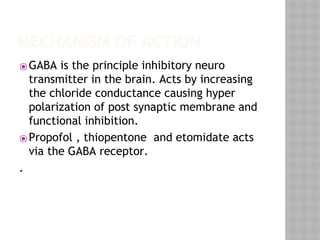
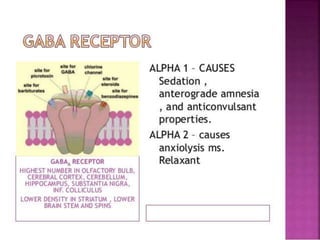
⦿GABA is the principle inhibitory neuro
transmitter in the brain. Acts by increasing
the chloride conductance causing hyper
polarization of post synaptic membrane and
functional inhibition.
⦿Propofol , thiopentone and etomidate acts
via the GABA receptor.
.
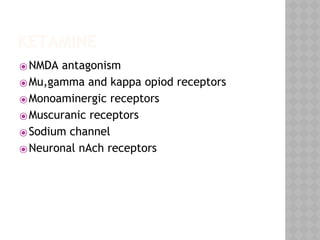
KETAMINE
⦿NMDA antagonism
⦿Mu,gamma and kappa opiod receptors
⦿Monoaminergic receptors
⦿Muscuranic receptors
⦿Sodium channel
⦿Neuronal nAch receptors
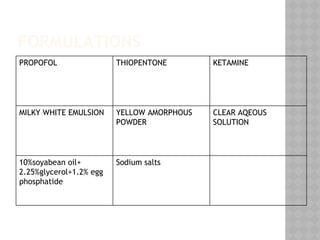
FORMULATIONS
PROPOFOL THIOPENTONE KETAMINE
MILKY WHITE EMULSION YELLOW AMORPHOUS
POWDER
CLEAR AQEOUS
SOLUTION
10%soyabean oil+
2.25%glycerol+1.2% egg
phosphatide
Sodium salts
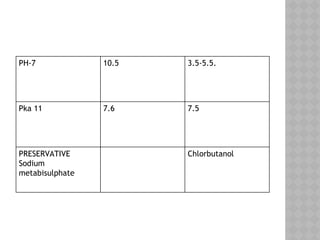
PH-7 10.5 3.5-5.5.
Pka 11 7.6 7.5
PRESERVATIVE
Sodium
metabisulphate
Chlorbutanol
METABOLISM
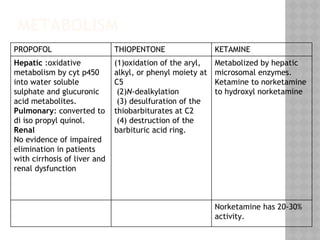
PROPOFOL THIOPENTONE KETAMINE
Hepatic :oxidative
metabolism by cyt p450
into water soluble
sulphate and glucuronic
acid metabolites.
Pulmonary: converted to
di iso propyl quinol.
Renal
No evidence of impaired
elimination in patients
with cirrhosis of liver and
renal dysfunction
(1)oxidation of the aryl,
alkyl, or phenyl moiety at
C5
(2)N-dealkylation
(3) desulfuration of the
thiobarbiturates at C2
(4) destruction of the
barbituric acid ring.
Metabolized by hepatic
microsomal enzymes.
Ketamine to norketamine
to hydroxyl norketamine
Norketamine has 20-30%
activity.
PHARMACOKINETICS
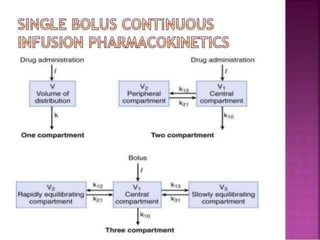
⦿volume of distribution: The theoretical
volume that would be necessary to contain
the total amount of an administered drug at
the same concentration that it is observed in
the blood plasma.
⦿ The volume of distribution is useful in
estimating the dose required to achieve a
given plasma concentration .
⦿Context-sensitive half-life or context
sensitive half-time is defined as the time
taken for blood plasma concentration of a
drug to decline by one half after an infusion
designed to maintain a steady state (i.e. a
constant plasma concentration) has been
stopped.
⦿The "context" is the duration of infusion.
( how long does the effects of the drugs last
after stopping the infusion)
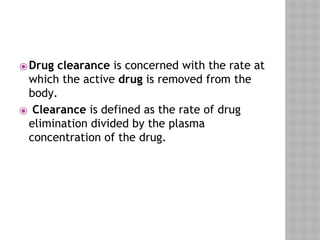
⦿Drug clearance is concerned with the rate at
which the active drug is removed from the
body.
⦿ Clearance is defined as the rate of drug
elimination divided by the plasma
concentration of the drug.
PHARMACOKINETICS
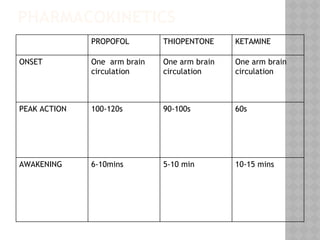
PROPOFOL THIOPENTONE KETAMINE
ONSET One arm brain
circulation
One arm brain
circulation
One arm brain
circulation
PEAK ACTION 100-120s 90-100s 60s
AWAKENING 6-10mins 5-10 min 10-15 mins
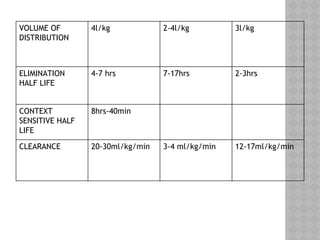
VOLUME OF
DISTRIBUTION
4l/kg 2-4l/kg 3l/kg
ELIMINATION
HALF LIFE
4-7 hrs 7-17hrs 2-3hrs
CONTEXT
SENSITIVE HALF
LIFE
8hrs-40min
CLEARANCE 20-30ml/kg/min 3-4 ml/kg/min 12-17ml/kg/min
PHARMACODYNAMICS
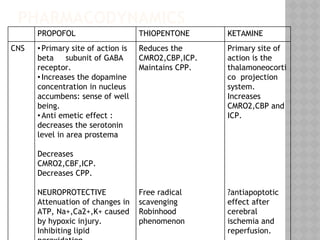
PROPOFOL THIOPENTONE KETAMINE
CNS •Primary site of action is
beta subunit of GABA
receptor.
•Increases the dopamine
concentration in nucleus
accumbens: sense of well
being.
•Anti emetic effect :
decreases the serotonin
level in area prostema
Decreases
CMRO2,CBF,ICP.
Decreases CPP.
NEUROPROTECTIVE
Attenuation of changes in
ATP, Na+,Ca2+,K+ caused
by hypoxic injury.
Inhibiting lipid
Reduces the
CMRO2,CBP,ICP.
Maintains CPP.
Free radical
scavenging
Robinhood
phenomenon
Primary site of
action is the
thalamoneocorti
co projection
system.
Increases
CMRO2,CBP and
ICP.
?antiapoptotic
effect after
cerebral
ischemia and
reperfusion.
KETAMINE
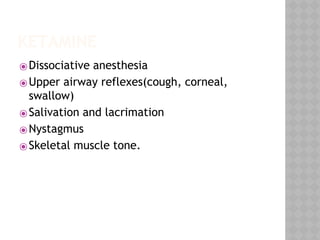
⦿Dissociative anesthesia
⦿Upper airway reflexes(cough, corneal,
swallow)
⦿Salivation and lacrimation
⦿Nystagmus
⦿Skeletal muscle tone.
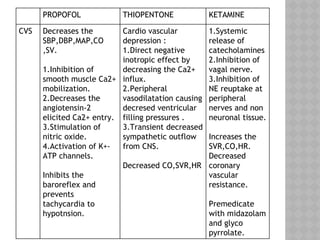
PROPOFOL THIOPENTONE KETAMINE
CVS Decreases the
SBP,DBP,MAP,CO
,SV.
1.Inhibition of
smooth muscle Ca2+
mobilization.
2.Decreases the
angiotensin-2
elicited Ca2+ entry.
3.Stimulation of
nitric oxide.
4.Activation of K+-
ATP channels.
Inhibits the
baroreflex and
prevents
tachycardia to
hypotnsion.
Cardio vascular
depression :
1.Direct negative
inotropic effect by
decreasing the Ca2+
influx.
2.Peripheral
vasodilatation causing
decresed ventricular
filling pressures .
3.Transient decreased
sympathetic outflow
from CNS.
Decreased CO,SVR,HR
1.Systemic
release of
catecholamines
2.Inhibition of
vagal nerve.
3.Inhibition of
NE reuptake at
peripheral
nerves and non
neuronal tissue.
Increases the
SVR,CO,HR.
Decreased
coronary
vascular
resistance.
Premedicate
with midazolam
and glyco
pyrrolate.
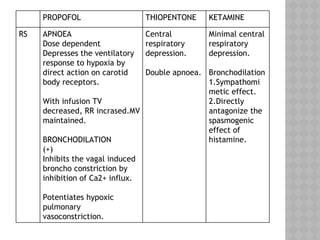
PROPOFOL THIOPENTONE KETAMINE
RS APNOEA
Dose dependent
Depresses the ventilatory
response to hypoxia by
direct action on carotid
body receptors.
With infusion TV
decreased, RR incrased.MV
maintained.
BRONCHODILATION
(+)
Inhibits the vagal induced
broncho constriction by
inhibition of Ca2+ influx.
Potentiates hypoxic
pulmonary
vasoconstriction.
Central
respiratory
depression.
Double apnoea.
Minimal central
respiratory
depression.
Bronchodilation
1.Sympathomi
metic effect.
2.Directly
antagonize the
spasmogenic
effect of
histamine.
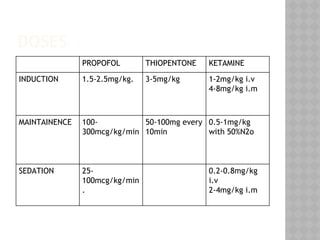
DOSES
PROPOFOL THIOPENTONE KETAMINE
INDUCTION 1.5-2.5mg/kg. 3-5mg/kg 1-2mg/kg i.v
4-8mg/kg i.m
MAINTAINENCE 100-
300mcg/kg/min
50-100mg every
10min
0.5-1mg/kg
with 50%N2o
SEDATION 25-
100mcg/kg/min
.
0.2-0.8mg/kg
i.v
2-4mg/kg i.m
PROPOFOL
⦿USES
⦿ANTIEMETIC
10mg i.v bolus followed by
10mcg/kg/min infusion.
⦿Used in chemotherapy induced and post
operative nausea vomiting.
⦿Inhibition of the sub cortical pathway.
⦿ANTIPRURITIC
⦿ANTICONVULSANT
⦿ATTENUATION OF BRONCHO CONSTRICTION
SIDE EFFECTS
⦿Allergic reactions.
⦿Abuse potential
⦿Bacterial growth
⦿Antioxidant properties.
⦿Pain on injection.
⦿Inhibits phagocytosis and killing of
Staphylococcus aureus and Escherichia coli.
PROPOFOL INFUSION SYNDROME
⦿ Infusion of propofol at 4 mg/kg/hour or more for
48 hours or longer.
⦿ Impaired fatty acid metabolism, such as
medium-chain acyl coenzyme A (MCAD)
deficiency and low carbohydrate supply.
⦿ The symptoms and signs are the result of muscle
injury and the release of intracellular toxic
contents.
⦿ Acute refractory bradycardia leading to asystole
in the presence of one or more of the following
⦿ Metabolic acidosis (base deficit >10 mmol/L),
⦿ Rhabdomyolysis,
⦿ Hyperlipidemia
⦿ Enlarged or fatty liver.
⦿ Cardiomyopathy with acute cardiac failure,
skeletal myopathy.
BARBITURATES
⦿USES
⦿Induction and
maintenance of
anaesthesia.
⦿Metho hexital –drug
of choice for electro
convulsive therapy
⦿Methohexital can be
used as a
premedication in
paediatrics.
⦿SIDE EFFECTS
⦿Allergic reaction
⦿Urticarial rash and
tissue necrosis
⦿Cough,hiccoughs,tre
mors
⦿Inducer of cytp450
KETAMINE
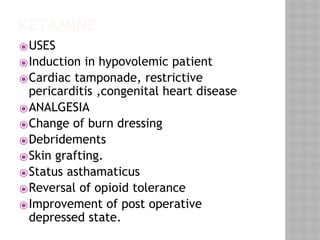
⦿USES
⦿Induction in hypovolemic patient
⦿Cardiac tamponade, restrictive
pericarditis ,congenital heart disease
⦿ANALGESIA
⦿Change of burn dressing
⦿Debridements
⦿Skin grafting.
⦿Status asthamaticus
⦿Reversal of opioid tolerance
⦿Improvement of post operative
depressed state.
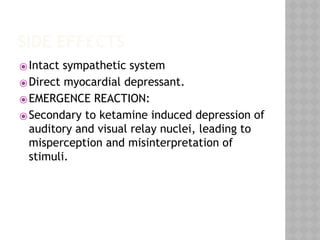
SIDE EFFECTS
⦿Intact sympathetic system
⦿Direct myocardial depressant.

⦿EMERGENCE REACTION:
⦿Secondary to ketamine induced depression of
auditory and visual relay nuclei, leading to
misperception and misinterpretation of
stimuli.
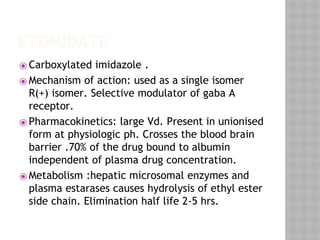
ETOMIDATE
⦿ Carboxylated imidazole .
⦿ Mechanism of action: used as a single isomer
R(+) isomer. Selective modulator of gaba A
receptor.
⦿ Pharmacokinetics: large Vd. Present in unionised
form at physiologic ph. Crosses the blood brain
barrier .70% of the drug bound to albumin
independent of plasma drug concentration.
⦿ Metabolism :hepatic microsomal enzymes and
plasma estarases causes hydrolysis of ethyl ester
side chain. Elimination half life 2-5 hrs.
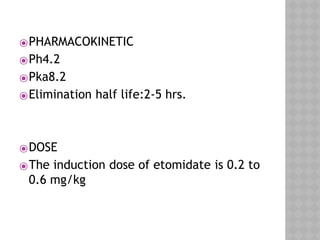
⦿PHARMACOKINETIC
⦿Ph4.2
⦿Pka8.2
⦿Elimination half life:2-5 hrs.
⦿DOSE
⦿The induction dose of etomidate is 0.2 to
0.6 mg/kg
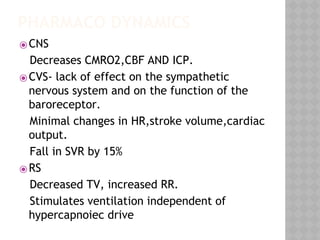
PHARMACO DYNAMICS
⦿CNS
Decreases CMRO2,CBF AND ICP.
⦿CVS- lack of effect on the sympathetic
nervous system and on the function of the
baroreceptor.
Minimal changes in HR,stroke volume,cardiac
output.
Fall in SVR by 15%
⦿RS
Decreased TV, increased RR.
Stimulates ventilation independent of
hypercapnoiec drive
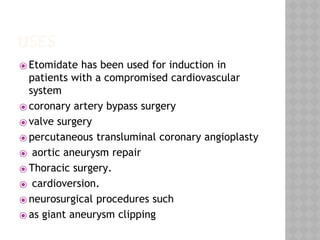
USES
⦿ Etomidate has been used for induction in
patients with a compromised cardiovascular
system
⦿ coronary artery bypass surgery
⦿ valve surgery
⦿ percutaneous transluminal coronary angioplasty
⦿ aortic aneurysm repair
⦿ Thoracic surgery.
⦿ cardioversion.
⦿ neurosurgical procedures such
⦿ as giant aneurysm clipping
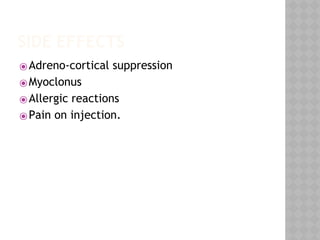
SIDE EFFECTS
⦿Adreno-cortical suppression
⦿Myoclonus
⦿Allergic reactions
⦿Pain on injection.
REFERNCES
⦿MILLER’S ANESTHESIA, 8th edition.
⦿STOELTING’S PHARMACOLOGY AND
PHYSIOLOGY IN ANESTHETIC PRACTICE, 5th
edition.
THANK YOU

INTRAVENOUS INDUCTION AGENTS.pptx

  • 1.
    PHARMACOKINETICS AND PHARMACODYNAMICS OF INTRAVENOUSANESTHETICS AGENTS PRESENTER: Dr.SUCHETHA.S MODERATOR: Dr.SAGAR.S.M HEAD OF DEPT: Dr.ARUN KUMAR.A.
  • 2.
    ⦿PHARMACOKINETICS: the studyof absorption, distribution,metabolism and excretion of the injected and inhaled drugs and their metabolites. ⦿PHARMACODYNAMICS: study of the responsiveness of the body to a drug and the mechanism by which the effects occur.
  • 3.
    ⦿An induction agentis the one which causes rapid reversible loss of consciousness.
  • 7.
    FACTORS AFFECTING THE INDUCTIONDOSE ⦿Route of administration ⦿Age ⦿Lean body mass ⦿Low cardiac output states ⦿Hypoproteinemia
  • 8.
    INDUCTION AGENTS ⦿PROPOFOL- ISOPROPYLPHENOL ⦿BARBITURATES(THIOPENTAL) ⦿KETAMINE- PHENCYCLIDINE ⦿ETOMIDATE-IMIDAZOLE ⦿BENZODIAZEPINES
  • 9.
    MECHANISM OF ACTION ⦿GABAis the principle inhibitory neuro transmitter in the brain. Acts by increasing the chloride conductance causing hyper polarization of post synaptic membrane and functional inhibition. ⦿Propofol , thiopentone and etomidate acts via the GABA receptor. .
  • 11.
    KETAMINE ⦿NMDA antagonism ⦿Mu,gamma andkappa opiod receptors ⦿Monoaminergic receptors ⦿Muscuranic receptors ⦿Sodium channel ⦿Neuronal nAch receptors
  • 12.
    FORMULATIONS PROPOFOL THIOPENTONE KETAMINE MILKYWHITE EMULSION YELLOW AMORPHOUS POWDER CLEAR AQEOUS SOLUTION 10%soyabean oil+ 2.25%glycerol+1.2% egg phosphatide Sodium salts
  • 13.
    PH-7 10.5 3.5-5.5. Pka11 7.6 7.5 PRESERVATIVE Sodium metabisulphate Chlorbutanol
  • 14.
    METABOLISM PROPOFOL THIOPENTONE KETAMINE Hepatic:oxidative metabolism by cyt p450 into water soluble sulphate and glucuronic acid metabolites. Pulmonary: converted to di iso propyl quinol. Renal No evidence of impaired elimination in patients with cirrhosis of liver and renal dysfunction (1)oxidation of the aryl, alkyl, or phenyl moiety at C5 (2)N-dealkylation (3) desulfuration of the thiobarbiturates at C2 (4) destruction of the barbituric acid ring. Metabolized by hepatic microsomal enzymes. Ketamine to norketamine to hydroxyl norketamine Norketamine has 20-30% activity.
  • 15.
    PHARMACOKINETICS ⦿volume of distribution:The theoretical volume that would be necessary to contain the total amount of an administered drug at the same concentration that it is observed in the blood plasma. ⦿ The volume of distribution is useful in estimating the dose required to achieve a given plasma concentration .
  • 16.
    ⦿Context-sensitive half-life orcontext sensitive half-time is defined as the time taken for blood plasma concentration of a drug to decline by one half after an infusion designed to maintain a steady state (i.e. a constant plasma concentration) has been stopped. ⦿The "context" is the duration of infusion. ( how long does the effects of the drugs last after stopping the infusion)
  • 17.
    ⦿Drug clearance isconcerned with the rate at which the active drug is removed from the body. ⦿ Clearance is defined as the rate of drug elimination divided by the plasma concentration of the drug.
  • 18.
    PHARMACOKINETICS PROPOFOL THIOPENTONE KETAMINE ONSETOne arm brain circulation One arm brain circulation One arm brain circulation PEAK ACTION 100-120s 90-100s 60s AWAKENING 6-10mins 5-10 min 10-15 mins
  • 19.
    VOLUME OF DISTRIBUTION 4l/kg 2-4l/kg3l/kg ELIMINATION HALF LIFE 4-7 hrs 7-17hrs 2-3hrs CONTEXT SENSITIVE HALF LIFE 8hrs-40min CLEARANCE 20-30ml/kg/min 3-4 ml/kg/min 12-17ml/kg/min
  • 20.
    PHARMACODYNAMICS PROPOFOL THIOPENTONE KETAMINE CNS•Primary site of action is beta subunit of GABA receptor. •Increases the dopamine concentration in nucleus accumbens: sense of well being. •Anti emetic effect : decreases the serotonin level in area prostema Decreases CMRO2,CBF,ICP. Decreases CPP. NEUROPROTECTIVE Attenuation of changes in ATP, Na+,Ca2+,K+ caused by hypoxic injury. Inhibiting lipid Reduces the CMRO2,CBP,ICP. Maintains CPP. Free radical scavenging Robinhood phenomenon Primary site of action is the thalamoneocorti co projection system. Increases CMRO2,CBP and ICP. ?antiapoptotic effect after cerebral ischemia and reperfusion.
  • 21.
    KETAMINE ⦿Dissociative anesthesia ⦿Upper airwayreflexes(cough, corneal, swallow) ⦿Salivation and lacrimation ⦿Nystagmus ⦿Skeletal muscle tone.
  • 22.
    PROPOFOL THIOPENTONE KETAMINE CVSDecreases the SBP,DBP,MAP,CO ,SV. 1.Inhibition of smooth muscle Ca2+ mobilization. 2.Decreases the angiotensin-2 elicited Ca2+ entry. 3.Stimulation of nitric oxide. 4.Activation of K+- ATP channels. Inhibits the baroreflex and prevents tachycardia to hypotnsion. Cardio vascular depression : 1.Direct negative inotropic effect by decreasing the Ca2+ influx. 2.Peripheral vasodilatation causing decresed ventricular filling pressures . 3.Transient decreased sympathetic outflow from CNS. Decreased CO,SVR,HR 1.Systemic release of catecholamines 2.Inhibition of vagal nerve. 3.Inhibition of NE reuptake at peripheral nerves and non neuronal tissue. Increases the SVR,CO,HR. Decreased coronary vascular resistance. Premedicate with midazolam and glyco pyrrolate.
  • 23.
    PROPOFOL THIOPENTONE KETAMINE RSAPNOEA Dose dependent Depresses the ventilatory response to hypoxia by direct action on carotid body receptors. With infusion TV decreased, RR incrased.MV maintained. BRONCHODILATION (+) Inhibits the vagal induced broncho constriction by inhibition of Ca2+ influx. Potentiates hypoxic pulmonary vasoconstriction. Central respiratory depression. Double apnoea. Minimal central respiratory depression. Bronchodilation 1.Sympathomi metic effect. 2.Directly antagonize the spasmogenic effect of histamine.
  • 24.
    DOSES PROPOFOL THIOPENTONE KETAMINE INDUCTION1.5-2.5mg/kg. 3-5mg/kg 1-2mg/kg i.v 4-8mg/kg i.m MAINTAINENCE 100- 300mcg/kg/min 50-100mg every 10min 0.5-1mg/kg with 50%N2o SEDATION 25- 100mcg/kg/min . 0.2-0.8mg/kg i.v 2-4mg/kg i.m
  • 25.
    PROPOFOL ⦿USES ⦿ANTIEMETIC 10mg i.v bolusfollowed by 10mcg/kg/min infusion. ⦿Used in chemotherapy induced and post operative nausea vomiting. ⦿Inhibition of the sub cortical pathway. ⦿ANTIPRURITIC ⦿ANTICONVULSANT ⦿ATTENUATION OF BRONCHO CONSTRICTION
  • 26.
    SIDE EFFECTS ⦿Allergic reactions. ⦿Abusepotential ⦿Bacterial growth ⦿Antioxidant properties. ⦿Pain on injection. ⦿Inhibits phagocytosis and killing of Staphylococcus aureus and Escherichia coli.
  • 27.
    PROPOFOL INFUSION SYNDROME ⦿Infusion of propofol at 4 mg/kg/hour or more for 48 hours or longer. ⦿ Impaired fatty acid metabolism, such as medium-chain acyl coenzyme A (MCAD) deficiency and low carbohydrate supply. ⦿ The symptoms and signs are the result of muscle injury and the release of intracellular toxic contents. ⦿ Acute refractory bradycardia leading to asystole in the presence of one or more of the following ⦿ Metabolic acidosis (base deficit >10 mmol/L), ⦿ Rhabdomyolysis, ⦿ Hyperlipidemia ⦿ Enlarged or fatty liver. ⦿ Cardiomyopathy with acute cardiac failure, skeletal myopathy.
  • 28.
    BARBITURATES ⦿USES ⦿Induction and maintenance of anaesthesia. ⦿Methohexital –drug of choice for electro convulsive therapy ⦿Methohexital can be used as a premedication in paediatrics. ⦿SIDE EFFECTS ⦿Allergic reaction ⦿Urticarial rash and tissue necrosis ⦿Cough,hiccoughs,tre mors ⦿Inducer of cytp450
  • 29.
    KETAMINE ⦿USES ⦿Induction in hypovolemicpatient ⦿Cardiac tamponade, restrictive pericarditis ,congenital heart disease ⦿ANALGESIA ⦿Change of burn dressing ⦿Debridements ⦿Skin grafting. ⦿Status asthamaticus ⦿Reversal of opioid tolerance ⦿Improvement of post operative depressed state.
  • 30.
    SIDE EFFECTS ⦿Intact sympatheticsystem ⦿Direct myocardial depressant. ⦿EMERGENCE REACTION: ⦿Secondary to ketamine induced depression of auditory and visual relay nuclei, leading to misperception and misinterpretation of stimuli.
  • 31.
    ETOMIDATE ⦿ Carboxylated imidazole. ⦿ Mechanism of action: used as a single isomer R(+) isomer. Selective modulator of gaba A receptor. ⦿ Pharmacokinetics: large Vd. Present in unionised form at physiologic ph. Crosses the blood brain barrier .70% of the drug bound to albumin independent of plasma drug concentration. ⦿ Metabolism :hepatic microsomal enzymes and plasma estarases causes hydrolysis of ethyl ester side chain. Elimination half life 2-5 hrs.
  • 32.
    ⦿PHARMACOKINETIC ⦿Ph4.2 ⦿Pka8.2 ⦿Elimination half life:2-5hrs. ⦿DOSE ⦿The induction dose of etomidate is 0.2 to 0.6 mg/kg
  • 33.
    PHARMACO DYNAMICS ⦿CNS Decreases CMRO2,CBFAND ICP. ⦿CVS- lack of effect on the sympathetic nervous system and on the function of the baroreceptor. Minimal changes in HR,stroke volume,cardiac output. Fall in SVR by 15% ⦿RS Decreased TV, increased RR. Stimulates ventilation independent of hypercapnoiec drive
  • 34.
    USES ⦿ Etomidate hasbeen used for induction in patients with a compromised cardiovascular system ⦿ coronary artery bypass surgery ⦿ valve surgery ⦿ percutaneous transluminal coronary angioplasty ⦿ aortic aneurysm repair ⦿ Thoracic surgery. ⦿ cardioversion. ⦿ neurosurgical procedures such ⦿ as giant aneurysm clipping
  • 35.
  • 36.
    REFERNCES ⦿MILLER’S ANESTHESIA, 8thedition. ⦿STOELTING’S PHARMACOLOGY AND PHYSIOLOGY IN ANESTHETIC PRACTICE, 5th edition.
  • 37.