Green–top Guideline No. 31
2nd Edition | February 2013
Minor revisions – January 2014
The Investigation and Management of
the Small–for–Gestational–Age Fetus
RCOG Green-top Guideline No. 31 2 of 34 © Royal College of Obstetricians and Gynaecologists
The Investigation and Management of the
Small–for–Gestational–Age Fetus
This is the second edition of this guideline. It replaces the first edition which was published in November
2002 under the same title.
Executive Summary of Recommendations
Risk factors for a SGA fetus/neonate
All women should be assessed at booking for risk factors for a SGA fetus/neonate to identify those who
require increased surveillance.
Women who have a major risk factor (Odds Ratio [OR] > 2.0) should be referred for serial ultrasound
measurement of fetal size and assessment of wellbeing with umbilical artery Doppler from 26–28
weeks of pregnancy (Appendix 1).
Women who have three or more minor risk factors should be referred for uterine artery Doppler at 20–24
weeks of gestation (Appendix 1).
Second trimester DS markers have limited predictive accuracy for delivery of a SGA neonate.
A low level (< 0.415 MoM) of the first trimester marker PAPP–A should be considered a major risk factor
for delivery of a SGA neonate.
In high risk populations uterine artery Doppler at 20–24 weeks of pregnancy has a moderate predictive
value for a severely SGA neonate.
In women with an abnormal uterine artery Doppler at 20–24 weeks of pregnancy, subsequent
normalisation of flow velocity indices is still associated with an increased risk of a SGA neonate.
Repeating uterine artery Doppler is therefore of limited value.
Women with an abnormal uterine artery Doppler at 20–24 weeks (defined as a pulsatility index [PI]
> 95th
centile) and/or notching should be referred for serial ultrasound measurement of fetal size and
assessment of wellbeing with umbilical artery Doppler commencing at 26–28 weeks of pregnancy.
Women with a normal uterine artery Doppler do not require serial measurement of fetal size and serial
assessment of wellbeing with umbilical artery Doppler unless they develop specific pregnancy
complications, for example antepartum haemorrhage or hypertension. However, they should be offered
a scan for fetal size and umbilical artery Doppler during the third trimester.
Serial ultrasound measurement of fetal size and assessment of wellbeing with umbilical artery Doppler
should be offered in cases of fetal echogenic bowel.
Abdominal palpation has limited accuracy for the prediction of a SGA neonate and thus should not be
routinely performed in this context.
Serial measurement of symphysis fundal height (SFH) is recommended at each antenatal appointment
from 24 weeks of pregnancy as this improves prediction of a SGA neonate.
B
P
P
P
P
B
A
C
P
C
C
B
© Royal College of Obstetricians and Gynaecologists3 of 34RCOG Green-top Guideline No. 31
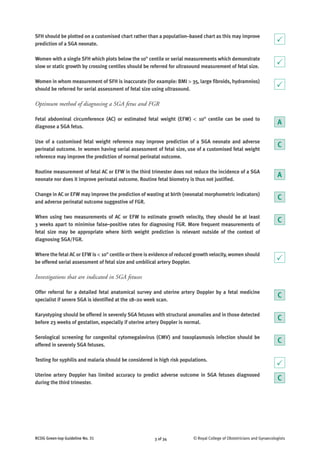
SFH should be plotted on a customised chart rather than a population–based chart as this may improve
prediction of a SGA neonate.
Women with a single SFH which plots below the 10th
centile or serial measurements which demonstrate
slow or static growth by crossing centiles should be referred for ultrasound measurement of fetal size.
Women in whom measurement of SFH is inaccurate (for example: BMI > 35, large fibroids, hydramnios)
should be referred for serial assessment of fetal size using ultrasound.
Optimum method of diagnosing a SGA fetus and FGR
Fetal abdominal circumference (AC) or estimated fetal weight (EFW) < 10th
centile can be used to
diagnose a SGA fetus.
Use of a customised fetal weight reference may improve prediction of a SGA neonate and adverse
perinatal outcome. In women having serial assessment of fetal size, use of a customised fetal weight
reference may improve the prediction of normal perinatal outcome.
Routine measurement of fetal AC or EFW in the third trimester does not reduce the incidence of a SGA
neonate nor does it improve perinatal outcome. Routine fetal biometry is thus not justified.
Change in AC or EFW may improve the prediction of wasting at birth (neonatal morphometric indicators)
and adverse perinatal outcome suggestive of FGR.
When using two measurements of AC or EFW to estimate growth velocity, they should be at least
3 weeks apart to minimise false–positive rates for diagnosing FGR. More frequent measurements of
fetal size may be appropriate where birth weight prediction is relevant outside of the context of
diagnosing SGA/FGR.
Where the fetal AC or EFW is < 10th
centile or there is evidence of reduced growth velocity, women should
be offered serial assessment of fetal size and umbilical artery Doppler.
Investigations that are indicated in SGA fetuses
Offer referral for a detailed fetal anatomical survey and uterine artery Doppler by a fetal medicine
specialist if severe SGA is identified at the 18–20 week scan.
Karyotyping should be offered in severely SGA fetuses with structural anomalies and in those detected
before 23 weeks of gestation, especially if uterine artery Doppler is normal.
Serological screening for congenital cytomegalovirus (CMV) and toxoplasmosis infection should be
offered in severely SGA fetuses.
Testing for syphilis and malaria should be considered in high risk populations.
Uterine artery Doppler has limited accuracy to predict adverse outcome in SGA fetuses diagnosed
during the third trimester.
A
C
C
P
P
A
P
P
C
P
C
C
C
C
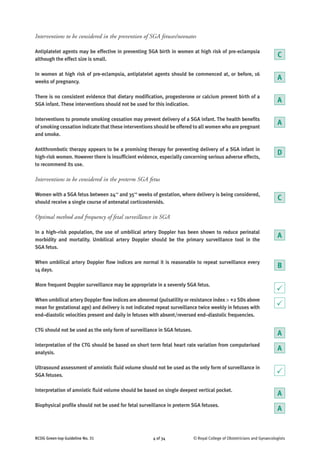
Interventions to be considered in the prevention of SGA fetuses/neonates
Antiplatelet agents may be effective in preventing SGA birth in women at high risk of pre-eclampsia
although the effect size is small.
In women at high risk of pre-eclampsia, antiplatelet agents should be commenced at, or before, 16
weeks of pregnancy.
There is no consistent evidence that dietary modification, progesterone or calcium prevent birth of a
SGA infant. These interventions should not be used for this indication.
Interventions to promote smoking cessation may prevent delivery of a SGA infant. The health benefits
of smoking cessation indicate that these interventions should be offered to all women who are pregnant
and smoke.
Antithrombotic therapy appears to be a promising therapy for preventing delivery of a SGA infant in
high-risk women. However there is insufficient evidence, especially concerning serious adverse effects,
to recommend its use.
Interventions to be considered in the preterm SGA fetus
Women with a SGA fetus between 24+0
and 35+6
weeks of gestation, where delivery is being considered,
should receive a single course of antenatal corticosteroids.
Optimal method and frequency of fetal surveillance in SGA
In a high–risk population, the use of umbilical artery Doppler has been shown to reduce perinatal
morbidity and mortality. Umbilical artery Doppler should be the primary surveillance tool in the
SGA fetus.
When umbilical artery Doppler flow indices are normal it is reasonable to repeat surveillance every
14 days.
More frequent Doppler surveillance may be appropriate in a severely SGA fetus.
When umbilical artery Doppler flow indices are abnormal (pulsatility or resistance index > +2 SDs above
mean for gestational age) and delivery is not indicated repeat surveillance twice weekly in fetuses with
end–diastolic velocities present and daily in fetuses with absent/reversed end–diastolic frequencies.
CTG should not be used as the only form of surveillance in SGA fetuses.
Interpretation of the CTG should be based on short term fetal heart rate variation from computerised
analysis.
Ultrasound assessment of amniotic fluid volume should not be used as the only form of surveillance in
SGA fetuses.
Interpretation of amniotic fluid volume should be based on single deepest vertical pocket.
Biophysical profile should not be used for fetal surveillance in preterm SGA fetuses.
RCOG Green-top Guideline No. 31 4 of 34 © Royal College of Obstetricians and Gynaecologists
B
C
C
P
A
A
D
A
A
P
A
P
A
A
A
5 of 34RCOG Green-top Guideline No. 31 © Royal College of Obstetricians and Gynaecologists
In the preterm SGA fetus, middle cerebral artery (MCA) Doppler has limited accuracy to predict
acidaemia and adverse outcome and should not be used to time delivery.
In the term SGA fetus with normal umbilical artery Doppler, an abnormal middle cerebral artery Doppler
(PI < 5th
centile) has moderate predictive value for acidosis at birth and should be used to time delivery.
Ductus venosus Doppler has moderate predictive value for acidaemia and adverse outcome.
Ductus venosus Doppler should be used for surveillance in the preterm SGA fetus with abnormal
umbilical artery Doppler and used to time delivery.
The optimal gestation to deliver the SGA fetus
In the preterm SGA fetus with umbilical artery AREDV detected prior to 32 weeks of gestation, delivery
is recommended when DV Doppler becomes abnormal or UV pulsations appear, provided the fetus is
considered viable and after completion of steroids. Even when venous Doppler is normal, delivery is
recommended by 32 weeks of gestation and should be considered between 30–32 weeks of gestation.
If MCA Doppler is abnormal, delivery should be recommended no later than 37 weeks of gestation.
In the SGA fetus detected after 32 weeks of gestation with an abnormal umbilical artery Doppler,
delivery no later than 37 weeks of gestation is recommended.
In the SGA fetus detected after 32 weeks of gestation with normal umbilical artery Doppler, a senior
obstetrician should be involved in determining the timing and mode of birth of these pregnancies.
Delivery should be offered at 37 weeks of gestation.
How the SGA fetus should be delivered
In the SGA fetus with umbilical artery AREDV delivery by caesarean section is recommended.
In the SGA fetus with normal umbilical artery Doppler or with abnormal umbilical artery PI but
end–diastolic velocities present, induction of labour can be offered but rates of emergency caesarean
section are increased and continuous fetal heart rate monitoring is recommended from the onset of
uterine contractions.
Early admission is recommended in women in spontaneous labour with a SGA fetus in order to instigate
continuous fetal heart rate monitoring.
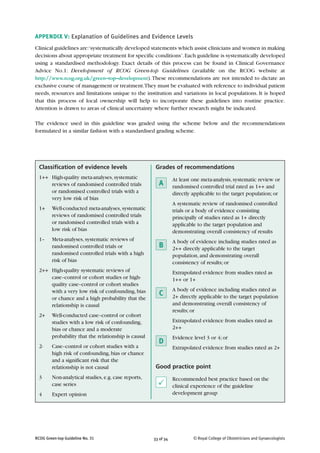
1. Purpose and scope
The purpose of this guideline is to provide advice that is based on the best evidence where available in order
to guide clinicians,regarding the investigation and management of the small–for–gestational age (SGA) fetus.
The guideline reviews the risk factors for a SGA fetus and provides recommendations regarding screening,
diagnosis and management, including fetal monitoring and delivery.
1.1 Population and setting
Unselected pregnant women in community settings.
High-risk women (calculated on the basis of past obstetric history, current medical disorders or ultrasound
diagnosis) in the hospital setting.
The guideline does not address multiple pregnancies or pregnancies with fetal abnormalities.
P
B
C
A
P
C
P
A
B
P
P
1.2. Interventions to be studied
Comparison of modalities to screen for and diagnose a SGA fetus.
Comparison of modalities to monitor a SGA fetus.
2. Definitions
Small–for–gestational age (SGA) refers to an infant born with a birth weight less than the 10th
centile.
Historically SGA birth has been defined using population centiles. But, the use of centiles customised for
maternal characteristics (maternal height, weight, parity and ethnic group) as well as gestational age at
delivery and infant sex, identifies small babies at higher risk of morbidity and mortality than those identified
by population centiles.1–2
With respect to the fetus, definitions of SGA birth and severe SGA vary. For the
purposes of this guideline, SGA birth is defined as an estimated fetal weight (EFW) or abdominal
circumference (AC) less than the 10th
centile and severe SGA as an EFW or AC less than the 3rd
centile.3
Other
definitions will be discussed where relevant.
Fetal growth restriction (FGR) is not synonymous with SGA. Some, but not all, growth restricted
fetuses/infants are SGA while 50–70% of SGA fetuses are constitutionally small,with fetal growth appropriate
for maternal size and ethnicity.4
The likelihood of FGR is higher in severe SGA infants. Growth restriction
implies a pathological restriction of the genetic growth potential.As a result, growth restricted fetuses may
manifest evidence of fetal compromise (abnormal Doppler studies,reduced liquor volume).Low birth weight
(LBW) refers to an infant with a birth weight < 2500 g.
As some of the definitions used in the published literature vary, or as in the case of FGR, can be used
inappropriately, further clarification is given where necessary throughout the guideline when referring to
the evidence.
3. Background
Small fetuses are divided into normal (constitutionally) small, non–placenta mediated growth restriction, for
example; structural or chromosomal anomaly, inborn errors of metabolism and fetal infection, and placenta
mediated growth restriction. Maternal factors can affect placental transfer of nutrients, for example; low
pre–pregnancy weight, under nutrition, substance abuse or severe anaemia. Medical conditions can affect
placental implantation and vasculature and hence transfer, for example; pre-eclampsia, autoimmune disease,
thrombophilias, renal disease, diabetes and essential hypertension.
As a group,structurally normal SGA fetuses are at increased risk of perinatal mortality and morbidity but most
adverse outcomes are concentrated in the growth restricted group.Several studies have shown that neonates
defined as SGA by population–based birthweight centiles but not customised centiles are not at increased risk
of perinatal morbidity or mortality.1,2,5
Clinical examination is a method of screening for fetal size, but is unreliable in detecting SGA fetuses.
Diagnosis of a SGA fetus usually relies on ultrasound measurement of fetal abdominal circumference or
estimation of fetal weight. Management of the SGA fetus is directed at timely delivery. A number of
surveillance tests are available, including cardiotocography, Doppler and ultrasound to assess biophysical
activity but there is controversy about which test or combination of tests should be used to time delivery,
especially in the fetus.
4. Identification and assessment of evidence
This guideline was developed in accordance with standard methodology for producing RCOG Green–top
Guidelines. Medline, Pubmed, all EBM reviews (Cochrane CRCT, Cochrane database of Systematic Reviews,
6 of 34RCOG Green-top Guideline No. 31 © Royal College of Obstetricians and Gynaecologists
RCOG Green-top Guideline No. 31 7 of 34 © Royal College of Obstetricians and Gynaecologists
methodology register, ACP journal club, DARE HTA, Maternity and Infant Care), EMBASE and TRIP were
searched for relevant randomised controlled trials (RCTs), systematic reviews, meta–analyses and cohort
studies.The search was restricted to articles published between 2002 and September 2011. Search words
included ‘fetal growth retardation’,‘fetal growth restriction’,‘infant, small for gestational age’, including all
relevant Medical Subject Heading (MeSH) terms.The search was limited to humans and the English language.
5. What are the risk factors for a SGA fetus/neonate? What is the optimum method of
screening for the SGA fetus/neonate and care of “at risk” pregnancies?
Methods employed in the first and second trimesters,to predict the likelihood of a SGA fetus/neonate include:
medical and obstetric history and examination, maternal serum screening and uterine artery Doppler.
Methods of screening for the SGA fetus/neonate in the second and third trimester are abdominal palpation
and measurement of symphysis fundal height (SFH) (including customised charts).
5.1 History
All women should be assessed at booking for risk factors for a SGA fetus/neonate to identify those who
require increased surveillance.
Women who have a major risk factor (Odds Ratio [OR] > 2.0) should be referred for serial ultrasound
measurement of fetal size and assessment of wellbeing with umbilical artery Doppler from 26–28
weeks of pregnancy (Appendix 1).
Women who have three or more minor risk factors should be referred for uterine artery Doppler at 20–24
weeks of gestation (Appendix 1).
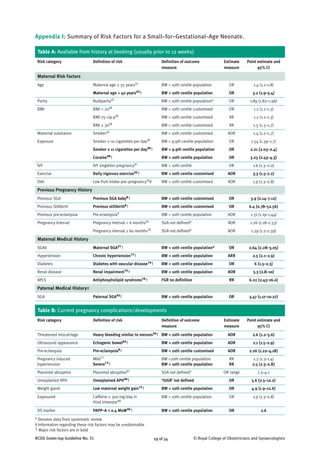
A table of risk factors and associated odds ratios (ORs) for the birth of a SGA neonate, where evidence is
consistent and not affected by adjustment for confounders, is presented in Appendix 1. It is acknowledged
that other risk factors may need to be considered on an individual basis.
Women that have previously had a SGA neonate have at least a twofold increased risk of a subsequent SGA
neonate.6–8
The risk is increased further after two SGA births.7
Classification of prior infant birthweight is best
done using customised centiles.1–2
This can be done using computer software that can be downloaded from the
internet.9
Women with a prior history of other placenta–mediated diseases are also at increased risk of a
subsequent SGA neonate.This includes prior pre-eclampsia8
and prior stillbirth,7
and in particular those with a
history of previous preterm unexplained stillbirth, due to the association with FGR.10
While termination of
pregnancy is not a risk factor for a SGA infant,11
the evidence regarding recurrent miscarriage is inconsistent.12,13
Maternal medical conditions associated with an increased risk of a SGA neonate are diabetes with vascular
disease,14
moderate and severe renal impairment (especially when associated with hypertension),15
antiphospholipid syndrome16
and chronic hypertension.17
Systemic lupus erythematosus18
and certain types
of congenital heart disease, in particular cyanotic congenital heart disease, are associated with increased
likelihood of a SGA neonate but there are no papers reporting ORs.19
The risk will therefore need to be
assessed on an individual basis.The evidence for an association with asthma, thyroid disease, inflammatory
bowel disease and depression is less convincing. Studies report a weak or non–significant association with
LBW but do not differentiate between the effect on SGA and preterm birth, and with confidence intervals
[CIs] often crossing one.Therefore, if uncomplicated and adequately treated, these are not considered to be
risk factors for a SGA fetus.20,21
Maternal risk factors associated with an increased risk of a SGA neonate are maternal age ≥ 35 years, with a
further increase in those ≥ 40 years old,22
African American23
or Indian/Asian ethnicity,2,24
nulliparity,25
social
deprivation,26
unmarried status,27
body mass index (BMI) < 20,28–30
BMI > 25,28,29
maternal SGA,31
daily vigorous
P
P
B
exercise,32
a short (< 6 months) or long (> 60 months) inter–pregnancy interval33
and heavy vaginal bleeding
during the first trimester.34
The effect of some of these risk factors is reduced once adjusted for other
associated factors and thus they are not included in Appendix 1. Maternal exposure to domestic violence
during pregnancy has been shown in a systematic review to be associated with low birth weight (Adjusted
OR [AOR] 1.53,95% CI 1.28–1.82).35
Low maternal weight gain has been shown to be associated with a SGA
infant in a preterm population (OR 4.9,95% CI 1.9–12.6)13
but it is no longer recommended that women are
routinely weighed during pregnancy.36
Several maternal exposures have a seemingly causative relationship with a SGA infant, including moderate
alcohol intake,37
drug use (with cocaine use during pregnancy being the most significant)38
and cigarette
smoking.39
The effects of smoking are dose dependent.29
Other risk factors are maternal caffeine consumption ≥ 300 mg per day in the third trimester40
and a low fruit
intake pre–pregnancy,while a high green leafy vegetable intake pre–pregnancy has been reported to be protective
(AOR 0.44,95% CI 0.24–0.81).32
Singleton pregnancies following IVF are also a risk factor for a SGA fetus.41
Changing paternity has been associated with an increased risk of a SGA infant,42
although a recent
systematic review demonstrated inconclusive evidence.43
A paternal history of SGA birth is a risk
factor for a SGA fetus.44
There is insufficient evidence to determine how risk factors relate to each other in the individual woman and
consequently how these risk factors should be managed.This includes abnormal maternal Down syndrome
serum markers (see below). Further evidence may become available from the SCOPE study.45
This guideline
has therefore categorized risk factors into major and minor based on published ORs for the birth of a SGA
neonate. Major risk factors (OR > 2.0) should prompt referral for serial ultrasound measurement of fetal size
and assessment of wellbeing with umbilical artery Doppler.The presence of multiple minor risk factors is
likely to constitute a significant risk for the birth of a SGA neonate and there is a rationale for further screening
using uterine artery Doppler at 20 weeks (see below).
5.2 Biochemical markers used for Down Syndrome (DS) Screening
Second trimester DS markers have limited predictive accuracy for delivery of a SGA neonate.
A low level (< 0.415 MoM) of the first trimester marker PAPP–A should be considered a major risk factor
for delivery of a SGA neonate.
Due to their placental origin, several biochemical markers have been investigated as screening tests for a
SGA fetus.
Two systematic reviews found low predictive accuracy for alpha fetoprotein (AFP) (> 2.5 MoM or
< 0.25 MoM),elevated hCG (> 3.0 MoM) and inhibinA (≥ 2.0 MoM),low unconjugated estriol (< 0.5
MoM) and the combined triple test to predict a SGA fetus.46,47
One review found methodological and
reporting limitations in all studies, resulting in great heterogeneity, concluding that serum markers
were only useful as a means of contributing to the overall assessment of risk for a pregnancy.47
In women with elevatedAFP,there is no evidence that increased fetal surveillance has any benefit.48
Similarly, there is a lack of evidence for the use of aspirin in women with raised hCG.49
In a large series of 49801 women at 11+
0 to 13+6
weeks, low PAPP–A (but not beta HCG) was inversely
associated with risk of being SGA. Using a 5th
centile (0.415 MoM) cut off, ORs for A SGA infant (birthweight
< 10th
centile) and severe SGA (birthweight < 3rd
centile) were 2.7 and 3.66 respectively.50
A systematic review
8 of 34RCOG Green-top Guideline No. 31 © Royal College of Obstetricians and Gynaecologists
Evidence
level 3
P
B
Evidence
level 3
Evidence
level
1+/2+
RCOG Green-top Guideline No. 31 9 of 34 © Royal College of Obstetricians and Gynaecologists
found that an unexplained low first trimester PAPP–A (< 0.4 MoM) and/or a low hCG (< 0.5 MoM) were
associated with an increased frequency of adverse obstetrical outcome including a SGA infant.47
There is some evidence that addition of fetal size at 18–20 weeks of gestation or fetal growth
between 11–14 and 18–20 weeks of gestation to first trimester serum markers improves prediction
of a SGA infant.51,52
However,different ultrasound parameters have been used and it is unclear what
combination provides optimum prediction.
5.3 Uterine artery Doppler
In high risk populations uterine artery Doppler at 20–24 weeks of pregnancy has a moderate predictive
value for a severely SGA neonate.
In women with an abnormal uterine artery Doppler at 20–24 weeks of pregnancy, subsequent
normalisation of flow velocity indices is still associated with an increased risk of a SGA neonate.
Repeating uterine artery Doppler is therefore of limited value.
Women with an abnormal uterine artery Doppler at 20–24 weeks (defined as a pulsatility index [PI]
> 95th
centile) and/or notching should be referred for serial ultrasound measurement of fetal size and
assessment of wellbeing with umbilical artery Doppler commencing at 26–28 weeks of pregnancy.
Women with a normal uterine artery Doppler do not require serial measurement of fetal size and serial
assessment of wellbeing with umbilical artery Doppler unless they develop specific pregnancy
complications, for example antepartum haemorrhage or hypertension. However, they should be offered
a scan for fetal size and umbilical artery Doppler during the third trimester.
SGA birth, particularly when severe (birth weight < 3rd
centile) or necessitating delivery < 36 weeks of gestation,
is characterised by failure of trophoblast invasion of the myometrial uterine spiral arteries and reduced
uteroplacental blood flow. Non–pregnant and first trimester artery blood flow velocity waveforms are associated
with low end–diastolic velocities and an early diastolic notch.Persistent notching or abnormal flow velocity ratios
after 24 weeks of gestation are associated with inadequate trophoblast invasion of the myometrial spiral arteries.53
However reduced endovascular trophoblast invasion of decidual spiral arteries has been associated with the same
waveform abnormalities as early as 10–14 weeks of pregnancy.54
A systematic review and meta–analysis summarised the results from 61 studies testing 41131 pregnant women
with uterine artery Doppler (in both first and second trimesters) and assessed the value of different Doppler
flow velocity indices.55
SGA birth in low risk patients was best predicted by an increased pulsatility index (PI)
(defined as > 95th
centile) with diastolic notching (positive likelihood ratio [LR+] 9.1,95% CI 5.0–16.7;negative
likelihood ratio [LR–] 0.89, 95% CI 0.85–0.93). Severe SGA (birthweight < 5th
or < 3rd
centile) in low risk
populations was best predicted in the second trimester by an increased PI (LR+ 13.7, 95% CI 10.3–16.9; LR–
0.34, 95% CI 0.23–0.48) or an increased PI with notching (LR+ 14.6, 95% CI 7.8–26.3; LR– 0.78, 95% CI
0.68–0.87). Uterine artery Doppler to predict a SGA infant in high risk populations overall showed low
predictive characteristics;an increased PI or notching in the second trimester best predicted a SGA infant (LR+
3.6, 95% CI 2.0–5.1; LR– 0.40, 95% CI 0.14–0.65). Prediction of severe SGA showed moderate utility with the
best prediction by a resistance index (> 0.58 or > 90th
centile) and notching in the second trimester (LR+ 10.9,
95% CI 10.4–11.4;LR– 0.20,95% CI 0.14–0.26).Although first trimester uterine artery Doppler studies suggest
a high specificity (91–96%) and high negative predictive values (91–99%), the low sensitivity (12–25%) for a
SGA neonate suggest early screening cannot be recommended on current evidence.55
There were three studies included in this review that looked at prediction of early onset SGA, all
of which were in low risk/unselected populations.55
Increased PI in the second trimester has been
shown to be predictive of delivery of a SGA fetus < 34 weeks in two studies (LR+ 13.7, 95% CI
P
P
Evidence
level 2+
A
C
Evidence
level 1
RCOG Green-top Guideline No. 31 10 of 34 © Royal College of Obstetricians and Gynaecologists
11.3–16.7;LR– 0.37,95% CI 0.27–0.52) and < 32 weeks in one study (LR+ 14.6,95% CI 11.5–18.7;
LR– 0.31 0.18–0.53).
In approximately 60% of cases with abnormal uterine artery Doppler at 20–22 weeks of gestation, PI remains
increased at 26–28 weeks.56
This group had the highest risk of a SGA infant (32%) compared to control women
with normal Doppler at 20–22 weeks of gestation (1%).However,even when uterine artery PI normalised by 26–28
weeks of gestation,the incidence of a SGA infant was higher than in controls (9.5%).Thus at present the evidence
suggests that repeating uterine artery Doppler later in the second trimester appears to be of limited value.
A systematic review assessing the effects on pregnancy outcome of routine utero–placental
Doppler ultrasound in the second trimester showed no benefit to mother or baby. However this
review included only two studies involving 4993 participants and women were all low risk for
hypertensive disorders.57
The combination of uterine artery Doppler and maternal serum markers has been shown in
case–control and cohort studies to have an improved predictive ability for the SGA neonate, although
predictive values are still poor.58–60
Use of combination testing in the second trimester appears to predict
adverse outcome related to placental insufficiency more effectively than first trimester screening.61
The developers’interpretation of the evidence relating to uterine artery Doppler screening is that the LR– is
insufficient to negate the risk associated with a major risk factor for a SGA neonate.In these women we would
not recommend uterine artery Doppler,as it would not change care.They should be offered serial assessment
of fetal size and umbilical artery Doppler from 26–28 weeks of pregnancy. For women with multiple minor
risk factors,the developers consider there to be value in uterine artery Doppler screening at 20–24 weeks of
pregnancy, with the institution of serial assessment of fetal size and umbilical artery Doppler from 26–28
weeks of pregnancy in those with an abnormal result,given the LR+.In those with a normal result there may
still be value in a single assessment of fetal size and umbilical artery Doppler during the third trimester.
5.4 Fetal echogenic bowel
Serial ultrasound measurement of fetal size and assessment of wellbeing with umbilical artery Doppler
should be offered in cases of fetal echogenic bowel.
Fetal echogenic bowel has been shown to be independently associated with a SGA neonate (AOR 2.1,95% CI
1.5–2.9) and fetal demise (AOR 9.6,95% CI 5.8–15.9).62
Serial measurements of fetal size and umbilical artery
Doppler is indicated following confirmation of echogenic bowel.
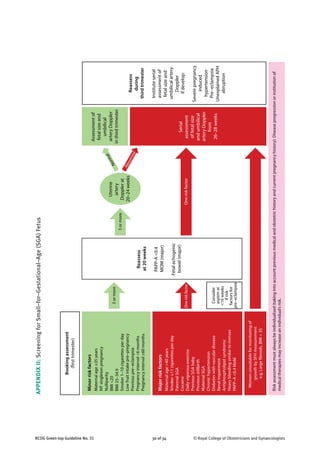
An algorithm to assist in the screening of the SGA fetus is provided in Appendix 2.Risk should be assessed at
booking and then reassessed at 20–24 weeks in the light of additional screening information, for example;
Down syndrome markers,18–20 week fetal anomaly scan.Several pregnancy complications (pre-eclampsia,7,17
pregnancy–induced hypertension,17
unexplained antepartum haemorrhage46
and abruption63
) increase the
risk of a SGA neonate and are indications for serial assessment of fetal size and umbilical artery Doppler.
5.5 Clinical examination
Abdominal palpation has limited accuracy for the prediction of a SGA neonate and thus should not be
routinely performed in this context.
Serial measurement of symphysis fundal height (SFH) is recommended at each antenatal appointment
from 24 weeks of pregnancy as this improves prediction of a SGA neonate.
SFH should be plotted on a customised chart rather than a population–based chart as this may improve
prediction of a SGA neonate.
Evidence
level 1
Evidence
level 1++
Evidence
level 2+
C
B
C
P
11 of 34RCOG Green-top Guideline No. 31 © Royal College of Obstetricians and Gynaecologists
Women with a single SFH which plots below the 10th
centile or serial measurements which demonstrate
slow or static growth by crossing centiles should be referred for ultrasound measurement of fetal size.
Women in whom measurement of SFH is inaccurate (for example: BMI > 35, large fibroids, hydramnios)
should be referred for serial assessment of fetal size using ultrasound.
Cohort and case–control studies performed in low risk populations have consistently shown
abdominal palpation to be of limited accuracy in the detection of a SGA neonate (sensitivity
19–21%, specificity 98%) and severely SGA neonate (< 2.3rd
centile, sensitivity 28%).65,66
In mixed
risk populations, the sensitivity increases to 32–44%.67,68
In high risk populations sensitivity is
reported as 37% for a SGA neonate and 53% for severe SGA.65
SFH should be measured from the fundus (variable point) to the symphysis pubis (fixed point) with the cm
values hidden from the examiner.68
Measurements should be plotted on a customised centile chart (see
below). Women with a single SFH which plots below the 10th
centile or serial measurements which
demonstrate slow or static growth (i.e. they cross centiles in a downward direction) should be referred for
further investigation (Appendix 3).There is no evidence to determine the number of centiles to be crossed
to prompt referral.
A recent systematic review of five studies highlighted the wide variation of predictive accuracy of
SFH measurement for a SGA infant.69
Although early studies reported sensitivities of 56–86% and
specificities of 80–93% for SFH detection of a SGA neonate,70–72
a large study of 2941 women
reported SFH to be less predictive with a sensitivity of 27% and specificity of 88% (LR+ 2.22, 95%
CI 1.77–2.78; LR– 0.83, 95% CI 0.77–0.90).73
Maternal obesity, abnormal fetal lie, large fibroids,
hydramnios and fetal head engagement contribute to the limited predictive accuracy of SFH
measurement. SFH is associated with significant intra– and inter–observer variation69,74
and serial
measurement may improve predictive accuracy.75
The impact on perinatal outcome of measuring SFH is uncertain.A systematic review found only one trial with
1639 women which showed that SFH measurement did not improve any of the perinatal outcomes measured.76
A customised SFH chart is adjusted for maternal characteristics (maternal height,weight,parity and ethnic group).
Calculation of customised centiles requires computer software that can be downloaded from the Internet.9
No trials were identified that compared customised with non–customised SFH charts and thus
evidence for their effectiveness on outcomes such as perinatal morbidity/mortality is lacking.
However observational studies suggest that customised SFH charts may improve the detection of a
SGA neonate.In one study,use of customised charts,with referral when a single SFH measurement
fell below the 10th
centile or the last two measurements were above 10th
centile but the slope was
flatter than the 10th
centile line,resulted in improved sensitivity for a SGA neonate (48% versus 29%,
OR 2.2, 95% CI 1.1–4.5) compared to abdominal palpation.77
Use of customised charts was also
associated with fewer referrals for investigation and fewer admissions. An audit from the West
Midlands also showed that use of customised SFH charts detected 36% of SGA neonates compared
with only 16% when customised charts were not used.78
6. What is the optimum method of diagnosing a SGA fetus and FGR?
Fetal abdominal circumference (AC) or estimated fetal weight (EFW) < 10th
centile can be used to
diagnose a SGA fetus.
P
Evidence
level 2++
Evidence
level 3
P
Evidence
level 2+
A
Use of a customised fetal weight reference may improve prediction of a SGA neonate and adverse
perinatal outcome. In women having serial assessment of fetal size, use of a customised fetal weight
reference may improve the prediction of normal perinatal outcome.
Routine measurement of fetal AC or EFW in the third trimester does not reduce the incidence of a SGA
neonate nor does it improve perinatal outcome. Routine fetal biometry is thus not justified.
Change in AC or EFW may improve the prediction of wasting at birth (neonatal morphometric indicators)
and adverse perinatal outcome suggestive of FGR.
When using two measurements of AC or EFW to estimate growth velocity, they should be at least
3 weeks apart to minimise false–positive rates for diagnosing FGR. More frequent measurements of
fetal size may be appropriate where birth weight prediction is relevant outside of the context of
diagnosing SGA/FGR.
Where the fetal AC or EFW is < 10th
centile or there is evidence of reduced growth velocity, women should
be offered serial assessment of fetal size and umbilical artery Doppler (see Section 7).
6.1 Ultrasound biometry
Two systematic reviews have assessed the accuracy of ultrasound biometric measures, both as individual
measures, as ratios, and combined (as the EFW).3,79
Use of the 10th
centile had better sensitivities and
specificities than other commonly used centiles.66
In a low risk population sensitivity varies from 0–10% and
specificity 66–99% for any parameter. In a high risk population, fetal AC < 10th
centile had sensitivity ranging
from 72.9–94.5% and specificity 50.6–83.8%.For EFW < 10th
centile,sensitivity was 33.3–89.2% and specificity
53.7–90.9%.3,79
Meta–analysis was not performed in these systematic reviews due to the considerable clinical
and methodological heterogeneity within the included papers. The potential advantage of EFW is that
customised standards exist and accuracy can more easily be determined against birthweight.
A retrospective study has shown that among high risk patients, EFW and AC < 10th
centile within
21 days of delivery better predicted a SGA infant than AC < 10th
centile (80% versus 49%,OR 4.26,
95% CI 1.94–9.16).80
Adverse perinatal outcome was also highest when both measures were
< 10th
centile.80
Kayem et al.81
found that measurement of AC in low risk women at term was a
better predictor of birth weight ≤ 2.5 kg than a single measurement of SFH (LR+ 9.9 versus 7.1,
LR– 0.5 versus 0.6).
Several studies have compared various formulae for estimating fetal weight in unselected patients.
A prospective study compared 35 different formulae and found that most are relatively accurate at
predicting birth weight up to 3500 g.82
Another study found the Shepard andAoki formulae to have
the best intraclass correlation coefficient, with EFW showing the smallest mean difference from
actual birth weight.83
Although formulae have been developed for SGA fetuses, there is little
evidence that accurate prediction of weight is substantially improved84,85
and in this population the
Hadlock formula86
may be most appropriate to use.
There is no evidence to recommend one specific method of measuring AC (directly or derived from
abdominal diameters) nor which centile chart to use.The centile charts produced by Chitty et al.87
were
optimally constructed and are widely used.
The same maternal characteristics (maternal height, weight, parity and ethnic group) that affect
birth weight affect fetal biometric measures and fetal weight gain,88,89
providing a rationale for the
use of a customised AC or EFW chart.9
A customised EFW < 10th
centile is predictive of a SGA
neonate (sensitivity 68%, specificity 89%).90
Use of customised fetal weight centiles to define SGA
RCOG Green-top Guideline No. 31 12 of 34 © Royal College of Obstetricians and Gynaecologists
A
C
C
C
P
Evidence
level 2++
Evidence
level 2–
Evidence
level 3
has also been shown to improve the prediction of adverse prenatal outcome;90,91
OR of adverse
outcomes (stillbirths, neonatal deaths, referral to higher level or special care unit or Apgar score <
7 at 5 minutes) for SGA neonates versus those not SGA was 1.59 (95% CI 1.53–1.66) for the
non–customised fetal weight reference compared with 2.84 (95% CI 2.71–2.99) for the customised
reference.90
Prediction of perinatal mortality was also improved by the customised reference (OR
3.65, 95% CI 3.40–3.92 versus OR 1.77, 95% CI 1.65–1.89).91
A further study demonstrated that
individual growth trajectories of low risk fetuses with normal outcome were less likely to cross
below the 10th
centile for fetal weight when using customised reference standards than when
unadjusted standards were used.92
However, no trials were identified that compared customised
with non–customised EFW chartsp.
A meta–analysis, including eight trials comprising 27024 women, found no evidence that routine
fetal biometry (with or without assessment of amniotic fluid volume and placental grade) after
24 weeks of pregnancy improved perinatal outcome in a low risk population (SGA neonate relative
risk [RR] 0.98, 95% CI 0.74–1.28; perinatal mortality RR 0.94, 95% CI 0.55–1.61).93
The timing and
content of the ultrasound scan varied substantially between studies and the authors noted high
heterogeneity between studies in the reduction of the risk of a SGA neonate, mainly due to the
findings of one study in which routine estimation of fetal weight, amniotic fluid volume and
placental grading at 30–32 and 36–37 weeks of gestation was shown to result in the birth of fewer
SGA neonates (10.4% versus 6.9%, RR 0.67, 95% CI 0.50–0.89).94
The change in fetal size between two time points is a direct measure of fetal growth and hence
serial measurement of AC or EFW (growth velocities) should allow the diagnosis of FGR.However
the optimal method of using serial ultrasound measurements is not clear.Although ‘eyeballing’ a
chart of individual AC or EFW measurements may give an impression of FGR a more objective
definition requires establishment of growth rate standards from longitudinally collected data.
Several standards have been reported,95,96
including conditional centiles for fetal growth,97
although
none has been adopted in clinical practice. Reported mean growth rates for AC and EFW after
30 weeks of gestation are 10 mm/14 days and 200 g/14 days although greater variation exists in the
lower limits (reflecting the methods used to derive the standard deviation [SD]).98
However a
change in AC of < 5mm over 14 days is suggestive of FGR.95
In a high risk population, identified as
being SGA,Chang et al.99,100
showed that a change inAC or EFW (defined as a change in SD score of
≥ –1.5) were better predictors of wasting at birth (ponderal index, mid–arm circumference/head
circumference ratio or subscapular skinfold thickness < 2 SD below mean) and adverse perinatal
outcome than the final AC or EFW before delivery.
Mongelli et al.101
used a mathematical model to estimate the impact of time interval between
examinations on the false positive rates for FGR (defined as no apparent growth in fetalAC between
two consecutive examinations).When the initial scan was performed at 32 weeks of gestation,the
false positive rates were 30.8%,16.9%,8.1% and 3.2% for intervals of 1,2,3 and 4 weeks respectively.
False positive rates were higher when the first scan was performed at 36 weeks of gestation (34.4%,
22.1%,12.7%,6.9% respectively).These findings suggest that if two measurements are to be used to
estimate velocity, they should be a minimum of 3 weeks apart to minimise false–positive rates for
diagnosing FGR.This recommendation does not preclude more frequent ultrasound measurements
of AC/EFW to predict fetal size at birth but rather indicates which measurements should be used
to interpret growth.
6.2 Biophysical tests
Biophysical tests,including amniotic fluid volume,cardiotocography (CTG) and biophysical scoring are poor
at diagnosing a small or growth restricted fetus.102–104
A systematic review of the accuracy of umbilical artery
13 of 34RCOG Green-top Guideline No. 31 © Royal College of Obstetricians and Gynaecologists
Evidence
level 3
Evidence
level 1+
Evidence
level 2+
Evidence
level 3
Doppler in a high–risk population to diagnose a SGA neonate has shown moderate accuracy (LR+ 3.76, 95%
CI 2.96–4.76; LR– 0.52, 95% CI 0.45–0.61).105
7. What investigations are indicated in SGA fetuses?
Offer a referral for a detailed fetal anatomical survey and uterine artery Doppler by a fetal medicine
specialist if severe SGA is identified at the 18–20 week scan.
Karyotyping should be offered in severely SGA fetuses with structural anomalies and in those detected
before 23 weeks of gestation, especially if uterine artery Doppler is normal.
Serological screening for congenital cytomegalovirus (CMV) and toxoplasmosis infection should be
offered in severe SGA.
Testing for syphilis and malaria should be considered in high risk populations.
Uterine artery Doppler has limited accuracy to predict adverse outcome in SGA fetuses diagnosed
during the third trimester.
In severe SGA, the incidence of chromosomal abnormalities has been reported to be as high as
19%.104
Triploidy was the most common chromosomal defect in fetuses referred before 26 weeks of
gestation and trisomy 18 in those referred thereafter.Within this population,the risk of aneuploidy
was found to be higher in fetuses with a structural abnormality, a normal amniotic fluid volume, a
higher head circumference/AC ratio or a normal uterine artery Doppler.106,107
One small study
suggested that,in severely SGA fetuses,the rate of aneuploidy was 20% in fetuses presenting before
23 weeks of gestation, irrespective of the presence of structural anomalies, compared with 0% in
fetuses presenting between 23–29 weeks of gestation.107
Fetal infections are responsible for up to 5% of SGA fetuses.108
The most common pathogens are reported to
be cytomegalovirus (CMV), toxoplasmosis, malaria and syphilis,108
although a recent multicentre study found
no association between congenital toxoplasmosis and incidence of a SGA infant.109
Malaria is a significant
cause of preterm birth and LBW worldwide and it should be considered in those from,or who have travelled
in, endemic areas.110
The predictive value of uterine artery Doppler in SGA fetuses diagnosed during the third trimester
is unclear and no systematic reviews on this topic were identified in the literature search for
this guideline. Severi et al.111
found that uterine artery RI > 0.50 and bilateral notching were
independently associated with emergency caesarean section in this population (OR 5.0, 95% CI
2.0–12.4; OR 12.2, 95% CI 2.0–74.3 respectively). Other studies have suggested that uterine artery
Doppler has no predictive value.112,113
8. What interventions should be considered in the prevention of SGA fetuses/neonates?
Antiplatelet agents may be effective in preventing SGA birth in women at high risk of pre-eclampsia
although the effect size is small.
In women at high risk of pre-eclampsia, antiplatelet agents should be commenced at, or before, 16 weeks
of pregnancy.
There is no consistent evidence that dietary modification, progesterone or calcium prevent birth of a
SGA infant. These interventions should not be used for this indication.
RCOG Green-top Guideline No. 31 14 of 34 © Royal College of Obstetricians and Gynaecologists
C
P
C
C
C
Evidence
level 2+
Evidence
level 2+
A
C
A
Interventions to promote smoking cessation may prevent delivery of a SGA infant. The health benefits of
smoking cessation indicate that these interventions should be offered to all women who are pregnant
and smoke.
Antithrombotic therapy appears to be a promising therapy for preventing delivery of a SGA infant in
high-risk women. However, there is insufficient evidence, especially concerning serious adverse effects,
to recommend its use.
Antiplatelet agents have been extensively investigated in women at varying levels of risk for
pre-eclampsia, with SGA as an outcome in both an individual patient data (IPD) meta–analysis and
a Cochrane review.114,115
In all pregnant women, the RR of a SGA neonate with therapy was 0.90
(95% CI 0.83–0.98) and for high risk women was 0.89 (95% CI 0.74–1.08).In the IPD meta–analysis
for all pregnant women the RR was 0.90 (95% CI 0.81–1.01).The majority of the included papers
randomised women at risk of pre-eclampsia and therefore it is not possible to determine the RR for
aspirin in women at risk of a SGA neonate alone.The Cochrane review concluded that further
information was required to assess which women are most likely to benefit,when treatment is best
started and at what dose.115
A recent systematic review and meta–analysis of five trials,with 414 women,has suggested that,with respect
to women at risk of pre-eclampsia,the timing of commencement of aspirin is important.116
Where aspirin was
started at 16 weeks of gestation or less the RR of a SGA infant was 0.47 (95% CI 0.30–0.74) and the number
needed to treat was 9 (95% CI 5.0–17.0). No reduction in risk of a SGA infant was found when aspirin was
started after 16 weeks of gestation (RR 0.92, 95% CI 0.78–1.10).
A systematic review of nine trials of aspirin,in 1317 women with abnormal uterine artery Doppler,
concluded that aspirin started before 16 weeks of pregnancy reduced the incidence of
pre-eclampsia as well as SGA birth (RR 0.51,95% CI 0.28–0.92);number needed to treat = 10 (95%
CI 5–50).117
Aspirin started after 20 weeks was not effective in reducing the risk of a SGA infant.
It is not possible to determine to what extent the effect of aspirin is due to the reduction of
pre-eclampsia in these women.
Dietary advice/modification interventions in pregnancy have yielded conflicting results in terms of
the incidence of SGA neonates. Based on thirteen trials in 4665 women, balanced energy/protein
supplementation has been associated with a modest increase in mean birth weight and a reduction
in the incidence of SGA neonates (RR 0.68,95% CI 0.56–0.84).118
These effects did not appear greater
in under–nourished women. In contrast, a review of two trials with 1076 women, showed
high–protein supplementation reduced mean birthweight.118
The impact on fetal growth of
multiple–micronutrient supplementation has been addressed in nine trials involving 15378 low risk
women.Compared with supplementation of two or less micronutrients or no supplementation or a
placebo,multiple micro–nutrient supplementation resulted in a decrease in SGA neonates (RR 0.92,
95% CI 0.86–0.99). However, this difference lost statistical significance when multiple
micro–nutrient supplementation was compared with iron/folic acid supplementation alone.119
Although maternal nutrient supplementation has been attempted in suspected SGA/FGR (including
intra–amniotic administration of nutrients),there is not enough evidence to evaluate the effects.120
A
systematic review of six trials,involving 2783 women,found that marine oil and other prostaglandin
precursor supplementation in low risk women did not alter the incidence of SGA neonates.121
Progesterone and calcium have also been used to prevent pre-eclampsia and its complications in
both high and low risk populations. In this context there is no evidence that either progesterone
(four trials, 1445 women)122
or calcium (four trials, 13 615 women)123
is effective in reducing the
incidence of SGA neonates.
15 of 34RCOG Green-top Guideline No. 31 © Royal College of Obstetricians and Gynaecologists
A
Evidence
level 1++
D
Evidence
level 1+
Evidence
level 1+
Smoking increases the risk of SGA, and 21 trials involving over 20 000 women have addressed the
impact of interventions to promote smoking cessation in pregnancy.124
Overall interventions reduced
low birth weight (RR 0.83, 95% CI 0.73–0.95) and preterm birth but SGA was not reported in the
systematic review as an outcome.Trials using cognitive behavioural therapy and incentives as the
main intervention strategy demonstrated consistent improvements in birthweight.124
Women who are
able to stop smoking by 15 weeks of gestation can reduce the risk back to that of non–smokers.39
Antithrombotic therapy has been used to improve outcome in women considered at risk of
placental dysfunction (primarily based on previous history of pre-eclampsia, FGR or stillbirth).
A systematic review of five studies involving 484 women,four of which compared heparin (either
alone or with dipyridamole) with no treatment, found that heparin reduced the incidence of SGA
neonates from 25% to 9% (RR 0.35, 95% CI 0.20–0.64) and also reduced the incidence of
pre-eclampsia.125
However, no differences were evident in perinatal mortality or preterm birth
below 34 weeks. The authors concluded that while this therapy appears promising, important
information about serious adverse effects and long–term childhood outcomes is unavailable.
Antihypertensive drug therapy for mild to moderate hypertension in pregnancy does not seem to
increase the risk of delivering a SGA neonate (19 trials,2437 women,RR 1.02,95% CI 0.89–1.16),126
but treatment with oral beta–blockers was associated with an increased risk of a SGA neonate (RR
1.36, 95% CI 1.02–1.82), partly dependent on one small outlying trial involving atenolol.127
Use of
atenolol is therefore best avoided but no recommendation can be made regarding the best agent
or target blood pressure to optimise fetal growth,especially when the fetus is known to be SGA.128
9. What interventions should be considered in the preterm SGA fetus?
Women with a SGA fetus between 24+0
and 35+6
weeks of gestation, where delivery is being considered,
should receive a single course of antenatal corticosteroids.
Women with a SGA fetus between 24+0
and 35+6
weeks of gestation, where delivery is being
considered, should receive a single course of antenatal corticosteroids to accelerate fetal lung
maturation and reduce neonatal death and morbidity.129
Bed rest in hospital for a suspected SGA infant has only been evaluated in one trial of 107 women that showed
no differences in any fetal growth parameters.130
Maternal oxygen administration has been investigated in three trials of SGA fetuses involving 94
women.131
Methodological problems were identified in two of the studies, both of which had
greater gestational ages of fetuses in the oxygen group.This may account for the increase in birth
weight in the intervention group.Oxygenation was associated with a lower perinatal mortality (RR
0.50, 95% CI 0.32–0.81).The authors of the systematic review concluded there was not enough
evidence to evaluate the benefits and risks of maternal oxygen therapy.131
A proportion of growth restricted fetuses will be delivered prematurely and consequently be at an increased
risk of developing cerebral palsy. Maternally administered magnesium sulphate has a neuroprotective effect
and reduces the incidence of cerebral palsy amongst preterm infants.Australian guidelines recommend the
administration of magnesium sulphate when delivery is before 30 weeks of gestation.132,133
10. What is the optimal method and frequency of fetal surveillance in a SGA infant and
what is/are the optimal test/s to time delivery?
A variety of tests are available for surveillance of the SGA fetus.They vary in terms of the time and personnel
required to perform and interpret them.The purpose of surveillance is to predict fetal acidaemia thereby
RCOG Green-top Guideline No. 31 16 of 34 © Royal College of Obstetricians and Gynaecologists
Evidence
level 1+
Evidence
level 2+
Evidence
level 1+
Evidence
level 2–
C
Evidence
level 2–
allowing timely delivery prior to irreversible end–organ damage and intrauterine fetal death.
10.1 Umbilical artery Doppler
In a high–risk population, the use of umbilical artery Doppler has been shown to reduce perinatal
morbidity and mortality. Umbilical artery Doppler should be the primary surveillance tool in the
SGA fetus.
When umbilical artery Doppler flow indices are normal it is reasonable to repeat surveillance every
14 days.
More frequent Doppler surveillance may be appropriate in a severely SGA fetus.
When umbilical artery Doppler flow indices are abnormal (pulsatility or resistance index > +2 SDs above
mean for gestational age) and delivery is not indicated repeat surveillance twice weekly in fetuses with
end–diastolic velocities present and daily in fetuses with absent/reversed end–diastolic frequencies.
There is compelling evidence that umbilical artery Doppler is a useful tool in the management of the high–risk
pregnancy.A systematic review of 104 observational studies of accuracy, involving 19191 fetuses, found that
umbilical artery Doppler predicted compromise of fetal/neonatal wellbeing with a pooled LR+ of 3.41 (95%
CI 2.68–4.34) and LR– 0.55 (95% CI 0.48–0.62).134
The technique predicted fetal death (LR+ 4.37, 95% CI
0.88–21.8; LR– 0.25, 95% CI 0.07–0.91) and acidosis (LR+ 2.75, 95% CI 1.48–5.11; LR– 0.58, 0.36–0.94).134
A systematic review of RCTs of effectiveness of umbilical artery Doppler as a surveillance tool in
high risk pregnancies (16 studies,testing 10225 fetuses) found that use of umbilical artery Doppler
was associated with a reduction in perinatal deaths from 1.7% to 1.2% (RR 0.71,95% CI 0.52–0.98),
number needed to treat was 203 (95% CI 103–4352).135
There were also fewer inductions of labour
(RR 0.89, 95% CI 0.80–0.99) and fewer caesarean sections (RR 0.90, 95% CI 0.84–0.97). No
difference was found in operative vaginal births (RR 0.95, 95% CI 0.80–1.14) nor in Apgar scores
< 7 at 5 minutes (RR 0.92,95% CI 0.69–1.24).135
Although not confined to SGA,this group of fetuses
made up a substantial proportion of the tested population.At present the recommendation from
the authors of this Cochrane review is that high risk pregnancies thought to be at risk of placental
insufficiency should be monitored with Doppler studies of the umbilical artery.
Several individual studies have also directly compared umbilical artery Doppler with other tests in the
management of the SGA fetus.Umbilical artery Doppler,but not biophysical profile or cardiotography (CTG),
predicted poor perinatal outcomes.136
Compared to CTG, use of umbilical artery Doppler is associated with
reduced use of antenatal resources (monitoring occasions, hospital admissions, inpatient stay), reduced
induction of labour and emergency caesarean section for fetal distress.137–139
A variety of descriptor indices of umbilical artery Doppler waveform have been used to predict perinatal
outcome.The large systematic review of test accuracy could not comment on which waveform index to use
due to poor reporting in individual studies.134
Although PI has been widely adopted in the UK, an analysis
using receiver operator curves found that RI had the best discriminatory ability to predict a range of adverse
perinatal outcomes.140
When defined by customised fetal weight standards 81% of SGA fetuses have a normal umbilical
artery Doppler.141
Outpatient management is safe in this group142
and it may be reasonable to repeat
Doppler surveillance every 14 days; one small randomised trial involving 167 SGA fetuses with
normal umbilical artery Doppler investigated frequency of surveillance; twice–weekly compared to
two weekly monitoring resulted in earlier deliveries and more inductions of labour with no
difference in neonatal morbidity.143
Compared to SGA fetuses identified before delivery and
17 of 34RCOG Green-top Guideline No. 31 © Royal College of Obstetricians and Gynaecologists
A
P
B
P
Evidence
level 1++
Evidence
level 2+
monitored with umbilical artery Doppler, unidentified SGA fetuses have a fourfold greater risk of
adverse fetal outcome (OR 4.1,95% CI 2.5–6.8) and fetal/infant death (OR 4.2,95% CI 2.1–8.5).144
In
this large series,SGA fetuses (defined as a birth weight deviation 22–27% below the norm,equivalent
to –2 SDs) were monitored with two weekly umbilical artery Doppler. However, compared to
appropriate for gestational age (AGA) fetuses,SGA fetuses with a normal umbilical artery Doppler are
still at increased risk of neonatal morbidity (OR 2.26, 95% CI 1.04–4.39)141
and adverse
neurodevelopmental outcome.145
In SGA fetuses with abnormal umbilical artery Doppler where there is not an indication for delivery
the optimal frequency of surveillance is unclear. Until definitive evidence becomes available it is
reasonable to repeat surveillance twice weekly in fetuses with end–diastolic velocities present and
daily in fetuses with absent or reversed end–diastolic velocities (AREDV).
In a low risk or unselected population, a systematic review of five trials, involving 14185 women,
found no conclusive evidence that routine umbilical artery Doppler benefits mother or baby.146
As
such, umbilical artery Doppler is not recommended for screening an unselected population.
10.2 Cardiotocography (CTG)
CTG should not be used as the only form of surveillance in SGA fetuses.
Interpretation of the CTG should be based on short term fetal heart rate variation from computerised
analysis.
Antenatal CTG has been compared with no intervention in a Cochrane systematic review of RCTs.
Based on four trials (1627 fetuses) of high risk pregnancies there was no clear evidence that
antenatal CTG improved perinatal mortality (RR 2.05, 95% CI 0.95–4.42).The included trials all
employed visual analysis and only one trial was regarded as high quality.147
Unlike conventional CTG, which has high intra– and interobserver variability, computerised
CTG (cCTG) is objective and consistent.148
Normal ranges for cCTG parameters throughout
gestation are available.149
Fetal heart rate (FHR) variation is the most useful predictor of fetal
wellbeing in SGA fetuses;150,151
a short term variation ≤ 3 ms (within 24 hours of delivery) has been
associated with a higher rate of metabolic acidaemia (54.2% versus 10.5%) and early neonatal death
(8.3% versus 0.5%).151
Comparison of cCTG with traditional CTG in the Cochrane review (two trials,469 high risk fetuses)
showed a reduction in perinatal mortality with cCTG (4.2% versus 0.9%,RR 0.20,95% CI 0.04–0.88)
but no significant difference in perinatal mortality excluding congenital anomalies (RR 0.23, 95%
CI 0.04–1.29), though the meta–analysis was underpowered to assess this outcome, or any other
measure of adverse perinatal outcome.147
10.3 Amniotic fluid volume
Ultrasound assessment of amniotic fluid volume should not be used as the only form of surveillance in
SGA fetuses.
Interpretation of amniotic fluid volume should be based on single deepest vertical pocket.
Amniotic fluid volume is usually estimated by the single deepest vertical pocket (SDVP) or amniotic
fluid index (AFI) methods; although both correlate poorly with actual amniotic fluid volume.152
A
Cochrane systematic review (five trials, 3226 women) compared the two methods and concluded
RCOG Green-top Guideline No. 31 18 of 34 © Royal College of Obstetricians and Gynaecologists
Evidence
level 2+
Evidence
level 4
Evidence
level 1+
A
A
Evidence
level 1+
Evidence
level 2+
Evidence
level 1–
P
A
Evidence
level 1+
that there was no evidence that one method was superior in the prevention of adverse perinatal
outcomes. However, compared to a SDVP < 2 cm, when an AFI ≤ 5 cm was used more cases of
oligohydramnios were diagnosed (RR 2.39, 95% CI 1.73–3.28) and more women had induction of
labour (RR 1.92, 95% CI 1.50–2.46) without an improvement in perinatal outcome.153
The incidence of an AFI ≤ 5 cm in a low risk population is 1.5%.154
Compared to cases with a normal AFI,the
risk of perinatal mortality and morbidity was not increased in cases with isolated oligohydramnios (RR 0.7,
95% CI 0.2–2.7) nor in those with associated conditions, including SGA fetuses (RR 1.6, 95% CI 0.9–2.6).
Notably over the 8 weeks after the initial diagnosis of oligohydramnios, mean EFW centile did not change
significantly (remaining on 3rd
centile in SGA fetuses).154
Oligohydramnios is associated with labour outcome; a systematic review of 18 studies involving
10551 women,found an AFI ≤ 5 cm was associated with an increased risk of caesarean section for
fetal distress (RR 2.2,95% CI 1.5–3.4) and anApgar score < 7 at 5 minutes (RR 5.2,95% CI 2.4–11.3)
but not acidaemia.155
Although older studies in high risk pregnancies have shown that a reduced
SDVP is associated with increased perinatal mortality,156
limited information is available about the
accuracy of oligohydramnios to independently predict perinatal mortality and substantive perinatal
morbidity in non–anomalous SGA fetuses monitored with umbilical artery Doppler.
10.4 Biophysical profile (BPP)
Biophysical profile should not be used for fetal surveillance in preterm SGA fetuses.
The biophysical profile (BPP) includes four acute fetal variables (breathing movement,gross body movement,
tone and CTG,and amniotic fluid volume each assigned a score of 2 (if normal) or 0 (if abnormal).Reducing
BPP score is associated with lower antepartum umbilical venous pH and increasing perinatal mortality.157
The
BPP is time consuming and the incidence of an equivocal result (6/10) is high (15–20%) in severely SGA
fetuses,158
although this rate can be reduced if cCTG is used instead of conventional CTG.150
A systematic review of the effectiveness of BPP as a surveillance tool in high risk pregnancies (five
studies, testing 2974 fetuses) found that the use of BPP was not associated with a reduction in
perinatal deaths (RR 1.33, 95% CI 0.60–2.98) or Apgar scores < 7 at 5 minutes (RR 1.27, 95% CI
0.85–1.92).159
Combined data from the two high quality trials suggested an increased risk of caesarean
section in the BPP group (RR 1.60,95% CI 1.05–2.44) with no improvement in perinatal outcome.159
Early observational studies in high risk non–anomalous fetuses reported very low false negative
rates for antepartum acidaemia (0%) and perinatal death within 7 days of a normal test (0.2%).157,160
However more recent studies in preterm severely SGA fetuses suggest the BPP is not an accurate
predictor of fetal acidaemia150,161
and that the test has much higher false negative rates (11%) in this
group.161
BPP is not recommended for fetal surveillance in the preterm SGA fetus.
10.5 Middle cerebral artery (MCA) Doppler
In the preterm SGA fetus, middle cerebral artery (MCA) Doppler has limited accuracy to predict
acidaemia and adverse outcome and should not be used to time delivery.
In the term SGA fetus with normal umbilical artery Doppler, an abnormal middle cerebral artery Doppler
(PI < 5th
centile) has moderate predictive value for acidosis at birth and should be used to time delivery.
Cerebral vasodilatation is a manifestation of the increase in diastolic flow, a sign of the ‘brain–sparing effect’
of chronic hypoxia, and results in decreases in Doppler indices of the middle cerebral artery (MCA) such as
the PI. Reduced MCA PI or MCA PI/umbilical artery PI (cerebroplacental ratio) is therefore an early sign of
fetal hypoxia in SGA fetuses.162–165
19 of 34RCOG Green-top Guideline No. 31 © Royal College of Obstetricians and Gynaecologists
Evidence
level 1+
Evidence
level 1+
Evidence
level 2+
A
Evidence
level 1+
B
C
No systematic reviews of effectiveness of MCA Doppler as a surveillance tool in high risk or SGA
fetuses were identified.A systematic review of 31 observational studies (involving 3337 fetuses)
found that MCA Doppler had limited predictive accuracy for adverse perinatal outcome (LR+ 2.79,
95% CI 1.10–1.67;LR– 0.56,95% CI 0.43–0.72) and perinatal mortality (LR+ 1.36,95% CI 1.10–1.67;
LR– 0.51, 95% CI 0.29–0.89).165
Most studies investigating MCA Doppler as a predictor of adverse
outcome in preterm SGA fetuses have reported low predictive value,165–167
especially when
umbilical artery Doppler is abnormal.In the largest study of predictors of neonatal outcome in SGA
neonates of less than 33 weeks gestational age (n = 604),although MCA PI < –2 SDs was associated
with neonatal death (LR 1.12, 95% CI 1.04–1.21) and major morbidity (LR 1.12, 95% CI 1.1–1.33),
it was not a statistically significant predictor of outcome on logistic regression.168
Initial findings of
a pre–terminal increase (reversal) of MCA PI have not been confirmed in subsequent reports.169,170
MCA Doppler may be a more useful test in SGA fetuses detected after 32 weeks of gestation where
umbilical artery Doppler is typically normal.171
Studies suggest an elevated MCA PI is associated
with emergency caesarean section and neonatal admission.172,173
In one study of 210 term SGA
fetuses with normal umbilical artery Doppler, MCA PI < 5th
centile was predictive of caesarean
section for nonreassuring fetal status (OR 18.0,95% CI 2.84–750) and neonatal metabolic acidosis,
defined as umbilical artery pH < 7.15 and base deficit > 12 mEq/L (OR 9.0, 95% CI 1.25–395).174
Based on this evidence it is reasonable to use MCA Doppler to time delivery in the term SGA fetus
with normal umbilical artery Doppler.
10.6 Ductus venosus (DV) and umbilical vein (UV) Doppler
Ductus venosus Doppler has moderate predictive value for acidaemia and adverse outcome.
Ductus venosus Doppler should be used for surveillance in the preterm SGA fetus with abnormal
umbilical artery Doppler and used to time delivery.
The Ductus venosus (DV) Doppler flow velocity pattern reflects atrial pressure–volume changes during the
cardiac cycle.As FGR worsens velocity reduces in the DV a–wave owing to increased afterload and preload,
as well as increased end–diastolic pressure, resulting from the directs effects of hypoxia/acidaemia and
increased adrenergic drive.175
A retrograde a–wave and pulsatile flow in the umbilical vein (UV) signifies the
onset of overt fetal cardiac compromise.175
No systematic reviews of effectiveness of venous Doppler as a surveillance tool in high risk or
SGA fetuses were identified. A systematic review of 18 observational studies (involving 2267
fetuses) found that DV Doppler had moderate predictive accuracy for the prediction of perinatal
mortality in high risk fetuses with placental insufficiency with a pooled LR+ of 4.21 (95% CI
1.98–8.96) and LR– of 0.43 (95% CI 0.30–0.61).175
For prediction of adverse perinatal outcome the
results were LR+ 3.15 (95% CI 2.19–4.54) and LR– 0.49 (95% CI 0.40–0.59).176
Observational studies have identified venous Doppler as the best predictor of acidaemia.150,177
Turan
et al.150
reported an OR of 5.68 (95% CI 1.67–19.32) for an increased DV PI for veins (PIV) and 45.0
(95% CI 5.0–406.5) for UV pulsation compared to 2.12 (95% CI 0.66–6.83) for AREDV in the
umbilical artery. In the large study of predictors of neonatal outcome in preterm SGA neonates
referred to above, gestational age was the most significant determinant of intact survival until 29
weeks of gestation but DV Doppler alone predicted intact survival beyond this gestational age.168
11. What is the optimal gestation to deliver the SGA fetus?
In the preterm SGA fetus with umbilical artery AREDV detected prior to 32 weeks of gestation, delivery
is recommended when DV Doppler becomes abnormal or UV pulsations appear, provided the fetus is
RCOG Green-top Guideline No. 31 20 of 34 © Royal College of Obstetricians and Gynaecologists
Evidence
level 1+
Evidence
level 2–
P
A
Evidence
level 1+
Evidence
level 2–
P
considered viable and after completion of steroids. Even when venous Doppler is normal, delivery is
recommended by 32 weeks of gestation and should be considered between 30–32 weeks of gestation.
If MCA Doppler is abnormal, delivery should be recommended no later than 37 weeks of gestation.
In the SGA fetus detected after 32 weeks of gestation with an abnormal umbilical artery Doppler,
delivery no later than 37 weeks of gestation is recommended.
In the SGA fetus detected after 32 weeks of gestation with normal umbilical artery Doppler, a senior
obstetrician should be involved in determining the timing and mode of birth of these pregnancies.
Delivery should be offered at 37 weeks of gestation.
At present there is no effective intervention to alter the course of FGR except delivery.Timing delivery is
therefore a critical issue in order to balance the risks of prematurity against those of continued intrauterine
stay; death and organ damage due to inadequate tissue perfusion.178
Gestational age is a critical determinant in decision–making.Various tools exist to predict survival in very
preterm births,such as the prematurity risk evaluation measure (PREM) score,which is a system derived from
UK cohorts and incorporates gestational age and EFW.179
In FGR detected prior to 33 weeks of gestation,
gestational age was found to be the most significant determinant of total survival until 27 weeks and intact
survival until 29 weeks.168
The second critical determinant in decision–making is the interpretation of surveillance tests which should
accurately predict perinatal outcomes of importance (death,major morbidity and neurodevelopmental delay).
Existing studies investigating the relationship between fetal surveillance tests and neurodevelopmental
outcome have recently been reviewed.185
Several studies have reported the sequence of changes in Doppler
and biophysical parameters as FGR worsens.170,181,182
While most fetuses showed a deterioration of arterial
Doppler indices before the occurrence of an abnormal DV PIV or biophysical abnormalities,the relationship
between venous Doppler and biophysical abnormalities was not consistent. For example, more than 50% of
fetuses delivered because of cCTG abnormalities had a normal DV PIV.181
11.1 Preterm SGA fetus
The RCT growth restriction intervention trial (GRIT) compared the effect of delivering early (after
completion of a steroid course) with delaying birth for as long as possible (i.e.until the obstetrician
was no longer uncertain).183
Between 24–36 weeks of gestation,588 fetuses were recruited.Median
time–to–delivery was 0.9 days in the early group and 4.9 days in the delay group.There was no
difference in total deaths prior to discharge (10% versus 9%, OR 1.1, 95% CI 0.6–1.8), inferring
obstetricians are delivering sick preterm fetuses at about the correct time to minimise mortality.183
At 2 years overall rates of death (12% versus 11% respectively) or severe disability, defined as
a Griffiths developmental quotient ≤ 70 or presence of motor or perceptual severe disability
(7% versus 4%) were similar (OR 1.1, 95% CI 0.7–1.8).184
These findings are consistent with
observational studies suggesting that fetal deterioration does not have an independent impact on
neurodevelopment in early–onset FGR.180
On the basis of GRIT, the evidence reviewed in Section 10 and that perinatal mortality increases
from 12% in fetuses with umbilical artery AREDV to 39% when DV PIV is increased (and 41% with
absence or reversal of DV A–wave)178
it would seem reasonable to recommend delivery when the
DV Doppler becomes abnormal or UV pulsations are present, provided the fetus is considered
viable (usually when gestational age is ≥ 24 weeks and EFW is > 500 g)181, 185
and after completion
of steroids.Based on available evidence it is not known whether delivery should be recommended
as soon as the DV PIV becomes abnormal or whether delivery should be deferred until the DV
21 of 34RCOG Green-top Guideline No. 31 © Royal College of Obstetricians and Gynaecologists
C
P
A
Evidence
level 1+
Evidence
level 4
A–wave becomes absent/reversed. This key question is being addressed in the ongoing trial of
umbilical and fetal flow in a European RCT which aims to determine whether delivery based on
reduced short term variability on cCTG leads to better neurodevelopmental outcome in surviving
infants than delivery based on DV Doppler.186
By 31 weeks of gestation,neonatal mortality and disability rates in this population are low;in GRIT,
mortality and disability rates in fetuses delivered at 31–36 weeks were 5% and 4% respectively183
while in the large series of early onset FGR reported by Baschat et al.,168
mortality was 8.6% in
fetuses delivered at 31 weeks and 2.6% in those delivered at 32 weeks. Given the mortality
associated with umbilical arteryAREDV alone178
delivery should be considered based on this finding
alone after 30 weeks of gestation and recommended no later than 32 weeks of gestation.
11.2 Near term / term SGA fetus
One randomised equivalence trial exists comparing the effect of induction of labour or expectant
monitoring in women beyond 36 weeks of gestation with suspected FGR (defined as a fetal AC or
EFW < 10th
centile or flattening of the growth curve in the third trimester, as judged by the
clinician).187
Between 36–41 weeks of gestation,650 fetuses were recruited;14 had umbilical artery
AREDV. Expectant monitoring consisted of twice weekly CTG and ultrasound examinations.
Induction group infants were delivered 9.9 (95% CI 8.6–11.3) days earlier and weighed 130 g (95%
CI 71–188) less. A total of 5.3% infants in the induction group experienced adverse outcome
(defined as death, umbilical artery pH < 7.05 or admission to intensive care) compared to 6.1% in
the expectant monitoring group (difference –0.8%, 95% CI –4.3–3.2). Caesarean section was
performed in 14% of women in both groups.187
Based on these results, it is reasonable to offer
delivery in SGA infants at 37 weeks of gestation.
Given the evidence reviewed in Section 10 and the increased risk of adverse outcomes in term/
near term SGA fetuses with increased umbilical artery PI and those with a normal umbilical artery
Doppler but reduced MCA PI, delivery should be recommended by 37 weeks of gestation.
An algorithm to assist in the management of the SGA fetus is provided in Appendix 3.
12. How should the SGA fetus be delivered?
In the SGA fetus with umbilical artery AREDV delivery by caesarean section is recommended.
In the SGA fetus with normal umbilical artery Doppler or with abnormal umbilical artery PI but
end–diastolic velocities present, induction of labour can be offered but rates of emergency caesarean
section are increased and continuous fetal heart rate monitoring is recommended from the onset of
uterine contractions.
Early admission is recommended in women in spontaneous labour with a SGA fetus in order to instigate
continuous fetal heart rate monitoring.
Compared to appropriate–for–gestational age fetuses,term and near term SGA fetuses are at increased risk of
FHR decelerations in labour, emergency caesarean section for suspected fetal compromise and metabolic
acidaemia at delivery.This reflects a lower prelabour pO2 and pH,188
greater cord compression secondary to
oligohydramnios189
and a greater fall in pH and higher lactate levels when FHR decelerations are present.190
Reported rates of emergency CS for suspected fetal compromise vary from 6–45% but a rate of ~15% is
probably reasonable for fetuses with an AC or EFW < 10th
centile,with higher rates in those with serial AC or
EFW measurements suggestive of FGR.98,191,192
No RCTs of mode of delivery in the SGA fetus were identified.
RCOG Green-top Guideline No. 31 22 of 34 © Royal College of Obstetricians and Gynaecologists
Evidence
level 4
Evidence
level 1+
Evidence
level 2–
P
B
P
Delivery in all recent studies reporting outcome of viable SGA fetuses with umbilical artery AREDV has been
by caesarean section and thus it is not possible to determine the likelihood of adverse outcome (including
emergency CS for suspected fetal compromise) associated with induced/spontaneous labour. Older series
report rates of intrapartum fetal heart decelerations necessitating CS of 75–95%.193,194
More recent prospective
data on the outcome of labour in SGA fetuses with an abnormal umbilical artery Doppler but end–diastolic
velocities is also extremely limited; suspected fetal compromise (necessitating emergency CS) has been
reported in 17–32% of such cases, compared to 6–9% in SGA fetuses with normal umbilical artery
Doppler.191,192,195
Although, it is acknowledged that knowledge of Doppler may lower obstetricians’ threshold
for emergency CS.196
The offer of induction of labour with continuous FHR monitoring is therefore reasonable
in term and near term fetuses, as well as SGA fetuses without umbilical artery AREDV.The procedures for
induction of labour should follow existing guidance.197
13. Suggested audit topics
All units should audit their antenatal detection rate of the SGA neonate. Definition of a SGA neonate should
be based on customised birthweight standards. Suggested auditable standards are as follows:
● All women should have a formal assessment of their risk of delivering a SGA neonate at booking.
● All women with a major risk factor for a SGA neonate should be offered serial ultrasound measurement of
fetal size and assessment of wellbeing with umbilical artery Doppler.
● All women with a SGA fetus should have serial ultrasound measurement of fetal size and assessment of
wellbeing with umbilical artery Doppler.
● All women with a SGA fetus where delivery is considered between 24+0
and 35+6
weeks of gestation should
receive a single course of antenatal corticosteroids.
14. What are the areas for future research?
Research may be required to evaluate the effectiveness of/determine:
● How combinations of risk factors for a SGA neonate (historical,biochemical and ultrasound) relate to each
other in the individual woman.
● Interventions, specifically aspirin, in women classified as being at high risk of delivering a SGA neonate
based on combined historical, biochemical, and ultrasound marker screening in the first trimester.
● Introducing customised SFH and EFW charts into clinical practice on substantive clinical endpoints
(perinatal mortality/morbidity and service utilisation).
● Routine third trimester ultrasound assessment of fetal size combined with umbilical artery Doppler on
substantive clinical endpoints (perinatal mortality/morbidity and service utilisation).
● Oxygen therapy in severe early–onset SGA foetuses associated with umbilical artery AREDV on substantive
clinical endpoints (perinatal mortality/morbidity and service utilisation).
● Optimal frequency and content of fetal surveillance in SGA fetuses with both a normal umbilical artery
Doppler and also an abnormal umbilical artery Doppler but with end–diastolic frequencies present.
● Measuring amniotic fluid volume and MCA Doppler in the near term SGA fetuses with a normal umbilical
artery Doppler on substantive clinical endpoints (perinatal morbidity and service utilisation).
● Potential health economic benefit of investment in maternity services to provide recommendations in this
guideline and future health outcomes of the children.
References
23 of 34RCOG Green-top Guideline No. 31 © Royal College of Obstetricians and Gynaecologists
1. Clausson B,Gardosi J,FrancisA,Cnattingius S.Perinatal outcome
in SGA births defined by customised versus population–based
birthweight standards.BJOG 2001;108:830–4.
2. Figueras F,Figueras J,Meler E,Eixarch E,Coll O,Gratecos E,et al.
Customised birthweight standards accurately predict perinatal
morbidity.Arch Dis Child Fetal Neonat Ed 2007;92:277–80.
3. ChangTC,Robson SC,Boys RJ,Spencer JA.Prediction of the
small for gestational age infant:which ultrasonic measurement
is best? Obstet Gynecol 1992;80:1030–8.
4. Alberry M,Soothill P.Management of fetal growth restriction.
Arch Dic Child Fetal Neonatal Ed 2007;92:62–7.
5. Odibo AO,Francis A,Cahill AG,Macones GA,Crane JP,Gardosi J.
Association between pregnancy complications and
small–for–gestational–age birth weight defined by customized
fetal growth standards versus a population–based standard.J
Matern Fetal Neonatal Med 2011;24:411–7.
6. Wolfe HM,GrossTL,Sokol RJ.Recurrent small for gestational
age birth:perinatal risks and outcomes.Am J Obstet Gynecol
1987;157:288–93.
7. Kleijer ME,Dekker GA,Heard AR.Risk factors for intrauterine
growth restriction in a socio–economically disadvantaged
region.J Matern Fetal Neonatal Med 2005;18:23–30.
8. Ananth CV,Peltier MR,Chavez MR,Kirby RS,Getahun D,
Vintzileos AM.Recurrence of ischemic placental disease.Obstet
Gynecol 2007;110:128–33.9.
9. Gestation Network Growth Charts.[https://www.gestation.net/
fetal_growth/download_grow.htm].
10. Gardosi J,Kady SM,McGeown P,FrancisA,TonksA.Classification
of stillbirth by relevant condition of death (ReCoDe):
population based cohort study.BMJ 2005;331:113–7.
11. Shah PS,Zao J.Induced termination of pregnancy and low
birthweight and preterm birth:a systematic review and
meta–analyses.BJOG 2009;116:1425–42.
12. Spinillo A,Capuzzo E,Piazzi G,Nicola S,Colonna L,Iasci A.
Maternal high–risk factors and severity of growth deficit in
small for gestational age infants.Early Hum Dev
1994;38:35–43.
13. Lang JM,Lieberman E,Cohen A.A comparison of risk–factors
for preterm labour and term small–for–gestational–age birth.
Epidemiology 1996;7:369–76.
14. Howarth C,Gazis A,James D.Associations of type 1 diabetes
mellitus,maternal vascular disease and complications of
pregnancy.Diabet Med 2007;24:1229–34.
15. Fink JC,Schwartz M,BenedettiTJ,Stehman–Breen CO.
Increased risk of adverse maternal and fetal outcomes among
women with renal disease.Paediatr Perinat Epidemiol
1998;12:277–87.
16. Yasuda M,Takakuwa K,Tokunaga A,Tanaka K.Prospective
studies of the association between anticardiolipin antibody and
outcome of pregnancy.Obstet Gynecol 1995;86:555–9.
17. Allen VM,Joseph KS,Murphy KE,Magee LA,Ohlsson A.The
effect of hypertensive disorders in pregnancy on small for
gestational age and stillbirth:a population based study.BMC
Pregnancy Childbirth 2004;4:17–25.
18. Yasmeen S,Wilkins EE,Field NT,Sheikh RA,Gilbert WM.
Pregnancy outcomes in women with systemic lupus
erythematosus.J Matern Fetal Med 2001;10:91–6.
19. Drenthen W,Pieper PG,Roos–Hesselink JW,van Lottum WA,
Voors AA,Mulder BJ,et al.Outcome of pregnancy in women
with congenital heart disease:a literature review.J Am Coll
Cardiol 2007;49:2303–11.
20. McCowan L,Horgan RP.Risk factors for small for gestational
age infants.Best Pract Res Clin Obstet Gynaecol
2009;23:779–93.
21. Grote NK,Bridge JA,Gavin AR,Melville JL,Iyengar S,Katon WJ.
A meta–analysis of depression during pregnancy and the risk
of preterm birth,low birth weight,and intrauterine growth
restriction.Arch Gen Psychiatry 2010;67:1012–24.
22. Odibo AO,Nelson D,Stamilio DM,Sehdev HM,Macones GA.
Advanced maternal age is an independent risk factor for
intrauterine growth restriction.Am J Perinatol 2006;23:325–8.
23. Kramer MS.Determinants of low birth weight:methodological
assessment and meta–analysis.BullWorld Health Organ
1987;65:663–737.
24. Alexander GR,Wingate MS,Mor J,Boulet S.Birth outcomes of
Asian–Indian–americans.Int J Gynaecol Obstet 2007;97:215–20.
25. Shah PS,Knowledge Synthesis Group on Determinants of
LBW/PT Births.Parity and low birth weight and pre–term
birth:a systematic review and meta–analyses.Acta Obstet
Gynecol Scand 2010;89:862–75.
26. Blumenshine P,Egarter S,Barclay CJ,Cubbin C,Braveman PA.
Socioeconomic disparities in adverse birth outcomes:a
systematic review.Am J Prev Med 2010;39:263–72.
27. Shah PS,Zao J,Ali S.Maternal marital status and birth
outcomes:a systematic review and meta–analyses.Matern
Child Health J 2011;15:1097–109.
28. Gardosi J,FrancisA.Adverse pregnancy outcome and association
with small for gestational age birthweight by customized and
popualtion–based centiles.Am J Obstet Gynecol 2009;201:1–8.
29. Kramer MS,Platt R,Yang H,McNamara H,Usher RH.Are all
growth restricted newborns created equal(ly)? Pediatrics
1999;103:599–602.
30. Han Z,Mulla S,Beyene J,Liao G,McDonald SD;Knowledge
Synthesis Group.Maternal underweight and the risk of
preterm birth and low birth weight:a systematic review and
meta–analyses.Int J Epidemiol 2011;40:65–101.
31. Shah PS,Shah V,Knowledge Synthesis Group on Determinants
of LBW/PT Births.Influence of maternal birth status on
offspring:a systematic review and meta–analysis.Acta Obstet
Gynecol Scand 2009;88:1307–18.
32. McCowan LM,Roberts CT,Dekker GA,Taylor RS,Chan EH,
Kenny LC,et al.Risk factors for small–for–gestational–age
infants by customised birthweight centiles:data from an
international prospective cohort study.BJOG
2010;117:1599–607.
33. Conde–Agudelo A,Rosas–Bermúdez A,Kafury–Goeta AC.Birth
spacing and risk of adverse perinatal outcomes:a
meta–analysis.JAMA 2006;295:1809–23.
34. Weiss JL,Malone FD,Vidaver J,Ball RH,Nyberg DA,Comstock
CH,et al.Threatened abortion:A risk factor for poor pregnancy
outcome,a population–based screening study.Am J Obstet
Gynecol 2004;190:745–50.
35. Shah JS,Shah J,Knowledge Synthesis Group on Determinants
of LBW/PT Births.Maternal exposure to domestic violence and
pregnancy and birth outcomes:a systematic review and
meta–analysis.JWomens Health 2010;19:2017–31.
36. National Institute for Health and Clinical Excellence (NICE).
Antenatal care.Routine care for the healthy pregnant
woman. London:NICE;2008.
37. Jaddoe VW,Bakker R,Hofman A,Mackenbach JP,Moll HA,
Steegers EA,et al.Moderate alcohol consumption during
pregnancy and the risk of low birth weight and preterm birth.
The generation R study.Ann Epidemiol 2007;17:834–40.
38. Gouin K,Murphy K,Shah PS,Knowledge Synthesis Group on
Determinants of LBW/PT Births.Effects of cocaine use during
pregnancy on low birthweight and preterm birth:systematic
review and metaanalyses.Am J Obstet Gynecol
2011;204:340:1–12.
39. McCowan LM,Dekker GA,Chan E,Stewart A,Chappell LC,
Hunter M,et al.Spontaneous preterm birth and small for
gestational age infants in women who stop smoking early in
pregnancy:prospective cohort study.BMJ 2009;338:b1081.
40. CARE Study group.Maternal caffeine intake during pregnancy
and risk of fetal growth restriction:a large prospective
observational study.BMJ 2008;337:a2332.
41. Jackson RA,Gibson KA,WuYW,Croughan MS.Perinatal
outcomes in singletons following in vitro fertilization:a meta-
analysis.Obstet Gynecol 2004;103:551–63.
42. Krulewitch CJ,HermanAA,Yu Kf,JohnsonYR.Does changing
paternity contribute to the risk of intrauterine growth
retardation? Paediatr Perinat Epidemiol 1997;11(Suppl 1):41–7.
43. Shah PS,Knowledge Synthesis Group on determinants of
LBW/PT births.Paternal factors and low birthweight,preterm
and small for gestational age births:a systematic review.Am J
Obstet Gynecol 2010;202:103–23.
44. Jaquet D,Swaminathan S,Alexander GR,Czernichow P,Collin
D,Salihu HM,et al.Significant paternal contribution to the risk
for small for gesational age.BJOG 2005;112:153–9.45.
45. The SCOPE Pregnancy Research Study.
[http://www.scopestudy.net/].
46. GagnonA,Wilson RD,Audibert F,AllenVM,Blight C,Brock JA,et
al.Obstetrical complications associated with abnormal maternal
serum markers analytes.J Obstet Gynaecol Can 2008;30:918–49.
47. Morris RK,Cnossen JS,Langejans M,Robson SC,Kleijnen J,Ter
Riet G,et al.Serum screening with Down's syndrome markers
to predict pre-eclampsia and small for gestational age:
systematic review and meta–analysis.BMC Pregnancy
Childbirth 2008;8:33.
48. Huerta–Enochian G,Katz V,Erfurth S.The association of
abnormal alpha–fetoprotein and adverse pregnancy outcome;
does increased fetal surveillance affect pregnancy outcome?
Am J Obstet Gynecol 2001;184:1549–53.
49. Wenstrom KD,Hauth JC,Goldenberg RL,DuBard MB,Lea C.
The effect of low–dose aspirin on pregnancies complicated by
elevated human chorionic gonadotrophin levels.Am J Obstet
Gynecol 1995;173:1292–6.
RCOG Green-top Guideline No. 31 24 of 34 © Royal College of Obstetricians and Gynaecologists
25 of 34RCOG Green-top Guideline No. 31 © Royal College of Obstetricians and Gynaecologists
50. Spencer K,Cowans NJ,Avgidou K,Molina F,Nicolaides KH.
First-Trimester Biochemical Markers of Aneuploidy and the
Prediction of Small-for-Gestational Age Fetuses.Obstetrical &
Gynaecolgical Survey 2009;64:370-2.
51. Fox NS,Shalom D,Chasen ST.Second–trimester fetal growth as
a predictor of poor obstetric and neonatal outcome in patients
with low first trimester serum pregnancy–associated plasma
protein–A and a euploid fetus.Ultrasound Obstet Gynecol
2009;33:34–8.
52. Kirkegaard I,HenriksenTB,Uldbjerg N.Early fetal growth,
PAPP–A and free β–hCG in relation to risk of delivering a
small–for–gestational age infant.Ultrasound Obstet Gynecol
2011;37:341–7.
53. Lin S,Shimizu I,Suehara N,Nakayama M,AonoT.Uterine artery
Doppler velocimetry in realtion to trophoblast migration into
the myometrium of the placental bed.Obstet Gynecol
1995;85:760–5.
54. Prefumo F,Sebire NJ,Thilaganathan B.Decreased endovascular
trophoblast invasion in first trimester pregnancies with
high–resistance uterine artery Doppler indices.Hum Reprod
2004;19:206–9.
55. Cnossen JS,Morris RK,ter Riet G,Mol BW,van der Post JA,
Coomarasamy A,et al.Use of uterine artery Doppler
ultrasonography to predict pre-eclampsia and intrauterine
growth restriction:a systematic review and bivariate
meta–analysis.CMAJ 2008;178:701–11.
56. GhiT,Contro A,Youssef F,Giorgetta F,Farina A,Pilu G,et al.
Persistence of increased uterine artery resistance in the third
trimester and pregnancy outcome.Ultrasound Obstet Gynecol
2010;36:577–81.
57. StampalijaT,Gyte GML,Alfirevic Z.Utero–placental Doppler
ultrasound for improving pregnancy outcome.Cochrane
Database Syst Rev 2010;(9):CD008363.
58. Pilalis A,Souka AP,Antsaklis P,Daskalakis G,Papantoniou N,
Mesogitis S,et al.Screening for pre-eclampsia and fetal growth
restriction by uterine artery Doppler and PAPP–A at 11–14
weeks gestation.Ultrasound Obstet Gynecol 2007;29:135–40.
59. Filippi E,Staughton J,Peregrine E,Jones P,Huttly W,Peebles
DM,et al.Uterine artery Doppler and adverse pregnancy
outcome in women with extreme levels of fetoplacental
proteins used for Down syndrome screening.Ultrasound
Obstet Gynecol 2011;37:520–27.
60. Dane B,Dane C,Kiray M,Cetin A,Koldas M,Erginbas M.
Correlation between first–trimester maternal serum markers,
second trimester uterine artery doppler indices and pregnancy
outcome.Gynecol Obstet Invest 2010;70:126–31.
61. Costa SL,Proctor L,Dodd JM,Toal M,Okun N,Johnson JA,et al.
Screening for placental insufficiency in high risk pregnancies:
Is earlier better? Placenta 2008;29:1034–40.
62. Goetzinger KR,Cahill AG,Macones GA,Odibo AO.Echogenic
bowel on second–trimester ultrasonography.Obstet Gynecol
2011;117:1341–8.
63. Harlev A,Levy A,ZaulanY,Koifman A,Mazor M,Wiznitzer A,et
al.Idiopathic bleeding during the second half of pregnancy as
a risk factor for adverse perinatal outcome.J Matern Fetal
Neonatal Med 2008;21:331–5.
64. Tikkanen M.Placental abruption:epidemiology,risk factors and
consequences.Acta Obstet Gynecol Scand 2011;90:140–9.
65. Bais JM,Eskes M,Pel M,Bonsel GJ,Bleker OP.Effectiveness of
detection of intrauterine growth retardation by abdominal
palpation as screening test in a low risk population:an
observational study.Eur J Obstet Gynecol Reprod Biol
2004;116:164–9.
66. Kean LH,Liu DTY.Antenatal care as a screening tool for the
detection of small for gestational age babies in the low risk
population.J Obstet Gynecol 1996;16:77–82.
67. Hall MH,Chng PK,MacGillivray I.Is routine antenatal care
worthwhile? Lancet 1980;2:78–80.
68. Rosenberg K,Grant JM,Hepburn M.Antenatal detection of
growth retardation:actual practice in a large maternity
hospital.BJOG 1982;89:12–5.
69. Morse K,Williams A,Gardosi J.Fetal growth screening by
fundal height measurement.Best Pract Res Clin Obstet
Gynaecol 2009;23:809–18.
70. Belizán JM,Villar J,Nardin JC,Malamud J,De Vicurna LS.
Diagnosis of intrauterine growth retardation by a simple
clinical method:measurement of uterine height.Am J Obstet
Gynecol 1978;131:643–6.
71. Cnattingius S,Axelsson O,Lindmark G.Symphysis–fundus
measurements and intrauterine growth retardation.Acta Obstet
Gynecol Scand 1984;63:335–40.
72. Mathai M,Jairaj P,Muthurathnam S.Screening for
light–for–gestational age infants:a comparison of three simple
measurements.BJOG 1987;94:217–21.
73. Persson B,Stangenberg M,Lunell NO,Brodin U,Holmberg NG,
Vaclavinkova V.Prediction of size of infants at birth by
measurement of symphysis fundus height.BJOG
1986;93:206–11.
74. Bailey SM,Sarmandal P,Grant JM.A comparison of three
methods of assessing inter–observer variation applied to
measurements of symphysis–fundus height.BJOG
1989;96:1266–71.
75. Pearce JM,Campbell S.A comparison of symphysis–fundal
height and ultrasound as screening tests for
light–for–gestational age infants.BJOG 1987;94:100–4.
76. Neilson JP.Symphysis–fundal height in pregnancy.Cochrane
Database Syst Rev 2000;(2):CD000944.
77. Gardosi J,Francis A.Controlled trial of fundal height
measurement plotted on customised antenatal growth charts.
BJOG 1999;106:309–17.
78. Wright J,Morse K,Kady S,Francis A.Audit of fundal height
measurement plotted on customised growth charts.MIDIRS
Midwifery Dig 2006;16:341–5.
79. Chauhan SP,Magann EF.Screening for fetal growth restriction.
Clin Obstet Gynecol 2006;49:284–94.
80. Chauhan SP,Cole J,Sanderson M,Magann EF,Scardo JA.
Suspicion of intrauterine growth restriction:Use of abdominal
circumference alone or estimated fetal weight below 10%.J
Mat Fetal Neonat Med 2006;19:557–62.
81. Kayem G,Grange G,Breart G,Goffinet F.Comparison of fundal
height measurement and sonographically measured fetal
abdominal circumference in the prediction of high and low
birth weight at term.Ultrasound Obstet Gynecol
2009;34:566–71.
82. Scioscia M,VimercatiA,Ceci O,Vicino M,Selvaggi LE.Estimation
of birth weight by two–dimensional ultrasonography:a critical
appraisal of its accuracy.Obstet Gynecol 2008;111:57–65.
83. Chien PF,Owen P,Khan KS.Validity of ultrasound estimation of
fetal weight.Obstet Gynecol 2000;95:856–60.84.Robson SC,
Gallivan S,Walkinshaw SA,Vaughan J,Rodeck CH.Ultrasonic
estimation of fetal weight;use of targeted formulas in small for
gestational age fetuses.Obstet Gynecol 1993;82:359–64.
85. Thiebaugeorges O,Fresson J,Audibert F,Guihard–Costa AM,
Frydman R,Droulle P.Diagnosis of small–for–gestational age
fetuses between 24 and 32 weeks,based on standard
sonographic measurements.Ultrasound Obstet Gynecol
2000;16:49–55.
86. Hadlock FP,Harrist RB,Sharman RS,Deter RL,Park SK.
Estimation of fetal weight with the use of head,body and
femur measurements–a prospective study.Am J Obstet
Gynecol 1985;151:333–7.
87. Chitty LS,Altman DG,Henderson A,Campbell S.Charts of fetal
size:3.Abdominal measurements.BJOG 1994;101:125–31.
88. Pang MW,LeungTN,Sahota DS,LauTK,Chang AM.Customizing
fetal biometric charts.Ultrasound Obstet Gynecol
2003;22:271–6.
89. de Jong CL,Gardosi J,Baldwin C,Francis A,Dekker GA,van
Geijn HP.Fetal weight gain in a serially scanned high–risk
population.Ultrasound Obstet Gynecol 1998;11:39–43.
90. de Jong CL,Francis A,Van Geijn HP,Gardosi J.Customised fetal
weight limits for antenatal detection of fetal growth restriction.
Ultrasound Obstet Gynecol 2000;15:36–40.
91. Mikolajczyk RT,Zhang J,Betran AP,Souza JP,Mori R,
Gülmezoglu AM,et al.A global reference for fetal–weight and
birthweight percentiles.Lancet 2011;377:1855–61.
92. Mongelli M,Gardosi J.Reduction of false–positive diagnosis of
fetal growth restriction by application of customized fetal
growth standards.Obstet Gynecol 1996;88:844–8.
93. Bricker L,Neilson JP,DowswellT.Routine ultrasound in late
pregnancy (after 24 weeks’gestation).Cochrane Database Syst
Rev 2008;(4):CD001451.
94. McKenna D,Tharmaratnam S,Mahsud S,Bailie C,Harper A,
Dornan J.A randomized trial using ultrasound to identify the
high–risk fetus in a low–risk population.Obstet Gynecol
2003;101:626–32.
95. Owen P,Donnet ML,Ogston SA,Christie AD,Howie PW,Patel
NB.Standards for ultrasound fetal growth velocity.BJOG
1996;103:60–9.
96. LarsenT,Petersen S,Greisen G,Larsen JF.Normal fetal growth
evaluated by longitudinal ultrasound examinations.Early Hum
Dev 1990;24:37–45.
97. Royston P.Calculation of unconditional and conditional
reference intervals for foetal size and growth from longitudinal
measurements.Stat Med 1995;14:1417–36.
98. Robson SC,ChangTC.Intrauterine growth retardation.In:Reed
G,Claireaux A,Cockburn F,editors.Diseases of the Fetus and
the Newborn. 2nd ed.London:Chapman and Hall;1994.
p.277–86.
99. ChangTC,Robson SC,Spencer JA,Gallivan S.Identification of
fetal growth retardation:comparison of Doppler waveform
indices and serial ultrasound measurements of abdominal
circumference and fetal weight.Obstet Gynecol 1993;82:230–6.
100. ChangTC,Tobson SC,Spencer JA,Gallivan S.Prediction of
perinatal morbidity at term in small fetuses:comparison of fetal
growth and Doppler ultrasound.BJOG 1994;101:422–7.
101. Mongelli M,Sverker EK,Tambyrajia R.Screening for fetal
growth restriction:a mathematical model of the effect of time
interval and ultrasound error.Obstet Gynecol 1998;92:908–12.
102. Chauhan SP,Magann EF,Dohrety DA,Ennen CS,Niederhauser
A,Morrison JC.Prediction of small for gestational age
newborns using ultrasound estimated and actual amniotic fluid
volume:published data revisited.ANZJOG 2008;48:160–4.
103. Owen P,Khan KS,Howie P.Single and serial estimates of
amniotic fluid volume and umbilical artery resistance in the
prediction of intrauterine growth restriction.Ultrasound
Obstet Gynecol 1999;13:415–9.
104. Niknafs P,Sibbald J.Accuracy of single ultrasound parameters in
detection of fetal growth restriction.Am J Perinatol
2001;18:325–34.
105. Morris RK,Malin G,Robson SC,Kleijnen J,Zamora J,Khan KS.
Fetal umbilical artery Doppler to predict compromise of
fetal/neonatal wellbeing in a high–risk population:systematic
review and bivariate meta–analysis.Ultrasound Obstet
Gynecol 2011;37:135–42.
106. Snijders RJ,Sherrod C,Gosden CM,Nicolaides KH.Fetal growth
retardation:associated malformations and chromosomal
abnormalities.Am J Obstet Gynecol 1993;168:547–55.
107. Anandakumar C,Chew S,WongYC,Malarvishy G,Po LU,
Ratnam SS.Early asymmetric IUGR and aneuploidy.J Obstet
Gynaecol Res 1996;22:365–70.
108. Hendrix N,Berghella V.Non–placental causes of intrauterine
growth restriction.Semin Perinatol 2008;32:161–5.
109. Freeman K,Oakley L,Pollak A,Buffolano W,Petersen E,
Semprini AE,et al.Association between congenital
toxoplasmosis and preterm birth,low birthweight and small
for gestational age birth.BJOG 2005;112:31–7.
110. Yakoob MY,Zakaria A,Waqar SN,Zafar S,Wahla AS,Zaidi SK,et
al.Does malaria during pregnancy affect the newborn? J Pak
Med Assoc 2005;55:543–6.
111. Severi FM,Bocchi C,Visentin A,Falco P,Cobellis L,Florio P,et al.
Uterine and fetal cerebral Doppler predict the outcome of
third–trimester small–for–gestational age fetuses with normal
umbilical artery Doppler.Ultrasound Obstet Gynecol
2002;19:225–8.
112. Vergani P,Roncaglia N,Ghidini A,Crippa I,Cameroni I,
Orsenigo F,et al.Can adverse neonatal outcome be predicted
in late preterm or term fetal growth restriction? Ultrasound
Obstet Gynecol 2010;36:166–70.
113. Oros D,Figueras F,Cruz–Martinez R,Meler E,Munmany M,
Gratacos E.Longitudinal changes in uterine,umbilical and fetal
cerebral Doppler indices in late–onset small–for–gestational
age fetuses.Ultrasound Obstet Gynecol 2011;37:191–5.
114. Duley L,Henderson–Smart DJ,Meher S,King JF.Antiplatelet
agents for preventing pre-eclampsia and its complications.
Cochrane Database Syst Rev 2007;(2):CD004659.
115.Askie LM,Duley L,Henderson–Smart DJ,Stewart LA,PARIS
Collaborative Group.Antiplatelet agents for prevention of
pre-eclampsia:a meta–analysis of individual patient data.
Lancet 2007;369:1791–8.
116. Bujold E,Roberge S,LacasseY,Bureau M,Audibert F,Marcoux S,
et al.Prevention of pre-eclampsia and intrauterine growth
restriction with aspirin started in early pregnancy.Obstet
Gynecol 2010;116:402–14.
117. Bujold E,Morency AM,Roberge S,LacasseY,Forest JC,Giguere
Y.Acetylsalicylic acid for the prevention of pre-eclampsia and
intra-uterine growth restriction in women with abnormal
uterine artery Doppler:a systematic review and meta–analysis.
J Obstet Gynecol Can 2009;31:818–26.
118. Kramer MS,Kakuma R.Energy and protein intake in
pregnancy.Cochrane Database Syst Rev 2010;(9):CD000032.
119. Haider BA,Bhutta ZA.Multiple–micronutrient supplementation
for women during pregnancy.Cochrane Database Syst Rev
2006;(4):CD004905.
120. Say L,Gulmezoglu AM,Hofmeyer JG.Maternal nutrient
supplementation for suspected impaired fetal growth.
Cochrane Summaries;2010 [http://summaries.cochrane.org/
CD000148/maternal–nutrient–supplementation–for–suspected
–impaired–fetal–growth].
121. Makrides M,Duley L,Olsen SF.Marine oil,and other
prostaglandin precursor,supplementation for pregnancy
complicated by pre-eclampsia or intrauterine growth
retardation.Cochrane Database Syst Rev 2006;(3):CD003402.
122. Meher S,Duley L.Progesterone for preventing pre-eclampsia
and its complications.Cochrane Database Syst Rev
2006;(4):CD006175.
123. Hofmeyr GJ,LawrieTA,Atallah AN,Duley L.Calcium
supplementation during pregnancy for preventing
hypertensive disorders and related problems.Cochrane
Database Syst Rev 2010;(8):CD001059.
124. Lumley J,Chamberlain C,DowswellT,Oliver S,Oakley L,
Watson L.Interventions to promote smoking cessation during
pregnancy.Cochrane Database Syst Rev 2009;(3):CD001055.
125. Dodd JM,McLeod A,Windrim R,Kingdom J.Anthithrombotic
therapy for improving maternal and infant health outcomes in
women considered at risk of placental dysfunction.Cochrane
Database Syst Rev 2010;(6):CD006780.
126. Abalos E,Duley L,Steyn WD,Henderson–Smart DJ.
Antihypertensive drug therapy for mild to moderate
hypertension during pregnancy.Cochrane Database Syst Rev
2007;(1):CD002252.
127. Magee L,Duley L.Oral beta–blockers for mild to moderate
hypertension during pregnancy.Cochrane Database Syst Rev
2003;(3):CD002863.
128. Nabhan AF,Elsedawy MM.Tight control of mild–moderate
pre–existing or non–proteinuric gestational hypertension.
Cochrane Database Syst Rev 2011;(7):CD006907.
129. Royal College of Obstetricians and Gynaecologists.Antenatal
Corticosteroids to Prevent Neonatal Morbidity and Mortality.
Green–top Guideline no.7.London:RCOG;2010.
130. Say L,Gulmezoglu MA,Hofmeyer JG.Bed rest in hospital for
suspected impaired fetal growth.Cochrane Database Syst Rev
1996;(1):CD000034.
131. Say L,Gulmezoglu MA,Hofmeyr GJ.Maternal oxygen
administration for suspected impaired fetal growth.Cochrane
Database Syst Rev 2003;(1):CD000137.
RCOG Green-top Guideline No. 31 26 of 34 © Royal College of Obstetricians and Gynaecologists
27 of 34RCOG Green-top Guideline No. 31 © Royal College of Obstetricians and Gynaecologists
132. Royal College of Obstetricians and Gynaecologists.Magnesium
Sulphate to Prevent Cerebal Palsy following Preterm Birth.
Scientific Impact Paper No.29.London;RCOG:2011.
133. Australian Research Centre for Health of Women and Babies.
Antenatal Magnesium Sulphate Prior to Preterm Birth for
Neuroprotection of the Fetus, Infant and Child – National
Clinical Practice Guidelines. Adelaide;ARCH:2010.
134. Morris RK,Malin G,Robson SC,Kleijnen J,Zamora J,Khan KS.
Fetal umbilical artery Doppler to predict compromise of fetal/
neonatal wellbeing in high–risk popualtion:systematic review
and bivariate meta–analysis.Ultrasound Obstet Gynecol
2011;37:135–42.
135. Alfirevic Z,StampalijaT,Gyte GL.Fetal and umbilical Doppler
ultrasound in high–risk pregnancies.Cochrane Database Syst
Rev 2010;(1):CD007529.pub2.
136. Soothill PW,Ajayi RA,Campbell S,Nicolaides KH.Prediction of
morbidity in small and normally grown fetuses by fetal heart
rate variability,biophysical profile score and umbilical artery
Doppler studies.BJOG 1993;100:742–5.
137. Haley J,Tuffnell DJ,Johnson N.Randomised controlled trial of
cardiotocography versus umbilical artery Doppler in the
management of small for gestational age fetuses.BJOG
1997;104:431–5.
138. Almstrom H,Ekman G,Axelsson O,Ulmsten U,Cnattingius S,
Maesel A,et al.Comparison of umbilical artery velocimetry and
cardiotocography for surveillance of small–for–gestational–age
fetuses.Lancet 1992;340:936–40.
139. Williams KP,Farquharson DF,Bebbington M,Dansereau J,
Galerneau F,Wilson RD,et al.Screening for fetal wellbeing in a
high risk pregnant population comparing the nonstress test
with umbilical artery Doppler velocimetry:A randomized
controlled clinical trial.Am J Obstet Gynecol 2003;188:1366–71.
140. Maulik D,Yarlagadda P,Youngblood JP,Ciston P.Comparative
efficacy of umbilical arterial Doppler indices for predicting
adverse perinatal outcome.Am J Obstet Gynecol
1991;164:1434–9.
141. Figueras F,Eixarch E,Gratacos E,Gardosi J.Predictiveness of
antenatal umbilical artery Doppler for adverse pregnancy
outcome in small–for–gestational age according to customised
birthweight centiles:population–based study.BJOG
2008;115:590–94.
142. Nienhuis SJ,Vles JS,Gerver WJ,Hoogland HJ.Doppler
ultrasonography in suspected intrauterine growth retardation:a
randomized clinical trial.Ultrasound Obstet Gynecol
1997;9:6–13.
143. McCowan LM,Harding JE,Roberts AB,Barker SE,Ford C,
Stewart AW.A pilot randomized controlled trial of two
regimens of fetal surveillance for small–for–gestational–age
fetuses with normal results of umbilical artery Doppler
velocimetry.Am J Obstet Gynecol 2000;182:81–6.
144. Lindqvist PG,Molin J.Does antenatal identification of
small–for–gestational age fetuses significantly improve their
outcome? Ultrasound Obstet Gynecol 2005;25:258–64.
145. Figueras F,Eixarch E,Meler E,IraolaA,Figueras J,Puerto B,et al.
Small–for–gestational–age fetuses with normal umbilical artery
Doppler have suboptimal perinatal and neurodevelopmental
outcome.Eur J Obstet Gynecol Reprod Biol 2008;136:34–8.
146. Alfirevic Z,StampalijaT,Gyte GLM.Fetal and umbilical artery
Doppler ultrasound in normal pregnancy.Cochrane Database
of Syst Rev 2010:(8):CD001450.
147. Grivell RM,Alfirevic Z,Gyte GML,Devane D.Antenatal
cardiotocography for fetal assessment.Cochrane Database
Syst Rev 2010;(1):CD007863.
148. Dawes GS,Moulden M,Redman CW.Improvements in
computerised fetal heart rate pattern analysis antepartum.J
Perinat Med 1996;24:25–36.
149. Serra V,Bellver J,Moulden M,Redman CW.Computerized
analysis of normal fetal heart rate pattern throughout gestation.
Ultrasound Obstet Gynecol 2009;34:74–9.
150. Turan S,Turan OM,Berg C,Moyano D,Bhide A,Bower S,et al.
Computerized fetal heart rate analysis,Doppler ultrasound
and biophysical profile score in the prediction of acid–base
status of growth–restricted fetuses.Ultrasound Obstet
Gynecol 2007;30:750–6.
151. Serra V,Moulden M,Bellver J,Redman CW.The value of the
short–term fetal heart rate variation for timing the delivery of
the growth–retarded fetuses.BJOG 2008;115:1101–7.
152. Magann EF,Isler CM,Chauhan SP,Martin JN.Amniotic fluid
volume estimation and the biophysical profile.Obstet
Gynecol 2000;96:640–2.
153. Nabhan AF,AbdelmoulaYA.Amniotic fluid index versus single
deepest vertical pocket as a screening test for preventing
adverse pregnany outcome.Cochrane Database Syst Rev
2008;(3):CD006593.
154. Zhang J,Troendle J,Meikle S,Klebanoff MA,Rayburn WF.
Isolated oligohydramnios is not associated with adverse
perinatal outcomes.BJOG 2004;111:220–5.
155. Chauhan SP,Sanderson M,Hendrix NW,Magann EF,Devoe LD.
Perinatal outcome and amniotic fluid index in the antepartum
and intrapartum periods:A meta–analysis.Am J Obstet Gynecol
1999;181:1473–8.
156. Bastide A,Manning F,Harman C,Lange I,Morrison I.Ultrasound
evaluation of amniotic fluid:outcome of pregnancies with
severe oligohydramnios.Am J Obstet Gynecol
1986;154:895–900.
157. Manning FA.Fetal biophysical profile:a critical appraisal.Fetal
Mat Med Rev 1997;9:103–23.
158. Baschat AA,Galan HL,Bhide A,Berg C,Kush ML,Oepkes D,et
al.Doppler and biophysical assessment in growth restricted
fetuses:distribution of test results.Ultrasound Obstet Gynecol
2006;27:41–7.
159. Lalor JG,Fawole B,Alfirevic Z,Devane D.Biophysical profile for
fetal assessment in high risk pregnancies.Cochrane Database
Syst Rev 2008;(1):CD007529.
160. Dayal AK,Manning FA,Berck DJ,Mussalli GM,Avila C,Harman
CR,et al.Fetal death after normal biophysical profile score:
An eighteen–year experience.Am J Obstet Gynecol
1999;181:1231–6.
161. Kaur S,Picconi JL,Chadha R,Kruger M,Mari G.Biophysical
profile in the treatment of intrauterine growth–restricted
fetuses who weigh <1000g.Am J Obstet Gynecol 2008;199:1–4.
162. Rizzo G,Capponi A,Arduini D,Romanini C.The value of fetal
arterial and venous flows in predicting pH and blood gases
measured in umbilical blood at cordocentesis in growth
restricted fetuses.BJOG 1995;102:963–9.
163. Arduini D,Rizzo G,Romanini C.Changes in pulsatility index
from fetal vessels preceding the onset of late decelerations
in growth retarded fetuses.Obstet Gynecol 1992;79:605–10.
164. Dubiel M,Gudmundsson S,Gunnarsson G,Marsal K.Middle
cerebral artery velocimetry as a predictor of hypoxemia in
fetuses with increased resistance to blood flow in the
umbilical artery.Early Hum Dev 1997;47:177–84.
165. Morris RK,Say R,Robson SC,Kleijen J,Khan KS.Systematic
review of middle cerebral artery Doppler to predict fetal
growth restriction/compromise of fetal wellbeing.Arch Dis
Child Fetal Neonatal Ed 2008;93(Suppl 1):31–6.
166. Ozeren M,Dinc H,Ekmen U,Senekayli C,Aydemir V.Umbilical
and middle cerebral artery Doppler indices in patients with
pre-eclampsia.Eur J Obstet Gynecol Reprod Biol
1999;82:11–6.
167. Vergani P,Roncaglia N,Ghidini A,Cripper I,Cameroni I,
Orsenigo F,et al.Can adverse neonatal outcome be predicted
in late preterm or term fetal growth restriction? Ultrasound
Obstet Gynecol 2010;36:166–70.
168. Baschat AA,Cosmi E,Bilardo CM,Wolf H,Berg C,Rigano S,et al.
Predictors of neonatal outcome in early–onset placental
dysfunction.Obstet Gynecol 2007;109:253–61.
169. Fieni S,Gramellini D,Piantelli G.Lack of normalisation of
middle cerebral artery velocity prior to fetal death before 30th
week of gestation:a report of three cases.Ultrasound Obstet
Gynecol 2004;24:474–5.
170. Baschat AA,Gembruch U,Harman CR.The sequence of
changes in Doppler and biophysical parameters as severe
fetal growth restriction worsens.Ultrasound Obstet Gynecol
2001;18:571–7.
171. Oros D,Figueras F,Cruz–Martinez R,Meler E,Munmany M,
Gratecos E.Longitudinal changes in uterine,umbilical and fetal
cerebral Doppler indices in late–onset small–for–gestational–age
fetuses.Ultrasound Obstet Gynecol 2011;37:191–5.
172. Hershkovitz R,Kingdom JC,Geary M,Rodeck CH.Fetal cerebral
blood flow redistribution in late gestation:identification of
compromise in small fetuses with normal umbilical artery
Doppler.Ultrasound Obstet Gynecol 2000;15:209–12.
173. Severi FM,Bocchi C,Visentin A,Falco P,Cobellis L,Florio P,et
al.Uterine and fetal cerebral Doppler predict the outcome of
third–trimester small–for–gestational age fetuses with normal
umbilical artery Doppler.Ultrsound Obstet Gynecol
2002;19:225–8.
174. Cruz–Martinez R,Figueras F,Hernandez–Andrade E,Oros D,
Gratecos E.Fetal brain Doppler to predict cesarean delivery
for nonreassuring fetal status in term small–for–gestational–age
fetuses.Obstet Gynecol 2011;117:618–26.
175. Yagel S,Kivilevitch Z,Cohen SM,Valsky DV,Messing B,Shen O,
et al.The fetal venous system,Part II:ultrasound evaluation of
the fetus with congenital venous system malformation or
developing circulatory compromise.Ultrasound Obstet
Gynecol 2010;36:93–111.
176. Morris RK,SelmanTJ,Verma M,Robson SC,Kleijnen J,Khan KS.
Systematic review and meta–analysis of the test accuracy of
ductus venosus Doppler to predict compromise of fetal/neonatal
wellbeing.Eur J Obstet Gynecol Reprod Biol 2010;152:3–12.
177. Baschat AA,Guclu S,Kush ML,Gembruch U,Weiner CP,Harman
CR.Venous Doppler in the prediction of acid–base status of
growth restricted fetuses with elevated placental blood flow
resistance.Am J Obstet Gynecol 2004;191:277–84.
178. Baschat AA.Doppler application in the delivery timing of the
preterm growth–restricted fetus;another step in the right
direction.Ultrasound Obstet Gynecol 2004;23:111–8.
179. ColeTJ,Hey E,Richmond S.The PREM score:a graphical tool
for predicting survival in very preterm births.Arch Dis Fetal
Neonat Ed 2010;95:14–9.
180. BaschatAA.Neurodevelopment following fetal growth restriction
and its relationship with antepartum parameters of placental
dysfunction.Ultrasound Obstet Gynecol 2011;37:501–14.
181. Ferrazzi E,Bozzo M,Rigano S,Bellotti M,Morabito A,Pardi G,et
al.Temporal sequence of abnormal Doppler changes in the
peripheral and central circulatory systems of the severely
growth–restricted fetus.Ultrasound Obstet Gynecol
2002;19:140–6.
182. Hecher K,Bilardo CM,Stigter RH,VilleY,Hackelöer BJ,Kok HJ,et
al.Monitoring of fetuses with intrauterine growth restriction:a
longitudinal study.Ultrasound Obstet Gynecol 2002;18:565–70.
183. GRIT Study Group.A randomised trial of timed delivery for the
compromised preterm fetus:short term outcomes and
Bayesian interpretation.BJOG 2003;110:27–32.
184. Thornton JG,Hornbuckle J,Vail A,Spiegelhalter DJ,Levene M;
GRIT study group.Infant wellbeing at 2 years of age in the
Growth Restriction InterventionTrial (GRIT):multicentred
randomised controlled trial.Lancet 2004;364:513–20.
185. Wilkinson AR,Ahluwalia J,Cole A,Crawford D,Fyle J,Gordon A,
et al.Management of babies born extremely preterm at less
than 26 weeks of gestation:a framework for clinical practice at
the time of birth.Arch Dis Child Fetal Neonatal Ed
2009;94:2–5.
186. Lees C.Protocol 02PRT/34Trial of umbilical and fetal flow in
Europe (TRUFFLE):a multicentre randomised study.[http://
www.thelancet.com/journals/lancet/misc/protocol/02PRT–34].
187. Boers KE,Vijgen SM,Bijlenga D,van der Post JA,Bekedam DJ,
Kwee A,et al.Induction versus expectant monitoring for
intrauterine growth restriction at term:randomised
equivalence trial (DIGITAT).BMJ 2010;341.
188. Nicolaides KH,Economides DL,Soothill PW.Blood gases,pH
and lactate in appropriate and small for gestational age fetuses.
Am J Obstet Gynecol 1989;161:996–1001.
189. Robson SC,Crawford RA,Spencer JA,Lee A.Intrapartum
amniotic fluid and its relationship to fetal distress.Am J Obstet
Gynecol 1992;166:78–82.
190. Lin CC,Moawad AH,Rosenow PJ,River P.Acid–base
characteristics of fetuses with intrauterine growth retardation
during labour and delivery.Am J Obstet Gynecol
1980;137:553–9.
191. Burke G,Stuart B,Crowley P,Ni Scanaill S,Drumm J.Is
intrauterine growth retardation with normal umbilical artery
blood flow a benign condition? BMJ 1990;300:1044–5.
192. Baschat AA,Weiner CP.Umbilical artery Doppler screening for
detection of the small fetus in need of antepartum
surveillance.Am J Obstet Gynecol 2000;182:154–8.
193. Karsdrop VH,van Vugt JM,van Geijn HP,Kostense PJ,Arduim D,
Montenegro N,et al.Clinical significance of absent or reversed
end diastolic waveforms in umbilical artery.Lancet
1994;344:1664–8.
194. Forouzan I.Absence of End–Diastolic Flow Velocity in the
Umbilical Artery:A Review.Obstet Gynecol Survey
1995;50:219–27.
195. Li H,Gudmundsson S,Olofsson P.Prospect of vaginal delivery
of growth restricted fetuses with abnormal umbilical artery
blood flow.Acta Obstet Gynecol Scand 2003;82:828–33.
196. Almström H,Axelsson O,Ekman G,Ingemarsson I,Maesel A,
Arström K,et al.Umbilical artery velocimetry may influence
clinical interpretation of intrapartum cardiotocograms.Acta
Obstet Gynecol Scand 1995;74:526–9.
197. National Institute for Health and Clinical Excellence (NICE).
Induction of labour. London;NICE:2008.
RCOG Green-top Guideline No. 31 28 of 34 © Royal College of Obstetricians and Gynaecologists
Appendix I: Summary of Risk Factors for a Small–for–Gestational–Age Neonate.
Table A: Available from history at booking (usually prior to 12 weeks)
Risk category Definition of risk Definition of outcome Estimate Point estimate and
measure measure 95% CI
Maternal Risk Factors
Age Maternal age ≥ 35 years22
BW < 10th centile population OR 1.4 (1.1–1.8)
Maternal age > 40 years22† BW < 10th centile population OR 3.2 (1.9–5.4)
Parity Nulliparity25
BW < 10th centile population* OR 1.89 (1.82–1.96)
BMI BMI < 2028
BW < 10th centile customised OR 1.2 (1.1–1.3)
BMI 25–29.928 BW < 10th centile customised RR 1.2 (1.1–1.3)
BMI ≥ 3028
BW < 10th centile customised RR 1.5 (1.3–1.7)
Maternal substance Smoker32
BW < 10th centile customised AOR 1.4 (1.2–1.7)
Exposure Smoker 1–10 cigarettes per day29
BW < 9.9th centile population OR 1.54 (1.39–1.7)
Smoker ≥ 11 cigarettes per day29† BW < 9.9th centile population OR 2.21 (2.03–2.4)
Cocaine38† BW < 10th centile population OR 3.23 (2.43–4.3)
IVF IVF singleton pregnancy41
BW < 10th centile OR 1.6 (1.3–2.0)
Exercise Daily vigorous exercise32† BW < 10th centile customised AOR 3.3 (1.5–7.2)
Diet Low fruit intake pre–pregnancy32
◊ BW < 10th centile customised AOR 1.9 (1.3–2.8)
Previous Pregnancy History
Previous SGA Previous SGA baby8† BW < 10th centile customised OR 3.9 (2.14–7.12)
Previous Stillbirth Previous stillbirth8† BW < 10th centile customised OR 6.4 (0.78–52.56)
Previous pre-eclampsia Pre-eclampsia9
BW < 10th centile population AOR 1.31 (1.19–1.44)
Pregnancy Interval Pregnancy interval < 6 months33
SGA not defined* AOR 1.26 (1.18–1.33)
Pregnancy interval ≥ 60 months33
SGA not defined* AOR 1.29 (1.2–1.39)
Maternal Medical History
SGA◊ Maternal SGA31† BW < 10th centile population* OR 2.64 (2.28–3.05)
Hypertension Chronic hypertension17† BW < 10th centile population ARR 2.5 (2.1–2.9)
Diabetes Diabetes with vascular disease14† BW < 10th centile population OR 6 (1.5–2.3)
Renal disease Renal impairment15† BW < 10th centile population AOR 5.3 (2.8–10)
APLS Antiphospholipid syndrome16† FGR no definition RR 6.22 (2.43–16.0)
Paternal Medical History◊
SGA Paternal SGA43† BW < 10th centile population OR 3.47 (1.17–10.27)
Table B: Current pregnancy complications/developments
Risk category Definition of risk Definition of outcome Estimate Point estimate and
measure measure 95% CI
Threatened miscarriage Heavy bleeding similar to menses34† BW < 10th centile population AOR 2.6 (1.2–5.6)
Ultrasound appearance Echogenic bowel62† BW < 10th centile population AOR 2.1 (1.5–2.9)
Pre-eclampsia Pre-eclampsia8† BW < 10th centile customised AOR 2.26 (1.22–4.18)
Pregnancy induced Mild17
BW <10th centile population RR 1.3 (1.3–1.4)
hypertension Severe17† BW < 10th centile population RR 2.5 (2.3–2.8)
Placental abruption Placental abruption61
SGA not defined* OR range 1.3–4.1
Unexplained APH Unexplained APH44† ‘IUGR’ not defined OR 5.6 (2.5–12.2)
Weight gain◊ Low maternal weight gain13† BW < 10th centile population OR 4.9 (1.9–12.6)
Exposure◊ Caffeine ≥ 300 mg/day in BW < 10th centile population OR 1.9 (1.3–2.8)
third trimester40
DS marker PAPP–A < 0.4 MoM45† BW < 10th centile population OR 2.6
* Denotes data from systematic review
◊ Information regarding these risk factors may be unobtainable
† Major risk factors are in bold
RCOG Green-top Guideline No. 31 29 of 34 © Royal College of Obstetricians and Gynaecologists
RCOG Green-top Guideline No. 31 30 of 34 © Royal College of Obstetricians and Gynaecologists
APPENDIXII:ScreeningforSmall–for–Gestational–Age(SGA)Fetus
31 of 34RCOG Green-top Guideline No. 31 © Royal College of Obstetricians and Gynaecologists
Referfor
fetalmedicine
specialist
opinion
SFH
Singlemeasurement<10th
customisedcentile
&/orserialmeasurementsindicativeofFGR
Delivery
Offerdeliveryby37weekswiththe
involvementofaseniorclinician
Recommenddeliveryby37weeksif
MCADopplerPI<5thcentile
Considerdelivery>34weeksifstaticgrowth
over3weeks
RecommendsteroidsifdeliveryisbyCS
(asperRCOGguidance)
Repeatultrasound
(Fortnightly)
Fetalbiometry
SingleACorEFW<10th
customisedcentile
SerialmeasurementsindicativeofFGR
Delivery
Recommenddeliveryby37weeks
ConsidersteroidsifdeliverybyCS
Considerdelivery>34weeksifstaticgrowth
over3weeks
RecommendsteroidsifdeliveryisbyCS
(asperRCOGguidance)
Repeatultrasound
Weekly
AC&EFW1,2
Twiceweekly
UADoppler
UADoppler
HighriskofSGAfetus/neonate
Basedonhistory,biochemistryoruterine
arteryDoppler
Delivery
Recommenddeliverybefore32weeksafter
steroidsif:
–abnormalDVDopplerand/orcCTG
provided≥24weeks&EFW>500g
Recommenddeliveryby32weeksaftersteroids
Considerdeliveryat30–32weeksevenwhen
DVDopplerisnormal
Repeatultrasound
Weekly
AC&EFW1,2
Daily
UADoppler
DVDoppler
[cCTG]3
1
Weeklymeasurementoffetalsizeisvaluableinpredictingbirthweightanddeterminingsize-for-gestationalage
2
IftwoAC/EFWmeasurementsareusedtoestimategrowth,theyshouldbeatleast3weeksapart
3
UsecCTGwhenDVDopplerisunavailableorresultsareinconsistent–recommenddeliveryifSTV<3ms
Abbreviations:AC,abdominalcircumference;EFW,estimatedfetalweight;PI,pulsatilityindex;RI,resistanceindex;UA,umbilicalartery;MCA,middlecerebralartery;DVductsvenosus;
SD,standarddeviation;AREDV.,Absent/reversedend–diastolicvelocities;cCTG,computerisedcardiotography;STV,shorttermvariation;SFH,symphysis–fundalheight;
FGR,fetalgrowthrestriction;EDV,end–diastolicvelocities.
PIorRI>2SDs,EDVpresentAREDVNormal
AC&EFW1,2
UADoppler
MCADopplerafter32weeks
APPENDIXIII:TheManagementoftheSmall–for–Gestational–Age(SGA)Fetus
APPENDIX IV: Glossary
AC Abdominal circumference
AFI Amniotic fluid index
AFP Alpha fetoprotein
AGA Appropriate for gestational age
AOR Adjusted odds ratio
APH Antepartum haemorrhage
AREDV Absent or Reversed End–Diastolic Velocity
BMI Body mass index
BPP Biophysical profile
CI Confidence interval
CTG Cardiotocography
cCTG Computerised cardiotocography
CMV Cytomegalo virus
DS Down Syndrome
DV Ductus venosus
EDV End-diastolic velocities
EFW Estimated fetal weight
FGR Fetal growth restriction
FHR Fetal heart rate
GRIT Growth restriction intervention trial
hCG Human chorionic gonadotrophin
IPD Individual patient data
LBW Low birth weight
LR Likelihood ratio
LR+ Positive likelihood ratio
LR– Negative likelihood ratio
MCA Middle cerebral artery
MeSH Medical subject heading
MoM Multiples of the median
OR Odds ratio
PAPP–A Pregnancy associated plasma protein–A
PI Pulsatility Index
PIV Pulsatility Index for veins
PREM Prematurity risk evaluation measure
RCT Randomised controlled trial
RR Relative risk
SDVP Single deepest vertical pocket
SFH Symphysis fundal height
SGA Small–for–gestational–age
STV Short term variation
TRUFFLE Trial of umbilical and fetal flow in Europe
RCOG Green-top Guideline No. 31 32 of 34 © Royal College of Obstetricians and Gynaecologists
33 of 34RCOG Green-top Guideline No. 31 © Royal College of Obstetricians and Gynaecologists
APPENDIX V: Explanation of Guidelines and Evidence Levels
Clinical guidelines are:‘systematically developed statements which assist clinicians and women in making
decisions about appropriate treatment for specific conditions’.Each guideline is systematically developed
using a standardised methodology. Exact details of this process can be found in Clinical Governance
Advice No.1: Development of RCOG Green-top Guidelines (available on the RCOG website at
http://www.rcog.org.uk/green–top–development).These recommendations are not intended to dictate an
exclusive course of management or treatment.They must be evaluated with reference to individual patient
needs, resources and limitations unique to the institution and variations in local populations. It is hoped
that this process of local ownership will help to incorporate these guidelines into routine practice.
Attention is drawn to areas of clinical uncertainty where further research might be indicated.
The evidence used in this guideline was graded using the scheme below and the recommendations
formulated in a similar fashion with a standardised grading scheme.
Grades of recommendations
At least one meta-analysis, systematic review or
randomised controlled trial rated as 1++ and
directly applicable to the target population; or
A systematic review of randomised controlled
trials or a body of evidence consisting
principally of studies rated as 1+ directly
applicable to the target population and
demonstrating overall consistency of results
A body of evidence including studies rated as
2++ directly applicable to the target
population, and demonstrating overall
consistency of results; or
Extrapolated evidence from studies rated as
1++ or 1+
A body of evidence including studies rated as
2+ directly applicable to the target population
and demonstrating overall consistency of
results; or
Extrapolated evidence from studies rated as
2++
Evidence level 3 or 4; or
Extrapolated evidence from studies rated as 2+
Good practice point
Recommended best practice based on the
clinical experience of the guideline
development group
Classification of evidence levels
1++ High-quality meta-analyses, systematic
reviews of randomised controlled trials
or randomised controlled trials with a
very low risk of bias
1+ Well-conducted meta-analyses, systematic
reviews of randomised controlled trials
or randomised controlled trials with a
low risk of bias
1– Meta-analyses, systematic reviews of
randomised controlled trials or
randomised controlled trials with a high
risk of bias
2++ High-quality systematic reviews of
case–control or cohort studies or high-
quality case–control or cohort studies
with a very low risk of confounding, bias
or chance and a high probability that the
relationship is causal
2+ Well-conducted case–control or cohort
studies with a low risk of confounding,
bias or chance and a moderate
probability that the relationship is causal
2- Case–control or cohort studies with a
high risk of confounding, bias or chance
and a significant risk that the
relationship is not causal
3 Non-analytical studies, e.g. case reports,
case series
4 Expert opinion
P
C
D
B
A
© Royal College of Obstetricians and Gynaecologists34 of 34RCOG Green-top Guideline No. 31
DISCLAIMER
The Royal College of Obstetricians and Gynaecologists produces guidelines as an educational aid to good clinical
practice. They present recognised methods and techniques of clinical practice, based on published evidence, for
consideration by obstetricians and gynaecologists and other relevant health professionals. The ultimate judgement
regarding a particular clinical procedure or treatment plan must be made by the doctor or other attendant in the light
of clinical data presented by the patient and the diagnostic and treatment options available within the appropriate
health services.
This means that RCOG Guidelines are unlike protocols or guidelines issued by employers, as they are not intended to
be prescriptive directions defining a single course of management. Departure from the local prescriptive protocols or
guidelines should be fully documented in the patient’s case notes at the time the relevant decision is taken.
The review process will commence in 2016, unless otherwise indicated.
This guideline was produced on behalf of the Guidelines Committee of the Royal College of Obstetricians and Gynaecologists
by:
Professor SC Robson MRCOG, Newcastle–upon–Tyne; Dr WL Martin FRCOG, Birmingham and Dr RK Morris MRCOG,
Birmingham.
Committee Lead Reviewers: Dr P Owen FRCOG, Glasgow, Scotland; Ms CJ Elson FRCOG, Leicestershire; Mr DJ Cruickshank
FRCOG, Middlesborough
and peer–reviewed by: British Maternal and Fetal Medicine Society (BMFMS); British Medical Ultrasound Society (BMUS);
British Society of Urogenital Radiology (BSUR); Clinical Studies Group for Stillbirth (CSGS, hosted by SANDS); International
Society of Ultrasound in Obstetrics and Gynaecologist (ISUOG); Perinatal Institute; Dr UB Agarwal MRCOG, Liverpool;
Professor JC Dornan FRCOG, County Down, Northern Ireland; Dr MA Harper FRCOG, Belfast; Mr B Kumar FRCOG,Wrexham;
Dr AC McKelvey MRCOG, Norfolk; Professor LME McCowan, University of Auckland, New Zealand; Mr DJ Tuffnell FRCOG,
Bradford; Mr SA Walkinshaw FRCOG, Liverpool.
Conflicts of interest; none declared.
The final version is the responsibility of the Guidelines Committee of the RCOG

Iugr rcog guidelines

  • 1.
    Green–top Guideline No.31 2nd Edition | February 2013 Minor revisions – January 2014 The Investigation and Management of the Small–for–Gestational–Age Fetus
  • 2.
    RCOG Green-top GuidelineNo. 31 2 of 34 © Royal College of Obstetricians and Gynaecologists The Investigation and Management of the Small–for–Gestational–Age Fetus This is the second edition of this guideline. It replaces the first edition which was published in November 2002 under the same title. Executive Summary of Recommendations Risk factors for a SGA fetus/neonate All women should be assessed at booking for risk factors for a SGA fetus/neonate to identify those who require increased surveillance. Women who have a major risk factor (Odds Ratio [OR] > 2.0) should be referred for serial ultrasound measurement of fetal size and assessment of wellbeing with umbilical artery Doppler from 26–28 weeks of pregnancy (Appendix 1). Women who have three or more minor risk factors should be referred for uterine artery Doppler at 20–24 weeks of gestation (Appendix 1). Second trimester DS markers have limited predictive accuracy for delivery of a SGA neonate. A low level (< 0.415 MoM) of the first trimester marker PAPP–A should be considered a major risk factor for delivery of a SGA neonate. In high risk populations uterine artery Doppler at 20–24 weeks of pregnancy has a moderate predictive value for a severely SGA neonate. In women with an abnormal uterine artery Doppler at 20–24 weeks of pregnancy, subsequent normalisation of flow velocity indices is still associated with an increased risk of a SGA neonate. Repeating uterine artery Doppler is therefore of limited value. Women with an abnormal uterine artery Doppler at 20–24 weeks (defined as a pulsatility index [PI] > 95th centile) and/or notching should be referred for serial ultrasound measurement of fetal size and assessment of wellbeing with umbilical artery Doppler commencing at 26–28 weeks of pregnancy. Women with a normal uterine artery Doppler do not require serial measurement of fetal size and serial assessment of wellbeing with umbilical artery Doppler unless they develop specific pregnancy complications, for example antepartum haemorrhage or hypertension. However, they should be offered a scan for fetal size and umbilical artery Doppler during the third trimester. Serial ultrasound measurement of fetal size and assessment of wellbeing with umbilical artery Doppler should be offered in cases of fetal echogenic bowel. Abdominal palpation has limited accuracy for the prediction of a SGA neonate and thus should not be routinely performed in this context. Serial measurement of symphysis fundal height (SFH) is recommended at each antenatal appointment from 24 weeks of pregnancy as this improves prediction of a SGA neonate. B P P P P B A C P C C B
  • 3.
    © Royal Collegeof Obstetricians and Gynaecologists3 of 34RCOG Green-top Guideline No. 31 SFH should be plotted on a customised chart rather than a population–based chart as this may improve prediction of a SGA neonate. Women with a single SFH which plots below the 10th centile or serial measurements which demonstrate slow or static growth by crossing centiles should be referred for ultrasound measurement of fetal size. Women in whom measurement of SFH is inaccurate (for example: BMI > 35, large fibroids, hydramnios) should be referred for serial assessment of fetal size using ultrasound. Optimum method of diagnosing a SGA fetus and FGR Fetal abdominal circumference (AC) or estimated fetal weight (EFW) < 10th centile can be used to diagnose a SGA fetus. Use of a customised fetal weight reference may improve prediction of a SGA neonate and adverse perinatal outcome. In women having serial assessment of fetal size, use of a customised fetal weight reference may improve the prediction of normal perinatal outcome. Routine measurement of fetal AC or EFW in the third trimester does not reduce the incidence of a SGA neonate nor does it improve perinatal outcome. Routine fetal biometry is thus not justified. Change in AC or EFW may improve the prediction of wasting at birth (neonatal morphometric indicators) and adverse perinatal outcome suggestive of FGR. When using two measurements of AC or EFW to estimate growth velocity, they should be at least 3 weeks apart to minimise false–positive rates for diagnosing FGR. More frequent measurements of fetal size may be appropriate where birth weight prediction is relevant outside of the context of diagnosing SGA/FGR. Where the fetal AC or EFW is < 10th centile or there is evidence of reduced growth velocity, women should be offered serial assessment of fetal size and umbilical artery Doppler. Investigations that are indicated in SGA fetuses Offer referral for a detailed fetal anatomical survey and uterine artery Doppler by a fetal medicine specialist if severe SGA is identified at the 18–20 week scan. Karyotyping should be offered in severely SGA fetuses with structural anomalies and in those detected before 23 weeks of gestation, especially if uterine artery Doppler is normal. Serological screening for congenital cytomegalovirus (CMV) and toxoplasmosis infection should be offered in severely SGA fetuses. Testing for syphilis and malaria should be considered in high risk populations. Uterine artery Doppler has limited accuracy to predict adverse outcome in SGA fetuses diagnosed during the third trimester. A C C P P A P P C P C C C C
  • 4.
    Interventions to beconsidered in the prevention of SGA fetuses/neonates Antiplatelet agents may be effective in preventing SGA birth in women at high risk of pre-eclampsia although the effect size is small. In women at high risk of pre-eclampsia, antiplatelet agents should be commenced at, or before, 16 weeks of pregnancy. There is no consistent evidence that dietary modification, progesterone or calcium prevent birth of a SGA infant. These interventions should not be used for this indication. Interventions to promote smoking cessation may prevent delivery of a SGA infant. The health benefits of smoking cessation indicate that these interventions should be offered to all women who are pregnant and smoke. Antithrombotic therapy appears to be a promising therapy for preventing delivery of a SGA infant in high-risk women. However there is insufficient evidence, especially concerning serious adverse effects, to recommend its use. Interventions to be considered in the preterm SGA fetus Women with a SGA fetus between 24+0 and 35+6 weeks of gestation, where delivery is being considered, should receive a single course of antenatal corticosteroids. Optimal method and frequency of fetal surveillance in SGA In a high–risk population, the use of umbilical artery Doppler has been shown to reduce perinatal morbidity and mortality. Umbilical artery Doppler should be the primary surveillance tool in the SGA fetus. When umbilical artery Doppler flow indices are normal it is reasonable to repeat surveillance every 14 days. More frequent Doppler surveillance may be appropriate in a severely SGA fetus. When umbilical artery Doppler flow indices are abnormal (pulsatility or resistance index > +2 SDs above mean for gestational age) and delivery is not indicated repeat surveillance twice weekly in fetuses with end–diastolic velocities present and daily in fetuses with absent/reversed end–diastolic frequencies. CTG should not be used as the only form of surveillance in SGA fetuses. Interpretation of the CTG should be based on short term fetal heart rate variation from computerised analysis. Ultrasound assessment of amniotic fluid volume should not be used as the only form of surveillance in SGA fetuses. Interpretation of amniotic fluid volume should be based on single deepest vertical pocket. Biophysical profile should not be used for fetal surveillance in preterm SGA fetuses. RCOG Green-top Guideline No. 31 4 of 34 © Royal College of Obstetricians and Gynaecologists B C C P A A D A A P A P A A A
  • 5.
    5 of 34RCOGGreen-top Guideline No. 31 © Royal College of Obstetricians and Gynaecologists In the preterm SGA fetus, middle cerebral artery (MCA) Doppler has limited accuracy to predict acidaemia and adverse outcome and should not be used to time delivery. In the term SGA fetus with normal umbilical artery Doppler, an abnormal middle cerebral artery Doppler (PI < 5th centile) has moderate predictive value for acidosis at birth and should be used to time delivery. Ductus venosus Doppler has moderate predictive value for acidaemia and adverse outcome. Ductus venosus Doppler should be used for surveillance in the preterm SGA fetus with abnormal umbilical artery Doppler and used to time delivery. The optimal gestation to deliver the SGA fetus In the preterm SGA fetus with umbilical artery AREDV detected prior to 32 weeks of gestation, delivery is recommended when DV Doppler becomes abnormal or UV pulsations appear, provided the fetus is considered viable and after completion of steroids. Even when venous Doppler is normal, delivery is recommended by 32 weeks of gestation and should be considered between 30–32 weeks of gestation. If MCA Doppler is abnormal, delivery should be recommended no later than 37 weeks of gestation. In the SGA fetus detected after 32 weeks of gestation with an abnormal umbilical artery Doppler, delivery no later than 37 weeks of gestation is recommended. In the SGA fetus detected after 32 weeks of gestation with normal umbilical artery Doppler, a senior obstetrician should be involved in determining the timing and mode of birth of these pregnancies. Delivery should be offered at 37 weeks of gestation. How the SGA fetus should be delivered In the SGA fetus with umbilical artery AREDV delivery by caesarean section is recommended. In the SGA fetus with normal umbilical artery Doppler or with abnormal umbilical artery PI but end–diastolic velocities present, induction of labour can be offered but rates of emergency caesarean section are increased and continuous fetal heart rate monitoring is recommended from the onset of uterine contractions. Early admission is recommended in women in spontaneous labour with a SGA fetus in order to instigate continuous fetal heart rate monitoring. 1. Purpose and scope The purpose of this guideline is to provide advice that is based on the best evidence where available in order to guide clinicians,regarding the investigation and management of the small–for–gestational age (SGA) fetus. The guideline reviews the risk factors for a SGA fetus and provides recommendations regarding screening, diagnosis and management, including fetal monitoring and delivery. 1.1 Population and setting Unselected pregnant women in community settings. High-risk women (calculated on the basis of past obstetric history, current medical disorders or ultrasound diagnosis) in the hospital setting. The guideline does not address multiple pregnancies or pregnancies with fetal abnormalities. P B C A P C P A B P P
  • 6.
    1.2. Interventions tobe studied Comparison of modalities to screen for and diagnose a SGA fetus. Comparison of modalities to monitor a SGA fetus. 2. Definitions Small–for–gestational age (SGA) refers to an infant born with a birth weight less than the 10th centile. Historically SGA birth has been defined using population centiles. But, the use of centiles customised for maternal characteristics (maternal height, weight, parity and ethnic group) as well as gestational age at delivery and infant sex, identifies small babies at higher risk of morbidity and mortality than those identified by population centiles.1–2 With respect to the fetus, definitions of SGA birth and severe SGA vary. For the purposes of this guideline, SGA birth is defined as an estimated fetal weight (EFW) or abdominal circumference (AC) less than the 10th centile and severe SGA as an EFW or AC less than the 3rd centile.3 Other definitions will be discussed where relevant. Fetal growth restriction (FGR) is not synonymous with SGA. Some, but not all, growth restricted fetuses/infants are SGA while 50–70% of SGA fetuses are constitutionally small,with fetal growth appropriate for maternal size and ethnicity.4 The likelihood of FGR is higher in severe SGA infants. Growth restriction implies a pathological restriction of the genetic growth potential.As a result, growth restricted fetuses may manifest evidence of fetal compromise (abnormal Doppler studies,reduced liquor volume).Low birth weight (LBW) refers to an infant with a birth weight < 2500 g. As some of the definitions used in the published literature vary, or as in the case of FGR, can be used inappropriately, further clarification is given where necessary throughout the guideline when referring to the evidence. 3. Background Small fetuses are divided into normal (constitutionally) small, non–placenta mediated growth restriction, for example; structural or chromosomal anomaly, inborn errors of metabolism and fetal infection, and placenta mediated growth restriction. Maternal factors can affect placental transfer of nutrients, for example; low pre–pregnancy weight, under nutrition, substance abuse or severe anaemia. Medical conditions can affect placental implantation and vasculature and hence transfer, for example; pre-eclampsia, autoimmune disease, thrombophilias, renal disease, diabetes and essential hypertension. As a group,structurally normal SGA fetuses are at increased risk of perinatal mortality and morbidity but most adverse outcomes are concentrated in the growth restricted group.Several studies have shown that neonates defined as SGA by population–based birthweight centiles but not customised centiles are not at increased risk of perinatal morbidity or mortality.1,2,5 Clinical examination is a method of screening for fetal size, but is unreliable in detecting SGA fetuses. Diagnosis of a SGA fetus usually relies on ultrasound measurement of fetal abdominal circumference or estimation of fetal weight. Management of the SGA fetus is directed at timely delivery. A number of surveillance tests are available, including cardiotocography, Doppler and ultrasound to assess biophysical activity but there is controversy about which test or combination of tests should be used to time delivery, especially in the fetus. 4. Identification and assessment of evidence This guideline was developed in accordance with standard methodology for producing RCOG Green–top Guidelines. Medline, Pubmed, all EBM reviews (Cochrane CRCT, Cochrane database of Systematic Reviews, 6 of 34RCOG Green-top Guideline No. 31 © Royal College of Obstetricians and Gynaecologists
  • 7.
    RCOG Green-top GuidelineNo. 31 7 of 34 © Royal College of Obstetricians and Gynaecologists methodology register, ACP journal club, DARE HTA, Maternity and Infant Care), EMBASE and TRIP were searched for relevant randomised controlled trials (RCTs), systematic reviews, meta–analyses and cohort studies.The search was restricted to articles published between 2002 and September 2011. Search words included ‘fetal growth retardation’,‘fetal growth restriction’,‘infant, small for gestational age’, including all relevant Medical Subject Heading (MeSH) terms.The search was limited to humans and the English language. 5. What are the risk factors for a SGA fetus/neonate? What is the optimum method of screening for the SGA fetus/neonate and care of “at risk” pregnancies? Methods employed in the first and second trimesters,to predict the likelihood of a SGA fetus/neonate include: medical and obstetric history and examination, maternal serum screening and uterine artery Doppler. Methods of screening for the SGA fetus/neonate in the second and third trimester are abdominal palpation and measurement of symphysis fundal height (SFH) (including customised charts). 5.1 History All women should be assessed at booking for risk factors for a SGA fetus/neonate to identify those who require increased surveillance. Women who have a major risk factor (Odds Ratio [OR] > 2.0) should be referred for serial ultrasound measurement of fetal size and assessment of wellbeing with umbilical artery Doppler from 26–28 weeks of pregnancy (Appendix 1). Women who have three or more minor risk factors should be referred for uterine artery Doppler at 20–24 weeks of gestation (Appendix 1). A table of risk factors and associated odds ratios (ORs) for the birth of a SGA neonate, where evidence is consistent and not affected by adjustment for confounders, is presented in Appendix 1. It is acknowledged that other risk factors may need to be considered on an individual basis. Women that have previously had a SGA neonate have at least a twofold increased risk of a subsequent SGA neonate.6–8 The risk is increased further after two SGA births.7 Classification of prior infant birthweight is best done using customised centiles.1–2 This can be done using computer software that can be downloaded from the internet.9 Women with a prior history of other placenta–mediated diseases are also at increased risk of a subsequent SGA neonate.This includes prior pre-eclampsia8 and prior stillbirth,7 and in particular those with a history of previous preterm unexplained stillbirth, due to the association with FGR.10 While termination of pregnancy is not a risk factor for a SGA infant,11 the evidence regarding recurrent miscarriage is inconsistent.12,13 Maternal medical conditions associated with an increased risk of a SGA neonate are diabetes with vascular disease,14 moderate and severe renal impairment (especially when associated with hypertension),15 antiphospholipid syndrome16 and chronic hypertension.17 Systemic lupus erythematosus18 and certain types of congenital heart disease, in particular cyanotic congenital heart disease, are associated with increased likelihood of a SGA neonate but there are no papers reporting ORs.19 The risk will therefore need to be assessed on an individual basis.The evidence for an association with asthma, thyroid disease, inflammatory bowel disease and depression is less convincing. Studies report a weak or non–significant association with LBW but do not differentiate between the effect on SGA and preterm birth, and with confidence intervals [CIs] often crossing one.Therefore, if uncomplicated and adequately treated, these are not considered to be risk factors for a SGA fetus.20,21 Maternal risk factors associated with an increased risk of a SGA neonate are maternal age ≥ 35 years, with a further increase in those ≥ 40 years old,22 African American23 or Indian/Asian ethnicity,2,24 nulliparity,25 social deprivation,26 unmarried status,27 body mass index (BMI) < 20,28–30 BMI > 25,28,29 maternal SGA,31 daily vigorous P P B
  • 8.
    exercise,32 a short (<6 months) or long (> 60 months) inter–pregnancy interval33 and heavy vaginal bleeding during the first trimester.34 The effect of some of these risk factors is reduced once adjusted for other associated factors and thus they are not included in Appendix 1. Maternal exposure to domestic violence during pregnancy has been shown in a systematic review to be associated with low birth weight (Adjusted OR [AOR] 1.53,95% CI 1.28–1.82).35 Low maternal weight gain has been shown to be associated with a SGA infant in a preterm population (OR 4.9,95% CI 1.9–12.6)13 but it is no longer recommended that women are routinely weighed during pregnancy.36 Several maternal exposures have a seemingly causative relationship with a SGA infant, including moderate alcohol intake,37 drug use (with cocaine use during pregnancy being the most significant)38 and cigarette smoking.39 The effects of smoking are dose dependent.29 Other risk factors are maternal caffeine consumption ≥ 300 mg per day in the third trimester40 and a low fruit intake pre–pregnancy,while a high green leafy vegetable intake pre–pregnancy has been reported to be protective (AOR 0.44,95% CI 0.24–0.81).32 Singleton pregnancies following IVF are also a risk factor for a SGA fetus.41 Changing paternity has been associated with an increased risk of a SGA infant,42 although a recent systematic review demonstrated inconclusive evidence.43 A paternal history of SGA birth is a risk factor for a SGA fetus.44 There is insufficient evidence to determine how risk factors relate to each other in the individual woman and consequently how these risk factors should be managed.This includes abnormal maternal Down syndrome serum markers (see below). Further evidence may become available from the SCOPE study.45 This guideline has therefore categorized risk factors into major and minor based on published ORs for the birth of a SGA neonate. Major risk factors (OR > 2.0) should prompt referral for serial ultrasound measurement of fetal size and assessment of wellbeing with umbilical artery Doppler.The presence of multiple minor risk factors is likely to constitute a significant risk for the birth of a SGA neonate and there is a rationale for further screening using uterine artery Doppler at 20 weeks (see below). 5.2 Biochemical markers used for Down Syndrome (DS) Screening Second trimester DS markers have limited predictive accuracy for delivery of a SGA neonate. A low level (< 0.415 MoM) of the first trimester marker PAPP–A should be considered a major risk factor for delivery of a SGA neonate. Due to their placental origin, several biochemical markers have been investigated as screening tests for a SGA fetus. Two systematic reviews found low predictive accuracy for alpha fetoprotein (AFP) (> 2.5 MoM or < 0.25 MoM),elevated hCG (> 3.0 MoM) and inhibinA (≥ 2.0 MoM),low unconjugated estriol (< 0.5 MoM) and the combined triple test to predict a SGA fetus.46,47 One review found methodological and reporting limitations in all studies, resulting in great heterogeneity, concluding that serum markers were only useful as a means of contributing to the overall assessment of risk for a pregnancy.47 In women with elevatedAFP,there is no evidence that increased fetal surveillance has any benefit.48 Similarly, there is a lack of evidence for the use of aspirin in women with raised hCG.49 In a large series of 49801 women at 11+ 0 to 13+6 weeks, low PAPP–A (but not beta HCG) was inversely associated with risk of being SGA. Using a 5th centile (0.415 MoM) cut off, ORs for A SGA infant (birthweight < 10th centile) and severe SGA (birthweight < 3rd centile) were 2.7 and 3.66 respectively.50 A systematic review 8 of 34RCOG Green-top Guideline No. 31 © Royal College of Obstetricians and Gynaecologists Evidence level 3 P B Evidence level 3 Evidence level 1+/2+
  • 9.
    RCOG Green-top GuidelineNo. 31 9 of 34 © Royal College of Obstetricians and Gynaecologists found that an unexplained low first trimester PAPP–A (< 0.4 MoM) and/or a low hCG (< 0.5 MoM) were associated with an increased frequency of adverse obstetrical outcome including a SGA infant.47 There is some evidence that addition of fetal size at 18–20 weeks of gestation or fetal growth between 11–14 and 18–20 weeks of gestation to first trimester serum markers improves prediction of a SGA infant.51,52 However,different ultrasound parameters have been used and it is unclear what combination provides optimum prediction. 5.3 Uterine artery Doppler In high risk populations uterine artery Doppler at 20–24 weeks of pregnancy has a moderate predictive value for a severely SGA neonate. In women with an abnormal uterine artery Doppler at 20–24 weeks of pregnancy, subsequent normalisation of flow velocity indices is still associated with an increased risk of a SGA neonate. Repeating uterine artery Doppler is therefore of limited value. Women with an abnormal uterine artery Doppler at 20–24 weeks (defined as a pulsatility index [PI] > 95th centile) and/or notching should be referred for serial ultrasound measurement of fetal size and assessment of wellbeing with umbilical artery Doppler commencing at 26–28 weeks of pregnancy. Women with a normal uterine artery Doppler do not require serial measurement of fetal size and serial assessment of wellbeing with umbilical artery Doppler unless they develop specific pregnancy complications, for example antepartum haemorrhage or hypertension. However, they should be offered a scan for fetal size and umbilical artery Doppler during the third trimester. SGA birth, particularly when severe (birth weight < 3rd centile) or necessitating delivery < 36 weeks of gestation, is characterised by failure of trophoblast invasion of the myometrial uterine spiral arteries and reduced uteroplacental blood flow. Non–pregnant and first trimester artery blood flow velocity waveforms are associated with low end–diastolic velocities and an early diastolic notch.Persistent notching or abnormal flow velocity ratios after 24 weeks of gestation are associated with inadequate trophoblast invasion of the myometrial spiral arteries.53 However reduced endovascular trophoblast invasion of decidual spiral arteries has been associated with the same waveform abnormalities as early as 10–14 weeks of pregnancy.54 A systematic review and meta–analysis summarised the results from 61 studies testing 41131 pregnant women with uterine artery Doppler (in both first and second trimesters) and assessed the value of different Doppler flow velocity indices.55 SGA birth in low risk patients was best predicted by an increased pulsatility index (PI) (defined as > 95th centile) with diastolic notching (positive likelihood ratio [LR+] 9.1,95% CI 5.0–16.7;negative likelihood ratio [LR–] 0.89, 95% CI 0.85–0.93). Severe SGA (birthweight < 5th or < 3rd centile) in low risk populations was best predicted in the second trimester by an increased PI (LR+ 13.7, 95% CI 10.3–16.9; LR– 0.34, 95% CI 0.23–0.48) or an increased PI with notching (LR+ 14.6, 95% CI 7.8–26.3; LR– 0.78, 95% CI 0.68–0.87). Uterine artery Doppler to predict a SGA infant in high risk populations overall showed low predictive characteristics;an increased PI or notching in the second trimester best predicted a SGA infant (LR+ 3.6, 95% CI 2.0–5.1; LR– 0.40, 95% CI 0.14–0.65). Prediction of severe SGA showed moderate utility with the best prediction by a resistance index (> 0.58 or > 90th centile) and notching in the second trimester (LR+ 10.9, 95% CI 10.4–11.4;LR– 0.20,95% CI 0.14–0.26).Although first trimester uterine artery Doppler studies suggest a high specificity (91–96%) and high negative predictive values (91–99%), the low sensitivity (12–25%) for a SGA neonate suggest early screening cannot be recommended on current evidence.55 There were three studies included in this review that looked at prediction of early onset SGA, all of which were in low risk/unselected populations.55 Increased PI in the second trimester has been shown to be predictive of delivery of a SGA fetus < 34 weeks in two studies (LR+ 13.7, 95% CI P P Evidence level 2+ A C Evidence level 1
  • 10.
    RCOG Green-top GuidelineNo. 31 10 of 34 © Royal College of Obstetricians and Gynaecologists 11.3–16.7;LR– 0.37,95% CI 0.27–0.52) and < 32 weeks in one study (LR+ 14.6,95% CI 11.5–18.7; LR– 0.31 0.18–0.53). In approximately 60% of cases with abnormal uterine artery Doppler at 20–22 weeks of gestation, PI remains increased at 26–28 weeks.56 This group had the highest risk of a SGA infant (32%) compared to control women with normal Doppler at 20–22 weeks of gestation (1%).However,even when uterine artery PI normalised by 26–28 weeks of gestation,the incidence of a SGA infant was higher than in controls (9.5%).Thus at present the evidence suggests that repeating uterine artery Doppler later in the second trimester appears to be of limited value. A systematic review assessing the effects on pregnancy outcome of routine utero–placental Doppler ultrasound in the second trimester showed no benefit to mother or baby. However this review included only two studies involving 4993 participants and women were all low risk for hypertensive disorders.57 The combination of uterine artery Doppler and maternal serum markers has been shown in case–control and cohort studies to have an improved predictive ability for the SGA neonate, although predictive values are still poor.58–60 Use of combination testing in the second trimester appears to predict adverse outcome related to placental insufficiency more effectively than first trimester screening.61 The developers’interpretation of the evidence relating to uterine artery Doppler screening is that the LR– is insufficient to negate the risk associated with a major risk factor for a SGA neonate.In these women we would not recommend uterine artery Doppler,as it would not change care.They should be offered serial assessment of fetal size and umbilical artery Doppler from 26–28 weeks of pregnancy. For women with multiple minor risk factors,the developers consider there to be value in uterine artery Doppler screening at 20–24 weeks of pregnancy, with the institution of serial assessment of fetal size and umbilical artery Doppler from 26–28 weeks of pregnancy in those with an abnormal result,given the LR+.In those with a normal result there may still be value in a single assessment of fetal size and umbilical artery Doppler during the third trimester. 5.4 Fetal echogenic bowel Serial ultrasound measurement of fetal size and assessment of wellbeing with umbilical artery Doppler should be offered in cases of fetal echogenic bowel. Fetal echogenic bowel has been shown to be independently associated with a SGA neonate (AOR 2.1,95% CI 1.5–2.9) and fetal demise (AOR 9.6,95% CI 5.8–15.9).62 Serial measurements of fetal size and umbilical artery Doppler is indicated following confirmation of echogenic bowel. An algorithm to assist in the screening of the SGA fetus is provided in Appendix 2.Risk should be assessed at booking and then reassessed at 20–24 weeks in the light of additional screening information, for example; Down syndrome markers,18–20 week fetal anomaly scan.Several pregnancy complications (pre-eclampsia,7,17 pregnancy–induced hypertension,17 unexplained antepartum haemorrhage46 and abruption63 ) increase the risk of a SGA neonate and are indications for serial assessment of fetal size and umbilical artery Doppler. 5.5 Clinical examination Abdominal palpation has limited accuracy for the prediction of a SGA neonate and thus should not be routinely performed in this context. Serial measurement of symphysis fundal height (SFH) is recommended at each antenatal appointment from 24 weeks of pregnancy as this improves prediction of a SGA neonate. SFH should be plotted on a customised chart rather than a population–based chart as this may improve prediction of a SGA neonate. Evidence level 1 Evidence level 1++ Evidence level 2+ C B C P
  • 11.
    11 of 34RCOGGreen-top Guideline No. 31 © Royal College of Obstetricians and Gynaecologists Women with a single SFH which plots below the 10th centile or serial measurements which demonstrate slow or static growth by crossing centiles should be referred for ultrasound measurement of fetal size. Women in whom measurement of SFH is inaccurate (for example: BMI > 35, large fibroids, hydramnios) should be referred for serial assessment of fetal size using ultrasound. Cohort and case–control studies performed in low risk populations have consistently shown abdominal palpation to be of limited accuracy in the detection of a SGA neonate (sensitivity 19–21%, specificity 98%) and severely SGA neonate (< 2.3rd centile, sensitivity 28%).65,66 In mixed risk populations, the sensitivity increases to 32–44%.67,68 In high risk populations sensitivity is reported as 37% for a SGA neonate and 53% for severe SGA.65 SFH should be measured from the fundus (variable point) to the symphysis pubis (fixed point) with the cm values hidden from the examiner.68 Measurements should be plotted on a customised centile chart (see below). Women with a single SFH which plots below the 10th centile or serial measurements which demonstrate slow or static growth (i.e. they cross centiles in a downward direction) should be referred for further investigation (Appendix 3).There is no evidence to determine the number of centiles to be crossed to prompt referral. A recent systematic review of five studies highlighted the wide variation of predictive accuracy of SFH measurement for a SGA infant.69 Although early studies reported sensitivities of 56–86% and specificities of 80–93% for SFH detection of a SGA neonate,70–72 a large study of 2941 women reported SFH to be less predictive with a sensitivity of 27% and specificity of 88% (LR+ 2.22, 95% CI 1.77–2.78; LR– 0.83, 95% CI 0.77–0.90).73 Maternal obesity, abnormal fetal lie, large fibroids, hydramnios and fetal head engagement contribute to the limited predictive accuracy of SFH measurement. SFH is associated with significant intra– and inter–observer variation69,74 and serial measurement may improve predictive accuracy.75 The impact on perinatal outcome of measuring SFH is uncertain.A systematic review found only one trial with 1639 women which showed that SFH measurement did not improve any of the perinatal outcomes measured.76 A customised SFH chart is adjusted for maternal characteristics (maternal height,weight,parity and ethnic group). Calculation of customised centiles requires computer software that can be downloaded from the Internet.9 No trials were identified that compared customised with non–customised SFH charts and thus evidence for their effectiveness on outcomes such as perinatal morbidity/mortality is lacking. However observational studies suggest that customised SFH charts may improve the detection of a SGA neonate.In one study,use of customised charts,with referral when a single SFH measurement fell below the 10th centile or the last two measurements were above 10th centile but the slope was flatter than the 10th centile line,resulted in improved sensitivity for a SGA neonate (48% versus 29%, OR 2.2, 95% CI 1.1–4.5) compared to abdominal palpation.77 Use of customised charts was also associated with fewer referrals for investigation and fewer admissions. An audit from the West Midlands also showed that use of customised SFH charts detected 36% of SGA neonates compared with only 16% when customised charts were not used.78 6. What is the optimum method of diagnosing a SGA fetus and FGR? Fetal abdominal circumference (AC) or estimated fetal weight (EFW) < 10th centile can be used to diagnose a SGA fetus. P Evidence level 2++ Evidence level 3 P Evidence level 2+ A
  • 12.
    Use of acustomised fetal weight reference may improve prediction of a SGA neonate and adverse perinatal outcome. In women having serial assessment of fetal size, use of a customised fetal weight reference may improve the prediction of normal perinatal outcome. Routine measurement of fetal AC or EFW in the third trimester does not reduce the incidence of a SGA neonate nor does it improve perinatal outcome. Routine fetal biometry is thus not justified. Change in AC or EFW may improve the prediction of wasting at birth (neonatal morphometric indicators) and adverse perinatal outcome suggestive of FGR. When using two measurements of AC or EFW to estimate growth velocity, they should be at least 3 weeks apart to minimise false–positive rates for diagnosing FGR. More frequent measurements of fetal size may be appropriate where birth weight prediction is relevant outside of the context of diagnosing SGA/FGR. Where the fetal AC or EFW is < 10th centile or there is evidence of reduced growth velocity, women should be offered serial assessment of fetal size and umbilical artery Doppler (see Section 7). 6.1 Ultrasound biometry Two systematic reviews have assessed the accuracy of ultrasound biometric measures, both as individual measures, as ratios, and combined (as the EFW).3,79 Use of the 10th centile had better sensitivities and specificities than other commonly used centiles.66 In a low risk population sensitivity varies from 0–10% and specificity 66–99% for any parameter. In a high risk population, fetal AC < 10th centile had sensitivity ranging from 72.9–94.5% and specificity 50.6–83.8%.For EFW < 10th centile,sensitivity was 33.3–89.2% and specificity 53.7–90.9%.3,79 Meta–analysis was not performed in these systematic reviews due to the considerable clinical and methodological heterogeneity within the included papers. The potential advantage of EFW is that customised standards exist and accuracy can more easily be determined against birthweight. A retrospective study has shown that among high risk patients, EFW and AC < 10th centile within 21 days of delivery better predicted a SGA infant than AC < 10th centile (80% versus 49%,OR 4.26, 95% CI 1.94–9.16).80 Adverse perinatal outcome was also highest when both measures were < 10th centile.80 Kayem et al.81 found that measurement of AC in low risk women at term was a better predictor of birth weight ≤ 2.5 kg than a single measurement of SFH (LR+ 9.9 versus 7.1, LR– 0.5 versus 0.6). Several studies have compared various formulae for estimating fetal weight in unselected patients. A prospective study compared 35 different formulae and found that most are relatively accurate at predicting birth weight up to 3500 g.82 Another study found the Shepard andAoki formulae to have the best intraclass correlation coefficient, with EFW showing the smallest mean difference from actual birth weight.83 Although formulae have been developed for SGA fetuses, there is little evidence that accurate prediction of weight is substantially improved84,85 and in this population the Hadlock formula86 may be most appropriate to use. There is no evidence to recommend one specific method of measuring AC (directly or derived from abdominal diameters) nor which centile chart to use.The centile charts produced by Chitty et al.87 were optimally constructed and are widely used. The same maternal characteristics (maternal height, weight, parity and ethnic group) that affect birth weight affect fetal biometric measures and fetal weight gain,88,89 providing a rationale for the use of a customised AC or EFW chart.9 A customised EFW < 10th centile is predictive of a SGA neonate (sensitivity 68%, specificity 89%).90 Use of customised fetal weight centiles to define SGA RCOG Green-top Guideline No. 31 12 of 34 © Royal College of Obstetricians and Gynaecologists A C C C P Evidence level 2++ Evidence level 2– Evidence level 3
  • 13.
    has also beenshown to improve the prediction of adverse prenatal outcome;90,91 OR of adverse outcomes (stillbirths, neonatal deaths, referral to higher level or special care unit or Apgar score < 7 at 5 minutes) for SGA neonates versus those not SGA was 1.59 (95% CI 1.53–1.66) for the non–customised fetal weight reference compared with 2.84 (95% CI 2.71–2.99) for the customised reference.90 Prediction of perinatal mortality was also improved by the customised reference (OR 3.65, 95% CI 3.40–3.92 versus OR 1.77, 95% CI 1.65–1.89).91 A further study demonstrated that individual growth trajectories of low risk fetuses with normal outcome were less likely to cross below the 10th centile for fetal weight when using customised reference standards than when unadjusted standards were used.92 However, no trials were identified that compared customised with non–customised EFW chartsp. A meta–analysis, including eight trials comprising 27024 women, found no evidence that routine fetal biometry (with or without assessment of amniotic fluid volume and placental grade) after 24 weeks of pregnancy improved perinatal outcome in a low risk population (SGA neonate relative risk [RR] 0.98, 95% CI 0.74–1.28; perinatal mortality RR 0.94, 95% CI 0.55–1.61).93 The timing and content of the ultrasound scan varied substantially between studies and the authors noted high heterogeneity between studies in the reduction of the risk of a SGA neonate, mainly due to the findings of one study in which routine estimation of fetal weight, amniotic fluid volume and placental grading at 30–32 and 36–37 weeks of gestation was shown to result in the birth of fewer SGA neonates (10.4% versus 6.9%, RR 0.67, 95% CI 0.50–0.89).94 The change in fetal size between two time points is a direct measure of fetal growth and hence serial measurement of AC or EFW (growth velocities) should allow the diagnosis of FGR.However the optimal method of using serial ultrasound measurements is not clear.Although ‘eyeballing’ a chart of individual AC or EFW measurements may give an impression of FGR a more objective definition requires establishment of growth rate standards from longitudinally collected data. Several standards have been reported,95,96 including conditional centiles for fetal growth,97 although none has been adopted in clinical practice. Reported mean growth rates for AC and EFW after 30 weeks of gestation are 10 mm/14 days and 200 g/14 days although greater variation exists in the lower limits (reflecting the methods used to derive the standard deviation [SD]).98 However a change in AC of < 5mm over 14 days is suggestive of FGR.95 In a high risk population, identified as being SGA,Chang et al.99,100 showed that a change inAC or EFW (defined as a change in SD score of ≥ –1.5) were better predictors of wasting at birth (ponderal index, mid–arm circumference/head circumference ratio or subscapular skinfold thickness < 2 SD below mean) and adverse perinatal outcome than the final AC or EFW before delivery. Mongelli et al.101 used a mathematical model to estimate the impact of time interval between examinations on the false positive rates for FGR (defined as no apparent growth in fetalAC between two consecutive examinations).When the initial scan was performed at 32 weeks of gestation,the false positive rates were 30.8%,16.9%,8.1% and 3.2% for intervals of 1,2,3 and 4 weeks respectively. False positive rates were higher when the first scan was performed at 36 weeks of gestation (34.4%, 22.1%,12.7%,6.9% respectively).These findings suggest that if two measurements are to be used to estimate velocity, they should be a minimum of 3 weeks apart to minimise false–positive rates for diagnosing FGR.This recommendation does not preclude more frequent ultrasound measurements of AC/EFW to predict fetal size at birth but rather indicates which measurements should be used to interpret growth. 6.2 Biophysical tests Biophysical tests,including amniotic fluid volume,cardiotocography (CTG) and biophysical scoring are poor at diagnosing a small or growth restricted fetus.102–104 A systematic review of the accuracy of umbilical artery 13 of 34RCOG Green-top Guideline No. 31 © Royal College of Obstetricians and Gynaecologists Evidence level 3 Evidence level 1+ Evidence level 2+ Evidence level 3
  • 14.
    Doppler in ahigh–risk population to diagnose a SGA neonate has shown moderate accuracy (LR+ 3.76, 95% CI 2.96–4.76; LR– 0.52, 95% CI 0.45–0.61).105 7. What investigations are indicated in SGA fetuses? Offer a referral for a detailed fetal anatomical survey and uterine artery Doppler by a fetal medicine specialist if severe SGA is identified at the 18–20 week scan. Karyotyping should be offered in severely SGA fetuses with structural anomalies and in those detected before 23 weeks of gestation, especially if uterine artery Doppler is normal. Serological screening for congenital cytomegalovirus (CMV) and toxoplasmosis infection should be offered in severe SGA. Testing for syphilis and malaria should be considered in high risk populations. Uterine artery Doppler has limited accuracy to predict adverse outcome in SGA fetuses diagnosed during the third trimester. In severe SGA, the incidence of chromosomal abnormalities has been reported to be as high as 19%.104 Triploidy was the most common chromosomal defect in fetuses referred before 26 weeks of gestation and trisomy 18 in those referred thereafter.Within this population,the risk of aneuploidy was found to be higher in fetuses with a structural abnormality, a normal amniotic fluid volume, a higher head circumference/AC ratio or a normal uterine artery Doppler.106,107 One small study suggested that,in severely SGA fetuses,the rate of aneuploidy was 20% in fetuses presenting before 23 weeks of gestation, irrespective of the presence of structural anomalies, compared with 0% in fetuses presenting between 23–29 weeks of gestation.107 Fetal infections are responsible for up to 5% of SGA fetuses.108 The most common pathogens are reported to be cytomegalovirus (CMV), toxoplasmosis, malaria and syphilis,108 although a recent multicentre study found no association between congenital toxoplasmosis and incidence of a SGA infant.109 Malaria is a significant cause of preterm birth and LBW worldwide and it should be considered in those from,or who have travelled in, endemic areas.110 The predictive value of uterine artery Doppler in SGA fetuses diagnosed during the third trimester is unclear and no systematic reviews on this topic were identified in the literature search for this guideline. Severi et al.111 found that uterine artery RI > 0.50 and bilateral notching were independently associated with emergency caesarean section in this population (OR 5.0, 95% CI 2.0–12.4; OR 12.2, 95% CI 2.0–74.3 respectively). Other studies have suggested that uterine artery Doppler has no predictive value.112,113 8. What interventions should be considered in the prevention of SGA fetuses/neonates? Antiplatelet agents may be effective in preventing SGA birth in women at high risk of pre-eclampsia although the effect size is small. In women at high risk of pre-eclampsia, antiplatelet agents should be commenced at, or before, 16 weeks of pregnancy. There is no consistent evidence that dietary modification, progesterone or calcium prevent birth of a SGA infant. These interventions should not be used for this indication. RCOG Green-top Guideline No. 31 14 of 34 © Royal College of Obstetricians and Gynaecologists C P C C C Evidence level 2+ Evidence level 2+ A C A
  • 15.
    Interventions to promotesmoking cessation may prevent delivery of a SGA infant. The health benefits of smoking cessation indicate that these interventions should be offered to all women who are pregnant and smoke. Antithrombotic therapy appears to be a promising therapy for preventing delivery of a SGA infant in high-risk women. However, there is insufficient evidence, especially concerning serious adverse effects, to recommend its use. Antiplatelet agents have been extensively investigated in women at varying levels of risk for pre-eclampsia, with SGA as an outcome in both an individual patient data (IPD) meta–analysis and a Cochrane review.114,115 In all pregnant women, the RR of a SGA neonate with therapy was 0.90 (95% CI 0.83–0.98) and for high risk women was 0.89 (95% CI 0.74–1.08).In the IPD meta–analysis for all pregnant women the RR was 0.90 (95% CI 0.81–1.01).The majority of the included papers randomised women at risk of pre-eclampsia and therefore it is not possible to determine the RR for aspirin in women at risk of a SGA neonate alone.The Cochrane review concluded that further information was required to assess which women are most likely to benefit,when treatment is best started and at what dose.115 A recent systematic review and meta–analysis of five trials,with 414 women,has suggested that,with respect to women at risk of pre-eclampsia,the timing of commencement of aspirin is important.116 Where aspirin was started at 16 weeks of gestation or less the RR of a SGA infant was 0.47 (95% CI 0.30–0.74) and the number needed to treat was 9 (95% CI 5.0–17.0). No reduction in risk of a SGA infant was found when aspirin was started after 16 weeks of gestation (RR 0.92, 95% CI 0.78–1.10). A systematic review of nine trials of aspirin,in 1317 women with abnormal uterine artery Doppler, concluded that aspirin started before 16 weeks of pregnancy reduced the incidence of pre-eclampsia as well as SGA birth (RR 0.51,95% CI 0.28–0.92);number needed to treat = 10 (95% CI 5–50).117 Aspirin started after 20 weeks was not effective in reducing the risk of a SGA infant. It is not possible to determine to what extent the effect of aspirin is due to the reduction of pre-eclampsia in these women. Dietary advice/modification interventions in pregnancy have yielded conflicting results in terms of the incidence of SGA neonates. Based on thirteen trials in 4665 women, balanced energy/protein supplementation has been associated with a modest increase in mean birth weight and a reduction in the incidence of SGA neonates (RR 0.68,95% CI 0.56–0.84).118 These effects did not appear greater in under–nourished women. In contrast, a review of two trials with 1076 women, showed high–protein supplementation reduced mean birthweight.118 The impact on fetal growth of multiple–micronutrient supplementation has been addressed in nine trials involving 15378 low risk women.Compared with supplementation of two or less micronutrients or no supplementation or a placebo,multiple micro–nutrient supplementation resulted in a decrease in SGA neonates (RR 0.92, 95% CI 0.86–0.99). However, this difference lost statistical significance when multiple micro–nutrient supplementation was compared with iron/folic acid supplementation alone.119 Although maternal nutrient supplementation has been attempted in suspected SGA/FGR (including intra–amniotic administration of nutrients),there is not enough evidence to evaluate the effects.120 A systematic review of six trials,involving 2783 women,found that marine oil and other prostaglandin precursor supplementation in low risk women did not alter the incidence of SGA neonates.121 Progesterone and calcium have also been used to prevent pre-eclampsia and its complications in both high and low risk populations. In this context there is no evidence that either progesterone (four trials, 1445 women)122 or calcium (four trials, 13 615 women)123 is effective in reducing the incidence of SGA neonates. 15 of 34RCOG Green-top Guideline No. 31 © Royal College of Obstetricians and Gynaecologists A Evidence level 1++ D Evidence level 1+ Evidence level 1+
  • 16.
    Smoking increases therisk of SGA, and 21 trials involving over 20 000 women have addressed the impact of interventions to promote smoking cessation in pregnancy.124 Overall interventions reduced low birth weight (RR 0.83, 95% CI 0.73–0.95) and preterm birth but SGA was not reported in the systematic review as an outcome.Trials using cognitive behavioural therapy and incentives as the main intervention strategy demonstrated consistent improvements in birthweight.124 Women who are able to stop smoking by 15 weeks of gestation can reduce the risk back to that of non–smokers.39 Antithrombotic therapy has been used to improve outcome in women considered at risk of placental dysfunction (primarily based on previous history of pre-eclampsia, FGR or stillbirth). A systematic review of five studies involving 484 women,four of which compared heparin (either alone or with dipyridamole) with no treatment, found that heparin reduced the incidence of SGA neonates from 25% to 9% (RR 0.35, 95% CI 0.20–0.64) and also reduced the incidence of pre-eclampsia.125 However, no differences were evident in perinatal mortality or preterm birth below 34 weeks. The authors concluded that while this therapy appears promising, important information about serious adverse effects and long–term childhood outcomes is unavailable. Antihypertensive drug therapy for mild to moderate hypertension in pregnancy does not seem to increase the risk of delivering a SGA neonate (19 trials,2437 women,RR 1.02,95% CI 0.89–1.16),126 but treatment with oral beta–blockers was associated with an increased risk of a SGA neonate (RR 1.36, 95% CI 1.02–1.82), partly dependent on one small outlying trial involving atenolol.127 Use of atenolol is therefore best avoided but no recommendation can be made regarding the best agent or target blood pressure to optimise fetal growth,especially when the fetus is known to be SGA.128 9. What interventions should be considered in the preterm SGA fetus? Women with a SGA fetus between 24+0 and 35+6 weeks of gestation, where delivery is being considered, should receive a single course of antenatal corticosteroids. Women with a SGA fetus between 24+0 and 35+6 weeks of gestation, where delivery is being considered, should receive a single course of antenatal corticosteroids to accelerate fetal lung maturation and reduce neonatal death and morbidity.129 Bed rest in hospital for a suspected SGA infant has only been evaluated in one trial of 107 women that showed no differences in any fetal growth parameters.130 Maternal oxygen administration has been investigated in three trials of SGA fetuses involving 94 women.131 Methodological problems were identified in two of the studies, both of which had greater gestational ages of fetuses in the oxygen group.This may account for the increase in birth weight in the intervention group.Oxygenation was associated with a lower perinatal mortality (RR 0.50, 95% CI 0.32–0.81).The authors of the systematic review concluded there was not enough evidence to evaluate the benefits and risks of maternal oxygen therapy.131 A proportion of growth restricted fetuses will be delivered prematurely and consequently be at an increased risk of developing cerebral palsy. Maternally administered magnesium sulphate has a neuroprotective effect and reduces the incidence of cerebral palsy amongst preterm infants.Australian guidelines recommend the administration of magnesium sulphate when delivery is before 30 weeks of gestation.132,133 10. What is the optimal method and frequency of fetal surveillance in a SGA infant and what is/are the optimal test/s to time delivery? A variety of tests are available for surveillance of the SGA fetus.They vary in terms of the time and personnel required to perform and interpret them.The purpose of surveillance is to predict fetal acidaemia thereby RCOG Green-top Guideline No. 31 16 of 34 © Royal College of Obstetricians and Gynaecologists Evidence level 1+ Evidence level 2+ Evidence level 1+ Evidence level 2– C Evidence level 2–
  • 17.
    allowing timely deliveryprior to irreversible end–organ damage and intrauterine fetal death. 10.1 Umbilical artery Doppler In a high–risk population, the use of umbilical artery Doppler has been shown to reduce perinatal morbidity and mortality. Umbilical artery Doppler should be the primary surveillance tool in the SGA fetus. When umbilical artery Doppler flow indices are normal it is reasonable to repeat surveillance every 14 days. More frequent Doppler surveillance may be appropriate in a severely SGA fetus. When umbilical artery Doppler flow indices are abnormal (pulsatility or resistance index > +2 SDs above mean for gestational age) and delivery is not indicated repeat surveillance twice weekly in fetuses with end–diastolic velocities present and daily in fetuses with absent/reversed end–diastolic frequencies. There is compelling evidence that umbilical artery Doppler is a useful tool in the management of the high–risk pregnancy.A systematic review of 104 observational studies of accuracy, involving 19191 fetuses, found that umbilical artery Doppler predicted compromise of fetal/neonatal wellbeing with a pooled LR+ of 3.41 (95% CI 2.68–4.34) and LR– 0.55 (95% CI 0.48–0.62).134 The technique predicted fetal death (LR+ 4.37, 95% CI 0.88–21.8; LR– 0.25, 95% CI 0.07–0.91) and acidosis (LR+ 2.75, 95% CI 1.48–5.11; LR– 0.58, 0.36–0.94).134 A systematic review of RCTs of effectiveness of umbilical artery Doppler as a surveillance tool in high risk pregnancies (16 studies,testing 10225 fetuses) found that use of umbilical artery Doppler was associated with a reduction in perinatal deaths from 1.7% to 1.2% (RR 0.71,95% CI 0.52–0.98), number needed to treat was 203 (95% CI 103–4352).135 There were also fewer inductions of labour (RR 0.89, 95% CI 0.80–0.99) and fewer caesarean sections (RR 0.90, 95% CI 0.84–0.97). No difference was found in operative vaginal births (RR 0.95, 95% CI 0.80–1.14) nor in Apgar scores < 7 at 5 minutes (RR 0.92,95% CI 0.69–1.24).135 Although not confined to SGA,this group of fetuses made up a substantial proportion of the tested population.At present the recommendation from the authors of this Cochrane review is that high risk pregnancies thought to be at risk of placental insufficiency should be monitored with Doppler studies of the umbilical artery. Several individual studies have also directly compared umbilical artery Doppler with other tests in the management of the SGA fetus.Umbilical artery Doppler,but not biophysical profile or cardiotography (CTG), predicted poor perinatal outcomes.136 Compared to CTG, use of umbilical artery Doppler is associated with reduced use of antenatal resources (monitoring occasions, hospital admissions, inpatient stay), reduced induction of labour and emergency caesarean section for fetal distress.137–139 A variety of descriptor indices of umbilical artery Doppler waveform have been used to predict perinatal outcome.The large systematic review of test accuracy could not comment on which waveform index to use due to poor reporting in individual studies.134 Although PI has been widely adopted in the UK, an analysis using receiver operator curves found that RI had the best discriminatory ability to predict a range of adverse perinatal outcomes.140 When defined by customised fetal weight standards 81% of SGA fetuses have a normal umbilical artery Doppler.141 Outpatient management is safe in this group142 and it may be reasonable to repeat Doppler surveillance every 14 days; one small randomised trial involving 167 SGA fetuses with normal umbilical artery Doppler investigated frequency of surveillance; twice–weekly compared to two weekly monitoring resulted in earlier deliveries and more inductions of labour with no difference in neonatal morbidity.143 Compared to SGA fetuses identified before delivery and 17 of 34RCOG Green-top Guideline No. 31 © Royal College of Obstetricians and Gynaecologists A P B P Evidence level 1++ Evidence level 2+
  • 18.
    monitored with umbilicalartery Doppler, unidentified SGA fetuses have a fourfold greater risk of adverse fetal outcome (OR 4.1,95% CI 2.5–6.8) and fetal/infant death (OR 4.2,95% CI 2.1–8.5).144 In this large series,SGA fetuses (defined as a birth weight deviation 22–27% below the norm,equivalent to –2 SDs) were monitored with two weekly umbilical artery Doppler. However, compared to appropriate for gestational age (AGA) fetuses,SGA fetuses with a normal umbilical artery Doppler are still at increased risk of neonatal morbidity (OR 2.26, 95% CI 1.04–4.39)141 and adverse neurodevelopmental outcome.145 In SGA fetuses with abnormal umbilical artery Doppler where there is not an indication for delivery the optimal frequency of surveillance is unclear. Until definitive evidence becomes available it is reasonable to repeat surveillance twice weekly in fetuses with end–diastolic velocities present and daily in fetuses with absent or reversed end–diastolic velocities (AREDV). In a low risk or unselected population, a systematic review of five trials, involving 14185 women, found no conclusive evidence that routine umbilical artery Doppler benefits mother or baby.146 As such, umbilical artery Doppler is not recommended for screening an unselected population. 10.2 Cardiotocography (CTG) CTG should not be used as the only form of surveillance in SGA fetuses. Interpretation of the CTG should be based on short term fetal heart rate variation from computerised analysis. Antenatal CTG has been compared with no intervention in a Cochrane systematic review of RCTs. Based on four trials (1627 fetuses) of high risk pregnancies there was no clear evidence that antenatal CTG improved perinatal mortality (RR 2.05, 95% CI 0.95–4.42).The included trials all employed visual analysis and only one trial was regarded as high quality.147 Unlike conventional CTG, which has high intra– and interobserver variability, computerised CTG (cCTG) is objective and consistent.148 Normal ranges for cCTG parameters throughout gestation are available.149 Fetal heart rate (FHR) variation is the most useful predictor of fetal wellbeing in SGA fetuses;150,151 a short term variation ≤ 3 ms (within 24 hours of delivery) has been associated with a higher rate of metabolic acidaemia (54.2% versus 10.5%) and early neonatal death (8.3% versus 0.5%).151 Comparison of cCTG with traditional CTG in the Cochrane review (two trials,469 high risk fetuses) showed a reduction in perinatal mortality with cCTG (4.2% versus 0.9%,RR 0.20,95% CI 0.04–0.88) but no significant difference in perinatal mortality excluding congenital anomalies (RR 0.23, 95% CI 0.04–1.29), though the meta–analysis was underpowered to assess this outcome, or any other measure of adverse perinatal outcome.147 10.3 Amniotic fluid volume Ultrasound assessment of amniotic fluid volume should not be used as the only form of surveillance in SGA fetuses. Interpretation of amniotic fluid volume should be based on single deepest vertical pocket. Amniotic fluid volume is usually estimated by the single deepest vertical pocket (SDVP) or amniotic fluid index (AFI) methods; although both correlate poorly with actual amniotic fluid volume.152 A Cochrane systematic review (five trials, 3226 women) compared the two methods and concluded RCOG Green-top Guideline No. 31 18 of 34 © Royal College of Obstetricians and Gynaecologists Evidence level 2+ Evidence level 4 Evidence level 1+ A A Evidence level 1+ Evidence level 2+ Evidence level 1– P A Evidence level 1+
  • 19.
    that there wasno evidence that one method was superior in the prevention of adverse perinatal outcomes. However, compared to a SDVP < 2 cm, when an AFI ≤ 5 cm was used more cases of oligohydramnios were diagnosed (RR 2.39, 95% CI 1.73–3.28) and more women had induction of labour (RR 1.92, 95% CI 1.50–2.46) without an improvement in perinatal outcome.153 The incidence of an AFI ≤ 5 cm in a low risk population is 1.5%.154 Compared to cases with a normal AFI,the risk of perinatal mortality and morbidity was not increased in cases with isolated oligohydramnios (RR 0.7, 95% CI 0.2–2.7) nor in those with associated conditions, including SGA fetuses (RR 1.6, 95% CI 0.9–2.6). Notably over the 8 weeks after the initial diagnosis of oligohydramnios, mean EFW centile did not change significantly (remaining on 3rd centile in SGA fetuses).154 Oligohydramnios is associated with labour outcome; a systematic review of 18 studies involving 10551 women,found an AFI ≤ 5 cm was associated with an increased risk of caesarean section for fetal distress (RR 2.2,95% CI 1.5–3.4) and anApgar score < 7 at 5 minutes (RR 5.2,95% CI 2.4–11.3) but not acidaemia.155 Although older studies in high risk pregnancies have shown that a reduced SDVP is associated with increased perinatal mortality,156 limited information is available about the accuracy of oligohydramnios to independently predict perinatal mortality and substantive perinatal morbidity in non–anomalous SGA fetuses monitored with umbilical artery Doppler. 10.4 Biophysical profile (BPP) Biophysical profile should not be used for fetal surveillance in preterm SGA fetuses. The biophysical profile (BPP) includes four acute fetal variables (breathing movement,gross body movement, tone and CTG,and amniotic fluid volume each assigned a score of 2 (if normal) or 0 (if abnormal).Reducing BPP score is associated with lower antepartum umbilical venous pH and increasing perinatal mortality.157 The BPP is time consuming and the incidence of an equivocal result (6/10) is high (15–20%) in severely SGA fetuses,158 although this rate can be reduced if cCTG is used instead of conventional CTG.150 A systematic review of the effectiveness of BPP as a surveillance tool in high risk pregnancies (five studies, testing 2974 fetuses) found that the use of BPP was not associated with a reduction in perinatal deaths (RR 1.33, 95% CI 0.60–2.98) or Apgar scores < 7 at 5 minutes (RR 1.27, 95% CI 0.85–1.92).159 Combined data from the two high quality trials suggested an increased risk of caesarean section in the BPP group (RR 1.60,95% CI 1.05–2.44) with no improvement in perinatal outcome.159 Early observational studies in high risk non–anomalous fetuses reported very low false negative rates for antepartum acidaemia (0%) and perinatal death within 7 days of a normal test (0.2%).157,160 However more recent studies in preterm severely SGA fetuses suggest the BPP is not an accurate predictor of fetal acidaemia150,161 and that the test has much higher false negative rates (11%) in this group.161 BPP is not recommended for fetal surveillance in the preterm SGA fetus. 10.5 Middle cerebral artery (MCA) Doppler In the preterm SGA fetus, middle cerebral artery (MCA) Doppler has limited accuracy to predict acidaemia and adverse outcome and should not be used to time delivery. In the term SGA fetus with normal umbilical artery Doppler, an abnormal middle cerebral artery Doppler (PI < 5th centile) has moderate predictive value for acidosis at birth and should be used to time delivery. Cerebral vasodilatation is a manifestation of the increase in diastolic flow, a sign of the ‘brain–sparing effect’ of chronic hypoxia, and results in decreases in Doppler indices of the middle cerebral artery (MCA) such as the PI. Reduced MCA PI or MCA PI/umbilical artery PI (cerebroplacental ratio) is therefore an early sign of fetal hypoxia in SGA fetuses.162–165 19 of 34RCOG Green-top Guideline No. 31 © Royal College of Obstetricians and Gynaecologists Evidence level 1+ Evidence level 1+ Evidence level 2+ A Evidence level 1+ B C
  • 20.
    No systematic reviewsof effectiveness of MCA Doppler as a surveillance tool in high risk or SGA fetuses were identified.A systematic review of 31 observational studies (involving 3337 fetuses) found that MCA Doppler had limited predictive accuracy for adverse perinatal outcome (LR+ 2.79, 95% CI 1.10–1.67;LR– 0.56,95% CI 0.43–0.72) and perinatal mortality (LR+ 1.36,95% CI 1.10–1.67; LR– 0.51, 95% CI 0.29–0.89).165 Most studies investigating MCA Doppler as a predictor of adverse outcome in preterm SGA fetuses have reported low predictive value,165–167 especially when umbilical artery Doppler is abnormal.In the largest study of predictors of neonatal outcome in SGA neonates of less than 33 weeks gestational age (n = 604),although MCA PI < –2 SDs was associated with neonatal death (LR 1.12, 95% CI 1.04–1.21) and major morbidity (LR 1.12, 95% CI 1.1–1.33), it was not a statistically significant predictor of outcome on logistic regression.168 Initial findings of a pre–terminal increase (reversal) of MCA PI have not been confirmed in subsequent reports.169,170 MCA Doppler may be a more useful test in SGA fetuses detected after 32 weeks of gestation where umbilical artery Doppler is typically normal.171 Studies suggest an elevated MCA PI is associated with emergency caesarean section and neonatal admission.172,173 In one study of 210 term SGA fetuses with normal umbilical artery Doppler, MCA PI < 5th centile was predictive of caesarean section for nonreassuring fetal status (OR 18.0,95% CI 2.84–750) and neonatal metabolic acidosis, defined as umbilical artery pH < 7.15 and base deficit > 12 mEq/L (OR 9.0, 95% CI 1.25–395).174 Based on this evidence it is reasonable to use MCA Doppler to time delivery in the term SGA fetus with normal umbilical artery Doppler. 10.6 Ductus venosus (DV) and umbilical vein (UV) Doppler Ductus venosus Doppler has moderate predictive value for acidaemia and adverse outcome. Ductus venosus Doppler should be used for surveillance in the preterm SGA fetus with abnormal umbilical artery Doppler and used to time delivery. The Ductus venosus (DV) Doppler flow velocity pattern reflects atrial pressure–volume changes during the cardiac cycle.As FGR worsens velocity reduces in the DV a–wave owing to increased afterload and preload, as well as increased end–diastolic pressure, resulting from the directs effects of hypoxia/acidaemia and increased adrenergic drive.175 A retrograde a–wave and pulsatile flow in the umbilical vein (UV) signifies the onset of overt fetal cardiac compromise.175 No systematic reviews of effectiveness of venous Doppler as a surveillance tool in high risk or SGA fetuses were identified. A systematic review of 18 observational studies (involving 2267 fetuses) found that DV Doppler had moderate predictive accuracy for the prediction of perinatal mortality in high risk fetuses with placental insufficiency with a pooled LR+ of 4.21 (95% CI 1.98–8.96) and LR– of 0.43 (95% CI 0.30–0.61).175 For prediction of adverse perinatal outcome the results were LR+ 3.15 (95% CI 2.19–4.54) and LR– 0.49 (95% CI 0.40–0.59).176 Observational studies have identified venous Doppler as the best predictor of acidaemia.150,177 Turan et al.150 reported an OR of 5.68 (95% CI 1.67–19.32) for an increased DV PI for veins (PIV) and 45.0 (95% CI 5.0–406.5) for UV pulsation compared to 2.12 (95% CI 0.66–6.83) for AREDV in the umbilical artery. In the large study of predictors of neonatal outcome in preterm SGA neonates referred to above, gestational age was the most significant determinant of intact survival until 29 weeks of gestation but DV Doppler alone predicted intact survival beyond this gestational age.168 11. What is the optimal gestation to deliver the SGA fetus? In the preterm SGA fetus with umbilical artery AREDV detected prior to 32 weeks of gestation, delivery is recommended when DV Doppler becomes abnormal or UV pulsations appear, provided the fetus is RCOG Green-top Guideline No. 31 20 of 34 © Royal College of Obstetricians and Gynaecologists Evidence level 1+ Evidence level 2– P A Evidence level 1+ Evidence level 2– P
  • 21.
    considered viable andafter completion of steroids. Even when venous Doppler is normal, delivery is recommended by 32 weeks of gestation and should be considered between 30–32 weeks of gestation. If MCA Doppler is abnormal, delivery should be recommended no later than 37 weeks of gestation. In the SGA fetus detected after 32 weeks of gestation with an abnormal umbilical artery Doppler, delivery no later than 37 weeks of gestation is recommended. In the SGA fetus detected after 32 weeks of gestation with normal umbilical artery Doppler, a senior obstetrician should be involved in determining the timing and mode of birth of these pregnancies. Delivery should be offered at 37 weeks of gestation. At present there is no effective intervention to alter the course of FGR except delivery.Timing delivery is therefore a critical issue in order to balance the risks of prematurity against those of continued intrauterine stay; death and organ damage due to inadequate tissue perfusion.178 Gestational age is a critical determinant in decision–making.Various tools exist to predict survival in very preterm births,such as the prematurity risk evaluation measure (PREM) score,which is a system derived from UK cohorts and incorporates gestational age and EFW.179 In FGR detected prior to 33 weeks of gestation, gestational age was found to be the most significant determinant of total survival until 27 weeks and intact survival until 29 weeks.168 The second critical determinant in decision–making is the interpretation of surveillance tests which should accurately predict perinatal outcomes of importance (death,major morbidity and neurodevelopmental delay). Existing studies investigating the relationship between fetal surveillance tests and neurodevelopmental outcome have recently been reviewed.185 Several studies have reported the sequence of changes in Doppler and biophysical parameters as FGR worsens.170,181,182 While most fetuses showed a deterioration of arterial Doppler indices before the occurrence of an abnormal DV PIV or biophysical abnormalities,the relationship between venous Doppler and biophysical abnormalities was not consistent. For example, more than 50% of fetuses delivered because of cCTG abnormalities had a normal DV PIV.181 11.1 Preterm SGA fetus The RCT growth restriction intervention trial (GRIT) compared the effect of delivering early (after completion of a steroid course) with delaying birth for as long as possible (i.e.until the obstetrician was no longer uncertain).183 Between 24–36 weeks of gestation,588 fetuses were recruited.Median time–to–delivery was 0.9 days in the early group and 4.9 days in the delay group.There was no difference in total deaths prior to discharge (10% versus 9%, OR 1.1, 95% CI 0.6–1.8), inferring obstetricians are delivering sick preterm fetuses at about the correct time to minimise mortality.183 At 2 years overall rates of death (12% versus 11% respectively) or severe disability, defined as a Griffiths developmental quotient ≤ 70 or presence of motor or perceptual severe disability (7% versus 4%) were similar (OR 1.1, 95% CI 0.7–1.8).184 These findings are consistent with observational studies suggesting that fetal deterioration does not have an independent impact on neurodevelopment in early–onset FGR.180 On the basis of GRIT, the evidence reviewed in Section 10 and that perinatal mortality increases from 12% in fetuses with umbilical artery AREDV to 39% when DV PIV is increased (and 41% with absence or reversal of DV A–wave)178 it would seem reasonable to recommend delivery when the DV Doppler becomes abnormal or UV pulsations are present, provided the fetus is considered viable (usually when gestational age is ≥ 24 weeks and EFW is > 500 g)181, 185 and after completion of steroids.Based on available evidence it is not known whether delivery should be recommended as soon as the DV PIV becomes abnormal or whether delivery should be deferred until the DV 21 of 34RCOG Green-top Guideline No. 31 © Royal College of Obstetricians and Gynaecologists C P A Evidence level 1+ Evidence level 4
  • 22.
    A–wave becomes absent/reversed.This key question is being addressed in the ongoing trial of umbilical and fetal flow in a European RCT which aims to determine whether delivery based on reduced short term variability on cCTG leads to better neurodevelopmental outcome in surviving infants than delivery based on DV Doppler.186 By 31 weeks of gestation,neonatal mortality and disability rates in this population are low;in GRIT, mortality and disability rates in fetuses delivered at 31–36 weeks were 5% and 4% respectively183 while in the large series of early onset FGR reported by Baschat et al.,168 mortality was 8.6% in fetuses delivered at 31 weeks and 2.6% in those delivered at 32 weeks. Given the mortality associated with umbilical arteryAREDV alone178 delivery should be considered based on this finding alone after 30 weeks of gestation and recommended no later than 32 weeks of gestation. 11.2 Near term / term SGA fetus One randomised equivalence trial exists comparing the effect of induction of labour or expectant monitoring in women beyond 36 weeks of gestation with suspected FGR (defined as a fetal AC or EFW < 10th centile or flattening of the growth curve in the third trimester, as judged by the clinician).187 Between 36–41 weeks of gestation,650 fetuses were recruited;14 had umbilical artery AREDV. Expectant monitoring consisted of twice weekly CTG and ultrasound examinations. Induction group infants were delivered 9.9 (95% CI 8.6–11.3) days earlier and weighed 130 g (95% CI 71–188) less. A total of 5.3% infants in the induction group experienced adverse outcome (defined as death, umbilical artery pH < 7.05 or admission to intensive care) compared to 6.1% in the expectant monitoring group (difference –0.8%, 95% CI –4.3–3.2). Caesarean section was performed in 14% of women in both groups.187 Based on these results, it is reasonable to offer delivery in SGA infants at 37 weeks of gestation. Given the evidence reviewed in Section 10 and the increased risk of adverse outcomes in term/ near term SGA fetuses with increased umbilical artery PI and those with a normal umbilical artery Doppler but reduced MCA PI, delivery should be recommended by 37 weeks of gestation. An algorithm to assist in the management of the SGA fetus is provided in Appendix 3. 12. How should the SGA fetus be delivered? In the SGA fetus with umbilical artery AREDV delivery by caesarean section is recommended. In the SGA fetus with normal umbilical artery Doppler or with abnormal umbilical artery PI but end–diastolic velocities present, induction of labour can be offered but rates of emergency caesarean section are increased and continuous fetal heart rate monitoring is recommended from the onset of uterine contractions. Early admission is recommended in women in spontaneous labour with a SGA fetus in order to instigate continuous fetal heart rate monitoring. Compared to appropriate–for–gestational age fetuses,term and near term SGA fetuses are at increased risk of FHR decelerations in labour, emergency caesarean section for suspected fetal compromise and metabolic acidaemia at delivery.This reflects a lower prelabour pO2 and pH,188 greater cord compression secondary to oligohydramnios189 and a greater fall in pH and higher lactate levels when FHR decelerations are present.190 Reported rates of emergency CS for suspected fetal compromise vary from 6–45% but a rate of ~15% is probably reasonable for fetuses with an AC or EFW < 10th centile,with higher rates in those with serial AC or EFW measurements suggestive of FGR.98,191,192 No RCTs of mode of delivery in the SGA fetus were identified. RCOG Green-top Guideline No. 31 22 of 34 © Royal College of Obstetricians and Gynaecologists Evidence level 4 Evidence level 1+ Evidence level 2– P B P
  • 23.
    Delivery in allrecent studies reporting outcome of viable SGA fetuses with umbilical artery AREDV has been by caesarean section and thus it is not possible to determine the likelihood of adverse outcome (including emergency CS for suspected fetal compromise) associated with induced/spontaneous labour. Older series report rates of intrapartum fetal heart decelerations necessitating CS of 75–95%.193,194 More recent prospective data on the outcome of labour in SGA fetuses with an abnormal umbilical artery Doppler but end–diastolic velocities is also extremely limited; suspected fetal compromise (necessitating emergency CS) has been reported in 17–32% of such cases, compared to 6–9% in SGA fetuses with normal umbilical artery Doppler.191,192,195 Although, it is acknowledged that knowledge of Doppler may lower obstetricians’ threshold for emergency CS.196 The offer of induction of labour with continuous FHR monitoring is therefore reasonable in term and near term fetuses, as well as SGA fetuses without umbilical artery AREDV.The procedures for induction of labour should follow existing guidance.197 13. Suggested audit topics All units should audit their antenatal detection rate of the SGA neonate. Definition of a SGA neonate should be based on customised birthweight standards. Suggested auditable standards are as follows: ● All women should have a formal assessment of their risk of delivering a SGA neonate at booking. ● All women with a major risk factor for a SGA neonate should be offered serial ultrasound measurement of fetal size and assessment of wellbeing with umbilical artery Doppler. ● All women with a SGA fetus should have serial ultrasound measurement of fetal size and assessment of wellbeing with umbilical artery Doppler. ● All women with a SGA fetus where delivery is considered between 24+0 and 35+6 weeks of gestation should receive a single course of antenatal corticosteroids. 14. What are the areas for future research? Research may be required to evaluate the effectiveness of/determine: ● How combinations of risk factors for a SGA neonate (historical,biochemical and ultrasound) relate to each other in the individual woman. ● Interventions, specifically aspirin, in women classified as being at high risk of delivering a SGA neonate based on combined historical, biochemical, and ultrasound marker screening in the first trimester. ● Introducing customised SFH and EFW charts into clinical practice on substantive clinical endpoints (perinatal mortality/morbidity and service utilisation). ● Routine third trimester ultrasound assessment of fetal size combined with umbilical artery Doppler on substantive clinical endpoints (perinatal mortality/morbidity and service utilisation). ● Oxygen therapy in severe early–onset SGA foetuses associated with umbilical artery AREDV on substantive clinical endpoints (perinatal mortality/morbidity and service utilisation). ● Optimal frequency and content of fetal surveillance in SGA fetuses with both a normal umbilical artery Doppler and also an abnormal umbilical artery Doppler but with end–diastolic frequencies present. ● Measuring amniotic fluid volume and MCA Doppler in the near term SGA fetuses with a normal umbilical artery Doppler on substantive clinical endpoints (perinatal morbidity and service utilisation). ● Potential health economic benefit of investment in maternity services to provide recommendations in this guideline and future health outcomes of the children. References 23 of 34RCOG Green-top Guideline No. 31 © Royal College of Obstetricians and Gynaecologists 1. Clausson B,Gardosi J,FrancisA,Cnattingius S.Perinatal outcome in SGA births defined by customised versus population–based birthweight standards.BJOG 2001;108:830–4. 2. Figueras F,Figueras J,Meler E,Eixarch E,Coll O,Gratecos E,et al. Customised birthweight standards accurately predict perinatal morbidity.Arch Dis Child Fetal Neonat Ed 2007;92:277–80. 3. ChangTC,Robson SC,Boys RJ,Spencer JA.Prediction of the small for gestational age infant:which ultrasonic measurement is best? Obstet Gynecol 1992;80:1030–8. 4. Alberry M,Soothill P.Management of fetal growth restriction. Arch Dic Child Fetal Neonatal Ed 2007;92:62–7. 5. Odibo AO,Francis A,Cahill AG,Macones GA,Crane JP,Gardosi J. Association between pregnancy complications and small–for–gestational–age birth weight defined by customized fetal growth standards versus a population–based standard.J Matern Fetal Neonatal Med 2011;24:411–7. 6. Wolfe HM,GrossTL,Sokol RJ.Recurrent small for gestational age birth:perinatal risks and outcomes.Am J Obstet Gynecol 1987;157:288–93. 7. Kleijer ME,Dekker GA,Heard AR.Risk factors for intrauterine growth restriction in a socio–economically disadvantaged region.J Matern Fetal Neonatal Med 2005;18:23–30.
  • 24.
    8. Ananth CV,PeltierMR,Chavez MR,Kirby RS,Getahun D, Vintzileos AM.Recurrence of ischemic placental disease.Obstet Gynecol 2007;110:128–33.9. 9. Gestation Network Growth Charts.[https://www.gestation.net/ fetal_growth/download_grow.htm]. 10. Gardosi J,Kady SM,McGeown P,FrancisA,TonksA.Classification of stillbirth by relevant condition of death (ReCoDe): population based cohort study.BMJ 2005;331:113–7. 11. Shah PS,Zao J.Induced termination of pregnancy and low birthweight and preterm birth:a systematic review and meta–analyses.BJOG 2009;116:1425–42. 12. Spinillo A,Capuzzo E,Piazzi G,Nicola S,Colonna L,Iasci A. Maternal high–risk factors and severity of growth deficit in small for gestational age infants.Early Hum Dev 1994;38:35–43. 13. Lang JM,Lieberman E,Cohen A.A comparison of risk–factors for preterm labour and term small–for–gestational–age birth. Epidemiology 1996;7:369–76. 14. Howarth C,Gazis A,James D.Associations of type 1 diabetes mellitus,maternal vascular disease and complications of pregnancy.Diabet Med 2007;24:1229–34. 15. Fink JC,Schwartz M,BenedettiTJ,Stehman–Breen CO. Increased risk of adverse maternal and fetal outcomes among women with renal disease.Paediatr Perinat Epidemiol 1998;12:277–87. 16. Yasuda M,Takakuwa K,Tokunaga A,Tanaka K.Prospective studies of the association between anticardiolipin antibody and outcome of pregnancy.Obstet Gynecol 1995;86:555–9. 17. Allen VM,Joseph KS,Murphy KE,Magee LA,Ohlsson A.The effect of hypertensive disorders in pregnancy on small for gestational age and stillbirth:a population based study.BMC Pregnancy Childbirth 2004;4:17–25. 18. Yasmeen S,Wilkins EE,Field NT,Sheikh RA,Gilbert WM. Pregnancy outcomes in women with systemic lupus erythematosus.J Matern Fetal Med 2001;10:91–6. 19. Drenthen W,Pieper PG,Roos–Hesselink JW,van Lottum WA, Voors AA,Mulder BJ,et al.Outcome of pregnancy in women with congenital heart disease:a literature review.J Am Coll Cardiol 2007;49:2303–11. 20. McCowan L,Horgan RP.Risk factors for small for gestational age infants.Best Pract Res Clin Obstet Gynaecol 2009;23:779–93. 21. Grote NK,Bridge JA,Gavin AR,Melville JL,Iyengar S,Katon WJ. A meta–analysis of depression during pregnancy and the risk of preterm birth,low birth weight,and intrauterine growth restriction.Arch Gen Psychiatry 2010;67:1012–24. 22. Odibo AO,Nelson D,Stamilio DM,Sehdev HM,Macones GA. Advanced maternal age is an independent risk factor for intrauterine growth restriction.Am J Perinatol 2006;23:325–8. 23. Kramer MS.Determinants of low birth weight:methodological assessment and meta–analysis.BullWorld Health Organ 1987;65:663–737. 24. Alexander GR,Wingate MS,Mor J,Boulet S.Birth outcomes of Asian–Indian–americans.Int J Gynaecol Obstet 2007;97:215–20. 25. Shah PS,Knowledge Synthesis Group on Determinants of LBW/PT Births.Parity and low birth weight and pre–term birth:a systematic review and meta–analyses.Acta Obstet Gynecol Scand 2010;89:862–75. 26. Blumenshine P,Egarter S,Barclay CJ,Cubbin C,Braveman PA. Socioeconomic disparities in adverse birth outcomes:a systematic review.Am J Prev Med 2010;39:263–72. 27. Shah PS,Zao J,Ali S.Maternal marital status and birth outcomes:a systematic review and meta–analyses.Matern Child Health J 2011;15:1097–109. 28. Gardosi J,FrancisA.Adverse pregnancy outcome and association with small for gestational age birthweight by customized and popualtion–based centiles.Am J Obstet Gynecol 2009;201:1–8. 29. Kramer MS,Platt R,Yang H,McNamara H,Usher RH.Are all growth restricted newborns created equal(ly)? Pediatrics 1999;103:599–602. 30. Han Z,Mulla S,Beyene J,Liao G,McDonald SD;Knowledge Synthesis Group.Maternal underweight and the risk of preterm birth and low birth weight:a systematic review and meta–analyses.Int J Epidemiol 2011;40:65–101. 31. Shah PS,Shah V,Knowledge Synthesis Group on Determinants of LBW/PT Births.Influence of maternal birth status on offspring:a systematic review and meta–analysis.Acta Obstet Gynecol Scand 2009;88:1307–18. 32. McCowan LM,Roberts CT,Dekker GA,Taylor RS,Chan EH, Kenny LC,et al.Risk factors for small–for–gestational–age infants by customised birthweight centiles:data from an international prospective cohort study.BJOG 2010;117:1599–607. 33. Conde–Agudelo A,Rosas–Bermúdez A,Kafury–Goeta AC.Birth spacing and risk of adverse perinatal outcomes:a meta–analysis.JAMA 2006;295:1809–23. 34. Weiss JL,Malone FD,Vidaver J,Ball RH,Nyberg DA,Comstock CH,et al.Threatened abortion:A risk factor for poor pregnancy outcome,a population–based screening study.Am J Obstet Gynecol 2004;190:745–50. 35. Shah JS,Shah J,Knowledge Synthesis Group on Determinants of LBW/PT Births.Maternal exposure to domestic violence and pregnancy and birth outcomes:a systematic review and meta–analysis.JWomens Health 2010;19:2017–31. 36. National Institute for Health and Clinical Excellence (NICE). Antenatal care.Routine care for the healthy pregnant woman. London:NICE;2008. 37. Jaddoe VW,Bakker R,Hofman A,Mackenbach JP,Moll HA, Steegers EA,et al.Moderate alcohol consumption during pregnancy and the risk of low birth weight and preterm birth. The generation R study.Ann Epidemiol 2007;17:834–40. 38. Gouin K,Murphy K,Shah PS,Knowledge Synthesis Group on Determinants of LBW/PT Births.Effects of cocaine use during pregnancy on low birthweight and preterm birth:systematic review and metaanalyses.Am J Obstet Gynecol 2011;204:340:1–12. 39. McCowan LM,Dekker GA,Chan E,Stewart A,Chappell LC, Hunter M,et al.Spontaneous preterm birth and small for gestational age infants in women who stop smoking early in pregnancy:prospective cohort study.BMJ 2009;338:b1081. 40. CARE Study group.Maternal caffeine intake during pregnancy and risk of fetal growth restriction:a large prospective observational study.BMJ 2008;337:a2332. 41. Jackson RA,Gibson KA,WuYW,Croughan MS.Perinatal outcomes in singletons following in vitro fertilization:a meta- analysis.Obstet Gynecol 2004;103:551–63. 42. Krulewitch CJ,HermanAA,Yu Kf,JohnsonYR.Does changing paternity contribute to the risk of intrauterine growth retardation? Paediatr Perinat Epidemiol 1997;11(Suppl 1):41–7. 43. Shah PS,Knowledge Synthesis Group on determinants of LBW/PT births.Paternal factors and low birthweight,preterm and small for gestational age births:a systematic review.Am J Obstet Gynecol 2010;202:103–23. 44. Jaquet D,Swaminathan S,Alexander GR,Czernichow P,Collin D,Salihu HM,et al.Significant paternal contribution to the risk for small for gesational age.BJOG 2005;112:153–9.45. 45. The SCOPE Pregnancy Research Study. [http://www.scopestudy.net/]. 46. GagnonA,Wilson RD,Audibert F,AllenVM,Blight C,Brock JA,et al.Obstetrical complications associated with abnormal maternal serum markers analytes.J Obstet Gynaecol Can 2008;30:918–49. 47. Morris RK,Cnossen JS,Langejans M,Robson SC,Kleijnen J,Ter Riet G,et al.Serum screening with Down's syndrome markers to predict pre-eclampsia and small for gestational age: systematic review and meta–analysis.BMC Pregnancy Childbirth 2008;8:33. 48. Huerta–Enochian G,Katz V,Erfurth S.The association of abnormal alpha–fetoprotein and adverse pregnancy outcome; does increased fetal surveillance affect pregnancy outcome? Am J Obstet Gynecol 2001;184:1549–53. 49. Wenstrom KD,Hauth JC,Goldenberg RL,DuBard MB,Lea C. The effect of low–dose aspirin on pregnancies complicated by elevated human chorionic gonadotrophin levels.Am J Obstet Gynecol 1995;173:1292–6. RCOG Green-top Guideline No. 31 24 of 34 © Royal College of Obstetricians and Gynaecologists
  • 25.
    25 of 34RCOGGreen-top Guideline No. 31 © Royal College of Obstetricians and Gynaecologists 50. Spencer K,Cowans NJ,Avgidou K,Molina F,Nicolaides KH. First-Trimester Biochemical Markers of Aneuploidy and the Prediction of Small-for-Gestational Age Fetuses.Obstetrical & Gynaecolgical Survey 2009;64:370-2. 51. Fox NS,Shalom D,Chasen ST.Second–trimester fetal growth as a predictor of poor obstetric and neonatal outcome in patients with low first trimester serum pregnancy–associated plasma protein–A and a euploid fetus.Ultrasound Obstet Gynecol 2009;33:34–8. 52. Kirkegaard I,HenriksenTB,Uldbjerg N.Early fetal growth, PAPP–A and free β–hCG in relation to risk of delivering a small–for–gestational age infant.Ultrasound Obstet Gynecol 2011;37:341–7. 53. Lin S,Shimizu I,Suehara N,Nakayama M,AonoT.Uterine artery Doppler velocimetry in realtion to trophoblast migration into the myometrium of the placental bed.Obstet Gynecol 1995;85:760–5. 54. Prefumo F,Sebire NJ,Thilaganathan B.Decreased endovascular trophoblast invasion in first trimester pregnancies with high–resistance uterine artery Doppler indices.Hum Reprod 2004;19:206–9. 55. Cnossen JS,Morris RK,ter Riet G,Mol BW,van der Post JA, Coomarasamy A,et al.Use of uterine artery Doppler ultrasonography to predict pre-eclampsia and intrauterine growth restriction:a systematic review and bivariate meta–analysis.CMAJ 2008;178:701–11. 56. GhiT,Contro A,Youssef F,Giorgetta F,Farina A,Pilu G,et al. Persistence of increased uterine artery resistance in the third trimester and pregnancy outcome.Ultrasound Obstet Gynecol 2010;36:577–81. 57. StampalijaT,Gyte GML,Alfirevic Z.Utero–placental Doppler ultrasound for improving pregnancy outcome.Cochrane Database Syst Rev 2010;(9):CD008363. 58. Pilalis A,Souka AP,Antsaklis P,Daskalakis G,Papantoniou N, Mesogitis S,et al.Screening for pre-eclampsia and fetal growth restriction by uterine artery Doppler and PAPP–A at 11–14 weeks gestation.Ultrasound Obstet Gynecol 2007;29:135–40. 59. Filippi E,Staughton J,Peregrine E,Jones P,Huttly W,Peebles DM,et al.Uterine artery Doppler and adverse pregnancy outcome in women with extreme levels of fetoplacental proteins used for Down syndrome screening.Ultrasound Obstet Gynecol 2011;37:520–27. 60. Dane B,Dane C,Kiray M,Cetin A,Koldas M,Erginbas M. Correlation between first–trimester maternal serum markers, second trimester uterine artery doppler indices and pregnancy outcome.Gynecol Obstet Invest 2010;70:126–31. 61. Costa SL,Proctor L,Dodd JM,Toal M,Okun N,Johnson JA,et al. Screening for placental insufficiency in high risk pregnancies: Is earlier better? Placenta 2008;29:1034–40. 62. Goetzinger KR,Cahill AG,Macones GA,Odibo AO.Echogenic bowel on second–trimester ultrasonography.Obstet Gynecol 2011;117:1341–8. 63. Harlev A,Levy A,ZaulanY,Koifman A,Mazor M,Wiznitzer A,et al.Idiopathic bleeding during the second half of pregnancy as a risk factor for adverse perinatal outcome.J Matern Fetal Neonatal Med 2008;21:331–5. 64. Tikkanen M.Placental abruption:epidemiology,risk factors and consequences.Acta Obstet Gynecol Scand 2011;90:140–9. 65. Bais JM,Eskes M,Pel M,Bonsel GJ,Bleker OP.Effectiveness of detection of intrauterine growth retardation by abdominal palpation as screening test in a low risk population:an observational study.Eur J Obstet Gynecol Reprod Biol 2004;116:164–9. 66. Kean LH,Liu DTY.Antenatal care as a screening tool for the detection of small for gestational age babies in the low risk population.J Obstet Gynecol 1996;16:77–82. 67. Hall MH,Chng PK,MacGillivray I.Is routine antenatal care worthwhile? Lancet 1980;2:78–80. 68. Rosenberg K,Grant JM,Hepburn M.Antenatal detection of growth retardation:actual practice in a large maternity hospital.BJOG 1982;89:12–5. 69. Morse K,Williams A,Gardosi J.Fetal growth screening by fundal height measurement.Best Pract Res Clin Obstet Gynaecol 2009;23:809–18. 70. Belizán JM,Villar J,Nardin JC,Malamud J,De Vicurna LS. Diagnosis of intrauterine growth retardation by a simple clinical method:measurement of uterine height.Am J Obstet Gynecol 1978;131:643–6. 71. Cnattingius S,Axelsson O,Lindmark G.Symphysis–fundus measurements and intrauterine growth retardation.Acta Obstet Gynecol Scand 1984;63:335–40. 72. Mathai M,Jairaj P,Muthurathnam S.Screening for light–for–gestational age infants:a comparison of three simple measurements.BJOG 1987;94:217–21. 73. Persson B,Stangenberg M,Lunell NO,Brodin U,Holmberg NG, Vaclavinkova V.Prediction of size of infants at birth by measurement of symphysis fundus height.BJOG 1986;93:206–11. 74. Bailey SM,Sarmandal P,Grant JM.A comparison of three methods of assessing inter–observer variation applied to measurements of symphysis–fundus height.BJOG 1989;96:1266–71. 75. Pearce JM,Campbell S.A comparison of symphysis–fundal height and ultrasound as screening tests for light–for–gestational age infants.BJOG 1987;94:100–4. 76. Neilson JP.Symphysis–fundal height in pregnancy.Cochrane Database Syst Rev 2000;(2):CD000944. 77. Gardosi J,Francis A.Controlled trial of fundal height measurement plotted on customised antenatal growth charts. BJOG 1999;106:309–17. 78. Wright J,Morse K,Kady S,Francis A.Audit of fundal height measurement plotted on customised growth charts.MIDIRS Midwifery Dig 2006;16:341–5. 79. Chauhan SP,Magann EF.Screening for fetal growth restriction. Clin Obstet Gynecol 2006;49:284–94. 80. Chauhan SP,Cole J,Sanderson M,Magann EF,Scardo JA. Suspicion of intrauterine growth restriction:Use of abdominal circumference alone or estimated fetal weight below 10%.J Mat Fetal Neonat Med 2006;19:557–62. 81. Kayem G,Grange G,Breart G,Goffinet F.Comparison of fundal height measurement and sonographically measured fetal abdominal circumference in the prediction of high and low birth weight at term.Ultrasound Obstet Gynecol 2009;34:566–71. 82. Scioscia M,VimercatiA,Ceci O,Vicino M,Selvaggi LE.Estimation of birth weight by two–dimensional ultrasonography:a critical appraisal of its accuracy.Obstet Gynecol 2008;111:57–65. 83. Chien PF,Owen P,Khan KS.Validity of ultrasound estimation of fetal weight.Obstet Gynecol 2000;95:856–60.84.Robson SC, Gallivan S,Walkinshaw SA,Vaughan J,Rodeck CH.Ultrasonic estimation of fetal weight;use of targeted formulas in small for gestational age fetuses.Obstet Gynecol 1993;82:359–64. 85. Thiebaugeorges O,Fresson J,Audibert F,Guihard–Costa AM, Frydman R,Droulle P.Diagnosis of small–for–gestational age fetuses between 24 and 32 weeks,based on standard sonographic measurements.Ultrasound Obstet Gynecol 2000;16:49–55. 86. Hadlock FP,Harrist RB,Sharman RS,Deter RL,Park SK. Estimation of fetal weight with the use of head,body and femur measurements–a prospective study.Am J Obstet Gynecol 1985;151:333–7. 87. Chitty LS,Altman DG,Henderson A,Campbell S.Charts of fetal size:3.Abdominal measurements.BJOG 1994;101:125–31. 88. Pang MW,LeungTN,Sahota DS,LauTK,Chang AM.Customizing fetal biometric charts.Ultrasound Obstet Gynecol 2003;22:271–6. 89. de Jong CL,Gardosi J,Baldwin C,Francis A,Dekker GA,van Geijn HP.Fetal weight gain in a serially scanned high–risk population.Ultrasound Obstet Gynecol 1998;11:39–43. 90. de Jong CL,Francis A,Van Geijn HP,Gardosi J.Customised fetal weight limits for antenatal detection of fetal growth restriction. Ultrasound Obstet Gynecol 2000;15:36–40.
  • 26.
    91. Mikolajczyk RT,ZhangJ,Betran AP,Souza JP,Mori R, Gülmezoglu AM,et al.A global reference for fetal–weight and birthweight percentiles.Lancet 2011;377:1855–61. 92. Mongelli M,Gardosi J.Reduction of false–positive diagnosis of fetal growth restriction by application of customized fetal growth standards.Obstet Gynecol 1996;88:844–8. 93. Bricker L,Neilson JP,DowswellT.Routine ultrasound in late pregnancy (after 24 weeks’gestation).Cochrane Database Syst Rev 2008;(4):CD001451. 94. McKenna D,Tharmaratnam S,Mahsud S,Bailie C,Harper A, Dornan J.A randomized trial using ultrasound to identify the high–risk fetus in a low–risk population.Obstet Gynecol 2003;101:626–32. 95. Owen P,Donnet ML,Ogston SA,Christie AD,Howie PW,Patel NB.Standards for ultrasound fetal growth velocity.BJOG 1996;103:60–9. 96. LarsenT,Petersen S,Greisen G,Larsen JF.Normal fetal growth evaluated by longitudinal ultrasound examinations.Early Hum Dev 1990;24:37–45. 97. Royston P.Calculation of unconditional and conditional reference intervals for foetal size and growth from longitudinal measurements.Stat Med 1995;14:1417–36. 98. Robson SC,ChangTC.Intrauterine growth retardation.In:Reed G,Claireaux A,Cockburn F,editors.Diseases of the Fetus and the Newborn. 2nd ed.London:Chapman and Hall;1994. p.277–86. 99. ChangTC,Robson SC,Spencer JA,Gallivan S.Identification of fetal growth retardation:comparison of Doppler waveform indices and serial ultrasound measurements of abdominal circumference and fetal weight.Obstet Gynecol 1993;82:230–6. 100. ChangTC,Tobson SC,Spencer JA,Gallivan S.Prediction of perinatal morbidity at term in small fetuses:comparison of fetal growth and Doppler ultrasound.BJOG 1994;101:422–7. 101. Mongelli M,Sverker EK,Tambyrajia R.Screening for fetal growth restriction:a mathematical model of the effect of time interval and ultrasound error.Obstet Gynecol 1998;92:908–12. 102. Chauhan SP,Magann EF,Dohrety DA,Ennen CS,Niederhauser A,Morrison JC.Prediction of small for gestational age newborns using ultrasound estimated and actual amniotic fluid volume:published data revisited.ANZJOG 2008;48:160–4. 103. Owen P,Khan KS,Howie P.Single and serial estimates of amniotic fluid volume and umbilical artery resistance in the prediction of intrauterine growth restriction.Ultrasound Obstet Gynecol 1999;13:415–9. 104. Niknafs P,Sibbald J.Accuracy of single ultrasound parameters in detection of fetal growth restriction.Am J Perinatol 2001;18:325–34. 105. Morris RK,Malin G,Robson SC,Kleijnen J,Zamora J,Khan KS. Fetal umbilical artery Doppler to predict compromise of fetal/neonatal wellbeing in a high–risk population:systematic review and bivariate meta–analysis.Ultrasound Obstet Gynecol 2011;37:135–42. 106. Snijders RJ,Sherrod C,Gosden CM,Nicolaides KH.Fetal growth retardation:associated malformations and chromosomal abnormalities.Am J Obstet Gynecol 1993;168:547–55. 107. Anandakumar C,Chew S,WongYC,Malarvishy G,Po LU, Ratnam SS.Early asymmetric IUGR and aneuploidy.J Obstet Gynaecol Res 1996;22:365–70. 108. Hendrix N,Berghella V.Non–placental causes of intrauterine growth restriction.Semin Perinatol 2008;32:161–5. 109. Freeman K,Oakley L,Pollak A,Buffolano W,Petersen E, Semprini AE,et al.Association between congenital toxoplasmosis and preterm birth,low birthweight and small for gestational age birth.BJOG 2005;112:31–7. 110. Yakoob MY,Zakaria A,Waqar SN,Zafar S,Wahla AS,Zaidi SK,et al.Does malaria during pregnancy affect the newborn? J Pak Med Assoc 2005;55:543–6. 111. Severi FM,Bocchi C,Visentin A,Falco P,Cobellis L,Florio P,et al. Uterine and fetal cerebral Doppler predict the outcome of third–trimester small–for–gestational age fetuses with normal umbilical artery Doppler.Ultrasound Obstet Gynecol 2002;19:225–8. 112. Vergani P,Roncaglia N,Ghidini A,Crippa I,Cameroni I, Orsenigo F,et al.Can adverse neonatal outcome be predicted in late preterm or term fetal growth restriction? Ultrasound Obstet Gynecol 2010;36:166–70. 113. Oros D,Figueras F,Cruz–Martinez R,Meler E,Munmany M, Gratacos E.Longitudinal changes in uterine,umbilical and fetal cerebral Doppler indices in late–onset small–for–gestational age fetuses.Ultrasound Obstet Gynecol 2011;37:191–5. 114. Duley L,Henderson–Smart DJ,Meher S,King JF.Antiplatelet agents for preventing pre-eclampsia and its complications. Cochrane Database Syst Rev 2007;(2):CD004659. 115.Askie LM,Duley L,Henderson–Smart DJ,Stewart LA,PARIS Collaborative Group.Antiplatelet agents for prevention of pre-eclampsia:a meta–analysis of individual patient data. Lancet 2007;369:1791–8. 116. Bujold E,Roberge S,LacasseY,Bureau M,Audibert F,Marcoux S, et al.Prevention of pre-eclampsia and intrauterine growth restriction with aspirin started in early pregnancy.Obstet Gynecol 2010;116:402–14. 117. Bujold E,Morency AM,Roberge S,LacasseY,Forest JC,Giguere Y.Acetylsalicylic acid for the prevention of pre-eclampsia and intra-uterine growth restriction in women with abnormal uterine artery Doppler:a systematic review and meta–analysis. J Obstet Gynecol Can 2009;31:818–26. 118. Kramer MS,Kakuma R.Energy and protein intake in pregnancy.Cochrane Database Syst Rev 2010;(9):CD000032. 119. Haider BA,Bhutta ZA.Multiple–micronutrient supplementation for women during pregnancy.Cochrane Database Syst Rev 2006;(4):CD004905. 120. Say L,Gulmezoglu AM,Hofmeyer JG.Maternal nutrient supplementation for suspected impaired fetal growth. Cochrane Summaries;2010 [http://summaries.cochrane.org/ CD000148/maternal–nutrient–supplementation–for–suspected –impaired–fetal–growth]. 121. Makrides M,Duley L,Olsen SF.Marine oil,and other prostaglandin precursor,supplementation for pregnancy complicated by pre-eclampsia or intrauterine growth retardation.Cochrane Database Syst Rev 2006;(3):CD003402. 122. Meher S,Duley L.Progesterone for preventing pre-eclampsia and its complications.Cochrane Database Syst Rev 2006;(4):CD006175. 123. Hofmeyr GJ,LawrieTA,Atallah AN,Duley L.Calcium supplementation during pregnancy for preventing hypertensive disorders and related problems.Cochrane Database Syst Rev 2010;(8):CD001059. 124. Lumley J,Chamberlain C,DowswellT,Oliver S,Oakley L, Watson L.Interventions to promote smoking cessation during pregnancy.Cochrane Database Syst Rev 2009;(3):CD001055. 125. Dodd JM,McLeod A,Windrim R,Kingdom J.Anthithrombotic therapy for improving maternal and infant health outcomes in women considered at risk of placental dysfunction.Cochrane Database Syst Rev 2010;(6):CD006780. 126. Abalos E,Duley L,Steyn WD,Henderson–Smart DJ. Antihypertensive drug therapy for mild to moderate hypertension during pregnancy.Cochrane Database Syst Rev 2007;(1):CD002252. 127. Magee L,Duley L.Oral beta–blockers for mild to moderate hypertension during pregnancy.Cochrane Database Syst Rev 2003;(3):CD002863. 128. Nabhan AF,Elsedawy MM.Tight control of mild–moderate pre–existing or non–proteinuric gestational hypertension. Cochrane Database Syst Rev 2011;(7):CD006907. 129. Royal College of Obstetricians and Gynaecologists.Antenatal Corticosteroids to Prevent Neonatal Morbidity and Mortality. Green–top Guideline no.7.London:RCOG;2010. 130. Say L,Gulmezoglu MA,Hofmeyer JG.Bed rest in hospital for suspected impaired fetal growth.Cochrane Database Syst Rev 1996;(1):CD000034. 131. Say L,Gulmezoglu MA,Hofmeyr GJ.Maternal oxygen administration for suspected impaired fetal growth.Cochrane Database Syst Rev 2003;(1):CD000137. RCOG Green-top Guideline No. 31 26 of 34 © Royal College of Obstetricians and Gynaecologists
  • 27.
    27 of 34RCOGGreen-top Guideline No. 31 © Royal College of Obstetricians and Gynaecologists 132. Royal College of Obstetricians and Gynaecologists.Magnesium Sulphate to Prevent Cerebal Palsy following Preterm Birth. Scientific Impact Paper No.29.London;RCOG:2011. 133. Australian Research Centre for Health of Women and Babies. Antenatal Magnesium Sulphate Prior to Preterm Birth for Neuroprotection of the Fetus, Infant and Child – National Clinical Practice Guidelines. Adelaide;ARCH:2010. 134. Morris RK,Malin G,Robson SC,Kleijnen J,Zamora J,Khan KS. Fetal umbilical artery Doppler to predict compromise of fetal/ neonatal wellbeing in high–risk popualtion:systematic review and bivariate meta–analysis.Ultrasound Obstet Gynecol 2011;37:135–42. 135. Alfirevic Z,StampalijaT,Gyte GL.Fetal and umbilical Doppler ultrasound in high–risk pregnancies.Cochrane Database Syst Rev 2010;(1):CD007529.pub2. 136. Soothill PW,Ajayi RA,Campbell S,Nicolaides KH.Prediction of morbidity in small and normally grown fetuses by fetal heart rate variability,biophysical profile score and umbilical artery Doppler studies.BJOG 1993;100:742–5. 137. Haley J,Tuffnell DJ,Johnson N.Randomised controlled trial of cardiotocography versus umbilical artery Doppler in the management of small for gestational age fetuses.BJOG 1997;104:431–5. 138. Almstrom H,Ekman G,Axelsson O,Ulmsten U,Cnattingius S, Maesel A,et al.Comparison of umbilical artery velocimetry and cardiotocography for surveillance of small–for–gestational–age fetuses.Lancet 1992;340:936–40. 139. Williams KP,Farquharson DF,Bebbington M,Dansereau J, Galerneau F,Wilson RD,et al.Screening for fetal wellbeing in a high risk pregnant population comparing the nonstress test with umbilical artery Doppler velocimetry:A randomized controlled clinical trial.Am J Obstet Gynecol 2003;188:1366–71. 140. Maulik D,Yarlagadda P,Youngblood JP,Ciston P.Comparative efficacy of umbilical arterial Doppler indices for predicting adverse perinatal outcome.Am J Obstet Gynecol 1991;164:1434–9. 141. Figueras F,Eixarch E,Gratacos E,Gardosi J.Predictiveness of antenatal umbilical artery Doppler for adverse pregnancy outcome in small–for–gestational age according to customised birthweight centiles:population–based study.BJOG 2008;115:590–94. 142. Nienhuis SJ,Vles JS,Gerver WJ,Hoogland HJ.Doppler ultrasonography in suspected intrauterine growth retardation:a randomized clinical trial.Ultrasound Obstet Gynecol 1997;9:6–13. 143. McCowan LM,Harding JE,Roberts AB,Barker SE,Ford C, Stewart AW.A pilot randomized controlled trial of two regimens of fetal surveillance for small–for–gestational–age fetuses with normal results of umbilical artery Doppler velocimetry.Am J Obstet Gynecol 2000;182:81–6. 144. Lindqvist PG,Molin J.Does antenatal identification of small–for–gestational age fetuses significantly improve their outcome? Ultrasound Obstet Gynecol 2005;25:258–64. 145. Figueras F,Eixarch E,Meler E,IraolaA,Figueras J,Puerto B,et al. Small–for–gestational–age fetuses with normal umbilical artery Doppler have suboptimal perinatal and neurodevelopmental outcome.Eur J Obstet Gynecol Reprod Biol 2008;136:34–8. 146. Alfirevic Z,StampalijaT,Gyte GLM.Fetal and umbilical artery Doppler ultrasound in normal pregnancy.Cochrane Database of Syst Rev 2010:(8):CD001450. 147. Grivell RM,Alfirevic Z,Gyte GML,Devane D.Antenatal cardiotocography for fetal assessment.Cochrane Database Syst Rev 2010;(1):CD007863. 148. Dawes GS,Moulden M,Redman CW.Improvements in computerised fetal heart rate pattern analysis antepartum.J Perinat Med 1996;24:25–36. 149. Serra V,Bellver J,Moulden M,Redman CW.Computerized analysis of normal fetal heart rate pattern throughout gestation. Ultrasound Obstet Gynecol 2009;34:74–9. 150. Turan S,Turan OM,Berg C,Moyano D,Bhide A,Bower S,et al. Computerized fetal heart rate analysis,Doppler ultrasound and biophysical profile score in the prediction of acid–base status of growth–restricted fetuses.Ultrasound Obstet Gynecol 2007;30:750–6. 151. Serra V,Moulden M,Bellver J,Redman CW.The value of the short–term fetal heart rate variation for timing the delivery of the growth–retarded fetuses.BJOG 2008;115:1101–7. 152. Magann EF,Isler CM,Chauhan SP,Martin JN.Amniotic fluid volume estimation and the biophysical profile.Obstet Gynecol 2000;96:640–2. 153. Nabhan AF,AbdelmoulaYA.Amniotic fluid index versus single deepest vertical pocket as a screening test for preventing adverse pregnany outcome.Cochrane Database Syst Rev 2008;(3):CD006593. 154. Zhang J,Troendle J,Meikle S,Klebanoff MA,Rayburn WF. Isolated oligohydramnios is not associated with adverse perinatal outcomes.BJOG 2004;111:220–5. 155. Chauhan SP,Sanderson M,Hendrix NW,Magann EF,Devoe LD. Perinatal outcome and amniotic fluid index in the antepartum and intrapartum periods:A meta–analysis.Am J Obstet Gynecol 1999;181:1473–8. 156. Bastide A,Manning F,Harman C,Lange I,Morrison I.Ultrasound evaluation of amniotic fluid:outcome of pregnancies with severe oligohydramnios.Am J Obstet Gynecol 1986;154:895–900. 157. Manning FA.Fetal biophysical profile:a critical appraisal.Fetal Mat Med Rev 1997;9:103–23. 158. Baschat AA,Galan HL,Bhide A,Berg C,Kush ML,Oepkes D,et al.Doppler and biophysical assessment in growth restricted fetuses:distribution of test results.Ultrasound Obstet Gynecol 2006;27:41–7. 159. Lalor JG,Fawole B,Alfirevic Z,Devane D.Biophysical profile for fetal assessment in high risk pregnancies.Cochrane Database Syst Rev 2008;(1):CD007529. 160. Dayal AK,Manning FA,Berck DJ,Mussalli GM,Avila C,Harman CR,et al.Fetal death after normal biophysical profile score: An eighteen–year experience.Am J Obstet Gynecol 1999;181:1231–6. 161. Kaur S,Picconi JL,Chadha R,Kruger M,Mari G.Biophysical profile in the treatment of intrauterine growth–restricted fetuses who weigh <1000g.Am J Obstet Gynecol 2008;199:1–4. 162. Rizzo G,Capponi A,Arduini D,Romanini C.The value of fetal arterial and venous flows in predicting pH and blood gases measured in umbilical blood at cordocentesis in growth restricted fetuses.BJOG 1995;102:963–9. 163. Arduini D,Rizzo G,Romanini C.Changes in pulsatility index from fetal vessels preceding the onset of late decelerations in growth retarded fetuses.Obstet Gynecol 1992;79:605–10. 164. Dubiel M,Gudmundsson S,Gunnarsson G,Marsal K.Middle cerebral artery velocimetry as a predictor of hypoxemia in fetuses with increased resistance to blood flow in the umbilical artery.Early Hum Dev 1997;47:177–84. 165. Morris RK,Say R,Robson SC,Kleijen J,Khan KS.Systematic review of middle cerebral artery Doppler to predict fetal growth restriction/compromise of fetal wellbeing.Arch Dis Child Fetal Neonatal Ed 2008;93(Suppl 1):31–6. 166. Ozeren M,Dinc H,Ekmen U,Senekayli C,Aydemir V.Umbilical and middle cerebral artery Doppler indices in patients with pre-eclampsia.Eur J Obstet Gynecol Reprod Biol 1999;82:11–6. 167. Vergani P,Roncaglia N,Ghidini A,Cripper I,Cameroni I, Orsenigo F,et al.Can adverse neonatal outcome be predicted in late preterm or term fetal growth restriction? Ultrasound Obstet Gynecol 2010;36:166–70. 168. Baschat AA,Cosmi E,Bilardo CM,Wolf H,Berg C,Rigano S,et al. Predictors of neonatal outcome in early–onset placental dysfunction.Obstet Gynecol 2007;109:253–61. 169. Fieni S,Gramellini D,Piantelli G.Lack of normalisation of middle cerebral artery velocity prior to fetal death before 30th week of gestation:a report of three cases.Ultrasound Obstet Gynecol 2004;24:474–5.
  • 28.
    170. Baschat AA,GembruchU,Harman CR.The sequence of changes in Doppler and biophysical parameters as severe fetal growth restriction worsens.Ultrasound Obstet Gynecol 2001;18:571–7. 171. Oros D,Figueras F,Cruz–Martinez R,Meler E,Munmany M, Gratecos E.Longitudinal changes in uterine,umbilical and fetal cerebral Doppler indices in late–onset small–for–gestational–age fetuses.Ultrasound Obstet Gynecol 2011;37:191–5. 172. Hershkovitz R,Kingdom JC,Geary M,Rodeck CH.Fetal cerebral blood flow redistribution in late gestation:identification of compromise in small fetuses with normal umbilical artery Doppler.Ultrasound Obstet Gynecol 2000;15:209–12. 173. Severi FM,Bocchi C,Visentin A,Falco P,Cobellis L,Florio P,et al.Uterine and fetal cerebral Doppler predict the outcome of third–trimester small–for–gestational age fetuses with normal umbilical artery Doppler.Ultrsound Obstet Gynecol 2002;19:225–8. 174. Cruz–Martinez R,Figueras F,Hernandez–Andrade E,Oros D, Gratecos E.Fetal brain Doppler to predict cesarean delivery for nonreassuring fetal status in term small–for–gestational–age fetuses.Obstet Gynecol 2011;117:618–26. 175. Yagel S,Kivilevitch Z,Cohen SM,Valsky DV,Messing B,Shen O, et al.The fetal venous system,Part II:ultrasound evaluation of the fetus with congenital venous system malformation or developing circulatory compromise.Ultrasound Obstet Gynecol 2010;36:93–111. 176. Morris RK,SelmanTJ,Verma M,Robson SC,Kleijnen J,Khan KS. Systematic review and meta–analysis of the test accuracy of ductus venosus Doppler to predict compromise of fetal/neonatal wellbeing.Eur J Obstet Gynecol Reprod Biol 2010;152:3–12. 177. Baschat AA,Guclu S,Kush ML,Gembruch U,Weiner CP,Harman CR.Venous Doppler in the prediction of acid–base status of growth restricted fetuses with elevated placental blood flow resistance.Am J Obstet Gynecol 2004;191:277–84. 178. Baschat AA.Doppler application in the delivery timing of the preterm growth–restricted fetus;another step in the right direction.Ultrasound Obstet Gynecol 2004;23:111–8. 179. ColeTJ,Hey E,Richmond S.The PREM score:a graphical tool for predicting survival in very preterm births.Arch Dis Fetal Neonat Ed 2010;95:14–9. 180. BaschatAA.Neurodevelopment following fetal growth restriction and its relationship with antepartum parameters of placental dysfunction.Ultrasound Obstet Gynecol 2011;37:501–14. 181. Ferrazzi E,Bozzo M,Rigano S,Bellotti M,Morabito A,Pardi G,et al.Temporal sequence of abnormal Doppler changes in the peripheral and central circulatory systems of the severely growth–restricted fetus.Ultrasound Obstet Gynecol 2002;19:140–6. 182. Hecher K,Bilardo CM,Stigter RH,VilleY,Hackelöer BJ,Kok HJ,et al.Monitoring of fetuses with intrauterine growth restriction:a longitudinal study.Ultrasound Obstet Gynecol 2002;18:565–70. 183. GRIT Study Group.A randomised trial of timed delivery for the compromised preterm fetus:short term outcomes and Bayesian interpretation.BJOG 2003;110:27–32. 184. Thornton JG,Hornbuckle J,Vail A,Spiegelhalter DJ,Levene M; GRIT study group.Infant wellbeing at 2 years of age in the Growth Restriction InterventionTrial (GRIT):multicentred randomised controlled trial.Lancet 2004;364:513–20. 185. Wilkinson AR,Ahluwalia J,Cole A,Crawford D,Fyle J,Gordon A, et al.Management of babies born extremely preterm at less than 26 weeks of gestation:a framework for clinical practice at the time of birth.Arch Dis Child Fetal Neonatal Ed 2009;94:2–5. 186. Lees C.Protocol 02PRT/34Trial of umbilical and fetal flow in Europe (TRUFFLE):a multicentre randomised study.[http:// www.thelancet.com/journals/lancet/misc/protocol/02PRT–34]. 187. Boers KE,Vijgen SM,Bijlenga D,van der Post JA,Bekedam DJ, Kwee A,et al.Induction versus expectant monitoring for intrauterine growth restriction at term:randomised equivalence trial (DIGITAT).BMJ 2010;341. 188. Nicolaides KH,Economides DL,Soothill PW.Blood gases,pH and lactate in appropriate and small for gestational age fetuses. Am J Obstet Gynecol 1989;161:996–1001. 189. Robson SC,Crawford RA,Spencer JA,Lee A.Intrapartum amniotic fluid and its relationship to fetal distress.Am J Obstet Gynecol 1992;166:78–82. 190. Lin CC,Moawad AH,Rosenow PJ,River P.Acid–base characteristics of fetuses with intrauterine growth retardation during labour and delivery.Am J Obstet Gynecol 1980;137:553–9. 191. Burke G,Stuart B,Crowley P,Ni Scanaill S,Drumm J.Is intrauterine growth retardation with normal umbilical artery blood flow a benign condition? BMJ 1990;300:1044–5. 192. Baschat AA,Weiner CP.Umbilical artery Doppler screening for detection of the small fetus in need of antepartum surveillance.Am J Obstet Gynecol 2000;182:154–8. 193. Karsdrop VH,van Vugt JM,van Geijn HP,Kostense PJ,Arduim D, Montenegro N,et al.Clinical significance of absent or reversed end diastolic waveforms in umbilical artery.Lancet 1994;344:1664–8. 194. Forouzan I.Absence of End–Diastolic Flow Velocity in the Umbilical Artery:A Review.Obstet Gynecol Survey 1995;50:219–27. 195. Li H,Gudmundsson S,Olofsson P.Prospect of vaginal delivery of growth restricted fetuses with abnormal umbilical artery blood flow.Acta Obstet Gynecol Scand 2003;82:828–33. 196. Almström H,Axelsson O,Ekman G,Ingemarsson I,Maesel A, Arström K,et al.Umbilical artery velocimetry may influence clinical interpretation of intrapartum cardiotocograms.Acta Obstet Gynecol Scand 1995;74:526–9. 197. National Institute for Health and Clinical Excellence (NICE). Induction of labour. London;NICE:2008. RCOG Green-top Guideline No. 31 28 of 34 © Royal College of Obstetricians and Gynaecologists
  • 29.
    Appendix I: Summaryof Risk Factors for a Small–for–Gestational–Age Neonate. Table A: Available from history at booking (usually prior to 12 weeks) Risk category Definition of risk Definition of outcome Estimate Point estimate and measure measure 95% CI Maternal Risk Factors Age Maternal age ≥ 35 years22 BW < 10th centile population OR 1.4 (1.1–1.8) Maternal age > 40 years22† BW < 10th centile population OR 3.2 (1.9–5.4) Parity Nulliparity25 BW < 10th centile population* OR 1.89 (1.82–1.96) BMI BMI < 2028 BW < 10th centile customised OR 1.2 (1.1–1.3) BMI 25–29.928 BW < 10th centile customised RR 1.2 (1.1–1.3) BMI ≥ 3028 BW < 10th centile customised RR 1.5 (1.3–1.7) Maternal substance Smoker32 BW < 10th centile customised AOR 1.4 (1.2–1.7) Exposure Smoker 1–10 cigarettes per day29 BW < 9.9th centile population OR 1.54 (1.39–1.7) Smoker ≥ 11 cigarettes per day29† BW < 9.9th centile population OR 2.21 (2.03–2.4) Cocaine38† BW < 10th centile population OR 3.23 (2.43–4.3) IVF IVF singleton pregnancy41 BW < 10th centile OR 1.6 (1.3–2.0) Exercise Daily vigorous exercise32† BW < 10th centile customised AOR 3.3 (1.5–7.2) Diet Low fruit intake pre–pregnancy32 ◊ BW < 10th centile customised AOR 1.9 (1.3–2.8) Previous Pregnancy History Previous SGA Previous SGA baby8† BW < 10th centile customised OR 3.9 (2.14–7.12) Previous Stillbirth Previous stillbirth8† BW < 10th centile customised OR 6.4 (0.78–52.56) Previous pre-eclampsia Pre-eclampsia9 BW < 10th centile population AOR 1.31 (1.19–1.44) Pregnancy Interval Pregnancy interval < 6 months33 SGA not defined* AOR 1.26 (1.18–1.33) Pregnancy interval ≥ 60 months33 SGA not defined* AOR 1.29 (1.2–1.39) Maternal Medical History SGA◊ Maternal SGA31† BW < 10th centile population* OR 2.64 (2.28–3.05) Hypertension Chronic hypertension17† BW < 10th centile population ARR 2.5 (2.1–2.9) Diabetes Diabetes with vascular disease14† BW < 10th centile population OR 6 (1.5–2.3) Renal disease Renal impairment15† BW < 10th centile population AOR 5.3 (2.8–10) APLS Antiphospholipid syndrome16† FGR no definition RR 6.22 (2.43–16.0) Paternal Medical History◊ SGA Paternal SGA43† BW < 10th centile population OR 3.47 (1.17–10.27) Table B: Current pregnancy complications/developments Risk category Definition of risk Definition of outcome Estimate Point estimate and measure measure 95% CI Threatened miscarriage Heavy bleeding similar to menses34† BW < 10th centile population AOR 2.6 (1.2–5.6) Ultrasound appearance Echogenic bowel62† BW < 10th centile population AOR 2.1 (1.5–2.9) Pre-eclampsia Pre-eclampsia8† BW < 10th centile customised AOR 2.26 (1.22–4.18) Pregnancy induced Mild17 BW <10th centile population RR 1.3 (1.3–1.4) hypertension Severe17† BW < 10th centile population RR 2.5 (2.3–2.8) Placental abruption Placental abruption61 SGA not defined* OR range 1.3–4.1 Unexplained APH Unexplained APH44† ‘IUGR’ not defined OR 5.6 (2.5–12.2) Weight gain◊ Low maternal weight gain13† BW < 10th centile population OR 4.9 (1.9–12.6) Exposure◊ Caffeine ≥ 300 mg/day in BW < 10th centile population OR 1.9 (1.3–2.8) third trimester40 DS marker PAPP–A < 0.4 MoM45† BW < 10th centile population OR 2.6 * Denotes data from systematic review ◊ Information regarding these risk factors may be unobtainable † Major risk factors are in bold RCOG Green-top Guideline No. 31 29 of 34 © Royal College of Obstetricians and Gynaecologists
  • 30.
    RCOG Green-top GuidelineNo. 31 30 of 34 © Royal College of Obstetricians and Gynaecologists APPENDIXII:ScreeningforSmall–for–Gestational–Age(SGA)Fetus
  • 31.
    31 of 34RCOGGreen-top Guideline No. 31 © Royal College of Obstetricians and Gynaecologists Referfor fetalmedicine specialist opinion SFH Singlemeasurement<10th customisedcentile &/orserialmeasurementsindicativeofFGR Delivery Offerdeliveryby37weekswiththe involvementofaseniorclinician Recommenddeliveryby37weeksif MCADopplerPI<5thcentile Considerdelivery>34weeksifstaticgrowth over3weeks RecommendsteroidsifdeliveryisbyCS (asperRCOGguidance) Repeatultrasound (Fortnightly) Fetalbiometry SingleACorEFW<10th customisedcentile SerialmeasurementsindicativeofFGR Delivery Recommenddeliveryby37weeks ConsidersteroidsifdeliverybyCS Considerdelivery>34weeksifstaticgrowth over3weeks RecommendsteroidsifdeliveryisbyCS (asperRCOGguidance) Repeatultrasound Weekly AC&EFW1,2 Twiceweekly UADoppler UADoppler HighriskofSGAfetus/neonate Basedonhistory,biochemistryoruterine arteryDoppler Delivery Recommenddeliverybefore32weeksafter steroidsif: –abnormalDVDopplerand/orcCTG provided≥24weeks&EFW>500g Recommenddeliveryby32weeksaftersteroids Considerdeliveryat30–32weeksevenwhen DVDopplerisnormal Repeatultrasound Weekly AC&EFW1,2 Daily UADoppler DVDoppler [cCTG]3 1 Weeklymeasurementoffetalsizeisvaluableinpredictingbirthweightanddeterminingsize-for-gestationalage 2 IftwoAC/EFWmeasurementsareusedtoestimategrowth,theyshouldbeatleast3weeksapart 3 UsecCTGwhenDVDopplerisunavailableorresultsareinconsistent–recommenddeliveryifSTV<3ms Abbreviations:AC,abdominalcircumference;EFW,estimatedfetalweight;PI,pulsatilityindex;RI,resistanceindex;UA,umbilicalartery;MCA,middlecerebralartery;DVductsvenosus; SD,standarddeviation;AREDV.,Absent/reversedend–diastolicvelocities;cCTG,computerisedcardiotography;STV,shorttermvariation;SFH,symphysis–fundalheight; FGR,fetalgrowthrestriction;EDV,end–diastolicvelocities. PIorRI>2SDs,EDVpresentAREDVNormal AC&EFW1,2 UADoppler MCADopplerafter32weeks APPENDIXIII:TheManagementoftheSmall–for–Gestational–Age(SGA)Fetus
  • 32.
    APPENDIX IV: Glossary ACAbdominal circumference AFI Amniotic fluid index AFP Alpha fetoprotein AGA Appropriate for gestational age AOR Adjusted odds ratio APH Antepartum haemorrhage AREDV Absent or Reversed End–Diastolic Velocity BMI Body mass index BPP Biophysical profile CI Confidence interval CTG Cardiotocography cCTG Computerised cardiotocography CMV Cytomegalo virus DS Down Syndrome DV Ductus venosus EDV End-diastolic velocities EFW Estimated fetal weight FGR Fetal growth restriction FHR Fetal heart rate GRIT Growth restriction intervention trial hCG Human chorionic gonadotrophin IPD Individual patient data LBW Low birth weight LR Likelihood ratio LR+ Positive likelihood ratio LR– Negative likelihood ratio MCA Middle cerebral artery MeSH Medical subject heading MoM Multiples of the median OR Odds ratio PAPP–A Pregnancy associated plasma protein–A PI Pulsatility Index PIV Pulsatility Index for veins PREM Prematurity risk evaluation measure RCT Randomised controlled trial RR Relative risk SDVP Single deepest vertical pocket SFH Symphysis fundal height SGA Small–for–gestational–age STV Short term variation TRUFFLE Trial of umbilical and fetal flow in Europe RCOG Green-top Guideline No. 31 32 of 34 © Royal College of Obstetricians and Gynaecologists
  • 33.
    33 of 34RCOGGreen-top Guideline No. 31 © Royal College of Obstetricians and Gynaecologists APPENDIX V: Explanation of Guidelines and Evidence Levels Clinical guidelines are:‘systematically developed statements which assist clinicians and women in making decisions about appropriate treatment for specific conditions’.Each guideline is systematically developed using a standardised methodology. Exact details of this process can be found in Clinical Governance Advice No.1: Development of RCOG Green-top Guidelines (available on the RCOG website at http://www.rcog.org.uk/green–top–development).These recommendations are not intended to dictate an exclusive course of management or treatment.They must be evaluated with reference to individual patient needs, resources and limitations unique to the institution and variations in local populations. It is hoped that this process of local ownership will help to incorporate these guidelines into routine practice. Attention is drawn to areas of clinical uncertainty where further research might be indicated. The evidence used in this guideline was graded using the scheme below and the recommendations formulated in a similar fashion with a standardised grading scheme. Grades of recommendations At least one meta-analysis, systematic review or randomised controlled trial rated as 1++ and directly applicable to the target population; or A systematic review of randomised controlled trials or a body of evidence consisting principally of studies rated as 1+ directly applicable to the target population and demonstrating overall consistency of results A body of evidence including studies rated as 2++ directly applicable to the target population, and demonstrating overall consistency of results; or Extrapolated evidence from studies rated as 1++ or 1+ A body of evidence including studies rated as 2+ directly applicable to the target population and demonstrating overall consistency of results; or Extrapolated evidence from studies rated as 2++ Evidence level 3 or 4; or Extrapolated evidence from studies rated as 2+ Good practice point Recommended best practice based on the clinical experience of the guideline development group Classification of evidence levels 1++ High-quality meta-analyses, systematic reviews of randomised controlled trials or randomised controlled trials with a very low risk of bias 1+ Well-conducted meta-analyses, systematic reviews of randomised controlled trials or randomised controlled trials with a low risk of bias 1– Meta-analyses, systematic reviews of randomised controlled trials or randomised controlled trials with a high risk of bias 2++ High-quality systematic reviews of case–control or cohort studies or high- quality case–control or cohort studies with a very low risk of confounding, bias or chance and a high probability that the relationship is causal 2+ Well-conducted case–control or cohort studies with a low risk of confounding, bias or chance and a moderate probability that the relationship is causal 2- Case–control or cohort studies with a high risk of confounding, bias or chance and a significant risk that the relationship is not causal 3 Non-analytical studies, e.g. case reports, case series 4 Expert opinion P C D B A
  • 34.
    © Royal Collegeof Obstetricians and Gynaecologists34 of 34RCOG Green-top Guideline No. 31 DISCLAIMER The Royal College of Obstetricians and Gynaecologists produces guidelines as an educational aid to good clinical practice. They present recognised methods and techniques of clinical practice, based on published evidence, for consideration by obstetricians and gynaecologists and other relevant health professionals. The ultimate judgement regarding a particular clinical procedure or treatment plan must be made by the doctor or other attendant in the light of clinical data presented by the patient and the diagnostic and treatment options available within the appropriate health services. This means that RCOG Guidelines are unlike protocols or guidelines issued by employers, as they are not intended to be prescriptive directions defining a single course of management. Departure from the local prescriptive protocols or guidelines should be fully documented in the patient’s case notes at the time the relevant decision is taken. The review process will commence in 2016, unless otherwise indicated. This guideline was produced on behalf of the Guidelines Committee of the Royal College of Obstetricians and Gynaecologists by: Professor SC Robson MRCOG, Newcastle–upon–Tyne; Dr WL Martin FRCOG, Birmingham and Dr RK Morris MRCOG, Birmingham. Committee Lead Reviewers: Dr P Owen FRCOG, Glasgow, Scotland; Ms CJ Elson FRCOG, Leicestershire; Mr DJ Cruickshank FRCOG, Middlesborough and peer–reviewed by: British Maternal and Fetal Medicine Society (BMFMS); British Medical Ultrasound Society (BMUS); British Society of Urogenital Radiology (BSUR); Clinical Studies Group for Stillbirth (CSGS, hosted by SANDS); International Society of Ultrasound in Obstetrics and Gynaecologist (ISUOG); Perinatal Institute; Dr UB Agarwal MRCOG, Liverpool; Professor JC Dornan FRCOG, County Down, Northern Ireland; Dr MA Harper FRCOG, Belfast; Mr B Kumar FRCOG,Wrexham; Dr AC McKelvey MRCOG, Norfolk; Professor LME McCowan, University of Auckland, New Zealand; Mr DJ Tuffnell FRCOG, Bradford; Mr SA Walkinshaw FRCOG, Liverpool. Conflicts of interest; none declared. The final version is the responsibility of the Guidelines Committee of the RCOG