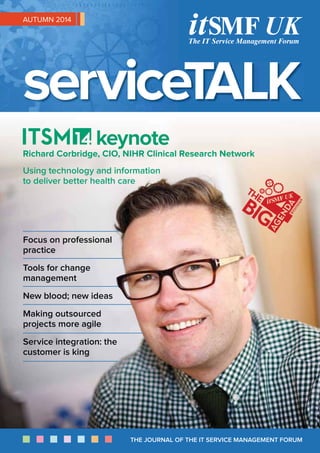
THE JOURNAL OF THE IT SERVICE MANAGEMENT FORUM
AUTUMN 2014
Focus on professional
practice
Tools for change
management
New blood; new ideas
Making outsourced
projects more agile
Service integration: the
customer is king
keynote
Richard Corbridge, CIO, NIHR Clinical Research Network
Using technology and information
to deliver better health care
AUTUMN 2014 SERVICE TALK 35
Historically, people have implemented
processes and not known whether what
they do is ‘poor’, ‘adequate’, ‘good’, or ‘best’.
They’ve implemented ITIL, so that must be
good, mustn’t it?
Until recently you wouldn’t really know. You
would get the ITIL books, go on courses, get
qualifications and then implement what the
books said was Best Practice. But ITIL has
never been a definitive way of doing service
management - it was only ever a guide to
implementing the different processes. So
after implementing the processes you didn’t
really know if it was the right solution for you.
The world has moved on and new
frameworks have been created or existing
ones have evolved. More and more
organisations are now deciding that ITIL is
just one of many possible frameworks that
can be used to deliver service management.
They are looking to leverage the relevant
parts of ITIL, COBIT, Six Sigma, ISO/IEC
20000 and other approaches to build a
cohesive Service Management System (SMS)
that works for them rather than just trying to
‘implement’ or adopt ITIL.
So even if you think that you practise
‘good’ service management, ITIL is not a
means of demonstrating that. If you want
to be sure that you manage your services
effectively and efficiently, one way is to ask
somebody else to check whether your SMS
is measurable against an internationally
recognised quality standard, such as ISO/IEC
20000.
Choosing this approach means that you can
apply for an independent certification body
to assess the system and confirm that your
service management is effective and uses
best practice principles.
What is the ISO/IEC 20000
standard?
Published by the International Organization
for Standardization (ISO) and International
Electrotechnical Commission (IEC), ISO/
IEC 20000:2011 is a worldwide quality
standard specifically aimed at IT support and
maintenance organisations. It describes
an integrated set of processes and a
management approach for the effective
delivery of IT services to the internal or
external customer.
ISO/IEC 20000 is basically
a marriage between two
best practices: ITIL and ISO’s management
system standards ISO 9001:2000 and ISO
14001:2004.
The main differences between ITIL version
3 and ISO/IEC 20000:2011 are the quality
management system and the opportunity
to be certified by an independent auditor.
These and other properties make it
an interesting concept for any internal
or external service provider providing
application or infrastructure management
services to its clients.
Pete Kostiuk outlines
the benefits and
considerations of
putting your service
management system
on the right track
with ISO/IEC 20000
certification.
How do I know if I
do ‘good’ service
management?
36 SERVICE TALK AUTUMN 2014
ISO20k certification will:
Enable the creation of a quality service
management system (SMS).
Embed the philosophy of Continual Service
Improvement for the benefit of you as a
service provider and therefore for your
customers into the future.
Help win and retain important business as
more and more organisations insist on only
dealing with suppliers that are accredited.
ISO/IEC 20000 was originally heavily based
upon ITIL and was established to overcome
the problem that organisations claiming to
be ‘ITIL-compliant’ were unable to prove it.
It has evolved to become a means for any
organisation to show they practise ‘good’
service management, and not necessarily
just using ITIL.
The standard considers the entire end-to-
end operation of service delivery and service
support, from supplier through the service
provider to the end customer. ISO/IEC 20000
prescribes a number of activities to be
performed, including:
Services provided to customers and
received from suppliers must be clearly
defined and agreed.
Key performance indicators and targets
should be set and monitored to ensure that
the expected level of the service has been
achieved.
There should be a mechanism for the
efficient handling of problems and
incidents.
Effective management and control are
required for releases and changes.
Continuous improvement of services is
required.
The cost efficiency of service provision
must be monitored.
Resources must be efficiently managed to
deliver the required service.
Who can use it?
If your organisation is involved in any of the
following areas, ISO/IEC 20000 will be of
benefit to you:
Post-implementation support and
maintenance activities
Help/service/support desk or incident
management facilities
Service level management, including
capacity management.
Relationship management with customers
or suppliers.
What are the benefits of
certification?
Customers are becoming ever more
sophisticated and better informed, and their
expectations are continuously growing.
For any progressive business, the only way
to keep ahead is to provide a better level
of service than the competition. Part of
this differentiation involves being able to
provide evidence that you practise service
management to an accepted and recognised
standard, and that the businesses you deal
with do the same.
As competition for business increases in the
marketplace, more and more organisations
are refusing to deal with suppliers that are
not ISO/IEC 20000 accredited. This means
that non-accredited organisations are
struggling to generate income - however
wonderful their product may be, customers
are not willing to deal with such companies.
They are looking for assurance that suppliers’
service delivery processes have been
assessed against a recognised standard.
Implementation of ISO/IEC 20000 brings
with it many benefits; these will of course
vary from one organisation to the next. But a
key strength is the establishment of an SMS
that is clearly auditable and has received
senior management buy-in.
Here are some examples of benefits that
ISO20k certification combined with other
methodologies can provide:
Creating competitive advantage via the
promotion of consistent and cost-effective
services.
More efficient use of resources for service
provision leading to cost reductions.
Lower incident volumes, faster incident
resolution and less business disruption due
to service failures.
Better management and staff
understanding of business objectives, roles
and processes.
Alignment of information technology
services to business strategy.
The creation of a consistent approach that
facilitates organisational change.
Reduced risk of not being able to meet
business objectives and service level
agreement targets.
Improved supply chain reliability.
How do I know if I do ‘good’ service management?
Create
quality
service
management
Certification
will...
Embed the
philosophy
of Continual
Service
Improvement
Win and
retain
important
business
ISO/IEC 2000
0
“Customers
are becoming
ever more
sophisticated
and better
informed”
AUTUMN 2014 SERVICE TALK 37
Higher customer satisfaction and improved
reputation.
A continuous improvement in the quality of
IT services.
Impartial and external methods of
assessment and audit that are recognised
internationally within the industry.
Any potential pitfalls?
As always, it might be perceived that any
investment in standards certification will
result in higher overheads, with extra
resources being required. In reality,
yes, there is an initial outlay but once
accreditation has been achieved and the
SMS has ‘bedded in’, the savings in improved
service availability will be clear; fewer
incidents, better service performance and
improved availability will make customers
want to do business with you.
One word of warning, though. Businesses
looking only to do business with ISO/IEC
20000 certified organisations must confirm
the scope of the supplier’s accreditation.
Compliance is only measured against
the services defined in the assessment.
Therefore it is possible for an organisation to
claim to be ISO20k certified if just one small
part of that organisation has been through
the process. For example you may wish to
purchase a customer management system,
but in the company that you are buying from
only the network service is ISO20k certified.
Make sure the certification is company-wide!
Can I achieve ISO/IEC 20000
compliance myself?
You can purchase and download the
standard on-line and familiarise yourself
with the details. You will need to bring in
an official ISO/IEC 20000 auditor to assess
your SMS, though, before you can achieve
certification.
What a lot of organisations do is employ
experienced consultants to assist in
preparing for certification, and this can
help the business through the confusion
and resourcing headaches of trying to
understand and learn what is required.
Once accredited, is that it?
Sorry, but no. Because a key part of
service management is continual service
improvement, CSI is a key element of ISO/
IEC 20000.
To retain certification you will need to show
evidence of both regular, internal process
audits and also be required to have six-
monthly partial external audits, with an
annual assessment.
Doing good service
management
As we’ve said, opinions will always vary on
the best way to implement good service
management and the right methodologies to
follow, but ISO/IEC 20000 is an excellent way
to make sure that you are on the right path to
very good practice.
Pete Kostiuk has been involved in IT from
his first day out of school, in 1976, until the
present day. He now works as a Senior Service
Management Consultant with Smatra, helping
organisations to implement and/or improve their
service management processes.
How do I know if I do ‘good’ service management?

pk article aug 14

  • 1.
    THE JOURNAL OFTHE IT SERVICE MANAGEMENT FORUM AUTUMN 2014 Focus on professional practice Tools for change management New blood; new ideas Making outsourced projects more agile Service integration: the customer is king keynote Richard Corbridge, CIO, NIHR Clinical Research Network Using technology and information to deliver better health care
  • 2.
    AUTUMN 2014 SERVICETALK 35 Historically, people have implemented processes and not known whether what they do is ‘poor’, ‘adequate’, ‘good’, or ‘best’. They’ve implemented ITIL, so that must be good, mustn’t it? Until recently you wouldn’t really know. You would get the ITIL books, go on courses, get qualifications and then implement what the books said was Best Practice. But ITIL has never been a definitive way of doing service management - it was only ever a guide to implementing the different processes. So after implementing the processes you didn’t really know if it was the right solution for you. The world has moved on and new frameworks have been created or existing ones have evolved. More and more organisations are now deciding that ITIL is just one of many possible frameworks that can be used to deliver service management. They are looking to leverage the relevant parts of ITIL, COBIT, Six Sigma, ISO/IEC 20000 and other approaches to build a cohesive Service Management System (SMS) that works for them rather than just trying to ‘implement’ or adopt ITIL. So even if you think that you practise ‘good’ service management, ITIL is not a means of demonstrating that. If you want to be sure that you manage your services effectively and efficiently, one way is to ask somebody else to check whether your SMS is measurable against an internationally recognised quality standard, such as ISO/IEC 20000. Choosing this approach means that you can apply for an independent certification body to assess the system and confirm that your service management is effective and uses best practice principles. What is the ISO/IEC 20000 standard? Published by the International Organization for Standardization (ISO) and International Electrotechnical Commission (IEC), ISO/ IEC 20000:2011 is a worldwide quality standard specifically aimed at IT support and maintenance organisations. It describes an integrated set of processes and a management approach for the effective delivery of IT services to the internal or external customer. ISO/IEC 20000 is basically a marriage between two best practices: ITIL and ISO’s management system standards ISO 9001:2000 and ISO 14001:2004. The main differences between ITIL version 3 and ISO/IEC 20000:2011 are the quality management system and the opportunity to be certified by an independent auditor. These and other properties make it an interesting concept for any internal or external service provider providing application or infrastructure management services to its clients. Pete Kostiuk outlines the benefits and considerations of putting your service management system on the right track with ISO/IEC 20000 certification. How do I know if I do ‘good’ service management?
  • 3.
    36 SERVICE TALKAUTUMN 2014 ISO20k certification will: Enable the creation of a quality service management system (SMS). Embed the philosophy of Continual Service Improvement for the benefit of you as a service provider and therefore for your customers into the future. Help win and retain important business as more and more organisations insist on only dealing with suppliers that are accredited. ISO/IEC 20000 was originally heavily based upon ITIL and was established to overcome the problem that organisations claiming to be ‘ITIL-compliant’ were unable to prove it. It has evolved to become a means for any organisation to show they practise ‘good’ service management, and not necessarily just using ITIL. The standard considers the entire end-to- end operation of service delivery and service support, from supplier through the service provider to the end customer. ISO/IEC 20000 prescribes a number of activities to be performed, including: Services provided to customers and received from suppliers must be clearly defined and agreed. Key performance indicators and targets should be set and monitored to ensure that the expected level of the service has been achieved. There should be a mechanism for the efficient handling of problems and incidents. Effective management and control are required for releases and changes. Continuous improvement of services is required. The cost efficiency of service provision must be monitored. Resources must be efficiently managed to deliver the required service. Who can use it? If your organisation is involved in any of the following areas, ISO/IEC 20000 will be of benefit to you: Post-implementation support and maintenance activities Help/service/support desk or incident management facilities Service level management, including capacity management. Relationship management with customers or suppliers. What are the benefits of certification? Customers are becoming ever more sophisticated and better informed, and their expectations are continuously growing. For any progressive business, the only way to keep ahead is to provide a better level of service than the competition. Part of this differentiation involves being able to provide evidence that you practise service management to an accepted and recognised standard, and that the businesses you deal with do the same. As competition for business increases in the marketplace, more and more organisations are refusing to deal with suppliers that are not ISO/IEC 20000 accredited. This means that non-accredited organisations are struggling to generate income - however wonderful their product may be, customers are not willing to deal with such companies. They are looking for assurance that suppliers’ service delivery processes have been assessed against a recognised standard. Implementation of ISO/IEC 20000 brings with it many benefits; these will of course vary from one organisation to the next. But a key strength is the establishment of an SMS that is clearly auditable and has received senior management buy-in. Here are some examples of benefits that ISO20k certification combined with other methodologies can provide: Creating competitive advantage via the promotion of consistent and cost-effective services. More efficient use of resources for service provision leading to cost reductions. Lower incident volumes, faster incident resolution and less business disruption due to service failures. Better management and staff understanding of business objectives, roles and processes. Alignment of information technology services to business strategy. The creation of a consistent approach that facilitates organisational change. Reduced risk of not being able to meet business objectives and service level agreement targets. Improved supply chain reliability. How do I know if I do ‘good’ service management? Create quality service management Certification will... Embed the philosophy of Continual Service Improvement Win and retain important business ISO/IEC 2000 0 “Customers are becoming ever more sophisticated and better informed”
  • 4.
    AUTUMN 2014 SERVICETALK 37 Higher customer satisfaction and improved reputation. A continuous improvement in the quality of IT services. Impartial and external methods of assessment and audit that are recognised internationally within the industry. Any potential pitfalls? As always, it might be perceived that any investment in standards certification will result in higher overheads, with extra resources being required. In reality, yes, there is an initial outlay but once accreditation has been achieved and the SMS has ‘bedded in’, the savings in improved service availability will be clear; fewer incidents, better service performance and improved availability will make customers want to do business with you. One word of warning, though. Businesses looking only to do business with ISO/IEC 20000 certified organisations must confirm the scope of the supplier’s accreditation. Compliance is only measured against the services defined in the assessment. Therefore it is possible for an organisation to claim to be ISO20k certified if just one small part of that organisation has been through the process. For example you may wish to purchase a customer management system, but in the company that you are buying from only the network service is ISO20k certified. Make sure the certification is company-wide! Can I achieve ISO/IEC 20000 compliance myself? You can purchase and download the standard on-line and familiarise yourself with the details. You will need to bring in an official ISO/IEC 20000 auditor to assess your SMS, though, before you can achieve certification. What a lot of organisations do is employ experienced consultants to assist in preparing for certification, and this can help the business through the confusion and resourcing headaches of trying to understand and learn what is required. Once accredited, is that it? Sorry, but no. Because a key part of service management is continual service improvement, CSI is a key element of ISO/ IEC 20000. To retain certification you will need to show evidence of both regular, internal process audits and also be required to have six- monthly partial external audits, with an annual assessment. Doing good service management As we’ve said, opinions will always vary on the best way to implement good service management and the right methodologies to follow, but ISO/IEC 20000 is an excellent way to make sure that you are on the right path to very good practice. Pete Kostiuk has been involved in IT from his first day out of school, in 1976, until the present day. He now works as a Senior Service Management Consultant with Smatra, helping organisations to implement and/or improve their service management processes. How do I know if I do ‘good’ service management?