VTA Next Network:
Your Transit Choices
Agenda Item #7.1
About Jarrett Walker + Assoc
• Stanford PhD, Caltrain Advocate in
the 80s.
• 22 Years Experience in Transit
Network Design.
• >50 metro areas in 9 countries.
• Author Human Transit.
• Long track record as transit
explainer. HumanTransit.org
• Successful designs in many cities
including San Antonio, Auckland,
Minneapolis, LA Suburbs
• Houston redesign implemented
August 2015
2
Outline
• Where We Are Now
• What High Ridership Transit Looks Like
• The Ridership-Coverage Tradeoff
• Options for the Summer 2017 Network (BART opening)
3
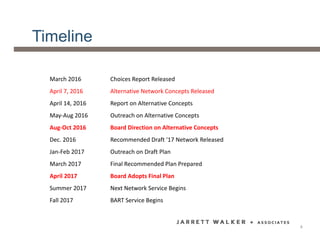
Timeline
March 2016 Choices Report Released
April 7, 2016 Alternative Network Concepts Released
April 14, 2016 Report on Alternative Concepts
May‐Aug 2016 Outreach on Alternative Concepts
Aug‐Oct 2016 Board Direction on Alternative Concepts
Dec. 2016 Recommended Draft '17 Network Released
Jan‐Feb 2017 Outreach on Draft Plan
March 2017 Final Recommended Plan Prepared
April 2017 Board Adopts Final Plan
Summer 2017 Next Network Service Begins
Fall 2017 BART Service Begins
4
Where We Are Now
5
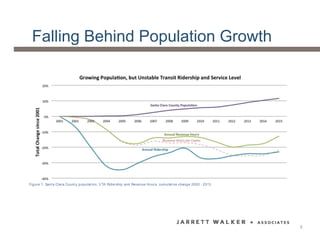
Falling Behind Population Growth
Figure 1: Sant a Clara Count y populat ion, VTA Ridership and Revenue Hours, cumulat ive change 2000 - 2013
6
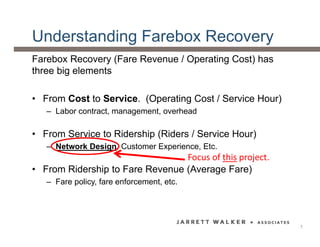
Understanding Farebox Recovery
Farebox Recovery (Fare Revenue / Operating Cost) has
three big elements
• From Cost to Service. (Operating Cost / Service Hour)
– Labor contract, management, overhead
• From Service to Ridership (Riders / Service Hour)
– Network Design, Customer Experience, Etc.
• From Ridership to Fare Revenue (Average Fare)
– Fare policy, fare enforcement, etc.
Focus of this project.
7
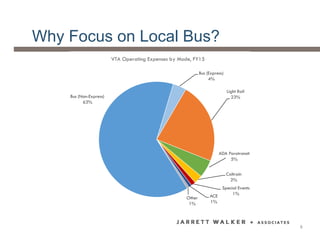
Why Focus on Local Bus?
Bus (Non-Express)
63%
Bus (Express)
4%
Light Rail
23%
ADA Paratransit
5%
Caltrain
2%
Special Events
1%ACE
1%
Other
1%
VTA Operating Expenses by Mode, FY15
8
The Ridership Recipe
IFyou want higher ridership, higher farebox return …
9
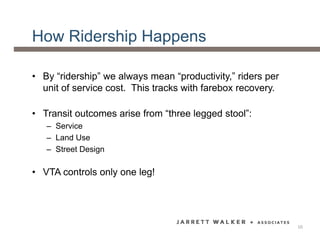
How Ridership Happens
• By “ridership” we always mean “productivity,” riders per
unit of service cost. This tracks with farebox recovery.
• Transit outcomes arise from “three legged stool”:
– Service
– Land Use
– Street Design
• VTA controls only one leg!
10
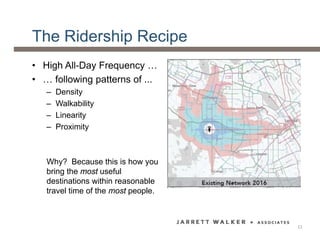
The Ridership Recipe
• High All-Day Frequency …
• … following patterns of ...
– Density
– Walkability
– Linearity
– Proximity
Why? Because this is how you
bring the most useful
destinations within reasonable
travel time of the most people.
11
Why Frequency Matters
Speed and reliability matter too, but frequency is the most
neglected element.
Frequency is a “cubed” benefit:
• Go when you want to go.
• Make connections easily, so that you can get to more
places.
• Less risk of being stranded by a reliability problem.
For trips <5 mi or so, frequency is the dominant element of
travel time.
12
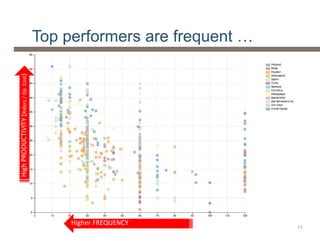
Top performers are frequent …
Higher FREQUENCY
High PRODUCTIVITY (Riders / Op. Cost)
13
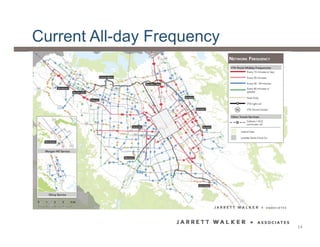
Current All-day Frequency
14
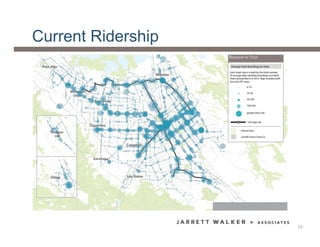
Current Ridership
15
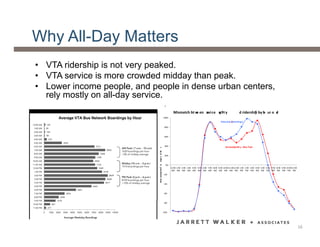
Why All-Day Matters
• VTA ridership is not very peaked.
• VTA service is more crowded midday than peak.
• Lower income people, and people in dense urban centers,
rely mostly on all-day service.
‐‐‐1
0
0%   
‐‐‐8
0
%   
‐‐‐6
0
%   
‐‐‐4
0
%   
‐‐‐2
0
%   
0%  
20%  
40%  
60%  
80%  
100%  
12:00  
AM  
1:00  
AM  
2:00  
AM  
3:00  
AM  
4:00  
AM  
5:00  
AM  
6:00  
AM  
7:00  
AM  
8:00  
AM  
9:00  
AM  
10:00  
AM  
11:00  
AM  
12:00  
PM  
1:00  
PM  
2:00  
PM  
3:00  
PM  
4:00  
PM  
5:00  
PM  
6:00  
PM  
7:00  
PM  
8:00  
PM  
9:00  
PM  
10:00  
PM  
11:00  
PM  
Hour  compared  to  avrage  of  all  hors  
Mismatch  b
e
t we en   se
r
vice   qua
n
9ty      
a n
d  ridership  b
y
  ho ur  of   day   
Ridership  (Boardings)  
Service  Q
u
an9t y   (Bus  Tr ips)   
16
Limits of VTA Peak-Only Service
• Adding service only during rush hour creates three
added costs for VTA.
– Cost to own/store/maintain fleet that is used rarely.
– Cost of very short shifts, esp. without part time drivers.
– Costs of one-way operation: all vehicles have to come back.
17
Land Use Drivers of Ridership
• Density
• Walkability
• Linearity
• Proximity
18
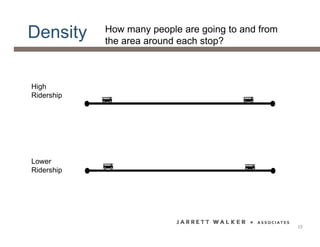
Density How many people are going to and from
the area around each stop?
High
Ridership
Lower
Ridership
19
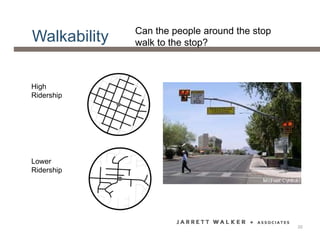
Walkability Can the people around the stop
walk to the stop?
High
Ridership
Lower
Ridership
20
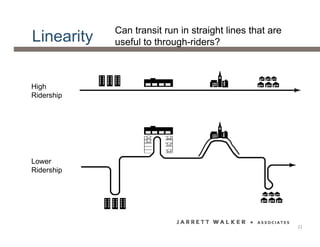
Linearity
High
Ridership
Lower
Ridership
Can transit run in straight lines that are
useful to through-riders?
21
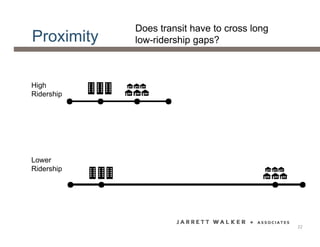
Proximity
High
Ridership
Lower
Ridership
Does transit have to cross long
low-ridership gaps?
22
But is Ridership What You Want?
The Ridership-Coverage Tradeoff
23
The Ridership-Coverage Tradeoff
• Maximizing Ridership (and farebox return) requires
thinking like a business.
• Businesses choose which markets to enter, based on
where their product can succeed.
• This is not the same as meeting people’s needs or
expectations.
24
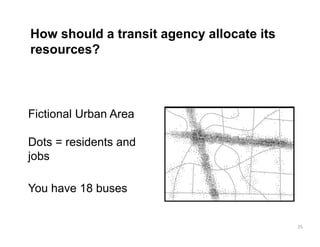
How should a transit agency allocate its
resources?
Fictional Urban Area
Dots = residents and
jobs
You have 18 buses
25
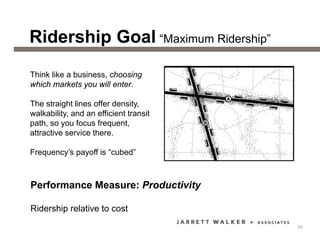
Ridership Goal “Maximum Ridership”
Performance Measure: Productivity
Ridership relative to cost
Ridership
Network
Think like a business, choosing
which markets you will enter.
The straight lines offer density,
walkability, and an efficient transit
path, so you focus frequent,
attractive service there.
Frequency’s payoff is “cubed”
26
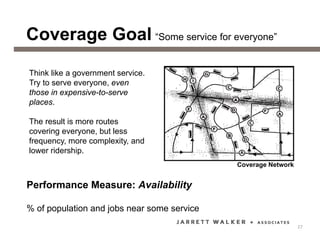
Coverage Goal “Some service for everyone”
Performance Measure: Availability
% of population and jobs near some service
Coverage Network
Think like a government service.
Try to serve everyone, even
those in expensive-to-serve
places.
The result is more routes
covering everyone, but less
frequency, more complexity, and
lower ridership.
27
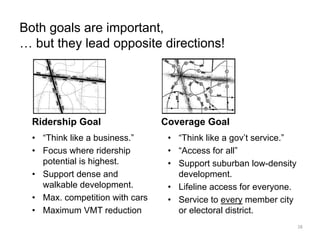
Both goals are important,
… but they lead opposite directions!
Ridership Goal
• “Think like a business.”
• Focus where ridership
potential is highest.
• Support dense and
walkable development.
• Max. competition with cars
• Maximum VMT reduction
Coverage Goal
• “Think like a gov’t service.”
• “Access for all”
• Support suburban low-density
development.
• Lifeline access for everyone.
• Service to every member city
or electoral district.
28
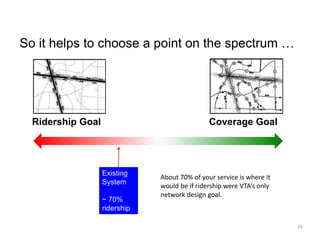
So it helps to choose a point on the spectrum …
Ridership Goal Coverage Goal
Existing
System
~ 70%
ridership
About 70% of your service is where it 
would be if ridership were VTA’s only 
network design goal.
29
3 Alternative Concepts for ‘17
70% Ridership? 80%? 90%?
30
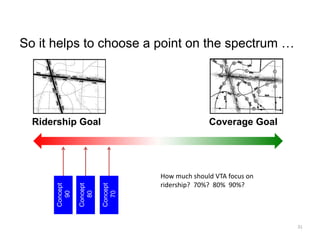
So it helps to choose a point on the spectrum …
Ridership Goal Coverage Goal
Concept
70
How much should VTA focus on 
ridership?  70%?  80%  90%?
Concept
80
Concept
90
31
All Concepts Integrate with BART
• All Fremont express lines are replaced by local
connections to BART at Milpitas and Berryessa.
• Direct service from BART to:
– Most of inner and eastside San Jose.
– San Jose Mineta Airport
– Tasman LRT corridor: Great America, Lockheed area, Mtn View
– Montague / Scott / Arques corridor: Jobsites in Santa Clara,
Sunnyvale, and Mtn View.
– North 1st LRT to northern San Jose jobsites.
– Winchester corridor: Santa Clara, Santana Row, Campbell.
– Stevens Creek corridor to Cupertino.
32
Not Shown but Still There
• VTA Express Network (100s) except lines to Fremont.
• VTA Limited (300s) except where fully replaced by new
rapid-stop service.
• Caltrain shuttles
• ACE shuttles
• FLEX service.
33
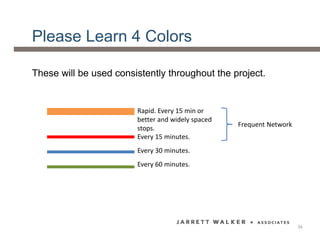
Please Learn 4 Colors
These will be used consistently throughout the project.
Rapid. Every 15 min or 
better and widely spaced 
stops.
Every 15 minutes. 
Every 30 minutes.
Every 60 minutes. 
Frequent Network
34
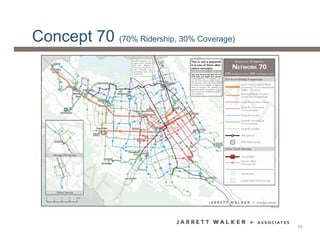
Concept 70 (70% Ridership, 30% Coverage)
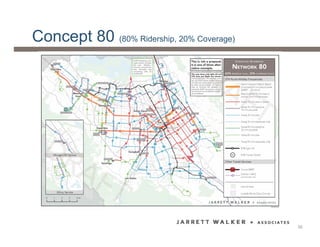
35
Concept 80 (80% Ridership, 20% Coverage)
36
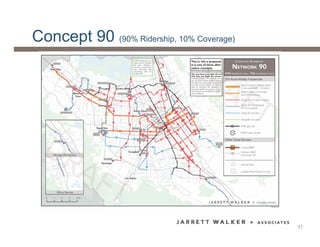
Concept 90 (90% Ridership, 10% Coverage)
37
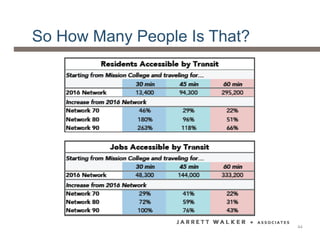
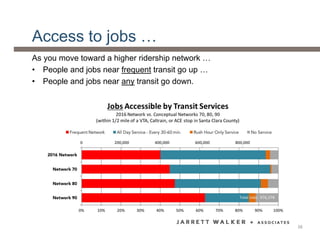
Access to jobs …
As you move toward a higher ridership network …
• People and jobs near frequent transit go up …
• People and jobs near any transit go down.
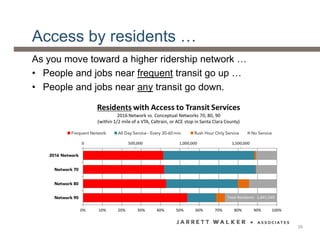
38
Access by residents …
As you move toward a higher ridership network …
• People and jobs near frequent transit go up …
• People and jobs near any transit go down.
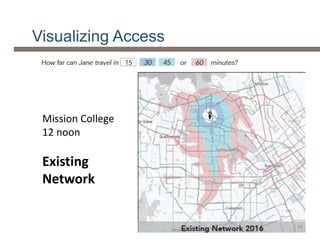
39
Visualizing Access
Mission College
12 noon
Existing 
Network
40
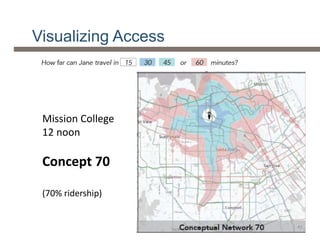
Visualizing Access
Mission College
12 noon
Concept 70
(70% ridership)
41
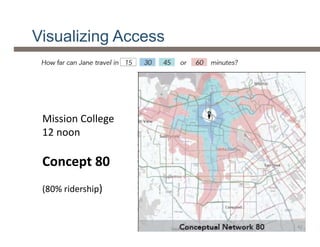
Visualizing Access
Mission College
12 noon
Concept 80
(80% ridership)
42
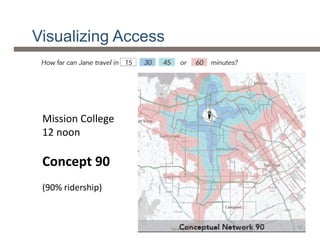
Visualizing Access
Mission College
12 noon
Concept 90
(90% ridership)
43
So How Many People Is That?
44
Cautions
• These are not proposals!
• They are illustrations of a policy choice.
• They are starting points for defining the final network.
• View these at high altitude. Not all micro details are
meaningful yet.
• Public reaction to these concepts will help you decide
where you want to be on the ridership-coverage
spectrum.
45
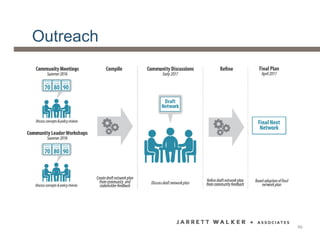
Outreach
46
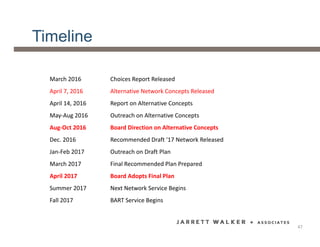
Timeline
March 2016 Choices Report Released
April 7, 2016 Alternative Network Concepts Released
April 14, 2016 Report on Alternative Concepts
May‐Aug 2016 Outreach on Alternative Concepts
Aug‐Oct 2016 Board Direction on Alternative Concepts
Dec. 2016 Recommended Draft '17 Network Released
Jan‐Feb 2017 Outreach on Draft Plan
March 2017 Final Recommended Plan Prepared
April 2017 Board Adopts Final Plan
Summer 2017 Next Network Service Begins
Fall 2017 BART Service Begins
47
Discussion
48

VTA's Next Network: Your Transit Choices

  • 1.
    VTA Next Network: YourTransit Choices Agenda Item #7.1
  • 2.
    About Jarrett Walker+ Assoc • Stanford PhD, Caltrain Advocate in the 80s. • 22 Years Experience in Transit Network Design. • >50 metro areas in 9 countries. • Author Human Transit. • Long track record as transit explainer. HumanTransit.org • Successful designs in many cities including San Antonio, Auckland, Minneapolis, LA Suburbs • Houston redesign implemented August 2015 2
  • 3.
    Outline • Where WeAre Now • What High Ridership Transit Looks Like • The Ridership-Coverage Tradeoff • Options for the Summer 2017 Network (BART opening) 3
  • 4.
    Timeline March 2016 Choices Report Released April 7, 2016 Alternative Network Concepts Released April 14, 2016Report on Alternative Concepts May‐Aug 2016 Outreach on Alternative Concepts Aug‐Oct 2016 Board Direction on Alternative Concepts Dec. 2016 Recommended Draft '17 Network Released Jan‐Feb 2017 Outreach on Draft Plan March 2017 Final Recommended Plan Prepared April 2017 Board Adopts Final Plan Summer 2017 Next Network Service Begins Fall 2017 BART Service Begins 4
  • 5.
  • 6.
    Falling Behind PopulationGrowth Figure 1: Sant a Clara Count y populat ion, VTA Ridership and Revenue Hours, cumulat ive change 2000 - 2013 6
  • 7.
    Understanding Farebox Recovery FareboxRecovery (Fare Revenue / Operating Cost) has three big elements • From Cost to Service. (Operating Cost / Service Hour) – Labor contract, management, overhead • From Service to Ridership (Riders / Service Hour) – Network Design, Customer Experience, Etc. • From Ridership to Fare Revenue (Average Fare) – Fare policy, fare enforcement, etc. Focus of this project. 7
  • 8.
    Why Focus onLocal Bus? Bus (Non-Express) 63% Bus (Express) 4% Light Rail 23% ADA Paratransit 5% Caltrain 2% Special Events 1%ACE 1% Other 1% VTA Operating Expenses by Mode, FY15 8
  • 9.
    The Ridership Recipe IFyouwant higher ridership, higher farebox return … 9
  • 10.
    How Ridership Happens •By “ridership” we always mean “productivity,” riders per unit of service cost. This tracks with farebox recovery. • Transit outcomes arise from “three legged stool”: – Service – Land Use – Street Design • VTA controls only one leg! 10
  • 11.
    The Ridership Recipe •High All-Day Frequency … • … following patterns of ... – Density – Walkability – Linearity – Proximity Why? Because this is how you bring the most useful destinations within reasonable travel time of the most people. 11
  • 12.
    Why Frequency Matters Speedand reliability matter too, but frequency is the most neglected element. Frequency is a “cubed” benefit: • Go when you want to go. • Make connections easily, so that you can get to more places. • Less risk of being stranded by a reliability problem. For trips <5 mi or so, frequency is the dominant element of travel time. 12
  • 13.
    Top performers arefrequent … Higher FREQUENCY High PRODUCTIVITY (Riders / Op. Cost) 13
  • 14.
  • 15.
  • 16.
    Why All-Day Matters •VTA ridership is not very peaked. • VTA service is more crowded midday than peak. • Lower income people, and people in dense urban centers, rely mostly on all-day service. ‐‐‐1 0 0%    ‐‐‐8 0 %    ‐‐‐6 0 %    ‐‐‐4 0 %    ‐‐‐2 0 %    0%   20%   40%   60%   80%   100%   12:00   AM   1:00   AM   2:00   AM   3:00   AM   4:00   AM   5:00   AM   6:00   AM   7:00   AM   8:00   AM   9:00   AM   10:00   AM   11:00   AM   12:00   PM   1:00   PM   2:00   PM   3:00   PM   4:00   PM   5:00   PM   6:00   PM   7:00   PM   8:00   PM   9:00   PM   10:00   PM   11:00   PM   Hour  compared  to  avrage  of  all  hors   Mismatch  b e t we en   se r vice   qua n 9ty       a n d  ridership  b y   ho ur  of   day    Ridership  (Boardings)   Service  Q u an9t y   (Bus  Tr ips)    16
  • 17.
    Limits of VTAPeak-Only Service • Adding service only during rush hour creates three added costs for VTA. – Cost to own/store/maintain fleet that is used rarely. – Cost of very short shifts, esp. without part time drivers. – Costs of one-way operation: all vehicles have to come back. 17
  • 18.
    Land Use Driversof Ridership • Density • Walkability • Linearity • Proximity 18
  • 19.
    Density How manypeople are going to and from the area around each stop? High Ridership Lower Ridership 19
  • 20.
    Walkability Can thepeople around the stop walk to the stop? High Ridership Lower Ridership 20
  • 21.
    Linearity High Ridership Lower Ridership Can transit runin straight lines that are useful to through-riders? 21
  • 22.
  • 23.
    But is RidershipWhat You Want? The Ridership-Coverage Tradeoff 23
  • 24.
    The Ridership-Coverage Tradeoff •Maximizing Ridership (and farebox return) requires thinking like a business. • Businesses choose which markets to enter, based on where their product can succeed. • This is not the same as meeting people’s needs or expectations. 24
  • 25.
    How should atransit agency allocate its resources? Fictional Urban Area Dots = residents and jobs You have 18 buses 25
  • 26.
    Ridership Goal “MaximumRidership” Performance Measure: Productivity Ridership relative to cost Ridership Network Think like a business, choosing which markets you will enter. The straight lines offer density, walkability, and an efficient transit path, so you focus frequent, attractive service there. Frequency’s payoff is “cubed” 26
  • 27.
    Coverage Goal “Someservice for everyone” Performance Measure: Availability % of population and jobs near some service Coverage Network Think like a government service. Try to serve everyone, even those in expensive-to-serve places. The result is more routes covering everyone, but less frequency, more complexity, and lower ridership. 27
  • 28.
    Both goals areimportant, … but they lead opposite directions! Ridership Goal • “Think like a business.” • Focus where ridership potential is highest. • Support dense and walkable development. • Max. competition with cars • Maximum VMT reduction Coverage Goal • “Think like a gov’t service.” • “Access for all” • Support suburban low-density development. • Lifeline access for everyone. • Service to every member city or electoral district. 28
  • 29.
    So it helpsto choose a point on the spectrum … Ridership Goal Coverage Goal Existing System ~ 70% ridership About 70% of your service is where it  would be if ridership were VTA’s only  network design goal. 29
  • 30.
    3 Alternative Conceptsfor ‘17 70% Ridership? 80%? 90%? 30
  • 31.
    So it helpsto choose a point on the spectrum … Ridership Goal Coverage Goal Concept 70 How much should VTA focus on  ridership?  70%?  80%  90%? Concept 80 Concept 90 31
  • 32.
    All Concepts Integratewith BART • All Fremont express lines are replaced by local connections to BART at Milpitas and Berryessa. • Direct service from BART to: – Most of inner and eastside San Jose. – San Jose Mineta Airport – Tasman LRT corridor: Great America, Lockheed area, Mtn View – Montague / Scott / Arques corridor: Jobsites in Santa Clara, Sunnyvale, and Mtn View. – North 1st LRT to northern San Jose jobsites. – Winchester corridor: Santa Clara, Santana Row, Campbell. – Stevens Creek corridor to Cupertino. 32
  • 33.
    Not Shown butStill There • VTA Express Network (100s) except lines to Fremont. • VTA Limited (300s) except where fully replaced by new rapid-stop service. • Caltrain shuttles • ACE shuttles • FLEX service. 33
  • 34.
    Please Learn 4Colors These will be used consistently throughout the project. Rapid. Every 15 min or  better and widely spaced  stops. Every 15 minutes.  Every 30 minutes. Every 60 minutes.  Frequent Network 34
  • 35.
    Concept 70 (70%Ridership, 30% Coverage) 35
  • 36.
    Concept 80 (80%Ridership, 20% Coverage) 36
  • 37.
    Concept 90 (90%Ridership, 10% Coverage) 37
  • 38.
    Access to jobs… As you move toward a higher ridership network … • People and jobs near frequent transit go up … • People and jobs near any transit go down. 38
  • 39.
    Access by residents… As you move toward a higher ridership network … • People and jobs near frequent transit go up … • People and jobs near any transit go down. 39
  • 40.
  • 41.
  • 42.
  • 43.
  • 44.
    So How ManyPeople Is That? 44
  • 45.
    Cautions • These arenot proposals! • They are illustrations of a policy choice. • They are starting points for defining the final network. • View these at high altitude. Not all micro details are meaningful yet. • Public reaction to these concepts will help you decide where you want to be on the ridership-coverage spectrum. 45
  • 46.
  • 47.
    Timeline March 2016 Choices Report Released April 7, 2016 Alternative Network Concepts Released April 14, 2016Report on Alternative Concepts May‐Aug 2016 Outreach on Alternative Concepts Aug‐Oct 2016 Board Direction on Alternative Concepts Dec. 2016 Recommended Draft '17 Network Released Jan‐Feb 2017 Outreach on Draft Plan March 2017 Final Recommended Plan Prepared April 2017 Board Adopts Final Plan Summer 2017 Next Network Service Begins Fall 2017 BART Service Begins 47
  • 48.