I T I L 4 F O U N D A T I O N
EXAM PREPARATION
2
Accredited ITIL 4 MP & Trainer
ScrumInc. Scrum Master
SAFe Program Consultant
Service Management Enthusiast
Landscape Photographer
Drone Pilot
Nature Lover / Bird Man
Husband of a wonderful wife
and father of a little girl
3
• Key-Concepts and Definitions (5)
• The 4 Dimensions (2)
• The Service Value System (1)
• The Guiding Principles (6)
• The Service Value Chain (2)
• Most important practices (19)
• Other examinable practices (5)
Agenda
4
• Key-Concepts and Definitions (5)
• The 4 Dimensions (2)
• The Service Value System (1)
• The Guiding Principles (6)
• The Service Value Chain (2)
• Most important practices (19)
• Other examinable practices (5)
Agenda
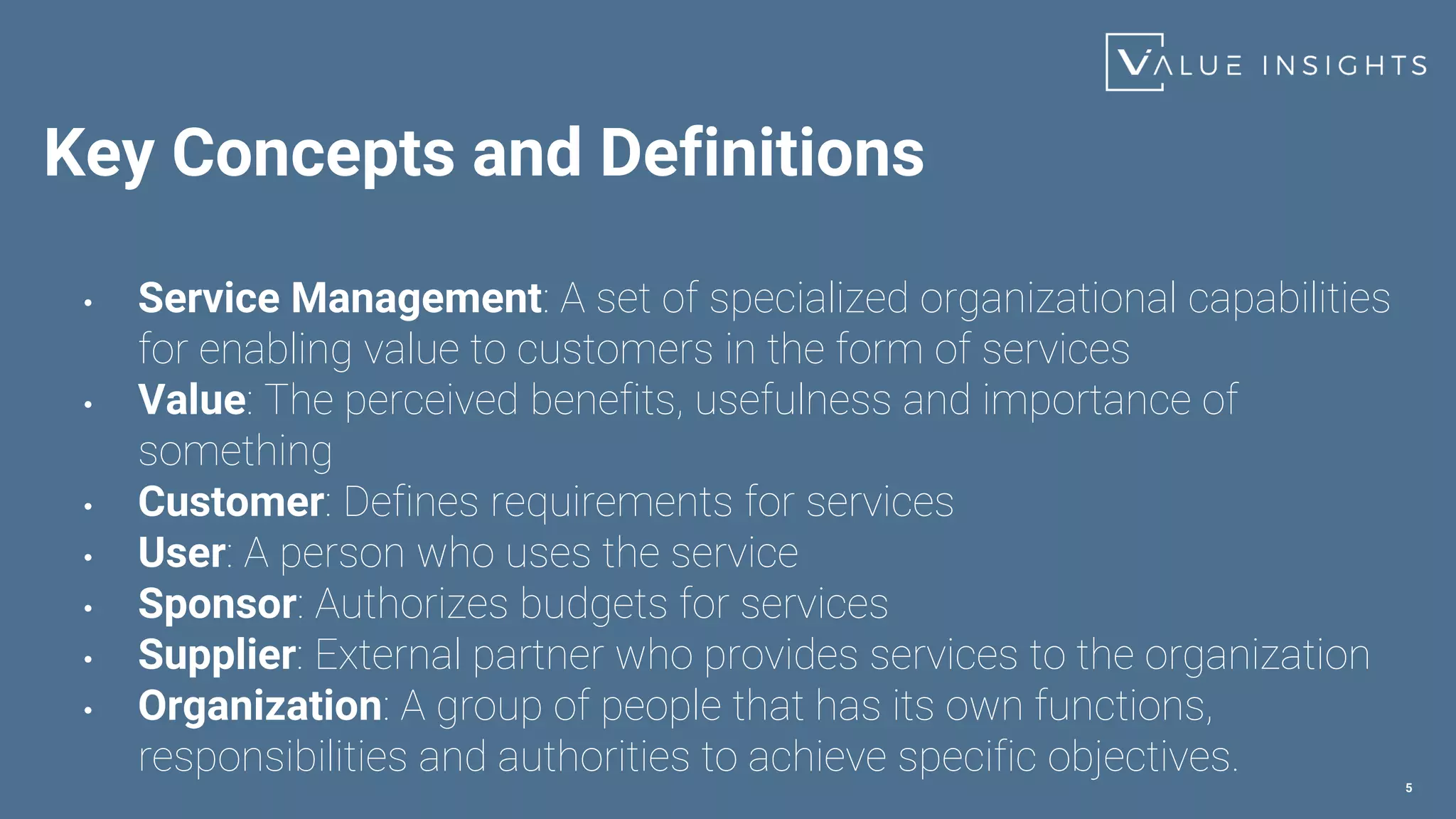
Key Concepts and Definitions
• Service Management: A set of specialized organizational capabilities
for enabling value to customers in the form of services
• Value: The perceived benefits, usefulness and importance of
something
• Customer: Defines requirements for services
• User: A person who uses the service
• Sponsor: Authorizes budgets for services
• Supplier: External partner who provides services to the organization
• Organization: A group of people that has its own functions,
responsibilities and authorities to achieve specific objectives.
5
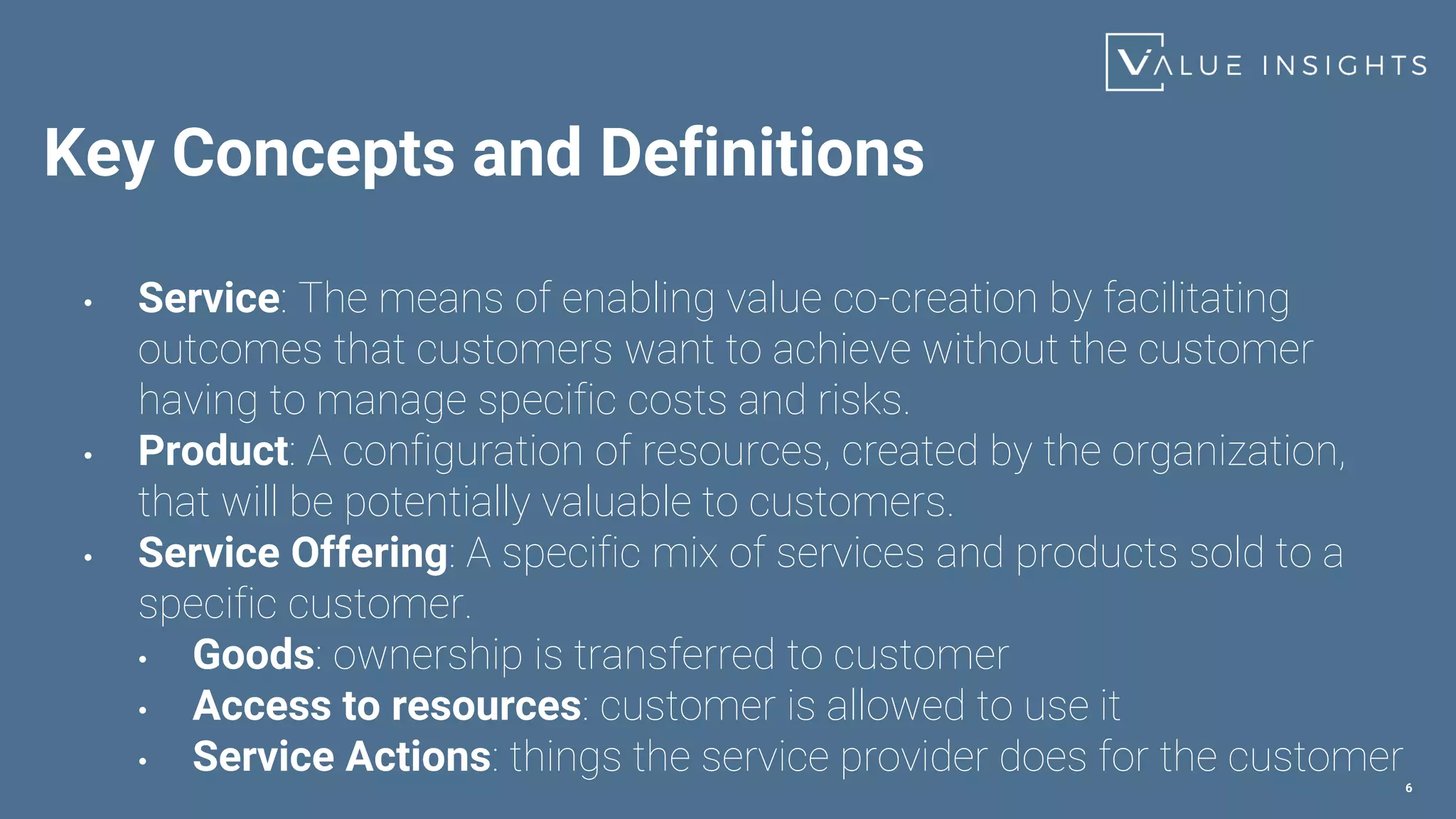
Key Concepts and Definitions
• Service: The means of enabling value co-creation by facilitating
outcomes that customers want to achieve without the customer
having to manage specific costs and risks.
• Product: A configuration of resources, created by the organization,
that will be potentially valuable to customers.
• Service Offering: A specific mix of services and products sold to a
specific customer.
• Goods: ownership is transferred to customer
• Access to resources: customer is allowed to use it
• Service Actions: things the service provider does for the customer
6
Key Concepts and Definitions
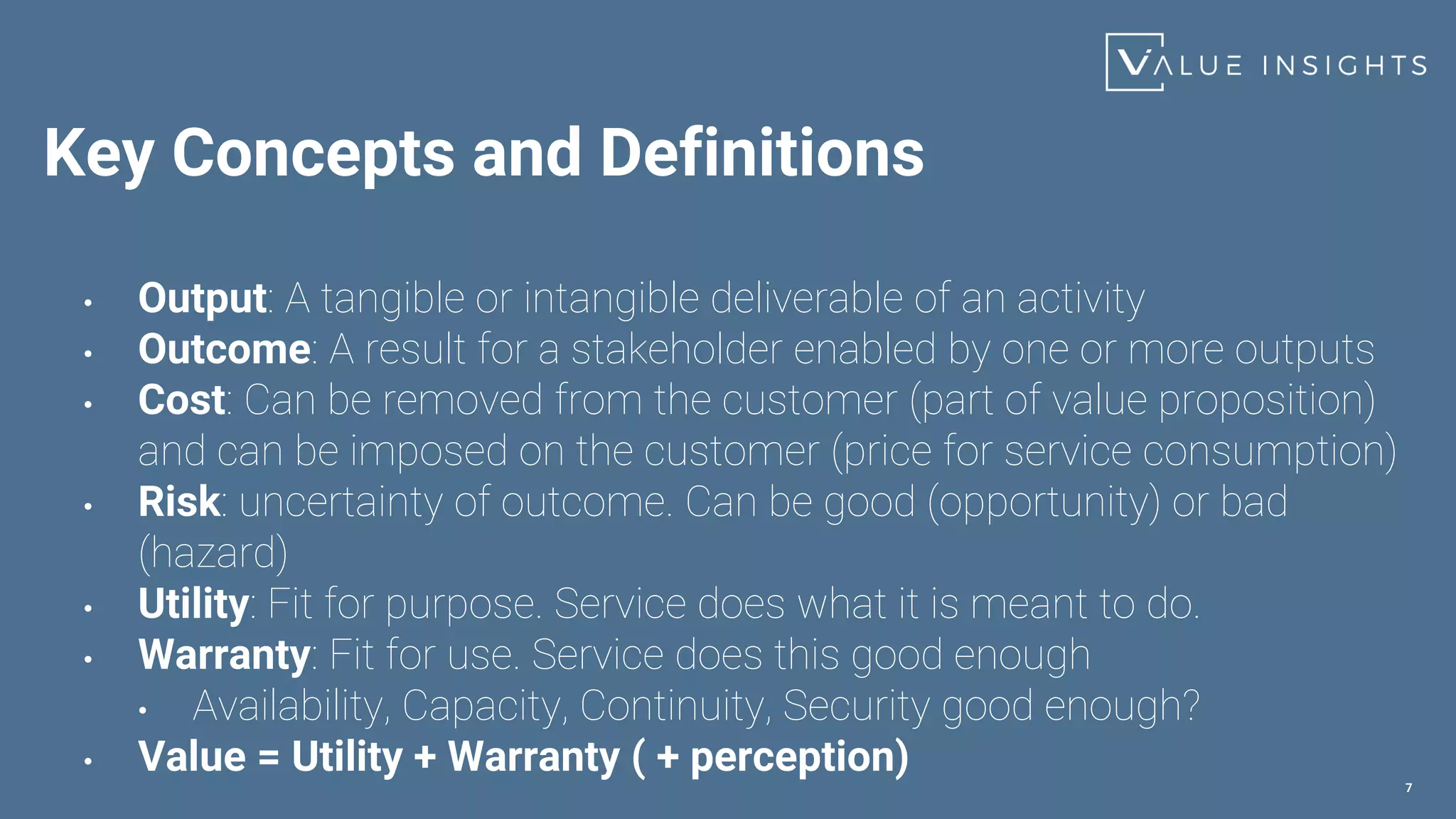
• Output: A tangible or intangible deliverable of an activity
• Outcome: A result for a stakeholder enabled by one or more outputs
• Cost: Can be removed from the customer (part of value proposition)
and can be imposed on the customer (price for service consumption)
• Risk: uncertainty of outcome. Can be good (opportunity) or bad
(hazard)
• Utility: Fit for purpose. Service does what it is meant to do.
• Warranty: Fit for use. Service does this good enough
• Availability, Capacity, Continuity, Security good enough?
• Value = Utility + Warranty ( + perception)
7
Summary
Key Concepts
• Service Management
• Stakeholders
• Value
• Value Co-Creation
8
Definitions
• Service
• Service Offerings
• Output vs. Outcome
• Risk
• Utility + Warranty
9
• Key-Concepts and Definitions (5)
• The 4 Dimensions (2)
• The Service Value System (1)
• The Guiding Principles (6)
• The Service Value Chain (2)
• Most important practices (19)
• Other examinable practices (5)
Agenda
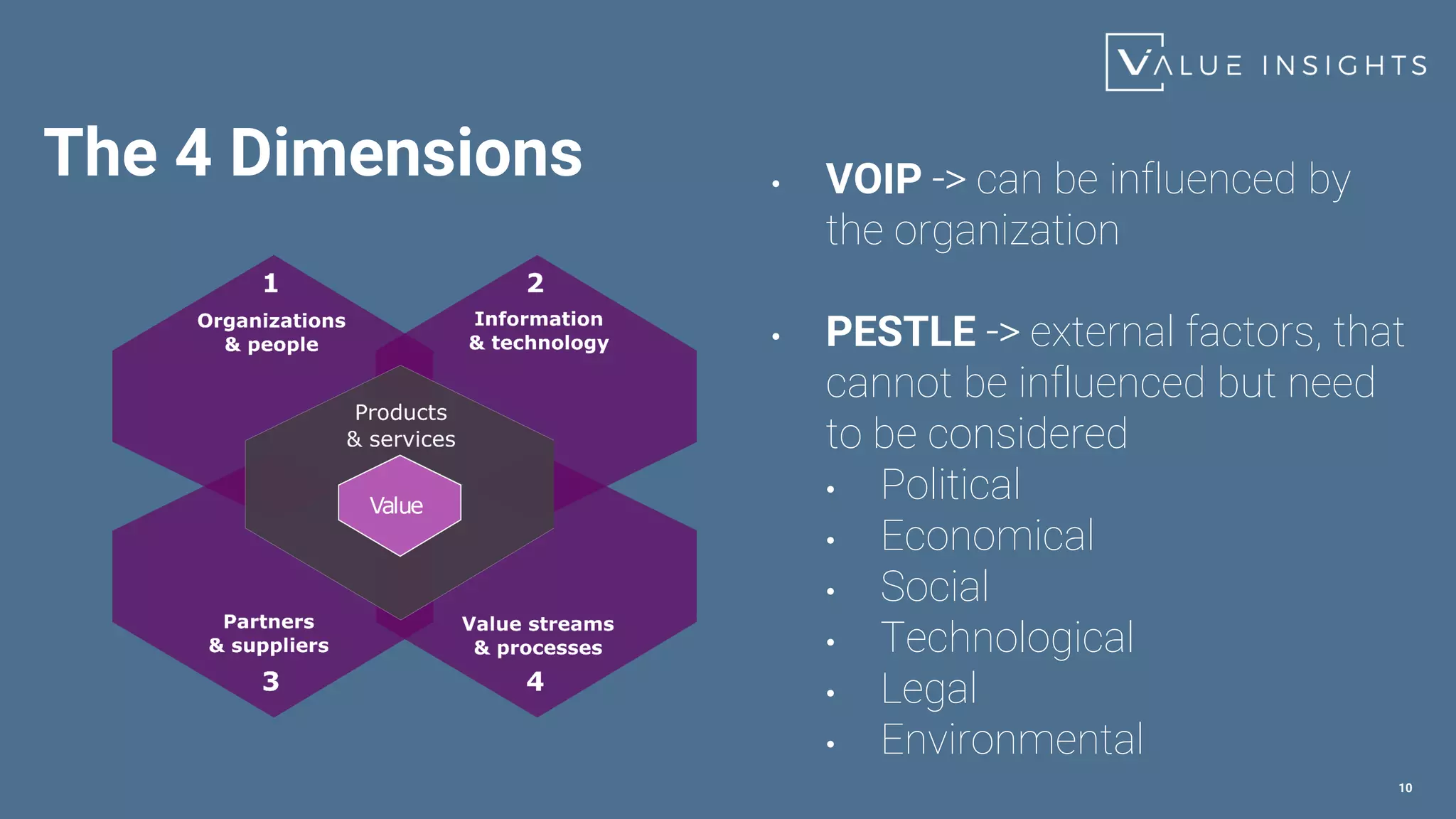
The 4 Dimensions
10
• VOIP -> can be influenced by
the organization
• PESTLE -> external factors, that
cannot be influenced but need
to be considered
• Political
• Economical
• Social
• Technological
• Legal
• Environmental
The 4 Dimensions
11
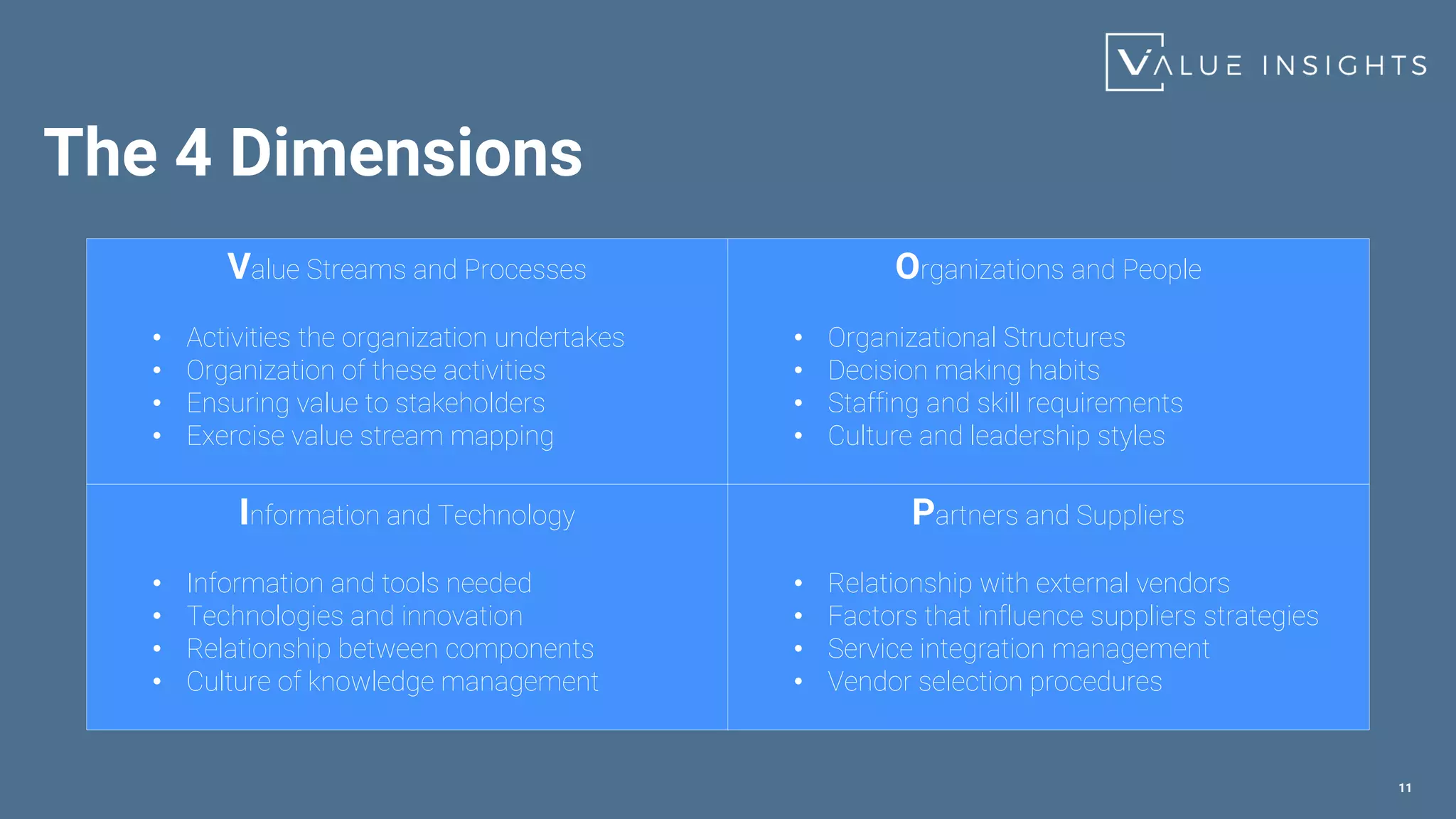
Value Streams and Processes
• Activities the organization undertakes
• Organization of these activities
• Ensuring value to stakeholders
• Exercise value stream mapping
Organizations and People
• Organizational Structures
• Decision making habits
• Staffing and skill requirements
• Culture and leadership styles
Information and Technology
• Information and tools needed
• Technologies and innovation
• Relationship between components
• Culture of knowledge management
Partners and Suppliers
• Relationship with external vendors
• Factors that influence suppliers strategies
• Service integration management
• Vendor selection procedures
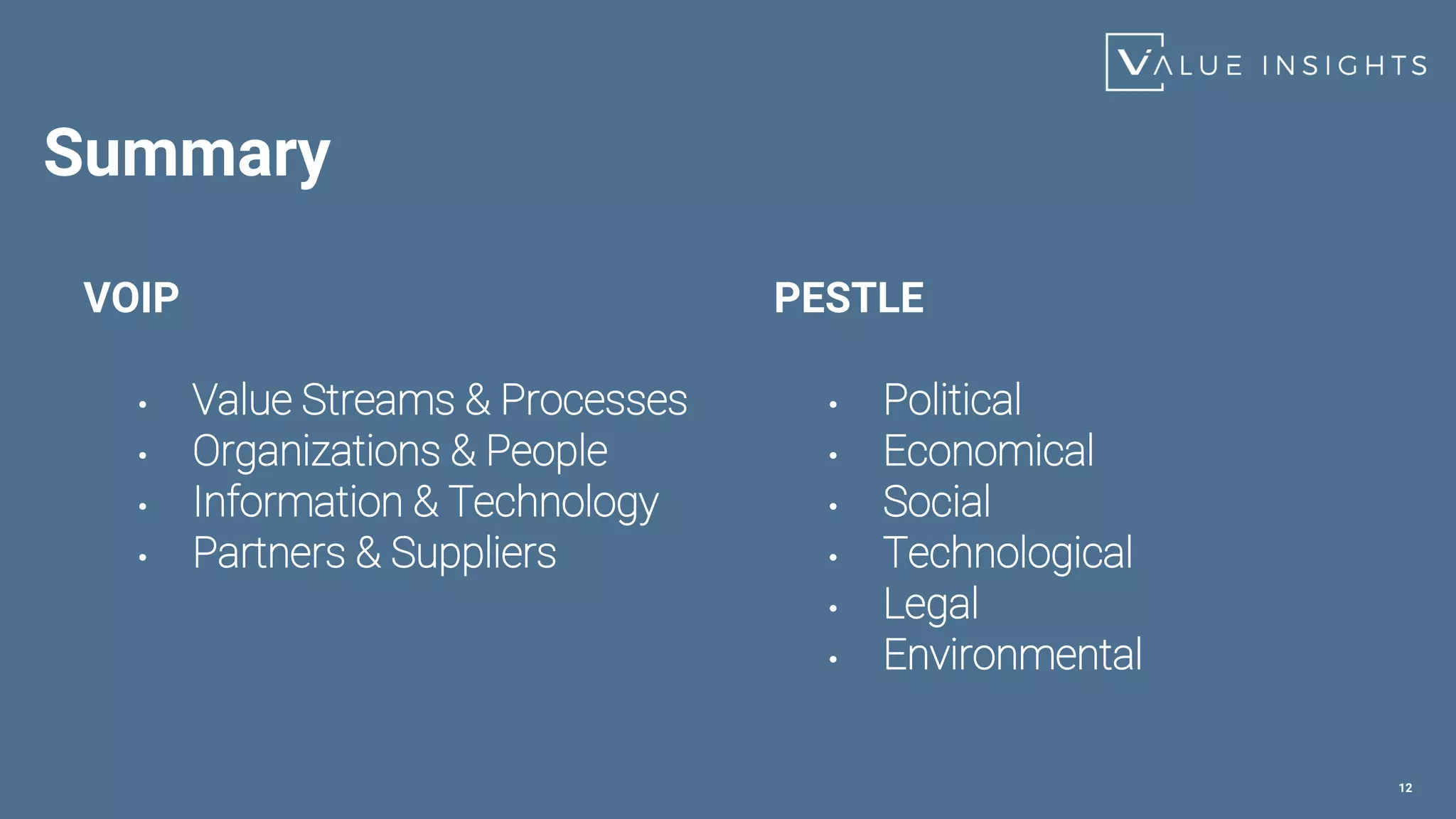
Summary
VOIP
• Value Streams & Processes
• Organizations & People
• Information & Technology
• Partners & Suppliers
12
PESTLE
• Political
• Economical
• Social
• Technological
• Legal
• Environmental
13
• Key-Concepts and Definitions (5)
• The 4 Dimensions (2)
• The Service Value System (1)
• The Guiding Principles (6)
• The Service Value Chain (2)
• Most important practices (19)
• Other examinable practices (5)
Agenda
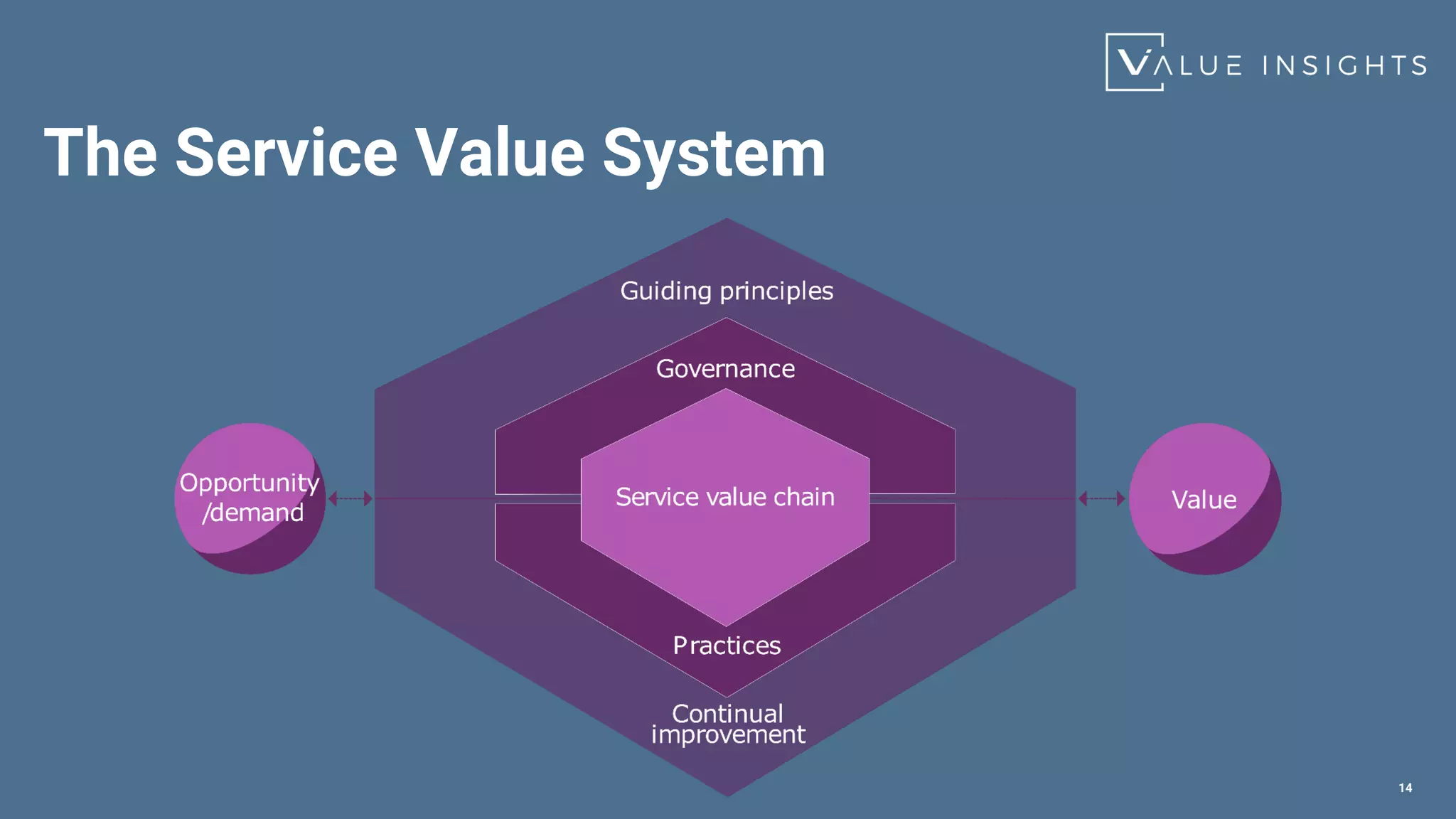
The Service Value System
14
15
• Key-Concepts and Definitions (5)
• The 4 Dimensions (2)
• The Service Value System (1)
• The Guiding Principles (6)
• The Service Value Chain (2)
• Most important practices (19)
• Other examinable practices (5)
Agenda
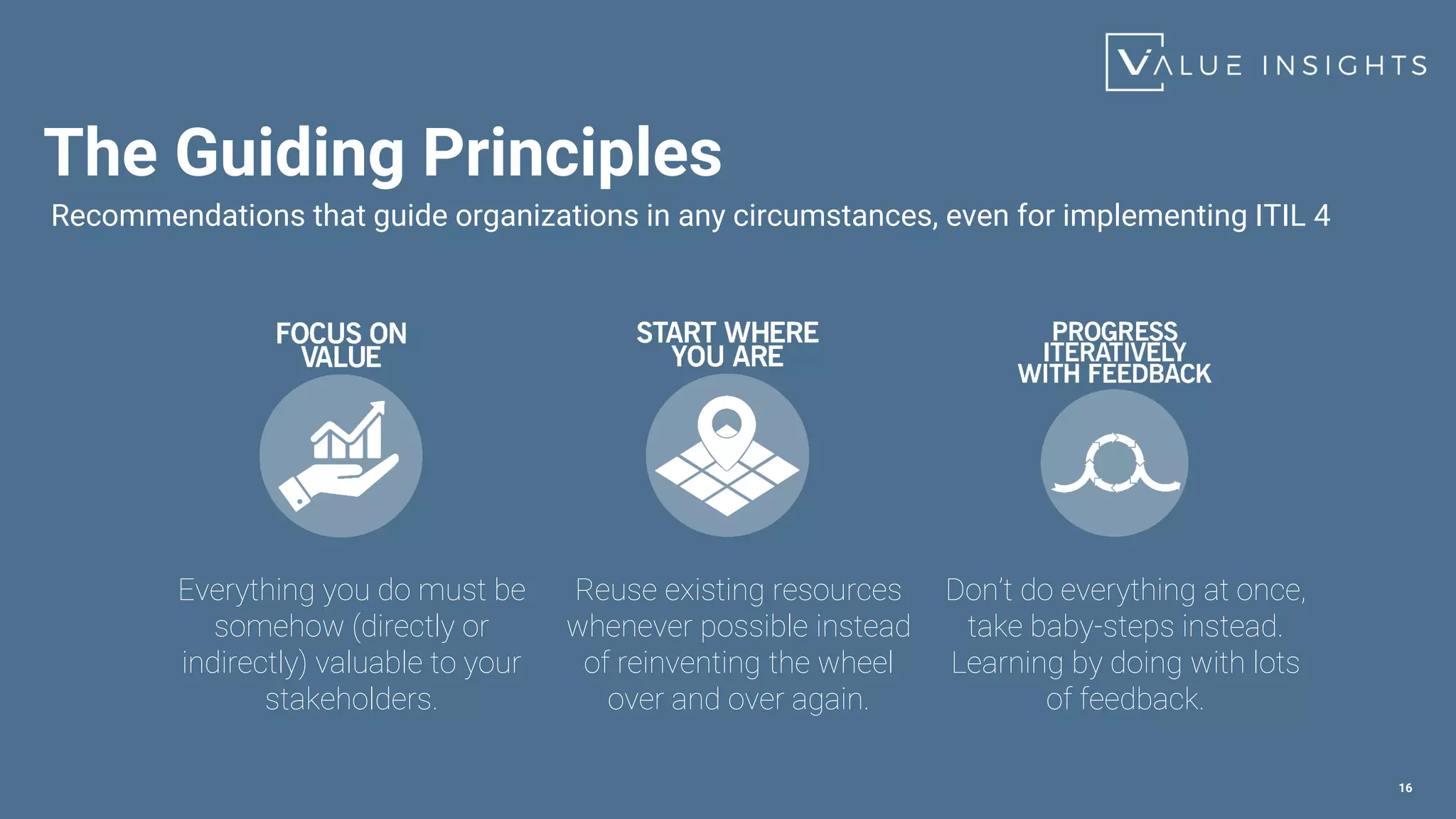
The Guiding Principles
16
Recommendations that guide organizations in any circumstances, even for implementing ITIL 4
Everything you do must be
somehow (directly or
indirectly) valuable to your
stakeholders.
Reuse existing resources
whenever possible instead
of reinventing the wheel
over and over again.
Don’t do everything at once,
take baby-steps instead.
Learning by doing with lots
of feedback.
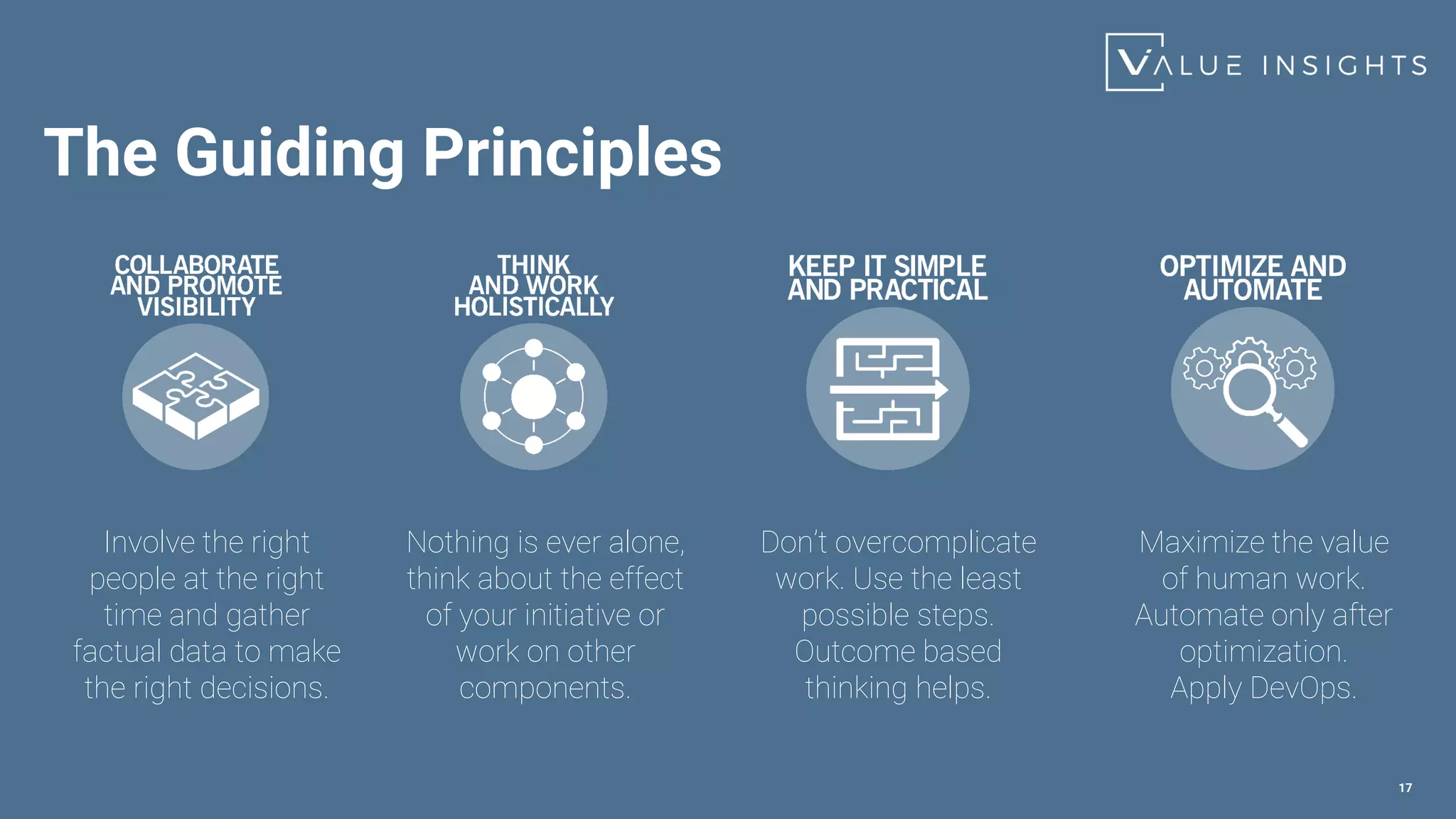
The Guiding Principles
17
Involve the right
people at the right
time and gather
factual data to make
the right decisions.
Nothing is ever alone,
think about the effect
of your initiative or
work on other
components.
Don’t overcomplicate
work. Use the least
possible steps.
Outcome based
thinking helps.
Maximize the value
of human work.
Automate only after
optimization.
Apply DevOps.
Summary
• Universally applicable to any work or initiative
• Represent well-proven, good practice
• Are neither prescriptive nor a must
• Can be applied stand-alone but are better in conjunction
• Have a strong relation to Lean-Agile thinking
18
19
• Key-Concepts and Definitions (5)
• The 4 Dimensions (2)
• The Service Value System (1)
• The Guiding Principles (6)
• The Service Value Chain (2)
• Most important practices (19)
• Other examinable practices (5)
Agenda
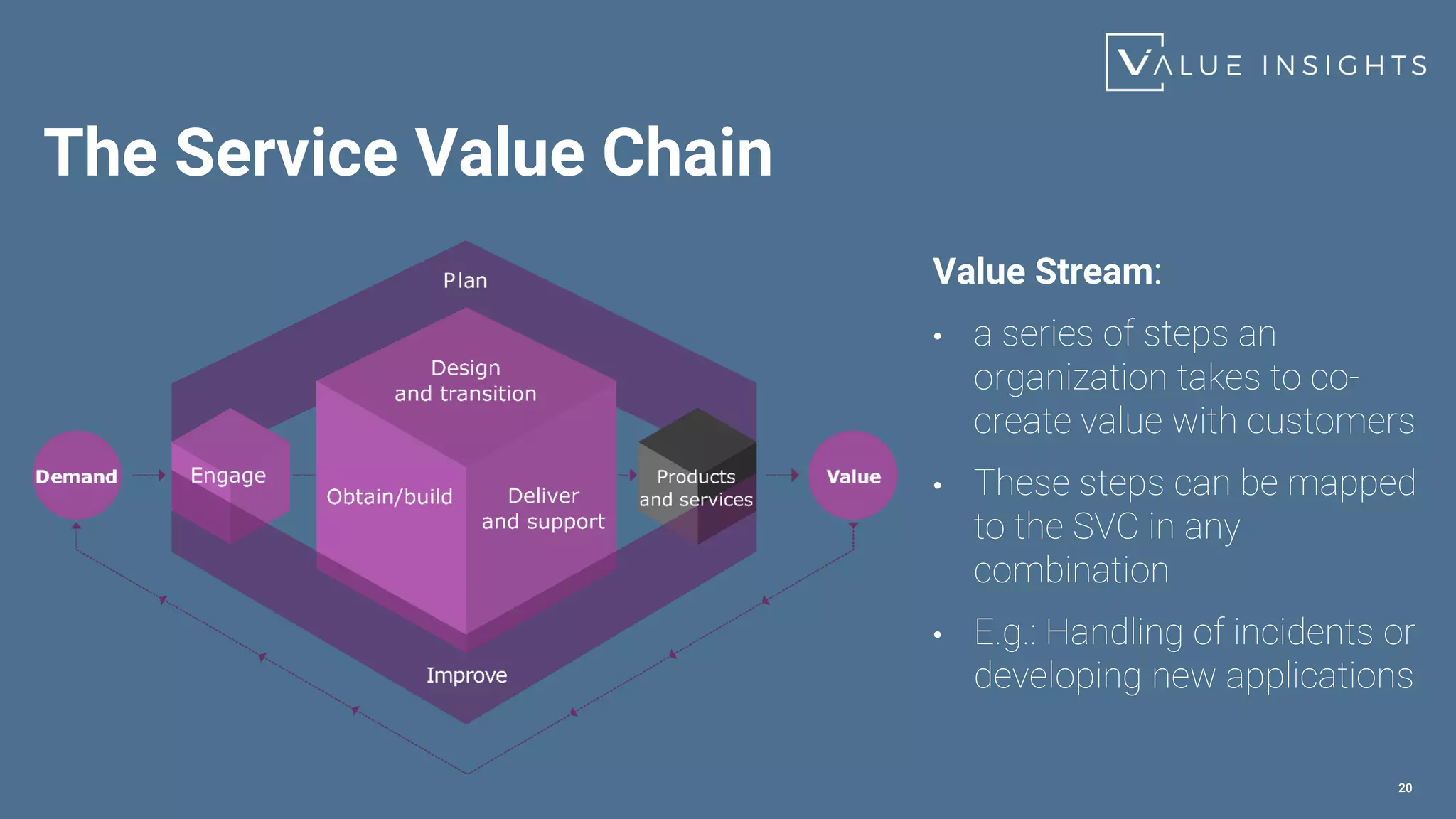
The Service Value Chain
20
Value Stream:
• a series of steps an
organization takes to co-
create value with customers
• These steps can be mapped
to the SVC in any
combination
• E.g.: Handling of incidents or
developing new applications
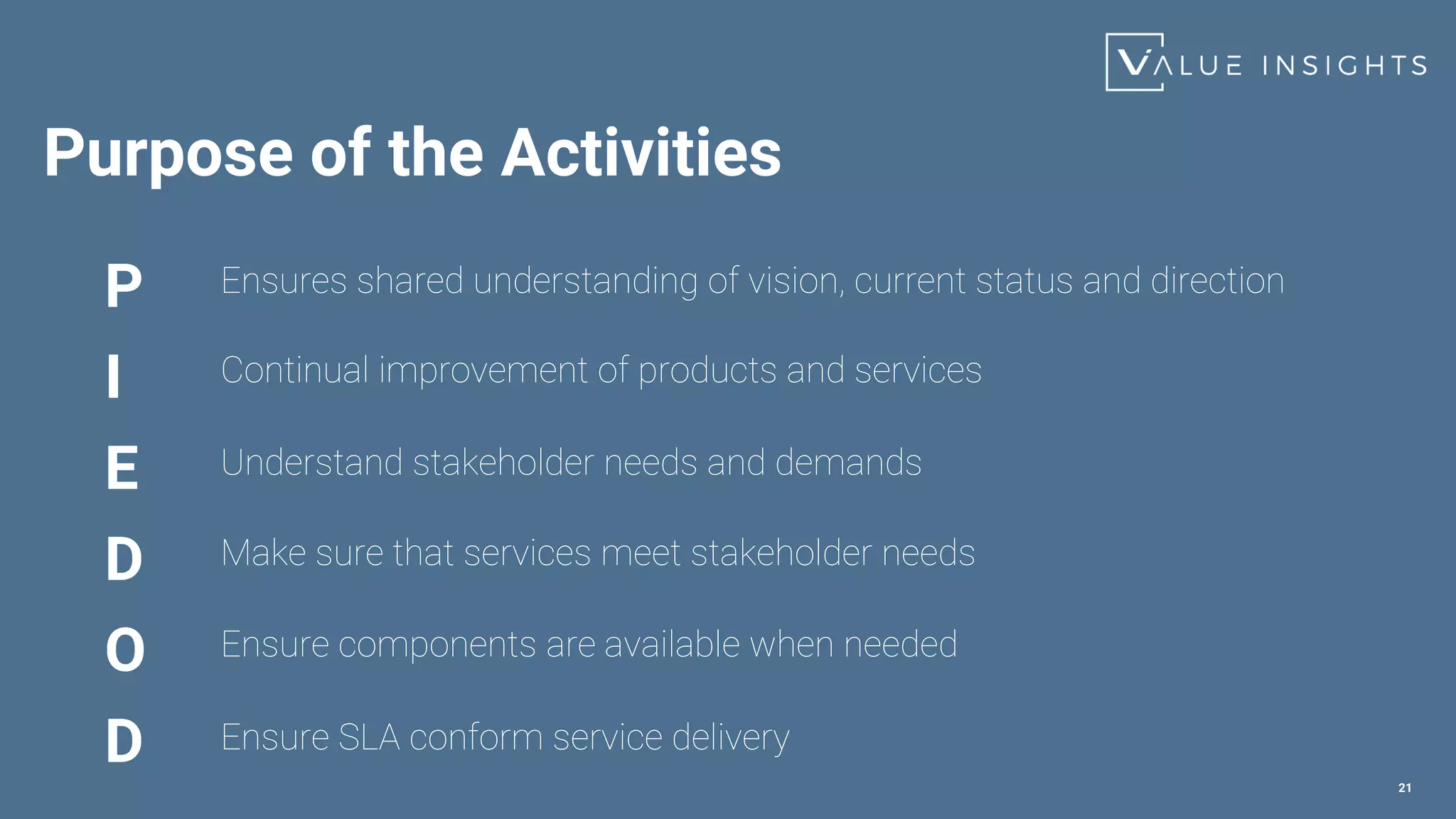
Purpose of the Activities
21
P
I
E
D
O
D
Ensures shared understanding of vision, current status and direction
Continual improvement of products and services
Understand stakeholder needs and demands
Ensure components are available when needed
Make sure that services meet stakeholder needs
Ensure SLA conform service delivery
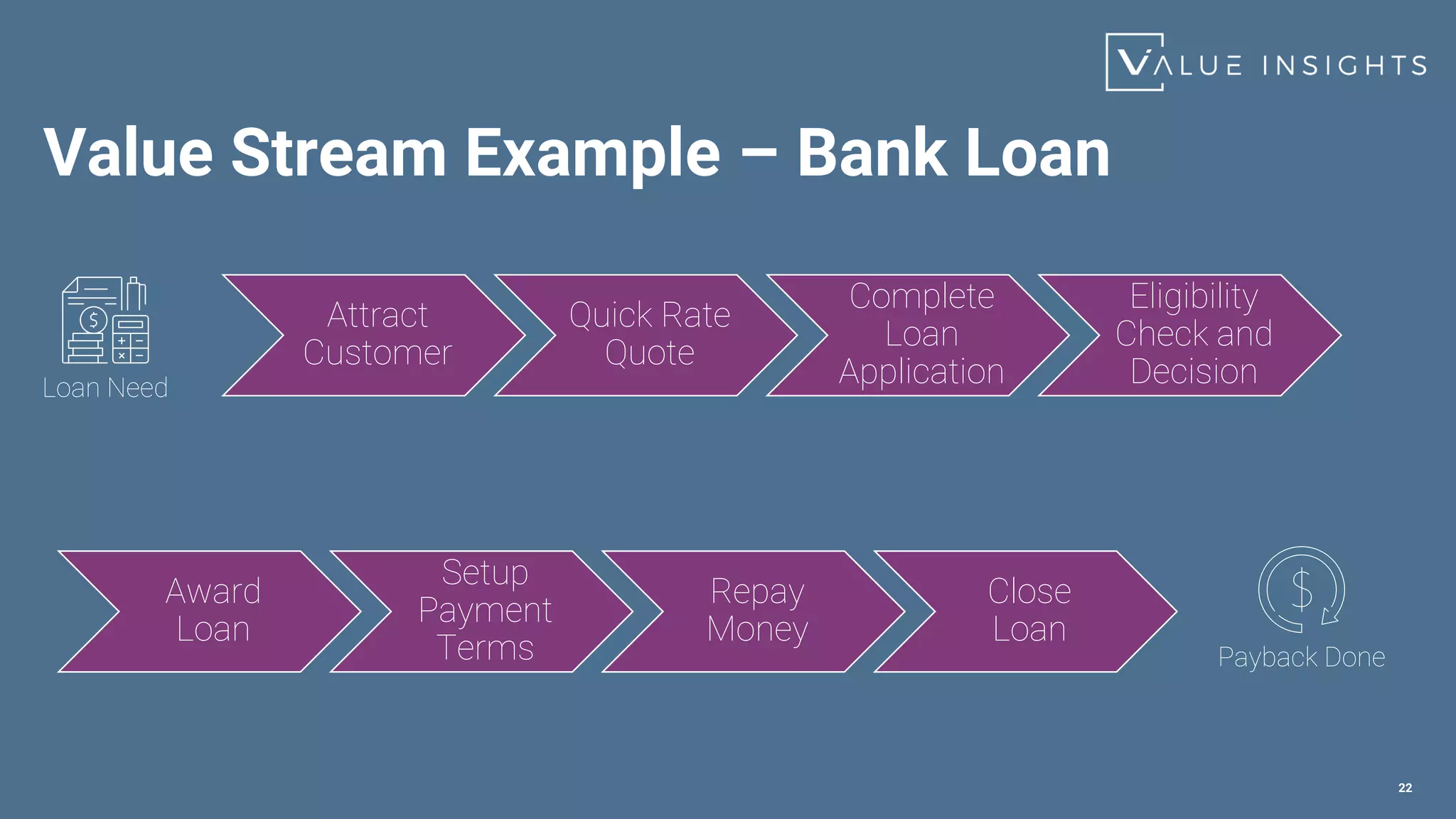
Value Stream Example – Bank Loan
22
Attract
Customer
Quick Rate
Quote
Complete
Loan
Application
Eligibility
Check and
Decision
Loan Need
Award
Loan
Setup
Payment
Terms
Repay
Money
Close
Loan
Payback Done
Summary
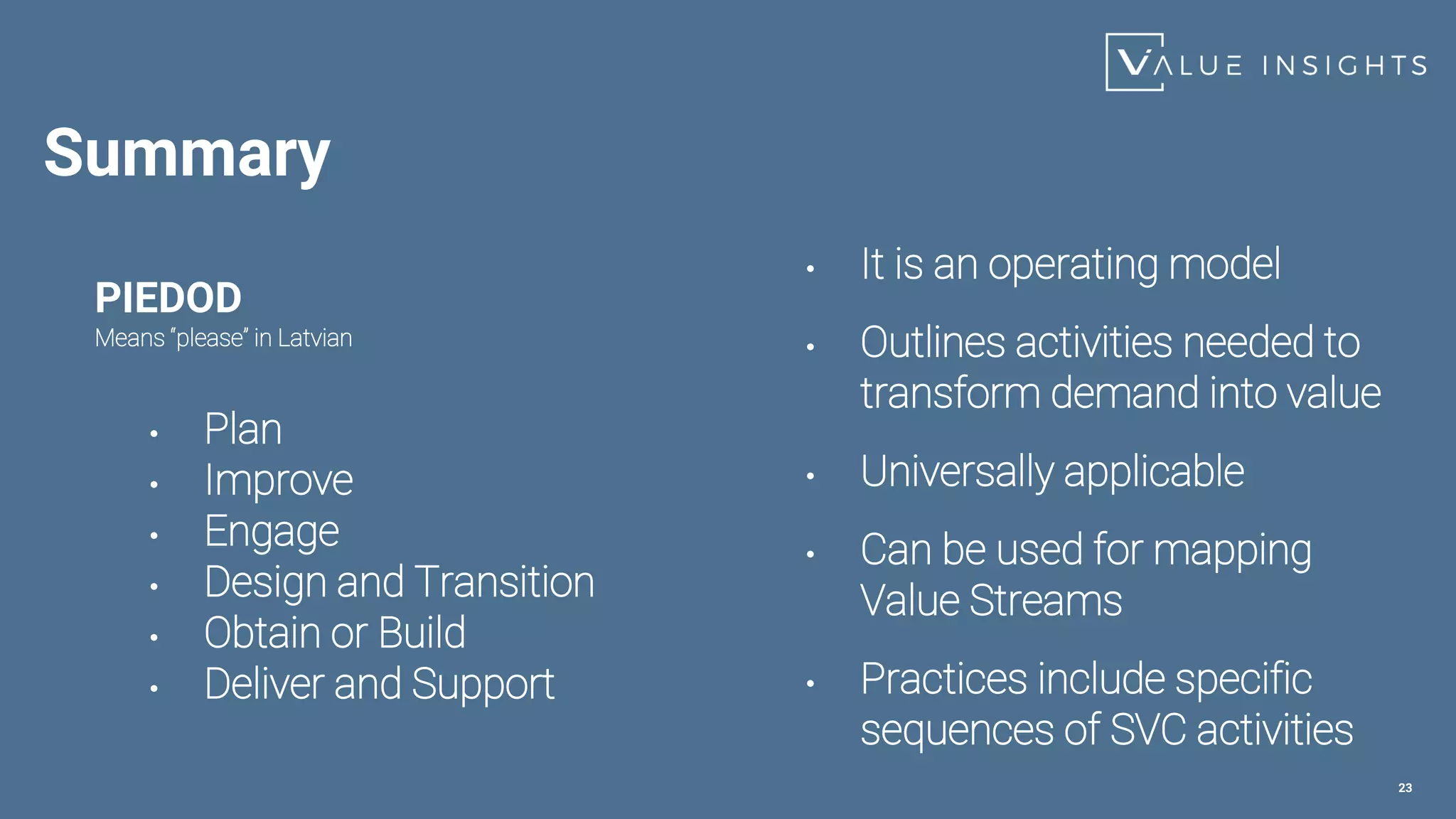
PIEDOD
Means “please” in Latvian
• Plan
• Improve
• Engage
• Design and Transition
• Obtain or Build
• Deliver and Support
23
• It is an operating model
• Outlines activities needed to
transform demand into value
• Universally applicable
• Can be used for mapping
Value Streams
• Practices include specific
sequences of SVC activities
24
• Key-Concepts and Definitions (5)
• The 4 Dimensions (2)
• The Service Value System (1)
• The Guiding Principles (6)
• The Service Value Chain (2)
• Most important practices (19)
• Other examinable practices (5)
Agenda
Practices
25
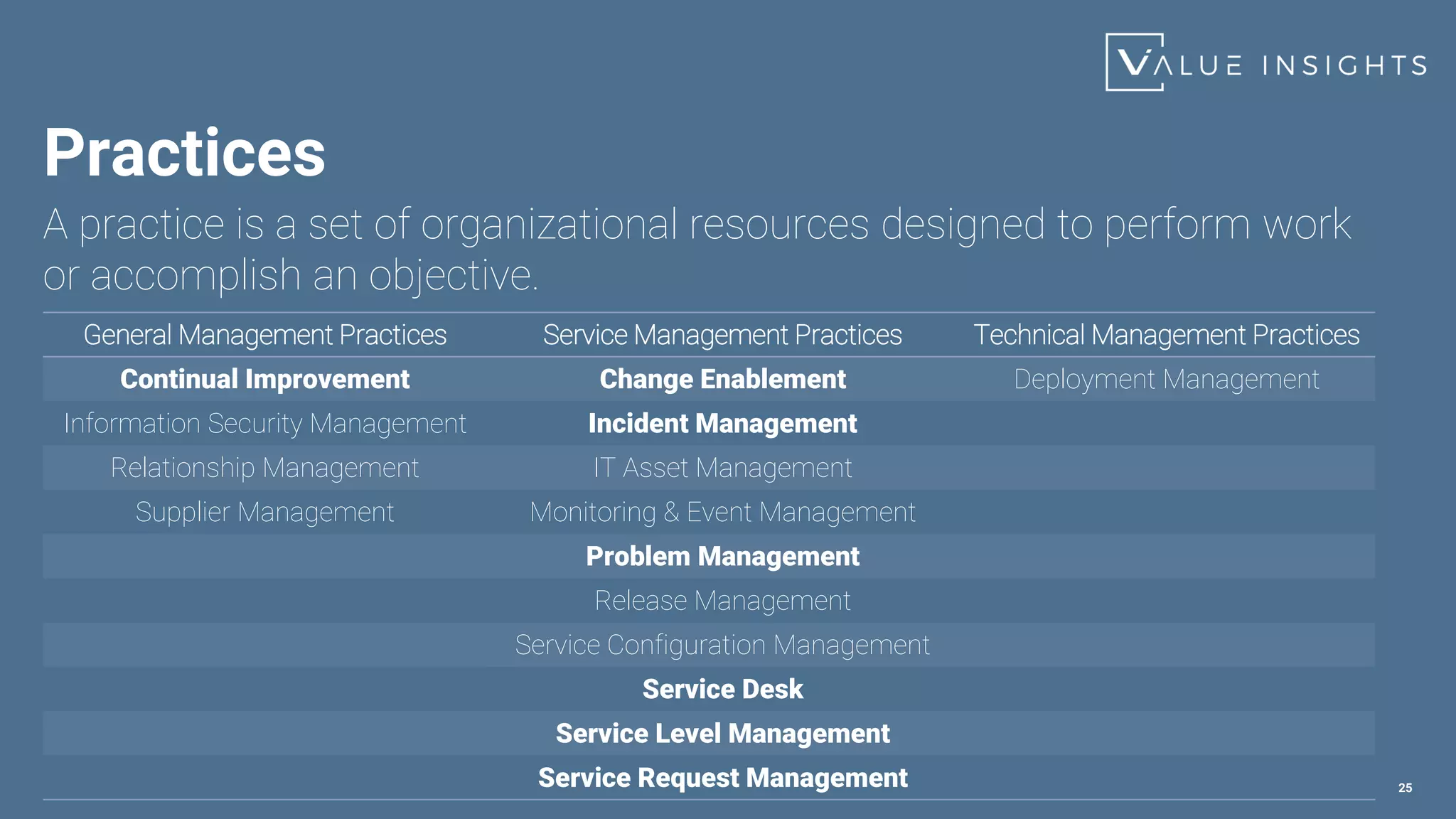
A practice is a set of organizational resources designed to perform work
or accomplish an objective.
General Management Practices Service Management Practices Technical Management Practices
Continual Improvement Change Enablement Deployment Management
Information Security Management Incident Management
Relationship Management IT Asset Management
Supplier Management Monitoring & Event Management
Problem Management
Release Management
Service Configuration Management
Service Desk
Service Level Management
Service Request Management
!Continual Improvement
26
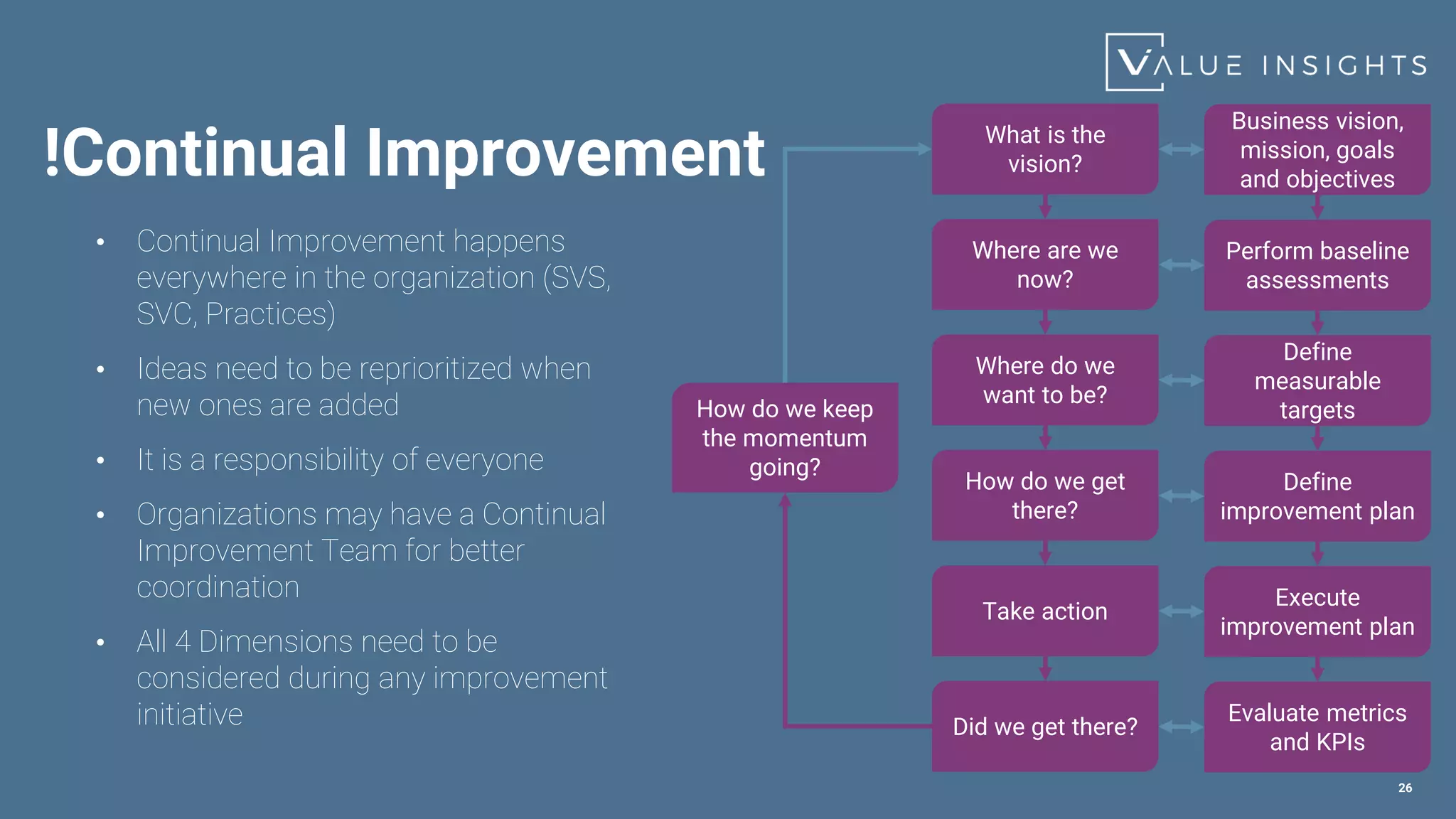
What is the
vision?
Where are we
now?
Where do we
want to be?
How do we get
there?
Take action
Did we get there?
Business vision,
mission, goals
and objectives
Perform baseline
assessments
Define
measurable
targets
Define
improvement plan
Execute
improvement plan
Evaluate metrics
and KPIs
How do we keep
the momentum
going?
• Continual Improvement happens
everywhere in the organization (SVS,
SVC, Practices)
• Ideas need to be reprioritized when
new ones are added
• It is a responsibility of everyone
• Organizations may have a Continual
Improvement Team for better
coordination
• All 4 Dimensions need to be
considered during any improvement
initiative
!Change Enablement
27
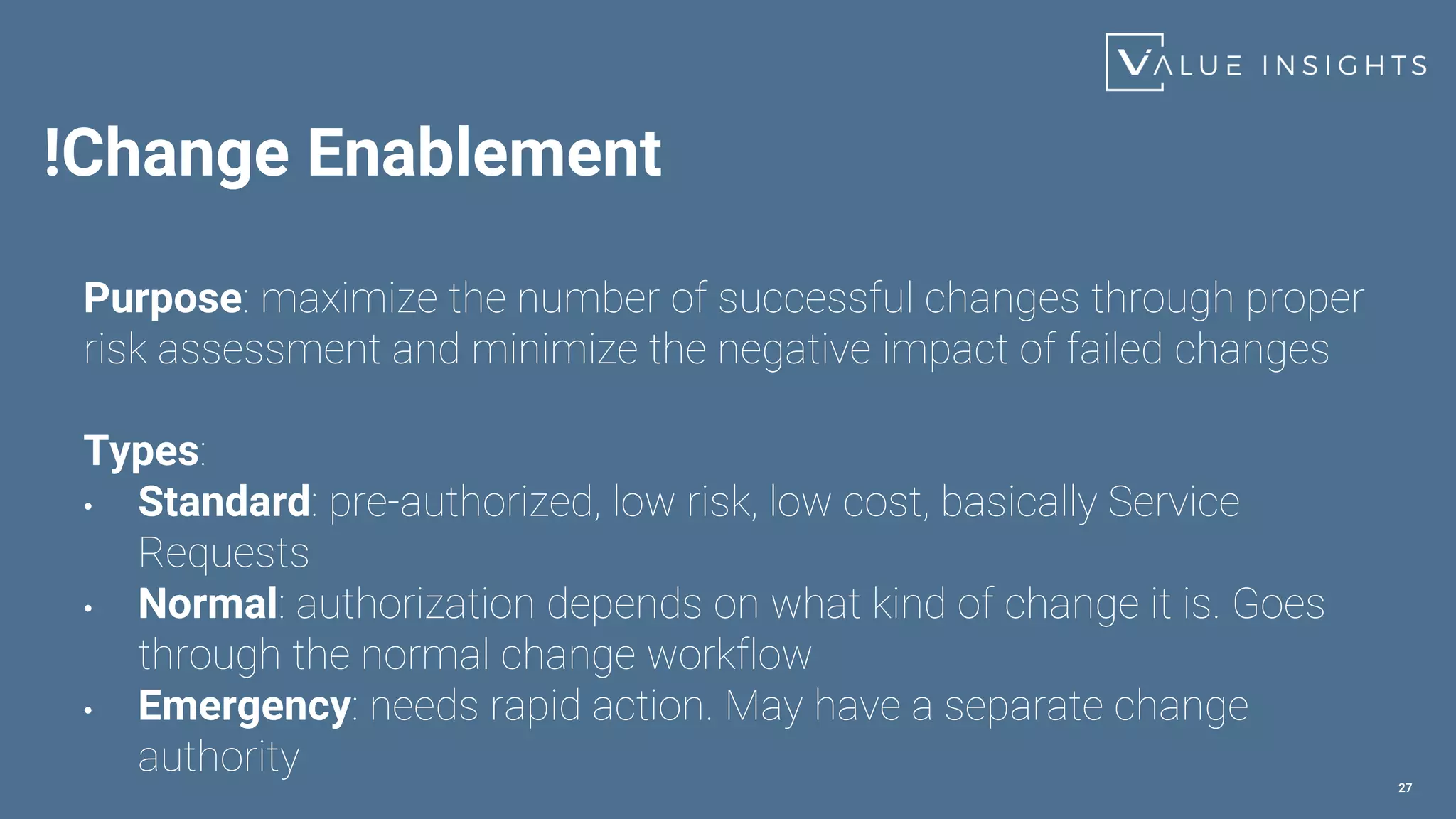
Purpose: maximize the number of successful changes through proper
risk assessment and minimize the negative impact of failed changes
Types:
• Standard: pre-authorized, low risk, low cost, basically Service
Requests
• Normal: authorization depends on what kind of change it is. Goes
through the normal change workflow
• Emergency: needs rapid action. May have a separate change
authority
!Incident Management
28
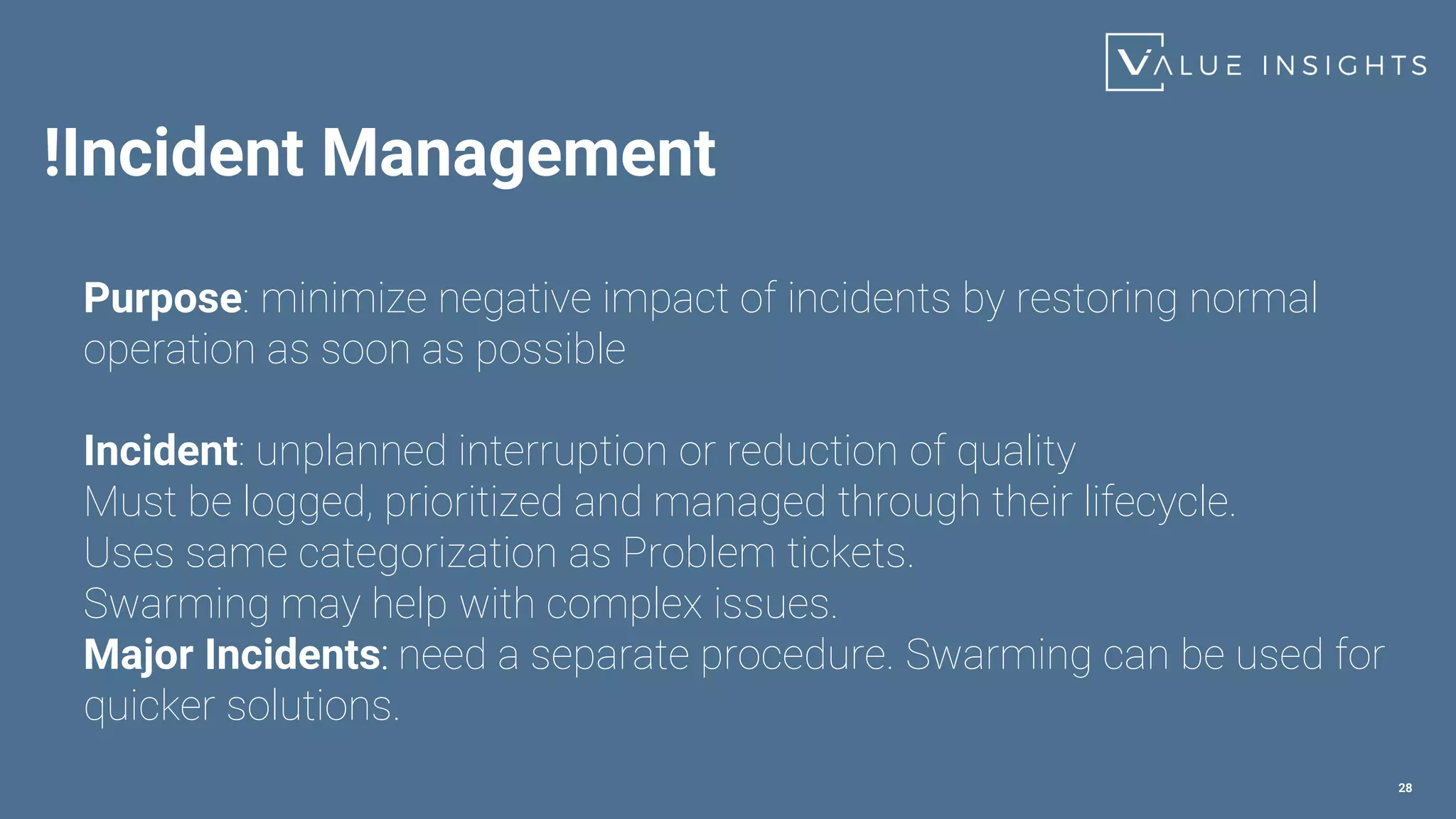
Purpose: minimize negative impact of incidents by restoring normal
operation as soon as possible
Incident: unplanned interruption or reduction of quality
Must be logged, prioritized and managed through their lifecycle.
Uses same categorization as Problem tickets.
Swarming may help with complex issues.
Major Incidents: need a separate procedure. Swarming can be used for
quicker solutions.
!Problem Management
29
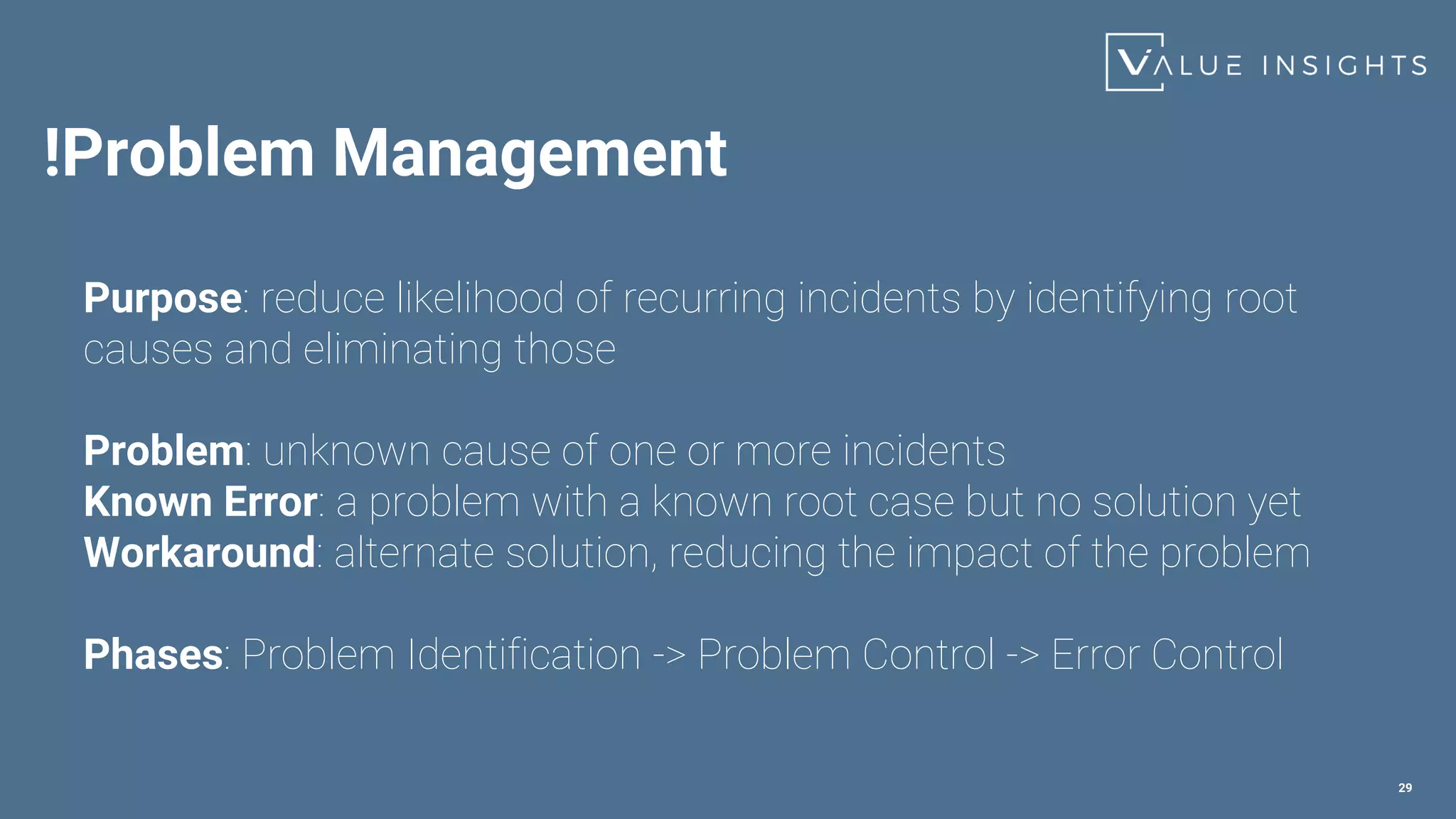
Purpose: reduce likelihood of recurring incidents by identifying root
causes and eliminating those
Problem: unknown cause of one or more incidents
Known Error: a problem with a known root case but no solution yet
Workaround: alternate solution, reducing the impact of the problem
Phases: Problem Identification -> Problem Control -> Error Control
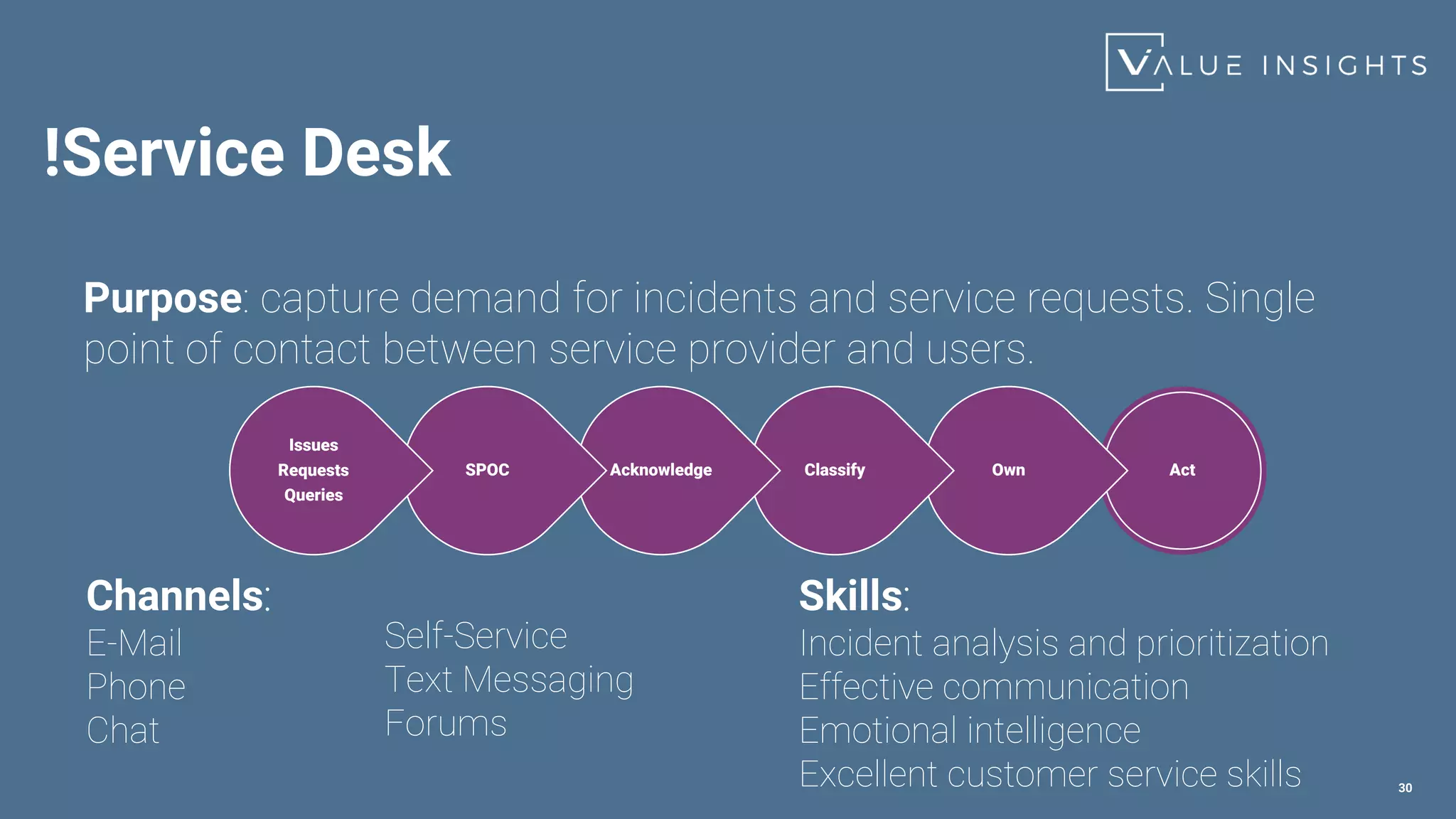
!Service Desk
30
Purpose: capture demand for incidents and service requests. Single
point of contact between service provider and users.
Act
Own
Classify
Acknowledge
SPOC
Issues
Requests
Queries
Channels:
E-Mail
Phone
Chat
Self-Service
Text Messaging
Forums
Skills:
Incident analysis and prioritization
Effective communication
Emotional intelligence
Excellent customer service skills
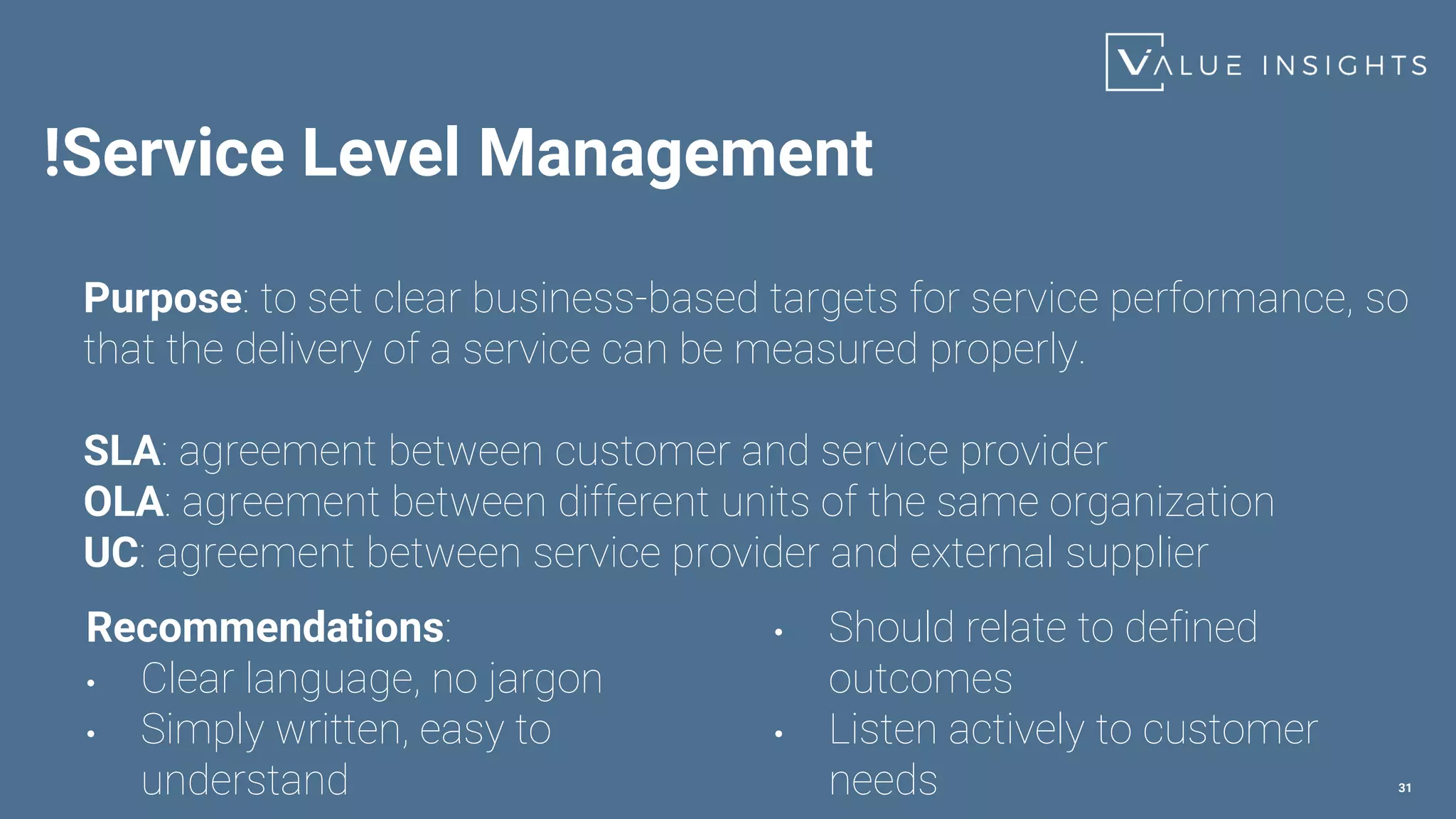
!Service Level Management
31
Purpose: to set clear business-based targets for service performance, so
that the delivery of a service can be measured properly.
SLA: agreement between customer and service provider
OLA: agreement between different units of the same organization
UC: agreement between service provider and external supplier
Recommendations:
• Clear language, no jargon
• Simply written, easy to
understand
• Should relate to defined
outcomes
• Listen actively to customer
needs
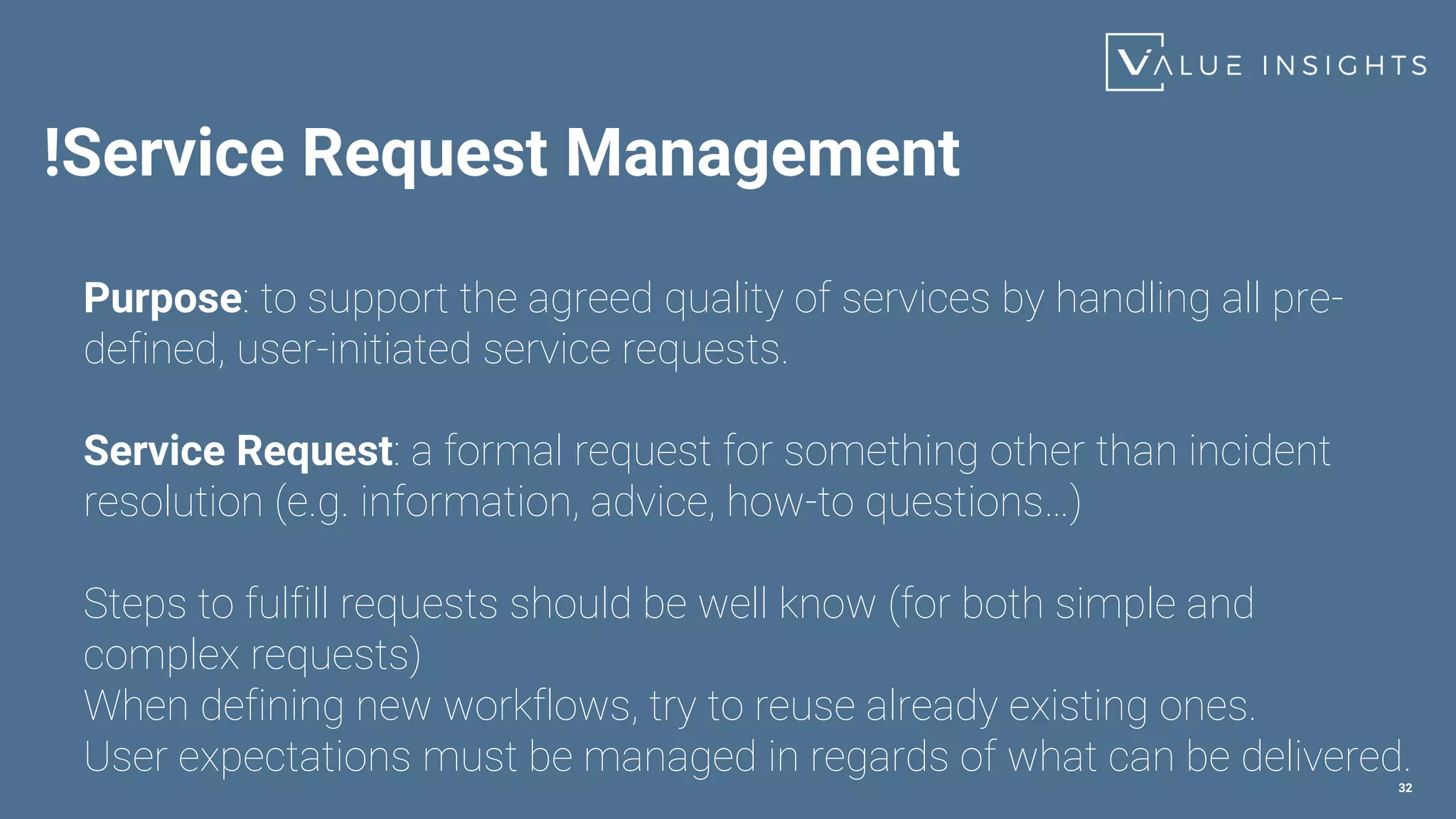
!Service Request Management
32
Purpose: to support the agreed quality of services by handling all pre-
defined, user-initiated service requests.
Service Request: a formal request for something other than incident
resolution (e.g. information, advice, how-to questions…)
Steps to fulfill requests should be well know (for both simple and
complex requests)
When defining new workflows, try to reuse already existing ones.
User expectations must be managed in regards of what can be delivered.
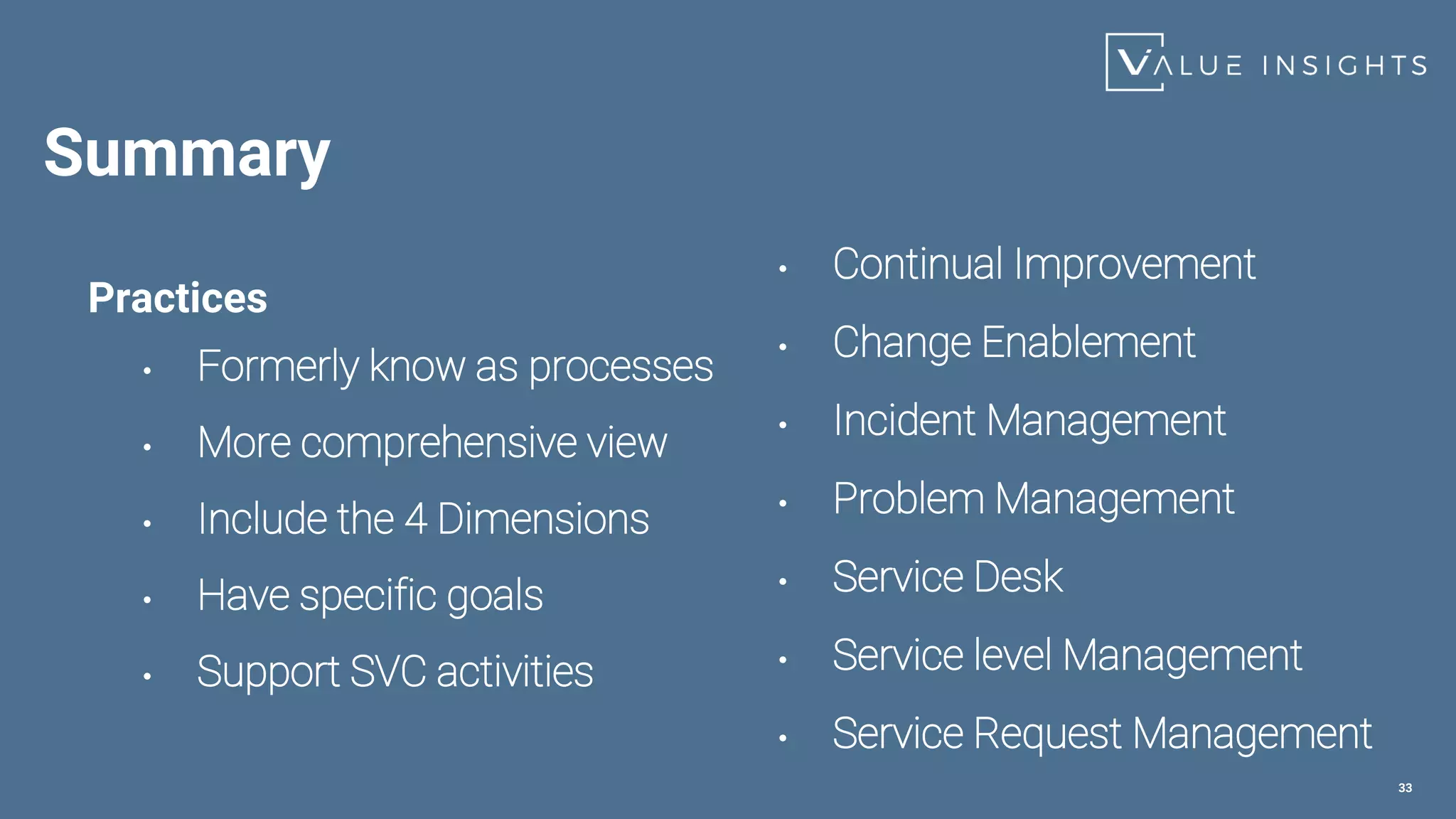
Summary
Practices
• Formerly know as processes
• More comprehensive view
• Include the 4 Dimensions
• Have specific goals
• Support SVC activities
33
• Continual Improvement
• Change Enablement
• Incident Management
• Problem Management
• Service Desk
• Service level Management
• Service Request Management
34
• Key-Concepts and Definitions (5)
• The 4 Dimensions (2)
• The Service Value System (1)
• The Guiding Principles (6)
• The Service Value Chain (2)
• Most important practices (19)
• Other examinable practices (5)
Agenda
Other Practices
35
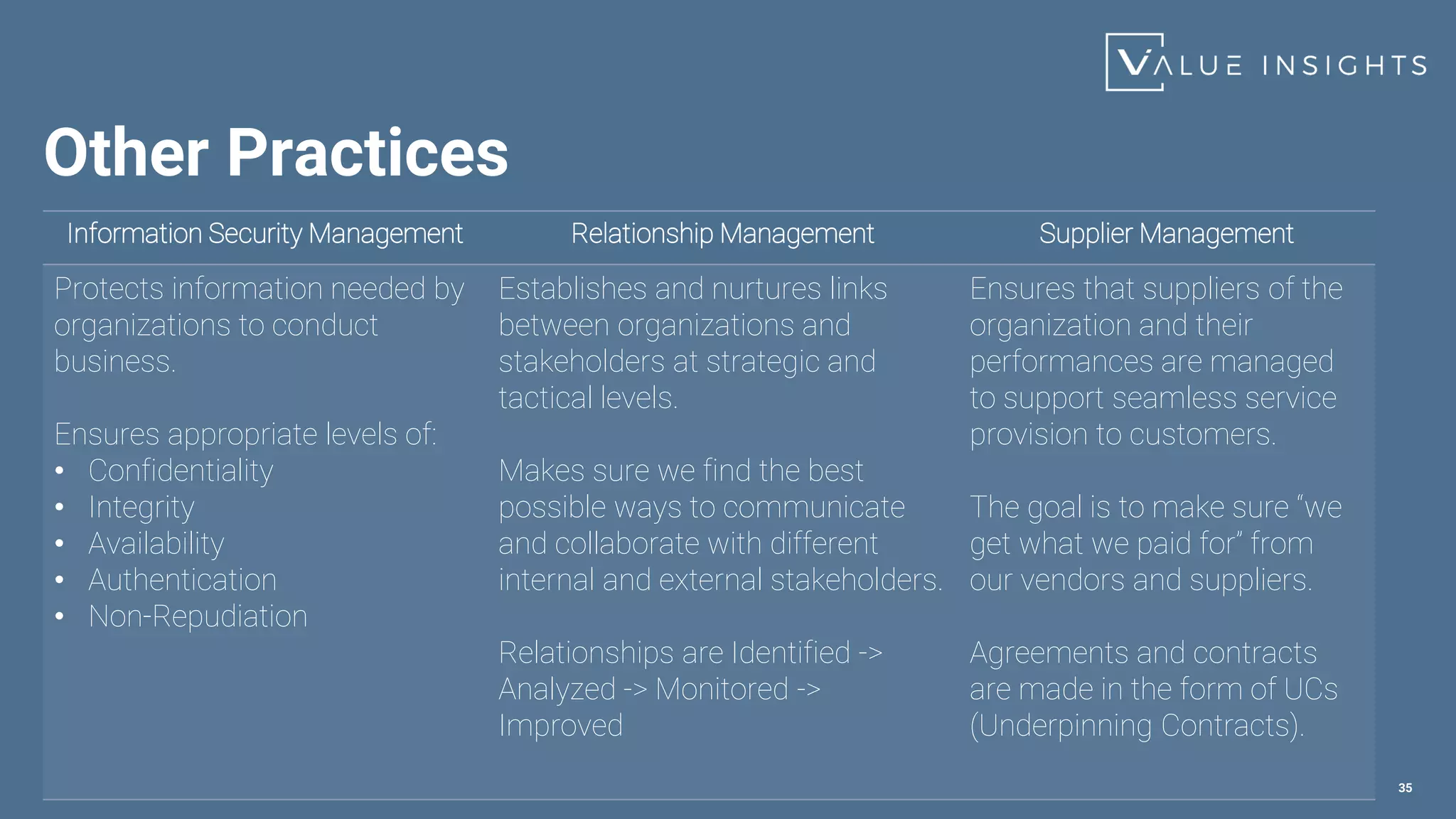
Information Security Management Relationship Management Supplier Management
Protects information needed by
organizations to conduct
business.
Ensures appropriate levels of:
• Confidentiality
• Integrity
• Availability
• Authentication
• Non-Repudiation
Establishes and nurtures links
between organizations and
stakeholders at strategic and
tactical levels.
Makes sure we find the best
possible ways to communicate
and collaborate with different
internal and external stakeholders.
Relationships are Identified ->
Analyzed -> Monitored ->
Improved
Ensures that suppliers of the
organization and their
performances are managed
to support seamless service
provision to customers.
The goal is to make sure “we
get what we paid for” from
our vendors and suppliers.
Agreements and contracts
are made in the form of UCs
(Underpinning Contracts).
Other Practices
36
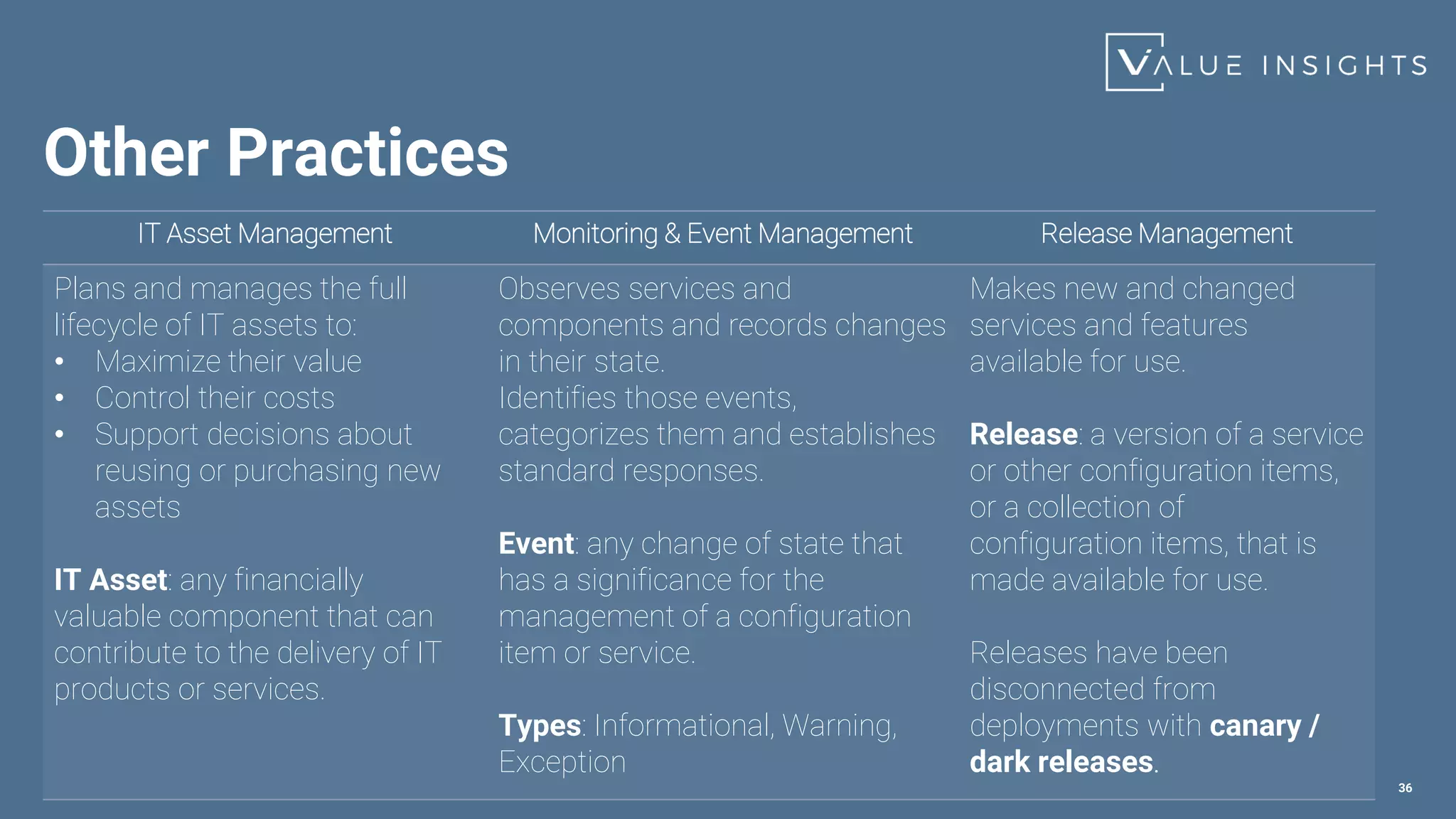
IT Asset Management Monitoring & Event Management Release Management
Plans and manages the full
lifecycle of IT assets to:
• Maximize their value
• Control their costs
• Support decisions about
reusing or purchasing new
assets
IT Asset: any financially
valuable component that can
contribute to the delivery of IT
products or services.
Observes services and
components and records changes
in their state.
Identifies those events,
categorizes them and establishes
standard responses.
Event: any change of state that
has a significance for the
management of a configuration
item or service.
Types: Informational, Warning,
Exception
Makes new and changed
services and features
available for use.
Release: a version of a service
or other configuration items,
or a collection of
configuration items, that is
made available for use.
Releases have been
disconnected from
deployments with canary /
dark releases.
Other Practices
37
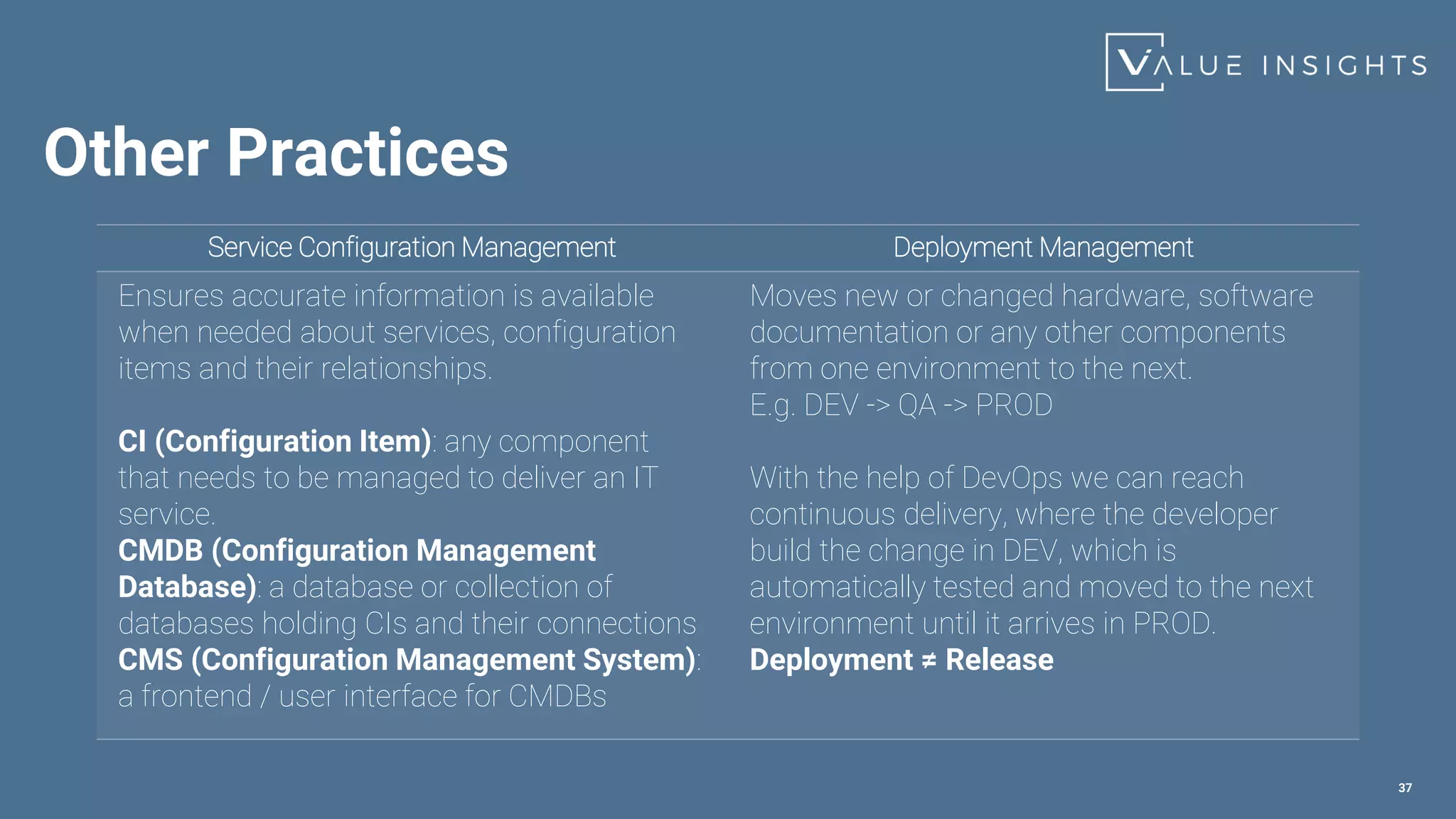
Service Configuration Management Deployment Management
Ensures accurate information is available
when needed about services, configuration
items and their relationships.
CI (Configuration Item): any component
that needs to be managed to deliver an IT
service.
CMDB (Configuration Management
Database): a database or collection of
databases holding CIs and their connections
CMS (Configuration Management System):
a frontend / user interface for CMDBs
Moves new or changed hardware, software
documentation or any other components
from one environment to the next.
E.g. DEV -> QA -> PROD
With the help of DevOps we can reach
continuous delivery, where the developer
build the change in DEV, which is
automatically tested and moved to the next
environment until it arrives in PROD.
Deployment ≠ Release
Summary
38
• Monitoring & Event Mgmt.
• Release Mgmt.
• Service Configuration Mgmt.
• Deployment Mgmt.
• Information Security Mgmt.
• Relationship Mgmt.
• Supplier Mgmt.
• IT Asset Mgmt.
Remember at least the purpose for the following practices
Purpose:
• To ensure…..
GET IN TOUCH
WITH US
O U R C O M P A N Y
- [ ] -
https://valueinsights.ch info@valueinsights.ch
Value Insights GmbH
39
Previous Video Next Video
Subscribe

Value Insights - ITIL 4 Foundation - exam preparation v1.0 (1).pdf

  • 1.
    I T IL 4 F O U N D A T I O N EXAM PREPARATION
  • 2.
    2 Accredited ITIL 4MP & Trainer ScrumInc. Scrum Master SAFe Program Consultant Service Management Enthusiast Landscape Photographer Drone Pilot Nature Lover / Bird Man Husband of a wonderful wife and father of a little girl
  • 3.
    3 • Key-Concepts andDefinitions (5) • The 4 Dimensions (2) • The Service Value System (1) • The Guiding Principles (6) • The Service Value Chain (2) • Most important practices (19) • Other examinable practices (5) Agenda
  • 4.
    4 • Key-Concepts andDefinitions (5) • The 4 Dimensions (2) • The Service Value System (1) • The Guiding Principles (6) • The Service Value Chain (2) • Most important practices (19) • Other examinable practices (5) Agenda
  • 5.
    Key Concepts andDefinitions • Service Management: A set of specialized organizational capabilities for enabling value to customers in the form of services • Value: The perceived benefits, usefulness and importance of something • Customer: Defines requirements for services • User: A person who uses the service • Sponsor: Authorizes budgets for services • Supplier: External partner who provides services to the organization • Organization: A group of people that has its own functions, responsibilities and authorities to achieve specific objectives. 5
  • 6.
    Key Concepts andDefinitions • Service: The means of enabling value co-creation by facilitating outcomes that customers want to achieve without the customer having to manage specific costs and risks. • Product: A configuration of resources, created by the organization, that will be potentially valuable to customers. • Service Offering: A specific mix of services and products sold to a specific customer. • Goods: ownership is transferred to customer • Access to resources: customer is allowed to use it • Service Actions: things the service provider does for the customer 6
  • 7.
    Key Concepts andDefinitions • Output: A tangible or intangible deliverable of an activity • Outcome: A result for a stakeholder enabled by one or more outputs • Cost: Can be removed from the customer (part of value proposition) and can be imposed on the customer (price for service consumption) • Risk: uncertainty of outcome. Can be good (opportunity) or bad (hazard) • Utility: Fit for purpose. Service does what it is meant to do. • Warranty: Fit for use. Service does this good enough • Availability, Capacity, Continuity, Security good enough? • Value = Utility + Warranty ( + perception) 7
  • 8.
    Summary Key Concepts • ServiceManagement • Stakeholders • Value • Value Co-Creation 8 Definitions • Service • Service Offerings • Output vs. Outcome • Risk • Utility + Warranty
  • 9.
    9 • Key-Concepts andDefinitions (5) • The 4 Dimensions (2) • The Service Value System (1) • The Guiding Principles (6) • The Service Value Chain (2) • Most important practices (19) • Other examinable practices (5) Agenda
  • 10.
    The 4 Dimensions 10 •VOIP -> can be influenced by the organization • PESTLE -> external factors, that cannot be influenced but need to be considered • Political • Economical • Social • Technological • Legal • Environmental
  • 11.
    The 4 Dimensions 11 ValueStreams and Processes • Activities the organization undertakes • Organization of these activities • Ensuring value to stakeholders • Exercise value stream mapping Organizations and People • Organizational Structures • Decision making habits • Staffing and skill requirements • Culture and leadership styles Information and Technology • Information and tools needed • Technologies and innovation • Relationship between components • Culture of knowledge management Partners and Suppliers • Relationship with external vendors • Factors that influence suppliers strategies • Service integration management • Vendor selection procedures
  • 12.
    Summary VOIP • Value Streams& Processes • Organizations & People • Information & Technology • Partners & Suppliers 12 PESTLE • Political • Economical • Social • Technological • Legal • Environmental
  • 13.
    13 • Key-Concepts andDefinitions (5) • The 4 Dimensions (2) • The Service Value System (1) • The Guiding Principles (6) • The Service Value Chain (2) • Most important practices (19) • Other examinable practices (5) Agenda
  • 14.
  • 15.
    15 • Key-Concepts andDefinitions (5) • The 4 Dimensions (2) • The Service Value System (1) • The Guiding Principles (6) • The Service Value Chain (2) • Most important practices (19) • Other examinable practices (5) Agenda
  • 16.
    The Guiding Principles 16 Recommendationsthat guide organizations in any circumstances, even for implementing ITIL 4 Everything you do must be somehow (directly or indirectly) valuable to your stakeholders. Reuse existing resources whenever possible instead of reinventing the wheel over and over again. Don’t do everything at once, take baby-steps instead. Learning by doing with lots of feedback.
  • 17.
    The Guiding Principles 17 Involvethe right people at the right time and gather factual data to make the right decisions. Nothing is ever alone, think about the effect of your initiative or work on other components. Don’t overcomplicate work. Use the least possible steps. Outcome based thinking helps. Maximize the value of human work. Automate only after optimization. Apply DevOps.
  • 18.
    Summary • Universally applicableto any work or initiative • Represent well-proven, good practice • Are neither prescriptive nor a must • Can be applied stand-alone but are better in conjunction • Have a strong relation to Lean-Agile thinking 18
  • 19.
    19 • Key-Concepts andDefinitions (5) • The 4 Dimensions (2) • The Service Value System (1) • The Guiding Principles (6) • The Service Value Chain (2) • Most important practices (19) • Other examinable practices (5) Agenda
  • 20.
    The Service ValueChain 20 Value Stream: • a series of steps an organization takes to co- create value with customers • These steps can be mapped to the SVC in any combination • E.g.: Handling of incidents or developing new applications
  • 21.
    Purpose of theActivities 21 P I E D O D Ensures shared understanding of vision, current status and direction Continual improvement of products and services Understand stakeholder needs and demands Ensure components are available when needed Make sure that services meet stakeholder needs Ensure SLA conform service delivery
  • 22.
    Value Stream Example– Bank Loan 22 Attract Customer Quick Rate Quote Complete Loan Application Eligibility Check and Decision Loan Need Award Loan Setup Payment Terms Repay Money Close Loan Payback Done
  • 23.
    Summary PIEDOD Means “please” inLatvian • Plan • Improve • Engage • Design and Transition • Obtain or Build • Deliver and Support 23 • It is an operating model • Outlines activities needed to transform demand into value • Universally applicable • Can be used for mapping Value Streams • Practices include specific sequences of SVC activities
  • 24.
    24 • Key-Concepts andDefinitions (5) • The 4 Dimensions (2) • The Service Value System (1) • The Guiding Principles (6) • The Service Value Chain (2) • Most important practices (19) • Other examinable practices (5) Agenda
  • 25.
    Practices 25 A practice isa set of organizational resources designed to perform work or accomplish an objective. General Management Practices Service Management Practices Technical Management Practices Continual Improvement Change Enablement Deployment Management Information Security Management Incident Management Relationship Management IT Asset Management Supplier Management Monitoring & Event Management Problem Management Release Management Service Configuration Management Service Desk Service Level Management Service Request Management
  • 26.
    !Continual Improvement 26 What isthe vision? Where are we now? Where do we want to be? How do we get there? Take action Did we get there? Business vision, mission, goals and objectives Perform baseline assessments Define measurable targets Define improvement plan Execute improvement plan Evaluate metrics and KPIs How do we keep the momentum going? • Continual Improvement happens everywhere in the organization (SVS, SVC, Practices) • Ideas need to be reprioritized when new ones are added • It is a responsibility of everyone • Organizations may have a Continual Improvement Team for better coordination • All 4 Dimensions need to be considered during any improvement initiative
  • 27.
    !Change Enablement 27 Purpose: maximizethe number of successful changes through proper risk assessment and minimize the negative impact of failed changes Types: • Standard: pre-authorized, low risk, low cost, basically Service Requests • Normal: authorization depends on what kind of change it is. Goes through the normal change workflow • Emergency: needs rapid action. May have a separate change authority
  • 28.
    !Incident Management 28 Purpose: minimizenegative impact of incidents by restoring normal operation as soon as possible Incident: unplanned interruption or reduction of quality Must be logged, prioritized and managed through their lifecycle. Uses same categorization as Problem tickets. Swarming may help with complex issues. Major Incidents: need a separate procedure. Swarming can be used for quicker solutions.
  • 29.
    !Problem Management 29 Purpose: reducelikelihood of recurring incidents by identifying root causes and eliminating those Problem: unknown cause of one or more incidents Known Error: a problem with a known root case but no solution yet Workaround: alternate solution, reducing the impact of the problem Phases: Problem Identification -> Problem Control -> Error Control
  • 30.
    !Service Desk 30 Purpose: capturedemand for incidents and service requests. Single point of contact between service provider and users. Act Own Classify Acknowledge SPOC Issues Requests Queries Channels: E-Mail Phone Chat Self-Service Text Messaging Forums Skills: Incident analysis and prioritization Effective communication Emotional intelligence Excellent customer service skills
  • 31.
    !Service Level Management 31 Purpose:to set clear business-based targets for service performance, so that the delivery of a service can be measured properly. SLA: agreement between customer and service provider OLA: agreement between different units of the same organization UC: agreement between service provider and external supplier Recommendations: • Clear language, no jargon • Simply written, easy to understand • Should relate to defined outcomes • Listen actively to customer needs
  • 32.
    !Service Request Management 32 Purpose:to support the agreed quality of services by handling all pre- defined, user-initiated service requests. Service Request: a formal request for something other than incident resolution (e.g. information, advice, how-to questions…) Steps to fulfill requests should be well know (for both simple and complex requests) When defining new workflows, try to reuse already existing ones. User expectations must be managed in regards of what can be delivered.
  • 33.
    Summary Practices • Formerly knowas processes • More comprehensive view • Include the 4 Dimensions • Have specific goals • Support SVC activities 33 • Continual Improvement • Change Enablement • Incident Management • Problem Management • Service Desk • Service level Management • Service Request Management
  • 34.
    34 • Key-Concepts andDefinitions (5) • The 4 Dimensions (2) • The Service Value System (1) • The Guiding Principles (6) • The Service Value Chain (2) • Most important practices (19) • Other examinable practices (5) Agenda
  • 35.
    Other Practices 35 Information SecurityManagement Relationship Management Supplier Management Protects information needed by organizations to conduct business. Ensures appropriate levels of: • Confidentiality • Integrity • Availability • Authentication • Non-Repudiation Establishes and nurtures links between organizations and stakeholders at strategic and tactical levels. Makes sure we find the best possible ways to communicate and collaborate with different internal and external stakeholders. Relationships are Identified -> Analyzed -> Monitored -> Improved Ensures that suppliers of the organization and their performances are managed to support seamless service provision to customers. The goal is to make sure “we get what we paid for” from our vendors and suppliers. Agreements and contracts are made in the form of UCs (Underpinning Contracts).
  • 36.
    Other Practices 36 IT AssetManagement Monitoring & Event Management Release Management Plans and manages the full lifecycle of IT assets to: • Maximize their value • Control their costs • Support decisions about reusing or purchasing new assets IT Asset: any financially valuable component that can contribute to the delivery of IT products or services. Observes services and components and records changes in their state. Identifies those events, categorizes them and establishes standard responses. Event: any change of state that has a significance for the management of a configuration item or service. Types: Informational, Warning, Exception Makes new and changed services and features available for use. Release: a version of a service or other configuration items, or a collection of configuration items, that is made available for use. Releases have been disconnected from deployments with canary / dark releases.
  • 37.
    Other Practices 37 Service ConfigurationManagement Deployment Management Ensures accurate information is available when needed about services, configuration items and their relationships. CI (Configuration Item): any component that needs to be managed to deliver an IT service. CMDB (Configuration Management Database): a database or collection of databases holding CIs and their connections CMS (Configuration Management System): a frontend / user interface for CMDBs Moves new or changed hardware, software documentation or any other components from one environment to the next. E.g. DEV -> QA -> PROD With the help of DevOps we can reach continuous delivery, where the developer build the change in DEV, which is automatically tested and moved to the next environment until it arrives in PROD. Deployment ≠ Release
  • 38.
    Summary 38 • Monitoring &Event Mgmt. • Release Mgmt. • Service Configuration Mgmt. • Deployment Mgmt. • Information Security Mgmt. • Relationship Mgmt. • Supplier Mgmt. • IT Asset Mgmt. Remember at least the purpose for the following practices Purpose: • To ensure…..
  • 39.
    GET IN TOUCH WITHUS O U R C O M P A N Y - [ ] - https://valueinsights.ch info@valueinsights.ch Value Insights GmbH 39
  • 40.
    Previous Video NextVideo Subscribe