International Journal of Advanced Research in Engineering and Technology (IJARET), ISSN 0976 –
6480(Print), ISSN 0976 – 6499(Online), Volume 6, Issue 3, March (2015), pp. 62-69 © IAEME
62
ITERATIVE METHODS FOR THE SOLUTION OF
SADDLE POINT PROBLEM
NDZANA Benoît
Senior Lecturer, National Advanced School of Engineering,
University of Yaounde I, Cameroon
BIYA MOTTO
Frederic, Senior Lecturer, Faculty of Sciences,
University of Yaounde I, Cameroon
LEKINI NKODO Claude Bernard
P.H.D. Student; National Advanced School of Engineering,
University of Yaounde I, Cameroon
ABSTRACT
Some new iterative methods for numerical solution of mixed finite element approximation of
Stokes problem are presented. The idea is the use of proper preconditioning for the conjugate
gradient algorithm. A particular case gives a variant of the Arrow-Hurwicz method.
I. STATEMENT OF THE PROBLEM
Let us consider a polygonal domain 	⊂ܴ௡
(n=2 or 3) of regular boundary ߲ = Γ.
Let us denote ܸ = ൛‫ݒ‬ ∈ ൫‫1ܪ‬ሺ ሻ൯
௡
ൟ, ܳ = ‫ܮ‬ଶሺ ሻ, ߳ሺ‫ݒ‬ሻ = ቀ߳௜௝ሺ‫ݒ‬ሻቁ
ଵஸ௜,௝ஸ௡
and
(1.1) ߳௜௝ሺ‫ݒ‬ሻ =
ଵ
ଶ
[
డ௩೔
డ௫ೕ
+
డ௩ೕ
డ௫೔
]
The Stokes problem for fluid flow is
(1.2.) ൞
−‫ݒ‬ ∑
డ
డ௫ೕ
߳௜௝ሺ‫ݑ‬ሻ + ሺ∇‫݌‬ሻ௜ = ݂௜, 1 ≤ ݅ ≤ ݊	݅݊	 ,௡
௝ୀଵ
∇. ‫ݑ‬ = 0	݅݊	
‫ݑ‬ ∈ ܸ, ‫݌‬ ∈ ܳ,
INTERNATIONAL JOURNAL OF ADVANCED RESEARCH IN ENGINEERING
AND TECHNOLOGY (IJARET)
ISSN 0976 - 6480 (Print)
ISSN 0976 - 6499 (Online)
Volume 6, Issue 3, March (2015), pp. 62-69
© IAEME: www.iaeme.com/ IJARET.asp
Journal Impact Factor (2015): 8.5041 (Calculated by GISI)
www.jifactor.com
IJARET
© I A E M E
International Journal of Advanced Research in Engineering and Technology (IJARET), ISSN 0976 –
6480(Print), ISSN 0976 – 6499(Online), Volume 6, Issue 3, March (2015), pp. 62-69 © IAEME
63
Where ݂ = ሺ݂ଵ, … , ݂௡ሻ is a given function inܳ௡
and ‫ݒ‬ the viscosity of the fluid. We look for a
velocity vector u and a static pressure p. The problem (1.1) – (1.2) can be formulated as the saddle
point problem.
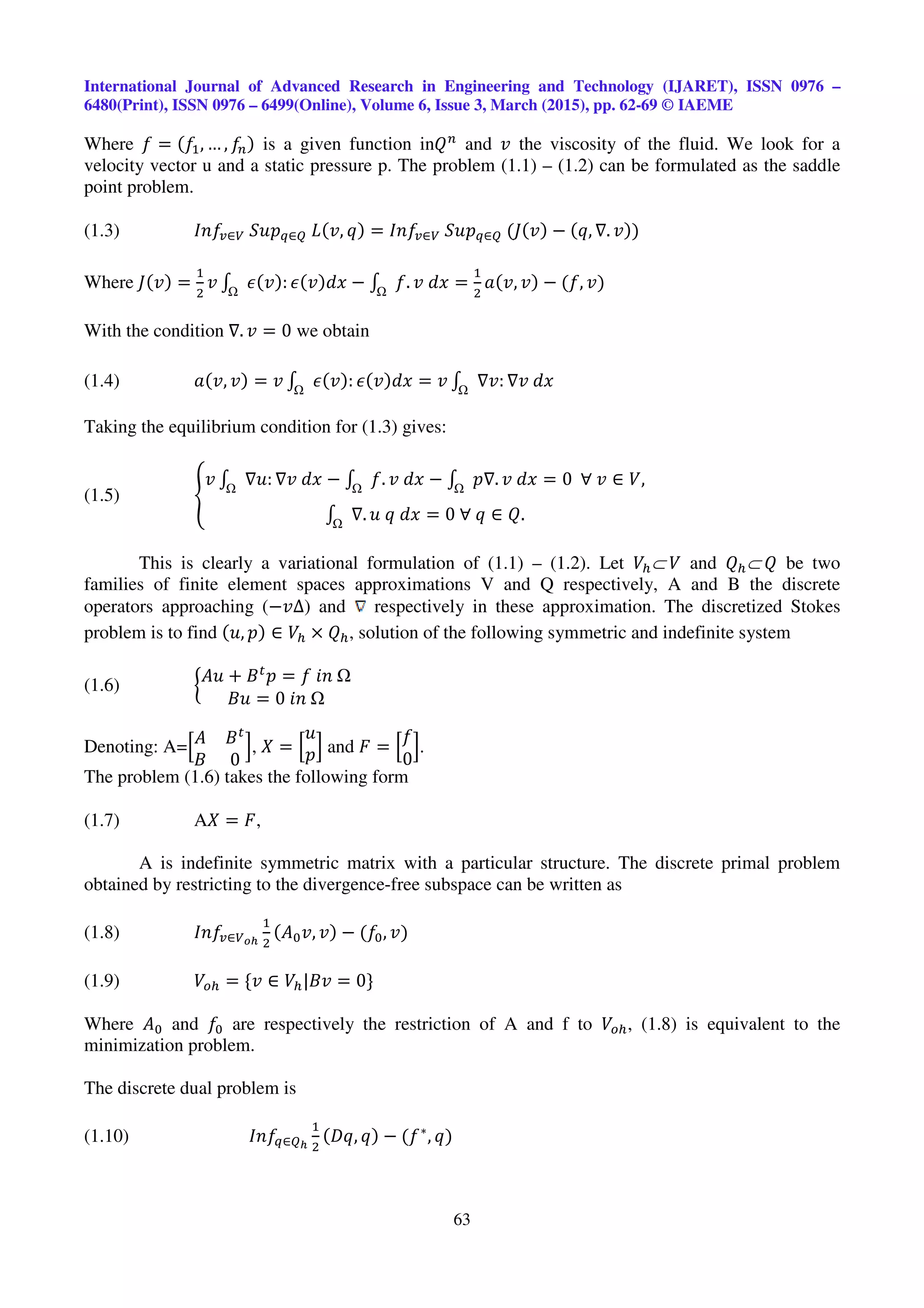
(1.3) ‫݂݊ܫ‬௩∈௏	ܵ‫݌ݑ‬௤∈ொ	‫ܮ‬ሺ‫,ݒ‬ ‫ݍ‬ሻ = ‫݂݊ܫ‬௩∈௏	ܵ‫݌ݑ‬௤∈ொ	ሺ‫ܬ‬ሺ‫ݒ‬ሻ − ሺ‫,ݍ‬ ∇. ‫ݒ‬ሻሻ
Where ‫ܬ‬ሺ‫ݒ‬ሻ =
ଵ
ଶ
‫ݒ‬ ‫׬‬ ߳ሺ‫ݒ‬ሻ: ߳ሺ‫ݒ‬ሻ݀‫ݔ‬ − ‫׬‬ ݂. ‫ݔ݀	ݒ‬ =
ଵ
ଶ
ܽሺ‫,ݒ‬ ‫ݒ‬ሻ − ሺ݂, ‫ݒ‬ሻ
With the condition ∇. ‫ݒ‬ = 0 we obtain
(1.4) ܽሺ‫,ݒ‬ ‫ݒ‬ሻ = ‫ݒ‬ ‫׬‬ ߳ሺ‫ݒ‬ሻ: ߳ሺ‫ݒ‬ሻ݀‫ݔ‬ = ‫ݒ‬ ‫׬‬ ∇‫:ݒ‬ ∇‫ݔ݀	ݒ‬
Taking the equilibrium condition for (1.3) gives:
(1.5) ቐ
‫ݒ‬ ‫׬‬ ∇‫:ݑ‬ ∇‫ݔ݀	ݒ‬ − ‫׬‬ ݂. ‫ݔ݀	ݒ‬ − ‫׬‬ ‫.∇݌‬ ‫ݔ݀	ݒ‬ = 0		∀	‫ݒ‬ ∈ ܸ,
‫׬‬ ∇. ‫ݔ݀	ݍ	ݑ‬ = 0	∀	‫ݍ‬ ∈ ܳ.
This is clearly a variational formulation of (1.1) – (1.2). Let ܸ௛⊂	ܸ and ܳ௛⊂	ܳ be two
families of finite element spaces approximations V and Q respectively, A and B the discrete
operators approaching (−‫)∆ݒ‬ and respectively in these approximation. The discretized Stokes
problem is to find ሺ‫,ݑ‬ ‫݌‬ሻ ∈ ܸ௛ × ܳ௛, solution of the following symmetric and indefinite system
(1.6) ൜
‫ݑܣ‬ + ‫ܤ‬௧
‫݌‬ = ݂	݅݊	
‫ݑܤ‬ = 0	݅݊	
Denoting: A=ቂ‫ܣ‬ ‫ܤ‬௧
‫ܤ‬ 0
ቃ, ܺ = ቂ
‫ݑ‬
‫݌‬ቃ and ‫ܨ‬ = ቂ
݂
0
ቃ.
The problem (1.6) takes the following form
(1.7) Aܺ = ‫,ܨ‬
A is indefinite symmetric matrix with a particular structure. The discrete primal problem
obtained by restricting to the divergence-free subspace can be written as
(1.8) ‫݂݊ܫ‬௩∈௏೚೓
ଵ
ଶ
ሺ‫ܣ‬଴‫,ݒ‬ ‫ݒ‬ሻ − ሺ݂଴, ‫ݒ‬ሻ
(1.9) ܸ௢௛ = {‫ݒ‬ ∈ ܸ௛|‫ݒܤ‬ = 0}
Where ‫ܣ‬଴ and ݂଴ are respectively the restriction of A and f to ܸ௢௛, (1.8) is equivalent to the
minimization problem.
The discrete dual problem is
(1.10) ‫݂݊ܫ‬௤∈ொ೓
ଵ
ଶ
ሺ‫,ݍܦ‬ ‫ݍ‬ሻ − ሺ݂∗
, ‫ݍ‬ሻ
International Journal of Advanced Research in Engineering and Technology (IJARET), ISSN 0976 –
6480(Print), ISSN 0976 – 6499(Online), Volume 6, Issue 3, March (2015), pp. 62-69 © IAEME
64
Where ‫ܦ‬ = ‫ܣܤ‬ିଵ
	‫ܤ‬௧
and ݂∗
= ‫ܣܤ‬ିଵ
	݂, this problem is also a standard quadratic problem although
‫ܦ‬ = ‫ܣܤ‬ିଵ
‫ܤ‬௧
cannot be computed explicitly as ‫ܣ‬ିଵ
is a full matrix. We shall develop algorithms
taking into account the special structure of A to obtain a general family of iterative methods some of
which will be explicited and analysed. Before doing so we recall the application of classical
optimization techniques to the primal and dual problems (1.8) and (1.10).
II. CLASSICAL SOLUTION METHODS
II. 1. Primal Problem
The Navier-Stokes and Stokes problem require a preconditioner yielding a divergence-free
solution and a divergence-free descent direction at each iteration. An efficient example of this
preconditioner can be built throught the block relaxation method, the advantage of which is to solve
a discretized problem in a small subregion. We have described in previous paper (cf [1], [4], [5])
such method. Let us denote S this preconditioning operator, the P.C.G. algorithm becomes.
Alg. 2.1:
Step 1: Select an initial divergence-free solution ‫ݑ‬଴
Step 2: Compute the divergence-free descent direction
(2.2) ‫ݖ‬௡
= ܵିଵ
݃௡
Where ݃௡
= ‫ݑܣ‬௡
− ݂, and compute
(2.2) Φ௡
= ‫ݖ‬௡
+ ߚ௡Φ௡ିଵ
so that ‫ܣ‬Φ௡
⊥Φ୬ିଵ
Step 3: Compute ߙ௡, ‫ݑ‬௡ାଵ and ݃௡ାଵ by
(2.4)
‫ݑ‬௡ାଵ = ‫ݑ‬௡
− ߙ௡Φ௡
݃௡ାଵ = ‫ݑܣ‬௡ାଵ − ݂
ߙ௡ defined by the condition ݃௡ାଵ⊥Φ௡
.
This is in fact the usual P.C.G method on the divergence-free subspace.
II. 2. Dual Problem
We remember in the following the C.G Uzawa algorithm for resolution of the dual problem.
Alg. 2.2:
Step 1: Let ‫݌‬଴
∈ ܳ௛, ‫ݑ‬଴
= ‫ܣ‬ିଵ
ሺ݂ − ‫ܤ‬௧
‫݌‬଴
ሻ, suppose ‫ݑ‬௡
known.
Step 2: Compute the descent direction
‫ݖ‬௡
= ൫‫ݖ‬௨
௡
, ‫ݖ‬௣
௡
൯ = ሺ−‫ܣ‬ିଵ
‫ܤ‬௧
‫ݑܤ‬௡
, ‫ݑܤ‬௡ሻ and compute
Φ௡
= ‫ݖ‬௡
+ ߚ௡Φ௡ିଵ
= ሺ߶௨
௡
, Φ௣
௡
ሻ
(2.5) ߚ௡ =
|஻௨೙|మ
|஻௨೙షభ|మ
International Journal of Advanced Research in Engineering and Technology (IJARET), ISSN 0976 –
6480(Print), ISSN 0976 – 6499(Online), Volume 6, Issue 3, March (2015), pp. 62-69 © IAEME
65
Step 3: Compute ߙ௡, ‫ݑ‬௡ାଵ and ‫݌‬௡ାଵ by
(2.6) ߙ௡ = −
|஻௨೙|మ
(஻௨೙,஻Φೠ
೙
)
(2.7) ቊ
‫ݑ‬௡ାଵ
= ‫ݑ‬௡
− ߙ௡Φ௨
௡
‫݌‬௡ାଵ
= ‫݌‬௡
− ߙ௡Φ௣
௡
This algorithm requires to solve exactly the linear system ‫ݑܣ‬ = ݂ − ‫ܤ‬௧
‫݌‬ at each iteration. If
we solve approximatively this system, we obtain Arrow-Hurwicz’s algorithm to find the saddle
point. The steepest descent method is obtained for ߚ௡ = 0; for ߙ = 0 constant we obtain the Uzawa
algorithm.
III. GENERAL FORMULATION
The principal idea of this method is to combine the two algorithms Alg. 2.1 and alg. 2.2 for
solving mutually the primal and the dual problems. The system (1.7) is indefinite, the standard C.G
method yields a divergent iterative method. However with a good preconditioner and proper descent
direction we can obtain a convergent iterative method, which coincides with a variant of Arrow-
Hurwicz algorithm (cf. [3]). The next algorithm is interesting when the projection on a divergence-
free subspace is difficult or very expensive with the preconditioner used. Let S be a preconditioning
operator of A (cf. [1]), ܴ௡
and ܴ௡
are the residuals respectively defined by
(3.1) ܴ௡
= ቀ
‫ݎ‬௨
௡
0
ቁ where ‫ݎ‬௨
௡
= ‫ݑܣ‬௡
+ ‫ܤ‬௧
‫݌‬௡
− ݂
And
(3.2) ܴ௡
= ൤
0
‫ݎ‬௣
௡൨ where ‫ݎ‬௣
௡
= ‫ݑܤ‬௡
The step descent directions are defined as solutions of the following problems
(3.3) ܵ‫ݖ‬௡
= ܴ௡
(3.4) ܵ‫ݖ‬௡
= ܴ௡
Those directions are defined to minimize respectively the resuduals of the primal and the dual
problems.
III. 1. G. “Primal-Dual” Algorithm
Step 1: Select an initial solution(‫ݑ‬଴
, ‫݌‬଴
).
Step 2: Solve ܵ‫ݖ‬௡
= ܴ௡
ߙ௡ is defined by a condition in order to minimize the residual ܴ௡
,
(3.5) ‫ݎ‬௨
೙శభ
మ
= ‫ݑ‬௡
− ߙ௡‫ݖ‬௨
௡
Compute ‫ݑ‬
೙శభ
మ and ‫݌‬
೙శభ
మ
International Journal of Advanced Research in Engineering and Technology (IJARET), ISSN 0976 –
6480(Print), ISSN 0976 – 6499(Online), Volume 6, Issue 3, March (2015), pp. 62-69 © IAEME
66
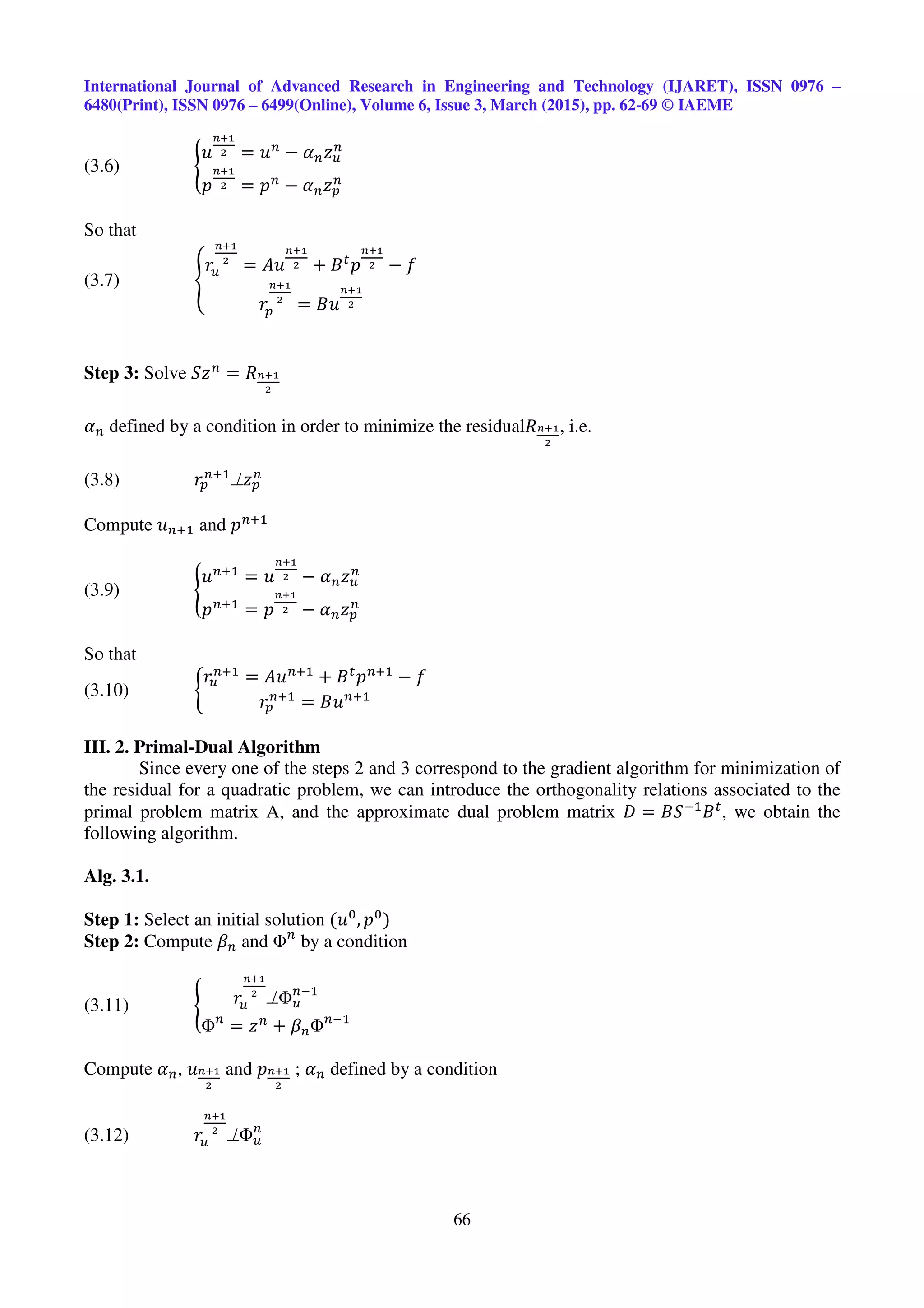
(3.6) ൝
‫ݑ‬
೙శభ
మ = ‫ݑ‬௡
− ߙ௡‫ݖ‬௨
௡
‫݌‬
೙శభ
మ = ‫݌‬௡
− ߙ௡‫ݖ‬௣
௡
So that
(3.7) ቐ
‫ݎ‬௨
೙శభ
మ
= ‫ݑܣ‬
೙శభ
మ + ‫ܤ‬௧
‫݌‬
೙శభ
మ − ݂
‫ݎ‬௣
೙శభ
మ
= ‫ݑܤ‬
೙శభ
మ
Step 3: Solve ܵ‫ݖ‬௡
= ܴ೙శభ
మ
ߙ௡ defined by a condition in order to minimize the residualܴ೙శభ
మ
, i.e.
(3.8) ‫ݎ‬௣
௡ାଵ
⊥‫ݖ‬௣
௡
Compute ‫ݑ‬௡ାଵ and ‫݌‬௡ାଵ
(3.9) ൝
‫ݑ‬௡ାଵ
= ‫ݑ‬
೙శభ
మ − ߙ௡‫ݖ‬௨
௡
‫݌‬௡ାଵ
= ‫݌‬
೙శభ
మ − ߙ௡‫ݖ‬௣
௡
So that
(3.10) ቊ
‫ݎ‬௨
௡ାଵ
= ‫ݑܣ‬௡ାଵ
+ ‫ܤ‬௧
‫݌‬௡ାଵ
− ݂
‫ݎ‬௣
௡ାଵ
= ‫ݑܤ‬௡ାଵ
III. 2. Primal-Dual Algorithm
Since every one of the steps 2 and 3 correspond to the gradient algorithm for minimization of
the residual for a quadratic problem, we can introduce the orthogonality relations associated to the
primal problem matrix A, and the approximate dual problem matrix ‫ܦ‬ = ‫ܵܤ‬ିଵ
‫ܤ‬௧
, we obtain the
following algorithm.
Alg. 3.1.
Step 1: Select an initial solution (‫ݑ‬଴
, ‫݌‬଴
)
Step 2: Compute ߚ௡ and Φ௡
by a condition
(3.11) ൝ ‫ݎ‬௨
೙శభ
మ
⊥Φ௨
௡ିଵ
Φ௡
= ‫ݖ‬௡
+ ߚ௡Φ௡ିଵ
Compute ߙ௡, ‫ݑ‬೙శభ
మ
and ‫݌‬೙శభ
మ
; ߙ௡ defined by a condition
(3.12) ‫ݎ‬௨
೙శభ
మ
⊥Φ௨
௡
International Journal of Advanced Research in Engineering and Technology (IJARET), ISSN 0976 –
6480(Print), ISSN 0976 – 6499(Online), Volume 6, Issue 3, March (2015), pp. 62-69 © IAEME
67
(3.13) ൝
‫ݑ‬
೙శభ
మ = ‫ݑ‬௡
− ߙ௡Φ௨
௡
‫݌‬
೙శభ
మ = ‫݌‬௡
− ߙ௡‫ݖ‬௣
௡
So that
(3.14) ቐ
‫ݎ‬௨
೙శభ
మ
= ‫ݑܣ‬
೙శభ
మ + ‫ܤ‬௧
‫݌‬
೙శభ
మ − ݂
‫ݎ‬௣
೙శభ
మ
= ‫ݑܤ‬
೙శభ
మ
Step 3: Solve ܵ‫ݖ‬௡
= ܴ೙శభ
మ
Compute ߚ௡ and Φ௡
by a condition
(3.15) ‫ݎ‬௣
௡ାଵ
⊥Φ௣
௡ିଵ
Φ௡
= ‫ݖ‬௡
+ ߚ௡Φ௡ିଵ
Compute ߙ௡, ‫ݑ‬௡ାଵ, ‫݌‬௡ାଵ. ߙ௡ defined by a condition
(3.16) ‫ݎ‬௣
௡ାଵ
⊥Φ௣
௡
‫ݑ‬௡ାଵ
= ‫ݑ‬
೙శభ
మ − ߙ௡Φ௨
௡
‫݌‬௡ାଵ
= ‫݌‬
೙శభ
మ − ߙ௡Φ௣
௡
So that
‫ݎ‬௨
௡ାଵ
= ‫ݑܣ‬௡ାଵ
+ ‫ܤ‬௧
‫݌‬௡ାଵ
− ݂
‫ݎ‬௣
௡ାଵ
= ‫ݑܤ‬௡ାଵ
Doing some iterations of Step 2 before moving to Step 3, we obtain a convergence of the
primal variable corresponding to a minimum in v of the lagrangien ‫,ݒ(ܮ‬ ‫)ݍ‬ and we pull back on
Uzawa’s method (Alg. 2.2).
On the contrary if we obtain convergence of the approximate dual variable and a divergence-
free solution after some iteration of Step 3, the whole process can be reduced to the primal algorithm
(Alg. 2.1). With a good preconditioner we can obtain easily the divergence-free condition and we
find once again the alg. 2.1. If the preconditioner yields rapidly the convergence of the primal
problem we find once again the Uzawa algorithm. The study of the convergence depends of the
preconditioner (cf. R. Aboulaich [1]). The convergence is illustrated in Figure 1. In the following we
present a particular example of preconditioning operator and we find a variant of Arrow-Hurwicz
algorithm.
III. 3. A Particular Case of Preconditioning
Let us denote ܵ = ቂܵ ‫ܤ‬௧
0 1
ቃ , ܴ௡
= ቂ
‫ݎ‬௨
௡
0
ቃ and ܴ௡
= ൤
0
‫ݎ‬௣
௡൨
The G. “P-D” algorithm becomes:
International Journal of Advanced Research in Engineering and Technology (IJARET), ISSN 0976 –
6480(Print), ISSN 0976 – 6499(Online), Volume 6, Issue 3, March (2015), pp. 62-69 © IAEME
68
Alg. 3.2
Step 1: The same
Step 2: Solve
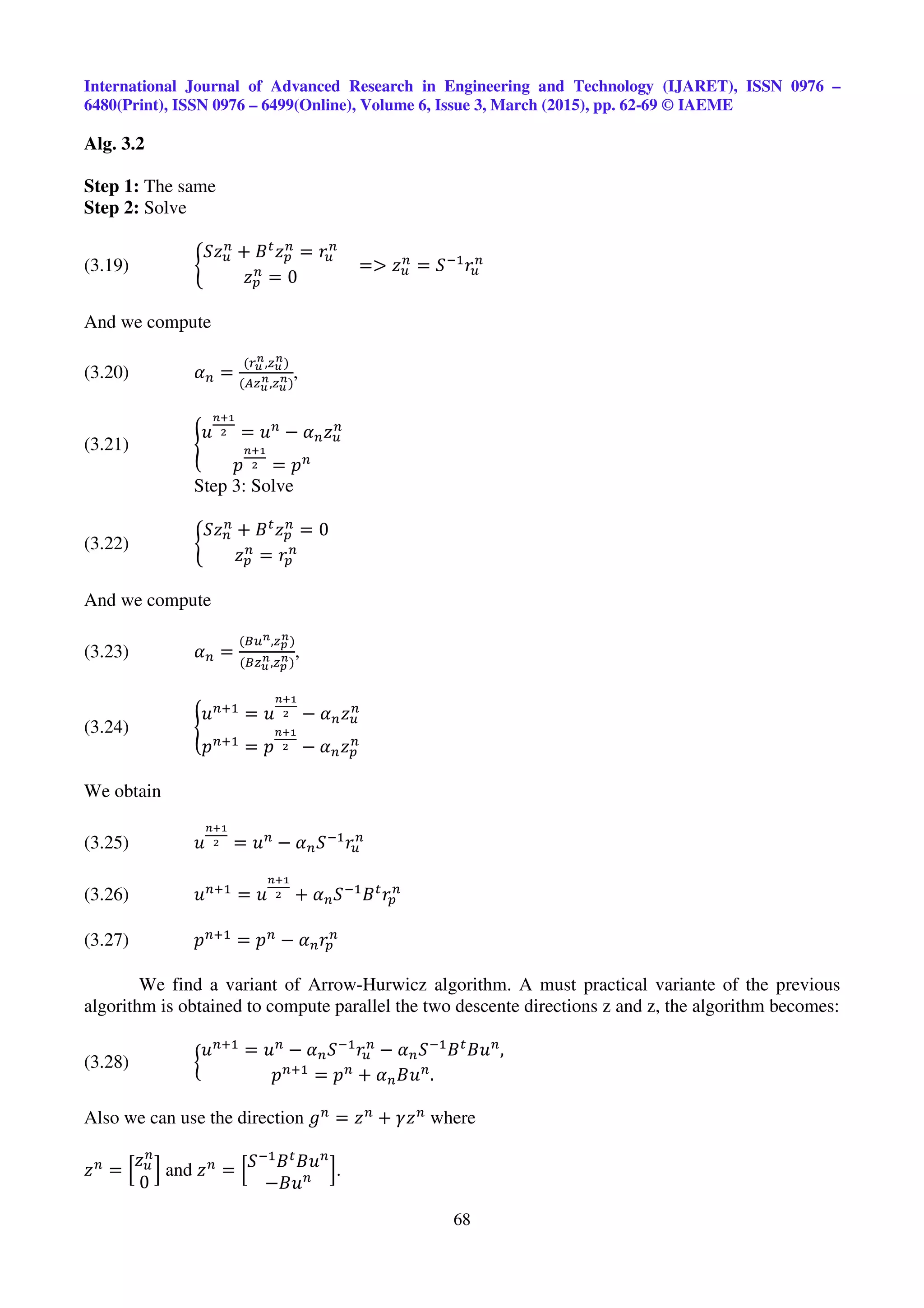
(3.19) ቊ
ܵ‫ݖ‬௨
௡
+ ‫ܤ‬௧
‫ݖ‬௣
௡
= ‫ݎ‬௨
௡
‫ݖ‬௣
௡
= 0
=> ‫ݖ‬௨
௡
= ܵିଵ
‫ݎ‬௨
௡
And we compute
(3.20) ߙ௡ =
(௥ೠ
೙,௭ೠ
೙)
(஺௭ೠ
೙,௭ೠ
೙)
,
(3.21) ൝
‫ݑ‬
೙శభ
మ = ‫ݑ‬௡
− ߙ௡‫ݖ‬௨
௡
‫݌‬
೙శభ
మ = ‫݌‬௡
Step 3: Solve
(3.22) ቊ
ܵ‫ݖ‬௡
௡
+ ‫ܤ‬௧
‫ݖ‬௣
௡
= 0
‫ݖ‬௣
௡
= ‫ݎ‬௣
௡
And we compute
(3.23) ߙ௡ =
(஻௨೙,௭೛
೙)
(஻௭ೠ
೙,௭೛
೙)
,
(3.24) ൝
‫ݑ‬௡ାଵ
= ‫ݑ‬
೙శభ
మ − ߙ௡‫ݖ‬௨
௡
‫݌‬௡ାଵ
= ‫݌‬
೙శభ
మ − ߙ௡‫ݖ‬௣
௡
We obtain
(3.25) ‫ݑ‬
೙శభ
మ = ‫ݑ‬௡
− ߙ௡ܵିଵ
‫ݎ‬௨
௡
(3.26) ‫ݑ‬௡ାଵ
= ‫ݑ‬
೙శభ
మ + ߙ௡ܵିଵ
‫ܤ‬௧
‫ݎ‬௣
௡
(3.27) ‫݌‬௡ାଵ
= ‫݌‬௡
− ߙ௡‫ݎ‬௣
௡
We find a variant of Arrow-Hurwicz algorithm. A must practical variante of the previous
algorithm is obtained to compute parallel the two descente directions z and z, the algorithm becomes:
(3.28) ൜
‫ݑ‬௡ାଵ
= ‫ݑ‬௡
− ߙ௡ܵିଵ
‫ݎ‬௨
௡
− ߙ௡ܵିଵ
‫ܤ‬௧
‫ݑܤ‬௡
,
‫݌‬௡ାଵ
= ‫݌‬௡
+ ߙ௡‫ݑܤ‬௡
.
Also we can use the direction ݃௡
= ‫ݖ‬௡
+ ߛ‫ݖ‬௡
where
‫ݖ‬௡
= ቂ
‫ݖ‬௨
௡
0
ቃ and ‫ݖ‬௡
= ቂܵିଵ
‫ܤ‬௧
‫ݑܤ‬௡
−‫ݑܤ‬௡ ቃ.
International Journal of Advanced Research in Engineering and Technology (IJARET), ISSN 0976 –
6480(Print), ISSN 0976 – 6499(Online), Volume 6, Issue 3, March (2015), pp. 62-69 © IAEME
69
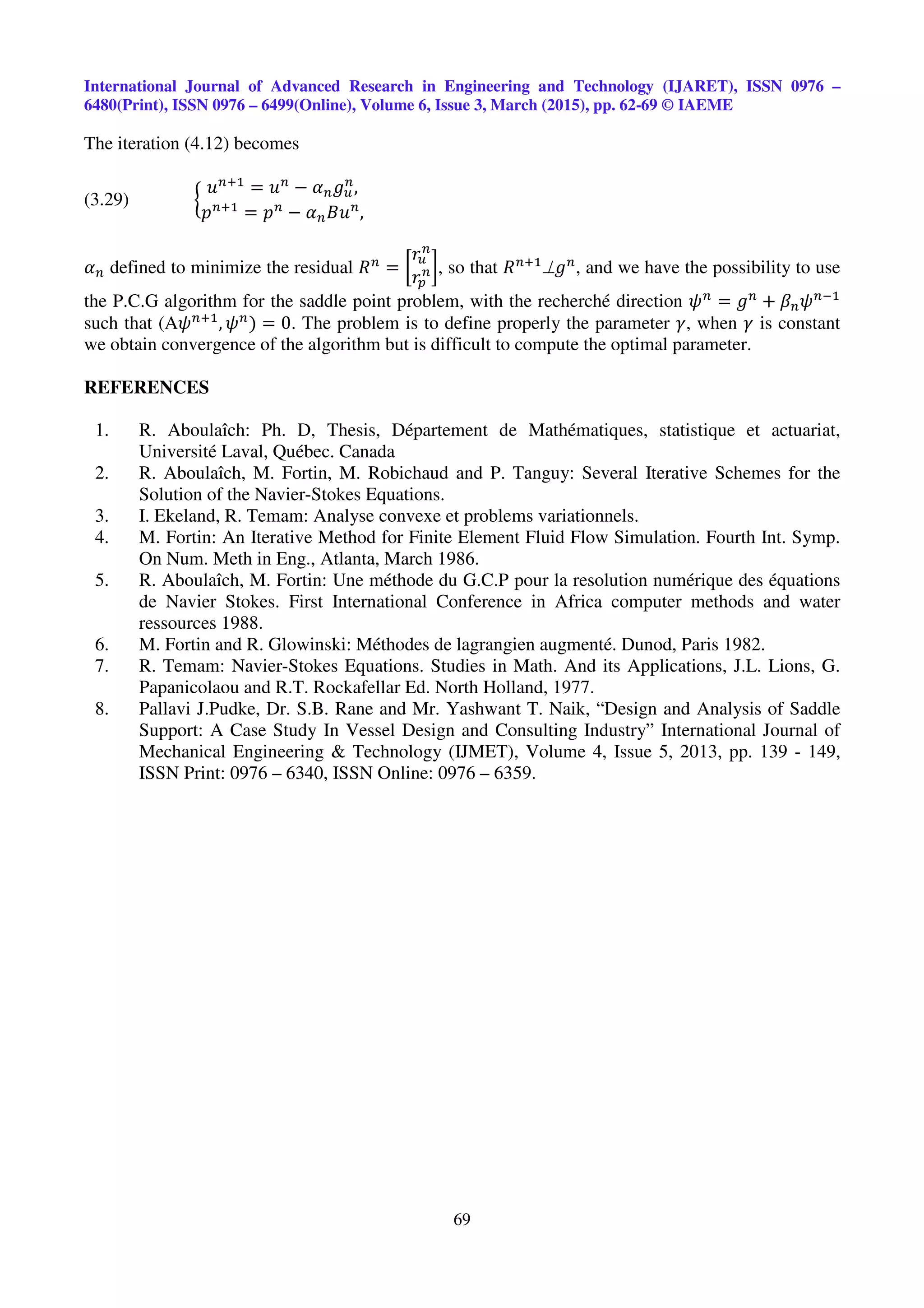
The iteration (4.12) becomes
(3.29) ൜
‫ݑ‬௡ାଵ
= ‫ݑ‬௡
− ߙ௡݃௨
௡
,
‫݌‬௡ାଵ
= ‫݌‬௡
− ߙ௡‫ݑܤ‬௡
,
ߙ௡ defined to minimize the residual ܴ௡
= ൤
‫ݎ‬௨
௡
‫ݎ‬௣
௡൨, so that ܴ௡ାଵ
⊥݃௡
, and we have the possibility to use
the P.C.G algorithm for the saddle point problem, with the recherché direction ߰௡
= ݃௡
+ ߚ௡߰௡ିଵ
such that (A߰௡ାଵ
, ߰௡
) = 0. The problem is to define properly the parameter ߛ, when ߛ is constant
we obtain convergence of the algorithm but is difficult to compute the optimal parameter.
REFERENCES
1. R. Aboulaîch: Ph. D, Thesis, Département de Mathématiques, statistique et actuariat,
Université Laval, Québec. Canada
2. R. Aboulaîch, M. Fortin, M. Robichaud and P. Tanguy: Several Iterative Schemes for the
Solution of the Navier-Stokes Equations.
3. I. Ekeland, R. Temam: Analyse convexe et problems variationnels.
4. M. Fortin: An Iterative Method for Finite Element Fluid Flow Simulation. Fourth Int. Symp.
On Num. Meth in Eng., Atlanta, March 1986.
5. R. Aboulaîch, M. Fortin: Une méthode du G.C.P pour la resolution numérique des équations
de Navier Stokes. First International Conference in Africa computer methods and water
ressources 1988.
6. M. Fortin and R. Glowinski: Méthodes de lagrangien augmenté. Dunod, Paris 1982.
7. R. Temam: Navier-Stokes Equations. Studies in Math. And its Applications, J.L. Lions, G.
Papanicolaou and R.T. Rockafellar Ed. North Holland, 1977.
8. Pallavi J.Pudke, Dr. S.B. Rane and Mr. Yashwant T. Naik, “Design and Analysis of Saddle
Support: A Case Study In Vessel Design and Consulting Industry” International Journal of
Mechanical Engineering & Technology (IJMET), Volume 4, Issue 5, 2013, pp. 139 - 149,
ISSN Print: 0976 – 6340, ISSN Online: 0976 – 6359.

Iterative methods for the solution of saddle point problem

  • 1.
    International Journal ofAdvanced Research in Engineering and Technology (IJARET), ISSN 0976 – 6480(Print), ISSN 0976 – 6499(Online), Volume 6, Issue 3, March (2015), pp. 62-69 © IAEME 62 ITERATIVE METHODS FOR THE SOLUTION OF SADDLE POINT PROBLEM NDZANA Benoît Senior Lecturer, National Advanced School of Engineering, University of Yaounde I, Cameroon BIYA MOTTO Frederic, Senior Lecturer, Faculty of Sciences, University of Yaounde I, Cameroon LEKINI NKODO Claude Bernard P.H.D. Student; National Advanced School of Engineering, University of Yaounde I, Cameroon ABSTRACT Some new iterative methods for numerical solution of mixed finite element approximation of Stokes problem are presented. The idea is the use of proper preconditioning for the conjugate gradient algorithm. A particular case gives a variant of the Arrow-Hurwicz method. I. STATEMENT OF THE PROBLEM Let us consider a polygonal domain ⊂ܴ௡ (n=2 or 3) of regular boundary ߲ = Γ. Let us denote ܸ = ൛‫ݒ‬ ∈ ൫‫1ܪ‬ሺ ሻ൯ ௡ ൟ, ܳ = ‫ܮ‬ଶሺ ሻ, ߳ሺ‫ݒ‬ሻ = ቀ߳௜௝ሺ‫ݒ‬ሻቁ ଵஸ௜,௝ஸ௡ and (1.1) ߳௜௝ሺ‫ݒ‬ሻ = ଵ ଶ [ డ௩೔ డ௫ೕ + డ௩ೕ డ௫೔ ] The Stokes problem for fluid flow is (1.2.) ൞ −‫ݒ‬ ∑ డ డ௫ೕ ߳௜௝ሺ‫ݑ‬ሻ + ሺ∇‫݌‬ሻ௜ = ݂௜, 1 ≤ ݅ ≤ ݊ ݅݊ ,௡ ௝ୀଵ ∇. ‫ݑ‬ = 0 ݅݊ ‫ݑ‬ ∈ ܸ, ‫݌‬ ∈ ܳ, INTERNATIONAL JOURNAL OF ADVANCED RESEARCH IN ENGINEERING AND TECHNOLOGY (IJARET) ISSN 0976 - 6480 (Print) ISSN 0976 - 6499 (Online) Volume 6, Issue 3, March (2015), pp. 62-69 © IAEME: www.iaeme.com/ IJARET.asp Journal Impact Factor (2015): 8.5041 (Calculated by GISI) www.jifactor.com IJARET © I A E M E
  • 2.
    International Journal ofAdvanced Research in Engineering and Technology (IJARET), ISSN 0976 – 6480(Print), ISSN 0976 – 6499(Online), Volume 6, Issue 3, March (2015), pp. 62-69 © IAEME 63 Where ݂ = ሺ݂ଵ, … , ݂௡ሻ is a given function inܳ௡ and ‫ݒ‬ the viscosity of the fluid. We look for a velocity vector u and a static pressure p. The problem (1.1) – (1.2) can be formulated as the saddle point problem. (1.3) ‫݂݊ܫ‬௩∈௏ ܵ‫݌ݑ‬௤∈ொ ‫ܮ‬ሺ‫,ݒ‬ ‫ݍ‬ሻ = ‫݂݊ܫ‬௩∈௏ ܵ‫݌ݑ‬௤∈ொ ሺ‫ܬ‬ሺ‫ݒ‬ሻ − ሺ‫,ݍ‬ ∇. ‫ݒ‬ሻሻ Where ‫ܬ‬ሺ‫ݒ‬ሻ = ଵ ଶ ‫ݒ‬ ‫׬‬ ߳ሺ‫ݒ‬ሻ: ߳ሺ‫ݒ‬ሻ݀‫ݔ‬ − ‫׬‬ ݂. ‫ݔ݀ ݒ‬ = ଵ ଶ ܽሺ‫,ݒ‬ ‫ݒ‬ሻ − ሺ݂, ‫ݒ‬ሻ With the condition ∇. ‫ݒ‬ = 0 we obtain (1.4) ܽሺ‫,ݒ‬ ‫ݒ‬ሻ = ‫ݒ‬ ‫׬‬ ߳ሺ‫ݒ‬ሻ: ߳ሺ‫ݒ‬ሻ݀‫ݔ‬ = ‫ݒ‬ ‫׬‬ ∇‫:ݒ‬ ∇‫ݔ݀ ݒ‬ Taking the equilibrium condition for (1.3) gives: (1.5) ቐ ‫ݒ‬ ‫׬‬ ∇‫:ݑ‬ ∇‫ݔ݀ ݒ‬ − ‫׬‬ ݂. ‫ݔ݀ ݒ‬ − ‫׬‬ ‫.∇݌‬ ‫ݔ݀ ݒ‬ = 0 ∀ ‫ݒ‬ ∈ ܸ, ‫׬‬ ∇. ‫ݔ݀ ݍ ݑ‬ = 0 ∀ ‫ݍ‬ ∈ ܳ. This is clearly a variational formulation of (1.1) – (1.2). Let ܸ௛⊂ ܸ and ܳ௛⊂ ܳ be two families of finite element spaces approximations V and Q respectively, A and B the discrete operators approaching (−‫)∆ݒ‬ and respectively in these approximation. The discretized Stokes problem is to find ሺ‫,ݑ‬ ‫݌‬ሻ ∈ ܸ௛ × ܳ௛, solution of the following symmetric and indefinite system (1.6) ൜ ‫ݑܣ‬ + ‫ܤ‬௧ ‫݌‬ = ݂ ݅݊ ‫ݑܤ‬ = 0 ݅݊ Denoting: A=ቂ‫ܣ‬ ‫ܤ‬௧ ‫ܤ‬ 0 ቃ, ܺ = ቂ ‫ݑ‬ ‫݌‬ቃ and ‫ܨ‬ = ቂ ݂ 0 ቃ. The problem (1.6) takes the following form (1.7) Aܺ = ‫,ܨ‬ A is indefinite symmetric matrix with a particular structure. The discrete primal problem obtained by restricting to the divergence-free subspace can be written as (1.8) ‫݂݊ܫ‬௩∈௏೚೓ ଵ ଶ ሺ‫ܣ‬଴‫,ݒ‬ ‫ݒ‬ሻ − ሺ݂଴, ‫ݒ‬ሻ (1.9) ܸ௢௛ = {‫ݒ‬ ∈ ܸ௛|‫ݒܤ‬ = 0} Where ‫ܣ‬଴ and ݂଴ are respectively the restriction of A and f to ܸ௢௛, (1.8) is equivalent to the minimization problem. The discrete dual problem is (1.10) ‫݂݊ܫ‬௤∈ொ೓ ଵ ଶ ሺ‫,ݍܦ‬ ‫ݍ‬ሻ − ሺ݂∗ , ‫ݍ‬ሻ
  • 3.
    International Journal ofAdvanced Research in Engineering and Technology (IJARET), ISSN 0976 – 6480(Print), ISSN 0976 – 6499(Online), Volume 6, Issue 3, March (2015), pp. 62-69 © IAEME 64 Where ‫ܦ‬ = ‫ܣܤ‬ିଵ ‫ܤ‬௧ and ݂∗ = ‫ܣܤ‬ିଵ ݂, this problem is also a standard quadratic problem although ‫ܦ‬ = ‫ܣܤ‬ିଵ ‫ܤ‬௧ cannot be computed explicitly as ‫ܣ‬ିଵ is a full matrix. We shall develop algorithms taking into account the special structure of A to obtain a general family of iterative methods some of which will be explicited and analysed. Before doing so we recall the application of classical optimization techniques to the primal and dual problems (1.8) and (1.10). II. CLASSICAL SOLUTION METHODS II. 1. Primal Problem The Navier-Stokes and Stokes problem require a preconditioner yielding a divergence-free solution and a divergence-free descent direction at each iteration. An efficient example of this preconditioner can be built throught the block relaxation method, the advantage of which is to solve a discretized problem in a small subregion. We have described in previous paper (cf [1], [4], [5]) such method. Let us denote S this preconditioning operator, the P.C.G. algorithm becomes. Alg. 2.1: Step 1: Select an initial divergence-free solution ‫ݑ‬଴ Step 2: Compute the divergence-free descent direction (2.2) ‫ݖ‬௡ = ܵିଵ ݃௡ Where ݃௡ = ‫ݑܣ‬௡ − ݂, and compute (2.2) Φ௡ = ‫ݖ‬௡ + ߚ௡Φ௡ିଵ so that ‫ܣ‬Φ௡ ⊥Φ୬ିଵ Step 3: Compute ߙ௡, ‫ݑ‬௡ାଵ and ݃௡ାଵ by (2.4) ‫ݑ‬௡ାଵ = ‫ݑ‬௡ − ߙ௡Φ௡ ݃௡ାଵ = ‫ݑܣ‬௡ାଵ − ݂ ߙ௡ defined by the condition ݃௡ାଵ⊥Φ௡ . This is in fact the usual P.C.G method on the divergence-free subspace. II. 2. Dual Problem We remember in the following the C.G Uzawa algorithm for resolution of the dual problem. Alg. 2.2: Step 1: Let ‫݌‬଴ ∈ ܳ௛, ‫ݑ‬଴ = ‫ܣ‬ିଵ ሺ݂ − ‫ܤ‬௧ ‫݌‬଴ ሻ, suppose ‫ݑ‬௡ known. Step 2: Compute the descent direction ‫ݖ‬௡ = ൫‫ݖ‬௨ ௡ , ‫ݖ‬௣ ௡ ൯ = ሺ−‫ܣ‬ିଵ ‫ܤ‬௧ ‫ݑܤ‬௡ , ‫ݑܤ‬௡ሻ and compute Φ௡ = ‫ݖ‬௡ + ߚ௡Φ௡ିଵ = ሺ߶௨ ௡ , Φ௣ ௡ ሻ (2.5) ߚ௡ = |஻௨೙|మ |஻௨೙షభ|మ
  • 4.
    International Journal ofAdvanced Research in Engineering and Technology (IJARET), ISSN 0976 – 6480(Print), ISSN 0976 – 6499(Online), Volume 6, Issue 3, March (2015), pp. 62-69 © IAEME 65 Step 3: Compute ߙ௡, ‫ݑ‬௡ାଵ and ‫݌‬௡ାଵ by (2.6) ߙ௡ = − |஻௨೙|మ (஻௨೙,஻Φೠ ೙ ) (2.7) ቊ ‫ݑ‬௡ାଵ = ‫ݑ‬௡ − ߙ௡Φ௨ ௡ ‫݌‬௡ାଵ = ‫݌‬௡ − ߙ௡Φ௣ ௡ This algorithm requires to solve exactly the linear system ‫ݑܣ‬ = ݂ − ‫ܤ‬௧ ‫݌‬ at each iteration. If we solve approximatively this system, we obtain Arrow-Hurwicz’s algorithm to find the saddle point. The steepest descent method is obtained for ߚ௡ = 0; for ߙ = 0 constant we obtain the Uzawa algorithm. III. GENERAL FORMULATION The principal idea of this method is to combine the two algorithms Alg. 2.1 and alg. 2.2 for solving mutually the primal and the dual problems. The system (1.7) is indefinite, the standard C.G method yields a divergent iterative method. However with a good preconditioner and proper descent direction we can obtain a convergent iterative method, which coincides with a variant of Arrow- Hurwicz algorithm (cf. [3]). The next algorithm is interesting when the projection on a divergence- free subspace is difficult or very expensive with the preconditioner used. Let S be a preconditioning operator of A (cf. [1]), ܴ௡ and ܴ௡ are the residuals respectively defined by (3.1) ܴ௡ = ቀ ‫ݎ‬௨ ௡ 0 ቁ where ‫ݎ‬௨ ௡ = ‫ݑܣ‬௡ + ‫ܤ‬௧ ‫݌‬௡ − ݂ And (3.2) ܴ௡ = ൤ 0 ‫ݎ‬௣ ௡൨ where ‫ݎ‬௣ ௡ = ‫ݑܤ‬௡ The step descent directions are defined as solutions of the following problems (3.3) ܵ‫ݖ‬௡ = ܴ௡ (3.4) ܵ‫ݖ‬௡ = ܴ௡ Those directions are defined to minimize respectively the resuduals of the primal and the dual problems. III. 1. G. “Primal-Dual” Algorithm Step 1: Select an initial solution(‫ݑ‬଴ , ‫݌‬଴ ). Step 2: Solve ܵ‫ݖ‬௡ = ܴ௡ ߙ௡ is defined by a condition in order to minimize the residual ܴ௡ , (3.5) ‫ݎ‬௨ ೙శభ మ = ‫ݑ‬௡ − ߙ௡‫ݖ‬௨ ௡ Compute ‫ݑ‬ ೙శభ మ and ‫݌‬ ೙శభ మ
  • 5.
    International Journal ofAdvanced Research in Engineering and Technology (IJARET), ISSN 0976 – 6480(Print), ISSN 0976 – 6499(Online), Volume 6, Issue 3, March (2015), pp. 62-69 © IAEME 66 (3.6) ൝ ‫ݑ‬ ೙శభ మ = ‫ݑ‬௡ − ߙ௡‫ݖ‬௨ ௡ ‫݌‬ ೙శభ మ = ‫݌‬௡ − ߙ௡‫ݖ‬௣ ௡ So that (3.7) ቐ ‫ݎ‬௨ ೙శభ మ = ‫ݑܣ‬ ೙శభ మ + ‫ܤ‬௧ ‫݌‬ ೙శభ మ − ݂ ‫ݎ‬௣ ೙శభ మ = ‫ݑܤ‬ ೙శభ మ Step 3: Solve ܵ‫ݖ‬௡ = ܴ೙శభ మ ߙ௡ defined by a condition in order to minimize the residualܴ೙శభ మ , i.e. (3.8) ‫ݎ‬௣ ௡ାଵ ⊥‫ݖ‬௣ ௡ Compute ‫ݑ‬௡ାଵ and ‫݌‬௡ାଵ (3.9) ൝ ‫ݑ‬௡ାଵ = ‫ݑ‬ ೙శభ మ − ߙ௡‫ݖ‬௨ ௡ ‫݌‬௡ାଵ = ‫݌‬ ೙శభ మ − ߙ௡‫ݖ‬௣ ௡ So that (3.10) ቊ ‫ݎ‬௨ ௡ାଵ = ‫ݑܣ‬௡ାଵ + ‫ܤ‬௧ ‫݌‬௡ାଵ − ݂ ‫ݎ‬௣ ௡ାଵ = ‫ݑܤ‬௡ାଵ III. 2. Primal-Dual Algorithm Since every one of the steps 2 and 3 correspond to the gradient algorithm for minimization of the residual for a quadratic problem, we can introduce the orthogonality relations associated to the primal problem matrix A, and the approximate dual problem matrix ‫ܦ‬ = ‫ܵܤ‬ିଵ ‫ܤ‬௧ , we obtain the following algorithm. Alg. 3.1. Step 1: Select an initial solution (‫ݑ‬଴ , ‫݌‬଴ ) Step 2: Compute ߚ௡ and Φ௡ by a condition (3.11) ൝ ‫ݎ‬௨ ೙శభ మ ⊥Φ௨ ௡ିଵ Φ௡ = ‫ݖ‬௡ + ߚ௡Φ௡ିଵ Compute ߙ௡, ‫ݑ‬೙శభ మ and ‫݌‬೙శభ మ ; ߙ௡ defined by a condition (3.12) ‫ݎ‬௨ ೙శభ మ ⊥Φ௨ ௡
  • 6.
    International Journal ofAdvanced Research in Engineering and Technology (IJARET), ISSN 0976 – 6480(Print), ISSN 0976 – 6499(Online), Volume 6, Issue 3, March (2015), pp. 62-69 © IAEME 67 (3.13) ൝ ‫ݑ‬ ೙శభ మ = ‫ݑ‬௡ − ߙ௡Φ௨ ௡ ‫݌‬ ೙శభ మ = ‫݌‬௡ − ߙ௡‫ݖ‬௣ ௡ So that (3.14) ቐ ‫ݎ‬௨ ೙శభ మ = ‫ݑܣ‬ ೙శభ మ + ‫ܤ‬௧ ‫݌‬ ೙శభ మ − ݂ ‫ݎ‬௣ ೙శభ మ = ‫ݑܤ‬ ೙శభ మ Step 3: Solve ܵ‫ݖ‬௡ = ܴ೙శభ మ Compute ߚ௡ and Φ௡ by a condition (3.15) ‫ݎ‬௣ ௡ାଵ ⊥Φ௣ ௡ିଵ Φ௡ = ‫ݖ‬௡ + ߚ௡Φ௡ିଵ Compute ߙ௡, ‫ݑ‬௡ାଵ, ‫݌‬௡ାଵ. ߙ௡ defined by a condition (3.16) ‫ݎ‬௣ ௡ାଵ ⊥Φ௣ ௡ ‫ݑ‬௡ାଵ = ‫ݑ‬ ೙శభ మ − ߙ௡Φ௨ ௡ ‫݌‬௡ାଵ = ‫݌‬ ೙శభ మ − ߙ௡Φ௣ ௡ So that ‫ݎ‬௨ ௡ାଵ = ‫ݑܣ‬௡ାଵ + ‫ܤ‬௧ ‫݌‬௡ାଵ − ݂ ‫ݎ‬௣ ௡ାଵ = ‫ݑܤ‬௡ାଵ Doing some iterations of Step 2 before moving to Step 3, we obtain a convergence of the primal variable corresponding to a minimum in v of the lagrangien ‫,ݒ(ܮ‬ ‫)ݍ‬ and we pull back on Uzawa’s method (Alg. 2.2). On the contrary if we obtain convergence of the approximate dual variable and a divergence- free solution after some iteration of Step 3, the whole process can be reduced to the primal algorithm (Alg. 2.1). With a good preconditioner we can obtain easily the divergence-free condition and we find once again the alg. 2.1. If the preconditioner yields rapidly the convergence of the primal problem we find once again the Uzawa algorithm. The study of the convergence depends of the preconditioner (cf. R. Aboulaich [1]). The convergence is illustrated in Figure 1. In the following we present a particular example of preconditioning operator and we find a variant of Arrow-Hurwicz algorithm. III. 3. A Particular Case of Preconditioning Let us denote ܵ = ቂܵ ‫ܤ‬௧ 0 1 ቃ , ܴ௡ = ቂ ‫ݎ‬௨ ௡ 0 ቃ and ܴ௡ = ൤ 0 ‫ݎ‬௣ ௡൨ The G. “P-D” algorithm becomes:
  • 7.
    International Journal ofAdvanced Research in Engineering and Technology (IJARET), ISSN 0976 – 6480(Print), ISSN 0976 – 6499(Online), Volume 6, Issue 3, March (2015), pp. 62-69 © IAEME 68 Alg. 3.2 Step 1: The same Step 2: Solve (3.19) ቊ ܵ‫ݖ‬௨ ௡ + ‫ܤ‬௧ ‫ݖ‬௣ ௡ = ‫ݎ‬௨ ௡ ‫ݖ‬௣ ௡ = 0 => ‫ݖ‬௨ ௡ = ܵିଵ ‫ݎ‬௨ ௡ And we compute (3.20) ߙ௡ = (௥ೠ ೙,௭ೠ ೙) (஺௭ೠ ೙,௭ೠ ೙) , (3.21) ൝ ‫ݑ‬ ೙శభ మ = ‫ݑ‬௡ − ߙ௡‫ݖ‬௨ ௡ ‫݌‬ ೙శభ మ = ‫݌‬௡ Step 3: Solve (3.22) ቊ ܵ‫ݖ‬௡ ௡ + ‫ܤ‬௧ ‫ݖ‬௣ ௡ = 0 ‫ݖ‬௣ ௡ = ‫ݎ‬௣ ௡ And we compute (3.23) ߙ௡ = (஻௨೙,௭೛ ೙) (஻௭ೠ ೙,௭೛ ೙) , (3.24) ൝ ‫ݑ‬௡ାଵ = ‫ݑ‬ ೙శభ మ − ߙ௡‫ݖ‬௨ ௡ ‫݌‬௡ାଵ = ‫݌‬ ೙శభ మ − ߙ௡‫ݖ‬௣ ௡ We obtain (3.25) ‫ݑ‬ ೙శభ మ = ‫ݑ‬௡ − ߙ௡ܵିଵ ‫ݎ‬௨ ௡ (3.26) ‫ݑ‬௡ାଵ = ‫ݑ‬ ೙శభ మ + ߙ௡ܵିଵ ‫ܤ‬௧ ‫ݎ‬௣ ௡ (3.27) ‫݌‬௡ାଵ = ‫݌‬௡ − ߙ௡‫ݎ‬௣ ௡ We find a variant of Arrow-Hurwicz algorithm. A must practical variante of the previous algorithm is obtained to compute parallel the two descente directions z and z, the algorithm becomes: (3.28) ൜ ‫ݑ‬௡ାଵ = ‫ݑ‬௡ − ߙ௡ܵିଵ ‫ݎ‬௨ ௡ − ߙ௡ܵିଵ ‫ܤ‬௧ ‫ݑܤ‬௡ , ‫݌‬௡ାଵ = ‫݌‬௡ + ߙ௡‫ݑܤ‬௡ . Also we can use the direction ݃௡ = ‫ݖ‬௡ + ߛ‫ݖ‬௡ where ‫ݖ‬௡ = ቂ ‫ݖ‬௨ ௡ 0 ቃ and ‫ݖ‬௡ = ቂܵିଵ ‫ܤ‬௧ ‫ݑܤ‬௡ −‫ݑܤ‬௡ ቃ.
  • 8.
    International Journal ofAdvanced Research in Engineering and Technology (IJARET), ISSN 0976 – 6480(Print), ISSN 0976 – 6499(Online), Volume 6, Issue 3, March (2015), pp. 62-69 © IAEME 69 The iteration (4.12) becomes (3.29) ൜ ‫ݑ‬௡ାଵ = ‫ݑ‬௡ − ߙ௡݃௨ ௡ , ‫݌‬௡ାଵ = ‫݌‬௡ − ߙ௡‫ݑܤ‬௡ , ߙ௡ defined to minimize the residual ܴ௡ = ൤ ‫ݎ‬௨ ௡ ‫ݎ‬௣ ௡൨, so that ܴ௡ାଵ ⊥݃௡ , and we have the possibility to use the P.C.G algorithm for the saddle point problem, with the recherché direction ߰௡ = ݃௡ + ߚ௡߰௡ିଵ such that (A߰௡ାଵ , ߰௡ ) = 0. The problem is to define properly the parameter ߛ, when ߛ is constant we obtain convergence of the algorithm but is difficult to compute the optimal parameter. REFERENCES 1. R. Aboulaîch: Ph. D, Thesis, Département de Mathématiques, statistique et actuariat, Université Laval, Québec. Canada 2. R. Aboulaîch, M. Fortin, M. Robichaud and P. Tanguy: Several Iterative Schemes for the Solution of the Navier-Stokes Equations. 3. I. Ekeland, R. Temam: Analyse convexe et problems variationnels. 4. M. Fortin: An Iterative Method for Finite Element Fluid Flow Simulation. Fourth Int. Symp. On Num. Meth in Eng., Atlanta, March 1986. 5. R. Aboulaîch, M. Fortin: Une méthode du G.C.P pour la resolution numérique des équations de Navier Stokes. First International Conference in Africa computer methods and water ressources 1988. 6. M. Fortin and R. Glowinski: Méthodes de lagrangien augmenté. Dunod, Paris 1982. 7. R. Temam: Navier-Stokes Equations. Studies in Math. And its Applications, J.L. Lions, G. Papanicolaou and R.T. Rockafellar Ed. North Holland, 1977. 8. Pallavi J.Pudke, Dr. S.B. Rane and Mr. Yashwant T. Naik, “Design and Analysis of Saddle Support: A Case Study In Vessel Design and Consulting Industry” International Journal of Mechanical Engineering & Technology (IJMET), Volume 4, Issue 5, 2013, pp. 139 - 149, ISSN Print: 0976 – 6340, ISSN Online: 0976 – 6359.