2TH LTT Course of the ERASMUS+ project - SMILE
SEA AND MUSIC IN LIFELONG EDUCATION
Cyprus, Greece, Italy, Portugal, Spain
Istituto Magistrale Statale “REGINA MARGHERITA”
Palermo (Italy)
Liceo Musicale e Coreutico
Tuesday 26th March 2019 – Monday 1st April 2019
SICILY: A MIXTURE OF CULTURES
Our land has experienced
lots of different
dominations in the past:
from The Greeks to the
Romans, from the Arabs
to the Normans, the
Bizantines, the French,
the Austrians and the
Spanish. All of them have
left something to us, to
our history , culture,
language, traditions and
our way of living, eating,
drinking and having fun or
being sad.
1
HERE WE’D LIKE TO SHOW YOU OUR LAND: SICILY
THE BIGGEST
ISLAND IN ITALY
A MIX OF
CULTURES,
HYSTORY,
NATURE, ARTS
& CRAFTS,
FOLK, TYPICAL
FOOD &
SWEETS
2
MYSTERIOUS PREHISTORIC TRAVELLERS CAME TO SICILY
Graffiti of the Addaura
cave in Palermo (Pa-
leolithic age, before
10/50.000 B.C.)
Graffiti of the traveller
from Genoa in
Levanzo island (before
10/50.000 B.C.)
Prehistoric village of
Mursia in Pantelleria
TP (20,000 B.C.)
3
PHOENICIANS IN SICILY: ART AND TRADE
Auriga (Mozia, V
sec. B.C.)
Phoenician ship
(Termini I.)
Tablet with Punic
funeral banquet (III
B.C., Palermo)
Golden phiale (IV
sec. B.C., from
Caltavuturo)
Punic ship from
Marsala (III sec. B.C.)
Phoenician necklace
with little pearls
4
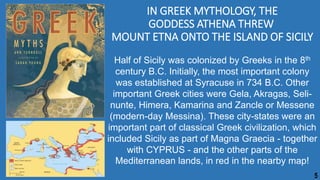
IN GREEK MYTHOLOGY, THE
GODDESS ATHENA THREW
MOUNT ETNA ONTO THE ISLAND OF SICILY
Half of Sicily was colonized by Greeks in the 8th
century B.C. Initially, the most important colony
was established at Syracuse in 734 B.C. Other
important Greek cities were Gela, Akragas, Seli-
nunte, Himera, Kamarina and Zancle or Messene
(modern-day Messina). These city-states were an
important part of classical Greek civilization, which
included Sicily as part of Magna Graecia - together
with CYPRUS - and the other parts of the
Mediterranean lands, in red in the nearby map!
5
GREEKS IN SICILY: THE RISE OF MAGNA GRECIA
The Telamone of
Olympeion temple of
Agrigento, ancient
Akragas, (between
480 e 470 B.C.)
The temple of
Concordia by night
in Agrigento (440-
430 B.C.)
The Greek theater of
Syracuse (between V
sec. B.C., and III sec.
A.D.)
6
THE TRANSITION FROM MAGNA GRECIA TO HELLENISM
The Agorà in the city of
Morgantina EN (aban-
doned towards 30 B.C.)
The statue of Demetra (or
Kore) called Venere of
Morgantina, stolen and
returned from the USA in
2011 (V sec. B.C.)
The Greek-Roman thea-
ter of Taormina with Etna
(from III sec. B.C. to II
sec. A.D.)
Two extraordinary Helleni-
stic coins, still shining, re-
cently discovered near
Caltavuturo (ab.Isec.A.D.)
7
IN THE ROMAN AGE SICILY BECAME THE
CENTRE OF THE EMPIRE AND ITS
BRIDGEHEAD TOWARDS AFRICA
At that time Sicily was the granary of Rome
and a place of passage of precious goods
and exotic and ferocious animals for bloody
games in amphitheaters and circuses
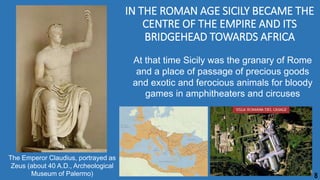
The Emperor Claudius, portrayed as
Zeus (about 40 A.D., Archeological
Museum of Palermo) 8
THE ROMAN AGE
Roman Villa del Casale
in Piazza Armerina -
EN (IVsec.A.D.)
The corridor of the gre-
at hunt: animals car-
ried on board of ships
(1) and on carts (2)
Room of the children
playing with little carts
towed by peacocks
Room of the girls in
bikini, playing sports
9
…THE RISE OF ARAB-NORMAN ART AND
ARCHITECTURE, THAT RECENTLY BECAME
A WORLD HERITAGE SITE
In the Middle Ages, after the expulsion of the Arab
invaders by the Norman kings, the engineering and
construction skills of the Arabs were used to build
large palaces, churches and fantastic gardens,
irrigation systems, water reservoirs and water
distribution, astronomical observatories...
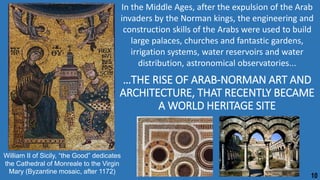
William II of Sicily, “the Good” dedicates
the Cathedral of Monreale to the Virgin
Mary (Byzantine mosaic, after 1172)
10
THE ARAB-NORMAN AGE
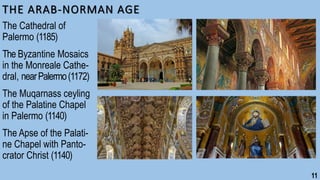
The Cathedral of
Palermo (1185)
The Byzantine Mosaics
in the Monreale Cathe-
dral, nearPalermo(1172)
The Muqarnass ceyling
of the Palatine Chapel
in Palermo (1140)
The Apse of the Palati-
ne Chapel with Panto-
crator Christ (1140)
11
THE ARAB-NORMAN AGE
The Norman Churches
of S.Cataldo (1154) and
S.Maria of the Admiral
(1143)in the city centre
of Palermo
The cloister of the
Cathedral of Monreale
with the fountain (XIIsec.)
The site of S.Giovanni
of Hermits with church
(mosque from VI sec.)
and cloister (XIIsec.)
The Zisa palace with
hunting gardens of the
Norman Kings (1165)
12
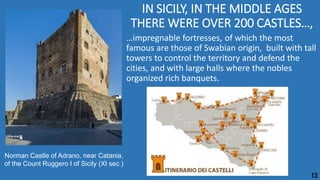
IN SICILY, IN THE MIDDLE AGES
THERE WERE OVER 200 CASTLES…,
…impregnable fortresses, of which the most
famous are those of Swabian origin, built with tall
towers to control the territory and defend the
cities, and with large halls where the nobles
organized rich banquets.
Norman Castle of Adrano, near Catania,
of the Count Ruggero I of Sicily (XI sec.)
13
THE NORMAN AND SWABIAN AGE
The Castle of
Caccamo (sec.XII) built
by Matteo Bonello
The Castle Ursino in
Catania built by
Federico II of Swabia
(from 1239 to 1250)
The Arab-Norman
Castle of Castellam-
mare del Golfo (built
by Arab from X sec.)
The Castle of Musso-
meli, built by Manfredi
III Chiaramonte, Count
of Modica (after1364)
onprevious Swabian
structures 14
SICILY HAS INTERPRETED ITALIAN
RENAISSANCE IN A CREATIVE AND
ORIGINAL WAY
In the XV and XVI centuries, Sicily was first subject
to the Aragonese government, then became part
of the Habsburg Empire of Charles V and of the
Kingdom of Spain of his successors.
Because of Aragonese and Spanish domination,
Architecture gets inspired by the Spanish Gothic
style.
Antonello da Messina was one of the greatest
painters in Europe, influenced by Flemish art.Portrait of an unknown sailor
(Antonello da Messina 1470 – Oil on
board – Mandralisca Museum, Cefalù)
15
RENAISSANCE
Antonello da Messina:
L’ Annunziata (1475)
Francesco Laurana:
Eleonora ofAragona (1468)
The Spanish-Gothic gate,
the windows and the
courtyard with two orders of
low arches in the Abatellis
Palace, the Museum of
Middle Ages and Modern art
in Palermo (built in 1495 by
the architect Matteo
Carnilivari)
16
IN SICILY THERE IS ONE OF THE MOST
EXTRAORDINARY COLLECTION OF
BAROQUE BUILDINGS OF ALL OF ITALY
 The “Pretoria Fountain” in Renaissance style, commonly
called “Fountain of Shame” in the city center of Palermo
(Francesco Camilliani, 1554 – in Palermo in 1581)
 The “4 Canti” Square, called also “the Theater of the Sun”
in the city center of Palermo (Giulio Lasso, 1608-1663)
17
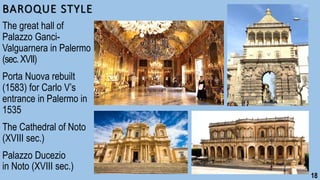
BAROQUE STYLE
The great hall of
Palazzo Ganci-
Valguarnera in Palermo
(sec.XVII)
Porta Nuova rebuilt
(1583) for Carlo V’s
entrance in Palermo in
1535
The Cathedral of Noto
(XVIII sec.)
Palazzo Ducezio
in Noto (XVIII sec.)
18
ECLECTICISM AND CLASSICISM IN THE
NINETEENTH CENTURY HAVE
INFLUENCED FIGURATIVE ARTS IN SICILY
 Bronze quadriga on the Politeama theater, with Apollo, god of
music, and Euterpe, muse of opera (B. Civiletti e M. Rutelli, after 1880)
 Chinese building, Giuseppe V. Marvuglia, Palermo 1799-1802
 Statue of Hercole on Doric Column, after 1750
19
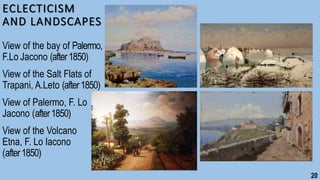
ECLECTICISM
AND LANDSCAPES
View of the bay of Palermo,
F.Lo Jacono (after1850)
View of the Salt Flats of
Trapani, A.Leto (after1850)
View of Palermo, F. Lo
Jacono (after1850)
View of the Volcano ,
Etna, F. Lo Iacono
(after1850)
20
IN SICILY AND PALERMO, ART NOUVEAU
– LIBERTY STYLE HERE – TAKES
CHARACTERISTICS THAT MAKES IT
UNIQUE IN THE WESTERN WORLD
 Liberty stained glass, Palermo, early 1900
 Chaise longue, Ducrot workshop production, Palermo 1900
 Bathouse at Mondello, Rudolf Stalker, after 1910
 Floral decoration on the ceiling, Villino Florio, Palermo, early 1900
21
LIBERTY STYLE
The Massimo Theatre,
Giovan Battista (classical
features) ed Ernesto Basile
(libertyfeatures) (1875-1897)
Door decoration in Villa Igea
(1899), Palermo
The Ribaudo Kiosk, Erne-.
sto Basile (early1900)
The Villino Florio, Ernesto
Basile (1900)
Liberty stained glass (early
1900)
22
CONTEMPORARY ART
WHERE NEW MEETS OLD, WHERE NEW
MEETS NATURE AND SOMETIMES
NEW GOES BACK TO THE ORIGIN
 Mitoray’s Art installation in the Valley of the Temples of
Agrigento, 2011
 Art installation known as Fiumara d’Arte in Tusa
(Messina), after 1982
 Cretto di Burri (1984-2015) on the ruins of Gibellina
village, destroyed by the earthquake of 1968 23
CONTEMPORARY
ART
The Vucciria,
Renato Guttuso (1974)
Stromboli Volcano ,
Renato Guttuso (1953)
The Nomadic,
Pippo Rizzo (1929)
The two Carabinieri,
Pippo Rizzo (1953)
24
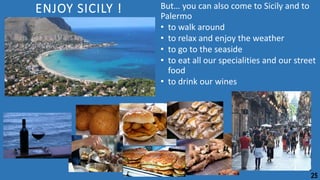
ENJOY SICILY ! But… you can also come to Sicily and to
Palermo
• to walk around
• to relax and enjoy the weather
• to go to the seaside
• to eat all our specialities and our street
food
• to drink our wines
25
ERASMUS PLUS - SMILE
SEA AND MUSIC IN LIFELONG EDUCATION
Cyprus, Greece, Italy, Portugal, Spain
Istituto Magistrale Statale “REGINA MARGHERITA”
Palermo (I)
Liceo Musicale e Coreutico
Good Bye

Italian presentation (greece)

  • 1.
    2TH LTT Courseof the ERASMUS+ project - SMILE SEA AND MUSIC IN LIFELONG EDUCATION Cyprus, Greece, Italy, Portugal, Spain Istituto Magistrale Statale “REGINA MARGHERITA” Palermo (Italy) Liceo Musicale e Coreutico Tuesday 26th March 2019 – Monday 1st April 2019
  • 2.
    SICILY: A MIXTUREOF CULTURES Our land has experienced lots of different dominations in the past: from The Greeks to the Romans, from the Arabs to the Normans, the Bizantines, the French, the Austrians and the Spanish. All of them have left something to us, to our history , culture, language, traditions and our way of living, eating, drinking and having fun or being sad. 1
  • 3.
    HERE WE’D LIKETO SHOW YOU OUR LAND: SICILY THE BIGGEST ISLAND IN ITALY A MIX OF CULTURES, HYSTORY, NATURE, ARTS & CRAFTS, FOLK, TYPICAL FOOD & SWEETS 2
  • 4.
    MYSTERIOUS PREHISTORIC TRAVELLERSCAME TO SICILY Graffiti of the Addaura cave in Palermo (Pa- leolithic age, before 10/50.000 B.C.) Graffiti of the traveller from Genoa in Levanzo island (before 10/50.000 B.C.) Prehistoric village of Mursia in Pantelleria TP (20,000 B.C.) 3
  • 5.
    PHOENICIANS IN SICILY:ART AND TRADE Auriga (Mozia, V sec. B.C.) Phoenician ship (Termini I.) Tablet with Punic funeral banquet (III B.C., Palermo) Golden phiale (IV sec. B.C., from Caltavuturo) Punic ship from Marsala (III sec. B.C.) Phoenician necklace with little pearls 4
  • 6.
    IN GREEK MYTHOLOGY,THE GODDESS ATHENA THREW MOUNT ETNA ONTO THE ISLAND OF SICILY Half of Sicily was colonized by Greeks in the 8th century B.C. Initially, the most important colony was established at Syracuse in 734 B.C. Other important Greek cities were Gela, Akragas, Seli- nunte, Himera, Kamarina and Zancle or Messene (modern-day Messina). These city-states were an important part of classical Greek civilization, which included Sicily as part of Magna Graecia - together with CYPRUS - and the other parts of the Mediterranean lands, in red in the nearby map! 5
  • 7.
    GREEKS IN SICILY:THE RISE OF MAGNA GRECIA The Telamone of Olympeion temple of Agrigento, ancient Akragas, (between 480 e 470 B.C.) The temple of Concordia by night in Agrigento (440- 430 B.C.) The Greek theater of Syracuse (between V sec. B.C., and III sec. A.D.) 6
  • 8.
    THE TRANSITION FROMMAGNA GRECIA TO HELLENISM The Agorà in the city of Morgantina EN (aban- doned towards 30 B.C.) The statue of Demetra (or Kore) called Venere of Morgantina, stolen and returned from the USA in 2011 (V sec. B.C.) The Greek-Roman thea- ter of Taormina with Etna (from III sec. B.C. to II sec. A.D.) Two extraordinary Helleni- stic coins, still shining, re- cently discovered near Caltavuturo (ab.Isec.A.D.) 7
  • 9.
    IN THE ROMANAGE SICILY BECAME THE CENTRE OF THE EMPIRE AND ITS BRIDGEHEAD TOWARDS AFRICA At that time Sicily was the granary of Rome and a place of passage of precious goods and exotic and ferocious animals for bloody games in amphitheaters and circuses The Emperor Claudius, portrayed as Zeus (about 40 A.D., Archeological Museum of Palermo) 8
  • 10.
    THE ROMAN AGE RomanVilla del Casale in Piazza Armerina - EN (IVsec.A.D.) The corridor of the gre- at hunt: animals car- ried on board of ships (1) and on carts (2) Room of the children playing with little carts towed by peacocks Room of the girls in bikini, playing sports 9
  • 11.
    …THE RISE OFARAB-NORMAN ART AND ARCHITECTURE, THAT RECENTLY BECAME A WORLD HERITAGE SITE In the Middle Ages, after the expulsion of the Arab invaders by the Norman kings, the engineering and construction skills of the Arabs were used to build large palaces, churches and fantastic gardens, irrigation systems, water reservoirs and water distribution, astronomical observatories... William II of Sicily, “the Good” dedicates the Cathedral of Monreale to the Virgin Mary (Byzantine mosaic, after 1172) 10
  • 12.
    THE ARAB-NORMAN AGE TheCathedral of Palermo (1185) The Byzantine Mosaics in the Monreale Cathe- dral, nearPalermo(1172) The Muqarnass ceyling of the Palatine Chapel in Palermo (1140) The Apse of the Palati- ne Chapel with Panto- crator Christ (1140) 11
  • 13.
    THE ARAB-NORMAN AGE TheNorman Churches of S.Cataldo (1154) and S.Maria of the Admiral (1143)in the city centre of Palermo The cloister of the Cathedral of Monreale with the fountain (XIIsec.) The site of S.Giovanni of Hermits with church (mosque from VI sec.) and cloister (XIIsec.) The Zisa palace with hunting gardens of the Norman Kings (1165) 12
  • 14.
    IN SICILY, INTHE MIDDLE AGES THERE WERE OVER 200 CASTLES…, …impregnable fortresses, of which the most famous are those of Swabian origin, built with tall towers to control the territory and defend the cities, and with large halls where the nobles organized rich banquets. Norman Castle of Adrano, near Catania, of the Count Ruggero I of Sicily (XI sec.) 13
  • 15.
    THE NORMAN ANDSWABIAN AGE The Castle of Caccamo (sec.XII) built by Matteo Bonello The Castle Ursino in Catania built by Federico II of Swabia (from 1239 to 1250) The Arab-Norman Castle of Castellam- mare del Golfo (built by Arab from X sec.) The Castle of Musso- meli, built by Manfredi III Chiaramonte, Count of Modica (after1364) onprevious Swabian structures 14
  • 16.
    SICILY HAS INTERPRETEDITALIAN RENAISSANCE IN A CREATIVE AND ORIGINAL WAY In the XV and XVI centuries, Sicily was first subject to the Aragonese government, then became part of the Habsburg Empire of Charles V and of the Kingdom of Spain of his successors. Because of Aragonese and Spanish domination, Architecture gets inspired by the Spanish Gothic style. Antonello da Messina was one of the greatest painters in Europe, influenced by Flemish art.Portrait of an unknown sailor (Antonello da Messina 1470 – Oil on board – Mandralisca Museum, Cefalù) 15
  • 17.
    RENAISSANCE Antonello da Messina: L’Annunziata (1475) Francesco Laurana: Eleonora ofAragona (1468) The Spanish-Gothic gate, the windows and the courtyard with two orders of low arches in the Abatellis Palace, the Museum of Middle Ages and Modern art in Palermo (built in 1495 by the architect Matteo Carnilivari) 16
  • 18.
    IN SICILY THEREIS ONE OF THE MOST EXTRAORDINARY COLLECTION OF BAROQUE BUILDINGS OF ALL OF ITALY  The “Pretoria Fountain” in Renaissance style, commonly called “Fountain of Shame” in the city center of Palermo (Francesco Camilliani, 1554 – in Palermo in 1581)  The “4 Canti” Square, called also “the Theater of the Sun” in the city center of Palermo (Giulio Lasso, 1608-1663) 17
  • 19.
    BAROQUE STYLE The greathall of Palazzo Ganci- Valguarnera in Palermo (sec.XVII) Porta Nuova rebuilt (1583) for Carlo V’s entrance in Palermo in 1535 The Cathedral of Noto (XVIII sec.) Palazzo Ducezio in Noto (XVIII sec.) 18
  • 20.
    ECLECTICISM AND CLASSICISMIN THE NINETEENTH CENTURY HAVE INFLUENCED FIGURATIVE ARTS IN SICILY  Bronze quadriga on the Politeama theater, with Apollo, god of music, and Euterpe, muse of opera (B. Civiletti e M. Rutelli, after 1880)  Chinese building, Giuseppe V. Marvuglia, Palermo 1799-1802  Statue of Hercole on Doric Column, after 1750 19
  • 21.
    ECLECTICISM AND LANDSCAPES View ofthe bay of Palermo, F.Lo Jacono (after1850) View of the Salt Flats of Trapani, A.Leto (after1850) View of Palermo, F. Lo Jacono (after1850) View of the Volcano , Etna, F. Lo Iacono (after1850) 20
  • 22.
    IN SICILY ANDPALERMO, ART NOUVEAU – LIBERTY STYLE HERE – TAKES CHARACTERISTICS THAT MAKES IT UNIQUE IN THE WESTERN WORLD  Liberty stained glass, Palermo, early 1900  Chaise longue, Ducrot workshop production, Palermo 1900  Bathouse at Mondello, Rudolf Stalker, after 1910  Floral decoration on the ceiling, Villino Florio, Palermo, early 1900 21
  • 23.
    LIBERTY STYLE The MassimoTheatre, Giovan Battista (classical features) ed Ernesto Basile (libertyfeatures) (1875-1897) Door decoration in Villa Igea (1899), Palermo The Ribaudo Kiosk, Erne-. sto Basile (early1900) The Villino Florio, Ernesto Basile (1900) Liberty stained glass (early 1900) 22
  • 24.
    CONTEMPORARY ART WHERE NEWMEETS OLD, WHERE NEW MEETS NATURE AND SOMETIMES NEW GOES BACK TO THE ORIGIN  Mitoray’s Art installation in the Valley of the Temples of Agrigento, 2011  Art installation known as Fiumara d’Arte in Tusa (Messina), after 1982  Cretto di Burri (1984-2015) on the ruins of Gibellina village, destroyed by the earthquake of 1968 23
  • 25.
    CONTEMPORARY ART The Vucciria, Renato Guttuso(1974) Stromboli Volcano , Renato Guttuso (1953) The Nomadic, Pippo Rizzo (1929) The two Carabinieri, Pippo Rizzo (1953) 24
  • 26.
    ENJOY SICILY !But… you can also come to Sicily and to Palermo • to walk around • to relax and enjoy the weather • to go to the seaside • to eat all our specialities and our street food • to drink our wines 25
  • 27.
    ERASMUS PLUS -SMILE SEA AND MUSIC IN LIFELONG EDUCATION Cyprus, Greece, Italy, Portugal, Spain Istituto Magistrale Statale “REGINA MARGHERITA” Palermo (I) Liceo Musicale e Coreutico Good Bye

Editor's Notes

  • #5 Tavoletta funeraria con scena di un banchetto funebre. Di epoca punica; da Marsala (Sicilia), Italia; III secolo D.C. Posizione: Museo Archeologico Salinas di Palermo
  • #6 Tavoletta funeraria con scena di un banchetto funebre. Di epoca punica; da Marsala (Sicilia), Italia; III secolo D.C. Posizione: Museo Archeologico Salinas di Palermo
  • #8 Telamone dell'Olympeion è un telamone in calcarenite, databile tra il 480 e il 470 a.C.  Telamone dell'Olympeion is a limestone telamone, dating from between 480 and 470 BC
  • #9 Tavoletta funeraria con scena di un banchetto funebre. Di epoca punica; da Marsala (Sicilia), Italia; III secolo D.C. Posizione: Museo Archeologico Salinas di Palermo
  • #10 AND THE BRIDGE HEAD TOWARDS AFRICA And place of transit of precious goods and exotic and ferocious animals for bloody games in amphitheaters statua ritratto dell' Imperatore Claudio , raffigurato come Zeus Statue-portrait of the Emperor Claudius, portrayed as Zeus
  • #11 Two lovers. Medallion mosaic (3rd-4th CE) from the cubicle of erotic scenes in the Villa del Casale, Piazza Armerina, Sicily, Italy. Ulisse e Polifemo mosaico a Triclinio Villa Romana del Casale vicino a Piazza Armerina Sicilia Italia - B6P99F dalla libreria Alamy di milioni di... corridor of the great hunt
  • #12 After the ancient age and the expulsion of the Arab invaders by the Norman kings, the engineering and construction skills of the Arabs were used to build large buildings, churches and fantastic gardens, irrigation systems and water collection and transport, astronomical observatories. .. born the Norman Arab art that is recently a World Heritage Site Dopo l'età antica e la cacciata degli invasori arabi da parte dei re normanni vennero utilizzate le capacità ingegneristiche e costruttive degli arabi per realizzare grandi palazzi, chiese e fantastici giardini, sistemi di irrigazione e di raccolta e trasporto dell'acqua, osservatori astronomici... nacque l'arte arabo normanna che da poco è patrimonio dell'umanità Guglielmo II di Sicilia "il Buono". Dedication mosaic - Cathedral of Monreale - Italy 2015 (crop).JPG William II of Sicily "the Good" dedicates the Cathedral of Monreale to the Madonna (Byzantine mosaic -
  • #14 gardens for hunting
  • #15 Nel XV e XVI secolo la Sicilia prima fu sottoposta al governo aragonese e poi fece parte dell'Impero asburgico di Carlo V e del Regno di Spagna dei suoi successori. In the fifteenth and sixteenth centuries, Sicily was first subjected to the Aragonese government and then became part of the Habsburg Empire of Charles V and the Kingdom of Spain of its successors. represents carlo who returns triumphant from Tunis in 1535 La Sicilia ha interpretato il Rinascimento in maniera autonoma ed originale - portrait of an unknown sailor Sicily interpreted Italian Renaissance in a creative and original way Antonello da Messina was one of the greatest painters in Europe
  • #16 gardens for hunting
  • #17 Nel XV e XVI secolo la Sicilia prima fu sottoposta al governo aragonese e poi fece parte dell'Impero asburgico di Carlo V e del Regno di Spagna dei suoi successori. In the fifteenth and sixteenth centuries, Sicily was first subjected to the Aragonese government and then became part of the Habsburg Empire of Charles V and the Kingdom of Spain of its successors. represents carlo who returns triumphant from Tunis in 1535 La Sicilia ha interpretato il Rinascimento in maniera autonoma ed originale - portrait of an unknown sailor Sicily interpreted Italian Renaissance in a creative and original way Antonello da Messina was one of the greatest painters in Europe
  • #19 Nel XV e XVI secolo la Sicilia prima fu sottoposta al governo aragonese e poi fece parte dell'Impero asburgico di Carlo V e del Regno di Spagna dei suoi successori. In the fifteenth and sixteenth centuries, Sicily was first subjected to the Aragonese government and then became part of the Habsburg Empire of Charles V and the Kingdom of Spain of its successors. represents carlo who returns triumphant from Tunis in 1535 La Sicilia ha interpretato il Rinascimento in maniera autonoma ed originale - portrait of an unknown sailor Sicily interpreted Italian Renaissance in a creative and original way Antonello da Messina was one of the greatest painters in Europe
  • #23 IN SICILIA E A PALERMO L'ART NOUVEAU ASSUME CARATTERISTICHE CHE LA RENDE UNICA NEL MONDO OCCIDENTALE IN SICILY AND PALERMO THE ART NOUVEAU - LIBERTY STYLE HERE - TAKES CHARACTERISTICS THAT MAKES IT UNIQUE IN THE WESTERN WORLD floral decoration on the ceiling