L. J. SALOMON, Z. ALFIREVIC, V. BERGHELLA, C. BILARDO, E. HERNANDEZ-
ANDRADE, S. L. JOHNSEN, K. KALACHE, K.-Y. LEUNG, G. MALINGER, H. MUNOZ, F.
  PREFUMO, A. TOI and W. LEE on behalf of the ISUOG Clinical Standards Committee
Why ?
•The International Society of Ultrasound in Obstetrics and Gynecology
(ISUOG) is a scientific organization that encourages sound clinical practice,
teaching and research for diagnostic imaging in women’s healthcare.
•Practice Guidelines and Consensus are intended to reflect what is
considered by ISUOG to be the best practices at the time at which they
were issued.
•Although ISUOG has made every effort to ensure that guidelines are
accurate when issued, neither the Society nor any of its employees or
members accepts any liability for the consequences of any inaccurate or
misleading data, opinions or statements issued by the CSC.
•Guidelines are not intended to establish a legal standard of care because
interpretation of the evidence that underpins the guidelines may be
influenced by individual circumstances and available resources.
•Approved guidelines can be distributed freely with the permission of ISUOG
(info@isuog.org).
What is the purpose of a mid-trimester
                 fetal ultrasound scan?
•Provide accurate diagnostic information for the delivery of optimized
antenatal care with the best possible outcomes for mother and fetus.
•The procedure is used to determine gestational age and to perform fetal
measurements for the timely detection of are to detect congenital
malformations and multiple pregnancies.
•Prenatal screening examination includes an evaluation of the following:
cardiac activity; fetal number (and chorionicity if multiple pregnancy); fetal
age/size; basic fetal anatomy; placental appearance and location.
•Although many malformations can be identified, it is acknowledged that
some may be missed, even with sonographic equipment in the best of
hands, or that they may develop later in pregnancy.
•Before starting the examination, a healthcare practitioner should counsel
the woman/couple regarding the potential benefits and limitations of a
routine mid-trimester fetal ultrasound scan.
Who should perform the scan?
•In order to achieve optimal results from routine screening examinations, it is
suggested that scans should be performed by individuals who fulfil the
following criteria:
    –trained in the use of diagnostic ultrasonography and related safety issues;
    –regularly perform fetal ultrasound scans;
    –participate in continuing medical education activities;
    –have established appropriate referral patterns for suspicious or abnormal
    findings;
    –routinely undertake quality assurance and control measures.
•If the examination cannot be performed completely in accordance with
adopted guidelines, the scan should be repeated, at least in part, at a later
time, or the patient can be referred to another practitioner. This should be
done as soon as possible, to minimize unnecessary patient anxiety and
unnecessary delay in the potential diagnosis of congenital anomalies or
growth disturbances.
What equipment?
•For routine screening, equipment should have at least the following:
    – real time, gray-scale ultrasound capabilities;
    – transabdominal transducers (3–5-MHz range);
    – adjustable acoustic power output controls with output display
    standards;
    – freeze frame capabilities;
    – electronic calipers;
    – capacity to print/store images;
    – regular maintenance and servicing, important for optimal equipment
    performance.
What document?
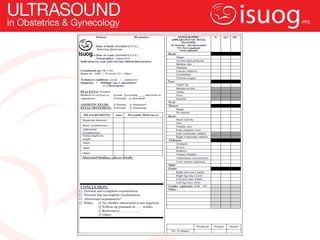
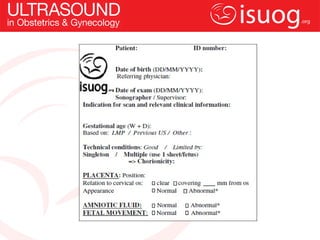
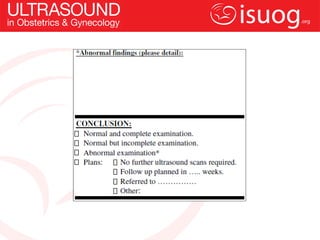
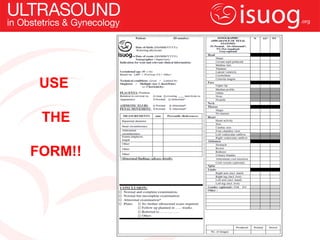
•An examination report should be produced as an electronic and/or a
paper document, to be sent to the referring care provider in
reasonable time. A sample reporting form is available at the end of
this guidelines.
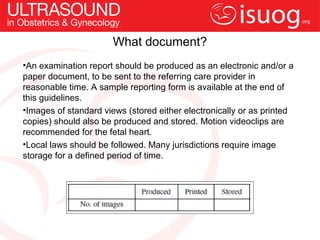
•Images of standard views (stored either electronically or as printed
copies) should also be produced and stored. Motion videoclips are
recommended for the fetal heart.
•Local laws should be followed. Many jurisdictions require image
storage for a defined period of time.
Is prenatal ultrasonography safe?

•Prenatal ultrasonography appears to be safe for clinical
practice.
•To date, there has been no independently confirmed study to
suggest otherwise.
•Fetal exposure times should be minimized, using the lowest
possible power output needed to obtain diagnostic
information,
•following the ALARA principle (As Low As Reasonably
Achievable).
•More details are available from the ISUOG Safety Statement.
Well being?
•Amniotic fluid assessment:
   – Amniotic fluid volume can be estimated subjectively or using
   sonographic measurements.
   – Subjective estimation is not inferior to the quantitative measurement
   techniques (e.g. deepest pocket, amniotic fluid index) when performed
   by experienced examiners.
•Fetal movement:
   – Normal fetuses typically have a relaxed position and show regular
   movements.
   – There are no specific movement and temporary absence or
   reduction of fetal movements during the scan should not be considered
   as a risk factor. Abnormal positioning or unusually restricted or
   persistently absent fetal movements may suggest abnormal fetal
   conditions such as arthrogryposis. The biophysical profile is not
   considered part of a routine mid-trimester scan.
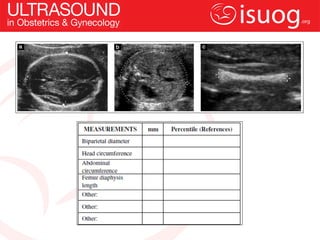
Fetal biometry?
•The following sonographic parameters can be used to estimate
gestational age and for fetal size assessment:
     – biparietal diameter (BPD);
     – head circumference (HC);
     – abdominal circumference (AC) or diameter;
     – femur diaphysis length (FDL).
•Measurements should be performed in a standardized manner on the
basis of strict quality criteria. An audit of results can help to ensure
accuracy of techniques with regard to specific reference tables.
•The chosen reference standards should be indicated in the report
•An image(s) should be taken to document the measurement(s).
•The application of Doppler techniques is not currently recommended
as part of the routine second-trimester ultrasound examination. There
is insufficient evidence to support universal use of uterine or umbilical
artery Doppler evaluation for the screening of low-risk pregnancies.
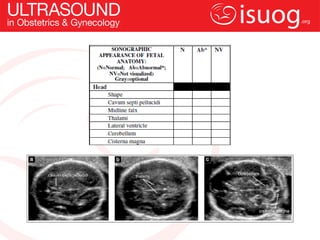
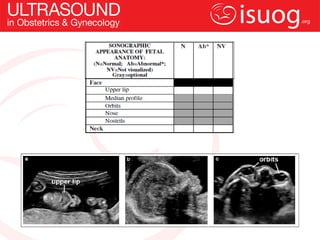
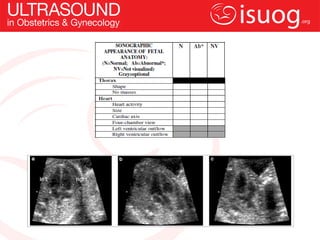
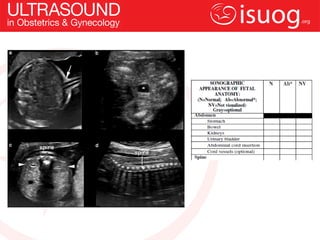
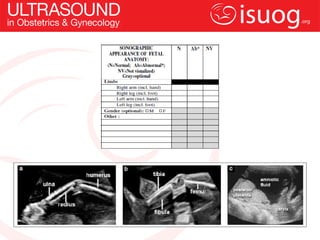
Fetal anatomy?
• Recommended minimum requirements for a basic fetal anatomical
survey during the mid-trimester of pregnancy are summarized in the
report form
• Survey includes:
    – Head: skull, brain..
    – Face
    – Neck
    – Thorax: chest, heart.
    – Abdomen/urinary tract.
    – Skeletal
    – Limbs
    – Placenta, umbilical cord…
Cervix, uterine and adnexa?
• Several studies have demonstrated a strong correlation between
short cervical length on transvaginal scan and subsequent preterm
birth. However, several randomized controlled trials that examined the
combination of routine cervical length measurement and subsequent
interventions (cerclage, progesterone) failed to demonstrate
conclusively any cost-effectiveness of such screening programs.

• Currently, there is insufficient evidence to recommend routine cervical
length measurements at the mid trimester in an unselected population.

• Uterine fibroids and adnexal masses should be documented if they
are likely to interfere with labor.
USE

 THE

FORM!!
ISUOG’s website is a great resource for more information:

ISUOG Mid-trimester Guidelines

  • 1.
    L. J. SALOMON,Z. ALFIREVIC, V. BERGHELLA, C. BILARDO, E. HERNANDEZ- ANDRADE, S. L. JOHNSEN, K. KALACHE, K.-Y. LEUNG, G. MALINGER, H. MUNOZ, F. PREFUMO, A. TOI and W. LEE on behalf of the ISUOG Clinical Standards Committee
  • 2.
    Why ? •The InternationalSociety of Ultrasound in Obstetrics and Gynecology (ISUOG) is a scientific organization that encourages sound clinical practice, teaching and research for diagnostic imaging in women’s healthcare. •Practice Guidelines and Consensus are intended to reflect what is considered by ISUOG to be the best practices at the time at which they were issued. •Although ISUOG has made every effort to ensure that guidelines are accurate when issued, neither the Society nor any of its employees or members accepts any liability for the consequences of any inaccurate or misleading data, opinions or statements issued by the CSC. •Guidelines are not intended to establish a legal standard of care because interpretation of the evidence that underpins the guidelines may be influenced by individual circumstances and available resources. •Approved guidelines can be distributed freely with the permission of ISUOG (info@isuog.org).
  • 4.
    What is thepurpose of a mid-trimester fetal ultrasound scan? •Provide accurate diagnostic information for the delivery of optimized antenatal care with the best possible outcomes for mother and fetus. •The procedure is used to determine gestational age and to perform fetal measurements for the timely detection of are to detect congenital malformations and multiple pregnancies. •Prenatal screening examination includes an evaluation of the following: cardiac activity; fetal number (and chorionicity if multiple pregnancy); fetal age/size; basic fetal anatomy; placental appearance and location. •Although many malformations can be identified, it is acknowledged that some may be missed, even with sonographic equipment in the best of hands, or that they may develop later in pregnancy. •Before starting the examination, a healthcare practitioner should counsel the woman/couple regarding the potential benefits and limitations of a routine mid-trimester fetal ultrasound scan.
  • 5.
    Who should performthe scan? •In order to achieve optimal results from routine screening examinations, it is suggested that scans should be performed by individuals who fulfil the following criteria: –trained in the use of diagnostic ultrasonography and related safety issues; –regularly perform fetal ultrasound scans; –participate in continuing medical education activities; –have established appropriate referral patterns for suspicious or abnormal findings; –routinely undertake quality assurance and control measures. •If the examination cannot be performed completely in accordance with adopted guidelines, the scan should be repeated, at least in part, at a later time, or the patient can be referred to another practitioner. This should be done as soon as possible, to minimize unnecessary patient anxiety and unnecessary delay in the potential diagnosis of congenital anomalies or growth disturbances.
  • 6.
    What equipment? •For routinescreening, equipment should have at least the following: – real time, gray-scale ultrasound capabilities; – transabdominal transducers (3–5-MHz range); – adjustable acoustic power output controls with output display standards; – freeze frame capabilities; – electronic calipers; – capacity to print/store images; – regular maintenance and servicing, important for optimal equipment performance.
  • 7.
    What document? •An examinationreport should be produced as an electronic and/or a paper document, to be sent to the referring care provider in reasonable time. A sample reporting form is available at the end of this guidelines. •Images of standard views (stored either electronically or as printed copies) should also be produced and stored. Motion videoclips are recommended for the fetal heart. •Local laws should be followed. Many jurisdictions require image storage for a defined period of time.
  • 8.
    Is prenatal ultrasonographysafe? •Prenatal ultrasonography appears to be safe for clinical practice. •To date, there has been no independently confirmed study to suggest otherwise. •Fetal exposure times should be minimized, using the lowest possible power output needed to obtain diagnostic information, •following the ALARA principle (As Low As Reasonably Achievable). •More details are available from the ISUOG Safety Statement.
  • 10.
    Well being? •Amniotic fluidassessment: – Amniotic fluid volume can be estimated subjectively or using sonographic measurements. – Subjective estimation is not inferior to the quantitative measurement techniques (e.g. deepest pocket, amniotic fluid index) when performed by experienced examiners. •Fetal movement: – Normal fetuses typically have a relaxed position and show regular movements. – There are no specific movement and temporary absence or reduction of fetal movements during the scan should not be considered as a risk factor. Abnormal positioning or unusually restricted or persistently absent fetal movements may suggest abnormal fetal conditions such as arthrogryposis. The biophysical profile is not considered part of a routine mid-trimester scan.
  • 11.
    Fetal biometry? •The followingsonographic parameters can be used to estimate gestational age and for fetal size assessment: – biparietal diameter (BPD); – head circumference (HC); – abdominal circumference (AC) or diameter; – femur diaphysis length (FDL). •Measurements should be performed in a standardized manner on the basis of strict quality criteria. An audit of results can help to ensure accuracy of techniques with regard to specific reference tables. •The chosen reference standards should be indicated in the report •An image(s) should be taken to document the measurement(s). •The application of Doppler techniques is not currently recommended as part of the routine second-trimester ultrasound examination. There is insufficient evidence to support universal use of uterine or umbilical artery Doppler evaluation for the screening of low-risk pregnancies.
  • 13.
    Fetal anatomy? • Recommendedminimum requirements for a basic fetal anatomical survey during the mid-trimester of pregnancy are summarized in the report form • Survey includes: – Head: skull, brain.. – Face – Neck – Thorax: chest, heart. – Abdomen/urinary tract. – Skeletal – Limbs – Placenta, umbilical cord…
  • 19.
    Cervix, uterine andadnexa? • Several studies have demonstrated a strong correlation between short cervical length on transvaginal scan and subsequent preterm birth. However, several randomized controlled trials that examined the combination of routine cervical length measurement and subsequent interventions (cerclage, progesterone) failed to demonstrate conclusively any cost-effectiveness of such screening programs. • Currently, there is insufficient evidence to recommend routine cervical length measurements at the mid trimester in an unselected population. • Uterine fibroids and adnexal masses should be documented if they are likely to interfere with labor.
  • 21.
  • 22.
    ISUOG’s website isa great resource for more information: