{
WELCOME TO
SMART
SONOGRAPHY
knowledge with skill
BASIC OBSTETRIC
ULTRASOUND TRAINING
FOR HEALTHCARE
PROFESSIONALS
PURPOSE OF TRAINING:
To educate midwives, nurses and other health workers in
rural areas on the effective use of ultrasound in enhancing
patient care and reducing maternal mortality rate by making
prompt decisions that relates to the health of their patients.
PROGRAMME OUTLINE
 Ultrasound defined with brief history
 Basic ultrasound principle
 Ultrasound terminology
 Intro to Basic Obstetric ultrasound
 1st , 2nd, and 3rd trimester pregnancy
 Basic measurements used in 1st, 2nd ,and 3rd trimester
pregnancy
 Writing the obstetric ultrasound Report
 Hands-on practicals
WHAT IS ULTRASOUND?
1. High frequency sound[pressure]waves
2. >20,000HZ[2kHz] upper limit of
human hearing.
3. 2MHZ-10MHZ medical diagnostic
frequency range.
4. Ultrasound waves are created by a
vibrating crystal within a ceramic probe.
5. “Piezoelectric” principle- electric
current causes crystals to vibrate,
returning waves create electric current.
HISTORY OF ULTRASOUND
- First introduced to medical world
in 1950s.
- However, has its beginnings in the
1880s when Pierre Curie introduced
simple echo sounding methods.
- This led to the discovery of
SONAR- [Sound navigating and
ranging]
IN ULTRASOUND THE FOLLOWING EVENTS
HAPPEN:
-The ultrasound machine transmits high frequency [1-12
mhz] sound pulses into the body using the probe.
- The sound waves travel into the body and hit a
boundary between tissues [e.g between fluid and soft
tissue or between soft tissue and bone].
- Some of the sound waves reflect back to the probe
while some travel on further until they reach another
boundary and reflect back to the probe.
- The reflected waves are detected by the probe and
relayed to the machine.
{
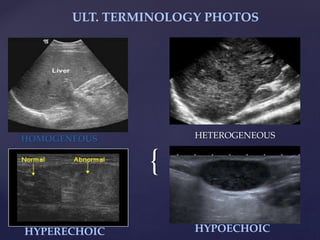
ULTRASOUND TERMINOLOGY
HOMOGENEOUS: Refers to an even echo pattern or
reflections that are relative and uniform in composition.
HETEROGENEOUS: Refers to an uneven echo pattern
HYPERECHOIC:: A relative term that refers to the echoes
returned from a structure. Hyperechoic refers to a lesion or
tumour which produces a stronger echo than surrounding
structures or tissues.
HYPOECHOIC: Refers to structures that contain fewer or weaker
echoes than surrounding tissues.
ACOUSTIC ENHANCEMENT: It is also called posterior
enhancement. Refers to the increased echoes deep to structures
that transmit sound exceptionally well, like fluid filled
structures.
ACOUSTIC SHADOWING: Characterized by a signal void
behind structures that strongly absorb or reflect ultrasound
waves.
{
ULT. TERMINOLOGY CONT’D
ECHOGENICITY: Capacity of a structure in the path of an
ultrasound beam to reflect back sound waves.
HYPERCHOGENIC: Refers to materials that produces
echoes that are stronger than normal or surrounding tissues
ANECHOIC: Free from echoes or reverberations
COMPLEX: Lesions composed of anechoic[cystic] and
echogenic[ solid] components.
ECHOES: The reflection of an ultrasound wave back to the
transducer from a structure.
{
HOMOGENEOUS HETEROGENEOUS
HYPERECHOIC HYPOECHOIC
ULT. TERMINOLOGY PHOTOS
{
ANECHOIC
ULT. TERMINOLOGY PHOTOS
ACOUSTIC ENHANCEMENT ACLOUSTIC SHADOWING
HYPERECHOIC
{
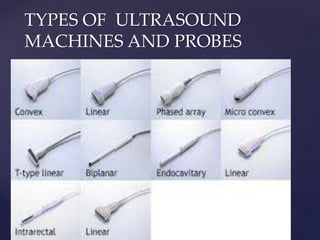
TYPES OF ULTRASOUND
MACHINES AND PROBES
{
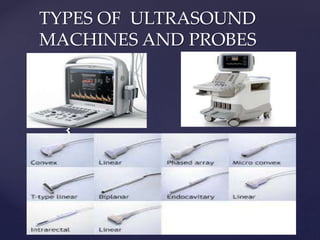
TYPES OF ULTRASOUND
MACHINES AND PROBES
{
THE EARLY PREGNANCY SCAN
The aims of early pregnancy scanning
are:
 Determine viability
 Gestational age
 Fetal number
 In addition, the adnexa should
be visualized to exclude
significant pathology
{
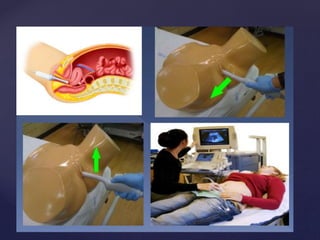
METHODS
 TRANSVAGINAL If 5-8
weeks
 TRANSABDOMINAL If 10-13
weeks
{
{
WHAT WILL I EXPERIENCE
DURING THE PROCEDURE?
--Most ultrasound examinations are painless, fast
and easy, usually no discomfort from pressure.
--If scanning is performed over an area of
tenderness, you may feel pressure or minor pain
from the transducer.
--With transvaginal ultrasound, there may be
minimal discomfort as the transducer is moved in
the vagina.
--Once the procedure is complete, the gel will be
wiped off your skin
{
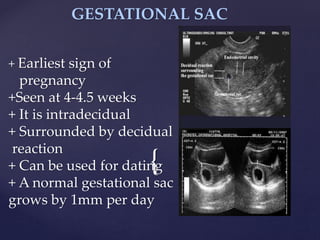
GESTATIONAL SAC
+ Earliest sign of
pregnancy
+Seen at 4-4.5 weeks
+ It is intradecidual
+ Surrounded by decidual
reaction
+ Can be used for dating
+ A normal gestational sac
grows by 1mm per day
{
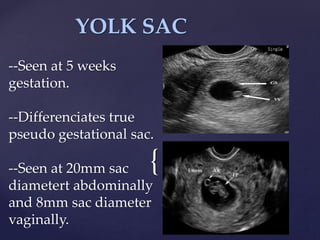
YOLK SAC
--Seen at 5 weeks
gestation.
--Differenciates true
pseudo gestational sac.
--Seen at 20mm sac
diametert abdominally
and 8mm sac diameter
vaginally.
ORDER OF FETAL STRUCTURES
Gestational sac- 4- 5 weeks
Yolk Sac – 5 to 6 weeks
Fetal pole – 6 to 7 weeks
Cardiac Activity- 6 to 7 weeks
EARLY PREGNANCY FAILURE
 Failed early pregnancy refers to the
death of the embryo and therefore ,
miscarriage.
 The most common cause of
embryonic death is a chromosomal
abnormality.
NON- VIABLE PREGNANCY
A Pregnancy is considered non-viable on transvaginal
scan if:
--No fetal heart beat where
-CRL is greater or equal
to 7mm.
--No fetal pole where:
-MSD is greater than 25mm with no embryo.
- Both fetus and gestational sac are expected to grow
1mm/day. Hence, absence or inadequate growth on
serial scans at least 7-10days apart is suggestive of
non-viability.
Other poor prognostic indicators
include;
--No yolk sac where:
MSD is greater than 8mm.
Embryo seen
-- Irregular gestational sac
--Low position of the gestational sac
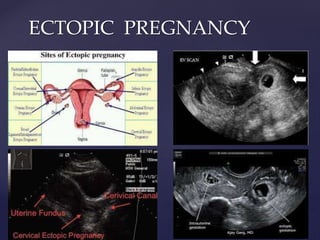
ECTOPIC PREGNANCY
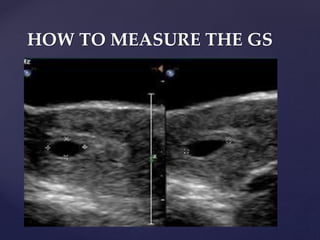
HOW TO MEASURE THE GS
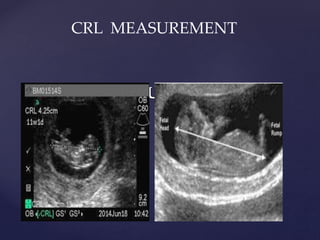
HOW TO MEASURE USING CRL
CRL MEASUREMENT
{
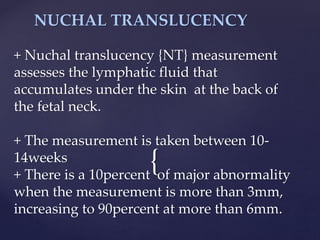
NUCHAL TRANSLUCENCY
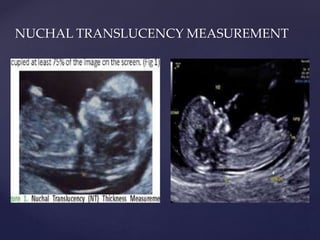
+ Nuchal translucency {NT} measurement
assesses the lymphatic fluid that
accumulates under the skin at the back of
the fetal neck.
+ The measurement is taken between 10-
14weeks
+ There is a 10percent of major abnormality
when the measurement is more than 3mm,
increasing to 90percent at more than 6mm.
{
NUCHAL TRANSLUCENCY MEASUREMENT
{
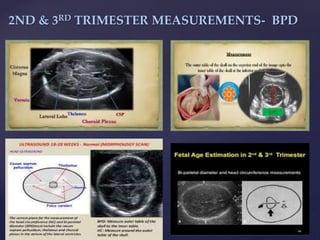
2ND & 3RD TRIMESTER MEASUREMENTS- BPD
{
OBSTETRIC USG IN 2ND & 3RD TRIMESTER
--Record placental position
--Establish fetal age and growth by
fetal biometry including;
-Bi-parietal diameter
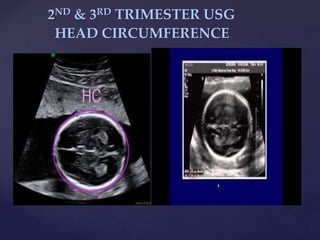
-Head circumference
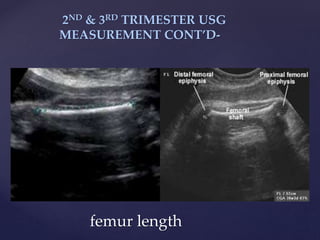
-Femur length
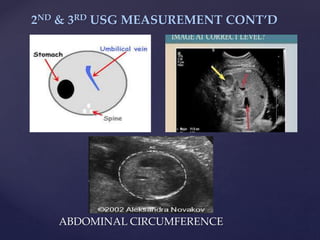
-Abdominal circumference
{
2ND & 3RD TRIMESTER USG
MEASUREMENT CONT’D-
femur length
{
2ND & 3RD USG MEASUREMENT CONT’D
ABDOMINAL CIRCUMFERENCE
{
2ND & 3RD TRIMESTER USG
HEAD CIRCUMFERENCE
{
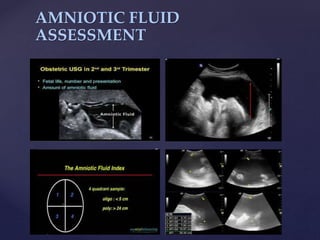
AMNIOTIC FLUID
ASSESSMENT
{
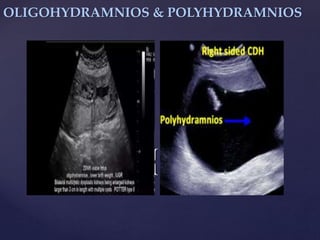
OLIGOHYDRAMNIOS
-Defn: Considerate deficiency of amniotic
fluid volume <200mls, 0.5-5.5percent of all
pregnancies
-Reasons: Fetal diseases,[ malformations,
hypotrophia, acardiacus]: maternal diseases[
Diabetes with microangiopathy, gestosis],
PROM, bad hydration, post-term pregnancy.
-Symptoms: Decreased fluid, fetal
movements, circumference of the abdomen,
easy to feel fetus parts and hard to move
presenting parts.
{
POLYHYDRAMNIOS
Defn: Excess amniotic
fluid [the largest
single pocket
measuring 11cm
approximately]
{
OLIGOHYDRAMNIOS & POLYHYDRAMNIOS
Writing the obstetric
ultrasound Report
THANK YOU
If your choice is
SMART SONOGRAPHY,
your ultrasound worries
don’t exist.
LET’S DO IT.
IT’S HANDS-ON TIME.
LET’S GO SCANNING.
Website: www.smartsonography-gh.com
facebook: @smartsonogh
Phones: 0243044363/0542417210

BASIC OBSTETRIC ULTRASOUND TRAINING

  • 1.
  • 2.
  • 3.
    PURPOSE OF TRAINING: Toeducate midwives, nurses and other health workers in rural areas on the effective use of ultrasound in enhancing patient care and reducing maternal mortality rate by making prompt decisions that relates to the health of their patients. PROGRAMME OUTLINE  Ultrasound defined with brief history  Basic ultrasound principle  Ultrasound terminology  Intro to Basic Obstetric ultrasound  1st , 2nd, and 3rd trimester pregnancy  Basic measurements used in 1st, 2nd ,and 3rd trimester pregnancy  Writing the obstetric ultrasound Report  Hands-on practicals
  • 4.
    WHAT IS ULTRASOUND? 1.High frequency sound[pressure]waves 2. >20,000HZ[2kHz] upper limit of human hearing. 3. 2MHZ-10MHZ medical diagnostic frequency range. 4. Ultrasound waves are created by a vibrating crystal within a ceramic probe. 5. “Piezoelectric” principle- electric current causes crystals to vibrate, returning waves create electric current.
  • 5.
    HISTORY OF ULTRASOUND -First introduced to medical world in 1950s. - However, has its beginnings in the 1880s when Pierre Curie introduced simple echo sounding methods. - This led to the discovery of SONAR- [Sound navigating and ranging]
  • 6.
    IN ULTRASOUND THEFOLLOWING EVENTS HAPPEN: -The ultrasound machine transmits high frequency [1-12 mhz] sound pulses into the body using the probe. - The sound waves travel into the body and hit a boundary between tissues [e.g between fluid and soft tissue or between soft tissue and bone]. - Some of the sound waves reflect back to the probe while some travel on further until they reach another boundary and reflect back to the probe. - The reflected waves are detected by the probe and relayed to the machine.
  • 7.
    { ULTRASOUND TERMINOLOGY HOMOGENEOUS: Refersto an even echo pattern or reflections that are relative and uniform in composition. HETEROGENEOUS: Refers to an uneven echo pattern HYPERECHOIC:: A relative term that refers to the echoes returned from a structure. Hyperechoic refers to a lesion or tumour which produces a stronger echo than surrounding structures or tissues. HYPOECHOIC: Refers to structures that contain fewer or weaker echoes than surrounding tissues. ACOUSTIC ENHANCEMENT: It is also called posterior enhancement. Refers to the increased echoes deep to structures that transmit sound exceptionally well, like fluid filled structures. ACOUSTIC SHADOWING: Characterized by a signal void behind structures that strongly absorb or reflect ultrasound waves.
  • 8.
    { ULT. TERMINOLOGY CONT’D ECHOGENICITY:Capacity of a structure in the path of an ultrasound beam to reflect back sound waves. HYPERCHOGENIC: Refers to materials that produces echoes that are stronger than normal or surrounding tissues ANECHOIC: Free from echoes or reverberations COMPLEX: Lesions composed of anechoic[cystic] and echogenic[ solid] components. ECHOES: The reflection of an ultrasound wave back to the transducer from a structure.
  • 9.
  • 10.
    { ANECHOIC ULT. TERMINOLOGY PHOTOS ACOUSTICENHANCEMENT ACLOUSTIC SHADOWING HYPERECHOIC
  • 11.
  • 12.
  • 13.
    { THE EARLY PREGNANCYSCAN The aims of early pregnancy scanning are:  Determine viability  Gestational age  Fetal number  In addition, the adnexa should be visualized to exclude significant pathology
  • 14.
    { METHODS  TRANSVAGINAL If5-8 weeks  TRANSABDOMINAL If 10-13 weeks
  • 15.
  • 16.
    { WHAT WILL IEXPERIENCE DURING THE PROCEDURE? --Most ultrasound examinations are painless, fast and easy, usually no discomfort from pressure. --If scanning is performed over an area of tenderness, you may feel pressure or minor pain from the transducer. --With transvaginal ultrasound, there may be minimal discomfort as the transducer is moved in the vagina. --Once the procedure is complete, the gel will be wiped off your skin
  • 17.
    { GESTATIONAL SAC + Earliestsign of pregnancy +Seen at 4-4.5 weeks + It is intradecidual + Surrounded by decidual reaction + Can be used for dating + A normal gestational sac grows by 1mm per day
  • 18.
    { YOLK SAC --Seen at5 weeks gestation. --Differenciates true pseudo gestational sac. --Seen at 20mm sac diametert abdominally and 8mm sac diameter vaginally.
  • 19.
    ORDER OF FETALSTRUCTURES Gestational sac- 4- 5 weeks Yolk Sac – 5 to 6 weeks Fetal pole – 6 to 7 weeks Cardiac Activity- 6 to 7 weeks
  • 20.
    EARLY PREGNANCY FAILURE Failed early pregnancy refers to the death of the embryo and therefore , miscarriage.  The most common cause of embryonic death is a chromosomal abnormality.
  • 21.
    NON- VIABLE PREGNANCY APregnancy is considered non-viable on transvaginal scan if: --No fetal heart beat where -CRL is greater or equal to 7mm. --No fetal pole where: -MSD is greater than 25mm with no embryo. - Both fetus and gestational sac are expected to grow 1mm/day. Hence, absence or inadequate growth on serial scans at least 7-10days apart is suggestive of non-viability.
  • 22.
    Other poor prognosticindicators include; --No yolk sac where: MSD is greater than 8mm. Embryo seen -- Irregular gestational sac --Low position of the gestational sac
  • 23.
  • 24.
  • 25.
    HOW TO MEASUREUSING CRL CRL MEASUREMENT
  • 26.
    { NUCHAL TRANSLUCENCY + Nuchaltranslucency {NT} measurement assesses the lymphatic fluid that accumulates under the skin at the back of the fetal neck. + The measurement is taken between 10- 14weeks + There is a 10percent of major abnormality when the measurement is more than 3mm, increasing to 90percent at more than 6mm.
  • 27.
  • 28.
    { 2ND & 3RDTRIMESTER MEASUREMENTS- BPD
  • 29.
    { OBSTETRIC USG IN2ND & 3RD TRIMESTER --Record placental position --Establish fetal age and growth by fetal biometry including; -Bi-parietal diameter -Head circumference -Femur length -Abdominal circumference
  • 30.
    { 2ND & 3RDTRIMESTER USG MEASUREMENT CONT’D- femur length
  • 31.
    { 2ND & 3RDUSG MEASUREMENT CONT’D ABDOMINAL CIRCUMFERENCE
  • 32.
    { 2ND & 3RDTRIMESTER USG HEAD CIRCUMFERENCE
  • 33.
  • 34.
    { OLIGOHYDRAMNIOS -Defn: Considerate deficiencyof amniotic fluid volume <200mls, 0.5-5.5percent of all pregnancies -Reasons: Fetal diseases,[ malformations, hypotrophia, acardiacus]: maternal diseases[ Diabetes with microangiopathy, gestosis], PROM, bad hydration, post-term pregnancy. -Symptoms: Decreased fluid, fetal movements, circumference of the abdomen, easy to feel fetus parts and hard to move presenting parts.
  • 35.
    { POLYHYDRAMNIOS Defn: Excess amniotic fluid[the largest single pocket measuring 11cm approximately]
  • 36.
  • 37.
  • 38.
    THANK YOU If yourchoice is SMART SONOGRAPHY, your ultrasound worries don’t exist.
  • 39.
    LET’S DO IT. IT’SHANDS-ON TIME. LET’S GO SCANNING.
  • 40.