Issues In Valuation Of Intangibles
Presented by:
Gaurav Bagchi
Ranjoy Bhattacharya
Tanmoy Purokayet
Soumyajit Biswas
What is an Intangible Asset?
Intangible assets are long lived non physical rights
or resources that possess a determinable future
use value and are specifically developed or
acquired for production or distribution of goods
and services.
Role Of Intangibles in Mergers & Aquisitions
Intangibles create a competitive advantage and their
economic value reduces due to more efficient
innovations by the same company or by competitors
or due to new substitute products or change in
customer demands.
The existence of intangible assets depend on
presence or expectation of earnings and thus
intangibles play a strategic role in corporate
valuation,especially in the context of M&A
Types of Intangible Assets
Some of the common intangible assets include:
1.Patent,copyright and licenses
2.Customer lists and relationships
3.Brands
4.Trained and assembled workforce
Contribution of Tangible and Intangible assets
in Valuation
From 1840 onwards till 1990s,corporate values
were mainly driven by their tangible assets.The
managements of companies linked all their
performance goals to those assets like ROI etc.
Even in a M&A scenario the prices were based on
the value of their tangible assets.The market cap of
the companies also followed value of tangible
assets with difference being seldom above 25%
In the latter half of 1990s the relationship between value of
tangible assets and market value changed dramatically.
By early 2000,the book value of the assets represented less
than 15% of total market value.So the question arises: what are
the key drivers of market value in this new economy?
Obviously they are intangible assets.
In this information age, more and more companies are finding
that assets that are easily measurable need not necessarily be
most valuable.
The stock price of a company is the result of market’s valuation
of it’s earnings potential and growth prospects and thus market
values those assets of a company,like brand,which are not
accounted for in traditional financial statements
Key parameters used in valuation of
intangible assets by Infosys
1. Clients: It includes marque or image enhancing
clients like Fortune 500 companies and revenue
contribution from other clients
2. Organisation: It incudes R&D investment,average
age of employees etc
3. People: It includes the quality of employees that
is denoted by education index of employees
Role of Brands in Intangible Asset Valuation
A Brand is a name,term,symbol,design or a
combination of these intended to identify the
goods and services of a company and differentiate
from those of other companies.
Successful brands are valuable because they
guarantee better pricing power for same
products,leading to higher profit margin and firm
value and thus are a chief source of competitive
advantage.
Of late there has been an increase in active market for brands
and as a result brand valuation has become very significant.In an
M&A deal,the selling company needs to avoid undervaluing the
intangibles,especially the brand and the buying company needs
to avoid overvaluing the price,due to inclusion of intangibles like
brand.
Any method of brand valuation requires segregation of cash flow
estimates from branded and unbranded products or services.
Interbrand’s Brand Valuation Model
The valuation model comprises Four elements:
1.Financial analysis
2.Market analysis
3.Brand analysis
4.Legal analysis
Based on the above factors brand value is
calculated as:
Brand value=Brand earning*Brand multiple(or
Brand strength)
Role of Goodwill in Intangible Asset valuation
Goodwill may be described as the aggregate of
those intangible attributes of a business which
contribute to it’s superior earning capacity.
It is that amount of an asset which is created
through business reputation or image building.
Goodwill is a comprehensive set of asset consisting of the
following elements:
1.Customer base
2.Organisation costs
3.Development costs
4.Trademarks
5.Patents
6.Licenses
7.Copyrights
8.Trade secrets
Types of Goodwill
1.Purchased Goodwill
2.Home grown Goodwill
Other issues: a)goodwill impairment
b)Disclosure and reporting of goodwill
impairment
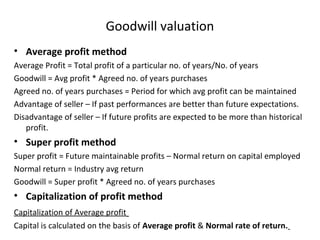
Goodwill valuation
• Average profit method
Average Profit = Total profit of a particular no. of years/No. of years
Goodwill = Avg profit * Agreed no. of years purchases
Agreed no. of years purchases = Period for which avg profit can be maintained
Advantage of seller – If past performances are better than future expectations.
Disadvantage of seller – If future profits are expected to be more than historical
profit.
• Super profit method
Super profit = Future maintainable profits – Normal return on capital employed
Normal return = Industry avg return
Goodwill = Super profit * Agreed no. of years purchases
• Capitalization of profit method
Capitalization of Average profit
Capital is calculated on the basis of Average profit & Normal rate of return.
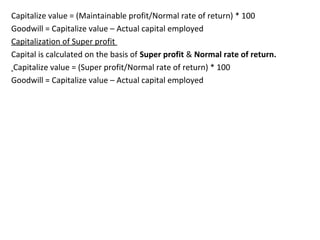
Capitalize value = (Maintainable profit/Normal rate of return) * 100
Goodwill = Capitalize value – Actual capital employed
Capitalization of Super profit
Capital is calculated on the basis of Super profit & Normal rate of return.
Capitalize value = (Super profit/Normal rate of return) * 100
Goodwill = Capitalize value – Actual capital employed

Issues in valuation_of_intangibles

  • 1.
    Issues In ValuationOf Intangibles Presented by: Gaurav Bagchi Ranjoy Bhattacharya Tanmoy Purokayet Soumyajit Biswas
  • 2.
    What is anIntangible Asset? Intangible assets are long lived non physical rights or resources that possess a determinable future use value and are specifically developed or acquired for production or distribution of goods and services.
  • 3.
    Role Of Intangiblesin Mergers & Aquisitions Intangibles create a competitive advantage and their economic value reduces due to more efficient innovations by the same company or by competitors or due to new substitute products or change in customer demands. The existence of intangible assets depend on presence or expectation of earnings and thus intangibles play a strategic role in corporate valuation,especially in the context of M&A
  • 4.
    Types of IntangibleAssets Some of the common intangible assets include: 1.Patent,copyright and licenses 2.Customer lists and relationships 3.Brands 4.Trained and assembled workforce
  • 5.
    Contribution of Tangibleand Intangible assets in Valuation From 1840 onwards till 1990s,corporate values were mainly driven by their tangible assets.The managements of companies linked all their performance goals to those assets like ROI etc. Even in a M&A scenario the prices were based on the value of their tangible assets.The market cap of the companies also followed value of tangible assets with difference being seldom above 25%
  • 6.
    In the latterhalf of 1990s the relationship between value of tangible assets and market value changed dramatically. By early 2000,the book value of the assets represented less than 15% of total market value.So the question arises: what are the key drivers of market value in this new economy? Obviously they are intangible assets. In this information age, more and more companies are finding that assets that are easily measurable need not necessarily be most valuable. The stock price of a company is the result of market’s valuation of it’s earnings potential and growth prospects and thus market values those assets of a company,like brand,which are not accounted for in traditional financial statements
  • 7.
    Key parameters usedin valuation of intangible assets by Infosys 1. Clients: It includes marque or image enhancing clients like Fortune 500 companies and revenue contribution from other clients 2. Organisation: It incudes R&D investment,average age of employees etc 3. People: It includes the quality of employees that is denoted by education index of employees
  • 8.
    Role of Brandsin Intangible Asset Valuation A Brand is a name,term,symbol,design or a combination of these intended to identify the goods and services of a company and differentiate from those of other companies. Successful brands are valuable because they guarantee better pricing power for same products,leading to higher profit margin and firm value and thus are a chief source of competitive advantage.
  • 9.
    Of late therehas been an increase in active market for brands and as a result brand valuation has become very significant.In an M&A deal,the selling company needs to avoid undervaluing the intangibles,especially the brand and the buying company needs to avoid overvaluing the price,due to inclusion of intangibles like brand. Any method of brand valuation requires segregation of cash flow estimates from branded and unbranded products or services.
  • 10.
    Interbrand’s Brand ValuationModel The valuation model comprises Four elements: 1.Financial analysis 2.Market analysis 3.Brand analysis 4.Legal analysis Based on the above factors brand value is calculated as: Brand value=Brand earning*Brand multiple(or Brand strength)
  • 11.
    Role of Goodwillin Intangible Asset valuation Goodwill may be described as the aggregate of those intangible attributes of a business which contribute to it’s superior earning capacity. It is that amount of an asset which is created through business reputation or image building.
  • 12.
    Goodwill is acomprehensive set of asset consisting of the following elements: 1.Customer base 2.Organisation costs 3.Development costs 4.Trademarks 5.Patents 6.Licenses 7.Copyrights 8.Trade secrets
  • 13.
    Types of Goodwill 1.PurchasedGoodwill 2.Home grown Goodwill Other issues: a)goodwill impairment b)Disclosure and reporting of goodwill impairment
  • 14.
    Goodwill valuation • Averageprofit method Average Profit = Total profit of a particular no. of years/No. of years Goodwill = Avg profit * Agreed no. of years purchases Agreed no. of years purchases = Period for which avg profit can be maintained Advantage of seller – If past performances are better than future expectations. Disadvantage of seller – If future profits are expected to be more than historical profit. • Super profit method Super profit = Future maintainable profits – Normal return on capital employed Normal return = Industry avg return Goodwill = Super profit * Agreed no. of years purchases • Capitalization of profit method Capitalization of Average profit Capital is calculated on the basis of Average profit & Normal rate of return.
  • 15.
    Capitalize value =(Maintainable profit/Normal rate of return) * 100 Goodwill = Capitalize value – Actual capital employed Capitalization of Super profit Capital is calculated on the basis of Super profit & Normal rate of return. Capitalize value = (Super profit/Normal rate of return) * 100 Goodwill = Capitalize value – Actual capital employed