INTANGIBLE
ASSETS – What
itis?
An intangible asset is an asset that is not physical in
nature, such as a patent, brand, trademark, or
copyright and Goodwill.
Businesses can create or acquire intangible assets.
An intangible asset can be considered indefinite (a
brand name, for example) or definite, like a legal
agreement or contract.
Since intangible assets have no shape or form, they
cannot be held or manipulated.
3.
Types of IntangibleAssets
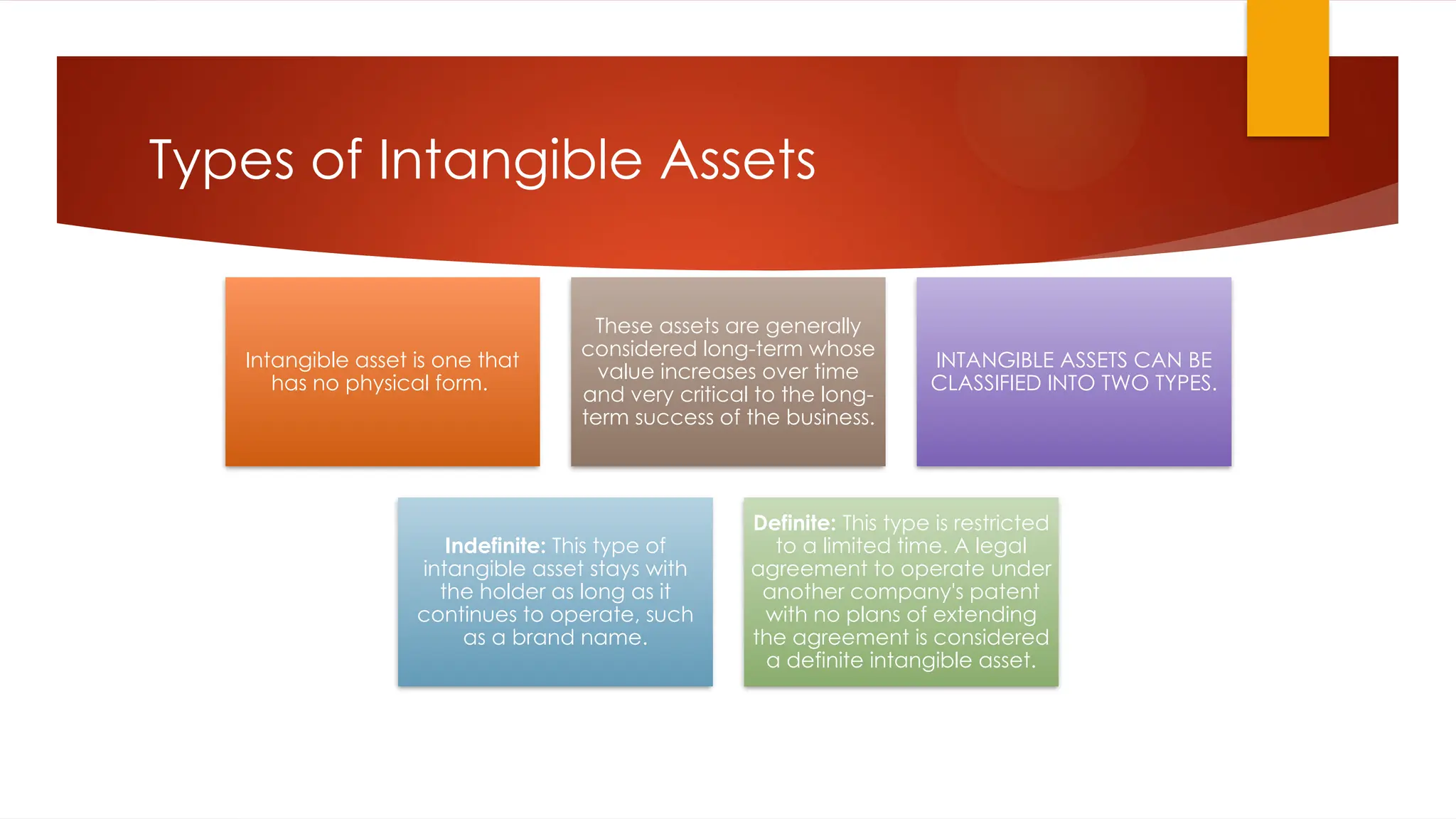
Intangible asset is one that
has no physical form.
These assets are generally
considered long-term whose
value increases over time
and very critical to the long-
term success of the business.
INTANGIBLE ASSETS CAN BE
CLASSIFIED INTO TWO TYPES.
Indefinite: This type of
intangible asset stays with
the holder as long as it
continues to operate, such
as a brand name.
Definite: This type is restricted
to a limited time. A legal
agreement to operate under
another company's patent
with no plans of extending
the agreement is considered
a definite intangible asset.
4.
Types of
Intangible
Assets
Themost common types of intangible
assets—notably
brands, goodwill, and intellectual
property.
Brands
The brand is something that sets one
business apart from another.
This may come in the form of a logo,
symbol, or brand name.
Businesses commonly use marketing,
design techniques, and advertising to
come up with their brands.
This allows consumers to easily identify a
particular company.
Example: most people can easily identify
Apple (AAPL) just by seeing its logo.
5.
Types of IntangibleAssets
Goodwill
When one company purchases another, the intangible assets associated
with that transaction are considered goodwill.
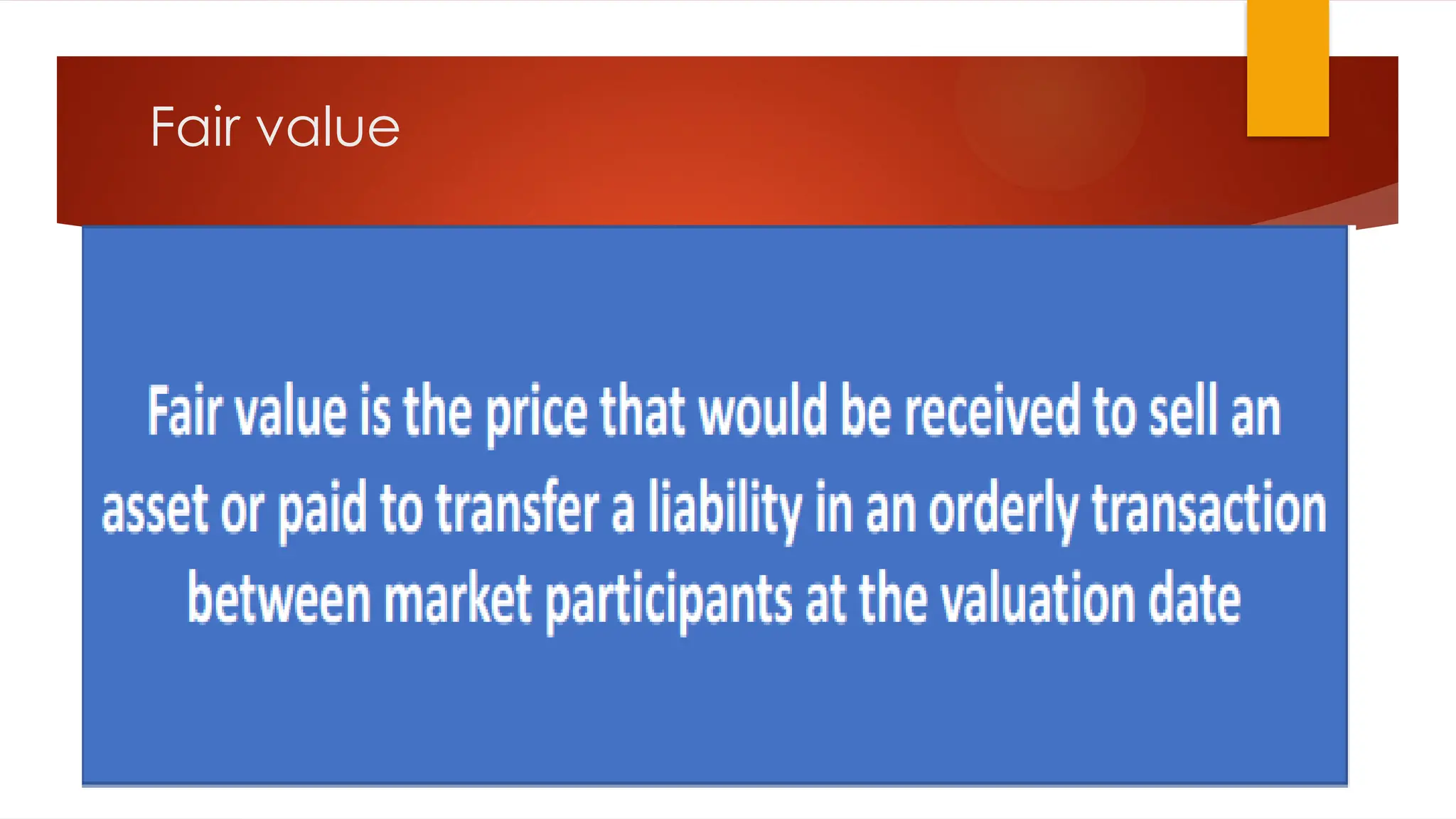
When a company acquires another business, any amount that exceeds the
fair value of the target's net assets represents its goodwill.
If the amount is above the target’s book value then it results in positive
goodwill.
Anything below book value is negative goodwill.
6.
Types of IntangibleAssets
Intellectual property is a type of intangible asset that is legally protected.
This means it cannot be used by another business or individual unless authorized by
the owner.
Common forms of intellectual property include
Copy Rights.
Digital Assets.
Franchises.
Patents
Trade Marks
Trade Secrets.
7.
Valuation of IntangibleAssets
Need for Valuing Intangible Assets:
Many companies do not understand that their trademarks, designs and
other intangible property rights and assets are often more valuable than, for
example, their inventories.
It is not uncommon for a company’s intangible assets to be their single most
valuable asset and can be used to ensure financing of the company's
growth.
8.
Valuation of IntangibleAssets
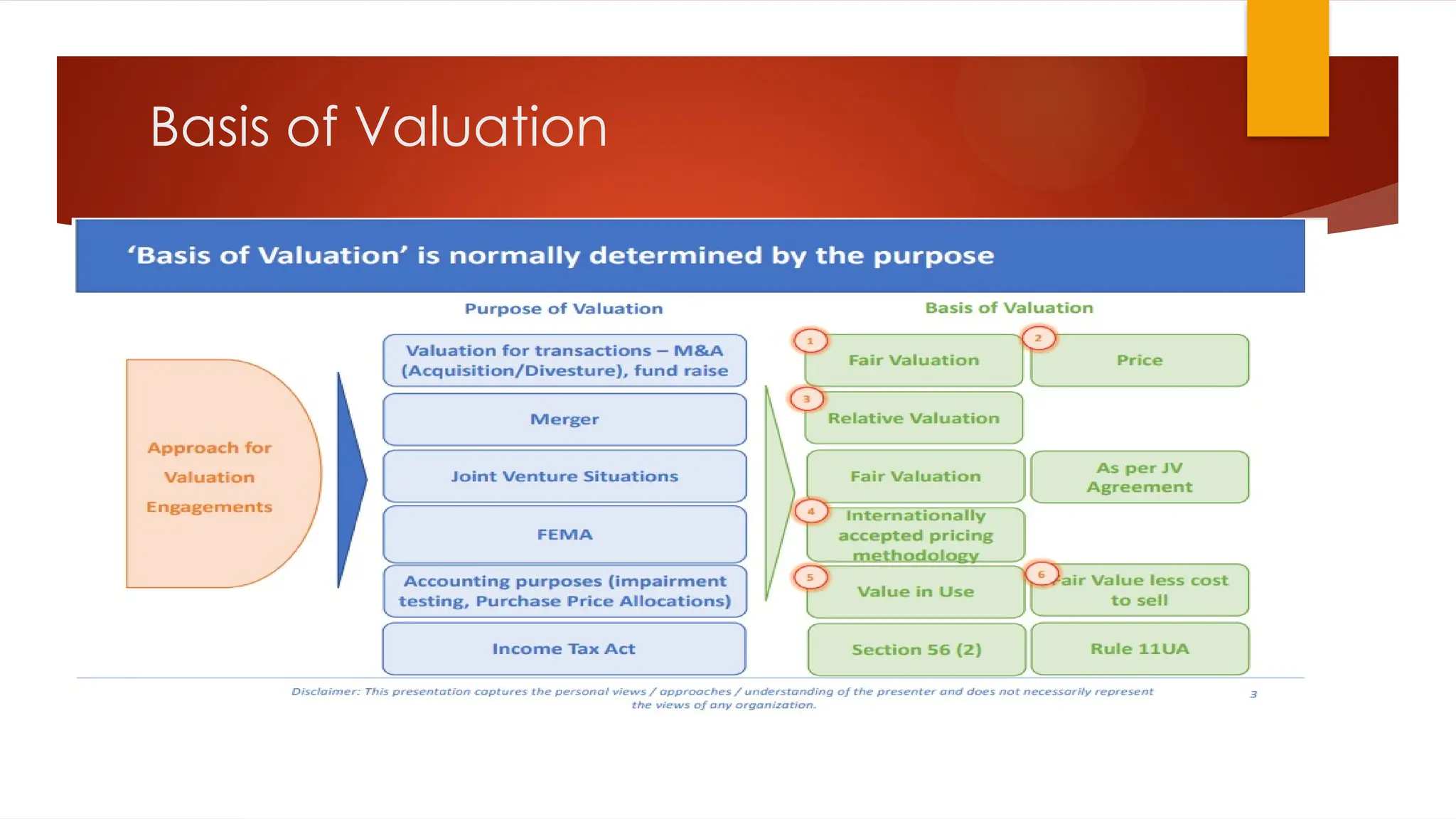
valuation may become necessary when:
• You plan to license out an intangible asset and you want to get an estimate
of future license fees
• You plan to buy or sell a business. A valuation of the intangible assets can
then be helpful in achieving a better price.
• Getting an accurate valuation of your intangible assets is not always easy.
• How much is a trademark worth after years of marketing?
9.
Valuation of IntangibleAssets
Does your patent protect a technical solution where there is a good market
basis or is the invention superfluous?
A well-known trademark or a strong patent can be the true core of a
company.
All intangible assets are not valuable? If they do not help to create, maintain,
or increase cash flow, they may not have direct value.
The value of your assets may also change over time. For example, a patent
can protect a unique solution, but after some time other solutions may arise
that reduce the value of your patent.
10.
Valuation of IntangibleAssets
Trademarks generally increase in value the more well-known they become.
The value of intangible property rights depends on the circumstances of a
given time and place. It is important to analyze the intangible property right
based on its use, the market and competitors.
The valuation of intangible property rights is very important. A valuation
indicates whether a right is necessary or not
Recognition and Measurementof Intangible
Assets as per IAS 38 and IND AS 38
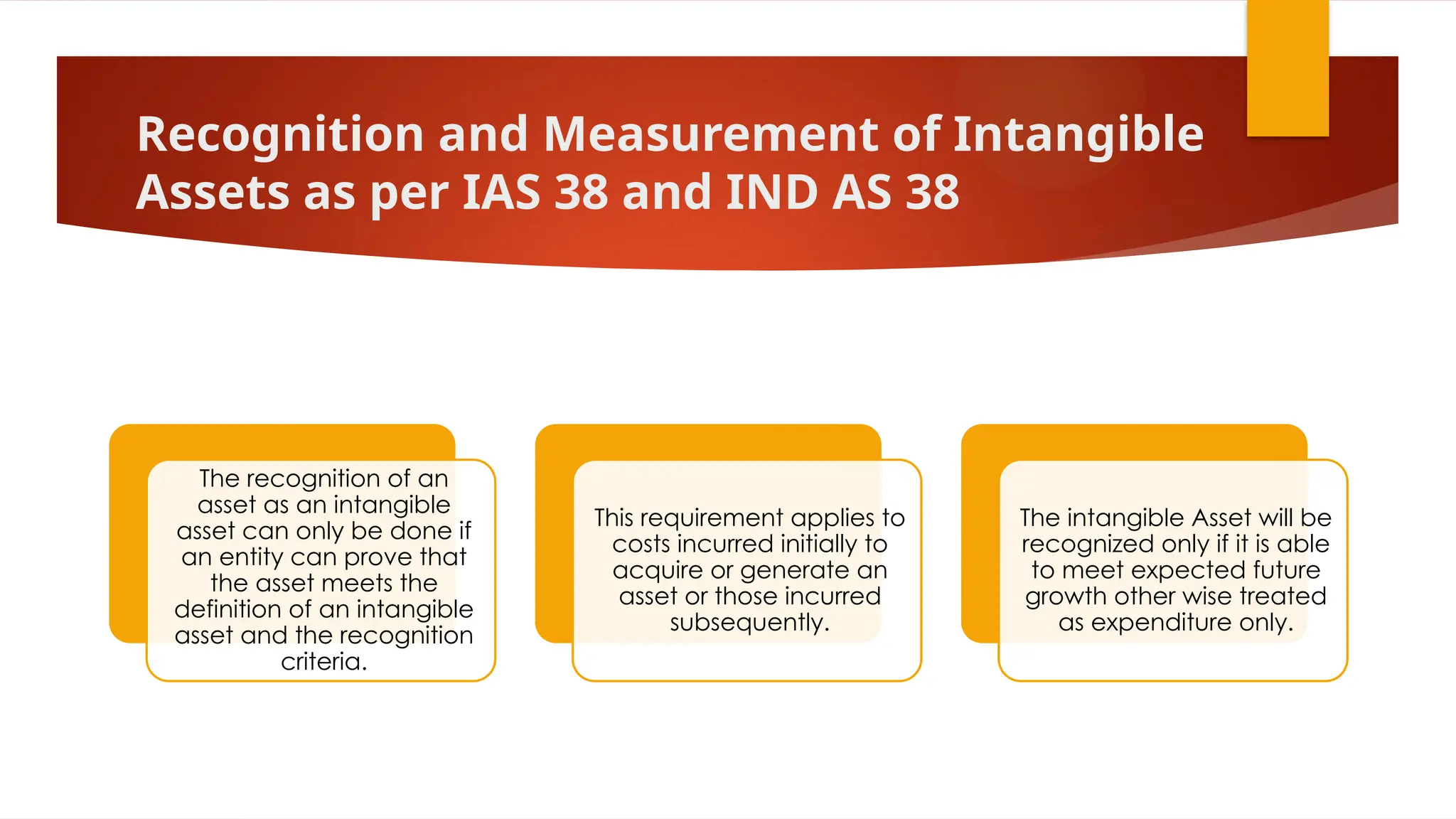
The recognition of an
asset as an intangible
asset can only be done if
an entity can prove that
the asset meets the
definition of an intangible
asset and the recognition
criteria.
This requirement applies to
costs incurred initially to
acquire or generate an
asset or those incurred
subsequently.
The intangible Asset will be
recognized only if it is able
to meet expected future
growth other wise treated
as expenditure only.
13.
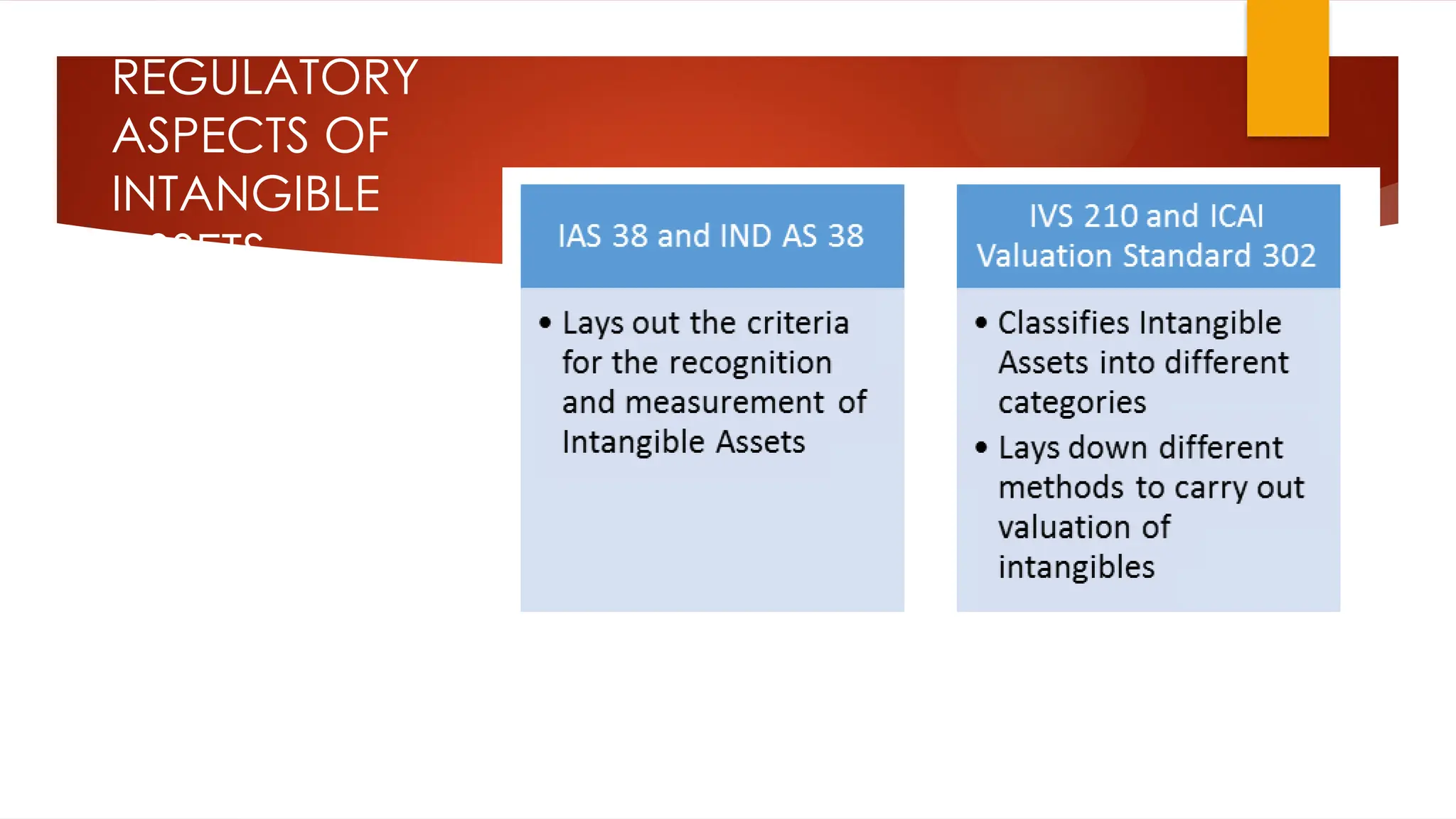
Valuation of IntangibleAssets as per
IAS 38 & IND AS 38.
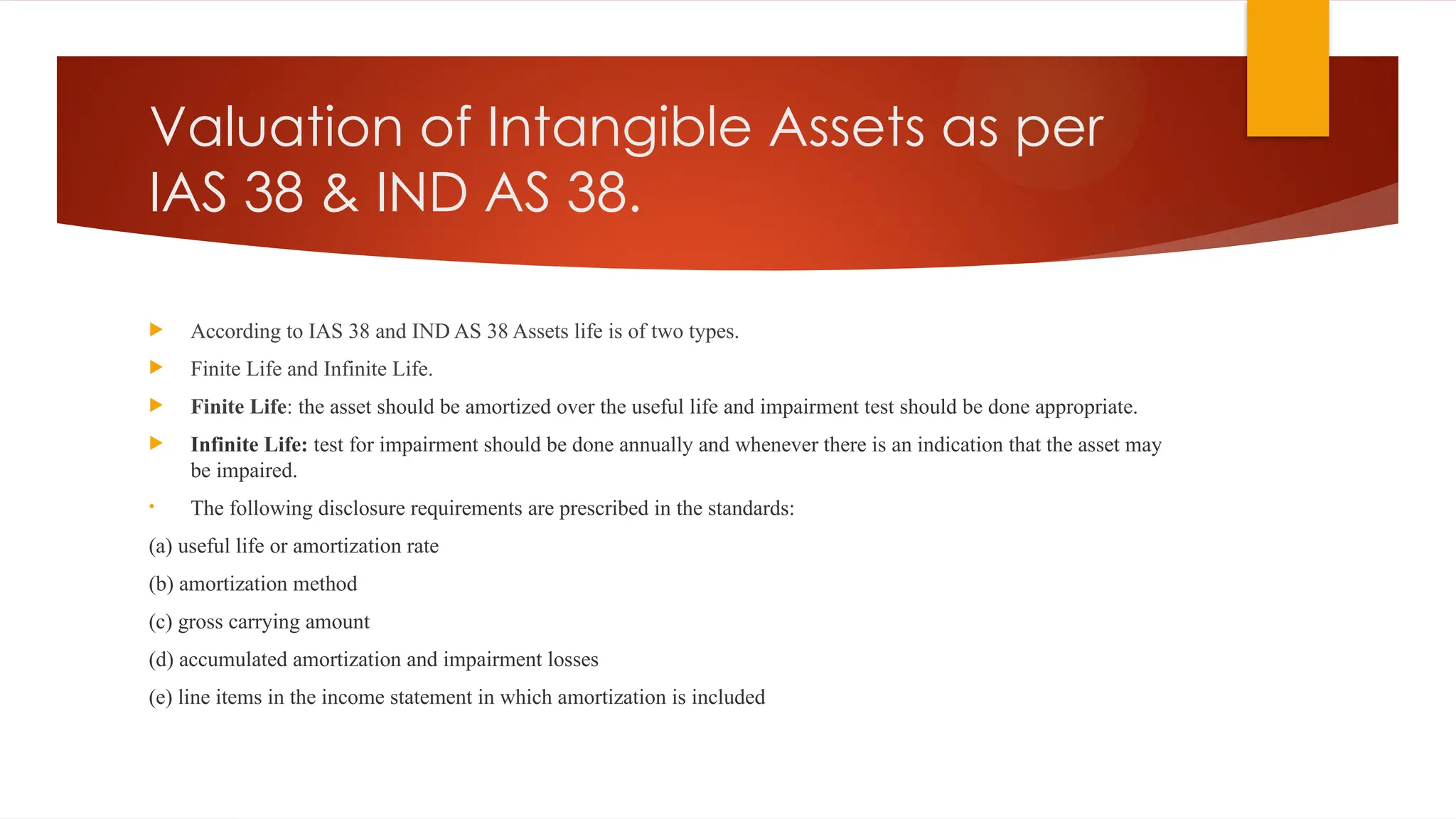
According to IAS 38 and IND AS 38 Assets life is of two types.
Finite Life and Infinite Life.
Finite Life: the asset should be amortized over the useful life and impairment test should be done appropriate.
Infinite Life: test for impairment should be done annually and whenever there is an indication that the asset may
be impaired.
• The following disclosure requirements are prescribed in the standards:
(a) useful life or amortization rate
(b) amortization method
(c) gross carrying amount
(d) accumulated amortization and impairment losses
(e) line items in the income statement in which amortization is included
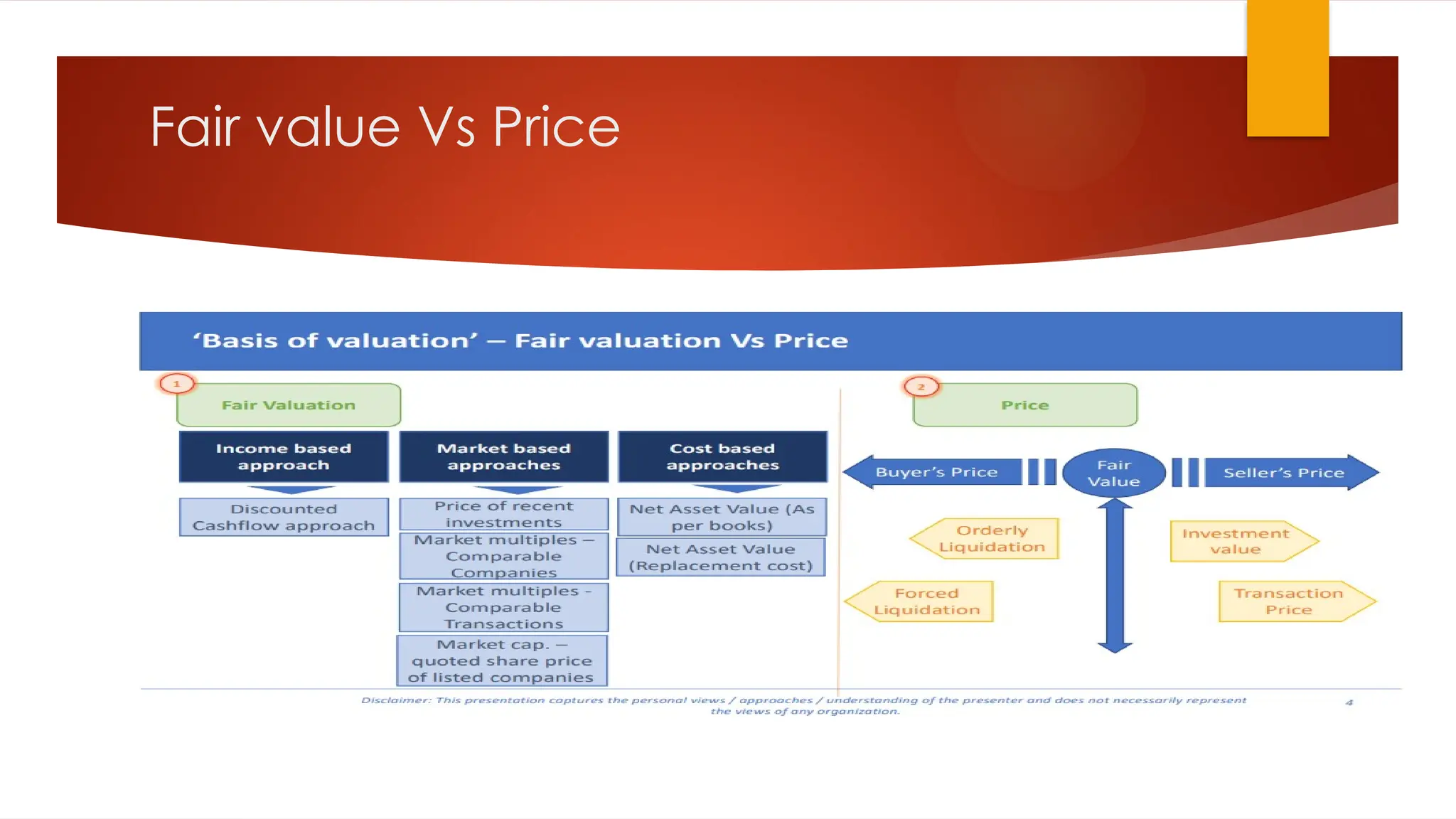
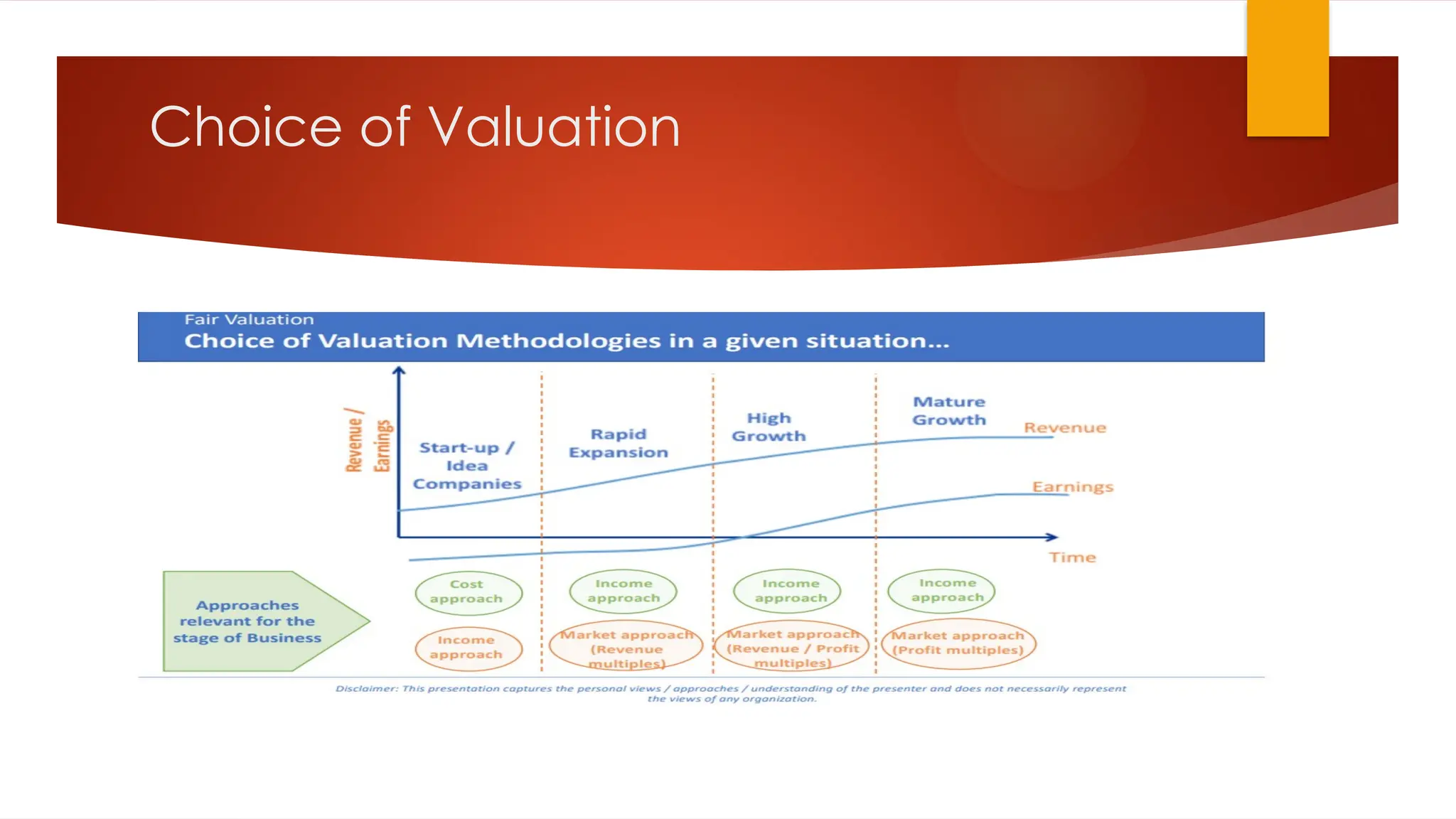
1. The CostApproach
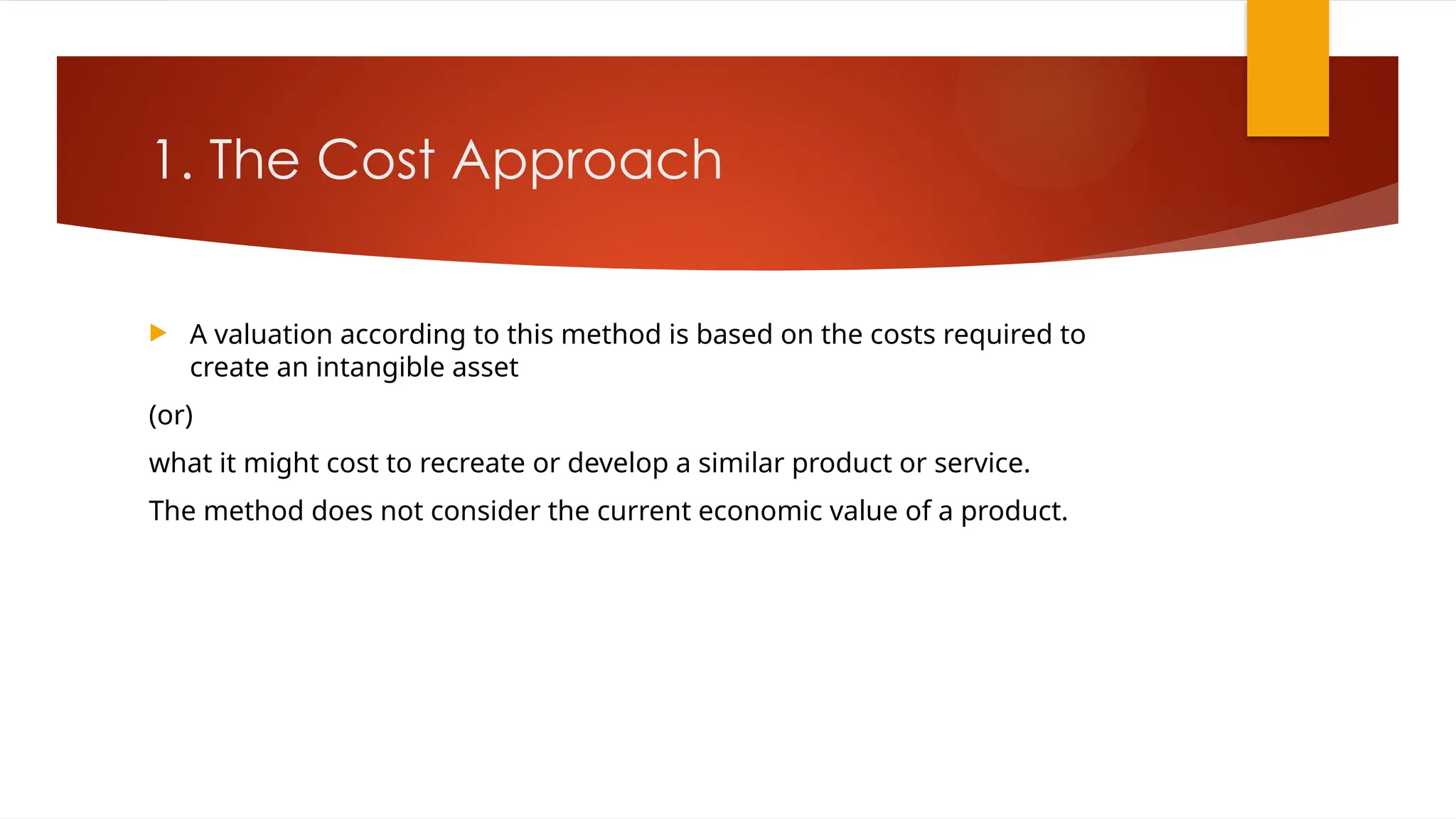
A valuation according to this method is based on the costs required to
create an intangible asset
(or)
what it might cost to recreate or develop a similar product or service.
The method does not consider the current economic value of a product.
16.
1. The CostApproach
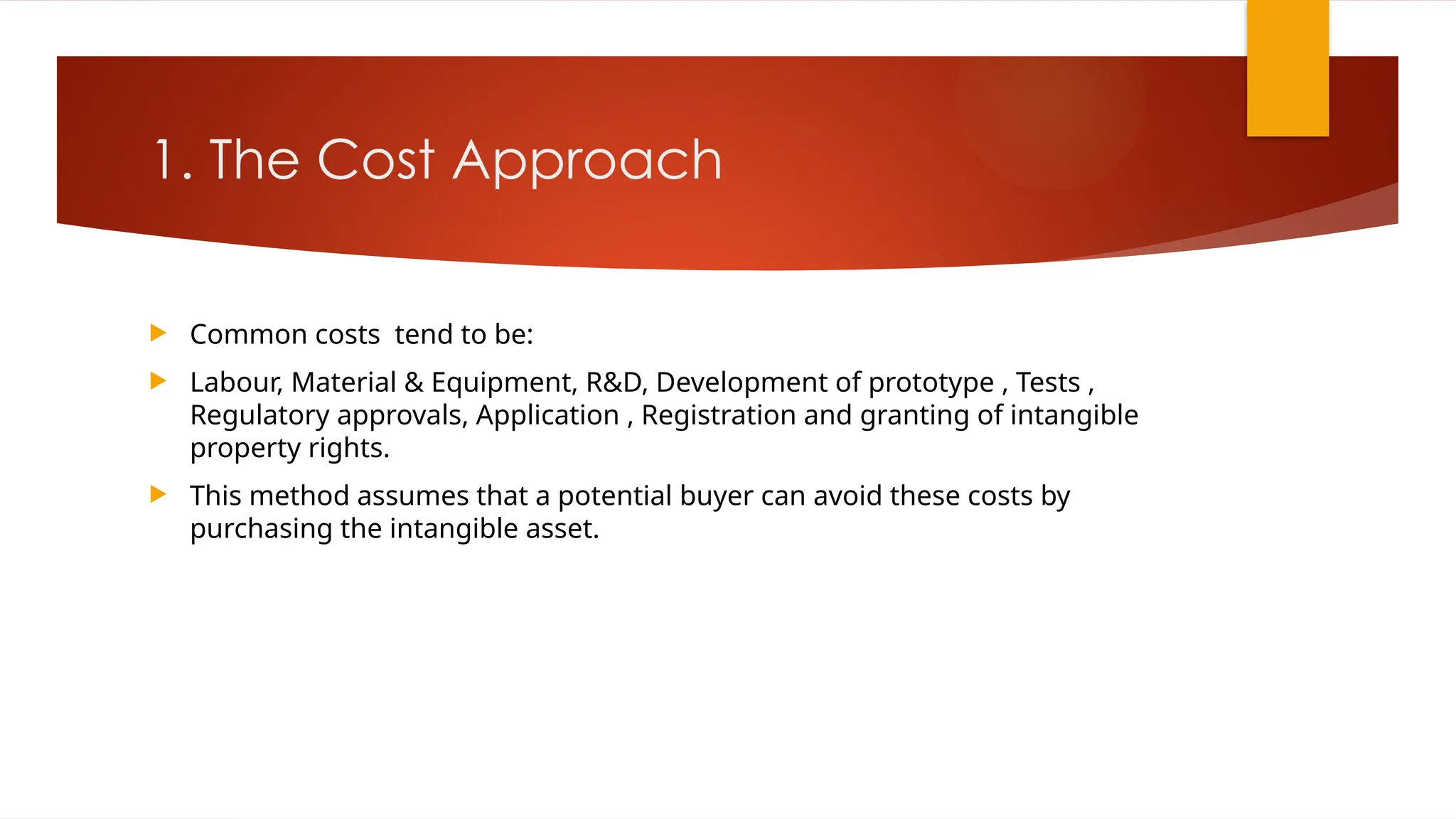
Common costs tend to be:
Labour, Material & Equipment, R&D, Development of prototype , Tests ,
Regulatory approvals, Application , Registration and granting of intangible
property rights.
This method assumes that a potential buyer can avoid these costs by
purchasing the intangible asset.
17.
Advantages of CostApproach
Time: By purchasing the asset, the buyer can avoid wasting time on research
and development.
Expenses: Should the buyer instead try to develop their own technology, the
buyer would need to spend at least this much.
Success: A buyer may not have succeeded in developing their own
technology.
Protection: A buyer may not be able to protect their own technology and
may also risk infringing on the rights of others.
This method is suitable for the business who are in the early stages.
18.
Draw backs ofCost Approach
Market potential of a business cannot be fully weighted , since focus is on
cost rather than profit.
This method does not consider future value and therefore a parameter on
which valuation is traditionally based is lost.
19.
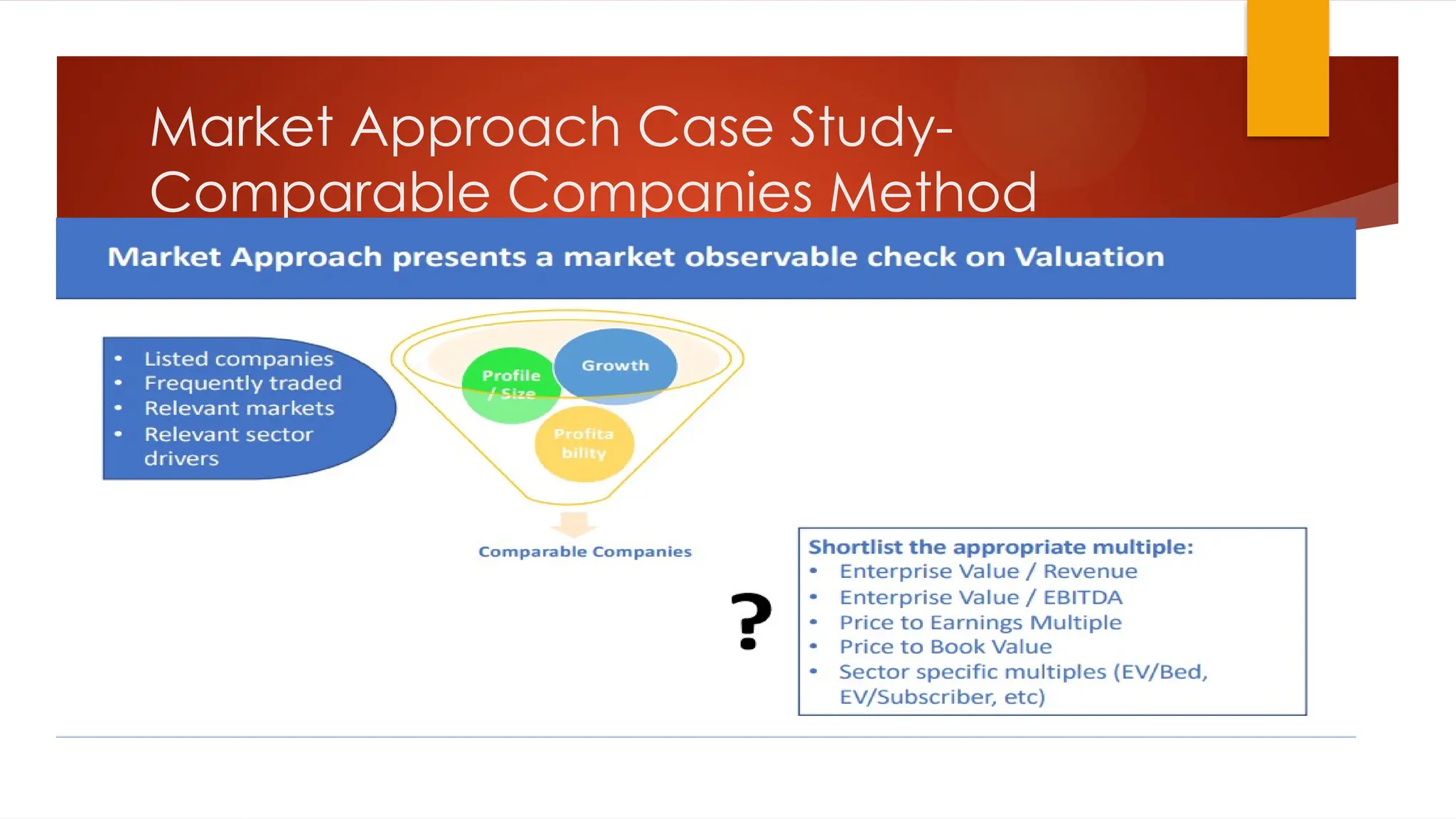
2. The MarketValue Approach
Basing the valuation of a product based on its performance on the market
can be a good approach when valuing intangible assets and rights.
Market valuation of intangible assets provides a good estimate of the value.
The problem with this method is that it can be difficult to find published
information on transfers of intangible property and rights, as they are often
confidential.
There are few transfers that are similar enough to provide a good
comparison.
20.
The Market ValueApproach
It is unlikely that this method would be used to evaluate patents. The value
of a patent is largely based on the uniqueness of the patent and therefore
comparable information is unlikely to be found.
Despite the difficulties, this method is objective and can provide companies
with a realistic analysis of the value of an intangible asset for both the
holder and the buyer.
21.
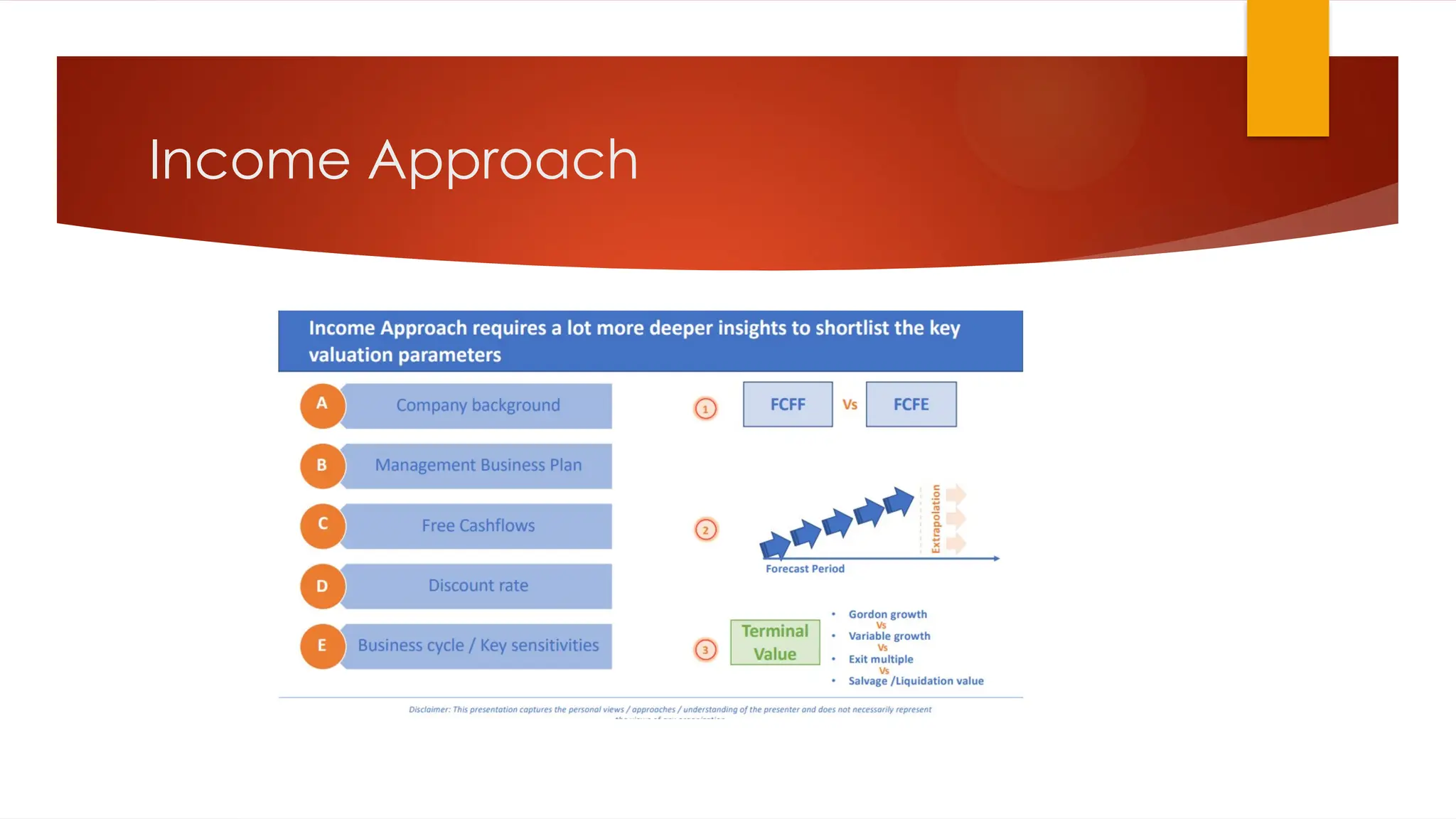
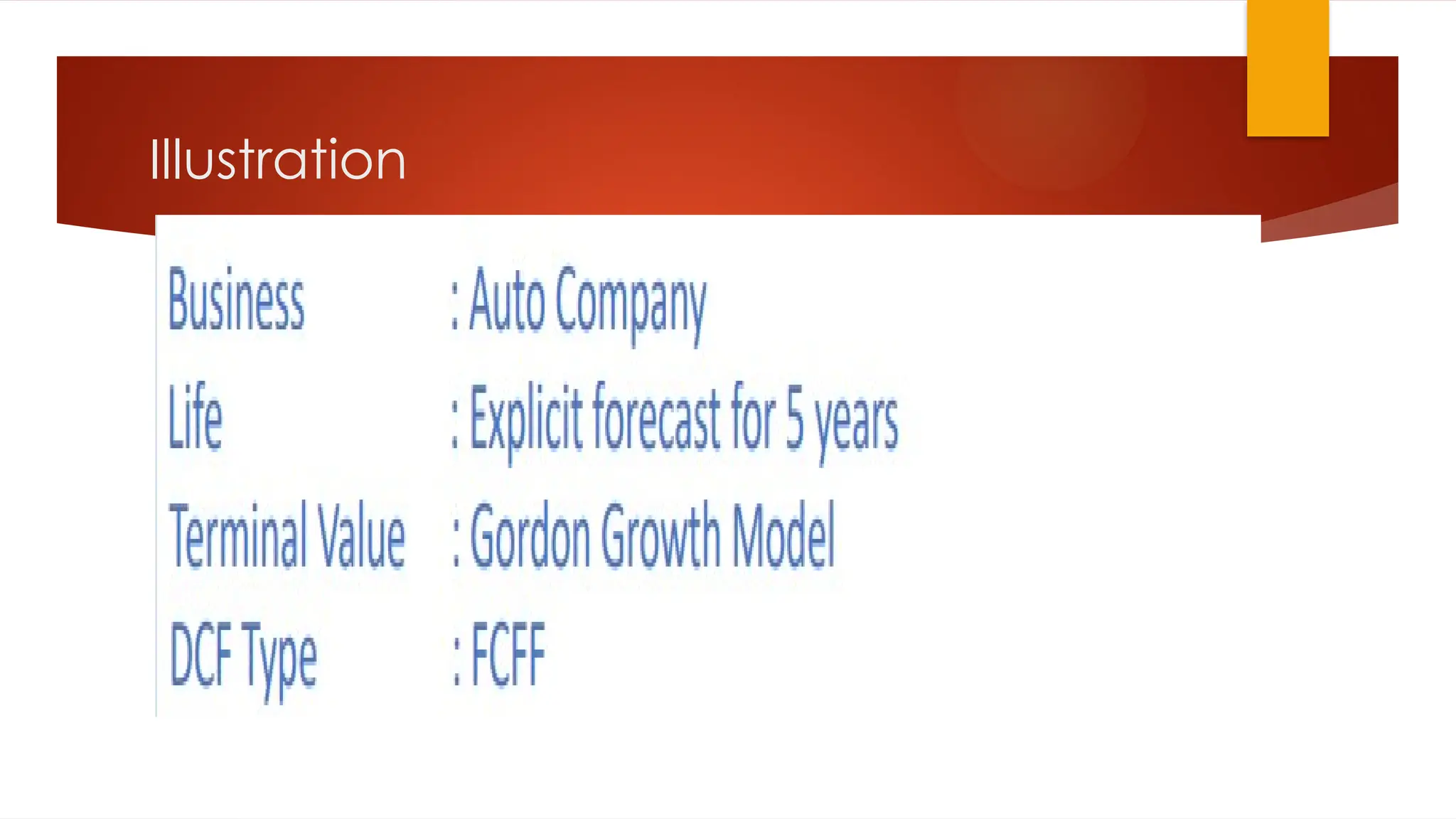
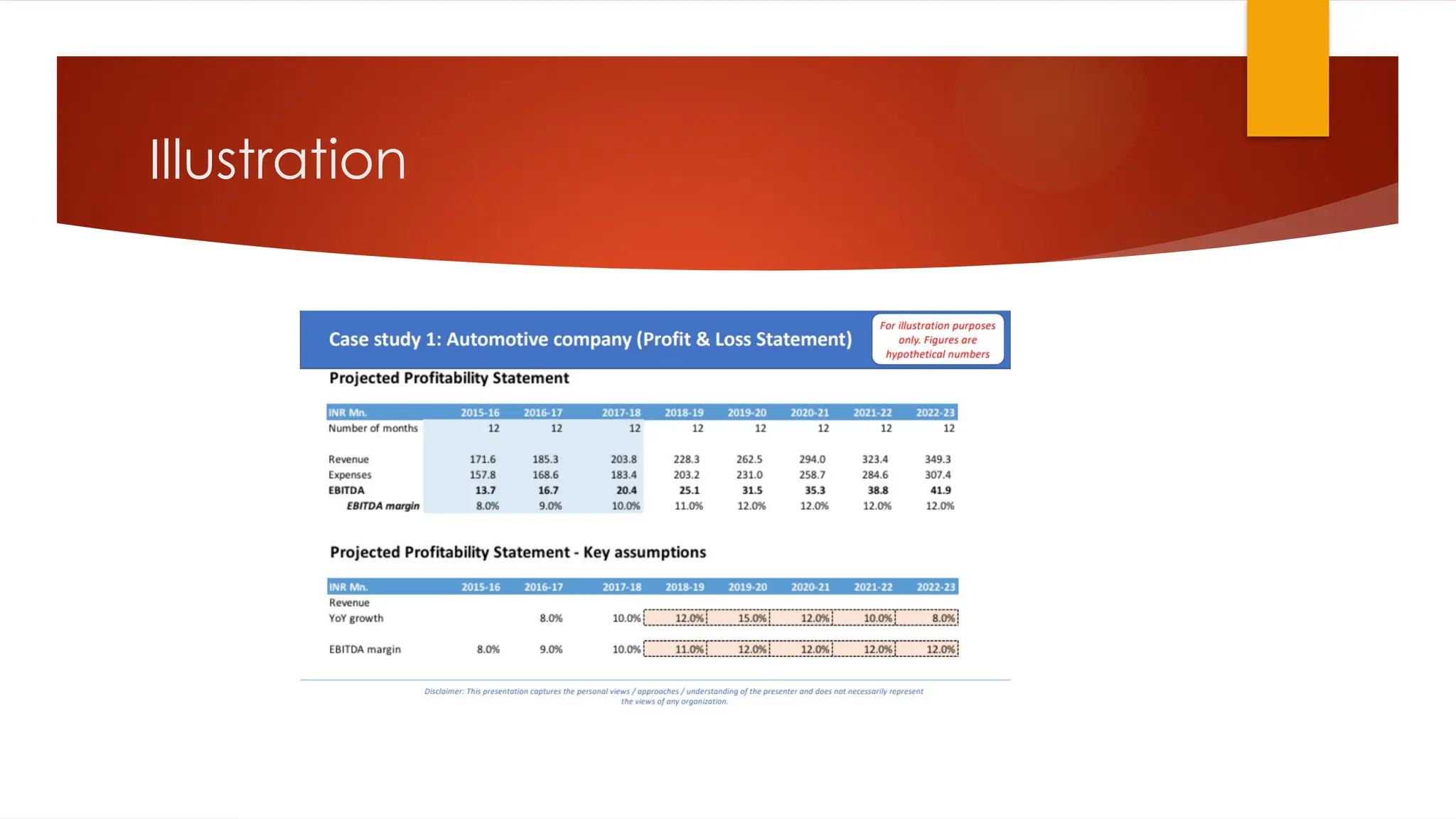
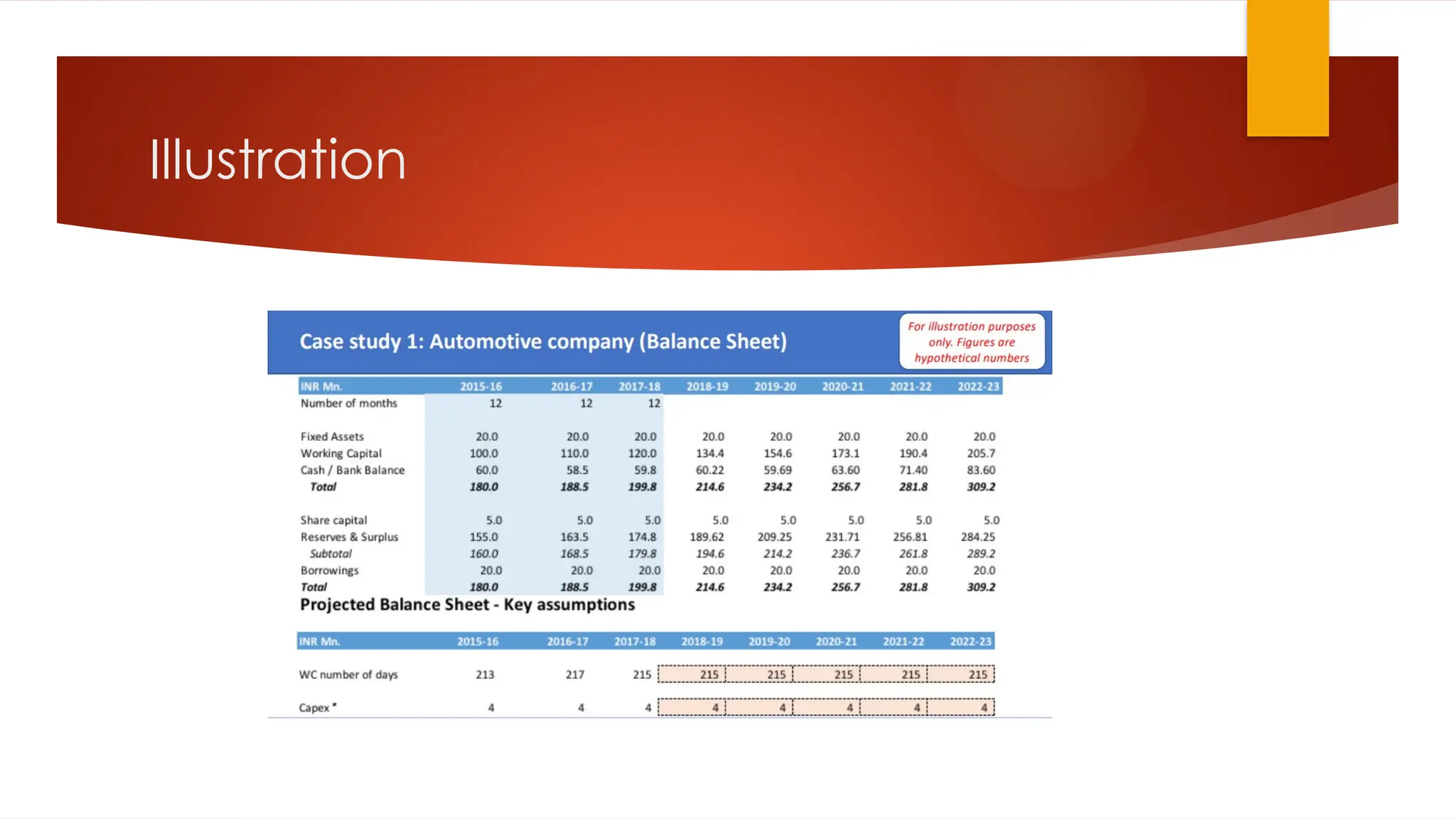
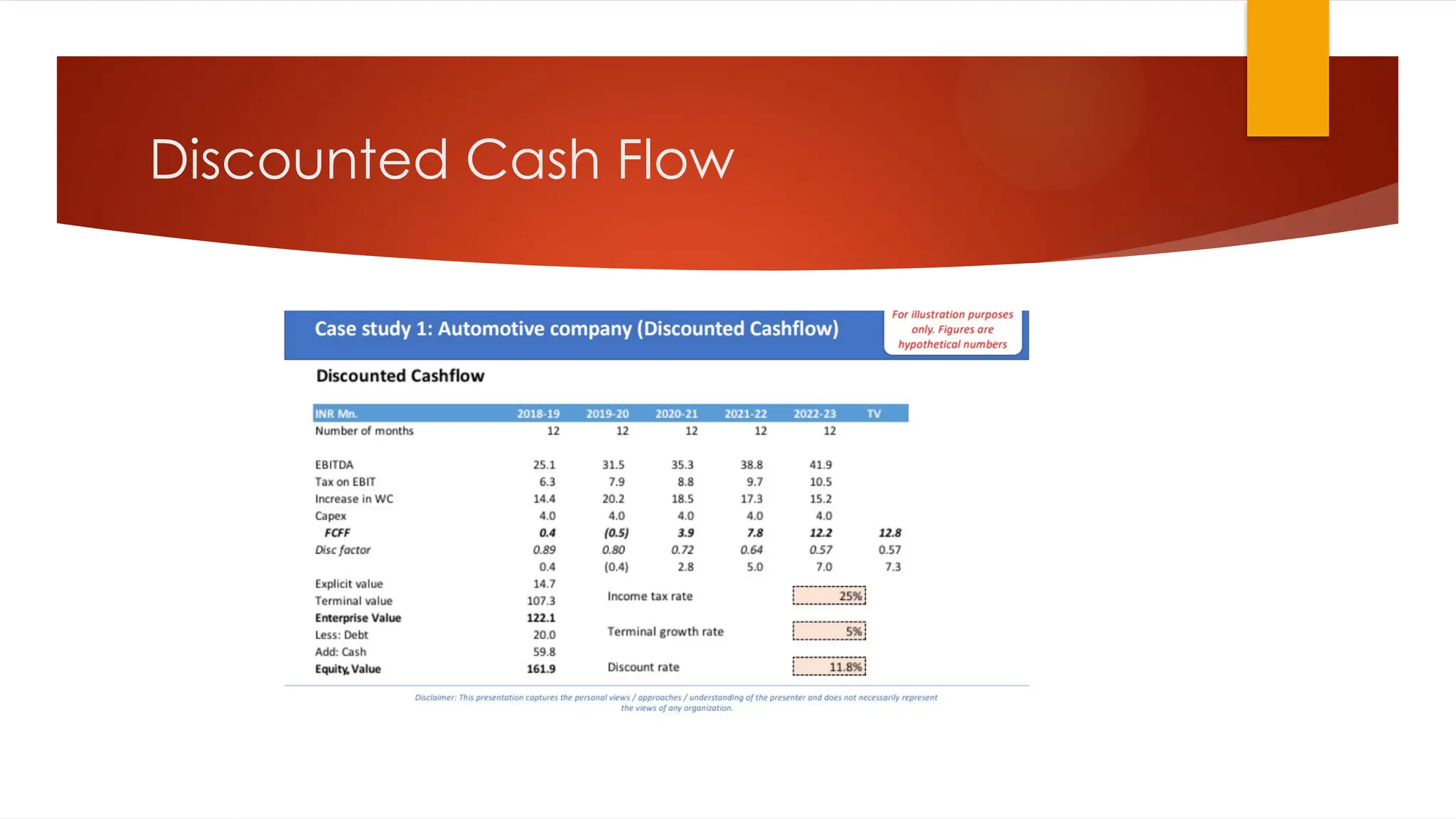
3.The Income Approach
This method focuses on the income that an intangible asset may generate in
the future.
The method considers both future income, which the right can generate
during its lifetime, as well as the costs of this.
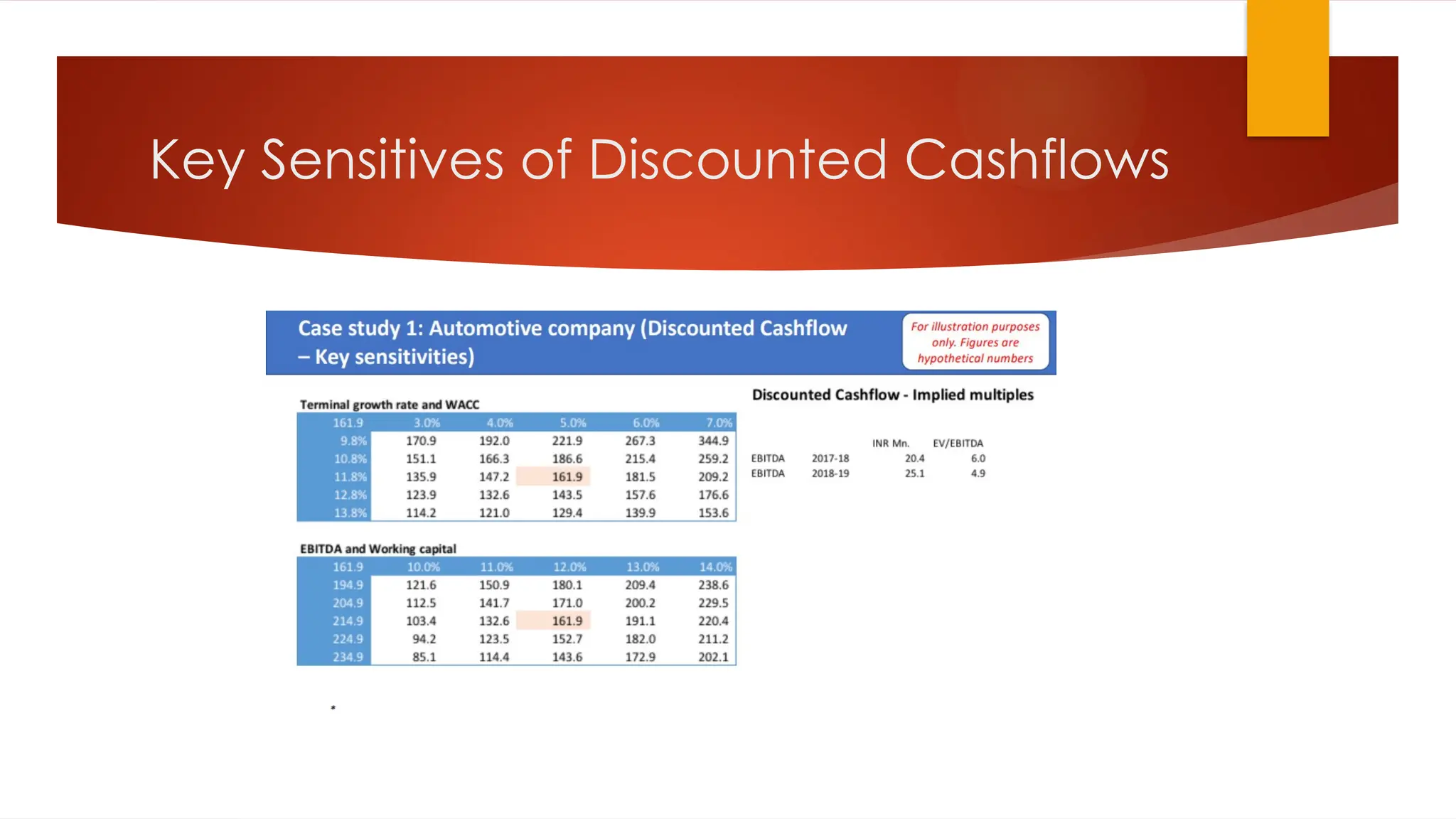
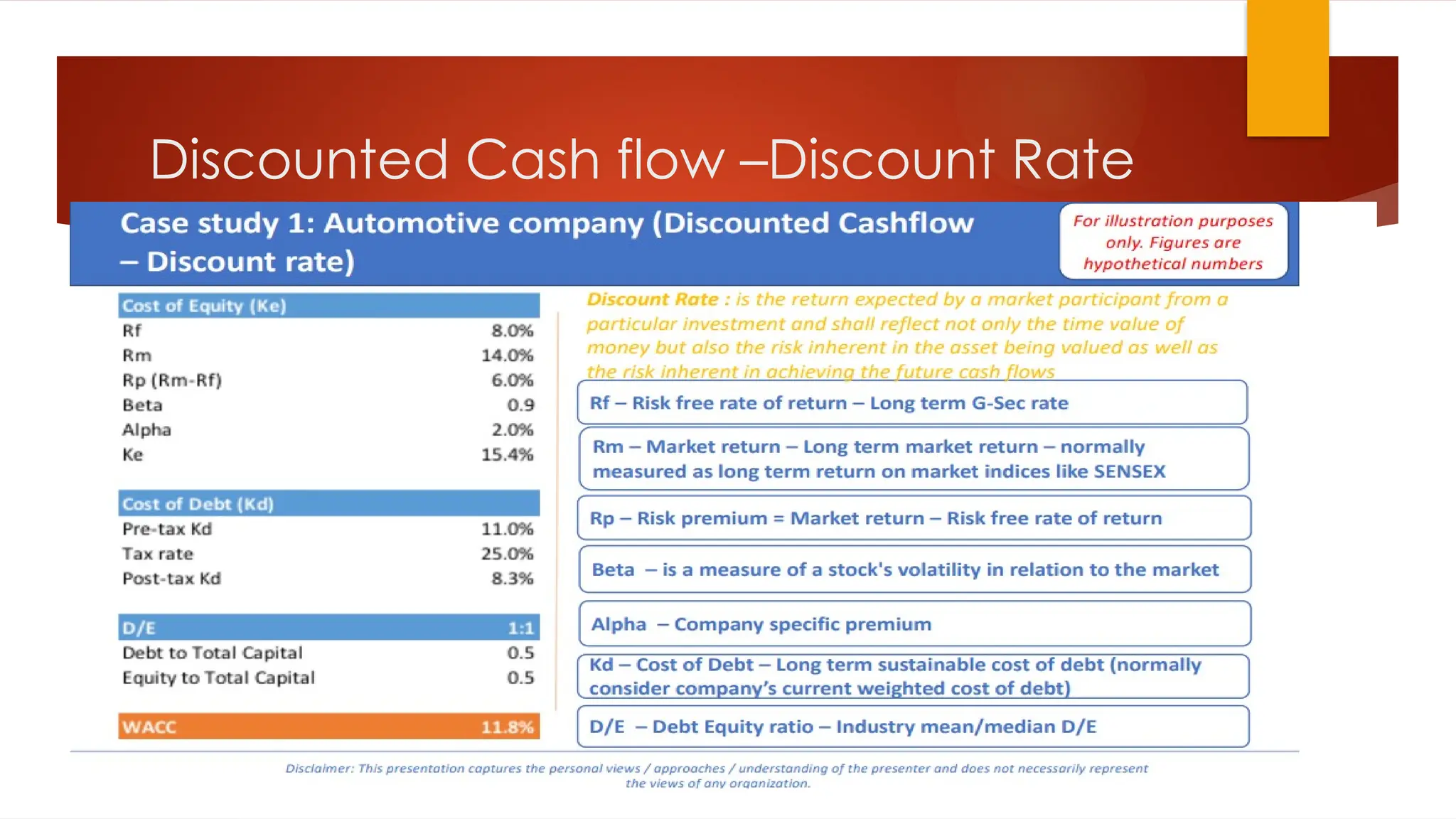
Risk and financial costs are also factors that have an impact. The result of
this analysis is called "Net Present Value" or NPV.
This method of valuing intangible assets gives a potential buyer the
opportunity to consider an investment based on whether the NPV valuation
is positive or negative.
22.
The Income Approach
How ever it should be noted that Income or Economic Benefit method is
only an assessment of likely future events rather than actual outcomes.
Draw backs of Income Methods are
• It is difficult to estimate the economic life cycle of intangible assets.
• It is difficult to estimate income for years to come.
• Factors such as the strength of the intangible asset, the size of the potential
market, competition, changes in the economic climate and the cost of
registration and depending oneself against infringements of the right must
be considered.
23.
Valuation of IntangibleAssets
Owing to the unique nature of intangibles, the questions of how to value
intangible assets ultimately comes down to choosing the right method for
valuation.
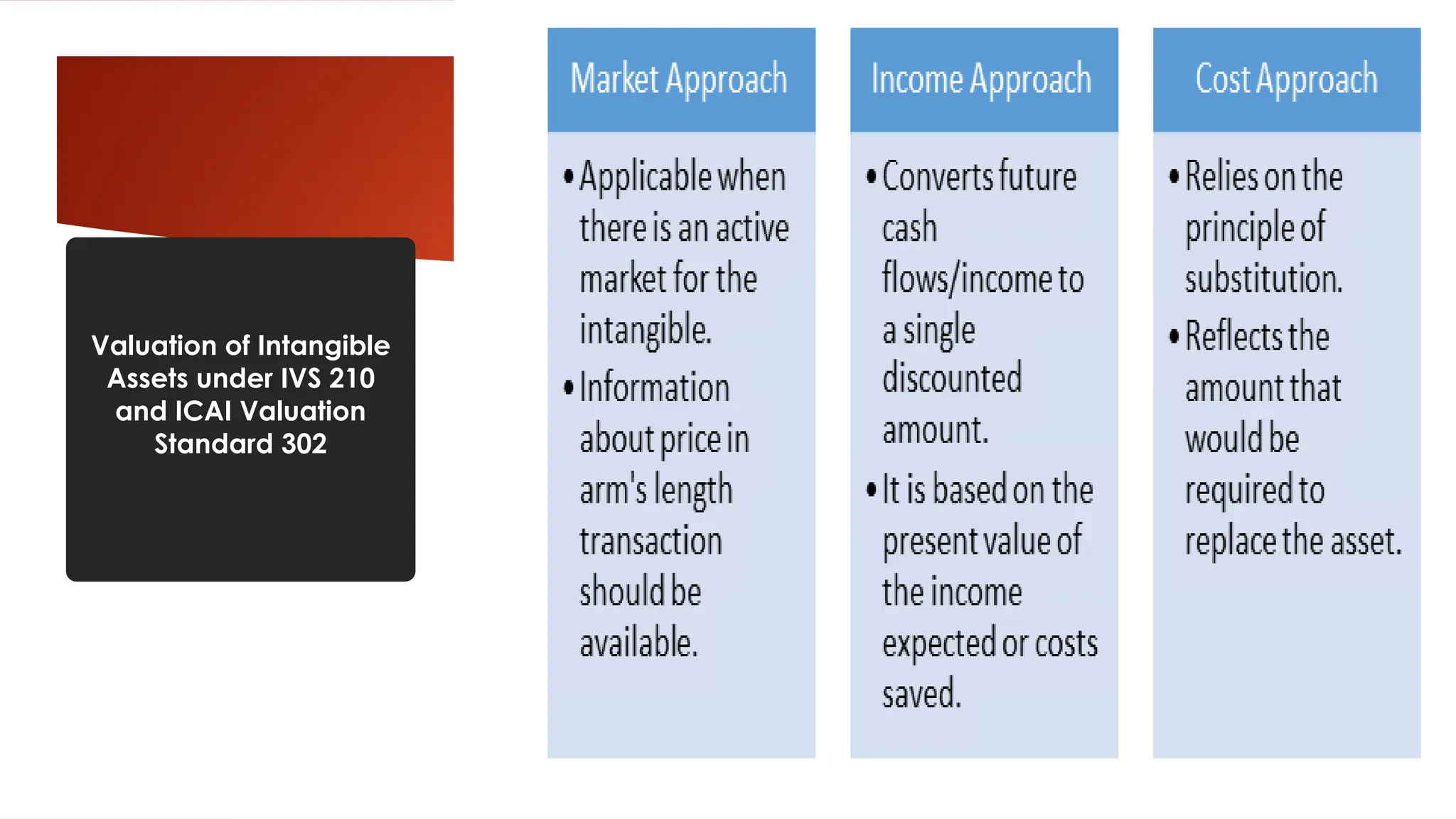
The five primary valuation methods are based on the three approaches
described above – the market, income and cost approaches. While valuing a
particular intangible asset, one method will likely be more appropriate
compared to the others.
24.
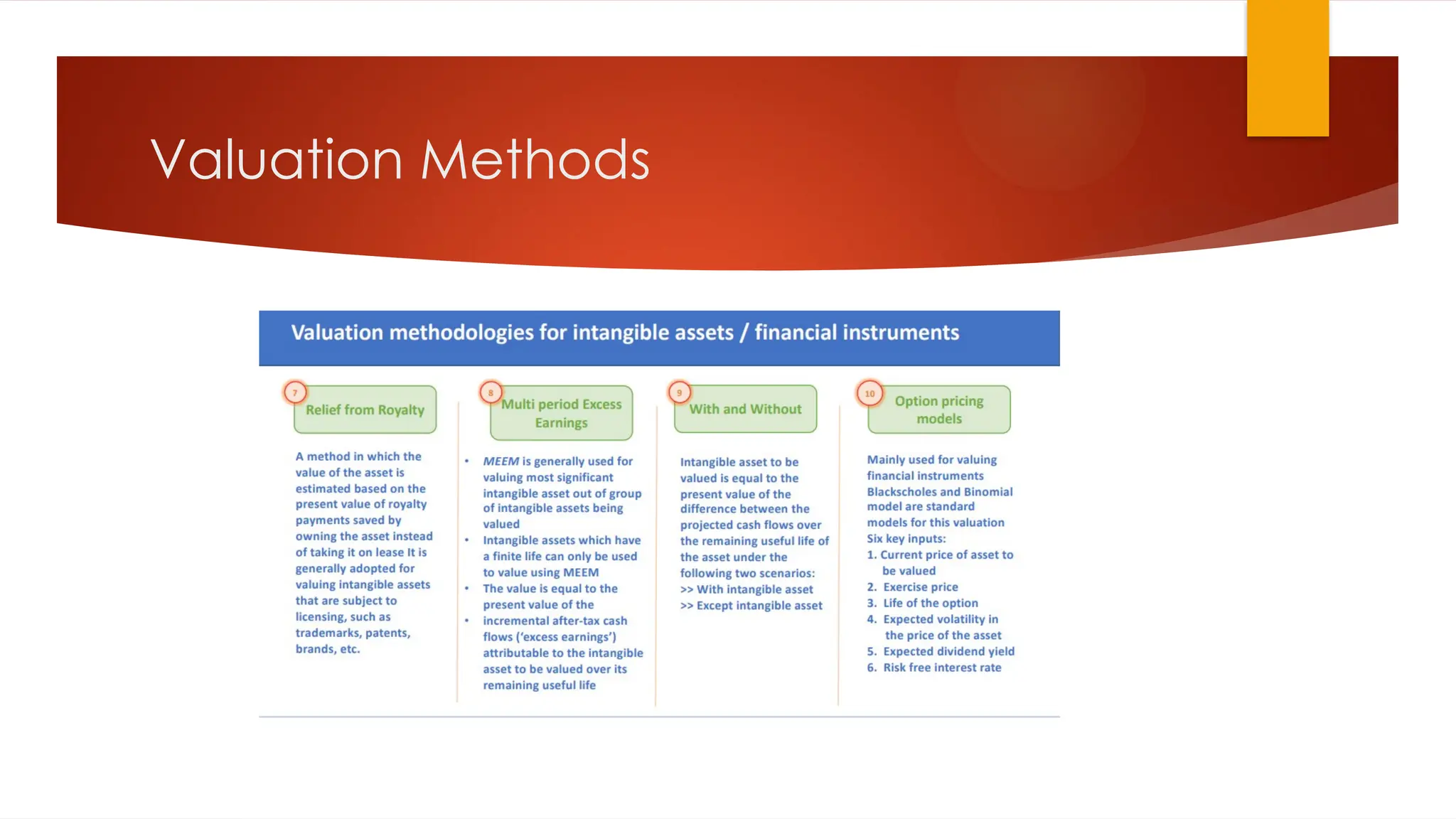
1) Relief
from
Royalty
Method
(RRM)
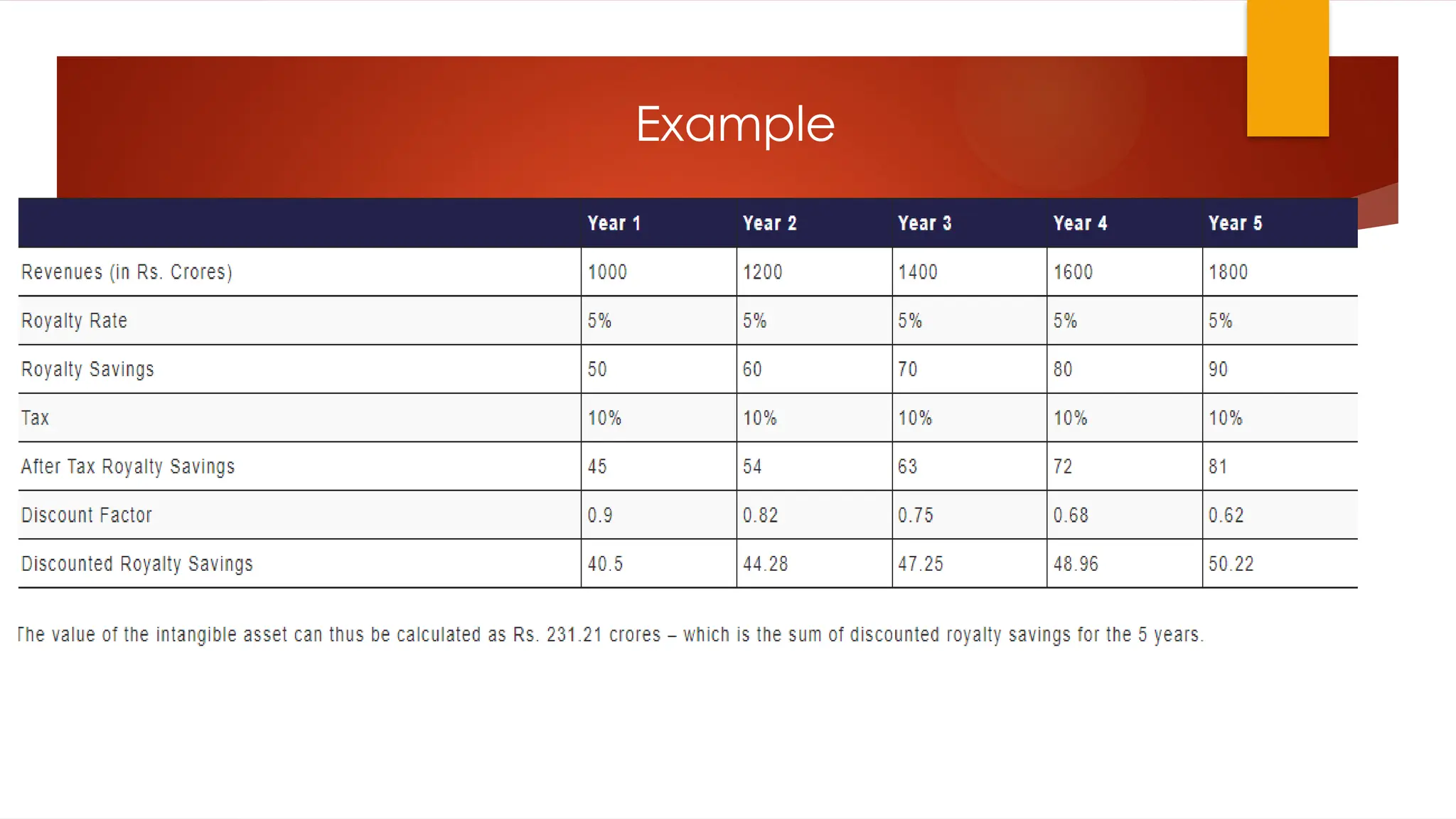
In thismethod, value is assigned to the
intangible asset based on approximate
royalty rates that would be saved by
owning the asset.
Because the asset is owned by the
Company, it doesn’t have to pay for the
use of the asset.
The RRM incorporates elements of both
the market (royalty rates for comparable
assets) and income (estimates of
revenue, growth, tax rates) approaches.
2) With andWithout Method (WWM)
The intangible asset’s value is determined by calculating the difference
between a discounted cash flow model for the enterprise with the asset and
a discounted cash flow model without the asset.
It should be noted that identification of incremental income and incremental
risk to business cost of capital excluding the capital is of paramount
importance here.
27.
3) Multi-Period ExcessEarnings
Method (MPEEM)
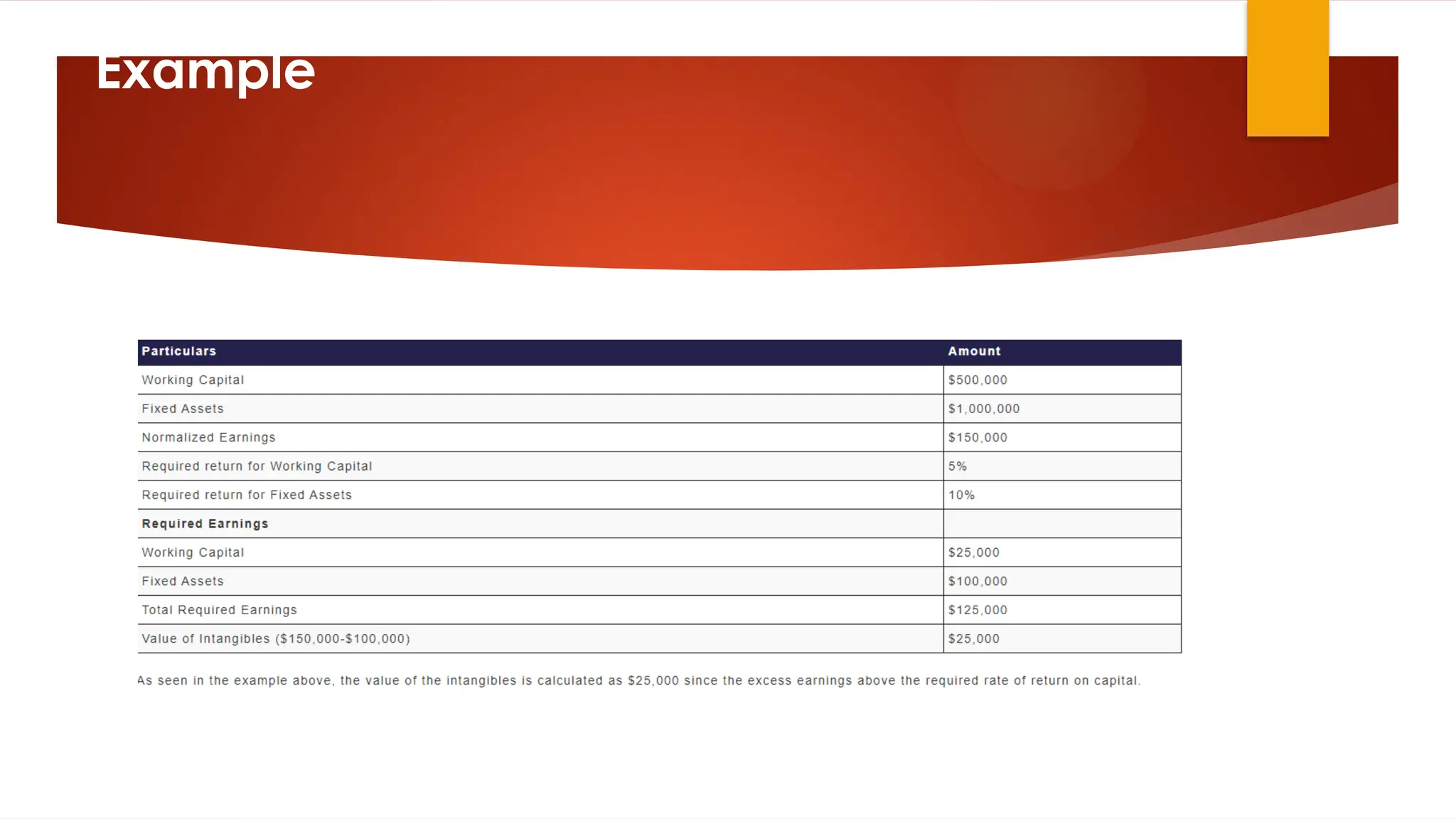
The cash flows related to a particular intangible asset are discounted to
calculate the present value.
It is applied when the cash flows associated to a particular intangible asset
can be properly determined.
Software and customer relationships are examples of assets that can be
valued using MPEEM.
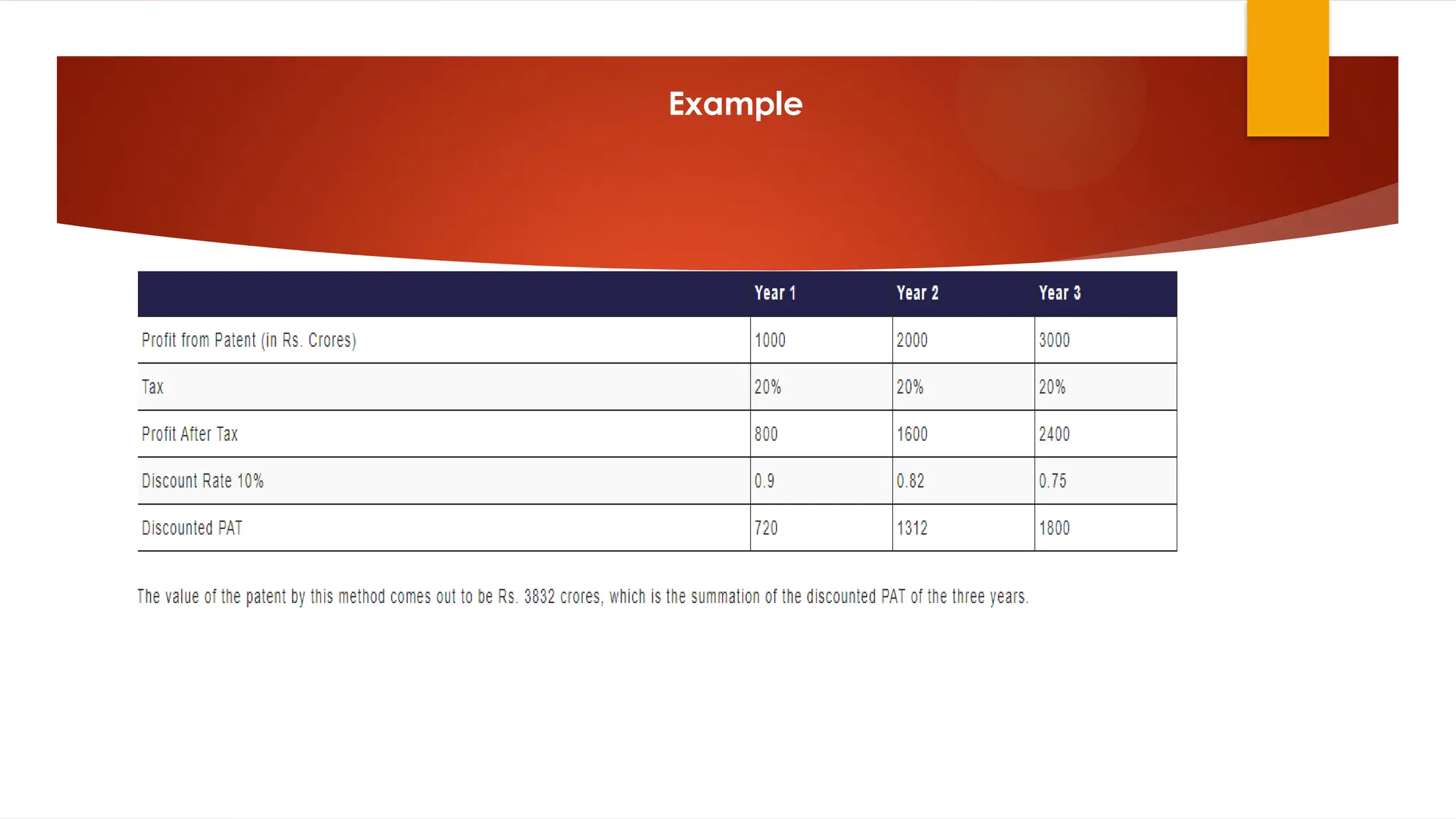
4) Real OptionPricing
This method is used to value intangible assets that are not presently
generating cash flows but are expected to do so in the future.
Undeveloped patent options are one example of an intangible asset that
may be valued using this method.
5) Replacement
Cost Method
Less
Obsolescence
The replacement cost method establishes
a value for the intangible based on the
amount is would cost the Company to
replace the asset.
Despite of all the guidance and standards
available for intangible valuations,
Intangible Valuations tends to be a highly
subjective activity.
The evolution and evaluation of the
intangible assets of a company is an
integral part of the analysis of a
company.
32.
Conclusion
Many technologyand service-based companies are heavily reliant on
intangible assets while performing their business functions, thereby giving
them immense importance currently.
The real challenge in intangible valuations lies in determining how much
portion of value is attributable to several tangible and intangible assets.
Therefore, it should be noted that the value is within the prescribed
framework under law while exercising structured and practical thinking in
relation to the benefit that can be derived from intangibles.
It is of no doubt that going forward, Companies that can accumulate and
harness Intangibles will be able to create more value.



![Brennan, Niamh and Connell, Brenda [2000] Intellectual Capital: Current Issue...](https://cdn.slidesharecdn.com/ss_thumbnails/0410brennanconnellintellectualcapitalcurrentissuesandpolicyimplications-121116102513-phpapp01-thumbnail.jpg?width=640&height=640&fit=bounds)


