Global Healthcare Systems
1
Learning Objectives
• By end of the lecture you will be able to:
– Know about universal healthcare & its various
models
– Understand Beveridge Model
– Understand Bismarck Model
– Understand the Canadian Model
– Know about Out of pocket systems
– Compare & Evaluate various healthcare models
2
Health system
• A good health system delivers quality services to all
people, when and where they need them
• The exact configuration of services varies from country
to country, but in all cases requires;
– robust financing mechanism;
– well-trained and adequately paid workforce;
– reliable information on which to base decisions and
policies;
– well maintained facilities, logistics to deliver quality
medicines and technologies’ providing equitable access to
people-centred care
– an efficient governance mechanism.
3
Universal Health Coverage
• Universal health coverage (UHC) means that
all people have access to the health services
they need, when and where they need them,
without financial hardship
• It is organized around providing a specified
package of benefits to all members of a
society with the end goal of providing;
– improved access to health services
(responsiveness)
– and improved health outcomes
5
..Universal healthcare
• Universal health coverage is the single most
powerful concept that public health has to
offer. (Margret Chan Former DG WHO)
• Most countries implement universal health
care through legislation, regulation, and
taxation
• The bulk of costs come from a combination of
compulsory insurance and tax revenues
6
Health Insurance
• “Coverage that provides for the payments of
benefits as a result of sickness or injury”
• Health insurance is an insurance that covers
the whole or a part of the risk of a person
incurring medical expenses
• Health Insurance can be Compulsory or
Voluntary
7
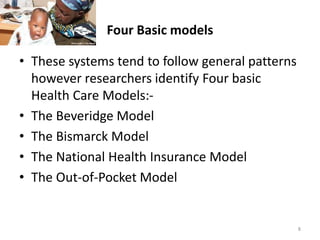
Four Basic models
• These systems tend to follow general patterns
however researchers identify Four basic
Health Care Models:-
• The Beveridge Model
• The Bismarck Model
• The National Health Insurance Model
• The Out-of-Pocket Model
8
William Beveridge
• Born in Rangpur, BD
• Director London School of
Economics
• A social reformer
• Chairman of the
committee which
presented report to the
Parliament on Social
Insurance and Allied
Services in 1942, paving
way for NHS
9
The Beveridge Model
• The founders of the Beveridge system of
health care, Lord William Beveridge and Nye
Bevan
• National Health Service (NHS) was, among the
world’s first tax-funded healthcare systems to
be completely free at the point of use
10
Characteristics
• In this system, health care is provided and financed by the
government through tax payments, just like the police force or
the public library; healthcare being a public service
• Single payer system – Government being the single payer,
removes all the competition in the market to minimize
expenses and standardize benefits
• Majority hospitals are owned by the government; while most
of the GPs are not public employees but rather independent
contractors to the NHS, similarly at many places NHS buys
inpatient and other services from private providers
• 100% population is insured
• Nearly half (47%) of the NHS budget is spent on acute and
emergency care 11
characteristics
• The 3 founding principles of this system are:
– Meeting the needs of everyone
– Free at the point of delivery of care (now co
pay for prescriptions, dentures & dentistry)
– Based on urgency of care and not on the
patient’s ability to pay
12
Bismarck Model
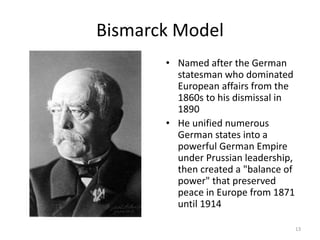
• Named after the German
statesman who dominated
European affairs from the
1860s to his dismissal in
1890
• He unified numerous
German states into a
powerful German Empire
under Prussian leadership,
then created a "balance of
power" that preserved
peace in Europe from 1871
until 1914
13
Germany
• It uses Statutory Health Insurance; heavily
regulated, non-profit insurance called Sickness
Funds, financed jointly by employers and
employees through payroll deduction
• Unlike the insurance industry, Bismarck-type
health insurance plans have to cover everybody,
and they don't make a profit
• Health expenditure is around 11.5% of GDP
14
• The law requires everyone living in Germany to be insured for
at least hospital and out-patient medical treatment
• 9O% Germans are insured with this compulsory health
insurance which includes complete coverage of most health
needs, the rest have private health insurance
• The compulsory health insurance is based on the monthly
fees which are not calculated by age and health status but by
personal income
• The compulsory payroll deduction is 15.5% of the pre-tax
income divided into 8.2% for the employee and 7.3% for the
employer
• The Federal Government provides Unemployment benefits to
those who are not working, however they receive 60% of the
benefits
15
Characteristics
• Only middle- and upper-class can opt out of
compulsory insurance for Private insurance
• The Sickness funds provide healthcare both at Public
and Private hospitals
• The compulsory insurance holders have a choice to
move from one provider to another
• The compulsory health insurance covers inpatient in
the nearest hospital and OPD with a registered doctors
and basic dental care
• Practitioners are mostly private, they can open a
practice or join an existing practice. They may also
choose to work as salaried doctors at hospitals.
16
The National Health Insurance Model
• This system has elements of both Beveridge
and Bismarck
• It uses private-sector providers, but payment
comes from a government run insurance
program that all citizens fund through a tax
• Essentially, the national health insurance
model is universal insurance that doesn't
make a profit
17
….characteristics
• Publicly funded universal health coverage (UHC)
systems, called Medicare
• All citizens and permanent residents receive necessary
hospital and physician services free at the point of use
• Role of government: The provincial governments have
primary responsibility for financing, organizing, and
delivering health services and supervising providers.
• Financing. Canada has a predominantly publicly
financed health system with approximately 70% of
health expenditures financed through the general tax
revenues of the federal, provincial and territorial (FPT)
governments
18
Out of Pocket Model
• The out-of-pocket model is the most common model in less-
developed areas and countries where there aren’t enough
financial resources to create a medical system like the three
models
• In this model, patients must pay for their procedures out of
pocket.
• It is a market driven healthcare, put simply, anybody requiring
medical treatment must pay for it on the spot
• There is no universal insurance system and income taxes are not
raised to provide access to healthcare for all citizens
• This method is most common in developing countries
– WHO & World bank report 2017
19
Which system?
• No system of health care is perfect
• There will always be a trade offs
– Longer waits
– Higher taxes or compulsory insurance
– Providers – private vs public
– Rich can always purchase the treatment of their choice
– Poor have to rely on social net works or only seek medical
care when they can come up with enough money to pay
for
• Many countries have a mixture of these basic models
21
India
• Population of 1.2 Billion, fast growing
economy with some astounding progress in
Health sector
• India provides universal free outpatient and
inpatient care at government clinics and
hospitals
22
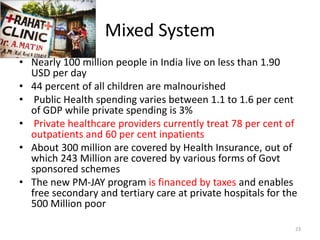
Mixed System
• Nearly 100 million people in India live on less than 1.90
USD per day
• 44 percent of all children are malnourished
• Public Health spending varies between 1.1 to 1.6 per cent
of GDP while private spending is 3%
• Private healthcare providers currently treat 78 per cent of
outpatients and 60 per cent inpatients
• About 300 million are covered by Health Insurance, out of
which 243 Million are covered by various forms of Govt
sponsored schemes
• The new PM-JAY program is financed by taxes and enables
free secondary and tertiary care at private hospitals for the
500 Million poor
23
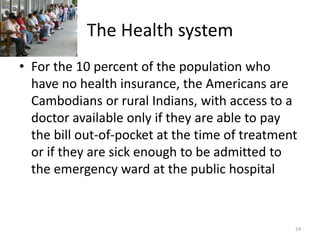
The Health system
• For the 10 percent of the population who
have no health insurance, the Americans are
Cambodians or rural Indians, with access to a
doctor available only if they are able to pay
the bill out-of-pocket at the time of treatment
or if they are sick enough to be admitted to
the emergency ward at the public hospital
24
• Deductibles: The amount you pay for covered
health care services before your insurance
plan starts to pay.
– With a $2,000 deductible, for example, you pay
the first $2,000 of covered services yourself.
• Coinsurance refers to a percentage of the
Medicare-approved cost of your health care
services that you're expected to pay after
you've paid your plan deductibles.
25
Thank You
Questions & Comments
26
References
• Healthcare models across the globe. A comparative analysis. Sibu Saha, MD, MBA
Professor of Surgery University of Kentucky
• Which country has the world's best healthcare system? The Guardian; 9 Feb 2016
• www.commonwealthfund.org/international-health-policy-
center/countries/canada
• Universal Health Coverage, WHO
• Canada Health system review Gregory P. Marchildon Sara Allin
• www.verawholehealth.com/blog/global-healthcare-4-major-national-models-and-
how-they-work
• Health Systems, Management, and Organization in Global Health. David Zakus,
Onil Bhattacharyya, and Xiaolin Wei
• An excerpt from T.R. Reid's book The Healing of America: A Global Quest for Better,
Cheaper, and Fairer Health Care, published by Penguin Press
• India's Healthcare System – overview and Quality Improvements
• Wikipedia
27

Ppt 0331 About Heath care and its models

  • 1.
  • 2.
    Learning Objectives • Byend of the lecture you will be able to: – Know about universal healthcare & its various models – Understand Beveridge Model – Understand Bismarck Model – Understand the Canadian Model – Know about Out of pocket systems – Compare & Evaluate various healthcare models 2
  • 3.
    Health system • Agood health system delivers quality services to all people, when and where they need them • The exact configuration of services varies from country to country, but in all cases requires; – robust financing mechanism; – well-trained and adequately paid workforce; – reliable information on which to base decisions and policies; – well maintained facilities, logistics to deliver quality medicines and technologies’ providing equitable access to people-centred care – an efficient governance mechanism. 3
  • 4.
    Universal Health Coverage •Universal health coverage (UHC) means that all people have access to the health services they need, when and where they need them, without financial hardship • It is organized around providing a specified package of benefits to all members of a society with the end goal of providing; – improved access to health services (responsiveness) – and improved health outcomes 5
  • 5.
    ..Universal healthcare • Universalhealth coverage is the single most powerful concept that public health has to offer. (Margret Chan Former DG WHO) • Most countries implement universal health care through legislation, regulation, and taxation • The bulk of costs come from a combination of compulsory insurance and tax revenues 6
  • 6.
    Health Insurance • “Coveragethat provides for the payments of benefits as a result of sickness or injury” • Health insurance is an insurance that covers the whole or a part of the risk of a person incurring medical expenses • Health Insurance can be Compulsory or Voluntary 7
  • 7.
    Four Basic models •These systems tend to follow general patterns however researchers identify Four basic Health Care Models:- • The Beveridge Model • The Bismarck Model • The National Health Insurance Model • The Out-of-Pocket Model 8
  • 8.
    William Beveridge • Bornin Rangpur, BD • Director London School of Economics • A social reformer • Chairman of the committee which presented report to the Parliament on Social Insurance and Allied Services in 1942, paving way for NHS 9
  • 9.
    The Beveridge Model •The founders of the Beveridge system of health care, Lord William Beveridge and Nye Bevan • National Health Service (NHS) was, among the world’s first tax-funded healthcare systems to be completely free at the point of use 10
  • 10.
    Characteristics • In thissystem, health care is provided and financed by the government through tax payments, just like the police force or the public library; healthcare being a public service • Single payer system – Government being the single payer, removes all the competition in the market to minimize expenses and standardize benefits • Majority hospitals are owned by the government; while most of the GPs are not public employees but rather independent contractors to the NHS, similarly at many places NHS buys inpatient and other services from private providers • 100% population is insured • Nearly half (47%) of the NHS budget is spent on acute and emergency care 11
  • 11.
    characteristics • The 3founding principles of this system are: – Meeting the needs of everyone – Free at the point of delivery of care (now co pay for prescriptions, dentures & dentistry) – Based on urgency of care and not on the patient’s ability to pay 12
  • 12.
    Bismarck Model • Namedafter the German statesman who dominated European affairs from the 1860s to his dismissal in 1890 • He unified numerous German states into a powerful German Empire under Prussian leadership, then created a "balance of power" that preserved peace in Europe from 1871 until 1914 13
  • 13.
    Germany • It usesStatutory Health Insurance; heavily regulated, non-profit insurance called Sickness Funds, financed jointly by employers and employees through payroll deduction • Unlike the insurance industry, Bismarck-type health insurance plans have to cover everybody, and they don't make a profit • Health expenditure is around 11.5% of GDP 14
  • 14.
    • The lawrequires everyone living in Germany to be insured for at least hospital and out-patient medical treatment • 9O% Germans are insured with this compulsory health insurance which includes complete coverage of most health needs, the rest have private health insurance • The compulsory health insurance is based on the monthly fees which are not calculated by age and health status but by personal income • The compulsory payroll deduction is 15.5% of the pre-tax income divided into 8.2% for the employee and 7.3% for the employer • The Federal Government provides Unemployment benefits to those who are not working, however they receive 60% of the benefits 15
  • 15.
    Characteristics • Only middle-and upper-class can opt out of compulsory insurance for Private insurance • The Sickness funds provide healthcare both at Public and Private hospitals • The compulsory insurance holders have a choice to move from one provider to another • The compulsory health insurance covers inpatient in the nearest hospital and OPD with a registered doctors and basic dental care • Practitioners are mostly private, they can open a practice or join an existing practice. They may also choose to work as salaried doctors at hospitals. 16
  • 16.
    The National HealthInsurance Model • This system has elements of both Beveridge and Bismarck • It uses private-sector providers, but payment comes from a government run insurance program that all citizens fund through a tax • Essentially, the national health insurance model is universal insurance that doesn't make a profit 17
  • 17.
    ….characteristics • Publicly fundeduniversal health coverage (UHC) systems, called Medicare • All citizens and permanent residents receive necessary hospital and physician services free at the point of use • Role of government: The provincial governments have primary responsibility for financing, organizing, and delivering health services and supervising providers. • Financing. Canada has a predominantly publicly financed health system with approximately 70% of health expenditures financed through the general tax revenues of the federal, provincial and territorial (FPT) governments 18
  • 18.
    Out of PocketModel • The out-of-pocket model is the most common model in less- developed areas and countries where there aren’t enough financial resources to create a medical system like the three models • In this model, patients must pay for their procedures out of pocket. • It is a market driven healthcare, put simply, anybody requiring medical treatment must pay for it on the spot • There is no universal insurance system and income taxes are not raised to provide access to healthcare for all citizens • This method is most common in developing countries – WHO & World bank report 2017 19
  • 19.
    Which system? • Nosystem of health care is perfect • There will always be a trade offs – Longer waits – Higher taxes or compulsory insurance – Providers – private vs public – Rich can always purchase the treatment of their choice – Poor have to rely on social net works or only seek medical care when they can come up with enough money to pay for • Many countries have a mixture of these basic models 21
  • 20.
    India • Population of1.2 Billion, fast growing economy with some astounding progress in Health sector • India provides universal free outpatient and inpatient care at government clinics and hospitals 22
  • 21.
    Mixed System • Nearly100 million people in India live on less than 1.90 USD per day • 44 percent of all children are malnourished • Public Health spending varies between 1.1 to 1.6 per cent of GDP while private spending is 3% • Private healthcare providers currently treat 78 per cent of outpatients and 60 per cent inpatients • About 300 million are covered by Health Insurance, out of which 243 Million are covered by various forms of Govt sponsored schemes • The new PM-JAY program is financed by taxes and enables free secondary and tertiary care at private hospitals for the 500 Million poor 23
  • 22.
    The Health system •For the 10 percent of the population who have no health insurance, the Americans are Cambodians or rural Indians, with access to a doctor available only if they are able to pay the bill out-of-pocket at the time of treatment or if they are sick enough to be admitted to the emergency ward at the public hospital 24
  • 23.
    • Deductibles: Theamount you pay for covered health care services before your insurance plan starts to pay. – With a $2,000 deductible, for example, you pay the first $2,000 of covered services yourself. • Coinsurance refers to a percentage of the Medicare-approved cost of your health care services that you're expected to pay after you've paid your plan deductibles. 25
  • 24.
  • 25.
    References • Healthcare modelsacross the globe. A comparative analysis. Sibu Saha, MD, MBA Professor of Surgery University of Kentucky • Which country has the world's best healthcare system? The Guardian; 9 Feb 2016 • www.commonwealthfund.org/international-health-policy- center/countries/canada • Universal Health Coverage, WHO • Canada Health system review Gregory P. Marchildon Sara Allin • www.verawholehealth.com/blog/global-healthcare-4-major-national-models-and- how-they-work • Health Systems, Management, and Organization in Global Health. David Zakus, Onil Bhattacharyya, and Xiaolin Wei • An excerpt from T.R. Reid's book The Healing of America: A Global Quest for Better, Cheaper, and Fairer Health Care, published by Penguin Press • India's Healthcare System – overview and Quality Improvements • Wikipedia 27