Plant Equipment in
Thermodynamic Energy Transfer
What is plant equipment?
Typically, in thermodynamics, ‘plant’ refers to heavy machinery and
equipment used during thermodynamic energy transfer.
For example, boilers, turbines, compressors, diffusers, condensers,
nozzles, diffusers etc.
What is a turbine and how does it work?
A turbine converts the potential and kinetic energy of a moving fluid (liquid or gas) to
mechanical energy.
In a turbine generator, a moving fluid—such as water, steam, combustion gases, or air—
pushes a series of blades mounted on a shaft, which rotates the shaft connected to a
generator.
What are four types of turbines?
The turbines are of basically four types and these are water turbine, steam turbine,
gas turbine and wind turbine.
Gas Turbine
Steam Turbine Water Turbine
Where are compressors used?
Compressors are used throughout industry to provide shop or instrument air; to power air
tools, paint sprayers, and abrasive blast equipment; to phase shift refrigerants for air
conditioning and refrigeration; to propel gas through pipelines; etc.
An air compressor is a device that converts power (using an electric motor, diesel or gasoline
engine, etc.) into potential energy stored in pressurized air (i.e., compressed air).
By one of several methods, an air compressor forces more and more air into a storage tank,
increasing the pressure. When the tank's pressure reaches its engineered upper limit, the air
compressor shuts off. The compressed air, then, is held in the tank until called into use. The
energy contained in the compressed air can be used for a variety of applications, utilizing the
kinetic energy of the air as it is released and the tank depressurizes. When tank pressure
reaches its lower limit, the air compressor turns on again and re-pressurizes the tank.
An air compressor must be differentiated from a pump because it works for any gas/air,
while pumps work on a liquid.
What is a Compressor and how does it work?
Air
compressor
Plant
Equipment
Energy In Energy Out
Turbine Compressed gas , air
or steam
Rotary
Mechanical
Motion
Compressor Rotary or Linear
Mechanical Motion
Compressed gas,
air or steam
A turbine is the opposite of a compressor or vice versa
A boiler doesn't necessarily just boil the
water but it does turn water into steam.
Steam is an inexpensive and efficient way
to transport heat. Not only is it easy to
pump through a home (water weighs
more and requires more effort to push
throughout a home) it holds heat better
than just air.
What is a Boiler?
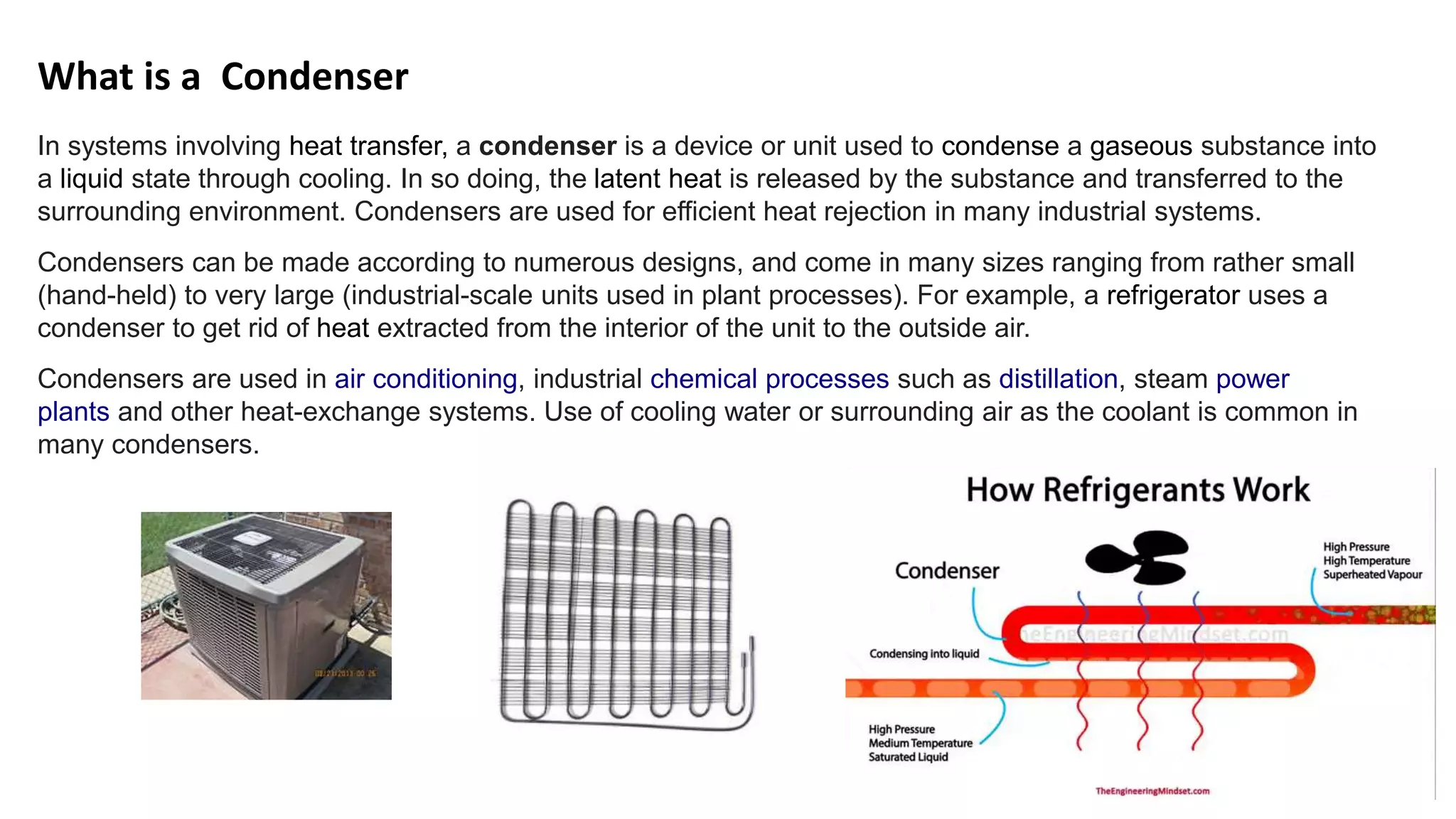
In systems involving heat transfer, a condenser is a device or unit used to condense a gaseous substance into
a liquid state through cooling. In so doing, the latent heat is released by the substance and transferred to the
surrounding environment. Condensers are used for efficient heat rejection in many industrial systems.
Condensers can be made according to numerous designs, and come in many sizes ranging from rather small
(hand-held) to very large (industrial-scale units used in plant processes). For example, a refrigerator uses a
condenser to get rid of heat extracted from the interior of the unit to the outside air.
Condensers are used in air conditioning, industrial chemical processes such as distillation, steam power
plants and other heat-exchange systems. Use of cooling water or surrounding air as the coolant is common in
many condensers.
What is a Condenser
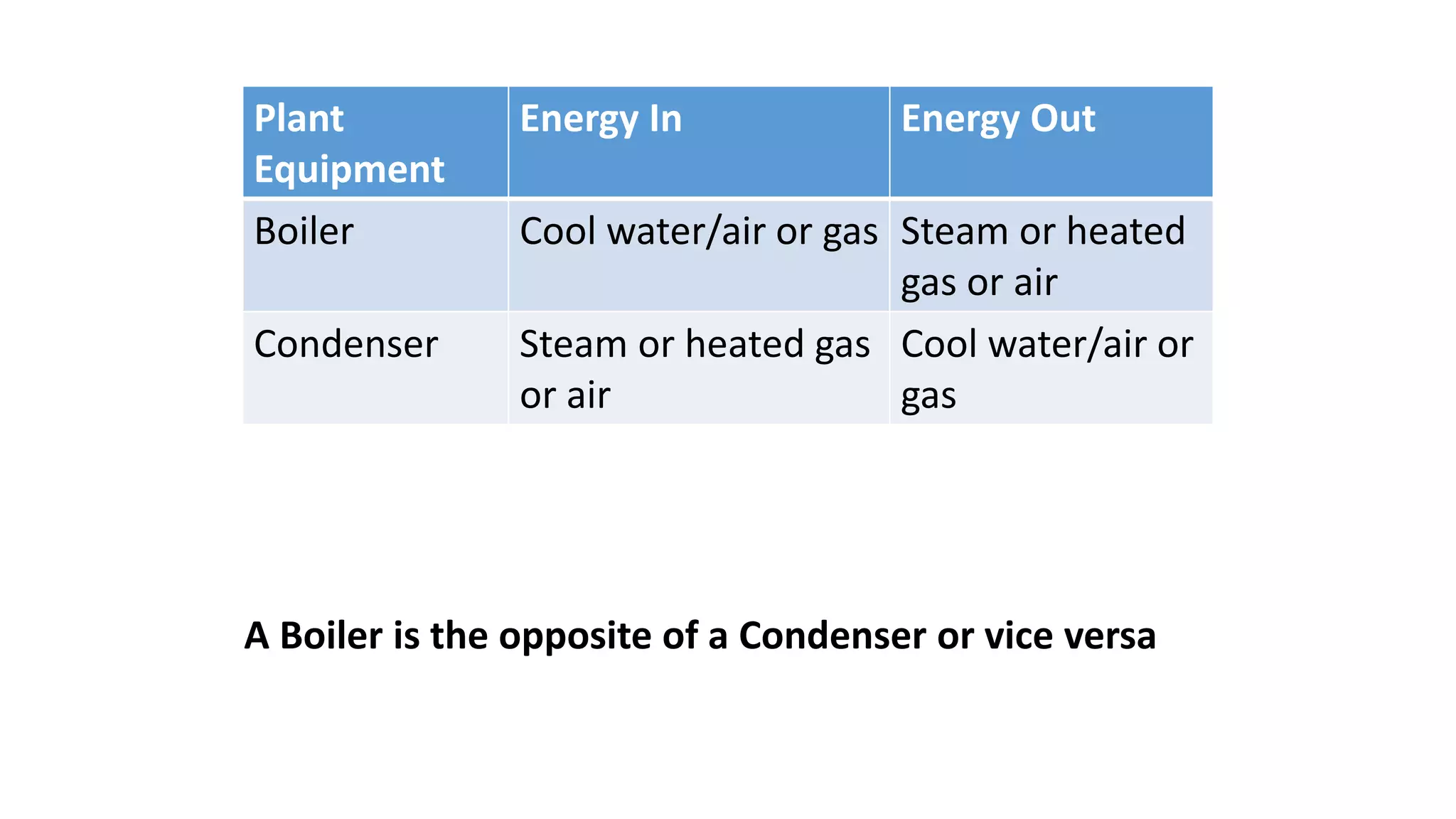
Plant
Equipment
Energy In Energy Out
Boiler Cool water/air or gas Steam or heated
gas or air
Condenser Steam or heated gas
or air
Cool water/air or
gas
A Boiler is the opposite of a Condenser or vice versa
A nozzle is a device designed to control the direction or
characteristics of a fluid flow (especially to increase velocity) as it
exits (or enters) an enclosed chamber or pipe.
What is a Nozzle
A nozzle is often a pipe or tube of varying cross sectional area, and it can be used to direct or modify the flow of
a fluid (liquid or gas). Nozzles are frequently used to control the rate of flow, speed, direction, mass, shape and/or
the pressure of the stream that emerges from them.
Finally the goal of a nozzle is to increase the kinetic energy of the flowing medium at the expense of its pressure
and internal energy.
What is a Diffuser
A diffuser is "a device for reducing the velocity and increasing the static
pressure of a fluid passing through a system”. The fluid's static pressure
rise as it passes through a duct is commonly referred to as pressure
recovery. In contrast, a nozzle is used to increase the discharge velocity
and lower the pressure of a fluid passing through it.
Frictional effects during analysis can sometimes be important, but usually they are neglected. Ducts containing
fluids flowing at low velocity can usually be analysed using Bernoulli's principle. Analysing ducts flowing at higher
velocities with Mach numbers in excess of 0.3 usually require compressible flow relations.
A typical subsonic diffuser is a duct that increases in area in the direction of flow. As the area increases, fluid
velocity decreases, and static pressure rises.
Plant
Equipment
Energy In Energy Out
Nozzle slow water/air or
gas
Fast water/air or gas
Diffuser Fast water/air or gas slow water/air or gas
A Nozzle is the opposite of a Diffuser or vice versa

Plant Equipment in Thermodynamic Systems.pptx

  • 1.
    Plant Equipment in ThermodynamicEnergy Transfer What is plant equipment? Typically, in thermodynamics, ‘plant’ refers to heavy machinery and equipment used during thermodynamic energy transfer. For example, boilers, turbines, compressors, diffusers, condensers, nozzles, diffusers etc.
  • 2.
    What is aturbine and how does it work? A turbine converts the potential and kinetic energy of a moving fluid (liquid or gas) to mechanical energy. In a turbine generator, a moving fluid—such as water, steam, combustion gases, or air— pushes a series of blades mounted on a shaft, which rotates the shaft connected to a generator. What are four types of turbines? The turbines are of basically four types and these are water turbine, steam turbine, gas turbine and wind turbine.
  • 3.
  • 4.
    Where are compressorsused? Compressors are used throughout industry to provide shop or instrument air; to power air tools, paint sprayers, and abrasive blast equipment; to phase shift refrigerants for air conditioning and refrigeration; to propel gas through pipelines; etc. An air compressor is a device that converts power (using an electric motor, diesel or gasoline engine, etc.) into potential energy stored in pressurized air (i.e., compressed air). By one of several methods, an air compressor forces more and more air into a storage tank, increasing the pressure. When the tank's pressure reaches its engineered upper limit, the air compressor shuts off. The compressed air, then, is held in the tank until called into use. The energy contained in the compressed air can be used for a variety of applications, utilizing the kinetic energy of the air as it is released and the tank depressurizes. When tank pressure reaches its lower limit, the air compressor turns on again and re-pressurizes the tank. An air compressor must be differentiated from a pump because it works for any gas/air, while pumps work on a liquid. What is a Compressor and how does it work?
  • 5.
  • 6.
    Plant Equipment Energy In EnergyOut Turbine Compressed gas , air or steam Rotary Mechanical Motion Compressor Rotary or Linear Mechanical Motion Compressed gas, air or steam A turbine is the opposite of a compressor or vice versa
  • 7.
    A boiler doesn'tnecessarily just boil the water but it does turn water into steam. Steam is an inexpensive and efficient way to transport heat. Not only is it easy to pump through a home (water weighs more and requires more effort to push throughout a home) it holds heat better than just air. What is a Boiler?
  • 8.
    In systems involvingheat transfer, a condenser is a device or unit used to condense a gaseous substance into a liquid state through cooling. In so doing, the latent heat is released by the substance and transferred to the surrounding environment. Condensers are used for efficient heat rejection in many industrial systems. Condensers can be made according to numerous designs, and come in many sizes ranging from rather small (hand-held) to very large (industrial-scale units used in plant processes). For example, a refrigerator uses a condenser to get rid of heat extracted from the interior of the unit to the outside air. Condensers are used in air conditioning, industrial chemical processes such as distillation, steam power plants and other heat-exchange systems. Use of cooling water or surrounding air as the coolant is common in many condensers. What is a Condenser
  • 9.
    Plant Equipment Energy In EnergyOut Boiler Cool water/air or gas Steam or heated gas or air Condenser Steam or heated gas or air Cool water/air or gas A Boiler is the opposite of a Condenser or vice versa
  • 10.
    A nozzle isa device designed to control the direction or characteristics of a fluid flow (especially to increase velocity) as it exits (or enters) an enclosed chamber or pipe. What is a Nozzle A nozzle is often a pipe or tube of varying cross sectional area, and it can be used to direct or modify the flow of a fluid (liquid or gas). Nozzles are frequently used to control the rate of flow, speed, direction, mass, shape and/or the pressure of the stream that emerges from them. Finally the goal of a nozzle is to increase the kinetic energy of the flowing medium at the expense of its pressure and internal energy.
  • 11.
    What is aDiffuser A diffuser is "a device for reducing the velocity and increasing the static pressure of a fluid passing through a system”. The fluid's static pressure rise as it passes through a duct is commonly referred to as pressure recovery. In contrast, a nozzle is used to increase the discharge velocity and lower the pressure of a fluid passing through it. Frictional effects during analysis can sometimes be important, but usually they are neglected. Ducts containing fluids flowing at low velocity can usually be analysed using Bernoulli's principle. Analysing ducts flowing at higher velocities with Mach numbers in excess of 0.3 usually require compressible flow relations. A typical subsonic diffuser is a duct that increases in area in the direction of flow. As the area increases, fluid velocity decreases, and static pressure rises.
  • 12.
    Plant Equipment Energy In EnergyOut Nozzle slow water/air or gas Fast water/air or gas Diffuser Fast water/air or gas slow water/air or gas A Nozzle is the opposite of a Diffuser or vice versa