Thermodynamic Processes
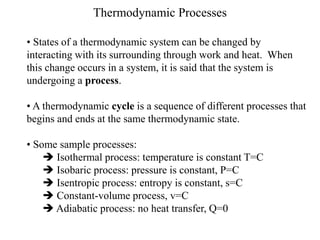
• States of a thermodynamic system can be changed by
interacting with its surrounding through work and heat. When
this change occurs in a system, it is said that the system is
undergoing a process.
• A thermodynamic cycle is a sequence of different processes that
begins and ends at the same thermodynamic state.
• Some sample processes:
 Isothermal process: temperature is constant T=C
 Isobaric process: pressure is constant, P=C
 Isentropic process: entropy is constant, s=C
 Constant-volume process, v=C
 Adiabatic process: no heat transfer, Q=0
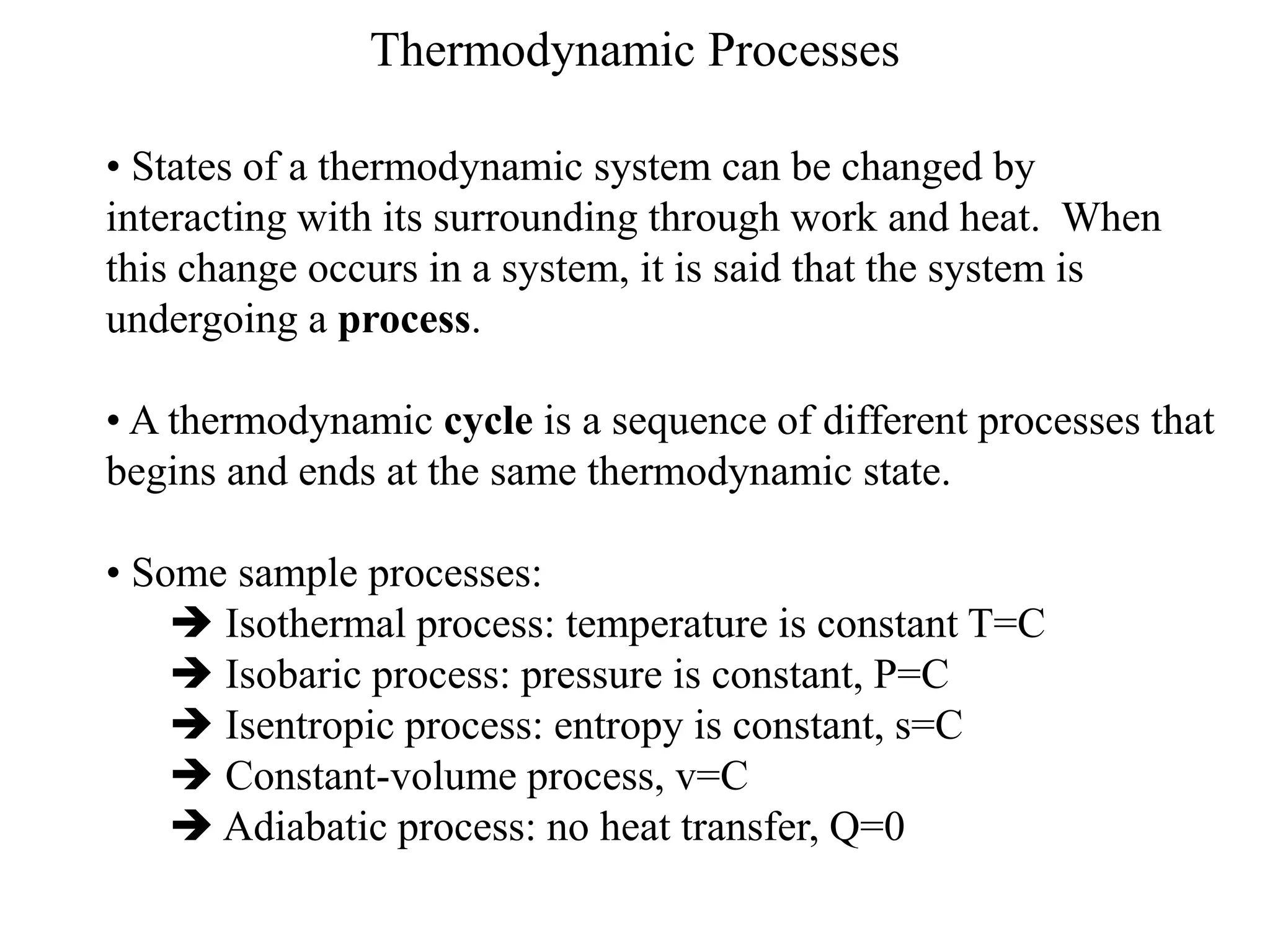
Process-1
• Use ideal gas assumption (closed system):
2
1
2 1
1 2
Isothermal process: T=constant
Energy balance U=Q-W, for ideal gas U= H=0
since both are functions of temperature only
Q=W, W= P
ln ln
Isobaric process:
mRT dV
dV dV mRT
V V
V P
mRT mRT
V P
  
 
   
 
   
   
  


2
2 1
1
2 1 2 1 2 1
2 2 1 1 2 1
P=constant
U=Q-W, W= PdV=P dV=P(V )
( ) ( ) ( )
( ) ( )
V
Q U P V V U U P V V
U PV U PV H H H
 
       
       
 
Process-2
v
v
Constant volume process: V=constant
Q-W= U, W= 0, no work done
Q= U=m u=m c
Adiabatic process: Q=0
Q-W= U, -W= U
- W=dU (infinitesimal increment of work and energy)
dU+PdV=0, mc 0
v
PdV
dT
mRT
dT dV
V
c

 
 
 
 
 
 
 




v
2 2 2 1 1
1 1 1 2 2
1
0, , integrate and assume
c =constant
ln ln ,
v
v
v
R k
c
c
RT dT dV
dT dV
V R T V
c T V T V V
R T V T V V

 
   
 
 
       
   
       
       
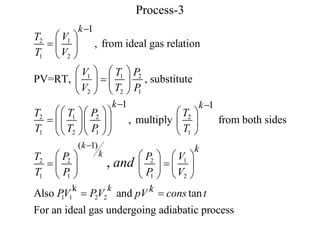
Process-3
2 1
1 2
1 1 2
2 2 1
2 1 2 2
1 2 1 1
2 2 2 1
1 1 1
( 1)
1
1 1
, from ideal gas relation
PV=RT, , substitute
, multiply from both sides
,
k
k
k
k k
T V
T V
V T P
V T P
T T P T
T T P T
T P P V
T P P
and


 
 
  
 
   

   
   
 
    
  
    
    
 
   
 
   
    2
1 1 2 2
k
Also and tan
For an ideal gas undergoing adiabatic process
k
k
k
V
PV PV pV cons t
 
 
 
 
Process-4
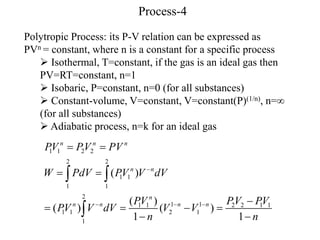
Polytropic Process: its P-V relation can be expressed as
PVn = constant, where n is a constant for a specific process
 Isothermal, T=constant, if the gas is an ideal gas then
PV=RT=constant, n=1
 Isobaric, P=constant, n=0 (for all substances)
 Constant-volume, V=constant, V=constant(P)(1/n), n=
(for all substances)
 Adiabatic process, n=k for an ideal gas
1 1 2 2
2 2
1 1
1 1
2
1 1
1 1 2 2 1 1
1 1 2 1
1
( )
( )
( ) ( )
1 1
n n n
n n
n
n n n n
PV PV PV
W PdV PV V dV
PV PV PV
PV V dV V V
n n

  
 
 

   
 
 


process.ppt

  • 1.
    Thermodynamic Processes • Statesof a thermodynamic system can be changed by interacting with its surrounding through work and heat. When this change occurs in a system, it is said that the system is undergoing a process. • A thermodynamic cycle is a sequence of different processes that begins and ends at the same thermodynamic state. • Some sample processes:  Isothermal process: temperature is constant T=C  Isobaric process: pressure is constant, P=C  Isentropic process: entropy is constant, s=C  Constant-volume process, v=C  Adiabatic process: no heat transfer, Q=0
  • 2.
    Process-1 • Use idealgas assumption (closed system): 2 1 2 1 1 2 Isothermal process: T=constant Energy balance U=Q-W, for ideal gas U= H=0 since both are functions of temperature only Q=W, W= P ln ln Isobaric process: mRT dV dV dV mRT V V V P mRT mRT V P                         2 2 1 1 2 1 2 1 2 1 2 2 1 1 2 1 P=constant U=Q-W, W= PdV=P dV=P(V ) ( ) ( ) ( ) ( ) ( ) V Q U P V V U U P V V U PV U PV H H H                    
  • 3.
    Process-2 v v Constant volume process:V=constant Q-W= U, W= 0, no work done Q= U=m u=m c Adiabatic process: Q=0 Q-W= U, -W= U - W=dU (infinitesimal increment of work and energy) dU+PdV=0, mc 0 v PdV dT mRT dT dV V c                    v 2 2 2 1 1 1 1 1 2 2 1 0, , integrate and assume c =constant ln ln , v v v R k c c RT dT dV dT dV V R T V c T V T V V R T V T V V                                       
  • 4.
    Process-3 2 1 1 2 11 2 2 2 1 2 1 2 2 1 2 1 1 2 2 2 1 1 1 1 ( 1) 1 1 1 , from ideal gas relation PV=RT, , substitute , multiply from both sides , k k k k k T V T V V T P V T P T T P T T T P T T P P V T P P and                                                             2 1 1 2 2 k Also and tan For an ideal gas undergoing adiabatic process k k k V PV PV pV cons t        
  • 5.
    Process-4 Polytropic Process: itsP-V relation can be expressed as PVn = constant, where n is a constant for a specific process  Isothermal, T=constant, if the gas is an ideal gas then PV=RT=constant, n=1  Isobaric, P=constant, n=0 (for all substances)  Constant-volume, V=constant, V=constant(P)(1/n), n= (for all substances)  Adiabatic process, n=k for an ideal gas 1 1 2 2 2 2 1 1 1 1 2 1 1 1 1 2 2 1 1 1 1 2 1 1 ( ) ( ) ( ) ( ) 1 1 n n n n n n n n n n PV PV PV W PdV PV V dV PV PV PV PV V dV V V n n                  