Islam (Sunni & Shia)
Southwest Asia’s
• Judaism, Christianity, & Islam are prominent religions
practiced in Southwest Asia.
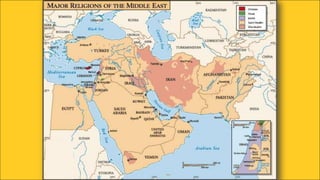
• 90% of the region’s population practices Islam, 4%
are Christian, and 2% follow Judaism.
• Followers of each practice monotheism, a belief in one
god.
What else do they have in common?
• They all originated in Southwest Asia.
• Each can trace their roots to Abraham as the father of
their faith.
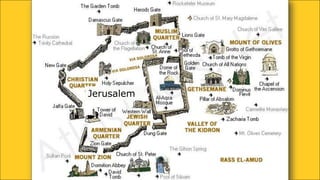
• Jerusalem is the holiest city in the world for Jews and
Christians, and the third holiest city for Muslims.
• All three have an important messenger, book of
teachings, and holidays.
Jerusalem
• Islam began around 622 CE in Southwest Asia.
• In Arabic, Islam means “surrender to the will of Allah” (God).
• Followers of Islam are called Muslims, and the founder is
Muhammad.
• Muslims believe that there is only one god (Allah) and that
Muhammad is the last and greatest prophet of Islam.
• Other prophets include Abraham, Moses, & Jesus.
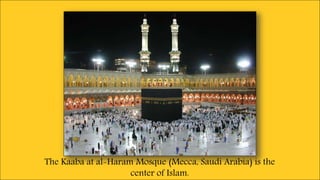
The Kaaba at al-Haram Mosque (Mecca, Saudi Arabia) is the
center of Islam.
• In 610 CE, Muhammad was an Arab merchant in Mecca who was
concerned about how rich merchants refused to help the needy.
• He went to meditate on this in the Cave of Hira.
• While there, Muhammad received a message from the angel
Gabriel, the messenger of Allah.
• Muhammad became known as a prophet of Allah, and he
continued to receive messages until his death.
• These messages form the basis of Islam and were eventually
written into the Qur’an (the Muslim holy book).
• Eventually, others began to listen to Muhammad’s messages
and this angered Mecca’s rulers.
• They threatened to kill Muhammad, so he & several
hundred of his followers fled to nearby Medina.
• Muhammad became a political and spiritual leader in
Medina.
• Eventually, all of the Arabian Peninsula came to accept
Muhammad’s teachings and turned to Islam.
• Muhammad died in 632 CE, but Islam continued to spread.
• Muslim armies conquered empires throughout
Southwest Asia, Northern Africa, and the Iberian
Peninsula (Europe).
• Today, there are 1.2 billion Muslims worldwide.
• 1 in every 5 people in the world is Muslim.
• It’s the second largest religion in the world (behind
Christianity).
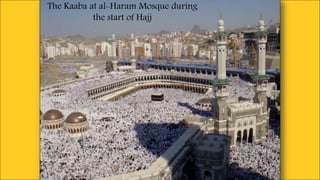
The Kaaba at al-Haram Mosque during
the start of Hajj
• The Muslim holy book is the Qur’an (Koran).
• It states how people should live their lives.
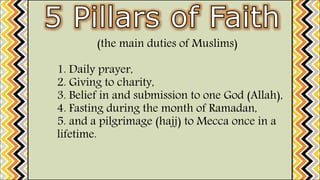
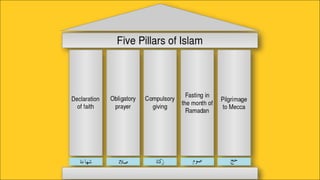
• It describes the Five Pillars of Faith (obligations
all Muslims must fulfill in their lifetime).
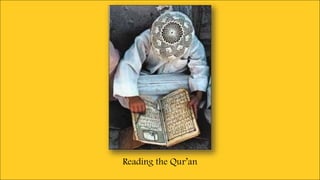
Reading the Qur’an
(the main duties of Muslims)
1. Daily prayer,
2. Giving to charity,
3. Belief in and submission to one God (Allah),
4. Fasting during the month of Ramadan,
5. and a pilgrimage (hajj) to Mecca once in a
lifetime.
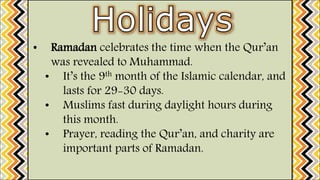
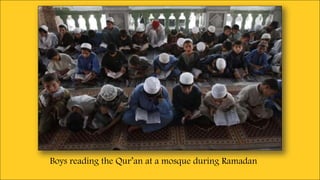
• Ramadan celebrates the time when the Qur’an
was revealed to Muhammad.
• It’s the 9th month of the Islamic calendar, and
lasts for 29-30 days.
• Muslims fast during daylight hours during
this month.
• Prayer, reading the Qur’an, and charity are
important parts of Ramadan.
Boys reading the Qur’an at a mosque during Ramadan
• Unlike the other religions, in Islam the Qur’an
gives instructions on how laws should be
enacted.
• The governments of Muslim countries follow
the Shari'a, or religious law.
• This creates a theocracy, a type of government
in which religious leaders are in control.
• After Muhammad’s death, followers fought over
who would be his successor and become the
next leader.
• This fight caused Muslims to split into two
groups:
1. Shi’a
2. Sunni
• Shiites believe that the supreme leader (called the
Caliph) must be a blood relative of Muhammad.
• Roughly 10% of the world’s Muslims are Shi’a.
• This branch of Islam is found mostly in Iran and some
parts of Iraq.
• This is the religion of most Persians (ethnic group in
Iran).
• Sunnis believe that the supreme leader (Caliph) does
NOT need to be related to Muhammad.
• This is the major branch of the religion, representing
about 90% of the world’s Muslim population.

Islam

  • 1.
    Islam (Sunni &Shia) Southwest Asia’s
  • 2.
    • Judaism, Christianity,& Islam are prominent religions practiced in Southwest Asia. • 90% of the region’s population practices Islam, 4% are Christian, and 2% follow Judaism. • Followers of each practice monotheism, a belief in one god. What else do they have in common?
  • 4.
    • They alloriginated in Southwest Asia. • Each can trace their roots to Abraham as the father of their faith. • Jerusalem is the holiest city in the world for Jews and Christians, and the third holiest city for Muslims. • All three have an important messenger, book of teachings, and holidays.
  • 5.
  • 7.
    • Islam beganaround 622 CE in Southwest Asia. • In Arabic, Islam means “surrender to the will of Allah” (God). • Followers of Islam are called Muslims, and the founder is Muhammad. • Muslims believe that there is only one god (Allah) and that Muhammad is the last and greatest prophet of Islam. • Other prophets include Abraham, Moses, & Jesus.
  • 8.
    The Kaaba atal-Haram Mosque (Mecca, Saudi Arabia) is the center of Islam.
  • 9.
    • In 610CE, Muhammad was an Arab merchant in Mecca who was concerned about how rich merchants refused to help the needy. • He went to meditate on this in the Cave of Hira. • While there, Muhammad received a message from the angel Gabriel, the messenger of Allah. • Muhammad became known as a prophet of Allah, and he continued to receive messages until his death. • These messages form the basis of Islam and were eventually written into the Qur’an (the Muslim holy book).
  • 10.
    • Eventually, othersbegan to listen to Muhammad’s messages and this angered Mecca’s rulers. • They threatened to kill Muhammad, so he & several hundred of his followers fled to nearby Medina. • Muhammad became a political and spiritual leader in Medina. • Eventually, all of the Arabian Peninsula came to accept Muhammad’s teachings and turned to Islam.
  • 11.
    • Muhammad diedin 632 CE, but Islam continued to spread. • Muslim armies conquered empires throughout Southwest Asia, Northern Africa, and the Iberian Peninsula (Europe). • Today, there are 1.2 billion Muslims worldwide. • 1 in every 5 people in the world is Muslim. • It’s the second largest religion in the world (behind Christianity).
  • 12.
    The Kaaba atal-Haram Mosque during the start of Hajj
  • 13.
    • The Muslimholy book is the Qur’an (Koran). • It states how people should live their lives. • It describes the Five Pillars of Faith (obligations all Muslims must fulfill in their lifetime).
  • 14.
  • 15.
    (the main dutiesof Muslims) 1. Daily prayer, 2. Giving to charity, 3. Belief in and submission to one God (Allah), 4. Fasting during the month of Ramadan, 5. and a pilgrimage (hajj) to Mecca once in a lifetime.
  • 17.
    • Ramadan celebratesthe time when the Qur’an was revealed to Muhammad. • It’s the 9th month of the Islamic calendar, and lasts for 29-30 days. • Muslims fast during daylight hours during this month. • Prayer, reading the Qur’an, and charity are important parts of Ramadan.
  • 18.
    Boys reading theQur’an at a mosque during Ramadan
  • 19.
    • Unlike theother religions, in Islam the Qur’an gives instructions on how laws should be enacted. • The governments of Muslim countries follow the Shari'a, or religious law. • This creates a theocracy, a type of government in which religious leaders are in control.
  • 21.
    • After Muhammad’sdeath, followers fought over who would be his successor and become the next leader. • This fight caused Muslims to split into two groups: 1. Shi’a 2. Sunni
  • 22.
    • Shiites believethat the supreme leader (called the Caliph) must be a blood relative of Muhammad. • Roughly 10% of the world’s Muslims are Shi’a. • This branch of Islam is found mostly in Iran and some parts of Iraq. • This is the religion of most Persians (ethnic group in Iran).
  • 23.
    • Sunnis believethat the supreme leader (Caliph) does NOT need to be related to Muhammad. • This is the major branch of the religion, representing about 90% of the world’s Muslim population.