Davide Scaramuzza
Towards Robust and Safe
Autonomous Drones
Website: http://rpg.ifi.uzh.ch/people_scaramuzza.html
Software & Datasets: http://rpg.ifi.uzh.ch/software_datasets.html
YouTube: https://www.youtube.com/user/ailabRPG/videos
Publications: http://rpg.ifi.uzh.ch/publications.html
http://rpg.ifi.uzh.ch
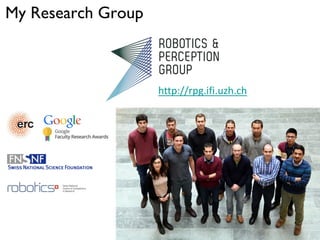
My Research Group
Autonomous Navigation of Flying Robots
[AURO’12, RAM’14, JFR’15]
Event-based Vision for Agile Flight
[IROS’3, ICRA’14, RSS’15]
Visual-Inertial State Estimation
[T-RO’08, IJCV’11, PAMI’13, RAM’14, JFR’15]
Current Research
Air-ground collaboration
[IROS’13, SSRR’14]
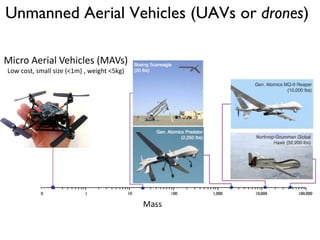
Unmanned Aerial Vehicles (UAVs or drones)
Mass
Micro Aerial Vehicles (MAVs)
Low cost, small size (<1m) , weight <5kg)
Today’s Applications
Toys
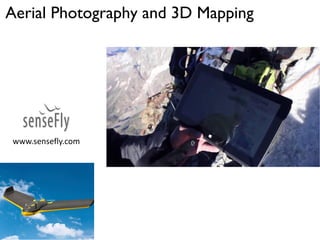
Aerial Photography and 3D Mapping
www.sensefly.com
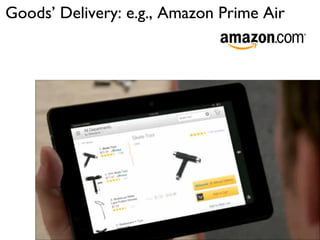
Goods’ Delivery: e.g., Amazon Prime Air
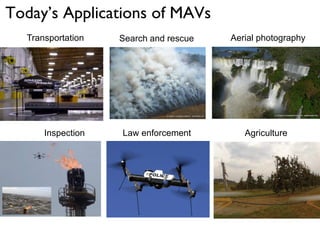
Transportation Search and rescue Aerial photography
Law enforcementInspection Agriculture
Today’s Applications of MAVs
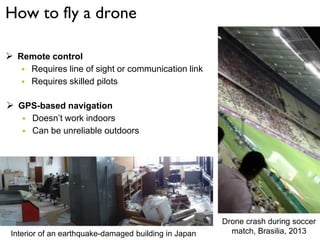
How to fly a drone
 Remote control
 Requires line of sight or communication link
 Requires skilled pilots
Drone crash during soccer
match, Brasilia, 2013Interior of an earthquake-damaged building in Japan
 GPS-based navigation
 Doesn’t work indoors
 Can be unreliable outdoors
Problems of GPS
 Does not work indoors
 Even outdoors it is not a reliable service
 Satellite coverage
 Multipath problem
Why do we need autonomy?
Autonomous Navigation is crucial for:
Remote InspectionSearch and Rescue
Fontana, Faessler, Scaramuzza
How do we Localize without GPS ?
Mellinger, Michael, Kumar
This robot is «blind»
How do we Localize without GPS ?
This robot is «blind»
How do we Localize without GPS ?
Motion capture system
Markers
This robot can «see»This robot is «blind»
How do we Localize without GPS ?
Motion capture system
Markers
AutonomousVision-based Navigation in GPS-denied Environments
[Scaramuzza, Achtelik, Weiss, Fraundorfer, et al., Vision-Controlled Micro Flying Robots: from System
Design to Autonomous Navigation and Mapping in GPS-denied Environments, IEEE RAM, 2014]
Problems with Vision-controlled MAVs
Quadrotors have the potential to navigate quickly through unstructured
environments, enter and rapidly explore collapsed buildings, but…
 Autonomous operation is currently restricted to controlled environments
 Autonomous maneuvers with onboard cameras are still slow and inaccurate
compared to those attainable with motion-capture systems
Why?
 Perception algorithms are mature but not robust
 Unlike lidars and Vicon, localization accuracy depends on depth & texture!
 Sparse models instead of dense environment models
 Control & perception have been mostly considered separately
 Not capable of adapting to changes
Outline
 Vision-based, GPS-denied Navigation
 From Sparse to Dense Models
 Active Vision and Control
 Low-latency State Estimation for agile motion
Vision-based, GPS-denied
Navigation
Image 𝐼 𝑘−1 Image 𝐼 𝑘
𝑇𝑘,𝑘−1
Visual Odometry
1. Scaramuzza, Fraundorfer. Visual Odometry, IEEE Robotics and Automation Magazine, 2011
2. D. Scaramuzza. 1-Point-RANSAC Visual Odometry, International Journal of Computer Vision, 2011
3. Forster, Pizzoli, Scaramuzza, SVO: Semi Direct Visual Odometry, IEEE ICRA’14]
Keyframe-based Visual Odometry
Keyframe 1 Keyframe 2
Initial pointcloud New triangulated points
Current frame
New keyframe
Feature-based vs. Direct Methods
Feature-based (e.g., PTAM, Klein’08)
1. Feature extraction
2. Feature matching
3. RANSAC + P3P
4. Reprojection error
minimization
𝑇𝑘,𝑘−1 = arg min
𝑇
𝒖′𝑖 − 𝜋 𝒑𝑖
2
𝑖
Direct approaches (e.g., Meilland’13)
1. Minimize photometric error
𝑇𝑘,𝑘−1
𝐼 𝑘
𝒖′𝑖
𝒑𝑖
𝒖𝑖
𝐼 𝑘−1
𝑇𝑘,𝑘−1 = ?
𝒑𝑖
𝒖′𝑖𝒖𝑖
𝑇𝑘,𝑘−1 = arg min
𝑇
𝐼 𝑘 𝒖′𝑖 − 𝐼 𝑘−1(𝒖𝑖) 2
𝑖
[Soatto’95, Meilland and Comport, IROS 2013], DVO [Kerl et al., ICRA
2013], DTAM [Newcombe et al., ICCV ‘11], ...
Feature-based vs. Direct Methods
1. Feature extraction
2. Feature matching
3. RANSAC + P3P
4. Reprojection error
minimization
𝑇𝑘,𝑘−1 = arg min
𝑇
𝒖′𝑖 − 𝜋 𝒑𝑖
2
𝑖
Direct approaches
1. Minimize photometric error
𝑇𝑘,𝑘−1 = arg min
𝑇
𝐼 𝑘 𝒖′𝑖 − 𝐼 𝑘−1(𝒖𝑖) 2
𝑖
 Large frame-to-frame motions
 Slow (20-30 Hz) due to costly feature
extraction and matching
 Not robust to high-frequency and
repetive texture
 Every pixel in the image can be
exploited (precision, robustness)
 Increasing camera frame-rate reduces
computational cost per frame
 Limited to small frame-to-frame
motion
Feature-based (e.g., PTAM, Klein’08)
Feature-based vs. Direct Methods
1. Feature extraction
2. Feature matching
3. RANSAC + P3P
4. Reprojection error
minimization
𝑇𝑘,𝑘−1 = arg min
𝑇
𝒖′𝑖 − 𝜋 𝒑𝑖
2
𝑖
Direct approaches
1. Minimize photometric error
𝑇𝑘,𝑘−1 = arg min
𝑇
𝐼 𝑘 𝒖′𝑖 − 𝐼 𝑘−1(𝒖𝑖) 2
𝑖
 Large frame-to-frame motions
 Slow (20-30 Hz) due to costly feature
extraction and matching
 Not robust to high-frequency and
repetive texture
 Every pixel in the image can be
exploited (precision, robustness)
 Increasing camera frame-rate reduces
computational cost per frame
 Limited to small frame-to-frame
motion
Feature-based (e.g., PTAM, Klein’08)
Our solution:
SVO: Semi-direct Visual Odometry [ICRA’14]
Combines feature-based and direct methods
SVO: Experiments in real-world environments
[Forster, Pizzoli, Scaramuzza, «SVO: Semi Direct Visual Odometry», ICRA’14]
Robust to fast and abrupt motions
Video:
https://www.youtube.com/watch?v=2YnI
Mfw6bJY
Processing Times of SVO
Laptop (Intel i7, 2.8 GHz)
Embedded ARM Cortex-A9, 1.7 GHz
400 frames per second
Up to 70 frames per second
 Open Source available at: github.com/uzh-rpg/rpg_svo
 Works with and without ROS
 Closed-Source professional edition available for companies
Source Code
Absolute Scale Estimation
Scale Ambiguity
 With a single camera, we only know the relative scale
 No information about the metric scale
Absolute Scale Estimation
 The absolute pose 𝑥 is known up to a scale 𝑠, thus
𝑥 = 𝑠𝑥
 IMU provides accelerations, thus
𝑣 = 𝑣0 + 𝑎 𝑡 𝑑𝑡
 By derivating the first one and equating them
𝑠𝑥 = 𝑣0 + 𝑎 𝑡 𝑑𝑡
 As shown in [Martinelli, TRO’12], for 6DOF, both 𝑠 and 𝑣0 can be determined in closed form
from a single feature observation and 3 views
The scale and velocity can then be tracked using
 Filter-based approaches
 Losely-coupled approaches [Lynen et al., IROS’13]
 Tightly-coupled approached (e.g., Google TANGO) [Mourikis & Roumeliotis, TRO’12]
 Optimization-based approaches [Leutenegger, RSS’13], [Forster, Scaramuzza, RSS’14]
 Fusion is solved as a non-linear optimization problem (no Kalman filter):
 Increased accuracy over filtering methods
IMU residuals Reprojection residuals
[Forster, Carlone, Dellaert, Scaramuzza, IMU Preintegration on Manifold for efficient Visual-Inertial
Maximum-a-Posteriori Estimation, RSS’15]
Visual-Inertial Fusion [RSS’15]
Comparison with Previous Works
Google TangoProposed ASLAM
Forster, Carlone, Dellaert, Scaramuzza, IMU Preintegration on Manifold for efficient Visual-Inertial Maximum-a-
Posteriori Estimation, Robotics Science and Systens’15
Accuracy: 0.1% of the travel distance
Video: https://www.youtube.com/watch?v=CsJkci5lfco
Integration on a
Quadrotor Platform
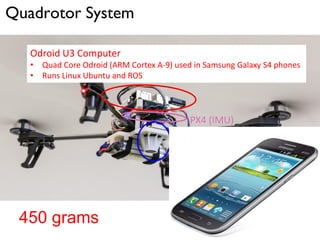
Quadrotor System
PX4 (IMU)
Global-Shutter Camera
• 752x480 pixels
• High dynamic range
• 90 fps
450 grams
Odroid U3 Computer
• Quad Core Odroid (ARM Cortex A-9) used in Samsung Galaxy S4 phones
• Runs Linux Ubuntu and ROS
Flight Results: Hovering
RMS error: 5 mm, height: 1.5 m – Down-looking camera
Faessler, Fontana, Forster, Mueggler, Pizzoli, Scaramuzza, Autonomous, Vision-based Flight and Live Dense 3D
Mapping with a Quadrotor Micro Aerial Vehicle, Journal of Field Robotics, 2015.
Flight Results: Indoor, aggressive flight
Speed: 4 m/s, height: 1.5 m – Down-looking camera
Faessler, Fontana, Forster, Mueggler, Pizzoli, Scaramuzza, Autonomous, Vision-based Flight and Live Dense 3D
Mapping with a Quadrotor Micro Aerial Vehicle, Journal of Field Robotics, 2015.
Video: https://www.youtube.com/watch?v=l3TCiCe_T3g
Autonomous Vision-based Flight over Mockup Disaster Zone
Firefighters’ training area, Zurich
Faessler, Fontana, Forster, Mueggler, Pizzoli, Scaramuzza, Autonomous, Vision-based Flight and Live Dense 3D
Mapping with a Quadrotor Micro Aerial Vehicle, Journal of Field Robotics, 2015.
Video:
https://www.youtube.com/watch?v
=3mNY9-DSUDk
Probabilistic Depth Estimation
Depth-Filter:
• Depth Filter for every feature
• Recursive Bayesian depth estimation
Mixture of Gaussian + Uniform distribution
[Forster, Pizzoli, Scaramuzza, SVO: Semi Direct Visual Odometry, IEEE ICRA’14]
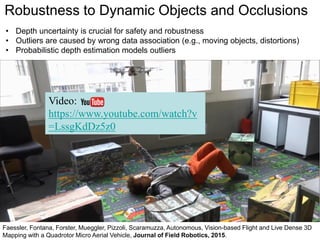
Robustness to Dynamic Objects and Occlusions
• Depth uncertainty is crucial for safety and robustness
• Outliers are caused by wrong data association (e.g., moving objects, distortions)
• Probabilistic depth estimation models outliers
Faessler, Fontana, Forster, Mueggler, Pizzoli, Scaramuzza, Autonomous, Vision-based Flight and Live Dense 3D
Mapping with a Quadrotor Micro Aerial Vehicle, Journal of Field Robotics, 2015.
Video:
https://www.youtube.com/watch?v
=LssgKdDz5z0
Failure Recovery
• Loss of GPS
• From aggressive flight
•Visual tracking
Automatic Failure Recovery from Aggressive Flight [ICRA’15]
Faessler, Fontana, Forster, Scaramuzza, Automatic Re-Initialization and Failure Recovery for Aggressive Flight
with a Monocular Vision-Based Quadrotor, ICRA’15. Featured in IEEE Spectrum.
Video:
https://www.youtube.com/watch?v
=pGU1s6Y55JI
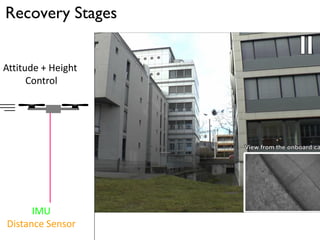
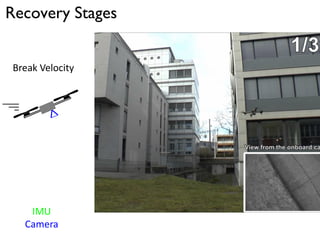
Recovery Stages
Throw
IMU
Recovery Stages
Attitude Control
IMU
Recovery Stages
Attitude + Height
Control
IMU
Distance Sensor
Recovery Stages
Break Velocity
IMU
Camera
Automatic Failure Recovery from Aggressive Flight [ICRA’15]
Faessler, Fontana, Forster, Scaramuzza, Automatic Re-Initialization and Failure Recovery for Aggressive Flight
with a Monocular Vision-Based Quadrotor, ICRA’15. Featured in IEEE Spectrum.
From Sparse to Dense 3D
Models
[M. Pizzoli, C. Forster, D. Scaramuzza, REMODE: Probabilistic, Monocular Dense Reconstruction in Real Time, ICRA’14]
Goal: estimate depth of every pixel in real time
 Pros:
- Advantageous for environment interaction (e.g., collision avoidance,
landing, grasping, industrial inspection, etc)
- Higher position accuracy
 Cons: computationally expensive (requires GPU)
Dense Reconstruction in Real-Time
[ICRA’15] [IROS’13, SSRR’14]
Dense Reconstruction Pipeline
 Local methods
 Estimate depth for every pixel independently using photometric cost aggregation
 Global methods
 Refine the depth surface as a whole by enforcing smoothness constraint
(“Regularization”)
𝐸 𝑑 = 𝐸 𝑑 𝑑 + λ𝐸𝑠(𝑑)
Data term Regularization term:
penalizes non-smooth
surfaces
[Newcombe et al. 2011]
[M. Pizzoli, C. Forster, D. Scaramuzza, REMODE: Probabilistic, Monocular Dense Reconstruction in Real Time, ICRA’14]
REMODE: Probabilistic Monocular Dense Reconstruction [ICRA’14]
Running at 50 Hz on GPU on a Lenovo W530, i7
Video:
https://www.youtube.com/watch?v
=QTKd5UWCG0Q
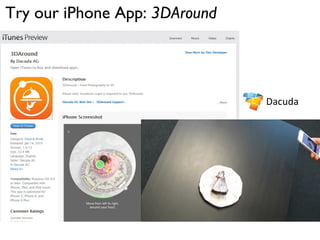
Try our iPhone App: 3DAround
Dacuda
Autonomus, Flying 3D Scanning [ JFR’15]
• Sensing, control, state estimation run onboard at 50 Hz (Odroid U3, ARM Cortex A9)
• Dense reconstruction runs live on video streamed to laptop (Lenovo W530, i7)
2x
Faessler, Fontana, Forster, Mueggler, Pizzoli, Scaramuzza, Autonomous, Vision-based Flight and Live Dense 3D
Mapping with a Quadrotor Micro Aerial Vehicle, Journal of Field Robotics, 2015.
Video:
https://www.youtube.com/watch?v
=7-kPiWaFYAc
• Sensing, control, state estimation run onboard at 50 Hz (Odroid U3, ARM Cortex A9)
• Dense reconstruction runs live on video streamed to laptop (Lenovo W530, i7)
Faessler, Fontana, Forster, Mueggler, Pizzoli, Scaramuzza, Autonomous, Vision-based Flight and Live Dense 3D
Mapping with a Quadrotor Micro Aerial Vehicle, Journal of Field Robotics, 2015.
Autonomus, Flying 3D Scanning [ JFR’15]
Applications: Industrial Inspection
Industrial collaboration with Parrot-SenseFly targets:
 Real-time dense reconstruction with 5 cameras
 Vision-based navigation
 Dense 3D mapping in real time
Faessler, Fontana, Forster, Mueggler, Pizzoli, Scaramuzza, Autonomous, Vision-based Flight and Live Dense 3D
Mapping with a Quadrotor Micro Aerial Vehicle, Journal of Field Robotics, 2015.
Video: https://www.youtube.com/watch?v=gr00Bf0AP1k
Inspection of CERN tunnels
 Problem: inspection of CERN tunnels currently done by technicians,
who expend much of their annual quota of safe radiation dose
 Goal: inspection of LHC tunnel with autonomous drone
 Challenge: low illumination, cluttered environment
Autonomous Landing-Spot Detection and Landing [ICRA’15]
Forster, Faessler, Fontana, Werlberger, Scaramuzza, Continuous On-Board Monocular-Vision-based Elevation Mapping
Applied to Autonomous Landing of Micro Aerial Vehicles, ICRA’15.
Video: https://www.youtube.com/watch?v=phaBKFwfcJ4
Having an autonomous landing-spot detection
can really help!
The Philae lander while approaching the comet on November 12, 2014
rpg.ifi.uzh.ch
Thanks! Questions?
Website: http://rpg.ifi.uzh.ch/people_scaramuzza.html
Software & Datasets: http://rpg.ifi.uzh.ch/software_datasets.html
YouTube: https://www.youtube.com/user/ailabRPG/videos
Publications: http://rpg.ifi.uzh.ch/publications.html

Towards Robust and Safe Autonomous Drones

  • 1.
    Davide Scaramuzza Towards Robustand Safe Autonomous Drones Website: http://rpg.ifi.uzh.ch/people_scaramuzza.html Software & Datasets: http://rpg.ifi.uzh.ch/software_datasets.html YouTube: https://www.youtube.com/user/ailabRPG/videos Publications: http://rpg.ifi.uzh.ch/publications.html
  • 2.
  • 3.
    Autonomous Navigation ofFlying Robots [AURO’12, RAM’14, JFR’15] Event-based Vision for Agile Flight [IROS’3, ICRA’14, RSS’15] Visual-Inertial State Estimation [T-RO’08, IJCV’11, PAMI’13, RAM’14, JFR’15] Current Research Air-ground collaboration [IROS’13, SSRR’14]
  • 4.
    Unmanned Aerial Vehicles(UAVs or drones) Mass Micro Aerial Vehicles (MAVs) Low cost, small size (<1m) , weight <5kg)
  • 5.
  • 6.
  • 7.
    Aerial Photography and3D Mapping www.sensefly.com
  • 8.
    Goods’ Delivery: e.g.,Amazon Prime Air
  • 9.
    Transportation Search andrescue Aerial photography Law enforcementInspection Agriculture Today’s Applications of MAVs
  • 10.
    How to flya drone  Remote control  Requires line of sight or communication link  Requires skilled pilots Drone crash during soccer match, Brasilia, 2013Interior of an earthquake-damaged building in Japan  GPS-based navigation  Doesn’t work indoors  Can be unreliable outdoors
  • 11.
    Problems of GPS Does not work indoors  Even outdoors it is not a reliable service  Satellite coverage  Multipath problem
  • 12.
    Why do weneed autonomy?
  • 13.
    Autonomous Navigation iscrucial for: Remote InspectionSearch and Rescue
  • 14.
    Fontana, Faessler, Scaramuzza Howdo we Localize without GPS ? Mellinger, Michael, Kumar
  • 15.
    This robot is«blind» How do we Localize without GPS ?
  • 16.
    This robot is«blind» How do we Localize without GPS ? Motion capture system Markers
  • 17.
    This robot can«see»This robot is «blind» How do we Localize without GPS ? Motion capture system Markers
  • 18.
    AutonomousVision-based Navigation inGPS-denied Environments [Scaramuzza, Achtelik, Weiss, Fraundorfer, et al., Vision-Controlled Micro Flying Robots: from System Design to Autonomous Navigation and Mapping in GPS-denied Environments, IEEE RAM, 2014]
  • 19.
    Problems with Vision-controlledMAVs Quadrotors have the potential to navigate quickly through unstructured environments, enter and rapidly explore collapsed buildings, but…  Autonomous operation is currently restricted to controlled environments  Autonomous maneuvers with onboard cameras are still slow and inaccurate compared to those attainable with motion-capture systems Why?  Perception algorithms are mature but not robust  Unlike lidars and Vicon, localization accuracy depends on depth & texture!  Sparse models instead of dense environment models  Control & perception have been mostly considered separately  Not capable of adapting to changes
  • 20.
    Outline  Vision-based, GPS-deniedNavigation  From Sparse to Dense Models  Active Vision and Control  Low-latency State Estimation for agile motion
  • 21.
  • 22.
    Image 𝐼 𝑘−1Image 𝐼 𝑘 𝑇𝑘,𝑘−1 Visual Odometry 1. Scaramuzza, Fraundorfer. Visual Odometry, IEEE Robotics and Automation Magazine, 2011 2. D. Scaramuzza. 1-Point-RANSAC Visual Odometry, International Journal of Computer Vision, 2011 3. Forster, Pizzoli, Scaramuzza, SVO: Semi Direct Visual Odometry, IEEE ICRA’14]
  • 23.
    Keyframe-based Visual Odometry Keyframe1 Keyframe 2 Initial pointcloud New triangulated points Current frame New keyframe
  • 24.
    Feature-based vs. DirectMethods Feature-based (e.g., PTAM, Klein’08) 1. Feature extraction 2. Feature matching 3. RANSAC + P3P 4. Reprojection error minimization 𝑇𝑘,𝑘−1 = arg min 𝑇 𝒖′𝑖 − 𝜋 𝒑𝑖 2 𝑖 Direct approaches (e.g., Meilland’13) 1. Minimize photometric error 𝑇𝑘,𝑘−1 𝐼 𝑘 𝒖′𝑖 𝒑𝑖 𝒖𝑖 𝐼 𝑘−1 𝑇𝑘,𝑘−1 = ? 𝒑𝑖 𝒖′𝑖𝒖𝑖 𝑇𝑘,𝑘−1 = arg min 𝑇 𝐼 𝑘 𝒖′𝑖 − 𝐼 𝑘−1(𝒖𝑖) 2 𝑖 [Soatto’95, Meilland and Comport, IROS 2013], DVO [Kerl et al., ICRA 2013], DTAM [Newcombe et al., ICCV ‘11], ...
  • 25.
    Feature-based vs. DirectMethods 1. Feature extraction 2. Feature matching 3. RANSAC + P3P 4. Reprojection error minimization 𝑇𝑘,𝑘−1 = arg min 𝑇 𝒖′𝑖 − 𝜋 𝒑𝑖 2 𝑖 Direct approaches 1. Minimize photometric error 𝑇𝑘,𝑘−1 = arg min 𝑇 𝐼 𝑘 𝒖′𝑖 − 𝐼 𝑘−1(𝒖𝑖) 2 𝑖  Large frame-to-frame motions  Slow (20-30 Hz) due to costly feature extraction and matching  Not robust to high-frequency and repetive texture  Every pixel in the image can be exploited (precision, robustness)  Increasing camera frame-rate reduces computational cost per frame  Limited to small frame-to-frame motion Feature-based (e.g., PTAM, Klein’08)
  • 26.
    Feature-based vs. DirectMethods 1. Feature extraction 2. Feature matching 3. RANSAC + P3P 4. Reprojection error minimization 𝑇𝑘,𝑘−1 = arg min 𝑇 𝒖′𝑖 − 𝜋 𝒑𝑖 2 𝑖 Direct approaches 1. Minimize photometric error 𝑇𝑘,𝑘−1 = arg min 𝑇 𝐼 𝑘 𝒖′𝑖 − 𝐼 𝑘−1(𝒖𝑖) 2 𝑖  Large frame-to-frame motions  Slow (20-30 Hz) due to costly feature extraction and matching  Not robust to high-frequency and repetive texture  Every pixel in the image can be exploited (precision, robustness)  Increasing camera frame-rate reduces computational cost per frame  Limited to small frame-to-frame motion Feature-based (e.g., PTAM, Klein’08) Our solution: SVO: Semi-direct Visual Odometry [ICRA’14] Combines feature-based and direct methods
  • 27.
    SVO: Experiments inreal-world environments [Forster, Pizzoli, Scaramuzza, «SVO: Semi Direct Visual Odometry», ICRA’14] Robust to fast and abrupt motions Video: https://www.youtube.com/watch?v=2YnI Mfw6bJY
  • 28.
    Processing Times ofSVO Laptop (Intel i7, 2.8 GHz) Embedded ARM Cortex-A9, 1.7 GHz 400 frames per second Up to 70 frames per second  Open Source available at: github.com/uzh-rpg/rpg_svo  Works with and without ROS  Closed-Source professional edition available for companies Source Code
  • 29.
  • 30.
    Scale Ambiguity  Witha single camera, we only know the relative scale  No information about the metric scale
  • 31.
    Absolute Scale Estimation The absolute pose 𝑥 is known up to a scale 𝑠, thus 𝑥 = 𝑠𝑥  IMU provides accelerations, thus 𝑣 = 𝑣0 + 𝑎 𝑡 𝑑𝑡  By derivating the first one and equating them 𝑠𝑥 = 𝑣0 + 𝑎 𝑡 𝑑𝑡  As shown in [Martinelli, TRO’12], for 6DOF, both 𝑠 and 𝑣0 can be determined in closed form from a single feature observation and 3 views The scale and velocity can then be tracked using  Filter-based approaches  Losely-coupled approaches [Lynen et al., IROS’13]  Tightly-coupled approached (e.g., Google TANGO) [Mourikis & Roumeliotis, TRO’12]  Optimization-based approaches [Leutenegger, RSS’13], [Forster, Scaramuzza, RSS’14]
  • 32.
     Fusion issolved as a non-linear optimization problem (no Kalman filter):  Increased accuracy over filtering methods IMU residuals Reprojection residuals [Forster, Carlone, Dellaert, Scaramuzza, IMU Preintegration on Manifold for efficient Visual-Inertial Maximum-a-Posteriori Estimation, RSS’15] Visual-Inertial Fusion [RSS’15]
  • 33.
    Comparison with PreviousWorks Google TangoProposed ASLAM Forster, Carlone, Dellaert, Scaramuzza, IMU Preintegration on Manifold for efficient Visual-Inertial Maximum-a- Posteriori Estimation, Robotics Science and Systens’15 Accuracy: 0.1% of the travel distance Video: https://www.youtube.com/watch?v=CsJkci5lfco
  • 34.
  • 35.
    Quadrotor System PX4 (IMU) Global-ShutterCamera • 752x480 pixels • High dynamic range • 90 fps 450 grams Odroid U3 Computer • Quad Core Odroid (ARM Cortex A-9) used in Samsung Galaxy S4 phones • Runs Linux Ubuntu and ROS
  • 36.
    Flight Results: Hovering RMSerror: 5 mm, height: 1.5 m – Down-looking camera Faessler, Fontana, Forster, Mueggler, Pizzoli, Scaramuzza, Autonomous, Vision-based Flight and Live Dense 3D Mapping with a Quadrotor Micro Aerial Vehicle, Journal of Field Robotics, 2015.
  • 37.
    Flight Results: Indoor,aggressive flight Speed: 4 m/s, height: 1.5 m – Down-looking camera Faessler, Fontana, Forster, Mueggler, Pizzoli, Scaramuzza, Autonomous, Vision-based Flight and Live Dense 3D Mapping with a Quadrotor Micro Aerial Vehicle, Journal of Field Robotics, 2015. Video: https://www.youtube.com/watch?v=l3TCiCe_T3g
  • 38.
    Autonomous Vision-based Flightover Mockup Disaster Zone Firefighters’ training area, Zurich Faessler, Fontana, Forster, Mueggler, Pizzoli, Scaramuzza, Autonomous, Vision-based Flight and Live Dense 3D Mapping with a Quadrotor Micro Aerial Vehicle, Journal of Field Robotics, 2015. Video: https://www.youtube.com/watch?v =3mNY9-DSUDk
  • 39.
    Probabilistic Depth Estimation Depth-Filter: •Depth Filter for every feature • Recursive Bayesian depth estimation Mixture of Gaussian + Uniform distribution [Forster, Pizzoli, Scaramuzza, SVO: Semi Direct Visual Odometry, IEEE ICRA’14]
  • 40.
    Robustness to DynamicObjects and Occlusions • Depth uncertainty is crucial for safety and robustness • Outliers are caused by wrong data association (e.g., moving objects, distortions) • Probabilistic depth estimation models outliers Faessler, Fontana, Forster, Mueggler, Pizzoli, Scaramuzza, Autonomous, Vision-based Flight and Live Dense 3D Mapping with a Quadrotor Micro Aerial Vehicle, Journal of Field Robotics, 2015. Video: https://www.youtube.com/watch?v =LssgKdDz5z0
  • 41.
    Failure Recovery • Lossof GPS • From aggressive flight •Visual tracking
  • 42.
    Automatic Failure Recoveryfrom Aggressive Flight [ICRA’15] Faessler, Fontana, Forster, Scaramuzza, Automatic Re-Initialization and Failure Recovery for Aggressive Flight with a Monocular Vision-Based Quadrotor, ICRA’15. Featured in IEEE Spectrum. Video: https://www.youtube.com/watch?v =pGU1s6Y55JI
  • 43.
  • 44.
  • 45.
    Recovery Stages Attitude +Height Control IMU Distance Sensor
  • 46.
  • 47.
    Automatic Failure Recoveryfrom Aggressive Flight [ICRA’15] Faessler, Fontana, Forster, Scaramuzza, Automatic Re-Initialization and Failure Recovery for Aggressive Flight with a Monocular Vision-Based Quadrotor, ICRA’15. Featured in IEEE Spectrum.
  • 48.
    From Sparse toDense 3D Models [M. Pizzoli, C. Forster, D. Scaramuzza, REMODE: Probabilistic, Monocular Dense Reconstruction in Real Time, ICRA’14]
  • 49.
    Goal: estimate depthof every pixel in real time  Pros: - Advantageous for environment interaction (e.g., collision avoidance, landing, grasping, industrial inspection, etc) - Higher position accuracy  Cons: computationally expensive (requires GPU) Dense Reconstruction in Real-Time [ICRA’15] [IROS’13, SSRR’14]
  • 50.
    Dense Reconstruction Pipeline Local methods  Estimate depth for every pixel independently using photometric cost aggregation  Global methods  Refine the depth surface as a whole by enforcing smoothness constraint (“Regularization”) 𝐸 𝑑 = 𝐸 𝑑 𝑑 + λ𝐸𝑠(𝑑) Data term Regularization term: penalizes non-smooth surfaces [Newcombe et al. 2011]
  • 51.
    [M. Pizzoli, C.Forster, D. Scaramuzza, REMODE: Probabilistic, Monocular Dense Reconstruction in Real Time, ICRA’14] REMODE: Probabilistic Monocular Dense Reconstruction [ICRA’14] Running at 50 Hz on GPU on a Lenovo W530, i7 Video: https://www.youtube.com/watch?v =QTKd5UWCG0Q
  • 52.
    Try our iPhoneApp: 3DAround Dacuda
  • 53.
    Autonomus, Flying 3DScanning [ JFR’15] • Sensing, control, state estimation run onboard at 50 Hz (Odroid U3, ARM Cortex A9) • Dense reconstruction runs live on video streamed to laptop (Lenovo W530, i7) 2x Faessler, Fontana, Forster, Mueggler, Pizzoli, Scaramuzza, Autonomous, Vision-based Flight and Live Dense 3D Mapping with a Quadrotor Micro Aerial Vehicle, Journal of Field Robotics, 2015. Video: https://www.youtube.com/watch?v =7-kPiWaFYAc
  • 54.
    • Sensing, control,state estimation run onboard at 50 Hz (Odroid U3, ARM Cortex A9) • Dense reconstruction runs live on video streamed to laptop (Lenovo W530, i7) Faessler, Fontana, Forster, Mueggler, Pizzoli, Scaramuzza, Autonomous, Vision-based Flight and Live Dense 3D Mapping with a Quadrotor Micro Aerial Vehicle, Journal of Field Robotics, 2015. Autonomus, Flying 3D Scanning [ JFR’15]
  • 55.
    Applications: Industrial Inspection Industrialcollaboration with Parrot-SenseFly targets:  Real-time dense reconstruction with 5 cameras  Vision-based navigation  Dense 3D mapping in real time Faessler, Fontana, Forster, Mueggler, Pizzoli, Scaramuzza, Autonomous, Vision-based Flight and Live Dense 3D Mapping with a Quadrotor Micro Aerial Vehicle, Journal of Field Robotics, 2015. Video: https://www.youtube.com/watch?v=gr00Bf0AP1k
  • 56.
    Inspection of CERNtunnels  Problem: inspection of CERN tunnels currently done by technicians, who expend much of their annual quota of safe radiation dose  Goal: inspection of LHC tunnel with autonomous drone  Challenge: low illumination, cluttered environment
  • 57.
    Autonomous Landing-Spot Detectionand Landing [ICRA’15] Forster, Faessler, Fontana, Werlberger, Scaramuzza, Continuous On-Board Monocular-Vision-based Elevation Mapping Applied to Autonomous Landing of Micro Aerial Vehicles, ICRA’15. Video: https://www.youtube.com/watch?v=phaBKFwfcJ4
  • 58.
    Having an autonomouslanding-spot detection can really help! The Philae lander while approaching the comet on November 12, 2014
  • 59.
    rpg.ifi.uzh.ch Thanks! Questions? Website: http://rpg.ifi.uzh.ch/people_scaramuzza.html Software& Datasets: http://rpg.ifi.uzh.ch/software_datasets.html YouTube: https://www.youtube.com/user/ailabRPG/videos Publications: http://rpg.ifi.uzh.ch/publications.html