
Is Restructuring Of IMF required In The Present Context of Globalization By Manjunath H N Mithilesh L N
IMF The  International Monetary Fund  ( IMF ) is the intergovernmental organization that oversees the global financial system by following the macroeconomic policies of its member countries, in particular those with an impact on exchange rate and the balance of payments It is an organization formed with a stated objective of stabilizing international exchange rates and facilitating development through the enforcement of liberalizing economic policies on other countries as a condition for loans, restructuring or aid
Members Members of the IMF are  186 of the UN members  and Kosovo  The other non-members are: North Korea, Andorra, Monaco, Liechtenstein, Nauru, Cook Islands, Niue, Vatican City and the rest of the states with limited recognition.  All members appoint a Governor to the IMF's Board of Governors
 
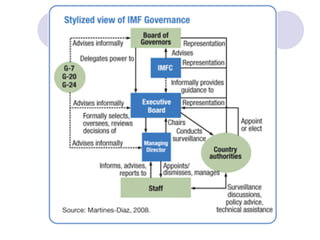
Board of Governors The Board of Governors is the highest decision-making body of the IMF. It consists of one governor and one alternate governor for each member country The governor is appointed by the member country and is usually the minister of finance or the head of the central bank.  The Board of Governors also elects or appoints executive directors and is the ultimate arbiter on issues related to the interpretation of the IMF's Articles of Agreement. Voting by the Board of Governors usually takes place by mail-in ballot.
Ministerial Committees The IMFC is responsible for advising, and reporting to, the Board of Governors as it manages and shapes the international monetary and financial system. The IMFC also monitors developments in global liquidity and the transfer of resources to developing countries  The Development Committee is a joint committee, tasked with advising the Boards of Governors of the IMF and the World Bank on issues related to economic development in emerging and developing countries.
Executive Board 24-member  Executive Board   These 24 board members represent all 187 countries The Board discusses everything from the IMF staff's annual health checks of member countries' economies to economic policy issues relevant to the global economy.
IMF and Globalization Marked by massive movements of capital and abrupt shifts in comparative advantage, globalization affects countries' policy choices in many areas, including labor, trade, and tax policies.  Helping a country benefit from globalization while avoiding potential downsides is an important task for the IMF
Need for Restructuring Of IMF Inability to Prevent Global Economic Crisis Changes in Communication and Technology
Areas of Restructuring Defining a New Role Governance Surveillance and Analysis Lending Financial Sources
Defining a New Role Make Crisis Prevention and Crisis Resolution to go hand in hand Work Out a Relationship with The World Bank and avoid “overlaps” Reduce the number of extraneous roles
Crisis Prevention Significant improvement in the Quality of Fund’s Financial and Economic Surveillance Reform of the member’s obligations so as to bring about a reasonable degree of Multilateral discipline
Reducing The Number of Extraneous Roles Involvement in Surveillance of Developing Countries Identifying another organization or body better suited to carry out  certain activities, including work on terrorist financing and money laundering
World Bank and IMF The IMF should pull back from debt relief programmes in developing countries as this would “help clarify the roles of the IMF and the World Bank.” Fund should utilize the expertise of the World Bank in social and poverty issues, to augment the Fund’s more macro-economics based analysis. The IMF should remain within its remit of crisis prevention, not extend its  activities into areas of social policy and development it does not appear to be equipped to deal with.
Governance While we note that changing the quotas may have no discernible effect on how the Fund operates, there is a good case for reforming the quotas to improve the Fund’s governance There  is a balance to be struck between the rights of those that provide the Fund’s resources, and the needs of those that utilise those same resources
Quotas Reform and Appointment of CMD Ensure that all countries are better represented in the governance structure of the IMF Open selection process for the IMF’s managing director so that it could be less Transparent
Enhancing the Executive Board and IMFC There needs to be a resident board, to  allow effective oversight of the Fund’s activities. This underlines the need to ensure proper representation of all the Fund’s members We welcome the moves to make the IMFC more effective. It is important that, as a high level body of the IMF, it is particularly cognizant of its role in providing guidance and oversight of the work of the Fund.  Other member countries to  persuade the Fund to release more material, including Executive Board minutes.
Surveillance and Analysis it seems entirely appropriate that the IMF, as the guardian of the global financial system, should seek to redouble its efforts in assessing the effects of the interplay between the world’s economies Ensure that there is broad consensus for this change in focus of the surveillance across all members of the Fund.
Multilateral consultation IMF’s new approach to multilateral consultation, given the Fund’s new focus on crisis prevention member states must feel that the actions that may be required from the conclusion of this process will be broadly beneficial In a manner which reinforces its neutrality and authoritativeness of the Fund
IEO The Independent Evaluation Office (IEO) has been a significant success it still has scope for further  development, especially given the International Monetary and Financial Committee' recommendation to include the IEO within the oversight of the surveillance remit
Conditionality in Lending Key concern about conditionality has been that it appears to undermine the sovereignty of the countries receiving IMF support Conditions with a Democratic process Should be Advocated
New Lending Facilities Exogenous Shocks Facility (ESF): “policy support and financial assistance to low-income countries facing exogenous shocks”, where exogenous shocks are described as including “commodity price changes (including oil), natural disasters,  and conflicts and crises in neighbouring countries that disrupt trade”. it Should be  designed so as to ensure that all member states that require it are not dissuaded by onerous conditionality
Financing Of IMF The Fund’s primary source of income derives from the difference between the interest received on its lending activities and the interest it has to pay out to the member states that hold money with the Fund separate funding and lending decisions.
Reform In Financing The search for a solution to the long-term financing of IMF operations should be considered against two criteria The first is that poorer nations should not have to pay to gain access to the range of services the IMF can provide. The second is that funding for surveillance should be seen to be as independent as the actual  analysis, especially where the IMF may also be a lender to a specific country
THANK YOU

Is restructuring of imf required in the present

  • 1.
    Is Restructuring OfIMF required In The Present Context of Globalization By Manjunath H N Mithilesh L N
  • 2.
    IMF The  InternationalMonetary Fund  ( IMF ) is the intergovernmental organization that oversees the global financial system by following the macroeconomic policies of its member countries, in particular those with an impact on exchange rate and the balance of payments It is an organization formed with a stated objective of stabilizing international exchange rates and facilitating development through the enforcement of liberalizing economic policies on other countries as a condition for loans, restructuring or aid
  • 3.
    Members Members ofthe IMF are  186 of the UN members  and Kosovo The other non-members are: North Korea, Andorra, Monaco, Liechtenstein, Nauru, Cook Islands, Niue, Vatican City and the rest of the states with limited recognition. All members appoint a Governor to the IMF's Board of Governors
  • 4.
  • 5.
    Board of GovernorsThe Board of Governors is the highest decision-making body of the IMF. It consists of one governor and one alternate governor for each member country The governor is appointed by the member country and is usually the minister of finance or the head of the central bank. The Board of Governors also elects or appoints executive directors and is the ultimate arbiter on issues related to the interpretation of the IMF's Articles of Agreement. Voting by the Board of Governors usually takes place by mail-in ballot.
  • 6.
    Ministerial Committees TheIMFC is responsible for advising, and reporting to, the Board of Governors as it manages and shapes the international monetary and financial system. The IMFC also monitors developments in global liquidity and the transfer of resources to developing countries The Development Committee is a joint committee, tasked with advising the Boards of Governors of the IMF and the World Bank on issues related to economic development in emerging and developing countries.
  • 7.
    Executive Board 24-member Executive Board   These 24 board members represent all 187 countries The Board discusses everything from the IMF staff's annual health checks of member countries' economies to economic policy issues relevant to the global economy.
  • 8.
    IMF and GlobalizationMarked by massive movements of capital and abrupt shifts in comparative advantage, globalization affects countries' policy choices in many areas, including labor, trade, and tax policies. Helping a country benefit from globalization while avoiding potential downsides is an important task for the IMF
  • 9.
    Need for RestructuringOf IMF Inability to Prevent Global Economic Crisis Changes in Communication and Technology
  • 10.
    Areas of RestructuringDefining a New Role Governance Surveillance and Analysis Lending Financial Sources
  • 11.
    Defining a NewRole Make Crisis Prevention and Crisis Resolution to go hand in hand Work Out a Relationship with The World Bank and avoid “overlaps” Reduce the number of extraneous roles
  • 12.
    Crisis Prevention Significantimprovement in the Quality of Fund’s Financial and Economic Surveillance Reform of the member’s obligations so as to bring about a reasonable degree of Multilateral discipline
  • 13.
    Reducing The Numberof Extraneous Roles Involvement in Surveillance of Developing Countries Identifying another organization or body better suited to carry out certain activities, including work on terrorist financing and money laundering
  • 14.
    World Bank andIMF The IMF should pull back from debt relief programmes in developing countries as this would “help clarify the roles of the IMF and the World Bank.” Fund should utilize the expertise of the World Bank in social and poverty issues, to augment the Fund’s more macro-economics based analysis. The IMF should remain within its remit of crisis prevention, not extend its activities into areas of social policy and development it does not appear to be equipped to deal with.
  • 15.
    Governance While wenote that changing the quotas may have no discernible effect on how the Fund operates, there is a good case for reforming the quotas to improve the Fund’s governance There is a balance to be struck between the rights of those that provide the Fund’s resources, and the needs of those that utilise those same resources
  • 16.
    Quotas Reform andAppointment of CMD Ensure that all countries are better represented in the governance structure of the IMF Open selection process for the IMF’s managing director so that it could be less Transparent
  • 17.
    Enhancing the ExecutiveBoard and IMFC There needs to be a resident board, to allow effective oversight of the Fund’s activities. This underlines the need to ensure proper representation of all the Fund’s members We welcome the moves to make the IMFC more effective. It is important that, as a high level body of the IMF, it is particularly cognizant of its role in providing guidance and oversight of the work of the Fund. Other member countries to persuade the Fund to release more material, including Executive Board minutes.
  • 18.
    Surveillance and Analysisit seems entirely appropriate that the IMF, as the guardian of the global financial system, should seek to redouble its efforts in assessing the effects of the interplay between the world’s economies Ensure that there is broad consensus for this change in focus of the surveillance across all members of the Fund.
  • 19.
    Multilateral consultation IMF’snew approach to multilateral consultation, given the Fund’s new focus on crisis prevention member states must feel that the actions that may be required from the conclusion of this process will be broadly beneficial In a manner which reinforces its neutrality and authoritativeness of the Fund
  • 20.
    IEO The IndependentEvaluation Office (IEO) has been a significant success it still has scope for further development, especially given the International Monetary and Financial Committee' recommendation to include the IEO within the oversight of the surveillance remit
  • 21.
    Conditionality in LendingKey concern about conditionality has been that it appears to undermine the sovereignty of the countries receiving IMF support Conditions with a Democratic process Should be Advocated
  • 22.
    New Lending FacilitiesExogenous Shocks Facility (ESF): “policy support and financial assistance to low-income countries facing exogenous shocks”, where exogenous shocks are described as including “commodity price changes (including oil), natural disasters, and conflicts and crises in neighbouring countries that disrupt trade”. it Should be designed so as to ensure that all member states that require it are not dissuaded by onerous conditionality
  • 23.
    Financing Of IMFThe Fund’s primary source of income derives from the difference between the interest received on its lending activities and the interest it has to pay out to the member states that hold money with the Fund separate funding and lending decisions.
  • 24.
    Reform In FinancingThe search for a solution to the long-term financing of IMF operations should be considered against two criteria The first is that poorer nations should not have to pay to gain access to the range of services the IMF can provide. The second is that funding for surveillance should be seen to be as independent as the actual analysis, especially where the IMF may also be a lender to a specific country
  • 25.