Presented to : Sir Amir Bashir
Presented By : Sumaiya Mumtaz
International Monetary
Fund :
 IMF is the intergovernmental organization
that oversees the global financial system
by following the macroeconomic policies of
its member countries. It is an organization
formed with a stated objective of
stabilizing international exchange rates
and facilitating development through the
enforcement of liberalizing economic
policies on other countries as a condition
for loans, restructuring or aid.
International Monetary Fund :
• IMF is an organization of 186 countries ,working to foster global monetary
co-operation , secure financial stability ,facilitate international trade ,promote
high employment and sustainable economic growth and reduce poverty
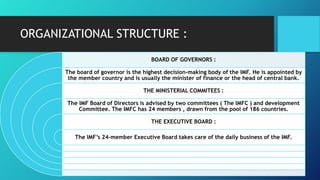
ORGANIZATIONAL STRUCTURE :
BOARD OF GOVERNORS :
The board of governor is the highest decision-making body of the IMF. He is appointed by
the member country and is usually the minister of finance or the head of central bank.
THE MINISTERIAL COMMITEES :
The IMF Board of Directors is advised by two committees ( The IMFC ) and development
Committee. The IMFC has 24 members , drawn from the pool of 186 countries.
THE EXECUTIVE BOARD :
The IMF’s 24-member Executive Board takes care of the daily business of the IMF.
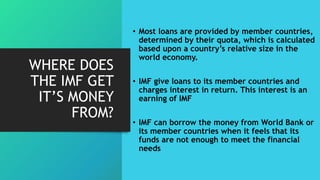
WHERE DOES
THE IMF GET
IT’S MONEY
FROM?
• Most loans are provided by member countries,
determined by their quota, which is calculated
based upon a country’s relative size in the
world economy.
• IMF give loans to its member countries and
charges interest in return. This interest is an
earning of IMF
• IMF can borrow the money from World Bank or
its member countries when it feels that its
funds are not enough to meet the financial
needs
SPECIAL DRAWING RIGHTS (SDR) :
• The Special Drawing Rights (SDR ) is an international reserve asset
that member countries can add to their foreign currency and gold
reserves and use for payments requiring foreign exchange. It is unit
of account for IMF operations and transactions
• Its value is set daily using a basket of four major currencies: the
euro, Japanese yen, pound sterling, and U.S. dollar.
• The IMF introduced the SDR in 1969 because of concern that the
stock and prospective growth of international reserves might not
be sufficient to support the expansion of world trade.
REVIEWS OF
IMF ON
PAKISTAN’S
PERFORMANCE
2019
• Pakistan has successfully completed its first-quarterly
review with the IMF under the $ 6 billion Extended Fund
Facility ( EFF ) finalized in May 2019 and reached a staff-
level agreement.
• Pakistan has set a target of generating about $3bn bonds
from the global market during the current fiscal year ending
June 2020.
• IMF Directors and senior officials have appreciated the
robust take-off on the programmed commitments by the
government.
Imf ppt

Imf ppt

  • 1.
    Presented to :Sir Amir Bashir Presented By : Sumaiya Mumtaz
  • 2.
    International Monetary Fund : IMF is the intergovernmental organization that oversees the global financial system by following the macroeconomic policies of its member countries. It is an organization formed with a stated objective of stabilizing international exchange rates and facilitating development through the enforcement of liberalizing economic policies on other countries as a condition for loans, restructuring or aid.
  • 3.
    International Monetary Fund: • IMF is an organization of 186 countries ,working to foster global monetary co-operation , secure financial stability ,facilitate international trade ,promote high employment and sustainable economic growth and reduce poverty
  • 6.
    ORGANIZATIONAL STRUCTURE : BOARDOF GOVERNORS : The board of governor is the highest decision-making body of the IMF. He is appointed by the member country and is usually the minister of finance or the head of central bank. THE MINISTERIAL COMMITEES : The IMF Board of Directors is advised by two committees ( The IMFC ) and development Committee. The IMFC has 24 members , drawn from the pool of 186 countries. THE EXECUTIVE BOARD : The IMF’s 24-member Executive Board takes care of the daily business of the IMF.
  • 10.
    WHERE DOES THE IMFGET IT’S MONEY FROM? • Most loans are provided by member countries, determined by their quota, which is calculated based upon a country’s relative size in the world economy. • IMF give loans to its member countries and charges interest in return. This interest is an earning of IMF • IMF can borrow the money from World Bank or its member countries when it feels that its funds are not enough to meet the financial needs
  • 11.
    SPECIAL DRAWING RIGHTS(SDR) : • The Special Drawing Rights (SDR ) is an international reserve asset that member countries can add to their foreign currency and gold reserves and use for payments requiring foreign exchange. It is unit of account for IMF operations and transactions • Its value is set daily using a basket of four major currencies: the euro, Japanese yen, pound sterling, and U.S. dollar. • The IMF introduced the SDR in 1969 because of concern that the stock and prospective growth of international reserves might not be sufficient to support the expansion of world trade.
  • 12.
    REVIEWS OF IMF ON PAKISTAN’S PERFORMANCE 2019 •Pakistan has successfully completed its first-quarterly review with the IMF under the $ 6 billion Extended Fund Facility ( EFF ) finalized in May 2019 and reached a staff- level agreement. • Pakistan has set a target of generating about $3bn bonds from the global market during the current fiscal year ending June 2020. • IMF Directors and senior officials have appreciated the robust take-off on the programmed commitments by the government.