Managing Process Improvement to Climb Mountains andAvoid QuicksandSEPG EuropeBill FoxKevin SchaaffJune 2010
What challenges do you face with process improvement?History of failed improvement projectsNo business imperative to adopt CMMIDanger Quicksand!Lack of employee buy inInsufficient resources from budget cutsSlow progress from competing business prioritiesManagement openly critical of the investment and value Early lack of project management support
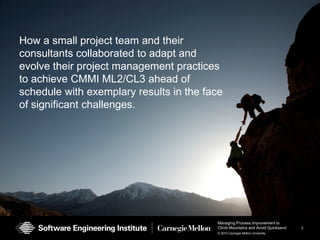
How a small project team and their consultants collaborated to adapt and evolve their project management practices to achieve CMMI ML2/CL3 ahead of schedule with exemplary results in the face of significant challenges.
TopicsBackground and timelineSeven significant challenges that could have resulted in failureEighteen lessons learned that can help you be more successfulResults that were achievedQuestions and answers
Background
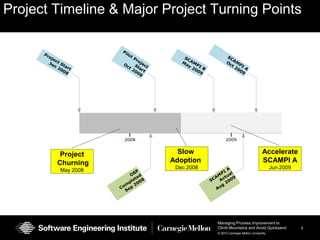
Project Timeline & Major Project Turning PointsSlow AdoptionDec 2008AccelerateSCAMPI AJun 2009Project ChurningMay 2008
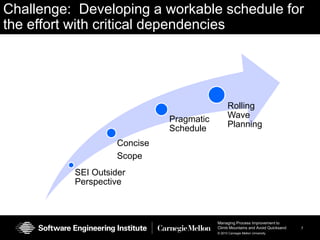
Challenge:  Developing a workable schedule for the effort with critical dependencies
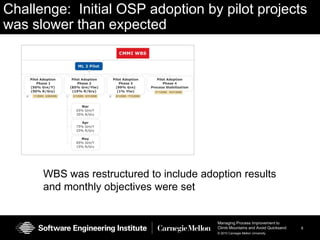
Challenge:  Initial OSP adoption by pilot projects was slower than expectedWBS was restructured to include adoption results and monthly objectives were set
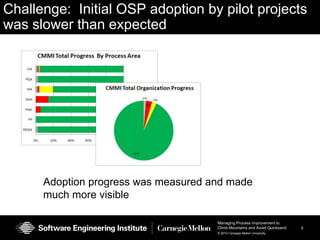
Challenge:  Initial OSP adoption by pilot projects was slower than expectedAdoption progress was measured and made much more visible
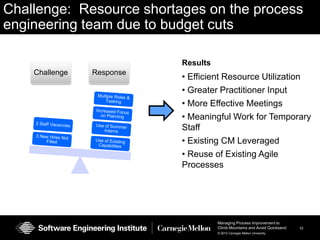
Challenge:  Resource shortages on the process engineering team due to budget cutsResults Efficient Resource Utilization
 Greater Practitioner Input
 More Effective Meetings
 Meaningful Work for Temporary Staff
 Existing CM Leveraged
 Reuse of Existing Agile ProcessesChallenge:  There was senior management concern with project progressTeam RoomConsistent ReviewIncreased VisibilityProcess & Engineering Collaboration
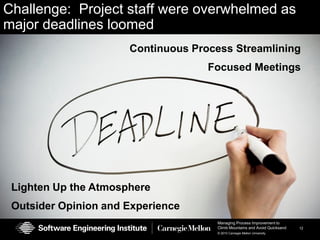
Challenge:  Project staff were overwhelmed as major deadlines loomedContinuous Process StreamliningFocused MeetingsLighten Up the AtmosphereOutsider Opinion and Experience
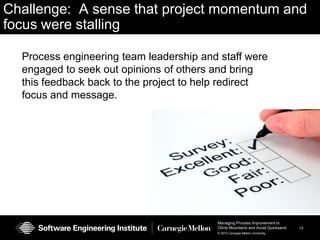
Challenge:  A sense that project momentum and focus were stallingProcess engineering team leadership and staff were engaged to seek out opinions of others and bring this feedback back to the project to help redirect focus and message.
Challenge:  Achieving a successful outcome was threatened when a new CIO changed priorities Practitioner  Support
 Senior Management Support
 Increased  Communications

Managing Process Improvement

  • 1.
    Managing Process Improvementto Climb Mountains andAvoid QuicksandSEPG EuropeBill FoxKevin SchaaffJune 2010
  • 2.
    What challenges doyou face with process improvement?History of failed improvement projectsNo business imperative to adopt CMMIDanger Quicksand!Lack of employee buy inInsufficient resources from budget cutsSlow progress from competing business prioritiesManagement openly critical of the investment and value Early lack of project management support
  • 3.
    How a smallproject team and their consultants collaborated to adapt and evolve their project management practices to achieve CMMI ML2/CL3 ahead of schedule with exemplary results in the face of significant challenges.
  • 4.
    TopicsBackground and timelineSevensignificant challenges that could have resulted in failureEighteen lessons learned that can help you be more successfulResults that were achievedQuestions and answers
  • 5.
  • 6.
    Project Timeline &Major Project Turning PointsSlow AdoptionDec 2008AccelerateSCAMPI AJun 2009Project ChurningMay 2008
  • 7.
    Challenge: Developinga workable schedule for the effort with critical dependencies
  • 8.
    Challenge: InitialOSP adoption by pilot projects was slower than expectedWBS was restructured to include adoption results and monthly objectives were set
  • 9.
    Challenge: InitialOSP adoption by pilot projects was slower than expectedAdoption progress was measured and made much more visible
  • 10.
    Challenge: Resourceshortages on the process engineering team due to budget cutsResults Efficient Resource Utilization
  • 11.
  • 12.
  • 13.
    Meaningful Workfor Temporary Staff
  • 14.
    Existing CMLeveraged
  • 15.
    Reuse ofExisting Agile ProcessesChallenge: There was senior management concern with project progressTeam RoomConsistent ReviewIncreased VisibilityProcess & Engineering Collaboration
  • 16.
    Challenge: Projectstaff were overwhelmed as major deadlines loomedContinuous Process StreamliningFocused MeetingsLighten Up the AtmosphereOutsider Opinion and Experience
  • 17.
    Challenge: Asense that project momentum and focus were stallingProcess engineering team leadership and staff were engaged to seek out opinions of others and bring this feedback back to the project to help redirect focus and message.
  • 18.
    Challenge: Achievinga successful outcome was threatened when a new CIO changed priorities Practitioner Support
  • 19.
  • 20.
    Increased Communications

Editor's Notes

  • #8 ResponseCreated a concise scope statement that divided the effort into phasesOne of the larger series of tasks – creating, reviewing and approving scores of OSP artifacts, was only managed at a high level in the schedule. Details were tracked in an excel spreadsheet. SEI consultants with implementation experience were brought in to guide planning effortsImpactEnabled more effective scheduling with identified critical dependencies using rolling wave planningEasier to establish rules to objectively monitor and track OSP Artifact creation status using earned-value techniques. Overall results were rolled up into the schedule to track progress by process areaA manageable working schedule
  • #9 ResponseA fresh look at the entire project was undertaken. Out of this review a decision was made to restructure the entire WBSOne key component of the WBS restructure was setting key milestones for the results that needed to be achievedOnce the milestones were established, they became a very visible indicator to all stakeholdersAfter the objectives were established, progress was more closely monitored and reviewedStaff who charged to the project, now charged to project tasks that reflected the next milestone objectiveImpactWBS restructured according to best practices and implemented within the organization’s project management system under the control of the PMOMilestones were set based upon agreed upon timeframes with pilot project team membersThe WBS was further broken down into monthly objectives and reviewed and analyzed with the larger project team at monthly meetings and weekly project team reviewsA weekly progress report showing adoption status and progress was created and distributed weekly.
  • #10 ResponseA fresh look at the entire project was undertaken. Out of this review a decision was made to restructure the entire WBSOne key component of the WBS restructure was setting key milestones for the results that needed to be achievedOnce the milestones were established, they became a very visible indicator to all stakeholdersAfter the objectives were established, progress was more closely monitored and reviewedStaff who charged to the project, now charged to project tasks that reflected the next milestone objectiveImpactWBS restructured according to best practices and implemented within the organization’s project management system under the control of the PMOMilestones were set based upon agreed upon timeframes with pilot project team membersThe WBS was further broken down into monthly objectives and reviewed and analyzed with the larger project team at monthly meetings and weekly project team reviewsA weekly progress report showing adoption status and progress was created and distributed weekly.
  • #11 ResponseProject staff who could fill multiple roles and didn’t have sufficient work on a consistent basis were used to assist effort and provided with weekly task listsAgendas for meetings and special events were prepared in advance for review and input by multiple stakeholdersSummer interns were carefully selected and managed to accomplish key work under the supervision of project staff Opportunities to utilize existing processes, resources, and capabilities throughout the organization were actively sought outImpactExisting resources more efficiently utilized.Greater practitioner input and insight into the process developmentMore effective meetingsMeaningful work for short-term temporary staffSignificant leverage gained using existing and robust CM processes and infrastructureReuse of existing Agile engineering processesResultsExisting resources more efficiently utilized. Greater practitioner input and insight into the process development More effective meetings Meaningful work for short-term temporary staff Significant leverage gained using existing and robust CM processes and infrastructure Reuse of existing Agile engineering processes
  • #12 ResponseOnce the milestones were established, they became a very visible indicator for all stakeholdersAfter the objectives were established, progress was more closely monitored and reviewed. A weekly progress reporting adoption status and progress was created and distributed weeklyA CMMI team room was established as a central focal point for meetings and reporting. Visual reports were posted making status very visibleProcess team senior leadership began meeting weekly with software engineering senior leadership to review progress and issuesImpactPMO reported status as part of standard reporting at monthly Director meetingsEach Director received a report on the status of their project(s)Senior management had almost real time visibility into project progressSenior management became very involved in the process and were taking a leadership by example approach by adopting organization processes for agendas, meeting minutes, and action and issues lists
  • #13 ResponseProcesses constantly examined for efficiency and streamlining.Meetings were more focused on action and kept short Key topics identified and confirmed with teamExtra attention was placed on lightening the atmosphere and making long meetings more enjoyable by making refreshments and snacks availableWhenever it appeared progress was stalling and a different approach needed, SEI consulting resources were engaged to help problem solve and bring the depth of their experience to impact the situationImpactProcesses more closely aligned with the way work performedAbbreviated minutes and action items created to keep focus on major prioritiesOverall less stressful atmosphere and better teamworkMore effective approaches implemented based on industry best practicesOrganization able to find a comfortable balance and pace to move the work forward
  • #14 ResponseProcess engineering team leadership and staff were engaged to seek out opinions of others and bring this feedback back to the project to help redirect focus and messageImpactEstablished a monthly meeting to share process improvement successes and setbacksSenior management leveraged these sessions to gain insight and awareness into a variety of issues as participants
  • #15 ResponsePractitioners actively voiced their support of the effortOther senior managers voiced their support of the effortProcess team leadership spent increased time communicating and managing upCustomers voiced support of the effort based on the observed improvements in product quality and deliveryImpactProject and process personnel became a closely integrated teamImprovements focused on fixing issuesInitiative exceeded expected results ahead of schedule
  • #16  The measure for process improvement effort sometimes overtook the purpose of the process improvement (progress vs. improvement) Lack of focus on process metrics during process development Participation in development of a process does not always equal understanding of the process All process improvement efforts must be tied to a clear Return on Investment (ROI)
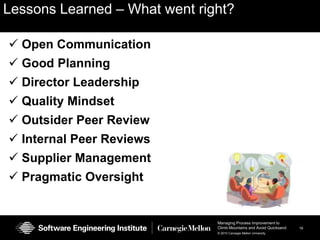
  • #17  Open communication between process and project team members Good planning of all tasks at appropriate level by Project Management Good leadership at Director level Quality and attention to detail mindset OSP process assets reviewed by outside consultants Peer reviews were very beneficial Supplier Management transitioned from sparse and fragmented to an organizational strength Pragmatic direction from outside consultants
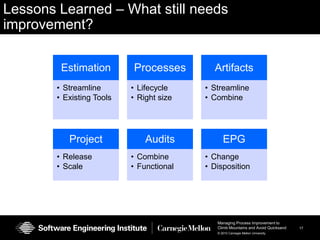
  • #18  Estimation process should be streamlined to take advantage of existing toolset (Clear Quest), and reduce duplication and tailored on a per project basis to improve estimation accuracy Processes should be more tightly aligned with project lifecycle; i.e. “leaner” for small maintenance work, more robust for new development Some process artifacts (e.g., Software Development Plan, Requirements Management Plan) should be streamlined or combined into existing toolsets to increase efficiency Applicability of standard processes to projects vs. releases need to be defined to improve the process scalability Combine functional audits into single audits per release to increase efficiency Focus of the Engineering Process Group should be to drive change rather than simply disposition Process Improvement Requests
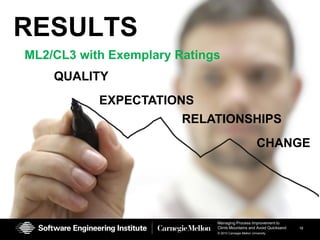
  • #19 Conducted SCAMPI A against the Continuous Representation for the Maturity Level Two Process Areas – Achieved CL3 for all ML2 Process Areas exceeding initial targets and two months ahead of schedule Increased quality of project deliverables due to:Consistency of processes and artifacts used by disciplinesUsed of standardized metrics for evaluating status of projectImplementation of traceability between project artifactsImproved productivityImproved relationship with the project business owners due to increased communication and visibility into project workChange management process improved control of project scope and provided better insight and understanding to customers and stakeholders regarding the analysis of scope changes. “Helped tremendously with the customer.”Standard process established common expectations for all project stakeholders