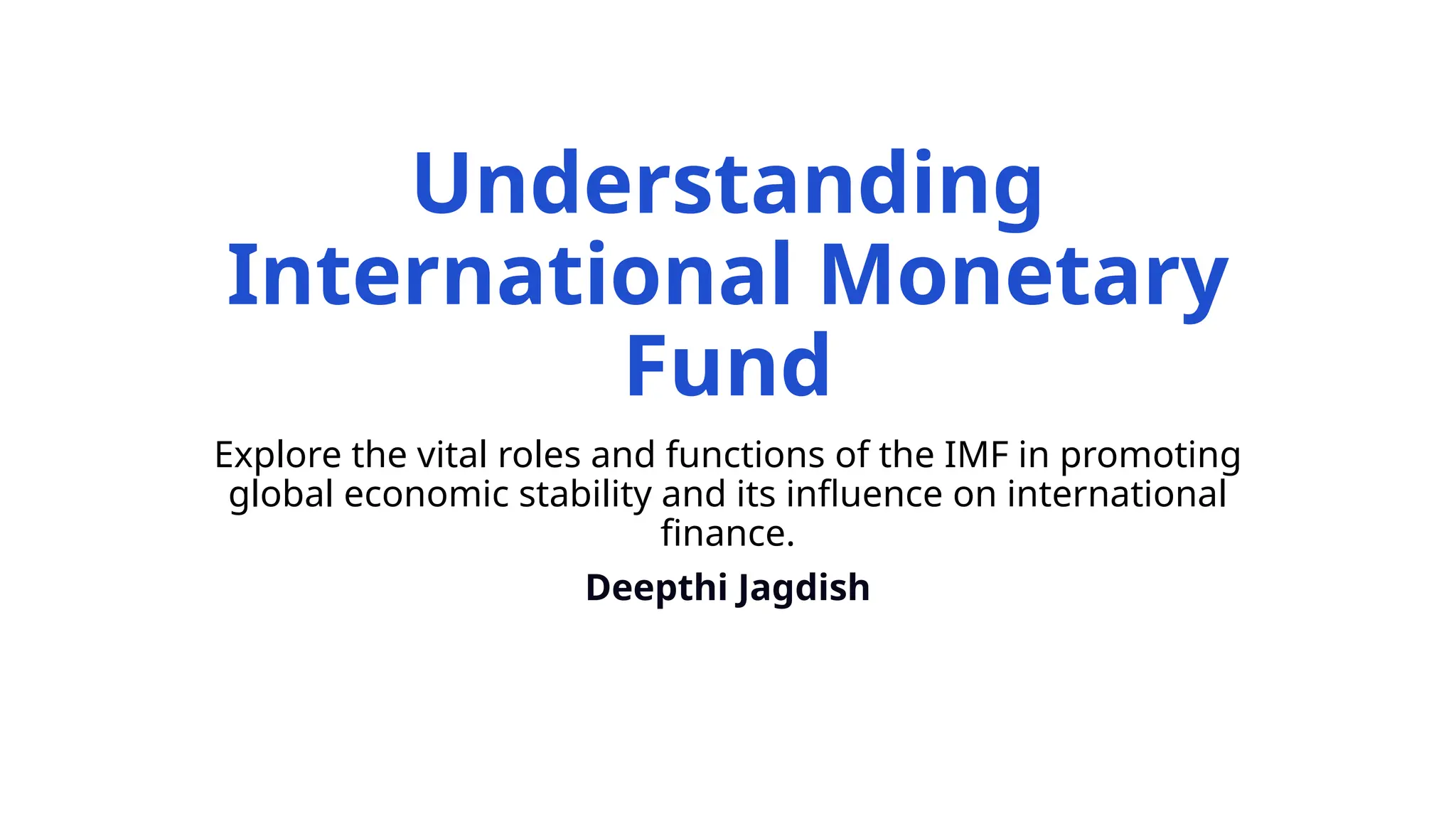
Historical Development ofthe IMF
July 1944
December 27, 1945
1946 onwards
2023
• Established during a UN conference
• The IMF was established at the UN conference in
Bretton Woods, New Hampshire, marking a pivotal
moment in international economic cooperation.
• Officially founded with 29 member countries
• The IMF officially came into existence with 29
founding members, focusing on global economic
stability.
• Purpose to enhance economic cooperation
• The IMF aimed to promote international financial
cooperation and reduce poverty worldwide.
• Expanded to 190 member countries
• As of 2023, the IMF's membership has grown to 190
countries, with Andorra being the most recent
member.
3.
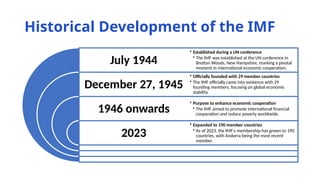
Global Monetary Cooperation
•Promoting cooperation among nations for stable
international monetary relations.
Financial Stability
• Eliminating risks of exchange rate fluctuations to
ensure stability.
Support for Employment
• Supporting sustainable economic growth to
promote job creation.
Facilitation of International Trade
• Facilitating balanced international trade to
enhance global commerce.
Poverty Eradication
• Aiming to reduce poverty across the world as a
fundamental objective.
Objectives of the
International Monetary
Fund
4.
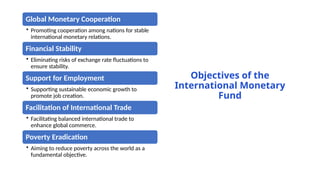
Key Functions ofthe IMF
• The IMF monitors
the global monetary
system and advises
member nations for
stability.
SURVEILLANCE
FUNCTION
• The IMF gives
precautionary
guidance to avert
potential financial
crises.
CRISIS PREVENTION
ADVICE
• IMF aids in
developing robust
monetary policies for
member countries.
MONETARY POLICY
TRAINING
• The IMF provides
strategic advice to
foster sustainable
economic growth.
POLICY
RECOMMENDATIONS
• The IMF trains
central banks in
effective financial
management
practices.
CAPACITY
DEVELOPMENT
• The IMF helps
nations establish
sound legal
frameworks for
finance.
LEGAL FRAMEWORKS
GUIDANCE
• The IMF offers
support during
financial crises to
restore economic
stability.
FINANCIAL
ASSISTANCE
• Central banks receive
support on
improving public
finance
management.
FOCUS ON PUBLIC
FINANCE
• The IMF enhances
the capability of
nations through
better statistical
practices.
STATISTICAL ANALYSIS
SUPPORT
5.
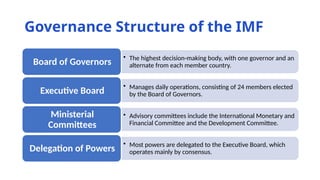
Governance Structure ofthe IMF
• The highest decision-making body, with one governor and an
alternate from each member country.
Board of Governors
• Manages daily operations, consisting of 24 members elected
by the Board of Governors.
Executive Board
• Advisory committees include the International Monetary and
Financial Committee and the Development Committee.
Ministerial
Committees
• Most powers are delegated to the Executive Board, which
operates mainly by consensus.
Delegation of Powers
6.
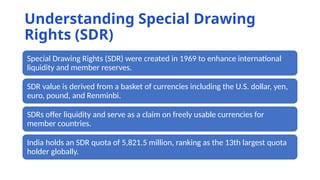
Understanding Special Drawing
Rights(SDR)
Special Drawing Rights (SDR) were created in 1969 to enhance international
liquidity and member reserves.
SDR value is derived from a basket of currencies including the U.S. dollar, yen,
euro, pound, and Renminbi.
SDRs offer liquidity and serve as a claim on freely usable currencies for
member countries.
India holds an SDR quota of 5,821.5 million, ranking as the 13th largest quota
holder globally.
7.
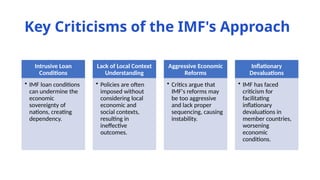
Key Criticisms ofthe IMF's Approach
Intrusive Loan
Conditions
• IMF loan conditions
can undermine the
economic
sovereignty of
nations, creating
dependency.
Lack of Local Context
Understanding
• Policies are often
imposed without
considering local
economic and
social contexts,
resulting in
ineffective
outcomes.
Aggressive Economic
Reforms
• Critics argue that
IMF's reforms may
be too aggressive
and lack proper
sequencing, causing
instability.
Inflationary
Devaluations
• IMF has faced
criticism for
facilitating
inflationary
devaluations in
member countries,
worsening
economic
conditions.