IMF
INTERNATIONAL MONETARY FUND

Adel Abouhana
THE CREATION OF THE IMF
The first part of the 20th century saw a
breakdown of cooperation among nations
 The IMF was one of the institutions set up to
avoid a repeat of that experience.
 It is a cooperative of 185 member countries
 Their objective is to promote world economic
stability and growth.
 The member countries are the shareholders of
the cooperative, providing the capital of the IMF
through quota subscriptions



The IMF is one of several autonomous
organizations designated by the United Nations
(UN) as “Specialized Agencies,”



UN has established working relationships.



The IMF is a permanent observer at the UN.



The Articles of Agreement that created the IMF
and govern its operations were adopted at the
United Nations Monetary and Financial
Conference in Bretton Woods, New Hampshire,
on July 22, 1944.



It entered into force on December 27, 1945.
MANDATE OF THE IMF
Promote international monetary cooperation
through a permanent institution
 Provides the machinery for consultation and
 collaboration on international monetary problems
 To facilitate the expansion and balanced growth of
international trade
 To contribute to the promotion and maintenance of
high levels of employment and real income and to
the development of the productive resources of all
members as primary objectives of economic policy
 • To promote exchange stability
 To maintain orderly exchange arrangements
among members, and to avoid competitive
exchange depreciation

To assist in the establishment of a multilateral
system of payments in respect of current
transactions between members and in the
elimination of foreign exchange restrictions
which hamper the growth of world trade
 To give confidence to members by making the
general resources of the IMF temporarily
available to them under adequate safeguards
 this provides them with an opportunity to correct
maladjustments in their balance of payments
without resorting to measures destructive of
national or international prosperity
 To shorten the duration and lessen the degree of
disequilibrium in the international balances of
payments of members.

THE FUNCTIONS OF THE IMF


Surveillance (like a doctor)
Gathering data and assessing economic policies of countries



Technical Assistance (like a teacher)
Strengthening human skills and institutional
capacity of countries



Financial Assistance (like a banker)
Lending to countries to support reforms


Surveillance



Surveillance over Members’ Economic Policies



countries agree to pursue economic policies that
are consistent with the objectives of the IMF.



The Articles of Agreement confer on the IMF the
legal authority to oversee compliance by
members with this obligation



IMF is “the only organization that has a mandate
to examine on a regular basis the economic



circumstances of virtually every country in the
world.”
TECHNICAL ASSISTANCE (LIKE A
TEACHER)

Strengthening human skills and institutional
capacity of countries
 Helps members in strengthening their policy
formulation and implementation, and the
legal,
 institutional, and market frameworks within
which they operate.
 It also constitutes an important complement
to IMF surveillance and lending operations in
member countries.

FINANCIAL ASSISTANCE (LIKE A
BANKER)


Lending to countries to support reforms



Improving financial sector surveillance.



Development of standards and codes of



good practice.



Enhancement of transparency in the IMF



and its member countries.



Involvement of the private sector in crisis
resolution
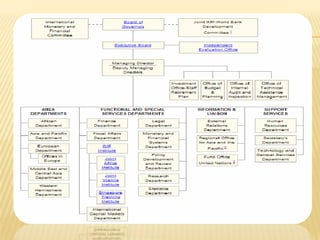
GOVERNANCE OF THE IMF


IMF is accountable to its member countries.



Board of Governors: one governor from each
member country. Meets once a year.



Day to day affairs are guided by the Executive
Board: 24 Executive Directors. Managing
Director of IMF is Chairman of Executive Board.
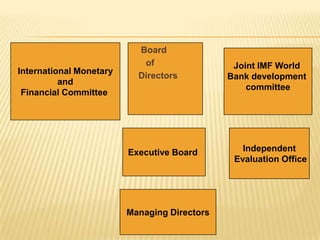
International Monetary
and
Financial Committee

Board
of
Directors

Executive Board

Managing Directors

Joint IMF World
Bank development
committee

Independent
Evaluation Office
ORGANISATION OF IMF
The Board of Governors, the highest decisionmaking body of the IMF, consists of one governor
and one alternate governor for each member
country.
 The governor is appointed by the member
country and is usually the minister of finance or
the governor of the central bank.
 Board of Governors decide on major policy issues
 All powers of the IMF are vested in the Board of
Governors.
 Day-to-day decision making – Executive
Governors

24 in number.
 The Managing Director is Chair person of the EB
 Meets thrice a week, more if required
 Five largest shareholders of IMF – US, japan,
Germany, UK & France along with China, Russia
and Saudi Arabia have their own seats on EB
 Other members are selected for 2 year terms by
groups of countries known as constituencies
 The Board of council may delegate to the
Executive Board all except certain reserved
powers.
 The Board of Governors normally meets once a
year.



Key policy issues relating to international
monetary system are considered twice a
year by IMFC



Development committee reports to the
Governors on development policy and other
related matters



IMF has a weighted voting system – the
larger the country’s quota (dependent on its
economic size) more votes for the country
QUOTAS & SUBSCRIPTIONS
Quota subscriptions generate most of the
IMF's financial resources.
 Each member country of the IMF is assigned
a quota, based broadly on its relative size in
the world economy.
 A member's quota determines its maximum
financial commitment to the IMF and its
voting power, and has a bearing on its
access to IMF financing.



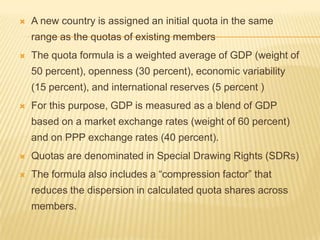
A new country is assigned an initial quota in the same range
as the quotas of existing members



The quota formula is a weighted average of GDP (weight of 50

percent), openness (30 percent), economic variability (15
percent), and international reserves (5 percent )


For this purpose, GDP is measured as a blend of GDP based
on a market exchange rates (weight of 60 percent) and on PPP
exchange rates (40 percent).



Quotas are denominated in Special Drawing Rights (SDRs)



The formula also includes a “compression factor” that reduces
the dispersion in calculated quota shares across members.
SPECIAL DRAWING RIGHTS


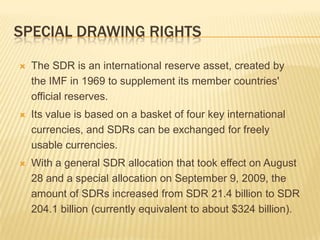
The SDR is an international reserve asset, created by the
IMF in 1969 to supplement its member countries' official
reserves.



Its value is based on a basket of four key international
currencies, and SDRs can be exchanged for freely usable
currencies.



With a general SDR allocation that took effect on August 28
and a special allocation on September 9, 2009, the amount
of SDRs increased from SDR 21.4 billion to SDR 204.1
billion (currently equivalent to about $324 billion).


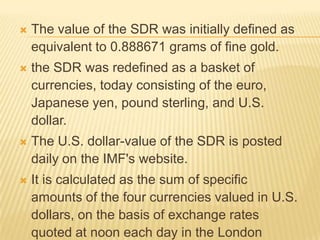
The value of the SDR was initially defined as
equivalent to 0.888671 grams of fine gold.



the SDR was redefined as a basket of
currencies, today consisting of the euro,
Japanese yen, pound sterling, and U.S. dollar.



The U.S. dollar-value of the SDR is posted daily
on the IMF's website.



It is calculated as the sum of specific amounts
of the four currencies valued in U.S. dollars, on
the basis of exchange rates quoted at noon
each day in the London market.
LENDING POLICIES
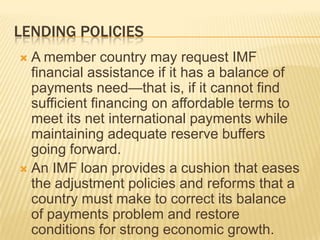
A member country may request IMF financial
assistance if it has a balance of payments
need—that is, if it cannot find sufficient
financing on affordable terms to meet its net
international payments while maintaining
adequate reserve buffers going forward.
 An IMF loan provides a cushion that eases
the adjustment policies and reforms that a
country must make to correct its balance of
payments problem and restore conditions for
strong economic growth.

IMF FACILITIES


the IMF has developed various loan
instruments, or “facilities,” that are tailored
to address the specific circumstances of its
diverse membership.



IMF financial policies govern the modalities
for the use of its financial resources under
existing IMF facilities.

IMF, World Bank AAQ , ADEL ABOUHANA,Development Bank , Qatar , Finance Slides, International Monetary Fund

  • 1.
  • 2.
    THE CREATION OFTHE IMF The first part of the 20th century saw a breakdown of cooperation among nations  The IMF was one of the institutions set up to avoid a repeat of that experience.  It is a cooperative of 185 member countries  Their objective is to promote world economic stability and growth.  The member countries are the shareholders of the cooperative, providing the capital of the IMF through quota subscriptions 
  • 3.
     The IMF isone of several autonomous organizations designated by the United Nations (UN) as “Specialized Agencies,”  UN has established working relationships.  The IMF is a permanent observer at the UN.  The Articles of Agreement that created the IMF and govern its operations were adopted at the United Nations Monetary and Financial Conference in Bretton Woods, New Hampshire, on July 22, 1944.  It entered into force on December 27, 1945.
  • 4.
    MANDATE OF THEIMF Promote international monetary cooperation through a permanent institution  Provides the machinery for consultation and  collaboration on international monetary problems  To facilitate the expansion and balanced growth of international trade  To contribute to the promotion and maintenance of high levels of employment and real income and to the development of the productive resources of all members as primary objectives of economic policy  • To promote exchange stability  To maintain orderly exchange arrangements among members, and to avoid competitive exchange depreciation 
  • 5.
    To assist inthe establishment of a multilateral system of payments in respect of current transactions between members and in the elimination of foreign exchange restrictions which hamper the growth of world trade  To give confidence to members by making the general resources of the IMF temporarily available to them under adequate safeguards  this provides them with an opportunity to correct maladjustments in their balance of payments without resorting to measures destructive of national or international prosperity  To shorten the duration and lessen the degree of disequilibrium in the international balances of payments of members. 
  • 6.
    THE FUNCTIONS OFTHE IMF  Surveillance (like a doctor) Gathering data and assessing economic policies of countries  Technical Assistance (like a teacher) Strengthening human skills and institutional capacity of countries  Financial Assistance (like a banker) Lending to countries to support reforms
  • 7.
     Surveillance  Surveillance over Members’Economic Policies  countries agree to pursue economic policies that are consistent with the objectives of the IMF.  The Articles of Agreement confer on the IMF the legal authority to oversee compliance by members with this obligation  IMF is “the only organization that has a mandate to examine on a regular basis the economic  circumstances of virtually every country in the world.”
  • 8.
    TECHNICAL ASSISTANCE (LIKEA TEACHER) Strengthening human skills and institutional capacity of countries  Helps members in strengthening their policy formulation and implementation, and the legal,  institutional, and market frameworks within which they operate.  It also constitutes an important complement to IMF surveillance and lending operations in member countries. 
  • 9.
    FINANCIAL ASSISTANCE (LIKEA BANKER)  Lending to countries to support reforms  Improving financial sector surveillance.  Development of standards and codes of  good practice.  Enhancement of transparency in the IMF  and its member countries.  Involvement of the private sector in crisis resolution
  • 10.
    GOVERNANCE OF THEIMF  IMF is accountable to its member countries.  Board of Governors: one governor from each member country. Meets once a year.  Day to day affairs are guided by the Executive Board: 24 Executive Directors. Managing Director of IMF is Chairman of Executive Board.
  • 11.
    International Monetary and Financial Committee Board of Directors ExecutiveBoard Managing Directors Joint IMF World Bank development committee Independent Evaluation Office
  • 13.
    ORGANISATION OF IMF TheBoard of Governors, the highest decisionmaking body of the IMF, consists of one governor and one alternate governor for each member country.  The governor is appointed by the member country and is usually the minister of finance or the governor of the central bank.  Board of Governors decide on major policy issues  All powers of the IMF are vested in the Board of Governors.  Day-to-day decision making – Executive Governors 
  • 14.
    24 in number. The Managing Director is Chair person of the EB  Meets thrice a week, more if required  Five largest shareholders of IMF – US, japan, Germany, UK & France along with China, Russia and Saudi Arabia have their own seats on EB  Other members are selected for 2 year terms by groups of countries known as constituencies  The Board of council may delegate to the Executive Board all except certain reserved powers.  The Board of Governors normally meets once a year. 
  • 15.
     Key policy issuesrelating to international monetary system are considered twice a year by IMFC  Development committee reports to the Governors on development policy and other related matters  IMF has a weighted voting system – the larger the country’s quota (dependent on its economic size) more votes for the country
  • 16.
    QUOTAS & SUBSCRIPTIONS Quotasubscriptions generate most of the IMF's financial resources.  Each member country of the IMF is assigned a quota, based broadly on its relative size in the world economy.  A member's quota determines its maximum financial commitment to the IMF and its voting power, and has a bearing on its access to IMF financing. 
  • 17.
     A new countryis assigned an initial quota in the same range as the quotas of existing members  The quota formula is a weighted average of GDP (weight of 50 percent), openness (30 percent), economic variability (15 percent), and international reserves (5 percent )  For this purpose, GDP is measured as a blend of GDP based on a market exchange rates (weight of 60 percent) and on PPP exchange rates (40 percent).  Quotas are denominated in Special Drawing Rights (SDRs)  The formula also includes a “compression factor” that reduces the dispersion in calculated quota shares across members.
  • 18.
    SPECIAL DRAWING RIGHTS  TheSDR is an international reserve asset, created by the IMF in 1969 to supplement its member countries' official reserves.  Its value is based on a basket of four key international currencies, and SDRs can be exchanged for freely usable currencies.  With a general SDR allocation that took effect on August 28 and a special allocation on September 9, 2009, the amount of SDRs increased from SDR 21.4 billion to SDR 204.1 billion (currently equivalent to about $324 billion).
  • 19.
     The value ofthe SDR was initially defined as equivalent to 0.888671 grams of fine gold.  the SDR was redefined as a basket of currencies, today consisting of the euro, Japanese yen, pound sterling, and U.S. dollar.  The U.S. dollar-value of the SDR is posted daily on the IMF's website.  It is calculated as the sum of specific amounts of the four currencies valued in U.S. dollars, on the basis of exchange rates quoted at noon each day in the London market.
  • 20.
    LENDING POLICIES A membercountry may request IMF financial assistance if it has a balance of payments need—that is, if it cannot find sufficient financing on affordable terms to meet its net international payments while maintaining adequate reserve buffers going forward.  An IMF loan provides a cushion that eases the adjustment policies and reforms that a country must make to correct its balance of payments problem and restore conditions for strong economic growth. 
  • 21.
    IMF FACILITIES  the IMFhas developed various loan instruments, or “facilities,” that are tailored to address the specific circumstances of its diverse membership.  IMF financial policies govern the modalities for the use of its financial resources under existing IMF facilities.